

- Market Size (2026)
- USD 2140.8 Mn
- Forecast (2036)
- USD 5209.3 Mn
- CAGR (2026 to 2036)
- 9.3%
How big is the Adaptive Sports Lighting System Market in 2026?
USD 2,140.8 million in 2026 and USD 5,209.3 million by 2036 at a 9.3% CAGR.
The adaptive sports lighting system industry value is expected to scale from USD 1,958.6459 million in 2025 to USD 5,209.3 million by 2036 at 9.3% CAGR, reflected by stadiums and training venues moving from fixed floodlights toward controlled LED systems. Retrofit / upgrade is expected to hold 61.0% share in 2026, driven by metal halide replacement and control-system additions. LED sports lighting is projected to secure 48.5% share in 2026, led by instant output and sports-grade beam control.
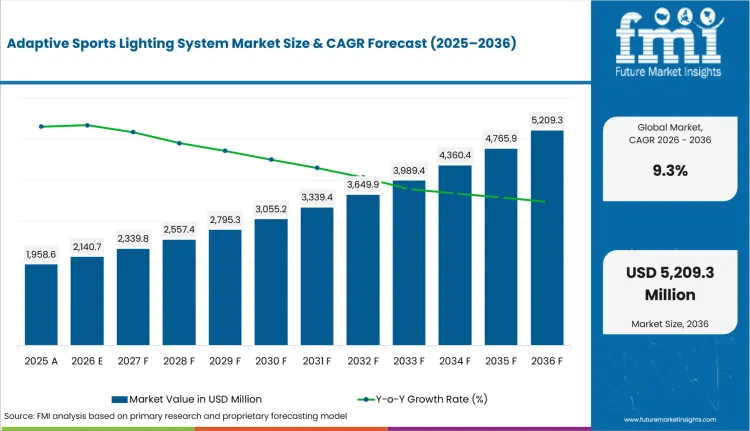
| Metric | Value |
|---|---|
| 2026 Market Size | USD 2,140.8 million |
| 2036 Market Size | USD 5,209.3 million |
| Forecast CAGR | 9.3% from 2026 to 2036 |
| Leading Installation | Retrofit / Upgrade |
| Retrofit / Upgrade Share in 2026 | 61.0% |
| Leading System Type | LED Sports Lighting |
| LED Sports Lighting Share in 2026 | 48.5% |
| Leading CAGR Country | India |
| India CAGR | 11.2% by 2036 |
Summary of the Adaptive Sports Lighting System Market
| Market Signal | Commercial Impact |
|---|---|
| Demand and Growth Drivers | Adaptive sports lighting demand is increasing as venues modernize lighting systems for professional events and community use.
|
| Product and Segment View | Retrofit projects, LED sports lighting, and stadium installations lead the market.
|
| Geography and Growth Outlook | India and China are expected to remain the fastest-growing markets for adaptive sports lighting.
|
| Competitive Landscape | Competition is focused on lighting performance, project execution, and commissioning expertise.
|
| Analyst Perspective | Adaptive sports lighting is evolving from a lighting upgrade into a strategic venue management solution.
- Rahul Pandita, Principal Consultant, Consumer Product, Future Market Insights |
Venue lighting investment is strengthening around measured sports performance and energy control. FIFA’s 2026 floodlight certification process requires five testing steps before a venue installation can receive a Quality Programme mark. European Commission reported almost 11 billion lamps in use across Europe in 2020, while lighting accounted for 8% of primary energy in its official environmental analysis.
Acuity Brands acquired M3 Innovation in May 2025, adding sports lighting technology focused on lowering installation and operation cost.Adaptive sports lighting system demand is forecast to expand through 2036, supported by LED replacement and multi-use venue scheduling.
Which factors support expansion in the Adaptive Sports Lighting System Market?
Verified performance and control-led venue operations support market value across stadiums and community sports grounds.
- Market value rises as stadium owners need lighting that supports sport-body guidance and evening training blocks.
- Retrofit / upgrade systems support adoption as venues can reuse poles and control rooms while replacing older luminaires.
- Broadcast users influence demand through flicker control and camera-ready lighting scenes during matches.
- EPC / venue Integrators promote demand as lighting is purchased inside wider stadium renovation and municipal sports projects.
Why is the Adaptive Sports Lighting System Market growing?
Sports venues need lighting systems that combine controllable LED output and longer facility use across evening schedules.
Adaptive sports lighting system buyers spend more on controlled LED systems as public and private venues need certified playing conditions and lower operating waste. United Kingdom Parliament reported 991 grassroots sports facility projects funded in 2025 to 2026, showing how public facility renewal can pull demand for upgraded lighting packages. Community sport access and lower manual switching needs increase acceptance for remote scheduling and scene control.
How is the Adaptive Sports Lighting System Market segmented?
Adaptive Sports Lighting System Market is segmented by system type, venue type, control feature, installation, and sales channel.
- LED Sports Lighting is projected to account for 48.5% share in 2026, influenced by energy saving and optical control across sports venues.
- Stadiums are expected to hold 42.0% share in 2026, shaped by broadcast performance and event-mode requirements.
- Dimming / scene control is anticipated to represent 38.0% share in 2026, led by preset modes for matches, training and maintenance.
- Retrofit / upgrade is expected to hold 61.0% share in 2026, guided by replacement of older systems without rebuilding venue infrastructure.
- EPC / venue Integrators are projected to account for 41.0% share in 2026, supported by bundled lighting and renovation contracts.
Why does LED Sports Lighting dominate the Adaptive Sports Lighting System Market by system type?
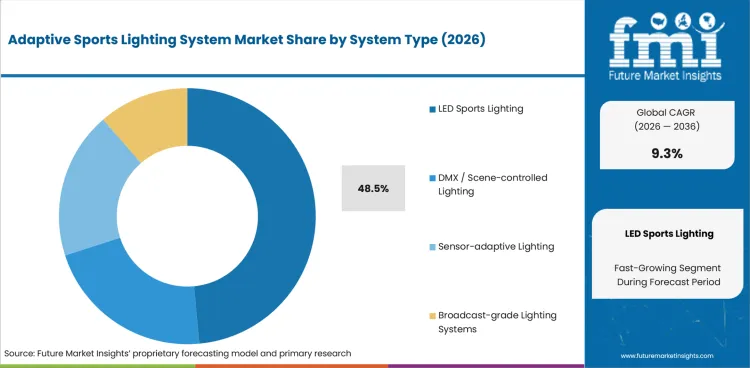
- LED sports lighting is projected to account for 48.5% share in 2026, driven by lower energy use and compatibility with adaptive controls.
- DMX / scene-controlled lighting gains demand as arenas and stadiums use timed scenes for player entry and non-match events.
Which venue type leads the Adaptive Sports Lighting System Market?
- Stadiums are expected to hold 42.0% share in 2026, shaped by higher illuminance needs and fixture scale.
- Indoor arenas gain demand as basketball and esports events require quick lighting changes without fixture replacement.
Which control feature leads the Adaptive Sports Lighting System Market?
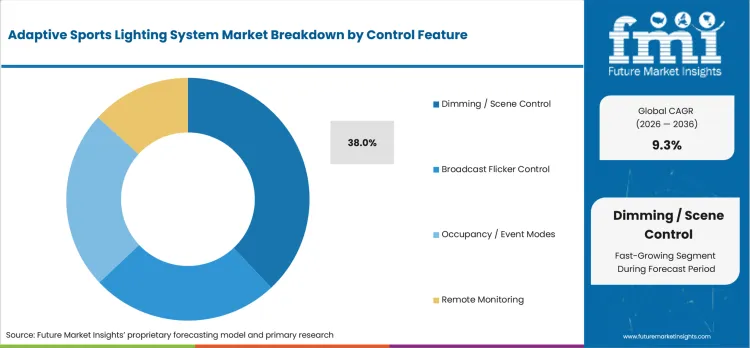
- Dimming / scene control is anticipated to represent 38.0% share in 2026, led by preset modes that reduce operator workload across match and training schedules.
- Broadcast flicker control gains use as UHD cameras and slow-motion replay expose output instability that normal spectators may not notice.
Which installation leads the Adaptive Sports Lighting System Market?
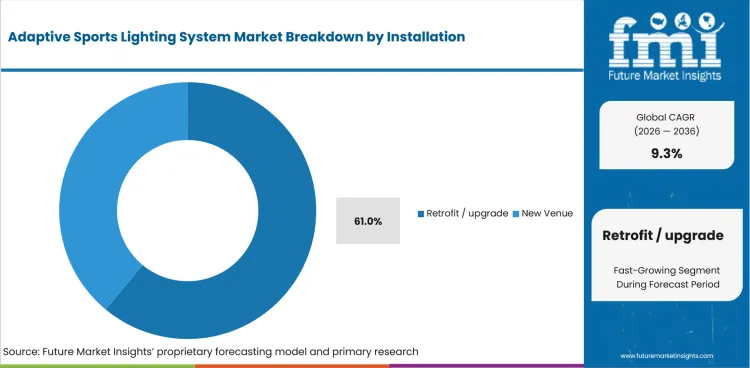
- Retrofit / upgrade is expected to hold 61.0% share in 2026, guided by venue preference for reusing poles and power systems while adding LED controls.
- New Venue projects remain active as stadium developers specify sports lighting and broadcast systems at design stage.
Which sales channel leads the Adaptive Sports Lighting System Market?
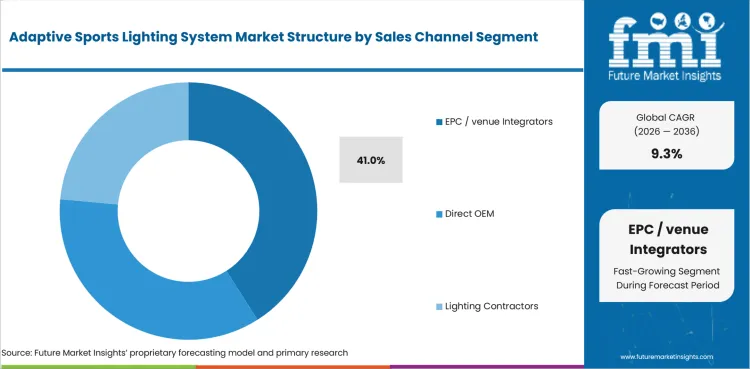
- EPC / venue Integrators are projected to account for 41.0% share in 2026, supported by buyer preference for bundled renovation and commissioning.
- Lighting contractors remain active across schools and club grounds needing faster installation and local maintenance access.
What are the drivers, restraints, and opportunities in the Adaptive Sports Lighting System Market?
Sports lighting modernization and broadcast performance expectations are shaping adaptive sports lighting system buying decisions.
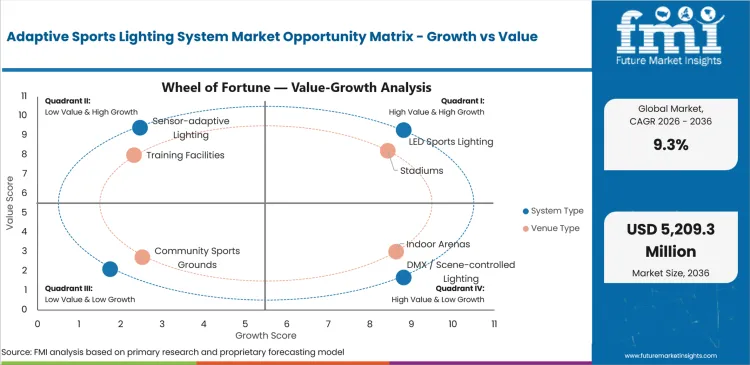
- Driver: Venue owners need controlled LED lighting to support match play and broadcast use from one installed system.
- Restraint: Glare and commissioning complexity can slow approval for fields near residential areas or sensitive sites.
- Opportunity: Sports lighting suppliers can expand service revenue through remote monitoring and control-software support.
Certified Sports Lighting Strengthens System Demand
Sports venues now need verified lighting output rather than fixture wattage alone. FIFA’s Quality Programme for Floodlights applies testing to football stadiums and indoor futsal courts, covering 4 venue formats. Stadium-upgrade funding further supports demand for certified lighting design, as FIFA Forward 2024 approved 89 stadium-related projects worldwide. Measured performance needs help suppliers sell design and commissioning support. Adaptive sports lighting suppliers gain demand as stadium owners require systems able to satisfy play and inspection needs in one project.
Glare and Spill-Light Control Limit Simple Retrofits
Outdoor sports lighting projects can face delays if spill control and glare shielding are not engineered before installation. Illuminating Engineering Society lists ANSI/IES RP-6-24 as the current recommended practice for lighting sports and recreational areas, which raises the technical threshold for professional and community projects. Smaller venues may delay adaptive lighting orders until suppliers prove beam control and reliable commissioning.
Control Software Creates Service-Led Expansion
Adaptive lighting suppliers can extend revenue through controls and monitoring. European Commission counted almost 11 billion lamps in Europe in 2020, showing the depth of lighting stock that can shift toward connected and efficient products through replacement cycles. Sports venues benefit from control-system upgrades linking lighting scenes and facility scheduling through one supplier relationship.
Which countries are growing in the Adaptive Sports Lighting System Market?
India 11.2% CAGR, China 10.4% CAGR, South Korea 9.6% CAGR, Germany 8.9% CAGR, United States 8.8% CAGR, France 8.7% CAGR, United Kingdom 8.5% CAGR, and Japan 8.1% CAGR through 2036.
.webp "Top Country Growth Comparison Adaptive Sports Lighting System Market Cagr (2026 2036)")
| Country | CAGR |
|---|---|
| India | 11.2% |
| China | 10.4% |
| South Korea | 9.6% |
| Germany | 8.9% |
| United States | 8.8% |
| France | 8.7% |
| United Kingdom | 8.5% |
| Japan | 8.1% |
Source: Future Market Insights, 2026.
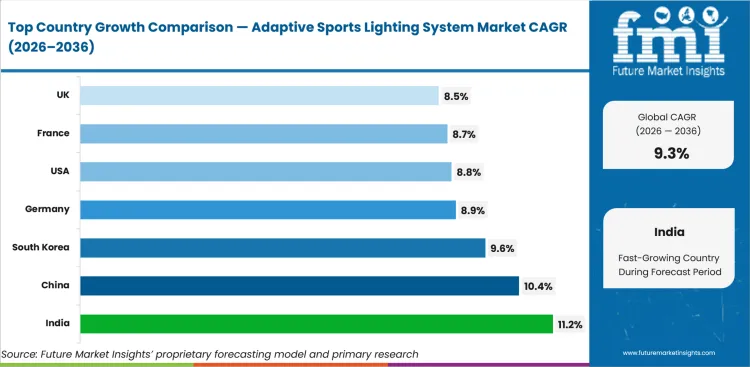
How do country-level CAGRs compare in the Adaptive Sports Lighting System Market?
India leads country expansion while Japan records the most measured pace among profiled markets.
- India is forecast to record 11.2% CAGR by 2036 due to cricket venue upgrades and public sports infrastructure investment.
- China is expected to expand at 10.4% CAGR from 2026 to 2036, led by sports venue construction and event-hosting demand.
- South Korea is projected to grow at 9.6% CAGR through 2036, driven by smart sports facilities and pro-league venues needing controlled lighting.
- Germany is expected to advance at 8.9% CAGR over the forecast period since club venues and municipal sports facilities pursue efficient lighting upgrades.
- United States is estimated to rise at 8.8% CAGR by 2036, reflected by municipal grounds and stadium renovation programs.
- France is expected to record 8.7% CAGR by 2036, influenced by Olympic legacy work and community sports facility renewal.
- United Kingdom is projected to post 8.5% CAGR by 2036, guided by grassroots facility funding and winter-use lighting needs.
- Japan is forecast to grow at 8.1% CAGR by 2036, backed by established stadium lighting projects and local electronics suppliers.
How fast is the Adaptive Sports Lighting System Market growing in India?
An 11.2% CAGR through 2036 reflects cricket venue upgrades and public sports infrastructure programs.
Country Market Snapshot Table
| Parameter | Value |
|---|---|
| Market Size in 2025 (Value) | USD 143.9 million |
| Market Size in 2026 (Value) | USD 160.0 million |
| Market Forecast in 2036 (Value) | USD 462.6 million |
| CAGR (2026 to 2036) | 11.2% |
| Years Considered | 2021 to 2036 |
| Base Year | 2025 |
| Forecast Period | 2026 to 2036 |
| Units Considered | Value (USD million) |
| Leading Sub-Region | Delhi NCR, Ahmedabad, Mumbai, Bengaluru, Chennai, Pune, Hyderabad, and Kolkata sports venue corridors |
India Adaptive Sports Lighting System Market Outlook
- India adaptive sports lighting system demand is advancing through cricket venues and public training infrastructure. Venue owners need controlled LED systems supporting televised matches and multi-sport public use.
- Buyers are expected to favor suppliers combining sports lighting design and service support. Cricket associations and public sports agencies will remain influential as stadium owners compare fixture output and maintenance access.
Key Growth Drivers
- Public sports infrastructure creates a wide base for lighting upgrades, as India Press Information Bureau reported approval of 326 new sports infrastructure projects worth ₹3,124.12 crore in 2025.
- Stadium utilization supports adaptive floodlight demand, reinforced by Sports Authority of India’s 2025 tariff circular listing floodlight use at ₹20,000 per hour for stadia booking.
- Venue owners need remote control features as evening match blocks and coaching sessions require quicker switching between practice and event modes.
- Local electrical contractors gain scope as cricket associations require installation support and periodic maintenance after fixture commissioning.
Key Restraints
- Tender-led buying can stretch project timing if technical specifications and inspection approvals move through several committees.
- Public venue operators may delay higher-end controls if annual maintenance budgets prioritize turf, seating, and safety works first.
- Budget absorption can slow venue upgrade timing, since a December 2025 parliamentary reply stated that ₹1,000 crore was allocated to Khelo India for FY2025-26 and ₹599.12 crore had been utilized so far.
What makes India unique
Cricket-led venue spending gives India a distinct demand base across training grounds and state sports facilities.
Key Companies
- Bajaj Electricals
- Crompton Greaves Consumer Electricals
- Wipro Lighting
- Havells India
- Jaquar Lighting
- HPL Electric & Power
- Surya Roshni
Sales & Marketing Channels
- Direct sales to cricket associations
- EPC-led stadium renovation bids
- Lighting contractor networks
- Public sports authority tenders
- Electrical distributor channels
- After-sales service agreements
Country Segment Breakdown Table
| Segment | Sub-Segments |
|---|---|
| By System Type | LED Sports Lighting · DMX / Scene-controlled Lighting · Sensor-adaptive Lighting · Broadcast-grade Lighting Systems |
| By Venue Type | Stadiums · Indoor Arenas · Training Facilities · Community Sports Grounds |
| By Control Feature | Dimming / Scene Control · Broadcast Flicker Control · Occupancy / Event Modes · Remote Monitoring |
| By Installation | New Venue · Retrofit / Upgrade |
| By Sales Channel | Direct OEM · Lighting Contractors · EPC / Venue Integrators |
| Key Sub-Regions Covered, Venue Corridors | Delhi NCR · Ahmedabad · Mumbai · Bengaluru · Chennai · Pune · Hyderabad · Kolkata |
Frequently Asked Questions
How fast is India Adaptive Sports Lighting System Market growing?
India records an estimated 11.2% CAGR through 2036, supported by cricket venue upgrades and public sports infrastructure programs.
Who leads India Adaptive Sports Lighting System Market?
Bajaj Electricals leads India supply, followed by Crompton Greaves Consumer Electricals and Wipro Lighting across local lighting production and service networks.
What is driving adoption in India Adaptive Sports Lighting System Market?
Cricket stadium upgrades and training-facility schedules are moving buyers toward controllable LED floodlighting systems.
How fast is the Adaptive Sports Lighting System Market growing in China?
A 10.4% CAGR through 2036 reflects venue construction and local LED supply.
Country Market Snapshot Table
| Parameter | Value |
|---|---|
| Market Size in 2025 (Value) | USD 226.4 million |
| Market Size in 2026 (Value) | USD 250.0 million |
| Market Forecast in 2036 (Value) | USD 672.4 million |
| CAGR (2026 to 2036) | 10.4% |
| Years Considered | 2021 to 2036 |
| Base Year | 2025 |
| Forecast Period | 2026 to 2036 |
| Units Considered | Value (USD million) |
| Leading Sub-Region | Beijing, Shanghai, Guangdong, Jiangsu, Zhejiang, Chengdu, and Shenzhen venue corridors |
China Adaptive Sports Lighting System Market Outlook
- China sports venue modernization is creating demand for adaptive lighting systems across public facilities and urban sports parks. Stadium owners and public facility operators need lighting systems that support mass participation and evening facility use.
- Buyers are expected to favor suppliers that combine competitive fixture pricing and control-system integration. Local manufacturers will remain influential as provinces compare cost and commissioning support.
Key Growth Drivers
- Sports facility expansion creates a large installed base for lighting upgrades, influenced by State Council reporting 4.23 billion square meters of sports venue floor area and 1,547 new sports parks put into use by 2025.
- Multi-city event preparation supports premium venue lighting, reinforced by Greater Bay Area reporting the 15th National Games from November 9 to 21, 2025, covering 34 major competitive events and 23 major mass events.
- Domestic LED supply supports shorter lead times for stadium and municipal venue replacement projects.
- Public sports participation plans encourage evening access, making controlled lighting valuable for training grounds and city parks.
Key Restraints
- Price-led tendering can pressure suppliers to reduce commissioning depth and after-sales coverage.
- Multi-sport venue requirements may complicate beam setting if one site hosts football and community events.
- Oversupply risk can pressure margins as China recorded more than 4.84 million sports venues by 2024, creating varied project quality and budget levels across provinces.
What makes China unique
China stands apart through large-scale venue construction and domestic LED manufacturing capacity across provincial public works.
Key Companies
- Opple Lighting
- MLS Lighting
- NVC Lighting
- Unilumin Sports
- Kingsun Optoelectronic
- Leyard Optoelectronic
- Absen Lighting
Sales & Marketing Channels
- Municipal sports facility tenders
- Direct sales to stadium operators
- EPC-led public works packages
- LED distributor networks
- Smart-city contractor partnerships
- Maintenance service agreements
Country Segment Breakdown Table
| Segment | Sub-Segments |
|---|---|
| By System Type | LED Sports Lighting · DMX / Scene-controlled Lighting · Sensor-adaptive Lighting · Broadcast-grade Lighting Systems |
| By Venue Type | Stadiums · Indoor Arenas · Training Facilities · Community Sports Grounds |
| By Control Feature | Dimming / Scene Control · Broadcast Flicker Control · Occupancy / Event Modes · Remote Monitoring |
| By Installation | New Venue · Retrofit / Upgrade |
| By Sales Channel | Direct OEM · Lighting Contractors · EPC / Venue Integrators |
| Key Sub-Regions Covered, Venue Corridors | Beijing · Shanghai · Guangdong · Jiangsu · Zhejiang · Chengdu · Shenzhen |
Frequently Asked Questions
How fast is China Adaptive Sports Lighting System Market growing?
China is forecast to expand at 10.4% CAGR through 2036, supported by sports venue construction and city-level sports park development.
Who leads China Adaptive Sports Lighting System Market?
Opple Lighting leads local supply, while MLS Lighting and NVC Lighting support project demand based on LED production and broad contractor access.
What is driving adoption in China Adaptive Sports Lighting System Market?
Sports parks and provincial public works are increasing demand for LED systems combining lighting output and control software.
How fast is the Adaptive Sports Lighting System Market growing in South Korea?
A 9.6% CAGR through 2036 reflects smart facility programs and pro-sports venue modernization.
Country Market Snapshot Table
| Parameter | Value |
|---|---|
| Market Size in 2025 (Value) | USD 82.1 million |
| Market Size in 2026 (Value) | USD 90.0 million |
| Market Forecast in 2036 (Value) | USD 225.1 million |
| CAGR (2026 to 2036) | 9.6% |
| Years Considered | 2021 to 2036 |
| Base Year | 2025 |
| Forecast Period | 2026 to 2036 |
| Units Considered | Value (USD million) |
| Leading Sub-Region | Seoul, Gyeonggi, Busan, Incheon, Daegu, and Daejeon sports facility corridors |
South Korea Adaptive Sports Lighting System Market Outlook
- South Korea’s smart sports policy environment is supporting controlled venue lighting across urban stadiums and public recreation facilities. Venue operators need lighting that supports televised matches and control-led facility management.
- Buyers are expected to favor systems integrating LED fixtures and safety inspection support. Local electronics and lighting suppliers are expected to remain important as sports facilities emphasize control reliability and compact installation.
Key Growth Drivers
- Smart sports participation programs support controlled facility use, reflected by Korea Ministry of Culture, Sports and Tourism’s 2026 plan providing up to KRW 50,000 in Sports Activity Incentive points per year.
- Sports industry expansion supports venue technology demand, with Korea Ministry of Culture, Sports and Tourism targeting sports industry revenue of KRW 90 trillion in 2025 from KRW 81 trillion in 2023.
- Urban venue density encourages lighting control systems reducing glare and support precise beam placement near residential zones.
- Professional baseball and football operators need stable lighting scenes for television coverage and sponsor activations.
Key Restraints
- Compact city venues may face tighter design limits as glare control and nearby buildings constrain lighting angles.
- Buyer preference for proven domestic suppliers may slow entry for foreign fixture specialists without Korean service networks.
- Event-safety review can add coordination work to venue lighting projects, led by Korea Ministry of Culture, Sports and Tourism inspecting stage equipment and emergency systems before a March 2026 concert expected to draw 170,000 to 260,000 attendees.
What makes South Korea unique
South Korea’s compact urban venue base favors lighting systems combining precise control and local electronics support.
Key Companies
- Kumho Electric
- Seoul Semiconductor
- Feelux
- Icepipe
- Yuyang D&U
- S-Tech
- Wooree Lighting
Sales & Marketing Channels
- Municipal smart sports tenders
- Direct sales to stadium operators
- Electrical contractor networks
- Sports facility maintenance channels
- Control-system integrator partnerships
- Public institution buying portals
Country Segment Breakdown Table
| Segment | Sub-Segments |
|---|---|
| By System Type | LED Sports Lighting · DMX / Scene-controlled Lighting · Sensor-adaptive Lighting · Broadcast-grade Lighting Systems |
| By Venue Type | Stadiums · Indoor Arenas · Training Facilities · Community Sports Grounds |
| By Control Feature | Dimming / Scene Control · Broadcast Flicker Control · Occupancy / Event Modes · Remote Monitoring |
| By Installation | New Venue · Retrofit / Upgrade |
| By Sales Channel | Direct OEM · Lighting Contractors · EPC / Venue Integrators |
| Key Sub-Regions Covered, Venue Corridors | Seoul · Gyeonggi · Busan · Incheon · Daegu · Daejeon |
Frequently Asked Questions
How fast is South Korea Adaptive Sports Lighting System Market growing?
South Korea is expected to expand at 9.6% CAGR through 2036, guided by smart facility programs and urban venue renewal.
Who leads South Korea Adaptive Sports Lighting System Market?
Kumho Electric leads local supply, supported by Seoul Semiconductor and Feelux across LED components and project channels.
What is driving adoption in South Korea Adaptive Sports Lighting System Market?
Urban sports facilities and pro-league broadcast needs are moving venues toward controlled sports lighting systems.
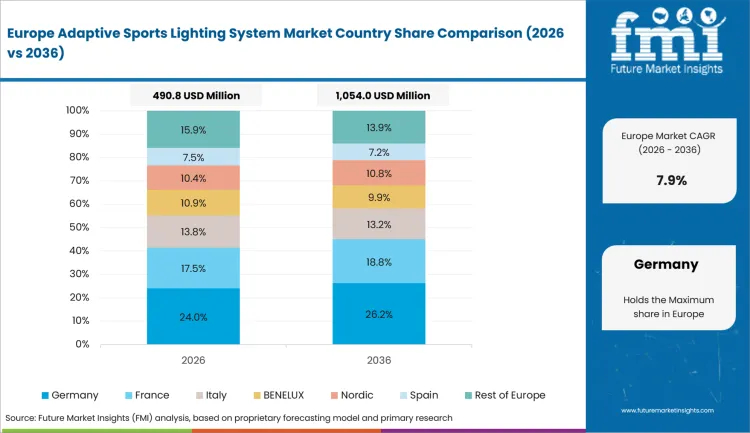
How fast is the Adaptive Sports Lighting System Market growing in Germany?
An 8.9% CAGR through 2036 reflects sports facility renovation and energy-efficient lighting upgrades.
Country Market Snapshot Table
| Parameter | Value |
|---|---|
| Market Size in 2025 (Value) | USD 124.0 million |
| Market Size in 2026 (Value) | USD 135.0 million |
| Market Forecast in 2036 (Value) | USD 316.7 million |
| CAGR (2026 to 2036) | 8.9% |
| Years Considered | 2021 to 2036 |
| Base Year | 2025 |
| Forecast Period | 2026 to 2036 |
| Units Considered | Value (USD million) |
| Leading Sub-Region | North Rhine-Westphalia, Bavaria, Baden-Württemberg, Berlin, Hesse, and Saxony sports facility corridors |
Germany Adaptive Sports Lighting System Market Outlook
- Germany’s club-sport and municipal venue network is increasing demand for efficient lighting retrofits. Sports clubs and public owners need systems that reduce energy use while improving training and match conditions.
- Buyers are expected to favor suppliers offering compliant design and documented photometry. Domestic lighting brands and contractors will remain influential as municipalities require engineering support and service assurance.
Key Growth Drivers
- Energy efficiency programs support LED sports lighting replacement, driven by European Commission reporting lighting as the third energy consumer among Ecodesign product groups and responsible for 8% of primary energy in the related 2020 assessment.
- German sports facility renovation programs support controlled LED adoption, reflected by 2025 to 2026 grant information listing eligible grants from EUR 250,000 to EUR 8 million for municipal sports facility renewal.
- Club sport networks need lighting upgrades extending training windows during darker months and reduce fixture maintenance.
- Local engineering preference favors suppliers able to provide photometric calculations and service documentation.
Key Restraints
- Municipal budget cycles can delay adaptive controls if energy savings are accepted but control software appears optional.
- Glare and night-sky concerns may slow projects near housing, requiring careful shielding and aiming validation before approval.
- Renovation backlog can absorb municipal budgets before lighting upgrades, due to Germany’s 2025 sustainable sport paper estimating necessary sports facility renovation costs at about EUR 31 billion.
What makes Germany unique
Germany draws its distinction from club-sport density and lighting engineering depth across public and professional venues.
Key Companies
- LEDVANCE
- SITECO
- TRILUX
- Regiolux
- WILA Lichttechnik
- Norka
- Hess
Sales & Marketing Channels
- Municipal renovation tenders
- Club facility upgrade programs
- Lighting contractor networks
- Direct manufacturer sales
- Energy-service partnerships
- Engineering consultant specifications
Country Segment Breakdown Table
| Segment | Sub-Segments |
|---|---|
| By System Type | LED Sports Lighting · DMX / Scene-controlled Lighting · Sensor-adaptive Lighting · Broadcast-grade Lighting Systems |
| By Venue Type | Stadiums · Indoor Arenas · Training Facilities · Community Sports Grounds |
| By Control Feature | Dimming / Scene Control · Broadcast Flicker Control · Occupancy / Event Modes · Remote Monitoring |
| By Installation | New Venue · Retrofit / Upgrade |
| By Sales Channel | Direct OEM · Lighting Contractors · EPC / Venue Integrators |
| Key Sub-Regions Covered, Venue Corridors | North Rhine-Westphalia · Bavaria · Baden-Württemberg · Berlin · Hesse · Saxony |
Frequently Asked Questions
How fast is Germany Adaptive Sports Lighting System Market growing?
Germany is forecast to expand at 8.9% CAGR through 2036, supported by club facility renovation and municipal energy-efficiency programs.
Who leads Germany Adaptive Sports Lighting System Market?
LEDVANCE leads Germany supply, followed by SITECO and TRILUX across domestic lighting engineering and contractor networks.
What is driving adoption in Germany Adaptive Sports Lighting System Market?
Sports hall refurbishment and photometric compliance needs are increasing demand for LED lighting systems with control capability.
How is the Adaptive Sports Lighting System Market performing in the United States?
An 8.8% CAGR through 2036 reflects municipal sports grounds and stadium renovation programs.
Country Market Snapshot Table
| Parameter | Value |
|---|---|
| Market Size in 2025 (Value) | USD 395.2 million |
| Market Size in 2026 (Value) | USD 430.0 million |
| Market Forecast in 2036 (Value) | USD 999.4 million |
| CAGR (2026 to 2036) | 8.8% |
| Years Considered | 2021 to 2036 |
| Base Year | 2025 |
| Forecast Period | 2026 to 2036 |
| Units Considered | Value (USD million) |
| Leading Sub-Region | Texas, California, Florida, Midwest, Northeast, and Southeast school and stadium corridors |
United States Adaptive Sports Lighting System Market Outlook
- United States demand is expanding across school athletics and professional venues. Buyers need systems managing tournament schedules and community access.
- Venue owners are expected to favor suppliers combining sports optics and local contractor coverage. School districts and municipalities will remain central as outdoor fields adopt LED replacement and remote scheduling.
Key Growth Drivers
- Stadium and municipal field buyers need remote control options, supported by Cooper Lighting Solutions’ AirMesh Hub specification offering five dimming levels of 0%, 25%, 50%, 75%, and 100%.
- Connected control demand is increasing as Cooper Lighting Solutions states that the AirMesh Hub can pre-program up to 25 scenes, with five scenes per button for sport and event lighting.
- School districts need lighting systems lowering staff switching work across practice and community rentals.
- Stadium owners seek event scenes supporting sponsor moments and maintenance modes.
Key Restraints
- Permitting can slow outdoor lighting projects if neighboring properties raise concerns about glare and spill.
- School and municipal buyers may phase control features after fixture replacement if capital budgets are limited.
- Federal building guidance raises proof expectations for energy upgrades, since 2024 LED and controls guidance requires LED products to reduce power consumption by at least 50% in applicable projects.
What makes the United States unique
United States demand is distinct through school athletics and sports-lighting specialists serving dispersed public and private venues.
Key Companies
- Musco Sports Lighting
- Cooper Lighting Solutions
- Acuity Brands
- Qualite Sports Lighting
- Sportsbeams Lighting
- Techline Sports Lighting
- SpecGrade LED
Sales & Marketing Channels
- School district bids
- Municipal field contracts
- Direct stadium sales
- Electrical contractor networks
- Sports construction partnerships
- Service and maintenance programs
Country Segment Breakdown Table
| Segment | Sub-Segments |
|---|---|
| By System Type | LED Sports Lighting · DMX / Scene-controlled Lighting · Sensor-adaptive Lighting · Broadcast-grade Lighting Systems |
| By Venue Type | Stadiums · Indoor Arenas · Training Facilities · Community Sports Grounds |
| By Control Feature | Dimming / Scene Control · Broadcast Flicker Control · Occupancy / Event Modes · Remote Monitoring |
| By Installation | New Venue · Retrofit / Upgrade |
| By Sales Channel | Direct OEM · Lighting Contractors · EPC / Venue Integrators |
| Key Sub-Regions Covered, Venue Corridors | Texas · California · Florida · Midwest · Northeast · Southeast |
Frequently Asked Questions
How fast is the United States Adaptive Sports Lighting System Market growing?
United States demand is set to rise at 8.8% CAGR through municipal fields and stadium renovation programs.
Who leads the United States Adaptive Sports Lighting System Market?
Musco Sports Lighting leads the United States market, supported by Cooper Lighting Solutions and Acuity Brands across domestic sports-lighting projects.
What is driving adoption in the United States Adaptive Sports Lighting System Market?
Night-game scheduling and remote control needs are increasing adoption of adaptive sports lighting systems.
What is driving Adaptive Sports Lighting System Market growth in France?
An 8.7% CAGR through 2036 reflects Olympic legacy works and community sports facility renewal.
Country Market Snapshot Table
| Parameter | Value |
|---|---|
| Market Size in 2025 (Value) | USD 101.2 million |
| Market Size in 2026 (Value) | USD 110.0 million |
| Market Forecast in 2036 (Value) | USD 253.3 million |
| CAGR (2026 to 2036) | 8.7% |
| Years Considered | 2021 to 2036 |
| Base Year | 2025 |
| Forecast Period | 2026 to 2036 |
| Units Considered | Value (USD million) |
| Leading Sub-Region | Paris Region, Auvergne-Rhône-Alpes, Hauts-de-France, Nouvelle-Aquitaine, Occitanie, and Grand Est venue corridors |
France Adaptive Sports Lighting System Market Outlook
- France’s Olympic legacy programs and municipal sport ownership are strengthening demand for lighting upgrades. Venue owners need systems improving facility use while controlling energy and maintenance cost.
- Buyers are expected to favor lighting suppliers with public-project experience and local installation support. Domestic manufacturers and regional contractors will remain important as public owners emphasize reliable service and compliant design.
Key Growth Drivers
- Olympic legacy facility programs support lighting upgrades, with OECD’s 2025 Paris legacy review citing EUR 39.5 million for structuring facilities and EUR 2.5 million for active schoolyards.
- City-level venue renewal supports sports-lighting replacement, reflected by City of Paris reporting that renovated Paris 2024 sports facilities included gymnasium ceiling and lighting work in 2024.
- Municipal clubs need adaptive lighting to extend evening access while improving energy control in older gyms and fields.
- Regional public works favor suppliers able to manage specification and maintenance through local teams.
Key Restraints
- Public tender procedures may lengthen project timelines if funding approvals and technical bids move separately.
- Heritage and dense urban sites can require added lighting design work to reduce spill and preserve neighborhood comfort.
- Participation funding can direct budgets toward access programs before equipment upgrades, since France increased Pass’Sport state aid to EUR 70 per child for the 2025 to 2026 season from EUR 50 earlier.
What makes France unique
France gains its character from Olympic legacy renewal and public projects tied to community access.
Key Companies
- Eclatec
- Ragni
- GHM Eclatec
- Sammode
- Aric
- Sécurlite
- Lenzi
Sales & Marketing Channels
- Municipal renovation tenders
- Direct sales to sports venues
- Lighting contractor networks
- Regional public works channels
- Energy-renovation programs
- Maintenance service contracts
Country Segment Breakdown Table
| Segment | Sub-Segments |
|---|---|
| By System Type | LED Sports Lighting · DMX / Scene-controlled Lighting · Sensor-adaptive Lighting · Broadcast-grade Lighting Systems |
| By Venue Type | Stadiums · Indoor Arenas · Training Facilities · Community Sports Grounds |
| By Control Feature | Dimming / Scene Control · Broadcast Flicker Control · Occupancy / Event Modes · Remote Monitoring |
| By Installation | New Venue · Retrofit / Upgrade |
| By Sales Channel | Direct OEM · Lighting Contractors · EPC / Venue Integrators |
| Key Sub-Regions Covered, Venue Corridors | Paris Region · Auvergne-Rhône-Alpes · Hauts-de-France · Nouvelle-Aquitaine · Occitanie · Grand Est |
Frequently Asked Questions
How fast is France Adaptive Sports Lighting System Market growing?
France shows 8.7% CAGR through 2036, supported by Olympic legacy facility renewal and municipal sports modernization.
Who leads France Adaptive Sports Lighting System Market?
Eclatec leads France supply, followed by Ragni and GHM Eclatec across municipal lighting projects and regional service channels.
What is driving adoption in France Adaptive Sports Lighting System Market?
Public sports facility renewal and urban retrofit needs are increasing demand for controllable LED sports lighting.
How is the Adaptive Sports Lighting System Market performing in the United Kingdom?
An 8.5% CAGR through 2036 reflects grassroots facility funding and winter sports use.
Country Market Snapshot Table
| Parameter | Value |
|---|---|
| Market Size in 2025 (Value) | USD 115.2 million |
| Market Size in 2026 (Value) | USD 125.0 million |
| Market Forecast in 2036 (Value) | USD 282.6 million |
| CAGR (2026 to 2036) | 8.5% |
| Years Considered | 2021 to 2036 |
| Base Year | 2025 |
| Forecast Period | 2026 to 2036 |
| Units Considered | Value (USD million) |
| Leading Sub-Region | London, Midlands, North West, Yorkshire, Scotland, and Wales grassroots and stadium corridors |
United Kingdom Adaptive Sports Lighting System Market Outlook
- United Kingdom grassroots sports funding is supporting lighting upgrades across football grounds and leisure-trust venues. Clubs and councils need lighting systems extending evening use and lower energy bills.
- Buyers are expected to favor suppliers offering photometric design and ongoing maintenance. Football clubs and leisure trusts will remain central as facility renewal connects lighting with access and scheduling.
Key Growth Drivers
- Grassroots sports projects support lighting upgrades, driven by Department for Culture, Media and Sport listing GBP 125 million investment in 2024 to 2025 for multi-sport facilities across the United Kingdom.
- Facility renewal remains active, reflected by Sport England welcoming GBP 100 million in 2025 government funding for sports facilities.
- Winter play needs support outdoor pitch lighting as clubs try to extend training and match access after dark.
- Stadium retrofit programs favor suppliers combining lighting design and energy-management support.
Key Restraints
- Planning approvals can slow outdoor lighting projects if residents object to glare or extended operating hours.
- Grassroots clubs may delay premium control features if grant funding covers essential surface or changing-room works first.
- Project pressure remains high as Parliament reported 991 grassroots sports facility projects funded in 2025 to 2026, requiring staged delivery across many local sites.
What makes the United Kingdom unique
Grassroots sport funding and winter training demand give the United Kingdom a distinct need for practical LED pitch lighting.
Key Companies
- Thorn Lighting
- DW Windsor
- ASD Lighting
- Kingfisher Lighting
- Abacus Lighting
- CU Phosco Lighting
- Whitecroft Lighting
Sales & Marketing Channels
- Local authority tenders
- Club facility grant programs
- Lighting contractor networks
- Direct sales to stadium owners
- Leisure trust buying channels
- Maintenance and inspection services
Country Segment Breakdown Table
| Segment | Sub-Segments |
|---|---|
| By System Type | LED Sports Lighting · DMX / Scene-controlled Lighting · Sensor-adaptive Lighting · Broadcast-grade Lighting Systems |
| By Venue Type | Stadiums · Indoor Arenas · Training Facilities · Community Sports Grounds |
| By Control Feature | Dimming / Scene Control · Broadcast Flicker Control · Occupancy / Event Modes · Remote Monitoring |
| By Installation | New Venue · Retrofit / Upgrade |
| By Sales Channel | Direct OEM · Lighting Contractors · EPC / Venue Integrators |
| Key Sub-Regions Covered, Venue Corridors | London · Midlands · North West · Yorkshire · Scotland · Wales |
Frequently Asked Questions
How fast is the United Kingdom Adaptive Sports Lighting System Market growing?
United Kingdom demand is predicted to grow at 8.5% CAGR, guided by grassroots facility funding and winter-use lighting demand.
Who leads the United Kingdom Adaptive Sports Lighting System Market?
Thorn Lighting leads United Kingdom supply, followed by DW Windsor and ASD Lighting across local lighting production and contractor-led delivery.
What is driving adoption in the United Kingdom Adaptive Sports Lighting System Market?
Club pitch usage and winter evening schedules are moving buyers toward adaptive sports lighting systems.
What is the Adaptive Sports Lighting System Market forecast for Japan?
An 8.1% CAGR through 2036 reflects premium stadium lighting and local electronics supplier strength.
Country Market Snapshot Table
| Parameter | Value |
|---|---|
| Market Size in 2025 (Value) | USD 106.4 million |
| Market Size in 2026 (Value) | USD 115.0 million |
| Market Forecast in 2036 (Value) | USD 250.6 million |
| CAGR (2026 to 2036) | 8.1% |
| Years Considered | 2021 to 2036 |
| Base Year | 2025 |
| Forecast Period | 2026 to 2036 |
| Units Considered | Value (USD million) |
| Leading Sub-Region | Tokyo, Osaka, Aichi, Saitama, Yokohama, and Fukuoka sports facility corridors |
Japan Adaptive Sports Lighting System Market Outlook
- Japan’s premium stadium lighting demand is linked to electronics expertise and upcoming multi-sport events. Venue operators need systems supporting broadcast performance and careful glare control.
- Buyers are expected to favor suppliers offering precise optics and long-term service support. Domestic electronics and lighting companies will remain influential as stadium owners evaluate camera readiness and control reliability.
Key Growth Drivers
- Premium stadium projects support adaptive lighting adoption, with Panasonic Lighting’s Ajinomoto Stadium case stating 864 LED floodlights and seamless dimming from 0% to 100%.
- Large sports-event preparation supports venue readiness, as Aichi-Nagoya 2026 lists 43 sports across its official sports program and competition venue page.
- Local electronics suppliers support broadcast-ready lighting through controls and camera-compatible dimming expertise.
- Stadium and arena owners need lighting scenes shifting among football and concert use.
Key Restraints
- Dense urban sites can require careful shielding and beam control before outdoor lighting approvals move forward.
- Premium system expectations can raise purchase cost for smaller municipal grounds and school facilities.
- Broadcast-grade requirements can increase technical complexity, as Panasonic Lighting states arena systems must support 4K and 8K broadcasting with minimal flickering during super slow-motion capture.
What makes Japan unique
Japan is set apart by stadium electronics expertise and camera-ready sports lighting applications.
Key Companies
- Panasonic Lighting
- Iwasaki Electric
- Toshiba Lighting & Technology
- Koizumi Lighting Technology
- Endo Lighting
- Stanley Electric
- Yamada Shomei Lighting
Sales & Marketing Channels
- Direct sales to stadium owners
- Municipal sports facility bids
- Electrical contractor networks
- Electronics integrator partnerships
- Arena renovation packages
- Long-term maintenance contracts
Country Segment Breakdown Table
| Segment | Sub-Segments |
|---|---|
| By System Type | LED Sports Lighting · DMX / Scene-controlled Lighting · Sensor-adaptive Lighting · Broadcast-grade Lighting Systems |
| By Venue Type | Stadiums · Indoor Arenas · Training Facilities · Community Sports Grounds |
| By Control Feature | Dimming / Scene Control · Broadcast Flicker Control · Occupancy / Event Modes · Remote Monitoring |
| By Installation | New Venue · Retrofit / Upgrade |
| By Sales Channel | Direct OEM · Lighting Contractors · EPC / Venue Integrators |
| Key Sub-Regions Covered, Venue Corridors | Tokyo · Osaka · Aichi · Saitama · Yokohama · Fukuoka |
Frequently Asked Questions
How fast is Japan Adaptive Sports Lighting System Market growing?
Japan maintains 8.1% CAGR through 2036, backed by established stadium lighting and broadcast-ready electronics expertise.
Who leads Japan Adaptive Sports Lighting System Market?
Panasonic Lighting leads Japan supply, followed by Iwasaki Electric and Toshiba Lighting & Technology across local sports venue lighting systems.
What is driving adoption in Japan Adaptive Sports Lighting System Market?
Aichi-Nagoya 2026 venue preparation and electronics-led dimming systems are supporting adaptive lighting demand.
Who are the leading companies in the Adaptive Sports Lighting System Market?
Signify, Musco Sports Lighting, Schréder, Cooper Lighting Solutions, and Acuity Brands are leading companies in the adaptive sports lighting system market.
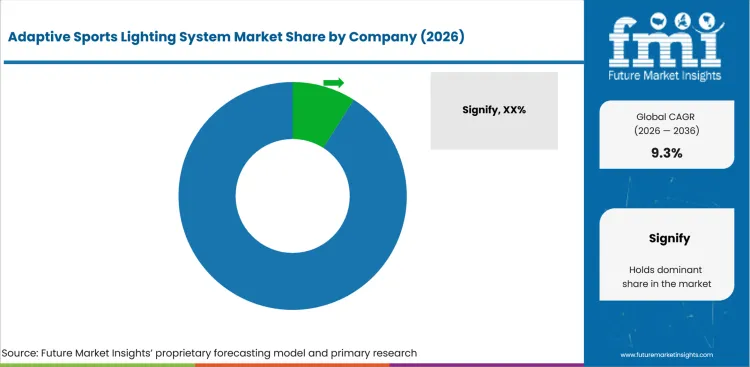
- Established lighting companies hold an advantage led by venue commissioning and control-system portfolios.
- Sports-specialist suppliers gain stronger acceptance by combining lighting design and field-test support.
- Regional lighting suppliers profit in country markets based on maintenance support and local code knowledge.
- Service-ready suppliers improve renewal chances through certified testing and post-installation performance reports.
Industrial and sports lighting companies compete by combining LED floodlights and commissioning programs. Signify holds a strong position through stadium lighting systems and FIFA Preferred Provider status. Musco Sports Lighting competes through specialist sports lighting design and certified project delivery. Schréder strengthens competition through OMNIBLAST sports floodlights and participation in the FIFA Quality Programme.
Control and integration depth have become stronger competitive separators as venues move beyond basic LED fixture replacement. Cooper Lighting Solutions competes through Ephesus sports lighting and AirMesh control products. Acuity Brands adds sports lighting strength through M3 Innovation and its North American distribution network. LEDVANCE, Panasonic Lighting, and Iwasaki Electric compete across broadcast-ready systems and local engineering support.
Smaller and regional suppliers can profit through local sports facility knowledge and faster field support. India, China, and South Korea create opportunities for suppliers operating project teams and electrical contractor networks. United States and Europe create stronger demand for flexible systems suited to schools and municipal fields. Companies proving glare control and reliable service across changing venue schedules should gain more durable buyer relationships.
How do top Adaptive Sports Lighting System companies compare?
Signify and Musco score on certified sports lighting depth while Cooper Lighting Solutions and Acuity Brands lead through control integration and North American channel strength.
| Company | Relevance to Market Title | Lighting Portfolio Depth | Sports Service Strength | Control Support | Channel Reach | Geographic Footprint |
|---|---|---|---|---|---|---|
| Signify | Very High | Very Strong | Very Strong | Very Strong | Very Strong | Global |
| Musco Sports Lighting | Very High | Strong | Very Strong | Strong | Strong | Global |
| Schréder | Very High | Strong | Strong | Strong | Strong | Europe and global |
| Cooper Lighting Solutions | Very High | Strong | Strong | Very Strong | Very Strong | United States and global |
| Acuity Brands | High | Strong | Moderate to Strong | Very Strong | Very Strong | North America |
| LEDVANCE | High | Strong | Moderate | Strong | Strong | Europe and global |
| Panasonic Lighting | High | Strong | Strong | Very Strong | Strong | Japan and Asia |
| Iwasaki Electric | High | Strong | Strong | Strong | Moderate | Japan |
| Thorn Lighting | Moderate to High | Strong | Moderate | Moderate | Strong | United Kingdom and Europe |
| Eclatec | Moderate to High | Moderate | Moderate | Moderate | Strong | France and Europe |
Source: Future Market Insights competitive analysis, 2026.
Who are the key players in the Adaptive Sports Lighting System Market?
Signify, Musco Sports Lighting, and Schréder are listed with Cooper Lighting Solutions and Acuity Brands among other suppliers.
Key global companies leading the Adaptive Sports Lighting System Market include:
- Signify
- Musco Sports Lighting
- Schréder
- Cooper Lighting Solutions
- Acuity Brands
- LEDVANCE
- Panasonic Lighting
- Iwasaki Electric
- Thorn Lighting
- Eclatec
- Zumtobel Group
- Qualite Sports Lighting
- Sportsbeams Lighting
- Techline Sports Lighting
- SITECO
Key Developments in Adaptive Sports Lighting System Market
- In March 2025, FIFA announced Musco Sports Lighting as a FIFA Preferred Provider for Floodlights, strengthening certified football floodlighting supplier positioning.
- In July 2025, FIFA announced Signify as a FIFA Preferred Provider for Floodlights, extending Signify’s verified role in football stadium lighting projects.
- In February 2026, Schréder joined the FIFA Quality Programme, adding its OMNIBLAST sports floodlight to certified football lighting pathways.
Key Players in the Adaptive Sports Lighting System Market
Certified Sports Lighting Leaders
- Signify
- Musco Sports Lighting
- Schréder
- Cooper Lighting Solutions
Controls and Venue Integration Companies
- Acuity Brands
- LEDVANCE
- Zumtobel Group
- SITECO
Regional Sports Lighting Suppliers
- Panasonic Lighting
- Iwasaki Electric
- Thorn Lighting
- Eclatec
School, Club, and Municipal Lighting Specialists
- Qualite Sports Lighting
- Sportsbeams Lighting
- Techline Sports Lighting
- SpecGrade LED
Adaptive Sports Lighting System Market - Scope & Definition
| Attribute | Detail |
|---|---|
| Market Definition | LED sports lighting systems with adaptive control, dimming, scene, sensor, or broadcast-grade capabilities used in sports venues |
| Functions Covered | Match lighting, training lighting, broadcast support, event scenes, occupancy modes, remote monitoring, glare control, and commissioning support |
| Applications Covered | Stadiums, indoor arenas, training facilities, community sports grounds, public pitches, school fields, and club venues |
| End-Use Industries | Sports venues, municipalities, schools, universities, professional clubs, event operators, and leisure trusts |
| Grades Covered | Standard LED systems, broadcast-grade systems, sensor-adaptive systems, scene-controlled systems, and remote-monitored lighting systems |
| Inclusions | Fixtures, controls, scene software, sensors, commissioning, monitoring modules, and sports lighting service packages |
| Exclusions | Household smart lighting, road lighting, decorative building lighting, horticulture lighting, marine lighting, scoreboard-only LED displays, and non-sports industrial floodlights |
Adaptive Sports Lighting System Market - Research Methodology
| Method | Description |
|---|---|
| Primary Research | FMI analyst interviews with venue owners, lighting contractors, sports facility consultants, EPC teams, control-system integrators, and maintenance managers across selected markets |
| Desk Research | Review of sport-body lighting guidance, official standards references, public facility funding evidence, company product documentation, and country-level venue upgrade signals |
| Market Sizing & Forecasting | Bottom-up system revenue approach using venue type, replacement cycle, system pricing, control-feature use, retrofit share, and commissioning intensity |
| Data Validation | Cross-verification using company portfolios, sports lighting standards, public infrastructure records, country-level facility signals, and supplier channel checks |
Adaptive Sports Lighting System Market - Report Scope
| Parameter | Details |
|---|---|
| Forecast Period | 2026 to 2036 |
| Historical Period | 2021 to 2025 |
| Quantitative Unit | Revenue in USD million |
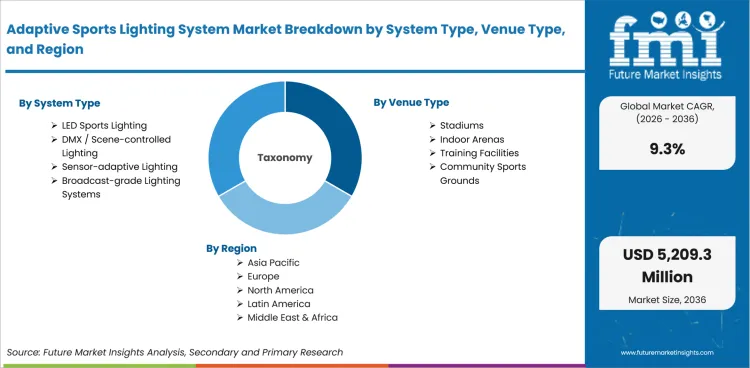
| By System Type | LED Sports Lighting, DMX / Scene-controlled Lighting, Sensor-adaptive Lighting, Broadcast-grade Lighting Systems |
| By Venue Type | Stadiums, Indoor Arenas, Training Facilities, Community Sports Grounds |
| By Control Feature | Dimming / Scene Control, Broadcast Flicker Control, Occupancy / Event Modes, Remote Monitoring |
| By Installation | New Venue, Retrofit / Upgrade |
| By Sales Channel | Direct OEM, Lighting Contractors, EPC / Venue Integrators |
| Regions Covered | North America, Latin America, Europe, East Asia, South Asia and Pacific, Middle East and Africa |
| Countries Covered | India, China, South Korea, Germany, United States, France, United Kingdom, Japan |
| Key Companies Profiled | Signify, Musco Sports Lighting, Schréder, Cooper Lighting Solutions, Acuity Brands, LEDVANCE, Panasonic Lighting, Iwasaki Electric, Thorn Lighting, Eclatec |
| Approach | Bottom-up system revenue approach using fixture pricing, control software share, venue type, retrofit activity, commissioning intensity, and country-level sports infrastructure exposure |
Source: Future Market Insights competitive analysis, 2026.
Adaptive Sports Lighting System Market Breakdown by System Type, Venue Type, Control Feature, Installation, Sales Channel, and Region
Adaptive Sports Lighting System Market Segmented by System Type
- LED Sports Lighting
- DMX / Scene-controlled Lighting
- Sensor-adaptive Lighting
- Broadcast-grade Lighting Systems
Adaptive Sports Lighting System Market Segmented by Venue Type
- Stadiums
- Indoor Arenas
- Training Facilities
- Community Sports Grounds
Adaptive Sports Lighting System Market Segmented by Control Feature
- Dimming / Scene Control
- Broadcast Flicker Control
- Occupancy / Event Modes
- Remote Monitoring
Adaptive Sports Lighting System Market Segmented by Installation
- New Venue
- Retrofit / Upgrade
Adaptive Sports Lighting System Market Segmented by Sales Channel
- Direct OEM
- Lighting Contractors
- EPC / Venue Integrators
Adaptive Sports Lighting System Market by Region
- North America
- Latin America
- Europe
- East Asia
- South Asia and Pacific
- Middle East and Africa
Research Sources and Bibliography
- Acuity Brands. (2025, May 1). Acuity acquires M3 Innovation, an innovative sports lighting startup.
- Aichi-Nagoya Asian Games Organizing Committee. (2026). Sports program and competition venues for the 20th Asian Games Aichi-Nagoya 2026.
- City of Paris. (2024, May 24). Which sports facilities have been renovated for the Paris 2024 Games?
- Cooper Lighting Solutions. (2024, May 10). AirMesh Hub specification sheet.
- Department for Culture, Media and Sport. (2024, October 8). Multi-Sport Grassroots Facilities Programme projects: 2024 to 2025.
- European Commission. (2024, March 11). Light sources.
- Fédération Internationale de Football Association. (2025, March 3). FIFA Quality Programme announces Musco Sports Lighting as a FIFA Preferred Provider for Floodlights.
- Fédération Internationale de Football Association. (2025, July 22). FIFA Quality Programme announces Signify as a FIFA Preferred Provider for Floodlights.
- Fédération Internationale de Football Association. (2026, February 10). FIFA Quality Programme for floodlights.
- Fédération Internationale de Football Association. (2026, February 10). Floodlight testing process.
- German Federal Ministry for the Environment, Nature Conservation, Nuclear Safety and Consumer Protection. (2025). Sustainable Sport 2030.
- Greater Bay Area. (2024, April 12). 15th National Games event and venue preparation update.
- Illuminating Engineering Society. (2024). ANSI/IES RP-6-24: Recommended Practice: Lighting Sports and Recreational Areas.
- India Press Information Bureau. (2025, June 10). India’s sporting transformation.
- Korea Ministry of Culture, Sports and Tourism. (2026, January 23). Sports Activity Incentives program expansion.
- Korea Ministry of Culture, Sports and Tourism. (2026, March 20). MCST Minister inspects safety preparedness at BTS Gwanghwamun concert site.
- Korea Ministry of Culture, Sports and Tourism. (2026). Sports industry policy plan.
- LEDVANCE. (2024, March 5). Light + Building 2024: LEDVANCE product highlights.
- Ministry of Youth Affairs and Sports, Government of India. (2025, December 8). Development of sports infrastructure under Khelo India Scheme.
- Organisation for Economic Co-operation and Development. (2025, September 19). The legacy of the Paris 2024 Olympic and Paralympic Games.
- Panasonic Lighting. (2026). Ajinomoto Stadium case study.
- Panasonic Lighting. (2026). Stadiums and arenas broadcast lighting solutions.
- Schréder. (2026, February 5). Schréder joins the FIFA Quality Programme.
- Service Public France. (2025, June 27). Pass’Sport evolves for the 2025-2026 season.
- Signify. (2025, September 15). Signify strengthens professional lighting portfolio with Signify-branded products.
- Sport England. (2025, March 21). Chief executive welcomes government funding for sports facilities.
- Sport England. (2026). Artificial lighting.
- Sports Authority of India. (2025, September 18). Revision of norms and tariff for booking of SAI stadia.
- State Council of the People’s Republic of China. (2025, September 9). China views sports industry as new growth driver in next five years.
- State Council Information Office of the People’s Republic of China. (2025, November 18). Sports venues and participation briefing.
- Thorn Lighting. (2024, November 13). Thorn Lighting announce partnership with Sunderland AFC for lighting upgrade.
- United Kingdom Parliament. (2026, January 27). Grassroots sports facilities.
- United States General Services Administration. (2024, January 31). LED lighting and controls guidance for federal buildings.
This bibliography is provided for reader reference and is not exhaustive. The full report contains the complete reference list and detailed citations.
This Report Answers
- Market size estimates for 2026 and forecasts through 2036 for the Adaptive Sports Lighting System Market.
- Insights across regional and country-level sports lighting modernization markets.
- Analysis of demand drivers and purchasing behavior.
- Evaluation of system types, venue types, control features, installations, and sales channels.
- Assessment of stadium retrofit and broadcast lighting requirements.
- Identification of opportunities across LED sports lighting and service-led control systems.
- Evaluation of EPC / Venue Integrator models and contractor-led lighting channels.
- Country-level analysis covering India, China, South Korea, Germany, United States, France, United Kingdom, and Japan.
- Assessment of competition, including leading sports lighting suppliers and control-system companies.
- Analysis of venue-level decision drivers and commissioning criteria.
- Regional outlooks across North America, Europe, East Asia, South Asia and Pacific, Latin America, and Middle East and Africa.
- Delivery of market data, forecasts, and supporting analysis in report-ready format.
Frequently Asked Questions
What is the growth prospect for adaptive sports lighting systems?
Demand for adaptive sports lighting systems is expected to rise as sports venues replace fixed floodlights with controlled LED systems that support match play and broadcast needs.
Which companies are expected to shape the adaptive sports lighting system market?
Signify, Musco Sports Lighting, Schréder, Cooper Lighting Solutions, Acuity Brands, LEDVANCE, Panasonic Lighting, Iwasaki Electric, Thorn Lighting, and Eclatec are expected to shape competition through sports lighting portfolios and service support.
Why are venue owners investing in adaptive sports lighting systems?
Venue owners are investing in adaptive sports lighting systems to improve match visibility and event-mode control across stadiums and community grounds.
Why are EPC / Venue Integrator sales channels important in the adaptive sports lighting system market?
EPC / Venue Integrator sales channels support lighting adoption by combining fixture selection and venue renovation support.
Which system formats are gaining attention in adaptive sports lighting systems?
LED Sports Lighting and DMX / Scene-controlled Lighting are gaining attention as venues target energy efficiency and multi-use event operation.
How does venue modernization influence adaptive sports lighting system demand?
Venue modernization influences demand by linking lighting replacement with remote monitoring and better scheduling across sports and entertainment use.
Why is control feature important for adaptive sports lighting systems?
Control feature is important since scene control and remote monitoring help venues manage different sports and event requirements.
What role does Retrofit / Upgrade play in adaptive sports lighting system adoption?
Retrofit / Upgrade supports adoption by allowing venue owners to replace older floodlights with controllable LED systems while retaining existing poles and facility layouts.
Preview the report firsthand - request a free sample
Get SampleGet the brochure for pricing and purchase details.
Get PDFTable of Content
- Key Takeaways
- Market Size and CAGR
- Top Growth Driver
- Fastest Growing Segment
- Leading Region
- Key Companies
- Emerging Opportunities
- Executive Summary
- Global Market Outlook
- Demand-side Trends
- Supply-side Trends
- Technology Roadmap Analysis
- Analysis and Recommendations
- Analyst Perspective (What is happening? Why now? What should investors know?)
- Key Questions Answered
- How large is the market?
- What is the CAGR?
- What are key trends?
- Which region dominates?
- Who are the leaders?
- Market Overview
- Market Coverage / Taxonomy
- Market Definition / Scope / Limitations
- Research Methodology
- Chapter Orientation
- Analytical Lens and Working Hypotheses
- Market Structure, Signals, and Trend Drivers
- Benchmarking and Cross-market Comparability
- Market Sizing, Forecasting, and Opportunity Mapping
- Research Design and Evidence Framework
- Desk Research Programme (Secondary Evidence)
- Expert Input and Fieldwork (Primary Evidence)
- Tooling, Models, and Reference Databases
- Data Engineering and Model Build
- Quality Assurance and Audit Trail
- Market Background
- Market Dynamics (Drivers, Restraints, Opportunity, Trends)
- Scenario Forecast (Optimistic, Likely, Conservative)
- Impact Analysis
- AI Impact
- Sustainability Impact
- Regulatory Impact
- Technology Impact
- Consumer / Buyer Analysis
- Purchase Drivers
- Adoption Barriers
- Buyer Journey
- Opportunity Map Analysis
- Product Life Cycle Analysis
- Supply Chain Analysis
- Investment Feasibility Matrix
- Value Chain Analysis
- PESTLE and Porter's Analysis
- Regulatory Landscape
- Regional Parent Market Outlook
- Production and Consumption Statistics
- Import and Export Statistics
- Global Market Analysis and Forecast, 2021 to 2036
- Historical Market Size Value (USD Million) & Volume (Unit) Analysis, 2021 to 2025
- Current and Future Market Size Value (USD Million) & Volume (Unit) Projections, 2026 to 2036
- Y-o-Y Growth Trend Analysis
- Absolute $ Opportunity Analysis
- Global Market Pricing Analysis, 2021 to 2036
- Global Market Analysis and Forecast, By System Type, 2021 to 2036
- Introduction / Key Findings
- Historical Market Size Value (USD Million) & Volume (Unit) Analysis By System Type, 2021 to 2025
- Current and Future Market Size Value (USD Million) & Volume (Unit) Analysis and Forecast By System Type, 2026 to 2036
- LED Sports Lighting
- DMX / Scene-controlled Lighting
- Sensor-adaptive Lighting
- Broadcast-grade Lighting Systems
- LED Sports Lighting
- Y-o-Y Growth Trend Analysis By System Type, 2021 to 2025
- Absolute $ Opportunity Analysis By System Type, 2026 to 2036
- Global Market Analysis and Forecast, By Venue Type, 2021 to 2036
- Introduction / Key Findings
- Historical Market Size Value (USD Million) & Volume (Unit) Analysis By Venue Type, 2021 to 2025
- Current and Future Market Size Value (USD Million) & Volume (Unit) Analysis and Forecast By Venue Type, 2026 to 2036
- Stadiums
- Indoor Arenas
- Training Facilities
- Community Sports Grounds
- Stadiums
- Y-o-Y Growth Trend Analysis By Venue Type, 2021 to 2025
- Absolute $ Opportunity Analysis By Venue Type, 2026 to 2036
- Global Market Analysis and Forecast, By Control Feature, 2021 to 2036
- Introduction / Key Findings
- Historical Market Size Value (USD Million) & Volume (Unit) Analysis By Control Feature, 2021 to 2025
- Current and Future Market Size Value (USD Million) & Volume (Unit) Analysis and Forecast By Control Feature, 2026 to 2036
- Dimming / Scene Control
- Broadcast Flicker Control
- Occupancy / Event Modes
- Remote Monitoring
- Dimming / Scene Control
- Y-o-Y Growth Trend Analysis By Control Feature, 2021 to 2025
- Absolute $ Opportunity Analysis By Control Feature, 2026 to 2036
- Global Market Analysis and Forecast, By Installation, 2021 to 2036
- Introduction / Key Findings
- Historical Market Size Value (USD Million) & Volume (Unit) Analysis By Installation, 2021 to 2025
- Current and Future Market Size Value (USD Million) & Volume (Unit) Analysis and Forecast By Installation, 2026 to 2036
- Retrofit / upgrade
- New Venue
- Retrofit / upgrade
- Y-o-Y Growth Trend Analysis By Installation, 2021 to 2025
- Absolute $ Opportunity Analysis By Installation, 2026 to 2036
- Global Market Analysis and Forecast, By Sales Channel, 2021 to 2036
- Introduction / Key Findings
- Historical Market Size Value (USD Million) & Volume (Unit) Analysis By Sales Channel, 2021 to 2025
- Current and Future Market Size Value (USD Million) & Volume (Unit) Analysis and Forecast By Sales Channel, 2026 to 2036
- EPC / venue Integrators
- Direct OEM
- Lighting Contractors
- EPC / venue Integrators
- Y-o-Y Growth Trend Analysis By Sales Channel, 2021 to 2025
- Absolute $ Opportunity Analysis By Sales Channel, 2026 to 2036
- Global Market Analysis and Forecast, By Region, 2021 to 2036
- Introduction
- Historical Market Size Value (USD Million) & Volume (Unit) Analysis By Region, 2021 to 2025
- Current Market Size Value (USD Million) & Volume (Unit) Analysis and Forecast By Region, 2026 to 2036
- North America
- Latin America
- Western Europe
- Eastern Europe
- East Asia
- South Asia and Pacific
- Middle East & Africa
- Market Attractiveness Analysis By Region
- North America Market Analysis and Forecast, By Country, 2021 to 2036
- Historical Market Size Value (USD Million) & Volume (Unit) Trend Analysis By Market Taxonomy, 2021 to 2025
- Market Size Value (USD Million) & Volume (Unit) Forecast By Market Taxonomy, 2026 to 2036
- By Country
- USA
- Canada
- Mexico
- By System Type
- By Venue Type
- By Control Feature
- By Installation
- By Sales Channel
- By Country
- Market Attractiveness Analysis
- By Country
- By System Type
- By Venue Type
- By Control Feature
- By Installation
- By Sales Channel
- Key Takeaways
- Latin America Market Analysis and Forecast, By Country
- Historical Market Size Value (USD Million) & Volume (Unit) Trend Analysis By Market Taxonomy, 2021 to 2025
- Market Size Value (USD Million) & Volume (Unit) Forecast By Market Taxonomy, 2026 to 2036
- By Country
- Brazil
- Chile
- Rest of Latin America
- By System Type
- By Venue Type
- By Control Feature
- By Installation
- By Sales Channel
- By Country
- Market Attractiveness Analysis
- By Country
- By System Type
- By Venue Type
- By Control Feature
- By Installation
- By Sales Channel
- Key Takeaways
- Western Europe Market Analysis and Forecast, By Country
- Historical Market Size Value (USD Million) & Volume (Unit) Trend Analysis By Market Taxonomy, 2021 to 2025
- Market Size Value (USD Million) & Volume (Unit) Forecast By Market Taxonomy, 2026 to 2036
- By Country
- Germany
- UK
- Italy
- Spain
- France
- Nordic
- BENELUX
- Rest of Western Europe
- By System Type
- By Venue Type
- By Control Feature
- By Installation
- By Sales Channel
- By Country
- Market Attractiveness Analysis
- By Country
- By System Type
- By Venue Type
- By Control Feature
- By Installation
- By Sales Channel
- Key Takeaways
- Eastern Europe Market Analysis and Forecast, By Country
- Historical Market Size Value (USD Million) & Volume (Unit) Trend Analysis By Market Taxonomy, 2021 to 2025
- Market Size Value (USD Million) & Volume (Unit) Forecast By Market Taxonomy, 2026 to 2036
- By Country
- Russia
- Poland
- Hungary
- Balkan & Baltic
- Rest of Eastern Europe
- By System Type
- By Venue Type
- By Control Feature
- By Installation
- By Sales Channel
- By Country
- Market Attractiveness Analysis
- By Country
- By System Type
- By Venue Type
- By Control Feature
- By Installation
- By Sales Channel
- Key Takeaways
- East Asia Market Analysis and Forecast, By Country
- Historical Market Size Value (USD Million) & Volume (Unit) Trend Analysis By Market Taxonomy, 2021 to 2025
- Market Size Value (USD Million) & Volume (Unit) Forecast By Market Taxonomy, 2026 to 2036
- By Country
- China
- Japan
- South Korea
- By System Type
- By Venue Type
- By Control Feature
- By Installation
- By Sales Channel
- By Country
- Market Attractiveness Analysis
- By Country
- By System Type
- By Venue Type
- By Control Feature
- By Installation
- By Sales Channel
- Key Takeaways
- South Asia and Pacific Market Analysis and Forecast, By Country
- Historical Market Size Value (USD Million) & Volume (Unit) Trend Analysis By Market Taxonomy, 2021 to 2025
- Market Size Value (USD Million) & Volume (Unit) Forecast By Market Taxonomy, 2026 to 2036
- By Country
- India
- ASEAN
- Australia & New Zealand
- Rest of South Asia and Pacific
- By System Type
- By Venue Type
- By Control Feature
- By Installation
- By Sales Channel
- By Country
- Market Attractiveness Analysis
- By Country
- By System Type
- By Venue Type
- By Control Feature
- By Installation
- By Sales Channel
- Key Takeaways
- Middle East & Africa Market Analysis and Forecast, By Country
- Historical Market Size Value (USD Million) & Volume (Unit) Trend Analysis By Market Taxonomy, 2021 to 2025
- Market Size Value (USD Million) & Volume (Unit) Forecast By Market Taxonomy, 2026 to 2036
- By Country
- Kingdom of Saudi Arabia
- Other GCC Countries
- Türkiye
- South Africa
- Other African Union
- Rest of Middle East & Africa
- By System Type
- By Venue Type
- By Control Feature
- By Installation
- By Sales Channel
- By Country
- Market Attractiveness Analysis
- By Country
- By System Type
- By Venue Type
- By Control Feature
- By Installation
- By Sales Channel
- Key Takeaways
- Key Countries Market Analysis
- USA
- Pricing Analysis
- Market Share Analysis, 2025
- By System Type
- By Venue Type
- By Control Feature
- By Installation
- By Sales Channel
- Canada
- Pricing Analysis
- Market Share Analysis, 2025
- By System Type
- By Venue Type
- By Control Feature
- By Installation
- By Sales Channel
- Mexico
- Pricing Analysis
- Market Share Analysis, 2025
- By System Type
- By Venue Type
- By Control Feature
- By Installation
- By Sales Channel
- Brazil
- Pricing Analysis
- Market Share Analysis, 2025
- By System Type
- By Venue Type
- By Control Feature
- By Installation
- By Sales Channel
- Chile
- Pricing Analysis
- Market Share Analysis, 2025
- By System Type
- By Venue Type
- By Control Feature
- By Installation
- By Sales Channel
- Germany
- Pricing Analysis
- Market Share Analysis, 2025
- By System Type
- By Venue Type
- By Control Feature
- By Installation
- By Sales Channel
- UK
- Pricing Analysis
- Market Share Analysis, 2025
- By System Type
- By Venue Type
- By Control Feature
- By Installation
- By Sales Channel
- Italy
- Pricing Analysis
- Market Share Analysis, 2025
- By System Type
- By Venue Type
- By Control Feature
- By Installation
- By Sales Channel
- Spain
- Pricing Analysis
- Market Share Analysis, 2025
- By System Type
- By Venue Type
- By Control Feature
- By Installation
- By Sales Channel
- France
- Pricing Analysis
- Market Share Analysis, 2025
- By System Type
- By Venue Type
- By Control Feature
- By Installation
- By Sales Channel
- India
- Pricing Analysis
- Market Share Analysis, 2025
- By System Type
- By Venue Type
- By Control Feature
- By Installation
- By Sales Channel
- ASEAN
- Pricing Analysis
- Market Share Analysis, 2025
- By System Type
- By Venue Type
- By Control Feature
- By Installation
- By Sales Channel
- Australia & New Zealand
- Pricing Analysis
- Market Share Analysis, 2025
- By System Type
- By Venue Type
- By Control Feature
- By Installation
- By Sales Channel
- China
- Pricing Analysis
- Market Share Analysis, 2025
- By System Type
- By Venue Type
- By Control Feature
- By Installation
- By Sales Channel
- Japan
- Pricing Analysis
- Market Share Analysis, 2025
- By System Type
- By Venue Type
- By Control Feature
- By Installation
- By Sales Channel
- South Korea
- Pricing Analysis
- Market Share Analysis, 2025
- By System Type
- By Venue Type
- By Control Feature
- By Installation
- By Sales Channel
- Russia
- Pricing Analysis
- Market Share Analysis, 2025
- By System Type
- By Venue Type
- By Control Feature
- By Installation
- By Sales Channel
- Poland
- Pricing Analysis
- Market Share Analysis, 2025
- By System Type
- By Venue Type
- By Control Feature
- By Installation
- By Sales Channel
- Hungary
- Pricing Analysis
- Market Share Analysis, 2025
- By System Type
- By Venue Type
- By Control Feature
- By Installation
- By Sales Channel
- Kingdom of Saudi Arabia
- Pricing Analysis
- Market Share Analysis, 2025
- By System Type
- By Venue Type
- By Control Feature
- By Installation
- By Sales Channel
- Türkiye
- Pricing Analysis
- Market Share Analysis, 2025
- By System Type
- By Venue Type
- By Control Feature
- By Installation
- By Sales Channel
- South Africa
- Pricing Analysis
- Market Share Analysis, 2025
- By System Type
- By Venue Type
- By Control Feature
- By Installation
- By Sales Channel
- USA
- Market Structure Analysis
- Competition Dashboard
- Competition Benchmarking
- Market Share Analysis of Top Players
- By Regional
- By System Type
- By Venue Type
- By Control Feature
- By Installation
- By Sales Channel
- Emerging Startups
- Innovation Benchmarking
- Competition Analysis
- Competition Deep Dive
- Signify
- Overview
- Product Portfolio
- Profitability by Market Segments (Product/Region/Sales Channel)
- Sales Footprint
- Strategy Overview
- Marketing Strategy
- Product Strategy
- Channel Strategy
- Musco Sports Lighting
- Schréder
- Cooper Lighting Solutions
- Acuity Brands
- LEDVANCE
- Panasonic Lighting
- Iwasaki Electric
- Thorn Lighting
- Eclatec
- Signify
- Case Studies
- Success Stories
- Recent Developments
- Competition Deep Dive
- Assumptions & Acronyms Used


