

- Industry Size (2026)
- USD 369.4 Mn
- Forecast (2036)
- USD 1560.5 Mn
- CAGR (2026 to 2036)
- 15.5%
Demand for AI Aortic Surgery Planning Tool Market Forecast and Outlook 2026 to 2036
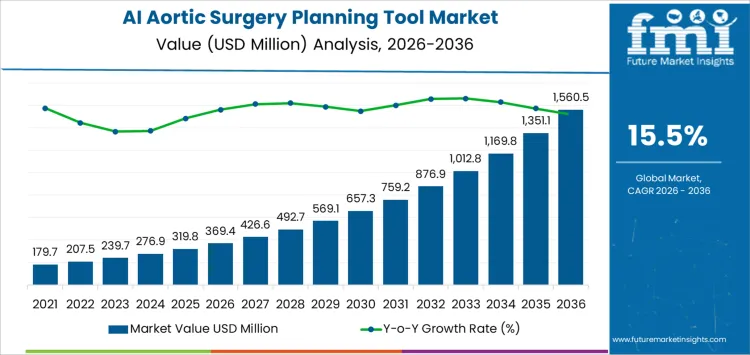
The AI aortic surgery planning tool market is expected to grow from USD 369.4 million in 2026 to USD 1,560.5 million by 2036, reflecting a compound annual growth rate (CAGR) of 15.5%. AI-driven surgical planning tools for aortic surgeries are transforming the field of cardiovascular surgery by providing surgeons with detailed, patient-specific simulations and predictions to optimize surgical outcomes. These tools utilize artificial intelligence to analyze patient data, such as imaging and genetic information, to develop personalized treatment plans for patients undergoing aortic surgery. The growing prevalence of aortic aneurysms and other vascular diseases, combined with the increasing demand for precision surgery and personalized medicine, is driving the demand for these tools.
The market's growth is also supported by advancements in AI technology, improvements in medical imaging, and the increasing focus on reducing surgical risks and improving recovery times. As healthcare providers adopt more advanced tools for preoperative planning, the AI aortic surgery planning tool market is expected to continue its rapid expansion over the next decade.
Quick Stats for AI Aortic Surgery Planning Tool Market
- AI Aortic Surgery Planning Tool Market Value (2026): USD 369.4 million
- AI Aortic Surgery Planning Tool Market Forecast Value (2036): USD 1,560.5 million
- AI Aortic Surgery Planning Tool Market Global Forecast CAGR (2026–2036): 15.50%
- Top Procedure Planning Focus by Share in AI Aortic Surgery Planning Tool Market: EVAR/TEVAR Sizing & Planning (46%)
- Key Growth Regions in AI Aortic Surgery Planning Tool Market: China, USA, UK, Germany, Japan
- Top Players in AI Aortic Surgery Planning Tool Market: Materialise, 3D Systems Healthcare, Siemens Healthineers, GE HealthCare, Philips, Aycan Medical Systems, TeraRecon, Vital Images (Canon), Mimics Innovation Suite ecosystem, Fujifilm Healthcare
What is the Growth Forecast for the AI Aortic Surgery Planning Tool Market through 2036?
The contribution of volume vs price growth for the AI aortic surgery planning tool market reveals how both factors play a role in the market's expansion. Starting at USD 369.4 million in 2026, the market grows to USD 426.1 million in 2027 and USD 491.9 million in 2028, reflecting both volume growth as the adoption of AI tools for surgical planning increases and potential price increases driven by advancements in technology.
From 2028 to 2030, the market continues to expand, reaching USD 567.8 million in 2029 and USD 655.4 million in 2030. Volume growth remains the primary driver during this phase as hospitals, surgical centers, and healthcare providers increasingly adopt AI-driven tools for more accurate preoperative planning. Between 2030 and 2035, the market accelerates with both volume and price growth contributing to the overall market value. The market reaches USD 756.6 million in 2031, USD 873.6 million in 2032, and USD 1,008.5 million in 2033, driven by the continued expansion of AI technology in surgical practice.
By 2035, the market is projected to reach USD 1,163.7 million, with the final value of USD 1,560.5 million expected in 2036. The contribution of volume vs price growth highlights that while volume growth continues to dominate, especially in the early years as adoption increases, price growth will also contribute as the tools become more advanced and sophisticated, leading to higher value per tool. This pattern reflects the increasing integration of AI technology into surgical workflows, driving both wider usage and higher prices as the tools evolve and offer more value to healthcare providers.
AI Aortic Surgery Planning Tool Market Key Takeaways
| Metric | Value |
|---|---|
| Industry Sales Value (2026) | USD 369.4 million |
| Industry Forecast Value (2036) | USD 1,560.5 million |
| Industry Forecast CAGR (2026-2036) | 15.5% |
What Is Driving the Demand for the AI Aortic Surgery Planning Tool Market Globally?
The global demand for AI aortic surgery planning tools is driven by rising prevalence of aortic disease and the need for precision in complex cardiovascular procedures. Conditions such as aortic aneurysms, dissections, and congenital malformations require detailed anatomical assessment to guide surgical or endovascular intervention. Traditional planning methods rely heavily on manual interpretation of imaging studies, which can be time consuming and subject to variability. AI enabled planning tools use machine learning and advanced image processing to automate segmentation, quantify vessel morphology, and simulate procedural scenarios. This supports more accurate sizing of grafts and stents, better prediction of post operative outcomes, and reduced risk of complications. As cardiovascular disease remains a leading cause of death worldwide and patient populations age, clinicians and healthcare systems seek technologies that improve procedural confidence and efficiency. Integration of AI with CT, MRI, and 3D imaging workflows enhances visualization, reduces planning time, and aids multidisciplinary teams in selecting optimal treatment strategies.
Future demand for AI aortic surgery planning tools is expected to grow as evidence of clinical benefit and workflow efficiencies accumulates. Advances in artificial intelligence and computational modelling will further refine predictive capabilities, including patient specific simulations and risk stratification. Wider adoption of minimally invasive and endovascular techniques, which require precise preoperative planning, will reinforce reliance on advanced planning software. Growth will also be supported by increasing investment in digital health and imaging infrastructure in emerging markets, where access to specialized planning resources has been limited. Regulatory clarity around AI medical software and reimbursement policies that recognise value in improved outcomes will influence adoption, particularly in systems that emphasise value based care. Education and training initiatives for surgeons and radiologists on AI tool integration will support clinical confidence. As healthcare systems focus on improving surgical outcomes, reducing operative time, and enhancing patient safety, demand for AI driven aortic surgery planning solutions is anticipated to expand steadily worldwide.
What Are the Key Segments in AI Aortic Surgery Planning Tool Market?
The AI aortic surgery planning tool market is segmented by procedure planning focus and AI function. EVAR/TEVAR sizing & planning leads the procedure planning focus segment with 46% of the market share, reflecting the growing demand for precise planning in endovascular aortic repair (EVAR) and thoracic endovascular aortic repair (TEVAR). Automated segmentation & centerline is the dominant AI function, holding 38% of the market share, due to its ability to enhance accuracy in identifying critical structures. The market is expanding as advancements in AI technology improve the accuracy, efficiency, and predictability of aortic surgery planning, enabling better patient outcomes.
Which Procedure Planning Focus Drives AI Aortic Surgery Planning Tool Market Demand Globally?
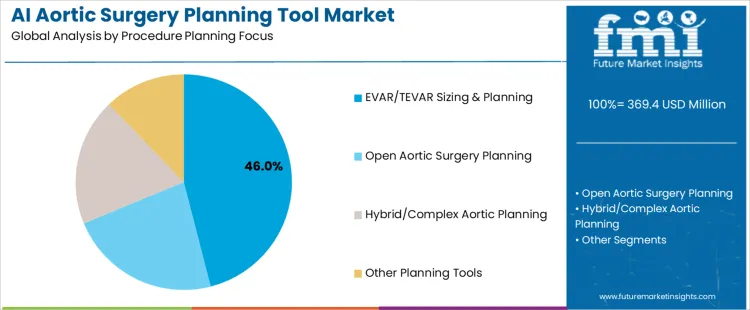
EVAR/TEVAR sizing & planning accounts for 46% of the market share. EVAR and TEVAR are minimally invasive procedures used to treat aortic aneurysms, and precise planning is essential to ensure the best possible outcome. AI-powered tools help clinicians accurately size and plan for these procedures by analyzing CT scans, measuring aortic dimensions, and selecting appropriate stent grafts. The demand for AI in EVAR/TEVAR planning has grown significantly as it improves surgical precision, reduces the risk of complications, and shortens planning time. With the increasing prevalence of aortic aneurysms and the shift towards less invasive procedures, EVAR/TEVAR sizing & planning remains a crucial segment in the market, driving the adoption of AI tools in surgical planning.
Which AI Function Drives AI Aortic Surgery Planning Tool Market Demand Globally?
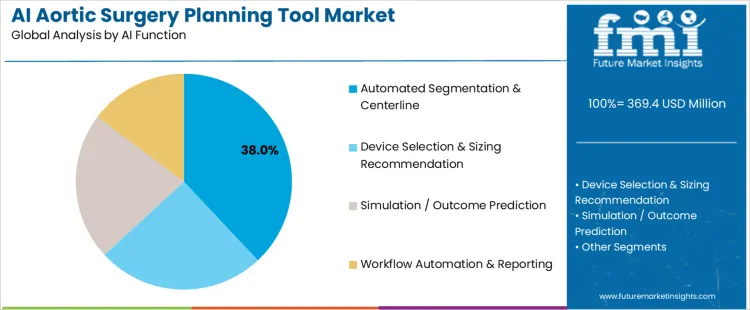
Automated segmentation & centerline leads the AI function segment with 38% of the market share. Automated segmentation involves the AI system identifying and isolating key structures, such as the aorta, from medical images, while centerline detection enables the accurate visualization of the aortic path, which is crucial for planning surgery. These AI-driven functions enhance the accuracy of measurements, reduce the time required for manual image analysis, and eliminate human error. As AI technology advances, the demand for automated segmentation and centerline detection continues to rise, making it a key driver in the aortic surgery planning tool market. Additionally, these tools improve surgical precision, leading to better patient outcomes and more efficient use of resources in aortic surgery planning.
What are the Key Dynamics of the Global AI Aortic Surgery Planning Tool Market?
The global AI aortic surgery planning tool market is expanding as healthcare providers adopt intelligent decision support systems to improve preoperative assessment and surgical outcomes for aortic conditions. These tools use artificial intelligence to analyse imaging data, model patient specific anatomy and assist clinicians with optimal procedural planning. Rising prevalence of aortic aneurysms, dissections and related vascular disorders increases demand for precision planning. Adoption spans hospitals, cardiovascular centres and specialist practices where advanced analytics help reduce operative risk, streamline workflow and support multidisciplinary treatment strategies worldwide.
What are the Key Drivers for the Global AI Aortic Surgery Planning Tool Market?
One key driver is increasing incidence of aortic diseases and related cardiovascular conditions, which creates demand for tools that help tailor surgical strategies to individual patient anatomy. Clinicians use AI enabled planning to interpret CT, MRI and 3D imaging data more accurately, potentially reducing intraoperative surprises. Growth in advanced imaging infrastructure and digital health technologies supports integration of planning tools into clinical workflows. Focus on improving outcomes and reducing procedure times motivates hospitals to invest in analytic platforms. Technological advances in machine learning, computer vision and predictive modelling enhance capabilities of planning tools and help clinicians assess risk, select device sizes and simulate surgical approaches.
What are the Restraints for the Global AI Aortic Surgery Planning Tool Market?
One restraint is variability in regulatory frameworks for clinical AI software, which can slow commercialisation and deployment across different markets. Demonstrating safety and efficacy requires rigorous clinical validation, and navigating approvals may require substantial time and investment. Integration with existing hospital picture archiving and communication systems, electronic medical records and imaging workflows demands technical resources, which can pose a barrier for smaller institutions. Clinician trust and familiarity with AI recommendations influence uptake, and some providers may prefer established protocols or require additional training. Cost of software licences and associated infrastructure may affect adoption where budgets are limited or reimbursement pathways for digital planning tools are absent.
What is the Key Trends in the Global AI Aortic Surgery Planning Tool Market?
A key trend is incorporation of advanced machine learning models that support automated segmentation of aortic structures and quantification of anatomical features relevant to surgical planning. Vendors are developing tools that offer interactive 3D visualisation, virtual simulation of device deployment and quantitative risk analytics to help clinicians explore multiple scenarios. Integration with cloud based platforms enables collaborative planning among multidisciplinary teams and remote expert review. Software that generates standardised reports and supports tracking of outcomes facilitates continuous quality improvement. Partnerships between AI developers, medical device manufacturers and clinical researchers help align tools with procedural needs and gather evidence that supports broader clinical adoption.
What is the Country-Wise Outlook for the AI Aortic Surgery Planning Tool Market?
The AI Aortic Surgery Planning Tool market is growing rapidly as healthcare providers increasingly adopt artificial intelligence (AI) to improve the precision and outcomes of aortic surgery. These AI-powered tools enable surgeons to plan procedures more accurately by analyzing imaging data and predicting surgical risks, which enhances patient safety and reduces complications. Countries such as China, the USA, and the UK are leading the growth in this market, driven by advancements in AI, a growing demand for personalized healthcare solutions, and the increasing prevalence of aortic diseases. In developed markets like Germany and Japan, AI-driven surgery planning tools are gaining traction due to their ability to optimize surgical workflows and improve patient outcomes. As the healthcare sector continues to embrace digital health technologies, the market for AI-powered aortic surgery planning tools is expected to expand across these regions.
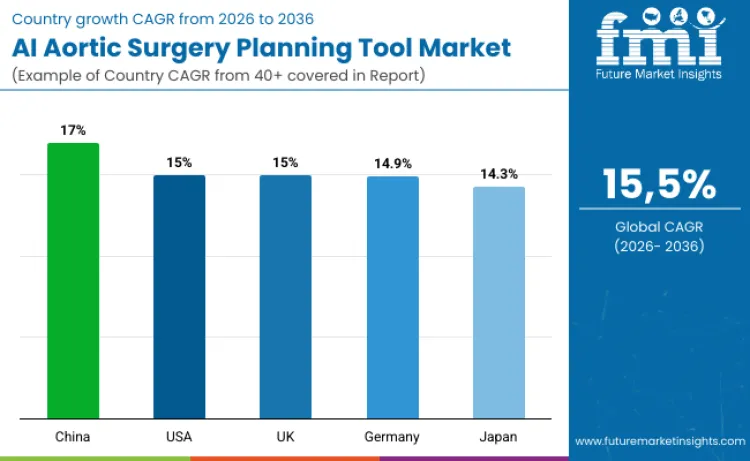
| Country | CAGR (2026 to 2036) |
|---|---|
| China | 17% |
| USA | 15% |
| UK | 15% |
| Germany | 14.9% |
| Japan | 14.3% |
What is Driving the Growth of the AI Aortic Surgery Planning Tool Market in China?
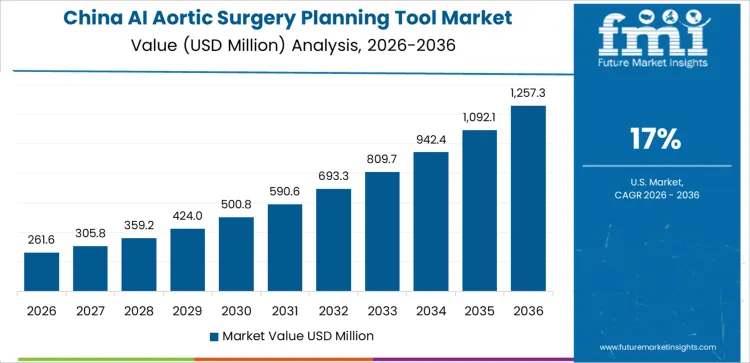
China’s AI Aortic Surgery Planning Tool market is projected to grow at a CAGR of 17%. The country’s rapidly expanding healthcare system and increasing investments in medical technology are driving the adoption of AI in surgery planning. With the rising prevalence of aortic diseases and the growing demand for precision medicine, AI-powered tools are becoming essential for improving the outcomes of aortic surgeries. China’s strong focus on healthcare modernization, coupled with advancements in AI and machine learning, is contributing to the market’s growth. The Chinese government’s initiatives to enhance healthcare access and the increasing use of digital health solutions in hospitals further support the demand for AI aortic surgery planning tools, driving market expansion.
What is Contributing to the Growth of the AI Aortic Surgery Planning Tool Market in the USA?
The USA’s AI Aortic Surgery Planning Tool market is expected to grow at a CAGR of 15%. The USA has a large number of hospitals and healthcare facilities increasingly integrating AI technologies to improve the accuracy and efficiency of surgeries. As the prevalence of aortic diseases such as aneurysms and dissections rises, there is a growing need for advanced tools that can help surgeons plan procedures more effectively. AI-driven aortic surgery planning tools enhance diagnostic precision and reduce surgical risks, contributing to better patient outcomes. The high adoption rate of AI in the USA, coupled with the growing focus on personalized healthcare and digital health technologies, is driving the market’s growth. As the demand for better surgical planning and patient care increases, the USA’s market for AI aortic surgery planning tools is expected to continue expanding.
What is Driving the AI Aortic Surgery Planning Tool Market Growth in the UK?
The UK’s AI Aortic Surgery Planning Tool market is projected to grow at a CAGR of 15%. With a well-established healthcare system and an increasing focus on precision medicine, AI is playing a critical role in enhancing surgical outcomes. The rising incidence of aortic diseases, combined with the demand for more effective and less invasive surgical approaches, is driving the adoption of AI-powered tools. These tools help optimize surgical planning, reduce risks, and improve post-operative care. As the UK continues to integrate AI into healthcare, with a focus on improving patient safety and reducing healthcare costs, the market for AI-driven aortic surgery planning tools is expected to grow steadily. Additionally, government initiatives to support digital health innovations further fuel market demand.
What is Influencing the Growth of the AI Aortic Surgery Planning Tool Market in Germany?
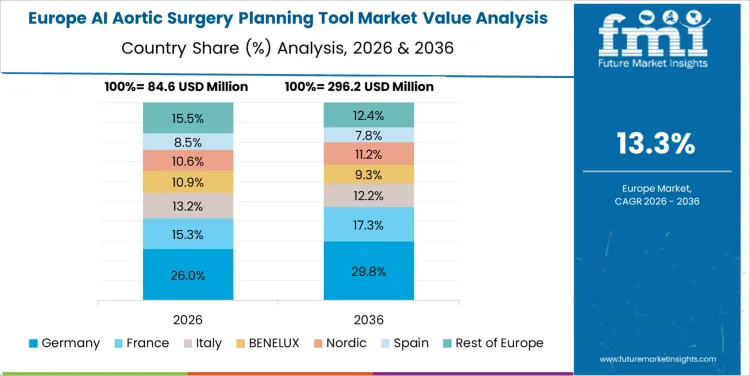
Germany’s AI Aortic Surgery Planning Tool market is expected to grow at a CAGR of 14.9%. Germany’s healthcare system is highly advanced, with a strong emphasis on improving patient outcomes through technological innovations. The rising prevalence of cardiovascular diseases, particularly those affecting the aorta, is driving the demand for more precise and efficient surgical planning. AI tools that enhance the planning process by predicting surgical outcomes and identifying risks are gaining traction in German hospitals. The country’s commitment to integrating AI in healthcare, alongside its focus on improving surgical precision and reducing recovery times, supports the market’s growth. As Germany continues to invest in digital health technologies, the demand for AI-powered aortic surgery planning tools is expected to rise.
What is Contributing to the Growth of the AI Aortic Surgery Planning Tool Market in Japan?
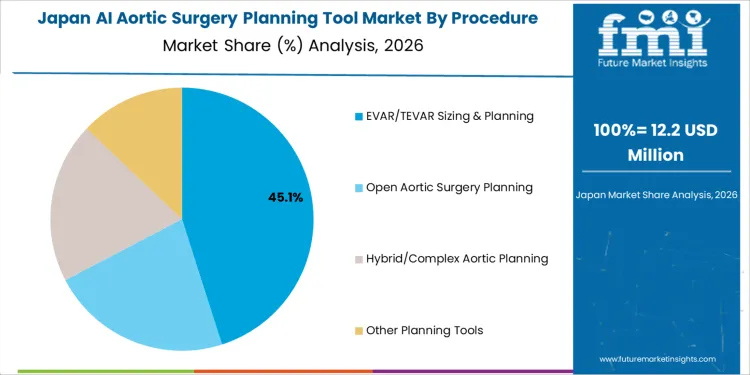
Japan’s AI Aortic Surgery Planning Tool market is projected to grow at a CAGR of 14.3%. Japan’s aging population and the increasing prevalence of cardiovascular diseases are key factors driving the demand for AI in surgical planning. AI-powered tools can help surgeons optimize procedures for aortic diseases, improving precision and reducing the likelihood of complications. Japan’s healthcare system is highly advanced, with a strong focus on integrating digital health solutions to improve patient care. The growing acceptance of AI in medical practice and the country’s commitment to healthcare innovation further support the adoption of AI-driven aortic surgery planning tools. As demand for more effective, personalized healthcare solutions rises, the market for these tools is expected to expand in Japan.
What is the Competitive Landscape for the AI Aortic Surgery Planning Tool Market?
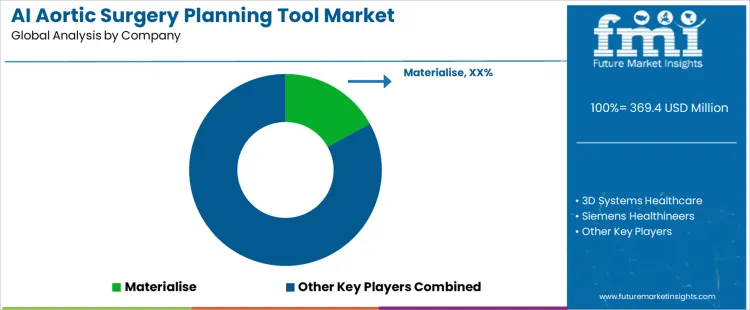
The AI Aortic Surgery Planning Tool Market is characterized by strong competition, with companies leveraging advanced AI and 3D imaging technologies to improve surgical planning and outcomes for aortic procedures. Materialise leads the market with its Mimics Innovation Suite, offering a comprehensive ecosystem that integrates AI for precise, patient-specific 3D models, allowing surgeons to plan and simulate complex aortic surgeries. Their strong focus on innovation and product integration positions them as a dominant player. Other key players, such as 3D Systems Healthcare, Siemens Healthineers, and GE HealthCare, also offer AI-based solutions that aid in preoperative planning and surgical simulation, improving accuracy and reducing surgical risks. Philips integrates AI with its imaging systems, focusing on seamless workflows for aortic surgery planning and personalized treatment.
Aycan Medical Systems, TeraRecon, and Vital Images (Canon) provide advanced imaging software with AI capabilities, specializing in aortic surgery planning tools. Aycan Medical Systems focuses on medical imaging software that enhances surgical precision, while TeraRecon and Vital Images offer solutions that utilize AI to create detailed 3D models and provide predictive analytics for aortic surgeries. Fujifilm Healthcare rounds out the competitive field with its AI-powered imaging tools that facilitate detailed surgical planning. These companies compete through technological innovation, product integration, and their ability to offer customizable solutions that cater to the evolving needs of cardiovascular surgeons. The competition is driven by advancements in AI, imaging accuracy, and the ability to improve surgical outcomes in complex aortic procedures.
Key Players of the AI Aortic Surgery Planning Tool Market
- Materialise
- 3D Systems Healthcare
- Siemens Healthineers
- GE HealthCare
- Philips
- Aycan Medical Systems
- TeraRecon
- Vital Images (Canon)
- Mimics Innovation Suite ecosystem
- Fujifilm Healthcare
Scope of the Report
| Items | Values |
|---|---|
| Quantitative Units (2026) | USD Billion |
| Procedure Planning Focus | EVAR/TEVAR Sizing & Planning, Open Aortic Surgery Planning, Hybrid/Complex Aortic Planning, Other Planning Tools |
| AI Function | Automated Segmentation & Centerline, Device Selection & Sizing Recommendation, Simulation / Outcome Prediction, Workflow Automation & Reporting |
| Deployment | Cloud / SaaS, On-Premise, Hybrid |
| Customer Type | Large Academic Hospitals, Community Hospitals, Vascular Specialty Centers, Other Customers |
| Companies | Materialise, 3D Systems Healthcare, Siemens Healthineers, GE HealthCare, Philips, Aycan Medical Systems, TeraRecon, Vital Images (Canon), Mimics Innovation Suite ecosystem, Fujifilm Healthcare |
| Regions Covered | North America, Latin America, Western Europe, Eastern Europe, South Asia and Pacific, East Asia, Middle East & Africa |
| Countries Covered | United States, Canada, Mexico, Brazil, Argentina, Germany, France, United Kingdom, Italy, Spain, Netherlands, China, India, Japan, South Korea, ANZ, GCC Countries, South Africa |
| Additional Attributes | Dollar by sales by procedure planning focus, AI function, deployment, customer type, and region. Includes market trends in AI aortic surgery planning tools, focusing on EVAR/TEVAR sizing, open aortic surgery planning, hybrid/complex aortic planning, and the role of AI in automated segmentation, device selection, simulation, and outcome prediction. Highlights cost-effectiveness, regulatory compliance, market share, competitive positioning of key companies, and the impact of cloud, on-premise, and hybrid deployment models. |
AI Aortic Surgery Planning Tool Market Segmentation
Procedure Planning Focus
- EVAR/TEVAR Sizing & Planning
- Open Aortic Surgery Planning
- Hybrid/Complex Aortic Planning
- Other Planning Tools
AI Function
- Automated Segmentation & Centerline
- Device Selection & Sizing Recommendation
- Simulation / Outcome Prediction
- Workflow Automation & Reporting
Deployment
- Cloud / SaaS
- On-Premise
- Hybrid
Customer Type
- Large Academic Hospitals
- Community Hospitals
- Vascular Specialty Centers
- Other Customers
Region
- Asia Pacific
- China
- Japan
- South Korea
- India
- Australia & New Zealand
- ASEAN
- Rest of Asia Pacific
- Europe
- Germany
- United Kingdom
- France
- Italy
- Spain
- Nordic
- BENELUX
- Rest of Europe
- North America
- United States
- Canada
- Mexico
- Latin America
- Brazil
- Chile
- Rest of Latin America
- Middle East & Africa
- Kingdom of Saudi Arabia
- Other GCC Countries
- Turkey
- South Africa
- Other African Union
- Rest of Middle East & Africa
Frequently Asked Questions
How big is the AI aortic surgery planning tool market in 2026?
The global AI aortic surgery planning tool market is estimated to be valued at USD 369.4 million in 2026.
What will be the size of AI aortic surgery planning tool market in 2036?
The market size for the AI aortic surgery planning tool market is projected to reach USD 1,560.5 million by 2036.
How much will be the AI aortic surgery planning tool market growth between 2026 and 2036?
The AI aortic surgery planning tool market is expected to grow at a 15.5% CAGR between 2026 and 2036.
What are the key product types in the AI aortic surgery planning tool market?
The key product types in AI aortic surgery planning tool market are evar/tevar sizing & planning, open aortic surgery planning, hybrid/complex aortic planning and other planning tools.
Which AI function segment to contribute significant share in the AI aortic surgery planning tool market in 2026?
In terms of AI function, automated segmentation & centerline segment to command 38.0% share in the AI aortic surgery planning tool market in 2026.
Preview the report firsthand - request a free sample
Get SampleGet the brochure for pricing and purchase details.
Get PDFTable of Content
- Executive Summary
- Global Market Outlook
- Demand-side Trends
- Supply-side Trends
- Technology Roadmap Analysis
- Analysis and Recommendations
- Market Overview
- Market Coverage / Taxonomy
- Market Definition / Scope / Limitations
- Market Background
- Market Dynamics
- Drivers
- Restraints
- Opportunity
- Trends
- Scenario Forecast
- Demand in Optimistic Scenario
- Demand in Likely Scenario
- Demand in Conservative Scenario
- Opportunity Map Analysis
- Product Life Cycle Analysis
- Supply Chain Analysis
- Investment Feasibility Matrix
- Value Chain Analysis
- PESTLE and Porter’s Analysis
- Regulatory Landscape
- Regional Parent Market Outlook
- Production and Consumption Statistics
- Import and Export Statistics
- Market Dynamics
- Global Market Analysis 2021 to 2025 and Forecast, 2026 to 2036
- Historical Market Size Value (USD Million) Analysis, 2021 to 2025
- Current and Future Market Size Value (USD Million) Projections, 2026 to 2036
- Y-o-Y Growth Trend Analysis
- Absolute $ Opportunity Analysis
- Global Market Pricing Analysis 2021 to 2025 and Forecast 2026 to 2036
- Global Market Analysis 2021 to 2025 and Forecast 2026 to 2036, By Procedure Planning Focus
- Introduction / Key Findings
- Historical Market Size Value (USD Million) Analysis By Procedure Planning Focus , 2021 to 2025
- Current and Future Market Size Value (USD Million) Analysis and Forecast By Procedure Planning Focus , 2026 to 2036
- EVAR/TEVAR Sizing & Planning
- Open Aortic Surgery Planning
- Hybrid/Complex Aortic Planning
- Other Planning Tools
- Y-o-Y Growth Trend Analysis By Procedure Planning Focus , 2021 to 2025
- Absolute $ Opportunity Analysis By Procedure Planning Focus , 2026 to 2036
- Global Market Analysis 2021 to 2025 and Forecast 2026 to 2036, By AI Function
- Introduction / Key Findings
- Historical Market Size Value (USD Million) Analysis By AI Function, 2021 to 2025
- Current and Future Market Size Value (USD Million) Analysis and Forecast By AI Function, 2026 to 2036
- Automated Segmentation & Centerline
- Device Selection & Sizing Recommendation
- Simulation / Outcome Prediction
- Workflow Automation & Reporting
- Y-o-Y Growth Trend Analysis By AI Function, 2021 to 2025
- Absolute $ Opportunity Analysis By AI Function, 2026 to 2036
- Global Market Analysis 2021 to 2025 and Forecast 2026 to 2036, By Deployment
- Introduction / Key Findings
- Historical Market Size Value (USD Million) Analysis By Deployment, 2021 to 2025
- Current and Future Market Size Value (USD Million) Analysis and Forecast By Deployment, 2026 to 2036
- Cloud / SaaS
- On-Premise
- Hybrid
- Y-o-Y Growth Trend Analysis By Deployment, 2021 to 2025
- Absolute $ Opportunity Analysis By Deployment, 2026 to 2036
- Global Market Analysis 2021 to 2025 and Forecast 2026 to 2036, By Customer Type
- Introduction / Key Findings
- Historical Market Size Value (USD Million) Analysis By Customer Type, 2021 to 2025
- Current and Future Market Size Value (USD Million) Analysis and Forecast By Customer Type, 2026 to 2036
- Large Academic Hospitals
- Community Hospitals
- Vascular Specialty Centers
- Other Customers
- Y-o-Y Growth Trend Analysis By Customer Type, 2021 to 2025
- Absolute $ Opportunity Analysis By Customer Type, 2026 to 2036
- Global Market Analysis 2021 to 2025 and Forecast 2026 to 2036, By Region
- Introduction
- Historical Market Size Value (USD Million) Analysis By Region, 2021 to 2025
- Current Market Size Value (USD Million) Analysis and Forecast By Region, 2026 to 2036
- North America
- Latin America
- Western Europe
- Eastern Europe
- East Asia
- South Asia and Pacific
- Middle East & Africa
- Market Attractiveness Analysis By Region
- North America Market Analysis 2021 to 2025 and Forecast 2026 to 2036, By Country
- Historical Market Size Value (USD Million) Trend Analysis By Market Taxonomy, 2021 to 2025
- Market Size Value (USD Million) Forecast By Market Taxonomy, 2026 to 2036
- By Country
- USA
- Canada
- Mexico
- By Procedure Planning Focus
- By AI Function
- By Deployment
- By Customer Type
- By Country
- Market Attractiveness Analysis
- By Country
- By Procedure Planning Focus
- By AI Function
- By Deployment
- By Customer Type
- Key Takeaways
- Latin America Market Analysis 2021 to 2025 and Forecast 2026 to 2036, By Country
- Historical Market Size Value (USD Million) Trend Analysis By Market Taxonomy, 2021 to 2025
- Market Size Value (USD Million) Forecast By Market Taxonomy, 2026 to 2036
- By Country
- Brazil
- Chile
- Rest of Latin America
- By Procedure Planning Focus
- By AI Function
- By Deployment
- By Customer Type
- By Country
- Market Attractiveness Analysis
- By Country
- By Procedure Planning Focus
- By AI Function
- By Deployment
- By Customer Type
- Key Takeaways
- Western Europe Market Analysis 2021 to 2025 and Forecast 2026 to 2036, By Country
- Historical Market Size Value (USD Million) Trend Analysis By Market Taxonomy, 2021 to 2025
- Market Size Value (USD Million) Forecast By Market Taxonomy, 2026 to 2036
- By Country
- Germany
- UK
- Italy
- Spain
- France
- Nordic
- BENELUX
- Rest of Western Europe
- By Procedure Planning Focus
- By AI Function
- By Deployment
- By Customer Type
- By Country
- Market Attractiveness Analysis
- By Country
- By Procedure Planning Focus
- By AI Function
- By Deployment
- By Customer Type
- Key Takeaways
- Eastern Europe Market Analysis 2021 to 2025 and Forecast 2026 to 2036, By Country
- Historical Market Size Value (USD Million) Trend Analysis By Market Taxonomy, 2021 to 2025
- Market Size Value (USD Million) Forecast By Market Taxonomy, 2026 to 2036
- By Country
- Russia
- Poland
- Hungary
- Balkan & Baltic
- Rest of Eastern Europe
- By Procedure Planning Focus
- By AI Function
- By Deployment
- By Customer Type
- By Country
- Market Attractiveness Analysis
- By Country
- By Procedure Planning Focus
- By AI Function
- By Deployment
- By Customer Type
- Key Takeaways
- East Asia Market Analysis 2021 to 2025 and Forecast 2026 to 2036, By Country
- Historical Market Size Value (USD Million) Trend Analysis By Market Taxonomy, 2021 to 2025
- Market Size Value (USD Million) Forecast By Market Taxonomy, 2026 to 2036
- By Country
- China
- Japan
- South Korea
- By Procedure Planning Focus
- By AI Function
- By Deployment
- By Customer Type
- By Country
- Market Attractiveness Analysis
- By Country
- By Procedure Planning Focus
- By AI Function
- By Deployment
- By Customer Type
- Key Takeaways
- South Asia and Pacific Market Analysis 2021 to 2025 and Forecast 2026 to 2036, By Country
- Historical Market Size Value (USD Million) Trend Analysis By Market Taxonomy, 2021 to 2025
- Market Size Value (USD Million) Forecast By Market Taxonomy, 2026 to 2036
- By Country
- India
- ASEAN
- Australia & New Zealand
- Rest of South Asia and Pacific
- By Procedure Planning Focus
- By AI Function
- By Deployment
- By Customer Type
- By Country
- Market Attractiveness Analysis
- By Country
- By Procedure Planning Focus
- By AI Function
- By Deployment
- By Customer Type
- Key Takeaways
- Middle East & Africa Market Analysis 2021 to 2025 and Forecast 2026 to 2036, By Country
- Historical Market Size Value (USD Million) Trend Analysis By Market Taxonomy, 2021 to 2025
- Market Size Value (USD Million) Forecast By Market Taxonomy, 2026 to 2036
- By Country
- Kingdom of Saudi Arabia
- Other GCC Countries
- Turkiye
- South Africa
- Other African Union
- Rest of Middle East & Africa
- By Procedure Planning Focus
- By AI Function
- By Deployment
- By Customer Type
- By Country
- Market Attractiveness Analysis
- By Country
- By Procedure Planning Focus
- By AI Function
- By Deployment
- By Customer Type
- Key Takeaways
- Key Countries Market Analysis
- USA
- Pricing Analysis
- Market Share Analysis, 2025
- By Procedure Planning Focus
- By AI Function
- By Deployment
- By Customer Type
- Canada
- Pricing Analysis
- Market Share Analysis, 2025
- By Procedure Planning Focus
- By AI Function
- By Deployment
- By Customer Type
- Mexico
- Pricing Analysis
- Market Share Analysis, 2025
- By Procedure Planning Focus
- By AI Function
- By Deployment
- By Customer Type
- Brazil
- Pricing Analysis
- Market Share Analysis, 2025
- By Procedure Planning Focus
- By AI Function
- By Deployment
- By Customer Type
- Chile
- Pricing Analysis
- Market Share Analysis, 2025
- By Procedure Planning Focus
- By AI Function
- By Deployment
- By Customer Type
- Germany
- Pricing Analysis
- Market Share Analysis, 2025
- By Procedure Planning Focus
- By AI Function
- By Deployment
- By Customer Type
- UK
- Pricing Analysis
- Market Share Analysis, 2025
- By Procedure Planning Focus
- By AI Function
- By Deployment
- By Customer Type
- Italy
- Pricing Analysis
- Market Share Analysis, 2025
- By Procedure Planning Focus
- By AI Function
- By Deployment
- By Customer Type
- Spain
- Pricing Analysis
- Market Share Analysis, 2025
- By Procedure Planning Focus
- By AI Function
- By Deployment
- By Customer Type
- France
- Pricing Analysis
- Market Share Analysis, 2025
- By Procedure Planning Focus
- By AI Function
- By Deployment
- By Customer Type
- India
- Pricing Analysis
- Market Share Analysis, 2025
- By Procedure Planning Focus
- By AI Function
- By Deployment
- By Customer Type
- ASEAN
- Pricing Analysis
- Market Share Analysis, 2025
- By Procedure Planning Focus
- By AI Function
- By Deployment
- By Customer Type
- Australia & New Zealand
- Pricing Analysis
- Market Share Analysis, 2025
- By Procedure Planning Focus
- By AI Function
- By Deployment
- By Customer Type
- China
- Pricing Analysis
- Market Share Analysis, 2025
- By Procedure Planning Focus
- By AI Function
- By Deployment
- By Customer Type
- Japan
- Pricing Analysis
- Market Share Analysis, 2025
- By Procedure Planning Focus
- By AI Function
- By Deployment
- By Customer Type
- South Korea
- Pricing Analysis
- Market Share Analysis, 2025
- By Procedure Planning Focus
- By AI Function
- By Deployment
- By Customer Type
- Russia
- Pricing Analysis
- Market Share Analysis, 2025
- By Procedure Planning Focus
- By AI Function
- By Deployment
- By Customer Type
- Poland
- Pricing Analysis
- Market Share Analysis, 2025
- By Procedure Planning Focus
- By AI Function
- By Deployment
- By Customer Type
- Hungary
- Pricing Analysis
- Market Share Analysis, 2025
- By Procedure Planning Focus
- By AI Function
- By Deployment
- By Customer Type
- Kingdom of Saudi Arabia
- Pricing Analysis
- Market Share Analysis, 2025
- By Procedure Planning Focus
- By AI Function
- By Deployment
- By Customer Type
- Turkiye
- Pricing Analysis
- Market Share Analysis, 2025
- By Procedure Planning Focus
- By AI Function
- By Deployment
- By Customer Type
- South Africa
- Pricing Analysis
- Market Share Analysis, 2025
- By Procedure Planning Focus
- By AI Function
- By Deployment
- By Customer Type
- USA
- Market Structure Analysis
- Competition Dashboard
- Competition Benchmarking
- Market Share Analysis of Top Players
- By Regional
- By Procedure Planning Focus
- By AI Function
- By Deployment
- By Customer Type
- Competition Analysis
- Competition Deep Dive
- Materialise
- Overview
- Product Portfolio
- Profitability by Market Segments (Product/Age /Sales Channel/Region)
- Sales Footprint
- Strategy Overview
- Marketing Strategy
- Product Strategy
- Channel Strategy
- 3D Systems Healthcare
- Siemens Healthineers
- GE HealthCare
- Philips
- Aycan Medical Systems
- TeraRecon
- Vital Images (Canon)
- Mimics Innovation Suite ecosystem
- Fujifilm Healthcare
- Materialise
- Competition Deep Dive
- Assumptions & Acronyms Used
- Research Methodology


