

- Market Size (2026)
- USD 1.0 Bn
- Forecast (2036)
- USD 1.9 Bn
- CAGR (2026 to 2036)
- 7.3%
How big is Anode Surface Treatments Market in 2026?
USD 1.0 Billion in 2026 and USD 1.9 Billion by 2036 at a 7.3% CAGR.
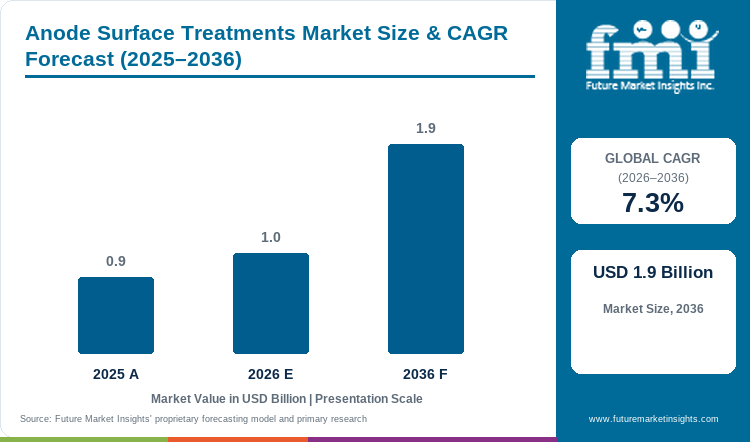
The Anode Surface Treatments market stood at USD 0.9 Billion in 2025, is estimated at USD 1.0 Billion in 2026, and is forecast to reach USD 1.9 Billion by 2036 at a 7.3% CAGR from 2026 to 2036.
Demand is moving from simple anode capacity toward tighter control of the particle-electrolyte interface. The International Energy Agency reported in May 2026 that EV battery deployment reached 1.2 TWh in 2025. That was almost 30% above 2024. EVs accounted for more than 70% of total battery deployment.
Surface treatments gain commercial relevance when cell makers seek faster charging or longer cycle life without replacing the full anode system. Carbon layers can reduce direct electrolyte contact and help stabilize the solid-electrolyte interphase. Polymer and oxide systems address other constraints. Changes in battery binders influence how treated anode particles behave in the finished electrode.
Silane and artificial SEI approaches extend the design space further. Anode-material producers therefore sell treatment performance as part of a qualified particle specification. Purchasing shifts when a treatment improves rate capability or swelling control while preserving first-cycle efficiency and production yield.
Country behavior reflects different points in the battery manufacturing build-out. A U.S. pilot project described by the Department of Energy explicitly tests lower-cost carbon coating precursors for domestically sourced graphite.
South Korea is linking cell, core-material, and raw-material clusters through a national battery triangle. Japan is emphasizing a 150 GWh domestic manufacturing base and next-generation batteries around 2030. Finland is planning upstream anode-material capacity around new industrial sites.
These conditions change which suppliers are credible and when. Mature cell ecosystems demand extensive qualification evidence. Newer upstream projects can design coating steps into plant specifications before operating procedures are fixed.
Interest becomes a purchase only after a treatment produces repeatable cell-level performance at commercial throughput and an acceptable delivered cost.
Key Takeaways
- The market is estimated at USD 1.0 Billion in 2026 and is forecast to reach USD 1.9 Billion by 2036 at a 7.3% CAGR.
- Carbon coating leads the Treatment Type category in 2026. Graphite leads the Anode Material category in 2026.
- Wet coating leads the Process category in 2026. EV cells lead the End Use category in 2026. Anode material producers lead the Sales Channel category in 2026.
- Driver: Higher EV battery deployment and faster charging increase the value of stable anode interfaces.
- Restraint: Cell qualification and scale-up reproducibility make treatment changes slow and costly.
- Opportunity: Silicon-rich anodes, artificial SEI concepts and regional material projects expand the addressable interface-engineering need. Finland has the highest profiled country CAGR at 7.2%, compared with Japan at 5.1%.
Analyst Perspective
Revenue capture will depend on proving interface gains without transferring process risk to the cell maker. A treatment must improve a measurable battery property at a loading and throughput that can survive scale-up.
- Nikhil Kaitwade, Principal Consultant, Future Market Insights
How is the Anode Surface Treatments Market segmented?
The market is segmented by Treatment Type, Anode Material, Process, End Use, and Sales Channel.
Treatment Type distinguishes the chemistry or interface layer applied to the anode surface. Anode Material separates mature graphite from silicon-containing, hard-carbon, and lithium-metal pilot platforms.
Process identifies how the surface is modified and therefore captures differences in equipment needs and coating control. End Use separates performance requirements across EV, storage, electronics, fast-charge, and pilot programs.
Sales Channel identifies where treatment value is purchased within the battery supply chain. Together these axes show whether the commercial value sits in the coating formulation, the treated particle, the production route, the cell requirement, or the supplier relationship.
What makes Carbon coating central to the Treatment Type category?
Carbon coating offers a practical balance between protection and electronic conductivity. On graphite it can reduce direct contact with the electrolyte and support formation of a more stable solid-electrolyte interphase.
On silicon-containing blends it can also help maintain conductive pathways as the active material expands and contracts. The treatment is compatible with pitch-derived carbon and other carbonaceous precursors that fit established thermal processing routes. Buyers still compare coating thickness and porosity.
They also test first-cycle efficiency and fast-charge response because excessive or poorly controlled carbon can add impedance or inactive mass. Its leadership therefore reflects manufacturing familiarity as well as a useful interface function.
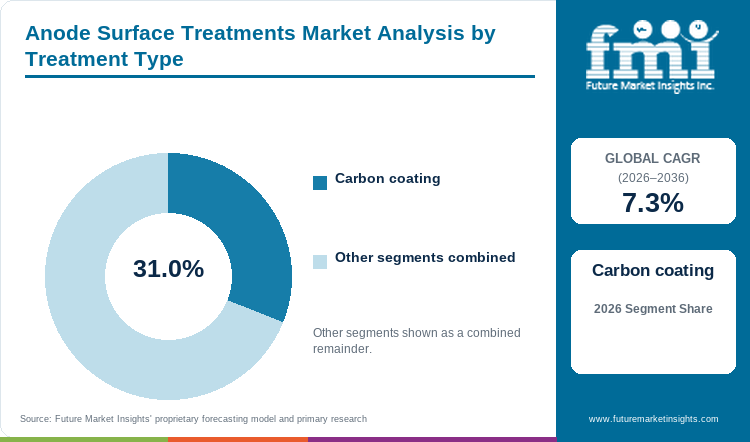
- Carbon coating represents 31.0% of the Treatment Type category in 2026. Its position reflects broad compatibility with commercial graphite and emerging silicon-containing anodes.
- Shanshan Technology reported in its 2024 ESG report published in May 2025 that its anode processes include coating and heat treatment, while silicon-anode production includes fluidized-bed carbon coating.
Why does Graphite anchor the Anode Material category?
Graphite remains the reference platform for commercial lithium-ion anodes, so surface modification is usually evaluated first against graphite economics and qualification practice. The interface controls electrolyte decomposition during formation and affects lithium-ion transport during charge.
That makes coatings relevant to fast-charge capability and low-temperature behavior. They can also influence gas generation and cycle stability without requiring a wholesale material-system change.
Natural and synthetic graphite also have mature particle-processing steps where coating can be integrated with spheroidization, heat treatment, or graphitization.
Silicon-graphite and silicon oxide are growing technical targets, but their higher expansion and more complex interface behavior increase the burden of process control and validation.
- Graphite represents 43.0% of the Anode Material category in 2026. Its scale gives treatment suppliers the largest installed qualification base for commercial surface-engineering programs.
- POSCO Future M stated in May 2026 that its next-generation silicon approach combines silicon nano-sizing with carbon composite technology, illustrating how graphite-era surface engineering is extending toward silicon-rich systems.
How does Wet coating lead the Process category?
Wet coating lets manufacturers tune a surface layer through precursor chemistry and solids content. Dispersion control and drying conditions provide additional levers. That flexibility is useful across carbon and polymer systems. It also supports oxide and silane formulations.
The route fits process knowledge already present in battery-material plants, which lowers the engineering barrier compared with adding vacuum deposition or plasma equipment. The trade-off is tight control of solvent removal and coating uniformity. Agglomeration and thermal conversion add further process variables.
A September 2025 technical review of graphite coating routes describes liquid-phase and vapor-phase deposition as the main families used for surface modification. For commercial buyers, the wet route remains attractive when it delivers uniform coverage without adding excessive drying cost or lot-to-lot variability.
- Wet coating represents 34.0% of the Process category in 2026. Its lead reflects formulation flexibility and compatibility with high-volume particle-processing workflows.
- Zhu and co-authors reported in September 2025 that common liquid-phase routes include hydrothermal, co-precipitation, and sol-gel methods alongside vapor-phase alternatives.
What supports EV cells within the End Use category?
EV cells put surface treatments under a demanding combination of charge rate and calendar life. Cycle life, energy density, and warranty expectations raise the bar further. Small interface improvements can matter when millions of cells must meet the same performance envelope. Comparable qualification pressure surrounds cathode battery materials inside the finished cell.
The IEA reported in May 2026 that EV battery deployment reached 1.2 TWh in 2025 and represented more than 70% of total battery deployment. That volume makes automotive qualification a major commercial filter for anode treatments.
Energy-storage and consumer applications can accept different trade-offs, while fast-charge cells push interface kinetics even harder. EV programs therefore lead because they combine high material volume with strict requirements for stable production and repeatable cell behavior.
- EV cells represent 55.0% of the End Use category in 2026. The segment combines the largest battery-demand pool with stringent validation of cycle life and charging behavior.
- The IEA reported in May 2026 that global EV battery deployment increased by almost 30% in 2025, reinforcing the scale of automotive demand that anode-interface suppliers must serve.
What drives Anode material producers in the Sales Channel category?
Surface treatment changes the specification of an anode particle before it reaches electrode mixing. That places anode-material producers in a natural position to own coating formulation and heat treatment. Quality control and lot release remain under the same upstream system.
A cell maker can then qualify a treated material instead of installing a separate particle-treatment step. This channel is especially important when coating performance depends on upstream particle morphology or graphitization conditions.
Direct cell-maker relationships remain important for co-development, while specialists can provide novel chemistries or process know-how. The commercial advantage of the upstream producer is integration: it can deliver a treated active material with one quality system and one qualification history.
- Anode material producers represent 43.0% of the Sales Channel category in 2026. Their lead reflects control of the particle before electrode manufacturing and the ability to bundle treatment with active-material qualification.
- BTR New Material showed fast-charging and silicon-based anode solutions at CIBF in May 2025, demonstrating how anode producers package surface and particle engineering into customer-facing material platforms.
What are the drivers, restraints, and opportunities in the Anode Surface Treatments Market?
EV battery scale and fast-charge requirements raise the value of interface control, while qualification and process reproducibility slow switching, and silicon-rich or localized anode programs create new treatment openings.
- Driver: Higher EV battery deployment and faster charging increase the value of stable anode interfaces.
- Restraint: Cell qualification and scale-up reproducibility make treatment changes slow and costly.
- Opportunity: Silicon-rich anodes, artificial SEI concepts, and regional material projects expand the addressable interface-engineering need.
The driver is not battery volume alone. It is the combination of volume with harder performance targets at the anode interface. The IEA reported in May 2026 that EV battery deployment reached 1.2 TWh in 2025 and could approach 3 TWh by 2030.
Faster charging increases the risk of lithium plating when graphite surfaces cannot accept lithium ions quickly enough. Surface treatments are purchased when they improve interfacial stability or transport without reducing energy density and yield.
This creates recurring demand for carbon coatings and other engineered layers because the treatment becomes part of an approved active-material specification rather than a discretionary finishing step.
Qualification is the binding restraint because a surface change can alter several cell properties at once. A September 2025 review of graphite coating strategies shows that coating chemistry and deposition route influence ionic transport, electrical conduction, and interface stability.
A layer that performs in a laboratory cell can still fail commercial tests through poor coverage or excess impedance. Scale-up can add solvent handling and heat-treatment requirements. Vacuum or plasma routes add different equipment burdens. Cell makers therefore resist switching after a material has been qualified.
Suppliers must prove lot-to-lot consistency and production throughput before a new treatment can displace an established surface specification.
The strongest opportunity sits where interface instability is already a commercialization problem. Silicon-containing anodes offer higher capacity but introduce expansion and repeated interface disruption. Lithium-metal pilots face even more demanding interphase control.
In February 2026 the U.S. Department of Energy described a graphite-anode pilot program that includes research on low-cost carbon coating precursors while reducing waste and heat-treatment energy.
That combination points to the commercial opening: treatments must improve electrochemical behavior and become cheaper to manufacture. Anode producers and surface specialists that can integrate treatment with regional pilot lines can qualify earlier in the development cycle and avoid retrofitting a mature cell process.
Which country CAGRs are profiled in the Anode Surface Treatments Market?
| Country | CAGR |
|---|---|
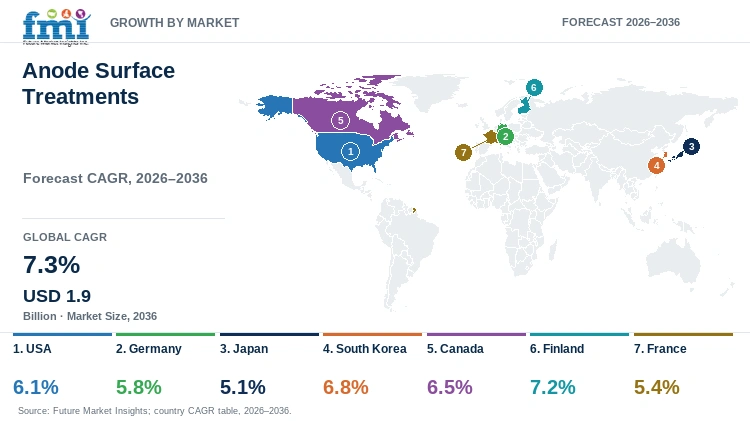
| USA | 6.1% |
| Germany | 5.8% |
| Japan | 5.1% |
| South Korea | 6.8% |
| Canada | 6.5% |
| Finland | 7.2% |
| France | 5.4% |
How do country-level CAGRs compare in the Anode Surface Treatments Market?
The seven profiled countries span a 2.1 percentage-point range between Finland at 7.2% and Japan at 5.1% from 2026 to 2036. Finland, South Korea, and Canada form the faster-growth band. The USA and Germany sit in the middle. France and Japan form the lower-growth band.
These rates describe the pace of expansion rather than absolute market size. Faster profiles tend to coincide with new upstream capacity or active industrial-policy support.
Slower profiles often reflect more mature battery ecosystems where qualification cycles, established suppliers, and cost benchmarks make replacement harder even when end-market demand remains substantial.
- Finland at 7.2% and South Korea at 6.8% are separated by 0.4 percentage points. Both reward suppliers that enter while new material infrastructure and technical standards are still being shaped.
- Canada at 6.5% and the USA at 6.1% are also separated by 0.4 percentage points. Localization programs create openings, but suppliers still need a credible path from pilot coating to commercial anode qualification.
- The USA at 6.1% and Germany at 5.8% form a mature middle band. Competitive advantage depends less on announcing capacity and more on proving cost, yield, and repeatability in established battery-manufacturing workflows.
- France at 5.4% and Japan at 5.1% show the slowest profiled rates. Suppliers must align with national industrial strategies while overcoming entrenched material specifications and long automotive validation cycles.
CAGR alone cannot determine commercial priority. A slower-growing country may still contain a larger installed cell base or more demanding premium programs. A faster-growing country may start from a smaller treatment revenue pool and depend on a few new facilities.
Supplier strategy should therefore combine growth rate with customer concentration and qualification timing. Local production plans and energy economics also matter, as does the position of anode processing in the domestic value chain.
The broader report covers additional countries and regions so these seven profiles can be read in context.
Country-wise Analysis
- USA: U.S. buyers increasingly connect anode sourcing with domestic processing and traceable qualification. Demand for Anode Surface Treatments in the USA is forecast to expand at 6.1% CAGR from 2026 to 2036. In February 2026 the U.S. Department of Energy described a pilot project for graphite anode material that will also explore low-cost carbon coating precursors and lower-energy heat treatment. The friction is the jump from pilot chemistry to repeatable automotive-scale output under local cost constraints. Suppliers need to show that coating performance survives commercial throughput while fitting domestic graphite conversion and cell-qualification programs.
- Germany: German battery programs tend to evaluate surface modification as part of an integrated electrode-production process rather than as an isolated material claim. Demand for Anode Surface Treatments in Germany is forecast to expand at 5.8% CAGR from 2026 to 2036. Fraunhofer FFB reported in September 2026 that it had validated roll-to-roll S-ALD coatings on graphite-based negative electrodes, including artificial passivation layers designed to act as SEI on anodes. The local friction is industrial transfer from research-scale performance into qualified production economics. Suppliers need strong process data and equipment integration support so new surface treatments do not destabilize yield or cycle-time targets.
- Japan: Japanese battery procurement emphasizes stable quality and long qualification histories across upstream materials. Demand for Anode Surface Treatments in Japan is forecast to expand at 5.1% CAGR from 2026 to 2036. In June 2026 METI revised its battery strategy with a target for a 150 GWh annual domestic manufacturing base from 2030 into the mid-2030s and full-scale all-solid-state commercialization around 2030. The friction is conservative material switching when incumbent graphite specifications already meet production needs. Suppliers must connect surface-treatment performance to measurable gains in power density, safety, or next-generation interface stability.
- South Korea: South Korean buyers operate within a dense cell and battery-material ecosystem where suppliers are expected to co-develop against specific customer targets. Demand for Anode Surface Treatments in South Korea is forecast to expand at 6.8% CAGR from 2026 to 2036. In September 2026 the South Korean industry ministry launched a battery triangle that links cell production with core materials and raw-material hubs while reviewing new next-generation battery infrastructure. The friction is rapid technical iteration combined with demanding customer qualification. Suppliers need local application support and the ability to adjust treatment chemistry without losing lot consistency or scale economics.
- Canada: Canadian commercialization is shaped by the need to move material science into domestic midstream manufacturing. Demand for Anode Surface Treatments in Canada is forecast to expand at 6.5% CAGR from 2026 to 2036. Natural Resources Canada identified anodes and coatings as strategic areas in its Emerging and Critical Materials Program as of January 2025. It also included electrolytes and battery-material manufacturing scale-up. The friction is converting laboratory or pilot coating capability into continuous production with bankable quality control. Suppliers that pair surface chemistry with scale-up engineering can fit the country’s effort to build more of the battery value chain domestically.
- Finland: Finnish purchasing opportunities are tied closely to new industrial projects that can embed surface-treatment choices before commissioning. Demand for Anode Surface Treatments in Finland is forecast to expand at 7.2% CAGR from 2026 to 2036. In July 2025 the City of Kotka announced a land reservation for Grafintec to advance a graphite anode material plant in the Keltakallio industrial area. The friction is that project schedules and final investment decisions determine when material demand becomes recurring revenue. Treatment suppliers need to engage during plant and product design while proving compatibility with European customer qualification and local energy-cost requirements.
- France: French buyers increasingly operate within an industrial policy that connects gigafactory scale with locally developed materials and components. Demand for Anode Surface Treatments in France is forecast to expand at 5.4% CAGR from 2026 to 2036. In March 2026 the French government launched France Batterie with a roadmap targeting 100 to 120 GWh of battery production capacity by 2030 and stronger domestic materials development. The friction is that upstream treatments must still compete with qualified imported material systems. Suppliers need to combine European production credibility with cell-level evidence that justifies a surface-specification change.
Who are the notable companies in the Anode Surface Treatments Market?
BTR New Material and Shanshan Technology are profiled. SGL Carbon and Tokai Carbon are also covered. Resonac and JFE Chemical are also covered. POSCO Future M and Epsilon Advanced Materials are also covered. NEI Corporation and Cabot Corporation complete the notable-company set.
Competitive positioning follows control of the anode particle and the ability to carry an interface concept through cell qualification. Integrated suppliers include BTR New Material and Shanshan Technology alongside JFE Chemical and POSCO Future M.
These companies combine active-material production with coating, heat treatment, or next-generation anode development. Tokai Carbon and Resonac compete from deep graphite-processing positions.
SGL Carbon is still relevant as a technical benchmark, but its 2025 annual report states that graphite anode production was discontinued in 2025. Epsilon Advanced Materials is building an ex-China anode platform and adding hard carbon and silicon-graphite programs.
NEI Corporation serves specialty development with configurable silicon-graphite electrodes. Cabot Corporation participates through conductive carbon systems that can support electrode conductivity and interface performance.
The result is competition between integrated particle suppliers and enabling specialists rather than a single supplier archetype.
- Integrated anode and surface-engineering platforms: BTR New Material, Shanshan Technology, JFE Chemical and POSCO Future M combine particle processing with commercial anode-material supply.
- Graphite specialists with battery-anode positions: SGL Carbon, Tokai Carbon and Resonac bring graphite processing knowledge, though SGL Carbon has exited graphite anode production.
- Emerging and enabling surface-treatment suppliers: Epsilon Advanced Materials, NEI Corporation, and Cabot Corporation target new anode chemistries or conductive-interface requirements.
Competitive Benchmarking: Anode Surface Treatments Market
| Company | Graphite Surface Modification | Next-Generation Anode Interface | Cell-Qualification Scale | Geographic Reach |
|---|---|---|---|---|
| BTR New Material | High | High | High | China, Indonesia, and international battery-material markets |
| Shanshan Technology | High | High | High | China with European expansion and global cell customers |
| SGL Carbon | Medium | Low | Low | Europe; graphite anode production discontinued in 2025 |
| Tokai Carbon | Medium | Low | Medium | Japan with supply to battery manufacturers and international end markets |
| Resonac | Medium | Low | Medium | Japan and international graphite markets |
| JFE Chemical | High | Medium | Medium | Japan and Asian battery-material markets |
| POSCO Future M | High | High | High | South Korea with global battery-customer pathways |
| Epsilon Advanced Materials | Medium | High | Medium | India with U.S. and European expansion programs |
| NEI Corporation | Medium | High | Low | United States with specialty and development customers |
| Cabot Corporation | Low | Low | Low | Global conductive-carbon manufacturing and battery customers |
Scoring basis: Graphite Surface Modification measures documented coating and heat-treatment capability. It also covers particle modification or closely related graphite-anode capability. Next-Generation Anode Interface measures documented work in silicon and silicon oxide.
Hard carbon, lithium-metal-adjacent, and engineered-interface systems are also included. Cell-Qualification Scale measures evidence of industrial anode supply or a defined customer-qualification path. High indicates broad documented capability. Medium indicates credible but narrower capability.
Low is used only for a documented limitation, which applies to SGL Carbon after its 2025 graphite-anode exit. Unavailable public information is left Low rather than converted to Low.
Key Developments in the Anode Surface Treatments Market
- In May 2026, POSCO Future M announced that it had secured mass-production technology for silicon anode materials. The company described silicon nano-sizing and carbon composite technology as ways to reduce the expansion that complicates silicon commercialization. It is targeting mass production and supply in 2028. The development matters because it brings surface and composite engineering closer to a defined industrial qualification path for higher-capacity anodes.
- In August 2026, Epsilon Advanced Materials announced that its anode material project had received approval under India’s Electronics Components Manufacturing Scheme. The approval adds policy support to the company’s effort to scale domestic anode-material production. For surface-treatment suppliers, the consequence is an additional ex-China qualification platform where coating and particle-engineering choices can be specified during scale-up rather than retrofitted after a cell process is fixed.
- In May 2025, BTR New Material introduced solid-state and semi-solid battery material solutions at CIBF 2025 that included silicon-based anodes and lithium-carbon composite anodes. The company also presented fast-charging anode solutions and an R graphite renewal concept. The release widens the set of anode interfaces that can be addressed within one upstream material platform, increasing the importance of treatment compatibility across conventional and next-generation particle systems.
Key Players in the Anode Surface Treatments Market
Integrated Anode-Material and Surface-Engineering Platforms
- BTR New Material
- Shanshan Technology
- JFE Chemical
- POSCO Future M
Graphite Specialists with Battery-Anode Positions
- SGL Carbon
- Tokai Carbon
- Resonac
Emerging and Enabling Interface Suppliers
- Epsilon Advanced Materials
- NEI Corporation
- Cabot Corporation
Anode Surface Treatments Market - Report Scope
| Coverage field | Report scope |
|---|---|
| Market breakdown | Treatment Type; Anode Material; Process; End Use; Sales Channel |
| Quantitative Units | USD Billion |
| Market Definition | Revenue includes commercial anode surface-treatment materials, paid surface-treatment services, and the treatment value embedded in purpose-made treated anode active materials within the stated segmentation universe. It excludes downstream finished electrodes, cells, packs, vehicles, and adjacent or substitute products not sold as anode surface treatments. |
| Regions Covered | North America; Latin America; Western Europe; Eastern Europe; East Asia; South Asia and Pacific; Middle East and Africa |
| Countries Covered | USA, Germany, Japan, South Korea, Canada, Finland, France, and more than twenty-five additional countries in the full report |
| Key Companies Profiled | BTR New Material, Shanshan Technology, SGL Carbon, Tokai Carbon, Resonac, JFE Chemical, POSCO Future M, Epsilon Advanced Materials, NEI Corporation, Cabot Corporation |
| Forecast Period | 2026 to 2036 |
| Approach | Hybrid bottom-up and top-down sizing using treatment economics, treated-anode activity, battery demand, and cross-checks across applications and sales channels. |
Anode Surface Treatments Market - Research Methodology
| Method | Approach |
|---|---|
| Primary Research | FMI consults battery-material makers and surface-treatment specialists. Cell makers and equipment partners clarify buying roles and process qualification. The research tests purchase criteria and adoption barriers. |
| Desk Research | FMI reviews government battery programs and company filings. Technical product documentation and interface research explain the treatment mechanism. Sources are retained when they support the defined market boundary. |
| Market Sizing and Forecasting | FMI reconciles treatment value with treated-anode activity and battery demand. Forecasts reflect process maturity and qualification timing. Country conditions and channel structure are checked against the revenue boundary. |
| Data Validation | Findings are checked against independent evidence. The estimate excludes downstream finished products and adjacent substitutes. Duplicate material and service value is removed. |
Anode Surface Treatments Market by Segments
Anode Surface Treatments Market segmented by Treatment Type:
- Carbon coating
- Oxide surface treatment
- Polymer coating
- Silane treatment
- Artificial SEI treatment
Anode Surface Treatments Market segmented by Anode Material:
- Graphite
- Silicon-graphite
- Silicon oxide
- Hard carbon
- Lithium metal pilot
Anode Surface Treatments Market segmented by Process:
- Wet coating
- Dry coating
- CVD/PVD
- Plasma treatment
- Thermal treatment
Anode Surface Treatments Market segmented by End Use:
- EV cells
- Energy storage cells
- Consumer electronics
- Fast-charge cells
- R&D/pilot lines
Anode Surface Treatments Market segmented by Sales Channel:
- Anode material producers
- Cell makers direct
- Surface treatment specialists
- Battery equipment partners
Anode Surface Treatments Market by Region:
- North America
- United States
- Canada
- Latin America
- Brazil
- Mexico
- Argentina
- Chile
- Western Europe
- Germany
- France
- United Kingdom
- Italy
- Spain
- Benelux
- Nordics
- Eastern Europe
- Poland
- Czech Republic
- Romania
- Hungary
- East Asia
- China
- Japan
- South Korea
- South Asia and Pacific
- India
- ASEAN
- Australia and New Zealand
- Middle East and Africa
- GCC Countries
- South Africa
- Türkiye
- Israel
Research Sources and Bibliography
- International Energy Agency (2026, May 20). Global EV Outlook 2026: Electric vehicle batteries.
- Zhu, X., Cao, B., Yan, C., Tang, C., Chen, A., & Zhang, Q. (2025, September). Advances in coating strategies for graphite anodes in lithium-ion batteries. Acta Physico-Chimica Sinica, 41(9), 100096.
- U.S. Department of Energy (2026, February 24). Flexible Pilot Plant for Producing Graphite Anode Material from North American Sources for Li-Ion Batteries.
- Fraunhofer Research Institution for Battery Cell Production FFB (2026, September 3). Electrode production and validation for S-ALD coatings.
- Ministry of Economy, Trade and Industry, Japan (2026, June 2). Battery Industry Strategy revised as the Battery and Power Industry Strategy.
- Ministry of Trade, Industry and Resources, Republic of Korea (2026, September 1). Battery triangle linking Chungcheong, Yeongnam, and Honam enters full operation.
- Natural Resources Canada (2025, January 16). Emerging and critical materials.
- City of Kotka (2025, July 1). A second battery industry project for Keltakallio in Kotka: Grafintec reserves a plot for an anode material factory.
- French Ministry of the Economy and Finance (2026, March 24). Avec France Batterie, la France structure une filière compétitive et souveraine.
- POSCO Future M (2026, May 20). POSCO Future M secures mass-production technology for silicon anode materials.
- BTR New Material Group (2025, May 17). BTR unveils breakthrough solid-state battery solutions and closed-loop recycling at CIBF2025.
- Resonac Graphite Business Unit (2025, May 14). ESTM business line.
- Ningbo Shanshan Co., Ltd. (2025, May 9). 2024 Environmental, Social and Governance Report.
- Epsilon Advanced Materials (2026, August 18). Epsilon’s Anode Material Project Receives Approval under MeitY’s Electronics Components Manufacturing Scheme.
- SGL Carbon SE (2026, March 19). Annual Report 2025.
This bibliography is provided for reader reference and is not exhaustive. The full report contains the complete reference list and detailed citations.
This Report Answers
- What is the size of the Anode Surface Treatments Market in 2026 and what value is forecast for 2036?
- Which battery-industry pressures support demand for anode surface treatments?
- Why does Carbon coating hold the leading position within Treatment Type?
- How does Graphite influence downstream demand for surface modification across commercial lithium-ion cells?
- Why does Wet coating hold the leading position within Process?
- How do the profiled country growth rates compare for the Anode Surface Treatments market?
- Which companies provide integrated anode materials, graphite expertise, or enabling interface technologies?
- How do qualification requirements and scale-up reproducibility limit adoption of new surface treatments?
Frequently Asked Questions
What is driving growth in the Anode Surface Treatments Market?
Growth is being driven by higher EV battery deployment and tighter fast-charge or cycle-life requirements that increase the value of stable anode interfaces. Surface treatments gain revenue when they improve cell performance without forcing a costly redesign of the qualified anode system.
Who are the key players in the Anode Surface Treatments Market?
BTR New Material, Shanshan Technology and SGL Carbon are among the profiled companies. Other suppliers listed under Key Players span graphite processing and interface technologies.
What notable restraint affects the Anode Surface Treatments Market?
The main restraint is qualification risk because a new surface layer can change impedance and first-cycle efficiency while also affecting gas generation and long-term cycling. Cell makers therefore demand repeatable coating quality and scale evidence before replacing an established anode specification.
Why should executives track the Anode Surface Treatments Market?
Surface treatment is becoming a strategic control point as battery makers push graphite and silicon-containing anodes toward faster charging and higher energy density. Tracking the market helps executives identify where interface engineering can protect qualification positions or open new upstream supply relationships.
What business problem does the Anode Surface Treatments Market address?
The market addresses unstable reactions and transport limits at the surface of battery anode materials. Suppliers use coatings or other treatments to manage electrolyte contact and solid-electrolyte interphase behavior while also controlling conductivity, swelling, and charging response.
What should battery-material procurement teams evaluate in the Anode Surface Treatments Market?
Teams should compare electrochemical benefit with coating uniformity and added inactive mass while also reviewing process throughput, lot consistency, and integration cost. They should also require cell-level qualification evidence that reflects the intended graphite or silicon blend and the target charging window.
What limits return on investment in the Anode Surface Treatments Market?
Return on investment falls when the treatment adds process cost or capital without producing a durable cell-level gain. Low yield and long requalification cycles can erase the value of improved laboratory performance, especially when drying energy or heat-treatment energy is high and coating thickness is inconsistent.
What supports long-term commercial confidence in the Anode Surface Treatments Market?
Long-term confidence comes from sustained battery deployment and the need to manage more demanding anode interfaces as fast charging and silicon content increase. Confidence is strongest for treatments that can be produced consistently at scale and remain embedded in recurring qualified material specifications.
Preview the report firsthand - request a free sample
Get SampleGet the brochure for pricing and purchase details.
Get PDFTable of Content
- Key Takeaways
- Market Size and CAGR
- Top Growth Driver
- Fastest Growing Segment
- Leading Region
- Key Companies
- Emerging Opportunities
- Executive Summary
- Global Market Outlook
- Demand-side Trends
- Supply-side Trends
- Technology Roadmap Analysis
- Analysis and Recommendations
- Analyst Perspective (What is happening? Why now? What should investors know?)
- Key Questions Answered
- How large is the market?
- What is the CAGR?
- What are key trends?
- Which region dominates?
- Who are the leaders?
- Market Overview
- Market Coverage / Taxonomy
- Market Definition / Scope / Limitations
- Research Methodology
- Chapter Orientation
- Analytical Lens and Working Hypotheses
- Market Structure, Signals, and Trend Drivers
- Benchmarking and Cross-market Comparability
- Market Sizing, Forecasting, and Opportunity Mapping
- Research Design and Evidence Framework
- Desk Research Programme (Secondary Evidence)
- Expert Input and Fieldwork (Primary Evidence)
- Tooling, Models, and Reference Databases
- Data Engineering and Model Build
- Quality Assurance and Audit Trail
- Market Background
- Market Dynamics (Drivers, Restraints, Opportunity, Trends)
- Scenario Forecast (Optimistic, Likely, Conservative)
- Impact Analysis
- AI Impact
- Sustainability Impact
- Regulatory Impact
- Technology Impact
- Consumer / Buyer Analysis
- Purchase Drivers
- Adoption Barriers
- Buyer Journey
- Opportunity Map Analysis
- Product Life Cycle Analysis
- Supply Chain Analysis
- Investment Feasibility Matrix
- Value Chain Analysis
- PESTLE and Porter's Analysis
- Regulatory Landscape
- Regional Parent Market Outlook
- Production and Consumption Statistics
- Import and Export Statistics
- Global Market Analysis and Forecast, 2021 to 2036
- Historical Market Size Value (USD Billion) Analysis, 2021 to 2025
- Current and Future Market Size Value (USD Billion) Projections, 2026 to 2036
- Y-o-Y Growth Trend Analysis
- Absolute $ Opportunity Analysis
- Global Market Pricing Analysis, 2021 to 2036
- Global Market Analysis and Forecast, By Treatment Type, 2021 to 2036
- Introduction / Key Findings
- Historical Market Size Value (USD Billion) Analysis By Treatment Type, 2021 to 2025
- Current and Future Market Size Value (USD Billion) Analysis and Forecast By Treatment Type, 2026 to 2036
- Carbon coating
- Oxide surface treatment
- Polymer coating
- Silane treatment
- Artificial SEI treatment
- Y-o-Y Growth Trend Analysis By Treatment Type, 2021 to 2025
- Absolute $ Opportunity Analysis By Treatment Type, 2026 to 2036
- Global Market Analysis and Forecast, By Anode Material, 2021 to 2036
- Introduction / Key Findings
- Historical Market Size Value (USD Billion) Analysis By Anode Material, 2021 to 2025
- Current and Future Market Size Value (USD Billion) Analysis and Forecast By Anode Material, 2026 to 2036
- Graphite
- Silicon-graphite
- Silicon oxide
- Hard carbon
- Lithium metal pilot
- Y-o-Y Growth Trend Analysis By Anode Material, 2021 to 2025
- Absolute $ Opportunity Analysis By Anode Material, 2026 to 2036
- Global Market Analysis and Forecast, By Process, 2021 to 2036
- Introduction / Key Findings
- Historical Market Size Value (USD Billion) Analysis By Process, 2021 to 2025
- Current and Future Market Size Value (USD Billion) Analysis and Forecast By Process, 2026 to 2036
- Wet coating
- Dry coating
- CVD/PVD
- Plasma treatment
- Thermal treatment
- Y-o-Y Growth Trend Analysis By Process, 2021 to 2025
- Absolute $ Opportunity Analysis By Process, 2026 to 2036
- Global Market Analysis and Forecast, By End Use, 2021 to 2036
- Introduction / Key Findings
- Historical Market Size Value (USD Billion) Analysis By End Use, 2021 to 2025
- Current and Future Market Size Value (USD Billion) Analysis and Forecast By End Use, 2026 to 2036
- EV cells
- Energy storage cells
- Consumer electronics
- Fast-charge cells
- R&D/pilot lines
- Y-o-Y Growth Trend Analysis By End Use, 2021 to 2025
- Absolute $ Opportunity Analysis By End Use, 2026 to 2036
- Global Market Analysis and Forecast, By Sales Channel, 2021 to 2036
- Introduction / Key Findings
- Historical Market Size Value (USD Billion) Analysis By Sales Channel, 2021 to 2025
- Current and Future Market Size Value (USD Billion) Analysis and Forecast By Sales Channel, 2026 to 2036
- Anode material producers
- Cell makers direct
- Surface treatment specialists
- Battery equipment partners
- Y-o-Y Growth Trend Analysis By Sales Channel, 2021 to 2025
- Absolute $ Opportunity Analysis By Sales Channel, 2026 to 2036
- Global Market Analysis and Forecast, By Region, 2021 to 2036
- Introduction
- Historical Market Size Value (USD Billion) Analysis By Region, 2021 to 2025
- Current Market Size Value (USD Billion) Analysis and Forecast By Region, 2026 to 2036
- North America
- Latin America
- Western Europe
- Eastern Europe
- East Asia
- South Asia and Pacific
- Middle East and Africa
- Market Attractiveness Analysis By Region
- North America Market Analysis and Forecast, By Country, 2021 to 2036
- Historical Market Size Value (USD Billion) Trend Analysis By Market Taxonomy, 2021 to 2025
- Market Size Value (USD Billion) Forecast By Market Taxonomy, 2026 to 2036
- By Country
- United States
- Canada
- By Treatment Type
- By Anode Material
- By Process
- By End Use
- By Sales Channel
- By Country
- Market Attractiveness Analysis
- By Country
- By Treatment Type
- By Anode Material
- By Process
- By End Use
- By Sales Channel
- Key Takeaways
- Latin America Market Analysis and Forecast, By Country
- Historical Market Size Value (USD Billion) Trend Analysis By Market Taxonomy, 2021 to 2025
- Market Size Value (USD Billion) Forecast By Market Taxonomy, 2026 to 2036
- By Country
- Brazil
- Mexico
- Argentina
- Chile
- By Treatment Type
- By Anode Material
- By Process
- By End Use
- By Sales Channel
- By Country
- Market Attractiveness Analysis
- By Country
- By Treatment Type
- By Anode Material
- By Process
- By End Use
- By Sales Channel
- Key Takeaways
- Western Europe Market Analysis and Forecast, By Country
- Historical Market Size Value (USD Billion) Trend Analysis By Market Taxonomy, 2021 to 2025
- Market Size Value (USD Billion) Forecast By Market Taxonomy, 2026 to 2036
- By Country
- Germany
- France
- United Kingdom
- Italy
- Spain
- Benelux
- Nordics
- By Treatment Type
- By Anode Material
- By Process
- By End Use
- By Sales Channel
- By Country
- Market Attractiveness Analysis
- By Country
- By Treatment Type
- By Anode Material
- By Process
- By End Use
- By Sales Channel
- Key Takeaways
- Eastern Europe Market Analysis and Forecast, By Country
- Historical Market Size Value (USD Billion) Trend Analysis By Market Taxonomy, 2021 to 2025
- Market Size Value (USD Billion) Forecast By Market Taxonomy, 2026 to 2036
- By Country
- Poland
- Czech Republic
- Romania
- Hungary
- By Treatment Type
- By Anode Material
- By Process
- By End Use
- By Sales Channel
- By Country
- Market Attractiveness Analysis
- By Country
- By Treatment Type
- By Anode Material
- By Process
- By End Use
- By Sales Channel
- Key Takeaways
- East Asia Market Analysis and Forecast, By Country
- Historical Market Size Value (USD Billion) Trend Analysis By Market Taxonomy, 2021 to 2025
- Market Size Value (USD Billion) Forecast By Market Taxonomy, 2026 to 2036
- By Country
- China
- Japan
- South Korea
- By Treatment Type
- By Anode Material
- By Process
- By End Use
- By Sales Channel
- By Country
- Market Attractiveness Analysis
- By Country
- By Treatment Type
- By Anode Material
- By Process
- By End Use
- By Sales Channel
- Key Takeaways
- South Asia and Pacific Market Analysis and Forecast, By Country
- Historical Market Size Value (USD Billion) Trend Analysis By Market Taxonomy, 2021 to 2025
- Market Size Value (USD Billion) Forecast By Market Taxonomy, 2026 to 2036
- By Country
- India
- ASEAN
- Australia and New Zealand
- By Treatment Type
- By Anode Material
- By Process
- By End Use
- By Sales Channel
- By Country
- Market Attractiveness Analysis
- By Country
- By Treatment Type
- By Anode Material
- By Process
- By End Use
- By Sales Channel
- Key Takeaways
- Middle East and Africa Market Analysis and Forecast, By Country
- Historical Market Size Value (USD Billion) Trend Analysis By Market Taxonomy, 2021 to 2025
- Market Size Value (USD Billion) Forecast By Market Taxonomy, 2026 to 2036
- By Country
- GCC Countries
- South Africa
- Türkiye
- Israel
- By Treatment Type
- By Anode Material
- By Process
- By End Use
- By Sales Channel
- By Country
- Market Attractiveness Analysis
- By Country
- By Treatment Type
- By Anode Material
- By Process
- By End Use
- By Sales Channel
- Key Takeaways
- Key Countries Market Analysis
- United States
- Pricing Analysis
- Market Share Analysis, 2025
- By Treatment Type
- By Anode Material
- By Process
- By End Use
- By Sales Channel
- Canada
- Pricing Analysis
- Market Share Analysis, 2025
- By Treatment Type
- By Anode Material
- By Process
- By End Use
- By Sales Channel
- Mexico
- Pricing Analysis
- Market Share Analysis, 2025
- By Treatment Type
- By Anode Material
- By Process
- By End Use
- By Sales Channel
- Brazil
- Pricing Analysis
- Market Share Analysis, 2025
- By Treatment Type
- By Anode Material
- By Process
- By End Use
- By Sales Channel
- Chile
- Pricing Analysis
- Market Share Analysis, 2025
- By Treatment Type
- By Anode Material
- By Process
- By End Use
- By Sales Channel
- Germany
- Pricing Analysis
- Market Share Analysis, 2025
- By Treatment Type
- By Anode Material
- By Process
- By End Use
- By Sales Channel
- United Kingdom
- Pricing Analysis
- Market Share Analysis, 2025
- By Treatment Type
- By Anode Material
- By Process
- By End Use
- By Sales Channel
- Italy
- Pricing Analysis
- Market Share Analysis, 2025
- By Treatment Type
- By Anode Material
- By Process
- By End Use
- By Sales Channel
- Spain
- Pricing Analysis
- Market Share Analysis, 2025
- By Treatment Type
- By Anode Material
- By Process
- By End Use
- By Sales Channel
- France
- Pricing Analysis
- Market Share Analysis, 2025
- By Treatment Type
- By Anode Material
- By Process
- By End Use
- By Sales Channel
- India
- Pricing Analysis
- Market Share Analysis, 2025
- By Treatment Type
- By Anode Material
- By Process
- By End Use
- By Sales Channel
- ASEAN
- Pricing Analysis
- Market Share Analysis, 2025
- By Treatment Type
- By Anode Material
- By Process
- By End Use
- By Sales Channel
- Australia and New Zealand
- Pricing Analysis
- Market Share Analysis, 2025
- By Treatment Type
- By Anode Material
- By Process
- By End Use
- By Sales Channel
- China
- Pricing Analysis
- Market Share Analysis, 2025
- By Treatment Type
- By Anode Material
- By Process
- By End Use
- By Sales Channel
- Japan
- Pricing Analysis
- Market Share Analysis, 2025
- By Treatment Type
- By Anode Material
- By Process
- By End Use
- By Sales Channel
- South Korea
- Pricing Analysis
- Market Share Analysis, 2025
- By Treatment Type
- By Anode Material
- By Process
- By End Use
- By Sales Channel
- Poland
- Pricing Analysis
- Market Share Analysis, 2025
- By Treatment Type
- By Anode Material
- By Process
- By End Use
- By Sales Channel
- Hungary
- Pricing Analysis
- Market Share Analysis, 2025
- By Treatment Type
- By Anode Material
- By Process
- By End Use
- By Sales Channel
- Türkiye
- Pricing Analysis
- Market Share Analysis, 2025
- By Treatment Type
- By Anode Material
- By Process
- By End Use
- By Sales Channel
- South Africa
- Pricing Analysis
- Market Share Analysis, 2025
- By Treatment Type
- By Anode Material
- By Process
- By End Use
- By Sales Channel
- Finland
- Pricing Analysis
- Market Share Analysis, 2025
- By Treatment Type
- By Anode Material
- By Process
- By End Use
- By Sales Channel
- United States
- Market Structure Analysis
- Competition Dashboard
- Competition Benchmarking
- Market Share Analysis of Top Players
- By Regional
- By Treatment Type
- By Anode Material
- By Process
- By End Use
- By Sales Channel
- Emerging Startups
- Innovation Benchmarking
- Competition Analysis
- Competition Deep Dive
- BTR New Material
- Overview
- Product Portfolio
- Profitability by Market Segments
- Sales Footprint
- Strategy Overview
- Marketing Strategy
- Product Strategy
- Channel Strategy
- Shanshan Technology
- SGL Carbon
- Tokai Carbon
- Resonac
- JFE Chemical
- POSCO Future M
- Epsilon Advanced Materials
- NEI Corporation
- Cabot Corporation
- BTR New Material
- Case Studies
- Success Stories
- Recent Developments
- Competition Deep Dive
- Assumptions & Acronyms Used


