

- Industry Size (2026)
- USD 875.0 Mn
- Forecast (2036)
- USD 1871.6 Mn
- CAGR (2026 to 2036)
- 7.9%
Anti-Yellowing Masterbatch for rPET Market Forecast and Outlook 2026 to 2036
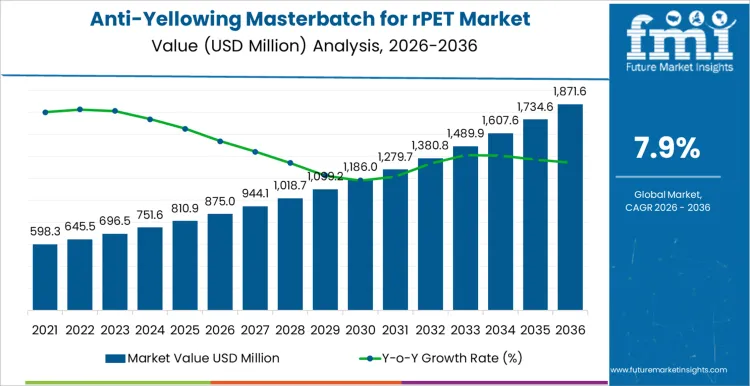
The anti-yellowing masterbatch for rPET market is projected to be valued at USD 875.0 million in 2026, and reach USD 1,871.6 million by 2036, at a 7.9% CAGR. Expansion reflects rising deployment of recycled PET in clarity-sensitive packaging formats where visual appearance directly influences brand perception and shelf acceptance. Growth is underpinned by the structural shift toward higher recycled content in beverage, food, and personal care packaging, where inherent yellowing from thermal history and polymer degradation limits rPET usability.
Anti-yellowing masterbatches enable converters to correct color drift, reduce yellow index, and preserve transparency during reprocessing, stretch blow molding, and thermoforming. Adoption accelerates as regulatory recycled content targets tighten and brand owners seek virgin-like aesthetics from rPET without compromising processing efficiency, food contact compliance, or mechanical integrity.
Quick Stats for Anti-Yellowing Masterbatch for rPET Market
- Anti-Yellowing Masterbatch for rPET Market Value (2026): USD 875.0 million
- Anti-Yellowing Masterbatch for rPET Market Forecast Value (2036): USD 1,871.6 million
- Anti-Yellowing Masterbatch for rPET Market Forecast CAGR 2026 to 2036: 7.9%
- Leading Resin Applications by Demand Share: Packaging and Bottling (50%), Automotive (24%)
- Fastest-Growing Countries: India, China, Brazil, USA, Germany
- Top Players in Global Demand: Clariant, BASF, LyondellBasell (A. Schulman), Sabic, Ampacet
Anti-Yellowing Masterbatch for rPET Market Key Takeaways
| Metric | Value |
|---|---|
| Market Value (2026) | USD 875.0 million |
| Market Forecast Value (2036) | USD 1871.6 million |
| Forecast CAGR 2026 to 2036 | 7.9% |
Why is the Demand for Anti Yellowing Masterbatch for rPET Growing?
The rise in demand for anti yellowing masterbatch in rPET applications is driven by the growing use of recycled PET in packaging, especially in industries where clarity and color consistency are vital. As rPET typically develops a yellowish tint due to prior use and thermal degradation, manufacturers require anti-yellowing solutions to restore visual appeal. Beverage, food, and cosmetic packaging sectors are particularly reliant on these masterbatches to maintain the appearance of virgin-like PET, supporting higher recycling content without compromising aesthetic quality.
The increasing consumer preference for sustainable packaging has led many brands to choose rPET, making anti-yellowing additives essential for achieving a premium look in recycled packaging. The demand is further influenced by regulatory pressures pushing for greater recycled content in packaging. Many regions now mandate minimum recycled material percentages, compelling packaging companies to increase rPET usage while ensuring the material maintains its visual appeal. Anti-yellowing masterbatch has become indispensable in meeting both regulatory and consumer expectations, as it helps preserve the functional and aesthetic properties of rPET in high-quality packaging applications.
How Is the Anti-Yellowing Masterbatch for rPET Industry Segmented by Masterbatch Type, Processing Technology, and Application?
Demand for anti-yellowing masterbatch solutions for rPET is driven by clarity retention requirements, aesthetic consistency, and recyclate variability management. Converters seek additives that counter thermal degradation, UV exposure, and contaminant-induced discoloration during reprocessing. Selection depends on compatibility with rPET, processing window tolerance, and downstream appearance targets. Segmentation by masterbatch type, processing technology, and application explains how formulation strategies align with processing conditions and end-use quality expectations across packaging, textiles, and durable goods.
Which Masterbatch Type Accounts for the Largest Share in rPET Anti-Yellowing Solutions?
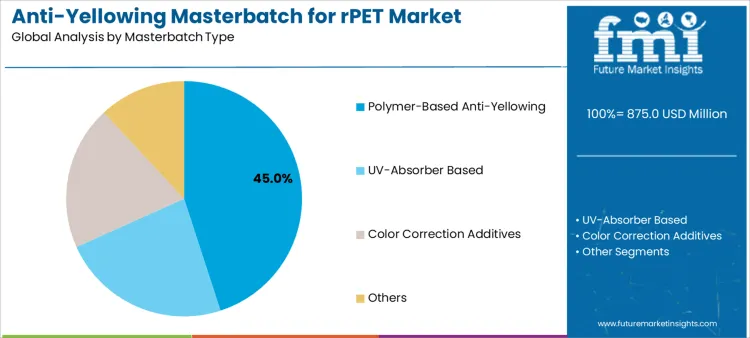
Polymer-based anti-yellowing masterbatch holds 45.0%, reflecting strong compatibility with rPET matrices and consistent dispersion during melt processing. These systems stabilize color by mitigating thermal oxidation and polymer chain scission across multiple recycling cycles. UV-bsorber based solutions account for 30.0%, addressing photo-induced yellowing during storage and product use. Color correction additives represent 15.0%, used to neutralize residual discoloration through optical balancing. Other solutions account for 10.0%, covering niche formulations and blended approaches. Masterbatch-type segmentation reflects prioritization of intrinsic stabilization versus optical correction under varied processing histories.
Key Points
- Polymer-based systems provide intrinsic stabilization benefits.
- UV absorbers target light-induced discoloration risks.
- Color correction focuses on optical appearance tuning.
How Does Processing Technology Influence Adoption of Anti-Yellowing Masterbatch?
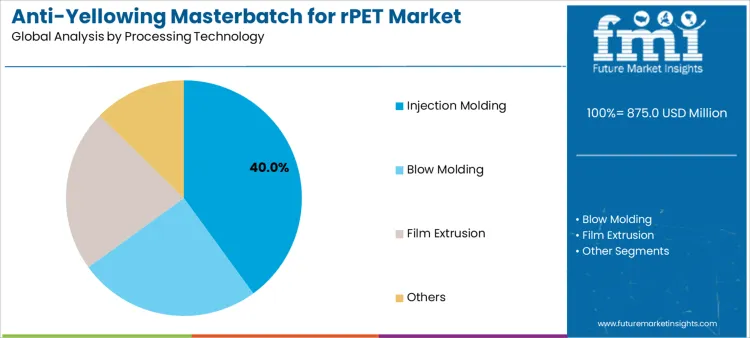
Injection molding accounts for 40.0%, driven by high thermal loads and sensitivity to color variation in molded rPET components. Blow molding represents 35.0%, particularly relevant for bottles where clarity and brightness are critical to brand presentation. Film extrusion holds 15.0%, requiring uniform dispersion to prevent haze and color streaking in thin gauges. Other processing technologies account for 10.0%, including sheet extrusion and specialty forming. Processing-technology segmentation highlights how residence time, shear, and temperature exposure shape anti-yellowing additive selection and dosing strategies.
Key Points
- Injection molding demands robust thermal stabilization.
- Blow molding prioritizes clarity and brightness retention.
- Film extrusion requires uniform optical performance.
Which Applications Drive Demand for Anti-Yellowing Masterbatch in rPET?
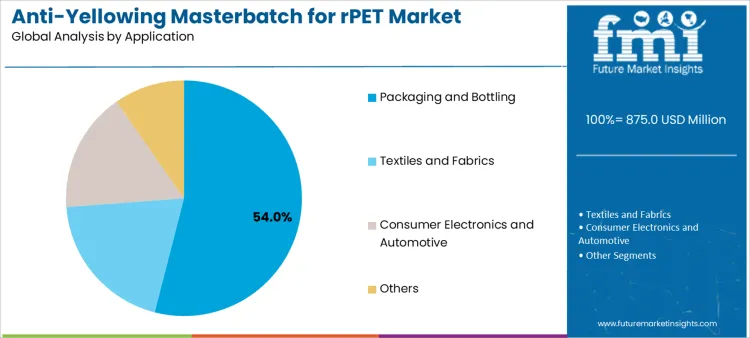
Packaging and bottling account for 54.0%, reflecting strict visual quality standards and recycled content mandates. Textiles and fabrics represent 21.0%, where color consistency affects yarn appearance and fabric uniformity. Consumer electronics and automotive applications hold 14.0%, using rPET components where surface aesthetics and durability matter. Other applications account for 11.0%, including sheets and specialty molded parts. Application segmentation shows concentration of demand in high-visibility uses where discoloration directly impacts acceptance and compliance.
Key Points
- Packaging leads due to visual quality requirements.
- Textiles require consistent recyclate coloration.
- Durable goods emphasize surface appearance stability.
What are the key dynamics in the anti yellowing masterbatch for rPET market?
Growth in the anti yellowing masterbatch for rPET market reflects increasing use of recycled PET in applications where clarity and color stability are essential. Demand is heightened in clear packaging for water, beverages, and cosmetics where yellowing undermines brand perception. Formulators seek masterbatches that counteract thermal and UV induced discoloration associated with PCR feedstocks. Selection criteria focus on optical clarity, dispersion uniformity, and compatibility with high speed PET processing equipment.
How do performance expectations in clear packaging shape ingredient demand?
In clear water and beverage bottles made from rPET, consumers expect transparency comparable to virgin PET. Yellowing during reheat and stretch blow molding results from degradation products and residual chromophores in recycled PET. Masterbatches engineered with optimized stabilizers and optical modifiers help maintain whiteness and reduce color shift during high temperature processing. Cosmetic and pharmaceutical vial producers apply anti yellowing solutions to protect product presentation and maintain aesthetic quality through shelf life. PET sheet and film converters require masterbatches that integrate seamlessly without affecting mechanical strength or haze levels, ensuring brand level clarity for premium packaged goods.
How do processing constraints and regulatory interpretation impact adoption?
Adoption of anti yellowing masterbatches for rPET is affected by processing conditions and evolving regional regulations on recycled content. High throughput molding and thermoforming lines impose shear and heat stresses that can diminish stabilizer effectiveness unless additive systems are tailored to meet those conditions. Regulatory frameworks governing recycled content declarations and food contact approvals influence formulation choices across markets, especially where clear food packaging must meet strict safety standards. Cost sensitivity arises when high performance anti yellowing systems add to compound expense, which influences use in value oriented segments of the packaging industry. Ongoing refinement in recycling technology that improves feedstock quality also affects masterbatch specification as PCR streams become more consistent over time.
How Is Demand for the Anti-Yellowing Masterbatch for rPET Market Evolving Globally?
Global demand for anti-yellowing masterbatches for recycled PET (rPET) is increasing as the packaging and automotive industries prioritize recycled content while addressing quality concerns such as discoloration. Growth reflects rising use of rPET in packaging applications, particularly in food and beverage containers, as well as the growing demand for sustainable and eco-friendly materials. Anti-yellowing masterbatches are essential in maintaining the aesthetic and functional qualities of rPET, preventing color degradation and enhancing product shelf life. India records 8.2% CAGR, China records 7.9% CAGR, Brazil records 7.4% CAGR, USA records 6.5% CAGR, and Germany records 6.2% CAGR. Adoption is driven by regulatory requirements, brand sustainability goals, and the need for high-quality recycled materials.
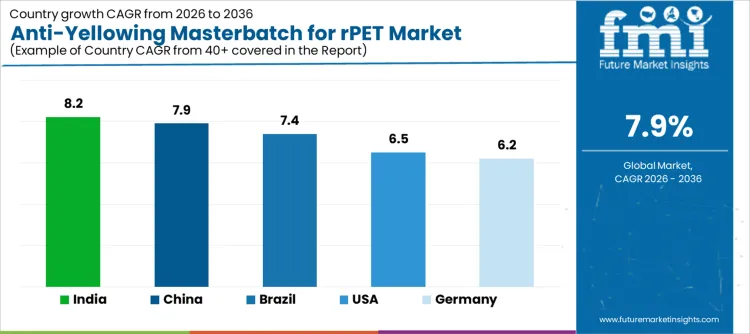
| Country | CAGR (%) |
|---|---|
| India | 8.2% |
| China | 7.9% |
| Brazil | 7.4% |
| USA | 6.5% |
| Germany | 6.2% |
What is driving growth of anti-yellowing masterbatch for rPET demand in India?
Demand for anti-yellowing masterbatch for rPET in India is expanding as manufacturers seek to improve the appearance and quality of recycled PET used in packaging. Growth at 8.2% CAGR reflects the increasing adoption of rPET in beverage containers, food packaging, and consumer goods, driven by growing sustainability efforts and government regulations. As rPET usage increases, the need for anti-yellowing solutions to prevent discoloration and maintain aesthetic appeal becomes crucial. The Indian packaging industry is focusing on using more recycled materials to meet environmental goals, making anti-yellowing masterbatches an essential part of the production process.
- Growth in rPET adoption in packaging
- Government regulations promoting sustainable packaging
- Need to maintain visual appeal and product quality
- Demand for eco-friendly materials in consumer goods
Why is China seeing expansion in anti-yellowing masterbatch for rPET adoption?
Anti-yellowing masterbatch demand for rPET in China is rising as the country’s packaging industry increases its reliance on recycled PET for eco-friendly packaging solutions. Growth at 7.9% CAGR reflects China's commitment to improving recycling rates and meeting domestic and international sustainability targets. With increasing use of rPET, particularly in the food and beverage packaging sectors, the need for anti-yellowing agents to preserve the quality of recycled materials is growing. Local manufacturers are adopting anti-yellowing masterbatches to meet quality and regulatory standards while enhancing the visual properties of rPET-based products.
- Strong government push for recycling and sustainability
- Increasing demand for rPET in food and beverage packaging
- Need to maintain high-quality recycled materials
- Growth in eco-friendly consumer goods
What factors are shaping anti-yellowing masterbatch for rPET sales in Brazil?
Sales of anti-yellowing masterbatch for rPET in Brazil are increasing as the local packaging industry prioritizes the use of recycled content to reduce plastic waste. Growth at 7.4% CAGR reflects the adoption of rPET in beverage bottles, food packaging, and consumer goods, driven by consumer demand for sustainable products. Anti-yellowing masterbatches are essential to prevent discoloration and maintain the high aesthetic quality of recycled PET products. As Brazilian manufacturers seek to meet international standards for recycled materials, the demand for anti-yellowing solutions is expected to continue rising.
- Increasing demand for recycled packaging solutions
- Need to meet sustainability goals and regulations
- Focus on maintaining product appearance and quality
- Rising consumer preference for eco-friendly packaging
How is the USA supporting growth of anti-yellowing masterbatch for rPET demand?
Demand for anti-yellowing masterbatch for rPET in the USA is advancing as sustainability initiatives and recycling regulations become more stringent. Growth at 6.5% CAGR reflects the widespread adoption of rPET in food and beverage containers, retail packaging, and other consumer products. As the USA strives to reduce plastic waste and increase the use of recycled materials, the need for anti-yellowing agents to maintain the quality and visual appeal of rPET becomes critical. The USA. packaging industry is embracing recycled content to meet both regulatory and consumer demands for eco-friendly packaging.
- Government-driven sustainability initiatives
- Increased adoption of rPET in packaging
- Regulatory pressure for more recycled content
- Demand for high-quality, visually appealing recycled products
What is driving expansion of anti-yellowing masterbatch for rPET demand in Germany?
Anti-yellowing masterbatch for rPET demand in Germany is rising as the country’s packaging industry continues to adopt sustainable practices and increase the use of recycled materials. Growth at 6.2% CAGR reflects Germany’s leadership in the circular economy, where recycled PET is increasingly used in beverage and food packaging. With a strong focus on recycling and reducing plastic waste, the German packaging industry requires anti-yellowing solutions to maintain the quality of rPET. As sustainability regulations tighten, manufacturers are turning to anti-yellowing masterbatches to meet both aesthetic and functional performance requirements for recycled materials.
- Strong emphasis on circular economy and recycling
- Increased use of rPET in food and beverage packaging
- Need for high-quality, sustainable packaging solutions
- Compliance with stringent environmental regulations
What is the competitive landscape of demand for the anti-yellowing masterbatch for rPET market globally?
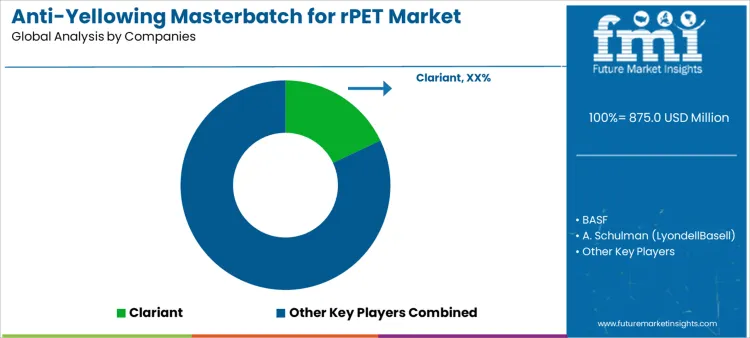
The rPET processing challenges linked to thermal degradation and color instability are driving demand for anti-yellowing masterbatch solutions. Packaging converters and resin compounders evaluate yellow index reduction efficiency, transparency retention, thermal stability during multiple extrusion cycles, and compatibility with food-grade rPET. Buyer assessment includes dosage efficiency, impact on mechanical properties, compliance with food contact regulations, and consistency across recycled feedstock variability. Procurement behavior favors suppliers with polymer-specific formulations, technical support during reprocessing trials, and reliable global supply. Trend in the anti-yellowing masterbatch for rPET market reflects rising bottle-to-bottle recycling targets and tighter visual quality expectations from brand owners.
Clariant leads competitive positioning through rPET-focused additive masterbatches engineered to maintain clarity and color neutrality in high-recycled-content packaging. BASF competes by leveraging antioxidant and stabilization chemistry integrated into masterbatch systems supporting repeated thermal exposure. A. Schulman under LyondellBasell maintains relevance through customized color and additive solutions aligned with recycled polymer processing requirements. SABIC supports demand by aligning additive development with its circular polymer initiatives and rPET material platforms. Ampacet participates with anti-yellowing solutions optimized for transparent packaging applications requiring consistent aesthetic performance. Competitive differentiation centers on stabilization efficiency, food-grade compliance, recyclate tolerance, and technical collaboration with rPET processors.
Key Players in the Anti-Yellowing Masterbatch for rPET Market
- Clariant
- BASF
- Schulman (LyondellBasell)
- Sabic
- Ampacet
- Others
Scope of the Report
| Items | Values |
|---|---|
| Quantitative Units | USD million |
| Masterbatch Type | Polymer-Based Anti-Yellowing; UV-Absorber Based; Color Correction Additives; Others |
| Processing Technology | Injection Molding; Blow Molding; Film Extrusion; Others |
| Application | Packaging and Bottling; Textiles and Fabrics; Consumer Electronics and Automotive; Others |
| Regions Covered | Asia Pacific, Europe, North America, Latin America, Middle East & Africa |
| Countries Covered | India, China, Brazil, USA, Germany, and 40+ countries |
| Key Companies Profiled | Clariant; BASF; A. Schulman (LyondellBasell); Sabic; Ampacet; Others |
| Additional Attributes | Dollar sales by masterbatch type, processing technology, and application; anti-yellowing performance in rPET applications for packaging, textiles, and consumer electronics; UV-absorption efficiency and color restoration under processing conditions; compatibility with injection molding, blow molding, and film extrusion techniques; impact on product aesthetics, durability, and recyclability; procurement dynamics influenced by sustainability targets, regulatory compliance, and long-term supplier relationships. |
Anti-Yellowing Masterbatch for rPET Market by Segment
Masterbatch Type:
- Polymer-Based Anti-Yellowing
- UV-Absorber Based
- Color Correction Additives
- Others
Processing Technology:
- Injection Molding
- Blow Molding
- Film Extrusion
- Others
Application:
- Packaging and Bottling
- Textiles and Fabrics
- Consumer Electronics and Automotive
- Others
Region:
- Asia Pacific
- China
- Japan
- South Korea
- India
- Australia & New Zealand
- ASEAN
- Rest of Asia Pacific
- Europe
- Germany
- United Kingdom
- France
- Italy
- Spain
- Nordic
- BENELUX
- Rest of Europe
- North America
- United States
- Canada
- Mexico
- Latin America
- Brazil
- Chile
- Rest of Latin America
- Middle East & Africa
- Kingdom of Saudi Arabia
- Other GCC Countries
- Turkey
- South Africa
- Other African Union
- Rest of Middle East & Africa
Bibliography
- European Food Safety Authority. (2023). Recycled polyethylene terephthalate (PET) used in food contact materials: Updated scientific opinion on decontamination efficiency and material quality. EFSA Journal, 21(5), e07935.
- Gao, Y., Liu, Y., Wang, S., & Zhang, J. (2024). Thermal degradation, discoloration, and stabilization strategies for recycled polyethylene terephthalate during melt processing. Journal of Applied Polymer Science, 141(6), e54872.
- International Organization for Standardization. (2023). Plastics - Recycled polyethylene terephthalate (PET) - Characterization of optical properties and color variation (ISO/TR 21960:2023). ISO.
- Paci, M., La Mantia, F. P., & Morreale, M. (2023). Influence of stabilizers and processing history on color evolution of recycled PET. Polymers, 15(18), 3772.
- PlasticsEurope. (2024). Circular economy for PET packaging: Quality requirements, discoloration control, and recycled content integration. PlasticsEurope Association.
- Welle, F., & Franz, R. (2023). Challenges and solutions for high-clarity recycled PET in food packaging applications. Food Packaging and Shelf Life, 36, 101064.
- Zhu, R., Chen, X., & Long, Y. (2024). Suppression of yellowing in recycled PET via antioxidant and optical modifier systems. Polymer Engineering & Science, 64(2), 421-432.
Frequently Asked Questions
How big is the anti-yellowing masterbatch for rpet market in 2026?
The global anti-yellowing masterbatch for rpet market is estimated to be valued at USD 875.0 million in 2026.
What will be the size of anti-yellowing masterbatch for rpet market in 2036?
The market size for the anti-yellowing masterbatch for rpet market is projected to reach USD 1,871.6 million by 2036.
How much will be the anti-yellowing masterbatch for rpet market growth between 2026 and 2036?
The anti-yellowing masterbatch for rpet market is expected to grow at a 7.9% CAGR between 2026 and 2036.
What are the key product types in the anti-yellowing masterbatch for rpet market?
The key product types in anti-yellowing masterbatch for rpet market are polymer-based anti-yellowing, uv-absorber based, color correction additives and others.
Which processing technology segment to contribute significant share in the anti-yellowing masterbatch for rpet market in 2026?
In terms of processing technology, injection molding segment to command 40.0% share in the anti-yellowing masterbatch for rpet market in 2026.
Preview the report firsthand - request a free sample
Get SampleGet the brochure for pricing and purchase details.
Get PDFTable of Content
- Executive Summary
- Global Market Outlook
- Demand-side Trends
- Supply-side Trends
- Technology Roadmap Analysis
- Analysis and Recommendations
- Market Overview
- Market Coverage / Taxonomy
- Market Definition / Scope / Limitations
- Market Background
- Market Dynamics
- Drivers
- Restraints
- Opportunity
- Trends
- Scenario Forecast
- Demand in Optimistic Scenario
- Demand in Likely Scenario
- Demand in Conservative Scenario
- Opportunity Map Analysis
- Product Life Cycle Analysis
- Supply Chain Analysis
- Investment Feasibility Matrix
- Value Chain Analysis
- PESTLE and Porter’s Analysis
- Regulatory Landscape
- Regional Parent Market Outlook
- Production and Consumption Statistics
- Import and Export Statistics
- Market Dynamics
- Global Market Analysis 2021 to 2025 and Forecast, 2026 to 2036
- Historical Market Size Value (USD Million) Analysis, 2021 to 2025
- Current and Future Market Size Value (USD Million) Projections, 2026 to 2036
- Y-o-Y Growth Trend Analysis
- Absolute $ Opportunity Analysis
- Global Market Pricing Analysis 2021 to 2025 and Forecast 2026 to 2036
- Global Market Analysis 2021 to 2025 and Forecast 2026 to 2036, By Masterbatch Type
- Introduction / Key Findings
- Historical Market Size Value (USD Million) Analysis By Masterbatch Type, 2021 to 2025
- Current and Future Market Size Value (USD Million) Analysis and Forecast By Masterbatch Type, 2026 to 2036
- Polymer-Based Anti-Yellowing
- UV-Absorber Based
- Color Correction Additives
- Others
- Polymer-Based Anti-Yellowing
- Y-o-Y Growth Trend Analysis By Masterbatch Type, 2021 to 2025
- Absolute $ Opportunity Analysis By Masterbatch Type, 2026 to 2036
- Global Market Analysis 2021 to 2025 and Forecast 2026 to 2036, By Processing Technology
- Introduction / Key Findings
- Historical Market Size Value (USD Million) Analysis By Processing Technology, 2021 to 2025
- Current and Future Market Size Value (USD Million) Analysis and Forecast By Processing Technology, 2026 to 2036
- Injection Molding
- Blow Molding
- Film Extrusion
- Others
- Injection Molding
- Y-o-Y Growth Trend Analysis By Processing Technology, 2021 to 2025
- Absolute $ Opportunity Analysis By Processing Technology, 2026 to 2036
- Global Market Analysis 2021 to 2025 and Forecast 2026 to 2036, By Application
- Introduction / Key Findings
- Historical Market Size Value (USD Million) Analysis By Application, 2021 to 2025
- Current and Future Market Size Value (USD Million) Analysis and Forecast By Application, 2026 to 2036
- Packaging and Bottling
- Textiles and Fabrics
- Consumer Electronics and Automotive
- Others
- Packaging and Bottling
- Y-o-Y Growth Trend Analysis By Application, 2021 to 2025
- Absolute $ Opportunity Analysis By Application, 2026 to 2036
- Global Market Analysis 2021 to 2025 and Forecast 2026 to 2036, By Region
- Introduction
- Historical Market Size Value (USD Million) Analysis By Region, 2021 to 2025
- Current Market Size Value (USD Million) Analysis and Forecast By Region, 2026 to 2036
- North America
- Latin America
- Western Europe
- Eastern Europe
- East Asia
- South Asia and Pacific
- Middle East & Africa
- Market Attractiveness Analysis By Region
- North America Market Analysis 2021 to 2025 and Forecast 2026 to 2036, By Country
- Historical Market Size Value (USD Million) Trend Analysis By Market Taxonomy, 2021 to 2025
- Market Size Value (USD Million) Forecast By Market Taxonomy, 2026 to 2036
- By Country
- USA
- Canada
- Mexico
- By Masterbatch Type
- By Processing Technology
- By Application
- By Country
- Market Attractiveness Analysis
- By Country
- By Masterbatch Type
- By Processing Technology
- By Application
- Key Takeaways
- Latin America Market Analysis 2021 to 2025 and Forecast 2026 to 2036, By Country
- Historical Market Size Value (USD Million) Trend Analysis By Market Taxonomy, 2021 to 2025
- Market Size Value (USD Million) Forecast By Market Taxonomy, 2026 to 2036
- By Country
- Brazil
- Chile
- Rest of Latin America
- By Masterbatch Type
- By Processing Technology
- By Application
- By Country
- Market Attractiveness Analysis
- By Country
- By Masterbatch Type
- By Processing Technology
- By Application
- Key Takeaways
- Western Europe Market Analysis 2021 to 2025 and Forecast 2026 to 2036, By Country
- Historical Market Size Value (USD Million) Trend Analysis By Market Taxonomy, 2021 to 2025
- Market Size Value (USD Million) Forecast By Market Taxonomy, 2026 to 2036
- By Country
- Germany
- UK
- Italy
- Spain
- France
- Nordic
- BENELUX
- Rest of Western Europe
- By Masterbatch Type
- By Processing Technology
- By Application
- By Country
- Market Attractiveness Analysis
- By Country
- By Masterbatch Type
- By Processing Technology
- By Application
- Key Takeaways
- Eastern Europe Market Analysis 2021 to 2025 and Forecast 2026 to 2036, By Country
- Historical Market Size Value (USD Million) Trend Analysis By Market Taxonomy, 2021 to 2025
- Market Size Value (USD Million) Forecast By Market Taxonomy, 2026 to 2036
- By Country
- Russia
- Poland
- Hungary
- Balkan & Baltic
- Rest of Eastern Europe
- By Masterbatch Type
- By Processing Technology
- By Application
- By Country
- Market Attractiveness Analysis
- By Country
- By Masterbatch Type
- By Processing Technology
- By Application
- Key Takeaways
- East Asia Market Analysis 2021 to 2025 and Forecast 2026 to 2036, By Country
- Historical Market Size Value (USD Million) Trend Analysis By Market Taxonomy, 2021 to 2025
- Market Size Value (USD Million) Forecast By Market Taxonomy, 2026 to 2036
- By Country
- China
- Japan
- South Korea
- By Masterbatch Type
- By Processing Technology
- By Application
- By Country
- Market Attractiveness Analysis
- By Country
- By Masterbatch Type
- By Processing Technology
- By Application
- Key Takeaways
- South Asia and Pacific Market Analysis 2021 to 2025 and Forecast 2026 to 2036, By Country
- Historical Market Size Value (USD Million) Trend Analysis By Market Taxonomy, 2021 to 2025
- Market Size Value (USD Million) Forecast By Market Taxonomy, 2026 to 2036
- By Country
- India
- ASEAN
- Australia & New Zealand
- Rest of South Asia and Pacific
- By Masterbatch Type
- By Processing Technology
- By Application
- By Country
- Market Attractiveness Analysis
- By Country
- By Masterbatch Type
- By Processing Technology
- By Application
- Key Takeaways
- Middle East & Africa Market Analysis 2021 to 2025 and Forecast 2026 to 2036, By Country
- Historical Market Size Value (USD Million) Trend Analysis By Market Taxonomy, 2021 to 2025
- Market Size Value (USD Million) Forecast By Market Taxonomy, 2026 to 2036
- By Country
- Kingdom of Saudi Arabia
- Other GCC Countries
- Turkiye
- South Africa
- Other African Union
- Rest of Middle East & Africa
- By Masterbatch Type
- By Processing Technology
- By Application
- By Country
- Market Attractiveness Analysis
- By Country
- By Masterbatch Type
- By Processing Technology
- By Application
- Key Takeaways
- Key Countries Market Analysis
- USA
- Pricing Analysis
- Market Share Analysis, 2025
- By Masterbatch Type
- By Processing Technology
- By Application
- Canada
- Pricing Analysis
- Market Share Analysis, 2025
- By Masterbatch Type
- By Processing Technology
- By Application
- Mexico
- Pricing Analysis
- Market Share Analysis, 2025
- By Masterbatch Type
- By Processing Technology
- By Application
- Brazil
- Pricing Analysis
- Market Share Analysis, 2025
- By Masterbatch Type
- By Processing Technology
- By Application
- Chile
- Pricing Analysis
- Market Share Analysis, 2025
- By Masterbatch Type
- By Processing Technology
- By Application
- Germany
- Pricing Analysis
- Market Share Analysis, 2025
- By Masterbatch Type
- By Processing Technology
- By Application
- UK
- Pricing Analysis
- Market Share Analysis, 2025
- By Masterbatch Type
- By Processing Technology
- By Application
- Italy
- Pricing Analysis
- Market Share Analysis, 2025
- By Masterbatch Type
- By Processing Technology
- By Application
- Spain
- Pricing Analysis
- Market Share Analysis, 2025
- By Masterbatch Type
- By Processing Technology
- By Application
- France
- Pricing Analysis
- Market Share Analysis, 2025
- By Masterbatch Type
- By Processing Technology
- By Application
- India
- Pricing Analysis
- Market Share Analysis, 2025
- By Masterbatch Type
- By Processing Technology
- By Application
- ASEAN
- Pricing Analysis
- Market Share Analysis, 2025
- By Masterbatch Type
- By Processing Technology
- By Application
- Australia & New Zealand
- Pricing Analysis
- Market Share Analysis, 2025
- By Masterbatch Type
- By Processing Technology
- By Application
- China
- Pricing Analysis
- Market Share Analysis, 2025
- By Masterbatch Type
- By Processing Technology
- By Application
- Japan
- Pricing Analysis
- Market Share Analysis, 2025
- By Masterbatch Type
- By Processing Technology
- By Application
- South Korea
- Pricing Analysis
- Market Share Analysis, 2025
- By Masterbatch Type
- By Processing Technology
- By Application
- Russia
- Pricing Analysis
- Market Share Analysis, 2025
- By Masterbatch Type
- By Processing Technology
- By Application
- Poland
- Pricing Analysis
- Market Share Analysis, 2025
- By Masterbatch Type
- By Processing Technology
- By Application
- Hungary
- Pricing Analysis
- Market Share Analysis, 2025
- By Masterbatch Type
- By Processing Technology
- By Application
- Kingdom of Saudi Arabia
- Pricing Analysis
- Market Share Analysis, 2025
- By Masterbatch Type
- By Processing Technology
- By Application
- Turkiye
- Pricing Analysis
- Market Share Analysis, 2025
- By Masterbatch Type
- By Processing Technology
- By Application
- South Africa
- Pricing Analysis
- Market Share Analysis, 2025
- By Masterbatch Type
- By Processing Technology
- By Application
- USA
- Market Structure Analysis
- Competition Dashboard
- Competition Benchmarking
- Market Share Analysis of Top Players
- By Regional
- By Masterbatch Type
- By Processing Technology
- By Application
- Competition Analysis
- Competition Deep Dive
- Clariant
- Overview
- Product Portfolio
- Profitability by Market Segments (Product/Age /Sales Channel/Region)
- Sales Footprint
- Strategy Overview
- Marketing Strategy
- Product Strategy
- Channel Strategy
- BASF
- A. Schulman (LyondellBasell)
- Sabic
- Ampacet
- Others
- Clariant
- Competition Deep Dive
- Assumptions & Acronyms Used
- Research Methodology


