

- Market Size (2026)
- USD 713.0 Mn
- Forecast (2036)
- USD 2042.9 Mn
- CAGR (2026 to 2036)
- 11.1%
How big is Aortic Valve Stenosis ECG Screening Market in 2026?
USD 713.0 million in 2026 and USD 2,042.9 million by 2036 at an 11.1% CAGR.
Sales of aortic valve stenosis ECG screening are projected to expand at an 11.1% CAGR from 2026 to 2036, moving the industry valuation from USD 713.0 million in 2026 to USD 2042.9 million during the forecast period. The industry is expected to gain from hospital demand for earlier cardiac risk identification before patients move to echocardiography or specialist review. ESC and EACTS guidance published in August 2025 highlights Heart Team review and Heart Valve Centers, which supports the need for clearer screening pathways before treatment decisions are made. ECG-based screening gives care teams a familiar first check within routine cardiovascular assessment and helps identify which patients need further testing.
Hospitals are expected to remain the main adoption point because aortic valve stenosis is often evaluated through structured cardiac-care pathways. Screening demand is expected to improve where ECG results are connected with clinical review and imaging referral. Wider use depends on how clearly providers show that ECG-based screening supports earlier case selection without adding unnecessary steps for clinicians. Investment becomes easier to assess when screening accuracy and patient follow-up are measured as separate operating outcomes.
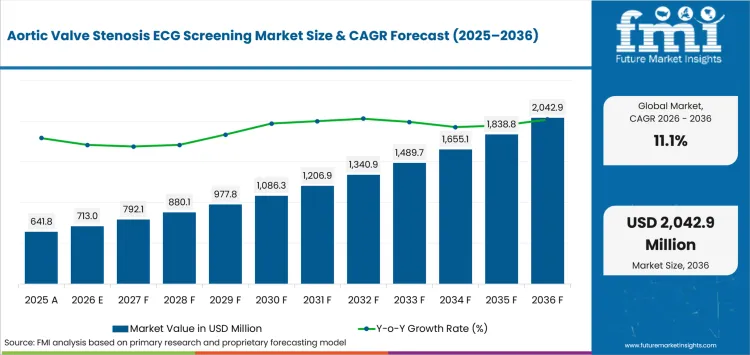
Key Takeaways of Aortic Valve Stenosis ECG Screening Market
- Demand for aortic valve stenosis ECG screening is driven by earlier valve-risk recognition and clear follow-up ownership, with hospitals pairing ECG review with echocardiography referral pathways before symptoms raise clinical burden.
- Resting ECG screening holds the leading technology share at 33.2% in 2026, supported by broad availability across routine cardiovascular care where familiar first-test positioning creates early review points before structural valve assessment begins.
- Hospitals account for 41.5% end-user share in 2026, as cardiology teams control follow-up decisions and manage clean handoffs between ECG capture and echocardiography confirmation within specialist cardiovascular pathways.
- Early diagnosis leads the application category at 31.5% share in 2026, driven by earlier risk recognition and defined follow-up ownership that improves patient routing before delayed symptoms narrow the care window.
- The USA, South Korea, and Japan record CAGRs of 13.2%, 12.5%, and 10.8% respectively through 2036, shaped by ageing populations, structured ECG-to-echocardiography referral pathways, and dense hospital infrastructure.
- Competition spans ECG device developers and AI cardiac analysis providers, with Eko Health and Anumana focusing on ECG-AI solutions, GE HealthCare and Siemens Healthineers combining imaging platforms with cardiology systems, and Philips and AliveCor extending screening through hospital-grade and portable ECG technologies.
Analyst Perspective
"Commercial adoption will depend on whether ECG screening improves early cardiovascular detection while fitting seamlessly into routine clinical workflows. Healthcare providers are evaluating diagnostic accuracy, follow-up efficiency, and interoperability with existing cardiology systems as distinct measures of value. Companies that support evidence-based implementation and integrated patient management will be better positioned to expand adoption."
- Anurag Sharma, Senior Analyst at Future Market Insights
Source: FMI's proprietary forecasting model and primary research
How is the Aortic Valve Stenosis ECG Screening Market segmented?
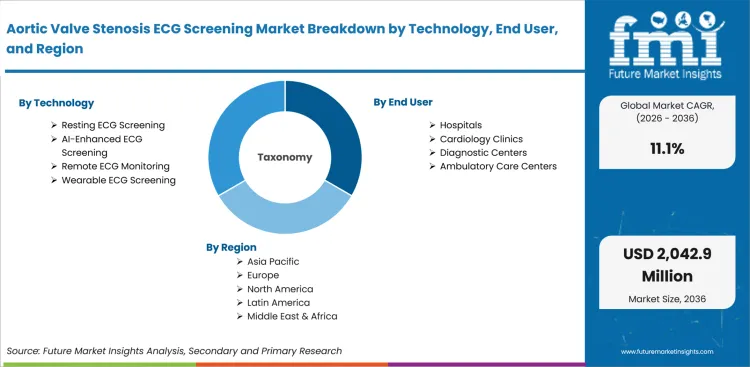
The aortic valve stenosis ECG screening market is segmented by technology, end user, application, age group, and region.
The segmentation framework separates the screening method from care setting and the clinical decision being supported. Technology covers resting ECG screening and AI-enhanced ECG screening. It also includes remote ECG monitoring and wearable ECG screening. End user analysis follows hospitals and cardiology clinics along with diagnostic centers and ambulatory care centers. Application analysis separates early diagnosis from risk stratification. It also reviews disease monitoring and population screening. Age group coverage distinguishes adults from the geriatric population. Regional analysis compares adoption across countries with different cardiology capacity and payment systems.
What supports demand for resting ECG Screening within the technology category?
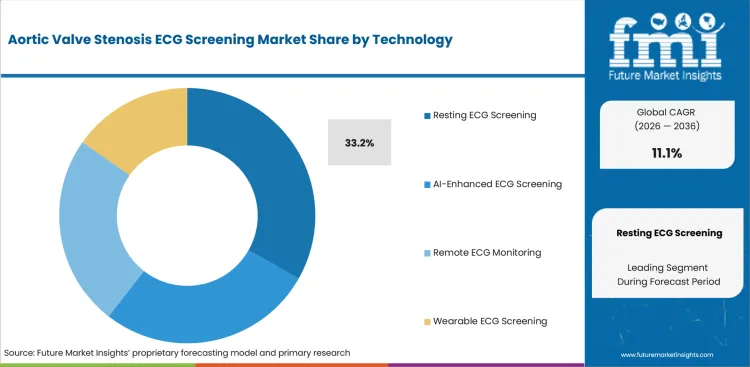
Resting ECG Screening gives clinicians a familiar first test before structural valve assessment begins. Mayo Clinic guidance updated in May 2025 places ECG and echocardiogram among tests used during aortic valve stenosis evaluation. This supports demand where screening results are routed into a clear imaging and cardiology review path.
- By technology, Resting ECG Screening is expected to lead with 33.2% share in 2026 due to broad availability across routine cardiovascular care.
- Hospitals and clinics favor this method when it creates an early review point. The value weakens when abnormal signals do not move into confirmatory imaging.
How do hospitals shape demand within the end user category?
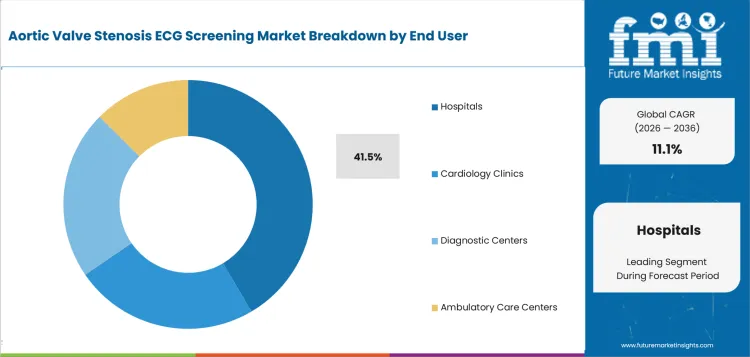
Hospitals remain central because ECG review and imaging confirmation are usually managed inside specialist cardiovascular pathways. Procurement teams evaluate screening tools by asking whether each result changes referral timing and patient routing. This gives hospitals the strongest end user position in 2026.
- Hospitals are forecast to hold 41.5% share of end user demand in 2026 as cardiology teams control follow-up decisions.
- Hospital adoption depends on clean handoffs between ECG capture and echocardiography. Programs are easier to defend when responsibility after an alert is named.
Why does early diagnosis lead the application category?
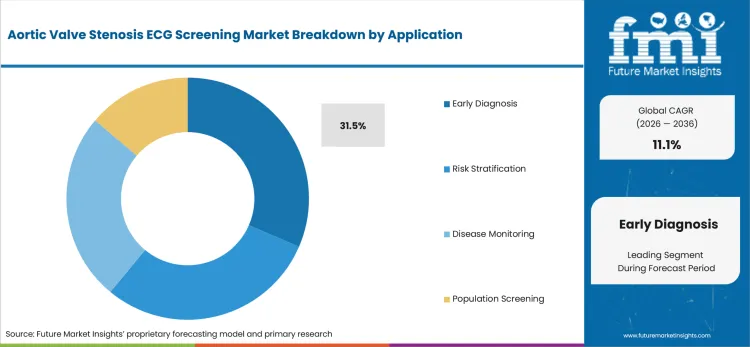
Early Diagnosis leads because screening has the clearest value before delayed symptoms narrow the care window. A screening program must help clinicians decide which patients need further valve assessment. This makes the application useful only when it improves patient routing and avoids unmanaged alerts.
- Early Diagnosis is estimated to account for 31.5% share in 2026 because the first clinical decision carries the main screening value.
- Demand is expected to be driven by earlier risk recognition and defined follow-up. Extra alerts without referral ownership reduce the application case.
How are adults positioned within the age group category?
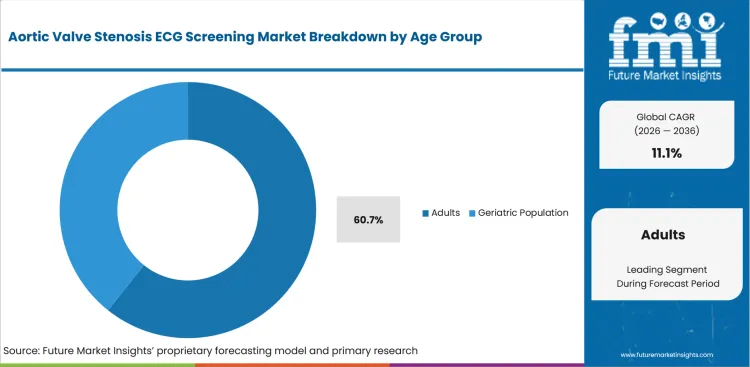
Adults form the broadest addressable group because screening begins before patients enter the highest-risk elderly pathway. This group includes patients with comorbid cardiovascular risk and unclear early symptoms. Wider adult coverage gives providers a larger base for structured first review.
- Adults hold 60.7% share of age group demand in 2026 as screening reaches both routine care and specialist referral settings.
- Demand is expected to remain strongest where adult ECG records are already available. Confirmatory imaging capacity still decides whether screening improves care.
What are the drivers, restraints, and opportunities in the Aortic Valve Stenosis ECG Screening Market?
Earlier valve-risk recognition and hospital workflow fit are expected to accelerate demand. Adoption remains limited when ECG output is not tied to confirmation and payment ownership.
- Driver: demand is expected to rise when ECG review creates an earlier route to valve assessment.
- Restraint: adoption is constrained when ECG findings do not confirm disease on their own.
- Opportunity: growth is expected to improve when screening output moves into a named follow-up pathway.
The main driver is a need for earlier valve-risk recognition inside everyday cardiovascular workflows. Eko Health stated in April 2026 that aortic stenosis is the most common valvular heart disease requiring intervention. The same clinical context makes early review valuable when ECG output points patients toward a timely echocardiogram. Demand is expected to be driven by clear referral rules and manageable alert volume.
The main restraint is the gap between screening output and confirmed diagnosis. ECG results do not replace echocardiography for aortic valve stenosis assessment. Adoption slows when a flagged result adds work without changing patient management. Reimbursement fit and imaging capacity also decide whether a screening program becomes routine.
The primary opportunity is concentrated in hospital-led pathways that define what happens after an abnormal ECG result. Screening companies are expected to gain traction when their tools fit that pathway. The strongest programs connect first review with specialist action.
Which country CAGRs are profiled in the Aortic Valve Stenosis ECG Screening Market?
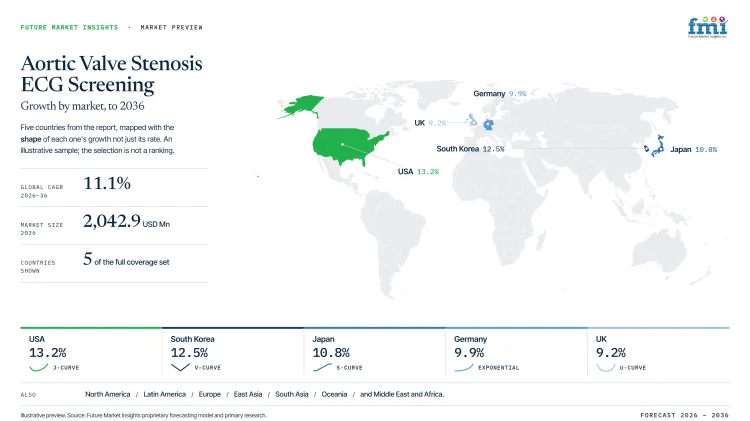
| Country | CAGR |
|---|---|
| USA | 13.2% |
| South Korea | 12.5% |
| Japan | 10.8% |
| Germany | 9.9% |
| UK | 9.2% |
How do country-level CAGRs compare in the Aortic Valve Stenosis ECG Screening Market?
The country comparison is defined less by the overall CAGR range and more by the spacing between the markets included in the analysis. The difference between the first and last country is four percentage points, creating a noticeable separation without producing isolated outliers.
- The USA and South Korea form a closely aligned upper group while Japan occupies a distinct middle position. Germany and the UK create a lower cluster where adoption is expected to depend more heavily on evidence requirements and public healthcare procurement. These differences reflect variation in cardiology capacity, reimbursement alignment, and the integration of ECG screening into established referral pathways rather than a simple distinction between healthcare systems.
- The USA and South Korea remain closely positioned in CAGR terms, yet their commercial development models differ. The USA benefits from structured referral pathways and a large ageing population, whereas South Korea relies on dense hospital infrastructure and rapid digital healthcare adoption.
- Japan occupies an intermediate position within the comparison. Its market development is expected to depend on efficient hospital workflows and earlier identification of valve disease within an ageing population.
- Germany and the UK form a closely aligned lower group. Although their growth rates are comparable, Germany places greater emphasis on clinical evidence and procurement review, while the UK depends on practical ECG triage within publicly funded referral pathways.
- Markets with comparable CAGRs can therefore present very different commercial entry conditions. Screening providers must align their market strategies with local reimbursement policies, cardiology workflows, imaging capacity, and referral discipline rather than relying solely on relative growth rates.
The full report provides country-level CAGR analysis across North America, Latin America, Europe, East Asia, South Asia, Oceania and the Middle East and Africa.
Country-wise Analysis
- The United States combines a large ageing population with established cardiology networks and broad access to routine ECG testing. The aortic valve stenosis ECG screening market in the USA is projected to expand at 13.2% CAGR from 2026 to 2036. USA Census Bureau data published in June 2025 showed that the population aged 65 and older reached 61.2 million in 2024. This demographic base creates a substantial group of patients who may require earlier assessment for structural heart disease. Hospitals can connect abnormal ECG findings with echocardiography and specialist cardiology review through existing referral networks. Screening providers should demonstrate that their systems improve patient selection without increasing unnecessary alerts or follow-up costs.
- South Korea combines dense hospital infrastructure with rapid adoption of digital healthcare technologies. Screening demand in South Korea is forecast to rise at 12.5% CAGR through 2036 due to ageing demographics and strong hospital connectivity. Statistics Korea reported in 2025 that people aged 65 and older represented 20.3% of the national population. This demographic shift supports earlier cardiovascular risk assessment across specialist and general hospital settings. Digital medical records can help providers route flagged ECG results toward imaging and clinical review with limited workflow disruption. Commercial strategies should emphasize software integration and clear responsibility for follow-up after an abnormal screening result.
- Japan has an advanced hospital system and a particularly large elderly population that raises the need for structured valve-disease assessment. Adoption of aortic valve stenosis ECG screening in Japan is estimated to expand at 10.8% CAGR by 2036. The Cabinet Office reported in its 2025 ageing white paper that the national ageing rate reached 29.3%. This population structure increases the number of patients who may present with unclear symptoms or multiple cardiovascular conditions. Compact hospital workflows require screening tools that support rapid referral without adding excessive review steps. Product selection should prioritize reliable ECG integration and defined pathways from initial screening to echocardiographic confirmation.
- Germany combines a sizeable ageing population with evidence-focused hospital procurement and regulated clinical decision processes. The German market is anticipated to advance at 9.9% CAGR from 2026 to 2036. Destatis reported that people aged 65 and older accounted for 23% of Germany’s population in 2024. This demographic profile supports demand for earlier valve-risk recognition within routine cardiovascular care. Hospitals are likely to evaluate screening accuracy and workflow impact before adopting ECG-led programs at scale. Market entry plans should include robust clinical evidence and clear documentation showing how flagged patients move into imaging and specialist review.
- The United Kingdom operates through a public healthcare system where diagnostic capacity and referral discipline shape technology adoption. The UK market is projected to grow at 9.2% CAGR by 2036 as providers assess whether ECG screening can improve early case selection. NHS England maintains monthly reporting for diagnostic waiting times and activity across core testing services. These reporting systems create a measurable operating context for evaluating whether screening reduces delays or adds further demand. Adoption will depend on how effectively ECG findings support practical referral decisions within publicly funded care pathways. Suppliers should show that their tools improve triage while remaining compatible with existing clinical records and constrained imaging capacity.
Who are the notable companies in the Aortic Valve Stenosis ECG Screening Market?
Eko Health, Anumana, GE HealthCare, Philips, Siemens Healthineers, AliveCor, and Nihon Kohden are the notable companies shaping this market.
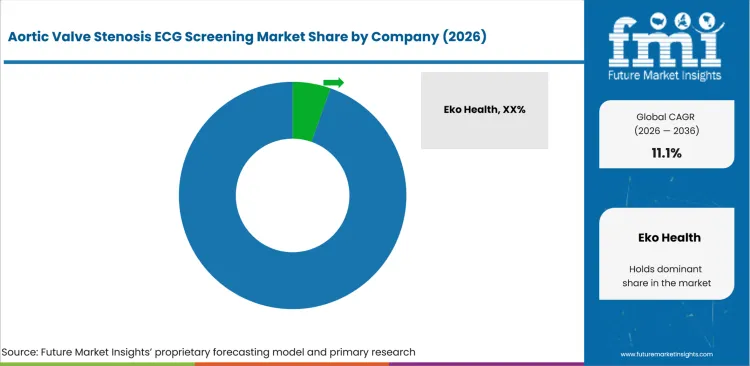
The competitive view covers direct ECG tools and AI-enabled cardiac analysis. It also covers hospital cardiology systems and imaging confirmation support. The assessment does not assign company market shares without verified company-level evidence. Comparison focuses on workflow fit and evidence status.
- Eko Health and Anumana form the closest ECG-AI group. Their relevance is based on regulated cardiac software activity and screening pathway evidence.
- GE HealthCare joins Siemens Healthineers and Philips in adding hospital system depth. Their role is strongest when screening output moves into imaging and cardiology records.
- AliveCor joins Nihon Kohden in extending the field through portable ECG and routine diagnostic equipment. Their role depends on clinical handoff design.
Competitive Benchmarking: Aortic Valve Stenosis ECG Screening Market
| Company | ECG Screening Role | AI or Analytics | Imaging or Follow-up Support | Geographic Reach |
|---|---|---|---|---|
| Eko Health | High | Medium | Medium | United States and selected international markets |
| Anumana | Medium | High | Medium | United States-focused |
| GE HealthCare | Medium | Low | High | Global |
| Philips | High | High | Medium | Global |
| Siemens Healthineers | Low | Medium | High | Global |
| AliveCor | High | Medium | Low | International |
| Nihon Kohden | High | Low | Medium | Global |
Scoring basis: High indicates a documented core capability inside the ECG screening or follow-up workflow. Medium indicates direct support through an adjacent platform. Low indicates limited direct evidence for the named capability.
Key Developments in the Aortic Valve Stenosis ECG Screening Market
- In August 2025, FDA listed Eko Foundation Analysis Software with Transformers under 510(k) K251494. The record confirms regulated cardiovascular software activity by Eko Health.
- In August 2025, GE HealthCare announced Vivid Pioneer with CE Mark and USA FDA 510(k) clearance. The system supports the imaging confirmation side of valve-disease workflows.
Key Players in the Aortic Valve Stenosis ECG Screening Market
ECG-AI and Cardiac Screening Developers
- Eko Health
- Anumana
- Philips Cardiologs
Hospital Cardiology System Providers
- GE HealthCare
- Siemens Healthineers
- Nihon Kohden
Portable ECG and Ambulatory Monitoring Providers
- AliveCor
Aortic Valve Stenosis ECG Screening Market - Report Scope
| Coverage field | Report scope |
|---|---|
| Market breakdown | Technology, end user, application, age group, and region. |
| Quantitative Units | Revenue in USD Million, CAGR in %. |
| Market Definition | Products and software-supported services used to screen or flag aortic valve stenosis risk through ECG-led cardiovascular workflows before confirmatory assessment. |
| Regions Covered | North America, Latin America, Europe, East Asia, South Asia, Oceania, and Middle East and Africa. |
| Countries Covered | USA, UK, Germany, Japan, and South Korea, with broader country coverage across the full report. |
| Key Companies Profiled | Eko Health, Anumana, GE HealthCare, Philips, Siemens Healthineers, AliveCor, Nihon Kohden. |
| Forecast Period | 2026 to 2036. |
| Approach | Hybrid bottom-up and top-down market sizing supported by primary interviews and official desk research. |
Aortic Valve Stenosis ECG Screening Market - Research Methodology
| Method | Approach |
|---|---|
| Primary Research | FMI analysts gathered input from manufacturers, service providers, technology developers, distributors, end users, procurement teams, and subject-matter experts. Interviews examined purchasing decisions, product or service evaluation, adoption barriers, approval requirements, pricing considerations, and expectations for technical or commercial support. Respondents were also asked what evidence is required before a trial, pilot, or initial order develops into regular purchasing. |
| Desk Research | Desk research covered government statistics, regulatory publications, trade data, industry associations, technical literature, standards, company filings, product information, and official corporate announcements. Sources were reviewed for relevance, publication date, geographic coverage, and consistency with the defined market scope. Claims relating to performance, applications, approvals, capacity, investment, and commercial activity were retained only when supported by credible public evidence. |
| Market Sizing and Forecasting | The market model combined the baseline value with historical performance, segment structure, pricing and volume indicators, adoption levels, company participation, and country-level demand conditions. Forecast assumptions considered economic activity, investment trends, regulatory developments, technology adoption, purchasing cycles, supply availability, and barriers to wider market use. Segment and regional estimates were reconciled before the final market total was calculated. |
| Data Validation | Estimates were checked against multiple independent indicators, including public data, company activity, trade patterns, industry developments, and findings from primary interviews. Validation also tested whether products, services, applications, and company revenues fell within the defined market boundaries. Adjacent categories, unsupported claims, overlapping revenues, and activities without direct market relevance were excluded to reduce double counting and maintain consistency across segments and countries. |
Aortic Valve Stenosis ECG Screening Market by Segments
Aortic Valve Stenosis ECG Screening Market segmented by Technology:
- Resting ECG Screening
- AI-Enhanced ECG Screening
- Remote ECG Monitoring
- Wearable ECG Screening
Aortic Valve Stenosis ECG Screening Market segmented by End User:
- Hospitals
- Cardiology Clinics
- Diagnostic Centers
- Ambulatory Care Centers
Aortic Valve Stenosis ECG Screening Market segmented by Application:
- Early Diagnosis
- Risk Stratification
- Disease Monitoring
- Population Screening
Aortic Valve Stenosis ECG Screening Market segmented by Age Group:
- Adults
- Geriatric Population
Aortic Valve Stenosis ECG Screening Market by Region:
- North America
- United States
- Canada
- Latin America
- Brazil
- Mexico
- Argentina
- Chile
- Western Europe
- Germany
- France
- United Kingdom
- Italy
- Spain
- Benelux
- Nordics
- Eastern Europe
- Poland
- Czech Republic
- Romania
- Hungary
- East Asia
- China
- Japan
- South Korea
- South Asia and Pacific
- India
- ASEAN
- Australia and New Zealand
- Middle East and Africa
- GCC Countries
- South Africa
- Türkiye
- Israel
Research Sources and Bibliography
- European Society of Cardiology. (2025, August 29). 2025 ESC/EACTS guidelines for the management of valvular heart disease. European Society of Cardiology.
- Mayo Clinic. (2025, May 10). Aortic valve stenosis: Diagnosis and treatment. Mayo Clinic.
- USA Census Bureau. (2025, June 26). Older adults outnumber children in 11 states and nearly half of USA counties. USA Census Bureau.
- Statistics Korea. (2025, September 29). 2025 statistics on the aged. Ministry of Data and Statistics.
- NHS England. (2026, February 25). Diagnostics Waiting Times and Activity Data Collection. NHS Standards Directory.
- USA Food and Drug Administration. (2025, August 12). 510(k) premarket notification K251494: Eko Foundation Analysis Software with Transformers (EFAST). USA Food and Drug Administration.
All sources were reviewed for date relevance and market fit. Each source also had to directly support the statement where it is used.
This Report Answers
- How large is the aortic valve stenosis ECG screening market in 2026 and 2036?
- Why does Resting ECG Screening hold the leading Technology share in 2026?
- How do hospitals shape adoption and follow-up workflows?
- Why does Early Diagnosis hold the leading Application share?
- How do adult cardiovascular workflows affect age-group demand?
- How do country growth rates compare across the five profiled countries?
- Which companies support ECG-led screening and follow-up workflows?
- What limits wider use of ECG-led screening for aortic stenosis?
- What evidence do procurement teams evaluate before adoption?
Frequently Asked Questions
How big is the Aortic Valve Stenosis ECG Screening Market in 2026?
The aortic valve stenosis ECG screening market is valued at USD 713.0 million in 2026 and is forecast to reach USD 2042.9 million by 2036.
What is the CAGR of the Aortic Valve Stenosis ECG Screening Market from 2026 to 2036?
The aortic valve stenosis ECG screening market is projected to grow at a CAGR of 11.1% between 2026 and 2036, supported by demand for earlier valve-risk recognition inside everyday cardiovascular workflows connecting ECG output with echocardiography referral pathways.
Which end user leads the Aortic Valve Stenosis ECG Screening Market?
Hospitals account for 41.5% of the aortic valve stenosis ECG screening market by end user in 2026, driven by cardiology teams controlling follow-up decisions and managing clean handoffs between ECG capture and echocardiography confirmation within specialist cardiovascular pathways.
Which segment is growing fastest in the Aortic Valve Stenosis ECG Screening Market?
Adults are the fastest-growing segment in the aortic valve stenosis ECG screening market, holding 60.7% share by age group in 2026, as screening reaches both routine care and specialist referral settings across patients with comorbid cardiovascular risk and unclear early symptoms.
Who are the leading companies in the Aortic Valve Stenosis ECG Screening Market?
Leading companies in the aortic valve stenosis ECG screening market include Eko Health, Anumana, GE HealthCare, Philips, Siemens Healthineers, AliveCor, and Nihon Kohden, competing across ECG-AI cardiac screening, hospital cardiology systems, and portable ambulatory monitoring platforms.
Preview the report firsthand - request a free sample
Get SampleGet the brochure for pricing and purchase details.
Get PDFTable of Content
- Key Takeaways
- Market Size and CAGR
- Top Growth Driver
- Fastest Growing Segment
- Leading Region
- Key Companies
- Emerging Opportunities
- Executive Summary
- Global Market Outlook
- Demand-side Trends
- Supply-side Trends
- Technology Roadmap Analysis
- Analysis and Recommendations
- Analyst Perspective (What is happening? Why now? What should investors know?)
- Key Questions Answered
- How large is the market?
- What is the CAGR?
- What are key trends?
- Which region dominates?
- Who are the leaders?
- Market Overview
- Market Coverage / Taxonomy
- Market Definition / Scope / Limitations
- Research Methodology
- Chapter Orientation
- Analytical Lens and Working Hypotheses
- Market Structure, Signals, and Trend Drivers
- Benchmarking and Cross-market Comparability
- Market Sizing, Forecasting, and Opportunity Mapping
- Research Design and Evidence Framework
- Desk Research Programme (Secondary Evidence)
- Expert Input and Fieldwork (Primary Evidence)
- Tooling, Models, and Reference Databases
- Data Engineering and Model Build
- Quality Assurance and Audit Trail
- Market Background
- Market Dynamics (Drivers, Restraints, Opportunity, Trends)
- Scenario Forecast (Optimistic, Likely, Conservative)
- Impact Analysis
- AI Impact
- Sustainability Impact
- Regulatory Impact
- Technology Impact
- Consumer / Buyer Analysis
- Purchase Drivers
- Adoption Barriers
- Buyer Journey
- Opportunity Map Analysis
- Product Life Cycle Analysis
- Supply Chain Analysis
- Investment Feasibility Matrix
- Value Chain Analysis
- PESTLE and Porter's Analysis
- Regulatory Landscape
- Regional Parent Market Outlook
- Production and Consumption Statistics
- Import and Export Statistics
- Global Market Analysis and Forecast, 2021 to 2036
- Historical Market Size Value (USD Million) Analysis, 2021 to 2025
- Current and Future Market Size Value (USD Million) Projections, 2026 to 2036
- Y-o-Y Growth Trend Analysis
- Absolute $ Opportunity Analysis
- Global Market Pricing Analysis, 2021 to 2036
- Global Market Analysis and Forecast, By Technology, 2021 to 2036
- Introduction / Key Findings
- Historical Market Size Value (USD Million) Analysis By Technology, 2021 to 2025
- Current and Future Market Size Value (USD Million) Analysis and Forecast By Technology, 2026 to 2036
- Resting ECG Screening
- AI-Enhanced ECG Screening
- Remote ECG Monitoring
- Wearable ECG Screening
- Resting ECG Screening
- Y-o-Y Growth Trend Analysis By Technology, 2021 to 2025
- Absolute $ Opportunity Analysis By Technology, 2026 to 2036
- Global Market Analysis and Forecast, By End User, 2021 to 2036
- Introduction / Key Findings
- Historical Market Size Value (USD Million) Analysis By End User, 2021 to 2025
- Current and Future Market Size Value (USD Million) Analysis and Forecast By End User, 2026 to 2036
- Hospitals
- Cardiology Clinics
- Diagnostic Centers
- Ambulatory Care Centers
- Hospitals
- Y-o-Y Growth Trend Analysis By End User, 2021 to 2025
- Absolute $ Opportunity Analysis By End User, 2026 to 2036
- Global Market Analysis and Forecast, By Application, 2021 to 2036
- Introduction / Key Findings
- Historical Market Size Value (USD Million) Analysis By Application, 2021 to 2025
- Current and Future Market Size Value (USD Million) Analysis and Forecast By Application, 2026 to 2036
- Early Diagnosis
- Risk Stratification
- Disease Monitoring
- Population Screening
- Early Diagnosis
- Y-o-Y Growth Trend Analysis By Application, 2021 to 2025
- Absolute $ Opportunity Analysis By Application, 2026 to 2036
- Global Market Analysis and Forecast, By Age Group, 2021 to 2036
- Introduction / Key Findings
- Historical Market Size Value (USD Million) Analysis By Age Group, 2021 to 2025
- Current and Future Market Size Value (USD Million) Analysis and Forecast By Age Group, 2026 to 2036
- Adults
- Geriatric Population
- Adults
- Y-o-Y Growth Trend Analysis By Age Group, 2021 to 2025
- Absolute $ Opportunity Analysis By Age Group, 2026 to 2036
- Global Market Analysis and Forecast, By Region, 2021 to 2036
- Introduction
- Historical Market Size Value (USD Million) Analysis By Region, 2021 to 2025
- Current Market Size Value (USD Million) Analysis and Forecast By Region, 2026 to 2036
- North America
- Latin America
- Western Europe
- Eastern Europe
- East Asia
- South Asia and Pacific
- Middle East & Africa
- Market Attractiveness Analysis By Region
- North America Market Analysis and Forecast, By Country, 2021 to 2036
- Historical Market Size Value (USD Million) Trend Analysis By Market Taxonomy, 2021 to 2025
- Market Size Value (USD Million) Forecast By Market Taxonomy, 2026 to 2036
- By Country
- USA
- Canada
- By Technology
- By End User
- By Application
- By Age Group
- By Country
- Market Attractiveness Analysis
- By Country
- By Technology
- By End User
- By Application
- By Age Group
- Key Takeaways
- Latin America Market Analysis and Forecast, By Country
- Historical Market Size Value (USD Million) Trend Analysis By Market Taxonomy, 2021 to 2025
- Market Size Value (USD Million) Forecast By Market Taxonomy, 2026 to 2036
- By Country
- Brazil
- Mexico
- Chile
- Rest of Latin America
- By Technology
- By End User
- By Application
- By Age Group
- By Country
- Market Attractiveness Analysis
- By Country
- By Technology
- By End User
- By Application
- By Age Group
- Key Takeaways
- Western Europe Market Analysis and Forecast, By Country
- Historical Market Size Value (USD Million) Trend Analysis By Market Taxonomy, 2021 to 2025
- Market Size Value (USD Million) Forecast By Market Taxonomy, 2026 to 2036
- By Country
- Germany
- UK
- Italy
- Spain
- France
- Nordic
- BENELUX
- Rest of Western Europe
- By Technology
- By End User
- By Application
- By Age Group
- By Country
- Market Attractiveness Analysis
- By Country
- By Technology
- By End User
- By Application
- By Age Group
- Key Takeaways
- Eastern Europe Market Analysis and Forecast, By Country
- Historical Market Size Value (USD Million) Trend Analysis By Market Taxonomy, 2021 to 2025
- Market Size Value (USD Million) Forecast By Market Taxonomy, 2026 to 2036
- By Country
- Russia
- Poland
- Hungary
- Balkan & Baltic
- Rest of Eastern Europe
- By Technology
- By End User
- By Application
- By Age Group
- By Country
- Market Attractiveness Analysis
- By Country
- By Technology
- By End User
- By Application
- By Age Group
- Key Takeaways
- East Asia Market Analysis and Forecast, By Country
- Historical Market Size Value (USD Million) Trend Analysis By Market Taxonomy, 2021 to 2025
- Market Size Value (USD Million) Forecast By Market Taxonomy, 2026 to 2036
- By Country
- China
- Japan
- South Korea
- By Technology
- By End User
- By Application
- By Age Group
- By Country
- Market Attractiveness Analysis
- By Country
- By Technology
- By End User
- By Application
- By Age Group
- Key Takeaways
- South Asia and Pacific Market Analysis and Forecast, By Country
- Historical Market Size Value (USD Million) Trend Analysis By Market Taxonomy, 2021 to 2025
- Market Size Value (USD Million) Forecast By Market Taxonomy, 2026 to 2036
- By Country
- India
- ASEAN
- Australia & New Zealand
- Rest of South Asia and Pacific
- By Technology
- By End User
- By Application
- By Age Group
- By Country
- Market Attractiveness Analysis
- By Country
- By Technology
- By End User
- By Application
- By Age Group
- Key Takeaways
- Middle East & Africa Market Analysis and Forecast, By Country
- Historical Market Size Value (USD Million) Trend Analysis By Market Taxonomy, 2021 to 2025
- Market Size Value (USD Million) Forecast By Market Taxonomy, 2026 to 2036
- By Country
- Kingdom of Saudi Arabia
- Other GCC Countries
- Türkiye
- South Africa
- Other African Union
- Rest of Middle East & Africa
- By Technology
- By End User
- By Application
- By Age Group
- By Country
- Market Attractiveness Analysis
- By Country
- By Technology
- By End User
- By Application
- By Age Group
- Key Takeaways
- Key Countries Market Analysis
- USA
- Pricing Analysis
- Market Share Analysis, 2025
- By Technology
- By End User
- By Application
- By Age Group
- Canada
- Pricing Analysis
- Market Share Analysis, 2025
- By Technology
- By End User
- By Application
- By Age Group
- Mexico
- Pricing Analysis
- Market Share Analysis, 2025
- By Technology
- By End User
- By Application
- By Age Group
- Brazil
- Pricing Analysis
- Market Share Analysis, 2025
- By Technology
- By End User
- By Application
- By Age Group
- Chile
- Pricing Analysis
- Market Share Analysis, 2025
- By Technology
- By End User
- By Application
- By Age Group
- Germany
- Pricing Analysis
- Market Share Analysis, 2025
- By Technology
- By End User
- By Application
- By Age Group
- UK
- Pricing Analysis
- Market Share Analysis, 2025
- By Technology
- By End User
- By Application
- By Age Group
- Italy
- Pricing Analysis
- Market Share Analysis, 2025
- By Technology
- By End User
- By Application
- By Age Group
- Spain
- Pricing Analysis
- Market Share Analysis, 2025
- By Technology
- By End User
- By Application
- By Age Group
- France
- Pricing Analysis
- Market Share Analysis, 2025
- By Technology
- By End User
- By Application
- By Age Group
- India
- Pricing Analysis
- Market Share Analysis, 2025
- By Technology
- By End User
- By Application
- By Age Group
- ASEAN
- Pricing Analysis
- Market Share Analysis, 2025
- By Technology
- By End User
- By Application
- By Age Group
- Australia & New Zealand
- Pricing Analysis
- Market Share Analysis, 2025
- By Technology
- By End User
- By Application
- By Age Group
- China
- Pricing Analysis
- Market Share Analysis, 2025
- By Technology
- By End User
- By Application
- By Age Group
- Japan
- Pricing Analysis
- Market Share Analysis, 2025
- By Technology
- By End User
- By Application
- By Age Group
- South Korea
- Pricing Analysis
- Market Share Analysis, 2025
- By Technology
- By End User
- By Application
- By Age Group
- Russia
- Pricing Analysis
- Market Share Analysis, 2025
- By Technology
- By End User
- By Application
- By Age Group
- Poland
- Pricing Analysis
- Market Share Analysis, 2025
- By Technology
- By End User
- By Application
- By Age Group
- Hungary
- Pricing Analysis
- Market Share Analysis, 2025
- By Technology
- By End User
- By Application
- By Age Group
- Kingdom of Saudi Arabia
- Pricing Analysis
- Market Share Analysis, 2025
- By Technology
- By End User
- By Application
- By Age Group
- Türkiye
- Pricing Analysis
- Market Share Analysis, 2025
- By Technology
- By End User
- By Application
- By Age Group
- South Africa
- Pricing Analysis
- Market Share Analysis, 2025
- By Technology
- By End User
- By Application
- By Age Group
- USA
- Market Structure Analysis
- Competition Dashboard
- Competition Benchmarking
- Market Share Analysis of Top Players
- By Regional
- By Technology
- By End User
- By Application
- By Age Group
- Emerging Startups
- Innovation Benchmarking
- Competition Analysis
- Competition Deep Dive
- Eko Health
- Overview
- Product Portfolio
- Profitability by Market Segments
- Sales Footprint
- Strategy Overview
- Marketing Strategy
- Product Strategy
- Channel Strategy
- Anumana
- GE HealthCare
- Philips
- Siemens Healthineers
- AliveCor
- Nihon Kohden
- Baxter
- Cardiologs
- HeartBeam
- Eko Health
- Case Studies
- Success Stories
- Recent Developments
- Competition Deep Dive
- Assumptions & Acronyms Used


