

- Market Size (2026)
- USD 1238.7 Mn
- Forecast (2036)
- USD 4058.4 Mn
- CAGR (2026 to 2036)
- 12.6%
How big is FDA Breakthrough Device Aortic Stenosis Screening Market in 2026?
USD 1,238.7 million in 2026 and USD 4,058.4 million by 2036 at a 12.6% CAGR.
Demand for FDA breakthrough device aortic stenosis screening is forecast to expand at 12.6% CAGR between 2026 and 2036, increasing valuation from USD 1238.7 million in 2026 to USD 4058.4 million by 2036. Commercial spending develops around tools that identify possible valve disease during routine encounters and direct appropriate patients toward confirmatory echocardiography. The FDA reported in March 2026 that 1,284 devices had received Breakthrough Device designation while 198 designated devices had obtained marketing authorization. Designation therefore shortens regulatory interaction without replacing the separate evidence required for legal marketing and clinical deployment. Providers compare aortic stenosis screening with ambulatory cardiac monitoring because both workflows require dependable acquisition plus accountable clinical review. Health systems also compare cardiac monitoring devices through integration effort and referral ownership across routine cardiovascular services. A defensible purchase connects screening sensitivity with referral capacity so added detections do not create unmanaged diagnostic queues.
National adoption routes differ materially because reimbursement and specialist capacity determine how a positive screen becomes a completed diagnostic decision. United States hospitals can connect cleared software with outpatient payment pathways while British primary care programs often require evidence that screening reduces referral delay across public services. German providers operate inside regulated imaging networks that demand documented interoperability and dependable local maintenance. Japanese and South Korean health systems combine aging populations with concentrated specialist services yet facility budgets can limit broad deployment outside major centers. The same technology therefore produces different economics across diagnostic imaging services because each country assigns screening and confirmation costs through distinct purchasing structures. Commercial evaluation should separate detection volume from completed follow-up since a screening platform creates limited value without timely echocardiography and cardiology review.
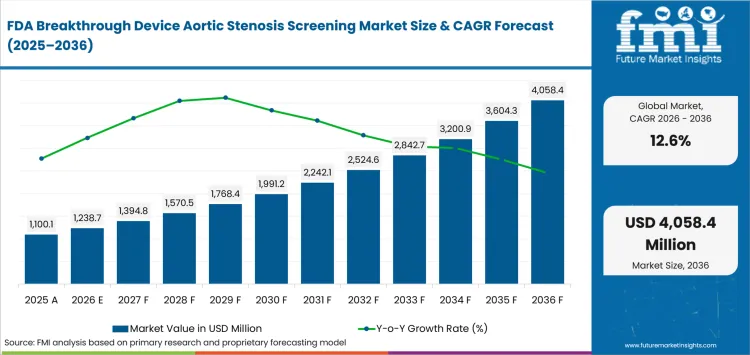
Key Takeaways of FDA Breakthrough Device Aortic Stenosis Screening Market
- Demand for aortic stenosis screening is driven by health-system need for earlier identification that reduces emergency referrals, with commercial value depending on detection volumes converting into documented follow-up and completed diagnostic pathways.
- By technology, ECG-based screening holds the leading share at 36.4% in 2026, supported by broad ECG availability across hospitals and ambulatory settings.
- Hospitals lead end-user demand at 30.6% share in 2026, owing to their control over specialist review and confirmatory imaging.
- Early detection is the dominant application segment, holding 35.5% share in 2026, driven by the clinical cost of identifying valve disease later in its progression.
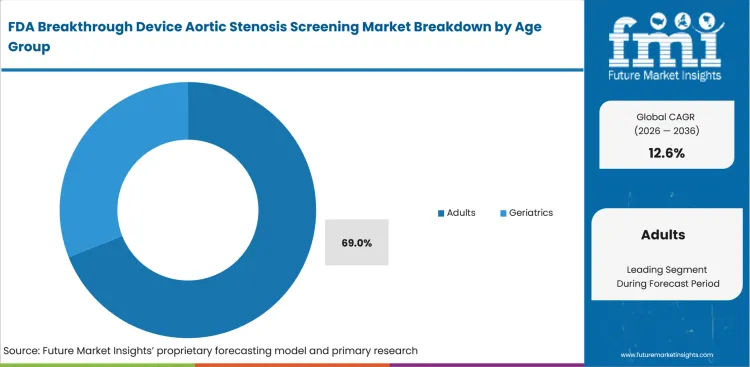
- Adults account for 69.0% age-group share in 2026, reflecting the broad population eligible for routine ECG and auscultation encounters.
- The UK, Germany, and Japan record CAGRs of 15.4%, 13.8%, and 13.0% respectively through 2036, while the USA and South Korea show slower profiled rates shaped by payment coverage and service concentration.
- Competition centers on Eko Health, Anumana, GE HealthCare, Echo IQ, Philips, Siemens Healthineers, AISAP, and Us2.ai, with vendors differentiating through digital stethoscope/ECG workflows, echocardiographic decision support, enterprise imaging integration, and automated cardiac ultrasound.
Analyst Perspective
"The FDA breakthrough device aortic stenosis screening market will be defined by its ability to improve early diagnosis while fitting within established cardiovascular care pathways. Healthcare providers are evaluating whether screening technologies translate into timely specialist referrals, efficient diagnostic follow-up, and measurable clinical benefit rather than higher detection rates alone. Companies that strengthen clinical validation, workflow integration, and reimbursement readiness will be better positioned to expand adoption."
— Anurag Sharma, Principal Analyst at Future Market Insights
Source: FMI's proprietary forecasting model and primary research
How is the FDA Breakthrough Device Aortic Stenosis Screening Market segmented?
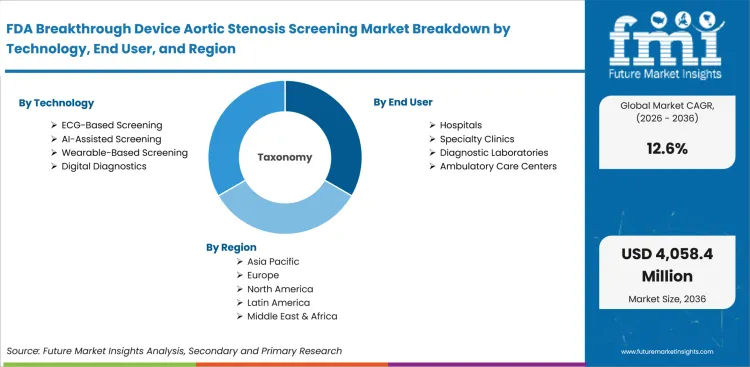
The FDA breakthrough device aortic stenosis screening market is segmented by technology, end user, application, age group, and region.
Technology separates ECG-based screening from AI-assisted tools and wearable acquisition systems together with broader digital diagnostics. End-user analysis distinguishes hospitals from specialty clinics and diagnostic laboratories plus ambulatory care centers that manage different referral responsibilities. Application categories follow early detection and population screening alongside risk assessment and follow-up monitoring across the care pathway. Age-group analysis separates adults from geriatric patients because disease burden and referral needs differ across these populations. Regional analysis compares approval routes and service access across countries with different cardiovascular delivery systems.
What supports demand for ECG-based screening within the technology category?
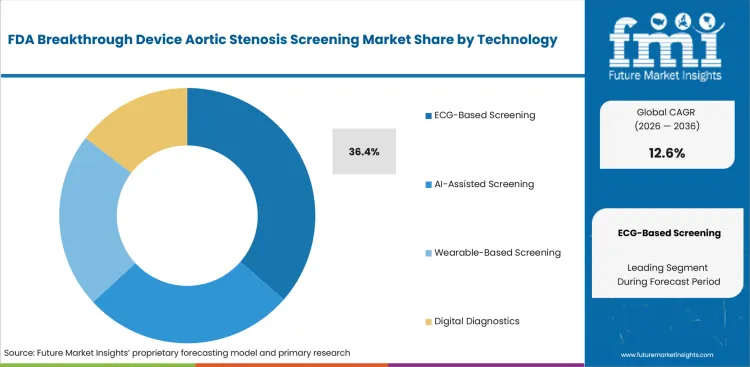
ECG-based screening uses a familiar clinical signal to identify patients who may need confirmatory valve imaging. The FDA product classification database identifies aortic stenosis machine learning-based notification software as a regulated device category for reviewing ECG information. The FDA classification gives developers a defined regulatory pathway for performance evidence and clear clinician-facing risk notifications. Hospitals can also compare the workflow with continuous cardiac monitoring because both systems depend on reliable acquisition and structured interpretation.
- Within technology, ECG-based screening is projected to account for 36.4% share in 2026 supported by broad ECG availability across hospitals and ambulatory settings. The segment benefits from a low additional acquisition burden yet commercial value depends on referral rules that convert risk notifications into echocardiography.
- Cardiology departments and primary care networks select ECG-based screening to identify hidden risk during routine recordings already captured for other clinical questions. Adoption requires validated performance across representative populations plus transparent physician review so false positives do not overwhelm imaging capacity.
How do hospitals evaluate aortic stenosis screening within the end-user category?
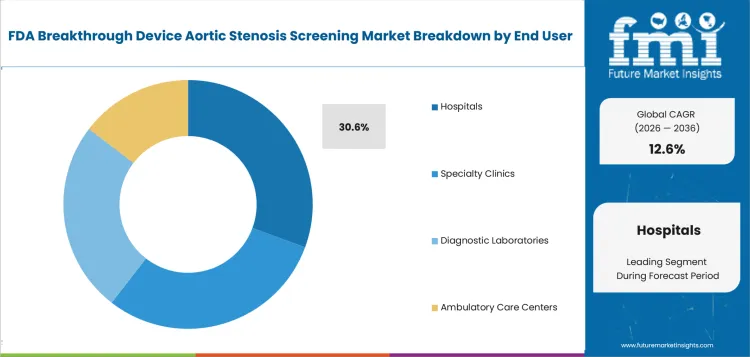
Hospitals combine screening access with echocardiography and cardiology services that can complete diagnostic confirmation within one governed pathway. Their purchasing case depends on whether outpatient examinations receive payment and whether referral capacity remains available during routine operations. Integrated systems can compare screening results with coronary diagnostic imaging records without treating either workflow as interchangeable evidence.
- Hospitals are estimated to hold 30.6% of end-user demand in 2026 owing to their control over specialist review and confirmatory imaging. The hospital share reflects their ability to manage clinical escalation although implementation costs remain material across information technology and staff training.
- Hospital outpatient departments gain a clearer payment route when screening examinations fit established reimbursement structures and documented physician oversight. Local coding support and follow-up capacity must remain available before payment becomes dependable operating revenue. Eko Health reported in December 2025 that CMS finalized national OPPS payment for SENSORA examinations in hospital-associated outpatient care.
What makes early detection central to the application category?
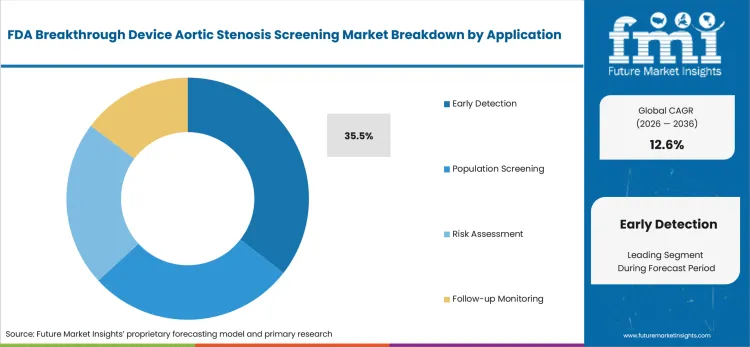
Early detection addresses patients whose valve disease may remain unnoticed during routine care until symptoms or functional decline become evident. Eko Health reported in February 2026 that Wayne General Hospital deployed SENSORA across emergency and primary care settings with staff training and escalation pathways. The deployment shows that point-of-care diagnostics require a defined referral response so local clinicians can direct appropriate findings toward echocardiography and specialist review.
- Early detection is forecast to represent 35.5% of application demand in 2026 driven by the clinical cost of identifying valve disease later in its progression. The segment gains relevance through routine encounters yet its economics depend on avoiding unnecessary referrals and documenting completed follow-up.
- Primary care practices and emergency departments adopt early detection tools to identify concerning signals before symptoms produce more complex cardiovascular presentations. Successful programs define staff training and physician review plus referral thresholds so screening results enter a controlled diagnostic pathway.
How does the adult population shape the age-group category?
Adult screening programs cover a broad population with variable symptoms and cardiovascular risk profiles across routine outpatient care. Screening designs must distinguish general adult access from targeted geriatric evaluation because disease prevalence increases substantially with age. Remote rhythm monitoring provides a related comparison for age-based enrollment across distributed outpatient networks and community services. Aortic stenosis screening remains distinct because every concerning result requires confirmatory imaging and valve-specific interpretation.
- By age-group, adults are projected to represent 69.0% share in 2026 reflecting the broad population eligible for routine ECG and auscultation encounters. The category remains commercially wide while screening intensity should increase selectively for older adults with stronger clinical risk.
- Primary care networks use adult screening to reach patients before a specialist referral has already been established. Programs need age-sensitive referral thresholds that preserve access without treating every adult result as clinically equivalent. The American Heart Association stated in June 2026 that older people face greater valve disease risk and diagnostic testing may include ECG plus echocardiography.
What are the drivers, restraints, and opportunities in the FDA Breakthrough Device Aortic Stenosis Screening Market?
Earlier case finding supports demand while referral capacity and geographic authorization constrain use; integrated care pathways create the clearest commercial opening.
- Driver: Earlier identification creates demand when routine examinations can direct suspected aortic stenosis toward timely echocardiography and specialist review.
- Restraint: Regulatory availability or limited diagnostic capacity can prevent positive findings from entering a completed clinical pathway.
- Opportunity: Integrated screening services can connect signal acquisition with referral management and documented follow-up across primary care and hospital networks.
Undiagnosed valve disease creates a clinical workload that supports earlier screening across routine cardiovascular encounters. The American Heart Association reported in November 2025 that its Target Aortic Stenosis initiative included more than 2,200 patients across at least 40 hospitals. The initiative focuses on earlier diagnosis and treatment pathways rather than isolated algorithm performance or notification volume. Clinical diagnostics providers gain a stronger purchasing case when screening identifies patients early enough for organized imaging and longitudinal management. Hospital leaders should therefore measure referral completion plus treatment decisions instead of counting alerts alone.
Geographic authorization and limited specialist capacity restrict adoption even when a screening algorithm performs well in its approved setting. Health systems outside the cleared geography cannot treat technical readiness as legal market access for clinical deployment. Echo IQ states that EchoSolv AS is FDA cleared for United States use and remains unavailable in other regions without local regulatory approval. Facilities inside an authorized market also need echocardiography capacity and trained reviewers for every actionable result. Commercial expansion therefore depends on country-specific clearance plus service resources that complete the diagnostic pathway.
Broader cardiovascular platforms create an opening for aortic stenosis screening algorithms that share established signal capture and enterprise integration. The wider platform can reduce separate integration work for future valve screening modules without proving their clinical adoption by itself. Wearable device connectivity provides another route for longitudinal data access although product claims require market-specific validation. Anumana announced in April 2025 that it expanded its ECG-AI platform across perioperative and acute care applications with new investment support. Developers should pair each algorithm with a defined deployment pathway and a specialty escalation service for actionable results.
Which country CAGRs are profiled in the FDA Breakthrough Device Aortic Stenosis Screening Market?
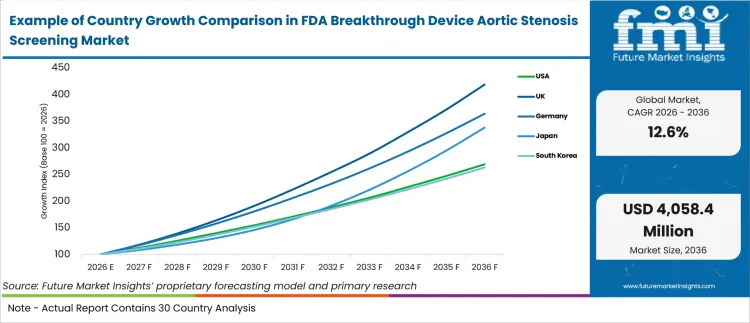
| Country | CAGR |
|---|---|
| USA | 10.4% |
| UK | 15.4% |
| Germany | 13.8% |
| Japan | 13.0% |
| South Korea | 10.2% |
How do country-level CAGRs compare in the FDA Breakthrough Device Aortic Stenosis Screening Market
The country comparison spans 5.2 percentage points between the UK at 15.4% and South Korea at 10.2%. Germany and Japan form a close middle cluster that remains separated by just 0.8 percentage point. USA and South Korea occupy another compressed pair with a difference of just 0.2 percentage point. The UK remains 1.6 points above Germany which creates the most pronounced separation among adjacent listed values. The listed rates describe forecast pace within the approved market profile and do not establish current market size or installed-base leadership.
- Public primary care pathways place the UK outside the main cluster through broader evaluations tied to procurement and clinical governance requirements.
- Germany combines a relatively strong forecast with regulated imaging networks that require interoperability and dependable service before software enters routine hospital use.
- Japan remains close to Germany although compact facilities and specialist concentration create different deployment economics across urban and regional providers.
- USA growth is positioned below the middle cluster because coverage and hospital adoption vary across payment settings despite extensive diagnostic infrastructure.
- South Korea nearly matches the USA rate while concentrated tertiary services can produce strong urban adoption and weaker access outside major medical centers.
Similar CAGRs can produce different entry conditions because legal sale status and reimbursement determine whether a technically suitable system can generate revenue. Training capacity and local maintenance also change implementation cost across otherwise comparable national growth forecasts and purchasing environments.
The full report provides country-level CAGR analysis across North America, Latin America, Europe, East Asia, South Asia, Oceania and the Middle East and Africa.
Country-wise Analysis
- United States health systems can connect FDA-authorized software with established echocardiography and outpatient reimbursement pathways across integrated provider networks. The American Heart Association reported in December 2025 that about 12% of Americans aged 75 years or older have aortic stenosis. The FDA breakthrough device aortic stenosis screening market in the USA is forecast to expand at 10.4% CAGR through 2036 shaped by uneven coverage and facility-level implementation decisions. The older population supports targeted screening while rural sites may lack nearby valve specialists and diagnostic capacity. Point-of-care diagnostic programs need referral agreements and service support that extend beyond the originating clinic.
- United Kingdom adoption operates through national health services and community practices that require centrally governed pathways for diagnostic escalation. Demand for the FDA breakthrough device aortic stenosis screening market in the UK is projected to rise at 15.4% CAGR between 2026 and 2036 supported by frontline cardiovascular assessment. Direct product availability can strengthen access yet NHS procurement and regional training may delay consistent deployment across public services. Eko Health announced in April 2025 that UK clinicians could purchase its CORE 500 digital stethoscope and Eko+ tools through local online channels. Commercial entrants need local clinical champions plus dependable support for referral documentation and device maintenance.
- German hospitals operate within mature cardiovascular imaging networks that demand documented interoperability and regulated clinical responsibility for software-assisted decisions. Germany’s FDA breakthrough device aortic stenosis screening market is anticipated to advance at 13.8% CAGR during the forecast period attributable to aging-related diagnostic need and specialist infrastructure. Destatis reported in May 2026 that Germany had 19.0 million residents aged 65 years or older in 2024 which represented 23% of the population. The demographic profile supports targeted case finding while hospital information-system integration and regional service coverage remain material frictions. Technology providers need validated German workflows and maintenance routes that protect continuity across imaging departments.
- Japanese cardiovascular services combine concentrated specialist expertise with facilities that often prioritize compact equipment and disciplined diagnostic workflows. Official data published by Japan’s Statistics Bureau in September 2025 placed the population aged 65 years or older at 36.19 million which equaled 29.4% nationally. Adoption of the FDA breakthrough device aortic stenosis screening market in Japan is estimated to grow at 13.0% CAGR through 2036 enabled by a large older population and structured referral pathways. The age profile supports screening demand yet regional access and limited clinical staffing can restrict follow-up outside large centers. Suppliers need Japanese-language integration and local training that preserves physician oversight across compact care settings.
- South Korean adoption centers on digitally connected tertiary hospitals that can combine screening signals with specialist imaging across dense urban networks. South Korea’s FDA breakthrough device aortic stenosis screening market is projected to record 10.2% CAGR from 2026 to 2036 linked to population aging and advanced hospital infrastructure. Urban concentration enables rapid clinical escalation while smaller regional facilities may face service distance and specialist shortages. A September 2025 release from the Ministry of Data and Statistics established that residents aged 65 years or older represented 20.3% of the population. Non-hospital diagnostics deployments need remote support and referral agreements that connect community screening with tertiary valve programs.
Who are the notable companies in the FDA Breakthrough Device Aortic Stenosis Screening Market?
Eko Health, Anumana, GE HealthCare, Echo IQ, Philips, Siemens Healthineers, AISAP, and Us2.ai are the notable companies shaping this market.
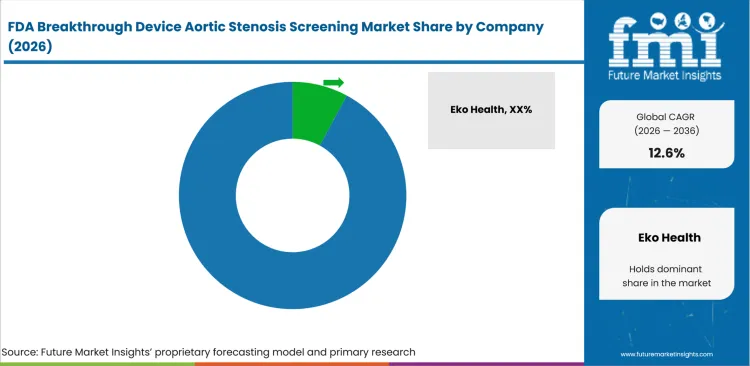
The competitive field combines frontline signal screening with echocardiographic decision support and enterprise imaging platforms that manage clinical workflow integration. Direct aortic stenosis capabilities remain concentrated among companies with ECG or echo algorithms that identify disease probability or automate valve measurements. Established imaging vendors contribute acquisition systems and integration channels rather than identical standalone screening products for aortic stenosis. Commercial evaluation should compare regulatory scope and workflow ownership together with local service coverage across each provider. Selection becomes defensible once a hospital can identify who validates signals and who manages every positive result through confirmatory imaging.
- Eko Health and Anumana support ECG or digital auscultation workflows that can extend cardiovascular risk detection into routine frontline examinations. Echo IQ provides FDA-cleared aortic stenosis decision support from existing echocardiographic measurements within the United States.
- GE HealthCare provides Automated Aortic Stenosis Software alongside broader cardiac imaging systems used across diagnostic departments. Philips and Siemens Healthineers support enterprise ECG or ultrasound workflows that can integrate algorithms across established diagnostic environments.
- AISAP applies automated cardiac ultrasound analysis across point-of-care settings while Us2.ai automates aortic stenosis measurements and severity grading from echocardiography. Their commercial reach depends on local regulatory status and implementation support across each intended clinical deployment geography.
Competitive Benchmarking: FDA Breakthrough Device Aortic Stenosis Screening Market
| Company | Aortic Stenosis Specificity | Screening Workflow Integration | Clinical Deployment Support | Geographic Reach |
|---|---|---|---|---|
| Eko Health | Medium | High | High | North America and selected international markets |
| Anumana | Medium | High | Medium | North America |
| GE HealthCare | High | High | High | Global |
| Echo IQ | High | Medium | Medium | United States |
| Philips | Medium | High | High | Global |
| Siemens Healthineers | Medium | High | High | Global |
| AISAP | High | Medium | Medium | United States and Israel |
| Us2.ai | High | High | Medium | Selected international markets |
Key Developments in the FDA Breakthrough Device Aortic Stenosis Screening Market
- In March 2026, GE HealthCare: The FDA cleared Automated Aortic Stenosis Software under submission K254161 for machine learning-based notification from ECG information. The authorization establishes a disease-specific commercial route within the Breakthrough Devices Program and gives health systems a regulated product for identifying patients who may need additional assessment.
- In January 2026, Eko Health reported publication of the TRICORDER randomized study across 205 NHS general practices serving approximately 1.5 million patients. Eko stated that its AI-enabled stethoscope workflow detected valvular heart disease 1.9 times more often than standard care which strengthens the evidence base for frontline screening implementation.
- In July 2025, Philips: Philips launched an ECG AI Marketplace with Anumana’s low ejection fraction algorithm as the first third-party solution for United States customers. The platform provides an enterprise route for adding validated algorithms to established ECG workflows and can reduce integration work for future disease-specific screening applications.
- In September 2025, Eko Health: The FDA cleared the EFAST cardiac foundation model for structural murmur and atrial fibrillation detection within SENSORA. The clearance expanded the platform’s frontline cardiac screening capabilities and created a broader signal-analysis base that can support referral workflows for suspected structural heart disease.
Key Players in the FDA Breakthrough Device Aortic Stenosis Screening Market
Frontline Cardiac Screening Developers
- Eko Health
- Anumana
- Echo IQ
Imaging and Workflow Platform Providers
- GE HealthCare
- Philips
- Siemens Healthineers
Automated Cardiac Ultrasound Providers
- AISAP
- Us2.ai
FDA Breakthrough Device Aortic Stenosis Screening Market - Report Scope
| Coverage field | Report scope |
|---|---|
| Market breakdown | Technology, end user, application, age group, and region. |
| Quantitative Units | Revenue in USD Million, CAGR in %. |
| Market Definition | FDA Breakthrough Device-related products and services used to screen for suspected aortic stenosis through ECG, digital auscultation, or automated cardiac imaging workflows. |
| Regions Covered | North America, Latin America, Western Europe, Eastern Europe, East Asia, South Asia and Pacific, and Middle East and Africa. |
| Countries Covered | USA, UK, Germany, Japan, and South Korea. |
| Key Companies Profiled | Eko Health, Anumana, GE HealthCare, Echo IQ, Philips, Siemens Healthineers, AISAP, and Us2.ai. |
| Forecast Period | 2026 to 2036. |
| Approach | Hybrid bottom-up and top-down market sizing supported by primary interviews and official desk research. |
FDA Breakthrough Device Aortic Stenosis Screening Market - Research Methodology
| Method | Approach |
|---|---|
| Primary Research | FMI analysts gathered input from manufacturers, service providers, technology developers, distributors, end users, sourcing teams, and subject-matter experts. Interviews examined purchasing decisions, product or service evaluation, adoption barriers, approval requirements, pricing considerations, and expectations for technical or commercial support. Respondents were also asked what evidence is required before a trial, pilot, or initial order develops into regular purchasing. |
| Desk Research | Desk research covered government statistics, regulatory publications, trade data, industry associations, technical literature, standards, company filings, product information, and official corporate announcements. Sources were reviewed for relevance, publication date, geographic coverage, and consistency with the defined market scope. Claims relating to performance, applications, approvals, capacity, investment, and commercial activity were retained only when supported by credible public evidence. |
| Market Sizing and Forecasting | The market model combined the baseline value with historical performance, segment structure, pricing and volume indicators, adoption levels, company participation, and country-level demand conditions. Forecast assumptions considered economic activity, investment trends, regulatory developments, technology adoption, purchasing cycles, supply availability, and barriers to wider market use. Segment and regional estimates were reconciled before the final market total was calculated. |
| Data Validation | Estimates were checked against multiple independent indicators, including public data, company activity, trade patterns, industry developments, and findings from primary interviews. Validation also tested whether products, services, applications, and company revenues fell within the defined market boundaries. Adjacent categories, unsupported claims, overlapping revenues, and activities without direct market relevance were excluded to reduce double counting and maintain consistency across segments and countries. |
FDA Breakthrough Device Aortic Stenosis Screening Market by Segments
FDA Breakthrough Device Aortic Stenosis Screening Market segmented by Technology:
- ECG-Based Screening
- AI-Assisted Screening
- Wearable-Based Screening
- Digital Diagnostics
FDA Breakthrough Device Aortic Stenosis Screening Market segmented by End User:
- Hospitals
- Specialty Clinics
- Diagnostic Laboratories
- Ambulatory Care Centers
FDA Breakthrough Device Aortic Stenosis Screening Market segmented by Application:
- Early Detection
- Population Screening
- Risk Assessment
- Follow-up Monitoring
FDA Breakthrough Device Aortic Stenosis Screening Market segmented by Age Group:
- Adults
- Geriatrics
FDA Breakthrough Device Aortic Stenosis Screening Market by Region
- North America
- United States
- Canada
- Latin America
- Brazil
- Mexico
- Argentina
- Chile
- Western Europe
- Germany
- France
- United Kingdom
- Italy
- Spain
- Benelux
- Nordics
- Eastern Europe
- Poland
- Czech Republic
- Romania
- Hungary
- East Asia
- China
- Japan
- South Korea
- South Asia and Pacific
- India
- ASEAN
- Australia and New Zealand
- Middle East and Africa
- GCC Countries
- South Africa
- Türkiye
- Israel
Research Sources and Bibliography
- USA Food and Drug Administration. (2026, March 31). Breakthrough Devices Program.
- USA Food and Drug Administration. (n.d.). Product classification: Aortic stenosis machine learning-based notification software. .
- USA Food and Drug Administration. (2026, March 27). 510(k) premarket notification: Automated Aortic Stenosis Software (AutoAS), K254161.
- American Heart Association. (2026, June 15). Heart Valve Disease Risks and Diagnosis.
- American Heart Association. (2025, November 3). New effort launched to support earlier diagnosis, treatment of aortic stenosis.
- American Heart Association. (2025, December 17). Heart Association highlights 2025’s major research findings.
- Eko Health. (2025, April 15). Eko Health Broadens Global Reach with UK Launch of AI-Powered Stethoscope Platform.
- Eko Health. (2025, December 2). CMS Finalizes OPPS Payment for Eko Health’s SENSORA® Platform, Expanding Reimbursement for AI-Enabled Cardiac Disease Detection in Hospital-Associated Outpatient Care.
- Eko Health. (2026, February 26). Wayne General Hospital Partners with Eko Health to Deploy AI-Assisted Cardiac Detection in Rural Mississippi.
- Eko Health. (2026, January 29). The Lancet Publishes TRICORDER Study on AI Stethoscopes in Primary Care.
- Eko Health. (2025, September 25). Eko Health Receives First FDA Clearance for Cardiac Foundation Model.
- Eko Health. (2019, June 21). Handheld Wireless Digital Phonocardiography for Machine Learning-Based Detection of Aortic Stenosis.
- Anumana. (2025, April 24). Anumana Expands AI Platform from Diagnostic Solutions to the Full Continuum of Cardiovascular Care.
- Anumana. (2020, February 29). Detection of Aortic Stenosis Using an Artificial Intelligence-Enabled Electrocardiogram.
- Philips. (n.d.). IntelliSpace ECG. .
- Philips. (2025, July 17). Philips Launches ECG AI Marketplace to Enhance Early Cardiac Diagnosis.
- GE HealthCare. (n.d.). Aortic Stenosis Solutions. .
- Echo IQ. (n.d.). Aortic Stenosis. .
- Echo IQ. (n.d.). EchoSolv™ AS Reimbursement. .
- Siemens Healthineers. (n.d.). ACUSON Origin Ultrasound System. .
- AISAP. (n.d.). AISAP Cardio. .
- Us2.ai. (n.d.). Automated Echo Analysis & Reporting Software. .
- Us2.ai. (n.d.). Accurately Detect & Grade Aortic Stenosis. .
- Statistisches Bundesamt. (2026, May 18). Ältere Menschen [Older people].
- Statistics Bureau of Japan. (2025, September 14).[Statistics on Japan’s elderly population for Respect for the Aged Day].
- Ministry of Data and Statistics. (2025, September 29). 2025 [2025 statistics on the elderly].
This bibliography is provided for reader reference and is not exhaustive. The full report contains the complete reference list and detailed citations
This Report Answers
- How large is the FDA breakthrough device aortic stenosis screening market in 2026 and 2036?
- Which clinical and commercial mechanisms support growth in the FDA breakthrough device aortic stenosis screening market?
- Why does ECG-based screening hold the largest approved technology share in 2026?
- How do hospitals evaluate reimbursement and referral capacity for aortic stenosis screening?
- What supports early detection across routine cardiovascular examinations and primary care pathways?
- How do country growth rates compare across USA, UK, Germany, Japan, and South Korea?
- Which companies provide screening algorithms or imaging workflow support in the FDA breakthrough device aortic stenosis screening market?
- What regulatory and service constraints limit commercial adoption across different countries?
- Which operating measures should executives use to assess screening return on investment?
Frequently Asked Questions
How big is the FDA Breakthrough Device Aortic Stenosis Screening Market in 2026?
The FDA breakthrough device aortic stenosis screening market is valued at USD 1238.7 million in 2026 and is forecast to reach USD 4058.4 million by 2036.
What is the CAGR of the FDA Breakthrough Device Aortic Stenosis Screening Market from 2026 to 2036?
The FDA breakthrough device aortic stenosis screening market grows at a CAGR of 12.6% between 2026 and 2036, supported by earlier detection initiatives, expanding regulatory approvals for AI-assisted screening solutions, and greater use of digital cardiovascular diagnostics across healthcare systems.
Which technology leads the FDA Breakthrough Device Aortic Stenosis Screening Market?
ECG-based screening accounts for 36.4% of the FDA breakthrough device aortic stenosis screening market by technology in 2026, supported by widespread ECG availability, established clinical workflows, and its ability to identify patients requiring confirmatory echocardiography.
How much will the FDA Breakthrough Device Aortic Stenosis Screening Market add between 2026 and 2036?
The FDA breakthrough device aortic stenosis screening market is set to add USD 2819.7 million between 2026 and 2036, growing from USD 1238.7 million to USD 4058.4 million as healthcare providers expand AI-assisted screening, strengthen referral pathways, and integrate cardiovascular decision-support technologies into routine care.
Who are the leading companies in the FDA Breakthrough Device Aortic Stenosis Screening Market?
Eight companies lead the FDA breakthrough device aortic stenosis screening market, including Eko Health, Anumana, GE HealthCare, Echo IQ, Philips, Siemens Healthineers, AISAP, and Us2.ai, competing through AI-enabled ECG analysis, echocardiography decision support, enterprise imaging integration, and automated cardiac ultrasound solutions.
Preview the report firsthand - request a free sample
Get SampleGet the brochure for pricing and purchase details.
Get PDFTable of Content
- Key Takeaways
- Market Size and CAGR
- Top Growth Driver
- Fastest Growing Segment
- Leading Region
- Key Companies
- Emerging Opportunities
- Executive Summary
- Global Market Outlook
- Demand-side Trends
- Supply-side Trends
- Technology Roadmap Analysis
- Analysis and Recommendations
- Analyst Perspective (What is happening? Why now? What should investors know?)
- Key Questions Answered
- How large is the market?
- What is the CAGR?
- What are key trends?
- Which region dominates?
- Who are the leaders?
- Market Overview
- Market Coverage / Taxonomy
- Market Definition / Scope / Limitations
- Research Methodology
- Chapter Orientation
- Analytical Lens and Working Hypotheses
- Market Structure, Signals, and Trend Drivers
- Benchmarking and Cross-market Comparability
- Market Sizing, Forecasting, and Opportunity Mapping
- Research Design and Evidence Framework
- Desk Research Programme (Secondary Evidence)
- Expert Input and Fieldwork (Primary Evidence)
- Tooling, Models, and Reference Databases
- Data Engineering and Model Build
- Quality Assurance and Audit Trail
- Market Background
- Market Dynamics (Drivers, Restraints, Opportunity, Trends)
- Scenario Forecast (Optimistic, Likely, Conservative)
- Impact Analysis
- AI Impact
- Sustainability Impact
- Regulatory Impact
- Technology Impact
- Consumer / Buyer Analysis
- Purchase Drivers
- Adoption Barriers
- Buyer Journey
- Opportunity Map Analysis
- Product Life Cycle Analysis
- Supply Chain Analysis
- Investment Feasibility Matrix
- Value Chain Analysis
- PESTLE and Porter's Analysis
- Regulatory Landscape
- Regional Parent Market Outlook
- Production and Consumption Statistics
- Import and Export Statistics
- Global Market Analysis and Forecast, 2021 to 2036
- Historical Market Size Value (USD Million) Analysis, 2021 to 2025
- Current and Future Market Size Value (USD Million) Projections, 2026 to 2036
- Y-o-Y Growth Trend Analysis
- Absolute $ Opportunity Analysis
- Global Market Pricing Analysis, 2021 to 2036
- Global Market Analysis and Forecast, By Technology, 2021 to 2036
- Introduction / Key Findings
- Historical Market Size Value (USD Million) Analysis By Technology, 2021 to 2025
- Current and Future Market Size Value (USD Million) Analysis and Forecast By Technology, 2026 to 2036
- ECG-Based Screening
- AI-Assisted Screening
- Wearable-Based Screening
- Digital Diagnostics
- ECG-Based Screening
- Y-o-Y Growth Trend Analysis By Technology, 2021 to 2025
- Absolute $ Opportunity Analysis By Technology, 2026 to 2036
- Global Market Analysis and Forecast, By End User, 2021 to 2036
- Introduction / Key Findings
- Historical Market Size Value (USD Million) Analysis By End User, 2021 to 2025
- Current and Future Market Size Value (USD Million) Analysis and Forecast By End User, 2026 to 2036
- Hospitals
- Specialty Clinics
- Diagnostic Laboratories
- Ambulatory Care Centers
- Hospitals
- Y-o-Y Growth Trend Analysis By End User, 2021 to 2025
- Absolute $ Opportunity Analysis By End User, 2026 to 2036
- Global Market Analysis and Forecast, By Application, 2021 to 2036
- Introduction / Key Findings
- Historical Market Size Value (USD Million) Analysis By Application, 2021 to 2025
- Current and Future Market Size Value (USD Million) Analysis and Forecast By Application, 2026 to 2036
- Early Detection
- Population Screening
- Risk Assessment
- Follow-up Monitoring
- Early Detection
- Y-o-Y Growth Trend Analysis By Application, 2021 to 2025
- Absolute $ Opportunity Analysis By Application, 2026 to 2036
- Global Market Analysis and Forecast, By Age Group, 2021 to 2036
- Introduction / Key Findings
- Historical Market Size Value (USD Million) Analysis By Age Group, 2021 to 2025
- Current and Future Market Size Value (USD Million) Analysis and Forecast By Age Group, 2026 to 2036
- Adults
- Geriatrics
- Adults
- Y-o-Y Growth Trend Analysis By Age Group, 2021 to 2025
- Absolute $ Opportunity Analysis By Age Group, 2026 to 2036
- Global Market Analysis and Forecast, By Region, 2021 to 2036
- Introduction
- Historical Market Size Value (USD Million) Analysis By Region, 2021 to 2025
- Current Market Size Value (USD Million) Analysis and Forecast By Region, 2026 to 2036
- North America
- Latin America
- Western Europe
- Eastern Europe
- East Asia
- South Asia and Pacific
- Middle East & Africa
- Market Attractiveness Analysis By Region
- North America Market Analysis and Forecast, By Country, 2021 to 2036
- Historical Market Size Value (USD Million) Trend Analysis By Market Taxonomy, 2021 to 2025
- Market Size Value (USD Million) Forecast By Market Taxonomy, 2026 to 2036
- By Country
- USA
- Canada
- By Technology
- By End User
- By Application
- By Age Group
- By Country
- Market Attractiveness Analysis
- By Country
- By Technology
- By End User
- By Application
- By Age Group
- Key Takeaways
- Latin America Market Analysis and Forecast, By Country
- Historical Market Size Value (USD Million) Trend Analysis By Market Taxonomy, 2021 to 2025
- Market Size Value (USD Million) Forecast By Market Taxonomy, 2026 to 2036
- By Country
- Brazil
- Mexico
- Chile
- Rest of Latin America
- By Technology
- By End User
- By Application
- By Age Group
- By Country
- Market Attractiveness Analysis
- By Country
- By Technology
- By End User
- By Application
- By Age Group
- Key Takeaways
- Western Europe Market Analysis and Forecast, By Country
- Historical Market Size Value (USD Million) Trend Analysis By Market Taxonomy, 2021 to 2025
- Market Size Value (USD Million) Forecast By Market Taxonomy, 2026 to 2036
- By Country
- Germany
- UK
- Italy
- Spain
- France
- Nordic
- BENELUX
- Rest of Western Europe
- By Technology
- By End User
- By Application
- By Age Group
- By Country
- Market Attractiveness Analysis
- By Country
- By Technology
- By End User
- By Application
- By Age Group
- Key Takeaways
- Eastern Europe Market Analysis and Forecast, By Country
- Historical Market Size Value (USD Million) Trend Analysis By Market Taxonomy, 2021 to 2025
- Market Size Value (USD Million) Forecast By Market Taxonomy, 2026 to 2036
- By Country
- Russia
- Poland
- Hungary
- Balkan & Baltic
- Rest of Eastern Europe
- By Technology
- By End User
- By Application
- By Age Group
- By Country
- Market Attractiveness Analysis
- By Country
- By Technology
- By End User
- By Application
- By Age Group
- Key Takeaways
- East Asia Market Analysis and Forecast, By Country
- Historical Market Size Value (USD Million) Trend Analysis By Market Taxonomy, 2021 to 2025
- Market Size Value (USD Million) Forecast By Market Taxonomy, 2026 to 2036
- By Country
- China
- Japan
- South Korea
- By Technology
- By End User
- By Application
- By Age Group
- By Country
- Market Attractiveness Analysis
- By Country
- By Technology
- By End User
- By Application
- By Age Group
- Key Takeaways
- South Asia and Pacific Market Analysis and Forecast, By Country
- Historical Market Size Value (USD Million) Trend Analysis By Market Taxonomy, 2021 to 2025
- Market Size Value (USD Million) Forecast By Market Taxonomy, 2026 to 2036
- By Country
- India
- ASEAN
- Australia & New Zealand
- Rest of South Asia and Pacific
- By Technology
- By End User
- By Application
- By Age Group
- By Country
- Market Attractiveness Analysis
- By Country
- By Technology
- By End User
- By Application
- By Age Group
- Key Takeaways
- Middle East & Africa Market Analysis and Forecast, By Country
- Historical Market Size Value (USD Million) Trend Analysis By Market Taxonomy, 2021 to 2025
- Market Size Value (USD Million) Forecast By Market Taxonomy, 2026 to 2036
- By Country
- Kingdom of Saudi Arabia
- Other GCC Countries
- Türkiye
- South Africa
- Other African Union
- Rest of Middle East & Africa
- By Technology
- By End User
- By Application
- By Age Group
- By Country
- Market Attractiveness Analysis
- By Country
- By Technology
- By End User
- By Application
- By Age Group
- Key Takeaways
- Key Countries Market Analysis
- USA
- Pricing Analysis
- Market Share Analysis, 2025
- By Technology
- By End User
- By Application
- By Age Group
- Canada
- Pricing Analysis
- Market Share Analysis, 2025
- By Technology
- By End User
- By Application
- By Age Group
- Mexico
- Pricing Analysis
- Market Share Analysis, 2025
- By Technology
- By End User
- By Application
- By Age Group
- Brazil
- Pricing Analysis
- Market Share Analysis, 2025
- By Technology
- By End User
- By Application
- By Age Group
- Chile
- Pricing Analysis
- Market Share Analysis, 2025
- By Technology
- By End User
- By Application
- By Age Group
- Germany
- Pricing Analysis
- Market Share Analysis, 2025
- By Technology
- By End User
- By Application
- By Age Group
- UK
- Pricing Analysis
- Market Share Analysis, 2025
- By Technology
- By End User
- By Application
- By Age Group
- Italy
- Pricing Analysis
- Market Share Analysis, 2025
- By Technology
- By End User
- By Application
- By Age Group
- Spain
- Pricing Analysis
- Market Share Analysis, 2025
- By Technology
- By End User
- By Application
- By Age Group
- France
- Pricing Analysis
- Market Share Analysis, 2025
- By Technology
- By End User
- By Application
- By Age Group
- India
- Pricing Analysis
- Market Share Analysis, 2025
- By Technology
- By End User
- By Application
- By Age Group
- ASEAN
- Pricing Analysis
- Market Share Analysis, 2025
- By Technology
- By End User
- By Application
- By Age Group
- Australia & New Zealand
- Pricing Analysis
- Market Share Analysis, 2025
- By Technology
- By End User
- By Application
- By Age Group
- China
- Pricing Analysis
- Market Share Analysis, 2025
- By Technology
- By End User
- By Application
- By Age Group
- Japan
- Pricing Analysis
- Market Share Analysis, 2025
- By Technology
- By End User
- By Application
- By Age Group
- South Korea
- Pricing Analysis
- Market Share Analysis, 2025
- By Technology
- By End User
- By Application
- By Age Group
- Russia
- Pricing Analysis
- Market Share Analysis, 2025
- By Technology
- By End User
- By Application
- By Age Group
- Poland
- Pricing Analysis
- Market Share Analysis, 2025
- By Technology
- By End User
- By Application
- By Age Group
- Hungary
- Pricing Analysis
- Market Share Analysis, 2025
- By Technology
- By End User
- By Application
- By Age Group
- Kingdom of Saudi Arabia
- Pricing Analysis
- Market Share Analysis, 2025
- By Technology
- By End User
- By Application
- By Age Group
- Türkiye
- Pricing Analysis
- Market Share Analysis, 2025
- By Technology
- By End User
- By Application
- By Age Group
- South Africa
- Pricing Analysis
- Market Share Analysis, 2025
- By Technology
- By End User
- By Application
- By Age Group
- USA
- Market Structure Analysis
- Competition Dashboard
- Competition Benchmarking
- Market Share Analysis of Top Players
- By Regional
- By Technology
- By End User
- By Application
- By Age Group
- Emerging Startups
- Innovation Benchmarking
- Competition Analysis
- Competition Deep Dive
- Eko Health
- Overview
- Product Portfolio
- Profitability by Market Segments
- Sales Footprint
- Strategy Overview
- Marketing Strategy
- Product Strategy
- Channel Strategy
- Anumana
- GE HealthCare
- Philips
- Siemens Healthineers
- AliveCor
- Baxter
- Cardiologs
- HeartBeam
- Abbott
- Eko Health
- Case Studies
- Success Stories
- Recent Developments
- Competition Deep Dive
- Assumptions & Acronyms Used


