

- Industry Size (2025)
- USD 844.7 Mn
- Forecast (2035)
- USD 1840.7 Mn
- CAGR (2025 to 2035)
- 8.1%
Aseptic Containment Systems Market Size and Share Forecast Outlook 2025 to 2035
The Aseptic Containment Systems Market is estimated to be valued at USD 844.7 million in 2025 and is projected to reach USD 1840.7 million by 2035, registering a compound annual growth rate (CAGR) of 8.1% over the forecast period.
Quick Stats for Aseptic Containment Systems Market
- Aseptic Containment Systems Market Value (2025): USD 844.7 million
- Aseptic Containment Systems Market Forecast Value (2035): USD 1840.7 million
- Aseptic Containment Systems Market Forecast CAGR: 8.1%
- Leading Segment in Aseptic Containment Systems Market in 2025: Biosafety Cabinets (38.5%)
- Key Growth Regions in Aseptic Containment Systems Market: North America, Asia-Pacific, Europe
- Top Key Players in Aseptic Containment Systems Market: Thermo Fisher Scientific Inc, The Baker Company, NuAire, Kewaunee Scientific Corporation, Labconco, IMA Pharma, GERMFREE, Robert Bosch GmbH, Polypipe
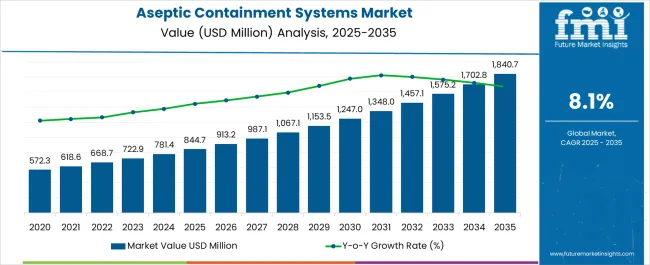
Aseptic Containment Systems Market Key Takeaways
| Metric | Value |
|---|---|
| Aseptic Containment Systems Market Estimated Value in (2025 E) | USD 844.7 million |
| Aseptic Containment Systems Market Forecast Value in (2035 F) | USD 1840.7 million |
| Forecast CAGR (2025 to 2035) | 8.1% |
Why is the Aseptic Containment Systems Market Growing?
The Aseptic Containment Systems market is growing steadily, supported by increasing demand for contamination-free environments across industries such as pharmaceuticals, biotechnology, and industrial manufacturing. Rising concerns over worker safety, product sterility, and regulatory compliance are fueling the adoption of advanced containment systems. Innovations in airflow technologies, barrier isolation, and ergonomic designs are enhancing operational safety while reducing risks of cross-contamination.
Global pharmaceutical and biopharmaceutical production expansion is significantly boosting demand, particularly in vaccine manufacturing and sterile drug formulation. In addition, the increasing number of biosafety and research laboratories is supporting sustained adoption. Industrial sectors are also incorporating aseptic containment systems to meet international safety standards and improve quality control processes.
Governments and regulatory authorities are tightening workplace safety guidelines, which is further encouraging investment in advanced containment solutions As industries adopt automation and robotics in cleanroom environments, the need for scalable, software-integrated, and energy-efficient systems is becoming critical This convergence of regulatory, technological, and safety factors is expected to drive long-term growth in the Aseptic Containment Systems market.
Segmental Analysis
The aseptic containment systems market is segmented by product type, application, end-user, and geographic regions. By product type, aseptic containment systems market is divided into Biosafety Cabinets, Biosafety Cabinet Class I, Biosafety Cabinet Class II, Biosafety Cabinet Class III, Restricted Access Barrier Systems (RABS), Open Restricted Access Barrier Systems, Closed Restricted Access Barrier Systems, Isolators, and Others. In terms of application, aseptic containment systems market is classified into Industrial, Research, Academic, and Others. Based on end-user, aseptic containment systems market is segmented into Pharmaceutical Industries, Biosafety Laboratories, Hospitals & Diagnostic Laboratories, and Research Institutes. Regionally, the aseptic containment systems industry is classified into North America, Latin America, Western Europe, Eastern Europe, Balkan & Baltic Countries, Russia & Belarus, Central Asia, East Asia, South Asia & Pacific, and the Middle East & Africa.
Insights into the Biosafety Cabinets Product Type Segment
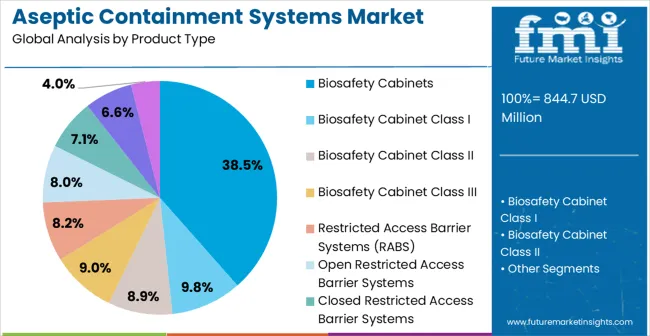
The biosafety cabinets product type segment is expected to account for 38.5% of the market revenue in 2025, making it the leading product category. Growth in this segment is being driven by its essential role in providing sterile work environments for sensitive processes such as microbiological testing, pharmaceutical production, and research applications.
Biosafety cabinets are widely adopted for their ability to protect both operators and samples from hazardous biological agents, reducing contamination risks and ensuring compliance with stringent safety standards. The integration of advanced HEPA filtration, airflow control, and ergonomic features has further strengthened adoption across research institutes and manufacturing facilities.
The segment’s dominance is also supported by rising investments in laboratory infrastructure and the growth of clinical research organizations worldwide As the global emphasis on biosafety and sterility continues to rise, biosafety cabinets are expected to remain a cornerstone of aseptic containment systems, driven by their reliability, safety, and adaptability across diverse end-use environments.
Insights into the Industrial Application Segment
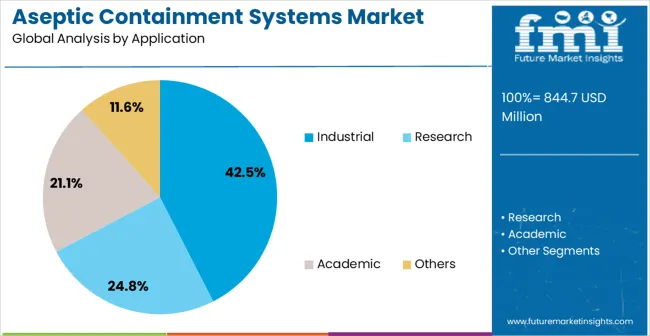
The industrial application segment is projected to hold 42.5% of the market share in 2025, positioning it as the leading application area. Growth in this segment is attributed to the increasing need for controlled and sterile environments in food processing, chemicals, and biotechnology-related manufacturing. Industrial users are adopting aseptic containment systems to comply with strict quality and safety standards, minimize risks of contamination, and enhance product shelf life.
The rising demand for sterile packaging solutions, particularly in the food and beverage sector, is also strengthening this segment. Technological innovations such as modular containment units and integration with digital monitoring systems are driving efficiency and scalability.
Industrial facilities are leveraging aseptic containment systems not only for compliance but also for process optimization and sustainability goals With global industries increasingly focused on safety and regulatory adherence, the adoption of these systems is expected to accelerate, ensuring that the industrial application segment maintains its leadership in the overall market landscape.
Insights into the Pharmaceutical Industries End-User Segment
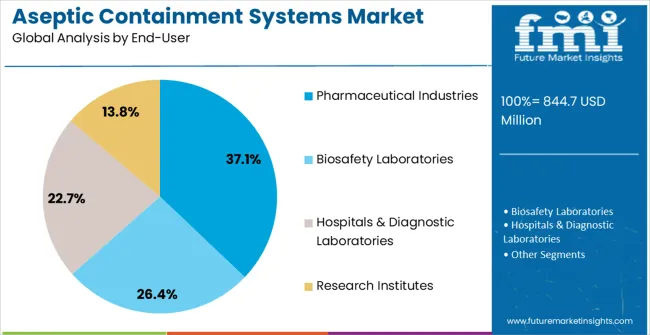
The pharmaceutical industries end-user segment is anticipated to hold 37.1% of the market share in 2025, making it the largest end-use segment. The growing complexity of drug development and the rising prevalence of sterile injectable products are driving the reliance on advanced containment systems. Pharmaceutical manufacturers are adopting these solutions to meet rigorous Good Manufacturing Practices (GMP) and regulatory requirements, ensuring product quality and patient safety.
The expansion of biopharmaceutical production, coupled with increasing investments in vaccine and biologics manufacturing, has further reinforced demand. The ability of containment systems to minimize contamination, protect operators, and improve efficiency is supporting widespread adoption.
Pharmaceutical companies are also investing in flexible and modular containment solutions to adapt to evolving production requirements With the industry’s heightened focus on quality assurance and safety, the pharmaceutical industries segment is expected to sustain its leading position, benefiting from continued innovation in aseptic technologies and global expansion of drug manufacturing facilities.
Market Overview
Aseptic Containment Systems Market Overview
Aseptic containment is related to laboratory biosafety where the physical containment of the microbial organisms is achieved. Aseptic containment system aids in separating the operator from the clean zone so as to avoid the contamination, interventions in the clean zone.
Various kinds of barrier technologies are said to achieve aseptic containment such as open and closed restricted access barriers, isolators etc. The aseptic zone is maintained through the use of high-efficiency particulate arrestance (HEPA) filters that employs the principle of turbulent air flow.
Biosafety cabinets are also known as one of the aseptic containment system which are equipped with HEPA filters. The aseptic containment system provides personnel protection from the pathogenic organism, avoids the release of organisms into environment, avoids contaminations of the product, and accidental infection to the workers etc.
Analysis of Aseptic Containment Systems Market By Key Countries
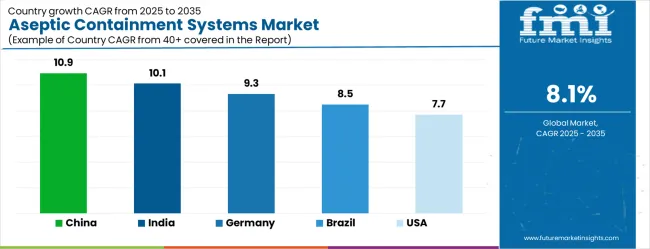
| Country | CAGR |
|---|---|
| China | 10.9% |
| India | 10.1% |
| Germany | 9.3% |
| Brazil | 8.5% |
| USA | 7.7% |
| UK | 6.9% |
| Japan | 6.1% |
Country-wise Analysis
The Aseptic Containment Systems Market is expected to register a CAGR of 8.1% during the forecast period, exhibiting varied country level momentum. China leads with the highest CAGR of 10.9%, followed by India at 10.1%. Developed markets such as Germany, France, and the UK continue to expand steadily, while the USA is likely to grow at consistent rates. Japan posts the lowest CAGR at 6.1%, yet still underscores a broadly positive trajectory for the global Aseptic Containment Systems Market. In 2024, Germany held a dominant revenue in the Western Europe market and is expected to grow with a CAGR of 9.3%. The USA Aseptic Containment Systems Market is estimated to be valued at USD 301.4 million in 2025 and is anticipated to reach a valuation of USD 301.4 million by 2035. Sales are projected to rise at a CAGR of 0.0% over the forecast period between 2025 and 2035. While Japan and South Korea markets are estimated to be valued at USD 40.0 million and USD 22.0 million respectively in 2025.
Key Players in the Aseptic Containment Systems Market
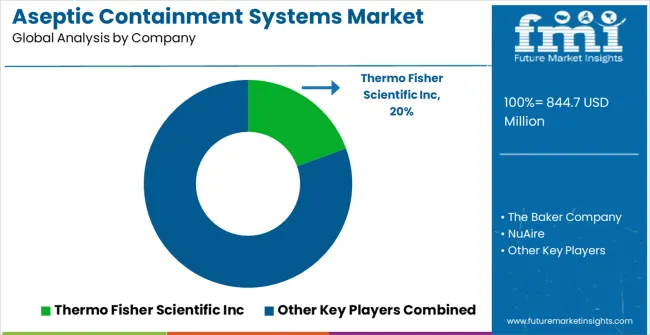
- Thermo Fisher Scientific Inc
- The Baker Company
- NuAire
- Kewaunee Scientific Corporation
- Labconco
- IMA Pharma
- GERMFREE
- Robert Bosch GmbH
- Polypipe
Scope of the Report
| Item | Value |
|---|---|
| Quantitative Units | USD 844.7 Million |
| Product Type | Biosafety Cabinets, Biosafety Cabinet Class I, Biosafety Cabinet Class II, Biosafety Cabinet Class III, Restricted Access Barrier Systems (RABS), Open Restricted Access Barrier Systems, Closed Restricted Access Barrier Systems, Isolators, and Others |
| Application | Industrial, Research, Academic, and Others |
| End-User | Pharmaceutical Industries, Biosafety Laboratories, Hospitals & Diagnostic Laboratories, and Research Institutes |
| Regions Covered | North America, Europe, Asia-Pacific, Latin America, Middle East & Africa |
| Country Covered | United States, Canada, Germany, France, United Kingdom, China, Japan, India, Brazil, South Africa |
| Key Companies Profiled | Thermo Fisher Scientific Inc, The Baker Company, NuAire, Kewaunee Scientific Corporation, Labconco, IMA Pharma, GERMFREE, Robert Bosch GmbH, and Polypipe |
Aseptic Containment Systems Market by Segments
Product Type:
- Biosafety Cabinets
- Biosafety Cabinet Class I
- Biosafety Cabinet Class II
- Biosafety Cabinet Class III
- Restricted Access Barrier Systems (RABS)
- Open Restricted Access Barrier Systems
- Closed Restricted Access Barrier Systems
- Isolators
- Others
Application:
- Industrial
- Research
- Academic
- Others
End-User:
- Pharmaceutical Industries
- Biosafety Laboratories
- Hospitals & Diagnostic Laboratories
- Research Institutes
Region:
- North America
- USA
- Canada
- Mexico
- Latin America
- Brazil
- Chile
- Rest of Latin America
- Western Europe
- Germany
- UK
- Italy
- Spain
- France
- Nordic
- BENELUX
- Rest of Western Europe
- Eastern Europe
- Russia
- Poland
- Hungary
- Balkan & Baltic
- Rest of Eastern Europe
- East Asia
- China
- Japan
- South Korea
- South Asia and Pacific
- India
- ASEAN
- Australia & New Zealand
- Rest of South Asia and Pacific
- Middle East & Africa
- Kingdom of Saudi Arabia
- Other GCC Countries
- Turkiye
- South Africa
- Other African Union
- Rest of Middle East & Africa
Frequently Asked Questions
How big is the aseptic containment systems market in 2025?
The global aseptic containment systems market is estimated to be valued at USD 844.7 million in 2025.
What will be the size of aseptic containment systems market in 2035?
The market size for the aseptic containment systems market is projected to reach USD 1,840.7 million by 2035.
How much will be the aseptic containment systems market growth between 2025 and 2035?
The aseptic containment systems market is expected to grow at a 8.1% CAGR between 2025 and 2035.
What are the key product types in the aseptic containment systems market?
The key product types in aseptic containment systems market are biosafety cabinets, biosafety cabinet class i, biosafety cabinet class ii, biosafety cabinet class iii, restricted access barrier systems (rabs), open restricted access barrier systems, closed restricted access barrier systems, isolators and others.
Which application segment to contribute significant share in the aseptic containment systems market in 2025?
In terms of application, industrial segment to command 42.5% share in the aseptic containment systems market in 2025.
Preview the report firsthand - request a free sample
Get SampleGet the brochure for pricing and purchase details.
Get PDFTable of Content
- Executive Summary
- Global Market Outlook
- Demand-side Trends
- Supply-side Trends
- Technology Roadmap Analysis
- Analysis and Recommendations
- Market Overview
- Market Coverage / Taxonomy
- Market Definition / Scope / Limitations
- Market Background
- Market Dynamics
- Drivers
- Restraints
- Opportunity
- Trends
- Scenario Forecast
- Demand in Optimistic Scenario
- Demand in Likely Scenario
- Demand in Conservative Scenario
- Opportunity Map Analysis
- Product Life Cycle Analysis
- Supply Chain Analysis
- Investment Feasibility Matrix
- Value Chain Analysis
- PESTLE and Porter’s Analysis
- Regulatory Landscape
- Regional Parent Market Outlook
- Production and Consumption Statistics
- Import and Export Statistics
- Market Dynamics
- Global Market Analysis 2020 to 2024 and Forecast, 2025 to 2035
- Historical Market Size Value (USD Million) Analysis, 2020 to 2024
- Current and Future Market Size Value (USD Million) Projections, 2025 to 2035
- Y-o-Y Growth Trend Analysis
- Absolute $ Opportunity Analysis
- Global Market Pricing Analysis 2020 to 2024 and Forecast 2025 to 2035
- Global Market Analysis 2020 to 2024 and Forecast 2025 to 2035, By Product Type
- Introduction / Key Findings
- Historical Market Size Value (USD Million) Analysis By Product Type , 2020 to 2024
- Current and Future Market Size Value (USD Million) Analysis and Forecast By Product Type , 2025 to 2035
- Biosafety Cabinets
- Biosafety Cabinet Class I
- Biosafety Cabinet Class II
- Biosafety Cabinet Class III
- Restricted Access Barrier Systems (RABS)
- Open Restricted Access Barrier Systems
- Closed Restricted Access Barrier Systems
- Isolators
- Others
- Y-o-Y Growth Trend Analysis By Product Type , 2020 to 2024
- Absolute $ Opportunity Analysis By Product Type , 2025 to 2035
- Global Market Analysis 2020 to 2024 and Forecast 2025 to 2035, By Application
- Introduction / Key Findings
- Historical Market Size Value (USD Million) Analysis By Application, 2020 to 2024
- Current and Future Market Size Value (USD Million) Analysis and Forecast By Application, 2025 to 2035
- Industrial
- Research
- Academic
- Others
- Y-o-Y Growth Trend Analysis By Application, 2020 to 2024
- Absolute $ Opportunity Analysis By Application, 2025 to 2035
- Global Market Analysis 2020 to 2024 and Forecast 2025 to 2035, By End-User
- Introduction / Key Findings
- Historical Market Size Value (USD Million) Analysis By End-User, 2020 to 2024
- Current and Future Market Size Value (USD Million) Analysis and Forecast By End-User, 2025 to 2035
- Pharmaceutical Industries
- Biosafety Laboratories
- Hospitals & Diagnostic Laboratories
- Research Institutes
- Y-o-Y Growth Trend Analysis By End-User, 2020 to 2024
- Absolute $ Opportunity Analysis By End-User, 2025 to 2035
- Global Market Analysis 2020 to 2024 and Forecast 2025 to 2035, By Region
- Introduction
- Historical Market Size Value (USD Million) Analysis By Region, 2020 to 2024
- Current Market Size Value (USD Million) Analysis and Forecast By Region, 2025 to 2035
- North America
- Latin America
- Western Europe
- Eastern Europe
- East Asia
- South Asia and Pacific
- Middle East & Africa
- Market Attractiveness Analysis By Region
- North America Market Analysis 2020 to 2024 and Forecast 2025 to 2035, By Country
- Historical Market Size Value (USD Million) Trend Analysis By Market Taxonomy, 2020 to 2024
- Market Size Value (USD Million) Forecast By Market Taxonomy, 2025 to 2035
- By Country
- USA
- Canada
- Mexico
- By Product Type
- By Application
- By End-User
- By Country
- Market Attractiveness Analysis
- By Country
- By Product Type
- By Application
- By End-User
- Key Takeaways
- Latin America Market Analysis 2020 to 2024 and Forecast 2025 to 2035, By Country
- Historical Market Size Value (USD Million) Trend Analysis By Market Taxonomy, 2020 to 2024
- Market Size Value (USD Million) Forecast By Market Taxonomy, 2025 to 2035
- By Country
- Brazil
- Chile
- Rest of Latin America
- By Product Type
- By Application
- By End-User
- By Country
- Market Attractiveness Analysis
- By Country
- By Product Type
- By Application
- By End-User
- Key Takeaways
- Western Europe Market Analysis 2020 to 2024 and Forecast 2025 to 2035, By Country
- Historical Market Size Value (USD Million) Trend Analysis By Market Taxonomy, 2020 to 2024
- Market Size Value (USD Million) Forecast By Market Taxonomy, 2025 to 2035
- By Country
- Germany
- UK
- Italy
- Spain
- France
- Nordic
- BENELUX
- Rest of Western Europe
- By Product Type
- By Application
- By End-User
- By Country
- Market Attractiveness Analysis
- By Country
- By Product Type
- By Application
- By End-User
- Key Takeaways
- Eastern Europe Market Analysis 2020 to 2024 and Forecast 2025 to 2035, By Country
- Historical Market Size Value (USD Million) Trend Analysis By Market Taxonomy, 2020 to 2024
- Market Size Value (USD Million) Forecast By Market Taxonomy, 2025 to 2035
- By Country
- Russia
- Poland
- Hungary
- Balkan & Baltic
- Rest of Eastern Europe
- By Product Type
- By Application
- By End-User
- By Country
- Market Attractiveness Analysis
- By Country
- By Product Type
- By Application
- By End-User
- Key Takeaways
- East Asia Market Analysis 2020 to 2024 and Forecast 2025 to 2035, By Country
- Historical Market Size Value (USD Million) Trend Analysis By Market Taxonomy, 2020 to 2024
- Market Size Value (USD Million) Forecast By Market Taxonomy, 2025 to 2035
- By Country
- China
- Japan
- South Korea
- By Product Type
- By Application
- By End-User
- By Country
- Market Attractiveness Analysis
- By Country
- By Product Type
- By Application
- By End-User
- Key Takeaways
- South Asia and Pacific Market Analysis 2020 to 2024 and Forecast 2025 to 2035, By Country
- Historical Market Size Value (USD Million) Trend Analysis By Market Taxonomy, 2020 to 2024
- Market Size Value (USD Million) Forecast By Market Taxonomy, 2025 to 2035
- By Country
- India
- ASEAN
- Australia & New Zealand
- Rest of South Asia and Pacific
- By Product Type
- By Application
- By End-User
- By Country
- Market Attractiveness Analysis
- By Country
- By Product Type
- By Application
- By End-User
- Key Takeaways
- Middle East & Africa Market Analysis 2020 to 2024 and Forecast 2025 to 2035, By Country
- Historical Market Size Value (USD Million) Trend Analysis By Market Taxonomy, 2020 to 2024
- Market Size Value (USD Million) Forecast By Market Taxonomy, 2025 to 2035
- By Country
- Kingdom of Saudi Arabia
- Other GCC Countries
- Turkiye
- South Africa
- Other African Union
- Rest of Middle East & Africa
- By Product Type
- By Application
- By End-User
- By Country
- Market Attractiveness Analysis
- By Country
- By Product Type
- By Application
- By End-User
- Key Takeaways
- Key Countries Market Analysis
- USA
- Pricing Analysis
- Market Share Analysis, 2024
- By Product Type
- By Application
- By End-User
- Canada
- Pricing Analysis
- Market Share Analysis, 2024
- By Product Type
- By Application
- By End-User
- Mexico
- Pricing Analysis
- Market Share Analysis, 2024
- By Product Type
- By Application
- By End-User
- Brazil
- Pricing Analysis
- Market Share Analysis, 2024
- By Product Type
- By Application
- By End-User
- Chile
- Pricing Analysis
- Market Share Analysis, 2024
- By Product Type
- By Application
- By End-User
- Germany
- Pricing Analysis
- Market Share Analysis, 2024
- By Product Type
- By Application
- By End-User
- UK
- Pricing Analysis
- Market Share Analysis, 2024
- By Product Type
- By Application
- By End-User
- Italy
- Pricing Analysis
- Market Share Analysis, 2024
- By Product Type
- By Application
- By End-User
- Spain
- Pricing Analysis
- Market Share Analysis, 2024
- By Product Type
- By Application
- By End-User
- France
- Pricing Analysis
- Market Share Analysis, 2024
- By Product Type
- By Application
- By End-User
- India
- Pricing Analysis
- Market Share Analysis, 2024
- By Product Type
- By Application
- By End-User
- ASEAN
- Pricing Analysis
- Market Share Analysis, 2024
- By Product Type
- By Application
- By End-User
- Australia & New Zealand
- Pricing Analysis
- Market Share Analysis, 2024
- By Product Type
- By Application
- By End-User
- China
- Pricing Analysis
- Market Share Analysis, 2024
- By Product Type
- By Application
- By End-User
- Japan
- Pricing Analysis
- Market Share Analysis, 2024
- By Product Type
- By Application
- By End-User
- South Korea
- Pricing Analysis
- Market Share Analysis, 2024
- By Product Type
- By Application
- By End-User
- Russia
- Pricing Analysis
- Market Share Analysis, 2024
- By Product Type
- By Application
- By End-User
- Poland
- Pricing Analysis
- Market Share Analysis, 2024
- By Product Type
- By Application
- By End-User
- Hungary
- Pricing Analysis
- Market Share Analysis, 2024
- By Product Type
- By Application
- By End-User
- Kingdom of Saudi Arabia
- Pricing Analysis
- Market Share Analysis, 2024
- By Product Type
- By Application
- By End-User
- Turkiye
- Pricing Analysis
- Market Share Analysis, 2024
- By Product Type
- By Application
- By End-User
- South Africa
- Pricing Analysis
- Market Share Analysis, 2024
- By Product Type
- By Application
- By End-User
- USA
- Market Structure Analysis
- Competition Dashboard
- Competition Benchmarking
- Market Share Analysis of Top Players
- By Regional
- By Product Type
- By Application
- By End-User
- Competition Analysis
- Competition Deep Dive
- Thermo Fisher Scientific Inc
- Overview
- Product Portfolio
- Profitability by Market Segments (Product/Age /Sales Channel/Region)
- Sales Footprint
- Strategy Overview
- Marketing Strategy
- Product Strategy
- Channel Strategy
- The Baker Company
- NuAire
- Kewaunee Scientific Corporation
- Labconco
- IMA Pharma
- GERMFREE
- Robert Bosch GmbH
- Polypipe
- Thermo Fisher Scientific Inc
- Competition Deep Dive
- Assumptions & Acronyms Used
- Research Methodology


