

- Market Size (2026)
- USD 100.4 Bn
- Forecast (2036)
- USD 192.0 Bn
- CAGR (2026 to 2036)
- 6.7%
How big is Aseptic Processing Market in 2026?
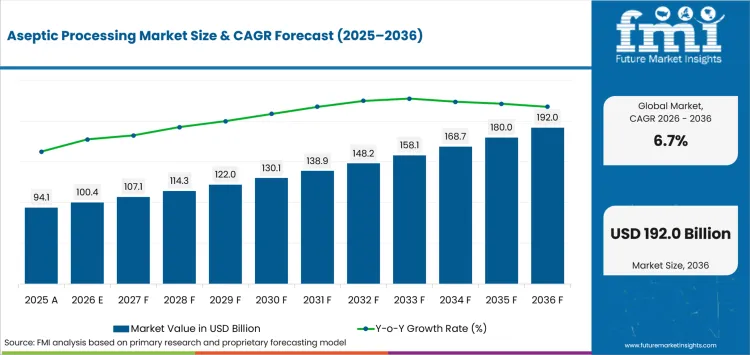
USD 100.4 billion in 2026 and USD 192.0 billion by 2036 at a 6.7% CAGR.
Demand for aseptic processing is projected to expand at 6.7% CAGR between 2026 and 2036, increasing valuation from USD 100.4 billion to USD 192.0 billion. The USD 91.6 billion increase follows line investment that keeps treated products commercially sterile from product treatment to sealed aseptic packaging. In May 2025, the USA FDA reiterated registration and scheduled-process filing requirements for low-acid aseptic systems. Those filings increase the value of integrated controls that document the complete sterile path during qualification and routine operation.
Country growth diverges with installed lines and liquid-product mixes creating different capital priorities in mature and expanding processing bases. Brazil is forecast at 7.8% CAGR while the USA is projected at 5.7%, leaving dairy processing equipment demand more expansion-led in Brazil and more retrofit-led in the USA In December 2025 IBGE recorded 7.01 billion liters of raw milk acquired by inspected Brazilian establishments during third-quarter 2025. That scale gives processors a larger liquid base for new aseptic capacity but does not remove service or qualification constraints.
Key Takeaways
- Demand rises as dairy and beverage producers use validated sterile processing to extend shelf life without weakening liquid-food or pharmaceutical product integrity.
- By type, packaging is estimated to hold 76.0% in 2026 owing to each filled unit requiring a qualified sterile barrier.
- In 2026, plastics is expected to lead the material category with 57.0% share because PET containers and pouches fit several aseptic line architectures.
- Food and beverages is set to lead the application category with 56.0% share in 2026 due to ambient distribution needs for sensitive liquids.
- Qualification failures and difficult restarts extend commissioning schedules since retrofit constraints require the complete sterile boundary to perform as one controlled process.
- Key players in the aseptic processing market include Tetra Pak International S.A., SIG Group AG, Sidel Group, Krones AG, GEA Group AG, Syntegon Technology GmbH, Alfa Laval AB, and IMA S.p.A.
Analyst Perspective
"Aseptic projects should be judged on sterile-boundary validation and package compatibility ahead of nominal equipment price comparisons. Commercial value comes from line designs that recover safely following interventions and local engineers who can contain downtime during requalification."
- Nikhil Kaitwade, Principal Consultant, Future Market Insights
How is the aseptic processing market segmented?
The aseptic processing market is segmented by type, material, application, sterilization technology, operation mode, and region.
The aseptic processing market is segmented by type, material, application, sterilization technology, operation mode, and region. Type covers packaging and processing while material includes plastics, paper and paperboard, glass, and metal. Application separates food and beverages from industrial use, sterilization technology includes thermal / UHT, chemical, filtration, and radiation / other, and operation mode covers continuous and batch systems.
How do food and beverages lead the application category?
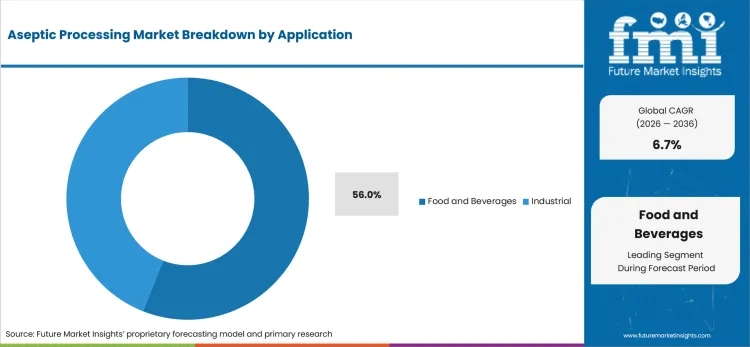
Food and beverage processors use aseptic lines for ambient distribution of treated liquids without a continuous chilled route. Plant-based beverages and UHT milk compete with juice and liquid foods for compatible capacity, while product quality limits thermal exposure and practical continuous-run length.
- Food and beverages is set to lead the application category with 56.0% share in 2026 due to repeat demand for shelf-stable sensitive liquids.
- Barrier changes must preserve shelf life and filling performance during qualified material conversion on installed aseptic lines. SIG Group AG documented Hochwald’s June 2025 launch of UHT milk in alu-layer-free aseptic cartons for Germany.
What makes packaging central to the type category?
Packaging stays commercially active beyond the initial equipment sale since every filled unit requires a qualified sterile barrier. Beverage packaging choices alter container sterilization and closure integrity while changing line speed. A filler without qualified material cannot ship saleable output, so processors track package supply continuity.
- By type, packaging is estimated to hold 76.0% in 2026 owing to repeat sterile-pack purchases around installed filling platforms.
- Each approved carton size requires continuing material supply on installed filling lines. In June 2026 Tetra Pak International S.A. launched a 48 oz Tetra Brik Aseptic Edge carton for USA and Canadian applications.
Why do plastics lead the material category?
PET bottles and flexible structures let processors change pack geometry without replacing the upstream sterilization train. Liquid packaging qualification must prove closure integrity and sterilant compatibility at commercial line speed. Resin and closure changes require trials before a new format enters regular production.
- In 2026, plastics is expected to lead the material category with 57.0% share because PET containers and pouches use polymer closures plus barrier layers.
- Commercial PET systems need package validation covering container geometry and shelf-life behavior ahead of regular production. In February 2026 Sidel Group detailed Britannia Industries’ 24,000-bottle-per-hour aseptic PET line with shelf-life studies and package validation.
What supports thermal / UHT in the sterilization technology category?
Thermal / UHT processing gives liquid producers a measurable time-temperature route before sterile transfer and filling. Sterilization equipment must control heat exposure closely enough to protect both microbial targets and product quality. Stable residence time and rapid recovery matter when commercial throughput leaves little room for repeated starts.
- By sterilization technology, thermal / UHT is forecast to represent 42.0% in 2026 driven by continuous heat-treatment use for sensitive liquid products.
- Pilot infrastructure keeps qualification close to production conditions by letting engineers test thermal treatment and filling together. In July 2025 GEA Group AG opened its Janesville technology center with thermal processing and aseptic filling capability.
What are the drivers, restraints and opportunities in the Aseptic Processing Market?
Shelf-life economics support investment while validation failures raise project risk and lower-resource sterile architectures widen the retrofit opportunity.
- Driver: Ambient shelf-life economics increase spending as processors seek longer distribution windows for sensitive liquid products without continuous refrigerated handling.
- Restraint: Qualification gaps and intervention-heavy operations raise restart risk since contamination control must hold during realistic commercial production conditions.
- Opportunity: Dry sterilization and flexible filling platforms reduce utilities or format-change burden if upgrades preserve validated sterile boundaries on commercial lines.
Ambient Shelf-Life Economics Sustain New Line Investment
Large dairy volumes give aseptic lines a stable production base as ambient formats extend distribution without continuous refrigeration. USDA NASS reported in April 2026 that USA milk production reached 232 billion pounds during 2025. That production base supports food sterilization equipment investment once shelf-life gains justify new sterile treatment and filling capacity.
Validation Failures Raise Commissioning and Restart Costs
Validation risk becomes commercial if routine interventions no longer resemble the conditions used during qualification. In July 2025 the USA FDA cited Daewoo Pharmaceutical for media fills that failed to represent commercial operations. Pharmaceutical packaging projects therefore require intervention studies and recovery procedures that protect the sterile path through production restart.
Lower-Resource Sterile Architectures Expand Retrofit Options
Retrofit economics improve if new designs reduce utilities or simplify format changes without weakening sterility assurance. In April 2026 SIG Group AG announced plans to double its Querétaro aseptic-carton capacity to 3.0 billion packs annually by 2028. The expansion strengthens beverage packaging equipment access in North America by placing package supply closer to filling-line service and commissioning teams.
Which country CAGRs are profiled in the Aseptic Processing Market?
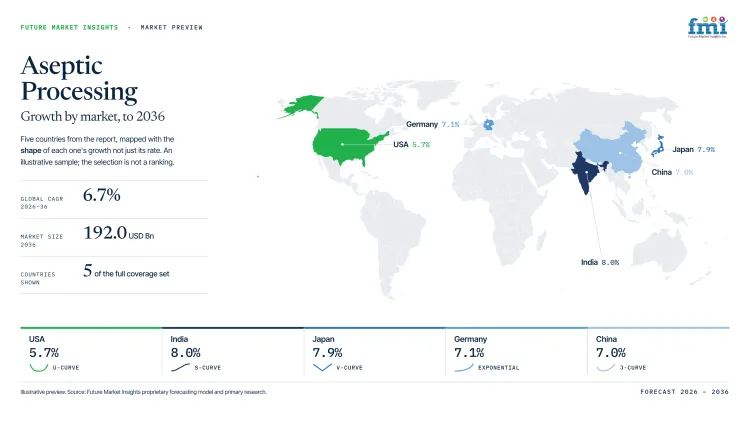
| Country | CAGR |
|---|---|
| Japan | 7.9% |
| Brazil | 7.8% |
| Germany | 7.1% |
| Mexico | 5.9% |
| USA | 5.7% |
How do country-level CAGRs compare in the Aseptic Processing Market?
Profiled rates span 2.2 percentage points, with Japan and Brazil forming an upper band near 8.0%. Germany occupies a middle position while Mexico and the USA form a slower group. The spread reflects different capacity cycles and product mixes plus service requirements instead of ranking addressable revenue.
- Japan rewards compact lines that handle frequent dairy and beverage format changes.
- Brazil pairs faster growth with large milk volumes and service needs.
- Germany favors validated upgrades that preserve barrier performance on installed filling assets.
- Mexico gains from Querétaro manufacturing depth and short North American replenishment routes.
- The USA places heavier weight on retrofit compatibility and documentation plus lifecycle service.
Comparable CAGRs produce different sales cycles since installed capacity and qualification burdens change capital-decision timing. The full report provides country-level CAGR analysis across North America, Latin America, Europe, East Asia, South Asia, Oceania and the Middle East and Africa.
Country-wise Analysis
- Japan: Beverage plants regularly handle short product runs and frequent format changes during regional test launches. That operating pattern favors compact aseptic platforms but raises qualification work if recipes or package dimensions change materially during production. Aseptic processing demand in Japan is forecast to rise at 7.9% CAGR through 2036 owing to strict product-assurance expectations and flexible filling requirements. Japan’s Ministry of Agriculture documented in June 2026 that regulators tested 750 dairy-product and infant-food samples during April 2025 to March 2026. The national monitoring burden favors equipment teams that can preserve validation evidence during repeated recipe and package changes.
- Brazil: Long domestic routes make ambient shelf life commercially useful for dairies and beverage processors seeking less refrigerated distribution exposure. Regional service coverage and spare-parts availability become more difficult outside major processing clusters and can extend restart schedules during unexpected line faults. In March 2026 IBGE recorded 27.51 billion liters of raw milk acquired by inspected establishments during 2025. Brazil is estimated to post 7.8% CAGR through 2036 because processors can route more output into shelf-stable distribution beyond major cities. Regional service distance therefore limits project economics unless technicians and parts inventory can contain recovery time after sterile-process deviations.
- Germany: At mature dairies, aseptic upgrades are judged against installed lines and strict package specifications. Material substitutions must preserve barrier performance without forcing unnecessary replacement of qualified filling assets or established maintenance routines. Germany’s aseptic processing outlook is anticipated to advance at 7.1% CAGR through 2036 reflecting steady upgrade demand and mature processing capacity. The Federal Office for Agriculture and Food stated in April 2026 that domestic producers delivered about 31.6 million tonnes of milk to German dairies during 2025. That large processing base places compatible retrofits ahead of unproven equipment architectures during capital reviews and scheduled modernization programs.
- Mexico: Near North American supply routes, Querétaro places packaging production and technical labor close to major project sites. That proximity can shorten replenishment and commissioning schedules even as factory expansions compete for experienced service technicians and qualified controls engineers. INEGI’s February 2026 labor data showed manufacturing represented 25.1% of Querétaro employment in fourth-quarter 2025. Mexico is projected to record 5.9% CAGR through 2036 attributable to regional manufacturing depth and package supply close to USA beverage customers. Processors still balance capital approval against qualification work for new shelf-stable recipes and container formats during multi-line expansion programs and phased commissioning schedules.
- USA: Retrofit projects at mature plants depend heavily on compatibility with qualified utilities and documented recovery procedures. Replacing sterile boundaries can extend shutdown time at facilities with little spare production capacity and narrow maintenance windows. By 2036 USA aseptic processing demand is projected to grow at 5.7% CAGR tied to replacement cycles and format conversion. USDA counted 9.57 million milk cows in the national dairy herd during its January 2026 inventory release. Replacement-led orders are expected to favor projects that fit fixed maintenance windows and preserve validated operating conditions at high-throughput plants with little spare capacity.
Who are the notable companies in the Aseptic Processing Market?
Tetra Pak International S.A., SIG Group AG, Sidel Group, Krones AG, GEA Group AG, Syntegon Technology GmbH, Alfa Laval AB, and IMA S.p.A. are the notable companies serving this market.
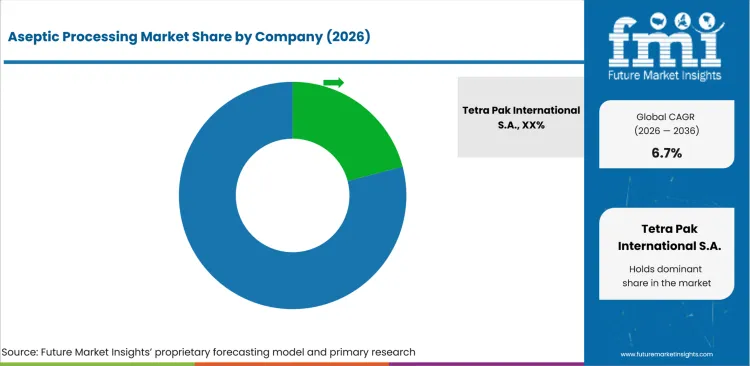
Competition follows distinct sterile-chain positions and no single equipment category controls the complete aseptic production route. Tetra Pak International S.A. and SIG Group AG control package-format relationships while Sidel Group and Krones AG integrate container treatment with liquid filling machines. GEA Group AG spans processing and filling while Syntegon Technology GmbH and IMA S.p.A. focus on pharmaceutical fill-finish. Alfa Laval AB supplies sterile fluid-handling components so qualification evidence and installed-base compatibility become more important entry barriers than corporate scale alone.
- Tetra Pak International S.A. and SIG Group AG compete where processors evaluate package material with filling technology and format economics.
- Sidel Group and Krones AG join GEA Group AG in targeting beverage processors that compare integrated treatment with filling automation and line-service depth.
- Syntegon Technology GmbH and IMA S.p.A. focus on closed pharmaceutical fill-finish while Alfa Laval AB supplies sterile fluid-handling components.
Competitive Benchmarking: Aseptic Processing Market
| Company | Aseptic Line Integration | Sterile-Process Depth | Validation and Automation Depth | Geographic Reach |
|---|---|---|---|---|
| Tetra Pak International S.A. | High | High | High | Global |
| SIG Group AG | High | Medium | High | Global |
| Sidel Group | High | High | High | Global |
| Krones AG | High | High | High | Global |
| GEA Group AG | Medium | High | High | Global |
| Syntegon Technology GmbH | Medium | High | High | Global |
| Alfa Laval AB | Low | Medium | Medium | Global |
| IMA S.p.A. | Medium | High | High | Global |
Scoring basis: High line integration requires three or more verified linked aseptic stages while Medium requires two and Low identifies one documented stage. High sterile-process depth requires multiple verified sterilization or transfer functions plus filling or barrier control. Medium requires one principal sterile function with supporting control while Low identifies component-level handling. High validation and automation depth requires documented qualification plus automated monitoring or closed-barrier control. Medium reflects one documented control route while Low identifies limited verified evidence. Geographic reach reflects verified regional operations or announced customer deployments instead of corporate reputation.
Key Developments in the Aseptic Processing Market
- In April 2026, Tetra Pak International S.A. and Sterilgarda Alimenti launched a 1-liter Tetra Brik Aseptic Edge carton using a paper-based barrier for ambient products.
- In January 2026, Krones AG reported that Wosana was expanding Polish contract-filling capacity with two turnkey aseptic PET lines for sensitive beverages.
- In May 2025, IMA S.p.A. documented an isolated aseptic fill-finish installation for Merck that handles highly potent pharmaceutical products.
Key Players in the Aseptic Processing Market
Aseptic Carton and Beverage Filling Platforms
- Tetra Pak International S.A.
- SIG Group AG
Integrated PET and Beverage Processing Systems
- Sidel Group
- Krones AG
- GEA Group AG
Pharmaceutical Fill-Finish and Sterile Components
- Syntegon Technology GmbH
- Alfa Laval AB
- IMA S.p.A.
Aseptic Processing Market - Report Scope
| Coverage field | Report scope |
|---|---|
| Market breakdown | By type, material, application, sterilization technology, operation mode, and region. |
| Quantitative Units | USD billion. |
| Market Definition | Revenue includes aseptic packaging systems and materials plus aseptic processing equipment and sterile-process components sold within the stated segmentation universe. |
| Regions Covered | North America, Latin America, Western Europe, Eastern Europe, East Asia, South Asia and Pacific, and Middle East and Africa. |
| Countries Covered | Japan, Brazil, Germany, Mexico, USA, and 20+ countries included in the full report. |
| Key Companies Profiled | Tetra Pak International S.A., SIG Group AG, Sidel Group, Krones AG, GEA Group AG, Syntegon Technology GmbH, Alfa Laval AB, IMA S.p.A. |
| Forecast Period | 2026 to 2036. |
| Approach | Primary and secondary research with market triangulation. |
Aseptic Processing Market - Research Methodology
| Method | Approach |
|---|---|
| Primary Research | FMI analysts gathered input from manufacturers, service providers, technology developers, distributors, end users, procurement teams, and subject-matter experts. Interviews examined purchasing decisions, product or service evaluation, adoption barriers, approval requirements, pricing considerations, and expectations for technical or commercial support. Respondents were also asked what evidence is required before a trial, pilot, or initial order develops into regular purchasing. |
| Desk Research | Desk research covered government statistics, regulatory publications, trade data, industry associations, technical literature, standards, company filings, product information, and official corporate announcements. Sources were reviewed for relevance, publication date, geographic coverage, and consistency with the defined market scope. Claims relating to performance, applications, approvals, capacity, investment, and commercial activity were retained only when supported by credible public evidence. |
| Market Sizing and Forecasting | The market model combined the baseline value with historical performance, segment structure, pricing and volume indicators, adoption levels, company participation, and country-level demand conditions. Forecast assumptions considered economic activity, investment trends, regulatory developments, technology adoption, purchasing cycles, supply availability, and barriers to wider market use. Segment and regional estimates were reconciled before the final market total was calculated. |
| Data Validation | Estimates were checked against multiple independent indicators, including public data, company activity, trade patterns, industry developments, and findings from primary interviews. Validation also tested whether products, services, applications, and company revenues fell within the defined market boundaries. Adjacent categories, unsupported claims, overlapping revenues, and activities without direct market relevance were excluded to reduce double counting and maintain consistency across segments and countries. |
Aseptic Processing Market by Segments
Aseptic Processing Market segmented by Type:
- Packaging
- Processing
Aseptic Processing Market segmented by Material:
- Plastics
- Paper and Paperboard
- Glass
- Metal
Aseptic Processing Market segmented by Application:
- Food and Beverages
- Industrial
Aseptic Processing Market segmented by Sterilization Technology:
- Thermal / UHT
- Chemical
- Filtration
- Radiation / Other
Aseptic Processing Market segmented by Operation Mode:
- Continuous
- Batch
Aseptic Processing Market by Region:
- North America
- USA
- Canada
- Latin America
- Brazil
- Mexico
- Argentina
- Chile
- Western Europe
- Germany
- France
- United Kingdom
- Italy
- Spain
- Benelux
- Nordics
- Eastern Europe
- Poland
- Czech Republic
- Romania
- Hungary
- East Asia
- China
- Japan
- South Korea
- South Asia and Pacific
- India
- ASEAN
- Australia and New Zealand
- Middle East and Africa
- GCC Countries
- South Africa
- Türkiye
- Israel
Research Sources and Bibliography
- USA Food and Drug Administration. (2025, May 29). Establishment Registration & Process Filing for Acidified and Low-Acid Canned Foods (LACF): Paper Submissions.
- Brazilian Institute of Geography and Statistics. (2025, December 10). Quarterly livestock surveys: Animal production hits record.
- Tetra Pak International S.A. (2026, June 11). Tetra Pak® Unveils Next-Level Efficiency, Convenience and Shelf Impact With the New 48 oz Size Tetra Brik® Aseptic Edge Carton.
- Sidel Group. (2026, February 12). Sidel delivers Britannia’s first-ever aseptic PET packaging line for Winkin Cow business.
- SIG Group AG. (2025, June 23). Germany: Hochwald pioneers shift to alu-layer-free aseptic cartons in Europe with SIG Terra packaging material.
- GEA Group AG. (2025, July 18). GEA opens New Food technology center in the USA to boost alternative proteins’ scale-up.
- USA Department of Agriculture, National Agricultural Statistics Service. (2026, April 30). Milk Production, Disposition, and Income 2025 Summary.
- USA Food and Drug Administration. (2025, July 2). Daewoo Pharmaceutical Co., Ltd. - 706371 - 07/02/2025.
- SIG Group AG. (2026, April 28). SIG announces plan to expand its plant in Querétaro to double its production capacity in North America.
- Ministry of Agriculture, Forestry and Fisheries, Japan. (2026, June). Comprehensive and Effective Approaches in Ensuring Food Safety regarding Radionuclides in Japan.
- Brazilian Institute of Geography and Statistics. (2026, March 18). Slaughter of cattle, chickens and pigs also hits record.
- Federal Office for Agriculture and Food. (2026, April 15). Deutsche verbrauchen weniger Milch, dafür mehr Käse und Butter.
- National Institute of Statistics and Geography. (2026, February 24). Encuesta Nacional de Ocupación y Empleo (ENOE), Querétaro, cuarto trimestre de 2025.
- USA Department of Agriculture, National Agricultural Statistics Service. (2026, January 30). Cattle inventory.
- Tetra Pak International S.A. (2026, April 22). Tetra Pak and Sterilgarda Alimenti launch industry-first 1-litre aseptic carton with paper-based barrier.
- Krones AG. (2026, January 21). Wosana is expanding its aseptic filling with Krones.
- Syntegon Technology GmbH. (2025, April 14). Syntegon launches new MLD Advanced for RTU syringes.
- Alfa Laval AB. (2025, March 24). Alfa Laval expands its hygienic valve portfolio for enhanced safety, efficiency and reliability.
- IMA S.p.A. (2025, May 27). Supporting Merck toward a new age of aseptic fill-finish processing of highly potent drugs.
- Tetra Pak International S.A. (2025, July 3). Tetra Pak Binh Duong expansion accelerates beverage carton packaging innovation to the Philippines and wider Asia Pacific region.
- GEA Group AG. (2025, December 18). GEA strengthens valve portfolio with acquisition of Hydract.
- Sidel Group. (2026, June 4). Thai Coconut grows its global market presence with an aseptic PET line from Sidel.
- SIG Group AG. (2026, May 20). Actron expands its services into co-packing in the Philippines with SIG’s flexible aseptic carton filling technology.
- GEA Group AG. (2025, September 15). GEA unveils a new generation of flexible, modular beverage filling technology at drinktec 2025.
- Tetra Pak International S.A. (2026, February 10). Tetra Pak extends paper-based barrier packaging to high-speed packaging lines in Asia.
- SIG Group AG. (2025, October 3). ALCA Corp launches first products filled on SIG’s next-gen aseptic spouted pouch system featuring in-line pouch sterilization.
- Sidel Group. (2025, October 21). Sibeg boosts sustainability with Sidel aseptic PET Line.
- Krones AG. (2025, March 5). The new compact Contipure AseptBloc in shopfloor reality.
- GEA Group AG. (2026, January 14). GEA separation technology for bioveterinary center in Angola.
- IMA S.p.A. (2026, January 9). IMA Life partners with Sharp Sterile Manufacturing to advance aseptic capabilities in the USA.
This bibliography is provided for reader reference and is not exhaustive. The full report contains the complete reference list and detailed citations.
This Report Answers
- How large is the aseptic processing market in 2026 and what value is forecast for 2036?
- Which sterile-chain conditions support repeat investment in aseptic processing and packaging systems?
- Why does packaging account for 76.0% of the type category in 2026?
- How do plastics influence package design and aseptic filling qualification requirements?
- Why do food and beverages represent 56.0% of application demand in 2026?
- How do Japan, Brazil, Germany, Mexico, and the USA differ in forecast growth and operating conditions?
- Which companies provide carton, PET, beverage-processing, pharmaceutical fill-finish, or sterile fluid-handling systems?
- How do qualification failures and recovery requirements affect commissioning risk and project economics?
- Which lower-resource sterilization or filling architectures can improve retrofit economics without weakening sterility assurance?
Frequently Asked Questions
How big is the Aseptic Processing Market in 2026?
The aseptic processing market is valued at USD 100.4 billion in 2026 and is projected to reach USD 192.0 billion by 2036. Growth is driven by shelf-life requirements and investment in validated sterile processing for sensitive liquid products.
What is the CAGR of the Aseptic Processing Market from 2026 to 2036?
The aseptic processing market is projected to grow at a CAGR of 6.7% between 2026 and 2036. Expansion follows liquid-food capacity growth plus aseptic packaging demand and replacement of aging processing lines.
Which type leads the Aseptic Processing Market?
The packaging segment is expected to hold 76.0% of the aseptic processing market by type in 2026, driven by repeat sterile-pack requirements around installed filling systems. Package compatibility also determines changeover effort and material replenishment during regular production.
Which material leads the Aseptic Processing Market?
The plastics segment is expected to hold 57.0% of the aseptic processing market by material in 2026, attributable to PET bottles and pouches using polymer closures and barrier layers. Format flexibility supports rigid and flexible aseptic packs on qualified filling platforms.
How much value will the Aseptic Processing Market add between 2026 and 2036?
The aseptic processing market is expected to add USD 91.6 billion in value between 2026 and 2036. Growth reflects new liquid-product capacity plus format expansion and replacement demand for validated sterile processing systems.
Which countries are projected to record the highest growth in the Aseptic Processing Market?
Japan is projected to grow at 7.9% CAGR, followed by Brazil at 7.8% and Germany at 7.1% through 2036. Their growth paths differ because package formats, installed lines, and service coverage shape project timing.
Which companies are active in the Aseptic Processing Market?
Key companies operating in the aseptic processing market include Tetra Pak International S.A., SIG Group AG, Sidel Group, Krones AG, GEA Group AG, Syntegon Technology GmbH, Alfa Laval AB, and IMA S.p.A. Competition centers on line integration and qualification support.
Preview the report firsthand - request a free sample
Get SampleGet the brochure for pricing and purchase details.
Get PDFTable of Content
- Key Takeaways
- Market Size and CAGR
- Top Growth Driver
- Fastest Growing Segment
- Leading Region
- Key Companies
- Emerging Opportunities
- Executive Summary
- Global Market Outlook
- Demand-side Trends
- Supply-side Trends
- Technology Roadmap Analysis
- Analysis and Recommendations
- Analyst Perspective (What is happening? Why now? What should investors know?)
- Key Questions Answered
- How large is the market?
- What is the CAGR?
- What are key trends?
- Which region dominates?
- Who are the leaders?
- Market Overview
- Market Coverage / Taxonomy
- Market Definition / Scope / Limitations
- Research Methodology
- Chapter Orientation
- Analytical Lens and Working Hypotheses
- Market Structure, Signals, and Trend Drivers
- Benchmarking and Cross-market Comparability
- Market Sizing, Forecasting, and Opportunity Mapping
- Research Design and Evidence Framework
- Desk Research Programme (Secondary Evidence)
- Expert Input and Fieldwork (Primary Evidence)
- Tooling, Models, and Reference Databases
- Data Engineering and Model Build
- Quality Assurance and Audit Trail
- Market Background
- Market Dynamics (Drivers, Restraints, Opportunity, Trends)
- Scenario Forecast (Optimistic, Likely, Conservative)
- Impact Analysis
- AI Impact
- Sustainability Impact
- Regulatory Impact
- Technology Impact
- Consumer / Buyer Analysis
- Purchase Drivers
- Adoption Barriers
- Buyer Journey
- Opportunity Map Analysis
- Product Life Cycle Analysis
- Supply Chain Analysis
- Investment Feasibility Matrix
- Value Chain Analysis
- PESTLE and Porter's Analysis
- Regulatory Landscape
- Regional Parent Market Outlook
- Production and Consumption Statistics
- Import and Export Statistics
- Global Market Analysis and Forecast, 2021 to 2036
- Historical Market Size Value (USD Billion) Analysis, 2021 to 2025
- Current and Future Market Size Value (USD Billion) Projections, 2026 to 2036
- Y-o-Y Growth Trend Analysis
- Absolute $ Opportunity Analysis
- Global Market Pricing Analysis, 2021 to 2036
- Global Market Analysis and Forecast, By Type, 2021 to 2036
- Introduction / Key Findings
- Historical Market Size Value (USD Billion) Analysis By Type, 2021 to 2025
- Current and Future Market Size Value (USD Billion) Analysis and Forecast By Type, 2026 to 2036
- Packaging
- Processing
- Packaging
- Y-o-Y Growth Trend Analysis By Type, 2021 to 2025
- Absolute $ Opportunity Analysis By Type, 2026 to 2036
- Global Market Analysis and Forecast, By Material, 2021 to 2036
- Introduction / Key Findings
- Historical Market Size Value (USD Billion) Analysis By Material, 2021 to 2025
- Current and Future Market Size Value (USD Billion) Analysis and Forecast By Material, 2026 to 2036
- Plastics
- Paper and Paperboard
- Glass
- Metal
- Plastics
- Y-o-Y Growth Trend Analysis By Material, 2021 to 2025
- Absolute $ Opportunity Analysis By Material, 2026 to 2036
- Global Market Analysis and Forecast, By Application, 2021 to 2036
- Introduction / Key Findings
- Historical Market Size Value (USD Billion) Analysis By Application, 2021 to 2025
- Current and Future Market Size Value (USD Billion) Analysis and Forecast By Application, 2026 to 2036
- Food and Beverages
- Industrial
- Food and Beverages
- Y-o-Y Growth Trend Analysis By Application, 2021 to 2025
- Absolute $ Opportunity Analysis By Application, 2026 to 2036
- Global Market Analysis and Forecast, By Sterilization Technology, 2021 to 2036
- Introduction / Key Findings
- Historical Market Size Value (USD Billion) Analysis By Sterilization Technology, 2021 to 2025
- Current and Future Market Size Value (USD Billion) Analysis and Forecast By Sterilization Technology, 2026 to 2036
- Thermal - UHT
- Chemical
- Filtration
- Radiation - Other
- Thermal - UHT
- Y-o-Y Growth Trend Analysis By Sterilization Technology, 2021 to 2025
- Absolute $ Opportunity Analysis By Sterilization Technology, 2026 to 2036
- Global Market Analysis and Forecast, By Operation Mode, 2021 to 2036
- Introduction / Key Findings
- Historical Market Size Value (USD Billion) Analysis By Operation Mode, 2021 to 2025
- Current and Future Market Size Value (USD Billion) Analysis and Forecast By Operation Mode, 2026 to 2036
- Continuous
- Batch
- Continuous
- Y-o-Y Growth Trend Analysis By Operation Mode, 2021 to 2025
- Absolute $ Opportunity Analysis By Operation Mode, 2026 to 2036
- Global Market Analysis and Forecast, By Region, 2021 to 2036
- Introduction
- Historical Market Size Value (USD Billion) Analysis By Region, 2021 to 2025
- Current Market Size Value (USD Billion) Analysis and Forecast By Region, 2026 to 2036
- North America
- Latin America
- Western Europe
- Eastern Europe
- East Asia
- South Asia and Pacific
- Middle East & Africa
- Market Attractiveness Analysis By Region
- North America Market Analysis and Forecast, By Country, 2021 to 2036
- Historical Market Size Value (USD Billion) Trend Analysis By Market Taxonomy, 2021 to 2025
- Market Size Value (USD Billion) Forecast By Market Taxonomy, 2026 to 2036
- By Country
- USA
- Canada
- By Type
- By Material
- By Application
- By Sterilization Technology
- By Operation Mode
- By Country
- Market Attractiveness Analysis
- By Country
- By Type
- By Material
- By Application
- By Sterilization Technology
- By Operation Mode
- Key Takeaways
- Latin America Market Analysis and Forecast, By Country
- Historical Market Size Value (USD Billion) Trend Analysis By Market Taxonomy, 2021 to 2025
- Market Size Value (USD Billion) Forecast By Market Taxonomy, 2026 to 2036
- By Country
- Brazil
- Mexico
- Chile
- Rest of Latin America
- By Type
- By Material
- By Application
- By Sterilization Technology
- By Operation Mode
- By Country
- Market Attractiveness Analysis
- By Country
- By Type
- By Material
- By Application
- By Sterilization Technology
- By Operation Mode
- Key Takeaways
- Western Europe Market Analysis and Forecast, By Country
- Historical Market Size Value (USD Billion) Trend Analysis By Market Taxonomy, 2021 to 2025
- Market Size Value (USD Billion) Forecast By Market Taxonomy, 2026 to 2036
- By Country
- Germany
- UK
- Italy
- Spain
- France
- Nordic
- BENELUX
- Rest of Western Europe
- By Type
- By Material
- By Application
- By Sterilization Technology
- By Operation Mode
- By Country
- Market Attractiveness Analysis
- By Country
- By Type
- By Material
- By Application
- By Sterilization Technology
- By Operation Mode
- Key Takeaways
- Eastern Europe Market Analysis and Forecast, By Country
- Historical Market Size Value (USD Billion) Trend Analysis By Market Taxonomy, 2021 to 2025
- Market Size Value (USD Billion) Forecast By Market Taxonomy, 2026 to 2036
- By Country
- Russia
- Poland
- Hungary
- Balkan & Baltic
- Rest of Eastern Europe
- By Type
- By Material
- By Application
- By Sterilization Technology
- By Operation Mode
- By Country
- Market Attractiveness Analysis
- By Country
- By Type
- By Material
- By Application
- By Sterilization Technology
- By Operation Mode
- Key Takeaways
- East Asia Market Analysis and Forecast, By Country
- Historical Market Size Value (USD Billion) Trend Analysis By Market Taxonomy, 2021 to 2025
- Market Size Value (USD Billion) Forecast By Market Taxonomy, 2026 to 2036
- By Country
- China
- Japan
- South Korea
- By Type
- By Material
- By Application
- By Sterilization Technology
- By Operation Mode
- By Country
- Market Attractiveness Analysis
- By Country
- By Type
- By Material
- By Application
- By Sterilization Technology
- By Operation Mode
- Key Takeaways
- South Asia and Pacific Market Analysis and Forecast, By Country
- Historical Market Size Value (USD Billion) Trend Analysis By Market Taxonomy, 2021 to 2025
- Market Size Value (USD Billion) Forecast By Market Taxonomy, 2026 to 2036
- By Country
- India
- ASEAN
- Australia & New Zealand
- Rest of South Asia and Pacific
- By Type
- By Material
- By Application
- By Sterilization Technology
- By Operation Mode
- By Country
- Market Attractiveness Analysis
- By Country
- By Type
- By Material
- By Application
- By Sterilization Technology
- By Operation Mode
- Key Takeaways
- Middle East & Africa Market Analysis and Forecast, By Country
- Historical Market Size Value (USD Billion) Trend Analysis By Market Taxonomy, 2021 to 2025
- Market Size Value (USD Billion) Forecast By Market Taxonomy, 2026 to 2036
- By Country
- Kingdom of Saudi Arabia
- Other GCC Countries
- Türkiye
- South Africa
- Other African Union
- Rest of Middle East & Africa
- By Type
- By Material
- By Application
- By Sterilization Technology
- By Operation Mode
- By Country
- Market Attractiveness Analysis
- By Country
- By Type
- By Material
- By Application
- By Sterilization Technology
- By Operation Mode
- Key Takeaways
- Key Countries Market Analysis
- USA
- Pricing Analysis
- Market Share Analysis, 2025
- By Type
- By Material
- By Application
- By Sterilization Technology
- By Operation Mode
- Canada
- Pricing Analysis
- Market Share Analysis, 2025
- By Type
- By Material
- By Application
- By Sterilization Technology
- By Operation Mode
- Mexico
- Pricing Analysis
- Market Share Analysis, 2025
- By Type
- By Material
- By Application
- By Sterilization Technology
- By Operation Mode
- Brazil
- Pricing Analysis
- Market Share Analysis, 2025
- By Type
- By Material
- By Application
- By Sterilization Technology
- By Operation Mode
- Chile
- Pricing Analysis
- Market Share Analysis, 2025
- By Type
- By Material
- By Application
- By Sterilization Technology
- By Operation Mode
- Germany
- Pricing Analysis
- Market Share Analysis, 2025
- By Type
- By Material
- By Application
- By Sterilization Technology
- By Operation Mode
- UK
- Pricing Analysis
- Market Share Analysis, 2025
- By Type
- By Material
- By Application
- By Sterilization Technology
- By Operation Mode
- Italy
- Pricing Analysis
- Market Share Analysis, 2025
- By Type
- By Material
- By Application
- By Sterilization Technology
- By Operation Mode
- Spain
- Pricing Analysis
- Market Share Analysis, 2025
- By Type
- By Material
- By Application
- By Sterilization Technology
- By Operation Mode
- France
- Pricing Analysis
- Market Share Analysis, 2025
- By Type
- By Material
- By Application
- By Sterilization Technology
- By Operation Mode
- India
- Pricing Analysis
- Market Share Analysis, 2025
- By Type
- By Material
- By Application
- By Sterilization Technology
- By Operation Mode
- ASEAN
- Pricing Analysis
- Market Share Analysis, 2025
- By Type
- By Material
- By Application
- By Sterilization Technology
- By Operation Mode
- Australia & New Zealand
- Pricing Analysis
- Market Share Analysis, 2025
- By Type
- By Material
- By Application
- By Sterilization Technology
- By Operation Mode
- China
- Pricing Analysis
- Market Share Analysis, 2025
- By Type
- By Material
- By Application
- By Sterilization Technology
- By Operation Mode
- Japan
- Pricing Analysis
- Market Share Analysis, 2025
- By Type
- By Material
- By Application
- By Sterilization Technology
- By Operation Mode
- South Korea
- Pricing Analysis
- Market Share Analysis, 2025
- By Type
- By Material
- By Application
- By Sterilization Technology
- By Operation Mode
- Russia
- Pricing Analysis
- Market Share Analysis, 2025
- By Type
- By Material
- By Application
- By Sterilization Technology
- By Operation Mode
- Poland
- Pricing Analysis
- Market Share Analysis, 2025
- By Type
- By Material
- By Application
- By Sterilization Technology
- By Operation Mode
- Hungary
- Pricing Analysis
- Market Share Analysis, 2025
- By Type
- By Material
- By Application
- By Sterilization Technology
- By Operation Mode
- Kingdom of Saudi Arabia
- Pricing Analysis
- Market Share Analysis, 2025
- By Type
- By Material
- By Application
- By Sterilization Technology
- By Operation Mode
- Türkiye
- Pricing Analysis
- Market Share Analysis, 2025
- By Type
- By Material
- By Application
- By Sterilization Technology
- By Operation Mode
- South Africa
- Pricing Analysis
- Market Share Analysis, 2025
- By Type
- By Material
- By Application
- By Sterilization Technology
- By Operation Mode
- USA
- Market Structure Analysis
- Competition Dashboard
- Competition Benchmarking
- Market Share Analysis of Top Players
- By Regional
- By Type
- By Material
- By Application
- By Sterilization Technology
- By Operation Mode
- Emerging Startups
- Innovation Benchmarking
- Competition Analysis
- Competition Deep Dive
- Tetra Pak International S.A.
- Overview
- Product Portfolio
- Profitability by Market Segments
- Sales Footprint
- Strategy Overview
- Marketing Strategy
- Product Strategy
- Channel Strategy
- SIG Group AG
- Krones AG
- GEA Group AG
- Alfa Laval AB
- Syntegon Technology GmbH
- SPX FLOW, Inc.
- JBT Corporation
- Sidel Group
- IMA S.p.A.
- Tetra Pak International S.A.
- Case Studies
- Success Stories
- Recent Developments
- Competition Deep Dive
- Assumptions & Acronyms Used


