

- Market Size (2026)
- USD 764.7 Mn
- Forecast (2036)
- USD 1449.0 Mn
- CAGR (2026 to 2036)
- 6.6%
How big is Attar & Perfume Oils Market in 2026?
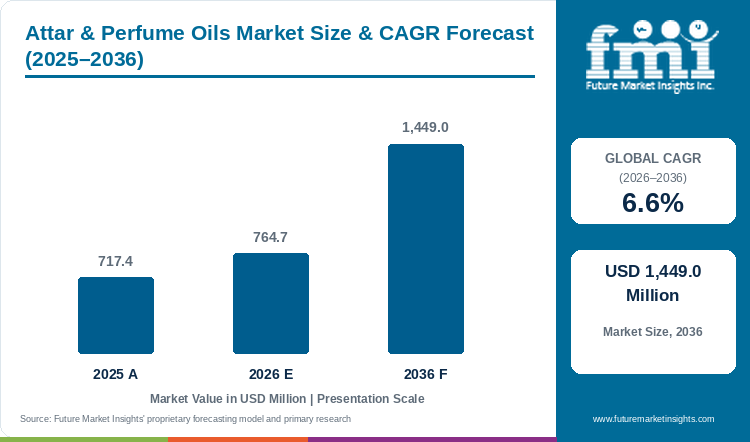
Sales of Attar & Perfume Oils will expand at a 6.6% CAGR between 2026 and 2036. Market value is estimated at USD 764.7 Million in 2026 and will reach USD 1,449.0 Million by 2036.
FMI values the attar & perfume oils market at USD 764.7 Million in 2026. The market was valued at about USD 717.4 Million in 2025 and is forecast to reach USD 1,449.0 Million by 2036 at a 6.6% CAGR. Buyers are choosing between traditional oils and familiar spray fragrances rather than one single format. This keeps oud fragrances important in Gulf markets while Eau de Parfum gives regional scent profiles a format that is already understood in global beauty retail.
Saudi Arabia already has strong familiarity with oud and concentrated fragrance but suppliers still need cosmetic notification [3]. Indonesia adds a different requirement because cosmetics move into mandatory halal certification from October 2026 [6]. France and the UK place more weight on allergen disclosure and product safety. Companies therefore need local product files as well as scent ranges that fit local buying habits.
Key Takeaways
- Eau de Parfum is projected to account for 40.0% of Product Type demand in 2026.
- Conventional products are expected to represent 52.0% of Nature demand in 2026.
- Cream & balm is projected to hold 30.0% of Format demand in 2026.
- Masstige is forecast to represent 30.0% of Price Positioning demand in 2026.
- Specialty beauty retail is projected to account for 27.0% of Sales Channel demand in 2026.
- UAE has the highest profiled country CAGR at 8.6% through 2036. Saudi Arabia follows at 8.2% while Indonesia is at 7.9%.
Analyst Perspective
“Over the next few years oil-based perfumes and high-concentration sprays will continue to grow together. Gulf markets will remain important for oud and attar while Indonesia will require stronger halal documentation from late 2026. Portable solids and masstige fragrances give brands room to reach more buyers. Companies that make sampling and authenticity easy will have a better chance of repeat purchase.”
- Rahul Pandita, Principal Consultant, Future Market Insights
How is the attar & perfume oils market segmented?
The market is segmented by Product Type, Nature, Format, Price Positioning, Sales Channel, and Region.
- By Product Type, the market includes Eau de Parfum, Eau de Toilette, Extrait & Intense, and Body Mists & Oils.
- Nature covers Conventional, Vegan & Cruelty-Free, Natural & Organic, Dermocosmetic / Clinical, and Fragrance-Free & Sensitive products.
- Format includes Cream & Balm, Liquid & Serum, Stick & Solid, Spray & Mist, Sheet & Patch, and Powder.
- Price Positioning is divided into Masstige, Mass, Premium, and Professional.
- Sales Channel covers Specialty Beauty Retail, E-commerce & DTC, Pharmacies & Drugstores, Supermarkets & Hypermarkets, and Salons & Spas.
- Region covers North America, Latin America, Western Europe, Eastern Europe, East Asia, South Asia and Pacific, and Middle East and Africa.
Why does Eau de Parfum lead demand within the Product Type category?
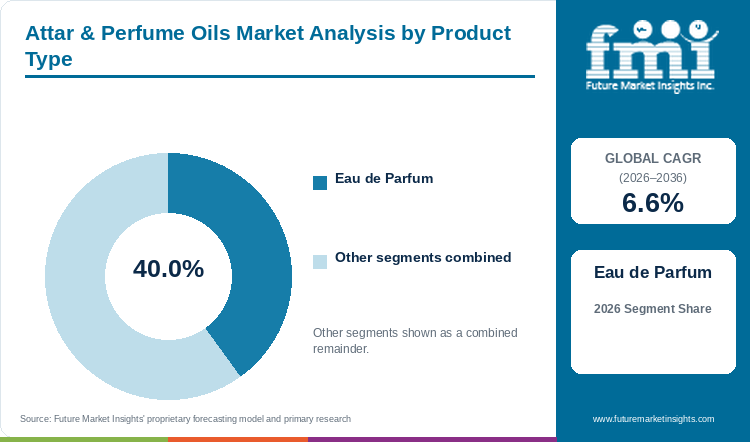
Eau de Parfum is projected to account for 40.0% of Product Type demand in 2026.
Eau de Parfum leads as it gives buyers a stronger scent than Eau de Toilette while keeping the familiar spray format. Saudi Arabia's food and drug authority describes Eau de Parfum as an ethanol-based fragrance class with 10% to 20% fragrance oil [2]. This concentration works for oud and amber profiles as well as mainstream fragrance families. The same product type is widely used across the broader perfume market.
Coty added four adidas Vibes Eau de Parfum scents in August 2025 [16]. Power Zone used an oud wood note and was sold through drugstores and mass-retail cosmetic aisles. This shows how oud cues can move into a familiar EDP format without requiring buyers to switch to pure oil.
- Eau de Parfum is projected to account for 40.0% of Product Type demand in 2026.
- Extrait and intense formats can gain demand among buyers who want higher concentration and are willing to pay more.
Why does Conventional lead demand within the Nature category?
Conventional is projected to account for 52.0% of Nature demand in 2026.
EU fragrance-allergen rules still require ingredient disclosure for relevant substances [11]. The rule applies to conventional and claims-led products alike. Conventional formulas therefore keep an advantage in scent design because they are not limited by an extra natural or vegan standard.
Natural positioning will continue to attract part of the market. It also creates demand for natural fragrance chemicals and other plant-derived inputs. The trade-off is a smaller ingredient pool and more sourcing work when brands want the same scent profile across several countries.
- Conventional is projected to account for 52.0% of Nature demand in 2026.
- Natural and vegan products can gain demand where ingredient origin matters to the buyer.
Why does Cream & balm lead demand within the Format category?
Cream & balm is projected to account for 30.0% of Format demand in 2026.
Cream and balm formats account for higher share as they give alcohol-free fragrance a familiar solid form. Dior's Mini Miss range uses solid perfume sticks made with rose wax [12]. This shows how a fragrance house can keep a recognizable scent while changing the way it is applied.
Sprays will remain important because buyers already know how to use them. Solid formats have a different job. They suit travel and discreet reapplication where a bottle or spray is less convenient.
- Cream & balm is projected to account for 30.0% of Format demand in 2026.
- Spray & mist formats remain important for buyers who prefer conventional perfume application.
Why does Masstige lead demand within the Price Positioning category?
Masstige is projected to account for 30.0% of Price Positioning demand in 2026.
Masstige is popular among end-users owing to its decent price point. This matters for oud and amber fragrances where packaging and scent intensity can create a premium impression. Coty described its Jawhara collection in November 2025 at a price below USD 25 with Middle Eastern-inspired scent cues [17].
Premium products will remain strong among buyers who value brand heritage and higher concentration. Masstige has a wider trial pool because the first purchase costs less. Brands can then move buyers into more expensive products after a scent family becomes familiar.
- Masstige is projected to account for 30.0% of Price Positioning demand in 2026.
- Premium products remain important where concentration and brand heritage support a higher price.
- E-commerce & DTC is important for repeat purchase after the buyer knows the scent.
What are the drivers, restraints and opportunities in the Attar & Perfume Oils Market?
Demand is supported by strong interest in personal fragrance. Compliance and counterfeit risk can slow purchase. Portable oils and solids give brands new ways to sell concentrated scent.
- Driver: Consumers are using fragrance for personal identity and are buying more than one scent for different occasions.
- Restraint: Allergen rules and product notification increase the work required before a fragrance can enter some markets.
- Opportunity: Alcohol-free oils and portable solids can bring concentrated fragrance into more daily-use occasions.
Fragrance is becoming a larger part of personal routines
dsm-firmenich reported in its 2025 annual report that 70% of respondents in its 21-country study appreciate scents more than before [24]. The same study found that 73% said scents bring pleasure. More interest in fragrance gives buyers a reason to own several products instead of one signature scent. This supports EDPs and concentrated oils as well as mists and solids.
Compliance and authenticity can slow a purchase
Fragrance brands have to meet safety and labeling rules before they can expand distribution. EU Regulation 2023/1545 adds individual labeling requirements for additional fragrance allergens [11]. Saudi Arabia requires cosmetic notification [3] and Indonesia adds mandatory halal certification from October 2026 [6]. Counterfeit products create another problem because buyers may avoid unfamiliar sellers when authenticity is unclear.
Portable formats create room for new use cases
Perfume oils and solids can be carried easily and applied without spraying. This makes them useful for travel or discreet reapplication. Brands can also use smaller sizes to reduce the cost of trying an unfamiliar scent. These formats give attar and perfume-oil suppliers a way to reach buyers who do not want a full-size premium bottle.
Which country CAGRs are profiled in the Attar & Perfume Oils Market?
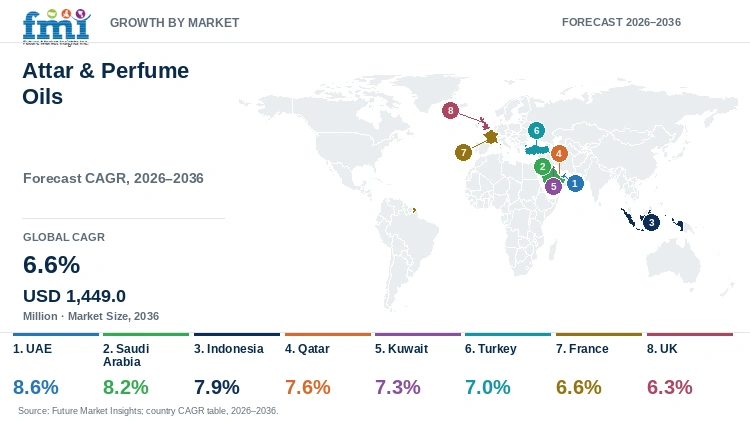
| Country | CAGR |
|---|---|
| UAE | 8.6% |
| Saudi Arabia | 8.2% |
| Indonesia | 7.9% |
| Qatar | 7.6% |
| Kuwait | 7.3% |
| Turkey | 7.0% |
| France | 6.6% |
| UK | 6.3% |
Country-wise Analysis
- UAE: UAE is expected to record the highest profiled CAGR at 8.6% through 2036. Dubai recorded 19.59 million overnight visitors in 2025 [4]. Fragrance benefits from this traffic because malls and travel retail give buyers a place to sample premium scents before purchase. Regional brands still have to compete with a large number of international fragrance houses.
- Saudi Arabia: Saudi Arabia is forecast to grow at an 8.2% CAGR through 2036. Buyers already know oud and concentrated fragrance formats. SFDA requires cosmetic product notification before wider sale [3]. Regional brands therefore have an advantage in scent familiarity but still need consistent product files and labeling.
- Indonesia: Indonesia is expected to grow at a 7.9% CAGR through 2036. BPJPH says cosmetics must carry halal certification from October 2026 [6]. This makes ingredient traceability important at the start of the forecast period. Brands with complex imported formulas may need more preparation before they can refresh local assortments.
- Qatar: Qatar is projected to grow at a 7.6% CAGR through 2036. Qatar Tourism reported 5.1 million international visitors in 2025 [5]. GCC travelers represented 35% of the total. Fragrance retailers can use this mix for gifting and premium discovery but sampling and clear price ladders remain important for conversion.
- Kuwait: Kuwait is forecast to grow at a 7.3% CAGR through 2036. The Ministry of Commerce has taken enforcement action against counterfeit perfumes [7]. This makes authenticity a practical buying issue. Branded stores and sellers that make provenance clear can reduce hesitation before purchase.
- Turkey: Turkey is expected to grow at a 7.0% CAGR through 2036. The country's Cosmetics Regulation covers finished fragrance products and sets responsibilities for manufacturers and importers [9]. Domestic and international brands can both compete on scent preference. Market entry still depends on compliant product files and labeling.
- France: France is forecast to grow at a 6.6% CAGR through 2036. EU fragrance-allergen labeling rules apply to complex perfume formulas [11]. This puts more value on formulation control as brands update scent lines. Growth will depend more on product differentiation than on teaching consumers about fragrance as a category.
- UK: The UK is expected to grow at a 6.3% CAGR through 2036. Cosmetics sold in Great Britain need a Responsible Person and the required safety information [10]. This raises the entry requirement for small imported fragrance sellers. Established brands can use clearer compliance and authenticity signals to build trust.
Who are the notable companies in the Attar & Perfume Oils Market?
Notable companies include Arabian Oud, Ajmal Perfumes, Abdul Samad Al Qurashi, Rasasi, Swiss Arabian, Estee Lauder Companies, Coty, Puig, Symrise, and DSM-Firmenich.
Arabian Oud and Ajmal Perfumes have dedicated oud and perfume-oil ranges. Abdul Samad Al Qurashi and Rasasi are also closely tied to concentrated fragrance in Gulf markets. Swiss Arabian sells perfume oils and attars alongside spray fragrances. These companies compete where buyers already understand oud and oil-based scent.
Estee Lauder Companies and Coty operate large branded fragrance portfolios. Puig is also strong in premium fragrance through brands such as Carolina Herrera and Rabanne. These groups compete through new launches and international retail reach rather than a narrow focus on attar.
Symrise and DSM-Firmenich work upstream with fragrance creation and ingredients. Their customers are brand owners rather than end consumers. Their role becomes more important when fragrance companies need new formulas or local scent development.
- Regional attar and oud specialists: Arabian Oud and Ajmal Perfumes lead this group. Abdul Samad Al Qurashi, Rasasi and Swiss Arabian are also included.
- Global fragrance portfolios: Estee Lauder Companies, Coty, and Puig.
- Fragrance creation and ingredients: Symrise and DSM-Firmenich.
Competitive Benchmarking: Attar & Perfume Oils Market
| Company | Finished-Fragrance Commercialization | Attar / Perfume-Oil Specialization | Fragrance Creation / Formulation Platform | Geographic Reach |
|---|---|---|---|---|
| Arabian Oud | High | High | Low | More than 150 cities worldwide |
| Ajmal Perfumes | High | High | Medium | Middle East and India with international distribution |
| Abdul Samad Al Qurashi | High | High | Low | Saudi Arabia and selected international markets |
| Rasasi | High | High | Low | UAE and wider regional distribution |
| Swiss Arabian | High | High | Low | UAE and international online distribution |
| Estee Lauder Companies | High | Low | Medium | Products sold in about 150 countries and territories |
| Coty | High | Low | High | Products sold in more than 120 countries and territories |
| Puig | High | Low | High | Global premium beauty distribution |
| Symrise | Low | Low | High | Fine-fragrance creative centers across major global regions |
| DSM-Firmenich | Low | Low | High | Operations in nearly 60 countries |
Scoring basis: Finished-Fragrance Commercialization looks at direct branded fragrance activity. Attar / Perfume-Oil Specialization looks at the depth of concentrated oil and attar ranges. Fragrance Creation / Formulation Platform looks at perfumery and ingredient-development capability. High indicates broad strength while Medium indicates a narrower role and Low indicates limited current activity in that area.
Key Developments in the Attar & Perfume Oils Market
- In August 2025 Coty introduced four adidas Vibes Eau de Parfum scents [16]. Power Zone used oud wood with plum and amber notes. The launch moved an oud cue into drugstore and mass-retail fragrance distribution.
- In October 2025 Estee Lauder Companies opened a Global Fragrance Atelier in Paris [32]. The site brings perfume creation and analytical tools together for the company's fragrance portfolio.
- In June 2026 DSM-Firmenich announced SENSORIUM Seoul [21]. The program focused on K-Scent and customer fragrance creation in South Korea.
Key Players in the Attar & Perfume Oils Market
Regional Attar, Oud and Concentrated-Oil Specialists
- Arabian Oud
- Ajmal Perfumes
- Abdul Samad Al Qurashi
- Rasasi
- Swiss Arabian
Global Branded Fragrance Portfolio Operators
- Estee Lauder Companies
- Coty
- Puig
Fragrance Creation and Ingredient Platforms
- Symrise
- DSM-Firmenich
Attar & Perfume Oils Market - Report Scope
| Coverage field | Report scope |
|---|---|
| Market breakdown | Product Type; Nature; Format; Price Positioning; Sales Channel; Region |
| Quantitative Units | USD Million |
| Market Definition | Revenue includes attar and perfume-oil products sold within the stated segmentation. It includes products organized under the approved Product Type and Format labels. Raw aroma chemicals sold only as ingredients are excluded. Incense and home fragrance are excluded. |
| Regions Covered | North America; Latin America; Western Europe; Eastern Europe; East Asia; South Asia and Pacific; Middle East and Africa |
| Countries Covered | Saudi Arabia; UAE; Qatar; Kuwait; Turkey; Indonesia; UK; France; and additional countries in the full report |
| Key Companies Profiled | Arabian Oud; Ajmal Perfumes; Abdul Samad Al Qurashi; Rasasi; Swiss Arabian; Estee Lauder Companies; Coty; Puig; Symrise; DSM-Firmenich |
| Forecast Period | 2026 to 2036 |
| Approach | Primary and desk research with market triangulation |
Attar & Perfume Oils Market - Research Methodology
| Method | Approach |
|---|---|
| Primary Research | FMI gathers input from fragrance brands, manufacturers, distributors, retailers and industry specialists. Discussions cover price, format, channel mix and repeat purchase. |
| Desk Research | Research uses regulator guidance, official statistics, company filings and first-party product information. |
| Market Sizing and Forecasting | Market values are reviewed against segment structure, product availability, pricing and country conditions. |
| Data Validation | Market definitions and company roles are checked across source types before the final estimates are used. |
Attar & Perfume Oils Market by Segments
Attar & Perfume Oils Market segmented by Product Type
- Eau de Parfum
- Eau de Toilette
- Extrait & Intense
- Body Mists & Oils
Attar & Perfume Oils Market segmented by Nature
- Conventional
- Vegan & Cruelty-Free
- Natural & Organic
- Dermocosmetic / Clinical
- Fragrance-Free & Sensitive
Attar & Perfume Oils Market segmented by Format
- Cream & Balm
- Liquid & Serum
- Stick & Solid
- Spray & Mist
- Sheet & Patch
- Powder
Attar & Perfume Oils Market segmented by Price Positioning
- Masstige
- Mass
- Premium
- Professional
Attar & Perfume Oils Market segmented by Sales Channel
- Specialty Beauty Retail
- E-commerce & DTC
- Pharmacies & Drugstores
- Supermarkets & Hypermarkets
- Salons & Spas
Attar & Perfume Oils Market by Region
- North America
- United States
- Canada
- Latin America
- Brazil
- Mexico
- Argentina
- Chile
- Western Europe
- Germany
- France
- United Kingdom
- Italy
- Spain
- Benelux
- Nordics
- Eastern Europe
- Poland
- Czech Republic
- Romania
- Hungary
- East Asia
- China
- Japan
- South Korea
- South Asia and Pacific
- India
- ASEAN
- Australia and New Zealand
- Middle East and Africa
- GCC Countries
- South Africa
- Türkiye
- Israel
Research Sources and Bibliography
- [1] Australian National University. (2024, July 8). Making scents of attar: the story of traditional north Indian perfume.
- [2] Saudi Food and Drug Authority. (2018, June 24). Awareness campaign on the optimal use of cosmetic products and fragrance categories.
- [3] Saudi Food and Drug Authority. Guidance and Requirements of Cosmetic Product Notification. (Official source page)
- [4] Dubai Department of Economy and Tourism. (2026, January 7). Tourism Performance Report January - December 2025.
- [5] Qatar Tourism. Annual performance report - 2025.
- [6] BPJPH. (2025, May 14). Produk Kosmetik Wajib Bersertifikat Halal pada Oktober 2026. (Official source page)
- [7] Kuwait Ministry of Commerce and Industry. (2022, January 6). The Ministry of Commerce seizes a large amount of counterfeit perfumes.
- [8] Kuwait Ministry of Commerce and Industry. (2022, April 13). Warning and Alert.
- [9] Resmi Gazete. (2023, May 8). Kozmetik Urunler Yonetmeligi.
- [10] Office for Product Safety and Standards. (2025, July 10). Consumer products: cosmetics.
- [11] European Commission. (2023, July 26). Commission Regulation (EU) 2023/1545 on labelling of fragrance allergens in cosmetic products.
- [12] Dior. Miss Dior Mini Miss.
- [13] LVMH. (2024, November 15). Parfums Christian Dior opens first fragrance and beauty boutique in New York City's SoHo neighborhood.
- [14] The Estee Lauder Companies. (2024, August 27). Balmain launches Balmain Beauty with Les Eternels.
- [15] The Estee Lauder Companies. Who We Are.
- [16] Coty. (2025, August 27). Coty pushes fragrance boundaries with daring new adidas Vibes scents. (Official source page)
- [17] Coty. (2025, November 14). An Aura Takes Hold: Coty's Jawhara Collection Captivates Consumers with Premium Fragrance Artistry.
- [18] DSM-Firmenich. (2025, July 28). DSM-Firmenich presents Connect: Future You.
- [19] Coty. (2024, February 20). Coty and Etro embark on new license agreement.
- [20] Puig. Puig global premium beauty company profile.
- [21] DSM-Firmenich. (2026, June 18). DSM-Firmenich unveils SENSORIUM Seoul: Exploring the Rise of K-Scent and the Future of Fragrance Creation.
- [22] Symrise. (2022, March 22). Symrise plans to strengthen its Fine Fragrance division in Grasse.
- [23] Puig. (2020, September 7). Puig presents AILICE for fragrance discovery.
- [24] DSM-Firmenich. (2026, February 20). Integrated Annual Report 2025 - Our markets.
- [25] DSM-Firmenich. (2026, February 20). Integrated Annual Report 2025 - The year in review.
- [26] Arabian Oud. Arabian Oud Luxury Perfumes Fragrances.
- [27] Ajmal Perfumes. Luxury Oud, Attar & EDP Fragrances.
- [28] Abdul Samad Al Qurashi. Oud oil.
- [29] Rasasi. Concentrated Oil (Attar).
- [30] Swiss Arabian. Perfume Oils & Attars.
- [31] Symrise. Fragrance.
- [32] The Estee Lauder Companies. (2025, October 14). The Estee Lauder Companies opens Global Fragrance Atelier in Paris. (Official source page)
- [33] Symrise. (2026). Corporate Report 2025. Fragrance campus and fine fragrance expansion.
This bibliography is provided for reader reference. The full report contains the complete reference list and supporting research.
This Report Answers
- What is the Attar & Perfume Oils Market size in 2026 and what value is forecast for 2036?
- Why does Eau de Parfum lead the Product Type category?
- Why does Conventional hold the largest Nature share?
- Why do Cream & balm formats hold the leading Format position?
- How do country growth rates differ across the eight profiled markets?
- Which companies have the strongest attar and perfume-oil positions?
- What compliance issues can slow market entry or assortment expansion?
- What should fragrance category teams evaluate before choosing suppliers or adding new ranges?
Frequently Asked Questions
How large is the Attar & Perfume Oils Market in 2026?
FMI values the market at USD 764.7 Million in 2026. Sales are forecast to reach USD 1,449.0 Million by 2036.
What is the market CAGR from 2026 to 2036?
The Attar & Perfume Oils Market is forecast to grow at a 6.6% CAGR from 2026 to 2036.
Which Product Type leads the market?
Eau de Parfum leads Product Type with a 40.0% share in 2026. The format combines stronger fragrance concentration with familiar spray use.
Which Nature segment holds the largest share?
Conventional leads Nature with a 52.0% share in 2026. It gives fragrance makers the widest choice of aroma materials and price points.
Which country has the highest profiled growth rate?
UAE has the highest profiled CAGR at 8.6% through 2036. Saudi Arabia follows at 8.2% while Indonesia is at 7.9%.
What is the main restraint in the Attar & Perfume Oils Market?
The main restraint is the cost of meeting different safety and labeling requirements across countries. Counterfeit products can also reduce trust in unfamiliar sellers.
Why does physical retail remain important for fragrance?
Buyers often want to smell a fragrance before paying for it. Specialty stores give them testers and a way to compare several scent families in one visit.
What should category managers check before adding a new attar or perfume-oil range?
They should check product notification and allergen information as well as scent quality and authenticity. The range also needs a clear price ladder and a reliable sampling route.
Preview the report firsthand - request a free sample
Get SampleGet the brochure for pricing and purchase details.
Get PDFTable of Content
- Key Takeaways
- Market Size and CAGR
- Top Growth Driver
- Fastest Growing Segment
- Leading Region
- Key Companies
- Emerging Opportunities
- Executive Summary
- Global Market Outlook
- Demand-side Trends
- Supply-side Trends
- Technology Roadmap Analysis
- Analysis and Recommendations
- Analyst Perspective (What is happening? Why now? What should investors know?)
- Key Questions Answered
- How large is the market?
- What is the CAGR?
- What are key trends?
- Which region dominates?
- Who are the leaders?
- Market Overview
- Market Coverage / Taxonomy
- Market Definition / Scope / Limitations
- Research Methodology
- Chapter Orientation
- Analytical Lens and Working Hypotheses
- Market Structure, Signals, and Trend Drivers
- Benchmarking and Cross-market Comparability
- Market Sizing, Forecasting, and Opportunity Mapping
- Research Design and Evidence Framework
- Desk Research Programme (Secondary Evidence)
- Expert Input and Fieldwork (Primary Evidence)
- Tooling, Models, and Reference Databases
- Data Engineering and Model Build
- Quality Assurance and Audit Trail
- Market Background
- Market Dynamics (Drivers, Restraints, Opportunity, Trends)
- Scenario Forecast (Optimistic, Likely, Conservative)
- Impact Analysis
- AI Impact
- Sustainability Impact
- Regulatory Impact
- Technology Impact
- Consumer / Buyer Analysis
- Purchase Drivers
- Adoption Barriers
- Buyer Journey
- Opportunity Map Analysis
- Product Life Cycle Analysis
- Supply Chain Analysis
- Investment Feasibility Matrix
- Value Chain Analysis
- PESTLE and Porter's Analysis
- Regulatory Landscape
- Regional Parent Market Outlook
- Production and Consumption Statistics
- Import and Export Statistics
- Global Market Analysis and Forecast, 2021 to 2036
- Historical Market Size Value (USD Million) Analysis, 2021 to 2025
- Current and Future Market Size Value (USD Million) Projections, 2026 to 2036
- Y-o-Y Growth Trend Analysis
- Absolute $ Opportunity Analysis
- Global Market Pricing Analysis, 2021 to 2036
- Global Market Analysis and Forecast, By Product Type, 2021 to 2036
- Introduction / Key Findings
- Historical Market Size Value (USD Million) Analysis By Product Type, 2021 to 2025
- Current and Future Market Size Value (USD Million) Analysis and Forecast By Product Type, 2026 to 2036
- Eau de Parfum
- Eau de Toilette
- Extrait & Intense
- Body Mists & Oils
- Y-o-Y Growth Trend Analysis By Product Type, 2021 to 2025
- Absolute $ Opportunity Analysis By Product Type, 2026 to 2036
- Global Market Analysis and Forecast, By Nature, 2021 to 2036
- Introduction / Key Findings
- Historical Market Size Value (USD Million) Analysis By Nature, 2021 to 2025
- Current and Future Market Size Value (USD Million) Analysis and Forecast By Nature, 2026 to 2036
- Conventional
- Vegan & Cruelty-Free
- Natural & Organic
- Dermocosmetic / Clinical
- Fragrance-Free & Sensitive
- Y-o-Y Growth Trend Analysis By Nature, 2021 to 2025
- Absolute $ Opportunity Analysis By Nature, 2026 to 2036
- Global Market Analysis and Forecast, By Format, 2021 to 2036
- Introduction / Key Findings
- Historical Market Size Value (USD Million) Analysis By Format, 2021 to 2025
- Current and Future Market Size Value (USD Million) Analysis and Forecast By Format, 2026 to 2036
- Cream & Balm
- Liquid & Serum
- Stick & Solid
- Spray & Mist
- Sheet & Patch
- Powder
- Y-o-Y Growth Trend Analysis By Format, 2021 to 2025
- Absolute $ Opportunity Analysis By Format, 2026 to 2036
- Global Market Analysis and Forecast, By Price Positioning, 2021 to 2036
- Introduction / Key Findings
- Historical Market Size Value (USD Million) Analysis By Price Positioning, 2021 to 2025
- Current and Future Market Size Value (USD Million) Analysis and Forecast By Price Positioning, 2026 to 2036
- Masstige
- Mass
- Premium
- Professional
- Y-o-Y Growth Trend Analysis By Price Positioning, 2021 to 2025
- Absolute $ Opportunity Analysis By Price Positioning, 2026 to 2036
- Global Market Analysis and Forecast, By Sales Channel, 2021 to 2036
- Introduction / Key Findings
- Historical Market Size Value (USD Million) Analysis By Sales Channel, 2021 to 2025
- Current and Future Market Size Value (USD Million) Analysis and Forecast By Sales Channel, 2026 to 2036
- Specialty Beauty Retail
- E-commerce & DTC
- Pharmacies & Drugstores
- Supermarkets & Hypermarkets
- Salons & Spas
- Y-o-Y Growth Trend Analysis By Sales Channel, 2021 to 2025
- Absolute $ Opportunity Analysis By Sales Channel, 2026 to 2036
- Global Market Analysis and Forecast, By Region, 2021 to 2036
- Introduction
- Historical Market Size Value (USD Million) Analysis By Region, 2021 to 2025
- Current Market Size Value (USD Million) Analysis and Forecast By Region, 2026 to 2036
- North America
- Latin America
- Western Europe
- Eastern Europe
- East Asia
- South Asia and Pacific
- Middle East and Africa
- Market Attractiveness Analysis By Region
- North America Market Analysis and Forecast, By Country, 2021 to 2036
- Historical Market Size Value (USD Million) Trend Analysis By Market Taxonomy, 2021 to 2025
- Market Size Value (USD Million) Forecast By Market Taxonomy, 2026 to 2036
- By Country
- United States
- Canada
- By Product Type
- By Nature
- By Format
- By Price Positioning
- By Sales Channel
- By Country
- Market Attractiveness Analysis
- By Country
- By Product Type
- By Nature
- By Format
- By Price Positioning
- By Sales Channel
- Key Takeaways
- Latin America Market Analysis and Forecast, By Country
- Historical Market Size Value (USD Million) Trend Analysis By Market Taxonomy, 2021 to 2025
- Market Size Value (USD Million) Forecast By Market Taxonomy, 2026 to 2036
- By Country
- Brazil
- Mexico
- Argentina
- Chile
- By Product Type
- By Nature
- By Format
- By Price Positioning
- By Sales Channel
- By Country
- Market Attractiveness Analysis
- By Country
- By Product Type
- By Nature
- By Format
- By Price Positioning
- By Sales Channel
- Key Takeaways
- Western Europe Market Analysis and Forecast, By Country
- Historical Market Size Value (USD Million) Trend Analysis By Market Taxonomy, 2021 to 2025
- Market Size Value (USD Million) Forecast By Market Taxonomy, 2026 to 2036
- By Country
- Germany
- France
- United Kingdom
- Italy
- Spain
- Benelux
- Nordics
- By Product Type
- By Nature
- By Format
- By Price Positioning
- By Sales Channel
- By Country
- Market Attractiveness Analysis
- By Country
- By Product Type
- By Nature
- By Format
- By Price Positioning
- By Sales Channel
- Key Takeaways
- Eastern Europe Market Analysis and Forecast, By Country
- Historical Market Size Value (USD Million) Trend Analysis By Market Taxonomy, 2021 to 2025
- Market Size Value (USD Million) Forecast By Market Taxonomy, 2026 to 2036
- By Country
- Poland
- Czech Republic
- Romania
- Hungary
- By Product Type
- By Nature
- By Format
- By Price Positioning
- By Sales Channel
- By Country
- Market Attractiveness Analysis
- By Country
- By Product Type
- By Nature
- By Format
- By Price Positioning
- By Sales Channel
- Key Takeaways
- East Asia Market Analysis and Forecast, By Country
- Historical Market Size Value (USD Million) Trend Analysis By Market Taxonomy, 2021 to 2025
- Market Size Value (USD Million) Forecast By Market Taxonomy, 2026 to 2036
- By Country
- China
- Japan
- South Korea
- By Product Type
- By Nature
- By Format
- By Price Positioning
- By Sales Channel
- By Country
- Market Attractiveness Analysis
- By Country
- By Product Type
- By Nature
- By Format
- By Price Positioning
- By Sales Channel
- Key Takeaways
- South Asia and Pacific Market Analysis and Forecast, By Country
- Historical Market Size Value (USD Million) Trend Analysis By Market Taxonomy, 2021 to 2025
- Market Size Value (USD Million) Forecast By Market Taxonomy, 2026 to 2036
- By Country
- India
- ASEAN
- Australia and New Zealand
- By Product Type
- By Nature
- By Format
- By Price Positioning
- By Sales Channel
- By Country
- Market Attractiveness Analysis
- By Country
- By Product Type
- By Nature
- By Format
- By Price Positioning
- By Sales Channel
- Key Takeaways
- Middle East and Africa Market Analysis and Forecast, By Country
- Historical Market Size Value (USD Million) Trend Analysis By Market Taxonomy, 2021 to 2025
- Market Size Value (USD Million) Forecast By Market Taxonomy, 2026 to 2036
- By Country
- GCC Countries
- South Africa
- Türkiye
- Israel
- By Product Type
- By Nature
- By Format
- By Price Positioning
- By Sales Channel
- By Country
- Market Attractiveness Analysis
- By Country
- By Product Type
- By Nature
- By Format
- By Price Positioning
- By Sales Channel
- Key Takeaways
- Key Countries Market Analysis
- United States
- Pricing Analysis
- Market Share Analysis, 2025
- By Product Type
- By Nature
- By Format
- By Price Positioning
- By Sales Channel
- Canada
- Pricing Analysis
- Market Share Analysis, 2025
- By Product Type
- By Nature
- By Format
- By Price Positioning
- By Sales Channel
- Mexico
- Pricing Analysis
- Market Share Analysis, 2025
- By Product Type
- By Nature
- By Format
- By Price Positioning
- By Sales Channel
- Brazil
- Pricing Analysis
- Market Share Analysis, 2025
- By Product Type
- By Nature
- By Format
- By Price Positioning
- By Sales Channel
- Chile
- Pricing Analysis
- Market Share Analysis, 2025
- By Product Type
- By Nature
- By Format
- By Price Positioning
- By Sales Channel
- Germany
- Pricing Analysis
- Market Share Analysis, 2025
- By Product Type
- By Nature
- By Format
- By Price Positioning
- By Sales Channel
- United Kingdom
- Pricing Analysis
- Market Share Analysis, 2025
- By Product Type
- By Nature
- By Format
- By Price Positioning
- By Sales Channel
- Italy
- Pricing Analysis
- Market Share Analysis, 2025
- By Product Type
- By Nature
- By Format
- By Price Positioning
- By Sales Channel
- Spain
- Pricing Analysis
- Market Share Analysis, 2025
- By Product Type
- By Nature
- By Format
- By Price Positioning
- By Sales Channel
- France
- Pricing Analysis
- Market Share Analysis, 2025
- By Product Type
- By Nature
- By Format
- By Price Positioning
- By Sales Channel
- India
- Pricing Analysis
- Market Share Analysis, 2025
- By Product Type
- By Nature
- By Format
- By Price Positioning
- By Sales Channel
- ASEAN
- Pricing Analysis
- Market Share Analysis, 2025
- By Product Type
- By Nature
- By Format
- By Price Positioning
- By Sales Channel
- Australia and New Zealand
- Pricing Analysis
- Market Share Analysis, 2025
- By Product Type
- By Nature
- By Format
- By Price Positioning
- By Sales Channel
- China
- Pricing Analysis
- Market Share Analysis, 2025
- By Product Type
- By Nature
- By Format
- By Price Positioning
- By Sales Channel
- Japan
- Pricing Analysis
- Market Share Analysis, 2025
- By Product Type
- By Nature
- By Format
- By Price Positioning
- By Sales Channel
- South Korea
- Pricing Analysis
- Market Share Analysis, 2025
- By Product Type
- By Nature
- By Format
- By Price Positioning
- By Sales Channel
- Poland
- Pricing Analysis
- Market Share Analysis, 2025
- By Product Type
- By Nature
- By Format
- By Price Positioning
- By Sales Channel
- Hungary
- Pricing Analysis
- Market Share Analysis, 2025
- By Product Type
- By Nature
- By Format
- By Price Positioning
- By Sales Channel
- Türkiye
- Pricing Analysis
- Market Share Analysis, 2025
- By Product Type
- By Nature
- By Format
- By Price Positioning
- By Sales Channel
- South Africa
- Pricing Analysis
- Market Share Analysis, 2025
- By Product Type
- By Nature
- By Format
- By Price Positioning
- By Sales Channel
- UAE
- Pricing Analysis
- Market Share Analysis, 2025
- By Product Type
- By Nature
- By Format
- By Price Positioning
- By Sales Channel
- Saudi Arabia
- Pricing Analysis
- Market Share Analysis, 2025
- By Product Type
- By Nature
- By Format
- By Price Positioning
- By Sales Channel
- Indonesia
- Pricing Analysis
- Market Share Analysis, 2025
- By Product Type
- By Nature
- By Format
- By Price Positioning
- By Sales Channel
- Qatar
- Pricing Analysis
- Market Share Analysis, 2025
- By Product Type
- By Nature
- By Format
- By Price Positioning
- By Sales Channel
- Kuwait
- Pricing Analysis
- Market Share Analysis, 2025
- By Product Type
- By Nature
- By Format
- By Price Positioning
- By Sales Channel
- Turkey
- Pricing Analysis
- Market Share Analysis, 2025
- By Product Type
- By Nature
- By Format
- By Price Positioning
- By Sales Channel
- United States
- Market Structure Analysis
- Competition Dashboard
- Competition Benchmarking
- Market Share Analysis of Top Players
- By Regional
- By Product Type
- By Nature
- By Format
- By Price Positioning
- By Sales Channel
- Emerging Startups
- Innovation Benchmarking
- Competition Analysis
- Competition Deep Dive
- Arabian Oud
- Overview
- Product Portfolio
- Profitability by Market Segments
- Sales Footprint
- Strategy Overview
- Marketing Strategy
- Product Strategy
- Channel Strategy
- Ajmal Perfumes
- Abdul Samad Al Qurashi
- Rasasi
- Swiss Arabian
- Estee Lauder Companies
- Coty
- Puig
- Symrise
- DSM-Firmenich
- Arabian Oud
- Case Studies
- Success Stories
- Recent Developments
- Competition Deep Dive
- Assumptions & Acronyms Used


