

- Market Size (2026)
- USD 1499.9 Mn
- Forecast (2036)
- USD 2842.1 Mn
- CAGR (2026 to 2036)
- 6.6%
How big is Oud Fragrances Market in 2026?
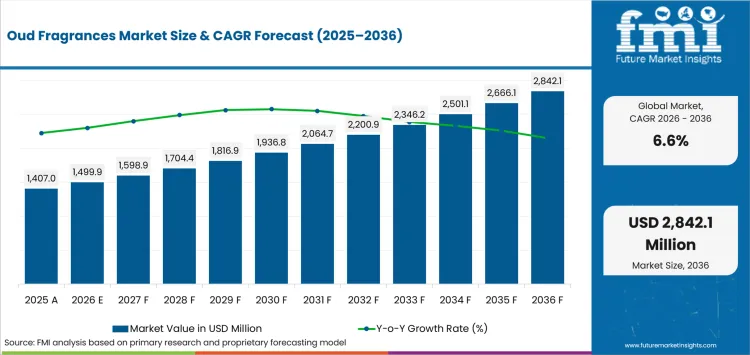
USD 1,499.9 million in 2026 and USD 2,842.1 million by 2036 at a 6.6% CAGR.
Demand for oud fragrances is projected to expand at 6.6% CAGR between 2026 and 2036, increasing valuation from USD 1499.9 million in 2026 to USD 2842.1 million by 2036. Wider access depends on retailers carrying enough fragrance depth for sampling and replenishment. Dubai Municipality documented nearly 13,000 cosmetics and consumer-products establishments in October 2025 and stated that the cosmetics sector had expanded by more than 50% since 2016. That commercial base gives oud-led sprays and oils more physical points for discovery without removing registration requirements.
Country conversion differs because local compliance capacity changes the cost and timing of launch work. France illustrates the heavier documentation side of this comparison. In February 2026 the DGCCRF said it had checked 147 cosmetics establishments and reviewed more than 200 product information files among small and newer operators. The review found insufficient command of regulatory requirements in part of that group. Markets with mature fragrance demand can therefore require more preparation than Gulf markets with deeper category familiarity and faster testing infrastructure.
Key Takeaways of Oud Fragrances Market
- Oud fragrances gain demand as familiar eau de parfum formats translate a resinous regional scent code into easier trial and everyday use.
- By product type, oud eau de parfum is estimated to hold 37.0% in 2026 owing to established spray routines and flexible scent construction.
- In 2026, conventional formulations are expected to account for 57.0% of nature because perfumers can control consistency and ingredient cost more closely.
- Liquid & serum is projected to hold 27.0% of format in 2026 owing to established use in sprays, oils, and attars.
- Natural agarwood sourcing and country-specific cosmetic rules can lengthen qualification whenever origin records or safety files need additional work.
- Some of the key players in this market include Arabian Oud, Ajmal Perfumes, Abdul Samad Al Qurashi, Rasasi, Swiss Arabian, Givaudan, Coty, DSM-Firmenich, L'Oreal, and Puig.
Analyst Perspective
"Oud earns repeat business when the scent identity survives changes in concentration and price without losing its recognizable woody character. Operators also need sourcing records and country-ready safety files because premium storytelling cannot compensate for a product that fails registration."
- Rahul Pandita, Principal Consultant, Future Market Insights
How is the Oud Fragrances Market segmented?
The oud fragrances market is segmented by product type, nature, format, price positioning, sales channel, and region.
Product types cover oud eau de parfum, pure oud oils, oud-blend attars, and bakhoor & home oud. Nature separates conventional, vegan & cruelty-free, natural & organic, dermocosmetic - clinical, and fragrance-free & sensitive offers. Format spans liquid & serum, cream & balm, stick & solid, spray & mist, sheet & patch, and powder. Price positioning runs from mass to professional, while sales channels range from specialty beauty retail to salons & spas.
What makes oud eau de parfum central to the product type category?
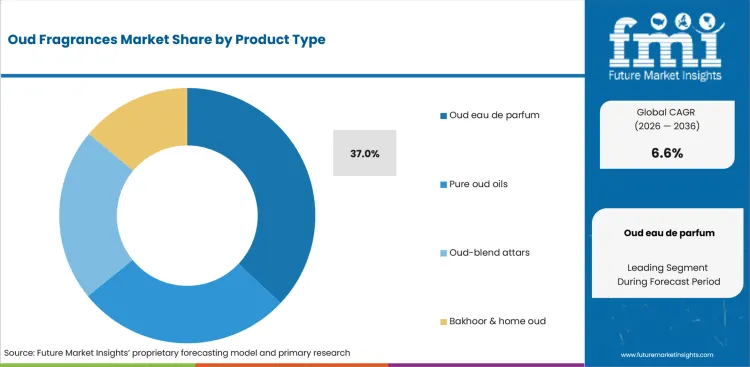
Oud eau de parfum uses the familiar bottle-and-spray ritual already established in the wider fragrance products category. Coty introduced the five-scent Jawhara collection on October 1, 2025 and later documented Oud Velvet as an oud-centered unisex eau de parfum. The launch shows how a recognizable oud accord can enter a wearable spray line without asking new customers to begin with concentrated oil.
- Based on product type, oud eau de parfum is projected to account for 37.0% in 2026 due to familiar application and broad formula flexibility.
- Spray formats support sampling at fragrance counters and provide room for woods, musks, florals, or spices to adjust intensity for different audiences.
Why does conventional formulation hold the nature position?
Conventional formulation gives perfumers a wider palette for stabilizing an oud impression when natural oil varies by origin or batch. Premium oud formulas also draw on botanical raw materials and aroma molecules, where natural extracts contribute provenance storytelling alongside the controlled accords that keep cost and consistency manageable. Givaudan announced construction of Campus 52 in Grasse in February 2026 to concentrate natural-fragrance ingredient development and production. The center strengthens access to natural inputs without removing the need for controlled accords in price-sensitive products.
- In 2026, conventional is expected to lead nature with 57.0% share because blended formulation gives perfumers tighter control over repeatability and cost.
- Natural and organic offers can command a stronger provenance story, yet finished formulas still need consistent odor performance between production batches.
How does liquid & serum shape demand within the format category?
Liquid delivery supports both modern sprays and traditional perfume oils, so retailers can vary concentration without changing basic handling. Swiss Arabian introduced Shaghaf Nectar Blush and Patchouli 01 in March 2026 as two new liquid perfume launches across established collections. That product activity keeps bottle-based discovery relevant even as home scent and solid formats broaden the category.
- By format, liquid & serum is forecast to represent 27.0% in 2026 driven by delivery systems already used by global perfume brands and Arabian perfume houses.
- Retailers can compare fluid formats by concentration and application style while maintaining similar storage, sampling, and replenishment routines at the counter.
What supports mass positioning within the price positioning category?
Mass pricing lowers the cost of first trial for customers who know oud by reputation but have not bought concentrated oil. Coty reported in August 2025 that it had launched in-house fragrance lines through Walmart and was extending scenting products into hair and body mists. Those actions show how fragrance companies use familiar retailers and lighter formats to widen access below niche-perfumery price points.
- The mass segment is set to lead price positioning with 35.0% share in 2026 due to wider retail reach outside the luxury perfume channel.
- Premium and masstige offers retain room for richer natural-material stories, while mass products depend more heavily on reproducible accords and efficient distribution.
Why does specialty beauty retail influence the sales channel category?
Oud can smell materially different by concentration and ingredient construction, which makes guided sampling valuable during a first purchase. Ajmal Perfumes described more than 350 flagship boutiques and exports to nearly 60 countries in a December 2025 company article. The retail network gives staff repeated chances to compare perfume oils with sprays and explain intensity before a customer commits to a full bottle.
- Specialty beauty retail is likely to capture 27.0% of sales channel in 2026 attributable to fragrance sampling and assisted comparison beyond perfume packaging alone.
- E-commerce serves replenishment efficiently, but discovery-led purchases still benefit from staff who can compare concentration, oud character, and intended wearing occasion.
What are the drivers, restraints and opportunities in the Oud Fragrances Market?
Accessible spray formats broaden entry into oud, while ingredient safety and origin records raise qualification work and local creation support improves market fit.
- Driver: Familiar eau de parfum and scenting formats let fragrance users try oud without starting with concentrated oil or incense.
- Restraint: Ingredient restrictions and natural-material documentation can force reformulation or delay a launch before retail listing begins.
- Opportunity: Regional creation support lets brands tune concentration and scent structure for local use without abandoning a recognizable oud signature.
Fragrance adoption is widening beyond a single bottle type because customers increasingly use scent in several daily formats. DSM-Firmenich reported in February 2026 that 70% of respondents in its 21-country consumer study appreciated scents more than before. The same behavior supports fragranced personal care as well as fine fragrance. Oud brands can use that broader scent repertoire to offer sprays or adjacent body formats while keeping concentrated oils for experienced customers.
Formula safety can interrupt otherwise attractive launches because fragrance houses must monitor restrictions that apply to ingredients and finished-use levels. IFRA opened consultation on its 52nd Amendment in December 2025 and kept the consultation open through June 2026. Changes in the perfume ingredient chemicals base can require another safety review before production. Natural agarwood adds a separate origin-record burden where protected species or authenticity claims apply.
Local creation capacity gives international brands a practical route to adjust oud intensity without losing the category code. DSM-Firmenich launched Connect: Future You in Jakarta in August 2025 with 22 original fragrances and several consumer formats developed for Indonesian customers. The program illustrates a commercial use for local perfumery teams: they can test scent expression and format together before a country launch. That approach is valuable in markets where fragrance preference must also fit halal or cosmetic documentation rules.
Which country CAGRs are covered in the Oud Fragrances Market?
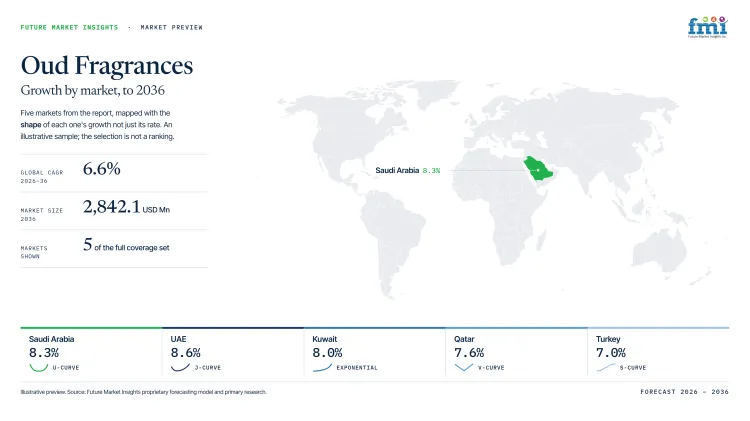
| Country | CAGR |
|---|---|
| UAE | 8.6% |
| Saudi Arabia | 8.3% |
| Kuwait | 8.0% |
| Qatar | 7.6% |
| Indonesia | 7.3% |
| Turkey | 7.0% |
| UK | 6.7% |
| France | 6.4% |
How do country-level CAGRs compare in the Oud Fragrances Market?
The country growth rates form a Gulf-heavy upper group and a separate European lower band over the 2026-2036 period. UAE, Saudi Arabia, and Kuwait sit at 8.0% or above because oud already fits established fragrance habits. Indonesia and Turkey occupy the middle range, while UK and France convert demand through more formal cosmetic documentation and mature retail competition.
- UAE pairs deep specialty-perfumery exposure with tourism-led assortment turnover that rewards frequent launches and reliable replenishment in major retail districts.
- Saudi Arabia carries strong domestic oud familiarity and a dense specialist-house presence that can sustain broader concentration ladders for repeat customers.
- Kuwait combines mature perfume-oil use with premium gifting behavior, which makes authenticity and controlled distribution important commercial differentiators.
- Qatar depends heavily on imported finished fragrance, so importer discipline and origin documentation can influence launch timing before consumer demand is tested.
- Indonesia mixes perfume-oil familiarity with a large halal-conscious consumer base, making certification readiness increasingly relevant for international fragrance launches.
- Turkey supports domestic and imported fragrance retail, but national product-safety enforcement can quickly interrupt non-compliant home-scent or cosmetic assortments.
- UK specialty and department-store channels support niche fragrance discovery, while local compliance ownership raises fixed preparation costs for smaller foreign brands.
- France offers mature fine-fragrance demand, yet detailed labeling and product-information duties leave less room for poorly documented niche launches.
Similar CAGRs therefore mask different launch economics because retail density and regulatory workload vary materially between the eight covered countries. A brand already equipped for local compliance can monetize a slower market more efficiently than an unprepared entrant in a faster one. The full report provides country-level CAGR analysis across North America, Latin America, Western Europe, Eastern Europe, East Asia, South Asia and Pacific, and Middle East and Africa.
Country-wise Analysis
- Dubai fragrance retail operates beside a high-volume import system that keeps assortment turnover unusually fast for specialty houses and global brands. Oud fragrance demand in the UAE is forecast to rise at 8.6% CAGR over the forecast period, supported by category familiarity and dense retail access. Dubai Municipality cut laboratory sample submission time by 90% through its March 2025 drive-through service. Faster handoff can shorten a testing step for firms using municipal laboratory services. Registration and release requirements still apply, so perfume bottles must reach shelves with compliant labels and launch-ready documentation.
- Saudi perfume houses can sell oud through sprays, oils, incense, and gifting formats because customers already understand concentration differences. The Saudi oud fragrances sector is projected to record 8.3% CAGR during the assessment period, driven by domestic category familiarity and specialist retail. The SFDA published its cosmetic-product notification list in March 2025 and continues to maintain searchable listed-product records. Formal notification gives legitimate operators a clear route to market, but every formula and accountable establishment still needs compliant records before broad distribution.
- Kuwaiti fragrance retail gives perfume oils and incense a familiar place beside modern eau de parfum, which keeps the oud story commercially legible. In Kuwait, oud fragrance demand is predicted to advance at 8.0% CAGR through 2036 owing to premium gifting and strong category familiarity. Kuwait's Public Authority for Industry lists KWS GSO 1943:2025 as the active technical regulation for cosmetics safety plus packaging and labeling. The standard gives importers a common compliance reference. Counterfeit concerns and premium positioning still increase the value of controlled distribution and traceable product identification.
- Qatar relies on imported finished fragrance for much of its assortment, so clearance quality can affect availability before scent preference becomes relevant. By 2036, Qatar is projected to grow at 7.6% CAGR attributable to Gulf fragrance habits and concentrated specialty retail. Qatar Customs publishes the Fourth Edition 2025 Unified Guide for Customs Procedures at First Points of Entry in the GCC. The guide formalizes customs documentation and clearance procedures for imported goods. Importers that maintain invoices, origin records, and classification files can reduce avoidable clearance friction, while smaller brands still need dependable local representation.
- Indonesia pairs traditional perfume-oil use with a large modern beauty channel that increasingly evaluates halal status before purchase. Adoption of oud fragrances in Indonesia is estimated to expand at 7.3% CAGR through 2036, driven by widening fragrance use and local product adaptation. BPJPH stated in May 2025 that cosmetics must carry halal certification after 17 October 2026 and reported 81,343 certified domestic cosmetic products. Foreign formulas can require ingredient-level documentation from several upstream sources. Local creation support therefore becomes valuable alongside agarwood sourcing and documentation for brands seeking a credible natural story.
- Turkey gives oud access through perfume stores and home-fragrance retail, but unsafe-product enforcement can remove non-compliant items quickly. Oud fragrance sales in Turkey are forecast to expand at 7.0% CAGR by 2036 supported by urban fragrance retail and regional scent familiarity. The Ministry of Trade listed Bella Maison Black Oud room fragrance in its unsafe-product portal on 15 May 2025 with chemical, burn, and injury risks. The enforcement record makes documentation and product safety commercially visible. Finished-fragrance brands therefore need local files that support both cosmetic and adjacent home-scent formats.
- UK fragrance shoppers can discover oud through department stores and specialty channels, although imported products still need a named compliance owner. The UK oud fragrances outlook is anticipated to advance at 6.7% CAGR over the assessment period owing to niche-fragrance demand and developed retail access. The Office for Product Safety and Standards confirmed in July 2025 that perfumes require safety assessment plus notification and a Responsible Person before sale in Great Britain. Those fixed requirements weigh more heavily on smaller entrants. Flavors and fragrances firms with local regulatory support can reduce avoidable launch delays.
- French consumers evaluate oud inside a mature fine-fragrance culture where composition and raw-material story receive close scrutiny. France is set to post 6.4% CAGR over the forecast period attributable to premium fragrance demand and specialist discovery. The DGCCRF stated in December 2025 that cosmetics manufacturing and market placement are subject to declaration and that labeling must support informed consumer choice. Allergen and ingredient information can therefore affect label design before launch. Brands with strong scent storytelling still need complete product files, which raises preparation costs for smaller imported niche ranges.
Who are the notable companies in the Oud Fragrances Market?
Arabian Oud, Ajmal Perfumes, Abdul Samad Al Qurashi, Rasasi, Swiss Arabian, Givaudan, Coty, DSM-Firmenich, L'Oreal, and Puig are the notable companies serving this market.
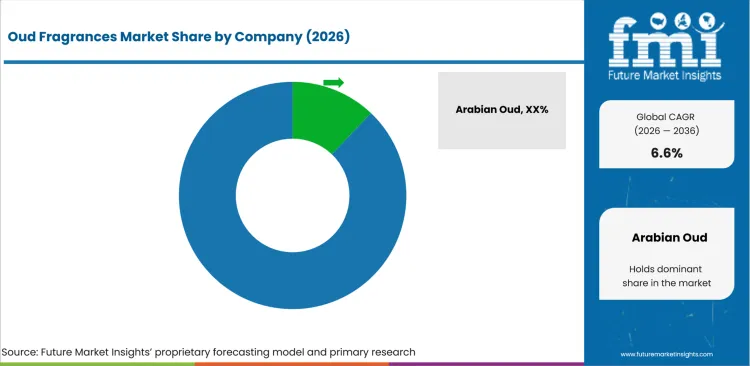
The competitive field divides between oud-focused houses, fragrance-creation groups, and international portfolio operators with different reasons for winning a brief. Arabian houses control scent heritage and direct retail experience. Givaudan and DSM-Firmenich influence formula construction and ingredient access. Coty, L'Oreal, and Puig bring brand licensing plus international distribution. Entry therefore depends on the specific role a company performs instead of corporate scale alone.
- Oud-focused houses include Arabian Oud, Ajmal Perfumes, Abdul Samad Al Qurashi, Rasasi, and Swiss Arabian with direct Arabian-perfumery portfolios.
- Creation groups Givaudan and DSM-Firmenich compete through perfumers, ingredient systems, and regional customer development for finished fragrance brands.
- International portfolio operators Coty, L'Oreal, and Puig manage fragrance brands through licensing, creation partners, manufacturing networks, and multi-country retail distribution.
Competitive Benchmarking: Oud Fragrances Market
| Company | Oud Portfolio Breadth | Creation / Production Control | Channel / Customer Breadth | Geographic Reach |
|---|---|---|---|---|
| Arabian Oud | High | High | High | Middle East, Europe, North America and Asia |
| Ajmal Perfumes | High | High | High | GCC, South Asia and international markets |
| Abdul Samad Al Qurashi | High | Medium | Medium | GCC and selected international markets |
| Rasasi | High | High | High | GCC and export markets in more than 90 countries |
| Swiss Arabian | High | Medium | High | GCC, North America, Europe and online markets |
| Givaudan | Medium | High | High | Global fragrance creation network |
| Coty | Medium | High | High | More than 120 countries and territories |
| DSM-Firmenich | Medium | High | High | Global perfumery and ingredient network |
| L'Oreal | Medium | High | High | Global luxury and beauty distribution |
| Puig | Medium | High | High | Global prestige fragrance distribution |
Key Developments in the Oud Fragrances Market
- In March 2026, L'Oreal completed its acquisition of Kering Beaute including Creed and secured fifty-year fragrance and beauty licenses for Bottega Veneta and Balenciaga.
- In October 2025, Swiss Arabian announced three new perfumes across its Shaghaf, Heritage, and Cities collections for GCC boutiques and global online sale.
- In September 2025, Givaudan broke ground on a Guangzhou fragrance and beauty facility with a creative center plus automated production for Chinese customers.
Key Players in the Oud Fragrances Market
Arabian Perfumery and Oud Specialists
- Arabian Oud
- Ajmal Perfumes
- Abdul Samad Al Qurashi
- Rasasi
- Swiss Arabian
Fragrance Creation and Ingredient Groups
- Givaudan
- DSM-Firmenich
International Fragrance Portfolio Operators
- Coty
- L'Oreal
- Puig
Oud Fragrances Market - Report Scope
| Coverage field | Report scope |
|---|---|
| Market breakdown | By product type, nature, format, price positioning, sales channel and region. |
| Quantitative Units | Revenue in USD million and CAGR in %. |
| Market Definition | Commercial revenue from oud-centered perfumes, perfume oils, attars, bakhoor and home-oud fragrance products within the stated taxonomy. |
| Regions Covered | North America, Latin America, Western Europe, Eastern Europe, East Asia, South Asia and Pacific, and Middle East and Africa. |
| Countries Covered | UAE, Saudi Arabia, Kuwait, Qatar, Indonesia, Turkey, UK, France, and 20+ countries included in the full report. |
| Key Companies | Arabian Oud, Ajmal Perfumes, Abdul Samad Al Qurashi, Rasasi, Swiss Arabian, Givaudan, Coty, DSM-Firmenich, L'Oreal, Puig. |
| Forecast Period | 2026 to 2036. |
| Approach | Primary and secondary research with market triangulation. |
Oud Fragrances Market - Research Methodology
| Method | Approach |
|---|---|
| Primary Research | FMI analysts gathered input from manufacturers, service providers, technology developers, distributors, end users, procurement teams, and subject-matter experts. Interviews examined purchasing decisions, product or service evaluation, adoption barriers, approval requirements, pricing considerations, and expectations for technical or commercial support. Respondents were also asked what evidence is required before a trial, pilot, or initial order develops into regular purchasing. |
| Desk Research | Desk research covered government statistics, regulatory publications, trade data, industry associations, technical literature, standards, company filings, product information, and official corporate announcements. Sources were reviewed for relevance, publication date, geographic coverage, and consistency with the defined market scope. Claims relating to performance, applications, approvals, capacity, investment, and commercial activity were retained only when supported by credible public evidence. |
| Market Sizing and Forecasting | The market model combined the baseline value with historical performance, segment structure, pricing and volume indicators, adoption levels, company participation, and country-level demand conditions. Forecast assumptions considered economic activity, investment trends, regulatory developments, technology adoption, purchasing cycles, supply availability, and barriers to wider market use. Segment and regional estimates were reconciled before the final market total was calculated. |
| Data Validation | Estimates were checked against multiple independent indicators, including public data, company activity, trade patterns, industry developments, and findings from primary interviews. Validation also tested whether products, services, applications, and company revenues fell within the defined market boundaries. Adjacent categories, unsupported claims, overlapping revenues, and activities without direct market relevance were excluded to reduce double counting and maintain consistency across segments and countries. |
Oud Fragrances Market by Segments
Oud Fragrances Market segmented by Product Type:
- Oud eau de parfum
- Pure oud oils
- Oud-blend attars
- Bakhoor & home oud
Oud Fragrances Market segmented by Nature:
- Conventional
- Vegan & cruelty-free
- Natural & organic
- Dermocosmetic - clinical
- Fragrance-free & sensitive
Oud Fragrances Market segmented by Format:
- Liquid & serum
- Cream & balm
- Stick & solid
- Spray & mist
- Sheet & patch
- Powder
Oud Fragrances Market segmented by Price Positioning:
- Mass
- Masstige
- Premium
- Professional
Oud Fragrances Market segmented by Sales Channel:
- Specialty beauty retail
- E-commerce & DTC
- Pharmacies & drugstores
- Supermarkets & hypermarkets
- Salons & spas
Oud Fragrances Market by Region:
- North America
- United States
- Canada
- Latin America
- Brazil
- Mexico
- Chile
- Rest of Latin America
- Western Europe
- Germany
- United Kingdom
- Italy
- Spain
- France
- Nordics
- Benelux
- Rest of Western Europe
- Eastern Europe
- Russia
- Poland
- Hungary
- Balkan and Baltic States
- Rest of Eastern Europe
- East Asia
- China
- Japan
- South Korea
- South Asia and Pacific
- India
- ASEAN
- Australia and New Zealand
- Rest of South Asia and Pacific
- Middle East and Africa
- Kingdom of Saudi Arabia
- Other GCC Countries
- Türkiye
- South Africa
- Other African Union Countries
- Rest of Middle East and Africa
Research Sources and Bibliography
- Dubai Municipality. (2025, October 27). Product safety at Beautyworld Middle East 2025
- Direction générale de la concurrence, de la consommation et de la répression des fraudes. (2026, February 2). Cosmétiques : des TPE nouvelles dans le secteur qui méconnaissent trop souvent la réglementation
- Coty Inc.. (2025, November 14). An Aura Takes Hold: Coty’s Jawhara Collection Captivates Consumers with Premium Fragrance Artistry
- Givaudan. (2026, February 17). Givaudan to invest CHF 55 million in Grasse, France to build ‘Campus 52’, its new centre of excellence dedicated to House of Naturals organisation
- Swiss Arabian. (2026, April 7). Swiss Arabian Unveils Two New Perfumes and Launches
- Coty Inc.. (2025, August 20). Coty Reports FY25 and Q4 Results; Targets Sequential LFL and EBITDA Trend Improvement in FY26, Returning to Growth in 2H26
- Ajmal Perfumes. (2025, December 16). Inside the Factory Of Ajmal
- DSM-Firmenich. (2026, February 20). Our markets - Perfumery & Beauty, Integrated Annual Report 2025
- International Fragrance Association. (2025, December 12). IFRA launches consultation on latest update to its safe use program
- DSM-Firmenich. (2025, July 28). dsm-firmenich presents Connect: Future You
- Dubai Municipality. (2025, March 7). Region’s first ‘Drive-Thru’ lab service for seamless experience
- Saudi Food and Drug Authority. (2025, March 5). List of Notification of Marketing for Cosmetic Products (Listed Products)
- Public Authority for Industry, Kuwait. (2025). KWS GSO 1943:2025, Cosmetics - Safety Requirements for Cosmetics and Personal Care Products
- General Authority of Customs, Qatar. (2025). Unified Guide for Customs Procedures at First Points of Entry in the GCC Member States, Fourth Edition
- Halal Product Assurance Organizing Agency. (2025, May 14). BPJPH: Produk Kosmetik Wajib Bersertifikat Halal pada Oktober 2026
- Ministry of Trade, Republic of Türkiye. (2025, May 15). GÜBİS notification 2025050009: Bella Maison Black Oud room fragrance
- Office for Product Safety and Standards. (2025, July 10). Consumer products: cosmetics
- Direction générale de la concurrence, de la consommation et de la répression des fraudes. (2025, December 4). Les produits cosmétiques
- L’Oreal. (2026, March 31). L’Oréal completes the acquisition of Kering Beauté within the framework of its strategic alliance with Kering
- Swiss Arabian. (2025, October 28). Swiss Arabian Unveils Three New Perfume Launches
- Givaudan. (2025, September 29). Givaudan breaks ground on new state-of-the-art Fragrance & Beauty facility in Guangzhou, China
- Arabian Oud. (2026, accessed September 9). About Arabian Oud
- Ajmal Perfumes. (2026, accessed September 9). About Ajmal Perfumes
- Rasasi Perfumes. (2026, accessed September 9). The Story of Rasasi Perfumes
- DSM-Firmenich. (2026, February 20). Perfumery & Beauty - Integrated Annual Report 2025
- Coty Inc.. (2025, August 21). Coty Announces Filing of Annual Report on Form 10-K for the Fiscal Year Ended June 30, 2025
- Puig. (2026, accessed September 9). Financial Information
- United States Patent and Trademark Office. (2025, February 18). TTABVUE Ex Parte Appeal 90892317, SOLID
- Ajmal Perfumes. (2025, November 27). The Untold Stories By Ajmal
- Ministry of Industry and Commerce, Bahrain. (2025, March 20). Issue No. 12 for the year 2025 regarding trademarks
- Ministry of Industry and Commerce, Bahrain. (2025, December 25). Issue No. 52 for the year 2025 regarding trademarks
- Givaudan. (2026, July 7). Givaudan announces strategic collaboration with Microcaps
- Coty Inc.. (2026, July 6). Megan Thee Stallion Enters Fragrance Industry & Introduces New “Hot Girl Summer Eau de Parfum” with Coty
- DSM-Firmenich. (2026, June 18). dsm-firmenich unveils SENSORIUM™ Seoul: Exploring the Rise of K-Scent and the Future of Fragrance Creation
- L’Oreal. (2025, February 7). L’Oréal groupe signs an exclusive agreement with Jacquemus
- Puig. (2025, October 8). Colonias Absolutas Puig: A tribute to Puig, its identity, legacy, and Mediterranean roots
- Givaudan. (2025, September 1). Givaudan completes the acquisition of a majority stake in Vollmens Fragrances
- Coty Inc.. (2025, September 30). Coty announces plans to bolster its leading position in fragrance and launches a strategic review of its consumer beauty business
- Givaudan. (2025, December 2). Givaudan completes the acquisition of Belle Aire Creations
- DSM-Firmenich. (2026, February 4). dsm-firmenich continues expansion in the Middle East with a new creative concept in Riyadh
- Coty Inc.. (2026, January 26). Coty Unveils the Bridgerton Fragrance Collection That Will Enchant the Ton
This bibliography is provided for reader reference and is not exhaustive. The full report contains the complete reference list and detailed citations.
This Report Answers
- How large is the oud fragrances market in 2026 and what value is forecast for 2036?
- Which operating conditions are widening oud fragrance use beyond concentrated oils and incense?
- Why does oud eau de parfum account for 37.0% of product type demand in 2026?
- How does conventional formulation support repeatable oud scent performance across price tiers?
- Why does liquid & serum account for 27.0% of format demand in 2026?
- How do the eight country CAGRs differ between Gulf, Asian, and European markets?
- Which companies serve oud-focused products, fragrance creation, and international portfolio distribution?
- What sourcing and safety requirements can slow natural-oud fragrance qualification before launch?
- Which channel and format choices improve first-purchase discovery for customers unfamiliar with oud?
Frequently Asked Questions
How big is the Oud Fragrances Market in 2026?
The oud fragrances market is valued at USD 1499.9 million in 2026 and is projected to reach USD 2842.1 million by 2036. Growth is driven by broader eau de parfum access and deeper fragrance retail distribution.
What is the CAGR of the Oud Fragrances Market from 2026 to 2036?
The oud fragrances market is projected to grow at a CAGR of 6.6% between 2026 and 2036. Expansion is supported by familiar spray formats and wider price ladders that reduce the barrier to first trial.
Which product type leads the Oud Fragrances Market?
The oud eau de parfum segment is expected to hold 37.0% of the oud fragrances market in 2026, driven by familiar spray use and flexible scent construction. Retail sampling also makes concentrated woody profiles easier to compare before purchase.
Which nature segment holds the stated share in the Oud Fragrances Market?
The conventional segment is expected to hold 57.0% of the oud fragrances market in 2026, attributable to stronger control over formula repeatability and ingredient cost. Natural oud remains important for premium provenance and high-concentration products.
Which format segment holds a significant share in the Oud Fragrances Market?
The liquid & serum segment is expected to hold 27.0% of the oud fragrances market in 2026, supported by established use in sprays and perfume oils. The format also fits routine sampling and bottle-based replenishment.
Which countries are projected to record the country growth comparison in the Oud Fragrances Market?
UAE is projected to grow at 8.6% CAGR, followed by Saudi Arabia at 8.3% and Kuwait at 8.0% through 2036. Gulf growth is supported by strong oud familiarity and dense specialty-fragrance retail.
Which companies are active in the Oud Fragrances Market?
Key companies operating in the oud fragrances market include Arabian Oud, Ajmal Perfumes, Abdul Samad Al Qurashi, Rasasi, Swiss Arabian, Givaudan, Coty, DSM-Firmenich, L'Oreal, and Puig. Their roles span finished oud portfolios, fragrance creation, ingredients, and international brand distribution.
Preview the report firsthand - request a free sample
Get SampleGet the brochure for pricing and purchase details.
Get PDFTable of Content
- Key Takeaways
- Market Size and CAGR
- Top Growth Driver
- Fastest Growing Segment
- Leading Region
- Key Companies
- Emerging Opportunities
- Executive Summary
- Global Market Outlook
- Demand-side Trends
- Supply-side Trends
- Technology Roadmap Analysis
- Analysis and Recommendations
- Analyst Perspective (What is happening? Why now? What should investors know?)
- Key Questions Answered
- How large is the market?
- What is the CAGR?
- What are key trends?
- Which region dominates?
- Who are the leaders?
- Market Overview
- Market Coverage / Taxonomy
- Market Definition / Scope / Limitations
- Research Methodology
- Chapter Orientation
- Analytical Lens and Working Hypotheses
- Market Structure, Signals, and Trend Drivers
- Benchmarking and Cross-market Comparability
- Market Sizing, Forecasting, and Opportunity Mapping
- Research Design and Evidence Framework
- Desk Research Programme (Secondary Evidence)
- Expert Input and Fieldwork (Primary Evidence)
- Tooling, Models, and Reference Databases
- Data Engineering and Model Build
- Quality Assurance and Audit Trail
- Market Background
- Market Dynamics (Drivers, Restraints, Opportunity, Trends)
- Scenario Forecast (Optimistic, Likely, Conservative)
- Impact Analysis
- AI Impact
- Sustainability Impact
- Regulatory Impact
- Technology Impact
- Consumer / Buyer Analysis
- Purchase Drivers
- Adoption Barriers
- Buyer Journey
- Opportunity Map Analysis
- Product Life Cycle Analysis
- Supply Chain Analysis
- Investment Feasibility Matrix
- Value Chain Analysis
- PESTLE and Porter's Analysis
- Regulatory Landscape
- Regional Parent Market Outlook
- Production and Consumption Statistics
- Import and Export Statistics
- Global Market Analysis and Forecast, 2021 to 2036
- Historical Market Size Value (USD Million) Analysis, 2021 to 2025
- Current and Future Market Size Value (USD Million) Projections, 2026 to 2036
- Y-o-Y Growth Trend Analysis
- Absolute $ Opportunity Analysis
- Global Market Pricing Analysis, 2021 to 2036
- Global Market Analysis and Forecast, By Product Type, 2021 to 2036
- Introduction / Key Findings
- Historical Market Size Value (USD Million) Analysis By Product Type, 2021 to 2025
- Current and Future Market Size Value (USD Million) Analysis and Forecast By Product Type, 2026 to 2036
- Oud eau de parfum
- Pure oud oils
- Oud-blend attars
- Bakhoor & home oud
- Oud eau de parfum
- Y-o-Y Growth Trend Analysis By Product Type, 2021 to 2025
- Absolute $ Opportunity Analysis By Product Type, 2026 to 2036
- Global Market Analysis and Forecast, By Nature, 2021 to 2036
- Introduction / Key Findings
- Historical Market Size Value (USD Million) Analysis By Nature, 2021 to 2025
- Current and Future Market Size Value (USD Million) Analysis and Forecast By Nature, 2026 to 2036
- Conventional
- Vegan & cruelty-free
- Natural & organic
- Dermocosmetic / clinical
- Fragrance-free & sensitive
- Conventional
- Y-o-Y Growth Trend Analysis By Nature, 2021 to 2025
- Absolute $ Opportunity Analysis By Nature, 2026 to 2036
- Global Market Analysis and Forecast, By Format, 2021 to 2036
- Introduction / Key Findings
- Historical Market Size Value (USD Million) Analysis By Format, 2021 to 2025
- Current and Future Market Size Value (USD Million) Analysis and Forecast By Format, 2026 to 2036
- Liquid & serum
- Cream & balm
- Stick & solid
- Spray & mist
- Sheet & patch
- Powder
- Liquid & serum
- Y-o-Y Growth Trend Analysis By Format, 2021 to 2025
- Absolute $ Opportunity Analysis By Format, 2026 to 2036
- Global Market Analysis and Forecast, By Price Positioning, 2021 to 2036
- Introduction / Key Findings
- Historical Market Size Value (USD Million) Analysis By Price Positioning, 2021 to 2025
- Current and Future Market Size Value (USD Million) Analysis and Forecast By Price Positioning, 2026 to 2036
- Mass
- Masstige
- Premium
- Professional
- Mass
- Y-o-Y Growth Trend Analysis By Price Positioning, 2021 to 2025
- Absolute $ Opportunity Analysis By Price Positioning, 2026 to 2036
- Global Market Analysis and Forecast, By Sales Channel, 2021 to 2036
- Introduction / Key Findings
- Historical Market Size Value (USD Million) Analysis By Sales Channel, 2021 to 2025
- Current and Future Market Size Value (USD Million) Analysis and Forecast By Sales Channel, 2026 to 2036
- Specialty beauty retail
- E-commerce & DTC
- Pharmacies & drugstores
- Supermarkets & hypermarkets
- Salons & spas
- Specialty beauty retail
- Y-o-Y Growth Trend Analysis By Sales Channel, 2021 to 2025
- Absolute $ Opportunity Analysis By Sales Channel, 2026 to 2036
- Global Market Analysis and Forecast, By Region, 2021 to 2036
- Introduction
- Historical Market Size Value (USD Million) Analysis By Region, 2021 to 2025
- Current Market Size Value (USD Million) Analysis and Forecast By Region, 2026 to 2036
- North America
- Latin America
- Western Europe
- Eastern Europe
- East Asia
- South Asia and Pacific
- Middle East & Africa
- Market Attractiveness Analysis By Region
- North America Market Analysis and Forecast, By Country, 2021 to 2036
- Historical Market Size Value (USD Million) Trend Analysis By Market Taxonomy, 2021 to 2025
- Market Size Value (USD Million) Forecast By Market Taxonomy, 2026 to 2036
- By Country
- USA
- Canada
- By Product Type
- By Nature
- By Format
- By Price Positioning
- By Sales Channel
- By Country
- Market Attractiveness Analysis
- By Country
- By Product Type
- By Nature
- By Format
- By Price Positioning
- By Sales Channel
- Key Takeaways
- Latin America Market Analysis and Forecast, By Country
- Historical Market Size Value (USD Million) Trend Analysis By Market Taxonomy, 2021 to 2025
- Market Size Value (USD Million) Forecast By Market Taxonomy, 2026 to 2036
- By Country
- Brazil
- Mexico
- Chile
- Rest of Latin America
- By Product Type
- By Nature
- By Format
- By Price Positioning
- By Sales Channel
- By Country
- Market Attractiveness Analysis
- By Country
- By Product Type
- By Nature
- By Format
- By Price Positioning
- By Sales Channel
- Key Takeaways
- Western Europe Market Analysis and Forecast, By Country
- Historical Market Size Value (USD Million) Trend Analysis By Market Taxonomy, 2021 to 2025
- Market Size Value (USD Million) Forecast By Market Taxonomy, 2026 to 2036
- By Country
- Germany
- UK
- Italy
- Spain
- France
- Nordic
- BENELUX
- Rest of Western Europe
- By Product Type
- By Nature
- By Format
- By Price Positioning
- By Sales Channel
- By Country
- Market Attractiveness Analysis
- By Country
- By Product Type
- By Nature
- By Format
- By Price Positioning
- By Sales Channel
- Key Takeaways
- Eastern Europe Market Analysis and Forecast, By Country
- Historical Market Size Value (USD Million) Trend Analysis By Market Taxonomy, 2021 to 2025
- Market Size Value (USD Million) Forecast By Market Taxonomy, 2026 to 2036
- By Country
- Russia
- Poland
- Hungary
- Balkan & Baltic
- Rest of Eastern Europe
- By Product Type
- By Nature
- By Format
- By Price Positioning
- By Sales Channel
- By Country
- Market Attractiveness Analysis
- By Country
- By Product Type
- By Nature
- By Format
- By Price Positioning
- By Sales Channel
- Key Takeaways
- East Asia Market Analysis and Forecast, By Country
- Historical Market Size Value (USD Million) Trend Analysis By Market Taxonomy, 2021 to 2025
- Market Size Value (USD Million) Forecast By Market Taxonomy, 2026 to 2036
- By Country
- China
- Japan
- South Korea
- By Product Type
- By Nature
- By Format
- By Price Positioning
- By Sales Channel
- By Country
- Market Attractiveness Analysis
- By Country
- By Product Type
- By Nature
- By Format
- By Price Positioning
- By Sales Channel
- Key Takeaways
- South Asia and Pacific Market Analysis and Forecast, By Country
- Historical Market Size Value (USD Million) Trend Analysis By Market Taxonomy, 2021 to 2025
- Market Size Value (USD Million) Forecast By Market Taxonomy, 2026 to 2036
- By Country
- India
- ASEAN
- Australia & New Zealand
- Rest of South Asia and Pacific
- By Product Type
- By Nature
- By Format
- By Price Positioning
- By Sales Channel
- By Country
- Market Attractiveness Analysis
- By Country
- By Product Type
- By Nature
- By Format
- By Price Positioning
- By Sales Channel
- Key Takeaways
- Middle East & Africa Market Analysis and Forecast, By Country
- Historical Market Size Value (USD Million) Trend Analysis By Market Taxonomy, 2021 to 2025
- Market Size Value (USD Million) Forecast By Market Taxonomy, 2026 to 2036
- By Country
- Kingdom of Saudi Arabia
- Other GCC Countries
- Türkiye
- South Africa
- Other African Union
- Rest of Middle East & Africa
- By Product Type
- By Nature
- By Format
- By Price Positioning
- By Sales Channel
- By Country
- Market Attractiveness Analysis
- By Country
- By Product Type
- By Nature
- By Format
- By Price Positioning
- By Sales Channel
- Key Takeaways
- Key Countries Market Analysis
- USA
- Pricing Analysis
- Market Share Analysis, 2025
- By Product Type
- By Nature
- By Format
- By Price Positioning
- By Sales Channel
- Canada
- Pricing Analysis
- Market Share Analysis, 2025
- By Product Type
- By Nature
- By Format
- By Price Positioning
- By Sales Channel
- Mexico
- Pricing Analysis
- Market Share Analysis, 2025
- By Product Type
- By Nature
- By Format
- By Price Positioning
- By Sales Channel
- Brazil
- Pricing Analysis
- Market Share Analysis, 2025
- By Product Type
- By Nature
- By Format
- By Price Positioning
- By Sales Channel
- Chile
- Pricing Analysis
- Market Share Analysis, 2025
- By Product Type
- By Nature
- By Format
- By Price Positioning
- By Sales Channel
- Germany
- Pricing Analysis
- Market Share Analysis, 2025
- By Product Type
- By Nature
- By Format
- By Price Positioning
- By Sales Channel
- UK
- Pricing Analysis
- Market Share Analysis, 2025
- By Product Type
- By Nature
- By Format
- By Price Positioning
- By Sales Channel
- Italy
- Pricing Analysis
- Market Share Analysis, 2025
- By Product Type
- By Nature
- By Format
- By Price Positioning
- By Sales Channel
- Spain
- Pricing Analysis
- Market Share Analysis, 2025
- By Product Type
- By Nature
- By Format
- By Price Positioning
- By Sales Channel
- France
- Pricing Analysis
- Market Share Analysis, 2025
- By Product Type
- By Nature
- By Format
- By Price Positioning
- By Sales Channel
- India
- Pricing Analysis
- Market Share Analysis, 2025
- By Product Type
- By Nature
- By Format
- By Price Positioning
- By Sales Channel
- ASEAN
- Pricing Analysis
- Market Share Analysis, 2025
- By Product Type
- By Nature
- By Format
- By Price Positioning
- By Sales Channel
- Australia & New Zealand
- Pricing Analysis
- Market Share Analysis, 2025
- By Product Type
- By Nature
- By Format
- By Price Positioning
- By Sales Channel
- China
- Pricing Analysis
- Market Share Analysis, 2025
- By Product Type
- By Nature
- By Format
- By Price Positioning
- By Sales Channel
- Japan
- Pricing Analysis
- Market Share Analysis, 2025
- By Product Type
- By Nature
- By Format
- By Price Positioning
- By Sales Channel
- South Korea
- Pricing Analysis
- Market Share Analysis, 2025
- By Product Type
- By Nature
- By Format
- By Price Positioning
- By Sales Channel
- Russia
- Pricing Analysis
- Market Share Analysis, 2025
- By Product Type
- By Nature
- By Format
- By Price Positioning
- By Sales Channel
- Poland
- Pricing Analysis
- Market Share Analysis, 2025
- By Product Type
- By Nature
- By Format
- By Price Positioning
- By Sales Channel
- Hungary
- Pricing Analysis
- Market Share Analysis, 2025
- By Product Type
- By Nature
- By Format
- By Price Positioning
- By Sales Channel
- Kingdom of Saudi Arabia
- Pricing Analysis
- Market Share Analysis, 2025
- By Product Type
- By Nature
- By Format
- By Price Positioning
- By Sales Channel
- Türkiye
- Pricing Analysis
- Market Share Analysis, 2025
- By Product Type
- By Nature
- By Format
- By Price Positioning
- By Sales Channel
- South Africa
- Pricing Analysis
- Market Share Analysis, 2025
- By Product Type
- By Nature
- By Format
- By Price Positioning
- By Sales Channel
- USA
- Market Structure Analysis
- Competition Dashboard
- Competition Benchmarking
- Market Share Analysis of Top Players
- By Regional
- By Product Type
- By Nature
- By Format
- By Price Positioning
- By Sales Channel
- Emerging Startups
- Innovation Benchmarking
- Competition Analysis
- Competition Deep Dive
- Arabian Oud
- Overview
- Product Portfolio
- Profitability by Market Segments
- Sales Footprint
- Strategy Overview
- Marketing Strategy
- Product Strategy
- Channel Strategy
- Ajmal Perfumes
- Abdul Samad Al Qurashi
- Rasasi
- Swiss Arabian
- Givaudan
- Coty
- DSM-Firmenich
- L'Oreal
- Puig
- Arabian Oud
- Case Studies
- Success Stories
- Recent Developments
- Competition Deep Dive
- Assumptions & Acronyms Used


