

- Market Size (2026)
- USD 199.4 Mn
- Forecast (2036)
- USD 571.4 Mn
- CAGR (2026 to 2036)
- 11.1%
How big is Autism Selective-Eating Nutrition Market in 2026?
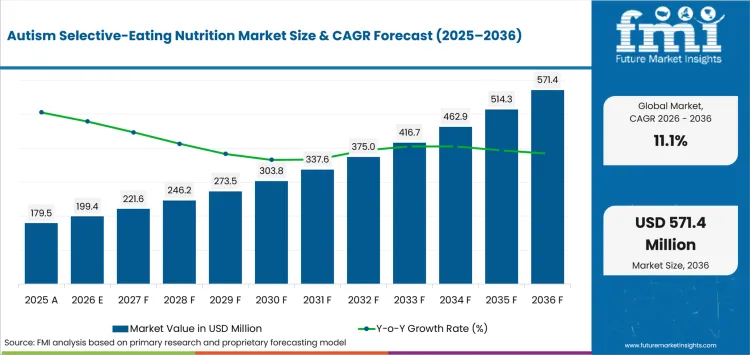
USD 199.4 million in 2026 and USD 571.4 million by 2036 at an 11.1% CAGR.
Autism selective-eating nutrition is projected to expand from USD 199.4 million in 2026 to USD 571.4 million by 2036 at an 11.1% CAGR. Purchasing starts if restricted accepted foods leave a nutrition gap that ordinary meals do not close reliably. The American Academy of Pediatrics noted in December 2025 that 70% of autistic children in cited parent-report research chose foods by mouthfeel. Sensory consistency therefore enters product selection alongside nutrient adequacy and age suitability.
Market scale also depends on how early families enter autism-related care and encounter feeding assessment during childhood. CDC reported in April 2025 that autism was identified in 32.2 per 1,000 eight-year-olds at 16 USA surveillance sites during 2022. The prevalence figure does not prove nutrition demand since feeding needs differ widely within the diagnosed population. It does define the population in which selective eating can prompt dietitian review and product trial.
Key Takeaways
- Persistent food selectivity turns nutrition adequacy into repeat purchasing once a tolerated format becomes part of the child's regular eating routine.
- By product type, balanced nutrition shakes are estimated to hold 41.2% in 2026 owing to concentrated nutrition in a familiar drink format.
- The beige - carb-predominant diets segment is likely to capture 46.2% of the dietary pattern category in 2026 attributable to familiar carbohydrate textures that reduce sensory change during trial.
- The 2-6 years segment is set to lead the age group category with 49.0% share in 2026 due to close caregiver control over meals during developmental monitoring.
- Taste and texture refusal can stop repeat use even if clinicians identify a genuine nutrition gap and recommend supplemental intake.
- Some of the key players in this market include Abbott (PediaSure), Else Nutrition, Kate Farms, Healthy Heights, Danone Nutricia, Nestlé Health Science, Mead Johnson / Reckitt, and Orgain.
Analyst Perspective
"Selective-eating nutrition earns repeat use once a child accepts the same flavor and texture often enough to close a documented intake gap. Brand evaluation should start with sensory consistency and age-appropriate nutrient delivery, then test replenishment access following the first tolerated trial."
- Nandini Roy Choudhury, Principal Consultant, Future Market Insights
How is the Autism Selective-Eating Nutrition Market segmented?
The market is segmented by product type, dietary pattern, age group, end user, sales channel and region.
Product type covers balanced nutrition shakes, micronutrient gummies and drops, fortified preferred-texture foods, gut-health support products and others. Dietary pattern covers beige - carb-predominant diets, brand-specific rigidity, texture-restricted diets and others. Age group includes 2-6 years, 7-12 years and 13+ years. End user covers home - caregiver, feeding and developmental clinics, schools and programs, plus others. Sales channels include online / DTC, retail pharmacy, supermarkets and hypermarkets, specialty and health stores, plus others.
What makes balanced nutrition shakes central to the product type category?
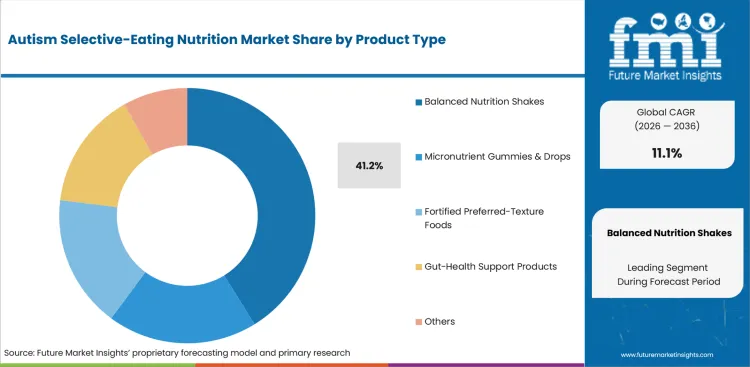
Balanced nutrition shakes give caregivers one controlled serving that can carry calories and micronutrients without requiring several unfamiliar foods. A familiar drink format also fits oral nutrition supplements into an accepted routine without adding a second sensory change.
- By product type, balanced nutrition shakes are estimated to hold 41.2% in 2026 owing to concentrated nutrition in a familiar drink format.
- Clinicians can fit one planned serving into a pediatric nutrition schedule following consistent sensory acceptance. The American Academy of Pediatrics updated dietary guidance in March 2026 and states that oral nutrition supplements can provide 25% to 50% of estimated energy or protein needs.
Why do beige - carb-predominant diets lead the dietary pattern category?
Beige or carbohydrate-predominant diets concentrate intake in visually familiar foods and repeatable textures. Japan's Children and Families Agency ran a September 2025 infant and young-child nutrition survey of about 6,000 households and collected food plus snack patterns for children through age five.
- In 2026, beige - carb-predominant diets are expected to lead the dietary pattern category with 46.2% share because familiar carbohydrate formats reduce sensory change during trial.
- Caregivers can test a fortified drink or soft food beside an accepted carbohydrate so pediatric supplements enter the meal without several simultaneous changes in texture or flavor.
How does 2-6 years shape the age group category?
Children aged 2-6 remain under close caregiver control during meals and commonly encounter developmental services before school-age routines become more independent.
- By age group, the 2-6 years segment is forecast to represent 49.0% in 2026 driven by caregiver control over most nutrition decisions during early developmental monitoring.
- Growth reviews can expose a narrow accepted-food set early and give families a reason to test age-appropriate portions for many households. CDC's April 2025 surveillance report placed the median age of earliest known autism diagnosis among eight-year-olds at 47 months, keeping many feeding discussions inside the same developmental window.
What supports home - caregiver as the leading end user category?
Caregivers see flavor refusal and serving fatigue between clinical visits, making home use the decisive test of whether a recommended product survives repeated exposure. Nutritional Growth Solutions stated in its August 2025 ASX filing that Healthy Heights launch shipments into 5,500 CVS stores were completed after June and widened family replenishment access.
- Home - caregiver is set to lead the end user category with 48.0% share in 2026 due to daily control over trial and replenishment decisions.
- Retail availability shortens the gap between a failed trial and a replacement option. Household observation then shows which calorie supplements or shakes earn repeat purchase following sensory acceptance.
What are the drivers, restraints and opportunities in the Autism Selective-Eating Nutrition Market?
Nutrition gaps support demand, sensory refusal delays repeat use and formats that reduce trial friction widen the reachable household base.
- Driver: Restricted accepted-food repertoires convert nutrition adequacy into repeated purchasing once ordinary meals fail to cover planned intake.
- Restraint: Sensory rejection and clinician caution can end trial before a nutritionally suitable product becomes a stable household purchase.
- Opportunity: Child-friendly formats with credible nutrition profiles can convert more recommended products from one-time trial into regular home replenishment.
Restricted food repertoires turn a dietary concern into repeated purchasing once ordinary meals no longer cover planned intake reliably. Autism Speaks noted in April 2025 that selective eating can be up to 15 times more common in autistic children. Repeat orders follow once a calorie or micronutrient format proves acceptable beside foods the child already eats during several routine meals.
Sensory rejection can end a product trial before nutrient quality influences household repurchase under normal home use. NHS England's January 2026 guidance identifies autistic children and young people with eating problems linked to food textures and sensory experiences. A clinical nutrition formula that changes odor or mouthfeel between batches risks losing repeat use even with an appropriate nutrient profile and clear clinical rationale.
Portable complete-nutrition formats can carry a clinically recommended serving into ordinary home routines without extra preparation or unfamiliar meal assembly. Nestlé Health Science launched Compleat Paediatric Oral Blends in March 2026 with more than 50% fruit in a child-friendly pouch. Companies serving children's enteral nutrition can extend oral use following discharge if the format preserves nutritional adequacy without making routine consumption overtly clinical for families.
Which country CAGRs are profiled in the Autism Selective-Eating Nutrition Market?
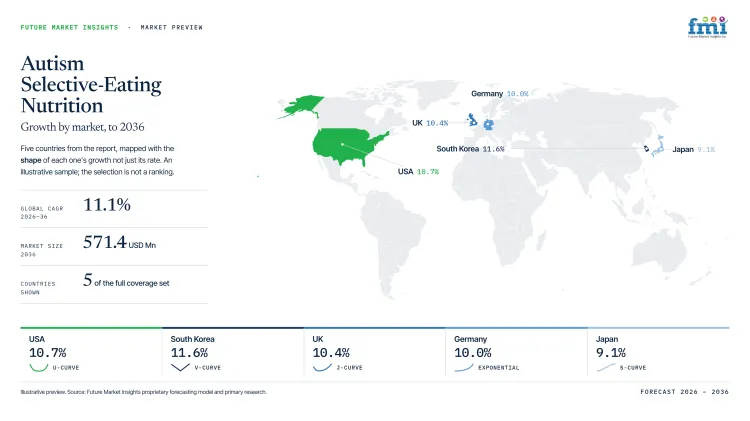
| Country | CAGR |
|---|---|
| South Korea | 11.6% |
| USA | 10.7% |
| UK | 10.4% |
| Germany | 10.0% |
| Japan | 9.1% |
How do country-level CAGRs compare in the Autism Selective-Eating Nutrition Market?
The five country forecasts span 2.5 percentage points from South Korea at 11.6% to Japan at 9.1%. USA and UK form a middle cluster with Germany at 10.0%. The narrow spread makes referral routes and retail access more important than small growth differences during commercial market entry.
- South Korea's e-commerce channels shorten repeat ordering once families identify tolerated formats.
- USA retail fragmentation makes national shelf presence valuable as local assortments vary widely.
- UK medical-nutrition routes separate clinician-supervised products from ordinary household supplementation more sharply.
- Germany's EU health-claim rules place substantiation ahead of broad lifestyle positioning nationally.
- Japan's smaller serving formats reward careful localization of flavor and package size.
Similar CAGRs produce different launch economics as each country converts clinical concern into purchasing differently. The full report provides country-level CAGR analysis across North America, Latin America, Europe, East Asia, South Asia, Oceania and the Middle East and Africa.
Country-wise Analysis
- South Korean families compare children's nutrition in a retail system where MFDS quality certification provides a visible trust signal during comparison of specialized options on labels or digital shelves in routine family purchase decisions. Autism selective-eating nutrition sales in South Korea are forecast to expand at 11.6% CAGR by 2036, propelled by fast online replenishment and child-nutrition formats that fit household routines once a first trial is tolerated. MFDS published a July 2025 list covering 547 certified children's favorite-food products as of June 30, so new entrants face recognizable quality cues and must document nutrition claims carefully ahead of rapid shelf expansion.
- USA families can reach pediatric nutrition through pharmacies and mass retailers plus direct ordering once a dietitian identifies an intake problem that warrants supplemental nutrition in markets with extensive retail networks. CDC reported in April 2025 that children born in 2018 were 1.7 times as likely to have autism identified by 48 months as children born in 2014. The USA is estimated to post 10.7% CAGR over the forecast period, tied to broad retail access and earlier developmental contact despite uneven insurance coverage and specialist availability that can interrupt follow-up following an initial product trial outside major pediatric centers in some regions.
- UK purchasing often begins through pediatric or dietetic referral, a pathway under pressure because NHS England Digital counted 236,225 open suspected-autism referrals in June 2025 with 89.4% open at least thirteen weeks. Autism selective-eating nutrition demand in the UK is forecast to rise at 10.4% CAGR over the forecast period, helped by multidisciplinary care and home replenishment routes for products recommended following assessment. Referral delay can leave families managing severe food refusal without timely dietetic guidance, so companies need clear clinician-facing evidence and practical home replenishment for product trial to convert into regular household purchasing during sustained home use.
- German caregivers encounter a cautious supplement culture where pediatric products must address a defined dietary shortfall without implying that every selective eater needs broad preventive supplementation in pharmacy and pediatric channels. BfR reported in December 2025 that iodine intake fell below its estimated average requirement for just under 45% of children and adolescents under a policy approach that reserves supplements for defined nutrient needs. Germany's autism selective-eating nutrition outlook is anticipated to advance at 10.0% CAGR over the assessment period, attributable to pharmacy access and clinician preference for documented need that supports targeted formulas but limits broad lifestyle positioning nationwide.
- Japanese households expect careful portioning and familiar sensory profiles from children's nutrition products as parents scrutinize serving size and ingredient claims during repeat use in family meals and school-day routines. Adoption of autism selective-eating nutrition in Japan is estimated to expand at 9.1% CAGR through 2036, given localized flavor expectations and retail rules that place substantial weight on label discipline during household trial. The Consumer Affairs Agency reported in November 2025 that 74 of 93 reviewed functional foods needed additional analytical-method materials, so specialized entrants must budget for claim verification ahead of launch and avoid broad positioning unsupported by domestic evidence.
Who are the notable companies in the Autism Selective-Eating Nutrition Market?
Abbott (PediaSure), Else Nutrition, Kate Farms, Healthy Heights, Danone Nutricia, Nestlé Health Science, Mead Johnson / Reckitt, Orgain
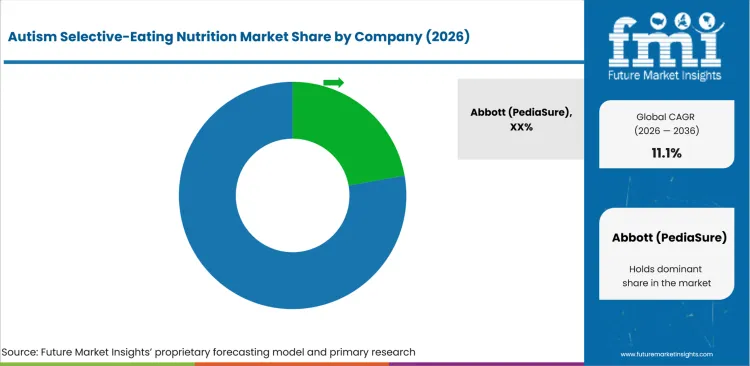
Competition divides between broad pediatric platforms and focused brands built around narrower acceptance or dietary needs. Abbott and Danone Nutricia bring clinician familiarity plus large child-nutrition portfolios with broad distribution reach. Kate Farms and Nestlé Health Science extend the field into enteral nutrition and specialized oral formats. Else Nutrition and Healthy Heights focus on plant-based or picky-eating formats that fit household trial more directly.
- Broad pediatric platforms: Abbott (PediaSure), Danone Nutricia, Nestlé Health Science and Mead Johnson / Reckitt pair professional reach with manufacturing plus distribution networks that support repeat replenishment.
- Selective-eating and plant-based specialists: Else Nutrition, Kate Farms and Healthy Heights focus child-specific formats on ingredient restrictions or sensory acceptance during household trial.
- Consumer and healthcare channel specialist: Orgain sells selected kids shakes in retail channels and under hospital contracts serving institutional nutrition programs. Hospital distribution places Orgain beside gut barrier support and broader clinical nutrition categories without treating institutional availability as evidence of autism-specific demand.
Competitive Benchmarking: Autism Selective-Eating Nutrition Market
| Company | Pediatric Nutrition Breadth | Sensory / Dietary Adaptation | Home-to-Clinical Access | Geographic Reach |
|---|---|---|---|---|
| Abbott (PediaSure) | High | Medium | High | Global |
| Else Nutrition | Medium | High | Medium | North America |
| Kate Farms | High | High | High | North America |
| Healthy Heights | Medium | Medium | Medium | USA and selected international markets |
| Danone Nutricia | High | High | High | Global |
| Nestlé Health Science | High | High | High | Global |
| Mead Johnson / Reckitt | Medium | Medium | High | Global child-nutrition footprint |
| Orgain | Medium | Medium | High | North America with hospital and retail access |
Scoring basis: High pediatric nutrition breadth requires documented oral and medical nutrition coverage for several pediatric needs whereas Medium indicates a narrower child-focused portfolio and Low identifies one documented route. High sensory / dietary adaptation requires several documented options involving allergens, plant-based design or texture-sensitive use. High home-to-clinical access requires both consumer replenishment and institutional distribution channels for routine use.
Key Developments in the Autism Selective-Eating Nutrition Market
- In May 2025, Else Nutrition expanded Kids Ready-to-Drink shakes into 1,000 stores of a major USA retailer and widened physical access beyond online purchasing.
- In September 2025, Kate Farms placed Kids Nutrition on shelves in select Walmart stores and on Walmart.com following earlier expansion through Target and medical channels.
- In November 2025, Orgain made Kids Protein and Kids Plant Protein nutrition shakes available through Nestlé Health Science contracts plus GPO and distributor agreements serving hospitals.
Key Players in the Autism Selective-Eating Nutrition Market
Established Pediatric Nutrition
- Abbott (PediaSure)
Selective Child Nutrition
- Else Nutrition
- Kate Farms
- Healthy Heights
Global Clinical and Pediatric Platforms
- Danone Nutricia
- Nestlé Health Science
- Mead Johnson / Reckitt
Consumer Pediatric Nutrition
- Orgain
Autism Selective-Eating Nutrition Market - Report Scope
| Coverage field | Report scope |
|---|---|
| Market breakdown | By product type, dietary pattern, age group, end user, sales channel and region. |
| Quantitative Units | USD million. |
| Market Definition | Revenue includes qualifying nutrition products purchased to address nutritional adequacy, energy or protein intake, micronutrient gaps, preferred-texture needs or gastrointestinal support in autistic people with selective-eating patterns. Revenue excludes feeding-therapy services, diagnostic services, ordinary foods not purchased for this use case and downstream care revenue. |
| Regions Covered | North America, Latin America, Western Europe, Eastern Europe, East Asia, South Asia and Pacific, Middle East and Africa. |
| Countries Covered | South Korea, USA, UK, Germany, Japan, and 20+ countries included in the full report. |
| Key Companies Profiled | Abbott (PediaSure), Else Nutrition, Kate Farms, Healthy Heights, Danone Nutricia, Nestlé Health Science, Mead Johnson / Reckitt, Orgain. |
| Forecast Period | 2026 to 2036. |
| Approach | Primary and secondary research with market triangulation. |
Autism Selective-Eating Nutrition Market - Research Methodology
| Method | Approach |
|---|---|
| Primary Research | FMI analysts gathered input from manufacturers, service providers, technology developers, distributors, end users, procurement teams, and subject-matter experts. Interviews examined purchasing decisions, product or service evaluation, adoption barriers, approval requirements, pricing considerations, and expectations for technical or commercial support. Respondents were also asked what evidence is required before a trial, pilot, or initial order develops into regular purchasing. |
| Desk Research | Desk research covered government statistics, regulatory publications, trade data, industry associations, technical literature, standards, company filings, product information, and official corporate announcements. Sources were reviewed for relevance, publication date, geographic coverage, and consistency with the defined market scope. Claims relating to performance, applications, approvals, capacity, investment, and commercial activity were retained only when supported by credible public evidence. |
| Market Sizing and Forecasting | The market model combined the baseline value with historical performance, segment structure, pricing and volume indicators, adoption levels, company participation, and country-level demand conditions. Forecast assumptions considered economic activity, investment trends, regulatory developments, technology adoption, purchasing cycles, supply availability, and barriers to wider market use. Segment and regional estimates were reconciled before the final market total was calculated. |
| Data Validation | Estimates were checked against multiple independent indicators, including public data, company activity, trade patterns, industry developments, and findings from primary interviews. Validation also tested whether products, services, applications, and company revenues fell within the defined market boundaries. Adjacent categories, unsupported claims, overlapping revenues, and activities without direct market relevance were excluded to reduce double counting and maintain consistency across segments and countries. |
Autism Selective-Eating Nutrition Market by Segments
Autism Selective-Eating Nutrition Market segmented by Product Type:
- Balanced Nutrition Shakes
- Micronutrient Gummies & Drops
- Fortified Preferred-Texture Foods
- Gut-Health Support Products
- Others
Autism Selective-Eating Nutrition Market segmented by Dietary Pattern:
- Beige - carb-Predominant Diets
- Brand-Specific Rigidity
- Texture-Restricted
- Others
Autism Selective-Eating Nutrition Market segmented by Age Group:
- 2-6 Years
- 7-12 Years
- 13+ Years
Autism Selective-Eating Nutrition Market segmented by End User:
- Home - caregiver
- Feeding & Developmental Clinics
- Schools & Programs
- Others
Autism Selective-Eating Nutrition Market segmented by Sales Channel:
- Online / DTC
- Retail Pharmacy
- Supermarkets & Hypermarkets
- Specialty & Health Stores
- Others
Autism Selective-Eating Nutrition Market by Region:
- North America
- United States
- Canada
- Latin America
- Brazil
- Mexico
- Chile
- Rest of Latin America
- Western Europe
- Germany
- United Kingdom
- Italy
- Spain
- France
- Nordics
- Benelux
- Rest of Western Europe
- Eastern Europe
- Russia
- Poland
- Hungary
- Balkan and Baltic States
- Rest of Eastern Europe
- East Asia
- China
- Japan
- South Korea
- South Asia and Pacific
- India
- ASEAN
- Australia and New Zealand
- Rest of South Asia and Pacific
- Middle East and Africa
- Kingdom of Saudi Arabia
- Other GCC Countries
- Türkiye
- South Africa
- Other African Union Countries
- Rest of Middle East and Africa
Research Sources and Bibliography
- American Academy of Pediatrics (2025, December 19). Parenting, practice, and the many ways neurodivergent children experience food
- Centers for Disease Control and Prevention (2025, April 17). Prevalence and early identification of autism spectrum disorder among children aged 4 and 8 years, 16 sites, United States, 2022
- American Academy of Pediatrics (2026, March 16). Dietary guidance for diagnosis and management of faltering weight
- Children and Families Agency, Japan (2025, September).
- Nutritional Growth Solutions Limited (2025, August 29). NGS Appendix 4D and Half Year Report
- Autism Speaks (2025, April 14). Supporting healthier eating habits in autistic children
- NHS England (2026, January 20). Eating disorder services for children and young people: National guidance
- Nestlé Health Science (2026, March 30). Nestlé introduces an innovative complete nutritional solution for children with special medical nutrition needs
- NHS England Digital (2025, August 14). Autism statistics, July 2024 to June 2025
- German Federal Institute for Risk Assessment (2025, December 19). Update (2025): maximum levels proposed for iodine in foods, including food supplements
- Consumer Affairs Agency, Japan (2025, November 11).
- Ministry of Food and Drug Safety, Republic of Korea (2025, July 8).
- Else Nutrition (2025, May 27). Else Nutrition expands nationwide with Kids Ready-to-Drink Shakes in 1,000 leading USA retailer stores
- Kate Farms (2025, September 23). Kate Farms launches Kids Nutrition line to Walmart
- Orgain Healthcare (2025, November 10). Orgain products now available through Nestlé Health Science
- Abbott (2026, June). Global Sustainability Report 2025
- Kate Farms (2025, March 12). Kate Farms introduces Kids Nutrition Shakes designed for ages 1-13
- Danone (2025, July 1). Danone completes the acquisition of Kate Farms, enhancing its USA specialized nutrition offerings
- Reckitt (2025, May 8). Infant and child nutrition pledge
- Orgain (2025, March 7). Orgain expands portfolio with new gut-health powder and kid offerings
- TruHeight (2026, June 12). What it actually takes to get a kids supplement into CVS
- Else Nutrition (2026, January 8). Else Nutrition Plans Canadian Market Relaunch in 2026
- Reckitt (2026, April 15). Mead Johnson Nutrition and Mass General Brigham expand research program with 5-year commitment to advancing pediatric and lifespan nutrition
- Nestlé Health Science (2025, October 15). Nestlé Health Science and University of California, Davis Innovation Institute for Food & Health announce strategic partnership to accelerate innovation in nutrition and health science
- Abbott and Sesame Workshop (2026, January 8). New year, new healthy habits: Sesame Workshop and Abbott debut new resources to help children and families build healthy habits early
This Report Answers
- What is the Autism Selective-Eating Nutrition Market size in 2026 and what value is forecast for 2036?
- What commercial conditions convert selective eating into repeated nutrition purchasing?
- Why do balanced nutrition shakes hold the leading position within product type?
- Why do beige - carb-predominant diets represent the largest dietary pattern segment?
- Why does the 2-6 years group account for the largest age-group share?
- How do growth rates differ between South Korea, USA, UK, Germany and Japan?
- Which companies provide broad pediatric nutrition and specialized child-focused formats?
- How do sensory refusal and clinical caution limit repeat purchasing?
- What channel and product attributes improve conversion from trial into replenishment?
Frequently Asked Questions
How big is the autism selective-eating nutrition market in 2026?
The autism selective-eating nutrition market is valued at USD 199.4 million in 2026 and is projected to reach USD 571.4 million by 2036. Growth is supported by nutrition gaps that emerge once restricted accepted foods leave caregivers seeking repeatable supplemental intake.
What is the CAGR of the autism selective-eating nutrition market from 2026 to 2036?
The autism selective-eating nutrition market is projected to grow at a CAGR of 11.1% between 2026 and 2036. Expansion is supported by earlier autism identification and repeat nutrition purchasing once caregivers find a sensory-compatible format.
Which product type leads the autism selective-eating nutrition market?
The balanced nutrition shakes segment is expected to hold 41.2% of the autism selective-eating nutrition market in 2026, driven by concentrated calories and micronutrients in a repeatable drink format. The format limits unfamiliar foods during supplementation and gives caregivers a repeatable serving following sensory acceptance.
Which dietary pattern holds the largest share in the autism selective-eating nutrition market?
The beige - carb-predominant diets segment is expected to account for 46.2% of the autism selective-eating nutrition market in 2026, attributable to narrow repertoires built on familiar carbohydrate textures. Fortified drinks can fit familiar routines without requiring several sensory changes during repeated household feeding.
Which companies are active in the autism selective-eating nutrition market?
Key companies operating in the market include Abbott (PediaSure), Else Nutrition, Kate Farms, Healthy Heights, Danone Nutricia, Nestlé Health Science, Mead Johnson / Reckitt, and Orgain. Their positions differ in pediatric nutrition breadth and sensory-adapted formats, with medical access separating how families encounter each company.
Preview the report firsthand - request a free sample
Get SampleGet the brochure for pricing and purchase details.
Get PDFTable of Content
- Key Takeaways
- Market Size and CAGR
- Top Growth Driver
- Fastest Growing Segment
- Leading Region
- Key Companies
- Emerging Opportunities
- Executive Summary
- Global Market Outlook
- Demand-side Trends
- Supply-side Trends
- Technology Roadmap Analysis
- Analysis and Recommendations
- Analyst Perspective (What is happening? Why now? What should investors know?)
- Key Questions Answered
- How large is the market?
- What is the CAGR?
- What are key trends?
- Which region dominates?
- Who are the leaders?
- Market Overview
- Market Coverage / Taxonomy
- Market Definition / Scope / Limitations
- Research Methodology
- Chapter Orientation
- Analytical Lens and Working Hypotheses
- Market Structure, Signals, and Trend Drivers
- Benchmarking and Cross-market Comparability
- Market Sizing, Forecasting, and Opportunity Mapping
- Research Design and Evidence Framework
- Desk Research Programme (Secondary Evidence)
- Expert Input and Fieldwork (Primary Evidence)
- Tooling, Models, and Reference Databases
- Data Engineering and Model Build
- Quality Assurance and Audit Trail
- Market Background
- Market Dynamics (Drivers, Restraints, Opportunity, Trends)
- Scenario Forecast (Optimistic, Likely, Conservative)
- Impact Analysis
- AI Impact
- Sustainability Impact
- Regulatory Impact
- Technology Impact
- Consumer / Buyer Analysis
- Purchase Drivers
- Adoption Barriers
- Buyer Journey
- Opportunity Map Analysis
- Product Life Cycle Analysis
- Supply Chain Analysis
- Investment Feasibility Matrix
- Value Chain Analysis
- PESTLE and Porter's Analysis
- Regulatory Landscape
- Regional Parent Market Outlook
- Production and Consumption Statistics
- Import and Export Statistics
- Global Market Analysis and Forecast, 2021 to 2036
- Historical Market Size Value (USD Million) Analysis, 2021 to 2025
- Current and Future Market Size Value (USD Million) Projections, 2026 to 2036
- Y-o-Y Growth Trend Analysis
- Absolute $ Opportunity Analysis
- Global Market Pricing Analysis, 2021 to 2036
- Global Market Analysis and Forecast, By Product Type, 2021 to 2036
- Introduction / Key Findings
- Historical Market Size Value (USD Million) Analysis By Product Type, 2021 to 2025
- Current and Future Market Size Value (USD Million) Analysis and Forecast By Product Type, 2026 to 2036
- Balanced Nutrition Shakes
- Micronutrient Gummies & Drops
- Fortified Preferred-Texture Foods
- Gut-Health Support Products
- Others
- Balanced Nutrition Shakes
- Y-o-Y Growth Trend Analysis By Product Type, 2021 to 2025
- Absolute $ Opportunity Analysis By Product Type, 2026 to 2036
- Global Market Analysis and Forecast, By Dietary Pattern, 2021 to 2036
- Introduction / Key Findings
- Historical Market Size Value (USD Million) Analysis By Dietary Pattern, 2021 to 2025
- Current and Future Market Size Value (USD Million) Analysis and Forecast By Dietary Pattern, 2026 to 2036
- Beige / Carb-Predominant Diets
- Brand-Specific Rigidity
- Texture-Restricted
- Others
- Beige / Carb-Predominant Diets
- Y-o-Y Growth Trend Analysis By Dietary Pattern, 2021 to 2025
- Absolute $ Opportunity Analysis By Dietary Pattern, 2026 to 2036
- Global Market Analysis and Forecast, By Age Group, 2021 to 2036
- Introduction / Key Findings
- Historical Market Size Value (USD Million) Analysis By Age Group, 2021 to 2025
- Current and Future Market Size Value (USD Million) Analysis and Forecast By Age Group, 2026 to 2036
- 2-6 Years
- 7-12 Years
- 13+ Years
- 2-6 Years
- Y-o-Y Growth Trend Analysis By Age Group, 2021 to 2025
- Absolute $ Opportunity Analysis By Age Group, 2026 to 2036
- Global Market Analysis and Forecast, By End User, 2021 to 2036
- Introduction / Key Findings
- Historical Market Size Value (USD Million) Analysis By End User, 2021 to 2025
- Current and Future Market Size Value (USD Million) Analysis and Forecast By End User, 2026 to 2036
- Home / Caregiver
- Feeding & Developmental Clinics
- Schools & Programs
- Others
- Home / Caregiver
- Y-o-Y Growth Trend Analysis By End User, 2021 to 2025
- Absolute $ Opportunity Analysis By End User, 2026 to 2036
- Global Market Analysis and Forecast, By Sales Channel, 2021 to 2036
- Introduction / Key Findings
- Historical Market Size Value (USD Million) Analysis By Sales Channel, 2021 to 2025
- Current and Future Market Size Value (USD Million) Analysis and Forecast By Sales Channel, 2026 to 2036
- Online / DTC
- Retail Pharmacy
- Supermarkets & Hypermarkets
- Specialty & Health Stores
- Others
- Online / DTC
- Y-o-Y Growth Trend Analysis By Sales Channel, 2021 to 2025
- Absolute $ Opportunity Analysis By Sales Channel, 2026 to 2036
- Global Market Analysis and Forecast, By Region, 2021 to 2036
- Introduction
- Historical Market Size Value (USD Million) Analysis By Region, 2021 to 2025
- Current Market Size Value (USD Million) Analysis and Forecast By Region, 2026 to 2036
- North America
- Latin America
- Western Europe
- Eastern Europe
- East Asia
- South Asia and Pacific
- Middle East & Africa
- Market Attractiveness Analysis By Region
- North America Market Analysis and Forecast, By Country, 2021 to 2036
- Historical Market Size Value (USD Million) Trend Analysis By Market Taxonomy, 2021 to 2025
- Market Size Value (USD Million) Forecast By Market Taxonomy, 2026 to 2036
- By Country
- USA
- Canada
- By Product Type
- By Dietary Pattern
- By Age Group
- By End User
- By Sales Channel
- By Country
- Market Attractiveness Analysis
- By Country
- By Product Type
- By Dietary Pattern
- By Age Group
- By End User
- By Sales Channel
- Key Takeaways
- Latin America Market Analysis and Forecast, By Country
- Historical Market Size Value (USD Million) Trend Analysis By Market Taxonomy, 2021 to 2025
- Market Size Value (USD Million) Forecast By Market Taxonomy, 2026 to 2036
- By Country
- Brazil
- Mexico
- Chile
- Rest of Latin America
- By Product Type
- By Dietary Pattern
- By Age Group
- By End User
- By Sales Channel
- By Country
- Market Attractiveness Analysis
- By Country
- By Product Type
- By Dietary Pattern
- By Age Group
- By End User
- By Sales Channel
- Key Takeaways
- Western Europe Market Analysis and Forecast, By Country
- Historical Market Size Value (USD Million) Trend Analysis By Market Taxonomy, 2021 to 2025
- Market Size Value (USD Million) Forecast By Market Taxonomy, 2026 to 2036
- By Country
- Germany
- UK
- Italy
- Spain
- France
- Nordic
- BENELUX
- Rest of Western Europe
- By Product Type
- By Dietary Pattern
- By Age Group
- By End User
- By Sales Channel
- By Country
- Market Attractiveness Analysis
- By Country
- By Product Type
- By Dietary Pattern
- By Age Group
- By End User
- By Sales Channel
- Key Takeaways
- Eastern Europe Market Analysis and Forecast, By Country
- Historical Market Size Value (USD Million) Trend Analysis By Market Taxonomy, 2021 to 2025
- Market Size Value (USD Million) Forecast By Market Taxonomy, 2026 to 2036
- By Country
- Russia
- Poland
- Hungary
- Balkan & Baltic
- Rest of Eastern Europe
- By Product Type
- By Dietary Pattern
- By Age Group
- By End User
- By Sales Channel
- By Country
- Market Attractiveness Analysis
- By Country
- By Product Type
- By Dietary Pattern
- By Age Group
- By End User
- By Sales Channel
- Key Takeaways
- East Asia Market Analysis and Forecast, By Country
- Historical Market Size Value (USD Million) Trend Analysis By Market Taxonomy, 2021 to 2025
- Market Size Value (USD Million) Forecast By Market Taxonomy, 2026 to 2036
- By Country
- China
- Japan
- South Korea
- By Product Type
- By Dietary Pattern
- By Age Group
- By End User
- By Sales Channel
- By Country
- Market Attractiveness Analysis
- By Country
- By Product Type
- By Dietary Pattern
- By Age Group
- By End User
- By Sales Channel
- Key Takeaways
- South Asia and Pacific Market Analysis and Forecast, By Country
- Historical Market Size Value (USD Million) Trend Analysis By Market Taxonomy, 2021 to 2025
- Market Size Value (USD Million) Forecast By Market Taxonomy, 2026 to 2036
- By Country
- India
- ASEAN
- Australia & New Zealand
- Rest of South Asia and Pacific
- By Product Type
- By Dietary Pattern
- By Age Group
- By End User
- By Sales Channel
- By Country
- Market Attractiveness Analysis
- By Country
- By Product Type
- By Dietary Pattern
- By Age Group
- By End User
- By Sales Channel
- Key Takeaways
- Middle East & Africa Market Analysis and Forecast, By Country
- Historical Market Size Value (USD Million) Trend Analysis By Market Taxonomy, 2021 to 2025
- Market Size Value (USD Million) Forecast By Market Taxonomy, 2026 to 2036
- By Country
- Kingdom of Saudi Arabia
- Other GCC Countries
- Türkiye
- South Africa
- Other African Union
- Rest of Middle East & Africa
- By Product Type
- By Dietary Pattern
- By Age Group
- By End User
- By Sales Channel
- By Country
- Market Attractiveness Analysis
- By Country
- By Product Type
- By Dietary Pattern
- By Age Group
- By End User
- By Sales Channel
- Key Takeaways
- Key Countries Market Analysis
- USA
- Pricing Analysis
- Market Share Analysis, 2025
- By Product Type
- By Dietary Pattern
- By Age Group
- By End User
- By Sales Channel
- Canada
- Pricing Analysis
- Market Share Analysis, 2025
- By Product Type
- By Dietary Pattern
- By Age Group
- By End User
- By Sales Channel
- Mexico
- Pricing Analysis
- Market Share Analysis, 2025
- By Product Type
- By Dietary Pattern
- By Age Group
- By End User
- By Sales Channel
- Brazil
- Pricing Analysis
- Market Share Analysis, 2025
- By Product Type
- By Dietary Pattern
- By Age Group
- By End User
- By Sales Channel
- Chile
- Pricing Analysis
- Market Share Analysis, 2025
- By Product Type
- By Dietary Pattern
- By Age Group
- By End User
- By Sales Channel
- Germany
- Pricing Analysis
- Market Share Analysis, 2025
- By Product Type
- By Dietary Pattern
- By Age Group
- By End User
- By Sales Channel
- UK
- Pricing Analysis
- Market Share Analysis, 2025
- By Product Type
- By Dietary Pattern
- By Age Group
- By End User
- By Sales Channel
- Italy
- Pricing Analysis
- Market Share Analysis, 2025
- By Product Type
- By Dietary Pattern
- By Age Group
- By End User
- By Sales Channel
- Spain
- Pricing Analysis
- Market Share Analysis, 2025
- By Product Type
- By Dietary Pattern
- By Age Group
- By End User
- By Sales Channel
- France
- Pricing Analysis
- Market Share Analysis, 2025
- By Product Type
- By Dietary Pattern
- By Age Group
- By End User
- By Sales Channel
- India
- Pricing Analysis
- Market Share Analysis, 2025
- By Product Type
- By Dietary Pattern
- By Age Group
- By End User
- By Sales Channel
- ASEAN
- Pricing Analysis
- Market Share Analysis, 2025
- By Product Type
- By Dietary Pattern
- By Age Group
- By End User
- By Sales Channel
- Australia & New Zealand
- Pricing Analysis
- Market Share Analysis, 2025
- By Product Type
- By Dietary Pattern
- By Age Group
- By End User
- By Sales Channel
- China
- Pricing Analysis
- Market Share Analysis, 2025
- By Product Type
- By Dietary Pattern
- By Age Group
- By End User
- By Sales Channel
- Japan
- Pricing Analysis
- Market Share Analysis, 2025
- By Product Type
- By Dietary Pattern
- By Age Group
- By End User
- By Sales Channel
- South Korea
- Pricing Analysis
- Market Share Analysis, 2025
- By Product Type
- By Dietary Pattern
- By Age Group
- By End User
- By Sales Channel
- Russia
- Pricing Analysis
- Market Share Analysis, 2025
- By Product Type
- By Dietary Pattern
- By Age Group
- By End User
- By Sales Channel
- Poland
- Pricing Analysis
- Market Share Analysis, 2025
- By Product Type
- By Dietary Pattern
- By Age Group
- By End User
- By Sales Channel
- Hungary
- Pricing Analysis
- Market Share Analysis, 2025
- By Product Type
- By Dietary Pattern
- By Age Group
- By End User
- By Sales Channel
- Kingdom of Saudi Arabia
- Pricing Analysis
- Market Share Analysis, 2025
- By Product Type
- By Dietary Pattern
- By Age Group
- By End User
- By Sales Channel
- Türkiye
- Pricing Analysis
- Market Share Analysis, 2025
- By Product Type
- By Dietary Pattern
- By Age Group
- By End User
- By Sales Channel
- South Africa
- Pricing Analysis
- Market Share Analysis, 2025
- By Product Type
- By Dietary Pattern
- By Age Group
- By End User
- By Sales Channel
- USA
- Market Structure Analysis
- Competition Dashboard
- Competition Benchmarking
- Market Share Analysis of Top Players
- By Regional
- By Product Type
- By Dietary Pattern
- By Age Group
- By End User
- By Sales Channel
- Emerging Startups
- Innovation Benchmarking
- Competition Analysis
- Competition Deep Dive
- Abbott (PediaSure)
- Overview
- Product Portfolio
- Profitability by Market Segments
- Sales Footprint
- Strategy Overview
- Marketing Strategy
- Product Strategy
- Channel Strategy
- Else Nutrition
- Kate Farms
- Healthy Heights
- Danone Nutricia
- Nestle Health Science
- Mead Johnson / Reckitt
- Medtrition
- Abbott (PediaSure)
- Case Studies
- Success Stories
- Recent Developments
- Competition Deep Dive
- Assumptions & Acronyms Used


