

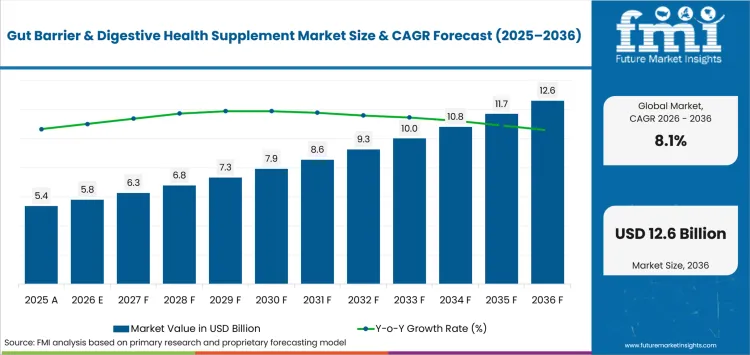
- Market Size (2026)
- USD 5.8 Bn
- Forecast (2036)
- USD 12.6 Bn
- CAGR (2026 to 2036)
- 8.1%
How big is Gut Barrier & Digestive Health Supplement Market in 2026?
USD 5.8 billion in 2026 and USD 12.6 billion by 2036 at an 8.1% CAGR.
Sales are projected to advance at 8.1% CAGR from 2026 to 2036, supported by strain-specific evidence and stable finished formats. Industry value increased from USD 5.4 billion in 2025 to USD 5.8 billion in 2026 and is projected to reach USD 12.6 billion by 2036. Commercial demand depends on whether each ingredient supports the stated digestive endpoint at the marketed dose and throughout the finished product’s shelf life. The NIH Office of Dietary Supplements updated its probiotics fact sheet in March 2025 and explains that clinical recommendations should identify the exact probiotic strain. The fact sheet also advises consumers to look for CFU counts stated at the end of shelf life rather than at manufacture. Manufacturers compete in the broader digestive health supplements market through verified strain identity and practical stability records rather than general microbiome language.
China and the United States use different launch routes for the same digestive-health supplement formulation. Chinese health foods with non-catalog ingredients require registration under the applicable route, whereas American supplements reach sale without finished-product premarket approval. SAMR’s service platform recorded 236 applications and 355 completed registrations or filings for qualifying health foods during August 2025. The monthly workload shows that technical evidence must fit a formal submission route for Chinese distribution. American supplement brands face enforcement risk across the dietary supplement category through ingredient declarations and structure-function claim controls. A practical launch plan should separate clinical substantiation from legal claim wording and channel-specific manufacturing records. Supplement brands that coordinate these workstreams reduce reformulation risk and create a clearer route from pilot batches to repeat production.
Key Takeaways of Gut Barrier & Digestive Health Supplement Market
- Demand is supported by products that connect named ingredients with measurable digestive endpoints and practical shelf-life controls.
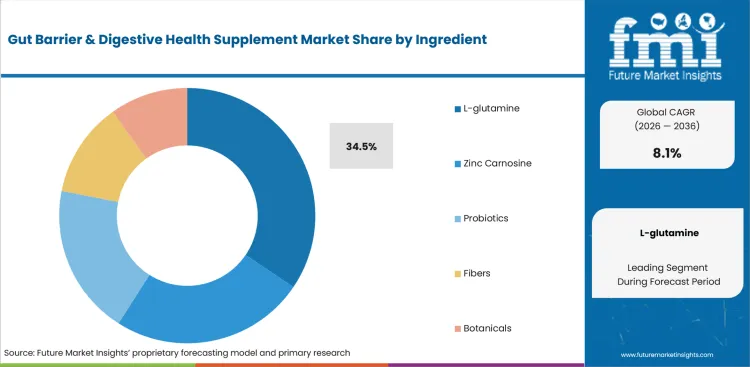
- L-glutamine is projected to account for 34.5% of ingredient demand in 2026, supported by established powder use and flexible dosing.
- Gut barrier is anticipated to capture 42.9% of application demand in 2026, reflecting stronger interest in permeability and tight-junction outcomes.
- Powder is forecast to represent 43.4% of form demand in 2026, aided by dose flexibility and compatibility with multi-ingredient blends.
- Restricted disease claims and variable strain evidence remain material barriers across markets with different formulation and labeling requirements.
- Competition centers on ingredient validation and delivery protection alongside regulatory support that shortens the path from formulation to repeat purchasing.
Analyst Perspective
“Gut-barrier supplements succeed through a direct match between the marketed ingredient and its studied dose across a protected finished format. L-glutamine powders require assay and flavor control across larger servings; probiotic products require viable-cell counts tied to the labeled strain throughout shelf life. The strongest portfolios pair restrained digestive claims with country-specific registration plans and packaging that preserves the tested composition through routine storage.”
- Nandini Roy Choudhury, Principal Analyst, Future Market Insights
How is the Gut Barrier & Digestive Health Supplement Market segmented?
The gut barrier and digestive health supplement industry is segmented by ingredient, application, form, and region.
The market is segmented by ingredient, application, form, and region to reflect formulation design and commercial use. Ingredient segmentation includes L-glutamine, zinc carnosine, probiotics, fibers, and botanicals according to identity testing, dose evidence, and finished-product compatibility. Application analysis covers gut barrier, digestion, and immunity according to the endpoint that supports the marketed supplement claim. Form segmentation compares powder, liquid, granules, and paste through dose accuracy, moisture control, consumer use, and shelf-life requirements. Regional analysis examines the USA, China, Germany, India, and the UK through their different ingredient, labeling, and claim pathways. Regulatory controls connect the probiotic ingredients market with strain-specific evidence, shelf-life counts and compliant claim language.
How does L-glutamine shape the ingredient category?
L-glutamine follows a chemical identity and assay route rather than the viable-cell controls used for probiotics. Powder servings can exceed probiotic doses, so supplement manufacturers also test dissolution and flavor burden. In July 2025, Kyowa Hakko Bio completed the transfer of its amino acids and human milk oligosaccharides business to a Meihua Holdings subsidiary. The completed transaction changes the legal seller for affected amino-acid supplies and makes specification continuity a practical contract issue. L-glutamine programs therefore require current certificates and documented change-control duties that protect specification continuity across repeat orders.
- The ingredient category is forecast to be led by L-glutamine at 34.5% share in 2026 due to established powder use and adjustable serving sizes. Consistent assay results and clear serving instructions support comparison across repeat orders without relying on live-cell protection systems.
- Supplement manufacturers use L-glutamine in single-ingredient powders and multi-ingredient blends that need adjustable dosing without live-cell protection. Large servings can create flavor and adherence problems across daily routines, so solubility testing and moisture-resistant packaging protect dose uniformity through distribution and household storage.
What supports gut barrier within the application category?
Gut-barrier positioning requires evidence that connects a named strain or ingredient with a defined permeability or digestive outcome. In July 2025, Novonesis announced a BB-12 scientific review covering more than 400 publications and 200 clinical studies. The review gives supplement developers a consolidated basis for strain-specific claims and population selection across formulation screening. It also confirms that evidence from BB-12 cannot validate another strain or finished formulation without separate support. Comparable gut health products require separate claim reviews and delivery assessments tied to their exact ingredients and finished formats.
- Gut barrier is set to lead the application category with 42.9% share in 2026 due to demand for defined permeability and digestive-resilience outcomes. Dose-specific studies and matched populations support measurable claims that carry more commercial value than broad wellness language.
- Practitioner and clinical channels favor gut-barrier supplements that connect a named ingredient with dose-specific human evidence and compliant claim wording. Adoption weakens if studies use unrelated populations or surrogate markers without a practical consumer outcome. Successful launches align the selected endpoint with label wording and post-launch manufacturing controls across each commercial batch.
What drives powder’s position in the form category?
Powder formats let manufacturers combine amino acids and probiotics with prebiotic fibers without the water-activity burden of ready-to-drink products. In April 2025, Lallemand Health Solutions and FrieslandCampina Ingredients published results from a 28-day Natural PRO-Digest consumer study involving 107 adults. Participants dissolved one daily sachet in water and completed self-reported questionnaires about gut comfort during the study period. The study supports convenient measured serving delivery without establishing clinical efficacy for the broader supplement category. Prebiotic ingredients can increase blend density and sensory load, so moisture protection and palatable serving size remain decisive.
- By form, powder is estimated to hold 43.4% in 2026 owing to flexible serving sizes and compatibility with multi-ingredient blends. Stick packs and tubs support measured dosing without the packaging weight or water activity associated with many liquid products.
- Brands choose powder for products that require adjustable dosing or several ingredients within one daily serving. Moisture exposure and flavor intensity create a separate adoption constraint across larger doses, so water-activity controls and validated packaging protect viable strains and reactive amino acids during distribution and household storage.
What are the drivers, restraints, and opportunities in the Gut Barrier & Digestive Health Supplement Market?
Named ingredients and matched human evidence support repeat demand. Restricted disease claims and shelf-life losses limit commercial conversion. Region-specific approvals create an opening for stable formulations with adaptable claim language.
- Driver: Consumers and practitioners increasingly expect named strains or ingredients with human evidence that matches the intended digestive endpoint and finished format.
- Restraint: Restricted disease claims and incomplete label controls increase launch risk across supplements positioned near gastrointestinal treatment language.
- Opportunity: Region-specific approvals create commercial value for formulations that pair validated ingredients with adaptable claims and stable delivery systems.
Evidence-led formulation creates direct demand for supplements that preserve a stated digestive benefit through production and routine use. In June 2025, Kerry reported a four-week open-label consumer perception study of BC30 among adults using GLP-1 medicines. Participants reported better digestive comfort and improved quality-of-life measures during the four-week study period. The findings do not establish treatment efficacy or prove category-wide commercial adoption across digestive-health supplements. The reported results show that a named strain can support a defined user context and clearer product positioning. Probiotic strains gain commercial value through matched population evidence instead of general microbiome claims.
Labeling and manufacturing failures are some of the notable restraints for digestive-health supplements sold through regulated channels. In July 2025, FDA cited Vidaslim for violations involving its Gut Check Probiotic Super Greens product. The letter identified CGMP violations covering quality control procedures, distribution records, reserve sample collection, and complaint handling, alongside labeling violations for the Gut Check Probiotic Super Greens product that included undeclared ingredients, missing adverse event contact, incomplete proprietary blend disclosure, and absent structure-function disclaimers. The documented failures can interrupt distribution and require corrective work even if the listed ingredients remain commercially available. Launch teams should review formula records and promotional claims together instead of treating compliance as a final artwork task.
Market-specific approvals create an opportunity for companies that can adapt one evidence platform across regulated regions. In August 2025, Health Canada approved the product license application for Novonesis ASTARTE and authorized several gastrointestinal-support claims. The authorization shows how a defined strain combination can secure usable claim language through documented evidence. Formulators can apply the same principle to adjacent synbiotic products without assuming that one approval transfers across compositions. Commercial gains depend on preserving the licensed strains and approved claim scope in every finished product.
Which country CAGRs are profiled in the Gut Barrier & Digestive Health Supplement Market?
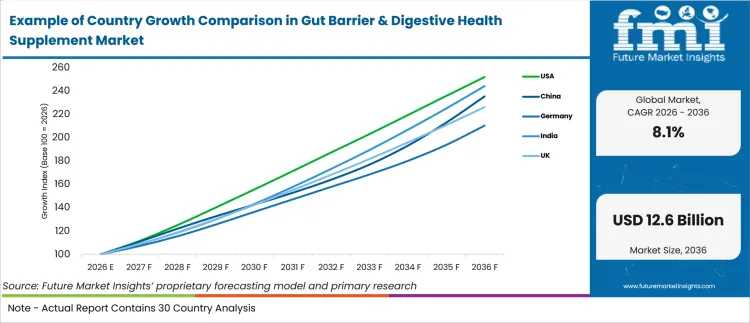
| Country | CAGR |
|---|---|
| USA | 8.1% |
| China | 8.9% |
| Germany | 7.7% |
| India | 9.3% |
| UK | 8.5% |
How do country-level CAGRs compare in the Gut Barrier & Digestive Health Supplement Market?
The country forecasts remain closely grouped across the gut barrier and digestive health supplement market, suggesting broad-based demand for products that support digestive wellness and microbiome health. India and China form a closely aligned upper group, reflecting rising consumer interest in preventive health and nutritional supplementation. The UK and the USA follow within a narrow range, indicating comparable market momentum despite differences in healthcare and retail landscapes. Germany remains connected to the broader comparison with a slightly more measured outlook rather than a pronounced separation from the other markets. The overall pattern points to growing awareness of gut health across all five countries, with differences shaped by supplement penetration, consumer education and product innovation priorities.
- India shows a notable position in the comparison as increasing awareness of digestive wellness and growing use of preventive nutrition products continue to support supplement adoption.
- China remains closely aligned with India as consumers increasingly seek probiotic, prebiotic and gut-support formulations as part of broader wellness routines.
- The UK reflects steady market expansion through strong consumer interest in microbiome health and the incorporation of digestive support ingredients into daily nutrition products.
- The USA benefits from a well-established supplement industry where innovation in gut health formulations and targeted wellness solutions continues to drive product development.
- Germany maintains a meaningful presence within the comparison as demand for scientifically supported digestive health products encourages the adoption of specialized supplement ingredients.
Comparable CAGRs do not create identical market conditions across countries. Differences in supplement usage habits, regulatory requirements, consumer awareness of gut health and distribution channels can influence product adoption and commercialization strategies. Similar growth forecasts may therefore reflect different routes to market and distinct patterns of consumer engagement. The full report provides country-level CAGR analysis across North America, Latin America, Europe, East Asia, South Asia, Oceania and the Middle East and Africa.
Country-wise Analysis
- United States supplement launches operate under federal ingredient and labeling rules without premarket approval for the finished product. Adoption of gut barrier and digestive health supplements in the USA is estimated to expand at 8.1% CAGR through 2036, supported by established direct-to-consumer and practitioner channels. In September 2025, FDA issued an online advisory letter concerning disease-treatment claims for an Ultimate Probiotic product. The action preserves a clear route for lawful structure-function positioning supported by product-specific evidence records. Coordinating website language with package claims remains a material friction across direct-to-consumer channels and marketplaces. USA brands need domestic responsible-party records and rapid adverse-event handling across the probiotic supplements category for sustained national distribution.
- China applies registration and filing controls to health foods according to ingredient eligibility and the approved functional scope. China's gut barrier and digestive health supplements outlook is anticipated to advance at 8.9% CAGR over the assessment period, reinforced by formal registration and filing routes for qualified health foods. Catalog ingredients can use the filing route and provide a direct commercial enabler for qualified products. SAMR reported in August 2025 that authorities had issued 14 thousand registration certificates and 23 thousand filing certificates cumulatively. Non-catalog materials and unsupported functions create a material friction through deeper technical and regulatory review. Local partners need clear regulatory ownership and Chinese-language stability records for distribution across provincial channels.
- German food supplements enter a mature retail environment that treats them as foods rather than products for disease treatment. Gut barrier and digestive health supplement sales in Germany are forecast to expand at 7.7% CAGR by 2036, shaped by mature retail access and cautious expectations for supplement claims. In July 2025, BfR reported that more than two-thirds of surveyed respondents had consumed a supplement during the previous year. Almost half reported using supplements to address illnesses or health conditions, which creates a material communication risk. Established pharmacy and specialty-retail access gives validated formulations a clear route through restrained and understandable claims. Brands should separate nutritional support from disease treatment through precise benefit language and visible dose guidance.
- India requires nutraceutical formulations to follow FSSAI standards for permitted ingredients and label claims across national distribution. The Indian gut barrier and digestive health supplement sector is projected to record 9.3% CAGR during the assessment period, aided by branded supplement channels and contract manufacturing capacity. The established standards create a direct commercial enabler for standardized formulas and coordinated national planning. In February 2026, India’s Press Information Bureau confirmed permissible ingredients and substance limits alongside labeling requirements and claims rules. Overlapping food and drug definitions create a material friction for formulations positioned near gastrointestinal treatment claims. Manufacturers need documented ingredient status and consistent batch testing for distribution across several Indian states.
- United Kingdom food supplements must satisfy composition and labeling requirements without implying disease prevention or treatment. Gut barrier and digestive health supplement demand in the United Kingdom is forecast to rise at 8.5% CAGR over the forecast period, enabled by pharmacy and online retail access. The Food Standards Agency guidance updated in June 2026 defines a food supplement as food sold in dose form. The guidance clarifies manufacturer and importer responsibilities and provides a direct commercial enabler for compliant distribution. Online marketplace variation creates a material friction through products that may not meet national composition or labeling requirements. Brands need local label review and traceable importer arrangements for wider promotion across online retail channels.
Who are the notable companies in the Gut Barrier & Digestive Health Supplement Market?
Novonesis, Kerry Group, ADM, Lallemand Health Solutions, Seed Health, Pendulum Therapeutics, Probi AB, and BioGaia AB are notable companies in the gut barrier and digestive health supplement market.
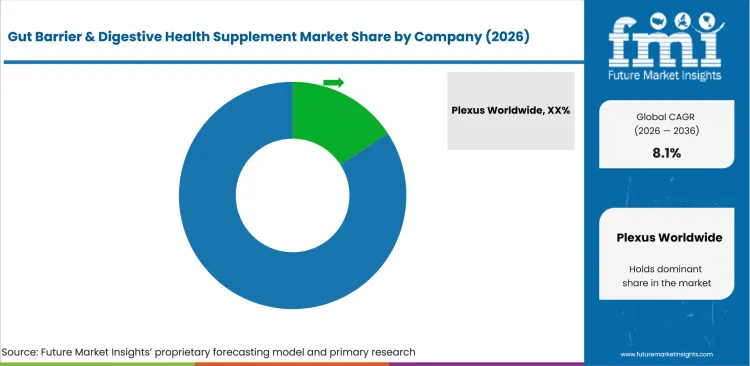
Competition separates ingredient platforms from branded supplement companies that sell through retail and practitioner channels. Ingredient groups compete through strain libraries and regulatory dossiers that support multiple finished-product positions across regulated regions. In June 2026, Probi AB reported that its dual-strain formulation improved bowel regularity and digestive comfort in a randomized placebo-controlled study of 100 healthy adults. The company made the formulation available for global B2B partnerships across dietary supplements and functional nutrition. Branded specialists compete through proprietary delivery systems and narrow microbiome positions designed for recurring use. Related immune support products can broaden digestive-health portfolios, but each formulation needs separate evidence and claim review.
- Novonesis and Lallemand Health Solutions provide documented microbial strains with formulation and regulatory support across several digestive positions. Their breadth suits finished-product developers that prefer one strain partner for regional claim planning and delivery validation.
- Kerry Group and ADM combine probiotic or prebiotic ingredients with formulation support for supplements and functional nutrition. Their advantage is strongest in programs that need stability evidence and regional application guidance around a defined digestive-health position.
- Seed Health and Pendulum Therapeutics compete through clinically positioned finished products sold directly to consumers and practitioners. Probi AB and BioGaia AB provide strain platforms with international distribution routes that require matched human evidence and format-specific stability.
Competitive Benchmarking: Gut Barrier & Digestive Health Supplement Market
| Company | Validated Ingredient Evidence | Gut-Barrier Evidence | Formulation and Delivery Support | Geographic Reach |
|---|---|---|---|---|
| Novonesis | High | High | High | Global |
| Kerry Group | Medium | Medium | High | Global |
| ADM | Medium | Low | High | Global |
| Lallemand Health Solutions | Medium | Medium | High | Global |
| Seed Health | High | High | Medium | United States DTC |
| Pendulum Therapeutics | Medium | Medium | Medium | United States DTC |
| Probi AB | Medium | Medium | Medium | Global B2B partnerships |
| BioGaia AB | Medium | Medium | Medium | More than 100 markets |
Key Developments in the Gut Barrier & Digestive Health Supplement Market
- In September 2025, Novonesis and Novo Nordisk entered a research partnership focused on the gut microbiome and metabolic health. The collaboration covers synbiotic food supplements and measurable microbiome biomarkers that can support defined endpoints. The program gives development teams a route to test defined endpoints, although each commercial formulation requires product-specific evidence and regional review.
- In September 2025, Kerry Group published the first BC30 digestive-health study conducted among healthy Chinese adults. The 28-day trial reported improved stool frequency and consistency alongside reduced constipation symptoms among the study participants. The study gives regional development teams population-specific evidence and supports shelf-stable probiotic formats without treating one strain as proof for the wider category.
- In September 2025, ADM announced Australian Therapeutic Goods Administration approval for Fibersol as an active ingredient in regulated health-product categories. The company reported formulation stability under heat and acid exposure alongside shear and repeated freeze-thaw conditions. The approval creates a documented route for powder supplements in Australia but serving levels and finished claims remain subject to the applicable product category.
- In April 2025, Lallemand Health Solutions launched the Innov’Biome open innovation challenge for documented probiotic and next-generation strains. The program targeted gut health alongside women’s health and healthy aging through microbial proposals with defined evidence packages. Selected developers can access fermentation and regulatory expertise that strengthens commercial preparation without treating participation as clinical proof.
Key Players in the Gut Barrier & Digestive Health Supplement Market
Ingredient and Formulation Platforms
- Novonesis
- Kerry Group
- ADM
- Lallemand Health Solutions
Science-Led Microbiome Brands
- Seed Health
- Pendulum Therapeutics
Specialist Probiotic Companies
- Probi AB
- BioGaia AB
Gut Barrier & Digestive Health Supplement Market - Report Scope
| Coverage field | Report scope |
|---|---|
| Market breakdown | Ingredient, application, form, and region. |
| Quantitative Units | USD Billion |
| Market Definition | Dietary supplements formulated with L-glutamine, zinc carnosine, probiotics, fibers, botanicals, or related ingredients and positioned for gut-barrier integrity, digestive support, or immunity. Prescription gastrointestinal therapies and products marketed for disease treatment remain outside the defined commercial boundary. |
| Regions Covered | North America, Latin America, Europe, East Asia, South Asia, Oceania, and Middle East and Africa. |
| Countries Covered | USA, China, Germany, India, and UK. |
| Key Companies Profiled | Novonesis, Kerry Group, ADM, Lallemand Health Solutions, Seed Health, Pendulum Therapeutics, Probi AB, and BioGaia AB |
| Forecast Period | 2026 to 2036. |
| Approach | Hybrid bottom-up and top-down market sizing supported by primary interviews and official desk research across the defined segments. |
Gut Barrier & Digestive Health Supplement Market - Research Methodology
| Method | Approach |
|---|---|
| Primary Research | FMI analysts gathered input from manufacturers, service providers, technology developers, distributors, end users, procurement teams, and subject-matter experts. Interviews examined purchasing decisions, product or service evaluation, adoption barriers, approval requirements, pricing considerations, and expectations for technical or commercial support. Respondents were also asked what evidence is required before a trial, pilot, or initial order develops into regular purchasing. |
| Desk Research | Desk research covered government statistics, regulatory publications, trade data, industry associations, technical literature, standards, company filings, product information, and official corporate announcements. Sources were reviewed for relevance, publication date, geographic coverage, and consistency with the defined market scope. Claims relating to performance, applications, approvals, capacity, investment, and commercial activity were retained only when supported by credible public evidence. |
| Market Sizing and Forecasting | The market model combined the baseline value with historical performance, segment structure, pricing and volume indicators, adoption levels, company participation, and country-level demand conditions. Forecast assumptions considered economic activity, investment trends, regulatory developments, technology adoption, purchasing cycles, supply availability, and barriers to wider market use. Segment and regional estimates were reconciled before the final market total was calculated. |
| Data Validation | Estimates were checked against multiple independent indicators, including public data, company activity, trade patterns, industry developments, and findings from primary interviews. Validation also tested whether products, services, applications, and company revenues fell within the defined market boundaries. Adjacent categories, unsupported claims, overlapping revenues, and activities without direct market relevance were excluded to reduce double counting and maintain consistency across segments and countries. |
Gut Barrier & Digestive Health Supplement Market by Segments
Gut Barrier & Digestive Health Supplement Market segmented by Ingredient:
- L-glutamine
- Zinc Carnosine
- Probiotics
- Fibers
- Botanicals
Gut Barrier & Digestive Health Supplement Market segmented by Application:
- Gut Barrier
- Digestion
- Immunity
Gut Barrier & Digestive Health Supplement Market segmented by Form:
- Powder
- Liquid
- Granules
- Paste
Gut Barrier & Digestive Health Supplement Market by Region:
- North America
- United States
- Canada
- Latin America
- Brazil
- Mexico
- Argentina
- Chile
- Western Europe
- Germany
- France
- United Kingdom
- Italy
- Spain
- Benelux
- Nordics
- Eastern Europe
- Poland
- Czech Republic
- Romania
- Hungary
- East Asia
- China
- Japan
- South Korea
- South Asia and Pacific
- India
- ASEAN
- Australia and New Zealand
- Middle East and Africa
- GCC Countries
- South Africa
- Türkiye
- Israel
Research Sources and Bibliography
- National Institutes of Health, Office of Dietary Supplements. (2025, March 25). Probiotics - Health Professional Fact Sheet.
- State Administration for Market Regulation. (2025, September 25). [August 2025 online service statistics].
- USA Food and Drug Administration. (2025, December 11). Letter to the Dietary Supplement Industry on the DSHEA Disclaimer.
- Kyowa Hakko Bio Co., Ltd. (2025, July 1). Regarding the Completion of the Transfer of the Amino Acids and Human Milk Oligosaccharides Business.
- Novonesis. (2025, July 8). New Landmark Scientific Review on the BB-12™ Probiotic Strain Published.
- Lallemand Health Solutions. (2025, April 14). Natural Pro-Digest: Bringing Best-In-Class Prebiotic and Probiotic Together.
- Kerry Group. (2025, June 4). GLP-1 users report improved quality of life when consuming Kerry Group’s BC30™ Probiotic.
- USA Food and Drug Administration. (2025, July 17). Vidaslim Co. - 705118 - 07/17/2025.
- Novonesis. (2025, August 13). Probiotic strain combination supporting women’s gut and vaginal health now approved by Health Canada.
- USA Food and Drug Administration. (2025, September 10). The Moringa Tree - Online Advisory Letter.
- State Administration for Market Regulation. (2025, August 29). [Transcript of the food-safety press conference].
- German Federal Institute for Risk Assessment. (2025, July 18). Between hype and misconception: common misunderstandings about food supplements.
- Press Information Bureau. (2026, February 6). Promotion of Nutraceuticals and Functional Foods.
- Food Standards Agency. (2026, June 25). Food supplements guidance.
- Lallemand Health Solutions. (2025, April 16). Innov’Biome by Lallemand: A New Biotics Open Innovation Challenge.
- Novonesis. (2025, September 8). Novonesis and Novo Nordisk will explore new solutions to improve metabolic health.
- Kerry Group. (2025, September 12). How BC30™ Supports Gut Health in Chinese Adults.
- ADM. (2025, September 29). ADM's Fibersol® Approved by Therapeutic Goods Administration (TGA) as an Active Ingredient for Health Products in Australia.
- Seed Health. (2025, April 10). How Seed Is Setting a New Standard for Probiotics Research.
- Pendulum Therapeutics. (2025, November 7). Pendulum Is Named the #1 Gastroenterologist Recommended Brand of Akkermansia-Based Probiotics.
- Probi AB. (2026, June 3). Clinical study demonstrates Probi’s new dual-strain probiotic significantly improves occasional constipation in healthy adults.
- BioGaia AB. (2026, March 30). BioGaia Annual and Sustainability Report 2025 published.
This bibliography is provided for reader reference and is not exhaustive. The full report contains the complete reference list and detailed citations.
This Report Answers
- How large is the gut barrier and digestive health supplement market in 2026 and 2036?
- Which formulation controls support repeat demand across probiotic and amino-acid supplements?
- Why is L-glutamine projected to hold the dominant ingredient share in 2026?
- How does gut barrier influence evidence requirements across the application category?
- Why does powder account for the leading form share in 2026?
- How do country growth rates differ across the USA, China, Germany, India, and the UK?
- Which companies provide documented ingredients or branded gut-health supplement platforms?
- What limits compliant disease-adjacent positioning across digestive-health supplements?
- How can regional approvals improve the commercial value of validated formulations?
Frequently Asked Questions
How big is the Gut Barrier & Digestive Health Supplement Market in 2026?
The gut barrier & digestive health supplement market is valued at USD 5.8 billion in 2026 and is forecast to reach USD 12.6 billion by 2036. Growth is supported by rising demand for named-ingredient formulations that connect specific strains and amino acids with measurable digestive endpoints across established retail and practitioner channels.
What is the CAGR of the Gut Barrier & Digestive Health Supplement Market from 2026 to 2036?
The gut barrier & digestive health supplement market grows at a CAGR of 8.1% between 2026 and 2036, supported by manufacturers adopting strain-specific evidence and stable finished formats once those systems preserve the stated digestive benefit at the marketed dose throughout the finished product's shelf life.
Which ingredient leads the Gut Barrier & Digestive Health Supplement Market?
L-glutamine accounts for 34.5% of the gut barrier & digestive health supplement market by ingredient in 2026, driven by established powder use and adjustable serving sizes that let manufacturers formulate single-ingredient and multi-ingredient blends without live-cell protection systems across commercial supplement programs.
How much will the Gut Barrier & Digestive Health Supplement Market add between 2026 and 2036?
The gut barrier & digestive health supplement market is set to add USD 6.8 billion between 2026 and 2036, growing from USD 5.8 billion to USD 12.6 billion as validated ingredient platforms and region-specific approvals enter funded commercial pathways across a widening base of digestive health supplement programs.
Who are the leading companies in the Gut Barrier & Digestive Health Supplement Market?
Five companies lead the gut barrier & digestive health supplement market, including Novonesis, Kerry Group, ADM, Lallemand Health Solutions, and Seed Health, competing through documented strain libraries, formulation support, prebiotic and probiotic ingredient platforms, and branded gut-health positions across retail and practitioner channels worldwide.
Preview the report firsthand - request a free sample
Get SampleGet the brochure for pricing and purchase details.
Get PDFTable of Content
- Key Takeaways
- Market Size and CAGR
- Top Growth Driver
- Fastest Growing Segment
- Leading Region
- Key Companies
- Emerging Opportunities
- Executive Summary
- Global Market Outlook
- Demand-side Trends
- Supply-side Trends
- Technology Roadmap Analysis
- Analysis and Recommendations
- Analyst Perspective (What is happening? Why now? What should investors know?)
- Key Questions Answered
- How large is the market?
- What is the CAGR?
- What are key trends?
- Which region dominates?
- Who are the leaders?
- Market Overview
- Market Coverage / Taxonomy
- Market Definition / Scope / Limitations
- Research Methodology
- Chapter Orientation
- Analytical Lens and Working Hypotheses
- Market Structure, Signals, and Trend Drivers
- Benchmarking and Cross-market Comparability
- Market Sizing, Forecasting, and Opportunity Mapping
- Research Design and Evidence Framework
- Desk Research Programme (Secondary Evidence)
- Expert Input and Fieldwork (Primary Evidence)
- Tooling, Models, and Reference Databases
- Data Engineering and Model Build
- Quality Assurance and Audit Trail
- Market Background
- Market Dynamics (Drivers, Restraints, Opportunity, Trends)
- Scenario Forecast (Optimistic, Likely, Conservative)
- Impact Analysis
- AI Impact
- Sustainability Impact
- Regulatory Impact
- Technology Impact
- Consumer / Buyer Analysis
- Purchase Drivers
- Adoption Barriers
- Buyer Journey
- Opportunity Map Analysis
- Product Life Cycle Analysis
- Supply Chain Analysis
- Investment Feasibility Matrix
- Value Chain Analysis
- PESTLE and Porter's Analysis
- Regulatory Landscape
- Regional Parent Market Outlook
- Production and Consumption Statistics
- Import and Export Statistics
- Global Market Analysis and Forecast, 2021 to 2036
- Historical Market Size Value (USD Billion) Analysis, 2021 to 2025
- Current and Future Market Size Value (USD Billion) Projections, 2026 to 2036
- Y-o-Y Growth Trend Analysis
- Absolute $ Opportunity Analysis
- Global Market Pricing Analysis, 2021 to 2036
- Global Market Analysis and Forecast, By Ingredient, 2021 to 2036
- Introduction / Key Findings
- Historical Market Size Value (USD Billion) Analysis By Ingredient, 2021 to 2025
- Current and Future Market Size Value (USD Billion) Analysis and Forecast By Ingredient, 2026 to 2036
- L-glutamine
- Zinc Carnosine
- Probiotics
- Fibers
- Botanicals
- L-glutamine
- Y-o-Y Growth Trend Analysis By Ingredient, 2021 to 2025
- Absolute $ Opportunity Analysis By Ingredient, 2026 to 2036
- Global Market Analysis and Forecast, By Application, 2021 to 2036
- Introduction / Key Findings
- Historical Market Size Value (USD Billion) Analysis By Application, 2021 to 2025
- Current and Future Market Size Value (USD Billion) Analysis and Forecast By Application, 2026 to 2036
- Gut Barrier
- Digestion
- Immunity
- Gut Barrier
- Y-o-Y Growth Trend Analysis By Application, 2021 to 2025
- Absolute $ Opportunity Analysis By Application, 2026 to 2036
- Global Market Analysis and Forecast, By Form, 2021 to 2036
- Introduction / Key Findings
- Historical Market Size Value (USD Billion) Analysis By Form, 2021 to 2025
- Current and Future Market Size Value (USD Billion) Analysis and Forecast By Form, 2026 to 2036
- Powder
- Liquid
- Granules
- Paste
- Powder
- Y-o-Y Growth Trend Analysis By Form, 2021 to 2025
- Absolute $ Opportunity Analysis By Form, 2026 to 2036
- Global Market Analysis and Forecast, By Region, 2021 to 2036
- Introduction
- Historical Market Size Value (USD Billion) Analysis By Region, 2021 to 2025
- Current Market Size Value (USD Billion) Analysis and Forecast By Region, 2026 to 2036
- North America
- Latin America
- Western Europe
- Eastern Europe
- East Asia
- South Asia and Pacific
- Middle East & Africa
- Market Attractiveness Analysis By Region
- North America Market Analysis and Forecast, By Country, 2021 to 2036
- Historical Market Size Value (USD Billion) Trend Analysis By Market Taxonomy, 2021 to 2025
- Market Size Value (USD Billion) Forecast By Market Taxonomy, 2026 to 2036
- By Country
- USA
- Canada
- By Ingredient
- By Application
- By Form
- By Country
- Market Attractiveness Analysis
- By Country
- By Ingredient
- By Application
- By Form
- Key Takeaways
- Latin America Market Analysis and Forecast, By Country
- Historical Market Size Value (USD Billion) Trend Analysis By Market Taxonomy, 2021 to 2025
- Market Size Value (USD Billion) Forecast By Market Taxonomy, 2026 to 2036
- By Country
- Brazil
- Mexico
- Chile
- Rest of Latin America
- By Ingredient
- By Application
- By Form
- By Country
- Market Attractiveness Analysis
- By Country
- By Ingredient
- By Application
- By Form
- Key Takeaways
- Western Europe Market Analysis and Forecast, By Country
- Historical Market Size Value (USD Billion) Trend Analysis By Market Taxonomy, 2021 to 2025
- Market Size Value (USD Billion) Forecast By Market Taxonomy, 2026 to 2036
- By Country
- Germany
- UK
- Italy
- Spain
- France
- Nordic
- BENELUX
- Rest of Western Europe
- By Ingredient
- By Application
- By Form
- By Country
- Market Attractiveness Analysis
- By Country
- By Ingredient
- By Application
- By Form
- Key Takeaways
- Eastern Europe Market Analysis and Forecast, By Country
- Historical Market Size Value (USD Billion) Trend Analysis By Market Taxonomy, 2021 to 2025
- Market Size Value (USD Billion) Forecast By Market Taxonomy, 2026 to 2036
- By Country
- Russia
- Poland
- Hungary
- Balkan & Baltic
- Rest of Eastern Europe
- By Ingredient
- By Application
- By Form
- By Country
- Market Attractiveness Analysis
- By Country
- By Ingredient
- By Application
- By Form
- Key Takeaways
- East Asia Market Analysis and Forecast, By Country
- Historical Market Size Value (USD Billion) Trend Analysis By Market Taxonomy, 2021 to 2025
- Market Size Value (USD Billion) Forecast By Market Taxonomy, 2026 to 2036
- By Country
- China
- Japan
- South Korea
- By Ingredient
- By Application
- By Form
- By Country
- Market Attractiveness Analysis
- By Country
- By Ingredient
- By Application
- By Form
- Key Takeaways
- South Asia and Pacific Market Analysis and Forecast, By Country
- Historical Market Size Value (USD Billion) Trend Analysis By Market Taxonomy, 2021 to 2025
- Market Size Value (USD Billion) Forecast By Market Taxonomy, 2026 to 2036
- By Country
- India
- ASEAN
- Australia & New Zealand
- Rest of South Asia and Pacific
- By Ingredient
- By Application
- By Form
- By Country
- Market Attractiveness Analysis
- By Country
- By Ingredient
- By Application
- By Form
- Key Takeaways
- Middle East & Africa Market Analysis and Forecast, By Country
- Historical Market Size Value (USD Billion) Trend Analysis By Market Taxonomy, 2021 to 2025
- Market Size Value (USD Billion) Forecast By Market Taxonomy, 2026 to 2036
- By Country
- Kingdom of Saudi Arabia
- Other GCC Countries
- Türkiye
- South Africa
- Other African Union
- Rest of Middle East & Africa
- By Ingredient
- By Application
- By Form
- By Country
- Market Attractiveness Analysis
- By Country
- By Ingredient
- By Application
- By Form
- Key Takeaways
- Key Countries Market Analysis
- USA
- Pricing Analysis
- Market Share Analysis, 2025
- By Ingredient
- By Application
- By Form
- Canada
- Pricing Analysis
- Market Share Analysis, 2025
- By Ingredient
- By Application
- By Form
- Mexico
- Pricing Analysis
- Market Share Analysis, 2025
- By Ingredient
- By Application
- By Form
- Brazil
- Pricing Analysis
- Market Share Analysis, 2025
- By Ingredient
- By Application
- By Form
- Chile
- Pricing Analysis
- Market Share Analysis, 2025
- By Ingredient
- By Application
- By Form
- Germany
- Pricing Analysis
- Market Share Analysis, 2025
- By Ingredient
- By Application
- By Form
- UK
- Pricing Analysis
- Market Share Analysis, 2025
- By Ingredient
- By Application
- By Form
- Italy
- Pricing Analysis
- Market Share Analysis, 2025
- By Ingredient
- By Application
- By Form
- Spain
- Pricing Analysis
- Market Share Analysis, 2025
- By Ingredient
- By Application
- By Form
- France
- Pricing Analysis
- Market Share Analysis, 2025
- By Ingredient
- By Application
- By Form
- India
- Pricing Analysis
- Market Share Analysis, 2025
- By Ingredient
- By Application
- By Form
- ASEAN
- Pricing Analysis
- Market Share Analysis, 2025
- By Ingredient
- By Application
- By Form
- Australia & New Zealand
- Pricing Analysis
- Market Share Analysis, 2025
- By Ingredient
- By Application
- By Form
- China
- Pricing Analysis
- Market Share Analysis, 2025
- By Ingredient
- By Application
- By Form
- Japan
- Pricing Analysis
- Market Share Analysis, 2025
- By Ingredient
- By Application
- By Form
- South Korea
- Pricing Analysis
- Market Share Analysis, 2025
- By Ingredient
- By Application
- By Form
- Russia
- Pricing Analysis
- Market Share Analysis, 2025
- By Ingredient
- By Application
- By Form
- Poland
- Pricing Analysis
- Market Share Analysis, 2025
- By Ingredient
- By Application
- By Form
- Hungary
- Pricing Analysis
- Market Share Analysis, 2025
- By Ingredient
- By Application
- By Form
- Kingdom of Saudi Arabia
- Pricing Analysis
- Market Share Analysis, 2025
- By Ingredient
- By Application
- By Form
- Türkiye
- Pricing Analysis
- Market Share Analysis, 2025
- By Ingredient
- By Application
- By Form
- South Africa
- Pricing Analysis
- Market Share Analysis, 2025
- By Ingredient
- By Application
- By Form
- USA
- Market Structure Analysis
- Competition Dashboard
- Competition Benchmarking
- Market Share Analysis of Top Players
- By Regional
- By Ingredient
- By Application
- By Form
- Emerging Startups
- Innovation Benchmarking
- Competition Analysis
- Competition Deep Dive
- Plexus Worldwide
- Overview
- Product Portfolio
- Profitability by Market Segments
- Sales Footprint
- Strategy Overview
- Marketing Strategy
- Product Strategy
- Channel Strategy
- Novonesis
- Kerry
- ADM
- Lonza
- Pendulum
- Seed Health
- Plexus Worldwide
- Case Studies
- Success Stories
- Recent Developments
- Competition Deep Dive
- Assumptions & Acronyms Used


