

- Market Size (2026)
- USD 76.9 Bn
- Forecast (2036)
- USD 108.5 Bn
- CAGR (2026 to 2036)
- 3.5%
How big is Automotive Brake System and Components Market in 2026?
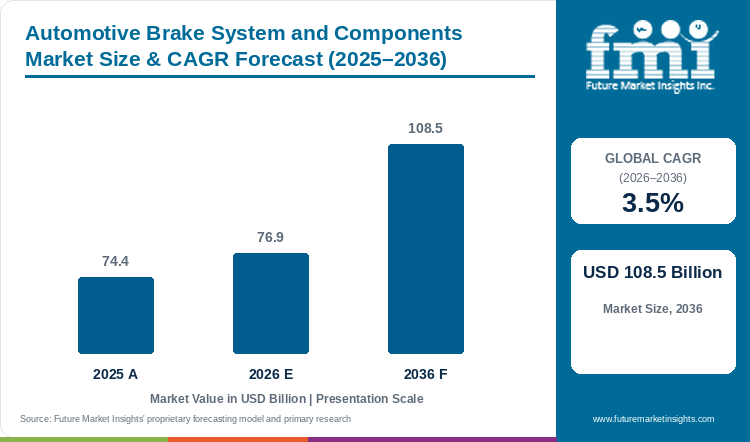
The automotive brake system and components market is estimated at USD 74.4 billion in 2025 and is expected to reach USD 76.9 billion in 2026. The automotive brake system and components market is projected to grow at a 3.5% CAGR from 2026 to 2036 and reach USD 108.5 billion by 2036.
Sales in the automotive brake system and components market, set by about 96 million new vehicles and the pads and discs that wear out on older ones, are estimated at USD 74.4 billion in 2025. Automotive brake system and components sales are expected to rise to USD 76.9 billion in 2026, and a 3.5% CAGR through 2036 is forecast to take the total to USD 108.5 billion. Electric cars alter brake content, since regenerative braking does most of the slowing and the friction system becomes an electronic backup. ACEA reported a 20.7% battery-electric share of new EU car registrations in H1 2026, up from 15.6% in H1 2025.[1] Each new electric car carries more brake electronics and needs pads and discs less often, so value per vehicle rises at the factory and replacement volume grows more slowly.
Measured per vehicle, brake demand is most intense in trucks and buses, by FMI's reading. Trucks and buses hold an estimated 35% of 2026 brake sales. A heavy truck carries air brakes, anti-lock control and electronic brake management on every axle and relines several times over a working life. Truck division order intake at Knorr-Bremse reached EUR 1,062 million in the June 2026 quarter, up 29.5%.[2] For truck makers and fleet owners, brake cost per vehicle follows axle count and duty cycle, so one heavy truck order can equal several car programmes for a commercial vehicle brake supplier.
Key Market Trends & Insights
- Rear-axle discs on more compact models give disc brakes an expected 62% of component sales in 2026, and drum brakes keep the other 38%.
- Passenger cars, SUVs and light vans carry a likely 65% of vehicle type sales in 2026. Global vehicle production reached 96.4 million units in 2025, up 3.9%, OICA reported.[3]
- Carmaker fitment on the assembly line holds an estimated 63.5% channel share in 2026, with the aftermarket at 36.5% for pads, discs, shoes and fluid.
Regional Highlights
- India leads on fast-rising vehicle output with a 5.4% CAGR. Mexico, a North American assembly base, is next at 4.3%.
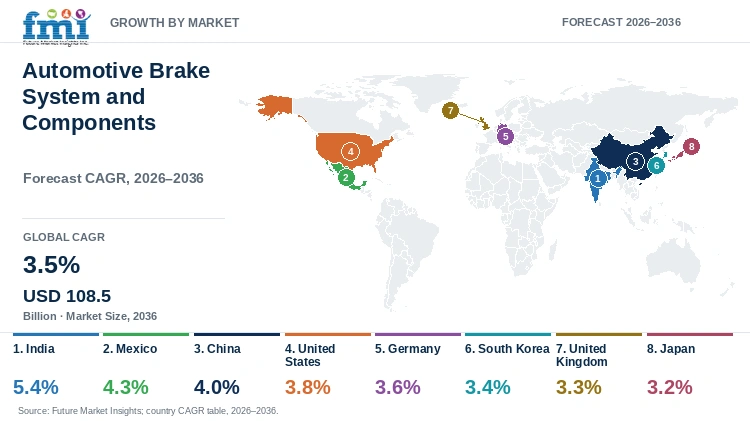
- China (4%) and the United States (3.8%) grow ahead of the 3.5% global automotive brake system and components market CAGR, and Germany is close at 3.6%. Busy Korean assembly lines give South Korea 3.4%, a tenth ahead of the United Kingdom, and flat Japanese output leaves Japan lowest at 3.2%.
- SIAM counted 4,39,309 domestic passenger vehicle sales in India for August 2026, 36.5% more than in August 2025.[4]
Market Size & Forecast
Table 1: Market Size and Forecast for the Automotive Brake System and Components Market (USD billion and percentage), 2025 to 2036
| Metric | Value |
|---|---|
| 2025 Market Size | USD 74.4 billion |
| Estimated Market Size in 2026 | USD 76.9 billion |
| Projected Market Size by 2036 | USD 108.5 billion |
| CAGR, 2026 to 2036 | 3.5% |
| Added Revenue, 2026 to 2036 | USD 31.6 billion |
| Market Expansion Multiple | 1.4x |
Brake orders arrive in two streams, carmaker programmes awarded years before a model launches and replacement parts bought each time a pad or disc wears out. Mobility sales at Bosch came to EUR 27.8 billion over January to June 2026, 0.5% below H1 2025, with the company saying automotive production had stagnated.[5] Safety and Motion sales at AUMOVIO fell 9.6% to EUR 3.4 billion in the same six months on lower production volumes and currency effects.[6] Electronic control content per car is rising, and a 7.1% CAGR forecast for the brake system control ECU platforms market is about twice the brake market rate. FMI estimates the automotive brake system and components market in 2036 at about 1.4 times the 2026 level, or USD 31.6 billion larger. A weak year for car production would cut factory orders first, and the aftermarket would soften the drop.
Electrification, Brake-by-Wire and Commercial Vehicle Braking
Electric cars shift brake spend from friction parts to electronics. Regenerative braking slows the car through the motor. As more electric models reach showrooms, the regenerative braking systems market is projected to expand on a 22% CAGR. Brake-by-wire cars replace the hydraulic link with sensors and actuators, and each one needs a pedal feel unit, opening fresh ground for the automotive brake-by-wire pedal simulator market on a 19.5% CAGR forecast. Germany added 48% more battery-electric registrations over January to June 2026.[1] Friction suppliers will sell fewer pads per car and more control units, actuators and sensors.
Truck braking is moving toward redundancy for automated driving. Knorr-Bremse plans series production of the rGSBC redundant braking system for Level 4 trucks in 2027, with North America as the first market.[7] Truck orders on hand at Knorr-Bremse reached EUR 1,979 million at 30 June 2026, up 11.7%.[2] Integrated boosterless units are replacing vacuum boosters in electric cars, with an 8.2% CAGR forecast for the brake system powerpack and boosterless units market. Brake makers with electronic and redundant systems will hold the highest value per vehicle through 2036.
Table 2: Production, Electrification and Supplier Indicators for the Automotive Brake System and Components Market (units, shares and sales), 2025 to 2026
| Indicator | Data Point | Relevance | Source |
|---|---|---|---|
| Global vehicle production, 2025 | 96.4 million units; up 3.9% | Sets factory brake volume. | [3] |
| EU BEV share of new cars, H1 2026 | 20.7%, from 15.6% | Regenerative braking cuts pad wear. | [1] |
| Knorr-Bremse truck order intake, Q2 2026 | EUR 1,062 million; up 29.5% | Truck brake demand is rising. | [2] |
| Bosch Mobility sales, H1 2026 | EUR 27.8 billion; down 0.5% | Car production is flat. | [5] |
| AUMOVIO Safety and Motion sales, H1 2026 | EUR 3.4 billion; down 9.6% | Lower European volumes. | [6] |
| Passenger vehicle sales in India, August 2026 | 4,39,309 units; up 36.5% | Fastest-growing brake buyer. | [4] |
| UK vehicle production, August 2026 | 40,872 units; up 5.7% | Small rebound from a low base. | [8] |
| South Korea vehicle production, June 2026 | 394,210 units; up 12% | Export programmes add volume. | [9] |
Analyst Perspective
“Brake value is moving from iron and friction material into electronics, and every electric car that leaves a plant in 2026 carries a brake control unit that costs more than the pads saved over the life of the car. I expect brake-by-wire and redundant truck braking to give the leading suppliers most of the new value through 2036, and India and Mexico to add the volume.”
- Nikhil Kaitwade, Principal Consultant, Future Market Insights.
How is the automotive brake system and components market segmented?
The market is segmented into component type, vehicle type, sales channel, and region. Disc brakes are expected to lead component type with 62% in 2026, passenger vehicles lead vehicle type with 65%, and OEM fitment leads sales channel with 63.5%.
By component type: disc brakes and drum brakes.
By vehicle type: passenger vehicles and commercial vehicles.
By sales channel: OEM and aftermarket.
By region: vehicle assembly plants, fleets and parts distributors in North America, Latin America, Western Europe, Eastern Europe, East Asia, South Asia and Pacific, and Middle East and Africa.
Why do disc brakes lead automotive brake system and components sales by component type?
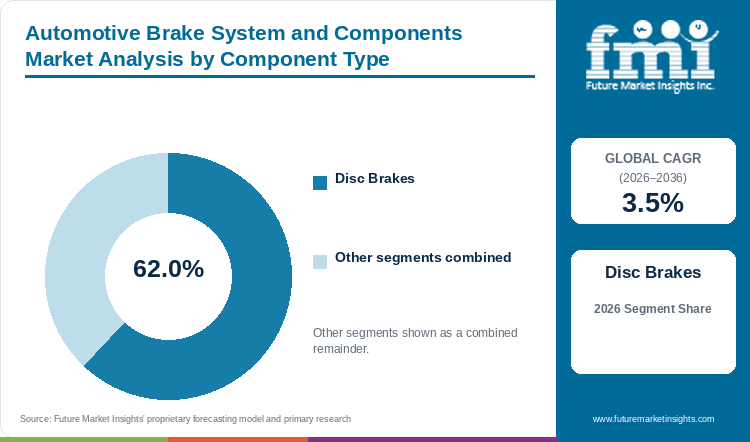
Disc brakes are expected to lead component type sales with 62% share in 2026, against 38% for drum brakes.
Table 3: Component Type Share for the Automotive Brake System and Components Market (percentage share), 2026
| Component Type | Estimated Share (2026) |
|---|---|
| Disc Brakes | 62% |
| Drum Brakes | 38% |
| Total | 100.0% |
Table 4: Component Type Leadership and Market Growth for the Automotive Brake System and Components Market (segment and CAGR percentage), 2026 to 2036
| Metric | Value |
|---|---|
| Global CAGR (2026 to 2036) | 3.5% |
| Leading Segment | Disc Brakes |
Disc brakes are expected to lead with 62% share in 2026, as a caliper and rotor shed heat faster, stop shorter and suit the electronic stability systems now fitted to most new cars. Drum brakes, at 38%, cost less to make and hold a parking brake easily, so carmakers keep them on the rear axle of small cars and on many trucks, vans and two-axle buses. Electric cars favour discs on the front and sometimes drums at the rear, since regenerative braking leaves the rear brake little work and a drum resists corrosion better. Safety and Motion sales at AUMOVIO were EUR 3.4 billion for H1 2026.[6] A carmaker choosing brakes for a new SUV will fit discs on all four wheels, which keeps the disc share rising.
- Ventilated front discs, solid rear discs, calipers and pads make up most disc brake sales.
- Excluding exchange-rate effects, Bosch Mobility sales grew 2.3% in the first six months of 2026.[5]
Why do passenger vehicles lead automotive brake system and components sales by vehicle type?
Passenger vehicles are likely to account for 65% of vehicle type sales in 2026, against 35% for commercial vehicles.
Table 5: Vehicle Type Share for the Automotive Brake System and Components Market (percentage share), 2026
| Vehicle Type | Estimated Share (2026) |
|---|---|
| Passenger Vehicles | 65% |
| Commercial Vehicles | 35% |
| Total | 100.0% |
Cars and SUVs make up most of the 96.4 million vehicles built in 2025, OICA reported, and passenger vehicles are projected to lead with 65% share in 2026 on that volume.[3] Commercial vehicles, at 35%, are built in smaller numbers, and each truck or bus carries more axles, air brake valves and electronic brake control, so brake value per vehicle is several times higher. Truck division sales at Knorr-Bremse reached EUR 959 million in Q2 2026, a 7.1% gain.[2] A brake supplier counting units will always see cars first, and commercial vehicles keep a large share on value per axle.
- Hatchbacks, sedans, SUVs and light vans set the passenger vehicle volume base.
- SIAM data show Indian domestic passenger vehicle sales up 36.5% in August 2026, adding brake sets at OEM plants.[4]
Why does OEM fitment lead automotive brake system and components sales by sales channel?
Factory fitment by vehicle makers is estimated at 63.5% of sales channel sales in 2026, with the aftermarket at 36.5%.
Table 6: Sales Channel Share for the Automotive Brake System and Components Market (percentage share), 2026
| Sales Channel | Estimated Share (2026) |
|---|---|
| OEM | 63.5% |
| Aftermarket | 36.5% |
| Total | 100.0% |
Every new vehicle leaves the plant with a full brake system, including calipers, discs or drums, a booster or brake-by-wire unit and electronic stability control, so OEM fitment is estimated to lead with 63.5% share in 2026. The aftermarket, an estimated 36.5%, sells pads, discs, shoes and fluid through dealers and parts chains, and those buyers replace wear parts only. Bosch said the global ramp-up of electromobility is slower than earlier expected, which keeps more combustion cars on the road needing pads.[5] A carmaker buys the whole system once per car, and a driver buys pads every few years, so the OEM channel stays larger.
- Carmaker and truck maker contracts cover calipers, boosters, control units and complete corner modules.
- Knorr-Bremse held truck division orders on hand of EUR 1,979 million at 30 June 2026, up 11.7%.[2]
What are the drivers, restraints, and opportunities in the automotive brake system and components market?
Rising vehicle output and stricter safety rules keep every new car and truck fitted with more brake electronics. Regenerative braking in electric cars cuts friction wear, and brake-by-wire and redundant truck systems add new value per vehicle.
- Driver: Stability control, automatic emergency braking and driver assistance on new models call for electronically controlled brakes on every axle.
- Restraint: Electric cars brake mostly through the motor, so pads and discs last longer and drivers return less often for replacement parts.
- Opportunity: Automated trucks and brake-by-wire cars need redundant, electronically actuated systems that carry far more value than hydraulic brakes.
Safety Electronics Raise Brake Content per Vehicle
Brake electronics carry the main growth driver, as stability control and emergency braking turn the brake into a computer-controlled system. OICA counted 96.4 million vehicles built in 2025, 3.9% more than in 2024.[3] Electronic brake control units are spreading, and FMI estimates that ECU content per vehicle keeps rising through 2036. Suppliers with in-house software and sensors will gain the next round of carmaker awards.
Regenerative Braking Cuts Friction Wear
Producers of pads, discs and shoes face fewer replacement visits as electric cars spread. Battery-electric cars reached 20.7% of new EU registrations in H1 2026.[1] Bosch reported that electromobility is ramping up more slowly than expected, which delays the effect.[5] Friction suppliers will shift toward corrosion-resistant discs and long-life pads for electric models.
Brake-by-Wire and Redundant Truck Brakes Add Value
Adoption of brake-by-wire and redundant systems is opening the highest-value contracts in the automotive brake system and components market. Knorr-Bremse will start series production of the redundant rGSBC truck brake system in 2027.[7] Brake fluid cooling and thermal parts are also needed in high-performance electric cars, with a 4.7% CAGR expected for the brake fluid thermal management system components market. Suppliers able to certify redundant systems for Level 4 trucks will set prices for that segment.
Which country CAGRs are profiled in the automotive brake system and components market?
Table 7: Country CAGR Comparison for the Automotive Brake System and Components Market (CAGR percentage), 2026 to 2036
| Country | CAGR (2026 to 2036) |
|---|---|
| India | 5.4% |
| Mexico | 4.3% |
| China | 4% |
| United States | 3.8% |
| Germany | 3.6% |
| South Korea | 3.4% |
| United Kingdom | 3.3% |
| Japan | 3.2% |
How do country-level CAGRs compare in the automotive brake system and components market?
India built 6.49 million vehicles in 2025 and carries a 5.4% CAGR in FMI's estimate.[3] Mexico follows at 4.3% as carmakers build for the North American market. China built 34.53 million vehicles in 2025 and grows at 4%.[3] The United States follows on 3.8%. Germany is close to the global average at 3.6% as electric cars cut pad wear. Export programmes support South Korea at 3.4%. The United Kingdom recovers from a low production base at 3.3%, and a flat domestic market leaves Japan at 3.2%.
- Indian carmakers are setting monthly sales highs, and every new car needs a full brake set.
- Mexican assembly plants build cars and pickups for buyers in the United States.
- Chinese carmakers build the largest volume of new vehicles in the world.
- American pickups and SUVs carry large disc brakes on all four wheels.
- Electric cars in Germany slow pad and disc replacement.
- Korean carmakers export more cars to Europe and North America.
- British vehicle output is recovering from a low base.
- Japanese buyers keep cars longer and buy fewer new models.
Full report country CAGRs cover: The full set of profiled rates spans 5.4% for India to 3.2% for Japan, and the automotive brake system and components market figure of 3.5% falls between Germany and South Korea. Mexico, China and the United States complete the faster group, and the United Kingdom joins South Korea and Japan below 3.5%.
Country-wise Analysis
India Automotive Brake System and Components Market Outlook (2026 to 2036)
India holds the top profiled rate, a 5.4% CAGR for automotive brake system and components sales. SIAM reported August 2026 sales of 4,39,309 passenger vehicles, 20,34,698 two-wheelers and 93,764 three-wheelers, each the highest for an August month.[4] India built 6.49 million vehicles in 2025.[3] Brake makers will add local caliper, disc and ABS lines as carmakers raise output and fit more safety features.
Key takeaway: Rising output and new safety features keep India first in the table.
Mexico Automotive Brake System and Components Market Outlook (2026 to 2036)
Car and pickup plants in Mexico build mostly for the United States, and the Mexican outlook is a 4.3% CAGR. Brake suppliers serve assembly plants in Guanajuato, Coahuila and Nuevo León with calipers, discs and corner modules. US trade rules on vehicles and parts will decide the size of new carmaker investment there.
Key takeaway: Export assembly for the United States and Canada gives Mexico a rate over 3.5%.
China Automotive Brake System and Components Market Outlook (2026 to 2036)
Output of new energy vehicles in China reached 16.626 million units in 2025, 29% above 2024, within overall production of 34.53 million.[3] FMI expects a 4% CAGR for China. Local brake makers compete for domestic carmaker programmes with integrated electronic brake units. Electric models will raise electronic content and lower pad replacement.
Key takeaway: Electric car volume and local suppliers shape the outlook in China.
United States Automotive Brake System and Components Market Outlook (2026 to 2036)
FMI sees a 3.8% CAGR for automotive brake system and components sales in the United States. American plants built 10.24 million vehicles in 2025, and new vehicle sales reached 16.7 million, OICA reported.[3] Heavy pickups and SUVs use large discs and calipers, and fleet trucks buy air disc brakes. Knorr-Bremse named North America as the first market for redundant braking on automated trucks.[7]
Key takeaway: Large vehicles and automated truck projects support American demand.
Germany Automotive Brake System and Components Market Outlook (2026 to 2036)
Petrol car registrations in Germany fell 18.2% in H1 2026, and battery-electric registrations grew by close to half, at 48%, ACEA reported.[1] A 3.6% CAGR is projected for German automotive brake system and components sales, with electronic content rising per car. German carmakers and suppliers such as Bosch, ZF and AUMOVIO are moving brake development toward brake-by-wire and electronic control.
Key takeaway: Electric cars and brake-by-wire work keep Germany near the global rate.
South Korea Automotive Brake System and Components Market Outlook (2026 to 2036)
June 2026 output in South Korea reached 394,210 vehicles, 12% more than in June 2025, and vehicle exports came to a value of USD 6.79 billion that month, just-auto reported.[9] South Korea is likely to grow at a 3.4% CAGR. HL Mando supplies brake systems to Hyundai and Kia plants at home and abroad.
Key takeaway: Export programmes support brake demand in South Korea.
United Kingdom Automotive Brake System and Components Market Outlook (2026 to 2036)
British demand in the automotive brake system and components market grows at a 3.3% CAGR in FMI's estimate, tied to the recovery in car output. SMMT counted 40,872 vehicles built in the United Kingdom in August 2026, 5.7% above August 2025, although year-to-date output was 7.1% lower.[8] Brake demand will follow the recovery in car output and the replacement needs of an ageing car parc.
Key takeaway: Small British vehicle output holds the United Kingdom two-tenths short of 3.5%.
Japan Automotive Brake System and Components Market Outlook (2026 to 2036)
Japanese buyers registered 433,683 new vehicles in September 2026, 1.3% above September 2025, and nine-month sales were up 2.3%, just-auto reported, citing JAMA.[10] Japan carries a forecast 3.2% CAGR, the slowest pace in the table. Akebono, Aisin, ADVICS and Hitachi Astemo supply Japanese carmakers, and hybrids dominate sales, which keeps pad wear low.
Key takeaway: Flat car sales and long pad life keep Japan last in the table.
Who are the notable companies in the automotive brake system and components market?
Bosch, AUMOVIO, ZF, Brembo, Akebono Brake Industry, Aisin, Hitachi Astemo, HL Mando, ADVICS and Knorr-Bremse are the profiled companies.
System suppliers, brake specialists and Japanese and Korean carmaker affiliates make up the group FMI profiles. Bosch kept a 2026 sales growth target of 2% to 5% after H1 group sales of EUR 46.4 billion.[5] AUMOVIO reported adjusted sales of EUR 8.6 billion for the half.[6] Knorr-Bremse raised the 2026 revenue range to EUR 8,100 million to EUR 8,300 million.[2] ZF, Brembo, Akebono Brake Industry, Aisin, Hitachi Astemo, HL Mando and ADVICS complete the group.
- System suppliers: Bosch, AUMOVIO and ZF.
- Brake specialists: Brembo, Akebono Brake Industry and Knorr-Bremse.
- Japanese and Korean carmaker affiliates: Aisin, ADVICS, Hitachi Astemo and HL Mando.
Competitive Benchmarking: Automotive Brake System and Components Market
Table 8: Competitive Benchmarking for the Automotive Brake System and Components Market (qualitative documentation ratings), 2026
| Company | Car Brakes | Truck Brakes | Brake Electronics | Recency |
|---|---|---|---|---|
| Bosch | High | Low | High | High |
| AUMOVIO | High | Low | High | High |
| Knorr-Bremse | Low | High | High | High |
| ZF | High | High | High | Medium |
| Brembo | High | Low | Medium | Medium |
Higher scores mean more dated results, product and plant releases were found for the company, and the scores carry no market-share meaning.
Key Developments in the Automotive Brake System and Components Market
- On 7 October 2026, JAMA figures cited by just-auto put September new vehicle sales in Japan 1.3% higher, with nine-month sales up 2.3%.[10]
- On 30 September 2026, SMMT reported UK vehicle production of 40,872 units for August, up 5.7%.[8]
- On 23 September 2026, Bosch said stagnant car output held Mobility sales to EUR 27.8 billion for January to June.[5]
- On 15 September 2026, SIAM reported August passenger vehicle sales of 4,39,309 units in India.[4]
- On 6 August 2026, lower production volumes and currency effects cut AUMOVIO Safety and Motion sales 9.6%, to EUR 3.4 billion for the half year.[6]
- On 29 July 2026, Knorr-Bremse reported truck division order intake up 29.5% for Q2 2026 and raised the full-year outlook.[2]
- On 23 July 2026, ACEA data put battery-electric cars at 20.7% of new EU registrations over the first half, up from 15.6%.[1]
- On 16 July 2026, a 12% June rise in South Korean vehicle output was noted by just-auto.[9]
- On 14 July 2026, Knorr-Bremse announced 2027 series production of a redundant brake system for automated trucks.[7]
- On 23 April 2026, OICA reported 2025 global vehicle production of 96.4 million units.[3]
Key Players in the Automotive Brake System and Components Market
System Suppliers
- Bosch
- AUMOVIO
- ZF
Brake Specialists
- Brembo
- Akebono Brake Industry
- Knorr-Bremse
Japanese and Korean Carmaker Affiliates
- Aisin
- ADVICS
- Hitachi Astemo
- HL Mando
Automotive Brake System and Components Market - Report Scope
Table 9: Report Scope for the Automotive Brake System and Components Market (coverage fields and definitions), 2026 to 2036
| Coverage field | Report scope |
|---|---|
| Market breakdown | Component type; vehicle type; sales channel; region |
| Quantitative units | USD billion |
| Market definition | Disc and drum brake systems and brake components, including calipers, rotors, drums, pads, shoes, boosters, hydraulic and electronic control units, for passenger and commercial vehicles, sold to vehicle makers and in the aftermarket. |
| Regions covered | North America; Latin America; Western Europe; Eastern Europe; East Asia; South Asia and Pacific; Middle East and Africa |
| Countries covered | United States; Canada; Brazil; Mexico; Argentina; Chile; Germany; France; United Kingdom; Italy; Spain; Benelux; Nordics; Poland; Czech Republic; Romania; Hungary; China; Japan; South Korea; India; ASEAN; Australia and New Zealand; GCC Countries; South Africa; Türkiye; Israel |
| Key companies profiled | Bosch, AUMOVIO, ZF, Brembo, Akebono Brake Industry, Aisin, Hitachi Astemo, HL Mando, ADVICS, Knorr-Bremse |
| Forecast period | 2026 to 2036 |
Automotive Brake System and Components Market - Research Methodology
Table 10: Research Methodology for the Automotive Brake System and Components Market (research methods and approach), 2026 edition
| Method | Approach |
|---|---|
| Data Sources | Supplier results, vehicle production and registration releases from OICA, ACEA, SIAM and SMMT, and trade press from May 2025 onward. |
| Desk Research | Desk research covers vehicle output, electrification, brake electronics and truck braking programmes. |
| Market Sizing and Forecasting | Sizing starts from the 2026 base of USD 76.9 billion and the 3.5% CAGR for 2026 to 2036. |
| Data Validation | Production, sales and order figures were matched to the association or company that reported them. |
Automotive Brake System and Components Market by Segments
Automotive Brake System and Components Market segmented by Component Type:
- Disc Brakes
- Drum Brakes
Automotive Brake System and Components Market segmented by Vehicle Type:
- Passenger Vehicles
- Commercial Vehicles
Automotive Brake System and Components Market segmented by Sales Channel:
- OEM
- Aftermarket
Automotive Brake System and Components Market by Region
- North America
- United States
- Canada
- Latin America
- Brazil
- Mexico
- Argentina
- Chile
- Western Europe
- Germany
- France
- United Kingdom
- Italy
- Spain
- Benelux
- Nordics
- Eastern Europe
- Poland
- Czech Republic
- Romania
- Hungary
- East Asia
- China
- Japan
- South Korea
- South Asia and Pacific
- India
- ASEAN
- Australia and New Zealand
- Middle East and Africa
- GCC Countries
- South Africa
- Türkiye
- Israel
Research Sources and Bibliography
- [1] European Automobile Manufacturers' Association (ACEA). (2026, July 23). New car registrations +5.7% in H1 2026; battery-electric 20.7% market share. https://www.acea.auto/pc-registrations/new-car-registrations-5-7-in-h1-2026-battery-electric-20-7-market-share/
- [2] Knorr-Bremse AG. (2026, July 29). Knorr-Bremse delivers strong second-quarter results and launches Growth Beyond strategy. https://newsroom.knorr-bremse.com/en/knorr-bremse-delivers-strong-second-quarter-results-and-launches-growth-beyond-strategy/
- [3] International Organization of Motor Vehicle Manufacturers (OICA). (2026, April 23). Auto industry growth shifted east in 2025 amid global repositioning. https://oica.net/auto-industry-growth-shifted-east-in-2025-amid-global-repositioning/
- [4] Society of Indian Automobile Manufacturers. (2026, September 15). Auto industry performance of August 2026. https://www.siam.in/news-&-updates/press-releases/auto-industry-performance-of-august-2026/620
- [5] Robert Bosch GmbH. (2026, September 23). Half-year figures 2026: Bosch reaffirms outlook. https://www.bosch-presse.de/pressportal/de/en/half-year-figures-2026-bosch-reaffirms-outlook-285632.html
- [6] AUMOVIO SE. (2026, August 6). AUMOVIO delivers operational progress in the first half of the year and specifies guidance for 2026 following BMW settlement. https://www.aumovio.com/en/company/press/press-releases/20260806-h1.html
- [7] Knorr-Bremse AG. (2026, July 14). Ready for the road: Knorr-Bremse to roll-out redundant braking system for autonomous trucks. https://newsroom.knorr-bremse.com/en/ready-for-the-road-knorr-bremse-to-roll-out-redundant-braking-system-for-autonomous-trucks/
- [8] Society of Motor Manufacturers and Traders. (2026, September 30). Vehicle manufacturing grows alongside £1bn investment boost but EU trade threats loom. https://www.smmt.co.uk/vehicle-manufacturing-grows-alongside-1bn-investment-boost-but-eu-trade-threats-loom/
- [9] Just Auto. (2026, July 16). South Korea auto exports rise 6% in June. https://www.just-auto.com/news/south-korea-auto-exports-rise-6-in-june/
- [10] Just Auto. (2026, October 7). Japan vehicle sales up slightly in September. https://www.just-auto.com/newsletters/japan-vehicle-sales-up-slightly-in-september
This bibliography is provided for reader reference. The full report contains the complete reference list and detailed citations.
This Report Answers
- How big is the automotive brake system and components market during 2026?
- What market size is projected by 2036?
- Which component type holds notable share?
- Which vehicle type holds notable share?
- Which countries have notable growth?
- Which companies are notable in the market?
Frequently Asked Questions
How large is the automotive brake system and components market expected in 2026?
FMI expects automotive brake system and components sales of USD 76.9 billion in 2026, from USD 74.4 billion in 2025. The automotive brake system and components market is projected to reach USD 108.5 billion by 2036.
What CAGR is projected for the automotive brake system and components market through 2036?
Sales in the automotive brake system and components market are projected to rise at a 3.5% CAGR from 2026 to 2036. Rising vehicle output and more brake electronics per car carry that growth.
Which component type holds a notable market share in 2026?
Component sales in 2026 are led by disc brakes at an expected 62% share. Drum brakes account for the other 38%.
Which vehicle type holds a notable market share in 2026?
Cars, SUVs and light vans give passenger vehicles a likely 65% share in 2026. Commercial vehicles account for 35%.
Which country has a notable expansion outlook through 2036?
Fast-rising vehicle output gives India a 5.4% CAGR in FMI's country view, the highest profiled rate. Mexico follows at 4.3%.
Who are the key companies in the automotive brake system and components market?
Leading system suppliers are Bosch, AUMOVIO and ZF, with Brembo, Akebono Brake Industry and Knorr-Bremse among the brake specialists. Aisin, ADVICS, Hitachi Astemo and HL Mando complete the profiled group.
Preview the report firsthand - request a free sample
Get SampleGet the brochure for pricing and purchase details.
Get PDFTable of Content
- Key Takeaways
- Market Size and CAGR
- Top Growth Driver
- Fastest Growing Segment
- Leading Region
- Key Companies
- Emerging Opportunities
- Executive Summary
- Global Market Outlook
- Demand-side Trends
- Supply-side Trends
- Technology Roadmap Analysis
- Analysis and Recommendations
- Analyst Perspective (What is happening? Why now? What should investors know?)
- Key Questions Answered
- How large is the market?
- What is the CAGR?
- What are key trends?
- Which region dominates?
- Who are the leaders?
- Market Overview
- Market Coverage / Taxonomy
- Market Definition / Scope / Limitations
- Research Methodology
- Chapter Orientation
- Analytical Lens and Working Hypotheses
- Market Structure, Signals, and Trend Drivers
- Benchmarking and Cross-market Comparability
- Market Sizing, Forecasting, and Opportunity Mapping
- Research Design and Evidence Framework
- Desk Research Programme (Secondary Evidence)
- Expert Input and Fieldwork (Primary Evidence)
- Tooling, Models, and Reference Databases
- Data Engineering and Model Build
- Quality Assurance and Audit Trail
- Market Background
- Market Dynamics (Drivers, Restraints, Opportunity, Trends)
- Scenario Forecast (Optimistic, Likely, Conservative)
- Impact Analysis
- AI Impact
- Sustainability Impact
- Regulatory Impact
- Technology Impact
- Consumer / Buyer Analysis
- Purchase Drivers
- Adoption Barriers
- Buyer Journey
- Opportunity Map Analysis
- Product Life Cycle Analysis
- Supply Chain Analysis
- Investment Feasibility Matrix
- Value Chain Analysis
- PESTLE and Porter's Analysis
- Regulatory Landscape
- Regional Parent Market Outlook
- Production and Consumption Statistics
- Import and Export Statistics
- Global Market Analysis and Forecast, 2021 to 2036
- Historical Market Size Value (USD Billion) Analysis, 2021 to 2025
- Current and Future Market Size Value (USD Billion) Projections, 2026 to 2036
- Y-o-Y Growth Trend Analysis
- Absolute $ Opportunity Analysis
- Global Market Pricing Analysis, 2021 to 2036
- Global Market Analysis and Forecast, By Component Type, 2021 to 2036
- Introduction / Key Findings
- Historical Market Size Value (USD Billion) Analysis By Component Type, 2021 to 2025
- Current and Future Market Size Value (USD Billion) Analysis and Forecast By Component Type, 2026 to 2036
- Disc Brakes
- Drum Brakes
- Y-o-Y Growth Trend Analysis By Component Type, 2021 to 2025
- Absolute $ Opportunity Analysis By Component Type, 2026 to 2036
- Global Market Analysis and Forecast, By Vehicle Type, 2021 to 2036
- Introduction / Key Findings
- Historical Market Size Value (USD Billion) Analysis By Vehicle Type, 2021 to 2025
- Current and Future Market Size Value (USD Billion) Analysis and Forecast By Vehicle Type, 2026 to 2036
- Passenger Vehicles
- Commercial Vehicles
- Y-o-Y Growth Trend Analysis By Vehicle Type, 2021 to 2025
- Absolute $ Opportunity Analysis By Vehicle Type, 2026 to 2036
- Global Market Analysis and Forecast, By Sales Channel, 2021 to 2036
- Introduction / Key Findings
- Historical Market Size Value (USD Billion) Analysis By Sales Channel, 2021 to 2025
- Current and Future Market Size Value (USD Billion) Analysis and Forecast By Sales Channel, 2026 to 2036
- OEM
- Aftermarket
- Y-o-Y Growth Trend Analysis By Sales Channel, 2021 to 2025
- Absolute $ Opportunity Analysis By Sales Channel, 2026 to 2036
- Global Market Analysis and Forecast, By Region, 2021 to 2036
- Introduction
- Historical Market Size Value (USD Billion) Analysis By Region, 2021 to 2025
- Current Market Size Value (USD Billion) Analysis and Forecast By Region, 2026 to 2036
- North America
- Latin America
- Western Europe
- Eastern Europe
- East Asia
- South Asia and Pacific
- Middle East and Africa
- Market Attractiveness Analysis By Region
- North America Market Analysis and Forecast, By Country, 2021 to 2036
- Historical Market Size Value (USD Billion) Trend Analysis By Market Taxonomy, 2021 to 2025
- Market Size Value (USD Billion) Forecast By Market Taxonomy, 2026 to 2036
- By Country
- United States
- Canada
- By Component Type
- By Vehicle Type
- By Sales Channel
- By Country
- Market Attractiveness Analysis
- By Country
- By Component Type
- By Vehicle Type
- By Sales Channel
- Key Takeaways
- Latin America Market Analysis and Forecast, By Country
- Historical Market Size Value (USD Billion) Trend Analysis By Market Taxonomy, 2021 to 2025
- Market Size Value (USD Billion) Forecast By Market Taxonomy, 2026 to 2036
- By Country
- Brazil
- Mexico
- Argentina
- Chile
- By Component Type
- By Vehicle Type
- By Sales Channel
- By Country
- Market Attractiveness Analysis
- By Country
- By Component Type
- By Vehicle Type
- By Sales Channel
- Key Takeaways
- Western Europe Market Analysis and Forecast, By Country
- Historical Market Size Value (USD Billion) Trend Analysis By Market Taxonomy, 2021 to 2025
- Market Size Value (USD Billion) Forecast By Market Taxonomy, 2026 to 2036
- By Country
- Germany
- France
- United Kingdom
- Italy
- Spain
- Benelux
- Nordics
- By Component Type
- By Vehicle Type
- By Sales Channel
- By Country
- Market Attractiveness Analysis
- By Country
- By Component Type
- By Vehicle Type
- By Sales Channel
- Key Takeaways
- Eastern Europe Market Analysis and Forecast, By Country
- Historical Market Size Value (USD Billion) Trend Analysis By Market Taxonomy, 2021 to 2025
- Market Size Value (USD Billion) Forecast By Market Taxonomy, 2026 to 2036
- By Country
- Poland
- Czech Republic
- Romania
- Hungary
- By Component Type
- By Vehicle Type
- By Sales Channel
- By Country
- Market Attractiveness Analysis
- By Country
- By Component Type
- By Vehicle Type
- By Sales Channel
- Key Takeaways
- East Asia Market Analysis and Forecast, By Country
- Historical Market Size Value (USD Billion) Trend Analysis By Market Taxonomy, 2021 to 2025
- Market Size Value (USD Billion) Forecast By Market Taxonomy, 2026 to 2036
- By Country
- China
- Japan
- South Korea
- By Component Type
- By Vehicle Type
- By Sales Channel
- By Country
- Market Attractiveness Analysis
- By Country
- By Component Type
- By Vehicle Type
- By Sales Channel
- Key Takeaways
- South Asia and Pacific Market Analysis and Forecast, By Country
- Historical Market Size Value (USD Billion) Trend Analysis By Market Taxonomy, 2021 to 2025
- Market Size Value (USD Billion) Forecast By Market Taxonomy, 2026 to 2036
- By Country
- India
- ASEAN
- Australia and New Zealand
- By Component Type
- By Vehicle Type
- By Sales Channel
- By Country
- Market Attractiveness Analysis
- By Country
- By Component Type
- By Vehicle Type
- By Sales Channel
- Key Takeaways
- Middle East and Africa Market Analysis and Forecast, By Country
- Historical Market Size Value (USD Billion) Trend Analysis By Market Taxonomy, 2021 to 2025
- Market Size Value (USD Billion) Forecast By Market Taxonomy, 2026 to 2036
- By Country
- GCC Countries
- South Africa
- Türkiye
- Israel
- By Component Type
- By Vehicle Type
- By Sales Channel
- By Country
- Market Attractiveness Analysis
- By Country
- By Component Type
- By Vehicle Type
- By Sales Channel
- Key Takeaways
- Key Countries Market Analysis
- United States
- Pricing Analysis
- Market Share Analysis, 2025
- By Component Type
- By Vehicle Type
- By Sales Channel
- Canada
- Pricing Analysis
- Market Share Analysis, 2025
- By Component Type
- By Vehicle Type
- By Sales Channel
- Mexico
- Pricing Analysis
- Market Share Analysis, 2025
- By Component Type
- By Vehicle Type
- By Sales Channel
- Brazil
- Pricing Analysis
- Market Share Analysis, 2025
- By Component Type
- By Vehicle Type
- By Sales Channel
- Chile
- Pricing Analysis
- Market Share Analysis, 2025
- By Component Type
- By Vehicle Type
- By Sales Channel
- Germany
- Pricing Analysis
- Market Share Analysis, 2025
- By Component Type
- By Vehicle Type
- By Sales Channel
- United Kingdom
- Pricing Analysis
- Market Share Analysis, 2025
- By Component Type
- By Vehicle Type
- By Sales Channel
- Italy
- Pricing Analysis
- Market Share Analysis, 2025
- By Component Type
- By Vehicle Type
- By Sales Channel
- Spain
- Pricing Analysis
- Market Share Analysis, 2025
- By Component Type
- By Vehicle Type
- By Sales Channel
- France
- Pricing Analysis
- Market Share Analysis, 2025
- By Component Type
- By Vehicle Type
- By Sales Channel
- India
- Pricing Analysis
- Market Share Analysis, 2025
- By Component Type
- By Vehicle Type
- By Sales Channel
- ASEAN
- Pricing Analysis
- Market Share Analysis, 2025
- By Component Type
- By Vehicle Type
- By Sales Channel
- Australia and New Zealand
- Pricing Analysis
- Market Share Analysis, 2025
- By Component Type
- By Vehicle Type
- By Sales Channel
- China
- Pricing Analysis
- Market Share Analysis, 2025
- By Component Type
- By Vehicle Type
- By Sales Channel
- Japan
- Pricing Analysis
- Market Share Analysis, 2025
- By Component Type
- By Vehicle Type
- By Sales Channel
- South Korea
- Pricing Analysis
- Market Share Analysis, 2025
- By Component Type
- By Vehicle Type
- By Sales Channel
- Poland
- Pricing Analysis
- Market Share Analysis, 2025
- By Component Type
- By Vehicle Type
- By Sales Channel
- Hungary
- Pricing Analysis
- Market Share Analysis, 2025
- By Component Type
- By Vehicle Type
- By Sales Channel
- Türkiye
- Pricing Analysis
- Market Share Analysis, 2025
- By Component Type
- By Vehicle Type
- By Sales Channel
- South Africa
- Pricing Analysis
- Market Share Analysis, 2025
- By Component Type
- By Vehicle Type
- By Sales Channel
- United States
- Market Structure Analysis
- Competition Dashboard
- Competition Benchmarking
- Market Share Analysis of Top Players
- By Regional
- By Component Type
- By Vehicle Type
- By Sales Channel
- Emerging Startups
- Innovation Benchmarking
- Competition Analysis
- Competition Deep Dive
- Bosch
- Overview
- Product Portfolio
- Profitability by Market Segments
- Sales Footprint
- Strategy Overview
- Marketing Strategy
- Product Strategy
- Channel Strategy
- AUMOVIO
- Knorr-Bremse
- ZF
- Brembo
- Akebono Brake Industry
- Aisin
- ADVICS
- Hitachi Astemo
- HL Mando
- Bosch
- Case Studies
- Success Stories
- Recent Developments
- Competition Deep Dive
- Assumptions & Acronyms Used


