

- Market Size (2026)
- USD 522.5 Mn
- Forecast (2036)
- USD 867.4 Mn
- CAGR (2026 to 2036)
- 5.2%
Automotive Fuel Filler Necks Market Summary
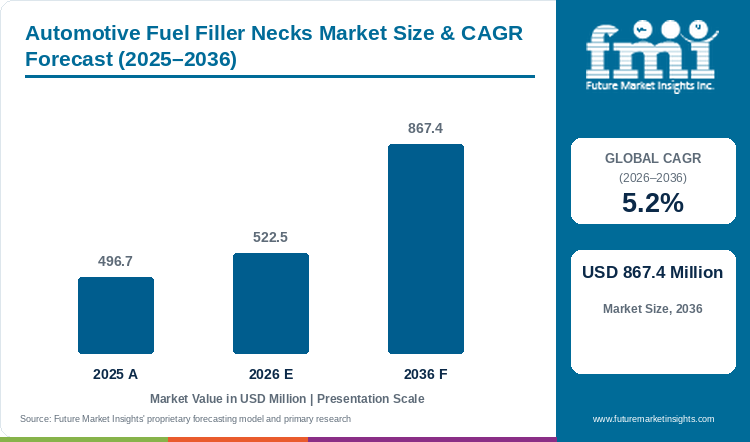
USD 522.5 million in 2026 is growing at a CAGR of 5.2% to reach USD 867.4 million by 2036.
The global automotive fuel filler necks market was valued at USD 496.7 million in 2025 and is estimated to reach USD 522.5 million in 2026. Growing at 5.2% CAGR between 2026-2036, the market is anticipated to reach USD 867.4 million by 2036. As per FMI research, steel-based assemblies are likely to account for leading share, worth 62.0% of total revenue in 2026. Gasoline vehicles lead the fuel mix, and the fleet explains why: petrol and diesel cars were 87.6% of the EU car fleet in 2024, while battery-electric cars were 2.3% [1]. The market therefore has a large installed base that keeps ageing and a new-vehicle mix that is moving toward electric drive.
Table 1: Market Size and Forecast for the Automotive Fuel Filler Necks Market (USD Million), 2025 to 2036
| Market size and forecast | Value |
|---|---|
| 2025 market size | USD 496.7 million |
| Estimated market size in 2026 | USD 522.5 million |
| Projected market size by 2036 | USD 867.4 million |
| CAGR (2026 to 2036) | 5.2% |
| Added revenue, 2026 to 2036 | USD 344.9 million |
Key Market Trends & Insights
- By material: Steel-based assemblies are likely to hold leading share of the automotive fuel filler necks market in 2026, representing 62.0% of total market revenue.
- By fuel type: Gasoline vehicles are likely to lead with a market share of 73.0% in 2026.
- By sales channel: OEM fitment is set to account for 68.0% of the market in 2026.
Regional Highlights
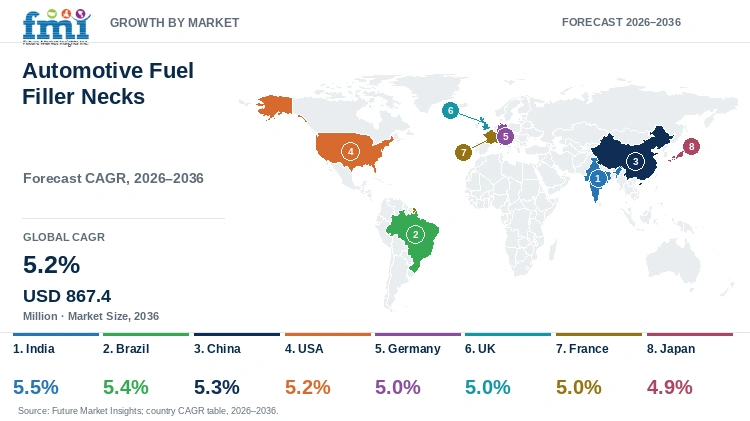
- Brazil is projected to expand at a CAGR of 5.4%, followed by China at 5.3% and the USA at 5.2%. Germany, the UK and France are set to grow at stable rates during the assessment period.
The industry produced 96.4 million vehicles in 2025, up 3.9%, and China alone built 16.6 million new-energy vehicles, up 29% [2]. Electric cars, which the IEA counts as battery-electric and plug-in hybrid, passed 20 million sales in 2025 and reached a 25% share, with almost 55% in China, 28% in Europe and around 10% in the United States [3]. Plug-in hybrids have a fuel tank, so the share of new cars without one is smaller than the electric share suggests. In the EU in 2025, petrol, diesel, hybrid-electric and plug-in hybrid cars together held 79.4% of registrations, against 17.4% for battery-electric [4].
The installed base is the steadier half of demand. US light vehicles in operation numbered 289 million in 2025, with an average age of 12.8 years and a scrappage rate of 4.5% [5]. The EU car fleet stood at 256.0 million in 2024 with an average age of 12.7 years [1], and the UK car parc reached 36,676,185 cars with an average age of 9.7 years [6]. Fleets of this age keep filler necks in service long after the first sale, which is where corrosion protection becomes a purchasing feature.
On the original-equipment side, material choice is shifting at the margin. A patent granted on 18 March 2025 to Hyundai Motor and Kia describes a single-layer polyamide filler neck with nanoclay that blocks evaporative gas, and it rejects both multilayer plastic and steel pipe for added weight and cost [10]. The same document describes the mounting bracket on the tip of a conventional neck as easily displaced by an impact in a collision [10]. For scale, FMI's estimate for filler necks equals about 4.7% of the USD 11.1 billion that FMI sizes for the Automotive Fuel Delivery System market in 2026 [11].
Table 2: Supporting Industry Indicators for the Automotive Fuel Filler Necks Market (mixed units), 2024 to 2026, mixed years
| Indicator | Metric | Why it matters | Source |
|---|---|---|---|
| Global vehicle production | 96.4 million vehicles in 2025, up 3.9% from 92.7 million in 2024. | The annual vehicle build sets the pool of first-fit filler necks. | OICA, Auto industry growth shifted east in 2025, 23 April 2026 [2] |
| China new-energy vehicle production | 16.6 million vehicles in 2025, up 29%, from total output of 34.5 million. | Electric drive is removing part of China's first-fit base. | OICA, Auto industry growth shifted east in 2025, 23 April 2026 [2] |
| Global electric car sales | More than 20 million in 2025, a 25% share. China almost 55%, Europe 28%, United States around 10%, Brazil 9%, India nearly 4%, Japan under 3%. | The electric share, which includes plug-in hybrids, sets how fast first-fit demand shifts by region. | IEA, Global EV Outlook 2026, Trends in electric cars, 2026 [3] |
| EU new car registrations by fuel | Petrol 26.6%, diesel 8.9%, hybrid-electric 34.5%, plug-in hybrid 9.4%, battery-electric 17.4% in 2025. | at least 79.4% of new EU cars carry a fuel tank. | ACEA, New car registrations 2025, 27 January 2026 [4] |
| EU car fleet by fuel | Petrol 49.2%, diesel 38.4%, hybrid-electric 5.0%, plug-in hybrid 1.4%, battery-electric 2.3% in 2024. | The installed fleet is still almost entirely fuelled by liquid fuel. | ACEA, Vehicles on European roads 2026, January 2026 [1] |
| EU car fleet size and age | 256.0 million cars in 2024, with an average age of 12.7 years. | An aged fleet sets the scale of repair demand. | ACEA, Vehicles on European roads 2026, January 2026 [1] |
| US light vehicles in operation | 289 million in 2025, average age 12.8 years, scrappage rate 4.5%. | The US fleet is the largest installed base of the eight profiled countries. | S&P Global Mobility, USA vehicle age rises to 12.8 years, 21 May 2025 [5] |
| US battery-electric share | BEVs fell from 10% to 7% of all new vehicles in model year 2024. | The battery-electric share of new US vehicles fell in model year 2024. | EPA, Highlights of the Automotive Trends Report, updated 19 February 2026 [12] |
| UK car parc | 36,676,185 cars with an average age of 9.7 years, about one in 22 vehicles zero-emission, in 2025. | The UK fleet is young next to the US and EU fleets. | SMMT, UK motorparc data 2025, via AM Online, 2025 [6] |
| Brazil vehicle output | 2.64 million vehicles in 2025, up 3.5%. Licensings 2.69 million, up 2.1%. | Output and sales grew at a moderate pace. | Anfavea, Brazil vehicle production 2025, via Mercado&Consumo, 15 January 2026 [13] |
| India passenger vehicle volumes | 4.64 million units in FY2025-26, up 7.9%. Electric registrations up over 80%. | India combines strong volume growth with a small but fast-growing electric base. | SIAM, FY2025-26 passenger vehicle volumes, via Autoguide India, 15 April 2026 [14] |
| Plastic filler neck patent | US 12,252,005 B2, granted to Hyundai Motor and Kia, 18 March 2025: single-layer polyamide with nanoclay. | The patent shows an original-equipment move to a lighter, lower-cost neck. | USPTO via Google Patents, US 12,252,005 B2 Plastic filler neck, granted 18 March 2025 [10] |
| Steel replacement neck | Dorman listing: steel, corrosion-resistant, direct replacement for specific vehicles. | Replacement catalogues remain steel-based. | Dorman, OE Solutions fuel tank filler neck listing, accessed 8 October 2026 [8] |
| Coated replacement neck | Spectra Premium: dual-coat finish, ground wiring and conductive paint. FN1200: steel, 282 mm, 29 mm inside diameter. | The listing shows corrosion and static features on a replacement neck. | Spectra Premium, fuel filler necks page, accessed 8 October 2026 [7]; Spectra Premium, FN1200 catalogue listing, accessed 8 October 2026 [9] |
| Fuel delivery system market | USD 11.1 billion in 2026, with gasoline holding 53%. | The filler neck is a small part of the wider fuel delivery system. | Future Market Insights, Automotive Fuel Delivery System Market, accessed 8 October 2026 [11] |
Demand Intensity Analysis
The 256.0 million EU cars in use are 23.7 times the 10.8 million cars registered in 2025 [1] [4], and petrol and diesel cars are 87.6% of that fleet, which is about 224.3 million cars [1]. The gasoline share in FMI's estimate, 73.0%, is close to the 74.9% that petrol takes among EU petrol and diesel registrations in 2025 [4].
Table 3: Demand Intensity Metrics for the Automotive Fuel Filler Necks Market (mixed units; production 2025, registrations 2025, fleet 2024 to 2025, revenue 2026)
| Demand intensity metric | Value | Basis |
|---|---|---|
| Global vehicle production, 2025 | 96.4 million vehicles, up 3.9% | OICA, Auto industry growth shifted east in 2025, 23 April 2026 [2] |
| Filler neck revenue per vehicle produced | About USD 5.42 | FMI 2026 estimate of USD 522.5 million against 2025 world motor vehicle production [2] |
| Steel-based and other material revenue, 2026 | USD 323.95 million and USD 198.55 million | FMI estimate: 62.0% and 38.0% of USD 522.5 million |
| Gasoline and diesel revenue, 2026 | USD 381.4 million and USD 141.1 million | FMI estimate: 73.0% and 27.0% of USD 522.5 million |
| OEM fitment and aftermarket replacement revenue, 2026 | USD 355.3 million and USD 167.2 million | FMI estimate: 68.0% and 32.0% of USD 522.5 million |
| Filler neck revenue as a share of the fuel delivery system market, 2026 | About 4.7% | FMI estimate of USD 522.5 million against USD 11.1 billion [11] |
| EU new cars with a fuel tank, 2025 | At least 79.4%: petrol 26.6%, diesel 8.9%, hybrid-electric 34.5% and plug-in hybrid 9.4% | ACEA, New car registrations 2025, 27 January 2026 [4] |
| Petrol share of EU petrol and diesel registrations, 2025 | 74.9%, from 26.6% petrol and 8.9% diesel | ACEA, New car registrations 2025, 27 January 2026 [4] |
| Petrol and diesel share of the EU car fleet, 2024 | 87.6%, or about 224.3 million of 255,999,373 cars | ACEA, Vehicles on European roads 2026, January 2026 [1] |
| EU car fleet against annual registrations | 256.0 million cars in 2024 against 10.8 million registered in 2025, a ratio of 23.7 | ACEA, Vehicles on European roads 2026, January 2026 [1]; ACEA, New car registrations 2025, 27 January 2026 [4] |
| Germany and France petrol and diesel fleet share, 2024 | 88.7% in each country | ACEA, Vehicles on European roads 2026, January 2026 [1] |
| US light vehicles in operation | 289 million, average age 12.8 years, scrappage rate 4.5% | S&P Global Mobility, U.S. vehicle age rises to 12.8 years, 21 May 2025 [5] |
| UK car parc | 36,676,185 cars, average age 9.7 years | SMMT, UK motorparc data 2025, via AM Online, 2025 [6] |
| China new-energy vehicle output against total output, 2025 | 16.6 million of 34.5 million, leaving at least 17.9 million other vehicles | OICA, Auto industry growth shifted east in 2025, 23 April 2026 [2] |
| Electric car sales share, 2025 | Global 25%, China almost 55%, Europe 28%, US around 10%, Brazil 9%, India nearly 4%, Japan under 3% | IEA, Global EV Outlook 2026, Trends in electric cars, 2026 [3] |
| US battery-electric share of new vehicles, model year 2024 | 7%, down from 10% | EPA, Highlights of the Automotive Trends Report, updated 19 February 2026 [12] |
Analyst Perspective
"The durable opportunity is an assembly that fits correctly and maintains the intended fuel path. A supplier's model coverage and material protection are more useful purchasing signals than a broad claim about automotive electrification."
- Nikhil Kaitwade, Principal Consultant, Future Market Insights.
How is the automotive fuel filler necks market segmented?
The market is segmented by material, fuel type, sales channel, and region.
- By material: steel-based assemblies, polymer and composite assemblies, and other metal assemblies.
- By fuel type: gasoline vehicles and diesel vehicles.
- By sales channel: OEM fitment and aftermarket replacement.
- By region: North America, Latin America, Europe, East Asia, South Asia and Pacific, and Middle East and Africa.
Why do Steel-based Assemblies lead the Material category?
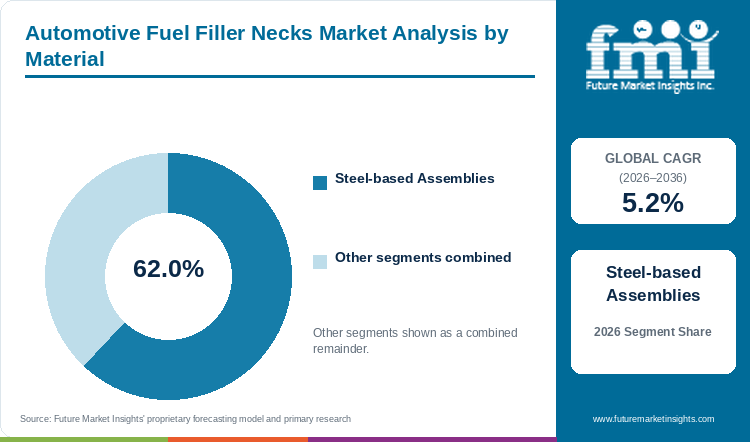
Based on material, steel-based assemblies are projected to account for 62.0% in 2026, as replacement assemblies match the original steel path in many applications.
The supplier catalogues for this segment are steel-based. Dorman lists a steel neck made of corrosion-resistant materials [8], and Spectra Premium's FN1200 is a steel neck [9], on a range that the brand lists with a dual-coat finish [7]. Polymer is gaining ground at the original-equipment end. The 2025 Hyundai and Kia patent describes a single-layer polyamide neck that avoids the weight and cost of steel pipe [10]. Alternative materials, covered in FMI's Automotive Plastic report, therefore have to be judged against the complete fuel-system design and not against weight alone.
- Steel is expected to keep the larger share because replacement necks are matched to original steel parts [8] [9].
- Polymer is expected to widen its role in first fit as designs such as the 2025 patent reduce weight and cost [10].
Why do Gasoline Vehicles lead the Fuel Type category?
By fuel type, gasoline vehicles are projected to account for 73.0% in 2026, in line with their weight in new registrations.
The EU registration mix shows the proportion. Petrol took 26.6% of 2025 registrations and diesel 8.9%, down 24.2%, so petrol is 74.9% of the two together [4]. The fleet reads differently, with petrol at 49.2% and diesel at 38.4%, and diesel's 27.0% in FMI's estimate sits above its 25.1% share of EU petrol and diesel registrations, which fits a fleet that carries more diesel [1]. A gasoline filler path also connects to the vent and evaporative arrangements. The FN1200 carries one vent line [9], and the Hyundai and Kia patent addresses evaporative gas flowing along the pipe [10]. FMI's Low-Permeation Fuel Lines & Hoses report covers the permeation-resistant lines on that side of the fuel system.
- Gasoline vehicles are expected to stay ahead because petrol is 74.9% of EU petrol and diesel registrations [4].
- Diesel is expected to keep a defined share through its large installed fleet, at 38.4% of EU cars [1].
Why does OEM Fitment lead the Sales Channel category?
By sales channel, OEM fitment is projected to account for 68.0% in 2026, as first-fit orders follow the production of vehicles with a fuel tank.
Production sets the first-fit base: 96.4 million vehicles in 2025 [2], of which at least 79.4% of new EU cars carry a fuel tank [4]. Replacement follows the condition of vehicles in use, and those fleets are large and old, at 289 million vehicles in the US [5] and 256.0 million cars in the EU [1]. FMI's estimate gives aftermarket replacement 32.0%. Coverage by model year is how the aftermarket reaches older platforms. Dorman lists necks for specific vehicle years, makes and models [8], and the FN1200 is listed for 2003 to 2006 models [9].
- First-fit supply is expected to remain the larger channel because at least 79.4% of new EU cars carry a fuel tank [4].
- Aftermarket replacement is expected to hold a firm share because the average US vehicle is 12.8 years old [5].
What are the drivers, restraints, and opportunities in the automotive fuel filler necks market?
The key driver is the large, ageing fleet of liquid-fuel vehicles, the restraint is the shift to electric drive, and coated replacement and lighter original designs provide the opportunity.
- Driver: Large and ageing fleets keep repair demand in place after first-fit supply has ended.
- Restraint: Battery-electric vehicles need no filler neck, so every point of electric share removes first-fit demand.
- Opportunity: Coated replacement necks and lighter original-equipment designs create room for suppliers that cover fit and material.
Ageing Fleets Support Replacement Demand
US light vehicles in operation numbered 289 million in 2025, with an average age of 12.8 years [5]. The EU car fleet stood at 256.0 million with an average age of 12.7 years [1], and the UK car parc at 36.7 million with an average age of 9.7 years [6]. A neck stays on the vehicle for as long as the vehicle runs, and it is held to its route by body mounting points. Attachment hardware of the kind covered in FMI's Automotive Fasteners report keeps that route in place, so a replacement has to restore both the tube and its support. Fleets of this size and age are expected to sustain replacement demand and support automotive fuel filler necks market growth.
Electric Drive Narrows the First-Fit Base
Battery-electric cars have no filler path. They were 17.4% of EU registrations in 2025 [4], and electric cars took almost 55% of sales in China [3]. The shift is uneven. In the US, BEVs fell from 10% to 7% of new vehicles in model year 2024 [12], and plug-in hybrids and hybrids keep a tank in every region. The installed base moves much more slowly, with battery-electric cars at 2.3% of the EU fleet [1]. Faster electric adoption may therefore slow first-fit demand and hamper the automotive fuel filler necks market growth, while repair demand persists.
Coated Replacement and Lighter Designs Open New Opportunities
Suppliers can add value on two fronts. For repair, Spectra Premium lists a dual-coat finish with ground wiring and conductive paint [7], and Dorman lists direct replacement necks built to meet emission and inspection standards [8]. For first fit, the 2025 Hyundai and Kia patent describes a single-layer polyamide neck that blocks evaporative gas without multilayer construction [10]. A supplier that covers both the exact repair and the lighter original design is positioned for either side of the market. These factors are expected to extend coverage across vehicle generations and favour suppliers with accurate fitment data.
Which country CAGRs are profiled in the automotive fuel filler necks market?
Table 4: Country CAGRs for the Automotive Fuel Filler Necks Market (%), 2026 to 2036
| Country | CAGR |
|---|---|
| India | 5.5% |
| Brazil | 5.4% |
| China | 5.3% |
| USA | 5.2% |
| Germany | 5.0% |
| UK | 5.0% |
| France | 5.0% |
| Japan | 4.9% |
Country-wise Analysis
- India: India's automotive fuel filler necks market is expected to grow at a 5.5% CAGR through 2036, the highest among the eight countries. Vehicle production increased by 8% to 6.5 million units in 2025. Passenger vehicle sales also reached 4.64 million units in FY2025-26 after growing by 7.9%. Electric cars accounted for nearly 4% of sales. Most new vehicles therefore continue to require fuel filler necks for their petrol or diesel systems. For component manufacturers, higher vehicle output creates opportunities to supply original equipment. The availability of locally manufactured filler neck assemblies and their use across different vehicle models will also influence future orders.
- Brazil: A growing domestic automotive industry will provide opportunities for fuel filler neck suppliers in Brazil. Local manufacturers produced 2.64 million vehicles in 2025 after recording a 3.5% increase in output. New vehicle registrations also rose by 2.1% to 2.69 million. Electric cars represented 9% of new car sales, leaving a substantial market for vehicles that use liquid fuels. Manufacturers of filler neck assemblies can serve both domestic vehicle production and replacement requirements. Brazil's market is projected to register a 5.4% CAGR through 2036 as demand continues for components used in petrol and flex-fuel vehicles.
- China: China's automotive fuel filler necks market is forecast to grow at a 5.3% CAGR through 2036. Domestic factories manufactured 34.5 million vehicles in 2025 and 16.6 million of these were classified as new-energy vehicles. The remaining 17.9 million vehicles provide a substantial production base outside the new-energy category. Plug-in hybrids also require fuel filler necks because they retain conventional fuel tanks. However, electric cars accounted for almost 55% of new car sales during the year. The changing sales mix will influence future orders as fully electric models do not require conventional fuel-filling assemblies. Suppliers will continue to receive business from petrol vehicles and plug-in hybrids but will need to account for changes in vehicle production plans.
- USA: Replacement demand is particularly important for automotive fuel filler neck suppliers in the United States. The country has around 289 million light vehicles in operation with an average age of 12.8 years. Older vehicles may require replacement of filler neck assemblies when corrosion or damage affects the fuel-filling system. Meanwhile, domestic vehicle production declined by 3% to 10.2 million units in 2025. Battery-electric vehicles accounted for 7% of new vehicles in model year 2024. Conventional and hybrid fuel systems therefore remain widely used. The US market is expected to expand at a 5.2% CAGR through 2036 with demand coming from both new vehicle assembly and replacement parts.
- Germany: Germany produced 4.1 million cars in 2025 following a 2% increase in output. New passenger car registrations reached 2,857,591 during the year. The existing vehicle fleet also provides business for fuel filler neck manufacturers. Petrol and diesel cars account for 88.7% of the country's 49.3 million passenger vehicles. Their average age stands at 10.6 years. Older fuel-filling components may need replacement when damage or deterioration affects their operation. Germany's automotive fuel filler necks market is projected to grow at a 5.0% CAGR through 2036. Both original-equipment orders and vehicle-specific replacement parts will contribute to demand.
- UK: Vehicle manufacturing in the UK declined sharply during 2025. Production fell by 16% to 0.76 million units, reducing the domestic assembly base for original-equipment suppliers. The country nevertheless has 36,676,185 cars in operation with an average age of 9.7 years. This creates a substantial market for replacement fuel-system components. Imported petrol and hybrid vehicles also require fuel filler necks regardless of where they are manufactured. Suppliers serving repair workshops will need parts compatible with different vehicle models and fuel tank arrangements. Demand in the UK is expected to grow at a 5.0% CAGR through 2036.
- France: France recorded an 8% increase in vehicle production during 2025 and manufactured 1.5 million cars and light commercial vehicles. New car registrations followed a different trend and declined to 1,632,152 from 1,718,416. The country has an existing fleet of 39.7 million cars with an average age of 11.5 years. Petrol and diesel vehicles represent 88.7% of that fleet. These vehicles will continue to require fuel-filling components during their remaining service life. Replacement demand will depend on the condition of existing assemblies and the availability of suitable parts. The French automotive fuel filler necks market is projected to expand at a 5.0% CAGR through 2036.
- Japan: Japan has the lowest projected growth rate among the eight countries at 4.9% through 2036. Its automotive industry produced 8.4 million vehicles in 2025 after recording a 2% increase in output. Electric car sales exceeded 100,000 units but remained below 3% of the market. Most vehicles sold in Japan therefore continue to use liquid-fuel systems, including hybrid models with petrol engines. Demand for filler neck assemblies will remain tied to these vehicle types and their production volumes. Replacement requirements from vehicles already in use will provide additional business. The relatively low electric-car sales share also indicates that battery-electric adoption alone does not explain Japan's lower market growth forecast.
Who are the notable companies in the automotive fuel filler necks market?
Dorman, Spectra Premium and Hyundai Motor with Kia are the companies with filler neck listings or patents profiled in this market.
The companies cover two sides of the market. Dorman and Spectra Premium list replacement necks for specific vehicles [8] [7] [9]. Hyundai Motor and Kia hold a 2025 patent for a lighter original-equipment neck [10].
- Dorman: OE Solutions fuel tank filler neck, a steel direct replacement for specific vehicle years, makes and models [8].
- Spectra Premium: fuel filler necks with a dual-coat finish, ground wiring and conductive paint, including the FN1200 steel neck [7] [9].
- Hyundai Motor and Kia: US 12,252,005 B2, a single-layer polyamide filler neck with nanoclay, granted 18 March 2025 [10].
Competitive Benchmarking: Automotive Fuel Filler Necks Market
Table 5: Competitive Benchmarking for the Automotive Fuel Filler Necks Market (patents and product listings), 2025 to 2026, mixed years
| Company | Filler neck listing or patent | Material | Key detail | Source |
|---|---|---|---|---|
| Dorman | OE Solutions fuel tank filler neck | Steel, corrosion-resistant | Direct replacement for specific vehicle years, makes and models, built to meet emission and inspection standards. | Dorman, OE Solutions fuel tank filler neck listing, accessed 8 October 2026 [8] |
| Spectra Premium | Fuel filler necks, including FN1200 | Steel in the FN1200 | Dual-coat finish, ground wiring and conductive paint. FN1200 is 282 mm long with a 29 mm fill pipe inside diameter and one 8 mm vent line. | Spectra Premium, fuel filler necks page, accessed 8 October 2026 [7]; Spectra Premium, FN1200 catalogue listing, accessed 8 October 2026 [9] |
| Hyundai Motor and Kia | US 12,252,005 B2, granted 18 March 2025 | Single-layer polyamide with nanoclay | Nanoclay blocks evaporative gas. The design avoids the weight and cost of multilayer plastic and steel pipe. | USPTO via Google Patents, US 12,252,005 B2 Plastic filler neck, granted 18 March 2025 [10] |
Key Players in the Automotive Fuel Filler Necks Market
Replacement Filler Neck Suppliers
- Dorman
- Spectra Premium
Original-Equipment Filler Neck Developers
- Hyundai Motor
- Kia
Automotive Fuel Filler Necks Market - Report Scope
Table 6: Report Scope for the Automotive Fuel Filler Necks Market (descriptive), 2025 to 2036
| Coverage field | Report scope |
|---|---|
| Market breakdown | Material, fuel type, sales channel, and region |
| Quantitative units | USD million |
| Market definition | Vehicle filler-neck assemblies that convey gasoline or diesel from the refuelling inlet to the tank. Fuel tanks and complete evaporative-control systems are excluded. Charging inlets are excluded. |
| Regions covered | North America, Latin America, Europe, East Asia, South Asia and Pacific, Middle East and Africa |
| Countries covered | China, India, USA, Germany, Japan, UK, France, Brazil |
| Key companies profiled | Dorman, Spectra Premium, Hyundai Motor, Kia |
| Forecast period | 2026 to 2036 |
| Approach | Secondary research with market modelling |
Automotive Fuel Filler Necks Market - Research Methodology
Table 7: Research Methodology for the Automotive Fuel Filler Necks Market (descriptive), 2025 to 2036
| Method | Approach |
|---|---|
| Desk Research | Desk research includes vehicle production, registration and fleet statistics, electric vehicle market data, patent documents, and supplier product listings. |
| Market Sizing and Forecasting | Market values and segment shares are FMI estimates. The 2026 estimate of USD 522.5 million is rolled forward at a 5.2% CAGR over the 2026 to 2036 period. Country growth rates are FMI estimates. |
| Technical Evidence | Patent documents and supplier product listings show how filler necks are specified, protected and fitted. Commercial implications are FMI analysis. |
| Competitive Assessment | Companies are included where public documents show a filler neck listing or patent. |
| Data Validation | Production, registration, fleet, patent and product figures are cross-checked against the published source documents. |
Automotive Fuel Filler Necks Market by Segments
Automotive Fuel Filler Necks Market segmented by Material:
- Steel-based Assemblies
- Polymer and Composite Assemblies
- Other Metal Assemblies
Automotive Fuel Filler Necks Market segmented by Fuel Type:
- Gasoline Vehicles
- Diesel Vehicles
Automotive Fuel Filler Necks Market segmented by Sales Channel:
- OEM Fitment
- Aftermarket Replacement
Automotive Fuel Filler Necks Market by Region
- North America
- United States
- Canada
- Latin America
- Brazil
- Mexico
- Rest of Latin America
- Europe
- Germany
- United Kingdom
- France
- Italy
- Rest of Europe
- East Asia
- China
- Japan
- South Korea
- South Asia and Pacific
- India
- Australia
- Rest of South Asia and Pacific
- Middle East and Africa
- GCC Countries
- South Africa
- Rest of Middle East and Africa
Research Sources and Bibliography
- [1] ACEA: Vehicles on European roads 2026. Report, January 2026.
- [2] OICA: Auto industry growth shifted east in 2025 amid global repositioning. Press release, 23 April 2026.
- [3] International Energy Agency: Global EV Outlook 2026, Trends in electric cars. Report chapter, 2026.
- [4] ACEA: New car registrations, +1.8% in 2025; battery-electric 17.4% market share. Press release, 27 January 2026.
- [5] S&P Global Mobility: U.S. vehicle age rises again to 12.8 years in 2025. Press release, 21 May 2025.
- [6] SMMT: UK motorparc data 2025, as reported by AM Online in UK vehicle parc hits record 42.5m as EVs rise but fleet ages. News report, 2025.
- [7] Spectra Premium: Fuel filler necks. Product page, accessed 8 October 2026.
- [8] Dorman: OE Solutions fuel tank filler neck. Retailer product listing on Vivid Racing, accessed 8 October 2026.
- [9] Spectra Premium: FN1200 filler neck. Electronic catalogue listing, accessed 8 October 2026.
- [10] US Patent 12,252,005 B2: Plastic filler neck for vehicles. Hyundai Motor Company and Kia Corporation, granted 18 March 2025.
- [11] Future Market Insights: Automotive Fuel Delivery System Market. Report page, accessed 8 October 2026.
- [12] US Environmental Protection Agency: Highlights of the Automotive Trends Report. Web page, last updated 19 February 2026.
- [13] Anfavea: Brazil vehicle production and licensing 2025, as reported by Mercado&Consumo. News report, 15 January 2026.
- [14] SIAM: FY2025-26 passenger vehicle volumes, as reported by Autoguide India. News report, 15 April 2026.
- OICA: World motor vehicle production 2025, all vehicles by country. Production table, April 2026.
This Report Answers
- How large is the Automotive Fuel Filler Necks Market in 2026 and what value is forecast for 2036?
- How does the 5.2% CAGR shape the outlook to 2036?
- Why do steel-based assemblies lead the material category?
- How does the gasoline segment influence purchasing priorities?
- How do fleet age and powertrain mix change filler neck demand?
- Why does OEM fitment lead the sales channel?
- How do growth rates differ across the eight profiled countries?
- Which companies list filler necks or hold recent patents?
Frequently Asked Questions
How large is the Automotive Fuel Filler Necks Market expected to be in 2026?
Future Market Insights estimates that the automotive fuel filler necks market will reach USD 522.5 million in 2026. The market is projected to expand further and reach USD 867.4 million by 2036.
What CAGR is forecast for the Automotive Fuel Filler Necks Market through 2036?
As per FMI, the automotive fuel filler necks market is projected to grow at a 5.2% CAGR from 2026 to 2036. Growth is supported by a large and ageing fleet of liquid-fuel vehicles.
Which material holds a notable share of the automotive fuel filler necks market in 2026?
Future Market Insights projects steel-based assemblies to hold 62.0% of material revenue in 2026. Replacement necks are matched to the original steel parts in many applications.
Which sales channel holds a notable share in 2026?
FMI finds that OEM fitment will hold 68.0% of sales channel revenue in 2026. First-fit orders follow the production of vehicles with a fuel tank.
Which country has a notable expansion outlook?
Future Market Insights predicts India to expand at a 5.5% CAGR during the 2026 to 2036 assessment period. India produced 6.5 million vehicles in 2025.
What is the main constraint on adoption?
Battery-electric vehicles do not need a filler neck, so the outlook is sensitive to the powertrain mix of new production. Plug-in hybrids and hybrids keep a fuel tank, and the installed fleet changes slowly.
Preview the report firsthand - request a free sample
Get SampleGet the brochure for pricing and purchase details.
Get PDFTable of Content
- Automotive Fuel Filler Necks Market Summary
- Key Market Trends & Insights
- Regional Highlights
- Demand Intensity Analysis
- Analyst Perspective
- Segmentation Analysis
- How is the automotive fuel filler necks market segmented?
- Why do Steel-based Assemblies lead the Material category?
- Why do Gasoline Vehicles lead the Fuel Type category?
- Why does OEM Fitment lead the Sales Channel category?
- Market Dynamics
- What are the drivers, restraints, and opportunities in the automotive fuel filler necks market?
- Ageing Fleets Support Replacement Demand
- Electric Drive Narrows the First-Fit Base
- Coated Replacement and Lighter Designs Open New Opportunities
- Country-wise Analysis
- Which country CAGRs are profiled in the automotive fuel filler necks market?
- Country-wise Analysis
- Who are the notable companies in the automotive fuel filler necks market?
- Competitive Benchmarking: Automotive Fuel Filler Necks Market
- Key Players in the Automotive Fuel Filler Necks Market
- Replacement Filler Neck Suppliers
- Original-Equipment Filler Neck Developers
- Report Scope and Methodology
- Automotive Fuel Filler Necks Market - Report Scope
- Automotive Fuel Filler Necks Market - Research Methodology
- Automotive Fuel Filler Necks Market by Segments
- Automotive Fuel Filler Necks Market segmented by Material:
- Automotive Fuel Filler Necks Market segmented by Fuel Type:
- Automotive Fuel Filler Necks Market segmented by Sales Channel:
- Automotive Fuel Filler Necks Market by Region
- Research Sources and Bibliography
- This Report Answers
- Frequently Asked Questions
- Competitive Landscape


