

- Industry Size (2026)
- USD 65.1 Bn
- Forecast (2036)
- USD 110.1 Bn
- CAGR (2026 to 2036)
- 5.4%
Automotive Fuel Accumulator Market Forecast and Outlook By FMI
In 2025, the Automotive Fuel Accumulator Market secured a value of USD 5.5 billion. Based on Future Market Insights' analysis, demand is estimated to grow to USD 5.8 billion in 2026 and USD 10.7 billion by 2036. FMI projects a CAGR of 6.2% during the forecast period.
The sector is undergoing a structural reset driven by stringent emission norms like Euro 7 and EPA stringent standards, compelling OEMs to optimize fuel delivery systems for maximum efficiency. The transition to hybrid vehicles is creating a sustained demand for advanced accumulators capable of managing the frequent start-stop cycles of internal combustion engines. While full electrification poses a long-term threat, the massive existing ICE fleet and the bridge technology of hybrids ensure a robust decade of growth.
Automotive Fuel Accumulator Key Takeaways
- Market Definition:
- The industry covers components essential for maintaining fuel line pressure and dampening noise in ICE and hybrid vehicles.
- Demand Drivers:
- Strict emission regulations necessitate precise fuel delivery, boosting demand for high-performance accumulators.
- The proliferation of hybrid vehicles requires reliable start-stop functionality, a key role of the accumulator.
- Consumer demand for quieter cabins drives the need for effective pulsation dampening.
- Key Segments Analyzed:
- Sales Channel: OEM (53.4% share) dominates due to direct integration into new vehicle fuel systems.
- Vehicle Type: Passenger Cars (41.7% share) lead due to high production volumes and consumer focus on comfort.
- Geography: Asia Pacific leads volume growth, supported by massive automotive manufacturing hubs in China and India.
- Analyst Opinion:
- Nikhil Kaitwade, Principal Consultant at Future Market Insights, opines, "In the updated Automotive Fuel Accumulator Market Report for 2026 to 2036, CXOs will find that value capture is moving from commodity hardware to 'System Integration.' My findings point at a 'Hybrid Resilience' where accumulators optimized for the specific pressure cycles of hybrid powertrains will command steady demand despite the EV transition."
- Strategic Implications:
- Partner with OEMs on next-gen hybrid platforms to secure long-term supply contracts.
- Invest in lightweight materials to contribute to overall vehicle weight reduction goals.
- Expand aftermarket distribution networks in emerging markets with aging vehicle fleets.
- Methodology:
- Validated through primary interviews with fuel system engineers and procurement managers.
- Zero reliance on speculative third-party market research reports.
- Based on verifiable vehicle production statistics and component attachment rates.
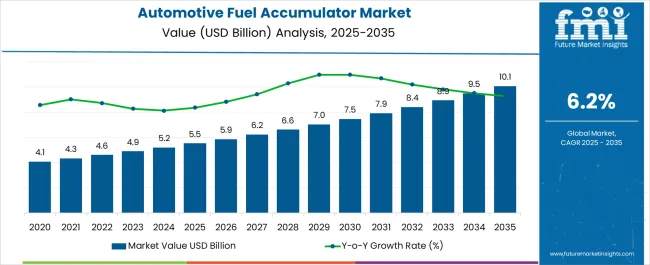
Markus Heyn, Chairman of the Mobility business sector at Robert Bosch GmbH, noted that, “While we are still convinced that electrification will make its way, it will not be linear. Therefore, we will continue investing in our competence in combustion engines, and not let it die as it would not be a good idea because the projections three years ago were completely different.” [1] This perspective reinforces FMI’s view that combustion engine-related technologies, including advanced fuel delivery and accumulator systems, will remain strategically important through the hybrid transition and tightening emissions regulations.
China (8.4% CAGR), India (7.8% CAGR), Germany (7.1% CAGR), Brazil (6.5% CAGR), and the USA (5.9% CAGR) are driving global expansion, with growth weighted heavily toward regions with large vehicle production bases and tightening emission regulations.
Automotive Fuel Accumulator Market Definition
The automotive fuel accumulator market comprises the global engineering, production, and trade of components designed to maintain residual pressure in the fuel lines of internal combustion engines after the engine is turned off. These devices dampen pressure pulses from the fuel pump, reduce noise, and ensure immediate restart capabilities, particularly in hot conditions (vapor lock prevention).
Market Inclusions
The report includes a comprehensive analysis of market dynamics, featuring Global and Regional Market Sizes (Volume and Value) and a 10-year Forecast (2026 to 2036). It covers segmental breakdowns by Sales Channel (OEM, Aftermarket) and Vehicle Type (Passenger Cars, LCV, HCV). It specifically tracks the adoption of fuel accumulators in gasoline and diesel injection systems.
Market Exclusions
The scope excludes general-purpose hydraulic accumulators not specifically designed for automotive fuel systems. It also omits fuel tanks, pumps, and filters unless sold as part of an integrated fuel delivery module containing an accumulator.
Research Methodology
- Primary Research: Interviews were conducted with product managers at Tier-1 automotive suppliers, R&D heads at OEM fuel system divisions, and aftermarket distributors.
- Desk Research: Production data from the International Organization of Motor Vehicle Manufacturers (OICA), corporate annual reports of key players (Bosch, Denso, Continental), and regulatory filings supported volume benchmarking.
- Market-Sizing and Forecasting: A hybrid top-down and bottom-up model was developed, reconstructing demand from global vehicle production forecasts and fuel system technology trends.
- Data Validation and Update Cycle: Outputs undergo anomaly screening against regional engine production data and structured peer review prior to release.
Segmental Analysis
Automotive Fuel Accumulator Market Analysis by Sales Channel
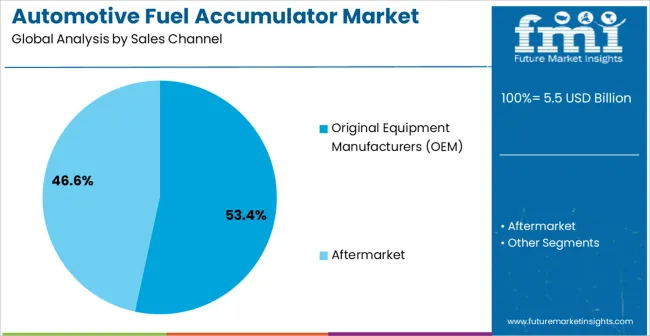
The Original Equipment Manufacturers (OEM) segment is projected to account for 53.4% of the market revenue in 2026. This dominance is driven by the integral nature of fuel accumulators in vehicle design; automakers source these components directly to ensure seamless integration with complex engine management systems and to meet stringent warranty and performance standards essential for new vehicle certification.
- Integration Focus: OEMs require accumulators that are custom-designed to fit specific platform architectures and pressure requirements.
- Quality Assurance: Direct supply ensures strict adherence to quality control, critical for preventing fuel leaks and ensuring safety.
- Volume Contracts: Large-scale procurement for global vehicle platforms drives significant revenue volume through this channel.
Automotive Fuel Accumulator Market Analysis by Vehicle Type
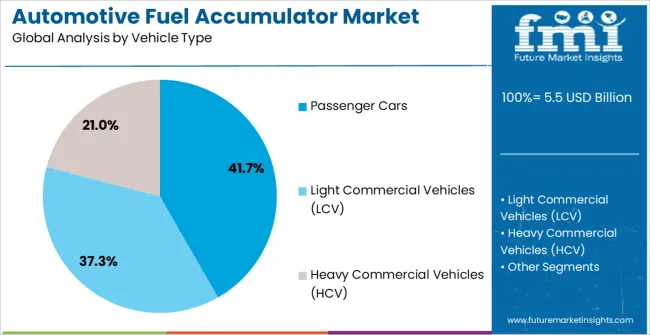
The Passenger Cars segment is anticipated to hold 41.7% of the market share in 2026. This leadership is underpinned by the sheer scale of global passenger vehicle production and the high consumer expectation for refined driving experiences, where accumulators play a key role in minimizing engine noise and ensuring smooth, reliable starts in daily commuting scenarios.
- Hybrid Adoption: The passenger car segment is seeing the highest penetration of hybrid technology, which relies on accumulators for frequent engine restarts.
- Comfort Demands: NVH reduction is a primary selling point in the passenger segment, driving the use of high-quality dampeners.
- Emission Compliance: Stringent regulations on passenger fleets force manufacturers to adopt advanced fuel systems.
Automotive Fuel Accumulator Drivers, Restraints, Opportunities
Future Market Insights analysis observes that the tightening of global emission standards is the primary accelerator. Regulations such as Euro 7 in Europe and Corporate Average Fuel Economy (CAFE) standards in the US compel automakers to squeeze every bit of efficiency from internal combustion engines. Fuel accumulators play a vital role here by ensuring consistent fuel pressure for optimal combustion and reducing evaporative emissions [2].
However, growth is restrained by the rapid shift towards Battery Electric Vehicles (BEVs). As major markets like the EU and California mandate the phase-out of ICE vehicles by 2035, the total addressable market for fuel systems faces a long-term existential threat. The opportunity lies in the Hybrid Transition, where hybrid electric vehicles (HEVs) and plug-in hybrids (PHEVs) will serve as a bridge technology for decades, particularly in regions with developing charging infrastructure. Additionally, the massive global aftermarket offers a stable revenue stream as the existing fleet of billions of ICE vehicles requires maintenance.
- Noise, Vibration, and Harshness (NVH) Reduction: Automakers are increasingly focused on cabin quietness; accumulators that effectively dampen fuel pump noise are in high demand.
- Emerging Markets: Increasing vehicle ownership in India, Southeast Asia, and Latin America provides a growth engine countering saturation in developed markets.
- Biofuel Compatibility: Developing accumulators resistant to corrosive biofuels (ethanol, biodiesel) presents a technical niche for innovation.
Regional Analysis
Based on the regional analysis, the Automotive Fuel Accumulator market is segmented into North America, Latin America, Europe, East Asia, South Asia & Pacific, and Middle East & Africa across 42+ countries. The full report offers market attractiveness analysis based on vehicle production trends.
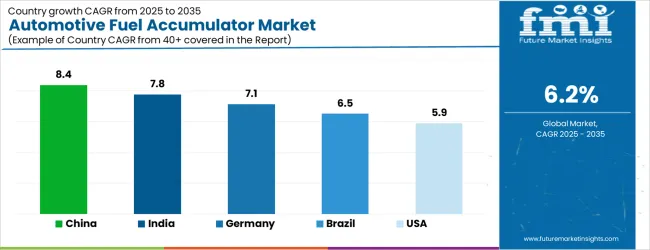
| Country | CAGR (2026 to 2036) |
|---|---|
| China | 8.4% |
| India | 7.8% |
| Germany | 7.1% |
| Brazil | 6.5% |
| USA | 5.9% |
| UK | 5.3% |
| Japan | 4.7% |
Source: Future Market Insights (FMI) analysis, based on proprietary forecasting model and primary research.
East Asia Automotive Fuel Accumulator Market Analysis
East Asia currently commands the largest share of global market volume, solidifying its position as the world's premier automotive manufacturing hub. This dominance is anchored by the region's colossal production output and a dual strategic focus on modernizing internal combustion engines while aggressively scaling New Energy Vehicles, ensuring sustained demand for advanced fuel system technologies.
- China: Demand is projected to escalate at an 8.4% CAGR through 2036. The market is propelled by China's massive vehicle production output and the government's dual focus on "New Energy Vehicles" (which includes hybrids) and cleaner ICE standards (China 6b) [3].
- Japan: A 4.7% CAGR is anticipated. Japan's automotive giants (Toyota, Honda) are global leaders in hybrid technology, ensuring sustained domestic demand for high-quality fuel system components.
FMI’s report includes a detailed analysis of growth in the East Asia region, along with a country-wise assessment that includes China, Japan, and South Korea.
South Asia & Pacific Automotive Fuel Accumulator Market Analysis
South Asia & Pacific is recognized as the fastest-growing region globally, primarily driven by rapidly rising disposable incomes and surging motorization rates among the middle class. This expansion is further accelerated by the region's transformation into a critical export hub for small cars and components, attracting significant foreign investment into local manufacturing ecosystems.
- India: An 7.8% CAGR is projected. Growth is supported by the booming passenger vehicle market and the implementation of BS-VI emission norms, which require advanced fuel injection systems and associated components like accumulators [4].
- ASEAN: The region is emerging as a key production hub for Japanese OEMs, driving demand for localized component supply chains.
FMI’s report includes a detailed analysis of growth in the South Asia & Pacific region, covering India, ASEAN, and Australia.
Western Europe Automotive Fuel Accumulator Market Analysis
Western Europe represents a highly mature market that prioritizes high-value, technologically advanced components over sheer volume growth. The region's industry is defined by stringent environmental regulations and a relentless pursuit of noise, vibration, and harshness (NVH) reduction, driving the adoption of premium fuel accumulators in luxury and high-performance vehicle segments.
- Germany: The market is forecast to expand at a 7.1% CAGR through 2036. As the home of premium automakers, Germany drives innovation in high-pressure fuel systems and NVH reduction technologies.
- UK: A 5.3% CAGR is expected, supported by a resilient automotive manufacturing sector and a strong aftermarket for vehicle maintenance.
FMI’s report includes a detailed analysis of growth in Western Europe, including Germany, UK, France, and Italy.
Competitive Aligners for Market Players
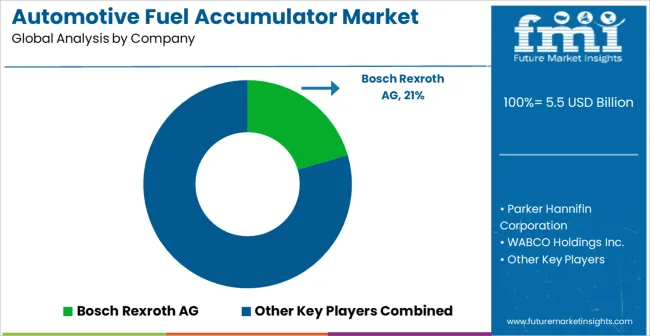
The market structure for automotive fuel accumulators is moderately consolidated, characterized by a select group of established Tier-1 suppliers who command the OEM landscape. While cost competitiveness remains relevant, the primary basis of competition is aggressively shifting from price arbitrage to system efficiency, hydraulic reliability, and noise, vibration, and harshness (NVH) performance. To secure their dominance, market leaders are actively pursuing consolidation strategies, acquiring niche manufacturers to integrate specialized diaphragm and piston technologies that meet stringent emission standards.
Furthermore, these incumbents are strengthening their positions through strategic partnerships and the expansion of global manufacturing footprints. This "local-for-local" approach allows them to serve major OEMs in key hubs like China and Germany directly, mitigating supply chain risks while ensuring just-in-time delivery for complex, high-pressure fuel systems essential for modern hybrid and internal combustion architectures.
Recent Developments:
- In April 2024, AdrenoMed AG received FDA Fast Track designation for Enibarcimab, a first-in-class antibody targeting septic shock. This is a critical development for the Ischemic Hepatitis market, as septic shock is a primary cause of liver hypoperfusion, and this drug targets the root cause of vascular leakage [10].
- In March 2025, a landmark review published in Frontiers in Immunology identified Nanodrug Delivery Systems and Mitochondrial Protection Agents (such as DCR3-SUMO proteins) as the next therapeutic frontier for Sepsis-Induced Liver Injury (SILI). This validation moves the market beyond simple supportive care toward targeted cytoprotection [5].
- In January 2024, European health authorities (HAS/EMA) updated the clinical positioning of Giapreza (Angiotensin II), confirming its role as a last-line vasopressor for refractory shock. This solidifies the "Hemodynamic Support" segment as the primary revenue driver for managing the hypotension that causes shock liver [6].
Key Players in Automotive Fuel Accumulator Market
- Bosch Rexroth AG
- Parker Hannifin Corporation
- WABCO Holdings Inc. (ZF)
- Continental AG
- Denso Corporation
- NOK Corporation
- Freudenberg Sealing Technologies
- Magneti Marelli (Marelli)
Scope of the Report
| Metric | Value |
|---|---|
| Quantitative Units | USD 5.8 billion (2026) to USD 10.7 billion (2036), at a CAGR of 6.2% |
| Market Definition | The automotive fuel accumulator market comprises components used to maintain residual pressure, dampen noise, and ensure smooth fuel flow in the fuel lines of internal combustion engines. |
| Sales Channel Segmentation | Original Equipment Manufacturers (OEM), Aftermarket |
| Vehicle Type Segmentation | Passenger Cars, Light Commercial Vehicles (LCV), Heavy Commercial Vehicles (HCV) |
| Regions Covered | North America, Latin America, Western Europe, Eastern Europe, East Asia, South Asia & Pacific, Middle East & Africa |
| Countries Covered | USA, Canada, Brazil, Germany, UK, France, China, Japan, India, South Korea, Saudi Arabia, South Africa |
| Key Companies Profiled | Bosch Rexroth AG, Parker Hannifin Corporation, WABCO Holdings Inc., Continental AG, Denso Corporation, NOK Corporation, Freudenberg Sealing Technologies, Magneti Marelli |
| Forecast Period | 2026 to 2036 |
| Approach | Hybrid top-down and bottom-up market modeling validated through primary interviews with automotive engineers and procurement managers, supported by vehicle production benchmarks and component attachment rates. |
Automotive Fuel Accumulator Market Analysis by Segments
Sales Channel:
- Original Equipment Manufacturers (OEM)
- Aftermarket
Vehicle Type:
- Passenger Cars
- Light Commercial Vehicles (LCV)
- Heavy Commercial Vehicles (HCV)
Region:
- North America
- Latin America
- Western Europe
- Eastern Europe
- East Asia
- South Asia & Pacific
- Middle East & Africa
Bibliography
- [1] [Autocar Professional Bureau. (2024). Bosch expects continued demand for ICE-based hybrid vehicles in foreseeable future.
- [2] European Commission. (2022). Euro 7: New rules for vehicle emissions.
- [3] International Council on Clean Transportation. (2023). China Stage 6 Emission Standard for Light-duty Vehicles.
- [4] Society of Indian Automobile Manufacturers. (2024). Automobile Industry Trends.
- [5] Li, Y., et al. (March 2025). Liver injury in sepsis: manifestations, mechanisms and emerging therapeutic strategies. Frontiers in Immunology.
- [6] Haute Autorité de Santé (HAS). (January 17, 2024). GIAPREZA (angiotensin II): Assessment of Clinical Benefit in Septic Shock. Transparency Committee Opinion.
- [7] OICA. (2024). 2023 Global Vehicle Production Statistics.
- [8] USA EPA. (2023). Final Rule for Control of Air Pollution from Motor Vehicles: Tier 3 Motor Vehicle Emission and Fuel Standards.
- [9] MarkLines. (2024). Global Automotive Parts Suppliers Trends.
- [10] AdrenoMed AG. (April 10, 2024). AdrenoMed Receives FDA Fast Track Designation for Enibarcimab for Treatment of Septic Shock. AdrenoMed Press Release.
This Report Addresses
- Market intelligence to enable structured strategic decision making across mature and emerging automotive fuel system hubs.
- Market size estimation and 10 year revenue forecasts from 2026 to 2036, supported by validated vehicle production benchmarks and engine platform data.
- Growth opportunity mapping across OEM and Aftermarket sales channels with emphasis on hybrid powertrain transitions.
- Segment and regional revenue forecasts covering passenger cars, light commercial vehicles, and heavy commercial vehicle applications.
- Competition strategy assessment including component integration models, partnership trends, and global supply chain positioning.
- Product innovation tracking including lightweight materials, pulsation dampening technologies, and biofuel compatibility.
- Regulatory impact analysis covering global emission standards (Euro 7, China 6b) and fuel efficiency mandates (CAFE).
- Market report delivery in PDF, Excel, PPT, and interactive dashboard formats for executive and operational use.
Frequently Asked Questions
How big is the Automotive Fuel Accumulator Market in 2026?
The global market is estimated to be valued at USD 5.8 billion in 2026.
What will be the market size of the Automotive Fuel Accumulator Market by 2036?
The market size is projected to reach USD 10.7 billion by 2036.
What is the expected demand growth for Automotive Fuel Accumulators in the global market between 2026 and 2036?
The market is expected to grow at a CAGR of 6.2% between 2026 and 2036.
Which Sales Channel segment is poised to lead global sales in 2026?
The Original Equipment Manufacturers (OEM) segment is expected to be the dominant form, capturing approximately 53.4% of the global market share.
Which Vehicle Type segment contributes the significant share in 2026?
The Passenger Cars segment commands a 41.7% share in the market in 2026 due to high global production volumes.
What is the primary driver for market growth in China?
Growth in China is driven by massive vehicle production and strict emission regulations like China 6b that require efficient fuel systems.
How do hybrids impact the market?
Hybrids are a major driver; their frequent engine start-stop cycles necessitate robust fuel accumulators to maintain pressure for immediate restarts.
What is the role of a fuel accumulator?
It maintains fuel line pressure after engine shutdown to prevent vapor lock and ensures smooth, quiet fuel delivery during operation.
Why is the aftermarket segment important?
The vast global fleet of aging ICE vehicles ensures steady replacement demand for maintenance and repair.
Who are the key players in the market?
Key players include Bosch, Continental, Denso, and Parker Hannifin.
What is the impact of EVs on this market?
Full EVs (BEVs) do not use fuel accumulators, posing a long-term challenge, but hybrids ensure continued demand in the medium term.
What trends are shaping component design?
Trends include lightweighting, compact designs for tight engine bays, and materials resistant to corrosive biofuels.
Which region is the fastest growing?
South Asia & Pacific, led by India, is the fastest-growing region due to increasing vehicle ownership.
Are commercial vehicles a significant segment?
Yes, LCVs and HCVs are significant, especially as emission standards tighten for logistics fleets.
What materials are typically used?
Stainless steel and high-grade polymers are common to withstand high pressures and corrosive fuels.
Preview the report firsthand - request a free sample
Get SampleGet the brochure for pricing and purchase details.
Get PDFTable of Content
- Executive Summary
- Global Market Outlook
- Demand-side Trends
- Supply-side Trends
- Technology Roadmap Analysis
- Analysis and Recommendations
- Market Overview
- Market Coverage / Taxonomy
- Market Definition / Scope / Limitations
- Research Methodology
- Chapter Orientation
- Analytical Lens and Working Hypotheses
- Market Structure, Signals, and Trend Drivers
- Company Annual and Sustainability Reports
- Peer-reviewed Journals and Academic Literature
- Corporate Websites, Product Literature, and Technical Notes
- Earnings Decks and Investor Briefings
- Statutory Filings and Regulatory Disclosures
- Technical White Papers and Standards Notes
- Trade Journals, Industry Magazines, and Analyst Briefs
- Conference Proceedings, Webinars, and Seminar Materials
- Government Statistics Portals and Public Data Releases
- Press Releases and Reputable Media Coverage
- Specialist Newsletters and Curated Briefings
- Sector Databases and Reference Repositories
- FMI Internal Proprietary Databases and Historical Market Datasets
- Subscription Datasets and Paid Sources
- Social Channels, Communities, and Digital Listening Inputs
- Additional Desk Sources
- Expert Input and Fieldwork (Primary Evidence)
- Primary Modes
- Qualitative Interviews and Expert Elicitation
- Quantitative Surveys and Structured Data Capture
- Blended Approach
- Why Primary Evidence is Used
- Field Techniques
- Interviews
- Surveys
- Focus Groups
- Observational and In-context Research
- Social and Community Interactions
- Stakeholder Universe Engaged
- C-suite Leaders
- Board Members
- Presidents and Vice Presidents
- R&D and Innovation Heads
- Technical Specialists
- Domain Subject-matter Experts
- Scientists
- Physicians and Other Healthcare Professionals
- Governance, Ethics, and Data Stewardship
- Research Ethics
- Data Integrity and Handling
- Primary Modes
- Tooling, Models, and Reference Databases
- Data Engineering and Model Build
- Data Acquisition and Ingestion
- Cleaning, Normalisation, and Verification
- Synthesis, Triangulation, and Analysis
- Quality Assurance and Audit Trail
- Market Background
- Market Dynamics
- Drivers
- Restraints
- Opportunity
- Trends
- Scenario Forecast
- Demand in Optimistic Scenario
- Demand in Likely Scenario
- Demand in Conservative Scenario
- Opportunity Map Analysis
- Product Life Cycle Analysis
- Supply Chain Analysis
- Investment Feasibility Matrix
- Value Chain Analysis
- PESTLE and Porter’s Analysis
- Regulatory Landscape
- Regional Parent Market Outlook
- Production and Consumption Statistics
- Import and Export Statistics
- Market Dynamics
- Global Market Analysis 2021 to 2025 and Forecast, 2026 to 2036
- Historical Market Size Value (USD Million) Analysis, 2021 to 2025
- Current and Future Market Size Value (USD Million) Projections, 2026 to 2036
- Y-o-Y Growth Trend Analysis
- Absolute $ Opportunity Analysis
- Global Market Pricing Analysis 2021 to 2025 and Forecast 2026 to 2036
- Global Market Analysis 2021 to 2025 and Forecast 2026 to 2036, By Sales Channel
- Introduction / Key Findings
- Historical Market Size Value (USD Million) Analysis By Sales Channel , 2021 to 2025
- Current and Future Market Size Value (USD Million) Analysis and Forecast By Sales Channel , 2026 to 2036
- Original Equipment Manufacturers (OEM)
- Aftermarket
- Original Equipment Manufacturers (OEM)
- Y-o-Y Growth Trend Analysis By Sales Channel , 2021 to 2025
- Absolute $ Opportunity Analysis By Sales Channel , 2026 to 2036
- Global Market Analysis 2021 to 2025 and Forecast 2026 to 2036, By Vehicle Type
- Introduction / Key Findings
- Historical Market Size Value (USD Million) Analysis By Vehicle Type, 2021 to 2025
- Current and Future Market Size Value (USD Million) Analysis and Forecast By Vehicle Type, 2026 to 2036
- Passenger Cars
- Light Commercial Vehicles (LCV)
- Heavy Commercial Vehicles (HCV)
- Passenger Cars
- Y-o-Y Growth Trend Analysis By Vehicle Type, 2021 to 2025
- Absolute $ Opportunity Analysis By Vehicle Type, 2026 to 2036
- Global Market Analysis 2021 to 2025 and Forecast 2026 to 2036, By Region
- Introduction
- Historical Market Size Value (USD Million) Analysis By Region, 2021 to 2025
- Current Market Size Value (USD Million) Analysis and Forecast By Region, 2026 to 2036
- North America
- Latin America
- Western Europe
- Eastern Europe
- East Asia
- South Asia and Pacific
- Middle East & Africa
- Market Attractiveness Analysis By Region
- North America Market Analysis 2021 to 2025 and Forecast 2026 to 2036, By Country
- Historical Market Size Value (USD Million) Trend Analysis By Market Taxonomy, 2021 to 2025
- Market Size Value (USD Million) Forecast By Market Taxonomy, 2026 to 2036
- By Country
- USA
- Canada
- Mexico
- By Sales Channel
- By Vehicle Type
- By Country
- Market Attractiveness Analysis
- By Country
- By Sales Channel
- By Vehicle Type
- Key Takeaways
- Latin America Market Analysis 2021 to 2025 and Forecast 2026 to 2036, By Country
- Historical Market Size Value (USD Million) Trend Analysis By Market Taxonomy, 2021 to 2025
- Market Size Value (USD Million) Forecast By Market Taxonomy, 2026 to 2036
- By Country
- Brazil
- Chile
- Rest of Latin America
- By Sales Channel
- By Vehicle Type
- By Country
- Market Attractiveness Analysis
- By Country
- By Sales Channel
- By Vehicle Type
- Key Takeaways
- Western Europe Market Analysis 2021 to 2025 and Forecast 2026 to 2036, By Country
- Historical Market Size Value (USD Million) Trend Analysis By Market Taxonomy, 2021 to 2025
- Market Size Value (USD Million) Forecast By Market Taxonomy, 2026 to 2036
- By Country
- Germany
- UK
- Italy
- Spain
- France
- Nordic
- BENELUX
- Rest of Western Europe
- By Sales Channel
- By Vehicle Type
- By Country
- Market Attractiveness Analysis
- By Country
- By Sales Channel
- By Vehicle Type
- Key Takeaways
- Eastern Europe Market Analysis 2021 to 2025 and Forecast 2026 to 2036, By Country
- Historical Market Size Value (USD Million) Trend Analysis By Market Taxonomy, 2021 to 2025
- Market Size Value (USD Million) Forecast By Market Taxonomy, 2026 to 2036
- By Country
- Russia
- Poland
- Hungary
- Balkan & Baltic
- Rest of Eastern Europe
- By Sales Channel
- By Vehicle Type
- By Country
- Market Attractiveness Analysis
- By Country
- By Sales Channel
- By Vehicle Type
- Key Takeaways
- East Asia Market Analysis 2021 to 2025 and Forecast 2026 to 2036, By Country
- Historical Market Size Value (USD Million) Trend Analysis By Market Taxonomy, 2021 to 2025
- Market Size Value (USD Million) Forecast By Market Taxonomy, 2026 to 2036
- By Country
- China
- Japan
- South Korea
- By Sales Channel
- By Vehicle Type
- By Country
- Market Attractiveness Analysis
- By Country
- By Sales Channel
- By Vehicle Type
- Key Takeaways
- South Asia and Pacific Market Analysis 2021 to 2025 and Forecast 2026 to 2036, By Country
- Historical Market Size Value (USD Million) Trend Analysis By Market Taxonomy, 2021 to 2025
- Market Size Value (USD Million) Forecast By Market Taxonomy, 2026 to 2036
- By Country
- India
- ASEAN
- Australia & New Zealand
- Rest of South Asia and Pacific
- By Sales Channel
- By Vehicle Type
- By Country
- Market Attractiveness Analysis
- By Country
- By Sales Channel
- By Vehicle Type
- Key Takeaways
- Middle East & Africa Market Analysis 2021 to 2025 and Forecast 2026 to 2036, By Country
- Historical Market Size Value (USD Million) Trend Analysis By Market Taxonomy, 2021 to 2025
- Market Size Value (USD Million) Forecast By Market Taxonomy, 2026 to 2036
- By Country
- Kingdom of Saudi Arabia
- Other GCC Countries
- Turkiye
- South Africa
- Other African Union
- Rest of Middle East & Africa
- By Sales Channel
- By Vehicle Type
- By Country
- Market Attractiveness Analysis
- By Country
- By Sales Channel
- By Vehicle Type
- Key Takeaways
- Key Countries Market Analysis
- USA
- Pricing Analysis
- Market Share Analysis, 2025
- By Sales Channel
- By Vehicle Type
- Canada
- Pricing Analysis
- Market Share Analysis, 2025
- By Sales Channel
- By Vehicle Type
- Mexico
- Pricing Analysis
- Market Share Analysis, 2025
- By Sales Channel
- By Vehicle Type
- Brazil
- Pricing Analysis
- Market Share Analysis, 2025
- By Sales Channel
- By Vehicle Type
- Chile
- Pricing Analysis
- Market Share Analysis, 2025
- By Sales Channel
- By Vehicle Type
- Germany
- Pricing Analysis
- Market Share Analysis, 2025
- By Sales Channel
- By Vehicle Type
- UK
- Pricing Analysis
- Market Share Analysis, 2025
- By Sales Channel
- By Vehicle Type
- Italy
- Pricing Analysis
- Market Share Analysis, 2025
- By Sales Channel
- By Vehicle Type
- Spain
- Pricing Analysis
- Market Share Analysis, 2025
- By Sales Channel
- By Vehicle Type
- France
- Pricing Analysis
- Market Share Analysis, 2025
- By Sales Channel
- By Vehicle Type
- India
- Pricing Analysis
- Market Share Analysis, 2025
- By Sales Channel
- By Vehicle Type
- ASEAN
- Pricing Analysis
- Market Share Analysis, 2025
- By Sales Channel
- By Vehicle Type
- Australia & New Zealand
- Pricing Analysis
- Market Share Analysis, 2025
- By Sales Channel
- By Vehicle Type
- China
- Pricing Analysis
- Market Share Analysis, 2025
- By Sales Channel
- By Vehicle Type
- Japan
- Pricing Analysis
- Market Share Analysis, 2025
- By Sales Channel
- By Vehicle Type
- South Korea
- Pricing Analysis
- Market Share Analysis, 2025
- By Sales Channel
- By Vehicle Type
- Russia
- Pricing Analysis
- Market Share Analysis, 2025
- By Sales Channel
- By Vehicle Type
- Poland
- Pricing Analysis
- Market Share Analysis, 2025
- By Sales Channel
- By Vehicle Type
- Hungary
- Pricing Analysis
- Market Share Analysis, 2025
- By Sales Channel
- By Vehicle Type
- Kingdom of Saudi Arabia
- Pricing Analysis
- Market Share Analysis, 2025
- By Sales Channel
- By Vehicle Type
- Turkiye
- Pricing Analysis
- Market Share Analysis, 2025
- By Sales Channel
- By Vehicle Type
- South Africa
- Pricing Analysis
- Market Share Analysis, 2025
- By Sales Channel
- By Vehicle Type
- USA
- Market Structure Analysis
- Competition Dashboard
- Competition Benchmarking
- Market Share Analysis of Top Players
- By Regional
- By Sales Channel
- By Vehicle Type
- Competition Analysis
- Competition Deep Dive
- Bosch Rexroth AG
- Overview
- Product Portfolio
- Profitability by Market Segments (Product/Age /Sales Channel/Region)
- Sales Footprint
- Strategy Overview
- Marketing Strategy
- Product Strategy
- Channel Strategy
- Parker Hannifin Corporation
- WABCO Holdings Inc. (ZF)
- Continental AG
- Denso Corporation
- NOK Corporation
- Freudenberg Sealing Technologies
- Magneti Marelli (Marelli)
- Bosch Rexroth AG
- Competition Deep Dive
- Assumptions & Acronyms Used


