

- Market Size (2026)
- USD 1108.0 Bn
- Forecast (2036)
- USD 2220.7 Bn
- CAGR (2026 to 2036)
- 7.2%
How big is Automotive Repair and Maintenance Services Market in 2026?
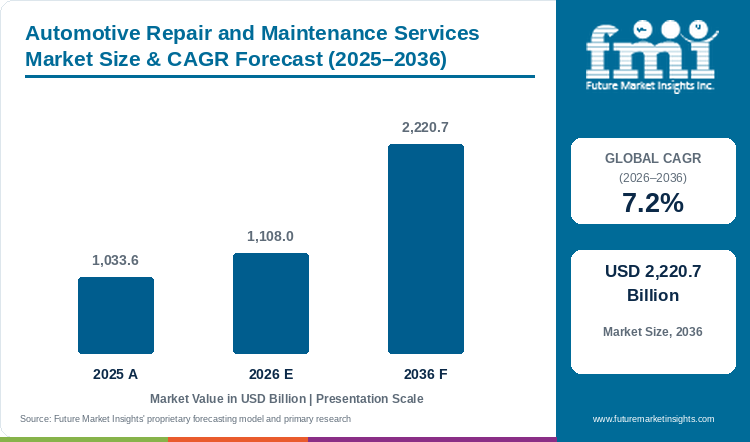
The automotive repair and maintenance services market is estimated at USD 1,033.6 billion in 2025 and is expected to reach USD 1,108.0 billion in 2026. Sales of automotive repair and maintenance services are projected to grow at a 7.2% CAGR and reach USD 2,220.7 billion by 2036.
Automotive repair and maintenance services market share is spread across many small workshops, with independent garages expected at 47% of 2026 sales. FMI's forecast sees the automotive repair and maintenance services market double over the decade, from USD 1,108.0 billion in 2026 to USD 2,220.7 billion in 2036 at a 7.2% CAGR, after an estimated USD 1,033.6 billion in 2025. Above all, car owners are keeping vehicles longer, and quick-service chains are adding bays near those owners. For instance, Valvoline reported 2,456 system-wide stores at the end of June 2026, 47 more than in March, and system-wide same-store sales growth of 8% for the April to June quarter.[1] Same-store growth at that rate shows owners returning for routine work on ageing cars.
Mechanical work brings in the most per vehicle, at an expected 21.5% of service type sales, as worn suspension, steering and engine parts need labour and parts together. Close behind come tires and wheels near 13%, then body, paint, interior and glass at about 12.5%. Lower down, oil change and lubrication, an estimated 11%, brings the most frequent visits at the smallest ticket. In turn, the workshop handling the routine visit gets first look at the heavier jobs, unlocking a steady pipeline of upsell work for quick-service chains.
Key Market Trends & Insights
- In service type terms, mechanical work is expected to lead in 2026 at 21.5%, with tires and wheels about 13% and body, paint, interior and glass near 12.5%.
- Passenger vehicles generate most workshop visits and are likely to hold 68% of vehicle type sales in 2026, with LCVs at an estimated 17.5%. Carmaker networks in emerging markets are adding the most new visits. For example, Maruti Suzuki serviced over 2.84 crore vehicles in FY 2025-26, the highest in a single financial year for the carmaker.[2] Service volume on that scale shows passenger car networks pulling routine work into organised bays.
- Independent garages are estimated to hold 47% of service provider sales in 2026, ahead of OEM authorized service centers at 31% and franchise garages at 18.5%.
- ICE vehicles still generate 86.5% of propulsion sales in 2026, and hybrids and EVs together hold 13.5%. Even so, Tuhu Car reported 5.3 million NEV transacting users over the twelve months to June 2026, up 56.7%.[3] NEV users growing that fast give franchised chains an early base of EV service customers.
Regional Highlights
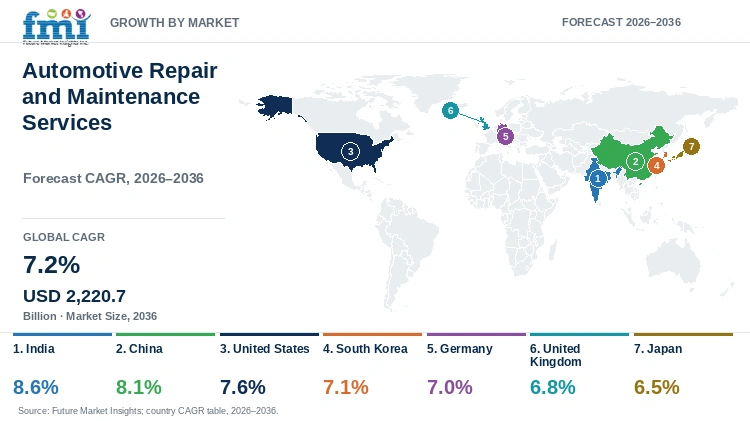
- India leads on FMI's forecast with 8.6%, helped by new workshops in smaller towns, well clear of the 7.2% global rate.
- Chinese sales advance 8.1% a year as franchised chains spread, and US sales 7.6% as older cars return for repairs. Growth in South Korea (7.1%) and Germany (7%) is close to the 7.2% global figure. The United Kingdom grows at 6.8%, held back by labour shortages, and Japan, with a shrinking car parc, is slowest at 6.5%.
- UK garage demand is growing faster than retail sales. Halfords reported 5.8% like-for-like sales growth at Autocentres in the year to 3 April 2026, with consumer garages near 8%.[4] Growth at that rate shows UK owners paying for more service and repair work even in a soft retail market.
Market Size & Forecast
Table 1: Market Size and Forecast for the Automotive Repair and Maintenance Services Market (USD billion and percentage), 2025 to 2036
| Metric | Value |
|---|---|
| 2025 Market Size | USD 1,033.6 billion |
| Estimated Market Size in 2026 | USD 1,108.0 billion |
| Projected Market Size by 2036 | USD 2,220.7 billion |
| CAGR, 2026 to 2036 | 7.2% |
| Added Revenue, 2026 to 2036 | USD 1,112.7 billion |
| Market Expansion Multiple | 2x |
Routine visits are growing at most chains, but owners are delaying larger repairs to stretch budgets. Even so, Monro said comparable store sales fell 1.7% in the quarter to 27 June 2026, with batteries up 8% and maintenance services down 5%, as customers put off tire and brake jobs.[5] However, deferred jobs do not disappear, and worn parts return as larger repairs later. Owners who modify cars also buy service work, and the automotive performance tuning and engine remapping services market carries a projected 6.4% CAGR. FMI's outlook adds about USD 1,112.7 billion of new sales to the automotive repair and maintenance services market by 2036, about double the 2026 base. Still, higher parts prices and tight technician supply are the main risks to that path.
Collision Volumes, Quick Service and EV Workshops
Consolidators are buying collision shops faster than insurance claims are growing. For instance, Boyd Group Services reported second-quarter 2026 sales of USD 1,013.7 million, up 29.9%, with same-store sales up 2.9% and repairable claims flat to down 2%.[6] Sales up nearly 30% against flat claims show growth coming from acquired locations. Large deals are behind that growth. In addition, the Joe Hudson's acquisition added 258 locations in the US Southeast in January 2026.[6] Body shop groups are therefore growing by acquisition faster than claim counts grow.
EV and hybrid work needs trained staff and new tools. In the United Kingdom, the IMI said in February 2026 that about one in four UK technicians held an EV qualification at the end of Q3 2025, and projected a gap of 44,000 technicians against EV maintenance demand over the decade.[7] A gap that size means EV repairs will queue at the few qualified shops. Some chains are already equipping sites. Meanwhile, Halfords has specialist EV servicing equipment in most Autocentres.[4] Therefore, early training will give a workshop the first out-of-warranty EV jobs in each town.
Table 2: Collision, Quick Service and EV Workshop Indicators for the Automotive Repair and Maintenance Services Market (sales, stores and staffing), 2026
| Indicator | Data Point | Relevance | Source |
|---|---|---|---|
| Valvoline system-wide stores, June 2026 | 2,456; up 47 in the quarter | Quick-lube network growth | [1] |
| Valvoline system-wide same-store sales, Q3 FY2026 | Up 8% | Routine maintenance visit frequency | [1] |
| Monro comparable store sales, Q1 FY2027 | Down 1.7%; batteries up 8% | Deferral of tire and brake jobs | [5] |
| Boyd Group Services sales, Q2 2026 | USD 1,013.7 million; up 29.9% | Collision repair consolidation | [6] |
| Halfords Autocentres like-for-like sales, FY2026 | Up 5.8% | Garage service demand in the United Kingdom | [4] |
| UK EV-qualified technicians, Q3 2025 | About one in four technicians | EV service capacity | [7] |
| Tuhu workshops, June 2026 | 8,825 | Franchised service networks in China | [3] |
Analyst Perspective
“Ageing cars and harder diagnostics are pushing more owners toward workshops that carry the right scan tools and trained staff. In my view, the next ten years will reward chains that pair a cheap, frequent visit such as an oil change with the skills to repair hybrids, EVs and driver-assistance sensors. Small garages that do not invest in EV training will keep the routine work and lose the higher-value jobs.”
- Nikhil Kaitwade, Principal Consultant, Future Market Insights.
How is the automotive repair and maintenance services market segmented?
The market is segmented into service type, vehicle type, service provider, propulsion, and region. Mechanical services are expected to lead service type with 21.5% share in 2026, and independent garages lead service provider with 47%.
By service type: mechanical, electrical, engine repair, transmission repair, brake, exhaust and emission, body, paint, interior and glass, tires and wheels, battery, oil change and lubrication, diagnostic, and others.
By vehicle type: passenger vehicles, LCVs, HCVs, and two-wheelers.
By service provider: OEM authorized service centers, independent garages, franchise garages, and mobile mechanics.
By propulsion: ICE, EVs, and hybrid vehicles.
By region: workshops and service networks in North America, Latin America, Western Europe, Eastern Europe, East Asia, South Asia and Pacific, and Middle East and Africa.
Why do mechanical services lead automotive repair and maintenance services sales by service type?
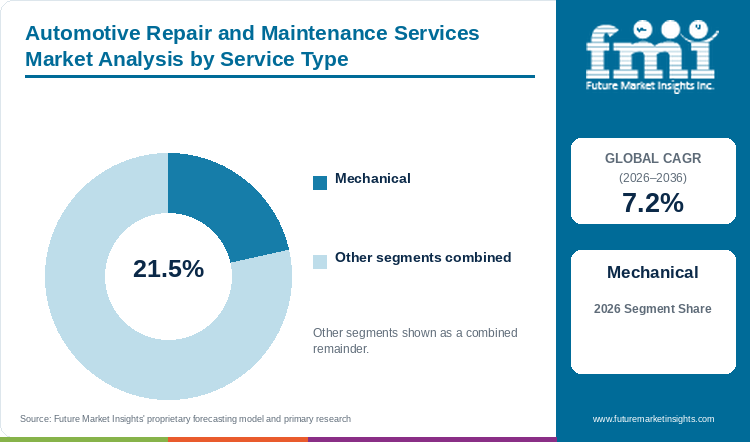
Mechanical services are expected to lead service type sales with 21.5% share in 2026, ahead of tires and wheels at about 13% and body, paint, interior and glass work at an estimated 12.5%.
Table 3: Service Type Share for the Automotive Repair and Maintenance Services Market (percentage share), 2026
| Service Type | Estimated Share (2026) |
|---|---|
| Mechanical | 21.5% |
| Tires and Wheels | 13% |
| Body, Paint, Interior and Glass | 12.5% |
| Oil Change and Lubrication | 11% |
| Brake | 8% |
| Engine Repair | 7% |
| Electrical | 6% |
| Transmission Repair | 5% |
| Diagnostic | 4.5% |
| Battery | 3.5% |
| Exhaust and Emission | 3% |
| Others | 5% |
| Total | 100.0% |
Table 4: Service Type Leadership and Market Growth for the Automotive Repair and Maintenance Services Market (segment and CAGR percentage), 2026 to 2036
| Metric | Value |
|---|---|
| Global CAGR (2026 to 2036) | 7.2% |
| Leading Segment | Mechanical |
As cars age past ten years, suspension, steering, cooling and drivetrain parts wear out together, and mechanical services are projected to lead in 2026, with 21.5% share. At about 13%, tires and wheels are bought in pairs or sets but less often, and Monro said tire and brake comparable sales slipped 1% in the June 2026 quarter.[5] Deferral of that kind holds back tire sales now but builds demand for later visits. Body, paint, interior and glass work, near 12.5%, follows insurance claims, which Boyd Group Services put flat to down 2% in Q2 2026.[6] With claims flat, collision groups add sales mainly through acquisitions. By comparison, oil change and lubrication, an estimated 11%, brings frequent visits at a small ticket. Brake (8%), engine repair (7%), electrical (6%) and transmission repair (5%) are narrower jobs, and diagnostic, battery and exhaust work each hold under 5%. Overall, owners pay for mechanical jobs on the first fault, so the category stays ahead of every single specialist line.
- Mechanical work covers suspension and steering, cooling, belts and hoses, clutches and general drivetrain faults.
- Suspension and alignment work is holding up better than tires. Monro reported front end, shocks and alignment comparable sales up 1% in the quarter to 27 June 2026.[5] Steady front-end demand shows owners still fixing faults that affect safety and handling.
Why do passenger vehicles lead automotive repair and maintenance services sales by vehicle type?
Passenger vehicles are likely to lead vehicle type sales with 68% share in 2026, with LCVs at about 17.5%, HCVs at 9.5% and two-wheelers at 5%.
Table 5: Vehicle Type Share for the Automotive Repair and Maintenance Services Market (percentage share), 2026
| Vehicle Type | Estimated Share (2026) |
|---|---|
| Passenger Vehicles | 68% |
| LCVs | 17.5% |
| HCVs | 9.5% |
| Two-Wheelers | 5% |
| Total | 100.0% |
Private cars make up most of the vehicle parc, so passenger vehicles are expected to lead the vehicle type split, at 68% in 2026. LCVs, about 17.5%, run high mileage for delivery and trade fleets, but each fleet negotiates rates and schedules work in batches. HCVs, near 9.5%, carry the largest bill per visit from a far smaller fleet count, and many truck operators keep work in company depots. Two-wheelers, about 5%, cost little per service. Carmaker networks with large car parcs gain the most passenger visits. In India, for instance, Maruti Suzuki serviced more than 2.84 crore cars in FY 2025-26 through over 6,000 touchpoints.[2] Networks of that reach capture visits that once went to roadside mechanics. On the HCV side, truck fleets often retread casings instead of buying new tires, and the tire retreading market has a forecast 2.8% CAGR, so HCV tire work will grow more slowly than car service. Over the forecast period, passenger car owners will keep supplying the bulk of bays and labour hours.
- Hatchbacks, sedans, SUVs and MPVs in private ownership supply most passenger car visits.
- Dealer networks are still expanding in emerging markets. Maruti Suzuki plans about 500 more service touchpoints in FY 2026-27.[2] Each new touchpoint brings dealer servicing to towns that small garages served before.
Why do independent garages lead automotive repair and maintenance services sales by service provider?
Independent garages are projected to lead service provider sales with 47% share in 2026, ahead of OEM authorized service centers at an estimated 31% and franchise garages at about 18.5%.
Table 6: Service Provider Share for the Automotive Repair and Maintenance Services Market (percentage share), 2026
| Service Provider | Estimated Share (2026) |
|---|---|
| Independent Garages | 47% |
| OEM Authorized Service Centers | 31% |
| Franchise Garages | 18.5% |
| Mobile Mechanics | 3.5% |
| Total | 100.0% |
Once the warranty ends, most owners move to a nearby garage with lower labour rates, so independent garages are estimated to lead in 2026, holding 47% share. By contrast, OEM authorized service centers, about 31%, keep newer cars, recall work and complex software updates. Franchise garages, near 18.5%, compete on brand, booking apps and fixed menu prices. Franchise models are scaling fastest in China. In China, Tuhu Car ran 8,825 workshops at 30 June 2026, of which 8,655 were franchised.[3] A network that large shows franchising moving independent garages under shared brands and booking systems. Mobile mechanics, an estimated 3.5%, handle batteries, tires and small jobs at the kerb. On balance, independents will keep the lead as long as parts and data access stay open to them.
- The independent group ranges from single-site garages to regional chains and specialist tire, brake and exhaust shops.
- Retail-linked garage chains are also building scale. Halfords operated 588 Autocentres locations at the end of FY26, including 496 consumer garages.[4] A network of that size lets Halfords compete with independents on location and with dealers on price.
Why do ICE vehicles lead automotive repair and maintenance services sales by propulsion?
ICE vehicles are expected to lead propulsion sales with 86.5% share in 2026, with hybrid vehicles at about 8.5% and EVs at an estimated 5%.
Table 7: Propulsion Share for the Automotive Repair and Maintenance Services Market (percentage share), 2026
| Propulsion | Estimated Share (2026) |
|---|---|
| ICE | 86.5% |
| Hybrid Vehicles | 8.5% |
| EVs | 5% |
| Total | 100.0% |
Petrol and diesel cars still make up most vehicles in use, and each needs oil, filters, belts and exhaust work, so ICE vehicles are likely to lead propulsion sales in 2026 at 86.5%. Hybrid vehicles, near 8.5%, still need engine service plus battery and cooling checks. EVs, about 5%, on the other hand, skip oil changes but wear tires and brakes faster and need high-voltage diagnostics. Out-of-warranty EVs are starting to reach independent and franchise workshops. For example, Tuhu said revenue from out-of-warranty specialised repair services more than tripled year on year in H1 2026.[3] In turn, battery health checks will become a larger service line, and the electric vehicle battery market is expected to grow at an 8.5% CAGR. Meanwhile, ICE work will shrink slowly, and the EV share will rise with each model year leaving warranty.
- For EVs, the common workshop jobs are high-voltage battery checks, thermal system service, tires and brake fluid.
- EV skills remain scarce. About one in four UK technicians held an EV qualification at the end of Q3 2025.[7] Shops with qualified staff can charge more for EV jobs until training catches up.
What are the drivers, restraints, and opportunities in the automotive repair and maintenance services market?
Older cars and more complex electronics bring owners back to workshops more often. Technician shortages and owners delaying large jobs hold sales back, and EV and driver-assistance repair opens new work for trained shops.
- Driver: Owners are keeping cars for more years, and older cars need more frequent wear-part replacement and fault diagnosis.
- Restraint: Too few trained technicians and owners postponing tire and brake jobs slow the conversion of visits into larger repairs.
- Opportunity: Hybrids and EVs leaving warranty need high-voltage diagnostics and battery service, which favours garages that train staff early.
Ageing Fleets Keep Bays Full
Workshop demand rises with vehicle age, since each extra year brings more worn parts and more faults. For instance, Valvoline added 47 system-wide stores in the April to June 2026 quarter and raised the full-year same-store sales outlook.[1] A higher outlook signals that chains expect visit growth to continue. Emerging-market networks show the same pattern. Likewise, Maruti Suzuki serviced more vehicles in FY 2025-26 than in any earlier financial year.[2] Consequently, chains are building bays ahead of the visits that older cars will bring.
Technician Gaps and Deferred Jobs Hold Back Sales
Owners putting off big jobs and shops unable to staff bays both slow sales of automotive repair and maintenance services. On the demand side, Monro said customers continued to defer tire and brake decisions in the quarter to June 2026.[5] Deferrals cut ticket size now and push work into later quarters. Staffing is the second constraint. On the staffing side, the IMI warned of a 44,000-technician gap against EV maintenance demand over the decade.[7] In FMI's reading, garages in the United Kingdom and Germany face the tightest staffing. In response, shops will raise wages and apprentice intake, and labour rates will rise with them.
EV Repair and Calibration Open New Work
Adoption of EV and hybrid repair skills will decide which garages gain the next decade of jobs. In China, Tuhu reported NEV transacting users up 56.7% and out-of-warranty specialised repair revenue more than tripled in H1 2026.[3] Growth at that speed shows EV owners moving to independent chains once warranties end. UK chains are preparing staff for the same shift. In the United Kingdom, Halfords has EV servicing equipment in most Autocentres and plans 250 new apprentices in FY27.[4] Accordingly, garages with EV training and battery diagnostics will take this work first.
Which country CAGRs are profiled in the automotive repair and maintenance services market?
Table 8: Country CAGR Comparison for the Automotive Repair and Maintenance Services Market (CAGR percentage), 2026 to 2036
| Country | CAGR (2026 to 2036) |
|---|---|
| India | 8.6% |
| China | 8.1% |
| United States | 7.6% |
| South Korea | 7.1% |
| Germany | 7% |
| United Kingdom | 6.8% |
| Japan | 6.5% |
How do country-level CAGRs compare in the automotive repair and maintenance services market?
Carmaker service networks are reaching deeper into Indian towns. Maruti Suzuki opened 502 service touchpoints in FY 2025-26, and India is set for 8.6% in FMI's outlook, ahead of every other country.[2] Each new touchpoint brings dealer-standard service to owners who relied on roadside mechanics. China is close behind at 8.1%, as franchised chains spread across smaller cities. Third, the United States, at 7.6%, has an ageing fleet and busy quick-service chains. Below that, South Korea and Germany are within 0.1 points of each other near the global rate. The United Kingdom follows at 6.8%, held back by technician shortages, and Japan comes last at 6.5% with a shrinking car parc and strict inspection-led maintenance.
- Carmaker networks in India are opening service touchpoints in smaller towns, moving routine work from roadside mechanics into dealer bays. Carmakers and parts suppliers with wide networks gain the most from that shift.
- Once warranties expire, Chinese NEV owners are moving to franchised chains. Platforms with EV-trained workshops, such as Tuhu, capture repair work that dealers lose.
- An ageing US car fleet needs more wear-part replacement each year, and quick-service chains are opening stores to meet that need. Chains with dense store networks take routine visits from dealers.
- Hybrids make up a growing part of the Korean fleet and need both engine and battery checks, so dealer networks with the right diagnostic tools keep most of that work.
- For German dealers facing soft new car sales, workshop orders now carry more of the earnings. Dealers with strong aftersales departments weather the slowdown better than showroom-led rivals.
- UK garage demand is rising faster than technicians can be trained. Shops that train EV staff early can raise labour rates and take the first out-of-warranty EV jobs.
- The Japanese car parc is shrinking with the population, and statutory inspections set most maintenance timing. Workshop growth there comes mainly from hybrid servicing, as discretionary repair stays limited.
Full report country CAGRs cover: profiled rates from 8.6% in India down to 6.5% in Japan, with China, the United States, South Korea, Germany and the United Kingdom in between, plus each other standard country reported by region.
Country-wise Analysis
India Automotive Repair and Maintenance Services Market Outlook (2026 to 2036)
In India, demand for automotive repair and maintenance services expands at an 8.6% CAGR, the quickest pace among the leading countries, as service networks spread into smaller towns. As a case in point, Maruti Suzuki opened the 6,000th service touchpoint in Kozhikode on 9 July 2026, said touchpoints now cover more than 3,000 cities and towns, and serviced over 2.84 crore vehicles in FY 2025-26.[2] As these networks grow, each new workshop in a smaller town turns roadside repairs into dealer-network visits.
Key takeaway: Smaller-town workshops add the most Indian visits.
China Automotive Repair and Maintenance Services Market Outlook (2026 to 2036)
Franchised platforms are drawing Chinese owners, and NEV owners in particular. Tuhu Car reported H1 2026 revenue of RMB 8.78 billion, up 11.4%, and 31.0 million transacting users over the last twelve months.[3] A user base that size gives franchised workshops steady traffic. Among these, NEV owners are the fastest-growing group on the platform. With NEV owners joining fast, Chinese demand increases about 8.1% a year, close behind India.
Key takeaway: Chinese growth comes from franchised chains and NEV repair.
United States Automotive Repair and Maintenance Services Market Outlook (2026 to 2036)
Quick-lube and collision chains are adding locations across the United States. For example, system-wide store sales at Valvoline rose 19% to USD 1,053.9 million in the June 2026 quarter.[1] Sales growth at that rate reflects both new stores and more visits per store. Collision groups are expanding as well. In collision, Boyd Group Services had 1,189 US locations by 11 August 2026.[6] That footprint lets Boyd meet insurer demands for regional coverage. Given this expansion, FMI expects the United States to grow at 7.6%, supported by an ageing fleet and more store openings.
Key takeaway: US demand grows with store openings and older cars.
South Korea Automotive Repair and Maintenance Services Market Outlook (2026 to 2036)
South Korean owners keep newer cars at carmaker dealer networks, and hybrids make up a growing part of the domestic fleet. Hybrid service needs both engine and battery checks, which keeps work at franchised centres with the right tools. On this basis, Korean demand grows about 7.1% a year, a tenth of a point below the global figure.
Key takeaway: Dealer hybrid servicing anchors South Korea.
Germany Automotive Repair and Maintenance Services Market Outlook (2026 to 2036)
German dealers are relying on workshops as vehicle sales weaken. In a ZDK dealer poll reported by AUTOHAUS on 1 September 2026, about 26% of dealers saw workshop orders improve and just under 30% saw a decline, and ZDK President Thomas Peckruhn said the workshop business keeps the trade stable.[8] In this setting, restrained demand in the vehicle trade is pushing German dealers to lean harder on aftersales. Consequently, German growth of about 7% a year comes mainly from aftersales work.
Key takeaway: Aftersales holds German dealers steady.
United Kingdom Automotive Repair and Maintenance Services Market Outlook (2026 to 2036)
UK garage service is growing faster than tire retail. Halfords said consumer garages grew about 8% like for like in FY26, as service, maintenance and repair growth more than offset weaker tire sales.[4] Growth in labour-led work favours chains with garage capacity. Staff supply is the limit. Even so, the IMI expects EV-qualified technicians to fall short of EV maintenance demand by 44,000 over the decade.[7] Labour supply therefore caps UK growth near 6.8% a year.
Key takeaway: Technician supply caps growth in the United Kingdom.
Japan Automotive Repair and Maintenance Services Market Outlook (2026 to 2036)
Japanese cars go through regular statutory inspections, which keep maintenance steady but limit discretionary repair. At the same time, the vehicle count is shrinking with the population, and hybrids already dominate new sales. As a result, FMI projects 6.5% for Japan, the slowest pace of the major countries.
Key takeaway: A shrinking car parc slows Japan.
Who are the notable companies in the automotive repair and maintenance services market?
Driven Brands, Bridgestone, Goodyear, Jiffy Lube, Midas, Bosch Car Service, Meineke Car Care Centers, AutoZone, Valvoline, Monro, Pep Boys, Tuffy, Christian Brothers Automotive, Express Oil Change & Tire Engineers, Halfords, Boyd Group Services and Tuhu Car are the profiled companies.
FMI analysis shows quick-service franchisors, tire makers with retail service networks, parts retailers and collision groups competing for workshop visits. Among these, Boyd Group Services reported Q2 2026 sales above USD 1 billion, at USD 1,013.7 million, against USD 996.7 million in Q1.[6] Crossing that level confirms Boyd as one of the largest collision groups in North America. Tire and service chains are also sizable. On the tire side, Monro ran 1,115 company-operated stores and 47 franchised locations after the June 2026 quarter.[5] A network that size gives Monro national reach for tire and brake work. UK garage chains are growing on service revenue. In the United Kingdom, Halfords Autocentres revenue reached GBP 725.2 million in FY26 on a 52-week basis.[4] That scale puts Autocentres among the largest UK garage networks. Driven Brands, Bridgestone, Goodyear, Jiffy Lube, Midas, Bosch Car Service, Meineke Car Care Centers, AutoZone, Valvoline, Pep Boys, Tuffy, Christian Brothers Automotive, Express Oil Change & Tire Engineers and Tuhu Car complete the group.
- Quick-service and franchise networks: Driven Brands, Valvoline, Jiffy Lube, Midas, Meineke Car Care Centers, Tuffy, Christian Brothers Automotive, Express Oil Change & Tire Engineers and Tuhu Car.
- Tire makers and retail service chains: Bridgestone, Goodyear, Monro, Pep Boys and Halfords.
- Parts, workshop concept and collision groups: AutoZone, Bosch Car Service and Boyd Group Services.
Competitive Benchmarking: Automotive Repair and Maintenance Services Market
Table 9: Competitive Benchmarking for the Automotive Repair and Maintenance Services Market (qualitative ratings), 2026
| Company | Quick Service | Tires and Brakes | Collision Repair | EV Readiness |
|---|---|---|---|---|
| Valvoline | High | Low | Low | Medium |
| Monro | Medium | High | Low | Low |
| Boyd Group Services | Low | Low | High | Medium |
| Halfords | Medium | High | Low | High |
| Tuhu Car | Medium | High | Low | High |
Ratings compare the companies on quick service, tires and brakes, collision repair and EV readiness.
Key Developments in the Automotive Repair and Maintenance Services Market
- In a ZDK poll of German dealers published on 1 September 2026, about 26% saw workshop orders improve, so aftersales is holding up better than car sales.[8]
- Tuhu Car counted 8,825 workshops at 30 June 2026, including 14 in Malaysia and seven in Hong Kong, in results of 21 August 2026; the first sites outside the mainland show the franchise model travelling.[3]
- Boyd Group Services said on 11 August 2026 that conversion of the Joe Hudson's locations was completed in the second quarter, which brings the added shops onto one system for insurer work.[6]
- Valvoline put full-year system-wide same-store sales growth at 7.5% to 8% in a 5 August 2026 guidance update, a signal that routine maintenance visits are still rising.[1]
- Batteries were the strongest Monro category in the first quarter of fiscal 2027, with comparable sales up 8%, Monro reported on 29 July 2026; for shops, failure-driven jobs are holding up as owners defer tires.[5]
- On 9 July 2026, Maruti Suzuki opened the 6,000th service touchpoint, in Kozhikode, Kerala, extending dealer servicing deeper into smaller Indian towns.[2]
- Halfords said on 25 June 2026 that Fusion sites linking shops and garages reached 103 locations, which raises service sales per town.[4]
- The IMI warned in February 2026 of a 44,000-technician gap against EV maintenance demand, pointing to higher labour rates for EV work.[7]
Key Players in the Automotive Repair and Maintenance Services Market
Quick-Service and Franchise Networks
- Driven Brands
- Valvoline
- Jiffy Lube
- Midas
- Meineke Car Care Centers
- Tuffy
- Christian Brothers Automotive
- Express Oil Change & Tire Engineers
- Tuhu Car
Tire Makers and Retail Service Chains
- Bridgestone
- Goodyear
- Monro
- Pep Boys
- Halfords
Parts, Workshop Concept and Collision Groups
- AutoZone
- Bosch Car Service
- Boyd Group Services
Automotive Repair and Maintenance Services Market - Report Scope
Table 10: Report Scope for the Automotive Repair and Maintenance Services Market (coverage fields and definitions), 2026 to 2036
| Coverage field | Report scope |
|---|---|
| Market breakdown | Service type; vehicle type; service provider; propulsion; region |
| Quantitative units | USD billion |
| Market definition | Paid labour and parts for scheduled maintenance, wear-part replacement, mechanical, electrical, body and collision repair, and diagnostics on cars, commercial vehicles and two-wheelers, delivered by dealers, independent and franchise garages and mobile mechanics. |
| Regions covered | North America; Latin America; Western Europe; Eastern Europe; East Asia; South Asia and Pacific; Middle East and Africa |
| Countries covered | United States; Canada; Brazil; Mexico; Argentina; Chile; Germany; France; United Kingdom; Italy; Spain; Benelux; Nordics; Poland; Czech Republic; Romania; Hungary; China; Japan; South Korea; India; ASEAN; Australia and New Zealand; GCC Countries; South Africa; Türkiye; Israel |
| Key companies profiled | Driven Brands, Bridgestone, Goodyear, Jiffy Lube, Midas, Bosch Car Service, Meineke Car Care Centers, AutoZone, Valvoline, Monro, Pep Boys, Tuffy, Christian Brothers Automotive, Express Oil Change & Tire Engineers, Halfords, Boyd Group Services, Tuhu Car |
| Forecast period | 2026 to 2036 |
Automotive Repair and Maintenance Services Market - Research Methodology
Table 11: Research Methodology for the Automotive Repair and Maintenance Services Market (research methods and approach), 2026 edition
| Method | Approach |
|---|---|
| Data Sources | Company results, industry associations, government statistics and trade publications. |
| Desk Research | Desk research covers store counts, same-store sales, claim volumes, technician supply and EV servicing capability. |
| Market Sizing and Forecasting | Sizing starts from the 2025 base of USD 1,033.6 billion and applies the 7.2% CAGR for 2026 to 2036. |
| Data Validation | Figures are cross-checked across company, industry and government sources. |
Automotive Repair and Maintenance Services Market by Segments
Automotive Repair and Maintenance Services Market segmented by Service Type:
- Mechanical
- Electrical
- Engine Repair
- Transmission Repair
- Brake
- Exhaust and Emission
- Body, Paint, Interior and Glass
- Tires and Wheels
- Battery
- Oil Change and Lubrication
- Diagnostic
- Others
Automotive Repair and Maintenance Services Market segmented by Vehicle Type:
- Passenger Vehicles
- LCVs
- HCVs
- Two-Wheelers
Automotive Repair and Maintenance Services Market segmented by Service Provider:
- OEM Authorized Service Centers
- Independent Garages
- Franchise Garages
- Mobile Mechanics
Automotive Repair and Maintenance Services Market segmented by Propulsion:
- ICE
- EVs
- Hybrid Vehicles
Automotive Repair and Maintenance Services Market by Region
- North America
- United States
- Canada
- Latin America
- Brazil
- Mexico
- Argentina
- Chile
- Western Europe
- Germany
- France
- United Kingdom
- Italy
- Spain
- Benelux
- Nordics
- Eastern Europe
- Poland
- Czech Republic
- Romania
- Hungary
- East Asia
- China
- Japan
- South Korea
- South Asia and Pacific
- India
- ASEAN
- Australia and New Zealand
- Middle East and Africa
- GCC Countries
- South Africa
- Türkiye
- Israel
Research Sources and Bibliography
- [1] Valvoline Inc. (2026, August 5). Valvoline Inc. Reports Third Quarter Results. https://www.sec.gov/Archives/edgar/data/0001674910/000167491026000062/q32026earningsrelease.htm
- [2] Maruti Suzuki India Limited. (2026, July 9). Maruti Suzuki strengthens after-sales footprint with 6,000th service touchpoint. https://www.marutisuzuki.com/corporate/media/press-releases/2026/july/maruti-suzuki-strengthens-after-sales-footprint-with-6-000th-service-touchpoint
- [3] TUHU Car Inc. (2026, August 21). Announcement of Interim Results for the Six Months Ended 30 June 2026. https://www1.hkexnews.hk/listedco/listconews/sehk/2026/0821/2026082100792.pdf
- [4] Halfords Group plc. (2026, June 25). Preliminary results for the 53-week period ended 3 April 2026. https://www.halfordscompany.com/media/tsbiyo4t/fy26-rns_vfinal.pdf
- [5] Monro, Inc. (2026, July 29). Monro, Inc. Announces First Quarter Fiscal 2027 Financial Results. https://www.sec.gov/Archives/edgar/data/0000876427/000119312526322170/d66984dex991.htm
- [6] Boyd Group Services Inc. (2026, August 11). Interim Report to Shareholders, Second Quarter and Six Months Ended June 30, 2026. https://www.sec.gov/Archives/edgar/data/0002091467/000119312526345758/d135444dex991.htm
- [7] Transport Operator. (2026, February 9). IMI warning as EV technician skills gap looms. https://transportoperator.co.uk/2026/02/09/imi-warning-ev-technician-skills-gap-looms/
- [8] AUTOHAUS. (2026, September 1). ZDK-Umfrage: Schwieriges Geschäft trotz guter E-Auto-Absätze. https://www.autohaus.de/nachrichten/autohandel/zdk-umfrage-schwieriges-geschaeft-trotz-guter-e-auto-absaetze-3897303
This bibliography is provided for reader reference. The full report contains the complete reference list and detailed citations.
This Report Answers
- How big is the automotive repair and maintenance services market during 2026?
- What market size is projected by 2036?
- Which service type holds notable share?
- Which vehicle type holds notable share?
- Which countries have notable growth?
- Which companies are notable in the market?
Frequently Asked Questions
How large is the automotive repair and maintenance services market expected in 2026?
FMI estimates the automotive repair and maintenance services market at USD 1,108.0 billion in 2026, against USD 1,033.6 billion in 2025. The automotive repair and maintenance services market is projected to reach USD 2,220.7 billion by 2036.
What CAGR is projected for the automotive repair and maintenance services market through 2036?
Sales of automotive repair and maintenance services are expected to grow at a 7.2% CAGR from 2026 to 2036. Older cars, more electronics and the first wave of out-of-warranty EVs support that growth.
Which service type holds a notable market share in 2026?
Mechanical services are expected to lead with 21.5% share in 2026. Tires and wheels follow at about 13%.
Which vehicle type holds a notable market share in 2026?
Passenger vehicles are likely to lead with 68% share in 2026. LCVs follow at an estimated 17.5%.
Which country has a notable expansion outlook through 2036?
India has the fastest outlook in FMI's forecast, at an 8.6% CAGR. China follows at 8.1%.
Who are the key companies in the automotive repair and maintenance services market?
Driven Brands, Valvoline, Jiffy Lube, Midas, Monro and Tuhu Car lead the quick-service and franchise networks, and Bridgestone, Goodyear and Halfords run large tire and garage chains. AutoZone, Bosch Car Service, Boyd Group Services, Meineke Car Care Centers, Pep Boys, Tuffy, Christian Brothers Automotive and Express Oil Change & Tire Engineers complete the profiled companies.
Preview the report firsthand - request a free sample
Get SampleGet the brochure for pricing and purchase details.
Get PDFTable of Content
- Key Takeaways
- Market Size and CAGR
- Top Growth Driver
- Fastest Growing Segment
- Leading Region
- Key Companies
- Emerging Opportunities
- Executive Summary
- Global Market Outlook
- Demand-side Trends
- Supply-side Trends
- Technology Roadmap Analysis
- Analysis and Recommendations
- Analyst Perspective (What is happening? Why now? What should investors know?)
- Key Questions Answered
- How large is the market?
- What is the CAGR?
- What are key trends?
- Which region dominates?
- Who are the leaders?
- Market Overview
- Market Coverage / Taxonomy
- Market Definition / Scope / Limitations
- Research Methodology
- Chapter Orientation
- Analytical Lens and Working Hypotheses
- Market Structure, Signals, and Trend Drivers
- Benchmarking and Cross-market Comparability
- Market Sizing, Forecasting, and Opportunity Mapping
- Research Design and Evidence Framework
- Desk Research Programme (Secondary Evidence)
- Expert Input and Fieldwork (Primary Evidence)
- Tooling, Models, and Reference Databases
- Data Engineering and Model Build
- Quality Assurance and Audit Trail
- Market Background
- Market Dynamics (Drivers, Restraints, Opportunity, Trends)
- Scenario Forecast (Optimistic, Likely, Conservative)
- Impact Analysis
- AI Impact
- Sustainability Impact
- Regulatory Impact
- Technology Impact
- Consumer / Buyer Analysis
- Purchase Drivers
- Adoption Barriers
- Buyer Journey
- Opportunity Map Analysis
- Product Life Cycle Analysis
- Supply Chain Analysis
- Investment Feasibility Matrix
- Value Chain Analysis
- PESTLE and Porter's Analysis
- Regulatory Landscape
- Regional Parent Market Outlook
- Production and Consumption Statistics
- Import and Export Statistics
- Global Market Analysis and Forecast, 2021 to 2036
- Historical Market Size Value (USD Billion) Analysis, 2021 to 2025
- Current and Future Market Size Value (USD Billion) Projections, 2026 to 2036
- Y-o-Y Growth Trend Analysis
- Absolute $ Opportunity Analysis
- Global Market Pricing Analysis, 2021 to 2036
- Global Market Analysis and Forecast, By Service Type, 2021 to 2036
- Introduction / Key Findings
- Historical Market Size Value (USD Billion) Analysis By Service Type, 2021 to 2025
- Current and Future Market Size Value (USD Billion) Analysis and Forecast By Service Type, 2026 to 2036
- Mechanical
- Electrical
- Engine Repair
- Transmission Repair
- Brake
- Exhaust and Emission
- Body, Paint, Interior and Glass
- Tires and Wheels
- Battery
- Oil Change and Lubrication
- Diagnostic
- Others
- Y-o-Y Growth Trend Analysis By Service Type, 2021 to 2025
- Absolute $ Opportunity Analysis By Service Type, 2026 to 2036
- Global Market Analysis and Forecast, By Vehicle Type, 2021 to 2036
- Introduction / Key Findings
- Historical Market Size Value (USD Billion) Analysis By Vehicle Type, 2021 to 2025
- Current and Future Market Size Value (USD Billion) Analysis and Forecast By Vehicle Type, 2026 to 2036
- Passenger Vehicles
- LCVs
- HCVs
- Two-Wheelers
- Y-o-Y Growth Trend Analysis By Vehicle Type, 2021 to 2025
- Absolute $ Opportunity Analysis By Vehicle Type, 2026 to 2036
- Global Market Analysis and Forecast, By Service Provider, 2021 to 2036
- Introduction / Key Findings
- Historical Market Size Value (USD Billion) Analysis By Service Provider, 2021 to 2025
- Current and Future Market Size Value (USD Billion) Analysis and Forecast By Service Provider, 2026 to 2036
- OEM Authorized Service Centers
- Independent Garages
- Franchise Garages
- Mobile Mechanics
- Y-o-Y Growth Trend Analysis By Service Provider, 2021 to 2025
- Absolute $ Opportunity Analysis By Service Provider, 2026 to 2036
- Global Market Analysis and Forecast, By Propulsion, 2021 to 2036
- Introduction / Key Findings
- Historical Market Size Value (USD Billion) Analysis By Propulsion, 2021 to 2025
- Current and Future Market Size Value (USD Billion) Analysis and Forecast By Propulsion, 2026 to 2036
- ICE
- EVs
- Hybrid Vehicles
- Y-o-Y Growth Trend Analysis By Propulsion, 2021 to 2025
- Absolute $ Opportunity Analysis By Propulsion, 2026 to 2036
- Global Market Analysis and Forecast, By Region, 2021 to 2036
- Introduction
- Historical Market Size Value (USD Billion) Analysis By Region, 2021 to 2025
- Current Market Size Value (USD Billion) Analysis and Forecast By Region, 2026 to 2036
- North America
- Latin America
- Western Europe
- Eastern Europe
- East Asia
- South Asia and Pacific
- Middle East and Africa
- Market Attractiveness Analysis By Region
- North America Market Analysis and Forecast, By Country, 2021 to 2036
- Historical Market Size Value (USD Billion) Trend Analysis By Market Taxonomy, 2021 to 2025
- Market Size Value (USD Billion) Forecast By Market Taxonomy, 2026 to 2036
- By Country
- United States
- Canada
- By Service Type
- By Vehicle Type
- By Service Provider
- By Propulsion
- By Country
- Market Attractiveness Analysis
- By Country
- By Service Type
- By Vehicle Type
- By Service Provider
- By Propulsion
- Key Takeaways
- Latin America Market Analysis and Forecast, By Country
- Historical Market Size Value (USD Billion) Trend Analysis By Market Taxonomy, 2021 to 2025
- Market Size Value (USD Billion) Forecast By Market Taxonomy, 2026 to 2036
- By Country
- Brazil
- Mexico
- Argentina
- Chile
- By Service Type
- By Vehicle Type
- By Service Provider
- By Propulsion
- By Country
- Market Attractiveness Analysis
- By Country
- By Service Type
- By Vehicle Type
- By Service Provider
- By Propulsion
- Key Takeaways
- Western Europe Market Analysis and Forecast, By Country
- Historical Market Size Value (USD Billion) Trend Analysis By Market Taxonomy, 2021 to 2025
- Market Size Value (USD Billion) Forecast By Market Taxonomy, 2026 to 2036
- By Country
- Germany
- France
- United Kingdom
- Italy
- Spain
- Benelux
- Nordics
- By Service Type
- By Vehicle Type
- By Service Provider
- By Propulsion
- By Country
- Market Attractiveness Analysis
- By Country
- By Service Type
- By Vehicle Type
- By Service Provider
- By Propulsion
- Key Takeaways
- Eastern Europe Market Analysis and Forecast, By Country
- Historical Market Size Value (USD Billion) Trend Analysis By Market Taxonomy, 2021 to 2025
- Market Size Value (USD Billion) Forecast By Market Taxonomy, 2026 to 2036
- By Country
- Poland
- Czech Republic
- Romania
- Hungary
- By Service Type
- By Vehicle Type
- By Service Provider
- By Propulsion
- By Country
- Market Attractiveness Analysis
- By Country
- By Service Type
- By Vehicle Type
- By Service Provider
- By Propulsion
- Key Takeaways
- East Asia Market Analysis and Forecast, By Country
- Historical Market Size Value (USD Billion) Trend Analysis By Market Taxonomy, 2021 to 2025
- Market Size Value (USD Billion) Forecast By Market Taxonomy, 2026 to 2036
- By Country
- China
- Japan
- South Korea
- By Service Type
- By Vehicle Type
- By Service Provider
- By Propulsion
- By Country
- Market Attractiveness Analysis
- By Country
- By Service Type
- By Vehicle Type
- By Service Provider
- By Propulsion
- Key Takeaways
- South Asia and Pacific Market Analysis and Forecast, By Country
- Historical Market Size Value (USD Billion) Trend Analysis By Market Taxonomy, 2021 to 2025
- Market Size Value (USD Billion) Forecast By Market Taxonomy, 2026 to 2036
- By Country
- India
- ASEAN
- Australia and New Zealand
- By Service Type
- By Vehicle Type
- By Service Provider
- By Propulsion
- By Country
- Market Attractiveness Analysis
- By Country
- By Service Type
- By Vehicle Type
- By Service Provider
- By Propulsion
- Key Takeaways
- Middle East and Africa Market Analysis and Forecast, By Country
- Historical Market Size Value (USD Billion) Trend Analysis By Market Taxonomy, 2021 to 2025
- Market Size Value (USD Billion) Forecast By Market Taxonomy, 2026 to 2036
- By Country
- GCC Countries
- South Africa
- Türkiye
- Israel
- By Service Type
- By Vehicle Type
- By Service Provider
- By Propulsion
- By Country
- Market Attractiveness Analysis
- By Country
- By Service Type
- By Vehicle Type
- By Service Provider
- By Propulsion
- Key Takeaways
- Key Countries Market Analysis
- United States
- Pricing Analysis
- Market Share Analysis, 2025
- By Service Type
- By Vehicle Type
- By Service Provider
- By Propulsion
- Canada
- Pricing Analysis
- Market Share Analysis, 2025
- By Service Type
- By Vehicle Type
- By Service Provider
- By Propulsion
- Mexico
- Pricing Analysis
- Market Share Analysis, 2025
- By Service Type
- By Vehicle Type
- By Service Provider
- By Propulsion
- Brazil
- Pricing Analysis
- Market Share Analysis, 2025
- By Service Type
- By Vehicle Type
- By Service Provider
- By Propulsion
- Chile
- Pricing Analysis
- Market Share Analysis, 2025
- By Service Type
- By Vehicle Type
- By Service Provider
- By Propulsion
- Germany
- Pricing Analysis
- Market Share Analysis, 2025
- By Service Type
- By Vehicle Type
- By Service Provider
- By Propulsion
- United Kingdom
- Pricing Analysis
- Market Share Analysis, 2025
- By Service Type
- By Vehicle Type
- By Service Provider
- By Propulsion
- Italy
- Pricing Analysis
- Market Share Analysis, 2025
- By Service Type
- By Vehicle Type
- By Service Provider
- By Propulsion
- Spain
- Pricing Analysis
- Market Share Analysis, 2025
- By Service Type
- By Vehicle Type
- By Service Provider
- By Propulsion
- France
- Pricing Analysis
- Market Share Analysis, 2025
- By Service Type
- By Vehicle Type
- By Service Provider
- By Propulsion
- India
- Pricing Analysis
- Market Share Analysis, 2025
- By Service Type
- By Vehicle Type
- By Service Provider
- By Propulsion
- ASEAN
- Pricing Analysis
- Market Share Analysis, 2025
- By Service Type
- By Vehicle Type
- By Service Provider
- By Propulsion
- Australia and New Zealand
- Pricing Analysis
- Market Share Analysis, 2025
- By Service Type
- By Vehicle Type
- By Service Provider
- By Propulsion
- China
- Pricing Analysis
- Market Share Analysis, 2025
- By Service Type
- By Vehicle Type
- By Service Provider
- By Propulsion
- Japan
- Pricing Analysis
- Market Share Analysis, 2025
- By Service Type
- By Vehicle Type
- By Service Provider
- By Propulsion
- South Korea
- Pricing Analysis
- Market Share Analysis, 2025
- By Service Type
- By Vehicle Type
- By Service Provider
- By Propulsion
- Poland
- Pricing Analysis
- Market Share Analysis, 2025
- By Service Type
- By Vehicle Type
- By Service Provider
- By Propulsion
- Hungary
- Pricing Analysis
- Market Share Analysis, 2025
- By Service Type
- By Vehicle Type
- By Service Provider
- By Propulsion
- Türkiye
- Pricing Analysis
- Market Share Analysis, 2025
- By Service Type
- By Vehicle Type
- By Service Provider
- By Propulsion
- South Africa
- Pricing Analysis
- Market Share Analysis, 2025
- By Service Type
- By Vehicle Type
- By Service Provider
- By Propulsion
- United States
- Market Structure Analysis
- Competition Dashboard
- Competition Benchmarking
- Market Share Analysis of Top Players
- By Regional
- By Service Type
- By Vehicle Type
- By Service Provider
- By Propulsion
- Emerging Startups
- Innovation Benchmarking
- Competition Analysis
- Competition Deep Dive
- Valvoline
- Overview
- Product Portfolio
- Profitability by Market Segments
- Sales Footprint
- Strategy Overview
- Marketing Strategy
- Product Strategy
- Channel Strategy
- Monro
- Boyd Group Services
- Halfords
- Tuhu Car
- Driven Brands
- Jiffy Lube
- Midas
- Meineke Car Care Centers
- Tuffy
- Christian Brothers Automotive
- Express Oil Change & Tire Engineers
- Bridgestone
- Goodyear
- Pep Boys
- AutoZone
- Bosch Car Service
- Valvoline
- Case Studies
- Success Stories
- Recent Developments
- Competition Deep Dive
- Assumptions & Acronyms Used


