

- Industry Size (2026)
- USD 336 Mn
- Forecast (2036)
- USD 3179.7 Mn
- CAGR (2026 to 2036)
- 25.20%
Automotive Uncooled Infrared Cores Market Forecast and Outlook 2026 to 2036
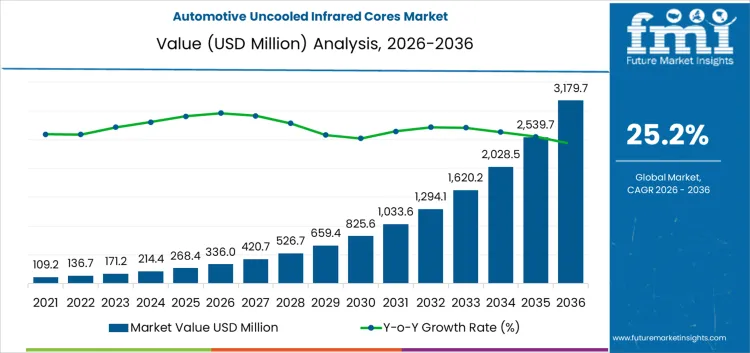
The automotive uncooled infrared cores market is projected to expand from USD 336 million in 2026 to USD 3,179.7 million by 2036, registering a CAGR of 25.20%. This market represents one of the fastest-scaling sensing segments within the automotive electronics and ADAS ecosystem. Growth is driven by the transition of thermal imaging from niche, luxury vehicle features to core safety and perception components in advanced driver-assistance and autonomous driving architectures. Unlike conventional cameras, uncooled infrared cores deliver consistent object detection in darkness, fog, and adverse weather, making them increasingly relevant for pedestrian safety, collision avoidance, and sensor redundancy.
Demand is strongly influenced by regulatory pressure on road safety, rising EV adoption, and OEM investments in multi-sensor fusion platforms. Competitive dynamics are shaped by rapid cost reduction, miniaturization, and improvements in thermal sensitivity that enable wider vehicle integration. Between 2026 and 2036, the market’s expansion is anchored in high value density, technology-driven adoption, and deepening OEM–Tier 1 collaboration rather than incremental vehicle production growth alone.
Quick Stats for Automotive Uncooled Infrared Cores Market
- Automotive Uncooled Infrared Cores Market Value (2026): USD 336 Million
- Automotive Uncooled Infrared Cores Market Forecast Value (2036): USD 3,179.7 Million
- Automotive Uncooled Infrared Cores Market Forecast CAGR (2026–2036): 25.2%
- Leading Type of Automotive Uncooled Infrared Cores: VOx Microbolometers
- Leading Application in Automotive Uncooled Infrared Cores Market: Night Vision & Pedestrian Detection
- Key Growth Regions in Automotive Uncooled Infrared Cores Market: Asia Pacific, North America, Europe, Latin America, Middle East & Africa
- Top Key Players in Automotive Uncooled Infrared Cores Market: Teledyne FLIR, Wuhan Guide Infrared Co., Ltd., Raytron Technology, Zhejiang ULIRVISION Technology, Global Sensor Technology, Semi Conductor Devices (SCD), Leonardo DRS
Automotive Uncooled Infrared Cores Market Key Takeaways
| Metric | Value |
|---|---|
| Automotive Uncooled Infrared Cores Market Value (2026) | USD 336 Million |
| Automotive Uncooled Infrared Cores Market Forecast Value (2036) | USD 3,179.7 Million |
| Automotive Uncooled Infrared Cores Market Forecast CAGR 2026 to 2036 | 25.20% |
Why is the Automotive Uncooled Infrared Cores Market Expanding Rapidly?
The automotive uncooled infrared cores market is growing as vehicle manufacturers increasingly adopt advanced driver assistance systems (ADAS) and autonomous driving technologies. These infrared cores provide high-resolution thermal imaging for night vision, pedestrian detection, and collision avoidance, enhancing vehicle safety and reducing accident risks. Rising consumer demand for safer vehicles is boosting integration across passenger and commercial vehicles.
Technological innovation is accelerating growth in the automotive uncooled infrared cores market. Developments in microbolometer technology, improved sensitivity, compact design, and low power consumption enable cost-effective integration into vehicle systems. Enhanced image processing and AI-based object recognition further improve detection accuracy, supporting broader adoption in ADAS and autonomous driving platforms.
Rising regulatory emphasis on road safety and increased investment in smart mobility solutions are driving demand in the automotive uncooled infrared cores market. Growth in electric vehicles, luxury vehicles, and commercial fleets increases the requirement for thermal imaging sensors. Automotive OEMs and Tier-1 suppliers are incorporating these systems to meet safety mandates and consumer expectations, sustaining rapid market expansion over the forecast period.
What Does the Segment Overview Indicate About The Automotive Uncooled Infrared Cores Market?
The automotive uncooled infrared cores market is segmented by detector type and application, reflecting distinct imaging capabilities and automotive integration levels. VOx microbolometers lead the detector segment with around 60% share, driven by their high thermal sensitivity, stability, and compatibility with automotive platforms. a-Si microbolometers and other uncooled detectors serve cost-sensitive or limited-resolution use cases. On the application side, night vision and pedestrian detection hold the largest share at approximately 50%, aligned with demand for enhanced driver awareness and low-light object detection. Other applications such as thermal ADAS sensing and autonomous driving vision systems represent emerging areas of adoption in advanced vehicle platforms.
Why Do VOx Microbolometers Hold the Leading Type Share in the Automotive Uncooled Infrared Cores Market?
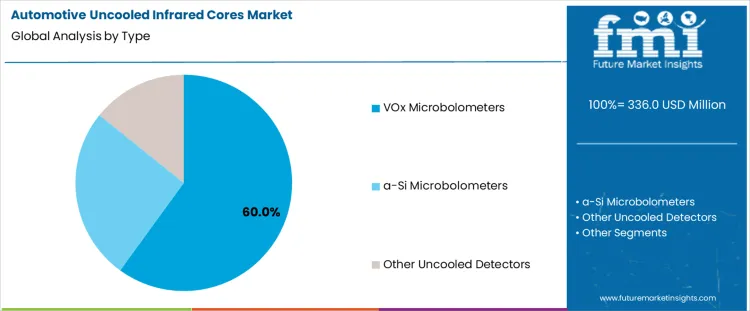
VOx microbolometers account for the largest 60% share in the automotive uncooled infrared cores market due to their ability to deliver high-resolution thermal images at a stable operating performance. These detectors are widely adopted in vehicle-mounted thermal cameras used for pedestrian detection, night vision enhancement, and lane-edge visibility. Their lower thermal drift, good uniformity, and noise reduction features make them suitable for high-reliability automotive environments. Compared to a-Si variants, VOx detectors offer better signal-to-noise performance, albeit at a higher cost. The segment benefits from growing integration into electric vehicles and premium car segments. As thermal imaging expands beyond luxury vehicles into mid-tier ADAS systems, VOx microbolometers remain the preferred architecture for scalable deployment.
How Does Night Vision and Pedestrian Detection Drive Demand in the Automotive Uncooled Infrared Cores Market?
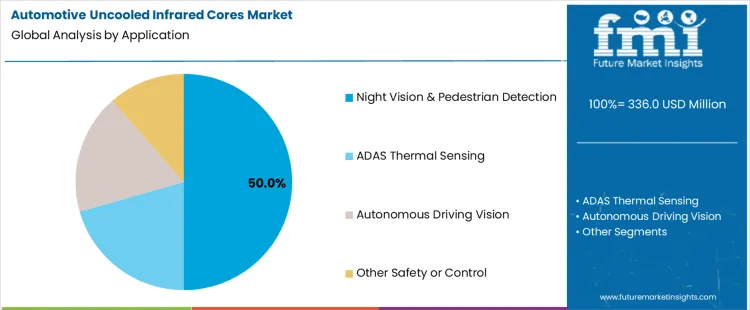
Night vision and pedestrian detection dominate application demand in the automotive uncooled infrared cores market, contributing approximately 50% share, as vehicle safety systems expand beyond visible-spectrum sensors. These applications rely on thermal imaging to detect heat signatures of pedestrians, animals, or obstacles beyond headlight range, especially during poor visibility or nighttime conditions. Uncooled cores provide passive detection without illumination, enabling consistent performance across weather and lighting environments. OEMs prioritize this functionality for collision avoidance and improved driver alertness in luxury and safety-conscious models. Demand also grows in regulatory-driven markets, where pedestrian protection standards are tightening. System-level integration with warning systems, HUDs, and ADAS platforms strengthens the position of thermal night vision in the automotive safety stack.
What Functional Needs Are Accelerating Growth in the Automotive Uncooled Infrared Cores Market?
The automotive uncooled infrared cores market is expanding due to rising demand for thermal sensing in advanced driver-assistance systems (ADAS), night vision, and occupant monitoring. These cores operate without cryogenic cooling, enabling compact integration into vehicles at lower cost. Automotive OEMs are embedding infrared modules into forward-facing sensors, mirror assemblies, and in-cabin systems for pedestrian detection, driver alertness, and blind spot coverage in low-visibility conditions. Electric vehicles and premium models are driving early adoption, where energy efficiency and safety perception are key differentiators. Growth is also supported by rising road safety regulations and insurance incentives tied to enhanced sensing capabilities in night-time or poor weather operation.
Why Are Thermal Cameras Gaining Ground in Automotive Sensing Platforms?
OEMs and Tier 1 suppliers are adopting uncooled infrared cores in automotive applications due to their ability to detect living objects and thermal signatures beyond the reach of conventional cameras. Thermal systems enhance nighttime visibility, fog navigation, and non-line-of-sight detection in urban or rural settings. Unlike LiDAR or radar, they can distinguish pedestrians and animals through heat contrast, regardless of lighting conditions. In-cabin applications include driver drowsiness monitoring and occupant classification for airbag deployment. As sensor fusion becomes standard in ADAS architectures, infrared cores are increasingly integrated into multi-sensor modules that combine visual, radar, and ultrasonic inputs for greater decision-making accuracy.
What Constraints Are Hindering Broader Use of Uncooled Infrared Cores in Vehicles?
Adoption in the automotive uncooled infrared cores market is limited by cost sensitivity and integration complexity. While uncooled systems are less expensive than cooled alternatives, they remain pricier than ultrasonic or camera modules, making them viable primarily for high-end vehicles. Packaging challenges arise in maintaining calibration, field of view, and protection from heat, dust, and vibration in exterior automotive environments. Supply chain concentration among few core providers restricts sourcing flexibility for OEMs. Additionally, thermal image interpretation in real-time vehicle systems requires advanced software pipelines, increasing development time and validation requirements. Regulatory approval processes for thermal-based ADAS features are still evolving in many regions.
What is the Country-Wise Growth Outlook for the Automotive Uncooled Infrared Cores Market?
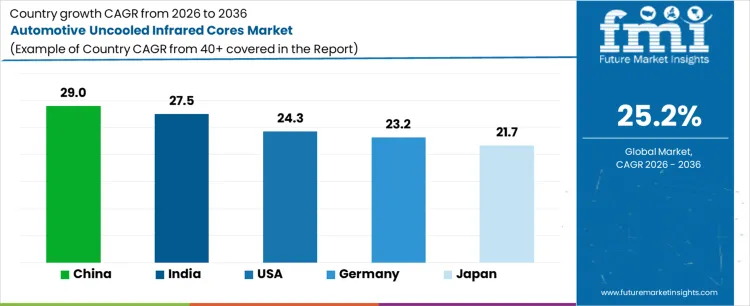
The automotive uncooled infrared cores market is expanding rapidly, driven by growing integration of thermal sensing in advanced driver-assistance systems, night vision, and autonomous vehicle platforms. China leads with a CAGR of 29.0%, supported by OEM investments in ADAS and high-end safety systems. India follows at 27.5% CAGR as defense mobility programs and mid-range SUVs adopt low-cost thermal modules. The USA posts a 24.3% CAGR, fueled by military-grade sensor repurposing and premium vehicle adoption. Germany grows at 23.2% CAGR through OEM R&D in luxury safety systems, while Japan records 21.7% CAGR driven by compact integration of thermal sensors in hybrid and electric platforms.
| Country | CAGR |
|---|---|
| China | 29.0% |
| India | 27.5% |
| USA | 24.3% |
| Germany | 23.2% |
| Japan | 21.7% |
Why Is China Leading Growth in the Automotive Uncooled Infrared Cores Market?
Demand for the automotive uncooled infrared cores in China is growing at a CAGR of 29.0%, supported by large-scale investments in autonomous vehicle platforms, intelligent mobility, and driver-assistance systems. Chinese OEMs are integrating thermal vision modules into premium EVs, SUVs, and next-gen commercial vehicles to enhance safety in low-visibility conditions. Uncooled infrared cores are increasingly used in front-sensing systems for pedestrian detection, object tracking, and blind spot recognition.
Government incentives for ADAS and smart driving features accelerate early adoption, especially among local EV manufacturers. Sensor makers partner with tier-1 automotive suppliers to develop modular, scalable infrared vision solutions suited for local vehicle architectures. Military-to-civilian transfer of infrared sensor technology also influences pricing and supply volume. The expanding use of thermal cores in night vision-enabled dashboards and perimeter monitoring further contributes to unit growth. These structural drivers make China the most aggressive adopter and highest-growth market for uncooled infrared cores in automotive applications.
What Is Driving India's Growth in the Automotive Uncooled Infrared Cores Market?
Sales for the automotive uncooled infrared cores in India are advancing at a CAGR of 27.5%, fueled by growing demand for collision avoidance, thermal imaging, and driver safety technologies in both defense and civilian mobility. The integration of infrared vision systems is expanding beyond luxury vehicles to include upper mid-range SUVs and defense-grade armored transports. Infrared cores are being adopted in urban fleet safety programs and semi-autonomous pilot vehicles tested by public transit agencies.
Indian OEMs are gradually incorporating low-cost thermal sensors into multi-modal sensor suites that include LiDAR and radar. Startups and government-backed R&D centers are investing in packaging, lens calibration, and thermal image processing for Indian climate and road conditions. Military projects involving tactical ground vehicles also increase demand for rugged, uncooled thermal sensors suited for 24/7 deployment. This broad adoption across both consumer and defense vehicle segments positions India as a high-growth zone for uncooled infrared integration.
Why Is the USA a Key Market for Automotive Uncooled Infrared Cores?
Demand for the automotive uncooled infrared cores in the USA is growing at a CAGR of 24.3%, supported by consistent deployment in military vehicle retrofits, autonomous R&D platforms, and premium segment passenger cars. OEMs and defense contractors increasingly rely on uncooled thermal imaging modules for low-light driving, blind spot detection, and animal or pedestrian recognition in off-road and rural environments. Integration with ADAS platforms and HUD systems supports adoption in luxury and electric vehicles.
Night vision systems built around uncooled cores are now being explored in law enforcement vehicles and large SUVs for safety enhancement. U.S.-based sensor manufacturers continue to optimize image resolution, refresh rate, and thermal accuracy to meet ISO standards. Military surplus repurposing also plays a role in expanding civil usage. Commercial fleet safety systems and autonomous shuttle prototypes use thermal cores as part of redundant object classification frameworks. These conditions support the USA’s position as a technologically advanced and steadily growing market.
What Is Supporting Germany’s Adoption of Uncooled Infrared Cores in Automotive?
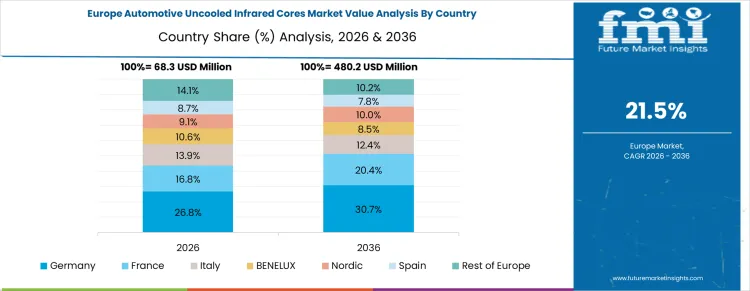
Sales for the automotive uncooled infrared cores in Germany are increasing at a CAGR of 23.2%, driven by the country’s focus on intelligent vehicle safety systems, luxury automotive engineering, and ADAS feature expansion. German OEMs are equipping high-end sedans, crossovers, and EVs with thermal sensors to enhance performance in fog, night driving, and adverse weather conditions. Infrared cores enable forward-looking pedestrian and animal detection systems integrated into adaptive cruise and lane-keeping modules.
Tier-1 suppliers work closely with component manufacturers to ensure compatibility with European road safety regulations and in-vehicle networking standards. German R&D labs continue to explore sensor fusion platforms that combine radar, visible spectrum cameras, and thermal imaging for robust environment modeling. Automotive suppliers are also expanding thermal detection for cabin monitoring and perimeter alert functions in autonomous test fleets. These trends support strong demand for uncooled infrared core technologies across Germany’s premium automotive segment and R&D infrastructure.
Why Is Japan Expanding Its Use of Automotive Uncooled Infrared Cores?
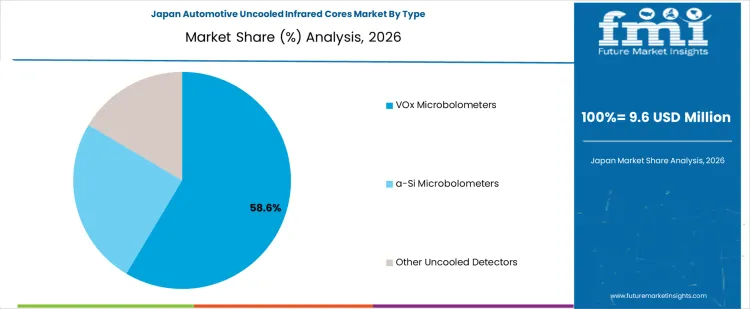
Demand for the automotive uncooled infrared cores in Japan is growing at a CAGR of 21.7%, driven by emphasis on compact sensor integration, electrified platforms, and low-visibility safety features. Japanese automakers are embedding miniaturized uncooled cores in front bumpers, side mirrors, and windscreen assemblies of hybrid and EV models. These sensors support pedestrian detection, thermal signature recognition, and object classification at night or in fog.
Urban use cases and autonomous shuttle prototypes also rely on thermal sensors for obstacle detection. Integration with driver-assist dashboards and visual warning systems expands consumer usability. Japan’s electronics ecosystem allows rapid component miniaturization and in-vehicle calibration, enabling manufacturers to deploy sensors in smaller form factors without cooling mechanisms. Demand also arises from advanced urban delivery fleets and robotaxi pilots in Tokyo and Osaka. These characteristics drive Japan’s steady expansion in the adoption of uncooled infrared cores across electric and autonomous mobility platforms.
How Are Leading Companies Competing And Differentiating In The Automotive Uncooled Infrared Cores Market?
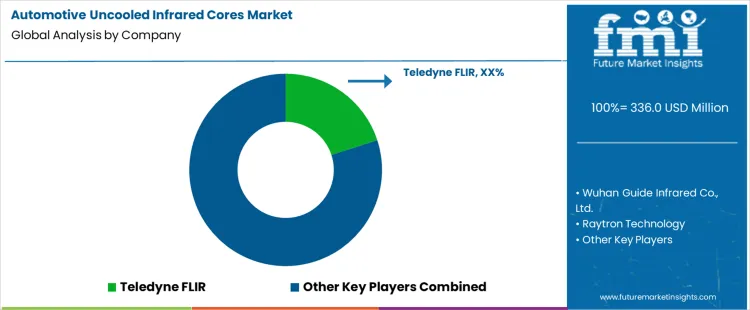
Competition in the automotive uncooled infrared cores market is being shaped by sensitivity, resolution, and integration flexibility. Teledyne FLIR is being positioned around high-performance cores for advanced driver-assistance systems, highlighting long-wave infrared detection, low-noise imaging, and compact footprint in product brochures. Wuhan Guide Infrared Co., Ltd. is being differentiated through cost-efficient cores for mass-market applications, emphasizing stability across temperature ranges and ease of integration into vehicle electronics. Raytron Technology focuses on scalable production and high frame-rate performance, promoting reliability and consistent detection in varied environmental conditions.
Miniaturization and system compatibility are being leveraged by Zhejiang ULIRVISION Technology, Global Sensor Technology, and Semi Conductor Devices (SCD). Zhejiang ULIRVISION emphasizes customizable cores for OEM requirements, with brochures highlighting low power consumption and uniform sensitivity. Global Sensor Technology positions its cores for seamless integration into camera modules and sensor fusion systems, stressing compact design and high thermal sensitivity. SCD promotes robust uncooled cores with high yield and reproducibility, targeting automotive safety and night-vision systems.
A different competitive approach is being taken by Leonardo DRS. Its cores are being positioned for military-grade automotive and off-road vehicles, highlighting ruggedness, long-term stability, and enhanced detection range. Across the market, differentiation is being driven by detection precision, thermal sensitivity, and integration flexibility. Product brochures translate technical performance into measurable advantages for ADAS, driver safety, and automotive sensor applications.
Automotive Uncooled Infrared Cores Market
- Teledyne FLIR
- Wuhan Guide Infrared Co., Ltd.
- Raytron Technology
- Zhejiang ULIRVISION Technology
- Global Sensor Technology
- Semi Conductor Devices (SCD)
- Leonardo DRS
Scope of Report
| Attributes | Description |
|---|---|
| Quantitative Unit | USD Million |
| Type | VOx Microbolometers, a Si Microbolometers, Other Uncooled Detectors |
| Application | Night Vision & Pedestrian Detection, ADAS Thermal Sensing, Autonomous Driving Vision, Other Safety or Control |
| Regions Covered | Asia Pacific, Europe, North America, Latin America, Middle East & Africa |
| Countries Covered | China, Japan, South Korea, India, Australia & New Zealand, ASEAN, Rest of Asia Pacific, Germany, United Kingdom, France, Italy, Spain, Nordic, BENELUX, Rest of Europe, United States, Canada, Mexico, Brazil, Chile, Rest of Latin America, Kingdom of Saudi Arabia, Other GCC Countries, Turkey, South Africa, Other African Union, Rest of Middle East & Africa |
| Key Companies Profiled | Teledyne FLIR, Wuhan Guide Infrared Co., Ltd., Raytron Technology, Zhejiang ULIRVISION Technology, Global Sensor Technology, Semi Conductor Devices (SCD), Leonardo DRS |
| Additional Attributes | Market revenue by detector type and application; regional adoption and penetration in automotive thermal sensing; OEM vs aftermarket integration; safety & autonomous driving system deployment; competitive landscape insights; growth contribution by APAC, North America, and Europe; forecasted trends and CAGR over 2026-2036. |
Automotive Uncooled Infrared Cores Market
Type:
- VOx Microbolometers
- a‑Si Microbolometers
- Other Uncooled Detectors
Application:
- Night Vision & Pedestrian Detection
- ADAS Thermal Sensing
- Autonomous Driving Vision
- Other Safety or Control
Region:
- Asia Pacific
- China
- Japan
- South Korea
- India
- Australia & New Zealand
- ASEAN
- Rest of Asia Pacific
- Europe
- Germany
- United Kingdom
- France
- Italy
- Spain
- Nordic
- BENELUX
- Rest of Europe
- North America
- United States
- Canada
- Mexico
- Latin America
- Brazil
- Chile
- Rest of Latin America
- Middle East & Africa
- Kingdom of Saudi Arabia
- Other GCC Countries
- Turkey
- South Africa
- Other African Union
- Rest of Middle East & Africa
Bibliography
- International Organization for Standardization. (2024). Infrared thermal imaging — Performance and testing of uncooled microbolometer detectors (ISO 19602:2024). ISO.
- Kohli, K. (2025). Uncooled microbolometers and infrared radiation detection. International Journal of Innovative Science and Research Technology, 10(6), 152–159.
- Institute of Electrical and Electronics Engineers. (2024). IEEE standard for automotive thermal imaging sensor performance and testing (IEEE Std 2848-2024). IEEE.
Frequently Asked Questions
How big is the automotive uncooled infrared cores market in 2026?
The global automotive uncooled infrared cores market is estimated to be valued at USD 336.0 million in 2026.
What will be the size of automotive uncooled infrared cores market in 2036?
The market size for the automotive uncooled infrared cores market is projected to reach USD 3,179.7 million by 2036.
How much will be the automotive uncooled infrared cores market growth between 2026 and 2036?
The automotive uncooled infrared cores market is expected to grow at a 25.2% CAGR between 2026 and 2036.
What are the key product types in the automotive uncooled infrared cores market?
The key product types in automotive uncooled infrared cores market are vox microbolometers, a‑si microbolometers and other uncooled detectors.
Which application segment to contribute significant share in the automotive uncooled infrared cores market in 2026?
In terms of application, night vision & pedestrian detection segment to command 50.0% share in the automotive uncooled infrared cores market in 2026.
Preview the report firsthand - request a free sample
Get SampleGet the brochure for pricing and purchase details.
Get PDFTable of Content
- Executive Summary
- Global Market Outlook
- Demand-side Trends
- Supply-side Trends
- Technology Roadmap Analysis
- Analysis and Recommendations
- Market Overview
- Market Coverage / Taxonomy
- Market Definition / Scope / Limitations
- Market Background
- Market Dynamics
- Drivers
- Restraints
- Opportunity
- Trends
- Scenario Forecast
- Demand in Optimistic Scenario
- Demand in Likely Scenario
- Demand in Conservative Scenario
- Opportunity Map Analysis
- Product Life Cycle Analysis
- Supply Chain Analysis
- Investment Feasibility Matrix
- Value Chain Analysis
- PESTLE and Porter’s Analysis
- Regulatory Landscape
- Regional Parent Market Outlook
- Production and Consumption Statistics
- Import and Export Statistics
- Market Dynamics
- Global Market Analysis 2021 to 2025 and Forecast, 2026 to 2036
- Historical Market Size Value (USD Million) Analysis, 2021 to 2025
- Current and Future Market Size Value (USD Million) Projections, 2026 to 2036
- Y-o-Y Growth Trend Analysis
- Absolute $ Opportunity Analysis
- Global Market Pricing Analysis 2021 to 2025 and Forecast 2026 to 2036
- Global Market Analysis 2021 to 2025 and Forecast 2026 to 2036, By Type
- Introduction / Key Findings
- Historical Market Size Value (USD Million) Analysis By Type, 2021 to 2025
- Current and Future Market Size Value (USD Million) Analysis and Forecast By Type, 2026 to 2036
- VOx Microbolometers
- a‑Si Microbolometers
- Other Uncooled Detectors
- VOx Microbolometers
- Y-o-Y Growth Trend Analysis By Type, 2021 to 2025
- Absolute $ Opportunity Analysis By Type, 2026 to 2036
- Global Market Analysis 2021 to 2025 and Forecast 2026 to 2036, By Application
- Introduction / Key Findings
- Historical Market Size Value (USD Million) Analysis By Application, 2021 to 2025
- Current and Future Market Size Value (USD Million) Analysis and Forecast By Application, 2026 to 2036
- Night Vision & Pedestrian Detection
- ADAS Thermal Sensing
- Autonomous Driving Vision
- Other Safety or Control
- Night Vision & Pedestrian Detection
- Y-o-Y Growth Trend Analysis By Application, 2021 to 2025
- Absolute $ Opportunity Analysis By Application, 2026 to 2036
- Global Market Analysis 2021 to 2025 and Forecast 2026 to 2036, By Region
- Introduction
- Historical Market Size Value (USD Million) Analysis By Region, 2021 to 2025
- Current Market Size Value (USD Million) Analysis and Forecast By Region, 2026 to 2036
- North America
- Latin America
- Western Europe
- Eastern Europe
- East Asia
- South Asia and Pacific
- Middle East & Africa
- Market Attractiveness Analysis By Region
- North America Market Analysis 2021 to 2025 and Forecast 2026 to 2036, By Country
- Historical Market Size Value (USD Million) Trend Analysis By Market Taxonomy, 2021 to 2025
- Market Size Value (USD Million) Forecast By Market Taxonomy, 2026 to 2036
- By Country
- USA
- Canada
- Mexico
- By Type
- By Application
- By Country
- Market Attractiveness Analysis
- By Country
- By Type
- By Application
- Key Takeaways
- Latin America Market Analysis 2021 to 2025 and Forecast 2026 to 2036, By Country
- Historical Market Size Value (USD Million) Trend Analysis By Market Taxonomy, 2021 to 2025
- Market Size Value (USD Million) Forecast By Market Taxonomy, 2026 to 2036
- By Country
- Brazil
- Chile
- Rest of Latin America
- By Type
- By Application
- By Country
- Market Attractiveness Analysis
- By Country
- By Type
- By Application
- Key Takeaways
- Western Europe Market Analysis 2021 to 2025 and Forecast 2026 to 2036, By Country
- Historical Market Size Value (USD Million) Trend Analysis By Market Taxonomy, 2021 to 2025
- Market Size Value (USD Million) Forecast By Market Taxonomy, 2026 to 2036
- By Country
- Germany
- UK
- Italy
- Spain
- France
- Nordic
- BENELUX
- Rest of Western Europe
- By Type
- By Application
- By Country
- Market Attractiveness Analysis
- By Country
- By Type
- By Application
- Key Takeaways
- Eastern Europe Market Analysis 2021 to 2025 and Forecast 2026 to 2036, By Country
- Historical Market Size Value (USD Million) Trend Analysis By Market Taxonomy, 2021 to 2025
- Market Size Value (USD Million) Forecast By Market Taxonomy, 2026 to 2036
- By Country
- Russia
- Poland
- Hungary
- Balkan & Baltic
- Rest of Eastern Europe
- By Type
- By Application
- By Country
- Market Attractiveness Analysis
- By Country
- By Type
- By Application
- Key Takeaways
- East Asia Market Analysis 2021 to 2025 and Forecast 2026 to 2036, By Country
- Historical Market Size Value (USD Million) Trend Analysis By Market Taxonomy, 2021 to 2025
- Market Size Value (USD Million) Forecast By Market Taxonomy, 2026 to 2036
- By Country
- China
- Japan
- South Korea
- By Type
- By Application
- By Country
- Market Attractiveness Analysis
- By Country
- By Type
- By Application
- Key Takeaways
- South Asia and Pacific Market Analysis 2021 to 2025 and Forecast 2026 to 2036, By Country
- Historical Market Size Value (USD Million) Trend Analysis By Market Taxonomy, 2021 to 2025
- Market Size Value (USD Million) Forecast By Market Taxonomy, 2026 to 2036
- By Country
- India
- ASEAN
- Australia & New Zealand
- Rest of South Asia and Pacific
- By Type
- By Application
- By Country
- Market Attractiveness Analysis
- By Country
- By Type
- By Application
- Key Takeaways
- Middle East & Africa Market Analysis 2021 to 2025 and Forecast 2026 to 2036, By Country
- Historical Market Size Value (USD Million) Trend Analysis By Market Taxonomy, 2021 to 2025
- Market Size Value (USD Million) Forecast By Market Taxonomy, 2026 to 2036
- By Country
- Kingdom of Saudi Arabia
- Other GCC Countries
- Turkiye
- South Africa
- Other African Union
- Rest of Middle East & Africa
- By Type
- By Application
- By Country
- Market Attractiveness Analysis
- By Country
- By Type
- By Application
- Key Takeaways
- Key Countries Market Analysis
- USA
- Pricing Analysis
- Market Share Analysis, 2025
- By Type
- By Application
- Canada
- Pricing Analysis
- Market Share Analysis, 2025
- By Type
- By Application
- Mexico
- Pricing Analysis
- Market Share Analysis, 2025
- By Type
- By Application
- Brazil
- Pricing Analysis
- Market Share Analysis, 2025
- By Type
- By Application
- Chile
- Pricing Analysis
- Market Share Analysis, 2025
- By Type
- By Application
- Germany
- Pricing Analysis
- Market Share Analysis, 2025
- By Type
- By Application
- UK
- Pricing Analysis
- Market Share Analysis, 2025
- By Type
- By Application
- Italy
- Pricing Analysis
- Market Share Analysis, 2025
- By Type
- By Application
- Spain
- Pricing Analysis
- Market Share Analysis, 2025
- By Type
- By Application
- France
- Pricing Analysis
- Market Share Analysis, 2025
- By Type
- By Application
- India
- Pricing Analysis
- Market Share Analysis, 2025
- By Type
- By Application
- ASEAN
- Pricing Analysis
- Market Share Analysis, 2025
- By Type
- By Application
- Australia & New Zealand
- Pricing Analysis
- Market Share Analysis, 2025
- By Type
- By Application
- China
- Pricing Analysis
- Market Share Analysis, 2025
- By Type
- By Application
- Japan
- Pricing Analysis
- Market Share Analysis, 2025
- By Type
- By Application
- South Korea
- Pricing Analysis
- Market Share Analysis, 2025
- By Type
- By Application
- Russia
- Pricing Analysis
- Market Share Analysis, 2025
- By Type
- By Application
- Poland
- Pricing Analysis
- Market Share Analysis, 2025
- By Type
- By Application
- Hungary
- Pricing Analysis
- Market Share Analysis, 2025
- By Type
- By Application
- Kingdom of Saudi Arabia
- Pricing Analysis
- Market Share Analysis, 2025
- By Type
- By Application
- Turkiye
- Pricing Analysis
- Market Share Analysis, 2025
- By Type
- By Application
- South Africa
- Pricing Analysis
- Market Share Analysis, 2025
- By Type
- By Application
- USA
- Market Structure Analysis
- Competition Dashboard
- Competition Benchmarking
- Market Share Analysis of Top Players
- By Regional
- By Type
- By Application
- Competition Analysis
- Competition Deep Dive
- Teledyne FLIR
- Overview
- Product Portfolio
- Profitability by Market Segments (Product/Age /Sales Channel/Region)
- Sales Footprint
- Strategy Overview
- Marketing Strategy
- Product Strategy
- Channel Strategy
- Wuhan Guide Infrared Co., Ltd.
- Raytron Technology
- Zhejiang ULIRVISION Technology
- Global Sensor Technology
- Semi Conductor Devices (SCD)
- Leonardo DRS
- Teledyne FLIR
- Competition Deep Dive
- Assumptions & Acronyms Used
- Research Methodology


