

- Market Size (2026)
- USD 0.9 Bn
- Forecast (2036)
- USD 5.2 Bn
- CAGR (2026 to 2036)
- 19.2%
Autonomous Battlefield Resupply Market Size, Forecast and Outlook By FMI
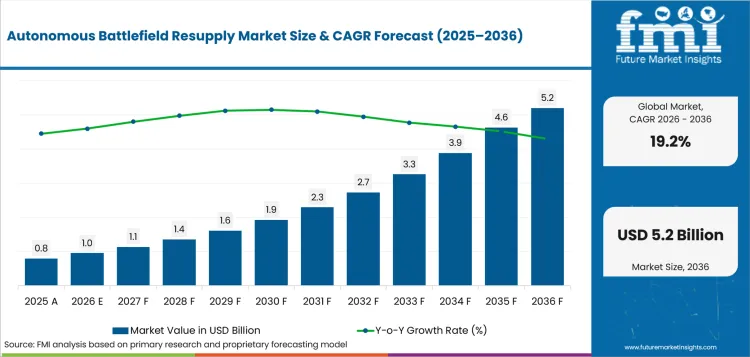
The autonomous battlefield resupply market value is predicted to expand from USD 0.8 billion in 2025 to USD 5.2 billion by 2036 at 19.2% CAGR, supported by unmanned tactical logistics and defense autonomy upgrades. Defense forces are projected to represent 58.7% share in 2026 as military buyers prioritize safer supply movement near contested routes. Supervised autonomy is anticipated to secure 44.2% share in 2026 due to commander approval rules and route control needs.
Key Takeaways, Market Size, and Forecast
- 2026 Market Size: USD 0.9 billion
- 2036 Market Size: USD 5.2 billion
- Forecast CAGR: 19.2% CAGR from 2026 to 2036
- Leading End User: Defense Forces
- Defense Forces Share in 2026: 58.7%
- Leading Autonomy Level: Supervised Autonomy
- Supervised Autonomy Share in 2026: 44.2%
- Leading Platform Type: Ground Resupply Robots
- Ground Resupply Robots Share in 2026: 41.6%
- Fastest-growing Country: United States
- United States CAGR: 22.8% CAGR by 2036
Summary of Autonomous Battlefield Resupply Market
- Demand and Growth Drivers
- Defense buyers are shifting unmanned supply movement for ammunition and medical payloads.
- Mission planners are prioritizing robotic logistics after field use showed value in short-range cargo and casualty movement.
- Suppliers are adding route control and secure operator approval tools for tactical users.
- Product and Segment View
- Defense forces are forecast to hold 58.7% share in 2026, driven by battlefield logistics and forward sustainment needs.
- Supervised autonomy is projected to represent 44.2% share in 2026, supported by human approval rules for movement near combat zones.
- Ground resupply robots are expected to account for 41.6% share in 2026, led by terrain access and repeat cargo movement needs.
- Geography and Competitive Outlook
- United States is projected to record 22.8% CAGR by 2036 owing to Marine Corps logistics autonomy and Army robotic resupply activity.
- United Kingdom is forecast to expand at 21.7% CAGR by 2036 through uncrewed vehicle trials and open mission architecture.
- Oshkosh Defense and Rheinmetall compete based on military vehicle depth and autonomous ground platform access.
- Milrem Robotics, Near Earth Autonomy, Bell Textron, Honeywell Aerospace, and Hanwha Aerospace compete by payload proof and mission integration.
- Analyst Opinion
- Rahul Pandita Principal Consultant for Technology at FMI, observes, “Autonomous battlefield resupply is moving from test-range robotics into tactical sustainment planning. Buyers compare payload proof and route reliability before autonomy claims. Suppliers with proven cargo movement and defense integration should retain repeat programs.”
- Autonomous Battlefield Resupply Market Value Analysis
- Market value is driven by eligible unmanned systems and autonomy packages used for battlefield supply movement.
- Supplier pricing reflects payload rating and autonomy depth before communications interfaces and support kits alter final contract value.
- Revenue improves as defense buyers move from single-purpose robotic trials into repeatable resupply packages for field units.
- Channel trust rises as live trials make cargo movement and route control easier for buyers to compare.
Forward resupply is under pressure to move cargo without exposing operators near ports or forward positions. USA Army’s 2025 ship-to-shore test showed USVs controlled from over 5,000 miles away and a UGV operated from 3,000 miles away. Long-distance control turns autonomous resupply into a command-and-control problem, not just a vehicle payload problem. Medium-lift aerial logistics is moving closer to scaled buying as Piasecki reported an initial USD 12 million Marine Corps award, 2 full-scale prototypes and demand above 300 aircraft for KARGO.
A production route of such size favors suppliers with owned airframe IP and repeatable manufacturing plans. Formation-level adoption has also become more practical as the Army described human-machine integrated formations over an 18 to 24 month window. Resupply suppliers therefore need systems integrating in platoon operations and pass cyber checks before contract award.
Autonomous Battlefield Resupply Market Definition
Autonomous battlefield resupply covers unmanned ground and aerial systems used to transport supplies during military operations. Scope includes ground resupply robots, aerial cargo UAS, autonomous vehicle kits, robotic trailers, and hybrid resupply carriers. Revenue includes system sales, autonomy modules, mission control software, payload kits, route planning tools, integration services, training, and managed support sold to defense forces, marine units, special forces, border forces, and disaster response agencies.
Autonomous Battlefield Resupply Market Inclusions
Market scope covers all commercially traded autonomous battlefield resupply systems categorized by platform type, including ground resupply robots and aerial cargo UAS. Platform type also covers autonomous vehicle kits, robotic trailers and hybrid resupply carriers. Payload class covers micro load and squad load. Payload class also covers platoon load, pallet load and medical load. Mobility mode covers tracked mobility, wheeled mobility and aerial lift. Mobility mode also covers leader follower and hybrid mobility.
Autonomy level covers teleoperated assist, supervised autonomy and waypoint autonomy. Autonomy level also covers leader follower and full autonomy. End users include defense forces, marine units, special forces, border forces and disaster response agencies. Mission roles include ammunition delivery, medical resupply, food and water, battery delivery and casualty movement. Revenue scope covers 2026 to 2036. The key stakeholders include autonomous resupply system manufacturers, UGV and UAS OEMs, autonomy software providers, payload kit suppliers, tactical communications firms, defense agencies, marine units, system integrators, training providers, distributors and regulatory bodies.
Autonomous Battlefield Resupply Market Exclusions
Scope excludes crewed logistics trucks without autonomous control, civilian parcel drones, general warehouse robots, and hardware-only cargo platforms without military resupply positioning. Counter-drone systems are excluded unless bundled with battlefield logistics mission control. Standalone batteries, sensors, radios, weapons, and charging equipment are outside scope unless sold as part of eligible autonomous resupply system contracts.
Autonomous Battlefield Resupply Market Research Methodology
- Primary Research: FMI analysts reviewed robotic logistics portfolios, defense autonomy trials, integrator checks, and buyer specification patterns across UGV, UAS, tactical logistics, and autonomous mission planning.
- Desk Research: Public data from defense agencies, official company releases, government technology programs, and field logistics documents were checked against autonomous battlefield resupply evidence.
- Market Sizing and Forecasting: Estimated using a bottom-up product-boundary approach based on eligible system revenue, platform integration presence, payload pricing, mission positioning, and country-level adoption.
- Data Validation: Forecast checks compared defense autonomy funding, resupply test evidence, UGV fleet expansion, live trial activity, and active supplier portfolios across leading countries.
Why is the Autonomous Battlefield Resupply Market Growing?
- Defense logistics teams are shifting routine supply movement toward robotic systems to reduce personnel exposure on contested routes.
- Tactical users are prioritizing autonomous platforms moving cargo across austere terrain with fewer crewed support vehicles.
- OEMs and integrators are building resupply platforms that connect unmanned ground vehicle and military robot capabilities into field logistics workflows.
Autonomous battlefield resupply is expected to gain stronger adoption as defense buyers test remote and autonomous systems across realistic field conditions. In May 2025, the USA Army reported that warfighters tested 14 emerging technologies from May 5 to 16, 2025 at Fort Leonard Wood. About 50 soldiers took part in the assessments, and one testing area included seven technologies in platoon-style lanes.
The same exercise included unmanned drones and boats moving across air along with land and water. This supports demand for resupply systems able to be evaluated inside operational lanes before wider fielding. It also strengthens supplier focus on payload movement and mission feedback from soldiers who will use the systems in logistics and support tasks.
Market Segmentation Analysis
- Ground resupply robots are expected to represent 41.6% share in 2026, led by rough-terrain movement and direct support for dismounted units.
- Squad load is projected to hold 36.9% share in 2026 due to infantry units needing practical cargo support for water and ammunition.
- Tracked mobility is anticipated to secure 38.4% share in 2026 since mud and damaged routes favor high-traction vehicles.
- Supervised autonomy is projected to account for 44.2% share in 2026, reflected by commanders needing mission approval control near friendly forces.
- Defense forces are forecast to capture 58.7% share in 2026 owing to tactical sustainment needs and direct buying authority.
- Ammunition delivery is expected to secure 31.5% share in 2026 as reload movement gets more time-sensitive across dispersed units.
The autonomous battlefield resupply market is divided into six primary segment groups based on platform type and payload class. Mobility mode, autonomy level, end user, and mission role complete the structure. Platform type covers ground resupply robots and aerial cargo UAS. Autonomous vehicle kits, robotic trailers, and hybrid resupply carriers complete platform coverage. Adjacent demand from military robots supports common standards across payload movement and operator control.
Insights into Autonomous Battlefield Resupply Market by Platform Type
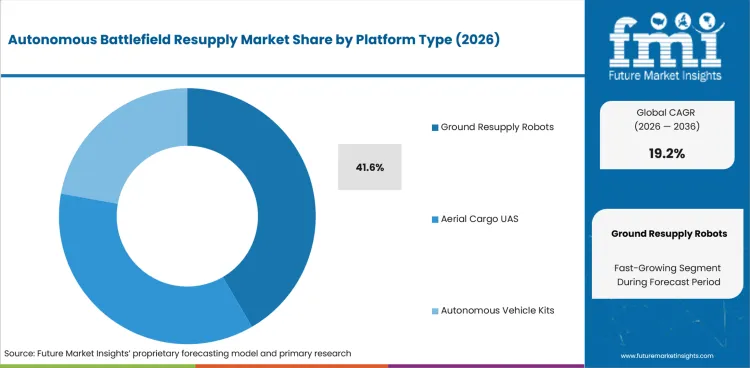
- Ground resupply robots are projected to hold 41.6% share in 2026, led by tactical cargo movement across terrain unsuitable for standard trucks.
- Aerial cargo UAS gains use as marine and dispersed units seek supply options avoiding exposed road movement.
Insights into Autonomous Battlefield Resupply Market by Payload Class
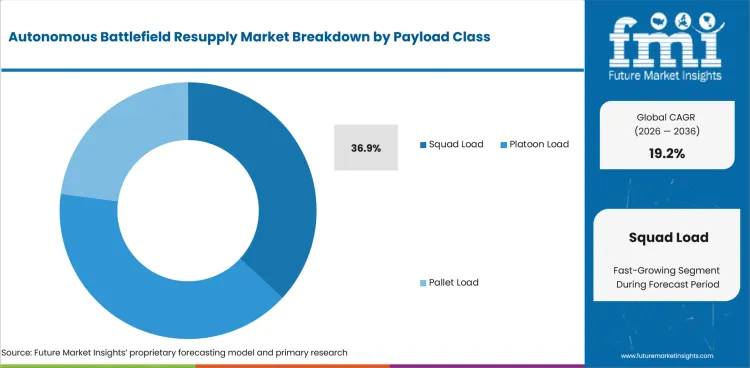
- Squad load is forecast to account for 36.9% share in 2026, backed by practical supply needs for small units operating away from main logistics hubs.
- Platoon load gains value as medium robotic systems move heavier cargo across repeated supply routes.
Insights into Autonomous Battlefield Resupply Market by Mobility Mode
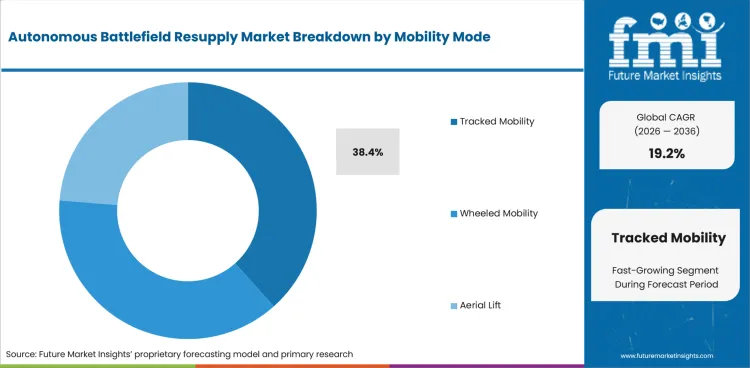
- Tracked mobility is expected to secure 38.4% share in 2026, reflected by better traction across soft ground and damaged battlefield routes.
- Aerial lift gains use as commanders seek faster delivery for isolated units and maritime expeditionary operations.
Insights into Autonomous Battlefield Resupply Market by Autonomy Level
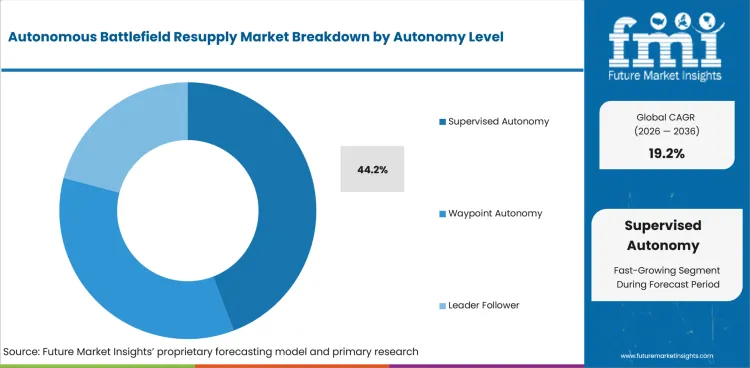
- Supervised autonomy is anticipated to hold 44.2% share in 2026, guided by mission rules requiring human confirmation during movement near combat zones.
- Leader follower autonomy gains use as vehicle columns and robotic trailers support resupply without full independent movement.
Insights into Autonomous Battlefield Resupply Market by End User
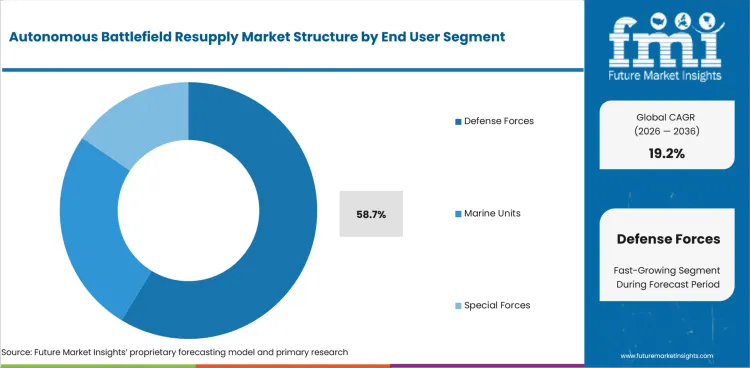
- Defense forces are projected to represent 58.7% share in 2026, driven by forward logistics needs and direct system buying authority.
- Marine units gain value as expeditionary forces require autonomous resupply across beach and distributed operating areas.
Insights into Autonomous Battlefield Resupply Market by Mission Role
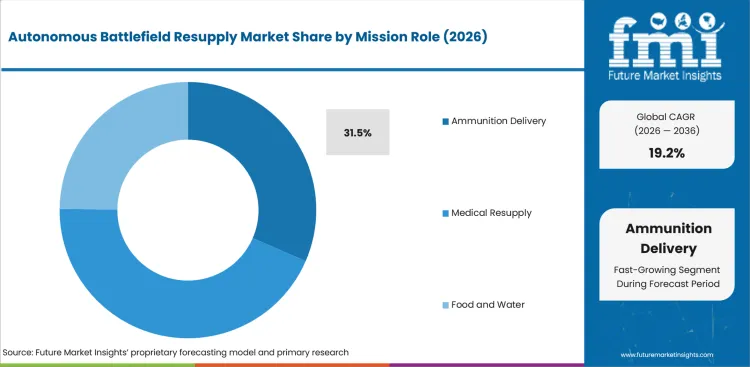
- Ammunition delivery is projected to hold 31.5% share in 2026, supported by reload pressure and dispersed firing positions.
- Medical resupply gains demand as units seek casualty support and emergency supplies without exposing rescue teams.
Autonomous Battlefield Resupply Market Drivers, Restraints and Opportunities
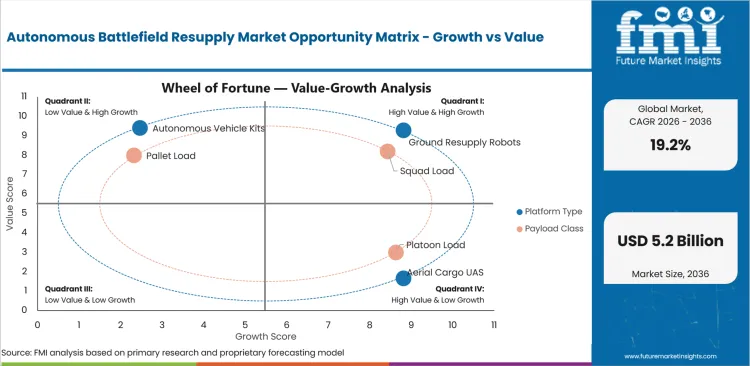
- Robotic cargo movement is turning autonomous systems into a core layer of battlefield logistics.
- Certification and cyber review cycles can slow field release across secure defense environments.
- Mixed ground and aerial resupply systems can help agencies coordinate supply movement under common mission rules.
Robotic Cargo Movement Lifts Demand
Defense buyers are assigning more mission value to systems moving payloads without exposing soldiers or crews. Milrem Robotics stated in October 2025 that more than 150 THeMIS UGVs would be delivered to Ukraine through a Dutch-led defense initiative. That delivery supports demand for autonomous systems tied to unmanned systems and field logistics modernization.
Cyber Review Slows Field Release
Autonomous resupply systems used near troops must pass safety and network checks before field use. Buyers often require encryption and route control testing before approving tactical movement. Such review cycles lengthen sales conversion and raise engineering cost for vendors lacking defense assurance depth. Suppliers must maintain auditable software builds and secure update controls to reduce acceptance delays.
Mixed Resupply Platforms Open Upgrade Revenue
Interoperability is creating add-on revenue beyond the first robotic platform. Oshkosh Defense described FMAV as a production-ready autonomous family with payload versatility for Army formation needs in October 2025. Near Earth Autonomy’s MARV-EL Increment 2 work with Bell Textron along with Moong and XP Services points to aircraft-agnostic autonomy for Marine logistics. Suppliers able to connect ground robots and tactical communications can capture mission package upgrades.
Mission Deployment Analysis
Autonomous battlefield resupply systems are expected to move from isolated platform trials into mission-level sustainment planning as defense agencies organize logistics around contested, multi-domain operations. In April 2025, USA Army Futures Command stated that its Contested Logistics Cross-Functional Team structures future sustainment work around four portfolio areas including human-machine integrated supply and distribution and demand reduction. It also defines contested logistics across six operating domains and electromagnetic spectrum. The portfolio directly supports demand for autonomous resupply systems that can move ammunition and medical supplies across dispersed formations instead of serving only as standalone cargo robots.
Defense Compliance and Operating Policy Analysis
Operating policy now acts as a stronger buying filter as tactical resupply UAS move closer to routine military use and installation-level training. In June 2025, the White House executive order on drone dominance directed FAA action on routine BVLOS operations within 30 days, a final rule within 240 days, AI-assisted waiver review within 120 days, and Blue UAS List expansion within 90 days for compliant drones and critical components. Such timelines support a clearer compliance path for battlefield resupply platforms since buyers need approved airspace access and faster waiver handling before scaling autonomous cargo UAS across military units.
Analysis of Autonomous Battlefield Resupply Market by Key Countries
.webp "Top Country Growth Comparison Autonomous Battlefield Resupply Market Cagr (2026 2036)")
| Country | CAGR |
|---|---|
| United States | 22.8% |
| United Kingdom | 21.7% |
| Germany | 20.9% |
| Japan | 20.3% |
| South Korea | 19.6% |
| India | 18.7% |
| China | 17.9% |
Source: Future Market Insights, 2026.
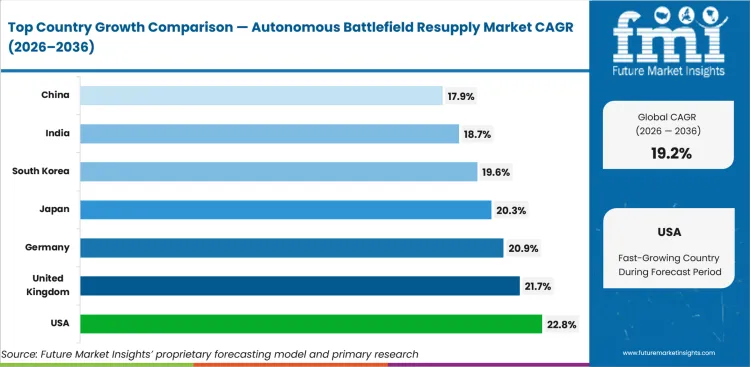
Autonomous Battlefield Resupply Market CAGR Analysis by Country
- United States is forecast to record 22.8% CAGR by 2036, supported by Marine Corps autonomous logistics and Army robotic resupply activity.
- United Kingdom is expected to expand at 21.7% CAGR by 2036, guided by uncrewed vehicle trials and open mission architecture.
- Germany is projected to grow at 20.9% CAGR through 2036, helped by autonomous ground system suppliers and European defense spending.
- Japan is expected to advance at 20.3% CAGR through 2036, backed by first autonomous vehicle testing and island defense needs.
- South Korea is projected to rise at 19.6% CAGR through 2036, reflected by defense electronics depth and unmanned system capability.
- India is forecast at 18.7% CAGR through 2036, shaped by domestic defense production and border logistics needs.
- China is expected to post 17.9% CAGR through 2036, influenced by UAV production scale and transport UAV development.
Demand Outlook for Autonomous Battlefield Resupply Market in United States
Autonomous logistics testing and defense vehicle integration center 2026 to 2036
Country Market Snapshot Table
| Parameter | Value |
|---|---|
| Market Size in 2025 | USD 208.3 million |
| Market Size in 2026 | USD 255.8 million |
| Market Forecast in 2036 | USD 1,994.7 million |
| CAGR 2026-2036 | 22.8% CAGR |
| Years Considered | 2021-2036 |
| Base Year | 2025 |
| Forecast Period | 2026-2036 |
| Units Considered | Value USD million |
| Leading Sub-Region | Pennsylvania and Virginia defense mobility corridors |
United States Autonomous Battlefield Resupply Market Outlook
- United States demand is shaped by live autonomous logistics trials and software-defined vehicle buying. Defense forces need resupply tools moving cargo through exposed routes under secure operator approval.
- Pennsylvania and Virginia support specification-led orders through defense vehicle integrators and autonomy software suppliers. Repeat testing across Army and Marine Corps programs should keep supervised autonomy and aerial resupply central to USA demand.
Key Growth Drivers
- Marine Corps logistics autonomy supports aerial resupply adoption across dispersed units. NAVAIR states TRUAS carries up to 120.0 pounds to a 9.0-kilometer combat radius at 50.0 knots.
- Army resupply concepts support robotic cargo use near forward units. USA Army analysis stated that a 600.0-pound UGV could deliver roughly 66.0 gallons of water or 28.0 cases of meals.
- Platform diversity creates demand for mission tools able to coordinate aerial cargo systems and robotic ground carriers under one operator view.
- Commercial autonomy teams give United States a deep supplier core for supervised autonomy and battlefield resupply.
Key Restraints
- Classified fielding rules can delay software release until mission data controls and cyber review are complete.
- Multi-vendor integration can raise cost for agencies connecting UGVs, UAS, and command systems into a single operating view.
- Acquisition review can stretch fielding cycles for new autonomy programs. GAO stated in June 2025 that DOD planned to invest nearly USD 2.4 trillion across 106.0 costliest weapon programs.
What makes United States unique
United States is unique due to major autonomy funding together with Marine Corps logistics programs, and live multi-domain resupply testing.
Key Companies
- Oshkosh Defense
- General Dynamics Land Systems
- Near Earth Autonomy
- Bell Textron
- Honeywell Aerospace
- Teledyne FLIR
Sales & Marketing Channels
- Direct defense contracts
- Prime contractor integration
- UGV OEM partnerships
- UAS logistics programs
- Mission software licensing
- Secure cloud partners
Market Taxonomy and Sub-Regions Covered
| Segment | Sub-Segments |
|---|---|
| By Platform Type | Ground Resupply Robots Aerial Cargo UAS Autonomous Vehicle Kits Robotic Trailers Hybrid Resupply Carriers |
| By Payload Class | Micro Load Squad Load Platoon Load Pallet Load Medical Load |
| By Mobility Mode | Tracked Mobility Wheeled Mobility Aerial Lift Leader Follower Hybrid Mobility |
| By Autonomy Level | Teleoperated Assist Supervised Autonomy Waypoint Autonomy Leader Follower Full Autonomy |
| By End User | Defense Forces Marine Units Special Forces Border Forces Disaster Response |
| By Mission Role | Ammunition Delivery Medical Resupply Food and Water Battery Delivery Casualty Movement |
| Key Sub-Regions Covered, Defense Mobility and Autonomy Corridors | Pennsylvania Virginia Michigan Wisconsin Texas California |
Frequently Asked Questions
How fast is United States autonomous battlefield resupply market growing?
The market in United States is forecast to scale at 22.8% CAGR from 2026 to 2036, led by Marine Corps logistics autonomy and Army resupply trials.
Who leads United States autonomous battlefield resupply market?
Oshkosh Defense, General Dynamics Land Systems, Near Earth Autonomy, Bell Textron, Honeywell Aerospace, and Teledyne FLIR compete due to autonomy depth and defense integration.
What is driving adoption in United States autonomous battlefield resupply market?
Autonomous logistics trials and multi-domain sustainment needs are moving systems from test environments into tactical supply workflows.
Sales Outlook for Autonomous Battlefield Resupply Market in United Kingdom
Uncrewed vehicle trial and open mission architecture center 2026 to 2036
Country Market Snapshot Table
| Parameter | Value |
|---|---|
| Market Size in 2025 | USD 60.5 million |
| Market Size in 2026 | USD 73.6 million |
| Market Forecast in 2036 | USD 524.5 million |
| CAGR 2026-2036 | 21.7% CAGR |
| Years Considered | 2021-2036 |
| Base Year | 2025 |
| Forecast Period | 2026-2036 |
| Units Considered | Value USD million |
| Leading Sub-Region | Bristol and Farnborough defense technology corridors |
United Kingdom Autonomous Battlefield Resupply Market Outlook
- United Kingdom demand is shaped by autonomous experimentation and open architecture integration. Buyers need resupply tools connecting air and land assets through trusted mission interfaces.
- Defense labs and prime contractors support testing for operator workload and human-machine teaming. Growth should stay strongest around simulation and integration services tied to C4ISR workflows.
Key Growth Drivers
- Autonomous system trials support mission software and resupply control demand. Dstl stated in June 2025 that one operator controlled 3.0 uncrewed air and land vehicles during a UK trial.
- Open mission architecture supports repeatable integration for uncrewed systems. DASA stated in September 2025 that 11.0 organizations received more than GBP 4.0 million for PYRAMID-compliant software systems.
- Local aerospace and robotics firms strengthen system integration options for aerial cargo and ground resupply vehicles.
- Simulation firms support mission rehearsal for robotic logistics and unmanned aerial vehicle operations.
Key Restraints
- Certification requirements can delay release for crewed-uncrewed teaming and safety-critical testing.
- Small suppliers may need prime contractor access to pass defense integration and assurance reviews.
- Budget discipline can slow wider rollout after trials. The House of Commons Library stated that the UK was expected to spend 2.4% of GDP on defense in 2025 and increase to 2.5% by 2027.
What makes United Kingdom unique
United Kingdom is unique due to open architecture programs and live trials for mixed uncrewed vehicle coordination.
Key Companies
- BAE Systems
- QinetiQ
- Malloy Aeronautics
- Supacat
- Horiba MIRA
Sales & Marketing Channels
- Defense research programs
- Prime contractor channels
- Simulation software channels
- UAS OEM partnerships
- Mission architecture partners
- Allied program routes
- mission software and defense trial access.
Market Taxonomy and Sub-Regions Covered
| Segment | Sub-Segments |
|---|---|
| By Platform Type | Ground Resupply Robots Aerial Cargo UAS Autonomous Vehicle Kits Robotic Trailers Hybrid Resupply Carriers |
| By Payload Class | Micro Load Squad Load Platoon Load Pallet Load Medical Load |
| By Mobility Mode | Tracked Mobility Wheeled Mobility Aerial Lift Leader Follower Hybrid Mobility |
| By Autonomy Level | Teleoperated Assist Supervised Autonomy Waypoint Autonomy Leader Follower Full Autonomy |
| By End User | Defense Forces Marine Units Special Forces Border Forces Disaster Response |
| By Mission Role | Ammunition Delivery Medical Resupply Food and Water Battery Delivery Casualty Movement |
| Key Sub-Regions Covered, Defense Autonomy and Mission Architecture Corridors | Bristol Farnborough London Portsmouth Stevenage Mancheste |
Frequently Asked Questions
How fast is United Kingdom autonomous battlefield resupply market growing?
Sales in United Kingdom are projected to rise at 21.7% CAGR through 2036, reflected by autonomous system trials and open architecture programs.
Who leads United Kingdom autonomous battlefield resupply market?
BAE Systems, QinetiQ, Malloy Aeronautics, Supacat, and Horiba MIRA compete led by mission software and defense trial access.
What is driving adoption in United Kingdom autonomous battlefield resupply market?
Open architecture work and uncrewed vehicle trials are supporting country demand.
Growth Outlook for Autonomous Battlefield Resupply Market in Germany
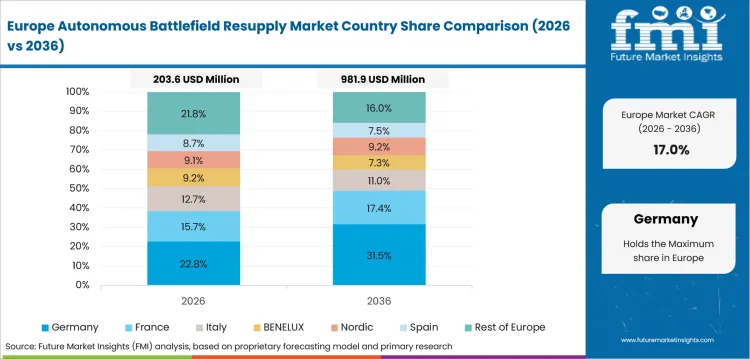
Autonomous ground systems and European defense mobility center 2026 to 2036
Country Market Snapshot Table
| Parameter | Value |
|---|---|
| Market Size in 2025 | USD 56.6 million |
| Market Size in 2026 | USD 68.4 million |
| Market Forecast in 2036 | USD 456.4 million |
| CAGR 2026-2036 | 20.9% CAGR |
| Years Considered | 2021-2036 |
| Base Year | 2025 |
| Forecast Period | 2026-2036 |
| Units Considered | Value USD million |
| Leading Sub-Region | Bavaria and North Rhine-Westphalia defense mobility corridors |
Germany Autonomous Battlefield Resupply Market Outlook
- Germany demand is shaped by European defense spending and local autonomous ground system capability. Buyers place high weight on tested mobility and cyber assurance.
- Bavaria and North Rhine-Westphalia support defense suppliers and vehicle integrators. Growth should stay aligned to tracked resupply platforms and secure European software stacks.
Key Growth Drivers
- Federal spending supports defense mobility programs. Germany’s Federal Ministry of Finance stated in June 2025 that the defense budget rose to about EUR 62.4 billion and reached 2.4% of GDP under NATO definitions.
- German UGV exports show practical allied interest. Rheinmetall stated in April 2024 that it would deliver 3.0 Mission Master SP vehicles to Japan in January 2025 for army testing.
- European airspace and safety expectations increase buyer interest in auditable mission software and certified interfaces.
- Local defense integrators strengthen supplier access for secure mission planning and robot systems.
Key Restraints
- Certification and safety review can slow autonomy release for operational use.
- Sovereign software requirements can limit use of foreign mission control components.
- Demand pressure can strain delivery schedules for vehicle makers. SIPRI stated in April 2026 that Germany’s military expenditure grew 24.0% year on year to USD 114.0 billion in 2025.
What makes Germany unique
Germany is unique due to strict assurance expectations and strong European ground system integration capability.
Key Companies
- Rheinmetall
- ARX Robotics
- Hensoldt
- Diehl Defence
- ESG Elektroniksystem
Sales & Marketing Channels
- Bundeswehr programs
- European defense integrators
- UGV OEM partnerships
- Research institutes
- Secure software distributors
- Training and simulation firms
Market Taxonomy and Sub-Regions Covered
| Segment | Sub-Segments |
|---|---|
| By Platform Type | Ground Resupply Robots Aerial Cargo UAS Autonomous Vehicle Kits Robotic Trailers Hybrid Resupply Carriers |
| By Payload Class | Micro Load Squad Load Platoon Load Pallet Load Medical Load |
| By Mobility Mode | Tracked Mobility Wheeled Mobility Aerial Lift Leader Follower Hybrid Mobility |
| By Autonomy Level | Teleoperated Assist Supervised Autonomy Waypoint Autonomy Leader Follower Full Autonomy |
| By End User | Defense Forces Marine Units Special Forces Border Forces Disaster Response |
| By Mission Role | Ammunition Delivery Medical Resupply Food and Water Battery Delivery Casualty Movement |
| Key Sub-Regions Covered, Defense Mobility and UGV Corridors | Bavaria North Rhine-Westphalia Berlin Hamburg Baden-Württemberg Lower Saxony |
Frequently Asked Questions
How fast is Germany autonomous battlefield resupply market growing?
Growth in Germany is expected at 20.9% CAGR through 2036, influenced by UGV capability and European defense modernization.
Who leads Germany autonomous battlefield resupply market?
Rheinmetall, ARX Robotics, Hensoldt, Diehl Defence, and ESG Elektroniksystem compete depending on ground systems and defense integration.
What is driving adoption in Germany autonomous battlefield resupply market?
European defense spending and local autonomous ground system capability are supporting secure resupply adoption.
Opportunity Analysis for Autonomous Battlefield Resupply Market in Japan
Island defense and autonomous ground vehicle testing center 2026 to 2036
Country Market Snapshot Table
| Parameter | Value |
|---|---|
| Market Size in 2025 | USD 44.1 million |
| Market Size in 2026 | USD 53.1 million |
| Market Forecast in 2036 | USD 337.1 million |
| CAGR 2026-2036 | 20.3% CAGR |
| Years Considered | 2021-2036 |
| Base Year | 2025 |
| Forecast Period | 2026-2036 |
| Units Considered | Value USD million |
| Leading Sub-Region | Tokyo and Nagoya defense technology corridors |
Japan Autonomous Battlefield Resupply Market Outlook
- Japan demand is shaped by island defense needs and autonomous vehicle testing. Local buyers are evaluating unmanned ground systems for supply movement and troop support.
- Tokyo and Nagoya support defense electronics and trading channels for allied suppliers. Adoption should focus on supervised autonomy and mission support for distributed defense positions.
Key Growth Drivers
- First autonomous vehicle testing supports local confidence. Rheinmetall stated in April 2024 that Japan would receive 3.0 Mission Master SP vehicles for testing by the Japanese army.
- Defense buildup funding supports unmanned and sustainment projects. Japan’s Ministry of Defense stated FY2025 DBP implementation expenditure amounted to JPY 8,475.0 billion and reached 62.0% of DBP expenses.
- Local industrial partners can support maintenance and adaptation for Japanese terrain.
- Aerial resupply systems can support remote outposts and maritime defense planning.
Key Restraints
- Field approval can move slowly for foreign autonomous platforms entering domestic defense trials.
- Terrain and weather requirements can raise validation needs for small UGV systems.
- Fiscal pressure can affect rollout timing. SIPRI stated in April 2026 that Japan’s military expenditure rose 9.7% to USD 62.2 billion and reached 1.4% of GDP in 2025.
What makes Japan unique
Japan is unique due to island defense requirements and early testing of imported autonomous ground systems.
Key Companies
- Mitsubishi Heavy Industries
- IHI
- Marubeni Aerospace
- NEC
- Subaru Corporation
Sales & Marketing Channels
- Direct defense programs
- Trading house channels
- Allied supplier partnerships
- UGV trial programs
- Aerospace integrators
- Mission support suppliers
Market Taxonomy and Sub-Regions Covered
| Segment | Sub-Segments |
|---|---|
| By Platform Type | Ground Resupply Robots Aerial Cargo UAS Autonomous Vehicle Kits Robotic Trailers Hybrid Resupply Carriers |
| By Payload Class | Micro Load Squad Load Platoon Load Pallet Load Medical Load |
| By Mobility Mode | Tracked Mobility Wheeled Mobility Aerial Lift Leader Follower Hybrid Mobility |
| By Autonomy Level | Teleoperated Assist Supervised Autonomy Waypoint Autonomy Leader Follower Full Autonomy |
| By End User | Defense Forces Marine Units Special Forces Border Forces Disaster Response |
| By Mission Role | Ammunition Delivery Medical Resupply Food and Water Battery Delivery Casualty Movement |
| Key Sub-Regions Covered, Defense Technology and Vehicle Testing Corridors | Tokyo Nagoya Osaka Yokohama Kobe Fukuoka |
Frequently Asked Questions
How fast is Japan autonomous battlefield resupply market growing?
Sector in Japan is projected to grow at 20.3% CAGR through 2036, supported by autonomous ground vehicle testing and island defense needs.
Who leads Japan autonomous battlefield resupply market?
Mitsubishi Heavy Industries, IHI, Marubeni Aerospace, NEC, and Subaru Corporation compete with defense engineering and integration access.
What is driving adoption in Japan autonomous battlefield resupply market?
Island defense planning and allied autonomous vehicle testing are supporting country demand.
Sales Outlook for Autonomous Battlefield Resupply Market in South Korea
Defense electronics and unmanned vehicle capability center 2026 to 2036
Country Market Snapshot Table
| Parameter | Value |
|---|---|
| Market Size in 2025 | USD 38.2 million |
| Market Size in 2026 | USD 45.7 million |
| Market Forecast in 2036 | USD 273.7 million |
| CAGR 2026-2036 | 19.6% CAGR |
| Years Considered | 2021-2036 |
| Base Year | 2025 |
| Forecast Period | 2026-2036 |
| Units Considered | Value USD million |
| Leading Sub-Region | Seoul and Changwon defense technology corridors |
South Korea Autonomous Battlefield Resupply Market Outlook
- South Korea demand is guided by defense electronics strength and local unmanned platform development. Military buyers need resupply coordination tools for border operations and maritime support.
- Seoul and Changwon support defense electronics and vehicle system integration capability. Demand should favor supervised autonomy and integration services tied to domestic unmanned platforms.
Key Growth Drivers
- Defense spending supports autonomy programs and local suppliers. SIPRI stated in April 2026 that South Korea allocated USD 47.8 billion to the military in 2025.
- National technology funding supports AI and robotics capability. South Korea’s MSIT stated major R&D budget for 2025 was KRW 24.8 trillion.
- Border and maritime monitoring needs influence demand for supervised resupply systems with secure operator approval.
- Export ambitions encourage mission software able to be adapted for allied customer requirements.
Key Restraints
- Export-sensitive autonomy software can encounter approval limits across customer countries.
- Platform integration complexity can raise costs for command software across air and ground assets.
- Mixed-platform validation can slow release. Hanwha Aerospace’s ADEX 2025 display included Themis-K along with Arion-SMET, and GRUNT as 3.0 unmanned vehicle lines tied to core land systems.
What makes South Korea unique
South Korea is unique due to defense electronics depth and unmanned system needs shaped by peninsula security conditions.
Key Companies
- Hanwha Aerospace
- Hyundai Rotem
- LIG Nex1
- Korea Aerospace Industries
- Doosan Robotics
Sales & Marketing Channels
- Defense acquisition programs
- Aerospace OEM channels
- Naval system integrators
- Electronics suppliers
- Simulation partners
- Allied export channels
- defense electronics and platform integration
Market Taxonomy and Sub-Regions Covered
| Segment | Sub-Segments |
|---|---|
| By Platform Type | Ground Resupply Robots Aerial Cargo UAS Autonomous Vehicle Kits Robotic Trailers Hybrid Resupply Carriers |
| By Payload Class | Micro Load Squad Load Platoon Load Pallet Load Medical Load |
| By Mobility Mode | Tracked Mobility Wheeled Mobility Aerial Lift Leader Follower Hybrid Mobility |
| By Autonomy Level | Teleoperated Assist Supervised Autonomy Waypoint Autonomy Leader Follower Full Autonomy |
| By End User | Defense Forces Marine Units Special Forces Border Forces Disaster Response |
| By Mission Role | Ammunition Delivery Medical Resupply Food and Water Battery Delivery Casualty Movement |
| Key Sub-Regions Covered, Defense Electronics and Mobility Corridors | Seoul Changwon Daejeon Busan Seongnam Sacheon |
Frequently Asked Questions
How fast is South Korea autonomous battlefield resupply market growing?
Industry in South Korea is forecast at 19.6% CAGR through 2036, shaped by defense electronics and unmanned system capability.
Who leads South Korea autonomous battlefield resupply market?
Hanwha Aerospace, Hyundai Rotem, LIG Nex1, Korea Aerospace Industries, and Doosan Robotics compete fueled by defense electronics and platform integration.
What is driving adoption in South Korea autonomous battlefield resupply market?
Defense technology spending and export-oriented unmanned systems are supporting resupply system uptake.
Opportunity Analysis for Autonomous Battlefield Resupply Market in India
Domestic defense production and border logistics center 2026 to 2036
Country Market Snapshot Table
| Parameter | Value |
|---|---|
| Market Size in 2025 | USD 52.5 million |
| Market Size in 2026 | USD 62.3 million |
| Market Forecast in 2036 | USD 345.9 million |
| CAGR 2026-2036 | 18.7% CAGR |
| Years Considered | 2021-2036 |
| Base Year | 2025 |
| Forecast Period | 2026-2036 |
| Units Considered | Value USD million |
| Leading Sub-Region | Bengaluru and Hyderabad autonomy corridors |
India Autonomous Battlefield Resupply Market Outlook
- India demand is shaped by domestic defense production and local unmanned system manufacturing. Buyers need resupply tools working across high-altitude and border operating conditions.
- Bengaluru and Hyderabad support supplier growth through aerospace software firms and startup programs. Adoption should stay strongest for supervised autonomy and integration services tied to Indian platforms.
Key Growth Drivers
- Local defense production supports unmanned logistics programs. India’s Ministry of Defence stated annual defense production reached INR 1,50,590.0 crore in FY 2024-25.
- Drone capacity supports aerial resupply skills. India’s Digital Sky platform recorded 38,575.0 registered drones, 39,890.0 remote pilot certificates, and 244.0 training organizations by February 2026.
- Border logistics needs support robotic carriers for ammunition and medical payloads.
- Local startups strengthen integration services for UGVs and micro tactical ground robot applications.
Key Restraints
- Defense approval cycles can slow system onboarding for mission tools tied to secure communications.
- Small suppliers may lack cyber documentation needed for command software integration.
- Capital approvals are spread across many systems. India’s DAC cleared proposals worth about INR 79,000.0 crore in October 2025 covering several defense needs.
What makes India unique
India is unique due to local defense production growth and terrain-driven logistics needs across border regions.
Key Companies
- Bharat Electronics Limited
- Hindustan Aeronautics Limited
- ideaForge
- Tonbo Imaging
- NewSpace Research
Sales & Marketing Channels
- Defense agencies
- Aerospace integrators
- Drone OEM partnerships
- Startup defense programs
- Border security channels
- Training platforms
Market Taxonomy and Sub-Regions Covered
| Segment | Sub-Segments |
|---|---|
| By Platform Type | Ground Resupply Robots Aerial Cargo UAS Autonomous Vehicle Kits Robotic Trailers Hybrid Resupply Carriers |
| By Payload Class | Micro Load Squad Load Platoon Load Pallet Load Medical Load |
| By Mobility Mode | Tracked Mobility Wheeled Mobility Aerial Lift Leader Follower Hybrid Mobility |
| By Autonomy Level | Teleoperated Assist Supervised Autonomy Waypoint Autonomy Leader Follower Full Autonomy |
| By End User | Defense Forces Marine Units Special Forces Border Forces Disaster Response |
| By Mission Role | Ammunition Delivery Medical Resupply Food and Water Battery Delivery Casualty Movement |
| Key Sub-Regions Covered, Defense Software and Drone Technology Corridors | Bengaluru Hyderabad Pune Chennai Delhi NCR Mumbai |
Frequently Asked Questions
How fast is India autonomous battlefield resupply market growing?
The market in India is expected to rise at 18.7% CAGR by 2036, backed by domestic defense production and border logistics needs.
Who leads India autonomous battlefield resupply market?
Bharat Electronics Limited, Hindustan Aeronautics Limited, ideaForge, Tonbo Imaging, and NewSpace Research compete based on drone platforms and defense integration.
What is driving adoption in India autonomous battlefield resupply market?
Domestic defense production and difficult border logistics are supporting autonomous resupply adoption.
Growth Outlook for Autonomous Battlefield Resupply Market in China
UAV production and autonomous logistics center 2026 to 2036
Country Market Snapshot Table
| Parameter | Value |
|---|---|
| Market Size in 2025 | USD 100.8 million |
| Market Size in 2026 | USD 118.9 million |
| Market Forecast in 2036 | USD 617.0 million |
| CAGR 2026-2036 | 17.9% CAGR |
| Years Considered | 2021-2036 |
| Base Year | 2025 |
| Forecast Period | 2026-2036 |
| Units Considered | Value USD million |
| Leading Sub-Region | Guangdong and Yangtze River Delta drone corridors |
China Autonomous Battlefield Resupply Market Outlook
- China demand is guided by UAV production scale and transport drone development. Local manufacturers can connect resupply autonomy with airframe production and sensor payloads at scale.
- Coastal technology clusters support faster platform integration for small UAS and tactical systems. Export-facing drone firms should keep demand concentrated around route planning and secure data links.
Key Growth Drivers
- UAV scale creates a large platform pool for resupply software and payload kits. China’s State Council Information Office stated in July 2024 that nearly 608,000.0 UAVs were newly registered in the first half of 2024.
- Low-altitude economy planning supports route control and fleet supervision. China National Intellectual Property Administration stated in May 2025 that low-altitude economy value is expected to reach CNY 1.5 trillion in 2025 and exceed CNY 3.5 trillion by 2035.
- Coastal industrial clusters strengthen integration of payloads and mission control tools.
- Transport UAV development creates experience transferring into autonomous cargo missions.
Key Restraints
- Export controls and security review can limit access to foreign autonomy components.
- Domestic price competition can pressure license revenue for basic mission planning tools.
- Infrastructure qualification can raise operating thresholds. Shenzhen Government Online stated in February 2026 that Shenzhen had 310.0 low-altitude logistics routes and more than 1,200.0 takeoff and landing facilities.
What makes China unique
China is unique due to UAV fleet scale and local production depth across airframes and mission control tools.
Key Companies
- AVIC
- CASIC
- NORINCO
- CETC
- DJI Enterprise
Sales & Marketing Channels
- State enterprise programs
- UAS OEM channels
- System integrators
- Low-altitude platform partners
- Industrial drone distributors
- Security agency channels
Market Taxonomy and Sub-Regions Covered
| Segment | Sub-Segments |
|---|---|
| By Platform Type | Ground Resupply Robots Aerial Cargo UAS Autonomous Vehicle Kits Robotic Trailers Hybrid Resupply Carriers |
| By Payload Class | Micro Load Squad Load Platoon Load Pallet Load Medical Load |
| By Mobility Mode | Tracked Mobility Wheeled Mobility Aerial Lift Leader Follower Hybrid Mobility |
| By Autonomy Level | Teleoperated Assist Supervised Autonomy Waypoint Autonomy Leader Follower Full Autonomy |
| By End User | Defense Forces Marine Units Special Forces Border Forces Disaster Response |
| By Mission Role | Ammunition Delivery Medical Resupply Food and Water Battery Delivery Casualty Movement |
| Key Sub-Regions Covered, Drone Manufacturing and Low-Altitude Corridors | Guangdong Shenzhen Shanghai Jiangsu Zhejiang Beijing |
Frequently Asked Questions
How fast is China autonomous battlefield resupply market growing?
Demand in China is projected to grow at 17.9% CAGR through 2036, guided by UAV production and transport drone development.
Who leads China autonomous battlefield resupply market?
AVIC, CASIC, NORINCO, CETC, and DJI Enterprise compete with drone platforms and mission software integration.
What is driving adoption in China autonomous battlefield resupply market?
UAV production depth and transport drone activity are creating routes for autonomous resupply adoption.
Competitive Landscape and Strategic Positioning
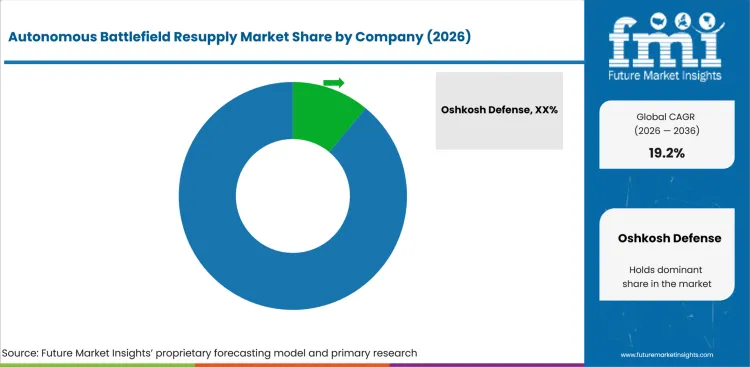
- Ground robotics suppliers compete on payload carriage and field support evidence.
- Vehicle autonomy integrators compete based on military truck access and established program relationships.
- Aerial logistics specialists compete by autonomous flight control and cargo mission testing.
- Entry barriers stay high due to cyber assurance and mission acceptance requirements.
Buyer evaluation is moving toward mission performance and route reliability instead of autonomy claims alone. Suppliers are required to prove one operator can supervise cargo movement without losing mission traceability or approval control.
Oshkosh Defense and General Dynamics Land Systems are positioned strongly in United States due to military vehicle access and autonomy integration depth. Rheinmetall and Milrem Robotics have stronger positioning in tracked UGV resupply and allied field evidence. Near Earth Autonomy, Bell Textron, and Honeywell Aerospace remain important for autonomous aerial logistics and avionics integration. Suppliers best positioned to profit are likely to combine supervised autonomy and local support access.
Key Companies in Autonomous Battlefield Resupply Market
Competitive structure is grouped by battlefield robotics suppliers, vehicle autonomy integrators, and aerial logistics specialists.
- Battlefield Robotics Suppliers: Rheinmetall, Milrem Robotics, Teledyne FLIR, and Hanwha Aerospace compete based on tracked mobility and field support roles.
- Vehicle Autonomy Integrators: Oshkosh Defense, General Dynamics Land Systems, Hyundai Rotem, and Honeywell Aerospace compete on military vehicle integration and autonomy kit depth.
- Aerial Logistics Specialists: Near Earth Autonomy, Bell Textron, Malloy Aeronautics, and SURVICE Engineering compete with cargo flight control and autonomous aircraft integration.
Competitive Benchmarking: Autonomous Battlefield Resupply Market
| Company | Payload Movement Proof | Supervised Autonomy Stack | Platform Integration | Defense Channel Access | Geographic Footprint |
|---|---|---|---|---|---|
| Oshkosh Defense | Very Strong | Strong | Very Strong | Very Strong | North America and allies |
| Rheinmetall | Very Strong | Strong | Very Strong | Very Strong | Europe and allied markets |
| Milrem Robotics | Very Strong | Strong | Strong | Strong | Europe and allied markets |
| Near Earth Autonomy | Strong | Very Strong | Strong | Strong | North America |
| Bell Textron | Strong | Strong | Very Strong | Very Strong | North America and allies |
| Honeywell Aerospace | Moderate | Very Strong | Very Strong | Very Strong | Global defense channels |
| General Dynamics Land Systems | Strong | Moderate | Very Strong | Very Strong | North America and allied markets |
| Hanwha Aerospace | Strong | Moderate | Strong | Strong | Asia and export markets |
| Hyundai Rotem | Moderate | Moderate | Strong | Strong | South Korea and export markets |
| Teledyne FLIR | Moderate | Strong | Strong | Strong | North America and Europe |
| Malloy Aeronautics | Strong | Moderate | Strong | Strong | United Kingdom and allies |
| SURVICE Engineering | Strong | Strong | Moderate | Moderate | North America |
Source: Future Market Insights competitive analysis, 2026.
Key Developments in Autonomous Battlefield Resupply Market
- In March 2025, III Marine Expeditionary Force reported that 12th Littoral Logistics Battalion trained with the Autonomous Low-Profile Vessel in Okinawa.
- In September 2025, the USA Marine Corps reported that Marines and Sailors with 4th Marine Regiment experimented with the Mission Master A-UGV in Okinawa.
- In November 2025, the USA Marine Corps issued MARADMIN 537/25 updating small UAS policy and stated that TRUAS/TRV-150 is waived from Group III to be operated and maintained as a Group 2 system by incidental operators trained through TALSA.
Key Players in Autonomous Battlefield Resupply Market
Major Global Players
- Oshkosh Defense
- Rheinmetall
- Milrem Robotics
- Near Earth Autonomy
- Bell Textron
- Honeywell Aerospace
- General Dynamics Land Systems
Specialist and Regional Players
- Hanwha Aerospace
- Hyundai Rotem
- Teledyne FLIR
- Malloy Aeronautics
- SURVICE Engineering
Autonomous Battlefield Resupply Market - Report Scope
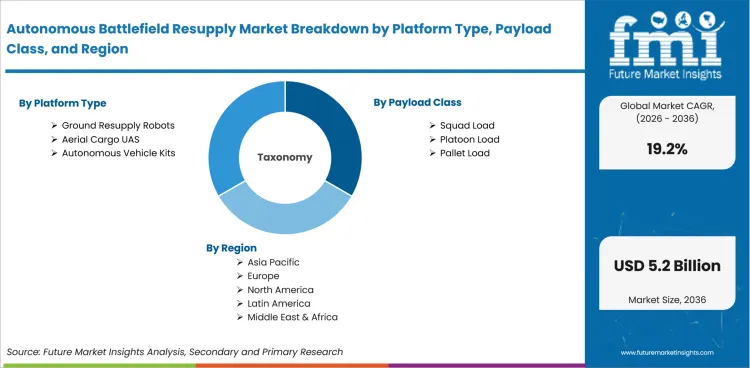
| Parameter | Details |
|---|---|
| Market size by 2036 | USD 5.2 billion |
| Growth rate | 19.2% CAGR from 2026 to 2036 |
| Forecast period | 2026 to 2036 |
| Base year value (2025) | USD 0.8 billion |
| By platform type | Ground resupply robots, aerial cargo UAS, autonomous vehicle kits, robotic trailers, hybrid resupply carriers |
| By payload class | Micro load, squad load, platoon load, pallet load, medical load |
| By mobility mode | Tracked mobility, wheeled mobility, aerial lift, leader follower, hybrid mobility |
| By autonomy level | Teleoperated assist, supervised autonomy, waypoint autonomy, leader follower, full autonomy |
| By end user | Defense forces, marine units, special forces, border forces, disaster response |
| By mission role | Ammunition delivery, medical resupply, food and water, battery delivery, casualty movement |
| Regions covered | North America, Latin America, Europe, East Asia, South Asia, Oceania, Middle East and Africa |
| Countries covered | United States, United Kingdom, Germany, Japan, South Korea, India, China |
| Key companies profiled | Oshkosh Defense, Rheinmetall, Milrem Robotics, Near Earth Autonomy, Bell Textron, Honeywell Aerospace, General Dynamics Land Systems, Hanwha Aerospace, Hyundai Rotem, Teledyne FLIR, Malloy Aeronautics, SURVICE Engineering |
| Approach | Bottom-up product-boundary approach using eligible system revenue, platform integration presence, payload pricing, mission positioning, autonomy module depth, defense program evidence, and country-level adoption |
Source: Future Market Insights, 2026.
Autonomous Battlefield Resupply Market Breakdown by Platform Type, Payload Class, Mobility Mode, Autonomy Level, End User, Mission Role, and Region
Autonomous Battlefield Resupply Market Segmented by Platform Type
- Ground Resupply Robots
- Aerial Cargo UAS
- Autonomous Vehicle Kits
- Robotic Trailers
- Hybrid Resupply Carriers
Autonomous Battlefield Resupply Market Segmented by Payload Class
- Micro Load
- Squad Load
- Platoon Load
- Pallet Load
- Medical Load
Autonomous Battlefield Resupply Market Segmented by Mobility Mode
- Tracked Mobility
- Wheeled Mobility
- Aerial Lift
- Leader Follower
- Hybrid Mobility
Autonomous Battlefield Resupply Market Segmented by Autonomy Level
- Teleoperated Assist
- Supervised Autonomy
- Waypoint Autonomy
- Leader Follower
- Full Autonomy
Autonomous Battlefield Resupply Market Segmented by End User
- Defense Forces
- Marine Units
- Special Forces
- Border Forces
- Disaster Response
Autonomous Battlefield Resupply Market Segmented by Mission Role
- Ammunition Delivery
- Medical Resupply
- Food and Water
- Battery Delivery
- Casualty Movement
Autonomous Battlefield Resupply Market by Region
- North America
- Latin America
- Europe
- East Asia
- South Asia
- Oceania
- Middle East and Africa
Research Sources and Bibliography
- Defense Federal Acquisition Regulations System. (2025, September 10). Defense Federal Acquisition Regulation Supplement: Assessing contractor implementation of cybersecurity requirements. Federal Register.
- Defense Science and Technology Laboratory. (2025, June 13). Successful trial paves the way for improved reconnaissance on Army operations. GOV.UK.
- Government Accountability Office. (2025, June 11). Weapon systems annual assessment: DOD leaders should take steps to improve innovation, speed, and insight into production challenges.
- Government of India Press Information Bureau. (2025, August 9). Defence production soars to an all-time high of Rs 1.51 lakh crore in FY 2024-25.
- Government of India Press Information Bureau. (2026, February 17). India’s drone ecosystem.
- Hicks, J. (2024, April 2). Army Futures Command general lays out continuous transformation plan. USA Army.
- Jones, A. (2025, April 29). Redefining logistics: Army demonstrates breakthrough in autonomous ship-to-shore resupply. USA Army.
- Milrem Robotics. (2025, October 6). Milrem Robotics to deliver over 150 THeMIS UGVs to Ukraine in a Dutch-led defence initiative.
- Ministry of Defense Japan. (2025, April 11). Overview of FY2025 budget.
- Near Earth Autonomy. (2026, April 28). Near Earth Autonomy awarded program to prototype autonomous logistics aircraft for USA Marine Corps.
- Oshkosh Defense. (2025, October 13). Oshkosh Defense introduces the Family of Multi-Mission Autonomous Vehicles at AUSA 2025.
- Piasecki Aircraft Corporation. (2025, April 29). Piasecki Aircraft acquires Kaman Air Vehicles’ KARGO UAV™ program.
- Rheinmetall. (2024, April 8). Rheinmetall to supply Japan with its first fleet of autonomous vehicles.
- Shenzhen Government Online. (2026, February 9). China’s tech hub Shenzhen operates over 300 low-altitude logistics routes.
- Stockholm International Peace Research Institute. (2026, April 27). Global military spending rise continues as European and Asian expenditures surge.
- USA Army. (2026, January 29). Let’s make innovative ideas: UGVs resupplying the front line.
- USA Marine Corps. (2025, March 2). 12th LLB Marines train with ALPV, enhance autonomous logistics capabilities. III Marine Expeditionary Force.
- USA Marine Corps. (2025, September 4). USA Marines and Sailors train and experiment with emerging drone technology in Okinawa.
- USA Marine Corps. (2025, November 12). Update to small unmanned aircraft system (sUAS) policy in accordance with Secretary of War guidance dated 10 July 2025.
- USA Army. (2025, May 21). Warfighters put emerging technologies to the test at Fort Leonard Wood.
- Jones, A. (2025, April 18). Army Futures Command’s Contested Logistics Cross-Functional Team: Transforming for future sustainment. USA Army.
- The White House. (2025, June 6). Unleashing American drone dominance.
This bibliography is provided for reader reference and is not exhaustive. The full report contains the complete reference list and detailed citations.
This Report Answers
- What is the 2026 value and 2036 forecast for autonomous battlefield resupply market?
- Which platform type is projected to hold the leading share during the forecast period?
- Which end user is expected to account for the leading 2026 share?
- How do payload movement and route assurance affect system buying?
- Which companies compete in autonomous battlefield resupply?
- Which countries record the highest CAGR through 2036?
- What recent developments are shaping autonomous battlefield resupply?
- How was the market estimate prepared?
Frequently Asked Questions
What is the autonomous battlefield resupply market size in 2026?
The autonomous battlefield resupply industry value is anticipated to cross USD 0.9 billion in 2026.
What is the projected autonomous battlefield resupply market size by 2036?
The autonomous battlefield resupply market is forecast to reach USD 5.2 billion by 2036.
What is the CAGR of autonomous battlefield resupply market?
The autonomous battlefield resupply sector is projected to expand at 19.2% CAGR from 2026 to 2036.
Which end user leads autonomous battlefield resupply market?
Defense forces lead with 58.7% share in 2026, influenced by forward supply movement and tactical logistics needs.
Which autonomy level leads autonomous battlefield resupply market?
Supervised autonomy leads with 44.2% share in 2026 as commanders need approval control during sensitive missions.
Which platform type leads autonomous battlefield resupply market?
Ground resupply robots lead with 41.6% share in 2026, led by rough-terrain movement and direct unit support needs.
Which payload class leads autonomous battlefield resupply market?
Squad load leads with 36.9% share in 2026 as small units need short-range cargo support for field-critical supplies.
Which mobility mode leads autonomous battlefield resupply market?
Tracked mobility leads with 38.4% share in 2026, led by traction needs across mud, rubble, and damaged routes.
Which mission role leads autonomous battlefield resupply market?
Ammunition delivery leads with 31.5% share in 2026 due to time-sensitive reload movement and dispersed firing positions.
Which country grows fastest in autonomous battlefield resupply market?
United States grows fastest with 22.8% CAGR by 2036, reflecting Marine Corps logistics autonomy and Army resupply trials.
Who are the key companies in autonomous battlefield resupply market?
Key companies include Oshkosh Defense, Rheinmetall, Milrem Robotics, Near Earth Autonomy, Bell Textron, Honeywell Aerospace, General Dynamics Land Systems, Hanwha Aerospace, Hyundai Rotem, Teledyne FLIR, Malloy Aeronautics, and SURVICE Engineering.
What is the main growth driver for autonomous battlefield resupply market?
Main growth driver is the shift from exposed crewed supply movement toward robotic cargo systems across battlefield logistics applications.
Preview the report firsthand - request a free sample
Get SampleGet the brochure for pricing and purchase details.
Get PDFTable of Content
- Executive Summary
- Global Market Outlook
- Demand-side Trends
- Supply-side Trends
- Technology Roadmap Analysis
- Analysis and Recommendations
- Market Overview
- Market Coverage / Taxonomy
- Market Definition / Scope / Limitations
- Research Methodology
- Chapter Orientation
- Analytical Lens and Working Hypotheses
- Market Structure, Signals, and Trend Drivers
- Benchmarking and Cross-market Comparability
- Market Sizing, Forecasting, and Opportunity Mapping
- Research Design and Evidence Framework
- Desk Research Programme (Secondary Evidence)
- Company Annual and Sustainability Reports
- Peer-reviewed Journals and Academic Literature
- Corporate Websites, Product Literature, and Technical Notes
- Earnings Decks and Investor Briefings
- Statutory Filings and Regulatory Disclosures
- Technical White Papers and Standards Notes
- Trade Journals, Industry Magazines, and Analyst Briefs
- Conference Proceedings, Webinars, and Seminar Materials
- Government Statistics Portals and Public Data Releases
- Press Releases and Reputable Media Coverage
- Specialist Newsletters and Curated Briefings
- Sector Databases and Reference Repositories
- FMI Internal Proprietary Databases and Historical Market Datasets
- Subscription Datasets and Paid Sources
- Social Channels, Communities, and Digital Listening Inputs
- Additional Desk Sources
- Expert Input and Fieldwork (Primary Evidence)
- Primary Modes
- Qualitative Interviews and Expert Elicitation
- Quantitative Surveys and Structured Data Capture
- Blended Approach
- Why Primary Evidence is Used
- Field Techniques
- Interviews
- Surveys
- Focus Groups
- Observational and In-context Research
- Social and Community Interactions
- Stakeholder Universe Engaged
- C-suite Leaders
- Board Members
- Presidents and Vice Presidents
- R&D and Innovation Heads
- Technical Specialists
- Domain Subject-matter Experts
- Scientists
- Defense agencies, autonomous systems OEMs, defense logistics providers, systems integrators, and procurement stakeholders
- Governance, Ethics, and Data Stewardship
- Research Ethics
- Data Integrity and Handling
- Primary Modes
- Tooling, Models, and Reference Databases
- Desk Research Programme (Secondary Evidence)
- Data Engineering and Model Build
- Data Acquisition and Ingestion
- Cleaning, Normalisation, and Verification
- Synthesis, Triangulation, and Analysis
- Quality Assurance and Audit Trail
- Market Background
- Market Dynamics
- Drivers
- Restraints
- Opportunity
- Trends
- Scenario Forecast
- Demand in Optimistic Scenario
- Demand in Likely Scenario
- Demand in Conservative Scenario
- Opportunity Map Analysis
- Product Life Cycle Analysis
- Supply Chain Analysis
- Investment Feasibility Matrix
- Value Chain Analysis
- PESTLE and Porter’s Analysis
- Regulatory Landscape
- Regional Parent Market Outlook
- Production and Consumption Statistics
- Import and Export Statistics
- Market Dynamics
- Global Market Analysis 2021 to 2025 and Forecast, 2026 to 2036
- Historical Market Size Value (USD Million) Analysis, 2021 to 2025
- Current and Future Market Size Value (USD Million) Projections, 2026 to 2036
- Y-o-Y Growth Trend Analysis
- Absolute $ Opportunity Analysis
- Global Market Pricing Analysis 2021 to 2025 and Forecast 2026 to 2036
- Global Market Analysis 2021 to 2025 and Forecast 2026 to 2036, By Deployment Architecture
- Introduction / Key Findings
- Historical Market Size Value (USD Million) Analysis By Deployment Architecture , 2021 to 2025
- Current and Future Market Size Value (USD Million) Analysis and Forecast By Deployment Architecture , 2026 to 2036
- Edge Mission Control
- Cloud Mission Planning
- Hybrid Command Nodes
- Edge Mission Control
- Y-o-Y Growth Trend Analysis By Deployment Architecture , 2021 to 2025
- Absolute $ Opportunity Analysis By Deployment Architecture , 2026 to 2036
- Global Market Analysis 2021 to 2025 and Forecast 2026 to 2036, By Mission Function
- Introduction / Key Findings
- Historical Market Size Value (USD Million) Analysis By Mission Function, 2021 to 2025
- Current and Future Market Size Value (USD Million) Analysis and Forecast By Mission Function, 2026 to 2036
- Collaborative ISR
- Strike Coordination
- EW Support
- Collaborative ISR
- Y-o-Y Growth Trend Analysis By Mission Function, 2021 to 2025
- Absolute $ Opportunity Analysis By Mission Function, 2026 to 2036
- Global Market Analysis 2021 to 2025 and Forecast 2026 to 2036, By Autonomy Level
- Introduction / Key Findings
- Historical Market Size Value (USD Million) Analysis By Autonomy Level, 2021 to 2025
- Current and Future Market Size Value (USD Million) Analysis and Forecast By Autonomy Level, 2026 to 2036
- Supervised Autonomy
- Conditional Autonomy
- Full Autonomy
- Supervised Autonomy
- Y-o-Y Growth Trend Analysis By Autonomy Level, 2021 to 2025
- Absolute $ Opportunity Analysis By Autonomy Level, 2026 to 2036
- Global Market Analysis 2021 to 2025 and Forecast 2026 to 2036, By Platform Type
- Introduction / Key Findings
- Historical Market Size Value (USD Million) Analysis By Platform Type, 2021 to 2025
- Current and Future Market Size Value (USD Million) Analysis and Forecast By Platform Type, 2026 to 2036
- Small UAS
- Tactical UAS
- Loitering Systems
- Small UAS
- Y-o-Y Growth Trend Analysis By Platform Type, 2021 to 2025
- Absolute $ Opportunity Analysis By Platform Type, 2026 to 2036
- Global Market Analysis 2021 to 2025 and Forecast 2026 to 2036, By End User
- Introduction / Key Findings
- Historical Market Size Value (USD Million) Analysis By End User, 2021 to 2025
- Current and Future Market Size Value (USD Million) Analysis and Forecast By End User, 2026 to 2036
- Defense Agencies
- Homeland Security
- Border Forces
- Defense Agencies
- Y-o-Y Growth Trend Analysis By End User, 2021 to 2025
- Absolute $ Opportunity Analysis By End User, 2026 to 2036
- Global Market Analysis 2021 to 2025 and Forecast 2026 to 2036, By Licensing Model
- Introduction / Key Findings
- Historical Market Size Value (USD Million) Analysis By Licensing Model, 2021 to 2025
- Current and Future Market Size Value (USD Million) Analysis and Forecast By Licensing Model, 2026 to 2036
- Enterprise License
- Mission Package
- Integration Services
- Enterprise License
- Y-o-Y Growth Trend Analysis By Licensing Model, 2021 to 2025
- Absolute $ Opportunity Analysis By Licensing Model, 2026 to 2036
- Global Market Analysis 2021 to 2025 and Forecast 2026 to 2036, By Region
- Introduction
- Historical Market Size Value (USD Million) Analysis By Region, 2021 to 2025
- Current Market Size Value (USD Million) Analysis and Forecast By Region, 2026 to 2036
- North America
- Latin America
- Western Europe
- Eastern Europe
- East Asia
- South Asia and Pacific
- Middle East & Africa
- Market Attractiveness Analysis By Region
- North America Market Analysis 2021 to 2025 and Forecast 2026 to 2036, By Country
- Historical Market Size Value (USD Million) Trend Analysis By Market Taxonomy, 2021 to 2025
- Market Size Value (USD Million) Forecast By Market Taxonomy, 2026 to 2036
- By Country
- USA
- Canada
- Mexico
- By Deployment Architecture
- By Mission Function
- By Autonomy Level
- By Platform Type
- By End User
- By Licensing Model
- By Country
- Market Attractiveness Analysis
- By Country
- By Deployment Architecture
- By Mission Function
- By Autonomy Level
- By Platform Type
- By End User
- By Licensing Model
- Key Takeaways
- Latin America Market Analysis 2021 to 2025 and Forecast 2026 to 2036, By Country
- Historical Market Size Value (USD Million) Trend Analysis By Market Taxonomy, 2021 to 2025
- Market Size Value (USD Million) Forecast By Market Taxonomy, 2026 to 2036
- By Country
- Brazil
- Chile
- Rest of Latin America
- By Deployment Architecture
- By Mission Function
- By Autonomy Level
- By Platform Type
- By End User
- By Licensing Model
- By Country
- Market Attractiveness Analysis
- By Country
- By Deployment Architecture
- By Mission Function
- By Autonomy Level
- By Platform Type
- By End User
- By Licensing Model
- Key Takeaways
- Western Europe Market Analysis 2021 to 2025 and Forecast 2026 to 2036, By Country
- Historical Market Size Value (USD Million) Trend Analysis By Market Taxonomy, 2021 to 2025
- Market Size Value (USD Million) Forecast By Market Taxonomy, 2026 to 2036
- By Country
- Germany
- UK
- Italy
- Spain
- France
- Nordic
- BENELUX
- Rest of Western Europe
- By Deployment Architecture
- By Mission Function
- By Autonomy Level
- By Platform Type
- By End User
- By Licensing Model
- By Country
- Market Attractiveness Analysis
- By Country
- By Deployment Architecture
- By Mission Function
- By Autonomy Level
- By Platform Type
- By End User
- By Licensing Model
- Key Takeaways
- Eastern Europe Market Analysis 2021 to 2025 and Forecast 2026 to 2036, By Country
- Historical Market Size Value (USD Million) Trend Analysis By Market Taxonomy, 2021 to 2025
- Market Size Value (USD Million) Forecast By Market Taxonomy, 2026 to 2036
- By Country
- Russia
- Poland
- Hungary
- Balkan & Baltic
- Rest of Eastern Europe
- By Deployment Architecture
- By Mission Function
- By Autonomy Level
- By Platform Type
- By End User
- By Licensing Model
- By Country
- Market Attractiveness Analysis
- By Country
- By Deployment Architecture
- By Mission Function
- By Autonomy Level
- By Platform Type
- By End User
- By Licensing Model
- Key Takeaways
- East Asia Market Analysis 2021 to 2025 and Forecast 2026 to 2036, By Country
- Historical Market Size Value (USD Million) Trend Analysis By Market Taxonomy, 2021 to 2025
- Market Size Value (USD Million) Forecast By Market Taxonomy, 2026 to 2036
- By Country
- China
- Japan
- South Korea
- By Deployment Architecture
- By Mission Function
- By Autonomy Level
- By Platform Type
- By End User
- By Licensing Model
- By Country
- Market Attractiveness Analysis
- By Country
- By Deployment Architecture
- By Mission Function
- By Autonomy Level
- By Platform Type
- By End User
- By Licensing Model
- Key Takeaways
- South Asia and Pacific Market Analysis 2021 to 2025 and Forecast 2026 to 2036, By Country
- Historical Market Size Value (USD Million) Trend Analysis By Market Taxonomy, 2021 to 2025
- Market Size Value (USD Million) Forecast By Market Taxonomy, 2026 to 2036
- By Country
- India
- ASEAN
- Australia & New Zealand
- Rest of South Asia and Pacific
- By Deployment Architecture
- By Mission Function
- By Autonomy Level
- By Platform Type
- By End User
- By Licensing Model
- By Country
- Market Attractiveness Analysis
- By Country
- By Deployment Architecture
- By Mission Function
- By Autonomy Level
- By Platform Type
- By End User
- By Licensing Model
- Key Takeaways
- Middle East & Africa Market Analysis 2021 to 2025 and Forecast 2026 to 2036, By Country
- Historical Market Size Value (USD Million) Trend Analysis By Market Taxonomy, 2021 to 2025
- Market Size Value (USD Million) Forecast By Market Taxonomy, 2026 to 2036
- By Country
- Kingdom of Saudi Arabia
- Other GCC Countries
- Turkiye
- South Africa
- Other African Union
- Rest of Middle East & Africa
- By Deployment Architecture
- By Mission Function
- By Autonomy Level
- By Platform Type
- By End User
- By Licensing Model
- By Country
- Market Attractiveness Analysis
- By Country
- By Deployment Architecture
- By Mission Function
- By Autonomy Level
- By Platform Type
- By End User
- By Licensing Model
- Key Takeaways
- Key Countries Market Analysis
- USA
- Pricing Analysis
- Market Share Analysis, 2025
- By Deployment Architecture
- By Mission Function
- By Autonomy Level
- By Platform Type
- By End User
- By Licensing Model
- Canada
- Pricing Analysis
- Market Share Analysis, 2025
- By Deployment Architecture
- By Mission Function
- By Autonomy Level
- By Platform Type
- By End User
- By Licensing Model
- Mexico
- Pricing Analysis
- Market Share Analysis, 2025
- By Deployment Architecture
- By Mission Function
- By Autonomy Level
- By Platform Type
- By End User
- By Licensing Model
- Brazil
- Pricing Analysis
- Market Share Analysis, 2025
- By Deployment Architecture
- By Mission Function
- By Autonomy Level
- By Platform Type
- By End User
- By Licensing Model
- Chile
- Pricing Analysis
- Market Share Analysis, 2025
- By Deployment Architecture
- By Mission Function
- By Autonomy Level
- By Platform Type
- By End User
- By Licensing Model
- Germany
- Pricing Analysis
- Market Share Analysis, 2025
- By Deployment Architecture
- By Mission Function
- By Autonomy Level
- By Platform Type
- By End User
- By Licensing Model
- UK
- Pricing Analysis
- Market Share Analysis, 2025
- By Deployment Architecture
- By Mission Function
- By Autonomy Level
- By Platform Type
- By End User
- By Licensing Model
- Italy
- Pricing Analysis
- Market Share Analysis, 2025
- By Deployment Architecture
- By Mission Function
- By Autonomy Level
- By Platform Type
- By End User
- By Licensing Model
- Spain
- Pricing Analysis
- Market Share Analysis, 2025
- By Deployment Architecture
- By Mission Function
- By Autonomy Level
- By Platform Type
- By End User
- By Licensing Model
- France
- Pricing Analysis
- Market Share Analysis, 2025
- By Deployment Architecture
- By Mission Function
- By Autonomy Level
- By Platform Type
- By End User
- By Licensing Model
- India
- Pricing Analysis
- Market Share Analysis, 2025
- By Deployment Architecture
- By Mission Function
- By Autonomy Level
- By Platform Type
- By End User
- By Licensing Model
- ASEAN
- Pricing Analysis
- Market Share Analysis, 2025
- By Deployment Architecture
- By Mission Function
- By Autonomy Level
- By Platform Type
- By End User
- By Licensing Model
- Australia & New Zealand
- Pricing Analysis
- Market Share Analysis, 2025
- By Deployment Architecture
- By Mission Function
- By Autonomy Level
- By Platform Type
- By End User
- By Licensing Model
- China
- Pricing Analysis
- Market Share Analysis, 2025
- By Deployment Architecture
- By Mission Function
- By Autonomy Level
- By Platform Type
- By End User
- By Licensing Model
- Japan
- Pricing Analysis
- Market Share Analysis, 2025
- By Deployment Architecture
- By Mission Function
- By Autonomy Level
- By Platform Type
- By End User
- By Licensing Model
- South Korea
- Pricing Analysis
- Market Share Analysis, 2025
- By Deployment Architecture
- By Mission Function
- By Autonomy Level
- By Platform Type
- By End User
- By Licensing Model
- Russia
- Pricing Analysis
- Market Share Analysis, 2025
- By Deployment Architecture
- By Mission Function
- By Autonomy Level
- By Platform Type
- By End User
- By Licensing Model
- Poland
- Pricing Analysis
- Market Share Analysis, 2025
- By Deployment Architecture
- By Mission Function
- By Autonomy Level
- By Platform Type
- By End User
- By Licensing Model
- Hungary
- Pricing Analysis
- Market Share Analysis, 2025
- By Deployment Architecture
- By Mission Function
- By Autonomy Level
- By Platform Type
- By End User
- By Licensing Model
- Kingdom of Saudi Arabia
- Pricing Analysis
- Market Share Analysis, 2025
- By Deployment Architecture
- By Mission Function
- By Autonomy Level
- By Platform Type
- By End User
- By Licensing Model
- Turkiye
- Pricing Analysis
- Market Share Analysis, 2025
- By Deployment Architecture
- By Mission Function
- By Autonomy Level
- By Platform Type
- By End User
- By Licensing Model
- South Africa
- Pricing Analysis
- Market Share Analysis, 2025
- By Deployment Architecture
- By Mission Function
- By Autonomy Level
- By Platform Type
- By End User
- By Licensing Model
- USA
- Market Structure Analysis
- Competition Dashboard
- Competition Benchmarking
- Market Share Analysis of Top Players
- By Regional
- By Deployment Architecture
- By Mission Function
- By Autonomy Level
- By Platform Type
- By End User
- By Licensing Model
- Competition Analysis
- Competition Deep Dive
- Anduril Industries
- Overview
- Product Portfolio
- Profitability by Market Segments (Product/Sales Channel/Region)
- Sales Footprint
- Strategy Overview
- Marketing Strategy
- Product Strategy
- Channel Strategy
- Shield AI
- Auterion
- XTEND
- Elbit Systems
- Lockheed Martin
- Anduril Industries
- Competition Deep Dive
- Assumptions & Acronyms Used


