

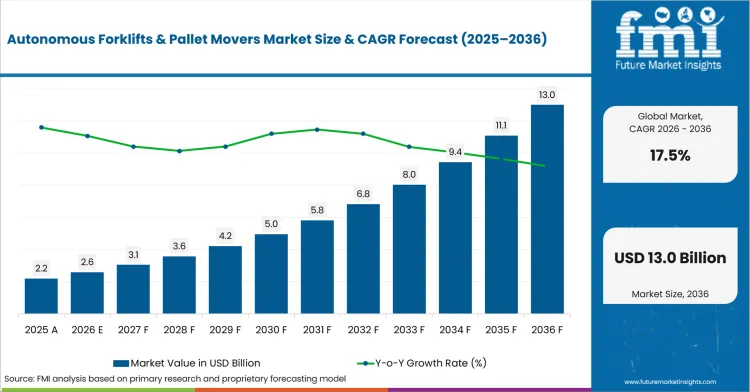
- Market Size (2026)
- USD 2.6 Bn
- Forecast (2036)
- USD 13.0 Bn
- CAGR (2026 to 2036)
- 17.5%
How big is Autonomous Forklifts & Pallet Movers Market in 2026?
USD 2.6 billion in 2026 and USD 13.0 billion by 2036 at a 17.5% CAGR.
Demand for autonomous forklifts & pallet is expected to drive valuation from USD 2.6 billion in 2026 to USD 13.0 billion by 2036 at a 17.5% CAGR, supported by ongoing advances in navigation and pallet-handling accuracy. For instance, Mueller and co-authors reported in March 2025 that a synthetic-data pallet-localization model achieved a 0.995 detection score at the standard 50% overlap threshold and kept average position error below 4.2 centimeters within five meters. These results apply directly to fork approach and pallet alignment other than general warehouse automation. They show why investment in warehouse robotics depends on perception quality as much as vehicle speed. Pilot testing can confirm alignment accuracy and reduce the risk of scaling an unreliable pallet route.
USA and German projects apply different performance tests to autonomous forklifts across active logistics operations. USA installations often start with trailer unloading or horizontal transport, which provides a clear cycle-time measure. German projects more often connect autonomous pallet vehicles with warehouse controls and fixed production schedules. Plant engineering teams need to compare payload and integration requirements with local maintenance coverage during equipment selection. A short demonstration has limited value if automated guided vehicles cannot recover from blocked handoffs during a full shift under routine operating conditions.
Key Takeaways of Autonomous Forklifts & Pallet Movers Market
- Demand for autonomous forklifts and pallet movers is driven by repeat pallet routes across factories and distribution centers, freeing trained drivers for damaged loads and production changes requiring judgment.
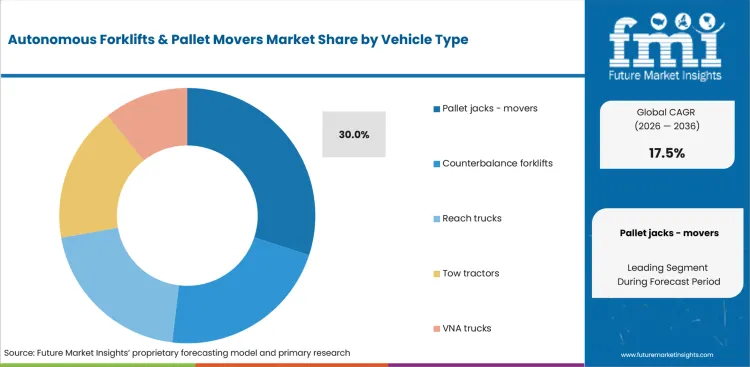
- Pallet jacks are the leading vehicle type for repeated floor-level transfers between receiving areas, staging points, and production links with fixed handoffs.
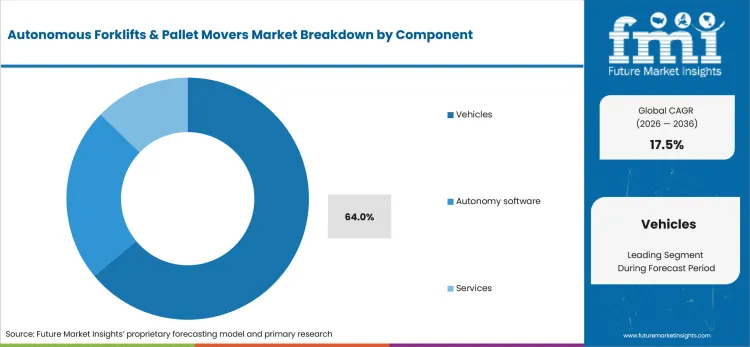
- Vehicles are estimated to lead component spending with 64.0% share in 2026, due to chassis, battery, and load-handling hardware costs.
- Software gains value as fleets require route changes, traffic control, and recovery support across shared operating areas, with service planning needing to match vehicle choice to local maintenance skills.
- Controlled vehicle paths, visible warning systems, and written emergency behavior remain critical safety factors for mixed-traffic operating environments.
- China, the United States, Europe, Japan, and India are expected to follow distinct adoption paths, shaped by dense production networks, broad distribution bases, outdoor mixed-traffic operation, and lower-cost perception approaches for pallet alignment.
- Competition centers on Jungheinrich, BALYO, Toyota Material Handling, Fox Robotics, and Cyngn, with vendors differentiating through mobile robot and warehouse software integration, autonomous reach-truck controls, industrial truck maintenance networks, and trailer/inter-building transport specialization.
Analyst Perspective
"The autonomous forklifts & pallet movers market is entering a stage where scalable warehouse execution matters more than isolated automation milestones. Operators are evaluating whether autonomous vehicles can maintain load identity, manage pallet variability, and recover efficiently from routine exceptions without disrupting material flow. The strongest commercial outcomes will come from deployments that generate consistent operational data, simplify fleet supervision, and integrate seamlessly with warehouse management processes. Vendors that help customers expand from single-route pilots to facility-wide automation with clear service accountability are likely to shape the next phase of market adoption."
- Nikhil Kaitwade, Principal Analyst at Future Market Insights
Source: FMI's proprietary forecasting model and primary research.
How is the Autonomous Forklifts & Pallet Movers Market segmented?
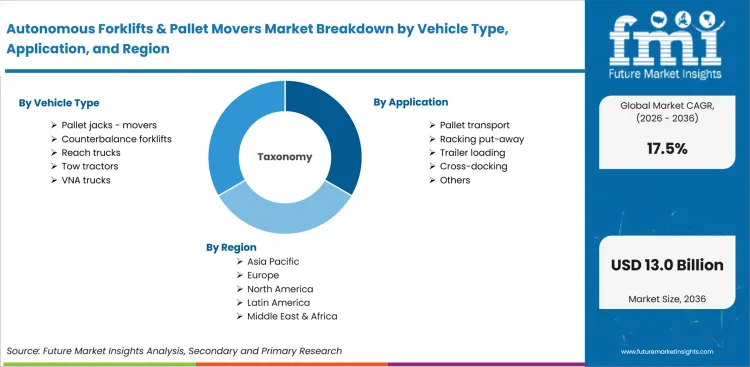
The Autonomous Forklifts & Pallet Movers Market is segmented by Vehicle Type, Application, Component, End-use Industry, Business Model, and Region.
The segmentation separates vehicle design from the pallet task and the software or service layer that supports daily operation. Vehicle Type covers floor-level movers and rack-handling trucks used for different lift duties and storage heights. Application distinguishes pallet transport from storage retrieval and dock work inside active facilities throughout each shift. Component analysis separates physical vehicles from autonomy software and integration services that support commissioning and route changes.
End-use Industry compares manufacturing operations with warehouses and distribution centers that manage load patterns. Business Model shows whether the operation owns equipment or pays through leasing and managed service contracts. Regional analysis links adoption with local automation skills and maintenance capacity across the forecast countries. This structure connects route requirements with spending choices across automated material handling equipment in warehouses and factories.
What supports demand for pallet jacks and movers within the vehicle type category?
Floor-level transport gives pallet jacks a defined task with fewer lift-height variables than rack handling. Jungheinrich reported in April 2025 that bilstein group ordered four EAE 212a mobile robots for routes of up to 220 meters. The project connects a specific vehicle format with repeat movement between production and logistics areas. It shows that route length and stable handoffs can justify automation without first addressing complex high-rack work.
- By Vehicle Type, pallet jacks and movers are estimated to hold 30.0% share in 2026 owing to their fit with horizontal pallet missions. The floor-level design reduces mast complexity and supports predictable stopping points across repeated industrial routes. Warehouse design and layout can accommodate autonomous transport without a complete rebuild of the storage system.
- Manufacturing plants and distribution centers are expected to favor pallet movers on routes with stable load dimensions and frequent handoffs. The format removes routine driving from standard loads and leaves trained staff available for damaged pallets or production changes. Clear fork-entry positions and adequate turning space remain essential, as a simple vehicle cannot compensate for a disorganized pickup area.
How do warehouse operators evaluate pallet transport within the application category?
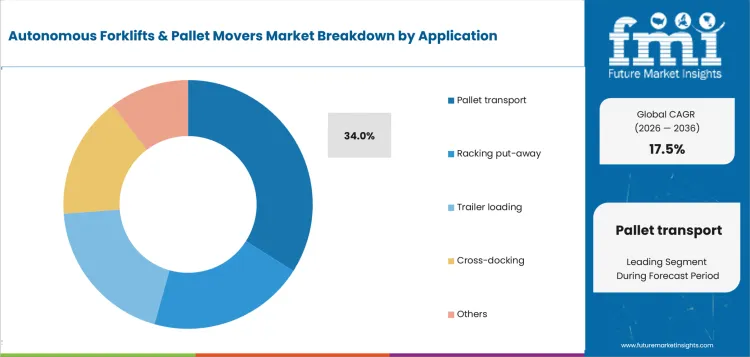
Pallet transport links receiving and storage with production or outbound staging, which gives the application a measurable trip count. STILL reported in March 2026 that two AXL 15 iGo pallet trucks could load up to 30 EPAL pallets into a trailer in about 35 minutes. The figure connects autonomous pallet movement with a defined dock cycle rather than general warehouse automation. Route approval should test trailer geometry, pallet condition and the handoff area under representative operating pressure.
- Pallet transport is expected to represent 34.0% of Application demand in 2026, reflecting repeated horizontal missions across warehouses and factories. Managers can compare completed trips and waiting time against a manual baseline across every defined route. An occupied destination can delay the vehicle even if its planned path remains clear, which makes links with inventory management software important during daily operation.
- Purchase activity for pallet transport systems is anticipated to rise at sites with stable pickup and drop positions. Mission software can redirect vehicles as dock priorities or line demand changes during an active shift. Written recovery rules for damaged loads and blocked lanes improve commercial value by reducing dependence on repeated external service calls.
How are vehicles positioned within the component category?
Every autonomous pallet mission requires a load-bearing platform with brakes and forks as well as sensing and onboard control. Jungheinrich introduced the EAC 212a in February 2026 for loads up to 1,200 kilograms and lift heights up to 1,200 millimeters. These specifications connect vehicle cost with the physical pallet task and the stability required during each lift. Software can assign work, but it cannot replace the rated capacity needed to handle the load safely.
- By Component, vehicles are forecast to account for 64.0% in 2026 due to the capital required for the chassis and battery. Forks and load-handling hardware add cost during equipment preparation and commissioning, which creates a practical selection sequence. Plant engineers confirm payload and lift height first, then choose controls that fit the selected platform and intended route.
- Fleet operations gain more value from software as truck counts and route changes increase across larger sites. AGV fleet management systems coordinate traffic and mission priority across shared aisles with several handoff points. The commercial test is clear: the software must preserve pallet identity and recover from blocked destinations without leaving vehicles idle for long periods.
What are the drivers, restraints, and opportunities in the Autonomous Forklifts & Pallet Movers Market?
Labor pressure supports repeat-route automation. Mixed-traffic safety slows approval. Service-based contracts can reduce early capital exposure.
- Driver: Repeated pallet routes support demand by shifting trained staff toward exceptions and higher-judgment handling work.
- Restraint: Safety validation can extend project schedules as each route must account for people, manual trucks and automated traffic.
- Opportunity: Managed service contracts can widen access by combining vehicles, software support and stated response duties.
Labor pressure becomes commercially relevant on pallet routes that consume driving hours without requiring continuous judgment. Cyngn reported in March 2026 that its DriveMod Tugger deployment at WEG was planned to handle up to 60 pallet moves each day. This repeat workload can be assigned to an autonomous industrial vehicle with a defined mission pattern. The economic case depends on route frequency, as low-use vehicles cannot recover integration and support costs during the planned contract.
Mixed traffic creates a restraint that navigation accuracy cannot resolve without a complete site-safety plan. The American National Standards Institute updated its guidance in June 2025 on ANSI/ITSDF B56.5-2024 for driverless and automatically guided industrial vehicles. The standard covers system design, operation and maintenance throughout commercial use of the automated vehicle system. Operations teams may need extra time to define pedestrian controls and emergency behavior, yet this preparation prevents safety gaps during commercial use.
Service-based access creates an opportunity for operations with a useful route and uncertain long-term utilization. A managed contract can combine the vehicle with mapping and maintenance under one performance plan. This arrangement lets the operation test route economics without separating software support from truck service. Companies that manage logistics robots can earn recurring revenue through stated uptime and response duties. Contract terms must explain how route changes affect price and service capacity during the full agreement.
Which country CAGRs are profiled in the Autonomous Forklifts & Pallet Movers Market?
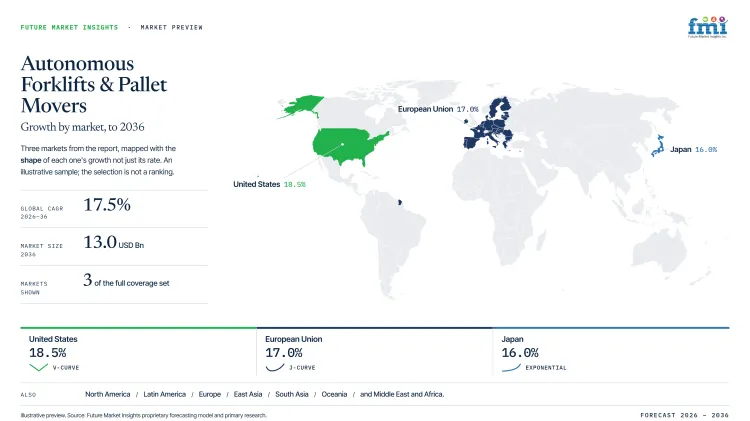
| Country | CAGR |
|---|---|
| United States | 18.5% |
| European Union | 17.0% |
| Japan | 16.0% |
Source: FMI's proprietary forecasting model and primary research.
How do country-level CAGRs compare in the Autonomous Forklifts & Pallet Movers Market?
The comparison spans 2.5 percentage points across the autonomous forklifts & pallet movers market. The United States records the highest CAGR at 18.5%, followed by the European Union at 17.0% and Japan at 16.0%. The narrow range indicates steady investment in autonomous material handling across the three markets, although warehouse modernization strategies and logistics requirements differ.
- The United States leads with a CAGR of 18.5%. Distribution centers and manufacturing facilities are expanding the use of autonomous forklifts and pallet movers to automate pallet transport, reduce manual handling and improve warehouse throughput.
- The European Union follows at 17.0%, 1.5 percentage points below the United States. Logistics operators are integrating autonomous material handling equipment into warehouse operations to improve internal transport and inventory movement. Adoption differs among member states because warehouse automation priorities, labor availability and investment cycles are not uniform.
- Japan records a CAGR of 16.0%, 1.0 percentage point behind the European Union. Companies continue evaluating autonomous forklifts and pallet movers for facilities where repetitive material movement, limited warehouse space and operational efficiency remain important considerations.
Comparable CAGRs do not indicate identical market conditions. Warehouse infrastructure, automation maturity, fleet replacement strategies and capital investment priorities influence deployment patterns and long-term commercial opportunities. The full report provides country-level CAGR analysis across North America, Latin America, Europe, East Asia, South Asia, Oceania and the Middle East and Africa.
Country-wise Analysis
- USA warehouses offer clear horizontal transport and trailer routes that support direct comparisons with manual driving. Demand is forecast to rise at 18.5% CAGR from 2026 to 2036, supported by labor exposure and extensive distribution activity. The USA Bureau of Labor Statistics recorded 391,620 industrial truck and tractor operators in transportation and warehousing in May 2024. That figure measures the manual work that autonomous forklifts may partly redesign across active distribution operations. Operations managers should compare completed missions with intervention time and missed pickups across the full route.
- European projects increasingly test autonomous forklifts beyond flat warehouse floors and other tightly structured indoor routes. Adoption in the European Union is estimated to expand at 17.0% CAGR during the forecast period as research groups address outdoor pallet work. In August 2025, Lang2Lift paper reported a 0.76 mean overlap score for pallet segmentation on a real-world dataset used by the ADAPT autonomous forklift. That result concerns pallet pickup under changing light and outdoor conditions, which raises the evidence required for commercial approval. Industrial plants need representative tests that show perception behavior around irregular loads and shared traffic.
- Japan combines established forklift engineering with controlled research on difficult pallet-loading decisions inside active industrial environments. The country is estimated to post 16.0% CAGR from 2026 to 2036 as manufacturers refine automated counterbalance and warehouse vehicles. Toyota Central R&D Labs reported in May 2025 that a 1/14-scale robotic forklift completed 60% of real pallet-loading trials. The result shows that fork engagement needs separate validation from route navigation, so Japanese projects are likely to favor staged testing that records failure causes and recovery behavior. Plant engineering teams should examine the test method and its limits, reducing the risk of expanding an unstable pallet-handling process.
Who are the notable companies in the Autonomous Forklifts & Pallet Movers Market?
BALYO, Jungheinrich, Toyota Material Handling, Fox Robotics, and Cyngn are notable companies in this market.
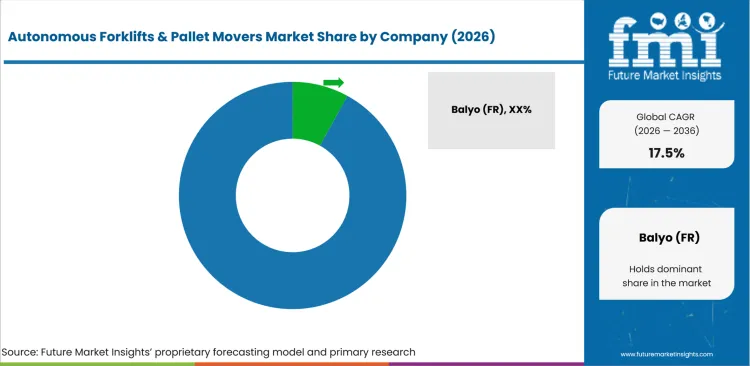
The competitive field combines established industrial truck manufacturers with autonomy companies that focus on specific pallet workflows. Jungheinrich connects mobile robots with warehouse software and service coverage across multi-step industrial projects, and Toyota Material Handling offers automated forklifts through its truck network. BALYO described autonomous forklift fleets in June 2026 as a way to scale pallet capacity during changing warehouse volumes. Fox Robotics concentrates on trailer loading, whereas Cyngn adapts DriveMod controls to manufacturing transport across industrial sites. The commercial comparison therefore includes mission control, maintenance and recovery support under one operating plan for automated material handling systems.
- BALYO and Jungheinrich cover several pallet tasks through different operating models and levels of project control. BALYO applies autonomous controls to low-lift and reach-truck formats, whereas Jungheinrich combines mobile robots with warehouse software and service support. The difference determines how maintenance and software duties are assigned across the project during daily operation.
- Toyota Material Handling and Fox Robotics approach automation from different product positions and operating scopes. Toyota offers automated forklift formats through an established industrial truck network, whereas Fox Robotics concentrates on trailer workflows with a clear cycle-time measure. The practical choice depends on the route scope and required service coverage across the planned operation.
- Cyngn applies DriveMod controls to industrial vehicle platforms used in manufacturing transport and inter-building pallet routes. This software-led approach can suit plants that do not want every system layer from one truck manufacturer. The operating plan must assign vehicle maintenance and autonomy support clearly across separate service teams.
Competitive Benchmarking: Autonomous Forklifts & Pallet Movers Market
| Company | Vehicle Scope | Autonomy Integration | Operations Support | Geographic Reach |
|---|---|---|---|---|
| BALYO | High | High | Medium | Medium |
| Jungheinrich | High | High | High | High |
| Toyota Material Handling | High | Medium | High | High |
| Fox Robotics | Low | High | Medium | Medium |
| Cyngn | Medium | High | Medium | Medium |
Scoring basis: High indicates verified direct capability across the stated dimension, Medium reflects narrower or partner-supported capability, and Low reflects limited direct scope in official company sources.
Source: Future Market Insights competitive assessment.
Key Developments in the Autonomous Forklifts & Pallet Movers Market
- In March 2025, Fox Robotics introduced the FoxBot Mk3, expanding its autonomous dock workflows to cover more applications and industries. The official announcement described four new capabilities: autonomous trailer loading, auto-adjusting fork tines that accommodate new load profiles, additional software integrations for warehouse workflows, and an expanded sensor suite for enhanced safe and efficient movement throughout the warehouse.
- In October 2025, Cyngn published a case study on its DriveMod Tugger deployment at U.S. Continental. The company said the earlier manual workflow required approximately 200 forklift trips each week and reported a fourfold efficiency improvement following rollout. The autonomous tugger transports pallets outdoors between buildings and automates material movement across the facility, replacing repetitive manual handling without requiring infrastructure changes.
- In June 2026, Jungheinrich announced an expansion at Landguth that added eight arculee M autonomous mobile robots to an existing fleet of eight. The combined fleet of 16 arculee M AMRs serves pallet flow inside an operating distribution center without closing the site for installation. The project shows how autonomous pallet vehicles can scale through stable commercial routes without disrupting current throughput.
- In June 2026, Big Joe Autonomous Solutions presented the AP44 autonomous pallet truck during Automate 2026. The model carries 4,400 pounds and extends the company's autonomous range into heavier horizontal pallet transport with manual, semi-autonomous and fully autonomous modes.
Key Players in the Autonomous Forklifts & Pallet Movers Market
Forklift manufacturers with integrated automation
- Jungheinrich
- Toyota Material Handling
Autonomy specialists for pallet vehicles
- BALYO
- Cyngn
Dock-focused autonomous forklift providers
- Fox Robotics
Autonomous Forklifts & Pallet Movers Market - Report Scope
| Coverage Field | Report Scope |
|---|---|
| Market Breakdown | Vehicle Type, Application, Component, End-use Industry, Business Model, and Region. |
| Quantitative Units | Revenue in USD billion and CAGR in percent. |
| Market Definition | Autonomous forklifts and pallet movers that transport or lift palletised loads using onboard control, sensing, and fleet software. |
| Regions Covered | North America, Latin America, Europe, East Asia, South Asia, Oceania, and Middle East and Africa. |
| Countries Covered | United States, Canada, China, Japan, India, major European countries, and other countries included in the regional model. |
| Key Companies Profiled | BALYO, Jungheinrich, Toyota Material Handling, Fox Robotics, and Cyngn. |
| Forecast Period | 2026 to 2036. |
| Approach | Company-level and demand-side market sizing supported by primary interviews, official secondary research and forecast reconciliation across segments. |
Source: Future Market Insights proprietary forecasting model and primary research.
Autonomous Forklifts & Pallet Movers Market - Research Methodology
| Method | Approach |
|---|---|
| Primary Research | FMI analysts gathered input from manufacturers, service providers, technology developers, distributors, end users, sourcing teams, and subject-matter experts. Interviews examined purchasing decisions, product or service evaluation, adoption barriers, approval requirements, pricing considerations, and expectations for technical or commercial support. Respondents were also asked what evidence is required before a trial, pilot, or initial order develops into regular purchasing. |
| Desk Research | Desk research covered government statistics, regulatory publications, trade data, industry associations, technical literature, standards, company filings, product information, and official corporate announcements. Sources were reviewed for relevance, publication date, geographic coverage, and consistency with the defined market scope. Claims relating to performance, applications, approvals, capacity, investment, and commercial activity were retained only when supported by credible public evidence. |
| Market Sizing and Forecasting | The market model combined the baseline value with historical performance, segment structure, pricing and volume indicators, adoption levels, company participation, and country-level demand conditions. Forecast assumptions considered economic activity, investment trends, regulatory developments, technology adoption, purchasing cycles, supply availability, and barriers to wider market use. Segment and regional estimates were reconciled before the final market total was calculated. |
| Data Validation | Estimates were checked against multiple independent indicators, including public data, company activity, trade patterns, industry developments, and findings from primary interviews. Validation also tested whether products, services, applications, and company revenues fell within the defined market boundaries. Adjacent categories, unsupported claims, overlapping revenues, and activities without direct market relevance were excluded to reduce double counting and maintain consistency across segments and countries. |
Source: Future Market Insights analysis based on proprietary forecasting models and primary research.
Autonomous Forklifts & Pallet Movers Market by Segments
Autonomous Forklifts & Pallet Movers Market segmented by Vehicle Type:
- Pallet Jacks and Movers
- Reach Trucks
- Counterbalance Forklifts
- Stackers
- Tuggers
Autonomous Forklifts & Pallet Movers Market segmented by Application:
- Pallet Transport
- Rack Storage and Retrieval
- Dock Loading and Unloading
- Production-Line Replenishment
- Cold-Storage Handling
Autonomous Forklifts & Pallet Movers Market segmented by Component:
- Vehicles
- Autonomy Software
- Integration and Services
Autonomous Forklifts & Pallet Movers Market segmented by End-use Industry:
- Manufacturing
- Warehousing and Distribution
- Retail and E-commerce
- Food and Beverage
- Automotive
Autonomous Forklifts & Pallet Movers Market segmented by Business Model:
- Direct Purchase
- Leasing
- Robotics-as-a-Service
- Managed Fleet Services
- Retrofit Automation
Autonomous Forklifts & Pallet Movers Market by Region:
- North America
- United States
- Canada
- Latin America
- Brazil
- Mexico
- Argentina
- Europe
- European Union
- United Kingdom
- Germany
- France
- Italy
- Spain
- East Asia
- China
- Japan
- South Korea
- South Asia
- India
- Thailand
- Indonesia
- Oceania
- Australia
- New Zealand
- Middle East and Africa
- GCC Countries
- South Africa
- Türkiye
Research Sources and Bibliography
- Mueller, H., Kim, Y., Gee, T., & Nejati, M. (2025, March). Pallet detection and localisation from synthetic data. arXiv.
- Jungheinrich. (2025, April). Jungheinrich automates warehouse logistics for bilstein group.
- Sutar, V., Maheshwari, M., & Mittal, A. (2025, November). Learning-based vision systems for semi-autonomous forklift operation in industrial warehouse environments. arXiv.
- Jungheinrich. (2026, February). Intelligent automation for high-lift applications: Jungheinrich launches Mobile Robot EAC 212a.
- Cyngn. (2026, March). Cyngn deploys DriveMod Tugger at WEG electric motor facility.
- American National Standards Institute. (2025, June). ANSI/ITSDF B56.5-2024: Guided industrial vehicles.
- SEER Robotics. (2026, June). How to ensure safety in complex industrial environments with non-standard loads and human-robot collaboration.
- USA Bureau of Labor Statistics. (2024, May). Data tables for OEWS industry charts: Transportation and warehousing.
- Nguyen, H. H., Huemer, J., Murschitz, M., Glueck, T., Vu, M. N., & Kugi, A. (2025, August). Lang2Lift: Language-guided pallet detection and pose estimation in autonomous outdoor forklift operation. arXiv.
- Oishi, K., Kato, T., Makino, H., & Ito, S. (2025, May). Visual-based forklift learning system enabling zero-shot simulation-to-reality without real-world data. arXiv.
- BALYO. (2026, June). Autonomous forklift fleet helps 3PLs meet fluctuating client demand.
- Fox Robotics. (2025, March). FoxBot Mk3 takes on more warehouse work with new capabilities and industry applications.
- Cyngn. (2025, October). USA Continental recommends Cyngn DriveMod Tugger after production use.
- Jungheinrich. (2026, June). Jungheinrich expands the vehicle fleet at Landguth automated distribution centre.
- Big Joe Autonomous Solutions. (2026, June). Big Joe Autonomous Solutions showcases four new solutions at Automate 2026.
- STILL. (2026, March). The AXL 15 iGo automates the loading and unloading of lorries.
This bibliography is provided for reader reference and uses primary government, standards-body, official trade body, and company sources.
This Report Answers
- What is the 2026 value of the Autonomous Forklifts & Pallet Movers Market?
- What revenue is projected for 2036 and what CAGR supports the forecast?
- Which vehicle type and application shares define the 2026 segment view?
- Why does pallet transport provide a practical first automation route?
- Which technical conditions decide whether fork alignment remains reliable?
- How do the country CAGRs compare through 2036?
- How do the profiled companies differ in vehicle scope and autonomy integration?
- Which safety and service checks support fleet expansion?
- How do business models change capital exposure and operating responsibility?
Frequently Asked Questions
What is driving growth in the Autonomous Forklifts & Pallet Movers Market?
Repeat pallet routes create measurable savings in driving time and employee exposure across active shifts. Growth improves as perception and fleet software complete routine handoffs with fewer interventions during daily production.
Who are the key players in the Autonomous Forklifts & Pallet Movers Market?
Jungheinrich and Toyota Material Handling combine automated vehicles with established industrial truck service networks across major operating sites. BALYO and Cyngn focus on autonomy controls, and Fox Robotics targets repeat trailer-unloading workflows inside distribution facilities.
What is a notable restraint in the Autonomous Forklifts & Pallet Movers Market?
Mixed traffic can extend project approval as people and manual trucks share the same operating area. Commercial operation requires defined emergency behavior and written responsibility across every vehicle and software layer.
Why should executives track the Autonomous Forklifts & Pallet Movers Market?
Autonomous pallet vehicles can change labor planning and industrial truck spending across several operating sites. The same shift can increase demand for software support and recurring fleet services during long-term operation.
What business problem does the Autonomous Forklifts & Pallet Movers Market address?
The market addresses repeated pallet transport that consumes driving time without requiring continuous operator judgment. Automation can improve route consistency and reduce employee exposure to industrial vehicle traffic during active shifts.
What should plant engineering teams evaluate?
Plant engineering teams should test payload and lift height on the intended route under representative conditions. They should compare integration duties and maintenance response with expected mission frequency across the full contract.
What limits return on investment?
Low route use can leave autonomous vehicles idle and weaken expected payback across the contract period. Blocked handoffs and poor load data can reduce useful vehicle capacity during active production shifts.
What supports long-term commercial confidence?
Documented route performance and recovery procedures give managers a reliable basis for approving fleet expansion. Clear responsibility across truck service and autonomy support reduces operating gaps during later growth.
Preview the report firsthand - request a free sample
Get SampleGet the brochure for pricing and purchase details.
Get PDFTable of Content
- Key Takeaways
- Market Size and CAGR
- Top Growth Driver
- Fastest Growing Segment
- Leading Region
- Key Companies
- Emerging Opportunities
- Executive Summary
- Global Market Outlook
- Demand-side Trends
- Supply-side Trends
- Technology Roadmap Analysis
- Analysis and Recommendations
- Analyst Perspective (What is happening? Why now? What should investors know?)
- Key Questions Answered
- How large is the market?
- What is the CAGR?
- What are key trends?
- Which region dominates?
- Who are the leaders?
- Market Overview
- Market Coverage / Taxonomy
- Market Definition / Scope / Limitations
- Research Methodology
- Chapter Orientation
- Analytical Lens and Working Hypotheses
- Market Structure, Signals, and Trend Drivers
- Benchmarking and Cross-market Comparability
- Market Sizing, Forecasting, and Opportunity Mapping
- Research Design and Evidence Framework
- Desk Research Programme (Secondary Evidence)
- Expert Input and Fieldwork (Primary Evidence)
- Tooling, Models, and Reference Databases
- Data Engineering and Model Build
- Quality Assurance and Audit Trail
- Market Background
- Market Dynamics (Drivers, Restraints, Opportunity, Trends)
- Scenario Forecast (Optimistic, Likely, Conservative)
- Impact Analysis
- AI Impact
- Sustainability Impact
- Regulatory Impact
- Technology Impact
- Consumer / Buyer Analysis
- Purchase Drivers
- Adoption Barriers
- Buyer Journey
- Opportunity Map Analysis
- Product Life Cycle Analysis
- Supply Chain Analysis
- Investment Feasibility Matrix
- Value Chain Analysis
- PESTLE and Porter's Analysis
- Regulatory Landscape
- Regional Parent Market Outlook
- Production and Consumption Statistics
- Import and Export Statistics
- Global Market Analysis and Forecast, 2021 to 2036
- Historical Market Size Value (USD Bn) Analysis, 2021 to 2025
- Current and Future Market Size Value (USD Bn) Projections, 2026 to 2036
- Y-o-Y Growth Trend Analysis
- Absolute $ Opportunity Analysis
- Global Market Pricing Analysis, 2021 to 2036
- Global Market Analysis and Forecast, By Vehicle Type, 2021 to 2036
- Introduction / Key Findings
- Historical Market Size Value (USD Bn) Analysis By Vehicle Type, 2021 to 2025
- Current and Future Market Size Value (USD Bn) Analysis and Forecast By Vehicle Type, 2026 to 2036
- Pallet jacks - movers
- Counterbalance forklifts
- Reach trucks
- Tow tractors
- VNA trucks
- Pallet jacks - movers
- Y-o-Y Growth Trend Analysis By Vehicle Type, 2021 to 2025
- Absolute $ Opportunity Analysis By Vehicle Type, 2026 to 2036
- Global Market Analysis and Forecast, By Application, 2021 to 2036
- Introduction / Key Findings
- Historical Market Size Value (USD Bn) Analysis By Application, 2021 to 2025
- Current and Future Market Size Value (USD Bn) Analysis and Forecast By Application, 2026 to 2036
- Pallet transport
- Racking put-away
- Trailer loading
- Cross-docking
- Others
- Pallet transport
- Y-o-Y Growth Trend Analysis By Application, 2021 to 2025
- Absolute $ Opportunity Analysis By Application, 2026 to 2036
- Global Market Analysis and Forecast, By Component, 2021 to 2036
- Introduction / Key Findings
- Historical Market Size Value (USD Bn) Analysis By Component, 2021 to 2025
- Current and Future Market Size Value (USD Bn) Analysis and Forecast By Component, 2026 to 2036
- Vehicles
- Autonomy software
- Services
- Vehicles
- Y-o-Y Growth Trend Analysis By Component, 2021 to 2025
- Absolute $ Opportunity Analysis By Component, 2026 to 2036
- Global Market Analysis and Forecast, By End-use Industry, 2021 to 2036
- Introduction / Key Findings
- Historical Market Size Value (USD Bn) Analysis By End-use Industry, 2021 to 2025
- Current and Future Market Size Value (USD Bn) Analysis and Forecast By End-use Industry, 2026 to 2036
- Manufacturing
- 3PL & warehousing
- Food & beverage
- Retail DC
- Others
- Manufacturing
- Y-o-Y Growth Trend Analysis By End-use Industry, 2021 to 2025
- Absolute $ Opportunity Analysis By End-use Industry, 2026 to 2036
- Global Market Analysis and Forecast, By Business Model, 2021 to 2036
- Introduction / Key Findings
- Historical Market Size Value (USD Bn) Analysis By Business Model, 2021 to 2025
- Current and Future Market Size Value (USD Bn) Analysis and Forecast By Business Model, 2026 to 2036
- Direct purchase
- Lease
- Robots-as-a-Service
- Retrofit kits
- Direct purchase
- Y-o-Y Growth Trend Analysis By Business Model, 2021 to 2025
- Absolute $ Opportunity Analysis By Business Model, 2026 to 2036
- Global Market Analysis and Forecast, By Region, 2021 to 2036
- Introduction
- Historical Market Size Value (USD Bn) Analysis By Region, 2021 to 2025
- Current Market Size Value (USD Bn) Analysis and Forecast By Region, 2026 to 2036
- North America
- Latin America
- Western Europe
- Eastern Europe
- East Asia
- South Asia and Pacific
- Middle East & Africa
- Market Attractiveness Analysis By Region
- North America Market Analysis and Forecast, By Country, 2021 to 2036
- Historical Market Size Value (USD Bn) Trend Analysis By Market Taxonomy, 2021 to 2025
- Market Size Value (USD Bn) Forecast By Market Taxonomy, 2026 to 2036
- By Country
- USA
- Canada
- By Vehicle Type
- By Application
- By Component
- By End-use Industry
- By Business Model
- By Country
- Market Attractiveness Analysis
- By Country
- By Vehicle Type
- By Application
- By Component
- By End-use Industry
- By Business Model
- Key Takeaways
- Latin America Market Analysis and Forecast, By Country
- Historical Market Size Value (USD Bn) Trend Analysis By Market Taxonomy, 2021 to 2025
- Market Size Value (USD Bn) Forecast By Market Taxonomy, 2026 to 2036
- By Country
- Brazil
- Mexico
- Chile
- Rest of Latin America
- By Vehicle Type
- By Application
- By Component
- By End-use Industry
- By Business Model
- By Country
- Market Attractiveness Analysis
- By Country
- By Vehicle Type
- By Application
- By Component
- By End-use Industry
- By Business Model
- Key Takeaways
- Western Europe Market Analysis and Forecast, By Country
- Historical Market Size Value (USD Bn) Trend Analysis By Market Taxonomy, 2021 to 2025
- Market Size Value (USD Bn) Forecast By Market Taxonomy, 2026 to 2036
- By Country
- Germany
- UK
- Italy
- Spain
- France
- Nordic
- BENELUX
- Rest of Western Europe
- By Vehicle Type
- By Application
- By Component
- By End-use Industry
- By Business Model
- By Country
- Market Attractiveness Analysis
- By Country
- By Vehicle Type
- By Application
- By Component
- By End-use Industry
- By Business Model
- Key Takeaways
- Eastern Europe Market Analysis and Forecast, By Country
- Historical Market Size Value (USD Bn) Trend Analysis By Market Taxonomy, 2021 to 2025
- Market Size Value (USD Bn) Forecast By Market Taxonomy, 2026 to 2036
- By Country
- Russia
- Poland
- Hungary
- Balkan & Baltic
- Rest of Eastern Europe
- By Vehicle Type
- By Application
- By Component
- By End-use Industry
- By Business Model
- By Country
- Market Attractiveness Analysis
- By Country
- By Vehicle Type
- By Application
- By Component
- By End-use Industry
- By Business Model
- Key Takeaways
- East Asia Market Analysis and Forecast, By Country
- Historical Market Size Value (USD Bn) Trend Analysis By Market Taxonomy, 2021 to 2025
- Market Size Value (USD Bn) Forecast By Market Taxonomy, 2026 to 2036
- By Country
- China
- Japan
- South Korea
- By Vehicle Type
- By Application
- By Component
- By End-use Industry
- By Business Model
- By Country
- Market Attractiveness Analysis
- By Country
- By Vehicle Type
- By Application
- By Component
- By End-use Industry
- By Business Model
- Key Takeaways
- South Asia and Pacific Market Analysis and Forecast, By Country
- Historical Market Size Value (USD Bn) Trend Analysis By Market Taxonomy, 2021 to 2025
- Market Size Value (USD Bn) Forecast By Market Taxonomy, 2026 to 2036
- By Country
- India
- ASEAN
- Australia & New Zealand
- Rest of South Asia and Pacific
- By Vehicle Type
- By Application
- By Component
- By End-use Industry
- By Business Model
- By Country
- Market Attractiveness Analysis
- By Country
- By Vehicle Type
- By Application
- By Component
- By End-use Industry
- By Business Model
- Key Takeaways
- Middle East & Africa Market Analysis and Forecast, By Country
- Historical Market Size Value (USD Bn) Trend Analysis By Market Taxonomy, 2021 to 2025
- Market Size Value (USD Bn) Forecast By Market Taxonomy, 2026 to 2036
- By Country
- Kingdom of Saudi Arabia
- Other GCC Countries
- Türkiye
- South Africa
- Other African Union
- Rest of Middle East & Africa
- By Vehicle Type
- By Application
- By Component
- By End-use Industry
- By Business Model
- By Country
- Market Attractiveness Analysis
- By Country
- By Vehicle Type
- By Application
- By Component
- By End-use Industry
- By Business Model
- Key Takeaways
- Key Countries Market Analysis
- USA
- Pricing Analysis
- Market Share Analysis, 2025
- By Vehicle Type
- By Application
- By Component
- By End-use Industry
- By Business Model
- Canada
- Pricing Analysis
- Market Share Analysis, 2025
- By Vehicle Type
- By Application
- By Component
- By End-use Industry
- By Business Model
- Mexico
- Pricing Analysis
- Market Share Analysis, 2025
- By Vehicle Type
- By Application
- By Component
- By End-use Industry
- By Business Model
- Brazil
- Pricing Analysis
- Market Share Analysis, 2025
- By Vehicle Type
- By Application
- By Component
- By End-use Industry
- By Business Model
- Chile
- Pricing Analysis
- Market Share Analysis, 2025
- By Vehicle Type
- By Application
- By Component
- By End-use Industry
- By Business Model
- Germany
- Pricing Analysis
- Market Share Analysis, 2025
- By Vehicle Type
- By Application
- By Component
- By End-use Industry
- By Business Model
- UK
- Pricing Analysis
- Market Share Analysis, 2025
- By Vehicle Type
- By Application
- By Component
- By End-use Industry
- By Business Model
- Italy
- Pricing Analysis
- Market Share Analysis, 2025
- By Vehicle Type
- By Application
- By Component
- By End-use Industry
- By Business Model
- Spain
- Pricing Analysis
- Market Share Analysis, 2025
- By Vehicle Type
- By Application
- By Component
- By End-use Industry
- By Business Model
- France
- Pricing Analysis
- Market Share Analysis, 2025
- By Vehicle Type
- By Application
- By Component
- By End-use Industry
- By Business Model
- India
- Pricing Analysis
- Market Share Analysis, 2025
- By Vehicle Type
- By Application
- By Component
- By End-use Industry
- By Business Model
- ASEAN
- Pricing Analysis
- Market Share Analysis, 2025
- By Vehicle Type
- By Application
- By Component
- By End-use Industry
- By Business Model
- Australia & New Zealand
- Pricing Analysis
- Market Share Analysis, 2025
- By Vehicle Type
- By Application
- By Component
- By End-use Industry
- By Business Model
- China
- Pricing Analysis
- Market Share Analysis, 2025
- By Vehicle Type
- By Application
- By Component
- By End-use Industry
- By Business Model
- Japan
- Pricing Analysis
- Market Share Analysis, 2025
- By Vehicle Type
- By Application
- By Component
- By End-use Industry
- By Business Model
- South Korea
- Pricing Analysis
- Market Share Analysis, 2025
- By Vehicle Type
- By Application
- By Component
- By End-use Industry
- By Business Model
- Russia
- Pricing Analysis
- Market Share Analysis, 2025
- By Vehicle Type
- By Application
- By Component
- By End-use Industry
- By Business Model
- Poland
- Pricing Analysis
- Market Share Analysis, 2025
- By Vehicle Type
- By Application
- By Component
- By End-use Industry
- By Business Model
- Hungary
- Pricing Analysis
- Market Share Analysis, 2025
- By Vehicle Type
- By Application
- By Component
- By End-use Industry
- By Business Model
- Kingdom of Saudi Arabia
- Pricing Analysis
- Market Share Analysis, 2025
- By Vehicle Type
- By Application
- By Component
- By End-use Industry
- By Business Model
- Türkiye
- Pricing Analysis
- Market Share Analysis, 2025
- By Vehicle Type
- By Application
- By Component
- By End-use Industry
- By Business Model
- South Africa
- Pricing Analysis
- Market Share Analysis, 2025
- By Vehicle Type
- By Application
- By Component
- By End-use Industry
- By Business Model
- USA
- Market Structure Analysis
- Competition Dashboard
- Competition Benchmarking
- Market Share Analysis of Top Players
- By Regional
- By Vehicle Type
- By Application
- By Component
- By End-use Industry
- By Business Model
- Emerging Startups
- Innovation Benchmarking
- Competition Analysis
- Competition Deep Dive
- Balyo (FR)
- Overview
- Product Portfolio
- Profitability by Market Segments
- Sales Footprint
- Strategy Overview
- Marketing Strategy
- Product Strategy
- Channel Strategy
- Jungheinrich (DE)
- Toyota Material Handling (JP)
- Fox Robotics (US)
- Cyngn (US)
- Balyo (FR)
- Case Studies
- Success Stories
- Recent Developments
- Competition Deep Dive
- Assumptions & Acronyms Used


