

- Market Size (2026)
- USD 2.9 Bn
- Forecast (2036)
- USD 14.5 Bn
- CAGR (2026 to 2036)
- 17.5%
How big is Autonomous Mining Haulage (Surface) Market in 2026?
USD 2.9 billion in 2026 and USD 14.5 billion by 2036 at a 17.5% CAGR.
Demand for autonomous mining haulage (surface) is expected to push industry value from USD 2.9 billion in 2026 to USD 14.5 billion by 2036 at a 17.5% CAGR, driven by production-scale fleet conversions. Caterpillar reported in April 2025 that its 65-tonne Cat 775 was engineered to enable future autonomous capability and was planned for introduction during 2026. The product development extends autonomy planning into quarry-class haulage, where smaller fleets and shorter shifts change the commercial case. The surface mining equipment market therefore depends on integrated route control and site support rather than isolated vehicle automation.
Country programs reflect different operating priorities across surface mines and quarries that are converting active production routes. China is pairing electric fleets with battery swapping and communications control, whereas United States quarry programs rely more heavily on dealer-backed conversions and formal safety plans. Mine engineering teams compare road geometry with radio coverage before approving each route for daily production. At a 2026 market value of USD 2.9 billion, commercial returns depend on funding control rooms and commissioning work alongside the trucks. The smart mining market faces the same integration test across connected production assets and operating teams. Capital returns weaken if autonomy-ready vehicles enter service without the operating support required for reliable production.
-market-value-analysis.webp "Autonomous Mining Haulage (surface) Market Value Analysis")
Key Takeaways of Autonomous Mining Haulage (Surface) Market
- Demand for autonomous mining haulage is driven by mines converting entire production loops into controlled operating systems with clear route responsibility, reducing avoidable queue variation around shovels and crushers.
- By equipment, autonomous haul trucks are expected to lead with 58.0% share in 2026, underpinned by their direct role in production movement.
- Surface metal mines are the dominant end-use segment, projected to hold 56.0% share in 2026, supported by long asset lives and dedicated control rooms.
- Iron ore and bulk materials are estimated to lead the commodity category with 38.0% share in 2026, attributable to stable high-volume haul routes.
- Software and service value is expected to increase as larger fleets need regular map updates and remote operating support, with fleet conversions typically advancing by route or truck group to preserve output during commissioning.
- China, Latin America, the United States, Japan, and Russia are expected to lead growth at 20.5%, 20.0%, 17.0%, 16.0%, and 15.0% CAGR respectively through 2036, shaped by fleet-scale projects, brownfield renewal, and formal safety frameworks.
- Competition centers on Komatsu, Caterpillar, Hitachi Construction Machinery, Liebherr, Hexagon, Epiroc, Fortescue, and Rio Tinto, with vendors differentiating through integrated truck systems versus machine-independent control platforms that preserve mixed fleets.
Analyst Perspective
"Autonomous mining programs reach commercial maturity when operational ownership shifts from pilot teams to everyday production management. Expanding deployment across an active mine requires dependable communications, coordinated traffic management, and consistent interaction between autonomous and manually operated equipment. Companies that help operators establish clear governance for fleet management, route control, and long-term operational support will be better placed to capture the next wave of autonomous mining investments."
- Nikhil Kaitwade , Principal Analyst at Future Market Insights
Source: FMI's proprietary forecasting model and primary research
How is the Autonomous Mining Haulage (Surface) Market segmented?
The autonomous mining haulage (surface) industry is segmented by equipment, commodity, component, end use, sales channel, and region.
Equipment analysis covers autonomous haul trucks and supporting machines that share production roads across active pits. Commodity analysis separates iron ore and bulk materials from copper and coal alongside gold and other mined materials. Component coverage compares vehicle hardware and retrofit kits with autonomy software plus operating services required throughout production. End-use analysis covers surface metal mines and coal mines alongside quarries and oil sands across different route conditions. Sales-channel analysis compares direct OEM purchases with retrofit programs and service contracts alongside pilot programs. The structure connects machine choice with the mobile mining equipment category and the service model used at each operating site throughout commissioning and regular production.
What supports demand for autonomous haul trucks within the equipment category?
-market-analysis-by-equipment.webp "Autonomous Mining Haulage (surface) Market Analysis By Equipment")
Haul trucks control repeated material movement between loading points and fixed destinations across surface mining operations. Komatsu reported in August 2025 that Smart Quarry Autonomous would integrate Pronto technology into quarry-sized trucks for North American operations. The OEM-agnostic system supports new Komatsu vehicles and retrofit installations through the company's dealer network. The development shows that truck autonomy is moving beyond ultra-class fleets into smaller production settings with established service channels.
- Autonomous haul trucks are projected to hold 58.0% share in 2026, underpinned by their direct role in repeated production movement. Each truck carries steering controls and braking interfaces alongside perception hardware and communication systems needed for road-ready operation. The share reflects capital spending on complete machines rather than software licenses that cannot move material without vehicle-side control.
- Mine engineering teams increasingly favor programs that connect dispatch data with loading and dumping controls. The construction equipment fleet management software category provides a useful comparison for work-order visibility across large fleets. Autonomous haulage contracts carry greater safety responsibility because route changes can alter braking and steering behavior across active production roads.
How does iron ore and bulk material movement shape demand within the commodity category?
-market-analysis-by-commodity.webp "Autonomous Mining Haulage (surface) Market Analysis By Commodity")
Iron ore and copper operations use long mine lives and fixed crusher destinations that suit repeatable autonomous routes. Epiroc reported in October 2025 that all 78 haul trucks at Roy Hill had been converted from manual to fully driverless operation through LinkOA. The company stated that the system had moved more than 250 million tonnes autonomously. The milestone shows how producers can preserve different truck models under one control layer without separating the production plan.
- Iron ore and bulk materials are estimated to represent 38.0% share in 2026, attributable to high tonnage and stable haul profiles. Large operations can spread control-room costs across many truck cycles and several production years at one mining complex. The segment share depends on continuity because every route interruption affects loading schedules and downstream crushing output.
- Copper and iron ore producers often convert fleets around active pits that cannot stop for a complete replacement. The machine condition monitoring category explains why machine-health data remains part of autonomy approval across active fleets. A route cannot protect output if maintenance teams receive late warnings about braking faults or communication failures.
How are surface metal mines positioned within the end-use category?
-market-analysis-by-end-use.webp "Autonomous Mining Haulage (surface) Market Analysis By End Use")
Surface metal mines can justify dedicated control rooms because large fleets operate for long periods under repeatable production plans. Caterpillar reported in March 2026 that Fortescue renewed MineStar Command coverage across three Western Australian operations. The renewed agreement extends a commercial deployment that began during 2012 at the Solomon operation and now supports multiple mine sites. Mine owners therefore evaluate autonomy as an operating system that must remain supported across truck replacement cycles and changing production plans.
- Surface metal mines are forecast to account for 56.0% share in 2026, supported by long asset lives and large material volumes. Control infrastructure can serve several fleet groups across the same mining complex throughout each production plan. The share reflects an operating setting where route consistency and control-room investment remain useful long enough to recover commissioning costs.
- Coal mines and quarries use smaller fleets with route changes that create different acceptance needs across active production areas. The mining drill category illustrates how supporting machines affect road access throughout each production shift. Haulage performance weakens if drill movements or road maintenance work are not governed by the same traffic plan.
What are the drivers, restraints, and opportunities in the Autonomous Mining Haulage (Surface) Market?
Production consistency supports route conversion across repeated mine cycles; site acceptance limits commissioning pace on active production roads; mixed-fleet services widen brownfield options for operations that cannot replace every truck at once.
- Driver: Production consistency supports autonomous haulage on repeated routes that carry material through every production shift. Mines gain value after approved speed and spacing rules reduce avoidable queues without weakening loading or dumping output.
- Restraint: Road design and communication coverage limit deployment across active pits that must maintain daily production. Each route needs evidence that the complete control chain remains available under local weather and traffic conditions.
- Opportunity: Mixed-fleet control services create a commercial opening for mines that cannot replace every truck through one manufacturer. Integration contracts can extend autonomy across existing assets with defined responsibility for software changes and incident response.
Production consistency is a factor supporting growth across surface fleets that run repeated routes throughout each operating shift. Caterpillar announced in May 2026 that Carmeuse would deploy MineStar Command for hauling across its Cat 777 fleet at the Drummond Island quarry. The agreement pairs autonomous trucks with loader and staffed-equipment controls under one operating plan for daily quarry production. The underground mining automation category faces similar control needs, but surface haulage places greater weight on long road networks and open-pit traffic.
Site acceptance is a factor limiting growth across brownfield mines that must protect ongoing production during commissioning. The Mine Safety and Health Administration's surface mobile equipment rule took effect in January 2024. Enforcement began in July 2024 after covered operations received a six-month implementation period for written safety programs. Mine operators must document mobile-equipment hazards and interaction controls across every affected production area before route approval. Autonomous projects therefore need traffic rules and incident procedures that protect output while meeting local safety duties.
Mixed-fleet support represents an emerging opportunity for mines that want to retain existing truck assets during staged conversions. Codelco reported in December 2025 that its five-year memorandum with Hexagon established pilot programs and technology testing across company operations. The agreement includes autonomous truck systems and fleet-management tools for operating sites in Chile. The smart mining technologies category benefits from the same need for interoperable control across mixed assets. Commercial value rises after one service structure covers integration testing and later software changes throughout the operating contract.
Which country CAGRs are profiled in the Autonomous Mining Haulage (Surface) Market?
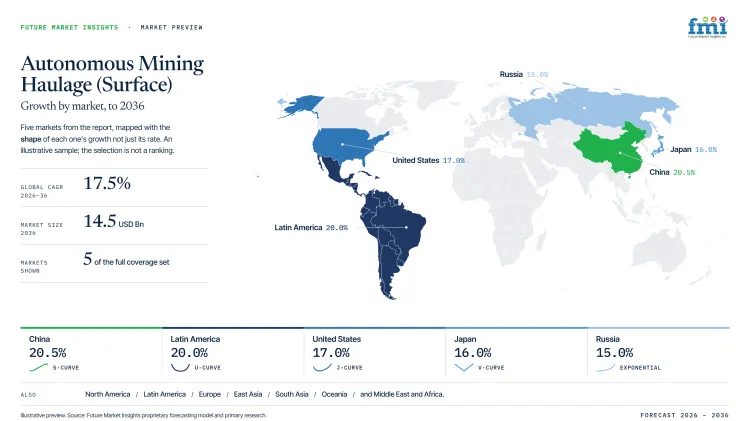
| Country | CAGR |
|---|---|
| China | 20.5% |
| Latin America | 20.0% |
| United States | 17.0% |
| Japan | 16.0% |
| Russia | 15.0% |
Source: FMI's proprietary forecasting model and primary research
How do country-level CAGRs compare in the Autonomous Mining Haulage (Surface) Market?
The comparison spans 5.5 percentage points across the autonomous mining haulage (surface) market. China records the highest CAGR at 20.5%, closely followed by Latin America at 20.0%. The United States reaches 17.0%, while Japan and Russia post 16.0% and 15.0%, respectively. The distribution reflects differences in surface mining activity, automation investment and deployment of autonomous haulage systems.
- China leads with a CAGR of 20.5%. Mining companies are expanding autonomous haulage programs to improve fleet utilization, increase operational consistency and enhance productivity across large surface mining operations.
- Latin America follows at 20.0%, only 0.5 percentage points below China. The region's large-scale open-pit mining operations continue evaluating autonomous haulage technologies to improve material movement, reduce equipment downtime and optimize mine site logistics.
- The United States records a CAGR of 17.0%, 3.0 percentage points behind Latin America. Mining operators are incorporating autonomous haulage into digital mine modernization strategies, focusing on fleet management, operational efficiency and safer transport across surface extraction sites.
- Japan posts a CAGR of 16.0%, 1.0 percentage point below the United States. Market activity reflects continued interest in autonomous mining technologies that integrate with advanced equipment control systems and remote operational management.
- Russia reaches a CAGR of 15.0%, trailing Japan by 1.0 percentage point. Autonomous haulage is being assessed for large mining environments where automated vehicle movement and centralized fleet coordination offer opportunities to improve operational performance.
Comparable CAGRs do not indicate identical market conditions. Mining scale, fleet composition, automation maturity and capital investment priorities shape deployment strategies and long-term commercial opportunities. The full report provides country-level CAGR analysis across North America, Latin America, Europe, East Asia, South Asia, Oceania and the Middle East and Africa.
Country-wise Analysis
- Latin American copper operations combine long open-pit routes with brownfield renewal programs that cannot interrupt daily production across active pits. The regional market is projected to record 20.0% CAGR through 2036, supported by large copper fleets and staged route conversions. Codelco's March 2025 annual report identified Gabriela Mistral as its first division to operate with 100% autonomous haul trucks. The operating record confirms that regional adoption can move beyond isolated pilot fleets into routine copper production. The Latin America mining equipment category therefore needs commissioning teams that can convert one route while adjacent production continues. Contract selection depends on local field support and clear responsibility for software changes across long mine lives.
- United States adoption combines ultra-class gold mines with quarry programs that depend on regional dealer support and formal safety plans. Demand in the United States is estimated to advance at 17.0% CAGR over the forecast period, underpinned by established safety duties and service coverage. Caterpillar reported in July 2025 that autonomous Cat 777 trucks had hauled one million tons at Bull Run Quarry in Virginia. The milestone confirms that a United States quarry program can move beyond commissioning into routine material production under regular site conditions. Mine managers still need route-specific traffic rules that satisfy Mine Safety and Health Administration requirements. Commercial awards therefore depend on documented governance and field teams that can resolve software or communication failures without reducing daily output.
- Japan has limited domestic surface mining scale but retains a material role through truck engineering and remote operating support for export markets. Japan is forecast to post 16.0% CAGR by 2036, attributable to manufacturer investment and global service programs. Komatsu reported in April 2026 that FrontRunner had reached 1,000 commissioned ultra-class autonomous haul trucks across global surface mines. The milestone unit carried a 290-metric-ton payload and demonstrated the export scale available to a Japanese equipment manufacturer. Overseas operating records help engineering teams test route control across different road and climate conditions. Japan's commercial value therefore comes from product design and service revenue rather than large domestic mining fleets.
- Russia continues to operate large surface mines where payload and haul distance support autonomous truck development across remote industrial locations. Adoption in Russia is predicted to expand at 15.0% CAGR during the forecast period, aided by local engineering partnerships and high-payload applications. BELAZ stated in September 2025 that a Belarusian-Russian venture had started an unmanned hydrogen truck project with a 220-ton payload target. The planned platform links alternative power systems with autonomous control for heavy surface routes and remote production areas. Remote mines need maintainable control hardware and dependable field support across long service distances and severe operating conditions. Technology selection therefore depends on component access and stable communications rather than vehicle capability presented without local operating evidence.
Who are the notable companies in the Autonomous Mining Haulage (Surface) Market?
Komatsu, Caterpillar, Hitachi Construction Machinery, Liebherr, Hexagon, Epiroc, Fortescue, and Rio Tinto are notable companies shaping this market.
-market-analysis-by-company.webp "Autonomous Mining Haulage (surface) Market Analysis By Company")
Competition centers on responsibility for truck control and fleet assignment throughout regular surface-mine production across several operating shifts. Integrated OEM systems reduce interface risk, but they can narrow machine choice during later fleet purchases and replacement cycles. Machine-independent platforms preserve mixed fleets and require deeper testing across steering plus braking interfaces before site acceptance. Fortescue and Rio Tinto influence technical specifications through large deployment programs and joint development work with equipment manufacturers. The equipment management software category provides a useful comparison for asset visibility across large fleets. Autonomous haulage adds safety-critical vehicle control that requires stricter governance for route maps and software changes.
- Komatsu and Caterpillar compete through integrated truck and command platforms with production histories across several surface mining operations. Direct responsibility for machine controls and regional service networks supports their commercial position during commissioning. Mine owners still compare supported truck models with the governance used for route-map changes throughout each operating contract.
- Hitachi Construction Machinery and Liebherr combine haul-truck engineering with autonomy platforms and operating data from active mine sites. Their commercial position depends on turning development programs into repeatable production evidence across several commodities. Each company must show that fleet control remains supported through future powertrain changes and later truck replacements.
- Hexagon and Epiroc compete through machine-independent control systems that support mixed fleets across active surface mining operations. Fortescue shapes technical requirements through joint programs with Caterpillar and Liebherr. Rio Tinto applies autonomous haulage at Gudai-Darri, reinforcing demand for open interfaces and clear responsibility for production performance.
Competitive Benchmarking: Autonomous Mining Haulage (Surface) Market
| Company | Truck Platform | Mixed-Fleet Control | Production Deployment | Geographic Reach |
|---|---|---|---|---|
| Komatsu | High | High | High | Global |
| Caterpillar | High | High | High | Global |
| Hitachi Construction Machinery | High | High | Medium | Global |
| Liebherr | High | Medium | Medium | Global |
| Hexagon | Low | High | Medium | Global |
| Epiroc | Low | High | High | Global |
| Fortescue | Medium | High | High | Australia |
| Rio Tinto | Medium | High | High | Australia |
Scoring basis: High indicates direct market capability supported by production evidence from active surface mining operations. Medium identifies partner-supported capability or a developing platform with narrower production evidence across the defined market. Low marks companies with limited responsibility for truck manufacturing or autonomous fleet control within the assessed market.
Source: Future Market Insights competitive analysis, 2026, with ratings based on verified portfolio relevance and deployment evidence.
Key Developments in the Autonomous Mining Haulage (Surface) Market
- April 2025: Liebherr displayed the autonomous battery-electric T 264 at Bauma through the Autonomous Haulage Solution developed with Fortescue for surface mining operations. The 240-ton class truck combined battery-electric propulsion with automated route control on a mine-haulage platform. The demonstration showed that mine planning must coordinate vehicle automation with charging availability and traffic flow across a complete commercial production route.
- March 2026: Hitachi Construction Machinery presented LANDCROS Autonomous Haulage Solution for mining at CONEXPO 2026 as a production-focused platform for surface operations. The development added another truck-manufacturer option for mines evaluating autonomous fleets across active production settings and different commodities. Commercial acceptance depends on operating evidence that covers route control and mixed traffic alongside local service throughout each deployment cycle.
- May 2025: Komatsu and Ouster announced a multimillion-dollar lidar supply agreement covering Komatsu autonomous mining equipment across several machine programs. The agreement adds 3D digital sensors to autonomous haulage and other applications across Komatsu's equipment portfolio. The development gives mining companies a clearer component-support path and raises the importance of sensor availability throughout commissioning and later replacement cycles across operating fleets.
Key Players in the Autonomous Mining Haulage (Surface) Market
Integrated Haul-Truck and Autonomous System Manufacturers
- Komatsu
- Caterpillar
- Hitachi Construction Machinery
- Liebherr
Machine-Independent Automation and Fleet-Control Providers
- Hexagon
- Epiroc
Mine Operators Co-Developing Autonomous Haulage
- Fortescue
- Rio Tinto
Autonomous Mining Haulage (Surface) Market - Report Scope
-market-breakdown-by-equipment,-commodity,-and-region.webp "Autonomous Mining Haulage (surface) Market Breakdown By Equipment, Commodity, And Region")
| Coverage field | Report scope |
|---|---|
| Market breakdown | Equipment, commodity, component, end use, sales channel, and region. |
| Market Definition | The market covers driverless haulage systems for surface mining production routes, including truck platforms, retrofit controls, fleet software, and related operating services. |
| Regions Covered | North America, Latin America, Europe, East Asia, South Asia, Oceania, and Middle East and Africa. |
| Countries Covered | China, Chile, Peru, Brazil, United States, Japan, Russia, Australia, and other countries within the 8+ country regional model. |
| Key Companies Profiled | Komatsu, Caterpillar, Hitachi Construction Machinery, Liebherr, Hexagon, Epiroc, Fortescue, and Rio Tinto. |
| Forecast Period | 2026 to 2036. |
| Approach | Hybrid bottom-up and top-down market sizing supported by primary interviews and official desk research. |
Source: Future Market Insights analysis supported by proprietary forecasting models and primary research
Autonomous Mining Haulage (Surface) Market - Research Methodology
| Method | Approach |
|---|---|
| Primary Research | FMI analysts gathered input from manufacturers, service providers, technology developers, distributors, end users, procurement teams, and subject-matter experts. Interviews examined purchasing decisions, product or service evaluation, adoption barriers, approval requirements, pricing considerations, and expectations for technical or commercial support. Respondents were also asked what evidence is required before a trial, pilot, or initial order develops into regular purchasing. |
| Desk Research | Desk research covered government statistics, regulatory publications, trade data, industry associations, technical literature, standards, company filings, product information, and official corporate announcements. Sources were reviewed for relevance, publication date, geographic coverage, and consistency with the defined market scope. Claims relating to performance, applications, approvals, capacity, investment, and commercial activity were retained only when supported by credible public evidence. |
| Market Sizing and Forecasting | The market model combined the baseline value with historical performance, segment structure, pricing and volume indicators, adoption levels, company participation, and country-level demand conditions. Forecast assumptions considered economic activity, investment trends, regulatory developments, technology adoption, purchasing cycles, supply availability, and barriers to wider market use. Segment and regional estimates were reconciled before the final market total was calculated. |
| Data Validation | Estimates were checked against multiple independent indicators, including public data, company activity, trade patterns, industry developments, and findings from primary interviews. Validation also tested whether products, services, applications, and company revenues fell within the defined market boundaries. Adjacent categories, unsupported claims, overlapping revenues, and activities without direct market relevance were excluded to reduce double counting and maintain consistency across segments and countries. |
Source: Future Market Insights analysis based on proprietary forecasting models and primary research
Autonomous Mining Haulage (Surface) Market by Segments
Autonomous Mining Haulage (Surface) Market segmented by Equipment:
- Autonomous Haul Trucks
- Drill Automation
- Dozer and Water Truck Autonomy
- Light Vehicle Autonomy
Autonomous Mining Haulage (Surface) Market segmented by Commodity:
- Iron Ore and Bulk Materials
- Copper
- Coal
- Gold and Other Commodities
Autonomous Mining Haulage (Surface) Market segmented by Component:
- Vehicles and Retrofit Kits
- Autonomy Software and Fleet Management Systems
- Services
Autonomous Mining Haulage (Surface) Market segmented by End Use:
- Surface Metal Mines
- Coal Mines
- Quarries and Aggregates
- Oil Sands
Autonomous Mining Haulage (Surface) Market segmented by Sales Channel:
- Direct OEM Purchases
- Retrofit Programs
- Service Contracts
- Pilot Programs
Autonomous Mining Haulage (Surface) Market by Region:
- North America
- United States
- Canada
- Europe
- Germany
- United Kingdom
- France
- Italy
- Spain
- Asia Pacific
- India
- China
- Japan
- South Korea
- Australia
- Latin America
- Brazil
- Argentina
- Mexico
- Chile
- Middle East & Africa
- UAE
- Saudi Arabia
- South Africa
Research Sources and Bibliography
- Caterpillar. (2026, March 23). Caterpillar and Fortescue extend agreement for Cat MineStar Command for hauling in Western Australia sites. Caterpillar.
- Caterpillar. (2026, May 4). Carmeuse Selects Caterpillar’s Autonomous Hauling Solution to Deploy at Drummond Island Operation. Caterpillar.
- Caterpillar. (2025, April 6). New Cat® 775 off-highway truck previews the next generation design and the future of autonomy. Caterpillar.
- Caterpillar. (2025, July 14). Caterpillar and Luck Stone celebrate one million tons hauled autonomously at Bull Run Quarry. Caterpillar.
- Codelco. (2025, March 29). Annual Report 2024. Codelco.
- Codelco. (2025, December 17). Codelco and Hexagon sign agreement to develop and implement advanced technological solutions in mining. Codelco.
- Epiroc. (2025, October 24). Epiroc and Hancock Iron Ore reach milestone as Roy Hill becomes world's largest fully agnostic autonomous mine. Epiroc.
- Hitachi Construction Machinery Americas. (2026, March 2). Hitachi Construction Machinery to showcase autonomous haulage for mining at CONEXPO 2026. Hitachi Construction Machinery.
- Huawei. (2025, June). North China's Yimin Mine deploys world's first fleet of 100 5G-A connected, self-driving electric trucks. Huawei.
- Komatsu. (2026, April 21). Komatsu becomes first OEM to commission 1,000 ultra-class autonomous haul trucks. Komatsu.
- Komatsu. (2025, May 22). Komatsu achieves autonomous trolley milestone with battery-ready electric-drive truck. Komatsu.
- Komatsu. (2025, August 7). Komatsu North America and Pronto launch autonomy solution for quarry-size trucks. Komatsu.
- Ouster. (2025, May 8). Ouster to supply lidar sensors for Komatsu's suite of autonomous offerings. Ouster.
- Rio Tinto. (n.d.). Gudai-Darri. Rio Tinto.
- Liebherr. (2025, April 6). Liebherr shares its exciting electrification solutions for mining equipment at Bauma 2025. Liebherr.
- Mine Safety and Health Administration. (2024, July 15). Frequently asked questions: Safety program for surface mobile equipment. USA Department of Labor.
- BELAZ. (2025, September 30). The project for unmanned and hydrogen-powered dump trucks has been launched. BELAZ.
The bibliography provides reader references from primary government sources, standards bodies, official trade bodies, and company publications.
This Report Answers
- What market value is estimated for 2026 and 2036?
- What CAGR is projected from 2026 to 2036?
- Which equipment, commodity, and end-use segments account for the stated 2026 shares?
- Which operating conditions support autonomous haulage across surface mines?
- How do country CAGRs compare across China, Latin America, the United States, Japan, and Russia?
- Which companies compete through truck platforms or machine-independent control systems?
- How do road design and communication coverage affect site acceptance?
- What commercial models support mixed-fleet conversions and long-term system service?
- What evidence should mine owners review before expanding a pilot route into production?
Frequently Asked Questions
What is driving growth in the autonomous mining haulage (surface) market?
Surface mines are converting complete haul routes into controlled production systems that reduce cycle variation. Expansion depends on reliable communications and traffic rules that protect output during every operating shift.
Who are the key players in the autonomous mining haulage (surface) market?
Komatsu and Caterpillar provide integrated truck and command systems for production fleets across surface mines worldwide. Hitachi Construction Machinery and Liebherr compete alongside Hexagon and Epiroc through open or mixed-fleet control models.
What is a notable restraint in the autonomous mining haulage (surface) market?
Brownfield road conditions and uneven radio coverage can delay route commissioning across active surface mines. Site approval requires documented traffic controls before driverless trucks operate beside staffed equipment during production.
Why should executives track the autonomous mining haulage (surface) market?
Autonomous haulage changes fleet capital planning and creates recurring spending on software and field support. Contract value increasingly depends on service responsibility throughout commissioning and regular production at each mine site.
What business problem does the autonomous mining haulage (surface) market address?
Surface mines need consistent material movement between loading points and fixed dumping destinations throughout each shift. Autonomous control reduces avoidable cycle variation under approved speed and spacing rules across complete routes.
What should mine owners evaluate in the autonomous mining haulage (surface) market?
Mine owners should compare supported truck models with local service coverage before awarding long-term contracts. Agreements need clear responsibility for route maps and software changes alongside incident response during production.
What limits return on investment in the autonomous mining haulage (surface) market?
Weak radio coverage and unstable haul roads can leave autonomous trucks underused after commissioning at active sites. Returns improve after mines convert complete production loops rather than isolated vehicles within one fleet.
What supports long-term commercial confidence in the autonomous mining haulage (surface) market?
Documented production results and predictable system support build confidence in multi-year autonomous fleet programs worldwide. Open interfaces preserve equipment choice and reduce dependence on one truck manufacturer during later expansions.
Preview the report firsthand - request a free sample
Get SampleGet the brochure for pricing and purchase details.
Get PDFTable of Content
- Key Takeaways
- Market Size and CAGR
- Top Growth Driver
- Fastest Growing Segment
- Leading Region
- Key Companies
- Emerging Opportunities
- Executive Summary
- Global Market Outlook
- Demand-side Trends
- Supply-side Trends
- Technology Roadmap Analysis
- Analysis and Recommendations
- Analyst Perspective (What is happening? Why now? What should investors know?)
- Key Questions Answered
- How large is the market?
- What is the CAGR?
- What are key trends?
- Which region dominates?
- Who are the leaders?
- Market Overview
- Market Coverage / Taxonomy
- Market Definition / Scope / Limitations
- Research Methodology
- Chapter Orientation
- Analytical Lens and Working Hypotheses
- Market Structure, Signals, and Trend Drivers
- Benchmarking and Cross-market Comparability
- Market Sizing, Forecasting, and Opportunity Mapping
- Research Design and Evidence Framework
- Desk Research Programme (Secondary Evidence)
- Expert Input and Fieldwork (Primary Evidence)
- Tooling, Models, and Reference Databases
- Data Engineering and Model Build
- Quality Assurance and Audit Trail
- Market Background
- Market Dynamics (Drivers, Restraints, Opportunity, Trends)
- Scenario Forecast (Optimistic, Likely, Conservative)
- Impact Analysis
- AI Impact
- Sustainability Impact
- Regulatory Impact
- Technology Impact
- Consumer / Buyer Analysis
- Purchase Drivers
- Adoption Barriers
- Buyer Journey
- Opportunity Map Analysis
- Product Life Cycle Analysis
- Supply Chain Analysis
- Investment Feasibility Matrix
- Value Chain Analysis
- PESTLE and Porter's Analysis
- Regulatory Landscape
- Regional Parent Market Outlook
- Production and Consumption Statistics
- Import and Export Statistics
- Global Market Analysis and Forecast, 2021 to 2036
- Historical Market Size Value (USD Bn) Analysis, 2021 to 2025
- Current and Future Market Size Value (USD Bn) Projections, 2026 to 2036
- Y-o-Y Growth Trend Analysis
- Absolute $ Opportunity Analysis
- Global Market Pricing Analysis, 2021 to 2036
- Global Market Analysis and Forecast, By Equipment, 2021 to 2036
- Introduction / Key Findings
- Historical Market Size Value (USD Bn) Analysis By Equipment, 2021 to 2025
- Current and Future Market Size Value (USD Bn) Analysis and Forecast By Equipment, 2026 to 2036
- Autonomous haul trucks
- Drill automation
- Dozer - water truck autonomy
- Light vehicle autonomy
- Autonomous haul trucks
- Y-o-Y Growth Trend Analysis By Equipment, 2021 to 2025
- Absolute $ Opportunity Analysis By Equipment, 2026 to 2036
- Global Market Analysis and Forecast, By Commodity, 2021 to 2036
- Introduction / Key Findings
- Historical Market Size Value (USD Bn) Analysis By Commodity, 2021 to 2025
- Current and Future Market Size Value (USD Bn) Analysis and Forecast By Commodity, 2026 to 2036
- Iron ore & bulk
- Copper
- Coal
- Gold & others
- Iron ore & bulk
- Y-o-Y Growth Trend Analysis By Commodity, 2021 to 2025
- Absolute $ Opportunity Analysis By Commodity, 2026 to 2036
- Global Market Analysis and Forecast, By Component, 2021 to 2036
- Introduction / Key Findings
- Historical Market Size Value (USD Bn) Analysis By Component, 2021 to 2025
- Current and Future Market Size Value (USD Bn) Analysis and Forecast By Component, 2026 to 2036
- Vehicles & retrofit kits
- Autonomy software - FMS
- Services
- Vehicles & retrofit kits
- Y-o-Y Growth Trend Analysis By Component, 2021 to 2025
- Absolute $ Opportunity Analysis By Component, 2026 to 2036
- Global Market Analysis and Forecast, By End-use, 2021 to 2036
- Introduction / Key Findings
- Historical Market Size Value (USD Bn) Analysis By End-use, 2021 to 2025
- Current and Future Market Size Value (USD Bn) Analysis and Forecast By End-use, 2026 to 2036
- Surface metal mines
- Coal mines
- Quarries & aggregates
- Oil sands
- Surface metal mines
- Y-o-Y Growth Trend Analysis By End-use, 2021 to 2025
- Absolute $ Opportunity Analysis By End-use, 2026 to 2036
- Global Market Analysis and Forecast, By Sales Channel, 2021 to 2036
- Introduction / Key Findings
- Historical Market Size Value (USD Bn) Analysis By Sales Channel, 2021 to 2025
- Current and Future Market Size Value (USD Bn) Analysis and Forecast By Sales Channel, 2026 to 2036
- Direct - OEM
- Retrofit programs
- Service contracts
- Pilot programs
- Direct - OEM
- Y-o-Y Growth Trend Analysis By Sales Channel, 2021 to 2025
- Absolute $ Opportunity Analysis By Sales Channel, 2026 to 2036
- Global Market Analysis and Forecast, By Region, 2021 to 2036
- Introduction
- Historical Market Size Value (USD Bn) Analysis By Region, 2021 to 2025
- Current Market Size Value (USD Bn) Analysis and Forecast By Region, 2026 to 2036
- North America
- Latin America
- Western Europe
- Eastern Europe
- East Asia
- South Asia and Pacific
- Middle East & Africa
- Market Attractiveness Analysis By Region
- North America Market Analysis and Forecast, By Country, 2021 to 2036
- Historical Market Size Value (USD Bn) Trend Analysis By Market Taxonomy, 2021 to 2025
- Market Size Value (USD Bn) Forecast By Market Taxonomy, 2026 to 2036
- By Country
- USA
- Canada
- By Equipment
- By Commodity
- By Component
- By End-use
- By Sales Channel
- By Country
- Market Attractiveness Analysis
- By Country
- By Equipment
- By Commodity
- By Component
- By End-use
- By Sales Channel
- Key Takeaways
- Latin America Market Analysis and Forecast, By Country
- Historical Market Size Value (USD Bn) Trend Analysis By Market Taxonomy, 2021 to 2025
- Market Size Value (USD Bn) Forecast By Market Taxonomy, 2026 to 2036
- By Country
- Brazil
- Mexico
- Chile
- Rest of Latin America
- By Equipment
- By Commodity
- By Component
- By End-use
- By Sales Channel
- By Country
- Market Attractiveness Analysis
- By Country
- By Equipment
- By Commodity
- By Component
- By End-use
- By Sales Channel
- Key Takeaways
- Western Europe Market Analysis and Forecast, By Country
- Historical Market Size Value (USD Bn) Trend Analysis By Market Taxonomy, 2021 to 2025
- Market Size Value (USD Bn) Forecast By Market Taxonomy, 2026 to 2036
- By Country
- Germany
- UK
- Italy
- Spain
- France
- Nordic
- BENELUX
- Rest of Western Europe
- By Equipment
- By Commodity
- By Component
- By End-use
- By Sales Channel
- By Country
- Market Attractiveness Analysis
- By Country
- By Equipment
- By Commodity
- By Component
- By End-use
- By Sales Channel
- Key Takeaways
- Eastern Europe Market Analysis and Forecast, By Country
- Historical Market Size Value (USD Bn) Trend Analysis By Market Taxonomy, 2021 to 2025
- Market Size Value (USD Bn) Forecast By Market Taxonomy, 2026 to 2036
- By Country
- Russia
- Poland
- Hungary
- Balkan & Baltic
- Rest of Eastern Europe
- By Equipment
- By Commodity
- By Component
- By End-use
- By Sales Channel
- By Country
- Market Attractiveness Analysis
- By Country
- By Equipment
- By Commodity
- By Component
- By End-use
- By Sales Channel
- Key Takeaways
- East Asia Market Analysis and Forecast, By Country
- Historical Market Size Value (USD Bn) Trend Analysis By Market Taxonomy, 2021 to 2025
- Market Size Value (USD Bn) Forecast By Market Taxonomy, 2026 to 2036
- By Country
- China
- Japan
- South Korea
- By Equipment
- By Commodity
- By Component
- By End-use
- By Sales Channel
- By Country
- Market Attractiveness Analysis
- By Country
- By Equipment
- By Commodity
- By Component
- By End-use
- By Sales Channel
- Key Takeaways
- South Asia and Pacific Market Analysis and Forecast, By Country
- Historical Market Size Value (USD Bn) Trend Analysis By Market Taxonomy, 2021 to 2025
- Market Size Value (USD Bn) Forecast By Market Taxonomy, 2026 to 2036
- By Country
- India
- ASEAN
- Australia & New Zealand
- Rest of South Asia and Pacific
- By Equipment
- By Commodity
- By Component
- By End-use
- By Sales Channel
- By Country
- Market Attractiveness Analysis
- By Country
- By Equipment
- By Commodity
- By Component
- By End-use
- By Sales Channel
- Key Takeaways
- Middle East & Africa Market Analysis and Forecast, By Country
- Historical Market Size Value (USD Bn) Trend Analysis By Market Taxonomy, 2021 to 2025
- Market Size Value (USD Bn) Forecast By Market Taxonomy, 2026 to 2036
- By Country
- Kingdom of Saudi Arabia
- Other GCC Countries
- Türkiye
- South Africa
- Other African Union
- Rest of Middle East & Africa
- By Equipment
- By Commodity
- By Component
- By End-use
- By Sales Channel
- By Country
- Market Attractiveness Analysis
- By Country
- By Equipment
- By Commodity
- By Component
- By End-use
- By Sales Channel
- Key Takeaways
- Key Countries Market Analysis
- USA
- Pricing Analysis
- Market Share Analysis, 2025
- By Equipment
- By Commodity
- By Component
- By End-use
- By Sales Channel
- Canada
- Pricing Analysis
- Market Share Analysis, 2025
- By Equipment
- By Commodity
- By Component
- By End-use
- By Sales Channel
- Mexico
- Pricing Analysis
- Market Share Analysis, 2025
- By Equipment
- By Commodity
- By Component
- By End-use
- By Sales Channel
- Brazil
- Pricing Analysis
- Market Share Analysis, 2025
- By Equipment
- By Commodity
- By Component
- By End-use
- By Sales Channel
- Chile
- Pricing Analysis
- Market Share Analysis, 2025
- By Equipment
- By Commodity
- By Component
- By End-use
- By Sales Channel
- Germany
- Pricing Analysis
- Market Share Analysis, 2025
- By Equipment
- By Commodity
- By Component
- By End-use
- By Sales Channel
- UK
- Pricing Analysis
- Market Share Analysis, 2025
- By Equipment
- By Commodity
- By Component
- By End-use
- By Sales Channel
- Italy
- Pricing Analysis
- Market Share Analysis, 2025
- By Equipment
- By Commodity
- By Component
- By End-use
- By Sales Channel
- Spain
- Pricing Analysis
- Market Share Analysis, 2025
- By Equipment
- By Commodity
- By Component
- By End-use
- By Sales Channel
- France
- Pricing Analysis
- Market Share Analysis, 2025
- By Equipment
- By Commodity
- By Component
- By End-use
- By Sales Channel
- India
- Pricing Analysis
- Market Share Analysis, 2025
- By Equipment
- By Commodity
- By Component
- By End-use
- By Sales Channel
- ASEAN
- Pricing Analysis
- Market Share Analysis, 2025
- By Equipment
- By Commodity
- By Component
- By End-use
- By Sales Channel
- Australia & New Zealand
- Pricing Analysis
- Market Share Analysis, 2025
- By Equipment
- By Commodity
- By Component
- By End-use
- By Sales Channel
- China
- Pricing Analysis
- Market Share Analysis, 2025
- By Equipment
- By Commodity
- By Component
- By End-use
- By Sales Channel
- Japan
- Pricing Analysis
- Market Share Analysis, 2025
- By Equipment
- By Commodity
- By Component
- By End-use
- By Sales Channel
- South Korea
- Pricing Analysis
- Market Share Analysis, 2025
- By Equipment
- By Commodity
- By Component
- By End-use
- By Sales Channel
- Russia
- Pricing Analysis
- Market Share Analysis, 2025
- By Equipment
- By Commodity
- By Component
- By End-use
- By Sales Channel
- Poland
- Pricing Analysis
- Market Share Analysis, 2025
- By Equipment
- By Commodity
- By Component
- By End-use
- By Sales Channel
- Hungary
- Pricing Analysis
- Market Share Analysis, 2025
- By Equipment
- By Commodity
- By Component
- By End-use
- By Sales Channel
- Kingdom of Saudi Arabia
- Pricing Analysis
- Market Share Analysis, 2025
- By Equipment
- By Commodity
- By Component
- By End-use
- By Sales Channel
- Türkiye
- Pricing Analysis
- Market Share Analysis, 2025
- By Equipment
- By Commodity
- By Component
- By End-use
- By Sales Channel
- South Africa
- Pricing Analysis
- Market Share Analysis, 2025
- By Equipment
- By Commodity
- By Component
- By End-use
- By Sales Channel
- USA
- Market Structure Analysis
- Competition Dashboard
- Competition Benchmarking
- Market Share Analysis of Top Players
- By Regional
- By Equipment
- By Commodity
- By Component
- By End-use
- By Sales Channel
- Emerging Startups
- Innovation Benchmarking
- Competition Analysis
- Competition Deep Dive
- Komatsu (JP)
- Overview
- Product Portfolio
- Profitability by Market Segments
- Sales Footprint
- Strategy Overview
- Marketing Strategy
- Product Strategy
- Channel Strategy
- Caterpillar (US)
- Hitachi CM (JP)
- Sandvik (SE)
- Komatsu (JP)
- Case Studies
- Success Stories
- Recent Developments
- Competition Deep Dive
- Assumptions & Acronyms Used


