

- Market Size (2026)
- USD 4.9 Bn
- Forecast (2036)
- USD 9.5 Bn
- CAGR (2026 to 2036)
- 6.8%
How big is the Barcode Printers Market in 2026?
USD 4.9 billion in 2026, reaching USD 9.5 billion by 2036 at a 6.8% CAGR
The barcode printers market was valued at USD 4.6 billion in 2025. The market is set to reach USD 4.9 billion by 2026-end and grow at a CAGR of 6.8% between 2026-2036 to reach USD 9.5 billion by 2036. 5-8 Inch-Second will dominate with a 44.0% share, while Industrial Barcode Printers will lead with a 46.0% share.
Barcode printer procurement is shaped by retail labeling requirements, warehouse automation timelines, and supply chain traceability mandates. Demand reflects investment in thermal, inkjet, and laser printing systems for product identification, shipping labels, and inventory management. Buyers include retail operations managers, warehouse logistics teams, and manufacturing quality departments evaluating print speed, label durability, and connectivity integration.
Growth reflects expanding e-commerce fulfillment operations and regulatory traceability requirements across retail, healthcare, and logistics sectors. GS1 confirmed updated barcode standardization guidelines in its 2025 release, supporting procurement of thermal printers compatible with GS1-128 and DataMatrix labeling formats.
Buyers separate suppliers on print speed, thermal head durability, and wireless connectivity for mobile and cloud-connected operation. Honeywell and Toshiba Tec rely on industrial barcode and scanning portfolios, while TSC and Avery Dennison gain preference where cost-effective desktop printing and label solution integration drive procurement.
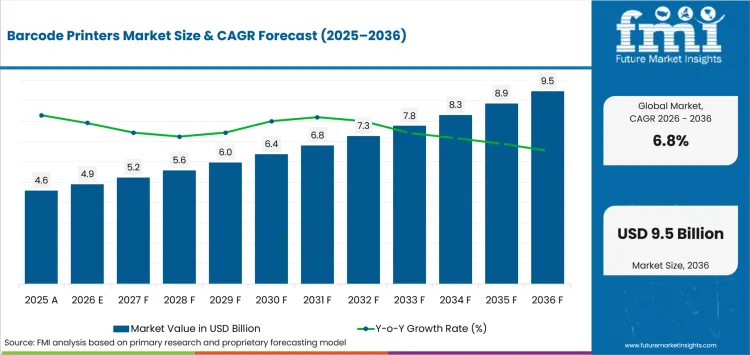
Key Takeaways of Barcode Printers Market
- E-commerce fulfillment expansion is expected to sustain barcode printer procurement for shipping label and inventory management applications.
- 5 to 8 Inch Per Second is expected to account for 44.0% of printing speed demand in 2026 because mid-range speed printers balance throughput with label quality for retail and logistics applications.
- Industrial Barcode Printers is projected to hold 46.0% of product type demand in 2026, driven by warehouse and manufacturing labeling volumes.
- Thermal is anticipated to represent 65.6% of printing type demand in 2026, supported by thermal transfer and direct thermal print durability for barcode labels.
- Spain leads with an 8.1% CAGR through 2036 as retail modernization and logistics labeling expansion sustain barcode printer procurement.
- Honeywell and Toshiba Tec are expected to compete through industrial barcode and scanning portfolios.
Analyst Perspective
"Buyers are expected to judge 5-8 inch-second on performance and total cost of ownership rather than headline price. Barcode printer adoption is expected to depend on e-commerce fulfillment growth and supply chain traceability mandates. Suppliers that combine print speed with wireless connectivity and cloud management are likely to secure warehouse and retail deployment contracts. Market success is projected to depend on meeting labeling throughput requirements while integrating with WMS and ERP platforms across supply chain operations."
- Nikhil Kaitwade, Principal Consultant at Future Market Insights
Why is the Barcode Printers Market growing?
Rising 5-8 Inch-Second and Industrial Barcode Printers demand across industrial end users
- Barcode-printer demand follows warehouse, logistics, and retail labeling volumes and label-standard upgrades rather than speculative buying.
- Spain leads growth at 8.1% CAGR as retail modernization and logistics labeling expansion sustain barcode printer procurement.
- Industrial Barcode Printers holds 46.0% of product type revenue, indicating where standardization is concentrating buyer spend.
Because printers anchor labeling reliability, barcode-printer spend concentrates with vendors offering thermal-print durability, media compatibility, and dependable service and supplies.
How is the Barcode Printers Market segmented?
The barcode printers industry is segmented by printing speed, product type, printing type, end use, connectivity, and region.
The barcode printers market is segmented by printing speed, product type, printing type, end use, connectivity, and region. By printing speed, the market covers 5 to 8 inch per second, up to 4 inch per second, and 8 inch per second. By product type, the market covers industrial barcode printers, desktop barcode printers, and mobile barcode printer. By printing type, the market covers thermal, dot matrix, inkjet, and laser. By end use, the market covers retail, manufacturing and industrial, transportation and logistics, healthcare and hospitality, and government. By connectivity, the market covers wired barcode printers, wireless barcode printers, and cloud connected barcode printers. Regions include North America, Latin America, Western Europe, Eastern Europe, East Asia, South Asia and Pacific, and the Middle East and Africa.
How does the 5 to 8 inch per second speed range shape demand?
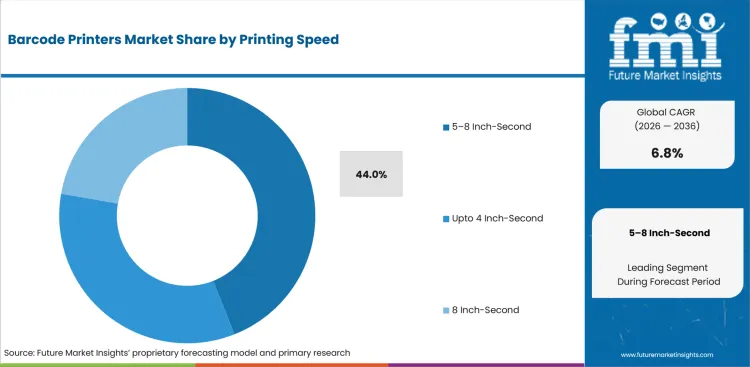
Printing speed selection determines labeling throughput and application suitability. The 5 to 8 inch per second range balances output speed with label quality for high-volume retail and logistics applications.
- 5 to 8 Inch Per Second is expected to account for 44.0% of printing speed demand in 2026.
- Industrial Barcode Printers is projected to hold 46.0% of product type demand as warehouse and manufacturing labeling volumes sustain industrial-grade printer procurement.
What supports thermal printing type demand?
Thermal printing type shapes buyer requirements because segment choice here determines integration path, deployment cost, and upgrade cadence for buyers. Demand concentrates here because thermal transfer and direct thermal printing produce durable barcode labels for shipping, inventory, and compliance labeling.
- Thermal is anticipated to represent 65.6% of printing type demand in 2026 because thermal transfer and direct thermal printing produce durable barcode labels for shipping, inventory, and compliance labeling.
- Wired Barcode Printers is forecast to hold 43.0% of connectivity demand as USB and Ethernet connections remain standard in fixed-position industrial installations.
How do end use and connectivity shape procurement?
End use and connectivity decide who controls the purchase and how the product reaches the account; together they determine integration path, deployment cost, and upgrade cadence for buyers. Demand concentrates here because point-of-sale, shelf labeling, and price tagging sustain high-volume printer procurement.
- Retail is expected to hold 30.2% of end-use demand in 2026 because point-of-sale, shelf labeling, and price tagging sustain high-volume printer procurement.
- Wireless Barcode Printers are gaining share as mobile warehouse workers require Bluetooth and Wi-Fi connectivity for pick-and-pack labeling workflows.
What are the drivers, restraints, and opportunities in the Barcode Printers Market?
Near-term procurement is shaped by e-commerce fulfillment growth, traceability mandates, and warehouse automation expansion.
- Driver: E-commerce fulfillment expansion is expected to push barcode printer procurement as warehouse operations scale shipping label and inventory management systems.
- Restraint: Thermal printhead replacement costs and maintenance complexity are likely to slow adoption if total cost of ownership exceeds buyer expectations for high-volume industrial printing.
- Opportunity: Cloud-connected barcode printer management is expected to open supplier access if remote monitoring and firmware updates reduce on-site maintenance for distributed retail and warehouse deployments.
E-commerce growth is expected to increase barcode printer procurement across warehouse and fulfillment operations. Honeywell reported in 2025 that its productivity solutions division maintained growth across industrial scanning and printing applications.
Printhead maintenance is expected to limit adoption if replacement costs and downtime reduce throughput in high-volume labeling operations. Toshiba Tec reported in 2025 that long-life thermal printhead technology remained a procurement priority for industrial barcode printer buyers.
Cloud-connected management creates a practical route by enabling remote printer monitoring and configuration across distributed sites. TSC reported in 2025 that its cloud-managed barcode printer platform expanded deployments across retail and logistics operations in Asia Pacific.
Which country CAGRs are profiled in the Barcode Printers Market?
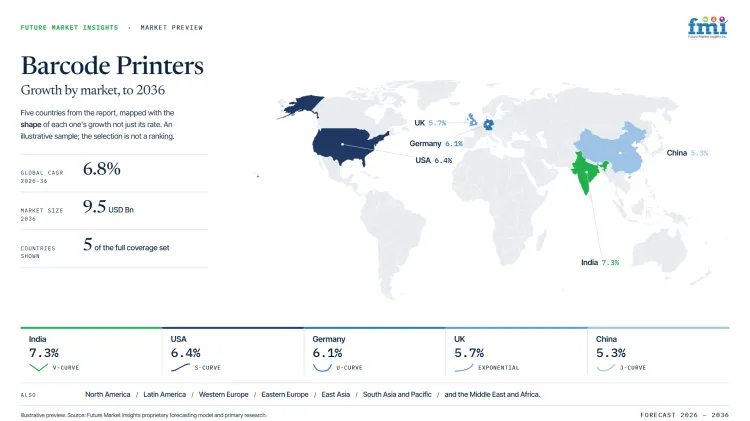
India 7.3%, USA 6.4%, Germany 6.1%, UK 5.7%, China 5.3% through 2036
| Country | CAGR (2026 to 2036) |
|---|---|
| India | 7.3% |
| USA | 6.4% |
| Germany | 6.1% |
| UK | 5.7% |
| China | 5.3% |
Source: FMI's proprietary forecasting model and primary research. 5 of the countries covered in the full report are shown here as a representative subset.
How do country-level CAGRs compare in the Barcode Printers Market?
The country comparison spans 2.0 percentage points and reveals three distinct growth groups across the Barcode Printers Market. India leads at 7.3%, followed by the United States and Germany as a closely aligned middle group separated by 0.3 percentage points. The United Kingdom and China form the lower tier with a 0.4-point difference.
- India leads the comparison at a 7.3% CAGR through 2036, supported by expanding digitalization budgets across manufacturing and services, although price sensitivity and phased implementation influence barcode-printer deployment.
- The United States records a 6.4% CAGR, remaining 0.9 percentage points below India. Deep enterprise technology budgets, early productivity-technology adoption and integration with established platforms support premium barcode-printer demand.
- Germany grows at a 6.1% CAGR, creating a 0.3-percentage-point gap from the United States. Industrial digitalization programs and engineering-led evaluation support demand for integrated and standards-compliant barcode-printing solutions.
- The United Kingdom records a 5.7% CAGR, remaining 0.4 percentage points below Germany. Its services-heavy economy, structured purchasing processes and steady digitalization budgets support consistent but competitive demand.
- China grows at a 5.3% CAGR, 0.4 percentage points below the United Kingdom. Rapid digital adoption, large-scale manufacturing digitalization programs and strong domestic platform ecosystems support high-volume barcode-printer deployments.
Comparable CAGRs can still produce different market conditions. Differences in logistics and retail labeling volumes, manufacturing digitalization, RFID adoption, automation intensity, enterprise technology budgets and facility throughput requirements influence barcode-printer demand across countries. The full report provides country-level CAGR analysis across major regions and individual markets within the Barcode Printers Market.
Country-wise Analysis
- India's growing digitalization budgets drive phased, price-sensitive barcode printers adoption. In India, demand is predicted to advance at a 7.3% CAGR through 2036, supported by growing barcode printers budgets across manufacturing and services. Industrial printers lead product-type demand in 2026, concentrating spend on high-throughput labeling. Price sensitivity and phased budgets stretch barcode printers deployment timelines.Vendors of barcode printers win India with modular pricing, local integration partners, and demonstrable payback.
- US enterprises adopt barcode printers early, with deep budgets and integration into established platforms. Demand draws on e-commerce fulfillment expansion. The Barcode Printers Market in the United States is projected to record a 6.4% CAGR during the assessment period, supported by deep enterprise budgets and early barcode printers adoption. Security review and ecosystem fit dominate barcode printers procurement gates for new vendors.Vendors of barcode printers win US accounts with enterprise-grade security, ecosystem integrations, and reference deployments.
- German barcode printers adoption runs through industrial digitalization programs with engineering-led evaluation. Sales in Germany are forecast to expand at a 6.1% CAGR by 2036, supported by industrial digitalization programs and engineering-led evaluation. Interoperability and data-compliance expectations extend barcode printers evaluation before rollout.Vendors of barcode printers hold German positions through interoperability with installed systems and strong data governance.
- UK barcode printers adoption runs through structured enterprise procurement in a services-heavy economy. The market outlook in the United Kingdom is anticipated to advance at a 5.7% CAGR over the assessment period, supported by steady barcode printers budgets and structured procurement. Compliance review and procurement structure lengthen barcode printers enterprise sales cycles.Vendors of barcode printers win UK accounts with compliance-ready offerings and local integration partners.
- China's large digitalization programs and domestic platform ecosystems drive fast barcode printers adoption. Demand in China is forecast to rise at a 5.3% CAGR over the forecast period, supported by rapid digital adoption and large-scale digitalization programs. Localization and data-compliance requirements lengthen barcode printers qualification for foreign vendors.Vendors of barcode printers convert Chinese demand with localization, domestic integration partnerships, and ecosystem fit.
Who are the notable companies in the Barcode Printers Market?
Brady Corporation, Toshiba Tec Corporation, AVERY DENNISON CORPORATION, Canon Finetech Nisca Inc., Epson India Pvt Ltd., TSC, TVS ELECTRONICS, and DASCOM are the notable companies shaping this market.
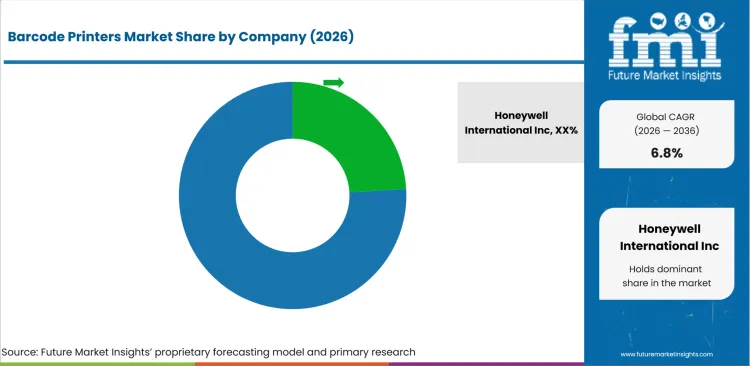
The field concentrates around labeling-hardware vendors that pair thermal-print engineering with media compatibility and service networks. Global automation and printing technology companies compete across Industrial barcode and scanning, Thermal barcode printers and Label and barcode solutions throughout established accounts. Industrial and desktop barcode printer specialists emphasize Industrial and desktop thermal printers and Receipt and label printers, while regional printing and labeling solution providers serve regional demand through Industrial label printers. A workable entry is an industrial-label or ID-card printer niche, or a regional supply-and-service position for a facility type. Growth then depends on media qualification, service coverage, and supplies availability across each launch market. Breadth pays off through teams that match printers, media, and software across labeling environments.
- Brady Corporation and Toshiba Tec Corporation combine Industrial barcode and scanning and Thermal barcode printers across multiple national markets. AVERY DENNISON CORPORATION adds Label and barcode solutions through established account relationships. Their edge comes from industrial and thermal print breadth with media and service depth.
- TSC, Epson India Pvt Ltd. and TVS ELECTRONICS follow focused routes across Industrial and desktop thermal printers, Receipt and label printers and Desktop printing solutions. Their commercial edge comes from ID-card and desktop-label niches rather than one standardized printer line.
- DASCOM, Zebra Technologies Corporation and OKI Data Australia provide regional coverage through Industrial label printers. These firms compete on focused labeling strengths, though distribution reach trails the global printer majors.
Competitive Benchmarking: Barcode Printers Market
| Company | Portfolio Relevance | Printer Focus | Account Access | Service Reach |
|---|---|---|---|---|
| Brady Corporation | High | Industrial barcode and scanning | Strong | Global |
| Toshiba Tec Corporation | High | Thermal barcode printers | Strong | Global |
| AVERY DENNISON CORPORATION | High | Label and barcode solutions | Strong | Global |
| Canon Finetech Nisca Inc. | Medium | ID and barcode card printers | Strong | Regional |
| TSC | Medium | Industrial and desktop thermal printers | Strong | Regional |
| Epson India Pvt Ltd. | Medium | Receipt and label printers | Moderate | Regional |
| TVS ELECTRONICS | Medium | Desktop printing solutions | Moderate | Regional |
| DASCOM | Medium | Industrial label printers | Moderate | Regional |
Source: Future Market Insights competitive analysis, 2026. Ratings reflect relative portfolio relevance, workflow or project fit, service capability, and geographic reach.
Key Developments in the Barcode Printers Market
- In August 2026, Brady Corporation completed its USD 1.4 billion all-cash acquisition of Honeywell Technologies' Productivity Solutions and Services (PSS) business, adding PSS's mobile computing, barcode scanning, RFID, and industrial printing solutions to Brady's identification and productivity portfolio.
- In January 2025, Toshiba America Business Solutions released its BX410T series of industrial thermal barcode printers, built on a dual-core processor running Toshiba's cloud-enabled A-BRID operating system for transportation, warehouse, manufacturing, and retail labeling applications.
- In September 2025, TSC Auto ID announced new capabilities for its TH Series 4-inch desktop barcode printers, adding built-in RAIN (UHF passive) RFID functionality to support combined barcode and RFID label encoding.
Key Players in the Barcode Printers Market
Global automation and printing technology companies
- Brady Corporation
- Toshiba Tec Corporation
- AVERY DENNISON CORPORATION
- Canon Finetech Nisca Inc.
Industrial and desktop barcode printer specialists
- TSC
- Epson India Pvt Ltd.
- TVS ELECTRONICS
Regional printing and labeling solution providers
- DASCOM
- Zebra Technologies Corporation
- OKI Data Australia
Barcode Printers Market: Report Scope
| Coverage field | Report scope |
|---|---|
| Market breakdown | Printing speed, product type, printing type, end use, connectivity, and region. |
| Market Definition | Barcode printers include industrial, desktop, and mobile thermal, inkjet, and laser printing systems used for product labeling, shipping labels, inventory management, and compliance traceability across retail, logistics, healthcare, and manufacturing applications. |
| Regions Covered | North America, Latin America, Western Europe, Eastern Europe, East Asia, South Asia and Pacific, and the Middle East and Africa. |
| Countries Covered | United States, China, India, Spain, Germany, United Kingdom, Brazil, and Japan. |
| Key Companies Profiled | Brady Corporation, Toshiba Tec Corporation, AVERY DENNISON CORPORATION, Canon Finetech Nisca Inc., Epson India Pvt Ltd., TSC, TVS ELECTRONICS, DASCOM. |
| Forecast Period | 2026 to 2036. |
| Approach | FMI used primary interviews, source validation, company authentication, and proprietary demand modeling to estimate market size, segment shares, country CAGRs, and competitive positioning. |
Source: Future Market Insights, analysis driven by proprietary forecasting models and primary research
Barcode Printers Market: Research Methodology
| Method | Approach |
|---|---|
| Primary Research | FMI interviewed barcode printers suppliers, buyers, distributors, and procurement leads. Inputs tested adoption triggers, product preferences, and replacement patterns. |
| Desk Research | Desk research used government releases, regulator updates, standards-body references, company filings, and official product pages. |
| Market Sizing and Forecasting | The forecast model linked 2026 revenue anchors to demand drivers, distribution reach, penetration rates, and country-specific conditions. |
| Data Validation | Data validation reconciled every external statistic against its source. Forecast values were checked against the ten-year CAGR formula. |
Source: Future Market Insights (FMI) analysis, based on proprietary forecasting model and primary research
Market Segmentation Analysis
Barcode Printers Market Segmented by Printing Speed:
- 5-8 Inch-Second
- Mid Speed Barcode Printers
- Balanced Printing Performance
- Improved Workflow Efficiency
- Commercial Label Printing Systems
- Medium Volume Printing Operations
- Enhanced Productivity Support
- Mid Speed Barcode Printers
- Upto 4 Inch-Second
- Entry Level Barcode Printers
- Low Volume Printing Applications
- Cost Effective Label Printing
- Compact Retail Printers
- Small Business Compatibility
- Basic Inventory Management Support
- Entry Level Barcode Printers
- 8 Inch-Second
- High Speed Industrial Printers
- Large Scale Label Production
- Continuous Printing Operations
- Advanced Warehouse Printers
- High Throughput Performance
- Reduced Printing Downtime
- High Speed Industrial Printers
Barcode Printers Market Segmented by Product Type:
- Industrial Barcode Printers
- Heavy Duty Industrial Printers
- High Volume Printing Capability
- Enhanced Durability Performance
- Rugged Warehouse Printers
- Continuous Label Production
- Industrial Environment Compatibility
- Heavy Duty Industrial Printers
- Desktop Barcode Printers
- Compact Desktop Printers
- Space Efficient Design
- Retail And Office Applications
- Light Duty Barcode Systems
- Affordable Printing Solutions
- Easy Operational Management
- Compact Desktop Printers
- Mobile Barcode Printer
- Handheld Mobile Printers
- Portable Label Printing Support
- Field Service Applications
- Wireless Mobile Printing Systems
- Real Time Printing Flexibility
- Improved Workforce Mobility
- Handheld Mobile Printers
Barcode Printers Market Segmented by Printing Type:
- Thermal
- Direct Thermal Printers
- Ink Free Printing Technology
- Fast Label Production
- Thermal Transfer Printers
- Durable Barcode Labeling
- Long Lasting Print Quality
- Direct Thermal Printers
- Dot Matrix
- Impact Dot Matrix Printers
- Multi Part Form Printing
- Reliable Industrial Applications
- Continuous Feed Printing Systems
- Cost Effective Operations
- Long Lasting Print Heads
- Impact Dot Matrix Printers
- Inkjet
- Color Inkjet Barcode Printers
- High Quality Label Graphics
- Flexible Printing Applications
- High Resolution Inkjet Systems
- Enhanced Product Identification
- Improved Branding Support
- Color Inkjet Barcode Printers
- Laser
- High Speed Laser Barcode Printers
- Sharp Print Quality
- Office And Enterprise Applications
- Monochrome Laser Printers
- Efficient Bulk Printing
- Low Maintenance Operations
- High Speed Laser Barcode Printers
Barcode Printers Market Segmented by End Use:
- Retail
- Point Of Sale Label Printing
- Efficient Inventory Tracking
- Enhanced Billing Accuracy
- Supermarket Barcode Applications
- Improved Product Identification
- Faster Checkout Operations
- Point Of Sale Label Printing
- Manufacturing & Industrial
- Production Line Labeling
- Real Time Product Tracking
- Improved Operational Efficiency
- Industrial Asset Tagging
- Enhanced Warehouse Management
- Reduced Inventory Errors
- Production Line Labeling
- Transportation & Logistics
- Shipping And Packaging Labels
- Improved Parcel Tracking
- Enhanced Logistics Efficiency
- Warehouse Barcode Operations
- Real Time Inventory Visibility
- Reduced Delivery Errors
- Shipping And Packaging Labels
- Healthcare & Hospitality
- Hospital Patient Identification Labels
- Improved Medical Safety
- Enhanced Record Accuracy
- Hospitality Asset Tracking
- Efficient Service Operations
- Improved Inventory Control
- Hospital Patient Identification Labels
- Government
- Document Tracking Applications
- Public Sector Asset Labeling
Barcode Printers Market Segmented by Connectivity:
- Wired Barcode Printers
- USB Connected Printers
- Stable Data Transmission
- Easy System Integration
- Ethernet Enabled Printers
- Centralized Printing Management
- Reliable Network Connectivity
- USB Connected Printers
- Wireless Barcode Printers
- Bluetooth Barcode Printers
- Portable Printing Convenience
- Mobile Workforce Compatibility
- Wi Fi Enabled Printers
- Remote Printing Operations
- Improved Workplace Flexibility
- Bluetooth Barcode Printers
- Cloud Connected Barcode Printers
- Cloud Managed Printing Systems
- Real Time Data Synchronization
- Centralized Device Monitoring
- IoT Enabled Barcode Printers
- Predictive Maintenance Support
- Enhanced Operational Analytics
- Cloud Managed Printing Systems
Barcode Printers Market by Region:
- North America
- USA
- Canada
- Mexico
- Latin America
- Brazil
- Chile
- Rest of Latin America
- Western Europe
- Germany
- UK
- Italy
- Spain
- France
- Nordic
- BENELUX
- Rest of Western Europe
- Eastern Europe
- Russia
- Poland
- Hungary
- Balkan & Baltic
- Rest of Eastern Europe
- East Asia
- China
- Japan
- South Korea
- South Asia and Pacific
- India
- ASEAN
- Australia & New Zealand
- Rest of South Asia and Pacific
- Middle East & Africa
- Kingdom of Saudi Arabia
- Other GCC Countries
- Türkiye
- South Africa
- Other African Union
- Rest of Middle East & Africa
Research Sources and Bibliography
- 1. GS1. (2025). Global Barcode Standardization Guidelines Update.
- 2. Brady Corporation. (2025). Productivity Solutions Division Performance Report.
- 3. Toshiba Tec Corporation. (2025). Thermal Barcode Printer Technology Assessment.
- 5. United States Food and Drug Administration. (2025). Unique Device Identification Labeling Requirements.
- 6. European Commission. (2025). Supply Chain Traceability Directive Implementation.
- 7. Goods and Services Tax Council India. (2025). GST Compliance Labeling Requirements.
- 8. Japan Industrial Standards. (2025). Barcode and Labeling Equipment Standards.
- 9. AVERY DENNISON CORPORATION. (2025). Label and Barcode Solutions Portfolio Update.
- 10. Spain Ministry of Industry. (2025). Retail Modernization and Logistics Infrastructure Report.
This bibliography is provided for reader reference and uses primary government sources plus standards-body sources. Company sources are included.
This Report Answers
- What is the estimated 2026 value of the barcode printers market?
- What market value is projected by 2036?
- What CAGR is forecast from 2026 to 2036?
- Which printing speed is expected to account for a notable 2026 share?
- Which countries are profiled for CAGR comparison?
- Which companies are notable in the competitive landscape?
Frequently Asked Questions
How big is the Barcode Printers Market in 2026?
The Barcode Printers Market is valued at USD 4.9 billion in 2026 and is forecast to reach USD 9.5 billion by 2036, expanding at a 6.8% CAGR. The Barcode Printers Market grew from USD 4.6 billion in 2025, with 8 Inch-Second holding 44.0% of printing speed demand in 2026.
What is the CAGR of the Barcode Printers Market from 2026 to 2036?
The Barcode Printers Market is projected to grow at a CAGR of 6.8% between 2026 and 2036, supported by expanding e-commerce fulfillment operations and regulatory traceability requirements across retail, healthcare, and logistics sectors. 8 Inch-Second holds 44.0% of Barcode Printers Market printing speed demand in 2026, while Industrial Barcode Printers leads product type with 46.0% in 2026.
Which printing speed leads the Barcode Printers Market?
8 Inch-Second accounts for 44.0% of the Barcode Printers Market by printing speed in 2026, driven by expanding e-commerce fulfillment operations and regulatory traceability requirements across retail, healthcare, and logistics sectors. The Barcode Printers Market grows at a 6.8% CAGR through 2036, while Industrial Barcode Printers leads product type with 46.0% in 2026.
How much will the Barcode Printers Market add between 2026 and 2036?
The Barcode Printers Market is set to add USD 4.6 billion between 2026 and 2036, growing from USD 4.9 billion to USD 9.5 billion at a 6.8% CAGR. Industrial Barcode Printers leads product type with 46.0% of Barcode Printers Market revenue in 2026, anchoring that incremental demand.
Who are the leading companies in the Barcode Printers Market?
The Barcode Printers Market profiles 8 key companies in 2026, led by Honeywell International Inc, Toshiba Tec Corporation, AVERY DENNISON CORPORATION, Canon Finetech Nisca Inc., and Epson India Pvt Ltd. These suppliers compete across printing speed, where 8 Inch-Second holds 44.0% of Barcode Printers Market demand in 2026.
Preview the report firsthand - request a free sample
Get SampleGet the brochure for pricing and purchase details.
Get PDFTable of Content
- Key Takeaways
- Market Size and CAGR
- Top Growth Driver
- Fastest Growing Segment
- Leading Region
- Key Companies
- Emerging Opportunities
- Executive Summary
- Global Market Outlook
- Demand-side Trends
- Supply-side Trends
- Technology Roadmap Analysis
- Analysis and Recommendations
- Analyst Perspective (What is happening? Why now? What should investors know?)
- Key Questions Answered
- How large is the market?
- What is the CAGR?
- What are key trends?
- Which region dominates?
- Who are the leaders?
- Market Overview
- Market Coverage / Taxonomy
- Market Definition / Scope / Limitations
- Research Methodology
- Chapter Orientation
- Analytical Lens and Working Hypotheses
- Market Structure, Signals, and Trend Drivers
- Benchmarking and Cross-market Comparability
- Market Sizing, Forecasting, and Opportunity Mapping
- Research Design and Evidence Framework
- Desk Research Programme (Secondary Evidence)
- Expert Input and Fieldwork (Primary Evidence)
- Tooling, Models, and Reference Databases
- Data Engineering and Model Build
- Quality Assurance and Audit Trail
- Market Background
- Market Dynamics (Drivers, Restraints, Opportunity, Trends)
- Scenario Forecast (Optimistic, Likely, Conservative)
- Impact Analysis
- AI Impact
- Sustainability Impact
- Regulatory Impact
- Technology Impact
- Consumer / Buyer Analysis
- Purchase Drivers
- Adoption Barriers
- Buyer Journey
- Opportunity Map Analysis
- Product Life Cycle Analysis
- Supply Chain Analysis
- Investment Feasibility Matrix
- Value Chain Analysis
- PESTLE and Porter's Analysis
- Regulatory Landscape
- Regional Parent Market Outlook
- Production and Consumption Statistics
- Import and Export Statistics
- Global Market Analysis and Forecast, 2021 to 2036
- Historical Market Size Value (USD Billion) Analysis, 2021 to 2025
- Current and Future Market Size Value (USD Billion) Projections, 2026 to 2036
- Y-o-Y Growth Trend Analysis
- Absolute $ Opportunity Analysis
- Global Market Pricing Analysis, 2021 to 2036
- Global Market Analysis and Forecast, By Printing Speed, 2021 to 2036
- Introduction / Key Findings
- Historical Market Size Value (USD Billion) Analysis By Printing Speed, 2021 to 2025
- Current and Future Market Size Value (USD Billion) Analysis and Forecast By Printing Speed, 2026 to 2036
- 5-8 Inch-Second
- Mid Speed Barcode Printers
- Commercial Label Printing Systems
- Upto 4 Inch-Second
- Entry Level Barcode Printers
- Compact Retail Printers
- 8 Inch-Second
- High Speed Industrial Printers
- Advanced Warehouse Printers
- 5-8 Inch-Second
- Y-o-Y Growth Trend Analysis By Printing Speed, 2021 to 2025
- Absolute $ Opportunity Analysis By Printing Speed, 2026 to 2036
- Global Market Analysis and Forecast, By Product Type, 2021 to 2036
- Introduction / Key Findings
- Historical Market Size Value (USD Billion) Analysis By Product Type, 2021 to 2025
- Current and Future Market Size Value (USD Billion) Analysis and Forecast By Product Type, 2026 to 2036
- Industrial Barcode Printers
- Heavy Duty Industrial Printers
- Rugged Warehouse Printers
- Desktop Barcode Printers
- Compact Desktop Printers
- Light Duty Barcode Systems
- Mobile Barcode Printer
- Handheld Mobile Printers
- Wireless Mobile Printing Systems
- Industrial Barcode Printers
- Y-o-Y Growth Trend Analysis By Product Type, 2021 to 2025
- Absolute $ Opportunity Analysis By Product Type, 2026 to 2036
- Global Market Analysis and Forecast, By Printing Type, 2021 to 2036
- Introduction / Key Findings
- Historical Market Size Value (USD Billion) Analysis By Printing Type, 2021 to 2025
- Current and Future Market Size Value (USD Billion) Analysis and Forecast By Printing Type, 2026 to 2036
- Thermal
- Direct Thermal Printers
- Thermal Transfer Printers
- Dot Matrix
- Impact Dot Matrix Printers
- Continuous Feed Printing Systems
- Inkjet
- Color Inkjet Barcode Printers
- High Resolution Inkjet Systems
- Laser
- High Speed Laser Barcode Printers
- Monochrome Laser Printers
- Thermal
- Y-o-Y Growth Trend Analysis By Printing Type, 2021 to 2025
- Absolute $ Opportunity Analysis By Printing Type, 2026 to 2036
- Global Market Analysis and Forecast, By End Use, 2021 to 2036
- Introduction / Key Findings
- Historical Market Size Value (USD Billion) Analysis By End Use, 2021 to 2025
- Current and Future Market Size Value (USD Billion) Analysis and Forecast By End Use, 2026 to 2036
- Retail
- Point Of Sale Label Printing
- Supermarket Barcode Applications
- Manufacturing & Industrial
- Production Line Labeling
- Industrial Asset Tagging
- Transportation & Logistics
- Shipping And Packaging Labels
- Warehouse Barcode Operations
- Healthcare & Hospitality
- Hospital Patient Identification Labels
- Hospitality Asset Tracking
- Government
- Document Tracking Applications
- Public Sector Asset Labeling
- Retail
- Y-o-Y Growth Trend Analysis By End Use, 2021 to 2025
- Absolute $ Opportunity Analysis By End Use, 2026 to 2036
- Global Market Analysis and Forecast, By Connectivity, 2021 to 2036
- Introduction / Key Findings
- Historical Market Size Value (USD Billion) Analysis By Connectivity, 2021 to 2025
- Current and Future Market Size Value (USD Billion) Analysis and Forecast By Connectivity, 2026 to 2036
- Wired Barcode Printers
- USB Connected Printers
- Ethernet Enabled Printers
- Wireless Barcode Printers
- Bluetooth Barcode Printers
- Wi Fi Enabled Printers
- Cloud Connected Barcode Printers
- Cloud Managed Printing Systems
- IoT Enabled Barcode Printers
- Wired Barcode Printers
- Y-o-Y Growth Trend Analysis By Connectivity, 2021 to 2025
- Absolute $ Opportunity Analysis By Connectivity, 2026 to 2036
- Global Market Analysis and Forecast, By Region, 2021 to 2036
- Introduction
- Historical Market Size Value (USD Billion) Analysis By Region, 2021 to 2025
- Current Market Size Value (USD Billion) Analysis and Forecast By Region, 2026 to 2036
- North America
- Latin America
- Western Europe
- Eastern Europe
- East Asia
- South Asia and Pacific
- Middle East & Africa
- Market Attractiveness Analysis By Region
- North America Market Analysis and Forecast, By Country, 2021 to 2036
- Historical Market Size Value (USD Billion) Trend Analysis By Market Taxonomy, 2021 to 2025
- Market Size Value (USD Billion) Forecast By Market Taxonomy, 2026 to 2036
- By Country
- USA
- Canada
- By Printing Speed
- By Product Type
- By Printing Type
- By End Use
- By Connectivity
- By Country
- Market Attractiveness Analysis
- By Country
- By Printing Speed
- By Product Type
- By Printing Type
- By End Use
- By Connectivity
- Key Takeaways
- Latin America Market Analysis and Forecast, By Country
- Historical Market Size Value (USD Billion) Trend Analysis By Market Taxonomy, 2021 to 2025
- Market Size Value (USD Billion) Forecast By Market Taxonomy, 2026 to 2036
- By Country
- Brazil
- Mexico
- Chile
- Rest of Latin America
- By Printing Speed
- By Product Type
- By Printing Type
- By End Use
- By Connectivity
- By Country
- Market Attractiveness Analysis
- By Country
- By Printing Speed
- By Product Type
- By Printing Type
- By End Use
- By Connectivity
- Key Takeaways
- Western Europe Market Analysis and Forecast, By Country
- Historical Market Size Value (USD Billion) Trend Analysis By Market Taxonomy, 2021 to 2025
- Market Size Value (USD Billion) Forecast By Market Taxonomy, 2026 to 2036
- By Country
- Germany
- UK
- Italy
- Spain
- France
- Nordic
- BENELUX
- Rest of Western Europe
- By Printing Speed
- By Product Type
- By Printing Type
- By End Use
- By Connectivity
- By Country
- Market Attractiveness Analysis
- By Country
- By Printing Speed
- By Product Type
- By Printing Type
- By End Use
- By Connectivity
- Key Takeaways
- Eastern Europe Market Analysis and Forecast, By Country
- Historical Market Size Value (USD Billion) Trend Analysis By Market Taxonomy, 2021 to 2025
- Market Size Value (USD Billion) Forecast By Market Taxonomy, 2026 to 2036
- By Country
- Russia
- Poland
- Hungary
- Balkan & Baltic
- Rest of Eastern Europe
- By Printing Speed
- By Product Type
- By Printing Type
- By End Use
- By Connectivity
- By Country
- Market Attractiveness Analysis
- By Country
- By Printing Speed
- By Product Type
- By Printing Type
- By End Use
- By Connectivity
- Key Takeaways
- East Asia Market Analysis and Forecast, By Country
- Historical Market Size Value (USD Billion) Trend Analysis By Market Taxonomy, 2021 to 2025
- Market Size Value (USD Billion) Forecast By Market Taxonomy, 2026 to 2036
- By Country
- China
- Japan
- South Korea
- By Printing Speed
- By Product Type
- By Printing Type
- By End Use
- By Connectivity
- By Country
- Market Attractiveness Analysis
- By Country
- By Printing Speed
- By Product Type
- By Printing Type
- By End Use
- By Connectivity
- Key Takeaways
- South Asia and Pacific Market Analysis and Forecast, By Country
- Historical Market Size Value (USD Billion) Trend Analysis By Market Taxonomy, 2021 to 2025
- Market Size Value (USD Billion) Forecast By Market Taxonomy, 2026 to 2036
- By Country
- India
- ASEAN
- Australia & New Zealand
- Rest of South Asia and Pacific
- By Printing Speed
- By Product Type
- By Printing Type
- By End Use
- By Connectivity
- By Country
- Market Attractiveness Analysis
- By Country
- By Printing Speed
- By Product Type
- By Printing Type
- By End Use
- By Connectivity
- Key Takeaways
- Middle East & Africa Market Analysis and Forecast, By Country
- Historical Market Size Value (USD Billion) Trend Analysis By Market Taxonomy, 2021 to 2025
- Market Size Value (USD Billion) Forecast By Market Taxonomy, 2026 to 2036
- By Country
- Kingdom of Saudi Arabia
- Other GCC Countries
- Türkiye
- South Africa
- Other African Union
- Rest of Middle East & Africa
- By Printing Speed
- By Product Type
- By Printing Type
- By End Use
- By Connectivity
- By Country
- Market Attractiveness Analysis
- By Country
- By Printing Speed
- By Product Type
- By Printing Type
- By End Use
- By Connectivity
- Key Takeaways
- Key Countries Market Analysis
- USA
- Pricing Analysis
- Market Share Analysis, 2025
- By Printing Speed
- By Product Type
- By Printing Type
- By End Use
- By Connectivity
- Canada
- Pricing Analysis
- Market Share Analysis, 2025
- By Printing Speed
- By Product Type
- By Printing Type
- By End Use
- By Connectivity
- Mexico
- Pricing Analysis
- Market Share Analysis, 2025
- By Printing Speed
- By Product Type
- By Printing Type
- By End Use
- By Connectivity
- Brazil
- Pricing Analysis
- Market Share Analysis, 2025
- By Printing Speed
- By Product Type
- By Printing Type
- By End Use
- By Connectivity
- Chile
- Pricing Analysis
- Market Share Analysis, 2025
- By Printing Speed
- By Product Type
- By Printing Type
- By End Use
- By Connectivity
- Germany
- Pricing Analysis
- Market Share Analysis, 2025
- By Printing Speed
- By Product Type
- By Printing Type
- By End Use
- By Connectivity
- UK
- Pricing Analysis
- Market Share Analysis, 2025
- By Printing Speed
- By Product Type
- By Printing Type
- By End Use
- By Connectivity
- Italy
- Pricing Analysis
- Market Share Analysis, 2025
- By Printing Speed
- By Product Type
- By Printing Type
- By End Use
- By Connectivity
- Spain
- Pricing Analysis
- Market Share Analysis, 2025
- By Printing Speed
- By Product Type
- By Printing Type
- By End Use
- By Connectivity
- France
- Pricing Analysis
- Market Share Analysis, 2025
- By Printing Speed
- By Product Type
- By Printing Type
- By End Use
- By Connectivity
- India
- Pricing Analysis
- Market Share Analysis, 2025
- By Printing Speed
- By Product Type
- By Printing Type
- By End Use
- By Connectivity
- ASEAN
- Pricing Analysis
- Market Share Analysis, 2025
- By Printing Speed
- By Product Type
- By Printing Type
- By End Use
- By Connectivity
- Australia & New Zealand
- Pricing Analysis
- Market Share Analysis, 2025
- By Printing Speed
- By Product Type
- By Printing Type
- By End Use
- By Connectivity
- China
- Pricing Analysis
- Market Share Analysis, 2025
- By Printing Speed
- By Product Type
- By Printing Type
- By End Use
- By Connectivity
- Japan
- Pricing Analysis
- Market Share Analysis, 2025
- By Printing Speed
- By Product Type
- By Printing Type
- By End Use
- By Connectivity
- South Korea
- Pricing Analysis
- Market Share Analysis, 2025
- By Printing Speed
- By Product Type
- By Printing Type
- By End Use
- By Connectivity
- Russia
- Pricing Analysis
- Market Share Analysis, 2025
- By Printing Speed
- By Product Type
- By Printing Type
- By End Use
- By Connectivity
- Poland
- Pricing Analysis
- Market Share Analysis, 2025
- By Printing Speed
- By Product Type
- By Printing Type
- By End Use
- By Connectivity
- Hungary
- Pricing Analysis
- Market Share Analysis, 2025
- By Printing Speed
- By Product Type
- By Printing Type
- By End Use
- By Connectivity
- Kingdom of Saudi Arabia
- Pricing Analysis
- Market Share Analysis, 2025
- By Printing Speed
- By Product Type
- By Printing Type
- By End Use
- By Connectivity
- Türkiye
- Pricing Analysis
- Market Share Analysis, 2025
- By Printing Speed
- By Product Type
- By Printing Type
- By End Use
- By Connectivity
- South Africa
- Pricing Analysis
- Market Share Analysis, 2025
- By Printing Speed
- By Product Type
- By Printing Type
- By End Use
- By Connectivity
- USA
- Market Structure Analysis
- Competition Dashboard
- Competition Benchmarking
- Market Share Analysis of Top Players
- By Regional
- By Printing Speed
- By Product Type
- By Printing Type
- By End Use
- By Connectivity
- Emerging Startups
- Innovation Benchmarking
- Competition Analysis
- Competition Deep Dive
- Brady Corporation
- Overview
- Product Portfolio
- Profitability by Market Segments
- Sales Footprint
- Strategy Overview
- Marketing Strategy
- Product Strategy
- Channel Strategy
- Toshiba Tec Corporation
- TVS ELECTRONICS
- AVERY DENNISON CORPORATION
- Canon Finetech Nisca Inc.
- Epson India Pvt Ltd.
- DASCOM
- Zebra Technologies Corporation
- TSC
- OKI Data Australia
- Brady Corporation
- Case Studies
- Success Stories
- Recent Developments
- Competition Deep Dive
- Assumptions & Acronyms Used


