

- Industry Size (2026)
- USD 102.92 Bn
- Forecast (2036)
- USD 186.05 Bn
- CAGR (2026 to 2036)
- 6.10%
Bariatric Lifts Market Size, Market Forecast and Outlook By FMI
The bariatric lifts market was valued at USD 97.00 billion in 2025, projected to reach USD 102.92 billion in 2026, and is forecast to expand to USD 186.05 billion by 2036 at a 6.10% CAGR. Rising global obesity prevalence rates, expanding bariatric surgery volumes, and tightening occupational safety regulations mandating mechanical patient handling in healthcare facilities are driving sustained demand for bariatric-rated lift systems. Hospital risk management departments now specify bariatric lift installation as a mandatory infrastructure requirement for acute care, rehabilitation, and long-term care units to comply with caregiver injury prevention mandates and patient dignity standards.
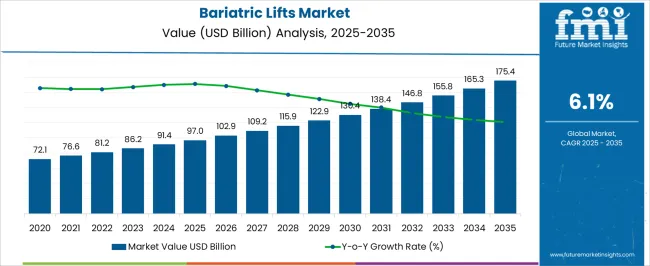
The absolute dollar opportunity of approximately USD 83.13 billion over the forecast period reflects the dual expansion of institutional healthcare facility procurement and home healthcare equipment adoption for post-bariatric surgery recovery and chronic obesity care management. Ceiling-mounted bariatric track systems are displacing mobile floor lifts in new hospital construction by eliminating floor space requirements and reducing single-caregiver lift operation risk. Smart lift systems with integrated weight monitoring and patient movement tracking are creating a premium product tier that serves both safe handling compliance and clinical data collection requirements.
Summary of Bariatric Lifts Market
- Bariatric Lifts Market Definition
- Bariatric lifts are powered patient handling devices rated for 500-lb and 1000-lb capacities, encompassing ceiling track, mobile floor, sit-to-stand, and lateral transfer systems for hospital, clinic, and home healthcare bariatric patient mobilization.
- Demand Drivers in the Market
- Rising global obesity prevalence is expanding the bariatric patient population requiring specialized handling equipment across acute care, rehabilitation, and long-term care facilities, generating procurement volumes proportional to obesity rate growth.
- Occupational safety regulations mandating mechanical patient handling to prevent caregiver musculoskeletal injuries are converting bariatric lift installation from a facility amenity to a compliance requirement in healthcare settings.
- Ceiling-mounted bariatric track systems displacing mobile floor lifts in new hospital construction eliminate floor space constraints and enable single-caregiver operation, commanding premium per-room installation values.
- Key Segments Analyzed in the FMI Report
- 1000-lbs by Type: 57.8% share in 2026, reflecting the growing proportion of super-obese patients requiring higher-capacity lift systems and the healthcare facility preference for specifying maximum capacity equipment that serves all bariatric weight categories.
- Hospital Use by Application: 42.9% share in 2026, as acute care and surgical recovery units generate the highest concentration of bariatric patient handling events requiring powered lift assistance per facility.
- China: 8.2% compound growth driven by hospital infrastructure expansion and rising obesity prevalence generating bariatric care facility equipment investment.
- Analyst Opinion at FMI
- Sabyasachi Ghosh, Principal Consultant for Healthcare, opines, The bariatric lifts market is transitioning from a specialty equipment niche to a standard healthcare infrastructure category as obesity prevalence rates push bariatric patient handling from occasional accommodation to routine operational requirement. Facilities that delay bariatric lift installation face compounding caregiver injury costs and regulatory non-compliance penalties that exceed equipment investment thresholds. The critical procurement risk centers on ceiling structural capacity verification, as retrofit ceiling track installations in existing facilities require engineering assessments that extend project timelines and add installation costs beyond the lift system purchase price.
- Strategic Implications / Executive Takeaways
- Hospital facility planners must specify bariatric-rated ceiling track infrastructure in all new construction designs to avoid costly structural retrofit requirements when bariatric lift installations become mandatory compliance items.
- Bariatric lift manufacturers must develop smart lift platforms integrating weight monitoring and movement tracking to capture the premium pricing tier serving both safe handling compliance and clinical data collection.
- Home healthcare equipment providers must expand bariatric lift rental programmes to serve the growing post-surgery recovery and chronic care management population requiring temporary high-capacity patient handling at home.
Bariatric Lifts Market Key Takeaways
| Metric | Details |
|---|---|
| Industry Size (2026) | USD 102.92 Billion |
| Industry Value (2036) | USD 186.05 Billion |
| CAGR (2026-2036) | 6.10% |
Source: Future Market Insights, 2026
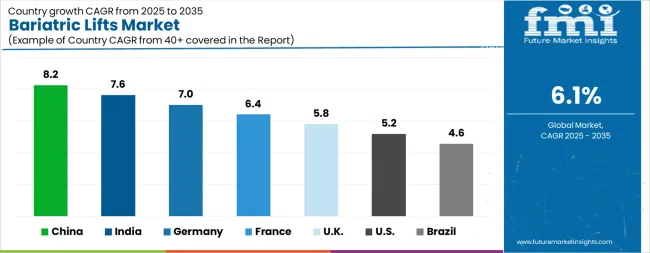
China sets the pace at an 8.2% CAGR, driven by hospital infrastructure expansion programmes and rising obesity prevalence generating bariatric care facility investment. India follows at 7.6% as tertiary hospital modernization and medical tourism infrastructure upgrades mandate bariatric-rated patient handling equipment. Germany registers 7.0% growth under occupational health regulations and established rehabilitation facility networks requiring bariatric lift fleet renewal. France maintains 6.4% supported by hospital modernization programme equipment procurement allocations. UK expands at 5.8% anchored by NHS patient safety framework compliance and bariatric care pathway infrastructure investment. USA tracks at 5.2% driven by the largest bariatric surgery volume base and CMS patient safety condition of participation compliance. Brazil registers 4.6% with SUS hospital equipment modernization and growing bariatric surgery programme expansion.
Bariatric Lifts Market Definition
Bariatric lifts are mechanically or electrically powered patient handling devices engineered to safely transfer, reposition, and mobilize patients exceeding standard weight capacity thresholds, typically rated for 500-lb and 1000-lb capacities. These systems encompass ceiling-mounted track lifts, mobile floor lifts, sit-to-stand lifts, and lateral transfer devices designed for hospital, clinic, rehabilitation, and home care environments serving bariatric patient populations.
Bariatric Lifts Market Inclusions
Market scope includes ceiling-mounted bariatric track lift systems, mobile floor bariatric lifts, bariatric sit-to-stand devices, lateral transfer systems, and smart lift platforms with integrated patient monitoring. Coverage spans hospital acute care, rehabilitation, long-term care, clinic, and home healthcare applications across 500-lb and 1000-lb weight capacity categories.
Bariatric Lifts Market Exclusions
Standard-capacity patient lifts rated below 500 lbs, bariatric beds and mattresses, bariatric wheelchairs, and surgical table positioning systems are excluded. Lift sling accessories sold separately from lift systems fall outside analytical parameters.
Bariatric Lifts Market Research Methodology
- Primary Research: Analysts engaged with hospital facilities management directors, patient safety programme coordinators, and bariatric equipment distributor sales managers to map procurement triggers for bariatric lift system specification and installation.
- Desk Research: Data collection phases aggregated hospital construction programme equipment specifications, occupational safety regulation compliance timelines, and bariatric surgery volume growth statistics from national health registries.
- Market-Sizing and Forecasting: Baseline values derive from a bottom-up aggregation of bariatric lift system unit installations multiplied by average system prices across type and application categories, applying region-specific obesity prevalence and healthcare infrastructure growth curves.
- Data Validation and Update Cycle: Projections are tested against publicly reported patient handling equipment segment revenues from leading medical device manufacturers and healthcare facility equipment distributors.
Why is the Bariatric Lifts Market Growing?
The bariatric lifts market is experiencing steady expansion, supported by the increasing prevalence of obesity-related conditions and the growing need for safe and efficient patient handling solutions in healthcare facilities. Rising global obesity rates are creating higher demand for specialized equipment designed to accommodate patients with limited mobility and greater body weight. Hospitals, rehabilitation centers, and long-term care facilities are prioritizing bariatric lifts to reduce the risk of caregiver injuries and improve patient comfort.
Technological innovations in lift design, including electric and hydraulic systems, enhanced safety features, and ergonomic operation, are further driving adoption. Healthcare providers are also investing in bariatric equipment as part of efforts to comply with safety regulations and improve quality of care standards.
The growing focus on improving efficiency in patient transfers and mobility assistance is influencing procurement decisions across healthcare systems worldwide As healthcare infrastructure expands and patient-centric care models evolve, the market is positioned for long-term growth, with opportunities emerging in both developed and emerging economies.
Segmental Analysis
The bariatric lifts market is segmented by type, application, and geographic regions. By type, bariatric lifts market is divided into 1000-lbs and 500-lbs. In terms of application, bariatric lifts market is classified into Hospital Use, Clinic Use, and Household. Regionally, the bariatric lifts industry is classified into North America, Latin America, Western Europe, Eastern Europe, Balkan & Baltic Countries, Russia & Belarus, Central Asia, East Asia, South Asia & Pacific, and the Middle East & Africa.
Insights into the 1000-lbs Type Segment
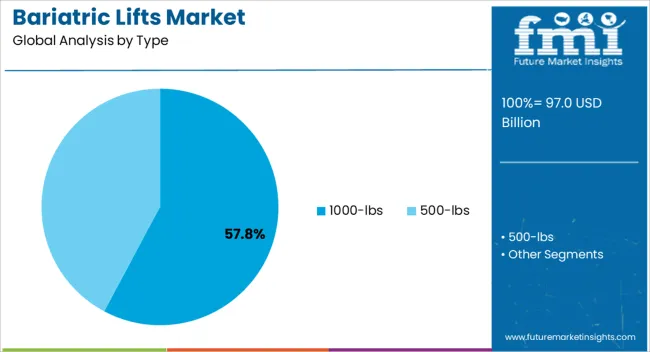
The 1000-lbs type segment is projected to account for 57.8% of the bariatric lifts market revenue share in 2026, making it the leading product type. This dominance is being driven by the increasing number of patients requiring equipment that can handle higher weight capacities safely and reliably. The segment’s growth is also being reinforced by its ability to reduce strain on healthcare workers, ensuring compliance with occupational safety standards.
Hospitals and long-term care facilities are prioritizing 1000-lbs lifts due to their durability, stability, and capacity to handle complex transfer needs in bariatric patient care. Advances in design have enabled smoother operation, improved maneuverability, and integration of electronic controls, making them more user-friendly for caregivers.
The strong adoption of this type is further supported by cost-efficiency over time, as it reduces workplace injuries and minimizes replacement frequency As obesity prevalence continues to rise and patient care requirements become more complex, the 1000-lbs segment is expected to maintain its leadership, offering a reliable and scalable solution for healthcare providers.
Insights into the Hospital Use Application Segment
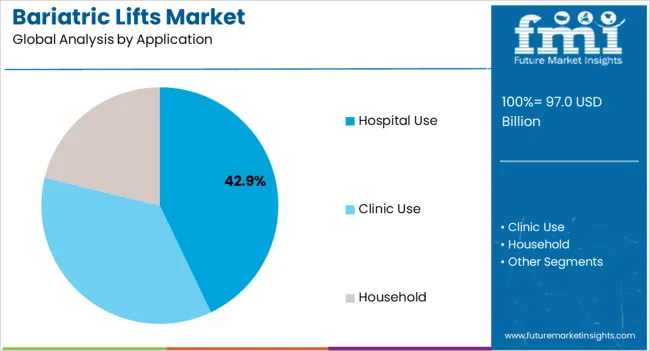
The hospital use segment is anticipated to represent 42.9% of the bariatric lifts market revenue share in 2026, establishing itself as the leading application area. Hospitals are increasingly adopting bariatric lifts to improve patient handling efficiency and to address safety concerns for both patients and staff. The ability to safely transfer patients with higher body weights without causing musculoskeletal strain to caregivers is a key factor driving adoption.
Hospitals are also expanding their bariatric care units to meet rising patient demand, which is fueling the procurement of advanced lifting equipment. The use of bariatric lifts in hospital environments is further reinforced by their role in improving patient dignity, reducing the risk of falls, and ensuring compliance with healthcare safety standards.
Continuous technological improvements, such as motorized controls, adjustable frames, and integrated monitoring systems, are enhancing the efficiency and comfort of hospital-based lifts With rising patient admissions, stricter safety regulations, and growing focus on staff welfare, hospital use is expected to remain the leading application segment in the bariatric lifts market.
Analysis of Bariatric Lifts Market By Key Countries
.webp "Top Country Growth Comparison Bariatric Lifts Market Cagr (2026 2036)")
| Country | CAGR |
|---|---|
| China | 8.2% |
| India | 7.6% |
| Germany | 7.0% |
| France | 6.4% |
| UK | 5.8% |
| USA | 5.2% |
| Brazil | 4.6% |
Source: FMI analysis based on primary research and proprietary forecasting model
Country-wise Analysis
The Bariatric Lifts Market is expected to register a CAGR of 6.1% during the forecast period, exhibiting varied country level momentum. China leads with the highest CAGR of 8.2%, followed by India at 7.6%. Developed markets such as Germany, France, and the UK continue to expand steadily, while the USA is likely to grow at consistent rates. Brazil posts the lowest CAGR at 4.6%, yet still underscores a broadly positive trajectory for the global Bariatric Lifts Market. In 2024, Germany held a dominant revenue in the Western Europe market and is expected to grow with a CAGR of 7.0%. The USA Bariatric Lifts Market is estimated to be valued at USD 33.2 billion in 2026 and is anticipated to reach a valuation of USD 55.0 billion by 2036. Sales are projected to rise at a CAGR of 5.2% over the forecast period between 2026 and 2036. While Japan and South Korea markets are estimated to be valued at USD 5.2 billion and USD 2.6 billion respectively in 2026.
Key Players in the Bariatric Lifts Market
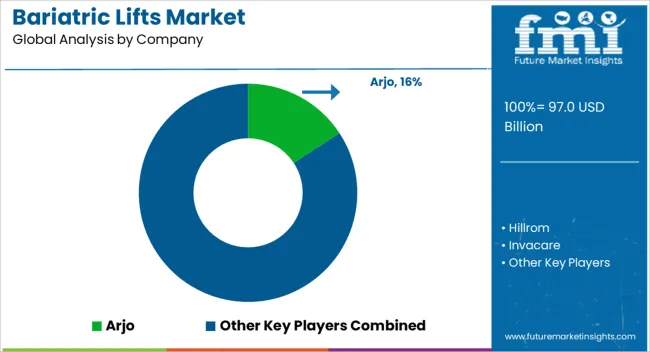
- Arjo
- Hillrom
- Invacare
- Handicare
- VANCARE
- Joerns Healthcare
- GAINSBOROUGH
- Prism Medical
- Hengyi
- Guldmann
Scope of the Report
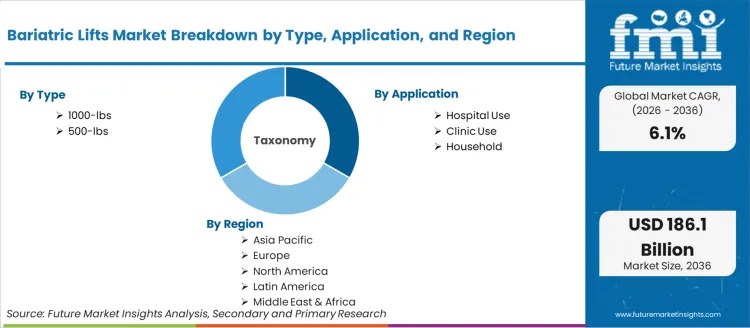
| Metric | Value |
|---|---|
| Quantitative Units | USD 102.92 Billion to USD 186.05 Billion, at a CAGR of 6.10% |
| Market Definition | Bariatric lifts are powered patient handling devices rated for 500-lb and 1000-lb capacities, encompassing ceiling track, mobile floor, sit-to-stand, and lateral transfer systems for hospital, clinic, and home healthcare bariatric patient mobilization. |
| Segmentation | Type: 1000-lbs and 500-lbs; Application: Hospital Use, Clinic Use, and Household |
| Regions Covered | North America, Latin America, Europe, East Asia, South Asia, Oceania, Middle East & Africa |
| Countries Covered | China, India, Germany, France, UK, USA, Brazil, and 40 plus countries |
| Key Companies Profiled | Arjo, Hillrom, Invacare, Handicare, VANCARE, Joerns Healthcare, GAINSBOROUGH, Prism Medical, Hengyi, Guldmann |
| Forecast Period | 2026 to 2036 |
| Approach | Forecasting models apply a bottom-up methodology starting with installed base metrics and projecting conversion rates to technology adoption. |
Bariatric Lifts Market by Segments
Type:
- 1000-lbs
- 500-lbs
Application:
- Hospital Use
- Clinic Use
- Household
Region:
- North America
- USA
- Canada
- Mexico
- Latin America
- Brazil
- Chile
- Rest of Latin America
- Western Europe
- Germany
- UK
- Italy
- Spain
- France
- Nordic
- BENELUX
- Rest of Western Europe
- Eastern Europe
- Russia
- Poland
- Hungary
- Balkan & Baltic
- Rest of Eastern Europe
- East Asia
- China
- Japan
- South Korea
- South Asia and Pacific
- India
- ASEAN
- Australia & New Zealand
- Rest of South Asia and Pacific
- Middle East & Africa
- Kingdom of Saudi Arabia
- Other GCC Countries
- Turkiye
- South Africa
- Other African Union
- Rest of Middle East & Africa
Bibliography
- 1. World Health Organization. (2024). Global Obesity Observatory: Prevalence Trends and Health System Impact Assessment. WHO.
- 2. Occupational Safety and Health Administration. (2024). Safe Patient Handling Programme: Healthcare Worker Injury Prevention Guidelines. OSHA.
- 3. National Health Service England. (2024). Patient Safety Framework: Bariatric Care Pathway Equipment Standards. NHS.
- 4. International Federation for the Surgery of Obesity. (2024). Global Bariatric Surgery Registry: Annual Procedure Volume Report. IFSO.
- 5. European Agency for Safety and Health at Work. (2024). Healthcare Sector Musculoskeletal Disorder Prevention: Patient Handling Equipment Guidelines. EU-OSHA.
- 6. National Bureau of Statistics of China. (2024). China Health Statistical Yearbook: Obesity Prevalence and Hospital Infrastructure Data. NBS.
This bibliography is provided for reader reference. The full FMI report contains the complete reference list with primary research documentation.
Frequently Asked Questions
How large is the demand for Bariatric Lifts in the global market in 2026?
Demand for bariatric lifts in the global market is estimated to be valued at USD 102.92 billion in 2026.
What will be the market size by 2036?
Market size for bariatric lifts is projected to reach USD 186.05 billion by 2036.
What is the expected CAGR between 2026 and 2036?
Demand is expected to grow at a CAGR of 6.10% between 2026 and 2036.
Which Type is poised to lead global sales by 2026?
1000-lbs accounts for 57.8% share in 2026 as facilities specify maximum capacity equipment serving all bariatric weight categories.
How is Hospital Use positioned as an Application in 2026?
Hospital Use represents 42.9% share in 2026, generating the highest concentration of bariatric handling events per facility.
What is driving demand in China?
Hospital infrastructure expansion and rising obesity prevalence fuel the fastest growth at 8.2% CAGR through 2036.
What is included in the scope of this report?
The market covers ceiling track lifts, mobile floor lifts, sit-to-stand devices, lateral transfer systems, and smart lift platforms across hospital, clinic, and home care applications.
What is excluded from the scope of this report?
Standard-capacity lifts under 500 lbs, bariatric beds, wheelchairs, surgical tables, and separately sold lift sling accessories are excluded.
Preview the report firsthand - request a free sample
Get SampleGet the brochure for pricing and purchase details.
Get PDFTable of Content
- Executive Summary
- Global Market Outlook
- Demand-side Trends
- Supply-side Trends
- Technology Roadmap Analysis
- Analysis and Recommendations
- Market Overview
- Market Coverage / Taxonomy
- Market Definition / Scope / Limitations
- Research Methodology
- Chapter Orientation
- Analytical Lens and Working Hypotheses
- Market Structure, Signals, and Trend Drivers
- Benchmarking and Cross-market Comparability
- Market Sizing, Forecasting, and Opportunity Mapping
- Research Design and Evidence Framework
- Desk Research Programme (Secondary Evidence)
- Company Annual and Sustainability Reports
- Peer-reviewed Journals and Academic Literature
- Corporate Websites, Product Literature, and Technical Notes
- Earnings Decks and Investor Briefings
- Statutory Filings and Regulatory Disclosures
- Technical White Papers and Standards Notes
- Trade Journals, Industry Magazines, and Analyst Briefs
- Conference Proceedings, Webinars, and Seminar Materials
- Government Statistics Portals and Public Data Releases
- Press Releases and Reputable Media Coverage
- Specialist Newsletters and Curated Briefings
- Sector Databases and Reference Repositories
- FMI Internal Proprietary Databases and Historical Market Datasets
- Subscription Datasets and Paid Sources
- Social Channels, Communities, and Digital Listening Inputs
- Additional Desk Sources
- Expert Input and Fieldwork (Primary Evidence)
- Primary Modes
- Qualitative Interviews and Expert Elicitation
- Quantitative Surveys and Structured Data Capture
- Blended Approach
- Why Primary Evidence is Used
- Field Techniques
- Interviews
- Surveys
- Focus Groups
- Observational and In-context Research
- Social and Community Interactions
- Stakeholder Universe Engaged
- C-suite Leaders
- Board Members
- Presidents and Vice Presidents
- R&D and Innovation Heads
- Technical Specialists
- Domain Subject-matter Experts
- Scientists
- Physicians and Other Healthcare Professionals
- Governance, Ethics, and Data Stewardship
- Research Ethics
- Data Integrity and Handling
- Primary Modes
- Tooling, Models, and Reference Databases
- Desk Research Programme (Secondary Evidence)
- Data Engineering and Model Build
- Data Acquisition and Ingestion
- Cleaning, Normalisation, and Verification
- Synthesis, Triangulation, and Analysis
- Quality Assurance and Audit Trail
- Market Background
- Market Dynamics
- Drivers
- Restraints
- Opportunity
- Trends
- Scenario Forecast
- Demand in Optimistic Scenario
- Demand in Likely Scenario
- Demand in Conservative Scenario
- Opportunity Map Analysis
- Product Life Cycle Analysis
- Supply Chain Analysis
- Investment Feasibility Matrix
- Value Chain Analysis
- PESTLE and Porter’s Analysis
- Regulatory Landscape
- Regional Parent Market Outlook
- Production and Consumption Statistics
- Import and Export Statistics
- Market Dynamics
- Global Market Analysis 2021 to 2025 and Forecast, 2026 to 2036
- Historical Market Size Value (USD Million) Analysis, 2021 to 2025
- Current and Future Market Size Value (USD Million) Projections, 2026 to 2036
- Y-o-Y Growth Trend Analysis
- Absolute $ Opportunity Analysis
- Global Market Pricing Analysis 2021 to 2025 and Forecast 2026 to 2036
- Global Market Analysis 2021 to 2025 and Forecast 2026 to 2036, By Type
- Introduction / Key Findings
- Historical Market Size Value (USD Million) Analysis By Type , 2021 to 2025
- Current and Future Market Size Value (USD Million) Analysis and Forecast By Type , 2026 to 2036
- 1000-lbs
- 500-lbs
- 1000-lbs
- Y-o-Y Growth Trend Analysis By Type , 2021 to 2025
- Absolute $ Opportunity Analysis By Type , 2026 to 2036
- Global Market Analysis 2021 to 2025 and Forecast 2026 to 2036, By Application
- Introduction / Key Findings
- Historical Market Size Value (USD Million) Analysis By Application, 2021 to 2025
- Current and Future Market Size Value (USD Million) Analysis and Forecast By Application, 2026 to 2036
- Hospital Use
- Clinic Use
- Household
- Hospital Use
- Y-o-Y Growth Trend Analysis By Application, 2021 to 2025
- Absolute $ Opportunity Analysis By Application, 2026 to 2036
- Global Market Analysis 2021 to 2025 and Forecast 2026 to 2036, By Region
- Introduction
- Historical Market Size Value (USD Million) Analysis By Region, 2021 to 2025
- Current Market Size Value (USD Million) Analysis and Forecast By Region, 2026 to 2036
- North America
- Latin America
- Western Europe
- Eastern Europe
- East Asia
- South Asia and Pacific
- Middle East & Africa
- Market Attractiveness Analysis By Region
- North America Market Analysis 2021 to 2025 and Forecast 2026 to 2036, By Country
- Historical Market Size Value (USD Million) Trend Analysis By Market Taxonomy, 2021 to 2025
- Market Size Value (USD Million) Forecast By Market Taxonomy, 2026 to 2036
- By Country
- USA
- Canada
- Mexico
- By Type
- By Application
- By Country
- Market Attractiveness Analysis
- By Country
- By Type
- By Application
- Key Takeaways
- Latin America Market Analysis 2021 to 2025 and Forecast 2026 to 2036, By Country
- Historical Market Size Value (USD Million) Trend Analysis By Market Taxonomy, 2021 to 2025
- Market Size Value (USD Million) Forecast By Market Taxonomy, 2026 to 2036
- By Country
- Brazil
- Chile
- Rest of Latin America
- By Type
- By Application
- By Country
- Market Attractiveness Analysis
- By Country
- By Type
- By Application
- Key Takeaways
- Western Europe Market Analysis 2021 to 2025 and Forecast 2026 to 2036, By Country
- Historical Market Size Value (USD Million) Trend Analysis By Market Taxonomy, 2021 to 2025
- Market Size Value (USD Million) Forecast By Market Taxonomy, 2026 to 2036
- By Country
- Germany
- UK
- Italy
- Spain
- France
- Nordic
- BENELUX
- Rest of Western Europe
- By Type
- By Application
- By Country
- Market Attractiveness Analysis
- By Country
- By Type
- By Application
- Key Takeaways
- Eastern Europe Market Analysis 2021 to 2025 and Forecast 2026 to 2036, By Country
- Historical Market Size Value (USD Million) Trend Analysis By Market Taxonomy, 2021 to 2025
- Market Size Value (USD Million) Forecast By Market Taxonomy, 2026 to 2036
- By Country
- Russia
- Poland
- Hungary
- Balkan & Baltic
- Rest of Eastern Europe
- By Type
- By Application
- By Country
- Market Attractiveness Analysis
- By Country
- By Type
- By Application
- Key Takeaways
- East Asia Market Analysis 2021 to 2025 and Forecast 2026 to 2036, By Country
- Historical Market Size Value (USD Million) Trend Analysis By Market Taxonomy, 2021 to 2025
- Market Size Value (USD Million) Forecast By Market Taxonomy, 2026 to 2036
- By Country
- China
- Japan
- South Korea
- By Type
- By Application
- By Country
- Market Attractiveness Analysis
- By Country
- By Type
- By Application
- Key Takeaways
- South Asia and Pacific Market Analysis 2021 to 2025 and Forecast 2026 to 2036, By Country
- Historical Market Size Value (USD Million) Trend Analysis By Market Taxonomy, 2021 to 2025
- Market Size Value (USD Million) Forecast By Market Taxonomy, 2026 to 2036
- By Country
- India
- ASEAN
- Australia & New Zealand
- Rest of South Asia and Pacific
- By Type
- By Application
- By Country
- Market Attractiveness Analysis
- By Country
- By Type
- By Application
- Key Takeaways
- Middle East & Africa Market Analysis 2021 to 2025 and Forecast 2026 to 2036, By Country
- Historical Market Size Value (USD Million) Trend Analysis By Market Taxonomy, 2021 to 2025
- Market Size Value (USD Million) Forecast By Market Taxonomy, 2026 to 2036
- By Country
- Kingdom of Saudi Arabia
- Other GCC Countries
- Turkiye
- South Africa
- Other African Union
- Rest of Middle East & Africa
- By Type
- By Application
- By Country
- Market Attractiveness Analysis
- By Country
- By Type
- By Application
- Key Takeaways
- Key Countries Market Analysis
- USA
- Pricing Analysis
- Market Share Analysis, 2025
- By Type
- By Application
- Canada
- Pricing Analysis
- Market Share Analysis, 2025
- By Type
- By Application
- Mexico
- Pricing Analysis
- Market Share Analysis, 2025
- By Type
- By Application
- Brazil
- Pricing Analysis
- Market Share Analysis, 2025
- By Type
- By Application
- Chile
- Pricing Analysis
- Market Share Analysis, 2025
- By Type
- By Application
- Germany
- Pricing Analysis
- Market Share Analysis, 2025
- By Type
- By Application
- UK
- Pricing Analysis
- Market Share Analysis, 2025
- By Type
- By Application
- Italy
- Pricing Analysis
- Market Share Analysis, 2025
- By Type
- By Application
- Spain
- Pricing Analysis
- Market Share Analysis, 2025
- By Type
- By Application
- France
- Pricing Analysis
- Market Share Analysis, 2025
- By Type
- By Application
- India
- Pricing Analysis
- Market Share Analysis, 2025
- By Type
- By Application
- ASEAN
- Pricing Analysis
- Market Share Analysis, 2025
- By Type
- By Application
- Australia & New Zealand
- Pricing Analysis
- Market Share Analysis, 2025
- By Type
- By Application
- China
- Pricing Analysis
- Market Share Analysis, 2025
- By Type
- By Application
- Japan
- Pricing Analysis
- Market Share Analysis, 2025
- By Type
- By Application
- South Korea
- Pricing Analysis
- Market Share Analysis, 2025
- By Type
- By Application
- Russia
- Pricing Analysis
- Market Share Analysis, 2025
- By Type
- By Application
- Poland
- Pricing Analysis
- Market Share Analysis, 2025
- By Type
- By Application
- Hungary
- Pricing Analysis
- Market Share Analysis, 2025
- By Type
- By Application
- Kingdom of Saudi Arabia
- Pricing Analysis
- Market Share Analysis, 2025
- By Type
- By Application
- Turkiye
- Pricing Analysis
- Market Share Analysis, 2025
- By Type
- By Application
- South Africa
- Pricing Analysis
- Market Share Analysis, 2025
- By Type
- By Application
- USA
- Market Structure Analysis
- Competition Dashboard
- Competition Benchmarking
- Market Share Analysis of Top Players
- By Regional
- By Type
- By Application
- Competition Analysis
- Competition Deep Dive
- Arjo
- Overview
- Product Portfolio
- Profitability by Market Segments (Product/Age /Sales Channel/Region)
- Sales Footprint
- Strategy Overview
- Marketing Strategy
- Product Strategy
- Channel Strategy
- Hillrom
- Invacare
- Handicare
- VANCARE
- Joerns Healthcare
- GAINSBOROUGH
- Prism Medical
- Hengyi
- Guldmann
- Arjo
- Competition Deep Dive
- Assumptions & Acronyms Used


