

- Market Size (2026)
- USD 510.0 Mn
- Forecast (2036)
- USD 1841.5 Mn
- CAGR (2026 to 2036)
- 13.7%
How big is the battery electrode coating vision inspection market in 2026?
USD 510.0 million in 2026 and USD 1,841.5 million by 2036 at a 13.7% CAGR.
The battery electrode coating vision inspection industry value is forecast to increase from USD 448.5 million in 2025 to USD 1,841.5 million by 2036 at 13.7% CAGR as battery plants move coating checks closer to wet coating, drying, calendaring, and slitting operations. Inline deployment is forecast to represent 68.0% share in 2026 as production teams need immediate reject decisions before downstream conversion cost is added. Cathode coating is expected to hold 57.5% share in 2026 because cathode surface defects carry higher material value and stronger release-control pressure than several other electrode checks.
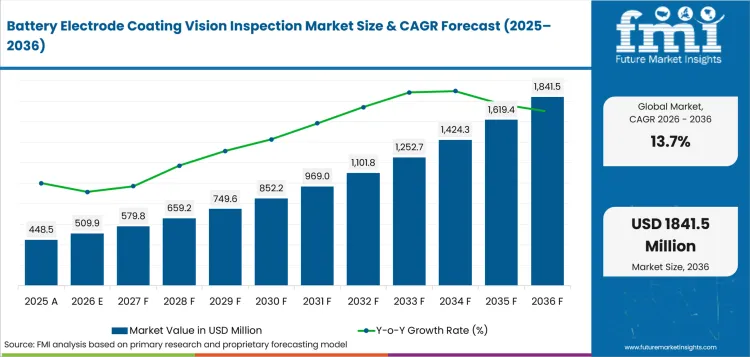
Battery Electrode Coating Vision Inspection Market Overview: Size and Forecast
- 2026 Market Size: USD 510.0 million
- 2036 Market Size: USD 1,841.5 million
- Forecast CAGR: 13.7% from 2026 to 2036
- Leading Deployment: Inline
- Inline Share in 2026: 68.0%
- Leading Electrode Type: Cathode Coating
- Cathode Coating Share in 2026: 57.5%
- • Fastest-growing Country: China
- China CAGR: 15.2% by 2036
Summary of the Battery Electrode Coating Vision Inspection Market
- Demand and Growth Drivers
- Battery plants are shifting from sample-based review toward continuous web inspection during coating and drying.
- High-speed line-scan systems are gaining attention as electrode web width and coating throughput increase together.
- Defect traceability is becoming a purchasing requirement when cell makers connect roll position, slurry batch, and coating recipe records.
- Product and Segment View
- Inline systems are forecast to represent 68.0% share in 2026 as operators need production-speed rejection before more process value is added.
- Cathode coating is projected to hold 57.5% share in 2026, led by higher active-material value and stronger downstream safety screening.
- Automotive end use is expected to account for 54.0% share in 2026 as EV cell makers demand repeatable coating evidence for customer audits.
- Geography and Competitive Outlook
- China is projected to record 15.2% CAGR by 2036, backed by high cell production density and repeated inspection package demand.
- India is expected to expand at 14.8% CAGR by 2036 through new battery plant setup and domestic capacity programs.
- Cognex and Keyence compete through application-ready inspection systems and broad factory automation reach.
- Basler, Teledyne DALSA, Omron, Zebra Technologies, and SICK focus on camera speed, lighting compatibility, software depth, and integration support.
- Competitive advantage is shaped by line-speed imaging, low false-reject tuning, stable lighting, and defect records tied to battery manufacturing execution systems.
- Analyst Opinion
- Nikhil Kaitwade, Principal Consultant at Future Market Insights for industrial domain, says, “Battery electrode coating vision inspection is now a quality economics decision. A coating defect is cheaper to stop at the web stage than after formation, ageing, or pack assembly. Suppliers should not sell cameras alone. They need proof that optics, lighting, software, encoders, and plant data links can work at coating speed. Buyers will reward vendors that reduce false rejects while keeping pinholes, streaks, agglomerates, edge beads, and missing coating visible. The strongest suppliers will connect defect images to roll position and process recipes, giving plant teams a faster way to protect yield and prove containment.”
Quality control is becoming a release-critical investment area as battery manufacturing scale rises. The International Energy Agency stated in May 2026 that global lithium-ion battery nameplate manufacturing capacity passed 4 TWh by the end of 2025, which was roughly 30% higher than in 2024. The same IEA battery analysis reported EV battery deployment of 1.2 TWh in 2025, up almost 30% from 2024 and more than seven times the 2020 level. U.S. Department of Energy critical materials reporting in June 2026 noted more than USD 3.0 billion selected for 25 projects across 14 states to boost domestic advanced battery and material production. These figures point to wider coating-web volume, stricter yield economics, and stronger buying interest in fast line-scan cameras, lighting control, frame grabbers, and software-based defect classification.
The battery electrode coating vision inspection market is expected to advance through 2036 as cell producers increase inline inspection depth across high-speed coating lines. Market expansion is supported by battery capacity additions, automated release control, and tighter traceability expectations from automotive and energy-storage buyers.
Which factors support expansion in the battery electrode coating vision inspection market?
Inline coating inspection revenue is supported by complete camera, lighting, software, integration, and service packages across high-speed electrode production lines.
- Market value is supported by industrial cameras and line-scan sensors before lighting and frame grabbers add further system value.
- Supplier pricing reflects inspection width, web speed, defect-library depth, and the number of camera stations placed around the coating line.
- Revenue improves when cell makers copy validated inspection packages across multiple coating lines inside one gigafactory.
- Service income rises as recipe setup, recalibration, operator training, and software tuning become recurring requirements across multi-shift plants.
Why is the battery electrode coating vision inspection market growing?
Battery producers are moving coating inspection upstream as defect escapes become more expensive after drying, calendaring, slitting, and cell assembly.
Demand is supported by larger battery output and stricter manufacturing evidence. The IEA reported in May 2026 that electric car sales exceeded 20 million in 2025 and reached 25% of global car sales. This raises the commercial cost of every coating escape because more battery cells must meet automotive validation, customer audits, and warranty expectations. Inline vision systems help plant teams classify pinholes, bubbles, streaks, particles, and coating-width deviation while the web is still traceable to roll position. Buyers are also asking for image records that can be reviewed alongside recipe and batch data. As a result, high-speed cameras, dark-surface lighting, and defect-classification software are moving from optional quality tools into core coating-line equipment.
How is the battery electrode coating vision inspection market segmented?
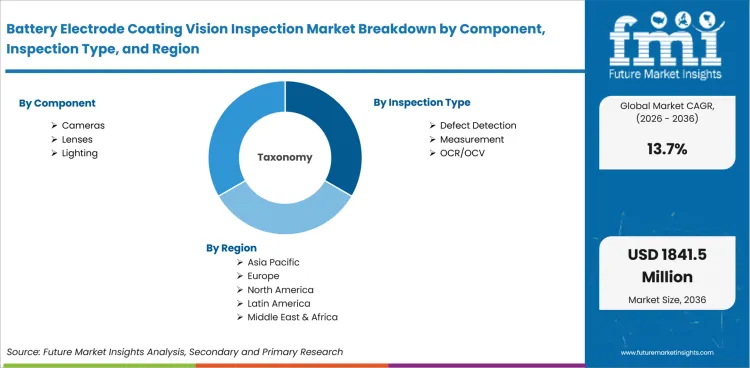
The battery electrode coating vision inspection industry is segmented by component, inspection type, deployment, end-use industry, electrode type, and region.
- Cameras are projected to account for 34.0% share in 2026, supported by line-scan imaging requirements that set the resolution floor for moving electrode webs.
- Defect detection is forecast to hold 46.0% share in 2026 as pinholes, streaks, bubbles, and agglomerates create direct rejection and warranty exposure.
- Inline systems are projected to secure 68.0% share in 2026, led by production teams placing inspection before calendaring and slitting increases rejected-material cost.
- Automotive end use is expected to capture 54.0% share in 2026 due to EV battery programs requiring traceable coating release records across batch and roll history.
- Cathode coating is anticipated to hold 57.5% share in 2026 as cathode active material value and safety review requirements make surface evidence more commercially important.
Why do cameras dominate the battery electrode coating vision inspection market?
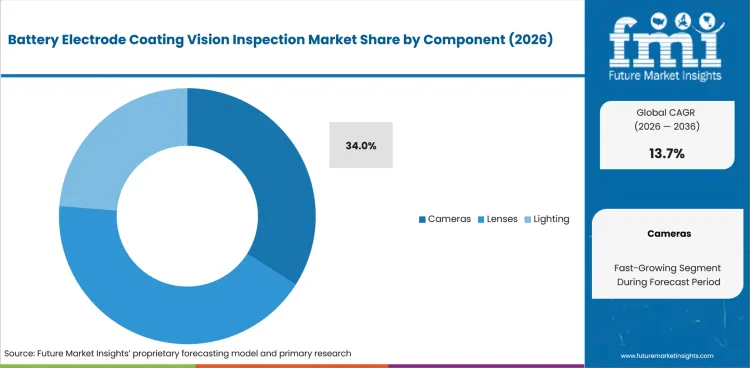
- Cameras are projected to account for 34.0% share in 2026, supported by line-scan imaging requirements that set the resolution floor for moving electrode webs.
- Lighting, lenses, and frame grabbers gain value around the camera decision as dark cathode and anode surfaces need stable contrast across long coating runs.
- Which inspection type leads the battery electrode coating vision inspection market?
- Defect detection is forecast to hold 46.0% share in 2026 as pinholes, streaks, bubbles, and agglomerates create direct rejection and warranty exposure.
- Measurement and OCR/OCV functions remain important, although buyers usually justify first spending through clear defect containment at coating speed.
Which deployment mode leads the battery electrode coating vision inspection market?
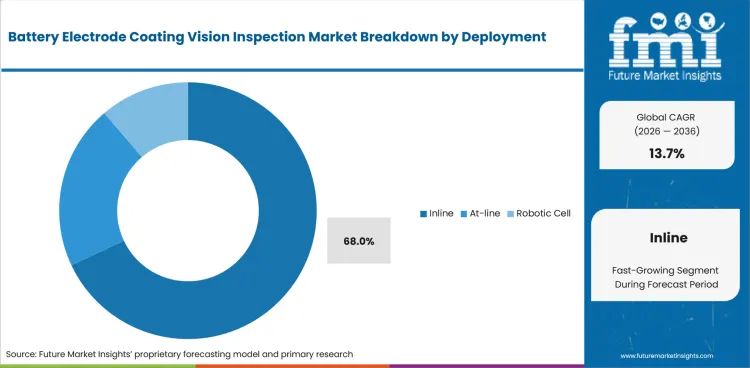
- Inline systems are anticipated to hold 68.0% share in 2026 through immediate production feedback and defect location records tied to web position.
- At-line and portable checks support process learning, while inline stations win serial-production budgets due to faster reject decisions and better traceability.
Which end-use industry leads the battery electrode coating vision inspection market?
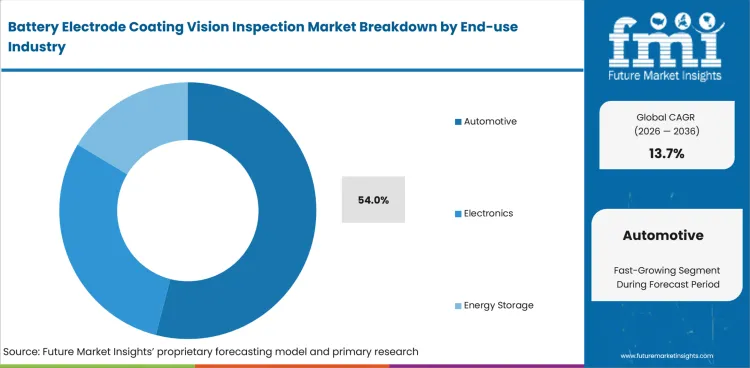
- Automotive is projected to represent 54.0% share in 2026, reflected by EV cell makers demanding repeatable coating evidence for qualification and audits.
- Electronics and energy-storage applications add steady demand when smaller cells or stationary battery projects require validated inspection before scale-up.
Which electrode type leads the battery electrode coating vision inspection market?
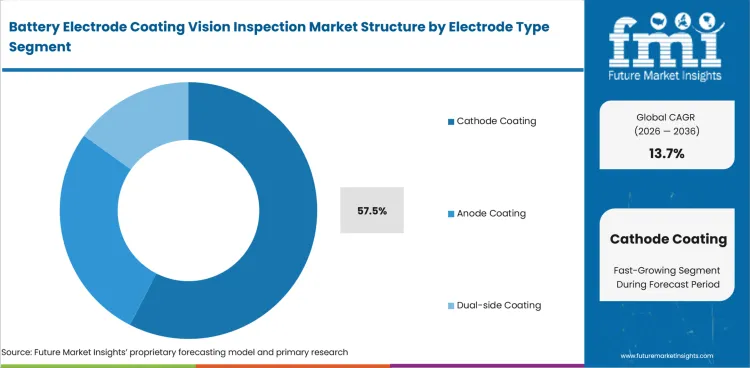
- Cathode coating is expected to secure 57.5% share in 2026 as high material cost and safety screening needs raise inspection intensity on cathode webs.
- Anode coating inspection expands with silicon blends and graphite surface changes, making defect libraries and lighting recipes more important over time.
What are the drivers, restraints, and opportunities in the battery electrode coating vision inspection market?
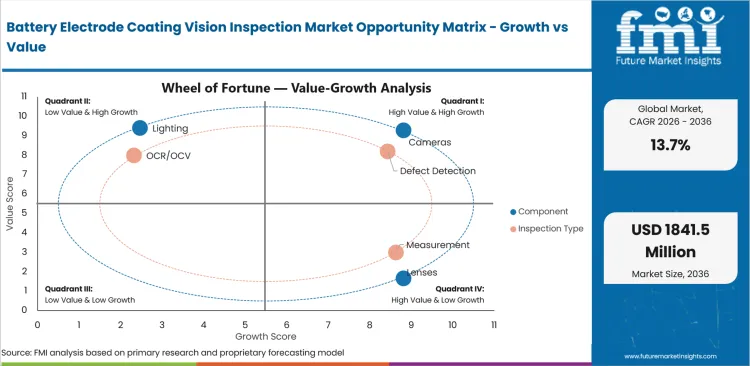
Wider coating webs and traceable release controls support adoption, while dark electrode surfaces and tuning cost limit easy deployment.
- Driver: wider electrode webs require faster cameras and synchronized line-scan systems to keep inspection matched with coating throughput.
- Restraint: dark coated surfaces and reflective foil edges make lighting setup difficult and can increase false rejects.
- Opportunity: AI classification can reduce overkill when it separates true coating faults from harmless surface variation.
Web-Speed Defect Capture
Coating-line speed is the first technical gate for this market. A vision system that cannot match web motion either misses small defects or forces a slower line. Teledyne DALSA introduced the Linea HS2 TDI family in September 2024 with 16k resolution and a 1 MHz line rate. This specification shows why fast web inspection increasingly needs cameras built for low-light and high-data-rate conditions. Suppliers with proven line-scan capture and stable frame-grabber integration are better placed for large battery plants.
Dark-Surface False Reject Control
False rejects restrain adoption when black active material, shiny foil edges, wet coating, and edge beads make harmless texture look like a defect. The IEA reported EV battery deployment of 1.2 TWh in 2025, and that level of cell output raises the cost of excess scrap across long coating runs. Buyers therefore need stable lighting, repeatable recipes, and classification software that protects yield without letting true pinholes or streaks pass through release gates.
AI-Linked Defect Libraries
Opportunity is strongest when inspection software learns defect context without hiding real faults. The USA Department of Energy selected 11 projects in December 2024 through a USD 25.0 million investment to advance domestic next-generation battery manufacturing. Such manufacturing programs create room for AI-assisted inspection models that link coating images with recipes, batch data, and root-cause actions. Vendors that prove explainable classification at line speed can move beyond camera supply into process-quality partnerships.
Which countries are growing fastest in the battery electrode coating vision inspection market?
China 15.2% CAGR, India 14.8% CAGR, South Korea 14.5% CAGR, United States 14.2% CAGR, France 13.1% CAGR, Germany 12.8% CAGR, United Kingdom 11.9% CAGR, and Japan 11.7% CAGR through 2036.
.webp "Top Country Growth Comparison Battery Electrode Coating Vision Inspection Market Cagr (2026 2036)")
| Country | CAGR |
|---|---|
| China | 15.2% |
| India | 14.8% |
| South Korea | 14.5% |
| United States | 14.2% |
| France | 13.1% |
| Germany | 12.8% |
| United Kingdom | 11.9% |
| Japan | 11.7% |
Source: Future Market Insights, 2026.
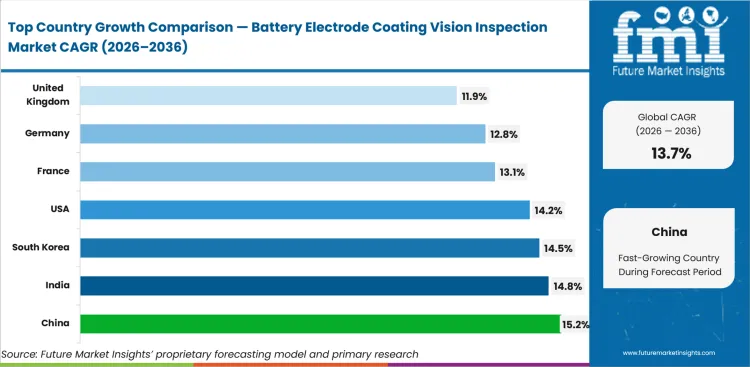
How do country-level CAGRs compare in the battery electrode coating vision inspection market?
China leads country expansion while Japan records the most measured outlook among profiled markets.
- China is forecast to record 15.2% CAGR by 2036 as high cell production density increases inspection repeat orders.
- India is expected to expand at 14.8% CAGR from 2026 to 2036 through new battery plant setup and domestic capacity programs.
- South Korea is projected to grow at 14.5% CAGR through 2036 as export-oriented battery makers require repeatable quality systems.
- The United States is estimated to rise at 14.2% CAGR by 2036 with domestic battery manufacturing support and local integration routes.
- France is expected to advance at 13.1% CAGR over the forecast period as large battery clusters create concentrated inspection demand.
- Germany is forecast to grow at 12.8% CAGR through 2036 as automotive validation and machine-builder channels shape purchases.
- The United Kingdom is projected to post 11.9% CAGR by 2036 as pilot lines and gigafactory projects move toward scale-up.
- Japan is estimated to rise at 11.7% CAGR through 2036 as process discipline supports steady qualification-based adoption.
What is the battery electrode coating vision inspection market outlook in the United States?
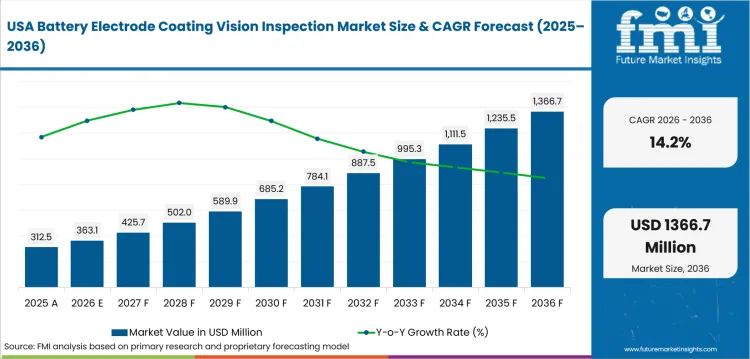
A 14.2% CAGR through 2036 reflects local battery plant investment and stronger demand for traceable coating release controls.
Country Market Snapshot Table
| Parameter | Value |
|---|---|
| Market Size in 2025 (Value) | USD 68.3 million |
| Market Size in 2026 (Value) | USD 78.0 million |
| Market Forecast in 2036 (Value) | USD 294.3 million |
| CAGR (2026 to 2036) | 14.2% |
| Years Considered | 2021 to 2036 |
| Base Year | 2025 |
| Forecast Period | 2026 to 2036 |
| Units Considered | Value (USD million) |
| Leading Sub-Region | Midwest and Southeast battery corridors |
United States Battery Electrode Coating Vision Inspection Market Outlook
- United States demand is shaped by new battery manufacturing projects, automotive customer audits, and plant-level interest in inline reject decisions. Buyers usually route coating vision packages through engineering contractors, equipment OEMs, and automation integrators.
- Suppliers with local application support have an advantage when coating recipes, dark surfaces, and line-speed testing need on-site tuning. USA purchasing also favors software that can connect images with batch and roll records.
Key Growth Drivers
- Federal manufacturing support strengthens new battery line planning. DOE announced a USD 500.0 million funding opportunity in March 2026 to expand critical materials processing, derivative battery manufacturing, and recycling.
- Battery supply-chain funding also supports inspection specification. DOE stated in December 2024 that more than USD 3.0 billion had been selected to boost advanced batteries and battery-material production.
- Automotive qualification programs push coating vision suppliers to document defect records for roll-level containment and warranty review.
- Local machine vision companies and integrators shorten commissioning cycles for multi-camera coating-line installations.
Key Restraints
- Demand pressure can stretch integration capacity. DOE’s advanced battery supply-chain review stated that USA battery deployment could increase by 6-fold from 2024 to 2035.
- EV plant schedule changes can defer inspection orders when cell manufacturers rebalance launch timing or capacity utilization.
- High integration cost can slow upgrades in plants that already rely on manual or at-line inspection workflows.
What makes United States unique
The United States is unique as a scale-up market where inspection is often specified during plant launch rather than after repeated quality escapes.
Key Companies
- Cognex
- Zebra Technologies
- Teledyne DALSA
- Keyence
- SICK
- Omron
- Rockwell Automation
Sales & Marketing Channels
- Direct sales to battery cell manufacturers
- Battery equipment OEM specification
- Automation system integrator partnerships
- Regional distributor networks
- Pilot-line validation projects
- Maintenance and calibration services
Country Segment Breakdown Table
| Segment | Sub-Segments |
|---|---|
| By Component | Cameras · Lenses · Lighting · Frame Grabbers · Vision Software · Services |
| By Inspection Type | Defect Detection · Measurement · OCR/OCV · Presence/Absence · Guidance |
| By Deployment | Inline · At-line · Robotic Cell · Portable |
| By End-use Industry | Automotive · Electronics · Energy Storage · Battery Materials · Research & Pilot Lines |
| By Electrode Type | Cathode Coating · Anode Coating · Dual-side Coating · Dry Electrode Coating · Separator Coating |
| Key Sub-Regions Covered, Battery Manufacturing Corridors | Midwest battery belt · Southeast automotive corridor · California · Texas · Northeast technology clusters · Pacific Northwest |
Frequently Asked Questions
How fast is United States battery electrode coating vision inspection market growing?
Demand in United States is projected to rise at 14.2% from 2026 to 2036, guided by battery manufacturing and coating-line quality needs.
Who leads United States battery electrode coating vision inspection market?
Cognex, Zebra Technologies, Teledyne DALSA, Keyence compete through machine vision portfolios, local support, and coating-line integration channels.
What is driving adoption in United States battery electrode coating vision inspection market?
Battery plant investment, automotive qualification, and the need for image-based defect evidence are moving buyers toward inline coating inspection systems.
How is the battery electrode coating vision inspection market performing in the United Kingdom?
An 11.9% CAGR through 2036 reflects pilot-line validation, gigafactory scale-up, and automotive battery qualification needs.
Country Market Snapshot Table
| Parameter | Value |
|---|---|
| Market Size in 2025 (Value) | USD 14.1 million |
| Market Size in 2026 (Value) | USD 15.8 million |
| Market Forecast in 2036 (Value) | USD 48.6 million |
| CAGR (2026 to 2036) | 11.9% |
| Years Considered | 2021 to 2036 |
| Base Year | 2025 |
| Forecast Period | 2026 to 2036 |
| Units Considered | Value (USD million) |
| Leading Sub-Region | Sunderland and West Midlands battery corridors |
United Kingdom Battery Electrode Coating Vision Inspection Market Outlook
- United Kingdom demand is influenced by pilot-line learning, automotive battery projects, and technology validation facilities. Buyers prefer flexible inspection platforms that can support process transfer from research cells to industrial coating lines.
- The market is smaller than East Asia, but supplier selection is demanding. Vendors that can support recipe tuning, training, and documented validation should gain stronger positions.
Key Growth Drivers
- The UK government said in May 2025 that the new AESC Sunderland gigafactory would power up to 100,000 EVs each year, creating a visible route for coating-line inspection demand.
- Business.gov.uk states battery manufacturing demand is projected to move from 110 GWh in 2030 to 200 GWh by 2040, supporting long-term process-quality investment.
- Pilot lines and research centers create demand for inspection systems that can handle recipe change and scale-up evidence.
- Automotive supply-chain qualification increases demand for image records linked to electrode batches and web position.
Key Restraints
- Faraday Institution analysis from September 2024 expected announced or under-construction UK battery plants to reach 57.6 GWh by 2030, which shows scale remains concentrated compared with larger Asian clusters.
- Project financing risk can delay repeated inspection orders until cell plant funding and production schedules are secure.
- Specialized vision-integration capacity is limited outside established automotive and research corridors.
What makes United Kingdom unique
The United Kingdom is unique due to its validation-heavy battery ecosystem and strong links between pilot lines, automotive programs, and industrial scale-up.
Key Companies
- Keyence UK
- Cognex UK
- SICK UK
- Zebra Technologies
- Omron Electronics
- MVTec partners
- Local automation integrators
Sales & Marketing Channels
- Direct sales to battery cell manufacturers
- Battery equipment OEM specification
- Automation system integrator partnerships
- Regional distributor networks
- Pilot-line validation projects
- Maintenance and calibration services
Country Segment Breakdown Table
| Segment | Sub-Segments |
|---|---|
| By Component | Cameras · Lenses · Lighting · Frame Grabbers · Vision Software · Services |
| By Inspection Type | Defect Detection · Measurement · OCR/OCV · Presence/Absence · Guidance |
| By Deployment | Inline · At-line · Robotic Cell · Portable |
| By End-use Industry | Automotive · Electronics · Energy Storage · Battery Materials · Research & Pilot Lines |
| By Electrode Type | Cathode Coating · Anode Coating · Dual-side Coating · Dry Electrode Coating · Separator Coating |
| Key Sub-Regions Covered, Battery Manufacturing Corridors | Sunderland · West Midlands · Oxford-Cambridge arc · Coventry · London engineering networks · South Wales |
Frequently Asked Questions
How fast is United Kingdom battery electrode coating vision inspection market growing?
Demand in United Kingdom is projected to rise at 11.9% from 2026 to 2036, guided by battery manufacturing and coating-line quality needs.
Who leads United Kingdom battery electrode coating vision inspection market?
Keyence UK, Cognex UK, SICK UK, Zebra Technologies compete through machine vision portfolios, local support, and coating-line integration channels.
What is driving adoption in United Kingdom battery electrode coating vision inspection market?
Battery plant investment, automotive qualification, and the need for image-based defect evidence are moving buyers toward inline coating inspection systems.
What is the battery electrode coating vision inspection market forecast for Germany?
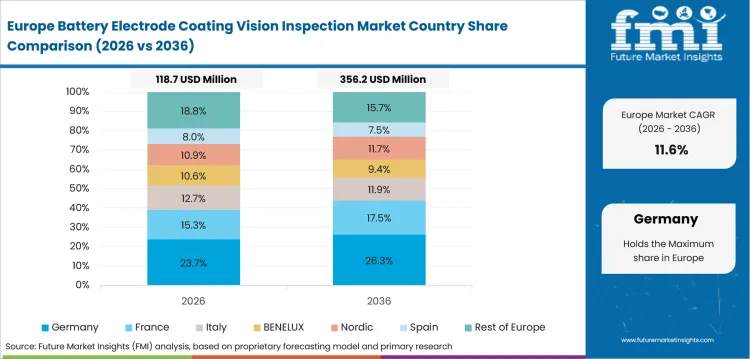
A 12.8% CAGR through 2036 reflects automotive process discipline and strong machine vision supplier depth.
Country Market Snapshot Table
| Parameter | Value |
|---|---|
| Market Size in 2025 (Value) | USD 27.9 million |
| Market Size in 2026 (Value) | USD 31.5 million |
| Market Forecast in 2036 (Value) | USD 105.1 million |
| CAGR (2026 to 2036) | 12.8% |
| Years Considered | 2021 to 2036 |
| Base Year | 2025 |
| Forecast Period | 2026 to 2036 |
| Units Considered | Value (USD million) |
| Leading Sub-Region | Bavaria, Baden-Württemberg, and Lower Saxony battery corridors |
Germany Battery Electrode Coating Vision Inspection Market Outlook
- Germany demand is tied to automotive qualification, equipment OEM influence, and validated automation architecture. Buyers tend to evaluate coating inspection as part of a complete line package rather than as a standalone camera purchase.
- Local optical, automation, and machine-builder ecosystems support detailed trials for cameras, lighting, and software. This makes Germany a reference market for tested inspection architecture.
Key Growth Drivers
- Domestic production supports battery-line validation demand. VDA reported 2.5 million passenger cars manufactured in Germany after the first seven months of 2025, including 864,000 electric cars in the first half.
- Local camera capability strengthens supplier access. Basler’s July 2024 racer 2 L launch covered 8k and 16k line-scan camera options for industrial web inspection.
- German machine builders influence camera, lighting, and software choices inside coating-line packages for European cell programs.
- Local suppliers such as Basler and SICK improve application support for web-speed inspection trials.
Key Restraints
- Vehicle electrification is advancing but not complete. ACEA reported battery-electric cars held 19.4% of EU new-car registrations in Q1 2026, keeping some battery-line investment staged.
- Long automotive validation cycles can slow replacement of incumbent inspection suppliers.
- High engineering and integration costs raise total installed system price for multi-camera coating stations.
What makes Germany unique
Germany is unique because battery demand, automotive validation culture, and local machine vision suppliers are concentrated in one industrial ecosystem.
Key Companies
- Basler
- SICK
- Siemens
- Cognex
- Keyence
- Teledyne DALSA
- MVTec Software
Sales & Marketing Channels
- Direct sales to battery cell manufacturers
- Battery equipment OEM specification
- Automation system integrator partnerships
- Regional distributor networks
- Pilot-line validation projects
- Maintenance and calibration services
Country Segment Breakdown Table
| Segment | Sub-Segments |
|---|---|
| By Component | Cameras · Lenses · Lighting · Frame Grabbers · Vision Software · Services |
| By Inspection Type | Defect Detection · Measurement · OCR/OCV · Presence/Absence · Guidance |
| By Deployment | Inline · At-line · Robotic Cell · Portable |
| By End-use Industry | Automotive · Electronics · Energy Storage · Battery Materials · Research & Pilot Lines |
| By Electrode Type | Cathode Coating · Anode Coating · Dual-side Coating · Dry Electrode Coating · Separator Coating |
| Key Sub-Regions Covered, Battery Manufacturing Corridors | Bavaria · Baden-Württemberg · Lower Saxony · North Rhine-Westphalia · Saxony · Thuringia |
Frequently Asked Questions
How fast is Germany battery electrode coating vision inspection market growing?
Demand in Germany is projected to rise at 12.8% from 2026 to 2036, guided by battery manufacturing and coating-line quality needs.
Who leads Germany battery electrode coating vision inspection market?
Basler, SICK, Siemens, Cognex compete through machine vision portfolios, local support, and coating-line integration channels.
What is driving adoption in Germany battery electrode coating vision inspection market?
Battery plant investment, automotive qualification, and the need for image-based defect evidence are moving buyers toward inline coating inspection systems.
How fast is the battery electrode coating vision inspection market growing in France?
A 13.1% CAGR through 2036 is supported by Dunkirk battery projects and European cell manufacturing investment.
Country Market Snapshot Table
| Parameter | Value |
|---|---|
| Market Size in 2025 (Value) | USD 18.9 million |
| Market Size in 2026 (Value) | USD 21.4 million |
| Market Forecast in 2036 (Value) | USD 73.3 million |
| CAGR (2026 to 2036) | 13.1% |
| Years Considered | 2021 to 2036 |
| Base Year | 2025 |
| Forecast Period | 2026 to 2036 |
| Units Considered | Value (USD million) |
| Leading Sub-Region | Dunkirk and northern battery corridor |
France Battery Electrode Coating Vision Inspection Market Outlook
- France demand is concentrated around large battery projects rather than many dispersed cell plants. This creates sizable inspection opportunities when gigafactory lines move from commissioning into repeat production.
- Suppliers must support factory acceptance testing, European service coverage, and process documentation. Advanced battery formats can add inspection complexity as electrode structures evolve.
Key Growth Drivers
- The European Investment Bank said in May 2024 that Verkor’s Dunkirk gigafactory is designed to manufacture cells for 300,000 electric vehicles each year.
- ACEA reported in April 2026 that France posted 48.2% battery-electric registration growth in the first four months of 2026, supporting EV battery qualification pressure.
- Dunkirk battery clustering increases the value of local commissioning support for coating inspection suppliers.
- European financing channels favor documented process control and repeatable quality evidence inside new battery plants.
Key Restraints
- OICA sales statistics show France at 2,042,788 vehicle sales in 2025, which makes battery inspection demand sensitive to automotive market timing and plant utilization.
- Large plant schedules can make inspection orders uneven when commissioning milestones move.
- Specialized battery workforce availability can slow validation and service work during ramp-up.
What makes France unique
France is unique as a cluster-driven battery market where a few large projects can create concentrated inspection demand.
Key Companies
- Cognex
- Keyence
- SICK
- Teledyne DALSA
- Omron
- Basler
- French automation integrators
Sales & Marketing Channels
- Direct sales to battery cell manufacturers
- Battery equipment OEM specification
- Automation system integrator partnerships
- Regional distributor networks
- Pilot-line validation projects
- Maintenance and calibration services
Country Segment Breakdown Table
| Segment | Sub-Segments |
|---|---|
| By Component | Cameras · Lenses · Lighting · Frame Grabbers · Vision Software · Services |
| By Inspection Type | Defect Detection · Measurement · OCR/OCV · Presence/Absence · Guidance |
| By Deployment | Inline · At-line · Robotic Cell · Portable |
| By End-use Industry | Automotive · Electronics · Energy Storage · Battery Materials · Research & Pilot Lines |
| By Electrode Type | Cathode Coating · Anode Coating · Dual-side Coating · Dry Electrode Coating · Separator Coating |
| Key Sub-Regions Covered, Battery Manufacturing Corridors | Dunkirk · Hauts-de-France · Île-de-France engineering base · Lyon · Grenoble · Grand Est |
Frequently Asked Questions
How fast is France battery electrode coating vision inspection market growing?
Demand in France is projected to rise at 13.1% from 2026 to 2036, guided by battery manufacturing and coating-line quality needs.
Who leads France battery electrode coating vision inspection market?
Cognex, Keyence, SICK, Teledyne DALSA compete through machine vision portfolios, local support, and coating-line integration channels.
What is driving adoption in France battery electrode coating vision inspection market?
Battery plant investment, automotive qualification, and the need for image-based defect evidence are moving buyers toward inline coating inspection systems.
What is the battery electrode coating vision inspection market outlook in Japan?
An 11.7% CAGR through 2036 reflects steady battery strategy support and careful supplier qualification.
Country Market Snapshot Table
| Parameter | Value |
|---|---|
| Market Size in 2025 (Value) | USD 34.9 million |
| Market Size in 2026 (Value) | USD 39.0 million |
| Market Forecast in 2036 (Value) | USD 117.9 million |
| CAGR (2026 to 2036) | 11.7% |
| Years Considered | 2021 to 2036 |
| Base Year | 2025 |
| Forecast Period | 2026 to 2036 |
| Units Considered | Value (USD million) |
| Leading Sub-Region | Kanto, Kansai, and Chubu battery corridors |
Japan Battery Electrode Coating Vision Inspection Market Outlook
- Japan demand is shaped by process discipline, long supplier relationships, and domestic battery manufacturing policy. Buyers place high value on repeatable calibration and low false-reject performance.
- The sales cycle can be slower than in larger scale-up markets, but chosen suppliers often retain strong positions. Local automation leaders support battery coating, measurement, and vision use cases.
Key Growth Drivers
- METI revised Japan’s battery strategy in June 2026 and set a domestic manufacturing base target of 150 GWh per year from 2030 to the mid-2030s.
- Japan’s 2025 climate transition bond allocation report noted 12 certified plans by September 2024 and an expected battery production base of roughly 120 GWh per year.
- Local automation suppliers support plant-level trials for coating measurement, visual inspection, and recipe control.
- Automotive battery programs emphasize defect containment evidence before wider serial production.
Key Restraints
- JAMA’s September 2025 manufacturing report stated new imported vehicles in Japan totaled 321,000 units in 2024, showing that market access patterns remain selective for some vehicle categories.
- Conservative qualification processes can lengthen sales cycles for new inspection software and lighting approaches.
- Mature supplier relationships can slow switching even when competing systems offer higher speed.
What makes Japan unique
Japan is unique due to process-quality expectations and the presence of domestic automation suppliers serving battery production workflows.
Key Companies
- Keyence
- Omron
- Cognex
- Basler
- Teledyne DALSA
- SICK
- Panasonic ecosystem integrators
Sales & Marketing Channels
- Direct sales to battery cell manufacturers
- Battery equipment OEM specification
- Automation system integrator partnerships
- Regional distributor networks
- Pilot-line validation projects
- Maintenance and calibration services
Country Segment Breakdown Table
| Segment | Sub-Segments |
|---|---|
| By Component | Cameras · Lenses · Lighting · Frame Grabbers · Vision Software · Services |
| By Inspection Type | Defect Detection · Measurement · OCR/OCV · Presence/Absence · Guidance |
| By Deployment | Inline · At-line · Robotic Cell · Portable |
| By End-use Industry | Automotive · Electronics · Energy Storage · Battery Materials · Research & Pilot Lines |
| By Electrode Type | Cathode Coating · Anode Coating · Dual-side Coating · Dry Electrode Coating · Separator Coating |
| Key Sub-Regions Covered, Battery Manufacturing Corridors | Kanto · Kansai · Chubu · Kyushu · Tohoku · Shikoku industrial corridors |
Frequently Asked Questions
How fast is Japan battery electrode coating vision inspection market growing?
Demand in Japan is projected to rise at 11.7% from 2026 to 2036, guided by battery manufacturing and coating-line quality needs.
Who leads Japan battery electrode coating vision inspection market?
Keyence, Omron, Cognex, Basler compete through machine vision portfolios, local support, and coating-line integration channels.
What is driving adoption in Japan battery electrode coating vision inspection market?
Battery plant investment, automotive qualification, and the need for image-based defect evidence are moving buyers toward inline coating inspection systems.
How fast is the battery electrode coating vision inspection market growing in China?
A 15.2% CAGR through 2036 reflects the world’s densest battery manufacturing base and high coating-line replication.
Country Market Snapshot Table
| Parameter | Value |
|---|---|
| Market Size in 2025 (Value) | USD 146.7 million |
| Market Size in 2026 (Value) | USD 169.0 million |
| Market Forecast in 2036 (Value) | USD 695.7 million |
| CAGR (2026 to 2036) | 15.2% |
| Years Considered | 2021 to 2036 |
| Base Year | 2025 |
| Forecast Period | 2026 to 2036 |
| Units Considered | Value (USD million) |
| Leading Sub-Region | Yangtze River Delta and Greater Bay Area battery clusters |
China Battery Electrode Coating Vision Inspection Market Outlook
- China demand is the largest country opportunity because cell production scale creates repeat purchasing across parallel coating lines. Buyers balance speed, price, local service, and fast commissioning.
- Local machine vision vendors compete strongly with global camera and software suppliers. Top-tier cell makers still pay for high-speed systems when defect escapes threaten yield and export qualification.
Key Growth Drivers
- China government statistics in February 2026 reported new energy vehicle output of 16.524 million units in 2025, up 25.1% from the previous year.
- SCIO reported in January 2026 that China’s NEV production and sales totaled 16.626 million and 16.49 million units in 2025, respectively.
- High-volume battery makers use local integrators to replicate inspection packages quickly across coating lines.
- Export-focused battery programs increase pressure for traceable defect evidence and lower false-reject rates.
Key Restraints
- China government data in November 2025 showed NEV production reached nearly 13.02 million units in the first ten months, which can intensify price pressure and fast delivery expectations for equipment suppliers.
- Premium inspection packages can face cost pressure outside top-tier battery cell makers.
- Local competition can shorten sales windows for global camera and software suppliers.
What makes China unique
China is unique due to unmatched cell manufacturing density and strong local integration capacity around battery coating lines.
Key Companies
- Keyence
- Cognex
- Teledyne DALSA
- Basler
- SICK
- Omron
- Local machine vision integrators
Sales & Marketing Channels
- Direct sales to battery cell manufacturers
- Battery equipment OEM specification
- Automation system integrator partnerships
- Regional distributor networks
- Pilot-line validation projects
- Maintenance and calibration services
Country Segment Breakdown Table
| Segment | Sub-Segments |
|---|---|
| By Component | Cameras · Lenses · Lighting · Frame Grabbers · Vision Software · Services |
| By Inspection Type | Defect Detection · Measurement · OCR/OCV · Presence/Absence · Guidance |
| By Deployment | Inline · At-line · Robotic Cell · Portable |
| By End-use Industry | Automotive · Electronics · Energy Storage · Battery Materials · Research & Pilot Lines |
| By Electrode Type | Cathode Coating · Anode Coating · Dual-side Coating · Dry Electrode Coating · Separator Coating |
| Key Sub-Regions Covered, Battery Manufacturing Corridors | Yangtze River Delta · Greater Bay Area · Sichuan-Chongqing · Fujian · Hubei · Jiangsu battery base |
Frequently Asked Questions
How fast is China battery electrode coating vision inspection market growing?
Demand in China is projected to rise at 15.2% from 2026 to 2036, guided by battery manufacturing and coating-line quality needs.
Who leads China battery electrode coating vision inspection market?
Keyence, Cognex, Teledyne DALSA, Basler compete through machine vision portfolios, local support, and coating-line integration channels.
What is driving adoption in China battery electrode coating vision inspection market?
Battery plant investment, automotive qualification, and the need for image-based defect evidence are moving buyers toward inline coating inspection systems.
What is the battery electrode coating vision inspection market forecast for South Korea?
A 14.5% CAGR through 2036 reflects export-oriented cell production and advanced battery process capability.
Country Market Snapshot Table
| Parameter | Value |
|---|---|
| Market Size in 2025 (Value) | USD 47.2 million |
| Market Size in 2026 (Value) | USD 54.0 million |
| Market Forecast in 2036 (Value) | USD 209.1 million |
| CAGR (2026 to 2036) | 14.5% |
| Years Considered | 2021 to 2036 |
| Base Year | 2025 |
| Forecast Period | 2026 to 2036 |
| Units Considered | Value (USD million) |
| Leading Sub-Region | Seoul-capital and Chungcheong battery corridor |
South Korea Battery Electrode Coating Vision Inspection Market Outlook
- South Korea demand is shaped by global battery makers, export programs, and advanced process-control expectations. Coating vision systems are evaluated for repeatability, speed, and integration into factory data systems.
- Domestic battery groups influence supplier requirements beyond Korea because their overseas factories often copy proven equipment packages. This creates follow-on opportunities for vendors approved in Korean programs.
Key Growth Drivers
- InvestKOREA reported that battery exports grew by more than 30% from USD 7.5 billion in 2020 to USD 9.83 billion in 2023, demonstrating strong battery industrial depth.
- InvestKOREA also stated that 2024 battery-sector exports were expected to reach USD 8.21 billion, keeping export quality and process control commercially important.
- Large cell makers require repeatable coating records before equipment packages are copied into overseas plants.
- Korean battery programs place strong emphasis on high-speed production, line uptime, and supplier qualification.
Key Restraints
- InvestKOREA noted a 16.5% expected decline in 2024 battery exports compared with the previous year, showing how EV demand cycles can affect inspection spending timing.
- Export exposure makes inspection demand sensitive to overseas plant schedules and customer program revisions.
- Domestic suppliers can face tight qualification windows when global battery makers standardize equipment families.
What makes South Korea unique
South Korea is unique because domestic battery makers can turn local qualification into global rollout across overseas cell plants.
Key Companies
- Cognex
- Keyence
- SICK
- Omron
- Teledyne DALSA
- Basler
- Korean automation integrators
Sales & Marketing Channels
- Direct sales to battery cell manufacturers
- Battery equipment OEM specification
- Automation system integrator partnerships
- Regional distributor networks
- Pilot-line validation projects
- Maintenance and calibration services
Country Segment Breakdown Table
| Segment | Sub-Segments |
|---|---|
| By Component | Cameras · Lenses · Lighting · Frame Grabbers · Vision Software · Services |
| By Inspection Type | Defect Detection · Measurement · OCR/OCV · Presence/Absence · Guidance |
| By Deployment | Inline · At-line · Robotic Cell · Portable |
| By End-use Industry | Automotive · Electronics · Energy Storage · Battery Materials · Research & Pilot Lines |
| By Electrode Type | Cathode Coating · Anode Coating · Dual-side Coating · Dry Electrode Coating · Separator Coating |
| Key Sub-Regions Covered, Battery Manufacturing Corridors | Seoul-capital area · Chungcheong · Ulsan · Gyeonggi · Gumi · Busan logistics corridor |
Frequently Asked Questions
How fast is South Korea battery electrode coating vision inspection market growing?
Demand in South Korea is projected to rise at 14.5% from 2026 to 2036, guided by battery manufacturing and coating-line quality needs.
Who leads South Korea battery electrode coating vision inspection market?
Cognex, Keyence, SICK, Omron compete through machine vision portfolios, local support, and coating-line integration channels.
What is driving adoption in South Korea battery electrode coating vision inspection market?
Battery plant investment, automotive qualification, and the need for image-based defect evidence are moving buyers toward inline coating inspection systems.
What is driving battery electrode coating vision inspection growth in India?
A 14.8% CAGR through 2036 is supported by new cell manufacturing programs and domestic EV scale-up.
Country Market Snapshot Table
| Parameter | Value |
|---|---|
| Market Size in 2025 (Value) | USD 25.7 million |
| Market Size in 2026 (Value) | USD 29.5 million |
| Market Forecast in 2036 (Value) | USD 117.3 million |
| CAGR (2026 to 2036) | 14.8% |
| Years Considered | 2021 to 2036 |
| Base Year | 2025 |
| Forecast Period | 2026 to 2036 |
| Units Considered | Value (USD million) |
| Leading Sub-Region | Gujarat, Tamil Nadu, Karnataka, and Maharashtra battery corridors |
India Battery Electrode Coating Vision Inspection Market Outlook
- India demand is emerging from new advanced chemistry cell projects, EV supply-chain localization, and equipment specification during plant planning. Early-stage plants can specify inspection from the start rather than retrofitting later.
- Suppliers need strong application support because new coating teams require recipe setup, operator training, and line validation. Domestic integrators can help global camera vendors reach battery manufacturers.
Key Growth Drivers
- Invest India stated in December 2025 that the ₹18,100-crore PLI scheme for ACC targets 50 GWh of Giga-scale capacity, with 40 GWh already allocated to three beneficiaries.
- SIAM reporting in May 2026 placed India EV sales above 2.3 million units in 2025, supporting domestic battery manufacturing and inspection planning.
- New battery plants create opportunities to specify inline inspection during initial plant engineering.
- Localization goals increase demand for process evidence that can support automotive and storage-battery customers.
Key Restraints
- India’s ACC program allocates 40 GWh against a 50 GWh target, leaving some capacity yet to be converted into fully commissioned cell lines.
- Battery-grade process engineering talent can be uneven across new industrial corridors.
- High imported camera and optics costs can slow broader adoption beyond leading cell programs.
What makes India unique
India is unique as a new-build market where coating vision inspection can be designed into plants before large-scale quality issues appear.
Key Companies
- Keyence India
- Cognex India
- SICK India
- Omron Automation
- Zebra Technologies
- Basler partners
- Indian automation integrators
Sales & Marketing Channels
- Direct sales to battery cell manufacturers
- Battery equipment OEM specification
- Automation system integrator partnerships
- Regional distributor networks
- Pilot-line validation projects
- Maintenance and calibration services
Country Segment Breakdown Table
| Segment | Sub-Segments |
|---|---|
| By Component | Cameras · Lenses · Lighting · Frame Grabbers · Vision Software · Services |
| By Inspection Type | Defect Detection · Measurement · OCR/OCV · Presence/Absence · Guidance |
| By Deployment | Inline · At-line · Robotic Cell · Portable |
| By End-use Industry | Automotive · Electronics · Energy Storage · Battery Materials · Research & Pilot Lines |
| By Electrode Type | Cathode Coating · Anode Coating · Dual-side Coating · Dry Electrode Coating · Separator Coating |
| Key Sub-Regions Covered, Battery Manufacturing Corridors | Gujarat · Tamil Nadu · Karnataka · Maharashtra · Telangana · NCR industrial corridor |
Frequently Asked Questions
How fast is India battery electrode coating vision inspection market growing?
Demand in India is projected to rise at 14.8% from 2026 to 2036, guided by battery manufacturing and coating-line quality needs.
Who leads India battery electrode coating vision inspection market?
Keyence India, Cognex India, SICK India, Omron Automation compete through machine vision portfolios, local support, and coating-line integration channels.
What is driving adoption in India battery electrode coating vision inspection market?
Battery plant investment, automotive qualification, and the need for image-based defect evidence are moving buyers toward inline coating inspection systems.
Who are the leading companies in the battery electrode coating vision inspection market?
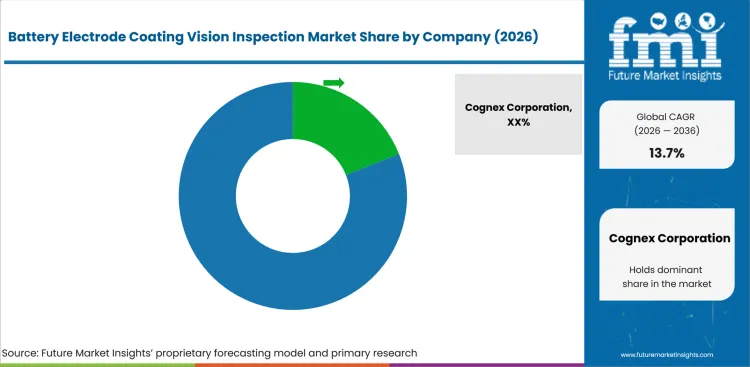
Cognex, Keyence, Basler, Teledyne DALSA, Omron, Zebra Technologies, and SICK.
- Established machine vision suppliers hold an advantage through proven industrial cameras, application software, and global service networks.
- Line-scan camera specialists gain stronger positions when they show stable imaging across dark electrode surfaces and fast moving webs.
- Automation-linked suppliers gain buyer confidence by connecting inspection images with roll position, recipe data, and production records.
- Regional integrators support adoption by tuning lighting, validating recipes, and training operators during coating-line commissioning.
Machine vision companies in the market compete by combining image capture, lighting control, classification software, and plant-data integration. Cognex and Keyence hold strong positions through application-ready systems and broad factory automation sales. Basler and Teledyne DALSA are important for industrial camera depth, especially where web-speed imaging and low-light performance drive supplier selection. Omron, SICK, and Zebra Technologies compete through automation portfolios that connect inspection outputs with factory workflows.
Hardware speed has become a competitive separator as battery coating lines raise throughput. Buyers need cameras and frame grabbers that can capture faint coating defects without slowing production. Software quality is equally important because false rejects can waste good electrode material while missed defects can create safety and warranty exposure. Suppliers able to prove stable performance under recipe changes should gain more durable qualification decisions.
Smaller and regional participants can win through application knowledge and fast on-site support. Battery plants often need lighting trials, encoder synchronization, and recipe-specific software tuning before full acceptance. Local integrators can therefore shape vendor choice, especially in India, the United Kingdom, South Korea, and China. Companies with strong camera portfolios and practical coating-line evidence are expected to win over sellers that only offer generic inspection hardware.
How do top battery electrode coating vision inspection companies compare?
Cognex and Keyence score strongest on application-ready inspection depth, while Teledyne DALSA leads high-speed line-scan camera relevance.
| Company | Relevance to Market Title | High-Speed Camera Depth | Software and AI Capability | Factory Integration | Channel Reach | Geographic Footprint |
|---|---|---|---|---|---|---|
| Cognex | Very High | Strong | Very Strong | Very Strong | Very Strong | Global |
| Keyence | Very High | Strong | Very Strong | Very Strong | Very Strong | Global |
| Basler | High | Very Strong | Strong | Strong | Strong | Global |
| Teledyne DALSA | Very High | Very Strong | Strong | Strong | Strong | Global |
| Omron | High | Strong | Strong | Very Strong | Very Strong | Global |
| Zebra Technologies | High | Strong | Strong | Strong | Very Strong | Global |
| SICK | High | Strong | Strong | Very Strong | Strong | Global |
| MVTec Software | Moderate to High | Moderate | Very Strong | Strong | Moderate | Europe-led global |
| Local Integrators | Moderate | Variable | Strong | Very Strong | Strong | Regional |
Source: Future Market Insights competitive analysis, 2026.
Who are the key players in the battery electrode coating vision inspection market?
Cognex, Keyence, Basler, Teledyne DALSA and Omron are listed with Zebra Technologies and SICK among other suppliers.
Key global companies leading the battery electrode coating vision inspection market include:
- Cognex Corporation
- Keyence Corporation
- Basler AG
- Teledyne DALSA
- Omron Corporation
- Zebra Technologies
- SICK AG
- MVTec Software GmbH
- Datalogic S.p.A.
- Baumer Group
- JAI A/S
- Industrial Vision Systems Ltd
Key Developments in Battery Electrode Coating Vision Inspection Market
- In April 2024, Cognex launched the In-Sight L38 3D vision system with embedded AI, supporting easier factory inspection setup for complex industrial applications.
- In July 2024, Basler launched racer 2 L line-scan cameras with 8k and 16k resolution, supporting high-speed web inspection use cases including battery production.
- In December 2024, Zebra Technologies announced an agreement to acquire Photoneo, expanding its 3D machine vision portfolio for inspection and automation applications.
Key Players in the Battery Electrode Coating Vision Inspection Market
Global Machine Vision Suppliers
- Cognex Corporation
- Keyence Corporation
- Basler AG
- Teledyne DALSA
- Omron Corporation
- Zebra Technologies
- SICK AG
Vision Software and Imaging Specialists
- MVTec Software GmbH
- Datalogic S.p.A.
- Baumer Group
- JAI A/S
- Industrial Vision Systems Ltd.
Regional Integration Partners
- Battery coating-line integrators
- Automotive automation integrators
- Machine vision distributors
- Factory commissioning service providers
Battery Electrode Coating Vision Inspection Market - Scope & Definition
| Attribute | Detail |
|---|---|
| Market Definition | Camera-based inspection systems used to review coated anode and cathode webs during battery electrode production, including inline and at-line visual checks. |
| Functions Covered | Defect detection, width measurement, OCR/OCV, presence checks, guidance, image recordkeeping, and batch traceability. |
| Applications Covered | Wet coating inspection, dry electrode checks, edge defect review, particle detection, missing coating detection, streak analysis, and width variation review. |
| End-Use Industries | Automotive cells, electronics batteries, energy storage systems, battery materials plants, and research or pilot-line facilities. |
| Components Covered | Industrial cameras, lenses, lighting, frame grabbers, software, and installation or calibration services. |
| Inclusions | Commercially sold vision inspection systems and services used for electrode coating inspection across inline, at-line, robotic cell, and portable deployment formats. |
| Exclusions | Electrochemical testers, battery cyclers, pack leak testers, thermal runaway chambers, and non-vision coating gauges sold as standalone process instruments. |
Source: Future Market Insights, 2026.
Battery Electrode Coating Vision Inspection Market - Research Methodology
| Method | Description |
|---|---|
| Primary Research | FMI analyst interviews with battery cell manufacturers, coating-line integrators, machine vision suppliers, distributors, and automation engineers. |
| Desk Research | Review of battery manufacturing references, official energy and vehicle sources, standards material, company product pages, and automation portfolios. |
| Market Sizing & Forecasting | Bottom-up modelling using coating-line additions, inspection system value, replacement cycles, country-level capacity signals, and software content. |
| Data Validation | Cross-verification using battery manufacturing capacity, EV production indicators, camera specifications, supplier participation, and regional adoption evidence. |
Source: Future Market Insights, 2026.
Battery Electrode Coating Vision Inspection Market - Report Scope
| Parameter | Details |
|---|---|
| Forecast period | 2026 to 2036 |
| Historical period | 2021 to 2025 |
| Quantitative unit | Revenue in USD million |
| By component | Cameras, lenses, lighting, frame grabbers, vision software, services |
| By inspection type | Defect detection, measurement, OCR/OCV, presence/absence, guidance |
| By deployment | Inline, at-line, robotic cell, portable |
| By end-use industry | Automotive, electronics, energy storage, battery materials, research and pilot lines |
| By electrode type | Cathode coating, anode coating, dual-side coating, dry electrode coating, separator coating |
| Regions covered | North America, Latin America, Europe, East Asia, South Asia and Pacific, Middle East and Africa |
| Countries covered | United States, United Kingdom, Germany, France, Japan, China, South Korea, India |
| Key companies profiled | Cognex, Keyence, Basler, Teledyne DALSA, Omron, Zebra Technologies, SICK, MVTec Software |
| Approach | Bottom-up coating-line approach using inspection package value, battery line additions, camera intensity, software content, and country-level manufacturing signals |
Source: Future Market Insights, 2026.
Battery Electrode Coating Vision Inspection Market Breakdown by Component, Inspection Type, Deployment, End-use Industry, Electrode Type, and Region
Battery Electrode Coating Vision Inspection Market Segmented by Component
- Cameras
- Lenses
- Lighting
- Frame Grabbers
- Vision Software
- Services
Battery Electrode Coating Vision Inspection Market Segmented by Inspection Type
- Defect Detection
- Measurement
- OCR/OCV
- Presence/Absence
- Guidance
Battery Electrode Coating Vision Inspection Market Segmented by Deployment
- Inline
- At-line
- Robotic Cell
- Portable
Battery Electrode Coating Vision Inspection Market Segmented by End-use Industry
- Automotive
- Electronics
- Energy Storage
- Battery Materials
- Research & Pilot Lines
Battery Electrode Coating Vision Inspection Market Segmented by Electrode Type
- Cathode Coating
- Anode Coating
- Dual-side Coating
- Dry Electrode Coating
- Separator Coating
Battery Electrode Coating Vision Inspection Market by Region
- North America
- Latin America
- Europe
- East Asia
- South Asia and Pacific
- Middle East and Africa
Research Sources and Bibliography
- Alternative Fuels Data Center. (2026, June). Vehicle registration counts by state. USA Department of Energy.
- Association des Constructeurs Européens d’Automobiles. (2026, April 23). New car registrations: +4% in Q1 2026; battery-electric 19.4% market share. ACEA.
- Association des Constructeurs Européens d’Automobiles. (2026, May 27). New car registrations: +4.2% in April 2026 year-to-date; battery-electric 19.7% market share. ACEA.
- Basler AG. (2024, July 2). Racer 2 L line scan cameras with 8k and 16k resolution. Basler AG.
- Cognex Corporation. (2024, April 1). Cognex launches the world’s first 3D vision system with AI. Cognex Corporation.
- Department for Business and Trade. (2025). Batteries: Invest in the UK. Government of the United Kingdom.
- European Investment Bank. (2024, May 30). French firm Verkor to mass-produce EV batteries in Dunkirk. European Investment Bank.
- Faraday Institution. (2024, September 17). UK electric vehicle and battery production potential to 2040. Faraday Institution.
- International Energy Agency. (2026, May 20). Electric vehicle batteries — Global EV Outlook 2026. International Energy Agency.
- International Energy Agency. (2026, May 20). Manufacturing and trade — Global EV Outlook 2026. International Energy Agency.
- International Energy Agency. (2026, May 20). Trends in electric cars — Global EV Outlook 2026. International Energy Agency.
- International Organization of Motor Vehicle Manufacturers. (2026, May). Auto industry growth shifted east in 2025 amid global repositioning. OICA.
- Invest India. (2025, December 12). Inside India’s EV manufacturing ecosystem: Key investment trends and government policies. Invest India.
- InvestKOREA. (2024). Battery industry. Korea Trade-Investment Promotion Agency.
- Japan Automobile Manufacturers Association. (2025, September 26). The motor industry of Japan 2025. JAMA.
- Ministry of Economy, Trade and Industry. (2025). Japan climate transition bonds allocation report. Government of Japan.
- Ministry of Economy, Trade and Industry. (2026, June 2). Battery Industry Strategy revised as the Battery Strategy. Government of Japan.
- National Bureau of Statistics of China. (2026, February 28). Statistical communiqué of the People’s Republic of China on national economic and social development in 2025. NBS.
- Society of Indian Automobile Manufacturers. (2026, May 29). India EV sales surge past 2.3 million units in 2025. SIAM.
- State Council Information Office of the People’s Republic of China. (2026, January 14). China’s auto output, sales reach new highs in 2025. SCIO.
- Teledyne DALSA. (2024, September 17). Teledyne unveils the first 16k TDI line scan camera with a 1-Megahertz line rate. Teledyne DALSA.
- The State Council of the People’s Republic of China. (2025, November 11). China’s NEV output, sales surge in first 10 months of 2025. The State Council.
- USA Department of Energy. (2024, December). 2021–2024 four-year review of supply chains for the advanced batteries sector. USA Department of Energy.
- USA Department of Energy. (2024, December 19). USA Department of Energy selects 11 projects to advance domestic manufacturing of next-generation batteries. USA Department of Energy.
- USA Department of Energy. (2026, March 13). Energy Department announces USD 500 million to strengthen domestic critical materials processing and manufacturing. USA Department of Energy.
- USA Department of Energy. (2026, June 4). Sector spotlight: Critical materials. USA Department of Energy.
- Verband der Automobilindustrie. (2025, August 4). Electric car production at record levels in first half of the year. VDA.
- Zebra Technologies. (2024, December 30). Zebra Technologies to acquire Photoneo, expanding its portfolio of 3D machine vision solutions. Zebra Technologies.
This bibliography is provided for reader reference and is not exhaustive. The full report contains the complete reference list and detailed citations.
This Report Answers
- Market size estimates for 2026 and forecasts through 2036 for the battery electrode coating vision inspection market.
- Insights across more than 30 regional and country-level markets.
- Analysis of demand drivers, coating-line adoption patterns, defect detection needs, and purchasing behavior.
- Evaluation of key component groups and inspection types, including camera, lighting, software, and inline deployment dynamics.
- Assessment of quality-control requirements, traceability needs, and line-speed inspection impacts on market development.
- Identification of growth opportunities across components, inspection types, deployment formats, end-use industries, and electrode types.
- Evaluation of supply chain dynamics, product innovation trends, and battery coating-line channel structures.
- Country-level growth analysis covering the United States, United Kingdom, Germany, France, Japan, China, South Korea, and India.
- Assessment of the competitive landscape, including leading machine vision suppliers and regional integration participants.
- Analysis of buyer preferences, market penetration trends, and emerging opportunities in coating-line inspection.
- Regional outlooks across North America, Europe, East Asia, South Asia and Pacific, Latin America, and Middle East and Africa.
- Delivery of market data, forecasts, and supporting analysis in PDF and Excel formats.
Frequently Asked Questions
What is the growth prospect for battery electrode coating vision inspection?
Demand for battery electrode coating vision inspection is expected to rise at a considerable pace as cell makers move defect checks closer to coating and drying stages.
Which companies are expected to shape the battery electrode coating vision inspection market?
Cognex, Keyence, Basler, Teledyne DALSA, Omron, Zebra Technologies, and SICK are expected to shape market competition through camera portfolios and coating-line integration support.
Why are battery manufacturers investing in coating vision inspection?
Battery manufacturers are investing in coating vision inspection to reduce scrap, improve release control, and link defect images with roll position and recipe records.
Why are inline systems important in the battery electrode coating vision inspection market?
Inline systems are important because coating defects must be detected before calendaring, slitting, formation, and pack-level processes add more cost.
Which component formats are gaining attention in battery electrode coating vision inspection?
High-speed cameras, stable lighting, frame grabbers, and classification software are gaining attention as plants raise web speed and coating width.
How does software influence battery electrode coating inspection?
Software influences inspection by classifying defects, reducing false rejects, and connecting inspection records with batch and production data.
Why is lighting important for battery electrode coating vision inspection?
Lighting is important because black active materials, reflective foil edges, wet coating, and edge beads can reduce defect contrast.
Which countries show strong adoption potential for coating vision inspection?
China, India, South Korea, and the United States show strong adoption potential due to battery manufacturing scale and new line investment.
How do regional integrators support battery electrode coating vision inspection?
Regional integrators support adoption by tuning lighting, validating inspection recipes, and helping operators connect vision systems with plant controls.
What is excluded from the battery electrode coating vision inspection market?
Electrochemical testers, battery cyclers, pack leak testers, thermal runaway chambers, and non-vision coating gauges are excluded from the market scope.
Preview the report firsthand - request a free sample
Get SampleGet the brochure for pricing and purchase details.
Get PDFTable of Content
- Key Takeaways
- Market Size and CAGR
- Top Growth Driver
- Fastest Growing Segment
- Leading Region
- Key Companies
- Emerging Opportunities
- Executive Summary
- Global Market Outlook
- Demand-side Trends
- Supply-side Trends
- Technology Roadmap Analysis
- Analysis and Recommendations
- Analyst Perspective (What is happening? Why now? What should investors know?)
- Key Questions Answered
- How large is the market?
- What is the CAGR?
- What are key trends?
- Which region dominates?
- Who are the leaders?
- Market Overview
- Market Coverage / Taxonomy
- Market Definition / Scope / Limitations
- Research Methodology
- Chapter Orientation
- Analytical Lens and Working Hypotheses
- Market Structure, Signals, and Trend Drivers
- Benchmarking and Cross-market Comparability
- Market Sizing, Forecasting, and Opportunity Mapping
- Research Design and Evidence Framework
- Desk Research Programme (Secondary Evidence)
- Expert Input and Fieldwork (Primary Evidence)
- Tooling, Models, and Reference Databases
- Data Engineering and Model Build
- Quality Assurance and Audit Trail
- Market Background
- Market Dynamics (Drivers, Restraints, Opportunity, Trends)
- Scenario Forecast (Optimistic, Likely, Conservative)
- Impact Analysis
- AI Impact
- Sustainability Impact
- Regulatory Impact
- Technology Impact
- Consumer / Buyer Analysis
- Purchase Drivers
- Adoption Barriers
- Buyer Journey
- Opportunity Map Analysis
- Product Life Cycle Analysis
- Supply Chain Analysis
- Investment Feasibility Matrix
- Value Chain Analysis
- PESTLE and Porter's Analysis
- Regulatory Landscape
- Regional Parent Market Outlook
- Production and Consumption Statistics
- Import and Export Statistics
- Global Market Analysis and Forecast, 2021 to 2036
- Historical Market Size Value (USD Million) Analysis, 2021 to 2025
- Current and Future Market Size Value (USD Million) Projections, 2026 to 2036
- Y-o-Y Growth Trend Analysis
- Absolute $ Opportunity Analysis
- Global Market Pricing Analysis, 2021 to 2036
- Global Market Analysis and Forecast, By Component, 2021 to 2036
- Introduction / Key Findings
- Historical Market Size Value (USD Million) Analysis By Component, 2021 to 2025
- Current and Future Market Size Value (USD Million) Analysis and Forecast By Component, 2026 to 2036
- Cameras
- Lenses
- Lighting
- Cameras
- Y-o-Y Growth Trend Analysis By Component, 2021 to 2025
- Absolute $ Opportunity Analysis By Component, 2026 to 2036
- Global Market Analysis and Forecast, By Inspection Type, 2021 to 2036
- Introduction / Key Findings
- Historical Market Size Value (USD Million) Analysis By Inspection Type, 2021 to 2025
- Current and Future Market Size Value (USD Million) Analysis and Forecast By Inspection Type, 2026 to 2036
- Defect Detection
- Measurement
- OCR/OCV
- Defect Detection
- Y-o-Y Growth Trend Analysis By Inspection Type, 2021 to 2025
- Absolute $ Opportunity Analysis By Inspection Type, 2026 to 2036
- Global Market Analysis and Forecast, By Deployment, 2021 to 2036
- Introduction / Key Findings
- Historical Market Size Value (USD Million) Analysis By Deployment, 2021 to 2025
- Current and Future Market Size Value (USD Million) Analysis and Forecast By Deployment, 2026 to 2036
- Inline
- At-line
- Robotic Cell
- Inline
- Y-o-Y Growth Trend Analysis By Deployment, 2021 to 2025
- Absolute $ Opportunity Analysis By Deployment, 2026 to 2036
- Global Market Analysis and Forecast, By End-use Industry, 2021 to 2036
- Introduction / Key Findings
- Historical Market Size Value (USD Million) Analysis By End-use Industry, 2021 to 2025
- Current and Future Market Size Value (USD Million) Analysis and Forecast By End-use Industry, 2026 to 2036
- Automotive
- Electronics
- Energy Storage
- Automotive
- Y-o-Y Growth Trend Analysis By End-use Industry, 2021 to 2025
- Absolute $ Opportunity Analysis By End-use Industry, 2026 to 2036
- Global Market Analysis and Forecast, By Electrode Type, 2021 to 2036
- Introduction / Key Findings
- Historical Market Size Value (USD Million) Analysis By Electrode Type, 2021 to 2025
- Current and Future Market Size Value (USD Million) Analysis and Forecast By Electrode Type, 2026 to 2036
- Cathode Coating
- Anode Coating
- Dual-side Coating
- Cathode Coating
- Y-o-Y Growth Trend Analysis By Electrode Type, 2021 to 2025
- Absolute $ Opportunity Analysis By Electrode Type, 2026 to 2036
- Global Market Analysis and Forecast, By Region, 2021 to 2036
- Introduction
- Historical Market Size Value (USD Million) Analysis By Region, 2021 to 2025
- Current Market Size Value (USD Million) Analysis and Forecast By Region, 2026 to 2036
- North America
- Latin America
- Western Europe
- Eastern Europe
- East Asia
- South Asia and Pacific
- Middle East & Africa
- Market Attractiveness Analysis By Region
- North America Market Analysis and Forecast, By Country, 2021 to 2036
- Historical Market Size Value (USD Million) Trend Analysis By Market Taxonomy, 2021 to 2025
- Market Size Value (USD Million) Forecast By Market Taxonomy, 2026 to 2036
- By Country
- USA
- Canada
- Mexico
- By Component
- By Inspection Type
- By Deployment
- By End-use Industry
- By Electrode Type
- By Country
- Market Attractiveness Analysis
- By Country
- By Component
- By Inspection Type
- By Deployment
- By End-use Industry
- By Electrode Type
- Key Takeaways
- Latin America Market Analysis and Forecast, By Country
- Historical Market Size Value (USD Million) Trend Analysis By Market Taxonomy, 2021 to 2025
- Market Size Value (USD Million) Forecast By Market Taxonomy, 2026 to 2036
- By Country
- Brazil
- Chile
- Rest of Latin America
- By Component
- By Inspection Type
- By Deployment
- By End-use Industry
- By Electrode Type
- By Country
- Market Attractiveness Analysis
- By Country
- By Component
- By Inspection Type
- By Deployment
- By End-use Industry
- By Electrode Type
- Key Takeaways
- Western Europe Market Analysis and Forecast, By Country
- Historical Market Size Value (USD Million) Trend Analysis By Market Taxonomy, 2021 to 2025
- Market Size Value (USD Million) Forecast By Market Taxonomy, 2026 to 2036
- By Country
- Germany
- UK
- Italy
- Spain
- France
- Nordic
- BENELUX
- Rest of Western Europe
- By Component
- By Inspection Type
- By Deployment
- By End-use Industry
- By Electrode Type
- By Country
- Market Attractiveness Analysis
- By Country
- By Component
- By Inspection Type
- By Deployment
- By End-use Industry
- By Electrode Type
- Key Takeaways
- Eastern Europe Market Analysis and Forecast, By Country
- Historical Market Size Value (USD Million) Trend Analysis By Market Taxonomy, 2021 to 2025
- Market Size Value (USD Million) Forecast By Market Taxonomy, 2026 to 2036
- By Country
- Russia
- Poland
- Hungary
- Balkan & Baltic
- Rest of Eastern Europe
- By Component
- By Inspection Type
- By Deployment
- By End-use Industry
- By Electrode Type
- By Country
- Market Attractiveness Analysis
- By Country
- By Component
- By Inspection Type
- By Deployment
- By End-use Industry
- By Electrode Type
- Key Takeaways
- East Asia Market Analysis and Forecast, By Country
- Historical Market Size Value (USD Million) Trend Analysis By Market Taxonomy, 2021 to 2025
- Market Size Value (USD Million) Forecast By Market Taxonomy, 2026 to 2036
- By Country
- China
- Japan
- South Korea
- By Component
- By Inspection Type
- By Deployment
- By End-use Industry
- By Electrode Type
- By Country
- Market Attractiveness Analysis
- By Country
- By Component
- By Inspection Type
- By Deployment
- By End-use Industry
- By Electrode Type
- Key Takeaways
- South Asia and Pacific Market Analysis and Forecast, By Country
- Historical Market Size Value (USD Million) Trend Analysis By Market Taxonomy, 2021 to 2025
- Market Size Value (USD Million) Forecast By Market Taxonomy, 2026 to 2036
- By Country
- India
- ASEAN
- Australia & New Zealand
- Rest of South Asia and Pacific
- By Component
- By Inspection Type
- By Deployment
- By End-use Industry
- By Electrode Type
- By Country
- Market Attractiveness Analysis
- By Country
- By Component
- By Inspection Type
- By Deployment
- By End-use Industry
- By Electrode Type
- Key Takeaways
- Middle East & Africa Market Analysis and Forecast, By Country
- Historical Market Size Value (USD Million) Trend Analysis By Market Taxonomy, 2021 to 2025
- Market Size Value (USD Million) Forecast By Market Taxonomy, 2026 to 2036
- By Country
- Kingdom of Saudi Arabia
- Other GCC Countries
- Türkiye
- South Africa
- Other African Union
- Rest of Middle East & Africa
- By Component
- By Inspection Type
- By Deployment
- By End-use Industry
- By Electrode Type
- By Country
- Market Attractiveness Analysis
- By Country
- By Component
- By Inspection Type
- By Deployment
- By End-use Industry
- By Electrode Type
- Key Takeaways
- Key Countries Market Analysis
- USA
- Pricing Analysis
- Market Share Analysis, 2025
- By Component
- By Inspection Type
- By Deployment
- By End-use Industry
- By Electrode Type
- Canada
- Pricing Analysis
- Market Share Analysis, 2025
- By Component
- By Inspection Type
- By Deployment
- By End-use Industry
- By Electrode Type
- Mexico
- Pricing Analysis
- Market Share Analysis, 2025
- By Component
- By Inspection Type
- By Deployment
- By End-use Industry
- By Electrode Type
- Brazil
- Pricing Analysis
- Market Share Analysis, 2025
- By Component
- By Inspection Type
- By Deployment
- By End-use Industry
- By Electrode Type
- Chile
- Pricing Analysis
- Market Share Analysis, 2025
- By Component
- By Inspection Type
- By Deployment
- By End-use Industry
- By Electrode Type
- Germany
- Pricing Analysis
- Market Share Analysis, 2025
- By Component
- By Inspection Type
- By Deployment
- By End-use Industry
- By Electrode Type
- UK
- Pricing Analysis
- Market Share Analysis, 2025
- By Component
- By Inspection Type
- By Deployment
- By End-use Industry
- By Electrode Type
- Italy
- Pricing Analysis
- Market Share Analysis, 2025
- By Component
- By Inspection Type
- By Deployment
- By End-use Industry
- By Electrode Type
- Spain
- Pricing Analysis
- Market Share Analysis, 2025
- By Component
- By Inspection Type
- By Deployment
- By End-use Industry
- By Electrode Type
- France
- Pricing Analysis
- Market Share Analysis, 2025
- By Component
- By Inspection Type
- By Deployment
- By End-use Industry
- By Electrode Type
- India
- Pricing Analysis
- Market Share Analysis, 2025
- By Component
- By Inspection Type
- By Deployment
- By End-use Industry
- By Electrode Type
- ASEAN
- Pricing Analysis
- Market Share Analysis, 2025
- By Component
- By Inspection Type
- By Deployment
- By End-use Industry
- By Electrode Type
- Australia & New Zealand
- Pricing Analysis
- Market Share Analysis, 2025
- By Component
- By Inspection Type
- By Deployment
- By End-use Industry
- By Electrode Type
- China
- Pricing Analysis
- Market Share Analysis, 2025
- By Component
- By Inspection Type
- By Deployment
- By End-use Industry
- By Electrode Type
- Japan
- Pricing Analysis
- Market Share Analysis, 2025
- By Component
- By Inspection Type
- By Deployment
- By End-use Industry
- By Electrode Type
- South Korea
- Pricing Analysis
- Market Share Analysis, 2025
- By Component
- By Inspection Type
- By Deployment
- By End-use Industry
- By Electrode Type
- Russia
- Pricing Analysis
- Market Share Analysis, 2025
- By Component
- By Inspection Type
- By Deployment
- By End-use Industry
- By Electrode Type
- Poland
- Pricing Analysis
- Market Share Analysis, 2025
- By Component
- By Inspection Type
- By Deployment
- By End-use Industry
- By Electrode Type
- Hungary
- Pricing Analysis
- Market Share Analysis, 2025
- By Component
- By Inspection Type
- By Deployment
- By End-use Industry
- By Electrode Type
- Kingdom of Saudi Arabia
- Pricing Analysis
- Market Share Analysis, 2025
- By Component
- By Inspection Type
- By Deployment
- By End-use Industry
- By Electrode Type
- Türkiye
- Pricing Analysis
- Market Share Analysis, 2025
- By Component
- By Inspection Type
- By Deployment
- By End-use Industry
- By Electrode Type
- South Africa
- Pricing Analysis
- Market Share Analysis, 2025
- By Component
- By Inspection Type
- By Deployment
- By End-use Industry
- By Electrode Type
- USA
- Market Structure Analysis
- Competition Dashboard
- Competition Benchmarking
- Market Share Analysis of Top Players
- By Regional
- By Component
- By Inspection Type
- By Deployment
- By End-use Industry
- By Electrode Type
- Emerging Startups
- Innovation Benchmarking
- Competition Analysis
- Competition Deep Dive
- Cognex Corporation
- Overview
- Product Portfolio
- Profitability by Market Segments (Product/Region/Sales Channel)
- Sales Footprint
- Strategy Overview
- Marketing Strategy
- Product Strategy
- Channel Strategy
- Keyence Corporation
- Basler AG
- Teledyne DALSA
- Omron Corporation
- Zebra Technologies
- Cognex Corporation
- Case Studies
- Success Stories
- Recent Developments
- Competition Deep Dive
- Assumptions & Acronyms Used


