

- Market Size (2026)
- USD 148.0 Mn
- Forecast (2036)
- USD 366.8 Mn
- CAGR (2026 to 2036)
- 9.5%
Cable Harness Vision Inspection Market Size, Market Forecast and Outlook By FMI
USD 148.0 million in 2026 and USD 366.8 million by 2036 at a 9.5% CAGR.
The cable harness vision inspection industry value is forecast to grow from USD 135.2 million in 2025 to USD 366.8 million by 2036 at 9.5% CAGR as harness plants move from manual visual checks toward image-backed confirmation for connector seating, terminal position, wire color order, and label readability. Inline deployment is forecast to represent 52.0% share in 2026 because manufacturers want rejection before the harness leaves the workstation. 2D Vision Systems are expected to secure 48.0% share in 2026, led by stable color, presence, and label verification across high-mix harness boards.
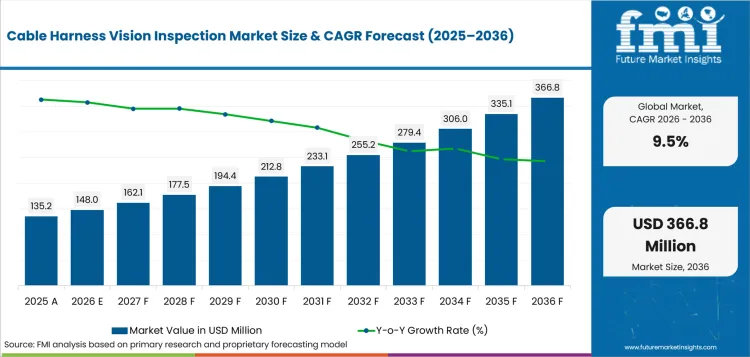
Cable Harness Vision Inspection Market Overview: Size and Forecast
- 2026 Market Size: USD 148.0 million
- 2036 Market Size: USD 366.8 million
- Forecast CAGR: 9.5% from 2026 to 2036
- Leading Deployment: Inline
- Inline Share in 2026: 52.0%
- Leading Technology: 2D Vision Systems
- 2D Vision Systems Share in 2026: 48.0%
- Fastest-growing Country: China
- China CAGR: 11.6% by 2036
Summary of the Cable Harness Vision Inspection Market
- Demand and Growth Drivers
- EV platform wiring raises inspection value as high-voltage connectors, interlock loops, and routed harness paths need visible confirmation before final assembly.
- Mixed-model harness boards require recipe-based checks because wire color order and connector orientation change across vehicle and electronics variants.
- Automated workstations increase demand for pass-fail image records that can be reviewed during customer audits and internal quality investigations.
- Product and Segment View
- Inline deployment is projected to hold 52.0% share in 2026, influenced by station-level rejection before defective harnesses move downstream.
- 2D Vision Systems are expected to secure 48.0% share in 2026, supported by stable color checks, label reading, and presence verification.
- Automotive is forecast to represent 46.0% share in 2026, led by EV wiring density and supplier audit requirements.
- Geography and Competitive Outlook
- China is projected to record 11.6% CAGR by 2036, backed by large automotive output and broad factory automation investment.
- India is estimated to expand at 11.1% CAGR by 2036 as local vehicle assembly and supplier quality upgrades accelerate.
- Cognex and Keyence compete through smart cameras, AI-enabled inspection tools, and strong factory automation channels.
- Basler, Teledyne, Omron, SICK, Balluff, Siemens, Zebra Technologies, and Datalogic support modular vision architectures and integrator-led projects.
- Analyst Opinion
- Nikhil Kaitwade, Principal Consultant at Future Market Insights for industrial domain, says, "Cable harness vision inspection is becoming a production quality gate rather than a camera purchase. Buyers are paying to stop wrong wire colors, missing terminals, and half-seated connectors before a harness enters a larger assembly. Suppliers with strong lighting design, teachable software, and plant integration support should gain preference where false rejects can disrupt operator trust."
Factory automation is setting the adoption floor for cable harness inspection as wiring boards, robotic cells, and final assembly stations require reliable image proof before release. International Federation of Robotics reported 542,000 industrial robots installed in 2024, with Asia accounting for 74% of new deployments. International Energy Agency reported Europe electric car sales reached 4.2 million in 2025, or 28% of new car sales. International Energy Agency also stated China public charging stock expanded from nearly 3.4 million points at end-2024 to more than 4.7 million at end-2025. These figures support demand for industrial machine vision systems that verify harness quality before defects reach vehicle or electronics assembly.
Which factors support expansion in the cable harness vision inspection market?
Finished vision cell revenue, software recipes, image records, and service support are increasing market value across automated harness production lines.
- Market value is supported by camera, lens, lighting, and software revenue before services add recurring validation income.
- Supplier pricing reflects inspection point count, fixture complexity, and cycle-time requirements before AI software affects final project value.
- Revenue improves as harness plants convert final manual checks into inline image-backed quality gates.
- Buyer confidence rises when industrial vision gateways connect camera evidence with work orders, reject logs, and plant quality systems.
Why is the cable harness vision inspection market growing?
EV platforms increase harness inspection intensity as high-voltage routing, connector seating, and terminal position carry higher safety and warranty risk.
Harness inspection demand is changing as assembly plants move quality checks from end-of-line review to station-level confirmation. International Energy Agency stated that nearly 22 million electric cars were produced globally in 2025, up more than 25% from the previous year. That production shift raises harness content per platform and increases visible checks for high-voltage routing, secondary locks, and label readability. Vision suppliers gain when they can prove stable capture across wire colors, reflective terminals, and tight connector cavities. The second driver is traceability across high-mix harness production, as a single harness board may serve multiple variants and operators need fast confirmation of color sequence, connector orientation, and label readability. Demand for vision guided robots also strengthens as robotic insertion and routing cells require camera feedback before the next cycle begins.
How is the cable harness vision inspection market segmented?
The cable harness vision inspection industry is segmented by component, inspection type, deployment, end-use industry, technology, and region.
- Cameras are projected to secure 34.0% share in 2026, led by their role in capturing connector cavities, wire colors, and terminal ends before software classifies the defect.
- Presence/Absence is anticipated to hold 31.0% share in 2026 since missing plugs, clips, seals, and secondary locks remain frequent visible failure points on harness boards.
- Inline deployment is expected to account for 52.0% share in 2026 due to buyer preference for rejecting defects before boards, pallets, or robots move forward.
- Automotive is forecast to represent 46.0% share in 2026, reflected by EV wiring density, supplier audits, and higher downstream cost of harness defects.
- 2D Vision Systems are projected to capture 48.0% share in 2026 as most color, label, and connector presence checks can be handled through stable two-dimensional imaging.
Segmentation is shaped by where the error happens and how quickly the plant must stop it. Cameras and lighting usually enter the bill of materials first, while software gains value when harness programs change often. Automated stations also increase the role of 3D automatic optical inspection machines when connector height, pin depth, or clip seating needs depth confirmation before line release.
Why do cameras dominate the cable harness vision inspection market?
Cable Harness Vision Inspection Market Analysis By Component
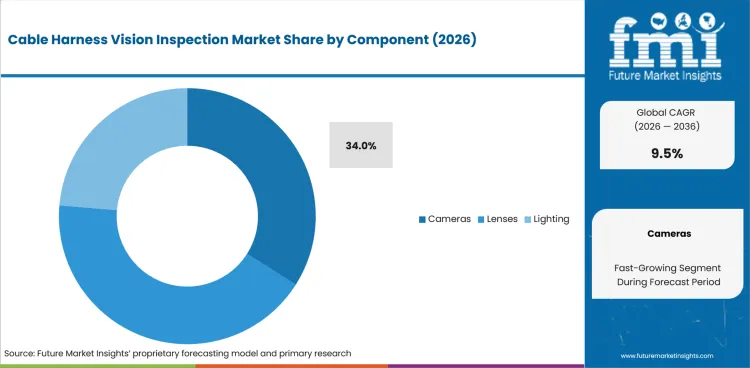
- Cameras are projected to account for 34.0% share in 2026 as connector cavities, wire colors, labels, and terminal ends all need repeatable image capture before a pass-fail decision is made.
- Buyers compare camera packages by sensor resolution, trigger stability, and service support, while machine vision camera demand increases when operators need fewer false rejects on fast-moving harness boards.
Which inspection type leads the cable harness vision inspection market?
Cable Harness Vision Inspection Market Analysis By Inspection Type
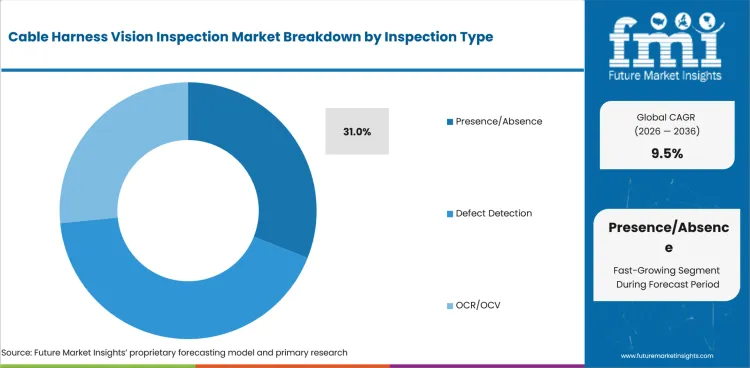
- Presence/Absence is estimated to hold 31.0% share in 2026 as missing seals, clips, secondary locks, and plugs are easy to miss during manual review.
- Harness plants value this check because it gives a clear pass-fail signal, while automated optical inspection systems support repeatable evidence for later defect review.
Which deployment leads the cable harness vision inspection market?
Cable Harness Vision Inspection Market Analysis By Deployment
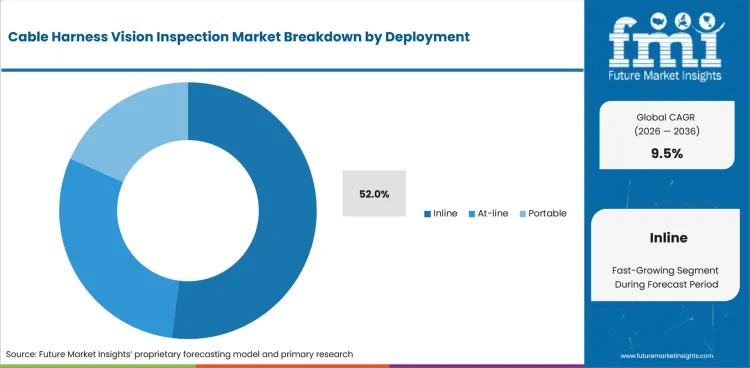
- Inline deployment is anticipated to represent 52.0% share in 2026 as factories reject defects before boards, pallets, or robots move forward.
- Inline systems need cycle-time discipline and low false rejects, which increases the value of compact cameras and proven inspection recipes across the industrial robotics market.
Which end-use industry leads the cable harness vision inspection market?
Cable Harness Vision Inspection Market Analysis By End-use Industry
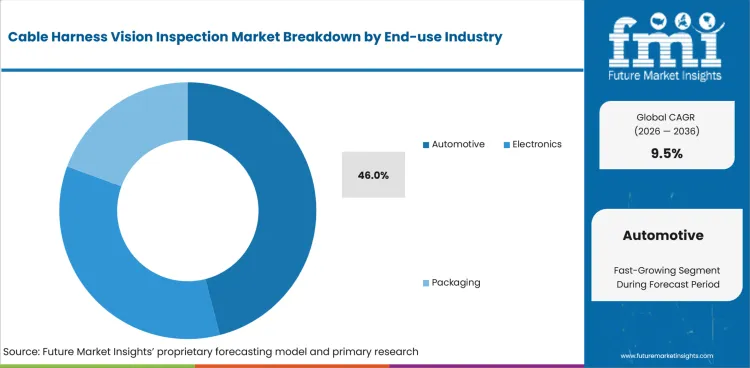
- Automotive is expected to account for 46.0% share in 2026 as EV platforms add higher-value harnesses and stricter safety checks.
- Automotive buyers often ask for image records by work order, shifting supplier selection toward software with traceability and reject image storage.
Which technology leads the cable harness vision inspection market?
Cable Harness Vision Inspection Market Analysis By Technology
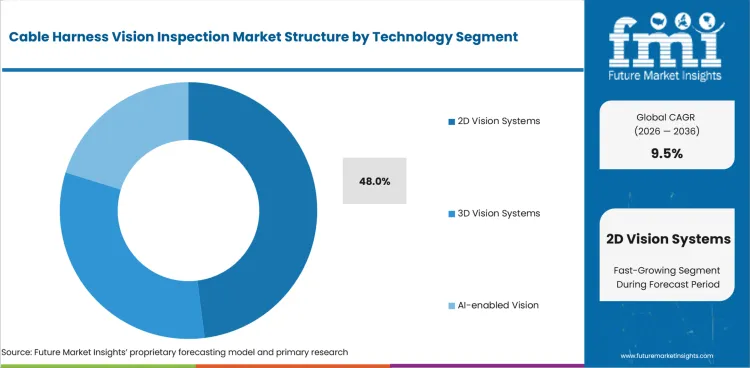
- 2D Vision Systems are projected to hold 48.0% share in 2026 as color verification, label reading, and part presence checks fit stable two-dimensional imaging.
- 3D Vision Systems gain value when depth, height, and terminal seating need confirmation on complex connectors or compact harness fixtures.
What are the drivers, restraints, and opportunities in the cable harness vision inspection market?
EV harness complexity and traceable inspection records support adoption while false rejects and fixture changeover costs restrain wider deployment.
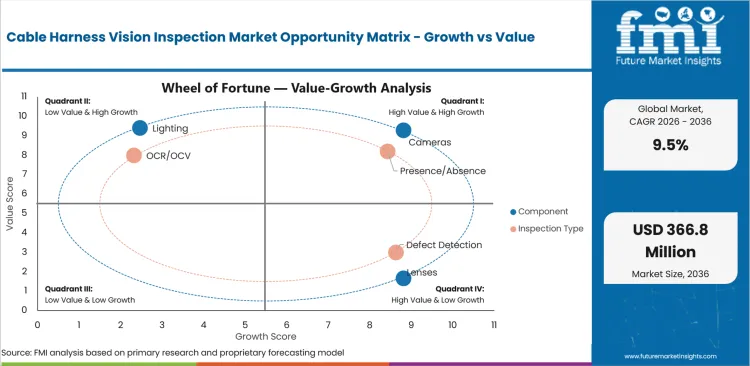
- Driver: EV harness complexity raises inspection value as high-voltage connectors and interlocks need visible confirmation before final assembly.
- Restraint: False reject control limits adoption because unstable lighting or poor fixture exposure can stop acceptable harnesses.
- Opportunity: Traceability creates opportunity as buyers request image records tied to each harness serial number and work order.
Connector Seating Risk and EV Harness Demand Outlook
Connector seating risk turns vision inspection into a production safeguard because a partially seated terminal can pass a quick manual glance and fail later under vibration. National Highway Traffic Safety Administration reported 997 safety recalls in 2025 and more than 29 million recalled vehicles in the United States. That recall exposure gives harness plants a stronger reason to verify visible attributes before release. Systems with controlled lighting, stable camera positioning, and clear reject records are positioned to win where automotive customers require proof of connector, seal, and label checks.
False Reject Control and Integration Cost Discipline
False reject control restrains adoption when plants fear a vision cell will stop production more often than it prevents defects. International Federation of Robotics stated that European robot installations totaled 85,000 units in 2024, with 67,800 installed in the European Union. Automation depth increases inspection opportunities but also raises the cost of unstable setups. Buyers therefore evaluate lighting trials, fixture design, and operator handoff before approving broader deployment. Suppliers with service teams that tune recipes after changeovers can reduce this adoption barrier.
Traceable Image Records and Robotic Vision Opportunity
Traceability creates a clear opportunity as harness plants need defect images connected with work orders, serial numbers, and audit trails. International Federation of Robotics reported that China, Japan, the United States, South Korea, and Germany accounted for 431,240 robot installations in 2024. That concentration supports robotic vision demand because automated handling needs a verified image signal before the next routing or insertion step. Suppliers that integrate camera outputs with plant quality systems can move beyond hardware sales into recipe management and recurring support.
Which countries are growing fastest in the cable harness vision inspection market?
China 11.6% CAGR, India 11.1% CAGR, South Korea 10.1% CAGR, Japan 9.4% CAGR, Germany 8.7% CAGR, United States 8.4% CAGR, France 7.8% CAGR, and United Kingdom 7.2% CAGR through 2036.
.webp "Top Country Growth Comparison Cable Harness Vision Inspection Market Cagr (2026 2036)")
| Country | CAGR |
|---|---|
| United States | 8.4% |
| United Kingdom | 7.2% |
| Germany | 8.7% |
| France | 7.8% |
| Japan | 9.4% |
| China | 11.6% |
| South Korea | 10.1% |
| India | 11.1% |
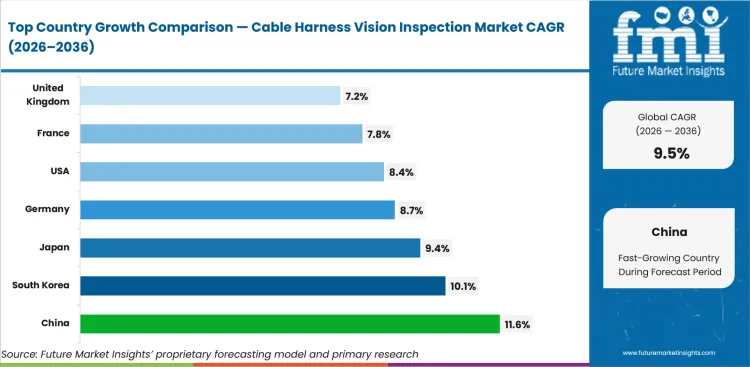
How do country-level CAGRs compare in the cable harness vision inspection market?
China leads country growth while the United Kingdom records the most cautious expansion outlook among profiled markets.
- The United States is expected to expand at 8.4% CAGR from 2026 to 2036 due to automation channels and audit-led harness quality requirements.
- The United Kingdom is forecast to grow at 7.2% CAGR by 2036 as retrofit projects and export-quality expectations support measured adoption.
- Germany is projected to post 8.7% CAGR by 2036 as EV production and automation depth support premium inspection cells.
- France is estimated to rise at 7.8% CAGR through 2036 with automotive, aerospace, and rail wiring creating staged inspection demand.
- Japan is expected to advance at 9.4% CAGR over the forecast period as local vision suppliers support stable inline systems.
- China is forecast to record 11.6% CAGR through 2036 as EV output and factory automation expand the inspection pool.
- South Korea is projected to grow at 10.1% CAGR by 2036 through dense robotics use and electronics-linked harness production.
- India is expected to rise at 11.1% CAGR from 2026 to 2036 as local automotive production and quality upgrades accelerate.
How fast is the cable harness vision inspection market growing in United States?
A 8.4% CAGR through 2036 reflects automation upgrades and harness quality requirements across United States manufacturing corridors.
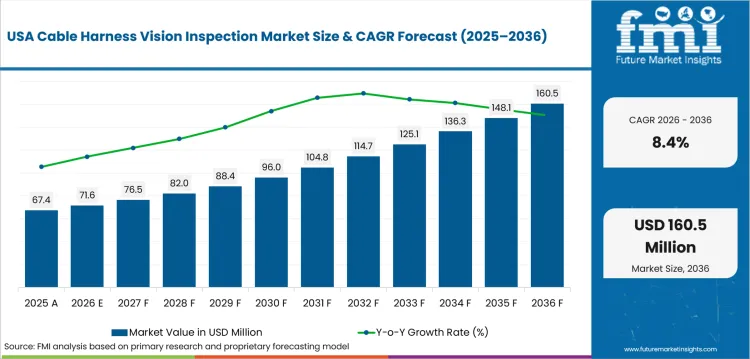
Country Market Snapshot Table
| Parameter | Value |
|---|---|
| Market Size in 2025 (Value) | USD 24.9 million |
| Market Size in 2026 (Value) | USD 27.0 million |
| Market Forecast in 2036 (Value) | USD 60.5 million |
| CAGR (2026 to 2036) | 8.4% |
| Years Considered | 2021 to 2036 |
| Base Year | 2025 |
| Forecast Period | 2026 to 2036 |
| Units Considered | Value (USD million) |
| Leading Sub-Region | Great Lakes and Southern automotive corridors |
United States Cable Harness Vision Inspection Market Outlook
United States cable harness vision inspection demand is shaped by transportation equipment manufacturing, aerospace wiring, and large automation channels. Buyers use vision systems to reduce rework and preserve quality evidence when harness defects can reach customer audits.
Large automotive and electronics buyers often rely on approved integrators, while smaller harness shops test compact cameras through distributors. Suppliers win when they prove stable image capture on real harness boards before full purchase approval.
Key Growth Drivers
- Public charging growth raises EV platform support work. USA Department of Transportation reported more than 206,000 publicly available charging ports in January 2025 after 38,000 new public chargers were turned on during 2024.
- Automation scale supports station-level inspection. International Federation of Robotics reported 34,200 industrial robot installations in the United States during 2024.
- Aerospace and defense wiring programs require careful defect evidence because harness failures can create high downstream correction cost.
- Integrator networks make pilot projects easier for mid-sized harness manufacturers that need camera trials before line conversion.
Key Restraints
- Recall exposure can make buyer approval stricter. National Highway Traffic Safety Administration reported more than 1.1 million pieces of vehicle equipment recalled in 2025.
- High labor and integration costs can delay adoption in low-volume harness lines with limited automation budgets.
- Buyer concern over false rejects makes proof-of-concept trials longer before multi-station rollout.
What makes United States unique
The United States is distinct because buyer decisions often combine automation return with audit risk and workforce availability.
Key Companies
- Cognex Corporation
- Keyence Corporation of America
- Zebra Technologies Corporation
- Omron Automation Americas
- SICK Inc.
- Datalogic USA
- Teledyne Technologies Incorporated
Sales & Marketing Channels
- Direct enterprise sales to automotive Tier 1 suppliers
- Certified system integrator projects for harness boards
- Distributor-led camera and lighting bundles
- OEM automation partnerships for robotic cells
- Service contracts for validation and line tuning
Country Segment Breakdown Table
| Segment | Sub-Segments |
|---|---|
| By Component | Cameras · Lenses · Lighting · Frame Grabbers · Vision Software · Services |
| By Inspection Type | Defect Detection · Measurement · OCR/OCV · Presence/Absence · Guidance |
| By Deployment | Inline · At-line · Robotic Cell · Portable |
| By End-use Industry | Electronics · Automotive · Packaging · Pharmaceuticals · Food & Beverage · Metals |
| By Technology | 2D Vision Systems · 3D Vision Systems · AI-enabled Vision · Line-scan Vision · Multispectral Vision |
| Key Sub-Regions Covered, Manufacturing and Automotive Corridors | Great Lakes · Southeast · Texas · California · New England · Pacific Northwest |
Market Taxonomy and Sub-Regions Covered
Frequently Asked Questions
How fast is United States cable harness vision inspection market growing?
Sales in United States are ready to scale at 8.4% CAGR from 2026 to 2036, guided by automation and harness quality investment.
Who leads United States cable harness vision inspection market?
Cognex Corporation, Keyence Corporation of America, Zebra Technologies Corporation, and Omron Automation Americas compete based on camera platforms, service support, and automation channels.
What is driving adoption in United States cable harness vision inspection market?
EV wiring complexity, automated production cells, and buyer demand for traceable defect images are moving harness suppliers toward vision inspection.
How fast is the cable harness vision inspection market growing in United Kingdom?
A 7.2% CAGR through 2036 reflects automation upgrades and harness quality requirements across United Kingdom manufacturing corridors.
Country Market Snapshot Table
| Parameter | Value |
|---|---|
| Market Size in 2025 (Value) | USD 7.9 million |
| Market Size in 2026 (Value) | USD 8.5 million |
| Market Forecast in 2036 (Value) | USD 17.0 million |
| CAGR (2026 to 2036) | 7.2% |
| Years Considered | 2021 to 2036 |
| Base Year | 2025 |
| Forecast Period | 2026 to 2036 |
| Units Considered | Value (USD million) |
| Leading Sub-Region | Midlands and aerospace-electronics corridors |
United Kingdom Cable Harness Vision Inspection Market Outlook
United Kingdom demand is supported by retrofit manufacturing projects, export-facing quality requirements, and aerospace wiring work. Plants often prefer compact inline or at-line systems because existing facilities may not have space for full new harness boards.
Retail-like speed is not the buying priority in this country. Buyers focus on stable documentation, operator training, and systems that can fit older production layouts without disrupting current workstations.
Key Growth Drivers
- EV infrastructure supports wiring and charging ecosystem suppliers. The United Kingdom government reported more than 82,000 public EV charging devices installed by July 2025.
- Targeted automation creates a retrofit inspection base. International Federation of Robotics reported 2,500 industrial robot installations in the United Kingdom during 2024.
- Aerospace and defense wiring work creates demand for careful inspection and traceable documentation.
- Compact at-line benches help suppliers upgrade harness checks without rebuilding every production line.
Key Restraints
- Export dependence raises defect cost pressure. SMMT reported 555,826 cars exported in 2025, equal to 77.5% of United Kingdom car output.
- Smaller vehicle production scale reduces the number of large greenfield harness inspection lines.
- Older plants can limit available space for inline vision cells and large lighting enclosures.
What makes United Kingdom unique
The United Kingdom stands out as a retrofit and export-quality market rather than a high-volume greenfield market.
Key Companies
- Cognex UK
- Keyence UK
- Omron Electronics UK
- SICK UK
- Datalogic UK
- Zebra Technologies UK
- Teledyne UK Limited
Sales & Marketing Channels
- Automation distributors serving manufacturing plants
- System integrators for retrofit inspection cells
- Direct sales to aerospace and defense suppliers
- OEM approval routes for automotive Tier 1 suppliers
- Service-led upgrades for existing harness boards
Country Segment Breakdown Table
| Segment | Sub-Segments |
|---|---|
| By Component | Cameras · Lenses · Lighting · Frame Grabbers · Vision Software · Services |
| By Inspection Type | Defect Detection · Measurement · OCR/OCV · Presence/Absence · Guidance |
| By Deployment | Inline · At-line · Robotic Cell · Portable |
| By End-use Industry | Electronics · Automotive · Packaging · Pharmaceuticals · Food & Beverage · Metals |
| By Technology | 2D Vision Systems · 3D Vision Systems · AI-enabled Vision · Line-scan Vision · Multispectral Vision |
| Key Sub-Regions Covered, Manufacturing and Automotive Corridors | Midlands · North East · Wales · Scotland · London · South East |
Market Taxonomy and Sub-Regions Covered
Frequently Asked Questions
How fast is United Kingdom cable harness vision inspection market growing?
Sales in United Kingdom are ready to scale at 7.2% CAGR from 2026 to 2036, guided by automation and harness quality investment.
Who leads United Kingdom cable harness vision inspection market?
Cognex UK, Keyence UK, Omron Electronics UK, and SICK UK compete based on camera platforms, service support, and automation channels.
What is driving adoption in United Kingdom cable harness vision inspection market?
EV wiring complexity, automated production cells, and buyer demand for traceable defect images are moving harness suppliers toward vision inspection.
How fast is the cable harness vision inspection market growing in Germany?
A 8.7% CAGR through 2036 reflects automation upgrades and harness quality requirements across Germany manufacturing corridors.
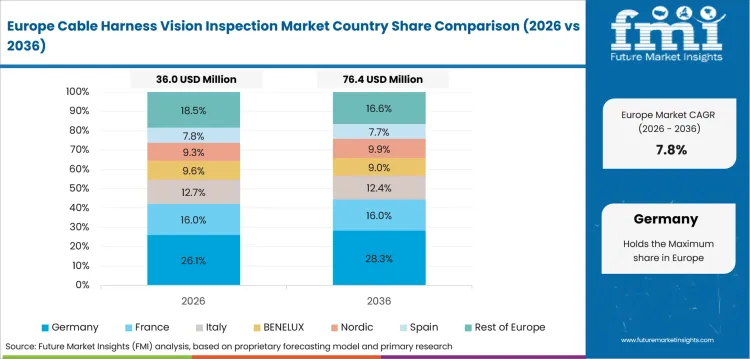
Country Market Snapshot Table
| Parameter | Value |
|---|---|
| Market Size in 2025 (Value) | USD 12.4 million |
| Market Size in 2026 (Value) | USD 13.5 million |
| Market Forecast in 2036 (Value) | USD 31.0 million |
| CAGR (2026 to 2036) | 8.7% |
| Years Considered | 2021 to 2036 |
| Base Year | 2025 |
| Forecast Period | 2026 to 2036 |
| Units Considered | Value (USD million) |
| Leading Sub-Region | Bavaria and Baden-Württemberg automotive clusters |
Germany Cable Harness Vision Inspection Market Outlook
Germany cable harness vision inspection demand is shaped by EV production, premium vehicle platforms, and deep factory automation know-how. Buyers expect careful validation because harness failures can affect safety-critical electrical systems.
The supplier environment supports advanced inspection through local camera, sensor, and automation companies. Plants usually evaluate lighting quality, lifecycle support, and data integration before approving broader deployment.
Key Growth Drivers
- EV production raises high-voltage harness inspection needs. International Energy Agency reported German electric car sales increased by 50% in 2025 to a record 850,000 units.
- Automation depth supports inline quality gates. International Federation of Robotics reported 26,982 industrial robot installations in Germany during 2024, equal to 32% of Europe installations.
- Local camera and sensor suppliers support faster technical evaluation for demanding automotive harness projects.
- Premium vehicle platforms make image-backed proof more important during supplier qualification.
Key Restraints
- Order volatility can delay new inspection spending. The Federal Statistical Office of Germany reported automotive manufacturing orders declined by 6.3% in December 2025.
- Long validation cycles slow new supplier entry into automotive plants with strict quality approval routines.
- High expectations for documentation raise integration costs for smaller system providers.
What makes Germany unique
Germany is the clearest market for premium inspection cells connected with EV quality and factory automation depth.
Key Companies
- Basler AG
- Siemens AG
- SICK AG
- Balluff GmbH
- Cognex Germany
- Keyence Deutschland GmbH
- Omron Electronics GmbH
Sales & Marketing Channels
- Direct sales to automotive Tier 1 suppliers
- Machine builder partnerships for harness boards
- PLC and factory software integration routes
- Distributor networks for cameras and lighting
- Validation-led pilots inside EV component plants
Country Segment Breakdown Table
| Segment | Sub-Segments |
|---|---|
| By Component | Cameras · Lenses · Lighting · Frame Grabbers · Vision Software · Services |
| By Inspection Type | Defect Detection · Measurement · OCR/OCV · Presence/Absence · Guidance |
| By Deployment | Inline · At-line · Robotic Cell · Portable |
| By End-use Industry | Electronics · Automotive · Packaging · Pharmaceuticals · Food & Beverage · Metals |
| By Technology | 2D Vision Systems · 3D Vision Systems · AI-enabled Vision · Line-scan Vision · Multispectral Vision |
| Key Sub-Regions Covered, Manufacturing and Automotive Corridors | Bavaria · Baden-Württemberg · Lower Saxony · North Rhine-Westphalia · Saxony · Hesse |
Market Taxonomy and Sub-Regions Covered
Frequently Asked Questions
How fast is Germany cable harness vision inspection market growing?
Sales in Germany are ready to scale at 8.7% CAGR from 2026 to 2036, guided by automation and harness quality investment.
Who leads Germany cable harness vision inspection market?
Basler AG, Siemens AG, SICK AG, and Balluff GmbH compete based on camera platforms, service support, and automation channels.
What is driving adoption in Germany cable harness vision inspection market?
EV wiring complexity, automated production cells, and buyer demand for traceable defect images are moving harness suppliers toward vision inspection.
How fast is the cable harness vision inspection market growing in France?
A 7.8% CAGR through 2036 reflects automation upgrades and harness quality requirements across France manufacturing corridors.
Country Market Snapshot Table
| Parameter | Value |
|---|---|
| Market Size in 2025 (Value) | USD 6.5 million |
| Market Size in 2026 (Value) | USD 7.0 million |
| Market Forecast in 2036 (Value) | USD 14.8 million |
| CAGR (2026 to 2036) | 7.8% |
| Years Considered | 2021 to 2036 |
| Base Year | 2025 |
| Forecast Period | 2026 to 2036 |
| Units Considered | Value (USD million) |
| Leading Sub-Region | Ile-de-France and Auvergne-Rhone-Alpes corridors |
France Cable Harness Vision Inspection Market Outlook
France demand is supported by automotive supplier quality, aerospace wiring, rail equipment, and industrial electronics. Buyers often choose staged projects when model allocation is uncertain and existing plants require retrofit work.
The market is not as high-volume as East Asia, but it has a strong documentation case. Suppliers should lead with traceability, operator simplicity, and service support for line changeovers.
Key Growth Drivers
- EV infrastructure supports downstream harness and charging equipment checks. International Energy Agency reported France had 185,000 public charging points by the end of 2025.
- Factory automation supports selected inspection projects. International Federation of Robotics reported 4,900 industrial robot installations in France during 2024.
- Aerospace and rail wiring applications add demand outside passenger vehicle assembly.
- European quality audits encourage image-backed inspection records for harness suppliers serving export programs.
Key Restraints
- EV incentive changes can make automotive demand less predictable. Service-Public.fr listed 2025 electric car support amounts of EUR 4,200 and EUR 3,100 under the revised ecological bonus.
- Plant allocation uncertainty can slow large inline inspection projects in some automotive corridors.
- Retrofit complexity can raise project cost in older facilities with limited space around harness boards.
What makes France unique
France combines automotive supplier demand with aerospace and rail wiring use cases that require careful documentation.
Key Companies
- Cognex France
- Keyence France
- Omron Electronics SAS
- SICK France
- Datalogic France
- Teledyne France
- Zebra Technologies France
Sales & Marketing Channels
- Tier 1 supplier qualification routes
- Local automation integrator projects
- Aerospace supplier quality programs
- Distributor sales for cameras and lighting
- Service-led retrofit projects in existing plants
Country Segment Breakdown Table
| Segment | Sub-Segments |
|---|---|
| By Component | Cameras · Lenses · Lighting · Frame Grabbers · Vision Software · Services |
| By Inspection Type | Defect Detection · Measurement · OCR/OCV · Presence/Absence · Guidance |
| By Deployment | Inline · At-line · Robotic Cell · Portable |
| By End-use Industry | Electronics · Automotive · Packaging · Pharmaceuticals · Food & Beverage · Metals |
| By Technology | 2D Vision Systems · 3D Vision Systems · AI-enabled Vision · Line-scan Vision · Multispectral Vision |
| Key Sub-Regions Covered, Manufacturing and Automotive Corridors | Ile-de-France · Auvergne-Rhone-Alpes · Hauts-de-France · Grand Est · Occitanie · Nouvelle-Aquitaine |
Market Taxonomy and Sub-Regions Covered
Frequently Asked Questions
How fast is France cable harness vision inspection market growing?
Sales in France are ready to scale at 7.8% CAGR from 2026 to 2036, guided by automation and harness quality investment.
Who leads France cable harness vision inspection market?
Cognex France, Keyence France, Omron Electronics SAS, and SICK France compete based on camera platforms, service support, and automation channels.
What is driving adoption in France cable harness vision inspection market?
EV wiring complexity, automated production cells, and buyer demand for traceable defect images are moving harness suppliers toward vision inspection.
How fast is the cable harness vision inspection market growing in Japan?
A 9.4% CAGR through 2036 reflects automation upgrades and harness quality requirements across Japan manufacturing corridors.
Country Market Snapshot Table
| Parameter | Value |
|---|---|
| Market Size in 2025 (Value) | USD 15.5 million |
| Market Size in 2026 (Value) | USD 17.0 million |
| Market Forecast in 2036 (Value) | USD 41.8 million |
| CAGR (2026 to 2036) | 9.4% |
| Years Considered | 2021 to 2036 |
| Base Year | 2025 |
| Forecast Period | 2026 to 2036 |
| Units Considered | Value (USD million) |
| Leading Sub-Region | Chubu and Kanto manufacturing corridors |
Japan Cable Harness Vision Inspection Market Outlook
Japan demand is shaped by automotive production, electronics manufacturing, and a quality culture that values low false rejects. Local vision suppliers make inspection technology familiar to plant teams and machine builders.
Buyers often prioritize stability and service support over headline software features. This supports suppliers with proven lighting, reliable cameras, and inspection recipes that can run for long periods without operator frustration.
Key Growth Drivers
- Vehicle production supports harness inspection demand. Japan Automobile Manufacturers Association reported motor vehicle production totals of 8.23 million units in its 2025 industry report.
- Automation familiarity supports inline quality checks. International Federation of Robotics reported 44,500 industrial robot installations in Japan during 2024.
- Local vision suppliers shorten evaluation cycles for automotive and electronics harness plants.
- Precision manufacturing culture favors stable inspection recipes over low-cost generic camera packages.
Key Restraints
- EV platform conversion can move gradually. International Energy Agency reported Japanese electric car sales were just above 100,000 units in 2025 and below 3% of sales.
- Mature plants may extend existing manual and at-line checks longer before full inline conversion.
- Strong supplier qualification rules can slow new entrant access to automotive harness projects.
What makes Japan unique
Japan is unique because local vision suppliers and quality culture create demand for highly stable inspection rather than lowest-cost systems.
Key Companies
- Keyence Corporation
- Omron Corporation
- Cognex Japan
- SICK Japan
- Basler Japan
- Datalogic Japan
- Teledyne Japan
Sales & Marketing Channels
- Direct sales to automotive and electronics manufacturers
- Factory automation distributor networks
- OEM machine builder channels
- Integrator-led inspection cell projects
- Service support tied to line changeovers
Country Segment Breakdown Table
| Segment | Sub-Segments |
|---|---|
| By Component | Cameras · Lenses · Lighting · Frame Grabbers · Vision Software · Services |
| By Inspection Type | Defect Detection · Measurement · OCR/OCV · Presence/Absence · Guidance |
| By Deployment | Inline · At-line · Robotic Cell · Portable |
| By End-use Industry | Electronics · Automotive · Packaging · Pharmaceuticals · Food & Beverage · Metals |
| By Technology | 2D Vision Systems · 3D Vision Systems · AI-enabled Vision · Line-scan Vision · Multispectral Vision |
| Key Sub-Regions Covered, Manufacturing and Automotive Corridors | Chubu · Kanto · Kansai · Kyushu · Tohoku · Hiroshima |
Market Taxonomy and Sub-Regions Covered
Frequently Asked Questions
How fast is Japan cable harness vision inspection market growing?
Sales in Japan are ready to scale at 9.4% CAGR from 2026 to 2036, guided by automation and harness quality investment.
Who leads Japan cable harness vision inspection market?
Keyence Corporation, Omron Corporation, Cognex Japan, and SICK Japan compete based on camera platforms, service support, and automation channels.
What is driving adoption in Japan cable harness vision inspection market?
EV wiring complexity, automated production cells, and buyer demand for traceable defect images are moving harness suppliers toward vision inspection.
How fast is the cable harness vision inspection market growing in China?
A 11.6% CAGR through 2036 reflects automation upgrades and harness quality requirements across China manufacturing corridors.
Country Market Snapshot Table
| Parameter | Value |
|---|---|
| Market Size in 2025 (Value) | USD 31.4 million |
| Market Size in 2026 (Value) | USD 35.0 million |
| Market Forecast in 2036 (Value) | USD 104.8 million |
| CAGR (2026 to 2036) | 11.6% |
| Years Considered | 2021 to 2036 |
| Base Year | 2025 |
| Forecast Period | 2026 to 2036 |
| Units Considered | Value (USD million) |
| Leading Sub-Region | Yangtze River Delta and Pearl River Delta |
China Cable Harness Vision Inspection Market Outlook
China cable harness vision inspection demand is driven by EV output, electronics assembly, appliances, and large factory automation programs. Buyers value throughput, price-performance, and fast local service when selecting inspection systems.
Domestic integrators compete with global camera and sensor suppliers. Plants often demand quick proof that a system can handle high-volume boards while keeping false rejects under control.
Key Growth Drivers
- Automation scale creates a large installed base for inspection upgrades. International Federation of Robotics reported 295,000 industrial robot installations in China during 2024, equal to 54% of global deployments.
- EV sales create strong harness complexity. International Energy Agency reported China sold more than 13 million electric cars in 2025, reaching nearly 55% of new car sales.
- Local integrators help factories tune camera positions, lighting, and fixtures across high-volume harness programs.
- Electronics and appliance manufacturing add demand for compact cable and connector inspection beyond automotive plants.
Key Restraints
- Policy pressure can increase supplier discipline. The State Council reported a 2025 auto sales target of about 32.3 million vehicles and more than 60 measures for sector stabilization.
- Price pressure can compress margins for high-spec inspection systems in competitive factory projects.
- Fast program turnover can make recipe management and fixture maintenance difficult for smaller suppliers.
What makes China unique
China is unique because high EV output, electronics scale, and domestic integration capacity create the broadest deployment pool.
Key Companies
- Cognex China
- Keyence China
- Hikrobot
- Daheng Imaging
- OPT Machine Vision
- Omron China
- SICK China
Sales & Marketing Channels
- Direct sales to EV and electronics manufacturers
- Domestic system integrator projects
- Camera and lighting distributor channels
- Robotic cell builder partnerships
- Service contracts for high-volume plants
Country Segment Breakdown Table
| Segment | Sub-Segments |
|---|---|
| By Component | Cameras · Lenses · Lighting · Frame Grabbers · Vision Software · Services |
| By Inspection Type | Defect Detection · Measurement · OCR/OCV · Presence/Absence · Guidance |
| By Deployment | Inline · At-line · Robotic Cell · Portable |
| By End-use Industry | Electronics · Automotive · Packaging · Pharmaceuticals · Food & Beverage · Metals |
| By Technology | 2D Vision Systems · 3D Vision Systems · AI-enabled Vision · Line-scan Vision · Multispectral Vision |
| Key Sub-Regions Covered, Manufacturing and Automotive Corridors | Yangtze River Delta · Pearl River Delta · Beijing-Tianjin-Hebei · Chongqing · Wuhan · Chengdu |
Market Taxonomy and Sub-Regions Covered
Frequently Asked Questions
How fast is China cable harness vision inspection market growing?
Sales in China are ready to scale at 11.6% CAGR from 2026 to 2036, guided by automation and harness quality investment.
Who leads China cable harness vision inspection market?
Cognex China, Keyence China, Hikrobot, and Daheng Imaging compete based on camera platforms, service support, and automation channels.
What is driving adoption in China cable harness vision inspection market?
EV wiring complexity, automated production cells, and buyer demand for traceable defect images are moving harness suppliers toward vision inspection.
How fast is the cable harness vision inspection market growing in South Korea?
A 10.1% CAGR through 2036 reflects automation upgrades and harness quality requirements across South Korea manufacturing corridors.
Country Market Snapshot Table
| Parameter | Value |
|---|---|
| Market Size in 2025 (Value) | USD 9.5 million |
| Market Size in 2026 (Value) | USD 10.5 million |
| Market Forecast in 2036 (Value) | USD 27.5 million |
| CAGR (2026 to 2036) | 10.1% |
| Years Considered | 2021 to 2036 |
| Base Year | 2025 |
| Forecast Period | 2026 to 2036 |
| Units Considered | Value (USD million) |
| Leading Sub-Region | Gyeonggi, Ulsan, and Chungcheong corridors |
South Korea Cable Harness Vision Inspection Market Outlook
South Korea demand is shaped by dense robotics use, battery manufacturing, electronics assembly, and automotive harness quality needs. Buyers expect compact automation, fast service, and reliable integration with existing production systems.
The country has a strong base of precision manufacturing, which makes image-backed checks attractive for high-value cable assemblies. Suppliers gain when they can support both automotive harnesses and electronics connectors.
Key Growth Drivers
- Dense robot use supports automated inspection cells. International Federation of Robotics reported South Korea had 1,220 robots per 10,000 manufacturing employees in 2024.
- EV production supports high-voltage harness quality checks. The USA International Trade Administration reported South Korea produced 407,009 EVs in 2025, equal to 11% of total automobile production.
- Battery and electronics manufacturing add demand for connector and cable inspection beyond passenger vehicles.
- Local automation familiarity helps plants adopt recipe-based inspection with shorter training cycles.
Key Restraints
- Some commercial EV segments remain uneven. International Energy Agency reported Korean electric light commercial vehicle sales were around 16,000 in 2025, about 60% below their 2023 peak.
- High factory uptime expectations make buyers cautious about systems that may create false stops.
- Strong local supplier relationships can slow entry for newer foreign vision platforms.
What makes South Korea unique
South Korea is unique because dense robotics use and electronics manufacturing create a strong base for compact inspection automation.
Key Companies
- Cognex Korea
- Keyence Korea
- Omron Electronics Korea
- SICK Korea
- Datalogic Korea
- Teledyne DALSA Korea
- Samsung SDS automation partners
Sales & Marketing Channels
- Direct sales to automotive and battery suppliers
- Automation distributor networks
- Integrator-led robotic cell projects
- Electronics manufacturing service channels
- Service-led lighting and recipe optimization
Country Segment Breakdown Table
| Segment | Sub-Segments |
|---|---|
| By Component | Cameras · Lenses · Lighting · Frame Grabbers · Vision Software · Services |
| By Inspection Type | Defect Detection · Measurement · OCR/OCV · Presence/Absence · Guidance |
| By Deployment | Inline · At-line · Robotic Cell · Portable |
| By End-use Industry | Electronics · Automotive · Packaging · Pharmaceuticals · Food & Beverage · Metals |
| By Technology | 2D Vision Systems · 3D Vision Systems · AI-enabled Vision · Line-scan Vision · Multispectral Vision |
| Key Sub-Regions Covered, Manufacturing and Automotive Corridors | Gyeonggi · Ulsan · Busan · Daegu · Chungcheong · Gwangju |
Market Taxonomy and Sub-Regions Covered
Frequently Asked Questions
How fast is South Korea cable harness vision inspection market growing?
Sales in South Korea are ready to scale at 10.1% CAGR from 2026 to 2036, guided by automation and harness quality investment.
Who leads South Korea cable harness vision inspection market?
Cognex Korea, Keyence Korea, Omron Electronics Korea, and SICK Korea compete based on camera platforms, service support, and automation channels.
What is driving adoption in South Korea cable harness vision inspection market?
EV wiring complexity, automated production cells, and buyer demand for traceable defect images are moving harness suppliers toward vision inspection.
How fast is the cable harness vision inspection market growing in India?
A 11.1% CAGR through 2036 reflects automation upgrades and harness quality requirements across India manufacturing corridors.
Country Market Snapshot Table
| Parameter | Value |
|---|---|
| Market Size in 2025 (Value) | USD 9.9 million |
| Market Size in 2026 (Value) | USD 11.0 million |
| Market Forecast in 2036 (Value) | USD 31.5 million |
| CAGR (2026 to 2036) | 11.1% |
| Years Considered | 2021 to 2036 |
| Base Year | 2025 |
| Forecast Period | 2026 to 2036 |
| Units Considered | Value (USD million) |
| Leading Sub-Region | Tamil Nadu, Maharashtra, and Gujarat corridors |
India Cable Harness Vision Inspection Market Outlook
India demand is supported by automotive production, electronics assembly, and supplier quality upgrades across industrial corridors. Buyers often start with at-line or portable systems before moving toward fully inline inspection.
The market is price-sensitive, but demand rises when defects affect export programs and customer scorecards. Suppliers need local service, operator training, and simple software recipes to support adoption beyond large plants.
Key Growth Drivers
- Automation is building from a smaller base. International Federation of Robotics reported 9,100 industrial robot installations in India during 2024, up 7% from the previous year.
- EV transition supports wiring checks in two-wheeler and component supply chains. International Energy Agency reported Indian electric two-wheeler sales were less than 1.3 million in 2025, around 6% of two-wheeler sales.
- Local vehicle and electronics clusters create staged demand for camera, lighting, and fixture upgrades.
- System integrators can win by offering practical training and low-maintenance inspection recipes for mid-sized suppliers.
Key Restraints
- Scheme execution gaps can slow EV supply-chain upgrades. Press Information Bureau reported 16,56,335 EVs incentivised against a revised target of 28,26,634 under PM E-DRIVE as of January 31, 2026.
- Price sensitivity can delay adoption when plants compare vision cells with manual inspection labor.
- Smaller harness shops may lack fixture engineering skills needed for repeatable image capture.
What makes India unique
India is unique because supplier upgrades are moving from manual checks toward scalable inspection in automotive and electronics corridors.
Key Companies
- Cognex India
- Keyence India
- Omron Automation India
- SICK India
- Datalogic India
- Zebra Technologies India
- Teledyne India
Sales & Marketing Channels
- Direct sales to automotive Tier 1 suppliers
- Automation distributors in industrial clusters
- Integrator-led inspection cell projects
- OEM qualification for export supply chains
- Service packages for training and fixture tuning
Country Segment Breakdown Table
| Segment | Sub-Segments |
|---|---|
| By Component | Cameras · Lenses · Lighting · Frame Grabbers · Vision Software · Services |
| By Inspection Type | Defect Detection · Measurement · OCR/OCV · Presence/Absence · Guidance |
| By Deployment | Inline · At-line · Robotic Cell · Portable |
| By End-use Industry | Electronics · Automotive · Packaging · Pharmaceuticals · Food & Beverage · Metals |
| By Technology | 2D Vision Systems · 3D Vision Systems · AI-enabled Vision · Line-scan Vision · Multispectral Vision |
| Key Sub-Regions Covered, Manufacturing and Automotive Corridors | Tamil Nadu · Maharashtra · Gujarat · Karnataka · Haryana · Uttar Pradesh |
Market Taxonomy and Sub-Regions Covered
Frequently Asked Questions
How fast is India cable harness vision inspection market growing?
Sales in India are ready to scale at 11.1% CAGR from 2026 to 2036, guided by automation and harness quality investment.
Who leads India cable harness vision inspection market?
Cognex India, Keyence India, Omron Automation India, and SICK India compete based on camera platforms, service support, and automation channels.
What is driving adoption in India cable harness vision inspection market?
EV wiring complexity, automated production cells, and buyer demand for traceable defect images are moving harness suppliers toward vision inspection.
Who are the leading companies in the cable harness vision inspection market?
Cognex, Keyence, Omron, SICK and Basler.
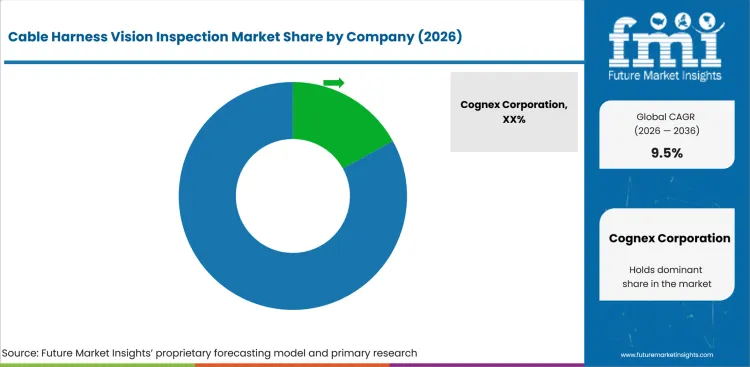
- Established machine vision companies hold an advantage through smart camera portfolios and factory automation channel depth.
- Specialist imaging suppliers gain projects by offering sensor depth, lighting compatibility and integrator support for fixture-heavy harness boards.
- Traceability and identification companies gain acceptance when harness images must connect with work orders, labels and plant quality records.
- Service-ready automation suppliers support trials through lighting studies, false-reject tuning and recipe maintenance after line changeovers.
Machine vision companies in the market compete by combining image capture, inspection software and plant-level integration. Cognex and Keyence remain strong in smart camera and edge inspection systems where connector presence, color checks and label reading must happen within tight cycle times. Omron and SICK compete through automation platforms, sensors and inspection systems connected with factory controls. Basler and Teledyne support modular camera architectures used by integrators and machine builders.
Integration capability has become a competitive separator as harness inspection projects require fixture design and lighting trials before deployment. Buyers are not selecting a camera in isolation. They are selecting a system that can see terminals inside connector cavities, handle reflective metal, reduce false rejects and retain defect images. This is why suppliers linked to inspection machines and AI industrial defect detection can gain when they combine hardware with repeatable quality evidence.
Regional and specialist suppliers can win through fast service and low-friction installation. China and India create opportunities for local integrators that tune systems quickly inside high-volume plants. Germany and Japan reward suppliers with strong validation discipline and stable inspection recipes. The best-positioned companies will combine camera quality, lighting control, software records and service support instead of selling generic imaging hardware.
How do top cable harness vision inspection companies compare?
Cognex and Keyence score strongest on smart-camera depth while Omron and SICK lead through factory automation integration.
| Company | Relevance to Market Title | Vision Portfolio Depth | Harness Inspection Fit | Factory Integration | Channel Reach | Geographic Footprint |
|---|---|---|---|---|---|---|
| Cognex Corporation | Very High | Very Strong | Very Strong | Strong | Very Strong | Global |
| Keyence Corporation | Very High | Very Strong | Very Strong | Very Strong | Very Strong | Global |
| Omron Corporation | High | Strong | Strong | Very Strong | Strong | Global |
| SICK AG | High | Strong | Strong | Very Strong | Strong | Global |
| Basler AG | High | Very Strong | Strong | Moderate | Strong | Europe and Global |
| Teledyne Technologies | High | Very Strong | Strong | Moderate | Strong | Global |
| Balluff GmbH | Moderate to High | Strong | Moderate | Strong | Moderate | Europe and Global |
| Zebra Technologies | Moderate to High | Moderate | Strong | Strong | Very Strong | Global |
| Datalogic S.p.A. | Moderate to High | Strong | Strong | Strong | Strong | Europe and Global |
| Siemens AG | Moderate | Moderate | Moderate | Very Strong | Very Strong | Global |
Source: Future Market Insights competitive analysis, 2026.
Who are the key players in the cable harness vision inspection market?
Cognex Corporation, Keyence Corporation and Omron Corporation are listed with SICK and Basler among other suppliers.
Key global companies leading the cable harness vision inspection market include:
- Cognex Corporation
- Keyence Corporation
- Omron Corporation
- SICK AG
- Basler AG
- Teledyne Technologies Incorporated
- Balluff GmbH
- Zebra Technologies Corporation
- Datalogic S.p.A.
- Siemens AG
Key Developments in Cable Harness Vision Inspection Market
- In May 2026, Cognex launched the In-Sight 3900 high-performance AI vision system for factory automation inspection applications.
- In March 2026, Basler AG and Orbbec announced a 3D camera partnership for factory automation and logistics applications.
- In October 2025, Datalogic and Datasensing presented machine vision and safety innovations at SPS Nuremberg for industrial automation.
Key Players in the Cable Harness Vision Inspection Market
Global Machine Vision Leaders
- Cognex Corporation
- Keyence Corporation
- Omron Corporation
- SICK AG
- Siemens AG
Specialist Imaging Suppliers
- Basler AG
- Teledyne Technologies Incorporated
- Balluff GmbH
- Hikrobot
Traceability and Identification Players
- Zebra Technologies Corporation
- Datalogic S.p.A.
- Datasensing S.r.l.
- OPT Machine Vision
Cable Harness Vision Inspection Market - Report Scope
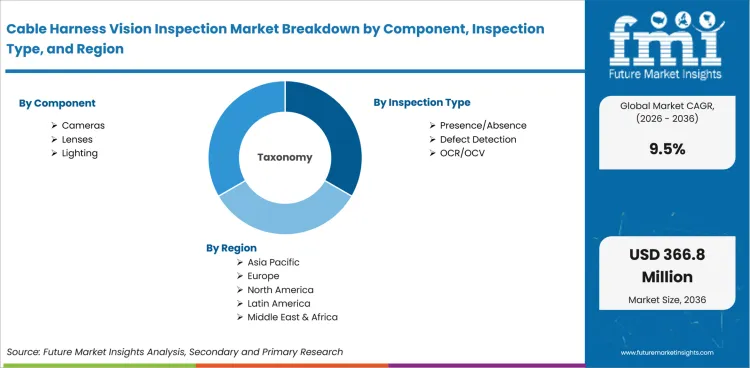
| Parameter | Details |
|---|---|
| Forecast period | 2026 to 2036 |
| Historical period | 2021 to 2025 |
| Quantitative unit | Revenue in USD million |
| By component | Cameras, lenses, lighting, frame grabbers, vision software, services |
| By inspection type | Defect detection, measurement, OCR/OCV, presence/absence, guidance |
| By deployment | Inline, at-line, robotic cell, portable |
| By end-use industry | Electronics, automotive, packaging, pharmaceuticals, food and beverage, metals |
| By technology | 2D vision systems, 3D vision systems, AI-enabled vision, line-scan vision, multispectral vision |
| Regions covered | North America, Latin America, Europe, East Asia, South Asia and Pacific, Middle East and Africa |
| Countries covered | United States, United Kingdom, Germany, France, Japan, China, South Korea, India |
| Key companies profiled | Cognex, Keyence, Omron, SICK, Basler, Teledyne, Balluff, Zebra Technologies, Datalogic, Siemens |
| Approach | Bottom-up system-boundary approach using project revenue, component mix, inspection point density, end-use demand, and country-level automation readiness |
Source: Future Market Insights, 2026.
Cable Harness Vision Inspection Market - Scope & Definition
| Attribute | Detail |
|---|---|
| Market Definition | Camera-based inspection systems used to visually verify cable and wire harness assemblies during or after production. |
| Functions Covered | Connector verification, wire color order checking, terminal position inspection, clip presence detection, label readability, routing confirmation, OCR/OCV, and image-backed defect logging. |
| Applications Covered | Inline harness boards, at-line benches, robotic cells, portable inspection stations, connector loading checks, terminal seating checks, label checks, and routing verification. |
| End-Use Industries | Electronics, automotive, packaging, pharmaceuticals, food and beverage, metals, and selected industrial manufacturing applications. |
| Technologies Covered | 2D vision systems, 3D vision systems, AI-enabled vision, line-scan vision, multispectral vision, smart cameras, lighting, lenses, and image-processing software. |
| Inclusions | Commercial camera-based harness inspection systems, software, services, inline cells, at-line benches, robotic cell inspection, portable tools, and country-level demand from 2026 to 2036. |
| Exclusions | Electrical continuity-only testers, pull-force testers, manual inspection tools, consumer cameras, security cameras, general microscopes without automated inspection software, and full harness manufacturing revenue outside visual inspection scope. |
Cable Harness Vision Inspection Market - Research Methodology
| Method | Description |
|---|---|
| Primary Research | FMI analyst interviews with harness manufacturers, automotive Tier 1 suppliers, electronics assembly plants, machine builders, system integrators, and quality managers across key markets. |
| Desk Research | Review of automation statistics, EV adoption data, public recall evidence, official company releases, product documentation, and credible industry association material related to machine vision and harness inspection. |
| Market Sizing & Forecasting | Bottom-up system-boundary approach using project revenue, inspection point density, component mix, end-use demand, deployment type, and country-level automation readiness. |
| Data Validation | Cross-verification using robotics adoption, EV platform growth, supplier portfolios, company launches, country manufacturing patterns, and direct cable harness inspection use cases. |
Cable Harness Vision Inspection Market Breakdown by Component, Inspection Type, Deployment, End-use Industry, Technology, and Region
Cable Harness Vision Inspection Market Segmented by Component
- Cameras
- Lenses
- Lighting
- Frame Grabbers
- Vision Software
- Services
Cable Harness Vision Inspection Market Segmented by Inspection Type
- Defect Detection
- Measurement
- OCR/OCV
- Presence/Absence
- Guidance
Cable Harness Vision Inspection Market Segmented by Deployment
- Inline
- At-line
- Robotic Cell
- Portable
Cable Harness Vision Inspection Market Segmented by End-use Industry
- Electronics
- Automotive
- Packaging
- Pharmaceuticals
- Food & Beverage
- Metals
Cable Harness Vision Inspection Market Segmented by Technology
- 2D Vision Systems
- 3D Vision Systems
- AI-enabled Vision
- Line-scan Vision
- Multispectral Vision
Cable Harness Vision Inspection Market by Region
- North America
- Latin America
- Europe
- East Asia
- South Asia and Pacific
- Middle East and Africa
Research Sources and Bibliography
- Basler AG. (2026, March 25). Basler AG and Orbbec: New 3D vision camera for industry.
- Cognex Corporation. (2026, May 5). Cognex launches In-Sight 3900 high-performance AI vision system.
- Datalogic S.p.A. (2025, October 28). Datalogic and Datasensing at SPS Nuremberg 2025.
- Department for Transport. (2025, July 24). Electric boost: EV chargepoints in the UK grow by 27% in a year.
- Department for Transport. (2025, October 17). Updates to the Vehicle Emissions Trading Schemes Order 2023.
- Federal Statistical Office of Germany. (2026, February 19). Stock of orders in manufacturing in December 2025.
- International Energy Agency. (2026, May 20). Global EV Outlook 2026.
- International Federation of Robotics. (2025, September 25). World Robotics 2025 report: Industrial robots.
- Japan Automobile Manufacturers Association. (2025, September 26). The motor industry of Japan 2025.
- National Highway Traffic Safety Administration. (2026, January). Vehicle Safety Recalls Week.
- Press Information Bureau. (2026, February 3). PM E-DRIVE scheme.
- Service-Public.fr. (2025, July). Ecological bonus: Support for electric cars.
- The State Council of the People’s Republic of China. (2025, September). China sets 2025 auto sales target.
- USA Department of Transportation. (2025, January). More than 206,000 publicly available EV charging ports.
- USA International Trade Administration. (2025, July). South Korea electric vehicles market.
This bibliography is provided for reader reference and is not exhaustive. The full report contains the complete reference list and detailed citations.
This Report Answers
- Market size estimates for 2026 and forecasts through 2036 for the cable harness vision inspection market.
- Analysis of component demand across cameras, lenses, lighting, frame grabbers, vision software, and services.
- Evaluation of inspection type demand across defect detection, measurement, OCR/OCV, presence/absence, and guidance.
- Insights into deployment formats including inline, at-line, robotic cell, and portable inspection systems.
- Assessment of end-use industry demand across automotive, electronics, packaging, pharmaceuticals, food and beverage, and metals.
- Technology analysis across 2D vision systems, 3D vision systems, AI-enabled vision, line-scan vision, and multispectral vision.
- Country-level growth analysis covering the United States, United Kingdom, Germany, France, Japan, China, South Korea, and India.
- Evaluation of demand drivers linked to EV harnesses, high-voltage connectors, automation, and traceable image records.
- Assessment of restraints linked to false rejects, fixture changeover, validation cycles, and buyer cost sensitivity.
- Competitive analysis of machine vision suppliers, imaging specialists, traceability players, and automation integrators.
- Explanation of the boundary between cable harness vision inspection and broader industrial inspection systems.
- Delivery of market data, forecasts, segmentation, country outlooks, and supporting analysis in publish-ready report format.
Frequently Asked Questions
What is the growth prospect for cable harness vision inspection?
Demand for cable harness vision inspection is expected to rise at a considerable pace as EV platforms, automated production cells, and high-mix harness variants require image-backed verification.
Which companies are expected to shape the cable harness vision inspection market?
Cognex, Keyence, Omron, SICK, Basler, Teledyne, Balluff, Zebra Technologies, Datalogic, and Siemens are expected to shape competition through vision systems, automation channels, and traceability platforms.
Why are automotive manufacturers investing in cable harness vision inspection?
Automotive manufacturers are investing in cable harness vision inspection to reduce connector defects, preserve defect images, and verify high-voltage harness assemblies before final installation.
Why are inline inspection systems important in the cable harness vision inspection market?
Inline inspection systems support early defect rejection by checking connector seating, wire order, labels, and clips before harnesses move into downstream assembly.
Which product formats are gaining attention in cable harness vision inspection?
Smart cameras, compact lighting assemblies, AI-enabled software, and 3D vision tools are gaining attention as factories seek stable inspection with fewer false rejects.
How do regulations influence cable harness vision inspection demand?
Regulations influence demand indirectly by raising quality expectations in automotive, aerospace, pharmaceuticals, and other sectors where documented inspection evidence supports safer production.
Why is lighting important for cable harness vision inspection?
Lighting is important because reflective terminals, dark connector cavities, and close wire colors can create false rejects when illumination is unstable.
What role does software play in cable harness vision inspection adoption?
Software supports adoption by handling inspection recipes, part teaching, reject image storage, work-order links, and quality records across high-mix production lines.
How do robotic cells support cable harness vision inspection?
Robotic cells support inspection by using camera feedback before routing, insertion, or connector-locking steps proceed to the next cycle.
Why are service teams important in cable harness vision inspection projects?
Service teams are important because plants need lighting tuning, fixture changes, recipe updates, and false-reject control after harness programs change.
Preview the report firsthand - request a free sample
Get SampleGet the brochure for pricing and purchase details.
Get PDFTable of Content
- Executive Summary
- Global Market Outlook
- Demand-side Trends
- Supply-side Trends
- Technology Roadmap Analysis
- Analysis and Recommendations
- Market Overview
- Market Coverage / Taxonomy
- Market Definition / Scope / Limitations
- Research Methodology
- Chapter Orientation
- Analytical Lens and Working Hypotheses
- Market Structure, Signals, and Trend Drivers
- Benchmarking and Cross-market Comparability
- Market Sizing, Forecasting, and Opportunity Mapping
- Research Design and Evidence Framework
- Desk Research Programme (Secondary Evidence)
- Company Annual and Sustainability Reports
- Peer-reviewed Journals and Academic Literature
- Corporate Websites, Product Literature, and Technical Notes
- Earnings Decks and Investor Briefings
- Statutory Filings and Regulatory Disclosures
- Technical White Papers and Standards Notes
- Trade Journals, Industry Magazines, and Analyst Briefs
- Conference Proceedings, Webinars, and Seminar Materials
- Government Statistics Portals and Public Data Releases
- Press Releases and Reputable Media Coverage
- Specialist Newsletters and Curated Briefings
- Sector Databases and Reference Repositories
- FMI Internal Proprietary Databases and Historical Market Datasets
- Subscription Datasets and Paid Sources
- Social Channels, Communities, and Digital Listening Inputs
- Additional Desk Sources
- Expert Input and Fieldwork (Primary Evidence)
- Primary Modes
- Qualitative Interviews and Expert Elicitation
- Quantitative Surveys and Structured Data Capture
- Blended Approach
- Why Primary Evidence is Used
- Field Techniques
- Interviews
- Surveys
- Focus Groups
- Observational and In-context Research
- Social and Community Interactions
- Stakeholder Universe Engaged
- C-suite Leaders
- Board Members
- Presidents and Vice Presidents
- R&D and Innovation Heads
- Technical Specialists
- Domain Subject-matter Experts
- Scientists
- Physicians and Other Healthcare Professionals
- Governance, Ethics, and Data Stewardship
- Research Ethics
- Data Integrity and Handling
- Primary Modes
- Tooling, Models, and Reference Databases
- Desk Research Programme (Secondary Evidence)
- Data Engineering and Model Build
- Data Acquisition and Ingestion
- Cleaning, Normalisation, and Verification
- Synthesis, Triangulation, and Analysis
- Quality Assurance and Audit Trail
- Market Background
- Market Dynamics
- Drivers
- Restraints
- Opportunity
- Trends
- Scenario Forecast
- Demand in Optimistic Scenario
- Demand in Likely Scenario
- Demand in Conservative Scenario
- Opportunity Map Analysis
- Product Life Cycle Analysis
- Supply Chain Analysis
- Investment Feasibility Matrix
- Value Chain Analysis
- PESTLE and Porter’s Analysis
- Regulatory Landscape
- Regional Parent Market Outlook
- Production and Consumption Statistics
- Import and Export Statistics
- Market Dynamics
- Global Market Analysis 2021 to 2025 and Forecast, 2026 to 2036
- Historical Market Size Value (USD Million) Analysis, 2021 to 2025
- Current and Future Market Size Value (USD Million) Projections, 2026 to 2036
- Y to o to Y Growth Trend Analysis
- Absolute $ Opportunity Analysis
- Global Market Pricing Analysis 2021 to 2025 and Forecast 2026 to 2036
- Global Market Analysis 2021 to 2025 and Forecast 2026 to 2036, By Component
- Introduction / Key Findings
- Historical Market Size Value (USD Million) Analysis By Component , 2021 to 2025
- Current and Future Market Size Value (USD Million) Analysis and Forecast By Component , 2026 to 2036
- Cameras
- Lenses
- Lighting
- Cameras
- Y to o to Y Growth Trend Analysis By Component , 2021 to 2025
- Absolute $ Opportunity Analysis By Component , 2026 to 2036
- Global Market Analysis 2021 to 2025 and Forecast 2026 to 2036, By Inspection Type
- Introduction / Key Findings
- Historical Market Size Value (USD Million) Analysis By Inspection Type, 2021 to 2025
- Current and Future Market Size Value (USD Million) Analysis and Forecast By Inspection Type, 2026 to 2036
- Presence/Absence
- Defect Detection
- OCR/OCV
- Presence/Absence
- Y to o to Y Growth Trend Analysis By Inspection Type, 2021 to 2025
- Absolute $ Opportunity Analysis By Inspection Type, 2026 to 2036
- Global Market Analysis 2021 to 2025 and Forecast 2026 to 2036, By Deployment
- Introduction / Key Findings
- Historical Market Size Value (USD Million) Analysis By Deployment, 2021 to 2025
- Current and Future Market Size Value (USD Million) Analysis and Forecast By Deployment, 2026 to 2036
- Inline
- At-line
- Portable
- Inline
- Y to o to Y Growth Trend Analysis By Deployment, 2021 to 2025
- Absolute $ Opportunity Analysis By Deployment, 2026 to 2036
- Global Market Analysis 2021 to 2025 and Forecast 2026 to 2036, By End-use Industry
- Introduction / Key Findings
- Historical Market Size Value (USD Million) Analysis By End-use Industry, 2021 to 2025
- Current and Future Market Size Value (USD Million) Analysis and Forecast By End-use Industry, 2026 to 2036
- Automotive
- Electronics
- Packaging
- Automotive
- Y to o to Y Growth Trend Analysis By End-use Industry, 2021 to 2025
- Absolute $ Opportunity Analysis By End-use Industry, 2026 to 2036
- Global Market Analysis 2021 to 2025 and Forecast 2026 to 2036, By Technology
- Introduction / Key Findings
- Historical Market Size Value (USD Million) Analysis By Technology, 2021 to 2025
- Current and Future Market Size Value (USD Million) Analysis and Forecast By Technology, 2026 to 2036
- 2D Vision Systems
- 3D Vision Systems
- AI-enabled Vision
- 2D Vision Systems
- Y to o to Y Growth Trend Analysis By Technology, 2021 to 2025
- Absolute $ Opportunity Analysis By Technology, 2026 to 2036
- Global Market Analysis 2021 to 2025 and Forecast 2026 to 2036, By Region
- Introduction
- Historical Market Size Value (USD Million) Analysis By Region, 2021 to 2025
- Current Market Size Value (USD Million) Analysis and Forecast By Region, 2026 to 2036
- North America
- Latin America
- Western Europe
- Eastern Europe
- East Asia
- South Asia and Pacific
- Middle East & Africa
- Market Attractiveness Analysis By Region
- North America Market Analysis 2021 to 2025 and Forecast 2026 to 2036, By Country
- Historical Market Size Value (USD Million) Trend Analysis By Market Taxonomy, 2021 to 2025
- Market Size Value (USD Million) Forecast By Market Taxonomy, 2026 to 2036
- By Country
- USA
- Canada
- Mexico
- By Component
- By Inspection Type
- By Deployment
- By End-use Industry
- By Technology
- By Country
- Market Attractiveness Analysis
- By Country
- By Component
- By Inspection Type
- By Deployment
- By End-use Industry
- By Technology
- Key Takeaways
- Latin America Market Analysis 2021 to 2025 and Forecast 2026 to 2036, By Country
- Historical Market Size Value (USD Million) Trend Analysis By Market Taxonomy, 2021 to 2025
- Market Size Value (USD Million) Forecast By Market Taxonomy, 2026 to 2036
- By Country
- Brazil
- Chile
- Rest of Latin America
- By Component
- By Inspection Type
- By Deployment
- By End-use Industry
- By Technology
- By Country
- Market Attractiveness Analysis
- By Country
- By Component
- By Inspection Type
- By Deployment
- By End-use Industry
- By Technology
- Key Takeaways
- Western Europe Market Analysis 2021 to 2025 and Forecast 2026 to 2036, By Country
- Historical Market Size Value (USD Million) Trend Analysis By Market Taxonomy, 2021 to 2025
- Market Size Value (USD Million) Forecast By Market Taxonomy, 2026 to 2036
- By Country
- Germany
- UK
- Italy
- Spain
- France
- Nordic
- BENELUX
- Rest of Western Europe
- By Component
- By Inspection Type
- By Deployment
- By End-use Industry
- By Technology
- By Country
- Market Attractiveness Analysis
- By Country
- By Component
- By Inspection Type
- By Deployment
- By End-use Industry
- By Technology
- Key Takeaways
- Eastern Europe Market Analysis 2021 to 2025 and Forecast 2026 to 2036, By Country
- Historical Market Size Value (USD Million) Trend Analysis By Market Taxonomy, 2021 to 2025
- Market Size Value (USD Million) Forecast By Market Taxonomy, 2026 to 2036
- By Country
- Russia
- Poland
- Hungary
- Balkan & Baltic
- Rest of Eastern Europe
- By Component
- By Inspection Type
- By Deployment
- By End-use Industry
- By Technology
- By Country
- Market Attractiveness Analysis
- By Country
- By Component
- By Inspection Type
- By Deployment
- By End-use Industry
- By Technology
- Key Takeaways
- East Asia Market Analysis 2021 to 2025 and Forecast 2026 to 2036, By Country
- Historical Market Size Value (USD Million) Trend Analysis By Market Taxonomy, 2021 to 2025
- Market Size Value (USD Million) Forecast By Market Taxonomy, 2026 to 2036
- By Country
- China
- Japan
- South Korea
- By Component
- By Inspection Type
- By Deployment
- By End-use Industry
- By Technology
- By Country
- Market Attractiveness Analysis
- By Country
- By Component
- By Inspection Type
- By Deployment
- By End-use Industry
- By Technology
- Key Takeaways
- South Asia and Pacific Market Analysis 2021 to 2025 and Forecast 2026 to 2036, By Country
- Historical Market Size Value (USD Million) Trend Analysis By Market Taxonomy, 2021 to 2025
- Market Size Value (USD Million) Forecast By Market Taxonomy, 2026 to 2036
- By Country
- India
- ASEAN
- Australia & New Zealand
- Rest of South Asia and Pacific
- By Component
- By Inspection Type
- By Deployment
- By End-use Industry
- By Technology
- By Country
- Market Attractiveness Analysis
- By Country
- By Component
- By Inspection Type
- By Deployment
- By End-use Industry
- By Technology
- Key Takeaways
- Middle East & Africa Market Analysis 2021 to 2025 and Forecast 2026 to 2036, By Country
- Historical Market Size Value (USD Million) Trend Analysis By Market Taxonomy, 2021 to 2025
- Market Size Value (USD Million) Forecast By Market Taxonomy, 2026 to 2036
- By Country
- Kingdom of Saudi Arabia
- Other GCC Countries
- Turkiye
- South Africa
- Other African Union
- Rest of Middle East & Africa
- By Component
- By Inspection Type
- By Deployment
- By End-use Industry
- By Technology
- By Country
- Market Attractiveness Analysis
- By Country
- By Component
- By Inspection Type
- By Deployment
- By End-use Industry
- By Technology
- Key Takeaways
- Key Countries Market Analysis
- USA
- Pricing Analysis
- Market Share Analysis, 2025
- By Component
- By Inspection Type
- By Deployment
- By End-use Industry
- By Technology
- Canada
- Pricing Analysis
- Market Share Analysis, 2025
- By Component
- By Inspection Type
- By Deployment
- By End-use Industry
- By Technology
- Mexico
- Pricing Analysis
- Market Share Analysis, 2025
- By Component
- By Inspection Type
- By Deployment
- By End-use Industry
- By Technology
- Brazil
- Pricing Analysis
- Market Share Analysis, 2025
- By Component
- By Inspection Type
- By Deployment
- By End-use Industry
- By Technology
- Chile
- Pricing Analysis
- Market Share Analysis, 2025
- By Component
- By Inspection Type
- By Deployment
- By End-use Industry
- By Technology
- Germany
- Pricing Analysis
- Market Share Analysis, 2025
- By Component
- By Inspection Type
- By Deployment
- By End-use Industry
- By Technology
- UK
- Pricing Analysis
- Market Share Analysis, 2025
- By Component
- By Inspection Type
- By Deployment
- By End-use Industry
- By Technology
- Italy
- Pricing Analysis
- Market Share Analysis, 2025
- By Component
- By Inspection Type
- By Deployment
- By End-use Industry
- By Technology
- Spain
- Pricing Analysis
- Market Share Analysis, 2025
- By Component
- By Inspection Type
- By Deployment
- By End-use Industry
- By Technology
- France
- Pricing Analysis
- Market Share Analysis, 2025
- By Component
- By Inspection Type
- By Deployment
- By End-use Industry
- By Technology
- India
- Pricing Analysis
- Market Share Analysis, 2025
- By Component
- By Inspection Type
- By Deployment
- By End-use Industry
- By Technology
- ASEAN
- Pricing Analysis
- Market Share Analysis, 2025
- By Component
- By Inspection Type
- By Deployment
- By End-use Industry
- By Technology
- Australia & New Zealand
- Pricing Analysis
- Market Share Analysis, 2025
- By Component
- By Inspection Type
- By Deployment
- By End-use Industry
- By Technology
- China
- Pricing Analysis
- Market Share Analysis, 2025
- By Component
- By Inspection Type
- By Deployment
- By End-use Industry
- By Technology
- Japan
- Pricing Analysis
- Market Share Analysis, 2025
- By Component
- By Inspection Type
- By Deployment
- By End-use Industry
- By Technology
- South Korea
- Pricing Analysis
- Market Share Analysis, 2025
- By Component
- By Inspection Type
- By Deployment
- By End-use Industry
- By Technology
- Russia
- Pricing Analysis
- Market Share Analysis, 2025
- By Component
- By Inspection Type
- By Deployment
- By End-use Industry
- By Technology
- Poland
- Pricing Analysis
- Market Share Analysis, 2025
- By Component
- By Inspection Type
- By Deployment
- By End-use Industry
- By Technology
- Hungary
- Pricing Analysis
- Market Share Analysis, 2025
- By Component
- By Inspection Type
- By Deployment
- By End-use Industry
- By Technology
- Kingdom of Saudi Arabia
- Pricing Analysis
- Market Share Analysis, 2025
- By Component
- By Inspection Type
- By Deployment
- By End-use Industry
- By Technology
- Turkiye
- Pricing Analysis
- Market Share Analysis, 2025
- By Component
- By Inspection Type
- By Deployment
- By End-use Industry
- By Technology
- South Africa
- Pricing Analysis
- Market Share Analysis, 2025
- By Component
- By Inspection Type
- By Deployment
- By End-use Industry
- By Technology
- USA
- Market Structure Analysis
- Competition Dashboard
- Competition Benchmarking
- Market Share Analysis of Top Players
- By Regional
- By Component
- By Inspection Type
- By Deployment
- By End-use Industry
- By Technology
- Competition Analysis
- Competition Deep Dive
- Cognex Corporation
- Overview
- Product Portfolio
- Profitability by Market Segments (Product/Age /Sales Channel/Region)
- Sales Footprint
- Strategy Overview
- Marketing Strategy
- Product Strategy
- Channel Strategy
- Keyence Corporation
- Omron Corporation
- SICK AG
- Basler AG
- Teledyne Technologies Incorporated
- Cognex Corporation
- Competition Deep Dive
- Assumptions & Acronyms Used


