

- Market Size (2026)
- USD 175.0 Mn
- Forecast (2036)
- USD 418.1 Mn
- CAGR (2026 to 2036)
- 9.1%
Textile Defect Vision Inspection Market Size, Market Forecast and Outlook By FMI
USD 175.0 million in 2026 and USD 418.1 million by 2036 at a 9.1% CAGR.
The textile defect vision inspection industry value is forecast to grow from USD 160.4 million in 2025 to USD 418.1 million by 2036 at 9.1% CAGR as mills replace manual roll checking with repeatable defect records and data-backed fabric release decisions. Inline systems are projected to hold 61.0% share in 2026 because producers want defect alerts before faults move into finishing, cutting, or shipment. Defect detection is expected to represent 58.0% share in 2026, led by the direct link between visible fabric faults, roll grading, claims control, and first-quality yield.
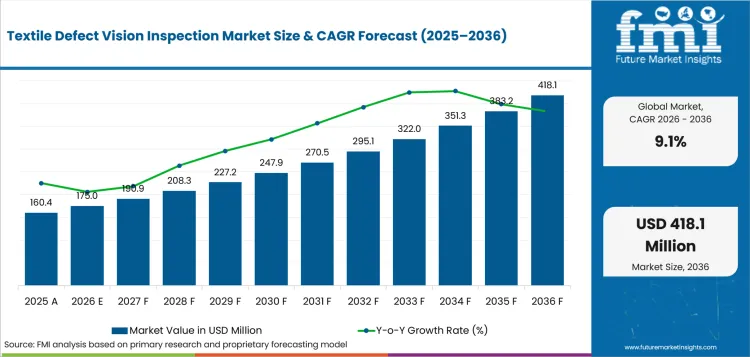
- 2025 Market Size: USD 160.4 million
- 2026 Market Size: USD 175.0 million
- 2036 Market Size: USD 418.1 million
- Forecast CAGR: 9.1% from 2026 to 2036
- Leading Deployment: Inline
- Inline Share in 2026: 61.0%
- Leading Inspection Type: Defect Detection
- Defect Detection Share in 2026: 58.0%
- Fastest-growing Country: India
- India CAGR: 11.2% by 2036
Summary of the Textile Defect Vision Inspection Market
- Demand and Growth Drivers
- Textile mills are moving inspection closer to production as late-stage roll rejection increases rework and shipment risk.
- Export-facing producers are investing in inspection records that support customer review before fabric release. Buyers usually evaluate the option by how well it reduces downtime, integration effort, and operator follow-up.
- Technical textile manufacturers need more consistent surface checks for automotive, protective, and industrial fabric applications. This makes deployment support and proof of plant-level reliability as important as the headline feature.
- Product and Segment View
- Inline systems are projected to hold 61.0% share in 2026, led by live-line inspection needs and faster operator response before defects move downstream.
- Defect Detection is expected to represent 58.0% share in 2026, supported by its direct connection with fabric downgrades, customer claims, and production rework.
- Woven Fabric is projected to secure 46.0% share in 2026, influenced by high roll volumes, visible fault risk, and wider use in apparel and industrial fabric supply chains.
- Geography and Competitive Outlook
- India is projected to record 11.2% CAGR by 2036, backed by export mill upgrades and broader inspection automation needs.
- China is expected to expand at 10.4% CAGR by 2036, supported by dense fabric clusters and high automation adoption.
- Uster Technologies, Cognex, Basler, and Teledyne Vision Solutions compete through camera depth, software scale, and industrial service networks.
- Shelton Vision, KEYENCE, OMRON, and textile machinery integrators focus on fabric-specific inspection, retrofit work, and country-level support.
- Analyst Opinion
- Nikhil Kaitwade, Principal Consultant at Future Market Insights for industrial domain, says, “Textile defect vision inspection is shifting from visual checking to production intelligence. Mills are buying these systems when they can reduce claim exposure, support cut planning, and prove release quality with traceable records. Suppliers gain an edge when they combine line-scan imaging, lighting control, defect classification, and mill workflow data in one package. The strongest systems will be the ones that work across real fabric conditions rather than controlled demonstrations.”
Market outlook is shaped by automation readiness, trade pressure, and sustainability-linked textile reporting. The International Federation of Robotics reported 542,000 industrial robot installations in 2024 and an operational global robot stock of 4,664,000 units, showing why factories are more prepared to connect vision data with line control. The World Trade Organization reported that world merchandise trade volume increased 5.3% year-on-year in the first quarter of 2025, while clothing trade value increased 7.0%, raising pressure on export-facing mills to document shipment quality.
WRAP reported that UK Textiles Pact signatories reduced environmental impacts across 62.0% of textiles placed on the market in the 2024 to 2025 reporting year, which strengthens the case for inspection data that supports waste reduction and better roll utilization.
Which factors support expansion in the textile defect vision inspection market?
Finished vision-system revenue, software modules, service support, and line-integration spending support market value across textile production and finishing workflows.
- Market value is supported by camera, lighting, software, and service revenue before retrofits add incremental system demand.
- Supplier pricing reflects image quality, classifier depth, mill recipe support, and production-line integration because fabric producers need inspection systems that work under real line speeds.
- Revenue improves as fabric producers link defect records with grading, cutting, claim review, and shipment release.
- Demand for fabric inspection machine market solutions rises as mills seek evidence-backed quality files for customers.
- Service demand expands as mills need defect-library tuning across fabric styles, line speeds, lighting conditions, and production shifts.
Why is the textile defect vision inspection market growing?
Textile producers are adopting vision inspection because manual checking cannot consistently support high-speed roll grading, defect classification, and customer-facing quality records.
The strongest demand shift comes from inspection moving into fabric workflows before defects create avoidable waste and claims. The World Trade Organization reported that world merchandise trade volume increased 4.9% year-on-year in the first half of 2025, while trade value increased 6.0%, keeping export quality and documentation under buyer scrutiny. For textile mills, the practical value is earlier defect discovery, fewer subjective grading disputes, and a quality record tied to each roll. Suppliers that connect image capture with grading rules can defend higher system pricing. The buyer case is shifting from whether the camera can see the flaw to whether the system can improve yield, release confidence, and traceability.
How is the textile defect vision inspection market segmented?
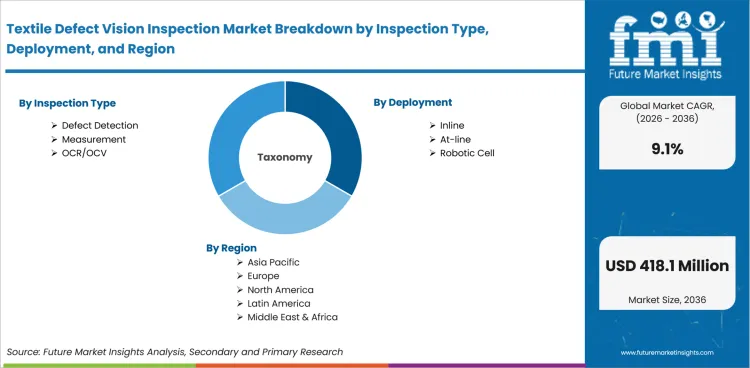
The textile defect vision inspection industry is segmented by component, inspection type, deployment, end-use industry, and fabric type.
- Vision Software is projected to account for 34.0% share in 2026, influenced by the need for defect libraries, classifier tuning, roll maps, dashboards, and workflow tools that convert images into usable production decisions.
- Defect Detection is expected to represent 58.0% share in 2026, since visible flaws such as stains, slubs, holes, floats, shade variation, and pattern deviation remain the clearest reason for system purchase.
- Inline systems are anticipated to hold 61.0% share in 2026, supported by mill demand for live alarms and position-linked defect capture while fabric is still moving through production.
- Automotive is projected to secure 27.0% share in 2026, led by technical textile users that need repeatable surface checks for interior fabrics, safety materials, and supplier-quality documentation.
- Woven Fabric is expected to capture 46.0% share in 2026, due to its broad mill base, high roll volumes, visible fault exposure, and strong fit with line-scan inspection workflows.
Why does vision software dominate the textile defect vision inspection market?
- Vision Software is projected to account for 34.0% share in 2026, led by the need to classify defects, store roll-level evidence, support quality dashboards, and improve decisions beyond image capture alone.
- Services gain importance as mills need recipe tuning, classifier training, and lighting adjustments whenever fabric style, pattern density, speed, or surface texture changes across production shifts.
Which inspection type leads the textile defect vision inspection market?
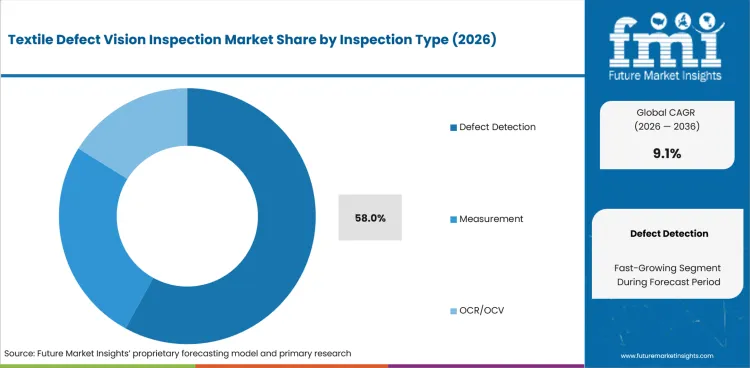
- Defect Detection is estimated to represent 58.0% share in 2026, reflected by its direct role in identifying surface flaws that cause downgrades, customer claims, cutting loss, and shipment rejection.
- Measurement inspection supports added value where mills need width, skew, repeat, or dimensional checks in workflows that combine quality control with production verification.
Which deployment leads the textile defect vision inspection market?
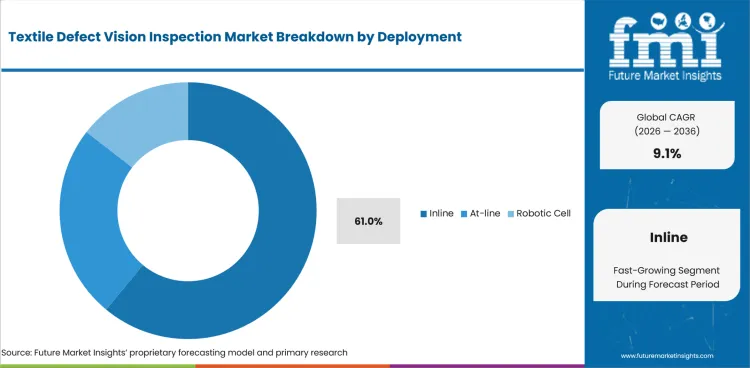
- Inline deployment is anticipated to hold 61.0% share in 2026, shaped by live production needs where mills want to stop repeated faults before fabric moves into later finishing or packing stages.
- At-line systems remain relevant for mills that need automated grading near production while avoiding the full mechanical and data-integration cost of continuous inline installation.
Which end-use industry leads the textile defect vision inspection market?
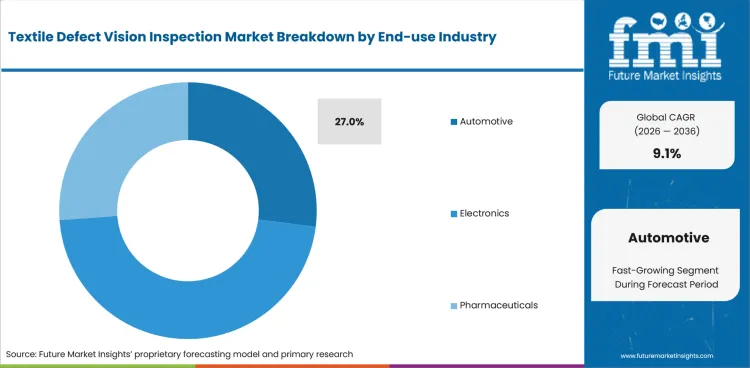
- Automotive is expected to secure 27.0% share in 2026, supported by stricter surface expectations for interior fabrics, airbags, seating textiles, headliners, and other technical textile components.
- Electronics applications gain value where fabric-like substrates, coated materials, filters, and technical sheets require consistent defect records before conversion or assembly.
Which fabric type leads the textile defect vision inspection market?
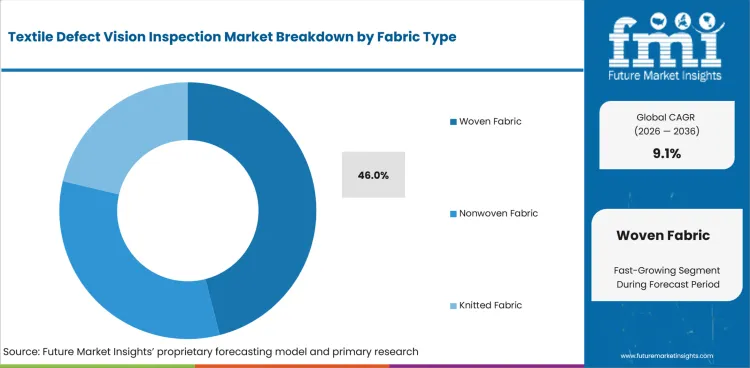
- Woven Fabric is projected to capture 46.0% share in 2026, due to wide adoption across apparel, home textiles, industrial fabrics, and export-oriented roll production.
- Technical Textiles are gaining importance as protective, automotive, medical, and filtration fabrics require repeatable inspection records and tighter defect severity classification.
What are the drivers, restraints, and opportunities in the textile defect vision inspection market?
Export quality control and automated roll evidence support demand while integration cost limits adoption among smaller mills.
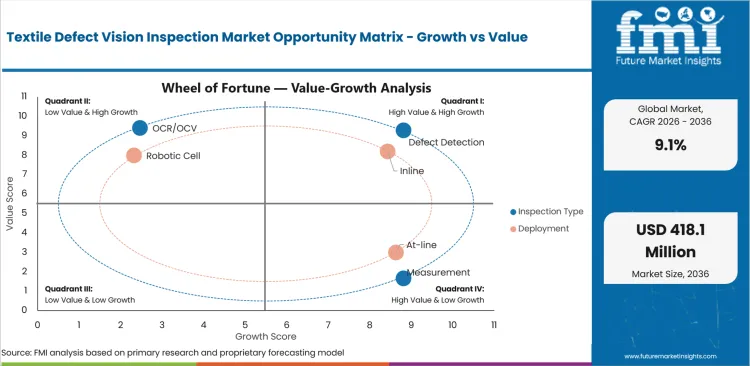
- Export-facing roll traceability pushes mills toward systems that preserve images, defect maps, and release evidence, giving buyers clearer proof before accepting shipments.
- Smaller mills delay upgrades when camera, lighting, software, and integration costs exceed the savings they expect from fewer claims and returns.
- Retrofit-ready inspection platforms can open demand among producers that want better defect evidence without replacing full fabric lines or inspection frames.
Roll Traceability in Export Mill Workflows
Export-facing textile mills need proof that visible defects were identified before shipment release. The World Trade Organization reported that clothing trade value increased 7.0% year-on-year in the first quarter of 2025, which reinforces the need for reliable roll documentation in apparel and fabric supply chains. This strengthens demand for computer vision market tools that connect image capture with defect classification and customer-facing records. Vendors that provide searchable defect maps and severity grades can support stronger buyer trust than hardware-only inspection systems.
Integration Cost Pressure in Smaller Mills
Cost remains a practical restraint because textile inspection projects require cameras, lenses, lighting, frame grabbers, software setup, and line integration. EURATEX reported that EU textile production fell by 1.9% and clothing production declined by 5.0% in the first half of 2025, while employment dropped by 4.0% to 5.0% in textiles and 3.0% in clothing. Imports also increased by 7.7% for textiles and 12.3% for clothing during the same period, adding price pressure on local mills. This operating pressure makes smaller mills more cautious about full inline installations. Suppliers can reduce adoption friction by offering staged retrofits, rental pilots, and service packages linked to measurable claim reduction.
Retrofit Opportunity for Connected Inspection
Retrofit demand is increasing because many mills already have viewing frames or finishing lines that can be upgraded with cameras, lighting, and defect software. Basler introduced a complete TDI vision system in April 2026 with a frame grabber using 4 x 25 Gbps optical data forwarding, showing how high-speed image movement is becoming more practical for line-scan inspection. This supports opportunities in 3D automatic optical inspection machine market workflows where speed and repeatable defect positioning matter. Suppliers that retrofit existing assets can reach mills with limited capital budgets.
Which countries are growing fastest in the textile defect vision inspection market?
India 11.2% CAGR, China 10.4% CAGR, South Korea 8.7% CAGR, United States 8.4% CAGR, Germany 8.2% CAGR, Japan 7.9% CAGR, France 7.6% CAGR, and United Kingdom 7.3% CAGR through 2036.
.webp "Top Country Growth Comparison Textile Defect Vision Inspection Market Cagr (2026 2036)")
| Country | CAGR |
|---|---|
| India | 11.2% |
| China | 10.4% |
| South Korea | 8.7% |
| United States | 8.4% |
| Germany | 8.2% |
| Japan | 7.9% |
| France | 7.6% |
| United Kingdom | 7.3% |
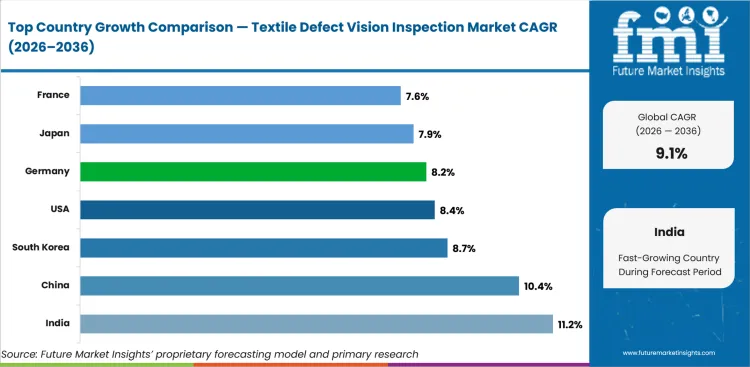
Source: Future Market Insights, 2026.
How do country-level CAGRs compare in the textile defect vision inspection market?
India leads country expansion while the United Kingdom records the most cautious outlook among profiled markets.
- India is forecast to record 11.2% CAGR by 2036 as export mills upgrade inspection to reduce claims and improve release evidence.
- China is expected to expand at 10.4% CAGR from 2026 to 2036 as dense textile clusters adopt connected quality systems.
- South Korea is projected to grow at 8.7% CAGR through 2036 as technical textiles and automation depth support inspection adoption.
- The United States is estimated to rise at 8.4% CAGR by 2036 with demand tied to technical textiles and quality traceability.
- Germany is expected to advance at 8.2% CAGR over the forecast period due to automotive textile standards and machine-building strength.
- Japan is forecast to grow at 7.9% CAGR through 2036 as machine vision suppliers support premium textile and technical material producers.
- France is projected to post 7.6% CAGR by 2036 as premium fabric and technical textile producers invest selectively in defect proof.
- The United Kingdom is expected to expand at 7.3% CAGR through 2036 as specialist mills adopt retrofit inspection and patterned-fabric systems.
How fast is the textile defect vision inspection market growing in India?
A 11.2% CAGR through 2036 reflects export-led mill upgrades and wider automation gaps across fabric production clusters.
Country Market Snapshot Table
| Parameter | Value |
|---|---|
| Market Size in 2025 (Value) | USD 16.9 million |
| Market Size in 2026 (Value) | USD 18.8 million |
| Market Forecast in 2036 (Value) | USD 54.3 million |
| CAGR (2026 to 2036) | 11.2% |
| Years Considered | 2021 to 2036 |
| Base Year | 2025 |
| Forecast Period | 2026 to 2036 |
| Units Considered | Value (USD million) |
| Leading Sub-Region | Gujarat and Tamil Nadu export mill corridors |
India Textile Defect Vision Inspection Market Outlook
India textile defect vision inspection demand is shaped by export pressure, shuttle-less loom adoption, and the need to reduce manual grading variation. Mills are using inspection systems to protect shipment quality and reduce subjective roll release decisions.
Adoption is expected to be strongest among export-oriented woven fabric producers, denim mills, home textile suppliers, and technical textile manufacturers. Local service capability will matter because mills need camera alignment, fabric recipe tuning, and operator training across varied production environments.
Key Growth Drivers
- Export-facing mills need stronger defect records as India’s textile and apparel exports including handicrafts increased 7.0% during April to December 2024, supporting investment in quality evidence.
- Government-backed production incentives support higher-value textile capacity, with the Ministry of Textiles stating that the PLI scheme has an outlay of Rs. 10,683 crore for man-made fibre apparel, fabrics, and technical textiles.
- Large mill clusters in Gujarat, Tamil Nadu, Maharashtra, and Karnataka create a practical base for retrofit inspection systems that can be sold through integrators and textile machinery partners.
- Local automation suppliers can support industrial robotics market adoption by bundling cameras, lighting, and vision software for finishing lines.
Key Restraints
- India’s automation base is expanding from a lower starting point, as the International Federation of Robotics reported 9,100 robot installations in 2024, making advanced inspection adoption uneven across smaller mills.
- Price-sensitive producers may delay full inline systems when manual checking is still viewed as cheaper than integrated camera, lighting, software, and service packages.
- Fabric diversity across cotton, blended, denim, and home textile lines raises setup work because defect libraries need adjustment across changing yarn, shade, and texture conditions.
What makes India unique
India is unique because export-led textile scale and uneven automation readiness create strong demand for staged vision inspection upgrades.
Key Companies
- Uster Technologies India
- Basler India
- Cognex India
- KEYENCE India
- OMRON Automation India
- Shelton Vision partners
- Local textile machinery integrators
Sales & Marketing Channels
- Direct sales to export mills
- Textile machinery OEM partnerships
- Automation integrator networks
- Demonstration projects in mill clusters
- Camera and lighting distributors
- Service-led retrofit packages
Country Segment Breakdown Table
| Segment | Sub-Segments |
|---|---|
| By Component | Cameras · Lenses · Lighting · Frame Grabbers · Vision Software · Services |
| By Inspection Type | Defect Detection · Measurement · OCR/OCV · Presence/Absence · Guidance |
| By Deployment | Inline · At-line · Robotic Cell · Portable |
| By End-use Industry | Electronics · Automotive · Packaging · Pharmaceuticals · Food & Beverage · Metals |
| By Fabric Type | Woven Fabric · Knitted Fabric · Nonwoven Fabric · Technical Textiles · Coated Fabric |
| Key Sub-Regions Covered, Textile Clusters | Gujarat · Tamil Nadu · Maharashtra · Karnataka · Telangana · Punjab |
Frequently Asked Questions
How fast is India textile defect vision inspection market growing?
Sales in India are ready to scale at 11.2% CAGR from 2026 to 2036, guided by export mill upgrades.
Who leads India textile defect vision inspection market?
Uster Technologies, Basler India, Cognex India, KEYENCE India, OMRON, and local integrators compete through mill-facing inspection solutions.
What is driving adoption in India textile defect vision inspection market?
Export quality control, technical textile capacity, and retrofit automation needs are moving mills toward camera-based fabric inspection.
What is the textile defect vision inspection market outlook in China?
A 10.4% CAGR through 2036 is supported by dense textile clusters and high automation adoption across large-scale manufacturing.
Country Market Snapshot Table
| Parameter | Value |
|---|---|
| Market Size in 2025 (Value) | USD 38.0 million |
| Market Size in 2026 (Value) | USD 42.0 million |
| Market Forecast in 2036 (Value) | USD 113.0 million |
| CAGR (2026 to 2036) | 10.4% |
| Years Considered | 2021 to 2036 |
| Base Year | 2025 |
| Forecast Period | 2026 to 2036 |
| Units Considered | Value (USD million) |
| Leading Sub-Region | Zhejiang, Jiangsu, and Guangdong textile clusters |
China Textile Defect Vision Inspection Market Outlook
China textile defect vision inspection demand is influenced by large fabric export clusters and factory automation depth. Mills use inspection systems to reduce defect leakage across high-volume finishing and apparel supply chains.
Large producers are more likely to embed inspection into connected production lines, while smaller mills compare imported systems with domestic camera and software alternatives. Competitive success will depend on cost, line speed, defect accuracy, and local service reach.
Key Growth Drivers
- Automation-heavy factories support connected quality workflows, as China installed 295,000 industrial robots in 2024, equal to 54.0% of global robot deployments.
- Fabric export activity keeps defect reduction commercially urgent, with China’s textile and apparel exports reaching USD 116.67 billion during January to May 2025.
- Textile machinery OEMs can embed inspection into new finishing and weaving lines, helping mills adopt vision systems without separate integration work.
- Large mill clusters create repeatable sales routes for suppliers that can prove detection stability across varied woven, knitted, printed, and coated fabrics.
Key Restraints
- Global suppliers face pricing pressure because domestic robot manufacturers reached 57.0% share of China’s robot market in 2024, reflecting stronger local alternatives in automation channels.
- Smaller producers may prefer basic visual inspection if the return from premium defect software is not visible across short or low-margin fabric runs.
- System validation can take longer where mills require inspection recipes across complex prints, shade variation, elastic fabrics, and fast-changing customer orders.
What makes China unique
China is unique because large textile export scale and automation density create a wide installed base for connected defect inspection.
Key Companies
- Uster Technologies China
- Cognex China
- Basler China
- KEYENCE China
- OMRON Automation China
- Hikrobot
- Local machine vision integrators
Sales & Marketing Channels
- Direct sales to large mills
- Textile machinery OEM channels
- Automation integrator networks
- Local camera and software distributors
- Demonstration lines in textile clusters
- Service contracts for recipe tuning
Country Segment Breakdown Table
| Segment | Sub-Segments |
|---|---|
| By Component | Cameras · Lenses · Lighting · Frame Grabbers · Vision Software · Services |
| By Inspection Type | Defect Detection · Measurement · OCR/OCV · Presence/Absence · Guidance |
| By Deployment | Inline · At-line · Robotic Cell · Portable |
| By End-use Industry | Electronics · Automotive · Packaging · Pharmaceuticals · Food & Beverage · Metals |
| By Fabric Type | Woven Fabric · Knitted Fabric · Nonwoven Fabric · Technical Textiles · Coated Fabric |
| Key Sub-Regions Covered, Textile Clusters | Zhejiang · Jiangsu · Guangdong · Shandong · Fujian · Shanghai |
Frequently Asked Questions
How fast is China textile defect vision inspection market growing?
Demand in China is projected to grow at 10.4% CAGR from 2026 to 2036, supported by textile scale and automation depth.
Who leads China textile defect vision inspection market?
Uster, Cognex, Basler, KEYENCE, OMRON, Hikrobot, and local integrators compete across fabric inspection and machine vision channels.
What is driving adoption in China textile defect vision inspection market?
Large textile clusters, export quality pressure, and connected factory readiness are moving mills toward inline defect inspection.
How is the textile defect vision inspection market performing in South Korea?
An 8.7% CAGR through 2036 reflects technical textile capability and strong factory automation use across manufacturing clusters.
Country Market Snapshot Table
| Parameter | Value |
|---|---|
| Market Size in 2025 (Value) | USD 9.8 million |
| Market Size in 2026 (Value) | USD 10.6 million |
| Market Forecast in 2036 (Value) | USD 24.4 million |
| CAGR (2026 to 2036) | 8.7% |
| Years Considered | 2021 to 2036 |
| Base Year | 2025 |
| Forecast Period | 2026 to 2036 |
| Units Considered | Value (USD million) |
| Leading Sub-Region | Seoul-Gyeonggi and Daegu textile clusters |
South Korea Textile Defect Vision Inspection Market Outlook
South Korea textile defect vision inspection demand is tied to technical fabrics, fashion supply chains, and strong automation familiarity. Producers need inspection systems that support smaller batches and higher surface-quality expectations.
Adoption is expected to favor mills serving industrial fabrics, performance apparel, automotive interiors, and coated textile applications. Local automation depth gives suppliers a strong base for demonstrations and integration.
Key Growth Drivers
- Technical and fabric production depth supports inspection demand, with InvestKOREA reporting that woven and knitted fabrics account for 22.3% of textile and fashion output.
- Factory automation readiness supports line-level vision adoption, as South Korea installed 30,600 industrial robots in 2024.
- Daegu and Gyeonggi textile clusters create sales opportunities for suppliers that can support short-run fabrics and frequent recipe changes.
- Technical textile producers need defect evidence for coated, functional, and high-performance materials where surface flaws affect downstream use.
Key Restraints
- South Korea’s textile export base is smaller than China’s and India’s, with textile exports valued at USD 10.3 billion in 2024, limiting scale-led system purchases.
- Mills handling specialty products may require long validation because defect severity rules differ across functional fabrics, fashion textiles, and coated materials.
- Imported inspection platforms can face price pressure when local integrators offer more economical camera, lighting, and software combinations.
What makes South Korea unique
South Korea is unique because advanced automation capability supports smaller but higher-specification textile inspection projects.
Key Companies
- KEYENCE Korea
- OMRON Korea
- Cognex Korea
- Basler Korea
- Uster Technologies partners
- Local machine vision integrators
- Textile machinery service firms
Sales & Marketing Channels
- Direct factory automation sales
- Integrator-led textile projects
- Technical demonstrations
- Machinery OEM partnerships
- Distributor-led camera supply
- Service support for fabric recipes
Country Segment Breakdown Table
| Segment | Sub-Segments |
|---|---|
| By Component | Cameras · Lenses · Lighting · Frame Grabbers · Vision Software · Services |
| By Inspection Type | Defect Detection · Measurement · OCR/OCV · Presence/Absence · Guidance |
| By Deployment | Inline · At-line · Robotic Cell · Portable |
| By End-use Industry | Electronics · Automotive · Packaging · Pharmaceuticals · Food & Beverage · Metals |
| By Fabric Type | Woven Fabric · Knitted Fabric · Nonwoven Fabric · Technical Textiles · Coated Fabric |
| Key Sub-Regions Covered, Textile Clusters | Seoul · Gyeonggi · Daegu · Busan · Ulsan · Incheon |
Frequently Asked Questions
How fast is South Korea textile defect vision inspection market growing?
Sales in South Korea are forecast to increase at 8.7% CAGR from 2026 to 2036, shaped by automation-led technical textile demand.
Who leads South Korea textile defect vision inspection market?
KEYENCE, OMRON, Cognex, Basler, Uster partners, and local integrators compete through automation and textile inspection channels.
What is driving adoption in South Korea textile defect vision inspection market?
Technical textile production, automation readiness, and short-run quality control are supporting adoption of defect vision systems.
What is the textile defect vision inspection market outlook in the United States?
An 8.4% CAGR through 2036 is supported by technical textile demand and domestic machine vision supplier depth.
Country Market Snapshot Table
| Parameter | Value |
|---|---|
| Market Size in 2025 (Value) | USD 31.8 million |
| Market Size in 2026 (Value) | USD 34.5 million |
| Market Forecast in 2036 (Value) | USD 77.2 million |
| CAGR (2026 to 2036) | 8.4% |
| Years Considered | 2021 to 2036 |
| Base Year | 2025 |
| Forecast Period | 2026 to 2036 |
| Units Considered | Value (USD million) |
| Leading Sub-Region | Southeast technical textile corridor |
United States Textile Defect Vision Inspection Market Outlook
United States demand is shaped by technical textiles, nonwovens, filtration media, medical textiles, and automotive fabric applications. Buyers value traceable inspection records because defect evidence supports customer release and quality audits.
Purchasing is expected to move through direct machine vision suppliers, automation integrators, and textile machinery retrofit partners. Suppliers with domestic service teams should gain an advantage where mills require fast lighting, lens, and classifier adjustments.
Key Growth Drivers
- Textile mill activity provides a base for inspection upgrades, with USA manufacturers’ shipments for textile mills reported at USD 2.009 billion in April 2026.
- Automation readiness supports connected inspection, as the United States installed 34,200 industrial robots in 2024. Buyers usually evaluate the option by how well it reduces downtime, integration effort, and operator follow-up.
- Technical textile producers need repeatable records for automotive, filtration, hygiene, and medical fabric applications where visible faults affect acceptance.
- Domestic vision guided robots market capability supports bundled inspection systems for quality-led manufacturing lines.
Key Restraints
- Textile and apparel shipments reached USD 60.9 billion in 2025, but fragmented operations can make premium inspection approvals uneven across smaller producers.
- Capital budgets often prioritize production equipment before quality automation when mills face low defect-claim frequency or short production runs.
- Integrating vision systems with older fabric lines can raise engineering cost because lighting, web speed, encoder signals, and database links require site-level adjustment.
What makes the United States unique
The United States is unique because technical textile value can justify premium inspection systems even when the textile mill base is fragmented.
Key Companies
- Cognex Corporation
- Teledyne Vision Solutions
- Uster Technologies
- Basler Inc.
- KEYENCE Corporation of America
- OMRON Automation Americas
- Shelton Vision channel partners
Sales & Marketing Channels
- Direct enterprise sales
- Automation integrator partnerships
- Textile machinery OEM retrofits
- Distributor support for camera components
- Quality-system consulting channels
- Demonstration projects at technical textile plants
Country Segment Breakdown Table
| Segment | Sub-Segments |
|---|---|
| By Component | Cameras · Lenses · Lighting · Frame Grabbers · Vision Software · Services |
| By Inspection Type | Defect Detection · Measurement · OCR/OCV · Presence/Absence · Guidance |
| By Deployment | Inline · At-line · Robotic Cell · Portable |
| By End-use Industry | Electronics · Automotive · Packaging · Pharmaceuticals · Food & Beverage · Metals |
| By Fabric Type | Woven Fabric · Knitted Fabric · Nonwoven Fabric · Technical Textiles · Coated Fabric |
| Key Sub-Regions Covered, Textile Corridors | Southeast · Midwest · Texas · California · Northeast · Pacific Northwest |
Frequently Asked Questions
How fast is United States textile defect vision inspection market growing?
Industry in the United States is projected to increase at 8.4% CAGR from 2026 to 2036 through technical textile inspection demand.
Who leads United States textile defect vision inspection market?
Cognex, Teledyne Vision Solutions, Uster Technologies, Basler, KEYENCE, and OMRON compete through machine vision depth and service reach.
What is driving adoption in United States textile defect vision inspection market?
Technical textile quality demands and domestic automation capability are moving mills toward traceable vision inspection systems.
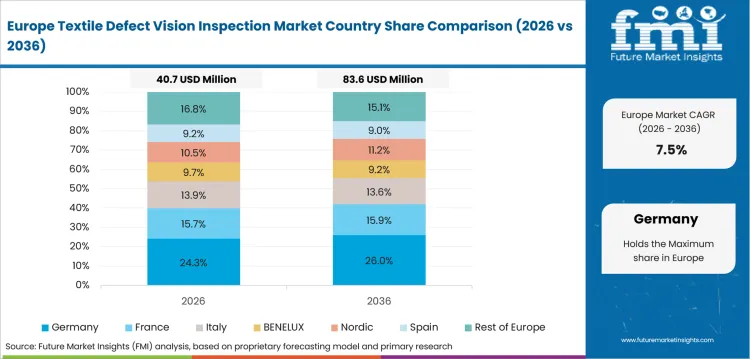
What is driving textile defect vision inspection adoption in Germany?
An 8.2% CAGR through 2036 reflects automotive textile standards, machine-building depth, and advanced automation channels.
Country Market Snapshot Table
| Parameter | Value |
|---|---|
| Market Size in 2025 (Value) | USD 14.6 million |
| Market Size in 2026 (Value) | USD 15.8 million |
| Market Forecast in 2036 (Value) | USD 34.8 million |
| CAGR (2026 to 2036) | 8.2% |
| Years Considered | 2021 to 2036 |
| Base Year | 2025 |
| Forecast Period | 2026 to 2036 |
| Units Considered | Value (USD million) |
| Leading Sub-Region | Baden-Württemberg and North Rhine-Westphalia machinery corridors |
Germany Textile Defect Vision Inspection Market Outlook
Germany textile defect vision inspection demand is tied to automotive textiles, industrial fabrics, and machine-building channels. Buyers evaluate systems by integration depth, defect accuracy, service reliability, and compatibility with broader production control.
Adoption is expected to be strongest where fabric producers serve automotive interiors, protective materials, industrial textiles, and high-value coated fabrics. Suppliers that combine line-scan imaging with local engineering support should gain stronger acceptance.
Key Growth Drivers
- Advanced automation readiness supports textile quality systems, as Germany installed 26,982 industrial robots in 2024. This makes deployment support and proof of plant-level reliability as important as the headline feature.
- Europe’s textile and clothing value chain gives Germany a strong regional customer base, with the European Environment Agency citing EUR 170 billion sector turnover and 1.3 million jobs across the EU textile and clothing industry.
- Automotive textile requirements create demand for repeatable inspection records that support supplier audits, defect severity ranking, and release documentation.
- Machine-building networks help inspection suppliers reach mills through OEM channels and smart factory market integration routes.
Key Restraints
- German manufacturing cost pressure can slow discretionary investment, with Destatis reporting that real manufacturing turnover in 2025 was 1.3% lower than a year earlier.
- Buyers may demand long validation cycles before line acceptance because automotive textile suppliers require stable defect rules across production lots.
- Energy and operating costs can reduce the urgency of full-line inspection upgrades when mills prioritize essential machinery and process-efficiency spending.
What makes Germany unique
Germany is unique because textile inspection demand is linked with automotive material standards and strong machine-building expertise.
Key Companies
- Basler AG
- SICK AG
- Balluff GmbH
- Siemens AG
- Uster Technologies Germany
- Cognex Germany
- Textile machinery integrators
Sales & Marketing Channels
- Machinery OEM partnerships
- Direct sales to technical textile producers
- Automation integrator networks
- Automotive supplier quality channels
- Trade fair demonstrations
- Distributor-led component supply
Country Segment Breakdown Table
| Segment | Sub-Segments |
|---|---|
| By Component | Cameras · Lenses · Lighting · Frame Grabbers · Vision Software · Services |
| By Inspection Type | Defect Detection · Measurement · OCR/OCV · Presence/Absence · Guidance |
| By Deployment | Inline · At-line · Robotic Cell · Portable |
| By End-use Industry | Electronics · Automotive · Packaging · Pharmaceuticals · Food & Beverage · Metals |
| By Fabric Type | Woven Fabric · Knitted Fabric · Nonwoven Fabric · Technical Textiles · Coated Fabric |
| Key Sub-Regions Covered, Industrial Corridors | Baden-Württemberg · North Rhine-Westphalia · Bavaria · Saxony · Hesse · Lower Saxony |
Frequently Asked Questions
How fast is Germany textile defect vision inspection market growing?
Demand in Germany is expected to rise at 8.2% CAGR from 2026 to 2036, supported by automotive textile quality requirements.
Who leads Germany textile defect vision inspection market?
Basler, SICK, Balluff, Siemens, Uster Technologies, and Cognex compete through industrial vision and automation channels.
What is driving adoption in Germany textile defect vision inspection market?
Automotive fabric standards, machine-building expertise, and integrated automation channels support adoption of textile inspection systems.
What is the textile defect vision inspection market forecast for Japan?
A 7.9% CAGR through 2036 reflects premium textile production and strong local machine vision capability.
Country Market Snapshot Table
| Parameter | Value |
|---|---|
| Market Size in 2025 (Value) | USD 15.2 million |
| Market Size in 2026 (Value) | USD 16.4 million |
| Market Forecast in 2036 (Value) | USD 35.0 million |
| CAGR (2026 to 2036) | 7.9% |
| Years Considered | 2021 to 2036 |
| Base Year | 2025 |
| Forecast Period | 2026 to 2036 |
| Units Considered | Value (USD million) |
| Leading Sub-Region | Tokyo-Osaka technical manufacturing corridor |
Japan Textile Defect Vision Inspection Market Outlook
Japan textile defect vision inspection demand is shaped by premium domestic production, technical fabrics, and high expectations for equipment reliability. Buyers prefer systems that can be demonstrated clearly and installed with limited operator burden.
Inspection spending is expected to concentrate in technical textile plants, high-quality fabric producers, and suppliers serving automotive or industrial customers. Local machine vision strength supports adoption where textile producers need stable setup and service.
Key Growth Drivers
- Japan remains a high-value import market for textiles and apparel, with Japan’s global textile and apparel imports valued at USD 30.873 billion in 2024.
- Strong automation capability supports vision inspection trials, as Japan installed 44,500 industrial robots in 2024. The purchasing case improves when the system connects alerts, records, and corrective action without adding manual work.
- Premium domestic textile producers need defect proof to protect quality claims against imported alternatives and strict customer acceptance standards.
- Local suppliers with strong demonstration capability can reduce adoption friction by showing stable detection across fabric texture, tension, and lighting variation.
Key Restraints
- Import penetration remains a structural challenge for domestic producers, with METI reporting clothing import penetration by volume at 98.5% in its textile policy material published in 2024.
- Smaller domestic production scale can cap total system volume because many textile producers serve specialized or limited-run fabric applications.
- High expectations for system reliability may lengthen qualification, especially when mills require repeatable performance across patterned and high-finish fabrics.
What makes Japan unique
Japan is unique because limited domestic textile scale is balanced by very strong local machine vision and factory automation capability.
Key Companies
- KEYENCE Corporation
- OMRON Corporation
- Cognex Japan
- Basler Japan
- Uster Technologies partners
- Japan Textile Machinery Association members
- Local automation integrators
Sales & Marketing Channels
- Direct factory automation sales
- Demonstration-led technical selling
- OEM machinery partnerships
- Distributor support for components
- Integrator support for older lines
- Service-led inspection pilots
Country Segment Breakdown Table
| Segment | Sub-Segments |
|---|---|
| By Component | Cameras · Lenses · Lighting · Frame Grabbers · Vision Software · Services |
| By Inspection Type | Defect Detection · Measurement · OCR/OCV · Presence/Absence · Guidance |
| By Deployment | Inline · At-line · Robotic Cell · Portable |
| By End-use Industry | Electronics · Automotive · Packaging · Pharmaceuticals · Food & Beverage · Metals |
| By Fabric Type | Woven Fabric · Knitted Fabric · Nonwoven Fabric · Technical Textiles · Coated Fabric |
| Key Sub-Regions Covered, Technical Clusters | Tokyo · Osaka · Aichi · Kyoto · Shizuoka · Fukuoka |
Frequently Asked Questions
How fast is Japan textile defect vision inspection market growing?
Sales in Japan are projected to advance at 7.9% CAGR from 2026 to 2036, driven by premium and technical fabric inspection demand.
Who leads Japan textile defect vision inspection market?
KEYENCE, OMRON, Cognex Japan, Basler Japan, Uster partners, and local integrators compete through machine vision channels.
What is driving adoption in Japan textile defect vision inspection market?
Premium textile quality expectations and local machine vision capability are moving producers toward repeatable defect inspection.
How is the textile defect vision inspection market growing in France?
A 7.6% CAGR through 2036 reflects premium textiles, technical fabrics, and selective automation upgrades.
Country Market Snapshot Table
| Parameter | Value |
|---|---|
| Market Size in 2025 (Value) | USD 10.1 million |
| Market Size in 2026 (Value) | USD 10.9 million |
| Market Forecast in 2036 (Value) | USD 22.7 million |
| CAGR (2026 to 2036) | 7.6% |
| Years Considered | 2021 to 2036 |
| Base Year | 2025 |
| Forecast Period | 2026 to 2036 |
| Units Considered | Value (USD million) |
| Leading Sub-Region | Auvergne-Rhône-Alpes and Paris premium textile clusters |
France Textile Defect Vision Inspection Market Outlook
France textile defect vision inspection demand is centered on premium fabrics, luxury-linked supply chains, protective textiles, and technical materials. Buyers value quality proof where smaller fabric runs carry high commercial value.
Adoption is expected to favor modular systems and specialist integrator support. Producers will prioritize systems that reduce subjective grading, protect brand claims, and support defect documentation for high-value customers.
Key Growth Drivers
- The Auvergne-Rhône-Alpes textile base supports local inspection demand, with the regional textile skills partnership reporting 805 establishments and 18,000 employees in the region in 2025.
- Industrial sales conditions support selective automation, with INSEE reporting that manufacturing turnover increased 0.2% in October 2025.
- Premium textile producers need evidence-backed grading to protect customer relationships when fabric defects can affect luxury and technical product value.
- Local integrators can support staged adoption by adapting camera, lens, and lighting packages to older finishing and inspection frames.
Key Restraints
- Production expectation weakness can slow discretionary inline inspection upgrades, with INSEE’s December 2025 monthly survey placing the expected production trend for textiles, clothing, leather, and footwear at -3.9 in November 2025.
- Small production runs make payback harder to standardize because defect frequency, fabric value, and claim exposure vary across premium and technical textile producers.
- Older finishing equipment may require custom mechanical adaptation before inline inspection can deliver stable image capture and defect positioning.
What makes France unique
France is unique because quality proof and brand protection can matter more than inspection speed in premium fabric workflows.
Key Companies
- Basler France
- Cognex France
- KEYENCE France
- OMRON France
- Uster Technologies partners
- Local automation integrators
- Textile machinery service firms
Sales & Marketing Channels
- Direct sales to premium textile producers
- Integrator-led retrofit projects
- Textile machinery service partners
- Quality assurance consulting routes
- Regional automation distributors
- Demonstration projects for technical fabrics
Country Segment Breakdown Table
| Segment | Sub-Segments |
|---|---|
| By Component | Cameras · Lenses · Lighting · Frame Grabbers · Vision Software · Services |
| By Inspection Type | Defect Detection · Measurement · OCR/OCV · Presence/Absence · Guidance |
| By Deployment | Inline · At-line · Robotic Cell · Portable |
| By End-use Industry | Electronics · Automotive · Packaging · Pharmaceuticals · Food & Beverage · Metals |
| By Fabric Type | Woven Fabric · Knitted Fabric · Nonwoven Fabric · Technical Textiles · Coated Fabric |
| Key Sub-Regions Covered, Premium Textile Areas | Auvergne-Rhône-Alpes · Île-de-France · Hauts-de-France · Grand Est · Nouvelle-Aquitaine · Occitanie |
Frequently Asked Questions
How fast is France textile defect vision inspection market growing?
Demand in France is projected to increase at 7.6% CAGR from 2026 to 2036, supported by premium and technical textile quality needs.
Who leads France textile defect vision inspection market?
Basler France, Cognex France, KEYENCE France, OMRON France, Uster partners, and local integrators compete through automation channels.
What is driving adoption in France textile defect vision inspection market?
Premium fabric quality proof, technical textile applications, and retrofit integration support adoption of textile inspection systems.
What is the textile defect vision inspection market outlook in the United Kingdom?
A 7.3% CAGR through 2036 reflects specialist textile clusters and patterned-fabric inspection needs.
Country Market Snapshot Table
| Parameter | Value |
|---|---|
| Market Size in 2025 (Value) | USD 11.8 million |
| Market Size in 2026 (Value) | USD 12.7 million |
| Market Forecast in 2036 (Value) | USD 25.7 million |
| CAGR (2026 to 2036) | 7.3% |
| Years Considered | 2021 to 2036 |
| Base Year | 2025 |
| Forecast Period | 2026 to 2036 |
| Units Considered | Value (USD million) |
| Leading Sub-Region | North West and Yorkshire textile corridors |
United Kingdom Textile Defect Vision Inspection Market Outlook
United Kingdom textile defect vision inspection demand is concentrated in specialist fabric production, patterned textile inspection, technical fabrics, and retrofit projects. Mills need systems that work across short runs and varied fabric designs.
Local supplier know-how supports adoption where fabric-specific inspection is more valuable than broad factory automation alone. Patterned-fabric specialists and integrators can help producers improve grading consistency without full-line replacement.
Key Growth Drivers
- Specialist textile employment supports inspection demand, with the House of Commons Library reporting 49,000 textile manufacturing jobs in Great Britain in 2024.
- Regional production clusters create targeted sales routes, with the North West and Yorkshire and the Humber each employing 10,000 textile manufacturing workers in 2024.
- Patterned fabric producers need AI-supported inspection recipes that reduce manual review time and separate acceptable design variation from true faults.
- Local inspection know-how supports robot sensors market and vision-system retrofits for existing mill frames.
Key Restraints
- Automation adoption is more selective, as the International Federation of Robotics reported UK industrial robot installations fell to 2,500 units in 2024.
- Smaller mill sizes can slow return-on-investment approval when producers need proof that claim reduction will exceed system and integration costs.
- Export-facing mills may prefer staged retrofits over full inline systems because short-run production makes standard payback models harder to apply.
What makes the United Kingdom unique
The United Kingdom is unique because specialist patterned-fabric inspection know-how supports retrofit demand in smaller textile clusters.
Key Companies
- Shelton Vision
- Cognex UK
- Basler UK
- KEYENCE UK
- OMRON UK
- Uster Technologies partners
- Local automation integrators
Sales & Marketing Channels
- Direct sales to technical textile mills
- British textile machinery networks
- Automation integrators for retrofit projects
- Distributor-led camera and lighting supply
- Demonstrations at textile machinery events
- Patterned-fabric inspection pilots
Country Segment Breakdown Table
| Segment | Sub-Segments |
|---|---|
| By Component | Cameras · Lenses · Lighting · Frame Grabbers · Vision Software · Services |
| By Inspection Type | Defect Detection · Measurement · OCR/OCV · Presence/Absence · Guidance |
| By Deployment | Inline · At-line · Robotic Cell · Portable |
| By End-use Industry | Electronics · Automotive · Packaging · Pharmaceuticals · Food & Beverage · Metals |
| By Fabric Type | Woven Fabric · Knitted Fabric · Nonwoven Fabric · Technical Textiles · Coated Fabric |
| Key Sub-Regions Covered, Textile Corridors | North West · Yorkshire · Midlands · Scotland · Wales · London |
Frequently Asked Questions
How fast is United Kingdom textile defect vision inspection market growing?
Industry in the United Kingdom is anticipated to grow at 7.3% CAGR from 2026 to 2036, guided by specialist textile inspection demand.
Who leads United Kingdom textile defect vision inspection market?
Shelton Vision, Cognex UK, Basler UK, KEYENCE UK, OMRON UK, and Uster partners compete through textile and machine vision channels.
What is driving adoption in United Kingdom textile defect vision inspection market?
Patterned-fabric inspection, retrofit demand, and specialist textile clusters are moving mills toward automated defect detection.
Who are the leading companies in the textile defect vision inspection market?
Uster Technologies, Shelton Vision, Cognex, Basler, Teledyne Vision Solutions, KEYENCE, and OMRON.
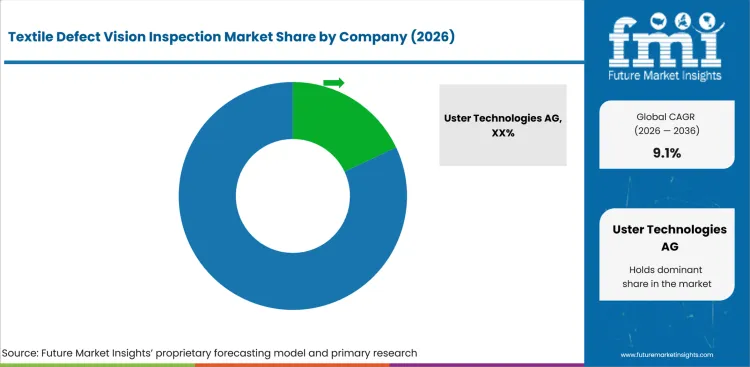
- Specialist textile inspection suppliers hold an advantage through fabric-specific defect libraries and roll-grading know-how.
- Broad machine vision companies gain share by offering cameras, lenses, lighting, AI tools, and service networks.
- Automation suppliers compete through line integration and factory software compatibility.
- Retrofit-ready suppliers gain better access to mills that want improved inspection without replacing full production lines.
Supplier competition is shaped by the shift from hardware inspection to quality workflow control. Uster Technologies and Shelton Vision compete strongly where textile mills need defect maps, fabric grading, and mill-specific decision support. Cognex, Basler, Teledyne Vision Solutions, KEYENCE, and OMRON compete by pairing image capture with software tools and automation service depth. Buyers assess whether systems can operate across fabric speed, surface texture, glare, pattern variation, and frequent style changes.
Software and service capability have become important competitive separators. Mills increasingly ask suppliers to prove stable detection across woven, knitted, printed, coated, and technical fabrics before approving wider rollout. Companies that provide recipe tuning, operator training, roll-map reporting, and integration with quality systems can defend stronger pricing. Hardware-only suppliers face pressure when mills require proof that inspection results can reduce claims and support shipment release.
Regional channel depth also affects supplier positioning. India and China require strong service coverage across dense textile clusters, while Germany, Japan, and South Korea need integration with advanced automation systems. France and the United Kingdom create opportunities for specialist and retrofit-led suppliers that can support high-value short runs. Companies with local demonstrations and after-sales support should gain more durable mill acceptance.
How do top textile defect vision inspection companies compare?
Uster and Shelton Vision score strongest on textile-specific relevance while Cognex, Basler, Teledyne, KEYENCE, and OMRON lead on broader machine vision scale.
| Company | Relevance to Market Title | Textile Inspection Depth | Vision Hardware Portfolio | Software Capability | Channel Reach | Geographic Footprint |
|---|---|---|---|---|---|---|
| Uster Technologies | Very High | Very Strong | Strong | Very Strong | Strong | Global |
| Shelton Vision | Very High | Very Strong | Moderate | Very Strong | Moderate | Europe and global exports |
| Cognex Corporation | High | Strong | Very Strong | Very Strong | Very Strong | Global |
| Basler AG | High | Moderate to Strong | Very Strong | Strong | Strong | Global |
| Teledyne Vision Solutions | High | Moderate | Very Strong | Strong | Very Strong | Global |
| KEYENCE Corporation | High | Moderate | Very Strong | Strong | Very Strong | Global |
| OMRON Corporation | High | Moderate | Strong | Strong | Very Strong | Global |
| SICK AG | Moderate to High | Moderate | Strong | Strong | Strong | Europe and global |
| Balluff GmbH | Moderate | Moderate | Strong | Moderate | Strong | Global |
| Hikrobot | Moderate to High | Moderate | Strong | Strong | Strong | China and global exports |
Source: Future Market Insights competitive analysis, 2026.
Who are the key players in the textile defect vision inspection market?
Uster Technologies, Shelton Vision and Cognex are listed with Basler, Teledyne Vision Solutions, KEYENCE and OMRON among other suppliers.
Key global companies leading the textile defect vision inspection market include:
- Uster Technologies AG
- Shelton Vision Ltd.
- Cognex Corporation
- Basler AG
- Teledyne Vision Solutions
- KEYENCE Corporation
- OMRON Corporation
- SICK AG
- Balluff GmbH
- Hikrobot
Key Developments in Textile Defect Vision Inspection Market
- In April 2026, Basler introduced a complete TDI vision system for high-speed inspection, combining a TDI line-scan camera, frame grabber, cooling, software, and optical data forwarding for industrial imaging applications.
- In October 2025, Basler acquired a 76.0% stake in Alpha TechSys Automation in India, strengthening local machine vision and automation service coverage for Indian industrial customers.
- In July 2024, OMRON integrated Digimarc decoding into its FH vision system and FHV7 smart cameras, supporting high-speed inspection and traceability workflows for industrial production lines.
Key Players in the Textile Defect Vision Inspection Market
Global Machine Vision and Automation Groups
- Cognex Corporation
- Basler AG
- Teledyne Vision Solutions
- KEYENCE Corporation
- OMRON Corporation
- Textile Inspection Specialists
- Uster Technologies AG
- Shelton Vision Ltd.
- Elbit Vision Systems
- Mahlo GmbH & Co. KG
- Texel, Inc.
Regional Industrial Vision Companies
- SICK AG
- Balluff GmbH
- Hikrobot
- Baumer Group
- Industrial automation integrators
Textile Defect Vision Inspection Market - Report Scope
| Parameter | Details |
|---|---|
| Forecast period | 2026 to 2036 |
| Historical period | 2021 to 2025 |
| Quantitative unit | Revenue in USD million |
| By component | Cameras, lenses, lighting, frame grabbers, vision software, services |
| By inspection type | Defect detection, measurement, OCR/OCV, presence/absence, guidance |
| By deployment | Inline, at-line, robotic cell, portable |
| By end-use industry | Electronics, automotive, packaging, pharmaceuticals, food and beverage, metals |
| By fabric type | Woven fabric, knitted fabric, nonwoven fabric, technical textiles, coated fabric |
| Regions covered | North America, Latin America, Europe, East Asia, South Asia and Pacific, Middle East and Africa |
| Countries covered | India, China, South Korea, United States, Germany, Japan, France, United Kingdom |
| Key companies profiled | Uster Technologies, Shelton Vision, Cognex, Basler, Teledyne Vision Solutions, KEYENCE, OMRON, SICK, Balluff, Hikrobot |
| Approach | Bottom-up system revenue approach using inspection hardware, software, service intensity, line adoption, fabric activity, and country-level automation readiness |
Source: Future Market Insights, 2026.
Textile Defect Vision Inspection Market - Scope & Definition
| Attribute | Detail |
|---|---|
| Market Definition | Camera-based systems used to detect visible fabric faults across textile production and finishing lines, combining cameras, lenses, lighting, frame grabbers, software, and services. |
| Functions Covered | Defect detection, roll grading, image capture, defect mapping, measurement, OCR/OCV, presence/absence checks, and guidance. |
| Applications Covered | Woven fabric inspection, knitted fabric inspection, nonwoven inspection, coated fabric inspection, technical textile inspection, and roll release support. |
| End-Use Industries | Electronics, automotive, packaging, pharmaceuticals, food and beverage, metals, and textile production workflows. |
| Grades Covered | Inline, at-line, robotic cell, and portable inspection configurations across different fabric and production-line settings. |
| Inclusions | Automated textile defect inspection systems, cameras, lighting, optics, software, frame grabbers, services, roll maps, grading tools, and inspection support used in production and finishing lines. |
| Exclusions | Manual cloth checking tables without automated image capture, generic CCTV systems, handheld magnifiers, laboratory-only textile testing devices, and broad automation platforms without textile defect inspection capability. |
Textile Defect Vision Inspection Market - Research Methodology
| Method | Description |
|---|---|
| Primary Research | FMI analyst interviews with textile mills, fabric finishers, machine vision suppliers, automation integrators, textile machinery providers, and quality managers across key markets. |
| Desk Research | Review of official manufacturing data, industrial automation sources, textile industry data, company product releases, and machine vision specifications. |
| Market Sizing & Forecasting | Bottom-up system revenue approach using equipment value, software value, service intensity, inspection-line adoption, country textile activity, and automation readiness. |
| Data Validation | Cross-verification using machine vision adoption signals, textile production indicators, supplier portfolios, country automation data, and adjacent fabric inspection machine demand. |
Textile Defect Vision Inspection Market Breakdown by Component, Inspection Type, Deployment, End-use Industry, Fabric Type, and Region
Textile Defect Vision Inspection Market Segmented by Component
- Cameras
- Lenses
- Lighting
- Frame Grabbers
- Vision Software
- Services
Textile Defect Vision Inspection Market Segmented by Inspection Type
- Defect Detection
- Measurement
- OCR/OCV
- Presence/Absence
- Guidance
Textile Defect Vision Inspection Market Segmented by Deployment
- Inline
- At-line
- Robotic Cell
- Portable
Textile Defect Vision Inspection Market Segmented by End-use Industry
- Electronics
- Automotive
- Packaging
- Pharmaceuticals
- Food & Beverage
- Metals
Textile Defect Vision Inspection Market Segmented by Fabric Type
- Woven Fabric
- Knitted Fabric
- Nonwoven Fabric
- Technical Textiles
- Coated Fabric
Textile Defect Vision Inspection Market by Region
- North America
- Latin America
- Europe
- East Asia
- South Asia and Pacific
- Middle East and Africa
Research Sources and Bibliography
- Basler AG. (2025, October 14). Basler AG acquires 76% stake in Alpha TechSys Automation in India.
- Basler AG. (2026, April 13). TDI camera and components: Complete solution.
- China Textile Information Center. (2025, June 19). China’s textile and apparel exports up 1% in the first five months of 2025.
- European Environment Agency. (2025, March 26). Circularity of the EU textiles value chain in numbers.
- EURATEX. (2025, December). EU textile and clothing industry outlook 2024-2025.
- Federal Reserve Bank of St. Louis. (2026, June 3). Manufacturers’ value of shipments: Textile mills.
- Federal Statistical Office of Germany. (2026, February 5). New orders in manufacturing in December 2025: +7.8% on the previous month.
- France, National Institute of Statistics and Economic Studies. (2025, December 17). Monthly business survey in goods-producing industries: Manufacture of textiles, clothing industries, leather and footwear industry - expected trend in production.
- France, National Institute of Statistics and Economic Studies. (2025, December 19). In October 2025, manufacturing turnover increased slightly.
- House of Commons Library. (2026, February 9). Onshoring in the fashion and textiles industry.
- International Federation of Robotics. (2025, September 25). World Robotics 2025 report: Industrial robots.
- InvestKOREA. (2025). Fashion.
- European Apparel and Textile Confederation. (2025, November 27). Europe’s textile and apparel industry is calling for decisive action.
- Ministry of Textiles, Government of India. (2025, April 1). Threads of progress.
- Ministry of Textiles, Government of India. (2025, August 5). Allocation of funds to PLI scheme.
- Ministry of Economy, Trade and Industry. (2024, February 29). Textile industry policy material.
- National Council of Textile Organizations. (2026). United States textile industry data.
- Observatoire économique régional Auvergne-Rhône-Alpes. (2025, June 16). Regional skills partnership for textile Auvergne-Rhône-Alpes.
- Observatoire of Economic Complexity. (2025). Textiles in South Korea trade.
- OMRON Europe. (2024, July 12). OMRON integrates Digimarc decoding into FH vision system and FHV7 smart camera.
- World Trade Organization. (2025, July 15). Merchandise trade posts strong growth in Q1 ahead of tariff changes.
- World Trade Organization. (2025, October 7). Global trade outlook and statistics.
- WRAP. (2025, October 28). UK Textiles Pact annual progress update 2024-25.
This bibliography is provided for reader reference and is not exhaustive. The full report contains the complete reference list and detailed citations.
This Report Answers
- Market size estimates for 2026 and forecasts through 2036 for the textile defect vision inspection market.
- Insights across regional and country-level markets covering North America, Europe, East Asia, South Asia and Pacific, and other regions.
- Analysis of demand drivers, mill adoption patterns, inspection use cases, and production-quality decision needs.
- Evaluation of key deployment types and inspection categories including inline systems and defect detection.
- Assessment of automation readiness, export quality pressure, and retrofit opportunities across textile mills.
- Identification of opportunities across components, inspection types, deployments, end-use industries, and fabric types.
- Evaluation of supplier competition across textile inspection specialists and broad machine vision companies.
- Country-level growth analysis covering India, China, South Korea, the United States, Germany, Japan, France, and the United Kingdom.
- Assessment of the competitive landscape, including leading textile defect vision inspection system suppliers and automation participants.
- Analysis of mill purchasing behavior, line integration needs, service requirements, and defect-library development.
- Regional outlooks across North America, Europe, East Asia, South Asia and Pacific, Latin America, and the Middle East and Africa.
- Delivery of market data, forecasts, and supporting analysis in PDF and Excel formats.
Frequently Asked Questions
What is the growth prospect for textile defect vision inspection?
Demand for textile defect vision inspection is expected to rise at a considerable pace as mills shift toward automated roll grading and traceable quality records.
Which companies are expected to shape the textile defect vision inspection market?
Uster Technologies, Shelton Vision, Cognex, Basler, Teledyne Vision Solutions, KEYENCE, and OMRON are expected to shape market competition through inspection software, cameras, and automation channels.
Why are textile mills investing in vision inspection systems?
Textile mills are investing in vision inspection systems to reduce subjective inspection, control claims, improve roll release confidence, and support defect evidence for customers.
Why are inline systems important in the textile defect vision inspection market?
Inline systems support live defect capture before fabric moves downstream, helping producers reduce repeated faults and protect first-quality yield.
Which inspection type is gaining attention in textile defect vision inspection?
Defect detection is gaining attention because visible fabric faults remain directly linked to downgrades, customer claims, and rework.
How do automation trends influence textile defect vision inspection?
Automation trends influence adoption by making mills more prepared to connect camera output, defect software, alarms, and quality databases.
Why is software important for textile defect vision inspection?
Software is important because mills need defect classification, roll maps, dashboards, and decision tools beyond image capture alone.
What role do retrofit systems play in textile defect vision inspection adoption?
Retrofit systems support adoption by allowing producers to upgrade existing inspection frames and finishing lines without replacing full production equipment.
How do country differences affect textile defect vision inspection demand?
Country differences affect demand through textile export scale, automation readiness, technical textile activity, mill size, and local service availability.
Preview the report firsthand - request a free sample
Get SampleGet the brochure for pricing and purchase details.
Get PDFTable of Content
- Key Takeaways
- Market Size and CAGR
- Top Growth Driver
- Fastest Growing Segment
- Leading Region
- Key Companies
- Emerging Opportunities
- Executive Summary
- Global Market Outlook
- Demand-side Trends
- Supply-side Trends
- Technology Roadmap Analysis
- Analysis and Recommendations
- Analyst Perspective (What is happening? Why now? What should investors know?)
- Key Questions Answered
- How large is the market?
- What is the CAGR?
- What are key trends?
- Which region dominates?
- Who are the leaders?
- Market Overview
- Market Coverage / Taxonomy
- Market Definition / Scope / Limitations
- Research Methodology
- Chapter Orientation
- Analytical Lens and Working Hypotheses
- Market Structure, Signals, and Trend Drivers
- Benchmarking and Cross-market Comparability
- Market Sizing, Forecasting, and Opportunity Mapping
- Research Design and Evidence Framework
- Desk Research Programme (Secondary Evidence)
- Expert Input and Fieldwork (Primary Evidence)
- Tooling, Models, and Reference Databases
- Data Engineering and Model Build
- Quality Assurance and Audit Trail
- Market Background
- Market Dynamics (Drivers, Restraints, Opportunity, Trends)
- Scenario Forecast (Optimistic, Likely, Conservative)
- Impact Analysis
- AI Impact
- Sustainability Impact
- Regulatory Impact
- Technology Impact
- Consumer / Buyer Analysis
- Purchase Drivers
- Adoption Barriers
- Buyer Journey
- Opportunity Map Analysis
- Product Life Cycle Analysis
- Supply Chain Analysis
- Investment Feasibility Matrix
- Value Chain Analysis
- PESTLE and Porter's Analysis
- Regulatory Landscape
- Regional Parent Market Outlook
- Production and Consumption Statistics
- Import and Export Statistics
- Global Market Analysis and Forecast, 2021 to 2036
- Historical Market Size Value (USD Million) Analysis, 2021 to 2025
- Current and Future Market Size Value (USD Million) Projections, 2026 to 2036
- Y-o-Y Growth Trend Analysis
- Absolute $ Opportunity Analysis
- Global Market Pricing Analysis, 2021 to 2036
- Global Market Analysis and Forecast, By Inspection Type, 2021 to 2036
- Introduction / Key Findings
- Historical Market Size Value (USD Million) Analysis By Inspection Type, 2021 to 2025
- Current and Future Market Size Value (USD Million) Analysis and Forecast By Inspection Type, 2026 to 2036
- Defect Detection
- Measurement
- OCR/OCV
- Defect Detection
- Y-o-Y Growth Trend Analysis By Inspection Type, 2021 to 2025
- Absolute $ Opportunity Analysis By Inspection Type, 2026 to 2036
- Global Market Analysis and Forecast, By Deployment, 2021 to 2036
- Introduction / Key Findings
- Historical Market Size Value (USD Million) Analysis By Deployment, 2021 to 2025
- Current and Future Market Size Value (USD Million) Analysis and Forecast By Deployment, 2026 to 2036
- Inline
- At-line
- Robotic Cell
- Inline
- Y-o-Y Growth Trend Analysis By Deployment, 2021 to 2025
- Absolute $ Opportunity Analysis By Deployment, 2026 to 2036
- Global Market Analysis and Forecast, By End-use Industry, 2021 to 2036
- Introduction / Key Findings
- Historical Market Size Value (USD Million) Analysis By End-use Industry, 2021 to 2025
- Current and Future Market Size Value (USD Million) Analysis and Forecast By End-use Industry, 2026 to 2036
- Automotive
- Electronics
- Pharmaceuticals
- Automotive
- Y-o-Y Growth Trend Analysis By End-use Industry, 2021 to 2025
- Absolute $ Opportunity Analysis By End-use Industry, 2026 to 2036
- Global Market Analysis and Forecast, By Fabric Type, 2021 to 2036
- Introduction / Key Findings
- Historical Market Size Value (USD Million) Analysis By Fabric Type, 2021 to 2025
- Current and Future Market Size Value (USD Million) Analysis and Forecast By Fabric Type, 2026 to 2036
- Woven Fabric
- Nonwoven Fabric
- Knitted Fabric
- Woven Fabric
- Y-o-Y Growth Trend Analysis By Fabric Type, 2021 to 2025
- Absolute $ Opportunity Analysis By Fabric Type, 2026 to 2036
- Global Market Analysis and Forecast, By Region, 2021 to 2036
- Introduction
- Historical Market Size Value (USD Million) Analysis By Region, 2021 to 2025
- Current Market Size Value (USD Million) Analysis and Forecast By Region, 2026 to 2036
- North America
- Latin America
- Western Europe
- Eastern Europe
- East Asia
- South Asia and Pacific
- Middle East & Africa
- Market Attractiveness Analysis By Region
- North America Market Analysis and Forecast, By Country, 2021 to 2036
- Historical Market Size Value (USD Million) Trend Analysis By Market Taxonomy, 2021 to 2025
- Market Size Value (USD Million) Forecast By Market Taxonomy, 2026 to 2036
- By Country
- USA
- Canada
- Mexico
- By Inspection Type
- By Deployment
- By End-use Industry
- By Fabric Type
- By Country
- Market Attractiveness Analysis
- By Country
- By Inspection Type
- By Deployment
- By End-use Industry
- By Fabric Type
- Key Takeaways
- Latin America Market Analysis and Forecast, By Country
- Historical Market Size Value (USD Million) Trend Analysis By Market Taxonomy, 2021 to 2025
- Market Size Value (USD Million) Forecast By Market Taxonomy, 2026 to 2036
- By Country
- Brazil
- Chile
- Rest of Latin America
- By Inspection Type
- By Deployment
- By End-use Industry
- By Fabric Type
- By Country
- Market Attractiveness Analysis
- By Country
- By Inspection Type
- By Deployment
- By End-use Industry
- By Fabric Type
- Key Takeaways
- Western Europe Market Analysis and Forecast, By Country
- Historical Market Size Value (USD Million) Trend Analysis By Market Taxonomy, 2021 to 2025
- Market Size Value (USD Million) Forecast By Market Taxonomy, 2026 to 2036
- By Country
- Germany
- UK
- Italy
- Spain
- France
- Nordic
- BENELUX
- Rest of Western Europe
- By Inspection Type
- By Deployment
- By End-use Industry
- By Fabric Type
- By Country
- Market Attractiveness Analysis
- By Country
- By Inspection Type
- By Deployment
- By End-use Industry
- By Fabric Type
- Key Takeaways
- Eastern Europe Market Analysis and Forecast, By Country
- Historical Market Size Value (USD Million) Trend Analysis By Market Taxonomy, 2021 to 2025
- Market Size Value (USD Million) Forecast By Market Taxonomy, 2026 to 2036
- By Country
- Russia
- Poland
- Hungary
- Balkan & Baltic
- Rest of Eastern Europe
- By Inspection Type
- By Deployment
- By End-use Industry
- By Fabric Type
- By Country
- Market Attractiveness Analysis
- By Country
- By Inspection Type
- By Deployment
- By End-use Industry
- By Fabric Type
- Key Takeaways
- East Asia Market Analysis and Forecast, By Country
- Historical Market Size Value (USD Million) Trend Analysis By Market Taxonomy, 2021 to 2025
- Market Size Value (USD Million) Forecast By Market Taxonomy, 2026 to 2036
- By Country
- China
- Japan
- South Korea
- By Inspection Type
- By Deployment
- By End-use Industry
- By Fabric Type
- By Country
- Market Attractiveness Analysis
- By Country
- By Inspection Type
- By Deployment
- By End-use Industry
- By Fabric Type
- Key Takeaways
- South Asia and Pacific Market Analysis and Forecast, By Country
- Historical Market Size Value (USD Million) Trend Analysis By Market Taxonomy, 2021 to 2025
- Market Size Value (USD Million) Forecast By Market Taxonomy, 2026 to 2036
- By Country
- India
- ASEAN
- Australia & New Zealand
- Rest of South Asia and Pacific
- By Inspection Type
- By Deployment
- By End-use Industry
- By Fabric Type
- By Country
- Market Attractiveness Analysis
- By Country
- By Inspection Type
- By Deployment
- By End-use Industry
- By Fabric Type
- Key Takeaways
- Middle East & Africa Market Analysis and Forecast, By Country
- Historical Market Size Value (USD Million) Trend Analysis By Market Taxonomy, 2021 to 2025
- Market Size Value (USD Million) Forecast By Market Taxonomy, 2026 to 2036
- By Country
- Kingdom of Saudi Arabia
- Other GCC Countries
- Türkiye
- South Africa
- Other African Union
- Rest of Middle East & Africa
- By Inspection Type
- By Deployment
- By End-use Industry
- By Fabric Type
- By Country
- Market Attractiveness Analysis
- By Country
- By Inspection Type
- By Deployment
- By End-use Industry
- By Fabric Type
- Key Takeaways
- Key Countries Market Analysis
- USA
- Pricing Analysis
- Market Share Analysis, 2025
- By Inspection Type
- By Deployment
- By End-use Industry
- By Fabric Type
- Canada
- Pricing Analysis
- Market Share Analysis, 2025
- By Inspection Type
- By Deployment
- By End-use Industry
- By Fabric Type
- Mexico
- Pricing Analysis
- Market Share Analysis, 2025
- By Inspection Type
- By Deployment
- By End-use Industry
- By Fabric Type
- Brazil
- Pricing Analysis
- Market Share Analysis, 2025
- By Inspection Type
- By Deployment
- By End-use Industry
- By Fabric Type
- Chile
- Pricing Analysis
- Market Share Analysis, 2025
- By Inspection Type
- By Deployment
- By End-use Industry
- By Fabric Type
- Germany
- Pricing Analysis
- Market Share Analysis, 2025
- By Inspection Type
- By Deployment
- By End-use Industry
- By Fabric Type
- UK
- Pricing Analysis
- Market Share Analysis, 2025
- By Inspection Type
- By Deployment
- By End-use Industry
- By Fabric Type
- Italy
- Pricing Analysis
- Market Share Analysis, 2025
- By Inspection Type
- By Deployment
- By End-use Industry
- By Fabric Type
- Spain
- Pricing Analysis
- Market Share Analysis, 2025
- By Inspection Type
- By Deployment
- By End-use Industry
- By Fabric Type
- France
- Pricing Analysis
- Market Share Analysis, 2025
- By Inspection Type
- By Deployment
- By End-use Industry
- By Fabric Type
- India
- Pricing Analysis
- Market Share Analysis, 2025
- By Inspection Type
- By Deployment
- By End-use Industry
- By Fabric Type
- ASEAN
- Pricing Analysis
- Market Share Analysis, 2025
- By Inspection Type
- By Deployment
- By End-use Industry
- By Fabric Type
- Australia & New Zealand
- Pricing Analysis
- Market Share Analysis, 2025
- By Inspection Type
- By Deployment
- By End-use Industry
- By Fabric Type
- China
- Pricing Analysis
- Market Share Analysis, 2025
- By Inspection Type
- By Deployment
- By End-use Industry
- By Fabric Type
- Japan
- Pricing Analysis
- Market Share Analysis, 2025
- By Inspection Type
- By Deployment
- By End-use Industry
- By Fabric Type
- South Korea
- Pricing Analysis
- Market Share Analysis, 2025
- By Inspection Type
- By Deployment
- By End-use Industry
- By Fabric Type
- Russia
- Pricing Analysis
- Market Share Analysis, 2025
- By Inspection Type
- By Deployment
- By End-use Industry
- By Fabric Type
- Poland
- Pricing Analysis
- Market Share Analysis, 2025
- By Inspection Type
- By Deployment
- By End-use Industry
- By Fabric Type
- Hungary
- Pricing Analysis
- Market Share Analysis, 2025
- By Inspection Type
- By Deployment
- By End-use Industry
- By Fabric Type
- Kingdom of Saudi Arabia
- Pricing Analysis
- Market Share Analysis, 2025
- By Inspection Type
- By Deployment
- By End-use Industry
- By Fabric Type
- Türkiye
- Pricing Analysis
- Market Share Analysis, 2025
- By Inspection Type
- By Deployment
- By End-use Industry
- By Fabric Type
- South Africa
- Pricing Analysis
- Market Share Analysis, 2025
- By Inspection Type
- By Deployment
- By End-use Industry
- By Fabric Type
- USA
- Market Structure Analysis
- Competition Dashboard
- Competition Benchmarking
- Market Share Analysis of Top Players
- By Regional
- By Inspection Type
- By Deployment
- By End-use Industry
- By Fabric Type
- Emerging Startups
- Innovation Benchmarking
- Competition Analysis
- Competition Deep Dive
- Uster Technologies AG
- Overview
- Product Portfolio
- Profitability by Market Segments (Product/Region/Sales Channel)
- Sales Footprint
- Strategy Overview
- Marketing Strategy
- Product Strategy
- Channel Strategy
- Shelton Vision Ltd.
- Cognex Corporation
- Basler AG
- Teledyne Vision Solutions
- SICK AG
- Uster Technologies AG
- Case Studies
- Success Stories
- Recent Developments
- Competition Deep Dive
- Assumptions & Acronyms Used


