

- Market Size (2026)
- USD 275.0 Mn
- Forecast (2036)
- USD 675.3 Mn
- CAGR (2026 to 2036)
- 9.4%
Thermal Vision Inspection for Factory Lines Market Size, Market Forecast and Outlook By FMI
USD 275.0 million in 2026 and USD 675.3 million by 2036 at a 9.4% CAGR.
The thermal vision inspection for factory lines industry value is forecast to grow from USD 251.4 million in 2025 to USD 675.3 million by 2036 at 9.4% CAGR as manufacturers move heat-pattern inspection into line quality systems. Inline systems are forecast to represent 58.0% share in 2026 because factories want thermal alarms connected directly to reject gates. Thermal imagers are expected to secure 46.0% share in 2026, led by radiometric imaging demand across seals, welds, batteries, and electronic assemblies.
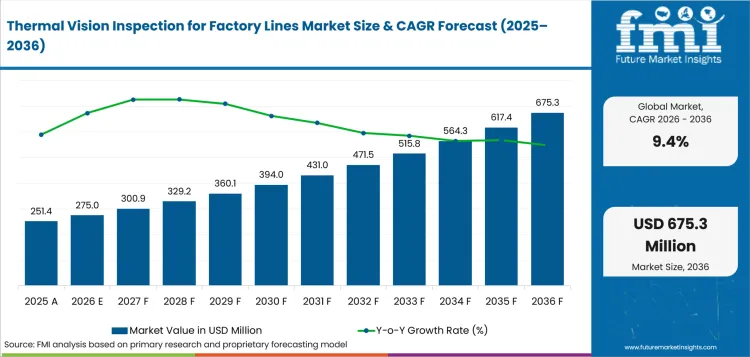
- 2026 Market Size: USD 275.0 million
- 2036 Market Size: USD 675.3 million
- Forecast CAGR: 9.4% from 2026 to 2036
- Leading Deployment: Inline
- Inline Share in 2026: 58.0%
- Leading Camera Technology: Thermal Imagers
- Thermal Imagers Share in 2026: 46.0%
- Fastest-growing Country: India
- India CAGR: 11.4% by 2036
Summary of the Thermal Vision Inspection for Factory Lines Market
- Demand and Growth Drivers
- Manufacturers are adding thermal inspection where solder faults, seal weakness, hot spots, and weld inconsistencies must be detected without slowing production.
- Quality teams are giving more attention to inspection systems that convert temperature patterns into repeatable reject decisions.
- Automation integrators are extending thermal cameras into PLC-linked cells where alarm records support traceability and batch review.
- Product and Segment View
- Inline systems are projected to represent 58.0% share in 2026, led by direct connection between thermal readings and reject gates.
- Thermal imagers are expected to secure 46.0% share in 2026, supported by radiometric measurement needs across production surfaces.
- Cameras are forecast to account for 42.0% share in 2026, reflecting the importance of detector quality and calibration confidence.
- Geography and Competitive Outlook
- India is projected to record 11.4% CAGR by 2036, backed by electronics assembly, EV supply chains, and newer inspection-ready production lines.
- China is expected to expand at 10.8% CAGR by 2036 through large-scale electronics, battery, packaging, and automotive automation.
- Teledyne FLIR and Optris compete through fixed thermal camera portfolios suited for process monitoring and factory automation.
- InfraTec, AMETEK Land, Automation Technology, and Fluke Process Instruments focus on industrial thermography, process heat measurement, and OEM-ready modules.
- Analyst Opinion
- Nikhil Kaitwade, Principal Consultant at Future Market Insights for industrial domain, says, "Thermal vision inspection is shifting from a camera purchase decision to a production-risk decision. Manufacturers should ask which defect creates heat before failure, which station can convert that signal into a reject action, and which supplier can maintain stable readings under dust, vibration, and changing surfaces. The strongest demand is coming from electronics soldering, battery formation, heat sealing, and metal processing. These applications need production control points rather than standalone inspection experiments. Suppliers that connect thermal images to PLC alarms, plant historians, and validation records will gain stronger buyer confidence."
Factory-line adoption is being shaped by automation density, measurable defect risk, and sensor integration depth. The International Federation of Robotics reported that China installed 295,000 industrial robots in 2024, equal to 54% of global installations, while Japan recorded 44,500 installations and South Korea recorded 30,600 installations in the same year. These automation clusters create a larger base for inline thermal inspection cells. NIST's 2024 manufacturing monitoring platform described 10 major physical components, including collaborative robots, conveyor belts, inspection cameras, sensors, and digital loggers, which reflects how inspection cameras are becoming part of AI-supported factory monitoring. Teledyne FLIR OEM stated in February 2026 that it delivers thousands of infrared modules daily, strengthening supply confidence for factory camera makers and integrators.
Which factors support expansion in the thermal vision inspection for factory lines market?
Factory-line risk control, automation integration, and non-contact thermal records support market value across production quality systems.
- Market value is supported by fixed thermal cameras, infrared linescanners, software, and calibration services used in factory inspection stations.
- Supplier pricing reflects detector sensitivity, enclosure design, lens choice, software logic, and validation support before line integration is approved.
- Revenue improves as electronics, automotive, packaging, and pharmaceutical buyers turn heat patterns into production-control signals. Buyers usually evaluate the option by how well it reduces downtime, integration effort, and operator follow-up.
- Integrator trust rises when thermal systems connect temperature zones, reject gates, alarm logs, and batch records without slowing line speed.
Why is the thermal vision inspection for factory lines market growing?
Heat-based defects appear before visible defects in seals, solder joints, batteries, and hot metal surfaces.
Electronics and high-speed packaging buyers are turning thermal inspection into a live production gate because manual sampling cannot keep pace with automated lines. In World Robotics 2025, the electrical and electronics industry returned to the leading customer position with 128,899 industrial robot installations in 2024, indicating a production environment where sensors must match automated handling speed. Thermal vision fits this setting by flagging overloads, hot components, uneven cooling, and weak thermal profiles before downstream failures occur. Suppliers that provide stable temperature data, fast alarms, and line-control integration can gain stronger purchase priority.
How is the thermal vision inspection for factory lines market segmented?
The thermal vision inspection for factory lines industry is segmented by deployment, camera technology, component, inspection type, and end-use industry.
- Inline systems are projected to secure 58.0% share in 2026, led by factories connecting thermal checks to real-time reject gates and closed-loop quality control.
- Thermal imagers are anticipated to hold 46.0% share in 2026, since radiometric image capture supports repeatable surface-temperature decisions across production steps.
- Cameras are expected to capture 42.0% share in 2026, due to detector quality remaining the highest-value layer in factory thermal inspection.
- Defect Detection is forecast to represent 36.5% share in 2026, guided by early visibility of seal faults, solder defects, and weld heat irregularities.
- Electronics is projected to account for 29.0% share in 2026, reflected by boards, power modules, and battery packs requiring heat-pattern inspection.
Which deployment leads the thermal vision inspection for factory lines market?
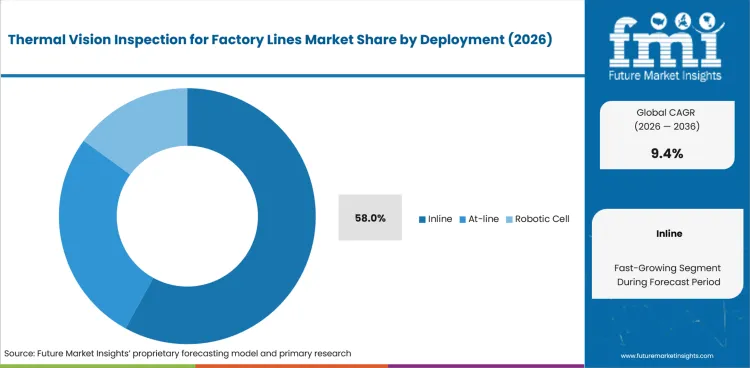
- Inline systems are projected to account for 58.0% share in 2026, attributable to manufacturers needing live thermal data tied to reject gates, PLC signals, and production records.
- At-line systems gain use where plants need controlled inspection near the line without changing guarded machine layouts or approved process timing.
Which camera technology leads the thermal vision inspection for factory lines market?
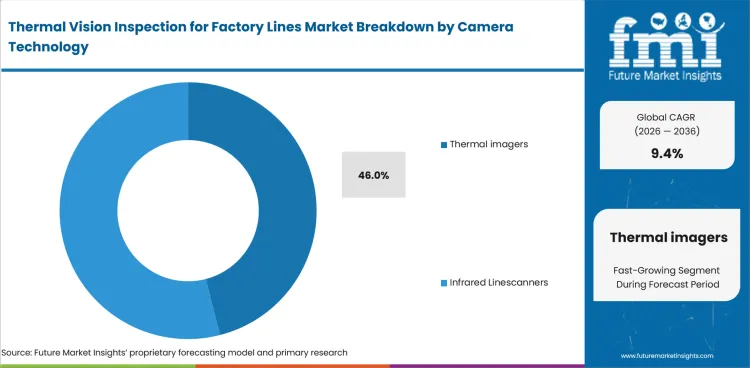
- Thermal imagers are anticipated to hold 46.0% share in 2026, supported by their ability to produce radiometric images that quality teams can compare against defined limits.
- Infrared linescanners gain relevance in continuous webs, metals, and heat-sealing lines where moving surfaces require consistent temperature profiles.
Which component leads the thermal vision inspection for factory lines market?
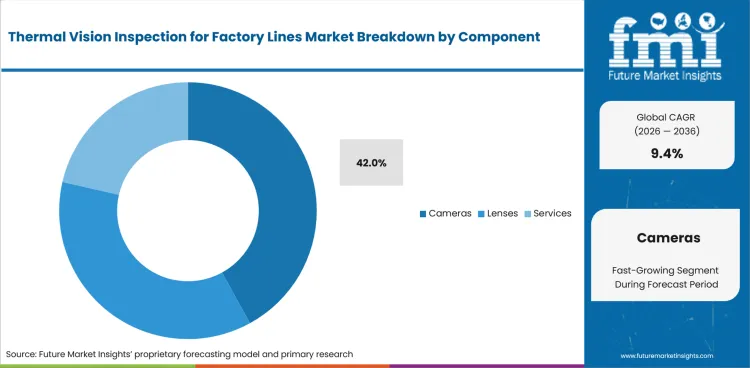
- Cameras are forecast to secure 42.0% share in 2026, reflected by detector stability, frame rate, thermal sensitivity, and enclosure durability driving purchase confidence.
- Vision software gains importance as buyers need temperature zones, trend alarms, recipe management, and audit records connected to line data.
Which inspection type leads the thermal vision inspection for factory lines market?
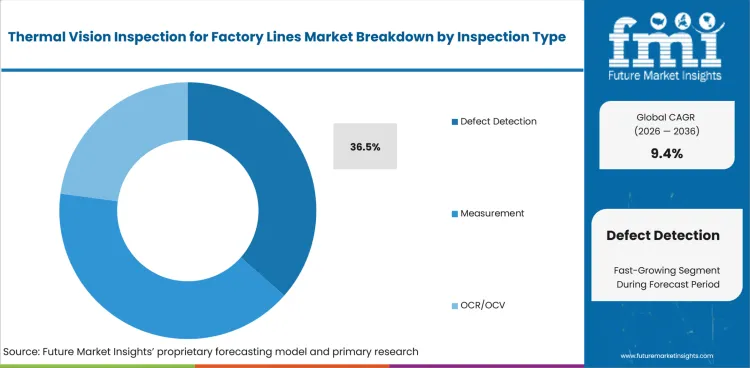
- Defect Detection is expected to represent 36.5% share in 2026, led by early thermal signatures in weak seals, solder faults, hot components, and weld inconsistency.
- Measurement applications expand where factories require controlled temperature profiles for curing, forming, heating, and cooling operations.
Which end-use industry leads the thermal vision inspection for factory lines market?
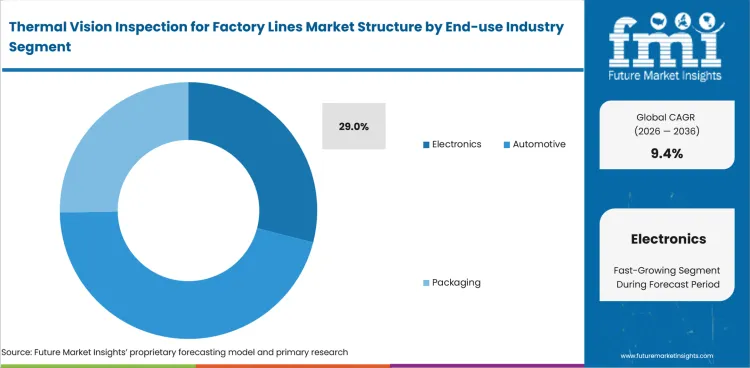
- Electronics is projected to account for 29.0% share in 2026, supported by the need to inspect boards, batteries, power modules, and compact assemblies without contact.
- Automotive demand increases as EV components, welded parts, adhesive bonds, and battery modules require thermal evidence during production.
What are the driver, restraints, and opportunities in the thermal vision inspection for factory lines market?
Heat-based production risk supports demand while calibration complexity limits adoption in plants with changing surfaces.
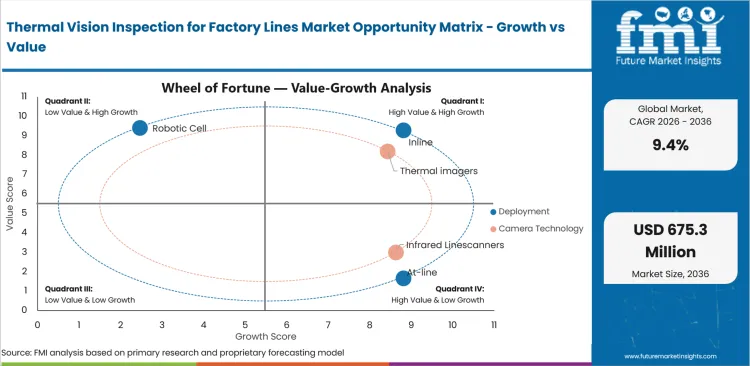
- Driver: Thermal seal, solder, battery, and weld inspection converts invisible heat faults into measurable production-control data.
- Restraint: Emissivity variation can create false alarms when setup, surface condition, or viewing angle is not controlled.
- Opportunity: Software vendors can connect thermal events to batch records, dashboards, and predictive quality systems.
Heat-Signature Defect Gates
Thermal vision grows where a defect creates a measurable heat pattern before a visible failure develops. Packaging plants use thermal cameras to examine seal trails, while electronics lines use them to detect overheating, uneven solder behavior, and abnormal power-module signatures. The value case strengthens when line-speed inspection reduces destructive sampling and missed defects. The International Federation of Robotics stated that global robot installations are expected to reach 575,000 units in 2025, indicating that production lines are becoming more automated and sensor-dependent. This supports wider adoption of thermal inspection that can operate within automated cells.
Calibration and Emissivity Risk
The main restraint is not only camera cost but measurement reliability across changing surfaces. Metals, plastics, food packs, and coated parts can show different emissivity behavior, so plants need process-specific calibration before thermal readings can support rejection decisions. The Office for National Statistics reported in 2025 that robotics adoption among UK firms with 10 to 19 employees was 3%, compared with 16% among firms with 250 or more employees. This adoption gap shows why smaller plants can face higher implementation pressure when thermal systems require technical setup, validation, and maintenance.
PLC-Ready Thermal Data Records
The opportunity is strongest for suppliers that make thermal inspection easy to connect with factory control systems. Buyers increasingly want temperature thresholds, event logs, recipe storage, and alarm outputs that support batch records and engineering review. The UK Smart Machines Strategy stated that full adoption of smart machines could raise UK gross value added from GBP 6.4 billion to GBP 150 billion by 2035, showing how connected manufacturing systems can reshape factory productivity. Thermal vision suppliers that package cameras with software, integration tools, and service support can capture higher-value projects.
Which countries are growing fastest in the thermal vision inspection for factory lines market?
India 11.4% CAGR, China 10.8% CAGR, South Korea 9.7% CAGR, United States 8.8% CAGR, Japan 8.7% CAGR, Germany 8.5% CAGR, France 8.1% CAGR, and United Kingdom 7.6% CAGR through 2036.
.webp "Top Country Growth Comparison Thermal Vision Inspection For Factory Lines Market Cagr (2026 2036)")
| Country | CAGR |
|---|---|
| India | 11.4% |
| China | 10.8% |
| South Korea | 9.7% |
| United States | 8.8% |
| Japan | 8.7% |
| Germany | 8.5% |
| France | 8.1% |
| United Kingdom | 7.6% |
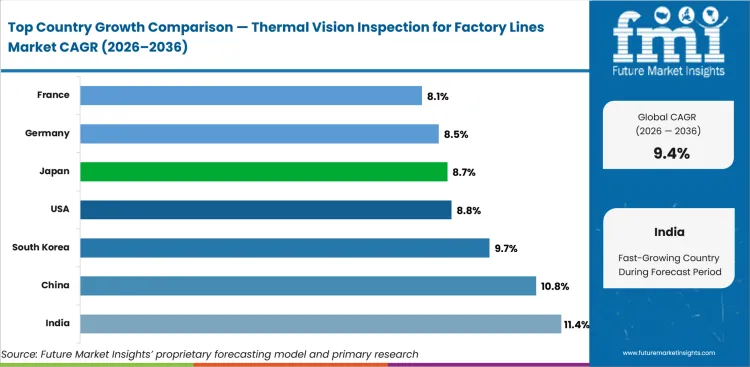
Source: Future Market Insights, 2026.
How do country-level CAGRs compare in the thermal vision inspection for factory lines market?
India leads country expansion while the United Kingdom records the most selective adoption outlook among profiled markets.
- India is forecast to record 11.4% CAGR by 2036 as electronics assembly, EV manufacturing, and new automation projects add thermal quality gates.
- China is expected to expand at 10.8% CAGR from 2026 to 2036 due to large electronics, battery, automotive, and packaging production clusters.
- South Korea is projected to grow at 9.7% CAGR through 2036 as semiconductor, battery, and high-robot-density factories require precise inspection.
- The United States is estimated to rise at 8.8% CAGR by 2036 with domestic thermal imaging supply and integrator-led automation upgrades.
- Japan is expected to advance at 8.7% CAGR over the forecast period as disciplined factory workflows support heat-based inspection in precision lines.
- Germany is forecast to grow at 8.5% CAGR through 2036 as automotive, electronics, and machine-building buyers specify engineered inspection systems.
- France is projected to post 8.1% CAGR by 2036 as regulated packaging, aerospace, and specialty manufacturing lines adopt targeted thermal checks.
- The United Kingdom is anticipated to record 7.6% CAGR through 2036 as retrofit-heavy plants prioritize projects with clear scrap or downtime savings.
How fast is the thermal vision inspection for factory lines market growing in India?
A 11.4% CAGR through 2036 reflects electronics assembly growth, EV supply-chain expansion, and new-line inspection readiness.
Country Market Snapshot Table
| Parameter | Value |
|---|---|
| Market Size in 2025 (Value) | USD 13.5 million |
| Market Size in 2026 (Value) | USD 15.0 million |
| Market Forecast in 2036 (Value) | USD 44.2 million |
| CAGR (2026 to 2036) | 11.4% |
| Years Considered | 2021 to 2036 |
| Base Year | 2025 |
| Forecast Period | 2026 to 2036 |
| Units Considered | Value (USD million) |
| Leading Sub-Region | Southern electronics and western automotive corridors |
India Thermal Vision Inspection for Factory Lines Market Outlook
India thermal vision inspection demand is influenced by electronics assembly, EV component production, and new automated manufacturing lines. Plants adding fresh inspection infrastructure can integrate thermal cameras earlier than older factories that depend on manual checks.
Local buyers are expected to prioritize systems that combine camera hardware, application software, and installer support. Suppliers that train integrators on emissivity setup, enclosure selection, and PLC connectivity should gain stronger acceptance.
Key Growth Drivers
- Electronics manufacturing expansion gives thermal inspection a larger production base. India's electronics manufacturing value rose from INR 1.9 lakh crore in 2014-15 to INR 11.32 lakh crore in 2024-25.
- Robot adoption supports line automation for thermal quality gates. The International Federation of Robotics reported that India installed 9,100 industrial robots in 2024, with automotive applications accounting for 45% of installations.
- EV battery packs and power electronics create demand for non-contact thermal inspection during assembly and testing.
- Newer factory lines make it easier for integrators to design thermal cameras into inspection stations from the start.
Key Restraints
- High domestic value-add requirements can raise qualification work for component suppliers. India's SPMEPCI framework requires applicants to invest at least INR 4,150 crore, while domestic value addition must reach defined milestones during the scheme period.
- Many smaller manufacturers need stronger technical support before adopting calibrated thermal imaging in routine production. This makes deployment support and proof of plant-level reliability as important as the headline feature.
- Price-sensitive procurement can delay premium cameras when buyers compare thermal systems against manual sampling costs. The purchasing case improves when the system connects alerts, records, and corrective action without adding manual work.
What makes India unique
India is unique due to fast electronics expansion, EV-linked supply-chain investment, and a new-line advantage for thermal inspection integration.
Key Companies
- Teledyne FLIR India
- Optris India distribution partners
- Keyence India
- Omron Automation India
- Cognex India
- Fluke Process Instruments partners
- Local automation system integrators
Sales & Marketing Channels
- Automation integrators
- Electronics manufacturing service providers
- Automotive tier supplier trials
- Packaging-line OEM partnerships
- Distributor-led technical sales
- Plant engineering pilot projects
Country Segment Breakdown Table
| Segment | Sub-Segments |
|---|---|
| By Deployment | Inline · At-line · Robotic Cell · Portable |
| By Camera Technology | Thermal Imagers · Infrared Linescanners · SWIR/NIR Cameras · Dual Visible-Thermal Cameras · Thermal Microscopy Modules |
| By Component | Cameras · Lenses · Lighting · Frame Grabbers · Vision Software · Services |
| By Inspection Type | Defect Detection · Measurement · OCR/OCV · Presence/Absence · Guidance |
| By End-use Industry | Electronics · Automotive · Packaging · Pharmaceuticals · Food & Beverage · Metals |
| Key Sub-Regions Covered, Manufacturing Corridors | Tamil Nadu · Karnataka · Maharashtra · Gujarat · Uttar Pradesh · Telangana |
Frequently Asked Questions
How fast is India thermal vision inspection for factory lines market growing?
Sales in India are ready to scale at 11.4% CAGR from 2026 to 2036, guided by electronics and EV manufacturing expansion.
Who leads India thermal vision inspection for factory lines market?
Teledyne FLIR India, Keyence India, Omron Automation India, Cognex India, and automation integrators compete through plant-ready inspection systems.
What is driving adoption in India thermal vision inspection for factory lines market?
Electronics assembly, EV components, and newer production lines are moving buyers toward inline thermal inspection.
What is the thermal vision inspection for factory lines market outlook in China?
A 10.8% CAGR through 2036 is supported by electronics, battery, automotive, and packaging automation scale.
Country Market Snapshot Table
| Parameter | Value |
|---|---|
| Market Size in 2025 (Value) | USD 35.2 million |
| Market Size in 2026 (Value) | USD 39.0 million |
| Market Forecast in 2036 (Value) | USD 108.8 million |
| CAGR (2026 to 2036) | 10.8% |
| Years Considered | 2021 to 2036 |
| Base Year | 2025 |
| Forecast Period | 2026 to 2036 |
| Units Considered | Value (USD million) |
| Leading Sub-Region | Yangtze River Delta and Pearl River Delta factory clusters |
China Thermal Vision Inspection for Factory Lines Market Outlook
China thermal vision inspection demand is shaped by large automated production clusters and extensive electronics and battery manufacturing. The country's factory scale gives thermal camera suppliers a wider base for inline, robotic-cell, and continuous-process applications.
Local integrators and machine builders are expected to drive adoption by embedding thermal cameras into inspection modules. Buyers will favor systems that offer local service, fast delivery, and stable measurement in high-throughput environments.
Key Growth Drivers
- China's automation base creates a strong pathway for thermal inspection. The International Federation of Robotics reported 295,000 industrial robot installations in China in 2024, equal to 54% of global installations.
- Advanced manufacturing output supports inspection demand. China reported industrial robot production increasing 27.0% year over year in the first two months of 2025.
- Battery and electronics lines need fast thermal inspection for cells, power modules, boards, and heat-sensitive assemblies.
- Domestic automation stacks make it easier for camera suppliers to bundle thermal modules with line-control software.
Key Restraints
- Price pressure can limit adoption of high-end calibrated cameras. China reported total industrial profits of CNY 2.12 trillion in the first four months of 2025, with only 1.4% year-over-year growth.
- Plants may choose lower-cost thermal cameras when inspection tasks are not tied to strict reject decisions.
- Large factory variation creates service demands across regions, line speeds, and application temperatures. Buyers usually evaluate the option by how well it reduces downtime, integration effort, and operator follow-up.
What makes China unique
China is unique due to large automation volume, battery-line expansion, and local machine-builder channels that can embed thermal inspection into production equipment.
Key Companies
- Hikrobot
- Teledyne FLIR China
- Optris China partners
- Keyence China
- Daheng Imaging
- Cognex China
- Local automation integrators
Sales & Marketing Channels
- OEM machine builders
- Local automation integrators
- Battery equipment suppliers
- Electronics manufacturing service providers
- Distributor-led industrial camera channels
- Direct technical sales into large factories
Country Segment Breakdown Table
| Segment | Sub-Segments |
|---|---|
| By Deployment | Inline · At-line · Robotic Cell · Portable |
| By Camera Technology | Thermal Imagers · Infrared Linescanners · SWIR/NIR Cameras · Dual Visible-Thermal Cameras · Thermal Microscopy Modules |
| By Component | Cameras · Lenses · Lighting · Frame Grabbers · Vision Software · Services |
| By Inspection Type | Defect Detection · Measurement · OCR/OCV · Presence/Absence · Guidance |
| By End-use Industry | Electronics · Automotive · Packaging · Pharmaceuticals · Food & Beverage · Metals |
| Key Sub-Regions Covered, Factory Clusters | Shanghai · Jiangsu · Zhejiang · Guangdong · Chongqing · Shandong |
Frequently Asked Questions
How fast is China thermal vision inspection for factory lines market growing?
Demand in China is projected to rise at 10.8% CAGR from 2026 to 2036, supported by automation-heavy production clusters.
Who leads China thermal vision inspection for factory lines market?
Hikrobot, Teledyne FLIR China, Keyence China, Daheng Imaging, Cognex China, and local integrators compete through camera and automation channels.
What is driving adoption in China thermal vision inspection for factory lines market?
Electronics, battery, automotive, and packaging lines are moving buyers toward integrated thermal inspection modules.
What is driving thermal vision inspection for factory lines growth in South Korea?
A 9.7% CAGR through 2036 reflects semiconductor, battery, and high-robot-density manufacturing demand.
Country Market Snapshot Table
| Parameter | Value |
|---|---|
| Market Size in 2025 (Value) | USD 16.4 million |
| Market Size in 2026 (Value) | USD 18.0 million |
| Market Forecast in 2036 (Value) | USD 45.4 million |
| CAGR (2026 to 2036) | 9.7% |
| Years Considered | 2021 to 2036 |
| Base Year | 2025 |
| Forecast Period | 2026 to 2036 |
| Units Considered | Value (USD million) |
| Leading Sub-Region | Gyeonggi semiconductor and battery corridors |
South Korea Thermal Vision Inspection for Factory Lines Market Outlook
South Korea demand is influenced by semiconductor, display, battery, and automotive component production. Thermal inspection fits high-precision manufacturing where temperature variation can indicate process drift before visible defects emerge.
Buyers are expected to favor compact, stable, and well-supported systems. Semiconductor and battery customers will place high value on calibration reliability, traceable readings, and local technical support.
Key Growth Drivers
- South Korea's automation density gives thermal inspection a strong factory base. The International Federation of Robotics reported 30,600 industrial robot installations in South Korea in 2024.
- Technology programs support inspection and automation supply chains. South Korea selected 6 global institutions in 2024 and planned roughly 45 joint R&D projects under its Global Industry and Technology Cooperation Center initiative.
- Semiconductor and battery plants need precise thermal monitoring for process control and defect prevention. This makes deployment support and proof of plant-level reliability as important as the headline feature.
- Dense local automation channels help camera suppliers qualify thermal inspection in production trials.
Key Restraints
- Dependence on imported robot components can affect automation sourcing. South Korea's robot strategy aimed to raise local manufacturing of core robot parts from 44% to 80% by 2030, showing that supply-chain localization remained unfinished.
- High precision requirements can lengthen qualification cycles before thermal systems are approved. The purchasing case improves when the system connects alerts, records, and corrective action without adding manual work.
- Factory customers may demand strong field-service response for calibration and downtime protection. Buyers usually evaluate the option by how well it reduces downtime, integration effort, and operator follow-up.
What makes South Korea unique
South Korea is unique due to semiconductor and battery intensity combined with one of the world's highest robot-density manufacturing bases.
Key Companies
- Teledyne FLIR Korea
- Keyence Korea
- Cognex Korea
- Omron Korea
- Hanwha Vision industrial channels
- SICK Korea
- Local machine vision integrators
Sales & Marketing Channels
- Semiconductor equipment suppliers
- Battery-line integrators
- Direct factory automation sales
- Electronics manufacturing trials
- Automotive tier supplier channels
- Distributor-led machine vision sales
Country Segment Breakdown Table
| Segment | Sub-Segments |
|---|---|
| By Deployment | Inline · At-line · Robotic Cell · Portable |
| By Camera Technology | Thermal Imagers · Infrared Linescanners · SWIR/NIR Cameras · Dual Visible-Thermal Cameras · Thermal Microscopy Modules |
| By Component | Cameras · Lenses · Lighting · Frame Grabbers · Vision Software · Services |
| By Inspection Type | Defect Detection · Measurement · OCR/OCV · Presence/Absence · Guidance |
| By End-use Industry | Electronics · Automotive · Packaging · Pharmaceuticals · Food & Beverage · Metals |
| Key Sub-Regions Covered, Technology Corridors | Gyeonggi · Seoul · Incheon · Chungcheong · Ulsan · Daegu |
Frequently Asked Questions
How fast is South Korea thermal vision inspection for factory lines market growing?
Industry in South Korea is expected to increase at 9.7% CAGR from 2026 to 2036 through semiconductor and battery inspection demand.
Who leads South Korea thermal vision inspection for factory lines market?
Teledyne FLIR Korea, Keyence Korea, Cognex Korea, Omron Korea, and local vision integrators compete through automation channels.
What is driving adoption in South Korea thermal vision inspection for factory lines market?
Semiconductor, battery, and precision automotive plants are moving thermal inspection into high-control production environments.
What is the thermal vision inspection for factory lines market forecast for the United States?
A 8.8% CAGR through 2036 reflects domestic thermal imaging supply and strong automation integrator channels.
Country Market Snapshot Table
| Parameter | Value |
|---|---|
| Market Size in 2025 (Value) | USD 38.6 million |
| Market Size in 2026 (Value) | USD 42.0 million |
| Market Forecast in 2036 (Value) | USD 97.6 million |
| CAGR (2026 to 2036) | 8.8% |
| Years Considered | 2021 to 2036 |
| Base Year | 2025 |
| Forecast Period | 2026 to 2036 |
| Units Considered | Value (USD million) |
| Leading Sub-Region | Midwest and South Atlantic manufacturing networks |
United States Thermal Vision Inspection for Factory Lines Market Outlook
United States thermal vision inspection demand is shaped by domestic camera supply, automation integrators, and quality-intensive production lines. Buyers use thermal imaging where defects can cause recalls, downtime, energy loss, or safety incidents.
Factories are expected to prioritize systems that connect to PLCs, SCADA environments, and validation records. Suppliers with local service teams and application templates should gain better acceptance across packaging, food, electronics, and automotive plants.
Key Growth Drivers
- USA automation depth supports inline thermal inspection. The International Federation of Robotics reported 34,200 industrial robot installations in the United States in 2024, representing 68% of robot installations in the Americas.
- Manufacturing monitoring architectures are becoming sensor-rich. NIST described a 2024 manufacturing platform with 10 major physical components, including inspection cameras, conveyors, sensors, and digital loggers.
- Domestic thermal imaging suppliers support procurement confidence for industrial camera technology. This makes deployment support and proof of plant-level reliability as important as the headline feature.
- Food, pharmaceutical, electronics, and automotive lines create varied demand for non-contact heat-pattern inspection. The purchasing case improves when the system connects alerts, records, and corrective action without adding manual work.
Key Restraints
- OT cybersecurity reviews can delay cameras that connect to plant networks. CISA released 3 Industrial Control Systems advisories on August 21, 2025, highlighting current security issues, vulnerabilities, and exploits surrounding ICS.
- Battery safety monitoring requires more than one detection method, keeping multi-sensor validation important for high-risk energy storage and EV applications.
- High labor costs raise the expense of calibration visits, line tuning, and multi-site service work.
What makes the United States unique
The United States is unique due to domestic thermal camera supply and a large integrator channel that can convert cameras into plant-ready inspection stations.
Key Companies
- Teledyne FLIR
- Fluke Process Instruments
- Cognex Corporation
- Zebra Technologies
- Keyence America
- AMETEK Land
- Industrial automation integrators
Sales & Marketing Channels
- Direct enterprise sales
- Certified automation integrators
- OEM packaging-line partnerships
- Distributor-led MRO channels
- Plant engineering pilot projects
- Validation and quality audit projects
Country Segment Breakdown Table
| Segment | Sub-Segments |
|---|---|
| By Deployment | Inline · At-line · Robotic Cell · Portable |
| By Camera Technology | Thermal Imagers · Infrared Linescanners · SWIR/NIR Cameras · Dual Visible-Thermal Cameras · Thermal Microscopy Modules |
| By Component | Cameras · Lenses · Lighting · Frame Grabbers · Vision Software · Services |
| By Inspection Type | Defect Detection · Measurement · OCR/OCV · Presence/Absence · Guidance |
| By End-use Industry | Electronics · Automotive · Packaging · Pharmaceuticals · Food & Beverage · Metals |
| Key Sub-Regions Covered, Factory Networks | Midwest · Southeast · Texas · California · New England · Pacific Northwest |
Frequently Asked Questions
How fast is United States thermal vision inspection for factory lines market growing?
Sector in the United States is anticipated to grow at 8.8% CAGR from 2026 to 2036, reflecting integrator-led automation upgrades.
Who leads United States thermal vision inspection for factory lines market?
Teledyne FLIR, Fluke Process Instruments, Cognex, Zebra Technologies, Keyence America, and AMETEK Land compete through industrial automation channels.
What is driving adoption in United States thermal vision inspection for factory lines market?
Domestic thermal imaging supply and multi-sector automation are moving plants toward PLC-linked thermal inspection.
How is the thermal vision inspection for factory lines market performing in Japan?
A 8.7% CAGR through 2036 reflects precision manufacturing, compact automation cells, and disciplined inspection workflows.
Country Market Snapshot Table
| Parameter | Value |
|---|---|
| Market Size in 2025 (Value) | USD 22.1 million |
| Market Size in 2026 (Value) | USD 24.0 million |
| Market Forecast in 2036 (Value) | USD 55.3 million |
| CAGR (2026 to 2036) | 8.7% |
| Years Considered | 2021 to 2036 |
| Base Year | 2025 |
| Forecast Period | 2026 to 2036 |
| Units Considered | Value (USD million) |
| Leading Sub-Region | Tokyo, Nagoya, and Osaka manufacturing corridor |
Japan Thermal Vision Inspection for Factory Lines Market Outlook
Japan demand is expected to build from precision manufacturing, electronics, automotive, and battery equipment production. Thermal vision must fit disciplined factory workflows where stable measurement and repeatability are valued over fast equipment switching.
Local automation relationships are expected to shape procurement. Buyers will favor compact sensors, long service life, documented calibration, and proven integration with machine controls.
Key Growth Drivers
- Japan remains a major automation market. The International Federation of Robotics reported 44,500 industrial robot installations and an operational stock of 450,500 robots in Japan in 2024.
- Battery supply-chain investment supports inspection equipment demand. METI approved 7 storage battery supply plans in 2024, including projects covering battery parts, materials, and manufacturing equipment.
- Electronics and precision-component lines require non-contact inspection for compact parts and heat-sensitive assemblies.
- Trusted automation channels help thermal vision suppliers qualify systems through careful plant trials.
Key Restraints
- Data and sustainability rules raise reporting complexity for battery-linked supply chains. METI's 2025 Ouranos Ecosystem report reviewed Battery Regulation requirements across Article 7, Article 48, Article 8, and Article 77, increasing digital traceability expectations.
- Mature inspection workflows slow replacement of stable visual systems unless thermal value is clearly proven. Buyers usually evaluate the option by how well it reduces downtime, integration effort, and operator follow-up.
- Buyers may require extended calibration evidence before approving multi-line deployment. This makes deployment support and proof of plant-level reliability as important as the headline feature.
What makes Japan unique
Japan is unique due to precision-first manufacturing and strong automation channels that demand stable, compact, and thoroughly qualified thermal systems.
Key Companies
- Keyence Corporation
- Omron Corporation
- Teledyne FLIR Japan
- AMETEK Land Japan
- Cognex Japan
- SICK Japan
- Local machine builders
Sales & Marketing Channels
- Direct technical sales teams
- OEM machine-builder channels
- Factory automation distributors
- Electronics quality engineering trials
- Automotive tier supplier pilots
- Battery equipment suppliers
Country Segment Breakdown Table
| Segment | Sub-Segments |
|---|---|
| By Deployment | Inline · At-line · Robotic Cell · Portable |
| By Camera Technology | Thermal Imagers · Infrared Linescanners · SWIR/NIR Cameras · Dual Visible-Thermal Cameras · Thermal Microscopy Modules |
| By Component | Cameras · Lenses · Lighting · Frame Grabbers · Vision Software · Services |
| By Inspection Type | Defect Detection · Measurement · OCR/OCV · Presence/Absence · Guidance |
| By End-use Industry | Electronics · Automotive · Packaging · Pharmaceuticals · Food & Beverage · Metals |
| Key Sub-Regions Covered, Manufacturing Corridors | Tokyo · Aichi · Osaka · Kanagawa · Shizuoka · Fukuoka |
Frequently Asked Questions
How fast is Japan thermal vision inspection for factory lines market growing?
Demand in Japan is forecast to rise at 8.7% CAGR from 2026 to 2036, supported by electronics and precision production.
Who leads Japan thermal vision inspection for factory lines market?
Keyence, Omron, Teledyne FLIR Japan, AMETEK Land Japan, Cognex Japan, and local machine builders compete through factory automation channels.
What is driving adoption in Japan thermal vision inspection for factory lines market?
Precision manufacturing and battery supply-chain investment are moving thermal vision into controlled factory inspection workflows.
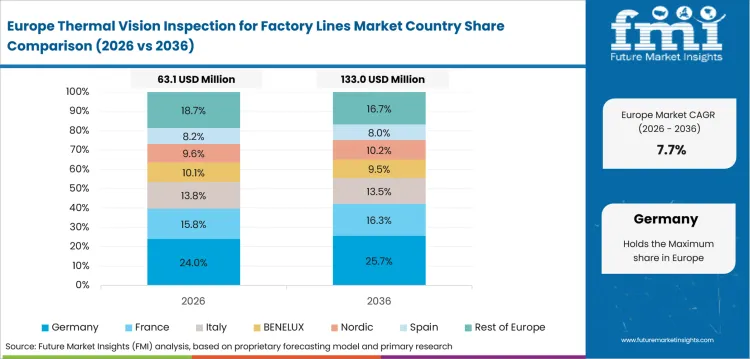
What is the thermal vision inspection for factory lines market outlook in Germany?
A 8.5% CAGR through 2036 is supported by automation density, local supplier depth, and engineered inspection demand.
Country Market Snapshot Table
| Parameter | Value |
|---|---|
| Market Size in 2025 (Value) | USD 20.3 million |
| Market Size in 2026 (Value) | USD 22.0 million |
| Market Forecast in 2036 (Value) | USD 49.7 million |
| CAGR (2026 to 2036) | 8.5% |
| Years Considered | 2021 to 2036 |
| Base Year | 2025 |
| Forecast Period | 2026 to 2036 |
| Units Considered | Value (USD million) |
| Leading Sub-Region | Baden-Wurttemberg and Bavaria automation clusters |
Germany Thermal Vision Inspection for Factory Lines Market Outlook
Germany is a demanding buyer market for thermal vision inspection because plants expect documented measurement stability and engineered integration. Automotive, electronics, plastics, packaging, and metals applications give suppliers varied use cases.
Local supplier depth supports adoption where camera hardware, software, optics, and service must be configured to process conditions. Buyers are expected to favor systems that can pass factory acceptance tests and long qualification cycles.
Key Growth Drivers
- Germany's automation base supports thermal inspection integration. Germany Trade & Invest reported 278,881 operational industrial robots and robot density of 449 units per 10,000 manufacturing employees in 2024.
- Investment activity strengthens automation supply. Germany attracted more than 450 robotics and automation investment projects between 2019 and 2024.
- German machine builders can embed thermal cameras into inspection systems for domestic and export customers.
- Automotive welding, battery assembly, plastics processing, and heat-sealing lines need engineered thermal measurement. The purchasing case improves when the system connects alerts, records, and corrective action without adding manual work.
Key Restraints
- Capital discipline can slow project conversion. The International Federation of Robotics reported that Germany installed 26,982 industrial robots in 2024, with annual installations down 5%.
- Strict validation cycles can delay camera approval on safety-critical production lines. Buyers usually evaluate the option by how well it reduces downtime, integration effort, and operator follow-up.
- High customization raises commissioning costs when plants require process-specific calibration and software logic.
What makes Germany unique
Germany is unique because it is both a buyer and supplier hub for engineered thermal inspection systems.
Key Companies
- Optris GmbH
- InfraTec GmbH
- Automation Technology GmbH
- SICK AG
- Balluff GmbH
- Basler AG
- Siemens automation channels
Sales & Marketing Channels
- OEM machine-builder partnerships
- Certified system integrator networks
- Automotive tier supplier trials
- Factory acceptance tests
- Trade fairs and technical demo centers
- Direct engineering sales
Country Segment Breakdown Table
| Segment | Sub-Segments |
|---|---|
| By Deployment | Inline · At-line · Robotic Cell · Portable |
| By Camera Technology | Thermal Imagers · Infrared Linescanners · SWIR/NIR Cameras · Dual Visible-Thermal Cameras · Thermal Microscopy Modules |
| By Component | Cameras · Lenses · Lighting · Frame Grabbers · Vision Software · Services |
| By Inspection Type | Defect Detection · Measurement · OCR/OCV · Presence/Absence · Guidance |
| By End-use Industry | Electronics · Automotive · Packaging · Pharmaceuticals · Food & Beverage · Metals |
| Key Sub-Regions Covered, Automation Clusters | Baden-Wurttemberg · Bavaria · North Rhine-Westphalia · Saxony · Hesse · Lower Saxony |
Frequently Asked Questions
How fast is Germany thermal vision inspection for factory lines market growing?
Germany thermal vision inspection demand is projected to increase at 8.5% CAGR from 2026 to 2036.
Who leads Germany thermal vision inspection for factory lines market?
Optris, InfraTec, Automation Technology, SICK, Balluff, Basler, and Siemens-linked automation channels compete across industrial vision and process control.
What is driving adoption in Germany thermal vision inspection for factory lines market?
Automation density, machine-building expertise, and automotive process inspection are moving buyers toward engineered thermal systems.
What is driving thermal vision inspection for factory lines growth in France?
A 8.1% CAGR through 2036 is supported by regulated packaging, aerospace, pharmaceuticals, and specialty manufacturing.
Country Market Snapshot Table
| Parameter | Value |
|---|---|
| Market Size in 2025 (Value) | USD 13.0 million |
| Market Size in 2026 (Value) | USD 14.0 million |
| Market Forecast in 2036 (Value) | USD 30.5 million |
| CAGR (2026 to 2036) | 8.1% |
| Years Considered | 2021 to 2036 |
| Base Year | 2025 |
| Forecast Period | 2026 to 2036 |
| Units Considered | Value (USD million) |
| Leading Sub-Region | Ile-de-France, Rhone-Alpes, and aerospace corridors |
France Thermal Vision Inspection for Factory Lines Market Outlook
France is a targeted adoption market where thermal vision is linked to regulated production, aerospace components, food packaging, and pharmaceutical validation. Buyers usually require evidence that thermal inspection reduces defect risk before broad rollout.
Suppliers are expected to compete through application proof, French-language service, and integration with existing lines. Thermal cameras should gain stronger acceptance in plants where non-contact measurement supports traceability and hygiene.
Key Growth Drivers
- France maintains an automation base for inspection projects. The International Federation of Robotics reported 4,900 industrial robot installations in France in 2024.
- Emissions and efficiency pressure supports process monitoring. INSEE reported France's greenhouse gas emissions at 399.8 million tonnes CO2e in 2024, creating a wider push for controlled industrial processes.
- Pharmaceutical and food packaging lines need non-contact thermal checks for seals, closures, and contamination-sensitive products. This makes deployment support and proof of plant-level reliability as important as the headline feature.
- Aerospace and specialty manufacturers use thermal inspection where component value justifies tighter process control.
Key Restraints
- Lower automation momentum can slow inline upgrades. France's industrial robot installations fell 24% in 2024, reducing the pace of factory-wide inspection expansion.
- Project approval can be slow when thermal systems are justified by rare recall or failure events.
- Plants often require local validation support before adopting new inspection technology across multiple lines. The purchasing case improves when the system connects alerts, records, and corrective action without adding manual work.
What makes France unique
France is unique due to regulated-use demand and application-specific buying behavior across packaging, aerospace, and pharmaceuticals.
Key Companies
- Teledyne FLIR France
- Keyence France
- SICK France
- Optris distribution partners
- Cognex France
- AMETEK Land channels
- French automation integrators
Sales & Marketing Channels
- Packaging OEM channels
- Pharmaceutical validation consultants
- Automation integrators
- Distributor-led technical sales
- Direct sales to aerospace suppliers
- Food-processing quality projects
Country Segment Breakdown Table
| Segment | Sub-Segments |
|---|---|
| By Deployment | Inline · At-line · Robotic Cell · Portable |
| By Camera Technology | Thermal Imagers · Infrared Linescanners · SWIR/NIR Cameras · Dual Visible-Thermal Cameras · Thermal Microscopy Modules |
| By Component | Cameras · Lenses · Lighting · Frame Grabbers · Vision Software · Services |
| By Inspection Type | Defect Detection · Measurement · OCR/OCV · Presence/Absence · Guidance |
| By End-use Industry | Electronics · Automotive · Packaging · Pharmaceuticals · Food & Beverage · Metals |
| Key Sub-Regions Covered, Industrial Areas | Ile-de-France · Auvergne-Rhone-Alpes · Occitanie · Nouvelle-Aquitaine · Hauts-de-France · Grand Est |
Frequently Asked Questions
How fast is France thermal vision inspection for factory lines market growing?
France thermal vision inspection demand is expected to grow at 8.1% CAGR from 2026 to 2036.
Who leads France thermal vision inspection for factory lines market?
Teledyne FLIR France, Keyence France, SICK France, Cognex France, Optris partners, and automation integrators compete through validated inspection projects.
What is driving adoption in France thermal vision inspection for factory lines market?
Regulated packaging, aerospace parts, pharmaceuticals, and process-efficiency pressure are moving factories toward thermal inspection.
What is the thermal vision inspection for factory lines market forecast for the United Kingdom?
A 7.6% CAGR through 2036 reflects retrofit-led inspection demand across food, pharmaceuticals, metals, and aerospace.
Country Market Snapshot Table
| Parameter | Value |
|---|---|
| Market Size in 2025 (Value) | USD 11.2 million |
| Market Size in 2026 (Value) | USD 12.0 million |
| Market Forecast in 2036 (Value) | USD 24.9 million |
| CAGR (2026 to 2036) | 7.6% |
| Years Considered | 2021 to 2036 |
| Base Year | 2025 |
| Forecast Period | 2026 to 2036 |
| Units Considered | Value (USD million) |
| Leading Sub-Region | Midlands and national regulated packaging networks |
United Kingdom Thermal Vision Inspection for Factory Lines Market Outlook
United Kingdom demand is selective and tied to measurable risk reduction on existing production lines. Thermal vision projects are expected to concentrate in food packaging, pharmaceuticals, aerospace, metals, and process industries.
Retrofit conditions shape supplier strategy because many plants need cameras fitted into older guarded spaces. Buyers will favor compact cameras, clear payback cases, and engineering support that reduces installation disruption.
Key Growth Drivers
- Robotics and automation remain active despite selective investment. The International Federation of Robotics reported 2,500 robot installations in the United Kingdom in 2024.
- Public investment supports robotics experimentation. The UK government announced GBP 52 million for robotics and autonomous systems hubs in 2026.
- Food and pharmaceutical packagers need thermal checks for seal integrity, closure control, and batch records. Buyers usually evaluate the option by how well it reduces downtime, integration effort, and operator follow-up.
- Aerospace and metals manufacturers use thermal inspection where high-value parts require non-contact process evidence.
Key Restraints
- Small-firm automation adoption remains limited. ONS reported that only 3% of UK firms with 10 to 19 employees adopted robotics, compared with 16% among firms with 250 or more employees.
- Retrofit projects can be constrained by older line layouts, guarded equipment, and limited panel space.
- Capital approval often depends on short payback tied to scrap reduction or downtime avoidance.
What makes the United Kingdom unique
The United Kingdom is unique because thermal vision suppliers must often prove value on retrofit-heavy lines before winning multi-site scale.
Key Companies
- AMETEK Land
- Teledyne FLIR UK
- Fluke Process Instruments
- Keyence UK
- SICK UK
- Cognex UK
- Specialist automation integrators
Sales & Marketing Channels
- OEM line-builder relationships
- Specialist thermal measurement distributors
- Engineering consultancy referrals
- Direct sales into regulated manufacturers
- Plant safety and quality audit projects. This makes deployment support and proof of plant-level reliability as important as the headline feature.
- Retrofit automation integrators
Country Segment Breakdown Table
| Segment | Sub-Segments |
|---|---|
| By Deployment | Inline · At-line · Robotic Cell · Portable |
| By Camera Technology | Thermal Imagers · Infrared Linescanners · SWIR/NIR Cameras · Dual Visible-Thermal Cameras · Thermal Microscopy Modules |
| By Component | Cameras · Lenses · Lighting · Frame Grabbers · Vision Software · Services |
| By Inspection Type | Defect Detection · Measurement · OCR/OCV · Presence/Absence · Guidance |
| By End-use Industry | Electronics · Automotive · Packaging · Pharmaceuticals · Food & Beverage · Metals |
| Key Sub-Regions Covered, Factory Corridors | Midlands · Yorkshire · Wales · Scotland · South East · North West |
Frequently Asked Questions
How fast is United Kingdom thermal vision inspection for factory lines market growing?
Industry in the United Kingdom is projected to increase at 7.6% CAGR from 2026 to 2036.
Who leads United Kingdom thermal vision inspection for factory lines market?
AMETEK Land, Teledyne FLIR UK, Fluke Process Instruments, Keyence UK, SICK UK, and Cognex UK compete through thermal and automation channels.
What is driving adoption in United Kingdom thermal vision inspection for factory lines market?
Retrofit inspection demand and regulated production lines are moving UK factories toward compact thermal vision systems.
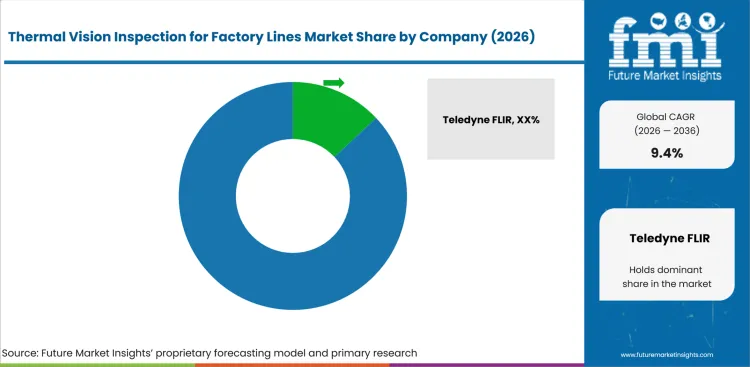
Who are the leading companies in the thermal vision inspection for factory lines market?
Teledyne FLIR, Optris, InfraTec, AMETEK Land and Fluke Process Instruments.
- Thermal camera suppliers hold an advantage through radiometric detector depth and industrial enclosure options.
- Process measurement specialists gain factory access by serving harsh lines that need continuous temperature records. The purchasing case improves when the system connects alerts, records, and corrective action without adding manual work.
- Machine vision companies gain relevance when plants require thermal modules inside broader inspection platforms.
- Integration-ready software supports adoption through PLC alarms, recipe control, batch records, and dashboard reporting. Buyers usually evaluate the option by how well it reduces downtime, integration effort, and operator follow-up.
Thermal camera groups in the market compete by combining detector stability with factory communication tools. Teledyne FLIR has strong OEM module depth and fixed-camera positioning for automation users. Optris and InfraTec compete through compact industrial thermography and machine-integration readiness. AMETEK Land and Fluke Process Instruments focus on continuous temperature measurement and harsh process environments. Buyers assess thermal sensitivity, frame rate, enclosure design, calibration support, and data integration before approving projects.
Application proof has become a competitive separator as thermal vision moves beyond maintenance inspection. Packaging users need seal-inspection evidence, electronics buyers need board and battery hot-spot detection, and metals processors need stable measurements under heat and surface variation. Suppliers that can support application trials and factory acceptance testing should gain more durable approval. Camera-only vendors face weaker positioning when they cannot provide software logic, line integration, or service support.
Smaller and regional players can win through specialist engineering support and faster customization. Automation Technology, Workswell, VisionTIR, and local integrators can serve OEM machine builders or process-specific applications. China, India, and South Korea create stronger opportunities for integrator-led systems, while Germany and Japan require deeper validation before scale deployment. Companies with calibrated measurement evidence and conservative claims should gain stronger listing decisions.
How do top thermal vision inspection for factory lines companies compare?
Teledyne FLIR and Optris score strongest on thermal camera depth while AMETEK Land leads harsh-line measurement relevance.
| Company | Relevance to Market Title | Radiometric Camera Depth | Factory Control Integration | Harsh-Line Application Support | Channel Reach | Geographic Footprint |
|---|---|---|---|---|---|---|
| Teledyne FLIR | Very High | Very Strong | Strong | Strong | Very Strong | Global |
| Optris GmbH | Very High | Very Strong | Strong | Strong | Strong | Global |
| InfraTec GmbH | Very High | Very Strong | Moderate | Strong | Moderate | Europe and Global OEM |
| AMETEK Land | High | Strong | Strong | Very Strong | Strong | Global |
| Fluke Process Instruments | High | Strong | Strong | Very Strong | Strong | Global |
| Automation Technology GmbH | High | Strong | Moderate | Moderate | Moderate | Europe and OEM Channels |
| Keyence Corporation | Moderate to High | Moderate | Very Strong | Moderate | Very Strong | Global |
| Cognex Corporation | Moderate to High | Low to Moderate | Very Strong | Moderate | Very Strong | Global |
| Workswell | Moderate | Strong | Moderate | Moderate | Moderate | Europe and Export Markets |
| VisionTIR | Moderate | Strong | Moderate | Strong | Moderate | Europe and Process Markets |
Source: Future Market Insights competitive analysis, 2026.
Who are the key players in the thermal vision inspection for factory lines market?
Teledyne FLIR, Optris, InfraTec, AMETEK Land and Fluke Process Instruments are listed with Automation Technology and Keyence among other suppliers.
Key global companies leading the thermal vision inspection for factory lines market include:
- Teledyne FLIR
- Optris GmbH
- InfraTec GmbH
- AMETEK Land
- Fluke Process Instruments
- Automation Technology GmbH
- Keyence Corporation
- Cognex Corporation
- Workswell
- VisionTIR
Key Developments in Thermal Vision Inspection for Factory Lines Market
- In September 2024, InfraTec introduced TarisIR mini as a radiometric IR camera module for OEM solutions and compact industrial integration.
- In October 2025, Optris introduced the Xi 320 MT infrared camera for demanding industrial applications, including high-temperature process measurement.
- In February 2026, Teledyne FLIR OEM highlighted daily production of thermal modules and software tools, supporting supply reliability for embedded thermal systems.
Key Players in the Thermal Vision Inspection for Factory Lines Market
Thermal Imaging Leaders
- Teledyne FLIR
- Optris
- InfraTec
- Automation Technology
Process Measurement Specialists
- AMETEK Land
- Fluke Process Instruments
- VisionTIR
- Workswell
Automation and Vision Channel Influencers
- Omron
- Keyence
- SICK
- Basler
- Zebra Technologies
Thermal Vision Inspection for Factory Lines Market - Report Scope
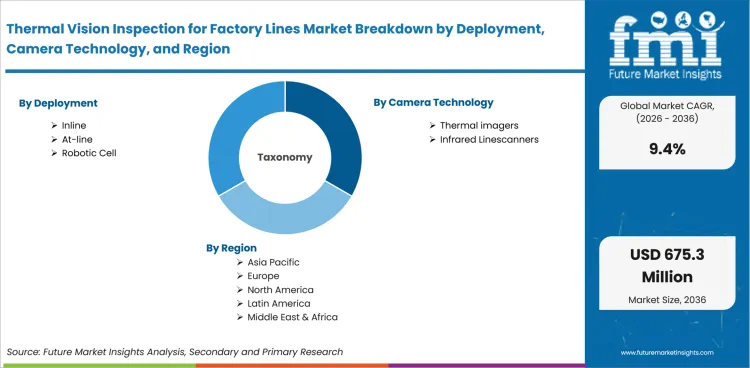
| Parameter | Details |
|---|---|
| Forecast period | 2026 to 2036 |
| Historical period | 2021 to 2025 |
| Quantitative unit | Revenue in USD million |
| By deployment | Inline, at-line, robotic cell, portable |
| By camera technology | Thermal imagers, infrared linescanners, SWIR/NIR cameras, dual visible-thermal cameras, thermal microscopy modules |
| By component | Cameras, lenses, lighting, frame grabbers, vision software, services |
| By inspection type | Defect detection, measurement, OCR/OCV, presence/absence, guidance |
| By end-use industry | Electronics, automotive, packaging, pharmaceuticals, food and beverage, metals |
| Regions covered | North America, Latin America, Europe, East Asia, South Asia and Pacific, Middle East and Africa |
| Countries covered | India, China, South Korea, United States, Japan, Germany, France, United Kingdom |
| Key companies profiled | Teledyne FLIR, Optris, InfraTec, AMETEK Land, Fluke Process Instruments, Automation Technology, Keyence, Cognex, Workswell, VisionTIR |
| Approach | Bottom-up factory-line approach using automation intensity, thermal inspection penetration, end-use line density, camera pricing, and supplier portfolio checks |
Source: Future Market Insights, 2026.
Thermal Vision Inspection for Factory Lines Market - Scope & Definition
| Attribute | Detail |
|---|---|
| Market Definition | Fixed and integrated thermal vision systems used on factory lines for non-contact heat-pattern inspection, measurement, part verification, and guidance. |
| Functions Covered | Heat-pattern detection, temperature measurement, defect detection, presence confirmation, OCR/OCV support, robotic guidance, and process monitoring. |
| Applications Covered | Heat-seal inspection, solder inspection, battery inspection, weld monitoring, hot-spot detection, process-temperature tracking, and batch-quality records. |
| End-Use Industries | Electronics, automotive, packaging, pharmaceuticals, food and beverage, and metals. |
| Grades Covered | Inline, at-line, robotic-cell, and portable factory-line inspection systems using thermal or infrared imaging. |
| Inclusions | Fixed thermal cameras, infrared linescanners, lenses, frame grabbers, vision software, enclosures, calibration services, and integration services used for factory-line quality control. |
| Exclusions | Building thermography, firefighting cameras, defense surveillance, medical thermography, consumer thermal phones, and automotive night vision for drivers. |
Thermal Vision Inspection for Factory Lines Market - Research Methodology
| Method | Description |
|---|---|
| Primary Research | FMI analyst interviews covered manufacturing quality heads, automation integrators, thermal camera suppliers, packaging-line builders, and plant engineering teams across key markets. |
| Desk Research | Review covered robot installation data, smart manufacturing programs, factory automation architectures, thermal camera portfolios, and official country manufacturing evidence. |
| Market Sizing & Forecasting | The model used a bottom-up factory-line approach combining automation intensity, camera average selling prices, inspection-use penetration, and end-use line density. |
| Data Validation | Cross-verification used industrial robot installation depth, verified supplier portfolios, component pricing, country automation readiness, and application-specific thermal inspection adoption. |
Thermal Vision Inspection for Factory Lines Market Breakdown by Deployment, Camera Technology, Component, Inspection Type, End-use Industry, and Region
Thermal Vision Inspection for Factory Lines Market Segmented by Deployment
- Inline
- At-line
- Robotic Cell
- Portable
Thermal Vision Inspection for Factory Lines Market Segmented by Camera Technology
- Thermal Imagers
- Infrared Linescanners
- SWIR/NIR Cameras
- Dual Visible-Thermal Cameras
- Thermal Microscopy Modules
Thermal Vision Inspection for Factory Lines Market Segmented by Component
- Cameras
- Lenses
- Lighting
- Frame Grabbers
- Vision Software
- Services
Thermal Vision Inspection for Factory Lines Market Segmented by Inspection Type
- Defect Detection
- Measurement
- OCR/OCV
- Presence/Absence
- Guidance
Thermal Vision Inspection for Factory Lines Market Segmented by End-use Industry
- Electronics
- Automotive
- Packaging
- Pharmaceuticals
- Food & Beverage
- Metals
Thermal Vision Inspection for Factory Lines Market by Region
- North America
- Latin America
- Europe
- East Asia
- South Asia and Pacific
- Middle East and Africa
Research Sources and Bibliography
- AMETEK Land. (2026). Fixed thermal imagers and line scanners. AMETEK Land.
- Automation Technology GmbH. (2025). Thermal imaging cameras and 3D sensor systems. Automation Technology GmbH.
- Cybersecurity and Infrastructure Security Agency. (2025, August 21). CISA releases three Industrial Control Systems advisories.
- Department for Science, Innovation and Technology. (2025, February 11). Smart Machines Strategy 2035. Government of the United Kingdom.
- Department for Science, Innovation and Technology. (2026, January 16). Red tape to be slashed for British robotics and defence innovators. Government of the United Kingdom.
- Fluke Process Instruments. (2026). MP Linescanner Series. Fluke Process Instruments.
- Germany Trade & Invest. (2025, September 29). Germany is Europe's leading robotics nation. Germany Trade & Invest.
- Germany Trade & Invest. (2025). Robotics industry. Germany Trade & Invest.
- InfraTec GmbH. (2024, September). TarisIR mini radiometric thermal camera module. InfraTec GmbH.
- International Federation of Robotics. (2025, September 25). World Robotics 2025 report: Industrial robots. International Federation of Robotics.
- International Trade Administration. (2024, August 28). South Korea robotics industry. USA Department of Commerce.
- Ministry of Economy, Trade and Industry. (2025, March 28). Ouranos Ecosystem Trust Study Group Report. Government of Japan.
- Ministry of Economy, Trade and Industry. (2025, June 3). Industrial structure in 2040 led by growth investment. Government of Japan.
- Ministry of Trade, Industry and Resources. (2024, April 5). Six global institutions selected as global industry and technology cooperation centers. Government of the Republic of Korea.
- National Institute of Standards and Technology. (2024, May 1). NIST pursues AI-enhanced monitoring in manufacturing processes. USA Department of Commerce.
- Office for National Statistics. (2025, March 24). Management practices and the adoption of technology and artificial intelligence in UK firms: 2023. Government of the United Kingdom.
- Optris GmbH. (2025, October). Xi 320 MT infrared camera for high-temperature measurement applications. Optris GmbH.
- Press Information Bureau. (2025, December 5). Electronics manufacturing grows sixfold in India. Government of India.
- Press Information Bureau. (2026, February 3). Electronics Components Manufacturing Scheme update. Government of India.
- Press Information Bureau. (2025, August 26). India's electric leap for green mobility. Government of India.
- State Council Information Office of the People's Republic of China. (2025, March 17). China's industrial economy sustains growth momentum. Government of the People's Republic of China.
- State Council of the People's Republic of China. (2025, June 16). China's industrial sector reports stable growth in May. Government of the People's Republic of China.
- Teledyne Technologies Incorporated. (2026, February 10). Teledyne FLIR OEM advances the state of the art in infrared imaging. Teledyne Technologies Incorporated.
- USA Department of Energy. (2024, May). Energy Storage Safety Strategic Plan. USA Department of Energy.
This bibliography is provided for reader reference and is not exhaustive. The full report contains the complete reference list and detailed citations.
This Report Answers
- Market size estimates for 2026 and forecasts through 2036 for the thermal vision inspection for factory lines market.
- Insights across regional and country-level markets with country CAGR comparison.
- Analysis of demand drivers, inspection adoption patterns, line-control needs, and purchasing behavior.
- Evaluation of deployment, camera technology, component, inspection type, and end-use industry segments.
- Assessment of automation depth, calibration challenges, and factory-control integration impacts on market development.
- Identification of growth opportunities across thermal cameras, linescanners, software, and services.
- Evaluation of supply chain dynamics, product innovation trends, and integration channel structures.
- Country-level growth analysis covering India, China, South Korea, United States, Japan, Germany, France, and United Kingdom.
- Assessment of the competitive landscape, including leading thermal camera and process measurement suppliers.
- Analysis of plant preferences, thermal inspection penetration trends, and emerging growth opportunities.
- Regional outlooks across North America, Europe, East Asia, South Asia and Pacific, Latin America, and Middle East and Africa.
- Delivery of market data, forecasts, and supporting analysis in report-ready Word format.
Frequently Asked Questions
What is the growth prospect for thermal vision inspection for factory lines?
Demand for thermal vision inspection for factory lines is expected to rise at a considerable pace as factories add non-contact heat-pattern checks to automated quality systems.
Which companies are expected to shape the thermal vision inspection for factory lines market?
Teledyne FLIR, Optris, InfraTec, AMETEK Land, Fluke Process Instruments, Automation Technology, Keyence, and Cognex are expected to shape market competition through camera portfolios and integration channels.
Why are manufacturers investing in thermal vision inspection for factory lines?
Manufacturers are investing in thermal vision inspection to detect heat-based defects before visible failures appear and to connect inspection events with production control records.
Why are inline systems important in the thermal vision inspection for factory lines market?
Inline systems support live reject decisions and help quality teams prevent defective products from moving downstream.
Which camera formats are gaining attention in thermal vision inspection for factory lines?
Thermal imagers and infrared linescanners are gaining attention because they support radiometric measurement across moving products and heat-sensitive surfaces.
How do calibration needs influence thermal vision inspection launches?
Calibration needs influence launches because emissivity, surface finish, angle, and process temperature must be controlled before thermal readings can support rejection decisions.
Why is software important for thermal vision inspection for factory lines?
Software is important because temperature zones, alarms, recipes, dashboards, and batch records help plants turn thermal images into quality decisions.
How do automation integrators support thermal vision inspection adoption?
Automation integrators support adoption by connecting cameras with PLCs, reject gates, SCADA systems, enclosures, and plant validation workflows.
Preview the report firsthand - request a free sample
Get SampleGet the brochure for pricing and purchase details.
Get PDFTable of Content
- Key Takeaways
- Market Size and CAGR
- Top Growth Driver
- Fastest Growing Segment
- Leading Region
- Key Companies
- Emerging Opportunities
- Executive Summary
- Global Market Outlook
- Demand-side Trends
- Supply-side Trends
- Technology Roadmap Analysis
- Analysis and Recommendations
- Analyst Perspective (What is happening? Why now? What should investors know?)
- Key Questions Answered
- How large is the market?
- What is the CAGR?
- What are key trends?
- Which region dominates?
- Who are the leaders?
- Market Overview
- Market Coverage / Taxonomy
- Market Definition / Scope / Limitations
- Research Methodology
- Chapter Orientation
- Analytical Lens and Working Hypotheses
- Market Structure, Signals, and Trend Drivers
- Benchmarking and Cross-market Comparability
- Market Sizing, Forecasting, and Opportunity Mapping
- Research Design and Evidence Framework
- Desk Research Programme (Secondary Evidence)
- Expert Input and Fieldwork (Primary Evidence)
- Tooling, Models, and Reference Databases
- Data Engineering and Model Build
- Quality Assurance and Audit Trail
- Market Background
- Market Dynamics (Drivers, Restraints, Opportunity, Trends)
- Scenario Forecast (Optimistic, Likely, Conservative)
- Impact Analysis
- AI Impact
- Sustainability Impact
- Regulatory Impact
- Technology Impact
- Consumer / Buyer Analysis
- Purchase Drivers
- Adoption Barriers
- Buyer Journey
- Opportunity Map Analysis
- Product Life Cycle Analysis
- Supply Chain Analysis
- Investment Feasibility Matrix
- Value Chain Analysis
- PESTLE and Porter's Analysis
- Regulatory Landscape
- Regional Parent Market Outlook
- Production and Consumption Statistics
- Import and Export Statistics
- Global Market Analysis and Forecast, 2021 to 2036
- Historical Market Size Value (USD Million) Analysis, 2021 to 2025
- Current and Future Market Size Value (USD Million) Projections, 2026 to 2036
- Y-o-Y Growth Trend Analysis
- Absolute $ Opportunity Analysis
- Global Market Pricing Analysis, 2021 to 2036
- Global Market Analysis and Forecast, By Deployment, 2021 to 2036
- Introduction / Key Findings
- Historical Market Size Value (USD Million) Analysis By Deployment, 2021 to 2025
- Current and Future Market Size Value (USD Million) Analysis and Forecast By Deployment, 2026 to 2036
- Inline
- At-line
- Robotic Cell
- Inline
- Y-o-Y Growth Trend Analysis By Deployment, 2021 to 2025
- Absolute $ Opportunity Analysis By Deployment, 2026 to 2036
- Global Market Analysis and Forecast, By Camera Technology, 2021 to 2036
- Introduction / Key Findings
- Historical Market Size Value (USD Million) Analysis By Camera Technology, 2021 to 2025
- Current and Future Market Size Value (USD Million) Analysis and Forecast By Camera Technology, 2026 to 2036
- Thermal imagers
- Infrared Linescanners
- Thermal imagers
- Y-o-Y Growth Trend Analysis By Camera Technology, 2021 to 2025
- Absolute $ Opportunity Analysis By Camera Technology, 2026 to 2036
- Global Market Analysis and Forecast, By Component, 2021 to 2036
- Introduction / Key Findings
- Historical Market Size Value (USD Million) Analysis By Component, 2021 to 2025
- Current and Future Market Size Value (USD Million) Analysis and Forecast By Component, 2026 to 2036
- Cameras
- Lenses
- Services
- Cameras
- Y-o-Y Growth Trend Analysis By Component, 2021 to 2025
- Absolute $ Opportunity Analysis By Component, 2026 to 2036
- Global Market Analysis and Forecast, By Inspection Type, 2021 to 2036
- Introduction / Key Findings
- Historical Market Size Value (USD Million) Analysis By Inspection Type, 2021 to 2025
- Current and Future Market Size Value (USD Million) Analysis and Forecast By Inspection Type, 2026 to 2036
- Defect Detection
- Measurement
- OCR/OCV
- Defect Detection
- Y-o-Y Growth Trend Analysis By Inspection Type, 2021 to 2025
- Absolute $ Opportunity Analysis By Inspection Type, 2026 to 2036
- Global Market Analysis and Forecast, By End-use Industry, 2021 to 2036
- Introduction / Key Findings
- Historical Market Size Value (USD Million) Analysis By End-use Industry, 2021 to 2025
- Current and Future Market Size Value (USD Million) Analysis and Forecast By End-use Industry, 2026 to 2036
- Electronics
- Automotive
- Packaging
- Electronics
- Y-o-Y Growth Trend Analysis By End-use Industry, 2021 to 2025
- Absolute $ Opportunity Analysis By End-use Industry, 2026 to 2036
- Global Market Analysis and Forecast, By Region, 2021 to 2036
- Introduction
- Historical Market Size Value (USD Million) Analysis By Region, 2021 to 2025
- Current Market Size Value (USD Million) Analysis and Forecast By Region, 2026 to 2036
- North America
- Latin America
- Western Europe
- Eastern Europe
- East Asia
- South Asia and Pacific
- Middle East & Africa
- Market Attractiveness Analysis By Region
- North America Market Analysis and Forecast, By Country, 2021 to 2036
- Historical Market Size Value (USD Million) Trend Analysis By Market Taxonomy, 2021 to 2025
- Market Size Value (USD Million) Forecast By Market Taxonomy, 2026 to 2036
- By Country
- USA
- Canada
- Mexico
- By Deployment
- By Camera Technology
- By Component
- By Inspection Type
- By End-use Industry
- By Country
- Market Attractiveness Analysis
- By Country
- By Deployment
- By Camera Technology
- By Component
- By Inspection Type
- By End-use Industry
- Key Takeaways
- Latin America Market Analysis and Forecast, By Country
- Historical Market Size Value (USD Million) Trend Analysis By Market Taxonomy, 2021 to 2025
- Market Size Value (USD Million) Forecast By Market Taxonomy, 2026 to 2036
- By Country
- Brazil
- Chile
- Rest of Latin America
- By Deployment
- By Camera Technology
- By Component
- By Inspection Type
- By End-use Industry
- By Country
- Market Attractiveness Analysis
- By Country
- By Deployment
- By Camera Technology
- By Component
- By Inspection Type
- By End-use Industry
- Key Takeaways
- Western Europe Market Analysis and Forecast, By Country
- Historical Market Size Value (USD Million) Trend Analysis By Market Taxonomy, 2021 to 2025
- Market Size Value (USD Million) Forecast By Market Taxonomy, 2026 to 2036
- By Country
- Germany
- UK
- Italy
- Spain
- France
- Nordic
- BENELUX
- Rest of Western Europe
- By Deployment
- By Camera Technology
- By Component
- By Inspection Type
- By End-use Industry
- By Country
- Market Attractiveness Analysis
- By Country
- By Deployment
- By Camera Technology
- By Component
- By Inspection Type
- By End-use Industry
- Key Takeaways
- Eastern Europe Market Analysis and Forecast, By Country
- Historical Market Size Value (USD Million) Trend Analysis By Market Taxonomy, 2021 to 2025
- Market Size Value (USD Million) Forecast By Market Taxonomy, 2026 to 2036
- By Country
- Russia
- Poland
- Hungary
- Balkan & Baltic
- Rest of Eastern Europe
- By Deployment
- By Camera Technology
- By Component
- By Inspection Type
- By End-use Industry
- By Country
- Market Attractiveness Analysis
- By Country
- By Deployment
- By Camera Technology
- By Component
- By Inspection Type
- By End-use Industry
- Key Takeaways
- East Asia Market Analysis and Forecast, By Country
- Historical Market Size Value (USD Million) Trend Analysis By Market Taxonomy, 2021 to 2025
- Market Size Value (USD Million) Forecast By Market Taxonomy, 2026 to 2036
- By Country
- China
- Japan
- South Korea
- By Deployment
- By Camera Technology
- By Component
- By Inspection Type
- By End-use Industry
- By Country
- Market Attractiveness Analysis
- By Country
- By Deployment
- By Camera Technology
- By Component
- By Inspection Type
- By End-use Industry
- Key Takeaways
- South Asia and Pacific Market Analysis and Forecast, By Country
- Historical Market Size Value (USD Million) Trend Analysis By Market Taxonomy, 2021 to 2025
- Market Size Value (USD Million) Forecast By Market Taxonomy, 2026 to 2036
- By Country
- India
- ASEAN
- Australia & New Zealand
- Rest of South Asia and Pacific
- By Deployment
- By Camera Technology
- By Component
- By Inspection Type
- By End-use Industry
- By Country
- Market Attractiveness Analysis
- By Country
- By Deployment
- By Camera Technology
- By Component
- By Inspection Type
- By End-use Industry
- Key Takeaways
- Middle East & Africa Market Analysis and Forecast, By Country
- Historical Market Size Value (USD Million) Trend Analysis By Market Taxonomy, 2021 to 2025
- Market Size Value (USD Million) Forecast By Market Taxonomy, 2026 to 2036
- By Country
- Kingdom of Saudi Arabia
- Other GCC Countries
- Türkiye
- South Africa
- Other African Union
- Rest of Middle East & Africa
- By Deployment
- By Camera Technology
- By Component
- By Inspection Type
- By End-use Industry
- By Country
- Market Attractiveness Analysis
- By Country
- By Deployment
- By Camera Technology
- By Component
- By Inspection Type
- By End-use Industry
- Key Takeaways
- Key Countries Market Analysis
- USA
- Pricing Analysis
- Market Share Analysis, 2025
- By Deployment
- By Camera Technology
- By Component
- By Inspection Type
- By End-use Industry
- Canada
- Pricing Analysis
- Market Share Analysis, 2025
- By Deployment
- By Camera Technology
- By Component
- By Inspection Type
- By End-use Industry
- Mexico
- Pricing Analysis
- Market Share Analysis, 2025
- By Deployment
- By Camera Technology
- By Component
- By Inspection Type
- By End-use Industry
- Brazil
- Pricing Analysis
- Market Share Analysis, 2025
- By Deployment
- By Camera Technology
- By Component
- By Inspection Type
- By End-use Industry
- Chile
- Pricing Analysis
- Market Share Analysis, 2025
- By Deployment
- By Camera Technology
- By Component
- By Inspection Type
- By End-use Industry
- Germany
- Pricing Analysis
- Market Share Analysis, 2025
- By Deployment
- By Camera Technology
- By Component
- By Inspection Type
- By End-use Industry
- UK
- Pricing Analysis
- Market Share Analysis, 2025
- By Deployment
- By Camera Technology
- By Component
- By Inspection Type
- By End-use Industry
- Italy
- Pricing Analysis
- Market Share Analysis, 2025
- By Deployment
- By Camera Technology
- By Component
- By Inspection Type
- By End-use Industry
- Spain
- Pricing Analysis
- Market Share Analysis, 2025
- By Deployment
- By Camera Technology
- By Component
- By Inspection Type
- By End-use Industry
- France
- Pricing Analysis
- Market Share Analysis, 2025
- By Deployment
- By Camera Technology
- By Component
- By Inspection Type
- By End-use Industry
- India
- Pricing Analysis
- Market Share Analysis, 2025
- By Deployment
- By Camera Technology
- By Component
- By Inspection Type
- By End-use Industry
- ASEAN
- Pricing Analysis
- Market Share Analysis, 2025
- By Deployment
- By Camera Technology
- By Component
- By Inspection Type
- By End-use Industry
- Australia & New Zealand
- Pricing Analysis
- Market Share Analysis, 2025
- By Deployment
- By Camera Technology
- By Component
- By Inspection Type
- By End-use Industry
- China
- Pricing Analysis
- Market Share Analysis, 2025
- By Deployment
- By Camera Technology
- By Component
- By Inspection Type
- By End-use Industry
- Japan
- Pricing Analysis
- Market Share Analysis, 2025
- By Deployment
- By Camera Technology
- By Component
- By Inspection Type
- By End-use Industry
- South Korea
- Pricing Analysis
- Market Share Analysis, 2025
- By Deployment
- By Camera Technology
- By Component
- By Inspection Type
- By End-use Industry
- Russia
- Pricing Analysis
- Market Share Analysis, 2025
- By Deployment
- By Camera Technology
- By Component
- By Inspection Type
- By End-use Industry
- Poland
- Pricing Analysis
- Market Share Analysis, 2025
- By Deployment
- By Camera Technology
- By Component
- By Inspection Type
- By End-use Industry
- Hungary
- Pricing Analysis
- Market Share Analysis, 2025
- By Deployment
- By Camera Technology
- By Component
- By Inspection Type
- By End-use Industry
- Kingdom of Saudi Arabia
- Pricing Analysis
- Market Share Analysis, 2025
- By Deployment
- By Camera Technology
- By Component
- By Inspection Type
- By End-use Industry
- Türkiye
- Pricing Analysis
- Market Share Analysis, 2025
- By Deployment
- By Camera Technology
- By Component
- By Inspection Type
- By End-use Industry
- South Africa
- Pricing Analysis
- Market Share Analysis, 2025
- By Deployment
- By Camera Technology
- By Component
- By Inspection Type
- By End-use Industry
- USA
- Market Structure Analysis
- Competition Dashboard
- Competition Benchmarking
- Market Share Analysis of Top Players
- By Regional
- By Deployment
- By Camera Technology
- By Component
- By Inspection Type
- By End-use Industry
- Emerging Startups
- Innovation Benchmarking
- Competition Analysis
- Competition Deep Dive
- Teledyne FLIR
- Overview
- Product Portfolio
- Profitability by Market Segments (Product/Region/Sales Channel)
- Sales Footprint
- Strategy Overview
- Marketing Strategy
- Product Strategy
- Channel Strategy
- Optris GmbH
- InfraTec GmbH
- AMETEK Land
- Fluke Process Instruments
- Automation Technology GmbH
- Keyence Corporation
- Cognex Corporation
- Teledyne FLIR
- Case Studies
- Success Stories
- Recent Developments
- Competition Deep Dive
- Assumptions & Acronyms Used


