

- Market Size (2026)
- USD 92.0 Mn
- Forecast (2036)
- USD 186.1 Mn
- CAGR (2026 to 2036)
- 7.3%
How big is the 3D vision calibration targets market in 2026?
USD 92.0 million in 2026 and USD 186.1 million by 2036 at a 7.3% CAGR.
The 3D vision calibration targets industry value is forecast to grow from USD 85.7 million in 2025 to USD 186.1 million by 2036 at 7.3% CAGR as factories widen target-based depth checks across inspection, robot guidance, and production validation workflows. Inline deployment is forecast to represent 44.0% share in 2026, led by line-side recalibration routines that reduce inspection drift after product changeovers. Calibration plates are expected to secure 41.0% share in 2026, supported by stable reference geometry and easier fixture repeatability in metrology-grade 3D vision cells.
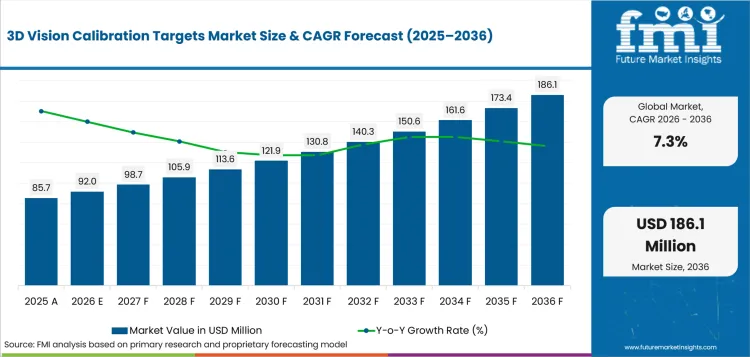
3D Vision Calibration Targets Market Overview: Size and Forecast
- 2026 Market Size: USD 92.0 million
- 2036 Market Size: USD 186.1 million
- Forecast CAGR: 7.3% from 2026 to 2036
- Leading Deployment: Inline
- Inline Share in 2026: 44.0%
- Leading Target Type: Calibration Plates
- Calibration Plates Share in 2026: 41.0%
- Fastest-growing Country: China
- China CAGR: 8.5% by 2036
Summary of the 3D Vision Calibration Targets Market
- Demand and Growth Drivers
- Inline inspection teams are adding target routines to confirm measurement stability after sensor movement, fixture adjustment, and product recipe changes.
- Robot integrators are using calibration targets to align camera coordinates with robot movement before production cells enter repeat operation.
- Electronics manufacturers are increasing reference checks as miniaturized assemblies leave little tolerance for depth error or lens distortion.
- Product and Segment View
- Inline is forecast to represent 44.0% share in 2026, led by production teams that need quick line-side recalibration without removing sensors.
- Calibration Plates are projected to hold 41.0% share in 2026, influenced by stable geometry and stronger acceptance in precision inspection cells.
- Measurement is expected to secure 36.0% share in 2026, supported by demand for trusted reference geometry in dimensional inspection.
- Geography and Competitive Outlook
- China is projected to record 8.5% CAGR by 2036, backed by high robot deployment and electronics automation depth.
- India is expected to expand at 8.2% CAGR through 2036 as electronics and automotive suppliers increase camera-guided quality checks.
- Cognex, KEYENCE, SICK, and Zebra Technologies compete through 3D vision systems, calibration workflows, and factory automation channels.
- MVTec, Basler, LMI Technologies, Zivid, Thorlabs, and Applied Image strengthen the ecosystem through software, sensors, and specialized target formats.
- Analyst Opinion
- Nikhil Kaitwade, Principal Consultant for Industrial Automation at FMI, observes, “3D vision calibration targets are becoming part of the factory quality record rather than a simple setup accessory. Buyers increasingly evaluate whether the target, software routine, and field handling method can protect measurement repeatability after a camera is moved or a robot cell is changed. Suppliers with documented geometry, software fit, and practical operator guidance should gain stronger repeat listing.”
Automation depth is setting the market outlook as 3D cameras move into production areas where calibration records must withstand audits and warranty reviews. The International Federation of Robotics reported 542,000 industrial robots installed in 2024, with annual installations above 500,000 units for the fourth straight year. A3 stated in February 2026 that North American companies ordered 36,766 robots valued at USD 2.25 billion in 2025. Cognex also stated in April 2024 that its In-Sight L38 AI-powered 3D tools can be trained with as few as 5 to 10 labeled images. These figures show why calibration targets are moving from occasional setup accessories into recurring tools for machine vision commissioning and measurement confidence.
Which factors support expansion in the 3D vision calibration targets market?
Recurring validation demand and software-linked inspection workflows support market value across industrial automation channels.
- Market value is supported by target kits, calibrated plates, and target-linked services used during commissioning and requalification.
- Supplier pricing reflects substrate stability, pattern accuracy, and documentation depth before software support changes order value.
- Revenue improves as 3D inspection shifts from visual checks toward real-world measurement and robot coordinate mapping.
- Buyer trust rises when target documentation makes accuracy, handling, replacement, and software compatibility easier to compare.
Why is the 3D vision calibration targets market growing?
Inline 3D inspection and robot guidance are increasing the need for repeatable calibration routines inside production workflows.
Growth outlook is becoming more structured as manufacturing plants move from simple pass-fail imaging toward calibrated dimensional control. IFR stated in its 2025 executive summary that electronics became the largest industrial robot customer sector in 2024 with 128,899 installations. That matters for calibration targets because electronics inspection often involves small parts, reflective surfaces, and tight height thresholds. Buyers therefore compare target material stability, pattern contrast, and software fit before choosing a target supplier. This supports demand for calibration plates, dot grids, and target-linked services across the machine vision system and services market.
How is the 3D vision calibration targets market segmented?
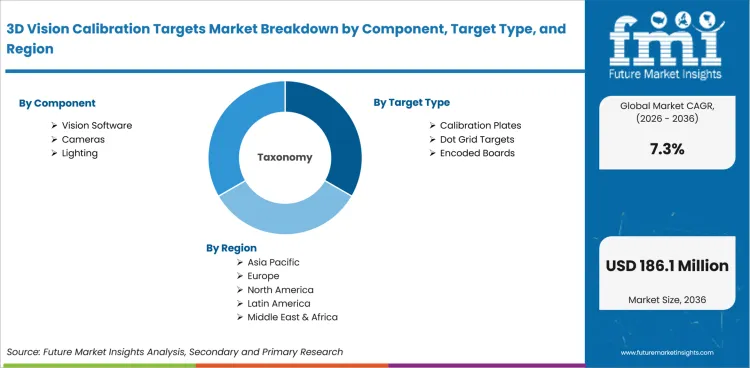
The 3D vision calibration targets industry is segmented by component, target type, inspection type, deployment, and end-use industry.
- Vision Software is projected to secure 29.0% share in 2026, led by calibration files that convert camera pixels into usable real-world coordinates.
- Calibration Plates are anticipated to hold 41.0% share in 2026 since stable substrates support repeatable geometry during line-side validation.
- Measurement is expected to capture 36.0% share in 2026 as depth accuracy directly affects dimensional pass-fail thresholds.
- Inline deployment is forecast to represent 44.0% share in 2026, guided by fast recalibration needs during production changeovers.
- Electronics is projected to account for 32.0% share in 2026, reflected by small components and high inspection frequency.
Which component leads the 3D vision calibration targets market?
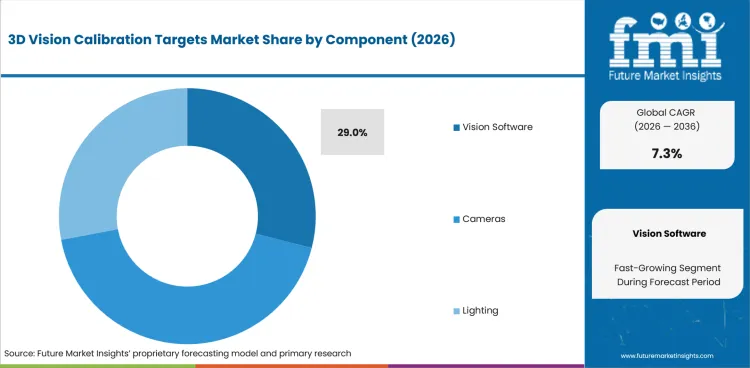
- Vision Software is projected to account for 29.0% share in 2026, influenced by calibration files that correct lens distortion and map coordinates into production recipes.
- Cameras and lenses create added demand for target kits as each hardware change can require fresh field calibration before inspection restarts.
Which target type leads the 3D vision calibration targets market?
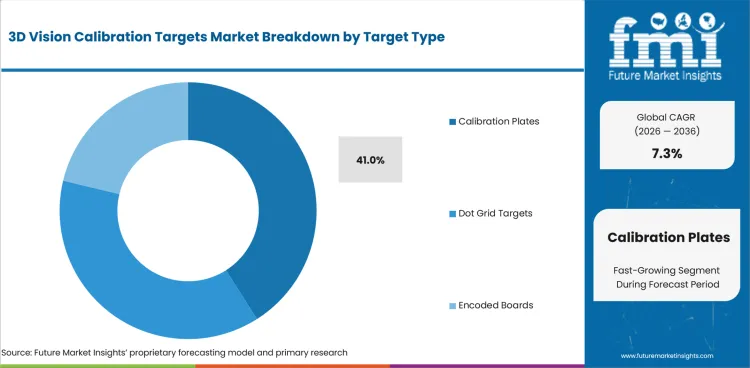
- Calibration Plates are expected to represent 41.0% share in 2026, supported by durable substrates and documented reference geometry for metrology-grade inspection.
- Dot grid targets gain use in higher precision routines where subpixel point detection helps software reduce calibration uncertainty across compact fields of view.
Which inspection type leads the 3D vision calibration targets market?
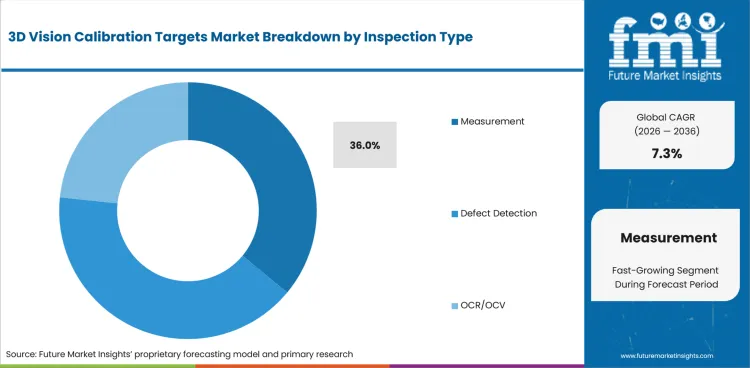
- Measurement is anticipated to hold 36.0% share in 2026 through dimensional control needs in electronics, automotive, and machined-part inspection.
- Guidance applications increase target demand when robot cells need hand-eye calibration and verified camera-to-robot coordinate alignment.
Which deployment leads the 3D vision calibration targets market?
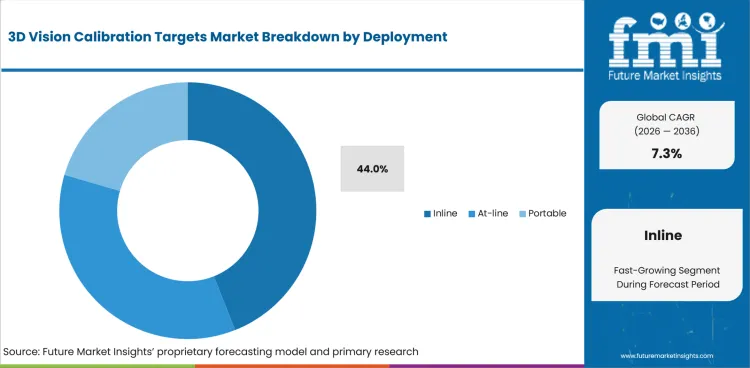
- Inline deployment is expected to represent 44.0% share in 2026, shaped by recalibration needs during production shifts and recipe changes.
- Robotic cell deployment gains importance as bin picking, assembly guidance, and depalletizing cells require repeatable target placement.
Which end-use industry leads the 3D vision calibration targets market?
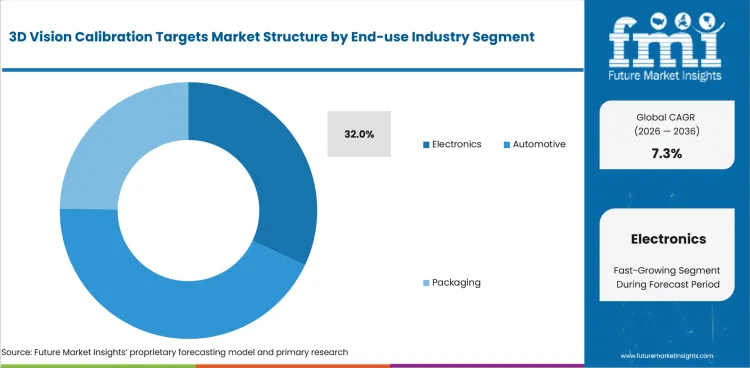
- Electronics is forecast to secure 32.0% share in 2026, reflected by high part variety and tighter depth tolerance in board and component inspection.
- Automotive demand rises as battery modules, weld seams, castings, and trim gaps require calibrated 3D measurement during production checks.
What are the drivers, restraints, and opportunities in the 3D vision calibration targets market?
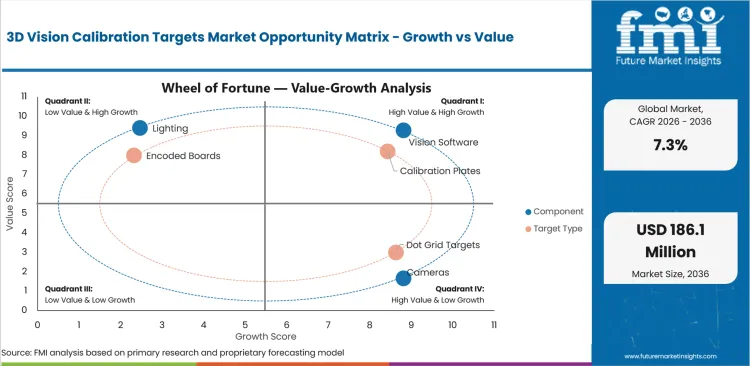
Metrology-grade inspection and robotic guidance support demand while skill gaps and low replacement awareness limit faster adoption.
- Driver: Factories are moving from image presence checks toward depth measurement that needs target-based reference control.
- Restraint: Smaller buyers can delay replacement when calibration error is hidden until inspection failures appear.
- Opportunity: Integrators can package targets with validation, training, and periodic recalibration to raise service revenue.
3D Vision Calibration Targets Market Demand Outlook
Demand outlook is moving toward target-based traceability as buyers need to defend inspection results across shifts, product lots, and supplier audits. IFR reported that the worldwide operational stock of industrial robots reached 4,664,000 units in 2024. That installed base creates recurring recalibration needs after gripper changes, camera movement, and process requalification. Target suppliers that pair stable plates with audit-ready procedures can protect premium pricing in the industrial machine vision market.
Calibration Skill and Replacement Restraint Analysis
The main restraint is not only target price but also the skill needed to mount, image, store, and reuse targets correctly. The Manufacturing Institute reported in April 2024 that manufacturers could need as many as 3.8 million additional employees between 2024 and 2033, while 1.9 million roles could remain unfilled if workforce challenges are not addressed. That skills pressure matters for calibration targets because plant teams need trained operators to position targets, validate images, and protect setup records. Poor field handling can weaken buyer confidence even when the target itself is accurate.
Service Bundling and Software Integration Opportunity
The opportunity is strongest where targets are sold with setup validation, operator guidance, and software-linked records. A3 reported that North American companies ordered 9,055 robots valued at USD 543 million in Q1 2026. This ongoing automation pipeline creates service openings for integrators that can attach calibration kits to robot cells, inspection stations, and maintenance contracts. The result is stronger revenue potential beyond one-time plate sales in the factory automation and industrial controls market.
Which countries are growing fastest in the 3D vision calibration targets market?
China 8.5% CAGR, India 8.2% CAGR, South Korea 7.8% CAGR, Japan 7.1% CAGR, Germany 6.8% CAGR, United States 6.6% CAGR, France 6.2% CAGR, and United Kingdom 5.9% CAGR through 2036.
.webp "Top Country Growth Comparison 3d Vision Calibration Targets Market Cagr (2026 2036)")
| Country | CAGR |
|---|---|
| United States | 6.6% |
| United Kingdom | 5.9% |
| Germany | 6.8% |
| France | 6.2% |
| Japan | 7.1% |
| China | 8.5% |
| South Korea | 7.8% |
| India | 8.2% |
Source: Future Market Insights, 2026.
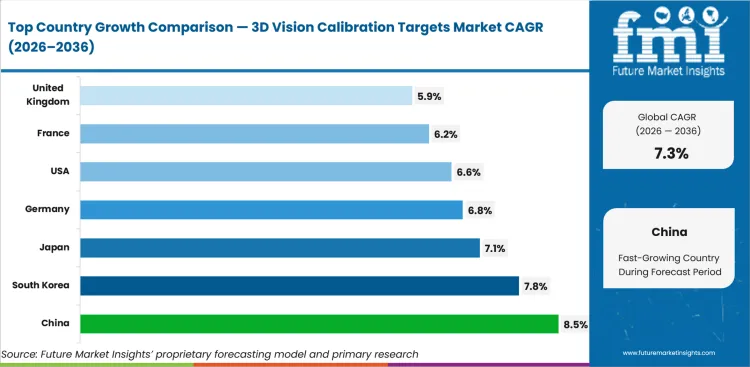
How do country-level CAGRs compare in the 3D vision calibration targets market?
China leads selected country growth while the United Kingdom records the most cautious expansion outlook among profiled markets.
- China is projected to record 8.5% CAGR by 2036 as automation investment and 3D inspection maturity shape adoption pace.
- India is projected to record 8.2% CAGR by 2036 as automation investment and 3D inspection maturity shape adoption pace.
- South Korea is projected to record 7.8% CAGR by 2036 as automation investment and 3D inspection maturity shape adoption pace.
- Japan is projected to record 7.1% CAGR by 2036 as automation investment and 3D inspection maturity shape adoption pace.
- Germany is projected to record 6.8% CAGR by 2036 as automation investment and 3D inspection maturity shape adoption pace.
- United States is projected to record 6.6% CAGR by 2036 as automation investment and 3D inspection maturity shape adoption pace.
- France is projected to record 6.2% CAGR by 2036 as automation investment and 3D inspection maturity shape adoption pace.
- United Kingdom is projected to record 5.9% CAGR by 2036 as automation investment and 3D inspection maturity shape adoption pace.
What is the 3D vision calibration targets market outlook in the United States?
A 6.6% CAGR through 2036 is supported by robot orders, integrator depth, and advanced manufacturing inspection needs.
Country Market Snapshot Table
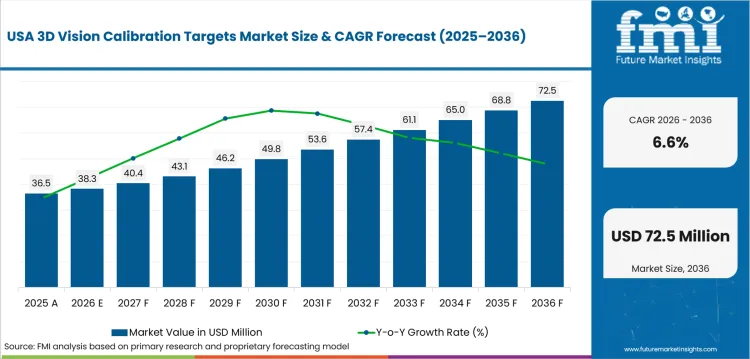
| Parameter | Value |
|---|---|
| Market Size in 2025 (Value) | USD 17.4 million |
| Market Size in 2026 (Value) | USD 18.5 million |
| Market Forecast in 2036 (Value) | USD 35.1 million |
| CAGR (2026 to 2036) | 6.6% |
| Years Considered | 2021 to 2036 |
| Base Year | 2025 |
| Forecast Period | 2026 to 2036 |
| Units Considered | Value (USD million) |
| Leading Sub-Region | Midwest and national integrator corridors |
United States 3D Vision Calibration Targets Market Outlook
United States demand is influenced by automation orders, durable goods production, and strong machine vision integrator networks. Buyers use calibration targets to protect measurement repeatability in electronics, medical devices, logistics, and automotive inspection cells.
Suppliers gain traction when target kits include software compatibility guidance, handling instructions, and validation records. Service partners are expected to remain important because many plants prefer target setup support during commissioning and requalification.
Key Growth Drivers
- Robot orders support target demand as A3 reported 36,766 North American robots valued at USD 2.25 billion in 2025.
- Durable manufacturing activity supports inspection investment as the U.S. Census Bureau reported durable goods orders rising 7.9% to USD 346.0 billion in April 2026.
- Medical device and electronics plants use traceable 3D checks where target documentation supports quality records.
- Integrator networks help buyers attach calibration kits to camera, lens, and robot-cell projects without building internal expertise.
Key Restraints
- Operator skill pressure can slow adoption as BLS projected 25,200 industrial engineer openings per year during 2024 to 2034.
- Smaller manufacturers may postpone target replacement until field measurement drift creates visible scrap or rework.
- Imported robot dependence can lengthen qualification cycles when camera hardware and target accessories arrive through different channels.
What makes United States unique
United States is unique due to national integrator depth and strong demand for validation records in high-value manufacturing.
Key Companies
- Cognex
- Zebra Technologies
- Teledyne Vision Solutions
- KEYENCE
- SICK
- Basler
- LMI Technologies
Sales & Marketing Channels
- Certified machine vision integrators
- Direct enterprise sales
- Distributor component bundles
- Robot OEM partnerships
- Maintenance validation services
- Electronics cluster suppliers
Country Segment Breakdown Table
| Segment | Sub-Segments |
|---|---|
| By Component | Cameras · Lenses · Lighting · Frame Grabbers · Vision Software · Services |
| By Target Type | Checkerboard Targets · Dot Grid Targets · Calibration Plates · Frustum Targets · Encoded Boards |
| By Inspection Type | Defect Detection · Measurement · OCR/OCV · Presence/Absence · Guidance |
| By Deployment | Inline · At-line · Robotic Cell · Portable |
| By End-use Industry | Electronics · Automotive · Packaging · Pharmaceuticals · Food and Beverage · Metals |
| Key Sub-Regions Covered, Automation and Inspection Clusters | Midwest · South Atlantic · California · Texas · Northeast · Pacific Northwest |
Frequently Asked Questions
How fast is United States 3D vision calibration targets market growing?
United States is expected to rise at 6.6% CAGR from 2026 to 2036, supported by its local automation base and 3D inspection use cases.
Who leads United States 3D vision calibration targets market?
Cognex, Zebra Technologies, Teledyne Vision Solutions, KEYENCE compete through machine vision systems, software support, and calibration workflow relevance.
What is driving adoption in United States 3D vision calibration targets market?
Adoption in United States is driven by target-backed 3D inspection, robot guidance validation, and repeatable recalibration during production changes.
How is the 3D vision calibration targets market performing in the United Kingdom?
A 5.9% CAGR through 2036 reflects selective automation investment and regulated manufacturing use cases.
Country Market Snapshot Table
| Parameter | Value |
|---|---|
| Market Size in 2025 (Value) | USD 4.1 million |
| Market Size in 2026 (Value) | USD 4.3 million |
| Market Forecast in 2036 (Value) | USD 7.6 million |
| CAGR (2026 to 2036) | 5.9% |
| Years Considered | 2021 to 2036 |
| Base Year | 2025 |
| Forecast Period | 2026 to 2036 |
| Units Considered | Value (USD million) |
| Leading Sub-Region | London and Midlands advanced manufacturing corridors |
United Kingdom 3D Vision Calibration Targets Market Outlook
United Kingdom demand is selective, with aerospace, pharmaceuticals, food packaging, and advanced manufacturing projects creating premium use cases. Buyers often evaluate calibration targets through integrator-led upgrades rather than broad plant replacement programs.
Local adoption improves when vendors demonstrate practical field routines and clear operator training. The market therefore favors suppliers that can explain how target placement protects inspection results inside compact and high-mix production areas.
Key Growth Drivers
- Robotics adoption support is improving as the UK government announced £52 million for hubs to drive robotics adoption in British business in January 2026.
- Advanced manufacturing investment supports inspection upgrades as the DRIVE35 programme provides £2.5 billion of capital and R&D funding for the automotive industry.
- Aerospace and pharmaceutical packaging plants need repeatable calibration routines for complex parts and validated production checks.
- Specialist distributors help mid-sized factories test calibration targets during line-specific machine vision upgrades.
Key Restraints
- New-cell volume is cautious as IFR reported UK industrial robot installations fell 35% to 2,500 units in 2024.
- Project-based buying can delay target replacement when calibration is treated as a commissioning item rather than a recurring control.
- Smaller plants may need external integrator support before operators can manage field calibration correctly.
What makes United Kingdom unique
United Kingdom is unique because premium calibration demand comes from regulated and high-mix manufacturing despite modest robot volume.
Key Companies
- Cognex UK
- KEYENCE UK
- SICK UK
- Zebra Technologies
- Basler
- MVTec
- specialist automation distributors
Sales & Marketing Channels
- Automation distributors
- Aerospace qualification projects
- Pharmaceutical packaging integrators
- Direct branch sales
- University-linked robotics programs
- Service partners
Country Segment Breakdown Table
| Segment | Sub-Segments |
|---|---|
| By Component | Cameras · Lenses · Lighting · Frame Grabbers · Vision Software · Services |
| By Target Type | Checkerboard Targets · Dot Grid Targets · Calibration Plates · Frustum Targets · Encoded Boards |
| By Inspection Type | Defect Detection · Measurement · OCR/OCV · Presence/Absence · Guidance |
| By Deployment | Inline · At-line · Robotic Cell · Portable |
| By End-use Industry | Electronics · Automotive · Packaging · Pharmaceuticals · Food and Beverage · Metals |
| Key Sub-Regions Covered, Automation and Inspection Clusters | London · Midlands · Manchester · Bristol · Glasgow · Cambridge |
Frequently Asked Questions
How fast is United Kingdom 3D vision calibration targets market growing?
United Kingdom is expected to rise at 5.9% CAGR from 2026 to 2036, supported by its local automation base and 3D inspection use cases.
Who leads United Kingdom 3D vision calibration targets market?
Cognex UK, KEYENCE UK, SICK UK, Zebra Technologies compete through machine vision systems, software support, and calibration workflow relevance.
What is driving adoption in United Kingdom 3D vision calibration targets market?
Adoption in United Kingdom is driven by target-backed 3D inspection, robot guidance validation, and repeatable recalibration during production changes.
What supports 3D vision calibration targets demand in Germany?
A 6.8% CAGR through 2036 reflects machine-builder specifications and high automation density.
Country Market Snapshot Table
| Parameter | Value |
|---|---|
| Market Size in 2025 (Value) | USD 6.6 million |
| Market Size in 2026 (Value) | USD 7.1 million |
| Market Forecast in 2036 (Value) | USD 13.7 million |
| CAGR (2026 to 2036) | 6.8% |
| Years Considered | 2021 to 2036 |
| Base Year | 2025 |
| Forecast Period | 2026 to 2036 |
| Units Considered | Value (USD million) |
| Leading Sub-Region | Bavaria, Baden-Wurttemberg, and Rhine-Ruhr machine-building clusters |
Germany 3D Vision Calibration Targets Market Outlook
Germany demand is supported by machine builders, automotive suppliers, and standards-aware factories that require documented inspection reliability. Calibration targets are commonly evaluated as part of complete camera, fixture, and software specifications.
Suppliers need strong engineering support because German buyers often request accuracy proof and workflow fit before approving target kits. Replacement demand remains steadier where existing 3D inspection cells require periodic validation.
Key Growth Drivers
- Automation density supports repeat target demand as IFR reported Germany had 449 robots per 10,000 manufacturing employees in 2024.
- Digital manufacturing support is expanding as Germany approved €140 million for the Manufacturing-X funding programme in October 2025.
- Machine builders embed calibration plates into inspection-cell specifications when buyers demand documented accuracy.
- Automotive suppliers need recalibration after tooling changes, battery pack updates, and mixed-model production runs.
Key Restraints
- Investment caution can slow new inspection cells as Destatis reported German manufacturing orders fell 3.8% month on month in April 2026.
- High engineering expectations increase supplier support costs for target qualification and documentation.
- Automotive capex timing can delay new inspection cells even when existing cells keep replacement demand active.
What makes Germany unique
Germany is unique because local machine builders can make calibration targets part of the inspection-cell specification.
Key Companies
- Basler
- SICK
- Balluff
- MVTec
- Siemens
- KEYENCE
- Cognex
- ZEISS automation partners
Sales & Marketing Channels
- Machine builder specifications
- Automotive Tier-1 programs
- Industrial automation distributors
- Software partner programs
- Vision trade shows
- Direct technical sales
Country Segment Breakdown Table
| Segment | Sub-Segments |
|---|---|
| By Component | Cameras · Lenses · Lighting · Frame Grabbers · Vision Software · Services |
| By Target Type | Checkerboard Targets · Dot Grid Targets · Calibration Plates · Frustum Targets · Encoded Boards |
| By Inspection Type | Defect Detection · Measurement · OCR/OCV · Presence/Absence · Guidance |
| By Deployment | Inline · At-line · Robotic Cell · Portable |
| By End-use Industry | Electronics · Automotive · Packaging · Pharmaceuticals · Food and Beverage · Metals |
| Key Sub-Regions Covered, Automation and Inspection Clusters | Bavaria · Baden-Wurttemberg · North Rhine-Westphalia · Saxony · Lower Saxony · Hesse |
Frequently Asked Questions
How fast is Germany 3D vision calibration targets market growing?
Germany is expected to rise at 6.8% CAGR from 2026 to 2036, supported by its local automation base and 3D inspection use cases.
Who leads Germany 3D vision calibration targets market?
Basler, SICK, Balluff, MVTec compete through machine vision systems, software support, and calibration workflow relevance.
What is driving adoption in Germany 3D vision calibration targets market?
Adoption in Germany is driven by target-backed 3D inspection, robot guidance validation, and repeatable recalibration during production changes.
How fast is the 3D vision calibration targets market growing in France?
A 6.2% CAGR through 2036 is supported by aerospace inspection, pharmaceutical packaging, and selective automation projects.
Country Market Snapshot Table
| Parameter | Value |
|---|---|
| Market Size in 2025 (Value) | USD 3.6 million |
| Market Size in 2026 (Value) | USD 3.8 million |
| Market Forecast in 2036 (Value) | USD 6.9 million |
| CAGR (2026 to 2036) | 6.2% |
| Years Considered | 2021 to 2036 |
| Base Year | 2025 |
| Forecast Period | 2026 to 2036 |
| Units Considered | Value (USD million) |
| Leading Sub-Region | Paris-Saclay, Toulouse, Lyon, and aerospace-led manufacturing corridors |
France 3D Vision Calibration Targets Market Outlook
France demand is tied to aerospace, pharmaceuticals, food processing, and automotive suppliers that need quality-led inspection routines. Calibration targets gain attention where 3D measurement can reduce rework in complex part and packaging validation tasks.
Integrator influence is high because many buyers want cell-level proof before adopting new target materials or software routines. Local branch support and European distributor coverage remain important for supplier selection.
Key Growth Drivers
- Manufacturing activity supports quality upgrades as INSEE reported French manufacturing output increased 0.4% in April 2026.
- Technology-sector depth supports automation adoption as French Tech 2030 selected 80 companies in its 2025 class.
- Aerospace suppliers need stable 3D reference tools for curved surfaces, assembly fixtures, and non-contact measurement routines.
- Food and pharmaceutical lines use calibrated vision for seal, label, code, and pack integrity checks.
Key Restraints
- Automation softness can slow target volume as IFR reported France robot installations declined 24% in 2024.
- Many buyers need integrator-led validation before moving from 2D inspection to target-based 3D measurement.
- Imported camera ecosystems can require extra compatibility checks before local teams approve target kits.
What makes France unique
France is unique because aerospace and regulated production create quality-driven purchases despite slower broad automation cycles.
Key Companies
- KEYENCE France
- Cognex France
- Basler France
- SICK France
- MVTec partners
- Teledyne distributors
Sales & Marketing Channels
- Aerospace supplier qualification routes
- Pharmaceutical packaging integrators
- Food processing automation partners
- European component distributors
- Direct branch sales
- Service validation partners
Country Segment Breakdown Table
| Segment | Sub-Segments |
|---|---|
| By Component | Cameras · Lenses · Lighting · Frame Grabbers · Vision Software · Services |
| By Target Type | Checkerboard Targets · Dot Grid Targets · Calibration Plates · Frustum Targets · Encoded Boards |
| By Inspection Type | Defect Detection · Measurement · OCR/OCV · Presence/Absence · Guidance |
| By Deployment | Inline · At-line · Robotic Cell · Portable |
| By End-use Industry | Electronics · Automotive · Packaging · Pharmaceuticals · Food and Beverage · Metals |
| Key Sub-Regions Covered, Automation and Inspection Clusters | Paris-Saclay · Toulouse · Lyon · Grenoble · Nantes · Lille |
Frequently Asked Questions
How fast is France 3D vision calibration targets market growing?
France is expected to rise at 6.2% CAGR from 2026 to 2036, supported by its local automation base and 3D inspection use cases.
Who leads France 3D vision calibration targets market?
KEYENCE France, Cognex France, Basler France, SICK France compete through machine vision systems, software support, and calibration workflow relevance.
What is driving adoption in France 3D vision calibration targets market?
Adoption in France is driven by target-backed 3D inspection, robot guidance validation, and repeatable recalibration during production changes.
What is the 3D vision calibration targets market forecast for Japan?
A 7.1% CAGR through 2036 reflects precision manufacturing and domestic automation supplier depth.
Country Market Snapshot Table
| Parameter | Value |
|---|---|
| Market Size in 2025 (Value) | USD 8.0 million |
| Market Size in 2026 (Value) | USD 8.6 million |
| Market Forecast in 2036 (Value) | USD 17.1 million |
| CAGR (2026 to 2036) | 7.1% |
| Years Considered | 2021 to 2036 |
| Base Year | 2025 |
| Forecast Period | 2026 to 2036 |
| Units Considered | Value (USD million) |
| Leading Sub-Region | Tokyo, Aichi, Osaka, and electronics precision corridors |
Japan 3D Vision Calibration Targets Market Outlook
Japan demand reflects precision manufacturing, compact factory layouts, and domestic automation supplier strength. Buyers value calibration workflows that reduce setup complexity and keep 3D measurement stable in electronics, optics, and automotive lines.
Supplier-led packages are important because Japanese plants often prefer validated accessory ecosystems. Calibration target vendors can gain share by proving compatibility with local 3D vision systems and practical service routines.
Key Growth Drivers
- Production stability supports inspection spending as METI reported Japan’s production index at 102.5 in April 2026, up 0.5% month on month.
- Automation visibility supports buyer education as the U.S. Commercial Service stated that IIFES 2024 drew about 200 exhibitors and 42,500 participants.
- Domestic vision suppliers can bundle targets with 3D inspection systems and service routines for compact factory cells.
- Electronics and optics plants need high-contrast target patterns to manage glare, focus drift, and lens distortion.
Key Restraints
- New equipment momentum is cautious as IFR stated Japan robot installations declined by 4% in 2024.
- Conservative qualification practices can extend approval timelines for new target substrates and field routines.
- Compact production spaces can make target placement fixtures more important than simple plate availability.
What makes Japan unique
Japan is unique because domestic suppliers combine vision systems, calibration accessories, and field support in packaged buying routes.
Key Companies
- KEYENCE
- OMRON
- Cognex Japan
- SICK Japan
- Basler
- Zivid channel partners
- MVTec distributors
Sales & Marketing Channels
- Direct OEM sales teams
- Factory automation distributors
- Robot integrator partnerships
- Electronics quality programs
- Service-led replacement contracts
- Precision equipment suppliers
Country Segment Breakdown Table
| Segment | Sub-Segments |
|---|---|
| By Component | Cameras · Lenses · Lighting · Frame Grabbers · Vision Software · Services |
| By Target Type | Checkerboard Targets · Dot Grid Targets · Calibration Plates · Frustum Targets · Encoded Boards |
| By Inspection Type | Defect Detection · Measurement · OCR/OCV · Presence/Absence · Guidance |
| By Deployment | Inline · At-line · Robotic Cell · Portable |
| By End-use Industry | Electronics · Automotive · Packaging · Pharmaceuticals · Food and Beverage · Metals |
| Key Sub-Regions Covered, Automation and Inspection Clusters | Tokyo · Aichi · Osaka · Kanagawa · Fukuoka · Shizuoka |
Frequently Asked Questions
How fast is Japan 3D vision calibration targets market growing?
Japan is expected to rise at 7.1% CAGR from 2026 to 2036, supported by its local automation base and 3D inspection use cases.
Who leads Japan 3D vision calibration targets market?
KEYENCE, OMRON, Cognex Japan, SICK Japan compete through machine vision systems, software support, and calibration workflow relevance.
What is driving adoption in Japan 3D vision calibration targets market?
Adoption in Japan is driven by target-backed 3D inspection, robot guidance validation, and repeatable recalibration during production changes.
Why is China leading growth in the 3D vision calibration targets market?
An 8.5% CAGR through 2036 reflects the largest automation base and deep electronics manufacturing scale.
Country Market Snapshot Table
| Parameter | Value |
|---|---|
| Market Size in 2025 (Value) | USD 19.7 million |
| Market Size in 2026 (Value) | USD 21.4 million |
| Market Forecast in 2036 (Value) | USD 48.4 million |
| CAGR (2026 to 2036) | 8.5% |
| Years Considered | 2021 to 2036 |
| Base Year | 2025 |
| Forecast Period | 2026 to 2036 |
| Units Considered | Value (USD million) |
| Leading Sub-Region | Yangtze River Delta, Greater Bay Area, and electronics automation clusters |
China 3D Vision Calibration Targets Market Outlook
China demand is driven by electronics, EV batteries, logistics automation, and high-volume inspection cells. Buyers compare cost carefully, although advanced plants still need stable targets with reliable geometry and documentation.
Channel success depends on local service speed, multi-vendor compatibility, and proof that target routines reduce commissioning mistakes. Imported target suppliers need clearer value evidence when competing against lower-cost local alternatives.
Key Growth Drivers
- Factory demand is reinforced by SCIO reporting that China’s industrial robot production rose 24.0% in July 2025.
- Smart factory investment supports calibration target adoption as the State Council stated that Shanghai planned to build 70 smart factories in 2024.
- Electronics, EV battery, and logistics plants require frequent target routines for high-volume 3D inspection cells.
- Local robot suppliers increase demand for cost-effective targets that can be validated across multi-vendor camera platforms.
Key Restraints
- Price pressure remains visible as the National Bureau of Statistics reported a 95.5% industrial product sales rate from January to February 2025.
- Local competition can compress margins for imported glass and ceramic targets unless documentation clearly supports premium use.
- Fast project cycles can increase field mistakes when target mounting and storage procedures are not standardized.
What makes China unique
China is unique because high robot volume and electronics scale create both premium validation demand and strong price competition.
Key Companies
- KEYENCE China
- Cognex China
- SICK China
- Basler China
- Hikrobot ecosystem partners
- LMI Technologies
- MVTec distributors
Sales & Marketing Channels
- Electronics cluster distributors
- EV battery integrators
- Direct global supplier sales
- Domestic automation marketplaces
- Robot OEM partnerships
- Local service providers
Country Segment Breakdown Table
| Segment | Sub-Segments |
|---|---|
| By Component | Cameras · Lenses · Lighting · Frame Grabbers · Vision Software · Services |
| By Target Type | Checkerboard Targets · Dot Grid Targets · Calibration Plates · Frustum Targets · Encoded Boards |
| By Inspection Type | Defect Detection · Measurement · OCR/OCV · Presence/Absence · Guidance |
| By Deployment | Inline · At-line · Robotic Cell · Portable |
| By End-use Industry | Electronics · Automotive · Packaging · Pharmaceuticals · Food and Beverage · Metals |
| Key Sub-Regions Covered, Automation and Inspection Clusters | Shanghai · Suzhou · Shenzhen · Guangzhou · Beijing · Chengdu |
Frequently Asked Questions
How fast is China 3D vision calibration targets market growing?
China is expected to rise at 8.5% CAGR from 2026 to 2036, supported by its local automation base and 3D inspection use cases.
Who leads China 3D vision calibration targets market?
KEYENCE China, Cognex China, SICK China, Basler China compete through machine vision systems, software support, and calibration workflow relevance.
What is driving adoption in China 3D vision calibration targets market?
Adoption in China is driven by target-backed 3D inspection, robot guidance validation, and repeatable recalibration during production changes.
How fast is South Korea 3D vision calibration targets market growing?
A 7.8% CAGR through 2036 reflects very high robot density and advanced electronics automation.
Country Market Snapshot Table
| Parameter | Value |
|---|---|
| Market Size in 2025 (Value) | USD 5.8 million |
| Market Size in 2026 (Value) | USD 6.2 million |
| Market Forecast in 2036 (Value) | USD 13.1 million |
| CAGR (2026 to 2036) | 7.8% |
| Years Considered | 2021 to 2036 |
| Base Year | 2025 |
| Forecast Period | 2026 to 2036 |
| Units Considered | Value (USD million) |
| Leading Sub-Region | Seoul Capital Area, Gyeonggi, Ulsan, and electronics-automotive corridors |
South Korea 3D Vision Calibration Targets Market Outlook
South Korea demand is shaped by semiconductor, display, battery, and automotive precision manufacturing. Very high automation intensity makes calibration a production-control topic rather than a one-time installation task.
Buyers often prefer supplier-backed workflows that can withstand strict qualification requirements. Target vendors with software fit and stable documentation are better placed to serve semiconductor and smart factory projects.
Key Growth Drivers
- Automation intensity is exceptional as IFR reported South Korea reached 1,220 robots per 10,000 manufacturing employees in 2024.
- Smart factory support strengthens adoption as MSS listed 400 AI-specialized smart factory projects within about 450 projects for 2026.
- Semiconductor and display lines need stable target geometry for subassembly inspection and high-frequency recalibration.
- Automotive battery and powertrain suppliers use calibrated 3D measurement to reduce rework in precision assembly cells.
Key Restraints
- Mature deployment can limit replacement bursts as the Ministry of Data and Statistics listed April 2026 monthly industrial statistics during a period when manufacturing production softened.
- High specification demands raise qualification work for imported target materials and custom plate makers.
- Factory teams may prefer bundled vendor targets when standalone suppliers cannot prove software compatibility.
What makes South Korea unique
South Korea is unique because very high robot density makes calibration a routine production-control concern.
Key Companies
- KEYENCE Korea
- Cognex Korea
- SICK Korea
- Zebra Technologies
- Basler
- MVTec partners
- semiconductor automation integrators
Sales & Marketing Channels
- Semiconductor equipment channels
- Automotive automation integrators
- Smart factory support programs
- Direct technical sales
- Distributor-led target kits
- Maintenance services
Country Segment Breakdown Table
| Segment | Sub-Segments |
|---|---|
| By Component | Cameras · Lenses · Lighting · Frame Grabbers · Vision Software · Services |
| By Target Type | Checkerboard Targets · Dot Grid Targets · Calibration Plates · Frustum Targets · Encoded Boards |
| By Inspection Type | Defect Detection · Measurement · OCR/OCV · Presence/Absence · Guidance |
| By Deployment | Inline · At-line · Robotic Cell · Portable |
| By End-use Industry | Electronics · Automotive · Packaging · Pharmaceuticals · Food and Beverage · Metals |
| Key Sub-Regions Covered, Automation and Inspection Clusters | Seoul · Gyeonggi · Ulsan · Busan · Daegu · Daejeon |
Frequently Asked Questions
How fast is South Korea 3D vision calibration targets market growing?
South Korea is expected to rise at 7.8% CAGR from 2026 to 2036, supported by its local automation base and 3D inspection use cases.
Who leads South Korea 3D vision calibration targets market?
KEYENCE Korea, Cognex Korea, SICK Korea, Zebra Technologies compete through machine vision systems, software support, and calibration workflow relevance.
What is driving adoption in South Korea 3D vision calibration targets market?
Adoption in South Korea is driven by target-backed 3D inspection, robot guidance validation, and repeatable recalibration during production changes.
What is driving 3D vision calibration targets growth in India?
An 8.2% CAGR through 2036 is supported by electronics scaling, automotive automation, and integrator-led adoption.
Country Market Snapshot Table
| Parameter | Value |
|---|---|
| Market Size in 2025 (Value) | USD 2.9 million |
| Market Size in 2026 (Value) | USD 3.1 million |
| Market Forecast in 2036 (Value) | USD 6.8 million |
| CAGR (2026 to 2036) | 8.2% |
| Years Considered | 2021 to 2036 |
| Base Year | 2025 |
| Forecast Period | 2026 to 2036 |
| Units Considered | Value (USD million) |
| Leading Sub-Region | Bengaluru, Pune, Chennai, Noida, and Gujarat electronics corridors |
India 3D Vision Calibration Targets Market Outlook
India demand is expanding as electronics, automotive, and EV component suppliers add camera-guided inspection to more production lines. Calibration targets are increasingly evaluated alongside training and integrator-led support.
Suppliers can build adoption by simplifying target handling, storage, and replacement practices for first-time 3D inspection users. Demonstration-based selling remains important because many buyers want proof before moving beyond low-cost patterns.
Key Growth Drivers
- Robot adoption is rising as IFR reported India installed a record 9,100 industrial robots in 2024, up 7%.
- Electronics demand is expanding as PIB stated India’s electronics production reached ₹11.3 lakh crore in 2024 to 2025.
- Automotive and EV component suppliers need calibration targets as camera-guided inspection moves into more supplier plants.
- Training-led service models help buyers manage target placement, calibration files, and replacement schedules.
Key Restraints
- Skill depth can limit advanced adoption as MeitY reported India ranked 12th among G20 countries in individual-user digitalisation in 2024.
- Smaller factories may select low-cost printed patterns without geometry traceability for high-precision 3D measurement.
- Imported target lead times can slow urgent recalibration when production lines change fixtures or sensors.
What makes India unique
India is unique because fast automation growth creates a training-led market for target kits and calibration services.
Key Companies
- KEYENCE India
- Cognex channel partners
- SICK India
- Basler distributors
- Zebra Technologies
- local automation integrators
- Applied Image distributors
Sales & Marketing Channels
- Integrator-led line projects
- Demonstration-based direct sales
- Electronics cluster distributors
- Automotive supplier programs
- Training-linked service contracts
- Industrial automation resellers
Country Segment Breakdown Table
| Segment | Sub-Segments |
|---|---|
| By Component | Cameras · Lenses · Lighting · Frame Grabbers · Vision Software · Services |
| By Target Type | Checkerboard Targets · Dot Grid Targets · Calibration Plates · Frustum Targets · Encoded Boards |
| By Inspection Type | Defect Detection · Measurement · OCR/OCV · Presence/Absence · Guidance |
| By Deployment | Inline · At-line · Robotic Cell · Portable |
| By End-use Industry | Electronics · Automotive · Packaging · Pharmaceuticals · Food and Beverage · Metals |
| Key Sub-Regions Covered, Automation and Inspection Clusters | Bengaluru · Pune · Chennai · Noida · Hyderabad · Ahmedabad |
Frequently Asked Questions
How fast is India 3D vision calibration targets market growing?
India is expected to rise at 8.2% CAGR from 2026 to 2036, supported by its local automation base and 3D inspection use cases.
Who leads India 3D vision calibration targets market?
KEYENCE India, Cognex channel partners, SICK India, Basler distributors compete through machine vision systems, software support, and calibration workflow relevance.
What is driving adoption in India 3D vision calibration targets market?
Adoption in India is driven by target-backed 3D inspection, robot guidance validation, and repeatable recalibration during production changes.
Who are the leading companies in the 3D vision calibration targets market?
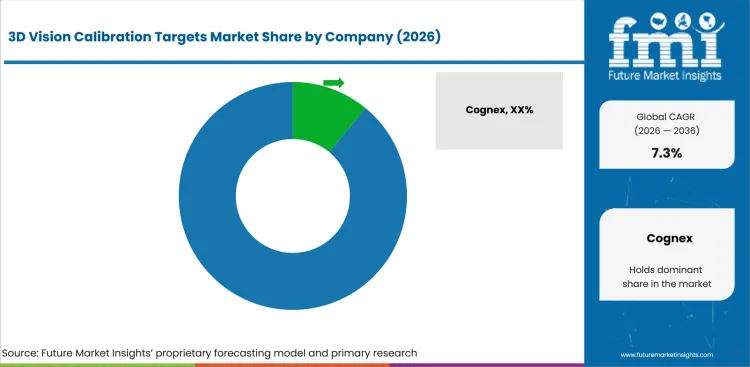
Cognex, KEYENCE, SICK, Zebra Technologies, Basler, LMI Technologies, MVTec and Applied Image.
- Established machine vision suppliers hold an advantage through installed camera systems, software environments, and service relationships with industrial buyers.
- Specialist target makers gain opportunities by offering custom plate geometry, controlled substrates, and traceability documentation for non-standard production cells.
- Software providers influence supplier choice because calibration target data must feed measurement correction, robot coordinates, and audit records.
- Integrator-ready target kits support repeat purchases through clear handling instructions, fixture guidance, and replacement timing discipline.
Machine vision suppliers in the market compete by combining 3D sensor availability with calibration workflow support. Cognex and KEYENCE gain strong influence when calibration routines are attached to camera commissioning and inspection recipes. SICK, Zebra Technologies, Basler, LMI Technologies, and Zivid strengthen the sensor ecosystem through structured light, stereo, line confocal, and industrial camera platforms. Buyers evaluate target compatibility with camera software before comparing simple plate pricing.
Software depth has become a competitive separator as calibration records move closer to production control. MVTec highlighted HALCON 24.11 in November 2024 with machine vision tools that support industrial inspection workflows. This gives software providers influence over target choice when plants want stable measurements across cameras, lenses, and inspection recipes. Siemens also holds relevance through AI-led quality control and industrial software environments that support production validation. Software fit is important because a precise target has limited value if the coordinate routine cannot be repeated by plant operators.
Smaller and specialist players can win where standard kits do not cover unusual fields of view, harsh cleaning conditions, or high-precision geometry needs. Applied Image and Thorlabs compete through calibration plates, grid targets, and precision reference patterns. The hard entry barrier is not printing a pattern. It is proving that the pattern, substrate, mounting method, and software routine deliver repeatable factory results. Suppliers with documented accuracy and practical field handling should gain more durable listing decisions.
How do top 3D vision calibration targets companies compare?
Cognex and KEYENCE score strongest on system fit while Applied Image leads specialist target relevance.
| Company | Relevance to Market Title | Calibration Workflow Depth | 3D Vision System Fit | Software Coordinate Support | Channel Reach | Geographic Footprint |
|---|---|---|---|---|---|---|
| Cognex | Very High | Very Strong | Very Strong | Strong | Very Strong | Global |
| KEYENCE | Very High | Very Strong | Very Strong | Strong | Very Strong | Global |
| SICK | High | Strong | Very Strong | Strong | Strong | Global |
| Zebra Technologies | High | Moderate | Strong | Strong | Very Strong | Global |
| Basler | High | Moderate | Strong | Strong | Strong | Global |
| LMI Technologies | High | Strong | Very Strong | Moderate | Strong | North America and global channels |
| MVTec | High | Very Strong | Moderate | Very Strong | Strong | Global |
| Zivid | Moderate to High | Strongc | Strong | Moderate | Moderate | Europe, North America, and Asia |
| Thorlabs | High | Strong | Moderate | Low to Moderate | Strong | Global |
| Applied Image | Very High | Very Strong | Moderate | Low to Moderate | Moderate | North America and export channels |
Source: Future Market Insights competitive analysis, 2026.
Who are the key players in the 3D vision calibration targets market?
Cognex, KEYENCE, SICK, Zebra Technologies, Basler, LMI Technologies and MVTec are listed with Zivid, Thorlabs and Applied Image among other suppliers.
Key global companies leading the 3D vision calibration targets market include:
- Cognex
- KEYENCE
- SICK
- Zebra Technologies
- Basler
- LMI Technologies
- MVTec
- Zivid
- Thorlabs
- Applied Image
Key Developments in 3D Vision Calibration Targets Market
- In April 2024, LMI Technologies launched the Gocator 4000 Series of smart 3D coaxial line confocal sensors for semiconductor, consumer electronics, EV battery, and other inline inspection applications.
- In May 2024, Zebra Technologies introduced its 3S Series 3D sensors at Automate 2024, using patented parallel structured light for static and moving items with sub-millimeter resolution and accuracy.
- In March 2026, Basler and Orbbec launched a technology partnership for industrial 3D vision in logistics and factory automation, with the Basler Stereo mini 3D camera as the first result.
Key Players in the 3D Vision Calibration Targets Market
System and Sensor Vendors
- Cognex
- KEYENCE
- SICK
- Zebra Technologies
- Basler
- OMRON
- Teledyne Vision Solutions
- LMI Technologies
- Zivid
Software and Workflow Providers
- MVTec
- Siemens
- Vision engineering software partners
Target and Specialist Suppliers
- Thorlabs
- Applied Image
- Specialist calibration target fabricators
Regional and Channel Partners
- Machine vision distributors
- Robotics integrators
- Industrial automation service providers
3D Vision Calibration Targets Market - Report Scope
| Parameter | Details |
|---|---|
| Forecast period | 2026 to 2036 |
| Historical period | 2021 to 2025 |
| Quantitative unit | Revenue in USD million |
| By component | Cameras, lenses, lighting, frame grabbers, vision software, services |
| By target type | Checkerboard targets, dot grid targets, calibration plates, frustum targets, encoded boards |
| By inspection type | Defect detection, measurement, OCR/OCV, presence/absence, guidance |
| By deployment | Inline, at-line, robotic cell, portable |
| By end-use industry | Electronics, automotive, packaging, pharmaceuticals, food and beverage, metals |
| Regions covered | North America, Latin America, Europe, East Asia, South Asia and Pacific, Middle East and Africa |
| Countries covered | United States, United Kingdom, Germany, France, Japan, China, South Korea, India |
| Key companies profiled | Cognex, KEYENCE, SICK, Zebra Technologies, Basler, LMI Technologies, MVTec, Zivid, Thorlabs, Applied Image |
| Approach | Bottom-up workflow-boundary approach using target kit revenue, 3D vision system adoption, recalibration frequency, replacement cycles, service attach rates, and country-level automation maturity |
Source: Future Market Insights, 2026.
3D Vision Calibration Targets Market Breakdown by Component, Target Type, Inspection Type, Deployment, End-use Industry, and Region
3D Vision Calibration Targets Market Segmented by Component:
- Cameras
- Lenses
- Lighting
- Frame Grabbers
- Vision Software
- Services
3D Vision Calibration Targets Market Segmented by Target Type:
- Checkerboard Targets
- Dot Grid Targets
- Calibration Plates
- Frustum Targets
- Encoded Boards
3D Vision Calibration Targets Market Segmented by Inspection Type:
- Defect Detection
- Measurement
- OCR/OCV
- Presence/Absence
- Guidance
3D Vision Calibration Targets Market Segmented by Deployment:
- Inline
- At-line
- Robotic Cell
- Portable
3D Vision Calibration Targets Market Segmented by End-use Industry:
- Electronics
- Automotive
- Packaging
- Pharmaceuticals
- Food and Beverage
- Metals
3D Vision Calibration Targets Market by Region:
- North America
- Latin America
- Europe
- East Asia
- South Asia and Pacific
- Middle East and Africa
Research Sources and Bibliography
- Advanced Propulsion Centre UK. (2025, July 14). DRIVE35 funding programme: Transformation. Advanced Propulsion Centre UK.
- Association for Advancing Automation. (2026, February 6). Robot orders grow 6.6% in 2025 as general industries drive broader automation adoption. Association for Advancing Automation.
- Association for Advancing Automation. (2026, May 7). Q1 2026 robotics statistics. Association for Advancing Automation.
- Basler AG. (2026, March 25). Basler AG and Orbbec launch technology partnership for industrial 3D vision in logistics and factory automation. Basler AG.
- Cognex Corporation. (2024, April 2). Cognex launches the world’s first 3D vision system with AI. Cognex Corporation.
- Destatis. (2026, June 8). New orders in manufacturing in April 2026: -3.8% on the previous month. Federal Statistical Office of Germany.
- Federal Ministry for Economic Affairs and Energy. (2025, April). Manufacturing-X funding programme. Government of Germany.
- French National Institute of Statistics and Economic Studies. (2026, June 5). In April 2026, manufacturing output increased by 0.4%. INSEE.
- French Tech Mission. (2025, June). French Tech 2030. Government of France.
- International Federation of Robotics. (2025, September). World Robotics 2025: Industrial robots executive summary. International Federation of Robotics.
- International Federation of Robotics. (2025, September 25). Global robot demand in factories doubles over 10 years. International Federation of Robotics.
- International Federation of Robotics. (2026, April 8). Robot density surges in Europe, Asia, and Americas. International Federation of Robotics.
- LMI Technologies. (2024, April 11). LMI Technologies launches Gocator 4000 Series of smart 3D coaxial line confocal sensors. LMI Technologies.
- Ministry of Economy, Trade and Industry. (2026, June 12). Indices of industrial production: Revised report for April 2026. Government of Japan.
- Ministry of Electronics and Information Technology. (2025, January). Estimation and measurement of India’s digital economy. Government of India.
- Ministry of SMEs and Startups. (2025, October 31). 2026 smart manufacturing innovation support program. Republic of Korea.
- MVTec Software GmbH. (2024, November 20). Machine vision software becomes even more powerful and user-friendly: MVTec presents HALCON 24.11. MVTec Software GmbH.
- National Bureau of Statistics of China. (2025, March 18). Industrial production operation from January to February 2025. National Bureau of Statistics of China.
- Office for Investment. (2026, February 5). Robotics and automation opportunities in the UK. UK Government.
- Press Information Bureau. (2025, October 11). India’s electronics leap. Government of India.
- SICK AG. (2024, June 5). Ruler3000 3D machine vision operating instructions. SICK AG.
- State Council Information Office of the People’s Republic of China. (2025, August 15). SCIO briefing on China’s economic performance in July 2025. State Council Information Office.
- The Manufacturing Institute. (2024, April 9). Manufacturers need as many as 3.8 million new employees by 2033. The Manufacturing Institute.
- The State Council of the People’s Republic of China. (2024, January 5). Shanghai goes big on smart factories. The State Council of the People’s Republic of China.
- U.S. Bureau of Labor Statistics. (2025, August 28). Industrial engineers: Occupational outlook handbook. U.S. Department of Labor.
- U.S. Census Bureau. (2026, June 3). Monthly advance report on durable goods manufacturers’ shipments, inventories, and orders: April 2026. U.S. Department of Commerce.
- U.S. Commercial Service. (2025, April 18). Japan advanced manufacturing opportunities. International Trade Administration.
- Zebra Technologies. (2024, May 6). Zebra Technologies unveils new solutions at Automate 2024, advancing the connected factory. Zebra Technologies.
- This bibliography is provided for reader reference and is not exhaustive. The full report contains the complete reference list and detailed citations.
3D Vision Calibration Targets Market - Scope & Definition
| Attribute | Detail |
|---|---|
| Market Definition | Calibration targets, target kits, and target-linked software or services used to align industrial 3D vision systems for measurement, inspection, and robot guidance. |
| Functions Covered | Camera calibration, lens distortion correction, coordinate mapping, hand-eye calibration support, measurement validation, and recalibration documentation. |
| Applications Covered | Checkerboard targets, dot grid targets, calibration plates, frustum targets, encoded boards, and reference patterns used in industrial 3D inspection workflows. |
| End-Use Industries | Electronics, automotive, packaging, pharmaceuticals, food and beverage, metals, logistics, and precision manufacturing. |
| Grades Covered | Printed targets, glass targets, ceramic targets, metal targets, custom high-precision targets, and software-compatible calibration kits. |
| Inclusions | All commercially relevant calibration targets and target-linked services used with industrial 3D cameras, lenses, lighting, frame grabbers, vision software, and production inspection systems. |
| Exclusions | Consumer photography charts, non-industrial AR markers, medical imaging phantoms, standalone 2D office scanning charts, and machine vision hardware sold without calibration target use. |
3D Vision Calibration Targets Market - Research Methodology
| Method | Description |
|---|---|
| Primary Research | FMI analyst interviews with machine vision integrators, plant quality heads, robotics engineers, optical component suppliers, target fabricators, and industrial automation distributors across key markets. |
| Desk Research | Review of official robotics data, government manufacturing statistics, company product releases, 3D vision manuals, machine vision software material, and automation investment documents. |
| Market Sizing & Forecasting | Hybrid bottom-up and top-down approach using target kit revenue, 3D vision system adoption, replacement rates, service attach rates, and country-level automation maturity. |
| Data Validation | Cross-verification using robot installation data, 3D inspection product evidence, country manufacturing indicators, calibration workflow relevance, and supplier capability checks. |
This Report Answers
- Market size estimates for 2026 and forecasts through 2036 for the 3D vision calibration targets market.
- Insights across regional and country-level markets covering advanced manufacturing and industrial automation demand.
- Analysis of demand drivers, recalibration patterns, target replacement needs, and industrial inspection use cases.
- Evaluation of key target types and deployment routes, including calibration plates, inline deployment, and robotic cells.
- Assessment of machine vision software integration, target documentation, and 3D measurement validation needs.
- Identification of opportunities across target materials, software-compatible kits, integrator services, and recurring calibration workflows.
- Evaluation of supply chain dynamics, specialist target fabrication, system vendor influence, and distributor channel structures.
- Country-level growth analysis covering the United States, United Kingdom, Germany, France, Japan, China, South Korea, and India.
- Assessment of the competitive landscape, including 3D vision system vendors, machine vision software providers, and specialist target makers.
- Analysis of buyer preferences, target material selection, software fit, and field handling requirements.
- Regional outlooks across North America, Europe, East Asia, South Asia and Pacific, Latin America, and Middle East and Africa.
- Delivery of market data, forecasts, and supporting analysis in PDF and Excel formats.
Frequently Asked Questions
What is the growth prospect for 3D vision calibration targets?
Demand for 3D vision calibration targets is expected to rise at a considerable pace as factories increase calibrated 3D inspection and robot-guidance workflows.
Which companies are expected to shape the 3D vision calibration targets market?
Cognex, KEYENCE, SICK, Zebra Technologies, Basler, LMI Technologies, MVTec, Zivid, Thorlabs, and Applied Image are expected to shape market competition through system fit, software support, and specialist target capabilities.
Why are machine vision suppliers investing in calibration workflows?
Machine vision suppliers are investing in calibration workflows because buyers need repeatable measurement results after camera movement, lens change, robot adjustment, and production requalification.
Why are specialist target makers important in this market?
Specialist target makers are important because custom substrates, high-contrast patterns, and traceable geometry support demanding 3D measurement tasks.
Which target formats are gaining attention in 3D vision calibration?
Calibration plates and dot grid targets are gaining attention as factories seek stable reference tools for metrology-grade 3D inspection.
How does software influence calibration target selection?
Software influences target selection because calibration files must correct distortion, align coordinates, and support repeatable inspection recipes.
Why is documentation important for calibration targets?
Documentation is important because buyers need evidence on geometry, handling, accuracy, and replacement procedures before using targets in production quality workflows.
What role do integrators play in 3D vision calibration target adoption?
Integrators support adoption by selecting target formats, setting up field routines, training operators, and attaching recalibration services to inspection cells.
How do inline inspection cells support calibration target demand?
Inline inspection cells support demand because sensors need quick target-based checks after product changeovers, fixture movement, and process adjustments.
Preview the report firsthand - request a free sample
Get SampleGet the brochure for pricing and purchase details.
Get PDFTable of Content
- Executive Summary
- Global Market Outlook
- Demand to side Trends
- Supply to side Trends
- Technology Roadmap Analysis
- Analysis and Recommendations
- Market Overview
- Market Coverage / Taxonomy
- Market Definition / Scope / Limitations
- Research Methodology
- Chapter Orientation
- Analytical Lens and Working Hypotheses
- Market Structure, Signals, and Trend Drivers
- Benchmarking and Cross-market Comparability
- Market Sizing, Forecasting, and Opportunity Mapping
- Research Design and Evidence Framework
- Desk Research Programme (Secondary Evidence)
- Company Annual and Sustainability Reports
- Peer-reviewed Journals and Academic Literature
- Corporate Websites, Product Literature, and Technical Notes
- Earnings Decks and Investor Briefings
- Statutory Filings and Regulatory Disclosures
- Technical White Papers and Standards Notes
- Trade Journals, Industry Magazines, and Analyst Briefs
- Conference Proceedings, Webinars, and Seminar Materials
- Government Statistics Portals and Public Data Releases
- Press Releases and Reputable Media Coverage
- Specialist Newsletters and Curated Briefings
- Sector Databases and Reference Repositories
- FMI Internal Proprietary Databases and Historical Market Datasets
- Subscription Datasets and Paid Sources
- Social Channels, Communities, and Digital Listening Inputs
- Additional Desk Sources
- Expert Input and Fieldwork (Primary Evidence)
- Primary Modes
- Qualitative Interviews and Expert Elicitation
- Quantitative Surveys and Structured Data Capture
- Blended Approach
- Why Primary Evidence is Used
- Field Techniques
- Interviews
- Surveys
- Focus Groups
- Observational and In-context Research
- Social and Community Interactions
- Stakeholder Universe Engaged
- C-suite Leaders
- Board Members
- Presidents and Vice Presidents
- R&D and Innovation Heads
- Technical Specialists
- Domain Subject-matter Experts
- Scientists
- Physicians and Other Healthcare Professionals
- Governance, Ethics, and Data Stewardship
- Research Ethics
- Data Integrity and Handling
- Primary Modes
- Tooling, Models, and Reference Databases
- Desk Research Programme (Secondary Evidence)
- Data Engineering and Model Build
- Data Acquisition and Ingestion
- Cleaning, Normalisation, and Verification
- Synthesis, Triangulation, and Analysis
- Quality Assurance and Audit Trail
- Market Background
- Market Dynamics
- Drivers
- Restraints
- Opportunity
- Trends
- Scenario Forecast
- Demand in Optimistic Scenario
- Demand in Likely Scenario
- Demand in Conservative Scenario
- Opportunity Map Analysis
- Product Life Cycle Analysis
- Supply Chain Analysis
- Investment Feasibility Matrix
- Value Chain Analysis
- PESTLE and Porter’s Analysis
- Regulatory Landscape
- Regional Parent Market Outlook
- Production and Consumption Statistics
- Import and Export Statistics
- Market Dynamics
- Global Market Analysis 2021 to 2025 and Forecast, 2026 to 2036
- Historical Market Size Value (USD Million) Analysis, 2021 to 2025
- Current and Future Market Size Value (USD Million) Projections, 2026 to 2036
- Y to o to Y Growth Trend Analysis
- Absolute $ Opportunity Analysis
- Global Market Pricing Analysis 2021 to 2025 and Forecast 2026 to 2036
- Global Market Analysis 2021 to 2025 and Forecast 2026 to 2036, By Component
- Introduction / Key Findings
- Historical Market Size Value (USD Million) Analysis By Component , 2021 to 2025
- Current and Future Market Size Value (USD Million) Analysis and Forecast By Component , 2026 to 2036
- Vision Software
- Cameras
- Lighting
- Vision Software
- Y to o to Y Growth Trend Analysis By Component , 2021 to 2025
- Absolute $ Opportunity Analysis By Component , 2026 to 2036
- Global Market Analysis 2021 to 2025 and Forecast 2026 to 2036, By Target Type
- Introduction / Key Findings
- Historical Market Size Value (USD Million) Analysis By Target Type, 2021 to 2025
- Current and Future Market Size Value (USD Million) Analysis and Forecast By Target Type, 2026 to 2036
- Calibration Plates
- Dot Grid Targets
- Encoded Boards
- Calibration Plates
- Y to o to Y Growth Trend Analysis By Target Type, 2021 to 2025
- Absolute $ Opportunity Analysis By Target Type, 2026 to 2036
- Global Market Analysis 2021 to 2025 and Forecast 2026 to 2036, By Inspection Type
- Introduction / Key Findings
- Historical Market Size Value (USD Million) Analysis By Inspection Type, 2021 to 2025
- Current and Future Market Size Value (USD Million) Analysis and Forecast By Inspection Type, 2026 to 2036
- Measurement
- Defect Detection
- OCR/OCV
- Measurement
- Y to o to Y Growth Trend Analysis By Inspection Type, 2021 to 2025
- Absolute $ Opportunity Analysis By Inspection Type, 2026 to 2036
- Global Market Analysis 2021 to 2025 and Forecast 2026 to 2036, By Deployment
- Introduction / Key Findings
- Historical Market Size Value (USD Million) Analysis By Deployment, 2021 to 2025
- Current and Future Market Size Value (USD Million) Analysis and Forecast By Deployment, 2026 to 2036
- Inline
- At-line
- Portable
- Inline
- Y to o to Y Growth Trend Analysis By Deployment, 2021 to 2025
- Absolute $ Opportunity Analysis By Deployment, 2026 to 2036
- Global Market Analysis 2021 to 2025 and Forecast 2026 to 2036, By End-use Industry
- Introduction / Key Findings
- Historical Market Size Value (USD Million) Analysis By End-use Industry, 2021 to 2025
- Current and Future Market Size Value (USD Million) Analysis and Forecast By End-use Industry, 2026 to 2036
- Electronics
- Automotive
- Packaging
- Electronics
- Y to o to Y Growth Trend Analysis By End-use Industry, 2021 to 2025
- Absolute $ Opportunity Analysis By End-use Industry, 2026 to 2036
- Global Market Analysis 2021 to 2025 and Forecast 2026 to 2036, By Region
- Introduction
- Historical Market Size Value (USD Million) Analysis By Region, 2021 to 2025
- Current Market Size Value (USD Million) Analysis and Forecast By Region, 2026 to 2036
- North America
- Latin America
- Western Europe
- Eastern Europe
- East Asia
- South Asia and Pacific
- Middle East & Africa
- Market Attractiveness Analysis By Region
- North America Market Analysis 2021 to 2025 and Forecast 2026 to 2036, By Country
- Historical Market Size Value (USD Million) Trend Analysis By Market Taxonomy, 2021 to 2025
- Market Size Value (USD Million) Forecast By Market Taxonomy, 2026 to 2036
- By Country
- USA
- Canada
- Mexico
- By Component
- By Target Type
- By Inspection Type
- By Deployment
- By End-use Industry
- By Country
- Market Attractiveness Analysis
- By Country
- By Component
- By Target Type
- By Inspection Type
- By Deployment
- By End-use Industry
- Key Takeaways
- Latin America Market Analysis 2021 to 2025 and Forecast 2026 to 2036, By Country
- Historical Market Size Value (USD Million) Trend Analysis By Market Taxonomy, 2021 to 2025
- Market Size Value (USD Million) Forecast By Market Taxonomy, 2026 to 2036
- By Country
- Brazil
- Chile
- Rest of Latin America
- By Component
- By Target Type
- By Inspection Type
- By Deployment
- By End-use Industry
- By Country
- Market Attractiveness Analysis
- By Country
- By Component
- By Target Type
- By Inspection Type
- By Deployment
- By End-use Industry
- Key Takeaways
- Western Europe Market Analysis 2021 to 2025 and Forecast 2026 to 2036, By Country
- Historical Market Size Value (USD Million) Trend Analysis By Market Taxonomy, 2021 to 2025
- Market Size Value (USD Million) Forecast By Market Taxonomy, 2026 to 2036
- By Country
- Germany
- UK
- Italy
- Spain
- France
- Nordic
- BENELUX
- Rest of Western Europe
- By Component
- By Target Type
- By Inspection Type
- By Deployment
- By End-use Industry
- By Country
- Market Attractiveness Analysis
- By Country
- By Component
- By Target Type
- By Inspection Type
- By Deployment
- By End-use Industry
- Key Takeaways
- Eastern Europe Market Analysis 2021 to 2025 and Forecast 2026 to 2036, By Country
- Historical Market Size Value (USD Million) Trend Analysis By Market Taxonomy, 2021 to 2025
- Market Size Value (USD Million) Forecast By Market Taxonomy, 2026 to 2036
- By Country
- Russia
- Poland
- Hungary
- Balkan & Baltic
- Rest of Eastern Europe
- By Component
- By Target Type
- By Inspection Type
- By Deployment
- By End-use Industry
- By Country
- Market Attractiveness Analysis
- By Country
- By Component
- By Target Type
- By Inspection Type
- By Deployment
- By End-use Industry
- Key Takeaways
- East Asia Market Analysis 2021 to 2025 and Forecast 2026 to 2036, By Country
- Historical Market Size Value (USD Million) Trend Analysis By Market Taxonomy, 2021 to 2025
- Market Size Value (USD Million) Forecast By Market Taxonomy, 2026 to 2036
- By Country
- China
- Japan
- South Korea
- By Component
- By Target Type
- By Inspection Type
- By Deployment
- By End-use Industry
- By Country
- Market Attractiveness Analysis
- By Country
- By Component
- By Target Type
- By Inspection Type
- By Deployment
- By End-use Industry
- Key Takeaways
- South Asia and Pacific Market Analysis 2021 to 2025 and Forecast 2026 to 2036, By Country
- Historical Market Size Value (USD Million) Trend Analysis By Market Taxonomy, 2021 to 2025
- Market Size Value (USD Million) Forecast By Market Taxonomy, 2026 to 2036
- By Country
- India
- ASEAN
- Australia & New Zealand
- Rest of South Asia and Pacific
- By Component
- By Target Type
- By Inspection Type
- By Deployment
- By End-use Industry
- By Country
- Market Attractiveness Analysis
- By Country
- By Component
- By Target Type
- By Inspection Type
- By Deployment
- By End-use Industry
- Key Takeaways
- Middle East & Africa Market Analysis 2021 to 2025 and Forecast 2026 to 2036, By Country
- Historical Market Size Value (USD Million) Trend Analysis By Market Taxonomy, 2021 to 2025
- Market Size Value (USD Million) Forecast By Market Taxonomy, 2026 to 2036
- By Country
- Kingdom of Saudi Arabia
- Other GCC Countries
- Turkiye
- South Africa
- Other African Union
- Rest of Middle East & Africa
- By Component
- By Target Type
- By Inspection Type
- By Deployment
- By End-use Industry
- By Country
- Market Attractiveness Analysis
- By Country
- By Component
- By Target Type
- By Inspection Type
- By Deployment
- By End-use Industry
- Key Takeaways
- Key Countries Market Analysis
- USA
- Pricing Analysis
- Market Share Analysis, 2025
- By Component
- By Target Type
- By Inspection Type
- By Deployment
- By End-use Industry
- Canada
- Pricing Analysis
- Market Share Analysis, 2025
- By Component
- By Target Type
- By Inspection Type
- By Deployment
- By End-use Industry
- Mexico
- Pricing Analysis
- Market Share Analysis, 2025
- By Component
- By Target Type
- By Inspection Type
- By Deployment
- By End-use Industry
- Brazil
- Pricing Analysis
- Market Share Analysis, 2025
- By Component
- By Target Type
- By Inspection Type
- By Deployment
- By End-use Industry
- Chile
- Pricing Analysis
- Market Share Analysis, 2025
- By Component
- By Target Type
- By Inspection Type
- By Deployment
- By End-use Industry
- Germany
- Pricing Analysis
- Market Share Analysis, 2025
- By Component
- By Target Type
- By Inspection Type
- By Deployment
- By End-use Industry
- UK
- Pricing Analysis
- Market Share Analysis, 2025
- By Component
- By Target Type
- By Inspection Type
- By Deployment
- By End-use Industry
- Italy
- Pricing Analysis
- Market Share Analysis, 2025
- By Component
- By Target Type
- By Inspection Type
- By Deployment
- By End-use Industry
- Spain
- Pricing Analysis
- Market Share Analysis, 2025
- By Component
- By Target Type
- By Inspection Type
- By Deployment
- By End-use Industry
- France
- Pricing Analysis
- Market Share Analysis, 2025
- By Component
- By Target Type
- By Inspection Type
- By Deployment
- By End-use Industry
- India
- Pricing Analysis
- Market Share Analysis, 2025
- By Component
- By Target Type
- By Inspection Type
- By Deployment
- By End-use Industry
- ASEAN
- Pricing Analysis
- Market Share Analysis, 2025
- By Component
- By Target Type
- By Inspection Type
- By Deployment
- By End-use Industry
- Australia & New Zealand
- Pricing Analysis
- Market Share Analysis, 2025
- By Component
- By Target Type
- By Inspection Type
- By Deployment
- By End-use Industry
- China
- Pricing Analysis
- Market Share Analysis, 2025
- By Component
- By Target Type
- By Inspection Type
- By Deployment
- By End-use Industry
- Japan
- Pricing Analysis
- Market Share Analysis, 2025
- By Component
- By Target Type
- By Inspection Type
- By Deployment
- By End-use Industry
- South Korea
- Pricing Analysis
- Market Share Analysis, 2025
- By Component
- By Target Type
- By Inspection Type
- By Deployment
- By End-use Industry
- Russia
- Pricing Analysis
- Market Share Analysis, 2025
- By Component
- By Target Type
- By Inspection Type
- By Deployment
- By End-use Industry
- Poland
- Pricing Analysis
- Market Share Analysis, 2025
- By Component
- By Target Type
- By Inspection Type
- By Deployment
- By End-use Industry
- Hungary
- Pricing Analysis
- Market Share Analysis, 2025
- By Component
- By Target Type
- By Inspection Type
- By Deployment
- By End-use Industry
- Kingdom of Saudi Arabia
- Pricing Analysis
- Market Share Analysis, 2025
- By Component
- By Target Type
- By Inspection Type
- By Deployment
- By End-use Industry
- Turkiye
- Pricing Analysis
- Market Share Analysis, 2025
- By Component
- By Target Type
- By Inspection Type
- By Deployment
- By End-use Industry
- South Africa
- Pricing Analysis
- Market Share Analysis, 2025
- By Component
- By Target Type
- By Inspection Type
- By Deployment
- By End-use Industry
- USA
- Market Structure Analysis
- Competition Dashboard
- Competition Benchmarking
- Market Share Analysis of Top Players
- By Regional
- By Component
- By Target Type
- By Inspection Type
- By Deployment
- By End-use Industry
- Competition Analysis
- Competition Deep Dive
- Cognex
- Overview
- Product Portfolio
- Profitability by Market Segments (Product/Age /Sales Channel/Region)
- Sales Footprint
- Strategy Overview
- Marketing Strategy
- Product Strategy
- Channel Strategy
- KEYENCE
- SICK
- Zebra Technologies
- Basler
- LMI Technologies
- Cognex
- Competition Deep Dive
- Assumptions & Acronyms Used


