

- Market Size (2026)
- USD 6.8 Bn
- Forecast (2036)
- USD 19.6 Bn
- CAGR (2026 to 2036)
- 11.1%
How big is Bioinformatics In IVD Testing Market in 2026?
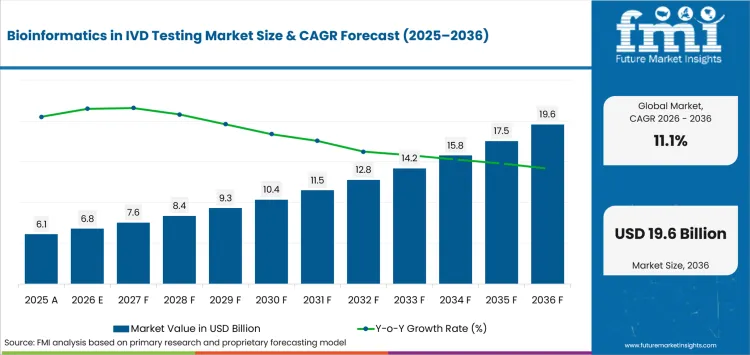
USD 6.8 billion in 2026 and USD 19.6 billion by 2036 at an 11.1% CAGR.
Demand for Bioinformatics in IVD Testing Market is projected to expand at 11.1% CAGR between 2026 and 2036. FMI estimates that Bioinformatics in Ivd Testing Market will rise from USD 6.8 billion in 2026 to USD 19.6 billion by 2036, reflecting an 11.1% CAGR. Revenue expands when laboratories move more molecular tests into routine service and must add validated secondary analysis, variant interpretation, knowledge management and controlled reporting to each assay menu.
The second-order effect is a higher switching cost after a pipeline enters production. A lower license price can be offset by revalidation, staff retraining, report-template changes and interface testing. This is why demand overlaps with the Clinical NGS Data Analysis Market, where reproducibility and interpretation governance have more commercial weight than raw algorithm speed.
Key Takeaways of Bioinformatics In IVD Testing Market
- Bioinformatics Software leads Product Type with a 36.0% share in 2026 because it forms the persistent control layer between instrument output and a reviewable laboratory report.
- Molecular Diagnostics leads Application at 34.0%, as genomic and nucleic-acid tests require repeatable alignment, variant calling and annotation and interpretation workflows.
- Clinical Diagnostic Laboratories lead End User at 37.0% because they operate validated tests at routine volume and must manage quality records across multiple assay menus.
- Direct Sales leads Distribution Channel at 41.0%, reflecting enterprise validation, implementation and integration and service requirements.
- Cloud-Based Deployment holds 39.0%, supported by elastic analysis capacity and centralized software updates, while data-control requirements preserve on-premise and hybrid demand.
- The USA records the highest CAGR among the profiled countries at 11.6%, followed by Japan at 11.4% and Germany at 11.2%.
- Illumina, Thermo Fisher Scientific, QIAGEN and Roche Diagnostics and SOPHiA GENETICS compete through sequencing integration and interpretation content and deployment choice and clinical workflow support.
Analyst perspective
“The commercial asset is the validated workflow, not the software seat. A laboratory can replace an algorithm quickly in a research project, but a patient-facing test requires version control, performance evidence and traceable knowledge updates and sign-out governance. Suppliers that reduce the cost of maintaining that evidence will gain more durable contracts than vendors competing on analysis speed alone.”
- Nandini Roy Choudhury, Principal Consultant, Future Market Insights
How is the Bioinformatics in IVD Testing Market segmented?
The Bioinformatics in Ivd Testing Market is segmented by Product Type, Application, End User, Distribution Channel, Deployment Mode, and Region.
The market is segmented by Product Type, Application, End User, Distribution Channel, and Deployment Mode. Product types include bioinformatics software, genomic data analysis software, clinical decision support software, platforms, cloud-based platforms, bioinformatics services, NGS data analysis solutions, variant calling solutions, sequence alignment solutions, and database and knowledge management tools. Applications cover molecular diagnostics, infectious disease testing, oncology diagnostics, genetic testing, clinical microbiology, and prenatal and reproductive testing. End users include diagnostic laboratories, hospitals, research institutes, biotechnology and pharmaceutical companies, and reference laboratories. Distribution channels include direct sales, enterprise contracts, SaaS platforms, managed services, and institutional procurement. Deployment modes include cloud, on-premise, hybrid, edge, and high-performance computing.
Why does bioinformatics software lead the product type category?
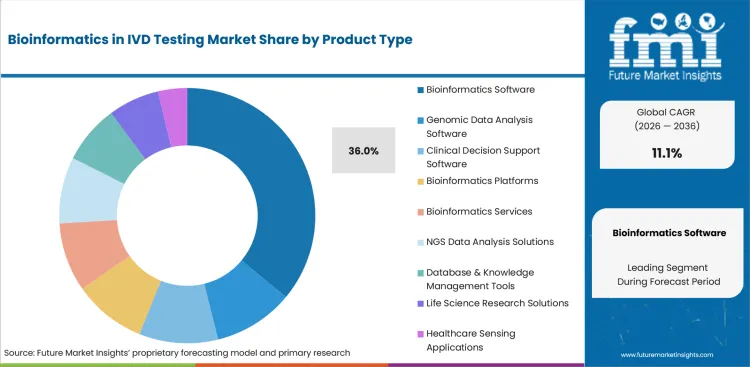
Bioinformatics software holds a 36.0% share in 2026. It leads because software is the reusable layer that converts instrument files into quality-controlled outputs, applies locked analysis parameters, manages annotations and creates reviewable evidence for sign-out. A laboratory can add a new assay or sequencer, but it still needs software to standardize how results are processed across operators and sites.
- Genomic Data Analysis Software is selected when laboratories need broad secondary-analysis capability across panels, exomes, or genomes. Clinical Decision Support Software becomes important after variants have been detected and must be linked to guidelines, therapies, or disease evidence. Bioinformatics Platforms coordinate data intake, workflow execution, user permissions and reporting. Cloud-Based Platforms suit variable workloads and multi-site access, while On-Premise Platforms fit laboratories that require direct infrastructure control or local data retention. These choices sit alongside the Clinical Decision Support Systems Market, where interpretation quality and workflow integration determine whether an insight reaches the clinician.
- Bioinformatics Services support laboratories that lack full-time computational staff or need temporary capacity. Data Analysis Services handle defined processing tasks, while Genomic Interpretation Services add expert review for complex findings. NGS Data Analysis Solutions package common pipelines for routine sequencing. Variant Calling Solutions focus on identifying sequence changes, and Sequence Alignment Solutions map reads to reference material. Database & Knowledge Management Tools preserve local evidence and curation history. Genomic Databases supply population or disease context, while Clinical Knowledge Bases connect findings to clinical literature, drug labels and professional guidance and trial information.
Why does molecular diagnostics lead the application category?
Molecular diagnostics accounts for a 34.0% share in 2026. It leads because nucleic-acid testing depends on analysis steps that cannot be separated from the assay result: quality filtering, alignment, signal interpretation and variant classification and report generation. The application therefore tracks the wider Molecular Diagnostics Market, but bioinformatics captures the software and service value required to make those tests operational.
- Infectious Disease Testing uses pipelines for organism detection and strain characterization. Oncology Diagnostics requires somatic variant review, biomarker calculation, and tumor-specific reporting. Genetic Testing covers broad constitutional analysis, while Hereditary Disease Testing narrows the workflow to inherited conditions. Carrier Screening needs consistent classification across high sample volumes. Companion Diagnostics tie test output to a defined therapy context. Precision Oncology and Targeted Therapy Selection require deeper interpretation of tumor alterations and treatment evidence.
- Clinical Microbiology uses sequence data to classify organisms within a laboratory workflow. Pathogen Identification emphasizes speed and reference coverage. Antimicrobial Resistance Analysis combines resistance determinants with organism context and connects with the NGS-based AMR Detection Market. Prenatal & Reproductive Testing requires stringent sample controls and risk calculation. Non-Invasive Prenatal Testing depends on fetal-fraction and chromosomal analysis, while Preimplantation Genetic Testing applies bioinformatics to embryo-related genomic screening within tightly controlled reproductive workflows.
Why do clinical diagnostic laboratories lead the end user category?
Clinical diagnostic laboratories hold a 37.0% share in 2026. They lead because their revenue depends on repeatable patient testing, documented quality systems, predictable turnaround and qualified staff review. Bioinformatics is therefore purchased as production infrastructure, with implementation and support tied to the laboratory quality system.
- Independent Diagnostic Laboratories value scalable workflows that can support several client hospitals or physician networks. Hospital Laboratories prioritize links to local information systems and rapid clinical communication. Hospitals may buy enterprise platforms that connect several departments, while Tertiary Care Hospitals need advanced oncology, rare-disease or transplant-related workflows. Specialty Hospitals use focused assay menus and disease-specific interpretation.
- Research Institutes need flexible pipelines and access to emerging methods. Genomics Research Centers prioritize high-throughput analysis and cohort management. Academic Institutions often require shared infrastructure for teaching, research, and translational projects. Biotechnology & Pharmaceutical Companies use bioinformatics across biomarker discovery, trial support, and companion-diagnostic development. Pharmaceutical Companies emphasize regulated evidence and trial integration, while Biotechnology Companies often need configurable workflows for smaller programs.
- Reference Laboratories support complex tests referred by other providers. National Reference Laboratories require standardized methods, surveillance capability, and broad sample intake. Private Reference Laboratories compete on turnaround, assay breadth, and service levels. It raises the value of automation and controlled interpretation.
Why does direct sales lead the distribution channel category?
Direct sales represents a 41.0% share in 2026. It leads because a clinical bioinformatics purchase usually includes workflow design, validation support, security review and integration and user training and service commitments. The supplier must understand the assay, instrument, reporting process and regulatory context before the system enters production.
- Enterprise Contracts fit multi-site laboratory networks that need common licensing and change control. OEM Partnerships embed analysis within an instrument or assay workflow. Value-Added Resellers provide local implementation and first-line support. Diagnostic Solution Providers combine software with assay components or laboratory services. IT Solution Integrators connect bioinformatics with LIMS, electronic medical records, identity management and data infrastructure.
- Cloud-Based Subscription spreads cost over usage or time. SaaS Platforms simplify software maintenance, while Managed Bioinformatics Services add operations staff and monitoring. Online Sales suit lower-complexity licenses or research tools, and Company Websites support direct product configuration or renewals. Digital Procurement Platforms help institutions manage approved suppliers and purchasing controls.
- Research & Institutional Procurement is used when platforms serve shared facilities or grant-funded programs. Government Research Contracts support public-health or national genomics work. Academic Procurement follows university tender, security, and budget rules and often with a need for broad user access and flexible research configuration.
Why does cloud-based deployment lead the deployment mode category?
Cloud-Based deployment holds a 39.0% share in 2026. It leads because sequencing workloads vary by run, while centralized software delivery reduces local infrastructure maintenance and supports collaboration across sites. Cloud deployment also allows suppliers to provide scalable compute and frequent content updates, though clinical users still need controlled release and validation processes.
- Public Cloud suits laboratories comfortable with shared hyperscale infrastructure and defined security controls. Private Cloud gives an organization stronger network and tenancy control. On-Premise Deployment remains relevant when data must stay within the laboratory environment. Local Server Deployment supports dedicated instrument-linked analysis, and Enterprise Data Centers fit health systems with established internal infrastructure.
- Hybrid Deployment keeps sensitive or latency-critical steps local while using cloud capacity for selected analysis or collaboration. Cloud-Integrated Systems connect local instruments to hosted interpretation. Multi-Cloud Deployment reduces dependence on one provider or supports regional requirements. Edge Computing Deployment moves processing nearer to the instrument. Local Edge Analytics is useful for rapid quality checks, while Real-Time Data Processing supports workflows where immediate analysis changes laboratory action.
- High-Performance Computing Deployment is selected for large genomes or complex pipelines. Cluster Computing distributes workloads across local or hosted nodes. GPU-Based Computing accelerates suitable algorithms, but buyers still evaluate validated performance, software support and the cost of maintaining specialized infrastructure.
What are the drivers, restraints, and opportunities in the Bioinformatics in IVD Testing Market?
Driver: Routine molecular testing requires validated analysis, interpretation, and reporting around each assay workflow. Restraint: Pipeline changes, reference updates, data governance and system integration can extend validation and delay switching. Opportunity: Version-controlled cloud and hybrid platforms can reduce maintenance while preserving auditability and laboratory control.
- Driver: Routine molecular testing requires validated analysis, interpretation, and reporting around each assay workflow.
- Restraint: Pipeline changes, reference updates, data governance and system integration can extend validation and delay switching.
- Opportunity: Version-controlled cloud and hybrid platforms can reduce maintenance while preserving auditability and laboratory control.
The driver begins with the laboratory result. An instrument produces data, but the buyer is paid for an accurate, timely and reviewable answer. As testing moves toward oncology selection, inherited disease, reproductive health and infectious disease and more value shifts into the computational path that converts signals into evidence. This demand is reinforced by the Personalized Medicine Market, where treatment decisions depend on reliable molecular classification.
The restraint appears after implementation. A pipeline update can change variant calls, annotations, classifications or report wording. Laboratories may need regression testing, document revision, staff training and interface checks and medical review before release. Data privacy and residency rules can limit deployment options. Integration failures can create manual work even when the analysis algorithm performs well.
The opportunity is to lower the recurring cost of evidence. Suppliers can provide locked production versions, transparent release notes, validation packs and configurable knowledge updates and secure audit trails and interfaces that preserve sample identity from instrument to report. Platforms that support both research exploration and controlled diagnostic production can help laboratories develop a test without rebuilding the workflow when it moves into routine use.
How do country-level CAGRs compare in the Bioinformatics in IVD Testing Market?
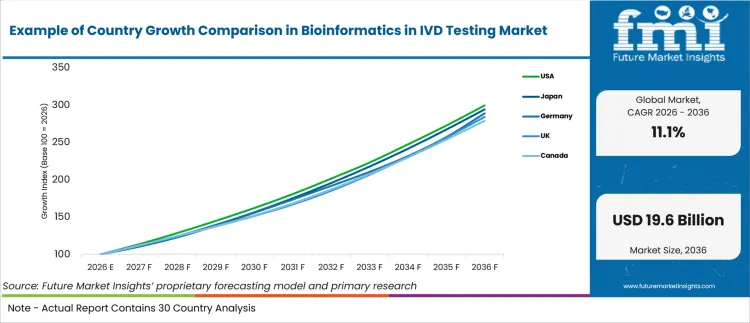
| Country | CAGR |
|---|---|
| USA | 11.6% |
| Japan | 11.4% |
| Germany | 11.2% |
| UK | 11.0% |
| Canada | 10.8% |
| Australia | 10.6% |
| South Korea | 10.5% |
How does the Bioinformatics in IVD Testing Market vary by country?
- USA: FDA oversight of IVDs and NGS tests combines with CLIA quality requirements for laboratories. Buyers therefore place high value on analytical validation support, traceability, locked workflows and documentation that can survive inspection or submission review.
- Japan: MHLW and PMDA share responsibility for medical-device regulation. Vendors need local regulatory support, Japanese-language implementation, controlled quality documentation and compatibility with laboratory practices that favor careful change management.
- Germany: German laboratories operate within the EU IVDR framework, while national procedure coding recognizes targeted and high-throughput sequencing in oncology. Demand centers on CE-IVD status where applicable, ISO 15189-aligned quality systems, and integration with accredited laboratory workflows.
- UK: MHRA guidance treats qualifying software as a medical device or IVD, while NHS and Genomics England programs have built large clinical genomics workflows. Suppliers must support national-scale interoperability and local laboratory governance without weakening evidence control.
- Canada: Health Canada applies risk-based classification to IVD devices and has separate guidance for software as a medical device. Commercial success depends on clear intended use, licensing strategy, cybersecurity evidence and support for provincial laboratory networks.
- Australia: TGA guidance explicitly addresses software that meets the definition of an IVD medical device. Buyers weigh classification, Australian Register of Therapeutic Goods requirements, and whether cloud or local deployment fits institutional security policy.
- South Korea: The Act on In Vitro Diagnostic Medical Devices created a dedicated IVD framework, and MFDS publishes approval and GMP guidance. Local partnerships, Korean regulatory documentation, and integration with domestic sequencing or hospital infrastructure shape supplier access.
Who are the notable companies in the Bioinformatics in IVD Testing Market?
Illumina, Inc., Thermo Fisher Scientific Inc., QIAGEN N.V. and Roche Diagnostics and Agilent Technologies, Inc. and SOPHiA GENETICS and DNAnexus, Inc. and Bio-Rad Laboratories, Inc. and BGI Genomics Co., Ltd. and Pacific Biosciences of California, Inc. are the notable companies in the market scope.
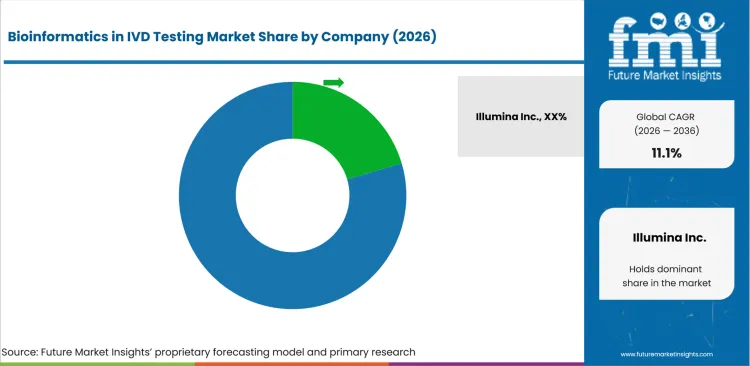
The competitive field includes sequencing companies that extend into analysis, clinical interpretation specialists, cloud data platforms and laboratory software suppliers. Illumina, Thermo Fisher Scientific, QIAGEN and Roche Diagnostics and Agilent Technologies and SOPHiA GENETICS and DNAnexus and Bio-Rad Laboratories and BGI Genomics and Pacific Biosciences are the named companies in the market scope.
Supplier advantage depends on where the company controls the workflow. Sequencing-integrated vendors can reduce handoffs from run planning to analysis. Interpretation specialists compete through curated evidence and report workflows. Cloud platforms compete through scalable compute, security, and collaboration. Laboratory software providers gain relevance when analysis is tightly linked to an installed instrument base.
How do companies compare in the Bioinformatics in Ivd Testing Market?
| Company | Documented market role | Workflow position |
|---|---|---|
| Illumina, Inc. | DRAGEN secondary analysis and Connected Insights interpretation | Sequencer-linked analysis with cloud and on-premise options |
| Thermo Fisher Scientific Inc. | Ion Reporter and Genexus software | Integrated sample-to-report NGS workflows with cloud or local analysis |
| QIAGEN N.V. | QCI Interpret and clinical genomic knowledge products | Variant interpretation, reporting, and expert-curated content |
| Roche Diagnostics | NAVIFY Mutation Profiler and sequencing workflow software | Oncology tertiary analysis with country-specific diagnostic labeling |
| Agilent Technologies, Inc. | Alissa Align & Call and Alissa Interpret | Secondary and tertiary analysis linked to Agilent assays and laboratory IT |
| SOPHiA GENETICS | SOPHiA DDM cloud platform | Genomic analysis and interpretation across IVD and research configurations |
| DNAnexus, Inc. | Precision health data and analytics platform | Governed cloud data management, pipeline execution, and collaboration |
| BGI Genomics Co., Ltd. | SIROmics and integrated sequencing-analysis services | Local in-hospital workflows and broader genomics service delivery |
| Pacific Biosciences of California, Inc. | SMRT Link software for HiFi sequencing | Long-read run management, secondary analysis, and visualization |
| Bio-Rad Laboratories, Inc. | CFX Maestro and instrument-linked analysis software | PCR data collection and analysis within installed laboratory workflows |
What are the key developments in the Bioinformatics in IVD Testing Market?
- In April 2025, QIAGEN announced cancer genomic profiling product and partnership updates, including plans to add QIAseq xHYB comprehensive genomic profiling panels to Element Biosciences workflows.
- In May 2025, Illumina launched DRAGEN version 4.4 with preconfigured oncology applications, added multiomics pipelines and expanded cloud acceleration support for secondary analysis.
- In November 2025, SOPHiA GENETICS and Complete Genomics announced an integration of SOPHiA DDM analytics with the DNBSEQ-T1+ platform for MSK-ACCESS and MSK-IMPACT precision-oncology research workflows.
- In November 2025, Pacific Biosciences announced that Berry Genomics had obtained regulatory approval in China for a clinical-grade long-read sequencing system, expanding the route for HiFi sequencing and associated analysis in clinical testing.
- In March 2026, BGI Genomics launched SIROmics for in-hospital sequencing and local analysis, positioning the offering around faster turnaround and greater control of clinical NGS workflows.
- In June 2026, Roche launched the AXELIOS 1 research sequencing platform with an open-source XOOS analysis suite. Roche states that the platform is for research use and is not for diagnostic procedures.
What is included in the Bioinformatics in IVD Testing Market report scope?
| Coverage field | Report scope |
|---|---|
| Market breakdown | Product Type, Application, End User and Distribution Channel and Deployment Mode and Region |
| Quantitative Units | Revenue in USD Billion and CAGR in %. |
| Market Definition | Revenue includes first-sale software licenses, subscriptions, platform access and bioinformatics services and analysis services and interpretation services and knowledge-management tools used within in vitro diagnostic testing workflows in the defined segmentation universe. |
| Regions Covered | North America; Latin America; Western Europe; Eastern Europe; East Asia; South Asia and Pacific; Middle East and Africa |
| Countries Covered | USA, Japan, Germany and UK and Canada and Australia and South Korea and more than twenty-five additional countries in the full report |
| Key Companies Profiled | Illumina, Inc.; Thermo Fisher Scientific Inc.; QIAGEN N.V.; Roche Diagnostics; Agilent Technologies, Inc.; SOPHiA GENETICS; DNAnexus, Inc.; Bio-Rad Laboratories, Inc.; BGI Genomics Co., Ltd.; Pacific Biosciences of California, Inc. |
| Forecast Period | 2026 to 2036 |
| Approach | Hybrid bottom-up and top-down sizing using company revenue indicators, installed workflow evidence, testing volumes and pricing checks and deployment mix and country indicators and buyer-side validation. |
How was the Bioinformatics in IVD Testing Market research conducted?
| Method | Approach |
|---|---|
| Primary Research | FMI engages bioinformatics software providers, diagnostic laboratories, molecular pathologists and laboratory directors and bioinformaticians and IT and security teams and procurement professionals and sequencing platform suppliers and subject-matter experts. |
| Desk Research | The review covers official IVD and software regulation, government laboratory guidance, recognized standards and company filings and first-party product documentation and official press releases and relevant technical guidance. |
| Market Sizing and Forecasting | The model reconciles supplier revenue, license and subscription structures, analysis-service revenue and testing volume and application mix and deployment mode and distribution channel and country demand indicators. |
| Data Validation | Supplier-side findings are cross-checked with laboratory users, implementation partners, regulatory evidence and application workflows and country-level signals. |
How is the Bioinformatics in IVD Testing Market segmentation
Bioinformatics in Ivd Testing Market segmented by Product Type:
- Bioinformatics Software
- Genomic Data Analysis Software
- Clinical Decision Support Software
- Bioinformatics Platforms
- Cloud-Based Platforms
- On-Premise Platforms
- Bioinformatics Services
- Data Analysis Services
- Genomic Interpretation Services
- NGS Data Analysis Solutions
- Variant Calling Solutions
- Sequence Alignment Solutions
- Database & Knowledge Management Tools
- Genomic Databases
- Clinical Knowledge Bases
Bioinformatics in Ivd Testing Market segmented by Application:
- Molecular Diagnostics
- Infectious Disease Testing
- Oncology Diagnostics
- Genetic Testing
- Hereditary Disease Testing
- Carrier Screening
- Companion Diagnostics
- Precision Oncology
- Targeted Therapy Selection
- Clinical Microbiology
- Pathogen Identification
- Antimicrobial Resistance Analysis
- Prenatal & Reproductive Testing
- Non-Invasive Prenatal Testing
- Preimplantation Genetic Testing
Bioinformatics in Ivd Testing Market segmented by End User:
- Clinical Diagnostic Laboratories
- Independent Diagnostic Laboratories
- Hospital Laboratories
- Hospitals
- Tertiary Care Hospitals
- Specialty Hospitals
- Research Institutes
- Genomics Research Centers
- Academic Institutions
- Biotechnology & Pharmaceutical Companies
- Pharmaceutical Companies
- Biotechnology Companies
- Reference Laboratories
- National Reference Laboratories
- Private Reference Laboratories
Bioinformatics in Ivd Testing Market segmented by Distribution Channel:
- Direct Sales
- Enterprise Contracts
- OEM Partnerships
- Value-Added Resellers
- Diagnostic Solution Providers
- IT Solution Integrators
- Cloud-Based Subscription
- SaaS Platforms
- Managed Bioinformatics Services
- Online Sales
- Company Websites
- Digital Procurement Platforms
- Research & Institutional Procurement
- Government Research Contracts
- Academic Procurement
Bioinformatics in Ivd Testing Market segmented by Deployment Mode:
- Cloud-Based Deployment
- Public Cloud
- Private Cloud
- On-Premise Deployment
- Local Server Deployment
- Enterprise Data Centers
- Hybrid Deployment
- Cloud-Integrated Systems
- Multi-Cloud Deployment
- Edge Computing Deployment
- Local Edge Analytics
- Real-Time Data Processing
- High-Performance Computing Deployment
- Cluster Computing
- GPU-Based Computing
Which regions are covered in the Bioinformatics in Ivd Testing Market?
- North America
- United States
- Canada
- Mexico
- Latin America
- Brazil
- Chile
- Rest of Latin America
- Western Europe
- Germany
- United Kingdom
- Italy
- Spain
- France
- Nordics
- Benelux
- Rest of Western Europe
- Eastern Europe
- Russia
- Poland
- Hungary
- Balkan and Baltic States
- Rest of Eastern Europe
- East Asia
- China
- Japan
- South Korea
- South Asia and Pacific
- India
- ASEAN
- Australia and New Zealand
- Rest of South Asia and Pacific
- Middle East and Africa
- Kingdom of Saudi Arabia
- Other GCC Countries
- Türkiye
- South Africa
- Other African Union Countries
- Rest of Middle East and Africa
Which sources support the Bioinformatics in IVD Testing Market analysis?
- USA Food and Drug Administration. In Vitro Diagnostics. Accessed July 31, 2026.
- USA Food and Drug Administration. Precision Medicine and NGS Tests. Accessed July 31, 2026.
- USA Food and Drug Administration. Overview of IVD Regulation. Accessed July 31, 2026.
- Centers for Medicare & Medicaid Services. Clinical Laboratory Improvement Amendments. Updated May 14, 2026.
- European Commission. In Vitro Diagnostic Medical Devices Overview. Accessed July 31, 2026.
- International Organization for Standardization. ISO 15189:2022, Medical laboratories - Requirements for quality and competence.
- Medicines and Healthcare products Regulatory Agency. Software and Artificial Intelligence as a Medical Device. Updated February 3, 2025.
- Medicines and Healthcare products Regulatory Agency. In Vitro Diagnostic Medical Devices: Guidance on Legislation. Updated January 15, 2025.
- Pharmaceuticals and Medical Devices Agency. Regulations and Approval/Certification of Medical Devices. Accessed July 31, 2026.
- Health Canada. Guidance for the Risk-based Classification System for In Vitro Diagnostic Devices. Updated June 19, 2026.
- Health Canada. Software as a Medical Device Guidance Document. Accessed July 31, 2026.
- Therapeutic Goods Administration. In-vitro Diagnostic Medical Device Software. Updated January 30, 2026.
- Ministry of Food and Drug Safety, Republic of Korea. Implementation of the Act on In Vitro Diagnostic Medical Devices. Accessed July 31, 2026.
- Federal Ministry of Health, Germany. OPS Code 1-996: High-throughput sequencing for analysis of genetic changes in solid malignant neoplasms. Accessed July 31, 2026.
- UK Government. Genome UK: 2022 to 2025 Implementation Plan for England. Published December 13, 2022.
- Illumina. Illumina DRAGEN v4.4 Powers Clinical Oncology Research and Multiomic Applications. May 13, 2025.
- Illumina. Connected Insights Product Page. Accessed July 31, 2026.
- Thermo Fisher Scientific. Ion Reporter Software. Accessed July 31, 2026.
- Thermo Fisher Scientific. Genexus System. Accessed July 31, 2026.
- QIAGEN. QCI Interpret for Hereditary Diseases. Accessed July 31, 2026.
- QIAGEN. Advances Cancer Genomic Profiling with New Products and Partnership Updates. April 22, 2025.
- Roche Diagnostics. NAVIFY Mutation Profiler. Accessed July 31, 2026.
- Roche Diagnostics. Roche Announces the Launch of AXELIOS 1. June 29, 2026.
- Agilent Technologies. NGS Data Analysis and Interpretation. Accessed July 31, 2026.
- SOPHiA GENETICS. SOPHiA DDM for Genomics. Accessed July 31, 2026.
- SOPHiA GENETICS. Complete Genomics Integration Announcement. November 11, 2025.
- DNAnexus. Precision Health Data Management, Analysis and Collaboration Platform. Accessed July 31, 2026.
- Bio-Rad Laboratories. CFX Maestro Software for CFX Real-Time PCR Instruments. Accessed July 31, 2026.
- BGI Genomics. BGI Genomics Launches SIROmics to Integrate Clinical NGS Workflows. March 30, 2026.
- Pacific Biosciences. Software and Bioinformatics. Accessed July 31, 2026.
- Pacific Biosciences. PacBio Supports Berry Genomics in Achieving Regulatory Approval for Clinical Long-Read Sequencing in China. November 4, 2025.
What questions does this report answer?
- What is the Bioinformatics in Ivd Testing Market size in 2026 and what value is forecast for 2036?
- Which laboratory workflow problems create demand for bioinformatics software and services in IVD testing?
- Why does Bioinformatics Software lead the Product Type category?
- How do molecular diagnostics, oncology, infectious disease and reproductive testing create different analysis requirements?
- Why do Clinical Diagnostic Laboratories hold the leading End User position?
- Why does Direct Sales lead the Distribution Channel category?
- How do cloud, on-premise, hybrid and edge and high-performance computing deployments differ?
- How do growth rates compare across USA, Japan, Germany and UK and Canada and Australia and South Korea?
- Which companies provide sequencing-linked analysis, clinical interpretation, cloud data platforms or instrument software?
- What validation, change-control, data-governance and integration issues can delay adoption?
Frequently Asked Questions
How big is the Bioinformatics in IVD Testing Market in 2026?
The bioinformatics in IVD testing market is valued at USD 6.8 billion in 2026 and is forecast to reach USD 19.6 billion by 2036. Growth is supported by laboratories moving more molecular tests into routine service, requiring validated secondary analysis, variant interpretation and controlled reporting across each assay menu.
What is the CAGR of the Bioinformatics in IVD Testing Market from 2026 to 2036?
The bioinformatics in IVD testing market grows at a CAGR of 11.1% between 2026 and 2036, driven by routine molecular testing that requires validated analysis, interpretation and reporting around each assay workflow, even as pipeline changes and data governance requirements can extend switching timelines.
Which product type leads the Bioinformatics in IVD Testing Market?
Bioinformatics software leads the bioinformatics in IVD testing market by product type, holding 36.0% share in 2026 as the reusable layer that converts instrument files into quality-controlled outputs and creates reviewable evidence for laboratory sign-out across operators and sites.
How much will the Bioinformatics in IVD Testing Market add between 2026 and 2036?
The bioinformatics in IVD testing market is set to add USD 12.8 billion between 2026 and 2036, growing from USD 6.8 billion to USD 19.6 billion as routine molecular testing expands demand for validated interpretation, knowledge management and controlled reporting infrastructure across diagnostic laboratories.
Who are the leading companies in the Bioinformatics in IVD Testing Market?
Ten companies lead the bioinformatics in IVD testing market, including Illumina, Thermo Fisher Scientific, QIAGEN, Roche Diagnostics, Agilent Technologies, SOPHiA GENETICS, DNAnexus, Bio-Rad Laboratories, BGI Genomics, and Pacific Biosciences, competing through sequencing integration, interpretation content and deployment flexibility.
Preview the report firsthand - request a free sample
Get SampleGet the brochure for pricing and purchase details.
Get PDFTable of Content
- Key Takeaways
- Market Size and CAGR
- Top Growth Driver
- Fastest Growing Segment
- Leading Region
- Key Companies
- Emerging Opportunities
- Executive Summary
- Global Market Outlook
- Demand-side Trends
- Supply-side Trends
- Technology Roadmap Analysis
- Analysis and Recommendations
- Analyst Perspective (What is happening? Why now? What should investors know?)
- Key Questions Answered
- How large is the market?
- What is the CAGR?
- What are key trends?
- Which region dominates?
- Who are the leaders?
- Market Overview
- Market Coverage / Taxonomy
- Market Definition / Scope / Limitations
- Research Methodology
- Chapter Orientation
- Analytical Lens and Working Hypotheses
- Market Structure, Signals, and Trend Drivers
- Benchmarking and Cross-market Comparability
- Market Sizing, Forecasting, and Opportunity Mapping
- Research Design and Evidence Framework
- Desk Research Programme (Secondary Evidence)
- Expert Input and Fieldwork (Primary Evidence)
- Tooling, Models, and Reference Databases
- Data Engineering and Model Build
- Quality Assurance and Audit Trail
- Market Background
- Market Dynamics (Drivers, Restraints, Opportunity, Trends)
- Scenario Forecast (Optimistic, Likely, Conservative)
- Impact Analysis
- AI Impact
- Sustainability Impact
- Regulatory Impact
- Technology Impact
- Consumer / Buyer Analysis
- Purchase Drivers
- Adoption Barriers
- Buyer Journey
- Opportunity Map Analysis
- Product Life Cycle Analysis
- Supply Chain Analysis
- Investment Feasibility Matrix
- Value Chain Analysis
- PESTLE and Porter's Analysis
- Regulatory Landscape
- Regional Parent Market Outlook
- Production and Consumption Statistics
- Import and Export Statistics
- Global Market Analysis and Forecast, 2021 to 2036
- Historical Market Size Value (USD Billion) Analysis, 2021 to 2025
- Current and Future Market Size Value (USD Billion) Projections, 2026 to 2036
- Y-o-Y Growth Trend Analysis
- Absolute $ Opportunity Analysis
- Global Market Pricing Analysis, 2021 to 2036
- Global Market Analysis and Forecast, By Product Type, 2021 to 2036
- Introduction / Key Findings
- Historical Market Size Value (USD Billion) Analysis By Product Type, 2021 to 2025
- Current and Future Market Size Value (USD Billion) Analysis and Forecast By Product Type, 2026 to 2036
- Bioinformatics Software
- Genomic Data Analysis Software
- Clinical Decision Support Software
- Bioinformatics Platforms
- Bioinformatics Services
- NGS Data Analysis Solutions
- Database & Knowledge Management Tools
- Life Science Research Solutions
- Healthcare Sensing Applications
- Bioinformatics Software
- Y-o-Y Growth Trend Analysis By Product Type, 2021 to 2025
- Absolute $ Opportunity Analysis By Product Type, 2026 to 2036
- Global Market Analysis and Forecast, By Application, 2021 to 2036
- Introduction / Key Findings
- Historical Market Size Value (USD Billion) Analysis By Application, 2021 to 2025
- Current and Future Market Size Value (USD Billion) Analysis and Forecast By Application, 2026 to 2036
- Molecular Diagnostics
- Genetic Testing
- Companion Diagnostics
- Clinical Microbiology
- Prenatal & Reproductive Testing
- Biomedical Optical Systems
- Healthcare Diagnostic Platforms
- Life Science Research Solutions
- Clinical Sensing Applications
- Molecular Diagnostics
- Y-o-Y Growth Trend Analysis By Application, 2021 to 2025
- Absolute $ Opportunity Analysis By Application, 2026 to 2036
- Global Market Analysis and Forecast, By End User, 2021 to 2036
- Introduction / Key Findings
- Historical Market Size Value (USD Billion) Analysis By End User, 2021 to 2025
- Current and Future Market Size Value (USD Billion) Analysis and Forecast By End User, 2026 to 2036
- Clinical Diagnostic Laboratories
- Hospitals
- Research Institutes
- Biotechnology & Pharmaceutical Companies
- Reference Laboratories
- Vehicle Monitoring Systems
- ADAS Sensor Platforms
- Transportation Safety Solutions
- Mobility Applications
- Clinical Diagnostic Laboratories
- Y-o-Y Growth Trend Analysis By End User, 2021 to 2025
- Absolute $ Opportunity Analysis By End User, 2026 to 2036
- Global Market Analysis and Forecast, By Distribution Channel, 2021 to 2036
- Introduction / Key Findings
- Historical Market Size Value (USD Billion) Analysis By Distribution Channel, 2021 to 2025
- Current and Future Market Size Value (USD Billion) Analysis and Forecast By Distribution Channel, 2026 to 2036
- Direct Sales
- Value-Added Resellers
- Cloud-Based Subscription
- Online Sales
- Research & Institutional Procurement
- Direct Sales
- Y-o-Y Growth Trend Analysis By Distribution Channel, 2021 to 2025
- Absolute $ Opportunity Analysis By Distribution Channel, 2026 to 2036
- Global Market Analysis and Forecast, By Deployment Mode, 2021 to 2036
- Introduction / Key Findings
- Historical Market Size Value (USD Billion) Analysis By Deployment Mode, 2021 to 2025
- Current and Future Market Size Value (USD Billion) Analysis and Forecast By Deployment Mode, 2026 to 2036
- Cloud-Based Deployment
- On-Premise Deployment
- Hybrid Deployment
- Edge Computing Deployment
- High-Performance Computing Deployment
- Cloud-Based Deployment
- Y-o-Y Growth Trend Analysis By Deployment Mode, 2021 to 2025
- Absolute $ Opportunity Analysis By Deployment Mode, 2026 to 2036
- Global Market Analysis and Forecast, By IoT-Enabled Optical Sensing Platforms
- Introduction / Key Findings
- Historical Market Size Value (USD Billion) Analysis By IoT-Enabled Optical Sensing Platforms, 2021 to 2025
- Current and Future Market Size Value (USD Billion) Analysis and Forecast By IoT-Enabled Optical Sensing Platforms, 2026 to 2036
- Flexible Deployment Detection Solutions
- Smart Network Applications
- Real-Time Wireless Data Acquisition Systems
- Distributed Sensor Monitoring Platforms
- Flexible Deployment Detection Solutions
- Y-o-Y Growth Trend Analysis By IoT-Enabled Optical Sensing Platforms, 2021 to 2025
- Absolute $ Opportunity Analysis By IoT-Enabled Optical Sensing Platforms, 2026 to 2036
- Global Market Analysis and Forecast, By Region, 2021 to 2036
- Introduction
- Historical Market Size Value (USD Billion) Analysis By Region, 2021 to 2025
- Current Market Size Value (USD Billion) Analysis and Forecast By Region, 2026 to 2036
- North America
- Latin America
- Western Europe
- Eastern Europe
- East Asia
- South Asia and Pacific
- Middle East & Africa
- Market Attractiveness Analysis By Region
- North America Market Analysis and Forecast, By Country, 2021 to 2036
- Historical Market Size Value (USD Billion) Trend Analysis By Market Taxonomy, 2021 to 2025
- Market Size Value (USD Billion) Forecast By Market Taxonomy, 2026 to 2036
- By Country
- USA
- Canada
- By Product Type
- By Application
- By End User
- By Distribution Channel
- By Deployment Mode
- By IoT-Enabled Optical Sensing Platforms
- By Country
- Market Attractiveness Analysis
- By Country
- By Product Type
- By Application
- By End User
- By Distribution Channel
- By Deployment Mode
- By IoT-Enabled Optical Sensing Platforms
- Key Takeaways
- Latin America Market Analysis and Forecast, By Country
- Historical Market Size Value (USD Billion) Trend Analysis By Market Taxonomy, 2021 to 2025
- Market Size Value (USD Billion) Forecast By Market Taxonomy, 2026 to 2036
- By Country
- Brazil
- Mexico
- Chile
- Rest of Latin America
- By Product Type
- By Application
- By End User
- By Distribution Channel
- By Deployment Mode
- By IoT-Enabled Optical Sensing Platforms
- By Country
- Market Attractiveness Analysis
- By Country
- By Product Type
- By Application
- By End User
- By Distribution Channel
- By Deployment Mode
- By IoT-Enabled Optical Sensing Platforms
- Key Takeaways
- Western Europe Market Analysis and Forecast, By Country
- Historical Market Size Value (USD Billion) Trend Analysis By Market Taxonomy, 2021 to 2025
- Market Size Value (USD Billion) Forecast By Market Taxonomy, 2026 to 2036
- By Country
- Germany
- UK
- Italy
- Spain
- France
- Nordic
- BENELUX
- Rest of Western Europe
- By Product Type
- By Application
- By End User
- By Distribution Channel
- By Deployment Mode
- By IoT-Enabled Optical Sensing Platforms
- By Country
- Market Attractiveness Analysis
- By Country
- By Product Type
- By Application
- By End User
- By Distribution Channel
- By Deployment Mode
- By IoT-Enabled Optical Sensing Platforms
- Key Takeaways
- Eastern Europe Market Analysis and Forecast, By Country
- Historical Market Size Value (USD Billion) Trend Analysis By Market Taxonomy, 2021 to 2025
- Market Size Value (USD Billion) Forecast By Market Taxonomy, 2026 to 2036
- By Country
- Russia
- Poland
- Hungary
- Balkan & Baltic
- Rest of Eastern Europe
- By Product Type
- By Application
- By End User
- By Distribution Channel
- By Deployment Mode
- By IoT-Enabled Optical Sensing Platforms
- By Country
- Market Attractiveness Analysis
- By Country
- By Product Type
- By Application
- By End User
- By Distribution Channel
- By Deployment Mode
- By IoT-Enabled Optical Sensing Platforms
- Key Takeaways
- East Asia Market Analysis and Forecast, By Country
- Historical Market Size Value (USD Billion) Trend Analysis By Market Taxonomy, 2021 to 2025
- Market Size Value (USD Billion) Forecast By Market Taxonomy, 2026 to 2036
- By Country
- China
- Japan
- South Korea
- By Product Type
- By Application
- By End User
- By Distribution Channel
- By Deployment Mode
- By IoT-Enabled Optical Sensing Platforms
- By Country
- Market Attractiveness Analysis
- By Country
- By Product Type
- By Application
- By End User
- By Distribution Channel
- By Deployment Mode
- By IoT-Enabled Optical Sensing Platforms
- Key Takeaways
- South Asia and Pacific Market Analysis and Forecast, By Country
- Historical Market Size Value (USD Billion) Trend Analysis By Market Taxonomy, 2021 to 2025
- Market Size Value (USD Billion) Forecast By Market Taxonomy, 2026 to 2036
- By Country
- India
- ASEAN
- Australia & New Zealand
- Rest of South Asia and Pacific
- By Product Type
- By Application
- By End User
- By Distribution Channel
- By Deployment Mode
- By IoT-Enabled Optical Sensing Platforms
- By Country
- Market Attractiveness Analysis
- By Country
- By Product Type
- By Application
- By End User
- By Distribution Channel
- By Deployment Mode
- By IoT-Enabled Optical Sensing Platforms
- Key Takeaways
- Middle East & Africa Market Analysis and Forecast, By Country
- Historical Market Size Value (USD Billion) Trend Analysis By Market Taxonomy, 2021 to 2025
- Market Size Value (USD Billion) Forecast By Market Taxonomy, 2026 to 2036
- By Country
- Kingdom of Saudi Arabia
- Other GCC Countries
- Türkiye
- South Africa
- Other African Union
- Rest of Middle East & Africa
- By Product Type
- By Application
- By End User
- By Distribution Channel
- By Deployment Mode
- By IoT-Enabled Optical Sensing Platforms
- By Country
- Market Attractiveness Analysis
- By Country
- By Product Type
- By Application
- By End User
- By Distribution Channel
- By Deployment Mode
- By IoT-Enabled Optical Sensing Platforms
- Key Takeaways
- Key Countries Market Analysis
- USA
- Pricing Analysis
- Market Share Analysis, 2025
- By Product Type
- By Application
- By End User
- By Distribution Channel
- By Deployment Mode
- By IoT-Enabled Optical Sensing Platforms
- Canada
- Pricing Analysis
- Market Share Analysis, 2025
- By Product Type
- By Application
- By End User
- By Distribution Channel
- By Deployment Mode
- By IoT-Enabled Optical Sensing Platforms
- Mexico
- Pricing Analysis
- Market Share Analysis, 2025
- By Product Type
- By Application
- By End User
- By Distribution Channel
- By Deployment Mode
- By IoT-Enabled Optical Sensing Platforms
- Brazil
- Pricing Analysis
- Market Share Analysis, 2025
- By Product Type
- By Application
- By End User
- By Distribution Channel
- By Deployment Mode
- By IoT-Enabled Optical Sensing Platforms
- Chile
- Pricing Analysis
- Market Share Analysis, 2025
- By Product Type
- By Application
- By End User
- By Distribution Channel
- By Deployment Mode
- By IoT-Enabled Optical Sensing Platforms
- Germany
- Pricing Analysis
- Market Share Analysis, 2025
- By Product Type
- By Application
- By End User
- By Distribution Channel
- By Deployment Mode
- By IoT-Enabled Optical Sensing Platforms
- UK
- Pricing Analysis
- Market Share Analysis, 2025
- By Product Type
- By Application
- By End User
- By Distribution Channel
- By Deployment Mode
- By IoT-Enabled Optical Sensing Platforms
- Italy
- Pricing Analysis
- Market Share Analysis, 2025
- By Product Type
- By Application
- By End User
- By Distribution Channel
- By Deployment Mode
- By IoT-Enabled Optical Sensing Platforms
- Spain
- Pricing Analysis
- Market Share Analysis, 2025
- By Product Type
- By Application
- By End User
- By Distribution Channel
- By Deployment Mode
- By IoT-Enabled Optical Sensing Platforms
- France
- Pricing Analysis
- Market Share Analysis, 2025
- By Product Type
- By Application
- By End User
- By Distribution Channel
- By Deployment Mode
- By IoT-Enabled Optical Sensing Platforms
- India
- Pricing Analysis
- Market Share Analysis, 2025
- By Product Type
- By Application
- By End User
- By Distribution Channel
- By Deployment Mode
- By IoT-Enabled Optical Sensing Platforms
- ASEAN
- Pricing Analysis
- Market Share Analysis, 2025
- By Product Type
- By Application
- By End User
- By Distribution Channel
- By Deployment Mode
- By IoT-Enabled Optical Sensing Platforms
- Australia & New Zealand
- Pricing Analysis
- Market Share Analysis, 2025
- By Product Type
- By Application
- By End User
- By Distribution Channel
- By Deployment Mode
- By IoT-Enabled Optical Sensing Platforms
- China
- Pricing Analysis
- Market Share Analysis, 2025
- By Product Type
- By Application
- By End User
- By Distribution Channel
- By Deployment Mode
- By IoT-Enabled Optical Sensing Platforms
- Japan
- Pricing Analysis
- Market Share Analysis, 2025
- By Product Type
- By Application
- By End User
- By Distribution Channel
- By Deployment Mode
- By IoT-Enabled Optical Sensing Platforms
- South Korea
- Pricing Analysis
- Market Share Analysis, 2025
- By Product Type
- By Application
- By End User
- By Distribution Channel
- By Deployment Mode
- By IoT-Enabled Optical Sensing Platforms
- Russia
- Pricing Analysis
- Market Share Analysis, 2025
- By Product Type
- By Application
- By End User
- By Distribution Channel
- By Deployment Mode
- By IoT-Enabled Optical Sensing Platforms
- Poland
- Pricing Analysis
- Market Share Analysis, 2025
- By Product Type
- By Application
- By End User
- By Distribution Channel
- By Deployment Mode
- By IoT-Enabled Optical Sensing Platforms
- Hungary
- Pricing Analysis
- Market Share Analysis, 2025
- By Product Type
- By Application
- By End User
- By Distribution Channel
- By Deployment Mode
- By IoT-Enabled Optical Sensing Platforms
- Kingdom of Saudi Arabia
- Pricing Analysis
- Market Share Analysis, 2025
- By Product Type
- By Application
- By End User
- By Distribution Channel
- By Deployment Mode
- By IoT-Enabled Optical Sensing Platforms
- Türkiye
- Pricing Analysis
- Market Share Analysis, 2025
- By Product Type
- By Application
- By End User
- By Distribution Channel
- By Deployment Mode
- By IoT-Enabled Optical Sensing Platforms
- South Africa
- Pricing Analysis
- Market Share Analysis, 2025
- By Product Type
- By Application
- By End User
- By Distribution Channel
- By Deployment Mode
- By IoT-Enabled Optical Sensing Platforms
- USA
- Market Structure Analysis
- Competition Dashboard
- Competition Benchmarking
- Market Share Analysis of Top Players
- By Regional
- By Product Type
- By Application
- By End User
- By Distribution Channel
- By Deployment Mode
- By IoT-Enabled Optical Sensing Platforms
- Emerging Startups
- Innovation Benchmarking
- Competition Analysis
- Competition Deep Dive
- Illumina Inc.
- Overview
- Product Portfolio
- Profitability by Market Segments
- Sales Footprint
- Strategy Overview
- Marketing Strategy
- Product Strategy
- Channel Strategy
- Thermo Fisher Scientific Inc.
- QIAGEN N.V.
- Roche Diagnostics
- Agilent Technologies Inc.
- SOPHiA GENETICS
- DNAnexus Inc.
- Bio-Rad Laboratories Inc.
- BGI Genomics Co. Ltd.
- Illumina Inc.
- Case Studies
- Success Stories
- Recent Developments
- Competition Deep Dive
- Assumptions & Acronyms Used


