

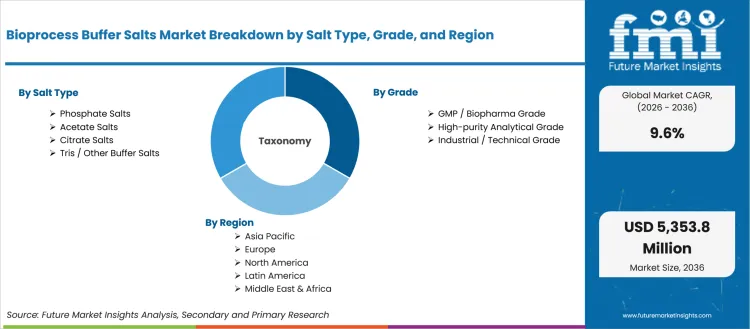
- Market Size (2026)
- USD 2140.7 Mn
- Forecast (2036)
- USD 5353.8 Mn
- CAGR (2026 to 2036)
- 9.6%
How big is the Bioprocess Buffer Salts Market in 2026?
USD 2,140.7 million in 2026 and USD 5,353.8 million by 2036 at a 9.6% CAGR.
Demand for bioprocess buffer salts is moving beyond routine chemical purchase decisions. Biologics producers need stable pH control at every stage of production, from cell culture preparation to purification and formulation. FDA’s CBER listed 21 Biological License Application approvals in 2025, reflecting continued movement of complex biological products through regulated review pathways.
A weak material record can turn a low-cost buffer salt into a batch-release concern and force extra quality review before production can move forward. Quality teams review supplier documents before a salt enters routine production use. Certificates and packaging consistency both influence supplier approval. EMA recommended 38 human medicines with new active substances in 2025, which shows why development teams need dependable process inputs during scale transfer.
CDMOs also need flexible formats as client recipes move from development batches into larger production runs. Prepared buffers and concentrates help plants reduce manual weighing work. Thermo Fisher lists process liquid catalog pack sizes of 5 L, 20 L, and 200 L, supporting demand for prepared formats across different production scales. Powder salts keep demand in facilities that prefer in-house mixing under validated procedures.
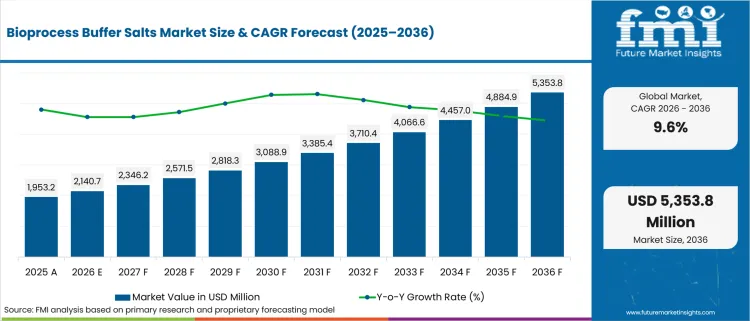
| Metric | Value |
|---|---|
| 2025 Market Size | USD 1,953.2 million |
| 2026 Market Size | USD 2,140.7 million |
| 2036 Market Size | USD 5,353.8 million |
| Forecast CAGR (2026-2036) | 9.6% |
| Grade Focus | GMP / Biopharma Grade |
| GMP / Biopharma Grade Share (2026) | 52.0% |
| Salt Type Focus | Phosphate Salts |
| Phosphate Salts Share (2026) | 38.0% |
| Application Focus | Chromatography Buffers |
| Chromatography Buffers Share (2026) | 34.0% |
| Fastest-growing Country | China |
| China CAGR by 2036 | 11.8% |
Summary of the Bioprocess Buffer Salts Market
| Market Signal | Commercial Impact |
|---|---|
| Demand and Growth Drivers | Demand for bioprocess buffer salts is expected to expand steadily through 2036 as biologics manufacturing, biosimilar development, and CDMO operations require reliable, documented process materials.
|
| Product and Segment View | GMP/Biopharma-grade salts, phosphate salts, and chromatography buffers continue to dominate their respective market segments.
|
| Geography and Growth Outlook | Asia continues to lead market expansion through biologics manufacturing investments, pharmaceutical exports, and regulatory support for life sciences.
|
| Competitive Landscape | Competition increasingly focuses on GMP compliance, process expertise, and comprehensive technical support for biologics manufacturing.
|
| Analyst Perspective | Bioprocess buffer salts are evolving from commodity chemicals into critical process inputs as biologics manufacturers place greater emphasis on quality assurance, regulatory compliance, and manufacturing consistency.
- Nikhil Kaitwade, Principal Consultant at Future Market Insights |
How is the Bioprocess Buffer Salts Market segmented?
Bioprocess buffer salts industry is segmented by salt type, grade, application, end use, sales format, and region.
Bioprocess buffer salts market is segmented by salt type, grade, application, end use, sales format, and region. Salt type coverage includes phosphate salts, acetate salts, citrate salts, and Tris / other buffer salts. Grade coverage includes GMP / Biopharma Grade, High-purity Analytical Grade, and Industrial / Technical Grade. Application demand covers cell culture media, chromatography buffers, UF / DF buffers, and formulation buffers. End-use buyers include biologics manufacturing, vaccine manufacturing, cell and gene therapy, and research / CDMO users. Sales formats include powder salts, ready-to-use buffers, and concentrates. Regional coverage includes North America, Latin America, Europe, East Asia, South Asia and Pacific, and Middle East and Africa.
Why do Phosphate Salts lead the salt type segment?
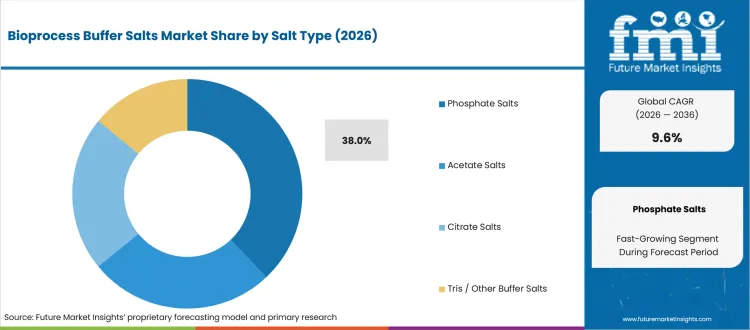
Phosphate salts keep a strong position because many biologics recipes already use phosphate systems during process development. Buyers prefer chemistry that remains familiar when teams move from small batches to validated commercial routines.
- Phosphate salts account for 38.0% share in 2026 as many upstream and downstream recipes use phosphate systems for stable pH control. Thermo Fisher lists sodium phosphate buffer solution at 0.2 M and pH 8.0, justifying why phosphate chemistry remains useful for controlled biological buffer preparation.
- Phosphate demand also benefits from validated preparation habits inside large biologics plants. Thermo Fisher describes phosphate buffer use for protein PEGylation at pH 7.4 and 50 mM, promoting repeat protein-handling workflows during scale transfer.
Why does GMP / Biopharma Grade lead the grade segment?
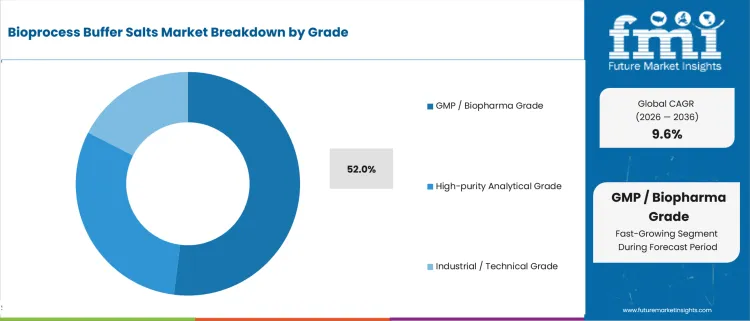
GMP / Biopharma Grade leads because regulated plants treat buffer salts as batch-contact materials. Supplier approval is tied to evidence quality, so buyers place more weight on documentation strength than on basic chemical identity alone.
- GMP / biopharma grade holds 52.0% share in 2026 as quality teams need traceable salts before approving materials for batch use. FDA reported 123 CDER product approvals in 2025, which shows why production teams need cleaner material records across active regulatory pipelines.
- Purchase decisions often move toward suppliers that can support certificates and change-control notices. Avantor’s hydration expansion quadrupled capacity for USP purified water and WFI-based hydration solutions, reflecting why qualified solution infrastructure matters for biopharma buyers.
What supports demand for Chromatography Buffers within the application segment?
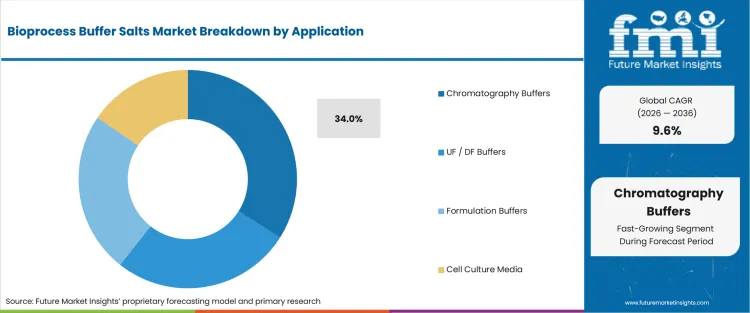
Chromatography buffers hold a central place because purification performance depends on controlled salt strength and pH behavior. Buyers connect buffer quality with resin performance, impurity removal, and the repeatability of downstream campaigns.
- Chromatography Buffers represent 34.0% application share in 2026 as purification recipes depend on controlled salt concentration and pH adjustment. Cytiva studied SEC buffer conditions across 20 mM phosphate and 50 mM to 500 mM NaCl, reflecting how buffer strength changes retention behavior.
- Senior buyers view chromatography buffers as yield-linked inputs. Cytiva’s AAV downstream work reported full capsid enrichment of 40% to 65% with viral genome recovery of 60% to 80%, showing why buffer and salt choices are importantduring advanced therapy purification.
How do buyers evaluate Biologics Manufacturing within the end-use segment?
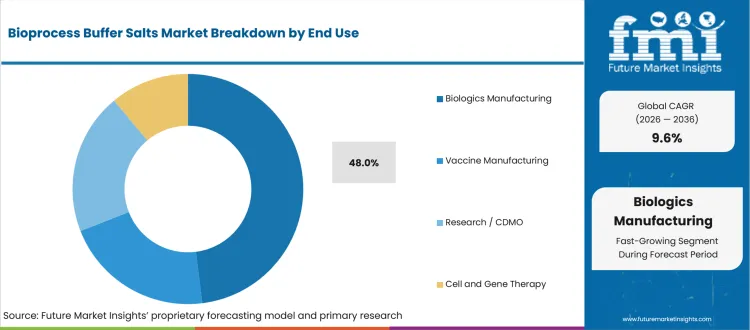
Biologics manufacturing uses buffers across multiple production steps, so supplier reliability affects more than one preparation room. Buyers assess whether salts can support upstream preparation and final formulation needs without adding review burden.
- Biologics Manufacturing is projected to hold 48.0% end-use share in 2026 as monoclonal antibodies and advanced therapies use buffers across several production steps. FDA reported 58 combined CDER and CBER novel approvals in 2025, which supports continuing demand for qualified materials during process development.
- Multi-site manufacturers review supplier reliability before repeat contracts. FDA’s approved cellular and gene therapy product list includes 48 licensed products from the Office of Therapeutic Products, showing why advanced biologics workflows need dependable buffer inputs.
How is Powder Salts positioned within the sales-format segment?
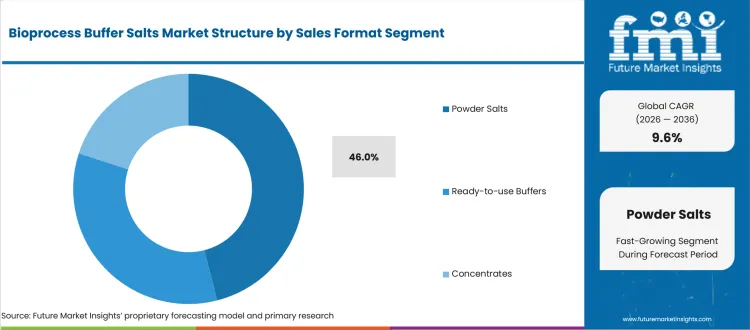
Powder salts remain important because large plants often prefer to keep mixing work inside validated procedures. Prepared formats gain interest when production teams need to reduce manual handling and support several product recipes at once.
- Powder Salts account for 46.0% sales-format share in 2026 as large facilities keep validated mixing work under internal process control. Thermo Fisher lists sodium phosphate monobasic monohydrate at 99.5% purity in 250 g and 1 kg options, explaining why dry salts remain practical for controlled in-house preparation.
- Ready-to-use buffers and concentrates gain attention in plants handling several products at once. Thermo Fisher states that Gibco process liquid and buffer solutions draw on more than 60 years of experience, supporting prepared-format use in facilities that want external buffer preparation support.
What are the drivers, restraints, and opportunities in the Bioprocess Buffer Salts Market?
Near-term purchases are being shaped by the quality requirement and format expansion route outlined below.
- Driver: GMP documentation drives buffer salt spending when biologics plants need traceable salts before batch-contact materials enter approved workflows.
- Restraint: Supplier qualification complexity restrains adoption when plants need to revalidate recipes, packaging formats, and material records across several production sites.
- Opportunity: Ready-to-use buffers and concentrates open an opportunity among CDMOs that need faster preparation support for varied client recipes.
Bioprocess buffer salt demand grows when production teams treat material records as part of batch control. Regulated plants need salts that arrive with dependable documents and technical support that reduces review time before production can move forward. FDA reported 1,248 drug quality assurance inspections in FY2025, including 702 domestic inspections, reflecting why manufacturing sites need cleaner supplier records before materials enter batch use.
Preparation discipline is moving into supplier selection as buyers compare powder salts and ready-to-use buffers. Facilities handling several biologics programs need fewer manual steps and clearer recipe transfer paths, which supports suppliers that offer validated formats across production scales. Thermo Fisher reported a CDMO case in which process liquids and buffers were supplied in 100 L bioprocess containers for the site’s 8 highest-volume buffers, helping the customer avoid USD 5.1 million in first-year capital and operating costs.
Qualification work can slow supplier changes as every new buffer salt must match existing recipes and quality files. Established suppliers gain an advantage when they support change notices and local service teams across multi-site biologics accounts. FDA’s FY2025 establishment report counted 1,951 active pharmaceutical ingredient establishments, explaining how large regulated material networks require careful supplier qualification before production teams adjust approved inputs.
Which country CAGRs are profiled in the Bioprocess Buffer Salts Market?
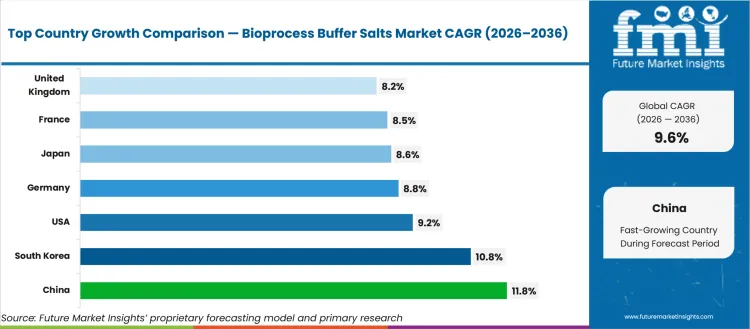
| Country | CAGR |
|---|---|
| United States | 9.2% |
| United Kingdom | 8.2% |
| Germany | 8.8% |
| France | 8.5% |
| Japan | 8.6% |
| China | 11.8% |
| South Korea | 10.8% |
| India | 11.3% |
Source: Future Market Insights analysis, 2026.
How do country-level CAGRs compare in the Bioprocess Buffer Salts Market?
Country growth in bioprocess buffer salts should be read through the production pressure behind biologics quality. In the United States and Western Europe, demand is aligned to regulated medicine development and production-site discipline. In China, South Korea, Japan, and India, the same category is closer to clinical development scale-up and local bioprocess capacity. For senior buyers, the question is more about where buffer salt reliability creates the highest value in batch release and supplier qualification.
- By 2036, the United States is projected to record 9.2% CAGR, reflected by drug development activity keeping process teams active. FDA’s 46 CDER novel drug approvals in 2025 show a steady product pipeline that needs documented materials during development and manufacturing transfer.
- The United Kingdom is expected to grow at 8.2% CAGR during the forecast period, driven by medicine oversight and life-science activity keeping qualified supply needs active. MHRA approved more than 2,000 medicine licences in 2024 to 2025, including 54 new medicines, while assessing over 5,000 clinical trial applications, which supports demand for documented process inputs used during development and regulated manufacturing.
- Over the assessment period, Germany is forecast to advance at 8.8% CAGR, led by a strong pharma production base maintaining quality records central to supplier approval. Germany Trade & Invest reported pharma industry sales of EUR 59.8 billion in 2023, giving buffer salt suppliers a large manufacturing base to serve.
- Through 2036, France is anticipated to post 8.5% CAGR since local medicine production density creates steady demand for supplier qualification. French Healthcare counted 271 pharmaceutical production sites in 2025, giving process input suppliers many regulated accounts to support.
- Japan is likely to expand at 8.6% CAGR by 2036 due to disciplined regulatory review sustaining attention on production records and validated inputs. PMDA’s 2025 update lists 12 months as standard total review time and 9 months for priority review, which supports careful process documentation.
- China is estimated to rise at 11.8% CAGR between 2026 and 2036 as improved local biologics trial pathways support commercial process planning. NMPA’s 2025 review process optimization notice created a 30-working-day clinical trial review pathway for eligible innovative drug INDs, while applicants must commit to starting clinical trials within 12 weeks of approval, giving developers a clearer route from research activity toward pilot production.
- South Korea is projected to record 10.8% CAGR by 2036, backed by biohealth export planning encouraging deeper bioprocess readiness. Invest KOREA’s outlook for USD 27.9 billion in 2025 biohealth exports and USD 30.4 billion the following year supports demand for media preparation and downstream production support.
- India is expected to grow at 11.3% CAGR during the forecast period, guided by export-led pharmaceutical capacity raising demand for qualified process inputs. Government data showing USD 30.5 billion in pharmaceutical exports during 2024 to 2025 supports stronger buying for documented salts used in regulated manufacturing.
Who are the notable companies in the Bioprocess Buffer Salts Market?
Merck KGaA, Thermo Fisher Scientific, Avantor, Cytiva, Sartorius, FUJIFILM Biosciences, Lonza, Corning, and Bio-Rad Laboratories are the notable companies shaping this market.
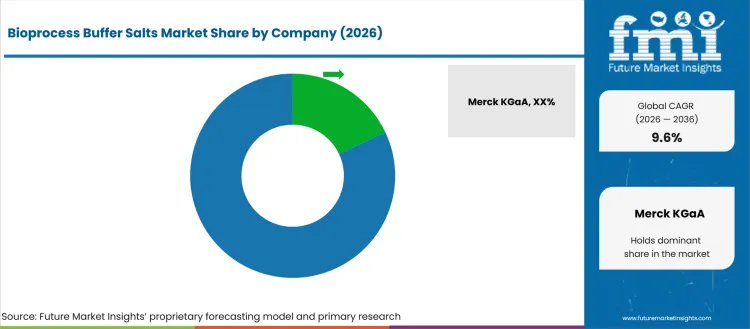
Competition in the bioprocess buffer salts market is differentiated by where buyers want supplier control to sustain. Merck KGaA, Thermo Fisher Scientific, and Avantor are stronger when the decision is tied to GMP documentation and process liquid support. Cytiva and Sartorius become more relevant when buffer preparation needs to connect with upstream and single-use workflow planning. FUJIFILM Biosciences, Lonza, Corning, and Bio-Rad matter when cell culture and research workflow links influence buffer salt buying.
- Merck KGaA is well placed where buyers need GMP-grade chemicals and multi-region supply assurance for commercial biologics programs.
- Thermo Fisher Scientific has an advantage in accounts that connect process liquids and bioprocess design support across scale-up projects.
- Avantor is positioned strongly in documented bioprocess inputs, especially where hydration solutions and excipient support are reviewed together.
- Cytiva and Sartorius compete through bioprocess workflow depth, helping buyers connect buffer preparation with upstream and single-use systems.
- FUJIFILM Biosciences, Lonza, Corning, and Bio-Rad hold positions through cell culture and research workflow links that influence buffer salt buying.
Competitive Benchmarking: Bioprocess Buffer Salts Market
| Company | GMP Documentation Depth | Buffer Format Range | Bioprocess Workflow Fit | Geographic Footprint |
|---|---|---|---|---|
| Merck KGaA | High | High | High | Global |
| Thermo Fisher Scientific | High | High | High | Global |
| Avantor | High | High | High | Global |
| Cytiva | High | Medium | High | Global |
| Sartorius | High | Medium | High | Global |
| FUJIFILM Biosciences | Medium | High | High | United States and Japan |
| Lonza | High | Medium | Medium | Global |
| Corning | Medium | Medium | Medium | Global |
| Bio-Rad Laboratories | Medium | Medium | High | Global |
Source: Future Market Insights competitive analysis, 2026.
Key Developments in the Bioprocess Buffer Salts Market
- In March 2025, Avantor completed a hydration expansion linked to USP purified water and WFI-based solutions. Production support covers buffer preparations, cell culture media, clean-in-place solutions, and formulation processes for biopharma buyers.
- In September 2025, FUJIFILM Biosciences introduced BalanCD HEK293 Perfusion A Medium for HEK293 perfusion cultures. Launch scope supports viral vector production workflows and expands supplier participation in gene therapy process inputs.
- In December 2025, Thermo Fisher Scientific expanded its Asia bioprocess design center network across Hyderabad, Incheon, and Singapore. Expanded centers support process design, media preparation, buffer work, purification, and scale-up planning.
Key Players in the Bioprocess Buffer Salts Market
Integrated Bioprocess Input Suppliers
- Merck KGaA
- Thermo Fisher Scientific
- Avantor
- Cytiva
- Sartorius
Cell Culture and Media Specialists
- FUJIFILM Biosciences
- Lonza
- Corning
Purification and Research Workflow Suppliers
- Bio-Rad Laboratories
Bioprocess Buffer Salts Market - Report Scope
| Coverage field | Report scope |
|---|---|
| Market breakdown | Bioprocess Buffer Salts Market Breakdown By Salt Type, Grade, Application, End Use, Sales Format, and Region |
| Market Definition | Salts and prepared buffer formats used to control pH and ionic strength during biopharmaceutical production workflows |
| Regions Covered | North America, Latin America, Europe, East Asia, South Asia and Pacific, Middle East and Africa |
| Countries Covered | United States, United Kingdom, Germany, France, Japan, China, South Korea, India and 30+ countries |
| Key Companies Profiled | Merck KGaA, Thermo Fisher Scientific, Avantor, Cytiva, Sartorius, FUJIFILM Biosciences, Lonza, Corning, Bio-Rad Laboratories |
| Forecast Period | 2026 to 2036 |
| Approach | Hybrid bottom-up and top-down methodology using salt demand, grade mix, application use, format adoption, and country-level bioprocess signals |
Source: Future Market Insights analysis, 2026.
Bioprocess Buffer Salts Market - Research Methodology
| Method | Approach |
|---|---|
| Primary Research | FMI analysts reviewed inputs from biopharma manufacturers, CDMOs, media suppliers, process development teams, and buffer preparation service providers. Supplier interviews focused on qualification files, documentation needs, concentration formats, and switching barriers. |
| Desk Research | Desk research covered regulator approval data, official medicine statistics, national pharmaceutical indicators, company product information, and public bioprocess updates. Product review checked use across cell culture, chromatography, UF / DF, formulation, GMP salts, and prepared buffer formats. |
| Market Sizing and Forecasting | The model combined market value, biologics demand signals, salt type mix, grade mix, application use, end-use demand, sales format adoption, and country-level production maturity. Forecast assumptions were adjusted for GMP qualification, outsourced buffer preparation, and cell culture media demand. |
| Data Validation | Forecasts were checked against drug approval activity, product portfolios, supplier investments, country-specific biopharma policy signals, chromatography workflow evidence, and bioprocessing system adoption. Company portfolios were reviewed to avoid counting adjacent chemicals without bioprocess buffer relevance. |
Bioprocess Buffer Salts Market by Segments
Bioprocess Buffer Salts Market segmented by Salt Type:
- Phosphate Salts
- Acetate Salts
- Citrate Salts
- Tris / Other Buffer Salts
Bioprocess Buffer Salts Market segmented by Grade:
- GMP / Biopharma Grade
- High-purity Analytical Grade
- Industrial / Technical Grade
Bioprocess Buffer Salts Market segmented by Application:
- Cell Culture Media
- Chromatography Buffers
- UF / DF Buffers
- Formulation Buffers
Bioprocess Buffer Salts Market segmented by End Use:
- Biologics Manufacturing
- Vaccine Manufacturing
- Cell and Gene Therapy
- Research / CDMO
Bioprocess Buffer Salts Market segmented by Sales Format:
- Powder Salts
- Ready-to-use Buffers
- Concentrates
Bioprocess Buffer Salts Market by Region:
- North America
- United States
- Canada
- Mexico
- Latin America
- Brazil
- Chile
- Rest of Latin America
- Western Europe
- Germany
- UK
- Italy
- Spain
- France
- Nordic
- BENELUX
- Rest of Western Europe
- Eastern Europe
- Russia
- Poland
- Hungary
- Balkan & Baltic
- Rest of Eastern Europe
- East Asia
- China
- Japan
- South Korea
- South Asia and Pacific
- India
- ASEAN
- Australia & New Zealand
- Rest of South Asia and Pacific
- Middle East & Africa
- Kingdom of Saudi Arabia
- Other GCC Countries
- Türkiye
- South Africa
- Other African Union
- Rest of Middle East & Africa
Research Sources and Bibliography
- USA Food and Drug Administration. (2026). Novel drug approvals for 2025. USA Food and Drug Administration.
- USA Food and Drug Administration. (2026, January 16). 2025 Biological License Application approvals. USA Food and Drug Administration.
- USA Food and Drug Administration. (2026). New drug therapy approvals 2025. USA Food and Drug Administration.
- USA Food and Drug Administration. (2026). FDA-Track: FY 2025 inspections of establishments performance dashboards. USA Food and Drug Administration.
- USA Food and Drug Administration. (2026). Report on the state of pharmaceutical quality FY2025. USA Food and Drug Administration.
- USA Food and Drug Administration. (2026). FY 2025 annual report on inspections of establishments. USA Food and Drug Administration.
- European Medicines Agency. (2026). Human medicines in 2025. European Medicines Agency.
- European Medicines Agency. (2026, June 11). EMA’s 2025 annual report shows strong approval numbers for human and veterinary medicines. European Medicines Agency.
- Press Information Bureau. (2026, March 21). India’s pharmaceuticals in global healthcare. Government of India.
- National Medical Products Administration. (2025, October 14). NMPA announcement on optimizing of the review and approval process for clinical trials of innovative drugs. National Medical Products Administration.
- National Medical Products Administration. (2025, October 14). Policy interpretation of the announcement on optimizing the review and approval process for clinical trials of innovative drugs. National Medical Products Administration.
- Invest KOREA. (2025, December 22). Biohealth industry exports expected to reach record high of USD 30.4 bn next year. Invest KOREA.
- Germany Trade & Invest. (2025). The pharmaceutical industry in Germany. Germany Trade & Invest.
- Business France. (2025, October 21). Pharmaceutical production: France, a European leader. French Healthcare.
- Pharmaceuticals and Medical Devices Agency. (2025, July 22). PMDA updates, Summer 2025. Pharmaceuticals and Medical Devices Agency.
- Medicines and Healthcare products Regulatory Agency. (2025, July 21). Medicines and Healthcare Products Regulatory Agency annual report and accounts 2024 to 2025. Government of the United Kingdom.
- Medicines and Healthcare products Regulatory Agency. (2025). MHRA impact report 2024 to 2025. Government of the United Kingdom.
- Avantor. (2025, March 17). Avantor provides first look at recently completed hydration expansion at DCAT Week 2025. Avantor.
- FUJIFILM Biosciences. (2025, September 15). FUJIFILM Biosciences introduces BalanCD HEK293 Perfusion A Medium to enable gene therapy production. FUJIFILM Biosciences.
- Thermo Fisher Scientific. (2025, December 2). Thermo Fisher Scientific deepens investment in Asia’s biopharma ecosystem with expansion of bioprocess design centers. Thermo Fisher Scientific.
- Thermo Fisher Scientific. (2026). Gibco process liquids and buffers. Thermo Fisher Scientific.
- Thermo Fisher Scientific. (2026). Sodium phosphate, 0.5M buffer solution, pH 7.5. Thermo Fisher Scientific.
- Thermo Fisher Scientific. (2026). Sodium phosphate, monobasic monohydrate, 99.5%, for biochemistry. Thermo Fisher Scientific.
- Thermo Fisher Scientific. (2024). Overcoming rapid growth challenges with buffer preparation. Thermo Fisher Scientific.
- Cytiva. (2024, May 30). How buffer pH and NaCl affect size exclusion chromatography. Cytiva.
- Cytiva. (2024). Enhanced AAV downstream processing. Cytiva.
- Bio-Rad Laboratories. (2026). Types of chromatography. Bio-Rad Laboratories.
- Avantor. (2026). High-performance bioprocess ingredients and excipients. Avantor.
- FUJIFILM Biosciences. (2026). Buffers and salt solutions. FUJIFILM Biosciences.
- Sartorius. (2026). Cell culture media and buffers. Sartorius.
- Corning. (2026). Cell culture media and reagents. Corning.
- Lonza. (2026). Bioprocessing solutions. Lonza.
This bibliography is provided for reader reference and is not exhaustive. The full report contains the complete reference list and detailed citations.
This Report Answers
- What is the expected global value of the Bioprocess Buffer Salts Market in 2026 and 2036?
- What CAGR is forecast for bioprocess buffer salts during the 2026 to 2036 period?
- Which grade category is used to assess GMP / Biopharma Grade demand in 2026?
- Why do biologics manufacturers buy GMP-grade buffer salts for regulated workflows?
- How do chromatography buffers shape purification planning and supplier choice?
- Which countries are compared in the bioprocess buffer salts forecast?
- Which companies compete across GMP salts, media, and purification workflows?
- What salt types and prepared formats are included within the bioprocess buffer salts definition?
- How does FMI size and forecast bioprocess buffer salts demand across segments and countries?
- What supplier-selection factors should executives assess before approving buffer salt vendors?
Frequently Asked Questions
What is driving growth in the bioprocess buffer salts market?
Growth is driven by regulated biologics production and demand for prepared buffer formats.
Why should executives track the bioprocess buffer salts market?
Executives should track this market since buffer quality affects batch release and the cost of scaling biologics production.
What business problem does the bioprocess buffer salts market address?
It helps buyers secure documented salts and buffer formats that support pH control and cleaner quality review before batch-contact use.
What should procurement leaders evaluate before selecting suppliers?
Purchase officers should compare GMP documentation depth and multi-site service capability.
What can limit return on investment for buyers?
Return on investment can be delayed when buyers need to revalidate recipes and align quality teams across several production sites.
How can suppliers build executive confidence?
Suppliers build confidence through consistent certificates and dependable post-approval service.
Preview the report firsthand - request a free sample
Get SampleGet the brochure for pricing and purchase details.
Get PDFTable of Content
- Key Takeaways
- Market Size and CAGR
- Top Growth Driver
- Fastest Growing Segment
- Leading Region
- Key Companies
- Emerging Opportunities
- Executive Summary
- Global Market Outlook
- Demand-side Trends
- Supply-side Trends
- Technology Roadmap Analysis
- Analysis and Recommendations
- Analyst Perspective (What is happening? Why now? What should investors know?)
- Key Questions Answered
- How large is the market?
- What is the CAGR?
- What are key trends?
- Which region dominates?
- Who are the leaders?
- Market Overview
- Market Coverage / Taxonomy
- Market Definition / Scope / Limitations
- Research Methodology
- Chapter Orientation
- Analytical Lens and Working Hypotheses
- Market Structure, Signals, and Trend Drivers
- Benchmarking and Cross-market Comparability
- Market Sizing, Forecasting, and Opportunity Mapping
- Research Design and Evidence Framework
- Desk Research Programme (Secondary Evidence)
- Expert Input and Fieldwork (Primary Evidence)
- Tooling, Models, and Reference Databases
- Data Engineering and Model Build
- Quality Assurance and Audit Trail
- Market Background
- Market Dynamics (Drivers, Restraints, Opportunity, Trends)
- Scenario Forecast (Optimistic, Likely, Conservative)
- Impact Analysis
- AI Impact
- Sustainability Impact
- Regulatory Impact
- Technology Impact
- Consumer / Buyer Analysis
- Purchase Drivers
- Adoption Barriers
- Buyer Journey
- Opportunity Map Analysis
- Product Life Cycle Analysis
- Supply Chain Analysis
- Investment Feasibility Matrix
- Value Chain Analysis
- PESTLE and Porter's Analysis
- Regulatory Landscape
- Regional Parent Market Outlook
- Production and Consumption Statistics
- Import and Export Statistics
- Global Market Analysis and Forecast, 2021 to 2036
- Historical Market Size Value (USD Million) & Volume (Unit) Analysis, 2021 to 2025
- Current and Future Market Size Value (USD Million) & Volume (Unit) Projections, 2026 to 2036
- Y-o-Y Growth Trend Analysis
- Absolute $ Opportunity Analysis
- Global Market Pricing Analysis, 2021 to 2036
- Global Market Analysis and Forecast, By Salt Type, 2021 to 2036
- Introduction / Key Findings
- Historical Market Size Value (USD Million) & Volume (Unit) Analysis By Salt Type, 2021 to 2025
- Current and Future Market Size Value (USD Million) & Volume (Unit) Analysis and Forecast By Salt Type, 2026 to 2036
- Phosphate Salts
- Acetate Salts
- Citrate Salts
- Tris / Other Buffer Salts
- Phosphate Salts
- Y-o-Y Growth Trend Analysis By Salt Type, 2021 to 2025
- Absolute $ Opportunity Analysis By Salt Type, 2026 to 2036
- Global Market Analysis and Forecast, By Grade, 2021 to 2036
- Introduction / Key Findings
- Historical Market Size Value (USD Million) & Volume (Unit) Analysis By Grade, 2021 to 2025
- Current and Future Market Size Value (USD Million) & Volume (Unit) Analysis and Forecast By Grade, 2026 to 2036
- GMP / Biopharma Grade
- High-purity Analytical Grade
- Industrial / Technical Grade
- GMP / Biopharma Grade
- Y-o-Y Growth Trend Analysis By Grade, 2021 to 2025
- Absolute $ Opportunity Analysis By Grade, 2026 to 2036
- Global Market Analysis and Forecast, By Application, 2021 to 2036
- Introduction / Key Findings
- Historical Market Size Value (USD Million) & Volume (Unit) Analysis By Application, 2021 to 2025
- Current and Future Market Size Value (USD Million) & Volume (Unit) Analysis and Forecast By Application, 2026 to 2036
- Chromatography Buffers
- UF / DF Buffers
- Formulation Buffers
- Cell Culture Media
- Chromatography Buffers
- Y-o-Y Growth Trend Analysis By Application, 2021 to 2025
- Absolute $ Opportunity Analysis By Application, 2026 to 2036
- Global Market Analysis and Forecast, By End Use, 2021 to 2036
- Introduction / Key Findings
- Historical Market Size Value (USD Million) & Volume (Unit) Analysis By End Use, 2021 to 2025
- Current and Future Market Size Value (USD Million) & Volume (Unit) Analysis and Forecast By End Use, 2026 to 2036
- Biologics Manufacturing
- Vaccine Manufacturing
- Research / CDMO
- Cell and Gene Therapy
- Biologics Manufacturing
- Y-o-Y Growth Trend Analysis By End Use, 2021 to 2025
- Absolute $ Opportunity Analysis By End Use, 2026 to 2036
- Global Market Analysis and Forecast, By Sales Format, 2021 to 2036
- Introduction / Key Findings
- Historical Market Size Value (USD Million) & Volume (Unit) Analysis By Sales Format, 2021 to 2025
- Current and Future Market Size Value (USD Million) & Volume (Unit) Analysis and Forecast By Sales Format, 2026 to 2036
- Powder Salts
- Ready-to-use Buffers
- Concentrates
- Powder Salts
- Y-o-Y Growth Trend Analysis By Sales Format, 2021 to 2025
- Absolute $ Opportunity Analysis By Sales Format, 2026 to 2036
- Global Market Analysis and Forecast, By Region, 2021 to 2036
- Introduction
- Historical Market Size Value (USD Million) & Volume (Unit) Analysis By Region, 2021 to 2025
- Current Market Size Value (USD Million) & Volume (Unit) Analysis and Forecast By Region, 2026 to 2036
- North America
- Latin America
- Western Europe
- Eastern Europe
- East Asia
- South Asia and Pacific
- Middle East & Africa
- Market Attractiveness Analysis By Region
- North America Market Analysis and Forecast, By Country, 2021 to 2036
- Historical Market Size Value (USD Million) & Volume (Unit) Trend Analysis By Market Taxonomy, 2021 to 2025
- Market Size Value (USD Million) & Volume (Unit) Forecast By Market Taxonomy, 2026 to 2036
- By Country
- USA
- Canada
- Mexico
- By Salt Type
- By Grade
- By Application
- By End Use
- By Sales Format
- By Country
- Market Attractiveness Analysis
- By Country
- By Salt Type
- By Grade
- By Application
- By End Use
- By Sales Format
- Key Takeaways
- Latin America Market Analysis and Forecast, By Country
- Historical Market Size Value (USD Million) & Volume (Unit) Trend Analysis By Market Taxonomy, 2021 to 2025
- Market Size Value (USD Million) & Volume (Unit) Forecast By Market Taxonomy, 2026 to 2036
- By Country
- Brazil
- Chile
- Rest of Latin America
- By Salt Type
- By Grade
- By Application
- By End Use
- By Sales Format
- By Country
- Market Attractiveness Analysis
- By Country
- By Salt Type
- By Grade
- By Application
- By End Use
- By Sales Format
- Key Takeaways
- Western Europe Market Analysis and Forecast, By Country
- Historical Market Size Value (USD Million) & Volume (Unit) Trend Analysis By Market Taxonomy, 2021 to 2025
- Market Size Value (USD Million) & Volume (Unit) Forecast By Market Taxonomy, 2026 to 2036
- By Country
- Germany
- UK
- Italy
- Spain
- France
- Nordic
- BENELUX
- Rest of Western Europe
- By Salt Type
- By Grade
- By Application
- By End Use
- By Sales Format
- By Country
- Market Attractiveness Analysis
- By Country
- By Salt Type
- By Grade
- By Application
- By End Use
- By Sales Format
- Key Takeaways
- Eastern Europe Market Analysis and Forecast, By Country
- Historical Market Size Value (USD Million) & Volume (Unit) Trend Analysis By Market Taxonomy, 2021 to 2025
- Market Size Value (USD Million) & Volume (Unit) Forecast By Market Taxonomy, 2026 to 2036
- By Country
- Russia
- Poland
- Hungary
- Balkan & Baltic
- Rest of Eastern Europe
- By Salt Type
- By Grade
- By Application
- By End Use
- By Sales Format
- By Country
- Market Attractiveness Analysis
- By Country
- By Salt Type
- By Grade
- By Application
- By End Use
- By Sales Format
- Key Takeaways
- East Asia Market Analysis and Forecast, By Country
- Historical Market Size Value (USD Million) & Volume (Unit) Trend Analysis By Market Taxonomy, 2021 to 2025
- Market Size Value (USD Million) & Volume (Unit) Forecast By Market Taxonomy, 2026 to 2036
- By Country
- China
- Japan
- South Korea
- By Salt Type
- By Grade
- By Application
- By End Use
- By Sales Format
- By Country
- Market Attractiveness Analysis
- By Country
- By Salt Type
- By Grade
- By Application
- By End Use
- By Sales Format
- Key Takeaways
- South Asia and Pacific Market Analysis and Forecast, By Country
- Historical Market Size Value (USD Million) & Volume (Unit) Trend Analysis By Market Taxonomy, 2021 to 2025
- Market Size Value (USD Million) & Volume (Unit) Forecast By Market Taxonomy, 2026 to 2036
- By Country
- India
- ASEAN
- Australia & New Zealand
- Rest of South Asia and Pacific
- By Salt Type
- By Grade
- By Application
- By End Use
- By Sales Format
- By Country
- Market Attractiveness Analysis
- By Country
- By Salt Type
- By Grade
- By Application
- By End Use
- By Sales Format
- Key Takeaways
- Middle East & Africa Market Analysis and Forecast, By Country
- Historical Market Size Value (USD Million) & Volume (Unit) Trend Analysis By Market Taxonomy, 2021 to 2025
- Market Size Value (USD Million) & Volume (Unit) Forecast By Market Taxonomy, 2026 to 2036
- By Country
- Kingdom of Saudi Arabia
- Other GCC Countries
- Türkiye
- South Africa
- Other African Union
- Rest of Middle East & Africa
- By Salt Type
- By Grade
- By Application
- By End Use
- By Sales Format
- By Country
- Market Attractiveness Analysis
- By Country
- By Salt Type
- By Grade
- By Application
- By End Use
- By Sales Format
- Key Takeaways
- Key Countries Market Analysis
- USA
- Pricing Analysis
- Market Share Analysis, 2025
- By Salt Type
- By Grade
- By Application
- By End Use
- By Sales Format
- Canada
- Pricing Analysis
- Market Share Analysis, 2025
- By Salt Type
- By Grade
- By Application
- By End Use
- By Sales Format
- Mexico
- Pricing Analysis
- Market Share Analysis, 2025
- By Salt Type
- By Grade
- By Application
- By End Use
- By Sales Format
- Brazil
- Pricing Analysis
- Market Share Analysis, 2025
- By Salt Type
- By Grade
- By Application
- By End Use
- By Sales Format
- Chile
- Pricing Analysis
- Market Share Analysis, 2025
- By Salt Type
- By Grade
- By Application
- By End Use
- By Sales Format
- Germany
- Pricing Analysis
- Market Share Analysis, 2025
- By Salt Type
- By Grade
- By Application
- By End Use
- By Sales Format
- UK
- Pricing Analysis
- Market Share Analysis, 2025
- By Salt Type
- By Grade
- By Application
- By End Use
- By Sales Format
- Italy
- Pricing Analysis
- Market Share Analysis, 2025
- By Salt Type
- By Grade
- By Application
- By End Use
- By Sales Format
- Spain
- Pricing Analysis
- Market Share Analysis, 2025
- By Salt Type
- By Grade
- By Application
- By End Use
- By Sales Format
- France
- Pricing Analysis
- Market Share Analysis, 2025
- By Salt Type
- By Grade
- By Application
- By End Use
- By Sales Format
- India
- Pricing Analysis
- Market Share Analysis, 2025
- By Salt Type
- By Grade
- By Application
- By End Use
- By Sales Format
- ASEAN
- Pricing Analysis
- Market Share Analysis, 2025
- By Salt Type
- By Grade
- By Application
- By End Use
- By Sales Format
- Australia & New Zealand
- Pricing Analysis
- Market Share Analysis, 2025
- By Salt Type
- By Grade
- By Application
- By End Use
- By Sales Format
- China
- Pricing Analysis
- Market Share Analysis, 2025
- By Salt Type
- By Grade
- By Application
- By End Use
- By Sales Format
- Japan
- Pricing Analysis
- Market Share Analysis, 2025
- By Salt Type
- By Grade
- By Application
- By End Use
- By Sales Format
- South Korea
- Pricing Analysis
- Market Share Analysis, 2025
- By Salt Type
- By Grade
- By Application
- By End Use
- By Sales Format
- Russia
- Pricing Analysis
- Market Share Analysis, 2025
- By Salt Type
- By Grade
- By Application
- By End Use
- By Sales Format
- Poland
- Pricing Analysis
- Market Share Analysis, 2025
- By Salt Type
- By Grade
- By Application
- By End Use
- By Sales Format
- Hungary
- Pricing Analysis
- Market Share Analysis, 2025
- By Salt Type
- By Grade
- By Application
- By End Use
- By Sales Format
- Kingdom of Saudi Arabia
- Pricing Analysis
- Market Share Analysis, 2025
- By Salt Type
- By Grade
- By Application
- By End Use
- By Sales Format
- Türkiye
- Pricing Analysis
- Market Share Analysis, 2025
- By Salt Type
- By Grade
- By Application
- By End Use
- By Sales Format
- South Africa
- Pricing Analysis
- Market Share Analysis, 2025
- By Salt Type
- By Grade
- By Application
- By End Use
- By Sales Format
- USA
- Market Structure Analysis
- Competition Dashboard
- Competition Benchmarking
- Market Share Analysis of Top Players
- By Regional
- By Salt Type
- By Grade
- By Application
- By End Use
- By Sales Format
- Emerging Startups
- Innovation Benchmarking
- Competition Analysis
- Competition Deep Dive
- Merck KGaA
- Overview
- Product Portfolio
- Profitability by Market Segments (Product/Region/Sales Channel)
- Sales Footprint
- Strategy Overview
- Marketing Strategy
- Product Strategy
- Channel Strategy
- Thermo Fisher Scientific
- Avantor
- Cytiva
- Sartorius
- FUJIFILM Biosciences
- Merck KGaA
- Case Studies
- Success Stories
- Recent Developments
- Competition Deep Dive
- Assumptions & Acronyms Used


