

- Market Size (2026)
- USD 294.9 Mn
- Forecast (2036)
- USD 445.0 Mn
- CAGR (2026 to 2036)
- 4.2%
How big is Body Exfoliating Mitts Market in 2026?
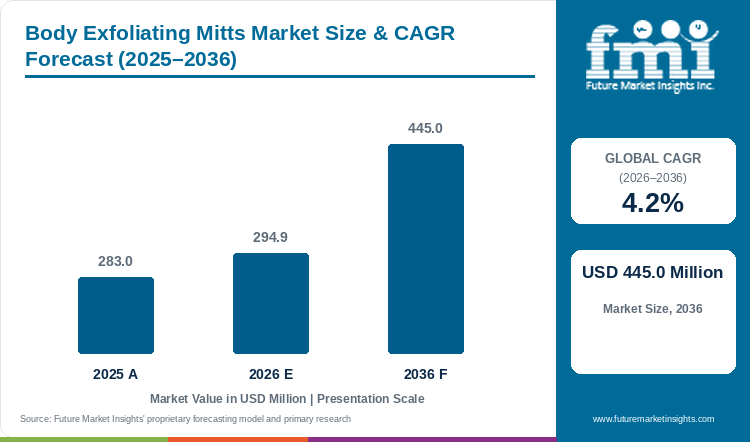
The body exfoliating mitts market is estimated at USD 283.0 million in 2025 and is projected to reach USD 294.9 million in 2026. Demand for body exfoliating mitts is expected to grow at a 4.2% CAGR and reach USD 445.0 million by 2036.
Body exfoliating mitts market size, counting shower mitts, gloves and straps, is estimated at USD 283.0 million for 2025, with USD 294.9 million projected for 2026. Sales of body exfoliating mitts are projected to reach USD 445.0 million by 2036, a 4.2% CAGR across the forecast period, as replacement buying and first-time users both add volume.
Through 2036, the dominant trend will be the move of the mitt from the grocery bath aisle into beauty retail, at higher shelf prices. For instance, Cleanlogic, a grocery bath accessory brand, put collagen-infused exfoliating cloths and gloves, with magnesium-infused body care, on Ulta.com from 13 July 2026 at USD 20 to USD 25.[1] In practice, a beauty shelf sells the same glove at two or three times the grocery price, and buyers replace a worn mitt with a better one instead of a cheaper one.
Repeat purchase is fragile among shoppers with sensitive skin, and gentle use decides whether that buyer comes back. On this point, the American Academy of Dermatology advises short, light strokes with a brush or sponge, warns that mechanical exfoliation may be too irritating for dry or sensitive skin, and tells people with darker skin tones to avoid strong exfoliation.[2] For that reason, FMI analysts advise mitt makers to grade every product by texture on the pack and to sell a soft option beside each coarse one, since a shopper who gets red skin from the first mitt rarely buys a second.
Key Market Trends & Insights
- Standard mitts are expected to lead product type at 35% in 2026, as a plain mitt that fits either hand is the easiest buy, and five-finger gloves follow at 29%. Gloves are also moving up the price ladder. In this segment, Cleanlogic added exfoliating gloves to the Infusions range in July 2026.[1] Treated gloves at beauty prices raise the value of each sale, so five-finger designs gain faster in value than in units.
- Nylon and polyester are expected to account for 58% of material sales in 2026, as cheap, quick-drying synthetic weaves suit daily showers, with viscose at 22%. Viscose gains from a separate export trend. At the same time, exports of Korean cosmetics reached USD 11.43 billion in 2025, carrying Korean body care habits abroad.[3] Wider exposure to the Korean scrub routine favours coarse viscose mitts outside Korea.
- Online retail is likely to hold 31% of channel sales in 2026, with supermarkets and hypermarkets on 25%. Multi-packs and video demonstrations sell well on marketplaces. For example, e-commerce made up 16.4% of US retail sales in 2025, the US Census Bureau reported.[4] Each point of retail moving online widens the shelf for niche textures that grocery pegs cannot carry.
Regional Highlights
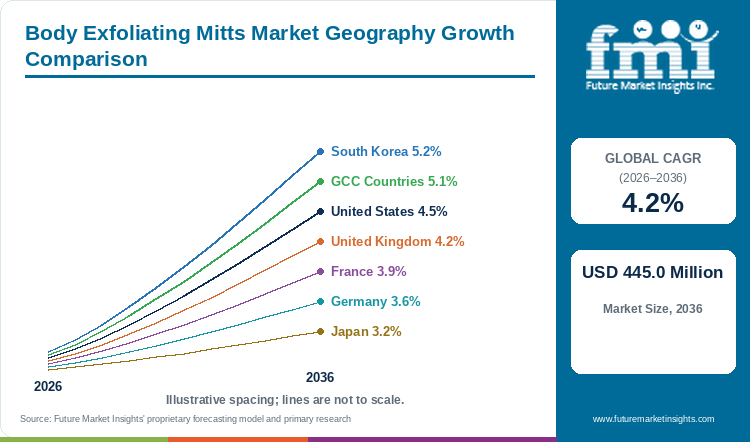
- Growth in South Korea, at 5.2% in FMI's forecast, runs a full point over the 4.2% global CAGR, as weekly bathhouse scrubs wear mitts out quickly. GCC Countries come a tenth lower at 5.1%.
- The United States is forecast at 4.5%, with pre-tan routines adding a regular use, and the United Kingdom matches the 4.2% global rate. Households in France, Germany and Japan already own mitts or body towels, so growth in the three countries slows to 3.9%, 3.6% and 3.2%.
- British shoppers are moving body care baskets online. Online sales reached 29.4% of Great Britain retail in June 2026, the Office for National Statistics reported.[5] A higher online share gives specialist mitt brands direct access to UK buyers without a drugstore listing.
Market Size & Forecast
Table 1: Market Size and Forecast for the Body Exfoliating Mitts Market (USD million and percentage), 2025 to 2036
| Metric | Value |
|---|---|
| 2025 Market Size | USD 283.0 million |
| Estimated Market Size in 2026 | USD 294.9 million |
| Projected Market Size by 2036 | USD 445.0 million |
| CAGR, 2026 to 2036 | 4.2% |
| Added Revenue, 2026 to 2036 | USD 150.1 million |
| Market Expansion Multiple | 1.5x |
Replacement adds as much to sales of body exfoliating mitts as new users do, as a mitt loses grip after months of washing and drying. Alongside this, a gentle tool sold beside body wash keeps the routine safe, and the American Academy of Dermatology updated home exfoliation advice in February 2026.[2] Clear safe-use advice reassures first-time buyers and keeps soft mitts on repeat lists. Body wash and lotion bought for the same shower routine belong to the skincare market, with 8.1% CAGR growth expected, and gloves add a low-cost step to that routine. As a result, FMI analysts expect the decade to bring USD 150.1 million in extra sales of body exfoliating mitts, leaving the 2036 figure 51% above 2026. Even so, washcloths, loofahs and scrubs remain the closest substitutes.
Grocery Aisles, Beauty Shelves and Bathhouse Habits
Grocery aisles still move the most units. On that front, Cleanlogic describes itself as the leading bath accessory brand in the grocery channel.[1] Grocery reach of that kind gives a brand the volume to fund premium ranges, and multi-packs sold beside body wash keep replacement cycles short.
Beauty shelves are adding treated and premium tools. For example, Cleanlogic priced the Infusions gloves and cloths at USD 20 to USD 25 for Ulta.com.[1] Prices at that level place a mitt beside skincare tools, so value per unit rises for brands with beauty listings. Meanwhile, bathhouse habits in South Korea and Türkiye support coarse viscose mitts, and Korean exporters shipped USD 2.2 billion of cosmetics to the United States in 2025.[3] As Korean beauty brands gain US shelf space, viscose scrub mitts reach new buyers, and brands will widen ranges at both ends of the price scale.
Table 2: Retail, Online and Skin Care Indicators for the Body Exfoliating Mitts Market (prices, shares and guidance), 2026
| Indicator | Data Point | Relevance | Source |
|---|---|---|---|
| Cleanlogic Infusions launch, July 2026 | USD 20 to USD 25 on Ulta.com | Premium gloves in beauty retail | [1] |
| American Academy of Dermatology guidance, February 2026 | Short, light strokes for tools | Safe use and repeat purchase | [2] |
| US e-commerce share of retail, 2025 | 16.4% | Online channel for mitts in the United States | [4] |
| Great Britain online share of retail, June 2026 | 29.4% | Online channel in the United Kingdom | [5] |
| Korean cosmetics exports, 2025 | USD 11.43 billion; up 12.3% | Reach of Korean body care habits | [3] |
| French e-commerce, 2025 | EUR 196.4 billion; up 7% | Online channel in France | [6] |
Analyst Perspective
“A body mitt is a small purchase, but I see the category moving from a grocery multi-pack to a beauty shelf product with graded textures and treated fabrics. That shift is unlocking a gentler second tier for body mitts, as buyers with sensitive skin finally get a product made for them. My advice to suppliers is to print texture grade, fiber and care steps on every pack, since a shopper who knows how to use and dry a mitt replaces the old one on time and stays with the brand.”
- Rahul Pandita, Principal Consultant, Future Market Insights.
How is the body exfoliating mitts market segmented?
The market is segmented into product type, material, sales channel, and region. Standard mitts are expected to lead product type with 35% share in 2026, and nylon and polyester lead material with 58%.
By product type: standard mitts, five-finger gloves, dual-texture mitts, and back mitts and straps.
By material: nylon and polyester, viscose, natural plant fibers, and silk.
By sales channel: online retail, supermarkets and hypermarkets, drugstores and pharmacies, beauty specialty stores, and spas and bathhouses.
By region: households, bathhouses, spas and retailers in North America, Latin America, Western Europe, Eastern Europe, East Asia, South Asia and Pacific, and Middle East and Africa.
Why do standard mitts lead body exfoliating mitts sales by product type?
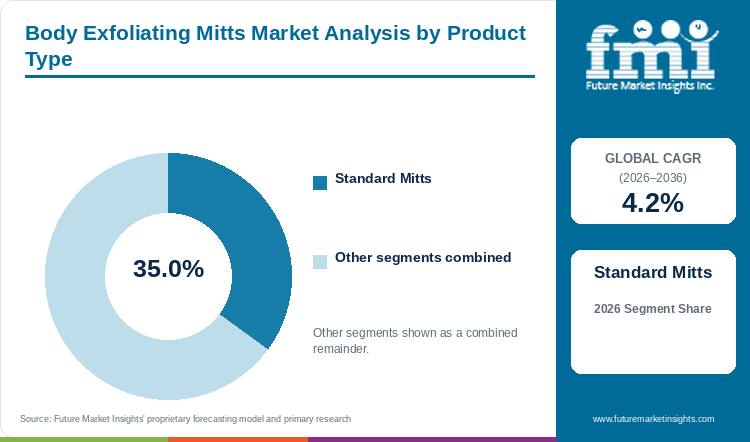
Standard mitts are expected to lead product type sales with 35% share in 2026, ahead of five-finger gloves at 29% and dual-texture mitts at 21%.
Table 3: Product Type Share for the Body Exfoliating Mitts Market (percentage share), 2026
| Product Type | Estimated Share (2026) |
|---|---|
| Standard Mitts | 35% |
| Five-Finger Gloves | 29% |
| Dual-Texture Mitts | 21% |
| Back Mitts and Straps | 15% |
| Total | 100.0% |
Table 4: Product Type Leadership and Market Growth for the Body Exfoliating Mitts Market (segment and CAGR percentage), 2026 to 2036
| Metric | Value |
|---|---|
| Global CAGR (2026 to 2036) | 4.2% |
| Leading Segment | Standard Mitts |
By product type, standard mitts are expected to capture the largest share of 2026 sales, at 35%, as one size fits most hands and the shape covers a large area in each stroke. By comparison, five-finger gloves, about 29%, give better grip on elbows, knees and feet and sell well in drugstores. Dual-texture mitts, an estimated 21%, pair a coarse side with a soft side for face and body. Back mitts and straps make up 15% and reach the shoulders without help. Gloves are gaining value faster than volume. Among brands, Cleanlogic sells exfoliating gloves in the Infusions line at USD 20 to USD 25.[1] A glove at beauty prices earns several times the margin of a grocery twin-pack, which draws more brands into the five-finger format. On the other hand, scrubs are the closest substitute, and the body scrub market, with a 10.5% CAGR outlook, competes for the same pre-tan step.
- Plain shower mitts in single and twin packs make up most standard mitt volume.
- Premium gloves are reaching beauty retail. Cleanlogic Infusions gloves launched on Ulta.com on 13 July 2026.[1] The listing tests how far beauty shoppers will pay for a body tool.
Why do nylon and polyester lead body exfoliating mitts sales by material?
Nylon and polyester are likely to lead material sales with 58% share in 2026, with viscose at 22% and natural plant fibers at 14%.
Table 5: Material Share for the Body Exfoliating Mitts Market (percentage share), 2026
| Material | Estimated Share (2026) |
|---|---|
| Nylon and Polyester | 58% |
| Viscose | 22% |
| Natural Plant Fibers | 14% |
| Silk | 6% |
| Total | 100.0% |
Nylon and polyester are likely to keep 58% of material sales in 2026, as synthetic weaves dry fast, hold texture through many washes and cost little. Behind them, viscose, about 22%, is the fabric of the Korean scrub towel and the Turkish kese mitt and gives a coarse, even rub. Natural plant fibers such as sisal, ramie, jute and cotton take an estimated 14%, and silk mitts 6%. Coarse viscose is also gaining an export audience. Meanwhile, shipments of Korean cosmetics abroad rose 12.3% to USD 11.43 billion in 2025, and Korean body care routines travel with them.[3] Growing curiosity about the Korean scrub routine supports viscose prices outside Korea. In addition, sustainability claims favour plant fibers, and the natural cosmetics market shows the same pull, at 5.7% CAGR through 2036.
- Woven nylon and polyester mitts make up most low-price and multi-pack volume.
- Korean beauty is building a US following. US cosmetics imports from South Korea reached USD 2.2 billion in 2025.[3] Retailers stocking Korean skincare add Korean scrub towels as a matching body care line.
Why does online retail lead body exfoliating mitts sales by sales channel?
Online retail is likely to lead channel sales with 31% share in 2026, ahead of supermarkets and hypermarkets at 25% and drugstores and pharmacies at 19%.
Table 6: Sales Channel Share for the Body Exfoliating Mitts Market (percentage share), 2026
| Sales Channel | Estimated Share (2026) |
|---|---|
| Online Retail | 31% |
| Supermarkets and Hypermarkets | 25% |
| Drugstores and Pharmacies | 19% |
| Beauty Specialty Stores | 15% |
| Spas and Bathhouses | 10% |
| Total | 100.0% |
Online retail is likely to remain the largest route, at 31% of 2026 channel sales, as video demonstrations and multi-pack pricing sell mitts well on marketplaces. To illustrate, US e-commerce reached USD 1,233.7 billion in 2025, 16.4% of retail sales.[4] Online retail at that scale lets small mitt brands sell nationally without grocery listings. Offline, supermarkets and hypermarkets, about 25%, sell mitts beside body wash. Drugstores and pharmacies hold an estimated 19%, beauty specialty stores 15% and spas and bathhouses 10%. Beauty chains also want exclusive body tools. In beauty retail, Cleanlogic chose Ulta.com for the July 2026 Infusions launch.[1] With the beauty and personal care product market growing at an 8.2% CAGR, mitts gain shelf space as beauty retailers add body care.
- Marketplaces, brand web stores and beauty retailer sites carry most online orders.
- UK buyers increasingly reorder bath accessories online. Online sales made up 29.4% of Great Britain retail in June 2026.[5] Brand web stores gain repeat orders once a worn mitt can be replaced from a saved basket.
What are the drivers, restraints, and opportunities in the body exfoliating mitts market?
Body care routines and pre-tan preparation keep demand for body exfoliating mitts steady. Skin irritation and hygiene worries hold back repeat use, and graded, treated mitts in beauty retail open higher price points.
- Driver: Shoppers use mitts in the shower before moisturizing or self-tanning, and worn mitts need replacing every few months.
- Restraint: Hard scrubbing can redden sensitive or darker skin, and a damp mitt that is not dried can harbour bacteria.
- Opportunity: Beauty retailers want graded, treated mitts at higher prices, and soft options open the category to sensitive skin.
Shower Routines Keep Mitts in Use
Body care routines bring the mitt into the shower several times a week. That said, people with dry or sensitive skin may prefer just a washcloth and a mild chemical exfoliator, the AAD says, and anyone using a brush or sponge should keep to short, light strokes.[2] Advice of this kind steers sensitive-skin buyers to soft mitts, so coarse textures sell mainly to regular users. Self-tan users, in particular, exfoliate before every application. In turn, each regular user replaces a mitt once the weave softens.
Skin Irritation and Hygiene Limit Repeat Use
Mechanical exfoliation can cause redness when used too hard or too often. Specifically, the American Academy of Dermatology tells people with darker skin tones to avoid strong mechanical exfoliation, as aggressive exfoliation can increase pigmentation.[2] In retail terms, FMI data indicate that drugstores and pharmacies feel this restraint most, since many pharmacy shoppers have sensitive skin. In response, brands will add drying hooks and care steps to packs.
Treated and Graded Mitts Open Higher Price Points
Beauty retailers are making room for body tools with added features. For instance, Cleanlogic launched collagen-infused exfoliating gloves and cloths on Ulta.com in July 2026, priced at USD 20 to USD 25.[1] A skincare claim on the fabric lets a mitt sell at skincare prices. Beyond the US, French shoppers spent EUR 76.1 billion online on goods in 2025, a 4% rise, which gives premium mitt brands a route to buyers.[6] Over the forecast period, suppliers with soft, medium and coarse grades will reach more skin types.
Which country CAGRs are profiled in the body exfoliating mitts market?
Table 7: Country CAGR Comparison for the Body Exfoliating Mitts Market (CAGR percentage), 2026 to 2036
| Country | CAGR (2026 to 2036) |
|---|---|
| South Korea | 5.2% |
| GCC Countries | 5.1% |
| United States | 4.5% |
| United Kingdom | 4.2% |
| France | 3.9% |
| Germany | 3.6% |
| Japan | 3.2% |
How do country-level CAGRs compare in the body exfoliating mitts market?
Bathhouse scrubbing is a weekly habit for many Koreans, and FMI expects the fastest country growth there, at 5.2%. GCC Countries follow at 5.1%, as hammam rituals and online beauty shopping spread through Saudi Arabia and the United Arab Emirates. Further down, demand in the United States is forecast to expand at 4.5%, helped by beauty retail and pre-tan routines. The United Kingdom is level with the 4.2% global rate. At the other end, Japan grows slowest at 3.2%, since most homes already own nylon body towels. Similarly, bath accessory shelves in France (3.9%) and Germany (3.6%) are mature.
- Weekly bathhouse scrubs wear viscose towels out within months in South Korea, which keeps replacement volume high and favours coarse textures. Makers of Korean-style viscose weaves gain at home and in export.
- In Saudi Arabia and the United Arab Emirates, hammam rituals are moving from the spa to the home bathroom through online beauty orders, shifting GCC demand toward retail kits sold on regional marketplaces.
- Self-tan users in the United States exfoliate before each application, so mitts stay on the repeat list. Grocery multi-packs already fill mass aisles, which makes the premium beauty shelf the main place for suppliers to add value.
- British buyers add mitts to online baskets with self-tan and body wash. With growth at the global rate, brands with strong web store listings gain more than those relying on drugstore pegs.
- Most French bathrooms already hold a gant exfoliant, and replacement accounts for most purchases. Pharmacy brands therefore compete on fabric quality and price per pack.
- German shoppers favour sisal and natural fibre mitts from drugstore chains, and own-brand ranges cap shelf prices. Textile makers secure volume through private label contracts with those chains.
- Long nylon body towels are already standard in Japanese homes, limiting first-time mitt buyers. Brands with gentler dual-texture or silk designs have the clearest opening.
Full report country CAGRs cover: bathhouse-led South Korea and hammam-led GCC Countries at the top, towel-saturated Japan at the bottom, the United States, the United Kingdom, France and Germany in the middle, and each other standard country by region.
Country-wise Analysis
South Korea Body Exfoliating Mitts Market Outlook (2026 to 2036)
Korean beauty brands are carrying home body care routines into export markets, which keeps domestic scrub towel makers busy. Korean cosmetics exports reached USD 11.43 billion in 2025, up 12.3%, the Ministry of Food and Drug Safety said.[3] On the ground, viscose scrub towels and mitts are a fixture of the Korean bathhouse and home shower. As a result, South Korea leads country growth for body exfoliating mitts, with growth expected at 5.2% as K-beauty brands add body care lines.
Key takeaway: Frequent bathhouse use turns South Korea into a replacement market for coarse viscose, and exporters of Korean beauty open foreign shelves for the same towels.
GCC Countries Body Exfoliating Mitts Market Outlook (2026 to 2036)
Online payment is changing how Gulf shoppers buy bath accessories. Mada card e-commerce sales in Saudi Arabia passed SAR 69.3 billion in Q1 2025, 56% higher than in Q1 2024, the Saudi Press Agency reported in July 2025.[7] This fast-growing online payment brings imported mitts and hammam sets to buyers in Saudi Arabia and the United Arab Emirates. Consequently, GCC Countries are forecast at a 5.1% CAGR, with spas and hotel bathhouses adding to retail sales.
Key takeaway: Card-based online buying gives imported hammam sets a direct route to Gulf homes, and hotel spas add a second, bulk buyer.
United States Body Exfoliating Mitts Market Outlook (2026 to 2036)
Premium positioning is the main change in US mitt sales. Cleanlogic launched the Infusions collection exclusively on Ulta.com on 13 July 2026, priced at USD 20 to USD 25.[1] An exclusive beauty listing at that price shows retailers treating mitts as skincare tools. More broadly, e-commerce made up 16.4% of US retail sales in 2025.[4] On this basis, FMI analysts expect demand for body exfoliating mitts in the United States to grow at 4.5%, as grocery multi-packs and premium beauty gloves both gain.
Key takeaway: US value growth comes from beauty listings at higher prices, and grocery multi-packs hold unit volume.
United Kingdom Body Exfoliating Mitts Market Outlook (2026 to 2036)
Online beauty orders keep gaining ground in the United Kingdom. Online sales reached 29.4% of Great Britain retail in June 2026, up from 28.9% in May.[5] A rising online share favours brands that bundle mitts with self-tan and body wash, and drugstores keep the impulse sale. Overall, growth in the United Kingdom is expected to match the 4.2% global rate for body exfoliating mitts.
Key takeaway: Bundled online baskets add mitt sales in the United Kingdom, though a mature drugstore shelf holds growth to the global average.
France Body Exfoliating Mitts Market Outlook (2026 to 2036)
French shoppers buy heavily online, though beauty is growing slowly there. French e-commerce reached EUR 196.4 billion in 2025, and beauty sales on leading sites rose 2%, FEVAD reported.[6] Slow beauty growth online leaves mitt sales in France reliant on replacement more than on new buyers. At the same time, the gant exfoliant has long been a pharmacy and bath shelf item in France. Most French households already own a gant, so a 3.9% CAGR is likely, below the global rate.
Key takeaway: French demand rests on replacing an old gant, so pharmacy brands gain through better fabrics more than through new users.
Germany Body Exfoliating Mitts Market Outlook (2026 to 2036)
German drugstores sell massage gloves and sisal mitts beside shower products. There, buyers favour natural fibers and long-lasting weaves. Replacement purchases dominate, so demand for body exfoliating mitts in Germany is likely to expand at 3.6%, six tenths short of the global pace.
Key takeaway: Drugstore own brands set German prices, and natural fibre mitts give branded suppliers the best case for a higher shelf price.
Japan Body Exfoliating Mitts Market Outlook (2026 to 2036)
Japanese shoppers order more beauty products online each year, though body towels still dominate the bath. Online buying of cosmetics and pharmaceuticals in Japan reached about JPY 1.015 trillion in 2024, an e-commerce ratio of 8.82%, METI reported in August 2025.[8] Even so, most Japanese homes already use long nylon body towels, which compete with mitts. For that reason, dual-texture and silk mitts supply most of the growth in Japan, which FMI puts at 3.2%.
Key takeaway: With body towels in nearly every Japanese bathroom, growth relies on refined mitts that offer a gentler or more luxurious scrub.
Who are the notable companies in the body exfoliating mitts market?
Cleanlogic, Dermasuri, EcoTools, Earth Therapeutics, Salux, Kessa, The Body Shop and Dandong Laotang Textile Mill are the profiled companies.
In FMI analysis, the leading companies include bath accessory brands, beauty tool brands, bathhouse mitt specialists and textile makers. Among these, Cleanlogic launched the Infusions line at Ulta Beauty in July 2026 and describes itself as the leading bath accessory brand in the grocery channel.[1] Holding both grocery and beauty shelves gives Cleanlogic reach that specialist brands lack. Alongside Cleanlogic, Dermasuri, EcoTools, Earth Therapeutics, Salux, Kessa, The Body Shop and Dandong Laotang Textile Mill complete the group.
- Bath accessory brands: Cleanlogic, EcoTools and Earth Therapeutics.
- Exfoliation specialists: Dermasuri, Salux and Kessa.
- Beauty retail brands and textile makers: The Body Shop and Dandong Laotang Textile Mill.
Competitive Benchmarking: Body Exfoliating Mitts Market
Table 8: Competitive Benchmarking for the Body Exfoliating Mitts Market (qualitative ratings), 2026
| Company | Treated Fabrics | Beauty Retail | Grocery Retail | Recent Activity |
|---|---|---|---|---|
| Cleanlogic | High | High | High | High |
| Dermasuri | Low | Medium | Low | Low |
| EcoTools | Medium | Medium | High | Low |
| Earth Therapeutics | Medium | Low | Medium | Low |
| Salux | Low | Low | Low | Low |
Ratings compare the companies on treated fabrics, beauty retail, grocery retail and recent activity.
Key Developments in the Body Exfoliating Mitts Market
- The Office for National Statistics put the online share of Great Britain retail at 29.4% for June 2026 in a 24 July 2026 release, which widens the reach of web-only mitt brands.[5]
- On 13 July 2026, Cleanlogic launched the Infusions collection of exfoliating cloths and gloves on Ulta.com, a sign that beauty chains now stock mitts as skincare tools.[1]
- In a 10 March 2026 release, the US Census Bureau reported 2025 e-commerce sales of USD 1,233.7 billion, 16.4% of retail; for mitt sellers this means a larger marketplace audience.[4]
- FEVAD said on 11 February 2026 that French online sales for 2025 came to EUR 196.4 billion, giving pharmacy mitt brands a second route to French buyers.[6]
- Safe-use guidance on exfoliation at home was updated by the American Academy of Dermatology on 6 February 2026, which favours soft and graded mitts over coarse ones.[2]
- Korean cosmetics exports for 2025 reached USD 11.43 billion, according to a 9 January 2026 Korea JoongAng Daily report, and the gain carries Korean scrub routines to new buyers.[3]
Key Players in the Body Exfoliating Mitts Market
Bath Accessory Brands
- Cleanlogic
- EcoTools
- Earth Therapeutics
Exfoliation Specialists
- Dermasuri
- Salux
- Kessa
Beauty Retail Brands and Textile Makers
- The Body Shop
- Dandong Laotang Textile Mill
Body Exfoliating Mitts Market - Report Scope
Table 9: Report Scope for the Body Exfoliating Mitts Market (coverage fields and definitions), 2026 to 2036
| Coverage field | Report scope |
|---|---|
| Market breakdown | Product type; material; sales channel; region |
| Quantitative units | USD million |
| Market definition | Reusable textured mitts, gloves and back straps used for mechanical exfoliation of the body, sold alone or as the mitt part of a set. Body scrubs, chemical exfoliants, body wash, self-tan applicator mitts and spa services are excluded. |
| Regions covered | North America; Latin America; Western Europe; Eastern Europe; East Asia; South Asia and Pacific; Middle East and Africa |
| Countries covered | United States; Canada; Brazil; Mexico; Argentina; Chile; Germany; France; United Kingdom; Italy; Spain; Benelux; Nordics; Poland; Czech Republic; Romania; Hungary; China; Japan; South Korea; India; ASEAN; Australia and New Zealand; GCC Countries; South Africa; Türkiye; Israel |
| Key companies profiled | Cleanlogic, Dermasuri, EcoTools, Earth Therapeutics, Salux, Kessa, The Body Shop, Dandong Laotang Textile Mill |
| Forecast period | 2026 to 2036 |
Body Exfoliating Mitts Market - Research Methodology
Table 10: Research Methodology for the Body Exfoliating Mitts Market (research methods and approach), 2026 edition
| Method | Approach |
|---|---|
| Data Sources | Brand launches, dermatology guidance, retail and e-commerce statistics and cosmetics export data. |
| Desk Research | Desk research covers mitt designs, fabrics, prices, retail placement and safe-use guidance. |
| Market Sizing and Forecasting | Sizing starts from the 2026 base of USD 294.9 million and the 4.2% CAGR for 2026 to 2036. |
| Data Validation | Figures are cross-checked across company, industry and government sources. |
Body Exfoliating Mitts Market by Segments
Body Exfoliating Mitts Market segmented by Product Type:
- Standard Mitts
- Five-Finger Gloves
- Dual-Texture Mitts
- Back Mitts and Straps
Body Exfoliating Mitts Market segmented by Material:
- Nylon and Polyester
- Viscose
- Natural Plant Fibers
- Silk
Body Exfoliating Mitts Market segmented by Sales Channel:
- Online Retail
- Supermarkets and Hypermarkets
- Drugstores and Pharmacies
- Beauty Specialty Stores
- Spas and Bathhouses
Body Exfoliating Mitts Market by Region
- North America
- United States
- Canada
- Latin America
- Brazil
- Mexico
- Argentina
- Chile
- Western Europe
- Germany
- France
- United Kingdom
- Italy
- Spain
- Benelux
- Nordics
- Eastern Europe
- Poland
- Czech Republic
- Romania
- Hungary
- East Asia
- China
- Japan
- South Korea
- South Asia and Pacific
- India
- ASEAN
- Australia and New Zealand
- Middle East and Africa
- GCC Countries
- South Africa
- Türkiye
- Israel
Research Sources and Bibliography
- [1] Mass Market Retailers. (2026, July 10). Cleanlogic launches Infusions collection at Ulta Beauty. https://massmarketretailers.com/cleanlogic-launches-infusions-collection-at-ulta-beauty/
- [2] American Academy of Dermatology Association. (2026, February 6). How to safely exfoliate at home. https://www.aad.org/public/everyday-care/skin-care-secrets/routine/safely-exfoliate-at-home
- [3] Korea JoongAng Daily. (2026, January 9). Korea's cosmetics exports surpass record $11 billion in 2025. https://www.koreajoongangdaily.com/business/koreas-cosmetics-exports-surpass-record-11-billion-in-2025/12129724
- [4] U.S. Census Bureau. (2026, March 10). Quarterly Retail E-Commerce Sales, 4th Quarter 2025. https://www2.census.gov/retail/releases/historical/ecomm/25q4.pdf
- [5] Office for National Statistics. (2026, July 24). Retail sales, Great Britain: June 2026. https://www.ons.gov.uk/businessindustryandtrade/retailindustry/bulletins/retailsales/june2026
- [6] FEVAD. (2026, February 11). Bilan du e-commerce en France: les Français ont dépensé près de 200 milliards d'euros sur internet en 2025. https://www.fevad.com/bilan-du-e-commerce-en-france-les-francais-ont-depense-pres-de-200-milliards-deuros-sur-internet-en-2025/
- [7] Saudi Press Agency. (2025, July 3). E-Commerce Sales in Saudi Arabia Exceed SAR 69 Billion During First Quarter. https://www.spa.gov.sa/en/N2351771
- [8] Ministry of Economy, Trade and Industry. (2025, August 26). Results of FY2024 E-Commerce Market Survey Compiled. https://www.meti.go.jp/english/press/2025/0826_003.html
This bibliography is provided for reader reference. The full report contains the complete reference list and detailed citations.
This Report Answers
- How big is the body exfoliating mitts market during 2026?
- What market size is projected by 2036?
- Which product type holds notable share?
- Which material holds notable share?
- Which countries have notable growth?
- Which companies are notable in the market?
Frequently Asked Questions
How large is the body exfoliating mitts market expected in 2026?
In FMI's estimate, the body exfoliating mitts market reaches USD 294.9 million in 2026, up from USD 283.0 million in 2025. Sales of body exfoliating mitts are projected to reach USD 445.0 million by 2036.
What CAGR is projected for the body exfoliating mitts market through 2036?
Demand for body exfoliating mitts is expected to grow at a 4.2% CAGR through 2036. Replacement of worn mitts, pre-tan routines and premium gloves in beauty retail carry that growth.
Which product type holds a notable market share in 2026?
Standard mitts are expected to make up 35% of 2026 product type sales, six points above five-finger gloves.
Which material holds a notable market share in 2026?
Nylon and polyester mitts are likely to hold 58% of material sales, against an estimated 22% for viscose.
Which country has a notable expansion outlook through 2036?
FMI projects South Korea to grow fastest, at a 5.2% CAGR. GCC Countries follow at 5.1%.
Who are the key companies in the body exfoliating mitts market?
Cleanlogic, EcoTools and Earth Therapeutics lead the bath accessory brands, and Dermasuri, Salux and Kessa lead the exfoliation specialists. The Body Shop and Dandong Laotang Textile Mill complete the profiled companies.
Preview the report firsthand - request a free sample
Get SampleGet the brochure for pricing and purchase details.
Get PDFTable of Content
- Key Takeaways
- Market Size and CAGR
- Top Growth Driver
- Fastest Growing Segment
- Leading Region
- Key Companies
- Emerging Opportunities
- Executive Summary
- Global Market Outlook
- Demand-side Trends
- Supply-side Trends
- Technology Roadmap Analysis
- Analysis and Recommendations
- Analyst Perspective (What is happening? Why now? What should investors know?)
- Key Questions Answered
- How large is the market?
- What is the CAGR?
- What are key trends?
- Which region dominates?
- Who are the leaders?
- Market Overview
- Market Coverage / Taxonomy
- Market Definition / Scope / Limitations
- Research Methodology
- Chapter Orientation
- Analytical Lens and Working Hypotheses
- Market Structure, Signals, and Trend Drivers
- Benchmarking and Cross-market Comparability
- Market Sizing, Forecasting, and Opportunity Mapping
- Research Design and Evidence Framework
- Desk Research Programme (Secondary Evidence)
- Expert Input and Fieldwork (Primary Evidence)
- Tooling, Models, and Reference Databases
- Data Engineering and Model Build
- Quality Assurance and Audit Trail
- Market Background
- Market Dynamics (Drivers, Restraints, Opportunity, Trends)
- Scenario Forecast (Optimistic, Likely, Conservative)
- Impact Analysis
- AI Impact
- Sustainability Impact
- Regulatory Impact
- Technology Impact
- Consumer / Buyer Analysis
- Purchase Drivers
- Adoption Barriers
- Buyer Journey
- Opportunity Map Analysis
- Product Life Cycle Analysis
- Supply Chain Analysis
- Investment Feasibility Matrix
- Value Chain Analysis
- PESTLE and Porter's Analysis
- Regulatory Landscape
- Regional Parent Market Outlook
- Production and Consumption Statistics
- Import and Export Statistics
- Global Market Analysis and Forecast, 2021 to 2036
- Historical Market Size Value (USD Million) Analysis, 2021 to 2025
- Current and Future Market Size Value (USD Million) Projections, 2026 to 2036
- Y-o-Y Growth Trend Analysis
- Absolute $ Opportunity Analysis
- Global Market Pricing Analysis, 2021 to 2036
- Global Market Analysis and Forecast, By Product Type, 2021 to 2036
- Introduction / Key Findings
- Historical Market Size Value (USD Million) Analysis By Product Type, 2021 to 2025
- Current and Future Market Size Value (USD Million) Analysis and Forecast By Product Type, 2026 to 2036
- Standard Mitts
- Five-Finger Gloves
- Dual-Texture Mitts
- Back Mitts and Straps
- Y-o-Y Growth Trend Analysis By Product Type, 2021 to 2025
- Absolute $ Opportunity Analysis By Product Type, 2026 to 2036
- Global Market Analysis and Forecast, By Material, 2021 to 2036
- Introduction / Key Findings
- Historical Market Size Value (USD Million) Analysis By Material, 2021 to 2025
- Current and Future Market Size Value (USD Million) Analysis and Forecast By Material, 2026 to 2036
- Nylon and Polyester
- Viscose
- Natural Plant Fibers
- Silk
- Y-o-Y Growth Trend Analysis By Material, 2021 to 2025
- Absolute $ Opportunity Analysis By Material, 2026 to 2036
- Global Market Analysis and Forecast, By Sales Channel, 2021 to 2036
- Introduction / Key Findings
- Historical Market Size Value (USD Million) Analysis By Sales Channel, 2021 to 2025
- Current and Future Market Size Value (USD Million) Analysis and Forecast By Sales Channel, 2026 to 2036
- Online Retail
- Supermarkets and Hypermarkets
- Drugstores and Pharmacies
- Beauty Specialty Stores
- Spas and Bathhouses
- Y-o-Y Growth Trend Analysis By Sales Channel, 2021 to 2025
- Absolute $ Opportunity Analysis By Sales Channel, 2026 to 2036
- Global Market Analysis and Forecast, By Region, 2021 to 2036
- Introduction
- Historical Market Size Value (USD Million) Analysis By Region, 2021 to 2025
- Current Market Size Value (USD Million) Analysis and Forecast By Region, 2026 to 2036
- North America
- Latin America
- Western Europe
- Eastern Europe
- East Asia
- South Asia and Pacific
- Middle East and Africa
- Market Attractiveness Analysis By Region
- North America Market Analysis and Forecast, By Country, 2021 to 2036
- Historical Market Size Value (USD Million) Trend Analysis By Market Taxonomy, 2021 to 2025
- Market Size Value (USD Million) Forecast By Market Taxonomy, 2026 to 2036
- By Country
- United States
- Canada
- By Product Type
- By Material
- By Sales Channel
- By Country
- Market Attractiveness Analysis
- By Country
- By Product Type
- By Material
- By Sales Channel
- Key Takeaways
- Latin America Market Analysis and Forecast, By Country
- Historical Market Size Value (USD Million) Trend Analysis By Market Taxonomy, 2021 to 2025
- Market Size Value (USD Million) Forecast By Market Taxonomy, 2026 to 2036
- By Country
- Brazil
- Mexico
- Argentina
- Chile
- By Product Type
- By Material
- By Sales Channel
- By Country
- Market Attractiveness Analysis
- By Country
- By Product Type
- By Material
- By Sales Channel
- Key Takeaways
- Western Europe Market Analysis and Forecast, By Country
- Historical Market Size Value (USD Million) Trend Analysis By Market Taxonomy, 2021 to 2025
- Market Size Value (USD Million) Forecast By Market Taxonomy, 2026 to 2036
- By Country
- Germany
- France
- United Kingdom
- Italy
- Spain
- Benelux
- Nordics
- By Product Type
- By Material
- By Sales Channel
- By Country
- Market Attractiveness Analysis
- By Country
- By Product Type
- By Material
- By Sales Channel
- Key Takeaways
- Eastern Europe Market Analysis and Forecast, By Country
- Historical Market Size Value (USD Million) Trend Analysis By Market Taxonomy, 2021 to 2025
- Market Size Value (USD Million) Forecast By Market Taxonomy, 2026 to 2036
- By Country
- Poland
- Czech Republic
- Romania
- Hungary
- By Product Type
- By Material
- By Sales Channel
- By Country
- Market Attractiveness Analysis
- By Country
- By Product Type
- By Material
- By Sales Channel
- Key Takeaways
- East Asia Market Analysis and Forecast, By Country
- Historical Market Size Value (USD Million) Trend Analysis By Market Taxonomy, 2021 to 2025
- Market Size Value (USD Million) Forecast By Market Taxonomy, 2026 to 2036
- By Country
- China
- Japan
- South Korea
- By Product Type
- By Material
- By Sales Channel
- By Country
- Market Attractiveness Analysis
- By Country
- By Product Type
- By Material
- By Sales Channel
- Key Takeaways
- South Asia and Pacific Market Analysis and Forecast, By Country
- Historical Market Size Value (USD Million) Trend Analysis By Market Taxonomy, 2021 to 2025
- Market Size Value (USD Million) Forecast By Market Taxonomy, 2026 to 2036
- By Country
- India
- ASEAN
- Australia and New Zealand
- By Product Type
- By Material
- By Sales Channel
- By Country
- Market Attractiveness Analysis
- By Country
- By Product Type
- By Material
- By Sales Channel
- Key Takeaways
- Middle East and Africa Market Analysis and Forecast, By Country
- Historical Market Size Value (USD Million) Trend Analysis By Market Taxonomy, 2021 to 2025
- Market Size Value (USD Million) Forecast By Market Taxonomy, 2026 to 2036
- By Country
- GCC Countries
- South Africa
- Türkiye
- Israel
- By Product Type
- By Material
- By Sales Channel
- By Country
- Market Attractiveness Analysis
- By Country
- By Product Type
- By Material
- By Sales Channel
- Key Takeaways
- Key Countries Market Analysis
- United States
- Pricing Analysis
- Market Share Analysis, 2025
- By Product Type
- By Material
- By Sales Channel
- Canada
- Pricing Analysis
- Market Share Analysis, 2025
- By Product Type
- By Material
- By Sales Channel
- Mexico
- Pricing Analysis
- Market Share Analysis, 2025
- By Product Type
- By Material
- By Sales Channel
- Brazil
- Pricing Analysis
- Market Share Analysis, 2025
- By Product Type
- By Material
- By Sales Channel
- Chile
- Pricing Analysis
- Market Share Analysis, 2025
- By Product Type
- By Material
- By Sales Channel
- Germany
- Pricing Analysis
- Market Share Analysis, 2025
- By Product Type
- By Material
- By Sales Channel
- United Kingdom
- Pricing Analysis
- Market Share Analysis, 2025
- By Product Type
- By Material
- By Sales Channel
- Italy
- Pricing Analysis
- Market Share Analysis, 2025
- By Product Type
- By Material
- By Sales Channel
- Spain
- Pricing Analysis
- Market Share Analysis, 2025
- By Product Type
- By Material
- By Sales Channel
- France
- Pricing Analysis
- Market Share Analysis, 2025
- By Product Type
- By Material
- By Sales Channel
- India
- Pricing Analysis
- Market Share Analysis, 2025
- By Product Type
- By Material
- By Sales Channel
- ASEAN
- Pricing Analysis
- Market Share Analysis, 2025
- By Product Type
- By Material
- By Sales Channel
- Australia and New Zealand
- Pricing Analysis
- Market Share Analysis, 2025
- By Product Type
- By Material
- By Sales Channel
- China
- Pricing Analysis
- Market Share Analysis, 2025
- By Product Type
- By Material
- By Sales Channel
- Japan
- Pricing Analysis
- Market Share Analysis, 2025
- By Product Type
- By Material
- By Sales Channel
- South Korea
- Pricing Analysis
- Market Share Analysis, 2025
- By Product Type
- By Material
- By Sales Channel
- Poland
- Pricing Analysis
- Market Share Analysis, 2025
- By Product Type
- By Material
- By Sales Channel
- Hungary
- Pricing Analysis
- Market Share Analysis, 2025
- By Product Type
- By Material
- By Sales Channel
- Türkiye
- Pricing Analysis
- Market Share Analysis, 2025
- By Product Type
- By Material
- By Sales Channel
- South Africa
- Pricing Analysis
- Market Share Analysis, 2025
- By Product Type
- By Material
- By Sales Channel
- GCC Countries
- Pricing Analysis
- Market Share Analysis, 2025
- By Product Type
- By Material
- By Sales Channel
- United States
- Market Structure Analysis
- Competition Dashboard
- Competition Benchmarking
- Market Share Analysis of Top Players
- By Regional
- By Product Type
- By Material
- By Sales Channel
- Emerging Startups
- Innovation Benchmarking
- Competition Analysis
- Competition Deep Dive
- Cleanlogic
- Overview
- Product Portfolio
- Profitability by Market Segments
- Sales Footprint
- Strategy Overview
- Marketing Strategy
- Product Strategy
- Channel Strategy
- Dermasuri
- EcoTools
- Earth Therapeutics
- Salux
- Kessa
- The Body Shop
- Dandong Laotang Textile Mill
- Cleanlogic
- Case Studies
- Success Stories
- Recent Developments
- Competition Deep Dive
- Assumptions & Acronyms Used


