

- Market Size (2026)
- USD 623.2 Mn
- Forecast (2036)
- USD 1116.1 Mn
- CAGR (2026 to 2036)
- 6.0%
How big is Body Butters Market in 2026?
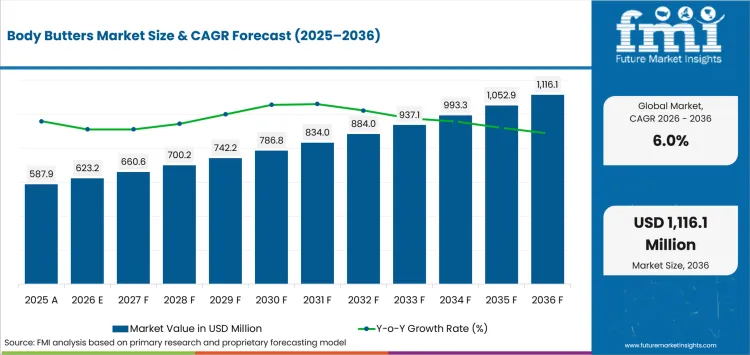
USD 623.2 million in 2026 and USD 1,116.1 million by 2036 at a 6.0% CAGR.
Sales of body butters are projected to rise at a 6.0% CAGR from 2026 to 2036, lifting value from USD 623.2 million to USD 1,116.1 million. The forecast represents USD 492.9 million in incremental value as richer body moisturizers extend beyond winter-only use into routine barrier care. In July 2026, Unilever said Vaseline Verified contributed to double-digit growth after scientists tested viral uses and converted proven behaviors into products and partnerships. Verified testing gives familiar occlusives new routine entry points without changing their core function.
Imported body butters reach Gulf shelves once brands document formula safety and confirm pack stability under hot storage. In October 2025, Dubai Municipality said Dubai entry points handle more than 90% of UAE imports under cosmetic evaluation, release and post-market controls. Concentrated entry routes make registration-ready files and heat-stable packaging part of launch economics for Gulf distributors.
Key Takeaways
- Demand for body butters comes from repeat barrier care built on clean spread and credible benefit claims.
- Based on product type, core - classic lines are projected to account for 31.0% in 2026 due to familiar rich textures that fit daily use and replenishment.
- By nature, conventional formulas are estimated to hold 45.0% in 2026 owing to formulation flexibility and price access in high-volume channels.
- In 2026, liquid & serum formats are expected to lead the format category with 28.0% share because faster spreading extends rich moisturization into warmer climates and shorter routines.
- Dense textures can lose conversion if residue, preservation, temperature exposure or claim documentation makes a scent or format difficult to scale consistently.
- Some of the key players in this market include Estee Lauder Companies, Coty, Amorepacific, L'Oreal, Unilever, Beiersdorf, Shiseido, Procter & Gamble, e.l.f. Beauty, and Kao Corporation.
Analyst Perspective
"Body butters win repeat purchase when rich formulas relieve dryness without delaying dressing or feeling heavy in warm weather. Brands earn more repeat orders through controlled spread, credible barrier claims and packaging that protects texture during distribution and repeated home use."
- Rahul Pandita, Principal Consultant, Future Market Insights
How is the body butters market segmented?
The market is evaluated by product type, nature, format, price positioning, sales channel and region.
Product type covers core - classic lines, targeted treatment lines, sensitive & gentle lines, premium & clinical lines and kits & sets. Nature covers conventional, vegan & cruelty-free, natural & organic, dermocosmetic - clinical and fragrance-free & sensitive. Format spans liquid & serum, cream & balm, stick & solid, spray & mist, sheet & patch and powder. Price positioning includes mass, masstige, premium and professional. Sales channel covers e-commerce & DTC, specialty beauty retail, pharmacies & drugstores, supermarkets & hypermarkets and salons & spas.
What makes core - classic lines central to product type?
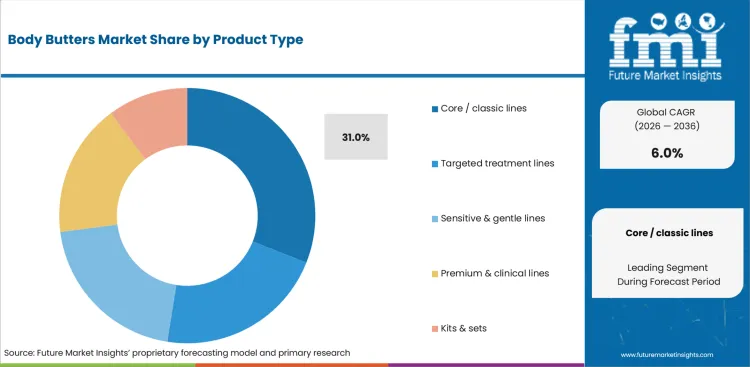
Core - classic lines give retailers a familiar rich-moisture offer for post-bath care and seasonal dryness. Brands can change fragrance or shea butter supply without changing the core use case.
- Core - classic lines are set to lead the product type category with 31.0% share in 2026 due to familiar textures that fit daily use and simple replenishment.
- Beiersdorf said in October 2025 that more than four NIVEA Creme tins sold each second during 2024, with the product available in more than 170 countries. The scale lowers education work for a rich cream used on multiple body areas.
Why does conventional lead the nature category?
Conventional formulas give high-volume brands more room to adjust emollients, preservatives and sensorial modifiers for scent or active variants. In January 2026, Beiersdorf launched NIVEA Creme Natural Touch following six years of research and more than 2,100 prototypes, showing the testing needed to alter a familiar cream without replacing the original.
- In 2026, conventional formulas are expected to lead the nature category with 45.0% share because formulation flexibility supports stable texture and mass-channel pricing.
- Natural cosmetics can win ingredient-led trial, but narrower raw-material choices increase claim and stability work that large retailers expect for wider ranges.
How does liquid & serum shape the format category?
Liquid & serum formats spread quickly over large body areas and fit pumps that limit repeated finger contact. The format also borrows active-led habits from skincare products without the waxier finish of a dense balm.
- By format, liquid & serum formats are forecast to represent 28.0% in 2026 driven by faster application over large body areas and a lighter sensory finish.
- Kao announced Curél Moist Barrier Oil Serum in July 2026 for dry sensitive skin, with launch planned first in Japan and then Europe. Its low-viscosity oil format carries ceramide-focused moisturization through a lighter application profile.
What supports mass leadership in price positioning?
Mass pricing fits products applied over large body areas and bought repeatedly, keeping trial costs manageable for routine users. L'Oreal's July 2025 half-year results said Mixa continued its body-care rollout in Europe, placing moisturization inside a high-volume platform with wide distribution.
- The mass segment is likely to capture 40.0% share in 2026 attributable to broad retail access and frequent-use economics.
- Retail scale lets brands rotate texture or fragrance variants without requiring a prestige consultation model, which protects frequent-use economics beyond the first purchase in large national retail networks.
Why is e-commerce & DTC central to sales channel?
Online product pages explain finish, scent, ingredient claims and use order without physical handling. Reviews and replenishment prompts give the skincare category a repeat-order route that shelf labels cannot match.
- By sales channel, e-commerce & DTC is estimated to hold 30.0% in 2026 owing to digital education, bundles and reorder prompts.
- Eurostat said in February 2025 that 20% of EU residents bought cosmetics or wellness products online during the prior three months in 2024. The recorded audience supports digital body-care discovery, but descriptions and reviews must explain residue, fragrance and application clearly.
What are the drivers, restraints and opportunities in the Body Butters Market?
Barrier-focused body care is increasing demand, while safety and sensory requirements can slow conversion. Lighter treatment formats widen year-round use.
- Driver: Treatment-led body routines are giving rich moisturization a more regular role in barrier care.
- Restraint: Dense formulas require tighter control of preservation, fragrance, pack hygiene and temperature stability for broad release.
- Opportunity: Butter-serum hybrids and sensitive-skin ranges can retain rich moisturization with lower residue and easier warm-weather use.
Treatment-led body care gives rich moisturization a clearer role in daily barrier routines instead of seasonal relief alone. In August 2026, Procter & Gamble launched Olay's revamped Repair Serum Body Wash range and Enrich Boosting Body Oil for consistent barrier care. The paired routine gives butter-serum and oil-rich formats a repeat-use route that retailers can merchandise beside familiar body care.
Safety controls can slow fragrance and format expansion even when consumer interest is already established. The European Commission said in March 2026 that cosmetics accounted for 36% of Safety Gate alerts recorded in 2025, the largest notified category. Rich scented ranges therefore need disciplined raw-material review, preservation and packaging controls as brands multiply SKUs that each require consistent safety documentation.
Sensitive-skin body lotions show how lighter treatment forms can preserve rich moisturization without the heavy finish that limits classic jars in warm weather. Amorepacific said in May 2025 that ILLIYOON's third-generation Ceramide Ato renewal supported continued brand growth. Butter-serums, fragrance-free creams and pump formats can follow the same route by reducing residue and keeping barrier positioning clear.
Which country CAGRs are profiled in the Body Butters Market?
| Country | CAGR (2026 to 2036) |
|---|---|
| UAE | 7.4% |
| Saudi Arabia | 7.1% |
| South Korea | 6.7% |
| USA | 6.4% |
| UK | 6.1% |
| France | 5.8% |
| Germany | 5.4% |
| Japan | 5.1% |
How do country-level CAGRs compare in the Body Butters Market?
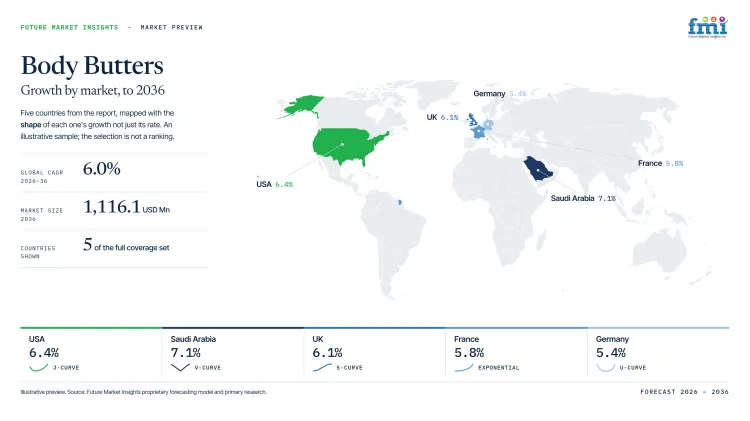
The 2.3-point spread separates two Gulf leaders from a broad middle group and three slower mature markets. UAE and Saudi Arabia sit above 7.0%, with South Korea, USA and UK clustered from 6.1% to 6.7%. France, Germany and Japan remain below 6.0%. Channel economics can outweigh a few tenths of CAGR.
- UAE travel retail widens premium discovery.
- Saudi Arabia supports higher-ticket beauty trial.
- South Korea compresses shelf-reset cycles.
- USA offers several replenishment models.
- UK compresses price ladders for routine moisturizers.
- France pairs pharmacy trust with sensorial retail.
- Germany's drugstore scale rewards focused assortments.
- Japan rewards compact premium presentation.
Comparable CAGRs produce different entry economics because local retail structure changes the cost of converting trial into repeat orders. The full report provides country-level CAGR analysis across North America, Latin America, Western Europe, Eastern Europe, East Asia, South Asia and Pacific, and Middle East and Africa.
Country-wise Analysis
- UAE body-care launches concentrate in premium urban retail and imported assortments, so distributors need registration-ready product files and formulas that tolerate hot storage if retailers are to widen shelf space or approve broader seasonal assortments in local chains. Adoption of body butters in UAE is estimated to expand at 7.4% CAGR through 2036, driven by frequent premium-beauty turnover and year-round moisturization demand from air-conditioned routines. Dubai Media Office stated in April 2025 that Montaji Plus held more than 1.7 million registered products, so complete product files become a stronger entry asset for local importers expanding seasonal assortments through premium retail and pharmacy channels.
- Saudi pharmacies and beauty retailers give imported body care wide reach, but hot logistics and tightly controlled product records make inventory discipline part of everyday execution for national distributors. The Saudi Food and Drug Authority said in July 2025 that it seized about 1.5 million noncompliant cosmetic packages after finding manipulated expiry dates, making traceability a direct commercial condition for wider placement. Saudi Arabia's body butters outlook is anticipated to advance at 7.1% CAGR over the assessment period, propelled by wider beauty discovery despite Arabic labeling, registration and hot-storage requirements that make disciplined local partners more useful than rapid assortment expansion.
- South Korean body care turns quickly through digital content and frequent product refreshes, which rewards brands that can test claims without delaying launch calendars or retailer resets. Body butter sales in South Korea are forecast to expand at 6.7% CAGR by 2036, tied to active-led hydration and rapid format testing in a market accustomed to ingredient-led launches. The Ministry of Food and Drug Safety reported in May 2026 that 2025 cosmetics exports rose 11.8% and placed Korea second globally, a scale that gives fast product cycles a large export platform even though functional claims require substantiation for durable listings in fast-reset retail channels.
- USA body-care launches can reach national retailers quickly, but every formula refresh increases the records that must stay current under federal cosmetics requirements and retailer onboarding for national drugstore programs at scale. FDA data current to June 30, 2026 listed 16,398 active cosmetic facility registrations, showing the scale of the regulated supply base and the administrative work behind broad distribution. The USA body butters sector is projected to record 6.4% CAGR during the assessment period, given wide retail access and disciplined listing maintenance, although weak SKU governance can erase the timing advantage that national chains and DTC launches provide.
- UK body-care launches depend on coordinated stock handoffs between national retailers, so a product that scales digitally must stay available as store distribution broadens and price comparison intensifies. In the UK, body butter demand is predicted to advance at 6.1% CAGR through 2036, supported by omnichannel replenishment and established drugstore access among routine moisturization shoppers. The Office for Product Safety and Standards counted 833 cosmetics, personal-care and grooming notifications in its 2025-26 Product Safety Database report, making current safety files and steady stock more valuable than rapid launches under Great Britain notification duties as distribution broadens into more stores nationally.
- French body-care purchases put sensorial finish under close comparison in selective beauty and online channels, with rich formulas expected to feel distinctive without becoming difficult to wear during normal daily routines. INSEE reported in October 2025 that 63% of people aged 15 or older bought goods or services online during the prior three months in 2024, giving established beauty brands broad digital reach without extra store space. Body butter demand in France is forecast to rise at 5.8% CAGR over the forecast period, aided by digital comparison and brand trust despite fragrance and claim presentation work that favors focused ranges with consistent documentation.
- German body-care launches face price-conscious shoppers who compare routine moisturizers online, so new formulas must earn repeat purchase to secure broader distribution in major urban centers and national drugstore chains. Germany is estimated to post 5.4% CAGR over the forecast period, attributable to steady moisturizer replenishment in mature personal-care channels and broad digital product comparison nationally. Destatis data current to November 2025 show 70% of people aged 16 to 74 bought online during the prior three months, whereas packaging participation and ingredient administration add fixed launch work that makes focused assortments more economical than broad fragrance proliferation for smaller brands.
- Japanese body-care purchases place high weight on spread, residue, fragrance strength, dispensing control and gifting cues, so rich moisturizers need precise sensory execution to become routine products beyond seasonal dryness in daily routines. Internet shopping reached 56.9% of two-or-more-person households in 2025, according to the Statistics Bureau of Japan's 2026 publication, the highest level since that survey began and evidence of a broad replenishment route beyond department stores. By 2036, Japan is projected to grow at 5.1% CAGR, because online access widens availability despite sticky-finish risk that makes smaller packs and controlled dosing more useful for everyday adoption than increasing formula richness alone.
Who are the notable companies in the Body Butters Market?
Estee Lauder Companies, Coty, Amorepacific, L'Oreal, Unilever, Beiersdorf, Shiseido, Procter & Gamble, e.l.f. Beauty, and Kao Corporation are the notable companies profiled in this market.
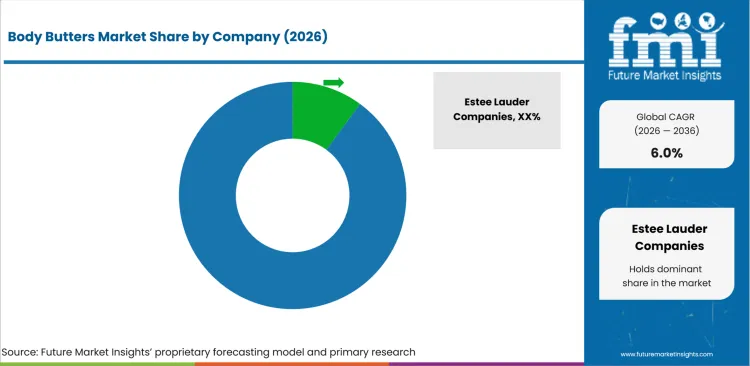
Body butters draw mass personal-care groups, prestige beauty houses, derma-focused portfolios and digital-first brands. Entry depends on stable texture, credible barrier claims and distribution that preserves formula quality through repeat purchase.
- L'Oreal, Unilever, Beiersdorf and Procter & Gamble use broad skin-and-body platforms. Coty and e.l.f. Beauty extend reach through accessible prestige and digital channels.
- Estee Lauder Companies, Shiseido, Amorepacific and Kao Corporation bring prestige, sensitive-skin or treatment-led expertise to more selective body-care routes.
Competitive Benchmarking: Body Butters Market
| Company | Body-Care Portfolio Breadth | Treatment / Sensitive-Skin Depth | Omnichannel Commercial Access | Geographic Reach |
|---|---|---|---|---|
| Estee Lauder Companies | High | Medium | High | Global |
| Coty | Medium | Low | High | Global |
| Amorepacific | High | High | High | Asia, North America and Europe |
| L'Oreal | High | High | High | Global |
| Unilever | High | Medium | High | Global |
| Beiersdorf | High | High | High | Global |
| Shiseido | Medium | Medium | High | Asia, Europe and the Americas |
| Procter & Gamble | High | Medium | High | Global |
| e.l.f. Beauty | Medium | Medium | High | North America, UK and selected markets |
| Kao Corporation | High | High | High | Asia, Europe and the Americas |
Scoring basis: High breadth requires several documented body-care brands or formats, Medium one platform with multiple offers and Low one narrow route. High treatment depth requires a derma or sensitive-skin platform with testing support. Medium covers targeted benefits and Low general moisturization. High omnichannel access requires physical retail plus e-commerce in several markets. Medium covers two narrower routes and Low one documented route.
Key Developments in the Body Butters Market
- In July 2026, Shiseido launched Clé de Peau Beauté Synactif Crème Corps as a dedicated body cream for rich leave-on care within its prestige Synactif line.
- In November 2025, Amorepacific launched ILLIYOON, Mamonde and Primera through Boots in 47 UK stores and online. The launch gave ILLIYOON's Ceramide Ato line a national retail entry point.
- In May 2025, Estee Lauder Companies launched Origins skincare and body care in the USA Amazon Premium Beauty store. The launch added national digital access for sensorial body care and giftable sets.
Key Players in the Body Butters Market
Prestige and Multibrand Beauty Groups
- Estee Lauder Companies
- Coty
- Amorepacific
- L'Oreal
Global Skin and Body Care Platforms
- Unilever
- Beiersdorf
- Shiseido
- Procter & Gamble
Digital and Sensitive-Skin Specialists
- e.l.f. Beauty
- Kao Corporation
Body Butters Market - Report Scope
| Coverage field | Report scope |
|---|---|
| Market breakdown | By product type, nature, format, price positioning, sales channel and region. |
| Quantitative Units | USD million. |
| Market Definition | Commercial leave-on body moisturizers sold as body butters, whipped butters, butter-serums, body balms, solid body butters and closely positioned treatment formats. Raw cosmetic ingredients and unrelated wash-off products are excluded from market sizing. |
| Regions Covered | North America, Latin America, Western Europe, Eastern Europe, East Asia, South Asia and Pacific, and Middle East and Africa. |
| Countries Covered | UAE, Saudi Arabia, South Korea, USA, UK, France, Germany, Japan, and 20+ countries included in the full report. |
| Key Companies Profiled | Estee Lauder Companies, Coty, Amorepacific, L'Oreal, Unilever, Beiersdorf, Shiseido, Procter & Gamble, e.l.f. Beauty, Kao Corporation. |
| Forecast Period | 2026 to 2036. |
| Approach | Primary and secondary research with market triangulation. |
Body Butters Market - Research Methodology
| Method | Approach |
|---|---|
| Primary Research | FMI analysts gathered input from manufacturers, service providers, technology developers, distributors, end users, procurement teams, and subject-matter experts. Interviews examined purchasing decisions, product or service evaluation, adoption barriers, approval requirements, pricing considerations, and expectations for technical or commercial support. Respondents were also asked what evidence is required before a trial, pilot, or initial order develops into regular purchasing. |
| Desk Research | Desk research covered government statistics, regulatory publications, trade data, industry associations, technical literature, standards, company filings, product information, and official corporate announcements. Sources were reviewed for relevance, publication date, geographic coverage, and consistency with the defined market scope. Claims relating to performance, applications, approvals, capacity, investment, and commercial activity were retained only when supported by credible public evidence. |
| Market Sizing and Forecasting | The market model combined the baseline value with historical performance, segment structure, pricing and volume indicators, adoption levels, company participation, and country-level demand conditions. Forecast assumptions considered economic activity, investment trends, regulatory developments, technology adoption, purchasing cycles, supply availability, and barriers to wider market use. Segment and regional estimates were reconciled before the final market total was calculated. |
| Data Validation | Estimates were checked against multiple independent indicators, including public data, company activity, trade patterns, industry developments, and findings from primary interviews. Validation also tested whether products, services, applications, and company revenues fell within the defined market boundaries. Adjacent categories, unsupported claims, overlapping revenues, and activities without direct market relevance were excluded to reduce double counting and maintain consistency across segments and countries. |
Body Butters Market by Segments
Body Butters Market segmented by Product Type:
- Core - classic lines
- Targeted treatment lines
- Sensitive & gentle lines
- Premium & clinical lines
- Kits & sets
Body Butters Market segmented by Nature:
- Conventional
- Vegan & cruelty-free
- Natural & organic
- Dermocosmetic - clinical
- Fragrance-free & sensitive
Body Butters Market segmented by Format:
- Liquid & serum
- Cream & balm
- Stick & solid
- Spray & mist
- Sheet & patch
- Powder
Body Butters Market segmented by Price Positioning:
- Mass
- Masstige
- Premium
- Professional
Body Butters Market segmented by Sales Channel:
- E-commerce & DTC
- Specialty beauty retail
- Pharmacies & drugstores
- Supermarkets & hypermarkets
- Salons & spas
Body Butters Market by Region:
- North America
- United States
- Canada
- Latin America
- Brazil
- Mexico
- Argentina
- Chile
- Western Europe
- Germany
- France
- United Kingdom
- Italy
- Spain
- Benelux
- Nordics
- Eastern Europe
- Poland
- Czech Republic
- Romania
- Hungary
- East Asia
- China
- Japan
- South Korea
- South Asia and Pacific
- India
- ASEAN
- Australia and New Zealand
- Middle East and Africa
- GCC Countries
- South Africa
- Türkiye
- Israel
Research Sources and Bibliography
- Unilever. (2026, July 13). How Vaseline turned verified hacks into new products and partnerships.
- Dubai Municipality. (2025, October 27). Product safety at Beautyworld Middle East 2025.
- Beiersdorf. (2025, October 9). From Hamburg to the World: 100 Years of the Blue NIVEA Tin.
- Beiersdorf. (2026, January 5). Iconic blue tin now available in two versions: Beiersdorf launches NIVEA Creme Natural Touch in Germany.
- Kao Corporation. (2026, July 1). Curél Unveils 'Moist Barrier Oil Serum' for Rough, Tight Skin Caused by Extreme Dryness.
- L'Oreal. (2025, July 29). 2025 Half-Year Results.
- Eurostat. (2025, February 20). Online shopping in the EU keeps growing.
- Procter & Gamble. (2026, August 27). Olay Launches 'Barrier Bootcamp' With New Repair Serum Body Wash Collection - Your Shower-Powered Workout for Skin Barrier Repair.
- European Commission. (2026, March 5). Commission's 2025 Safety Gate Report shows increased action against dangerous products and stronger consumer protection.
- Amorepacific. (2025, May 2). Amorepacific Holdings Consolidated Q1 2025 Business Performance.
- USA Food and Drug Administration. (2026, February 11). Registration & Listing of Cosmetic Product Facilities and Products.
- Statistisches Bundesamt. (2025, November 27). Internet users and online shoppers.
- Insee. (2025, October 14). Achats de produits et de services en ligne.
- Office for Product Safety and Standards. (2026, August 27). Product Safety Database report 2025 to 2026.
- Saudi Food and Drug Authority. (2025, July 15).
- Government of Dubai Media Office. (2025, April 30). Dubai Municipality's strategic projects set to transform sustainability, quality of life and community wellbeing.
- Statistics Bureau of Japan. (2026).
- Ministry of Food and Drug Safety. (2026, May 28).
- The Estee Lauder Companies. (2026, August 19). The Estee Lauder Companies Reports Fiscal 2026 Results.
- Coty. (2026, August 20). Coty Announces Filing of Annual Report on Form 10-K for the Fiscal Year Ended June 30, 2026.
- Amorepacific. (2026, July 31). Amorepacific Group Announces Q2 2026 Business Performance.
- L'Oreal. (2026, February 12). 2025 Annual Results.
- Unilever. (2026, February 12). Q4 and Full Year 2025 Results Full Announcement.
- Beiersdorf. (2026, March 3). Annual Report 2025.
- Shiseido Company, Limited. (2026, April 27). Integrated Report 2025.
- Procter & Gamble. (2026, July 29). P&G Announces Fourth Quarter and Fiscal Year 2026 Results.
- e.l.f. Beauty. (2026, May 20). e.l.f. Beauty Announces Fourth Quarter Fiscal 2026 Results.
- Kao Corporation. (2026, June 30). Kao Releases the Kao Integrated Report 2026 and the Kao Sustainability Report 2026.
- Shiseido Company, Limited. (2026, May 20).
- e.l.f. Beauty. (2026, May 27). Naturium Launches 'Glow Better Together' Campaign Celebrating the Community Behind Its Bestselling Glow Getter Collection.
- Amorepacific. (2025, November 3). Mamonde, Primera, and ILLIYOON Announce Official Debut at Boots in the United Kingdom.
- The Estee Lauder Companies. (2026, February 26). Aveda Announces Breakthrough Refillable Packaging Innovation in Partnership with AeroFlexx.
- L'Oreal. (2026, July 29). 2026 Half-Year Results.
- e.l.f. Beauty. (2025, October 3). Naturium Debuts First-Ever Pop-Up in Los Angeles, Bringing Biocompatible Skincare to Every One, Every Where, Every Day.
- Beiersdorf. (2025, October 2). A Winning Team Continues: NIVEA MEN and Real Madrid Extend Global Partnership Through 2030.
- The Estee Lauder Companies. (2025, October 1). Origins Launches in the Amazon.ca Premium Beauty Store.
- Beiersdorf. (2026, August 3). Beiersdorf reports solid first-half results and confirms full-year guidance.
- The Estee Lauder Companies. (2025, May 16). Origins Launches in the USA Amazon Premium Beauty Store.
- Kao Corporation. (2025, October 8). Curél Unveils 'Boosting Hand Care Gloves' and 'Boosting Heel Care Socks' Featuring Kao's Fine Fiber Technology.
- The Estee Lauder Companies. (2025, May 28). AVEDA Launches in the USA Amazon Premium Beauty Store.
This bibliography is provided for reader reference and is not exhaustive. The full report contains the complete reference list and detailed citations
This Report Answers
- How large is the body butters market?
- What supports repeat purchase?
- Why do core - classic lines lead?
- Why do conventional formulas lead?
- How do liquid & serum formats widen use?
- How much value is added through 2036?
- How do country CAGRs compare?
- Which companies are active?
Frequently Asked Questions
How big is the body butters market in 2026?
The body butters market is valued at USD 623.2 million in 2026 and is projected to reach USD 1,116.1 million by 2036. Repeat purchase comes from barrier-focused routines and treatment formats that extend use beyond seasonal dryness.
What is the CAGR of the body butters market from 2026 to 2036?
The body butters market is projected to grow at a CAGR of 6.0% between 2026 and 2036. Expansion depends on repeat moisturization and treatment-led body care sold through retail and digital channels.
Which product type leads the body butters market?
The core - classic lines segment is expected to hold 31.0% of the body butters market in 2026, supported by familiar rich textures and broad daily use. Simple replenishment keeps these formulas accessible through mass retail and DTC channels.
How much value will the body butters market add between 2026 and 2036?
The body butters market is expected to add USD 492.9 million in value between 2026 and 2036. The increase comes from repeat routines and treatment formats that extend rich moisturization beyond winter-only use.
Which companies are active in the body butters market?
Key companies operating in the body butters market include Estee Lauder Companies, Coty, Amorepacific, L'Oreal, Unilever, Beiersdorf, Shiseido, Procter & Gamble, e.l.f. Beauty, and Kao Corporation. Their positions differ by body-care breadth, treatment depth and commercial channel access.
Preview the report firsthand - request a free sample
Get SampleGet the brochure for pricing and purchase details.
Get PDFTable of Content
- Key Takeaways
- Market Size and CAGR
- Top Growth Driver
- Fastest Growing Segment
- Leading Region
- Key Companies
- Emerging Opportunities
- Executive Summary
- Global Market Outlook
- Demand-side Trends
- Supply-side Trends
- Technology Roadmap Analysis
- Analysis and Recommendations
- Analyst Perspective (What is happening? Why now? What should investors know?)
- Key Questions Answered
- How large is the market?
- What is the CAGR?
- What are key trends?
- Which region dominates?
- Who are the leaders?
- Market Overview
- Market Coverage / Taxonomy
- Market Definition / Scope / Limitations
- Research Methodology
- Chapter Orientation
- Analytical Lens and Working Hypotheses
- Market Structure, Signals, and Trend Drivers
- Benchmarking and Cross-market Comparability
- Market Sizing, Forecasting, and Opportunity Mapping
- Research Design and Evidence Framework
- Desk Research Programme (Secondary Evidence)
- Expert Input and Fieldwork (Primary Evidence)
- Tooling, Models, and Reference Databases
- Data Engineering and Model Build
- Quality Assurance and Audit Trail
- Market Background
- Market Dynamics (Drivers, Restraints, Opportunity, Trends)
- Scenario Forecast (Optimistic, Likely, Conservative)
- Impact Analysis
- AI Impact
- Sustainability Impact
- Regulatory Impact
- Technology Impact
- Consumer / Buyer Analysis
- Purchase Drivers
- Adoption Barriers
- Buyer Journey
- Opportunity Map Analysis
- Product Life Cycle Analysis
- Supply Chain Analysis
- Investment Feasibility Matrix
- Value Chain Analysis
- PESTLE and Porter's Analysis
- Regulatory Landscape
- Regional Parent Market Outlook
- Production and Consumption Statistics
- Import and Export Statistics
- Global Market Analysis and Forecast, 2021 to 2036
- Historical Market Size Value (USD Million) Analysis, 2021 to 2025
- Current and Future Market Size Value (USD Million) Projections, 2026 to 2036
- Y-o-Y Growth Trend Analysis
- Absolute $ Opportunity Analysis
- Global Market Pricing Analysis, 2021 to 2036
- Global Market Analysis and Forecast, By Product Type, 2021 to 2036
- Introduction / Key Findings
- Historical Market Size Value (USD Million) Analysis By Product Type, 2021 to 2025
- Current and Future Market Size Value (USD Million) Analysis and Forecast By Product Type, 2026 to 2036
- Core / classic lines
- Targeted treatment lines
- Sensitive & gentle lines
- Premium & clinical lines
- Kits & sets
- Core / classic lines
- Y-o-Y Growth Trend Analysis By Product Type, 2021 to 2025
- Absolute $ Opportunity Analysis By Product Type, 2026 to 2036
- Global Market Analysis and Forecast, By Nature, 2021 to 2036
- Introduction / Key Findings
- Historical Market Size Value (USD Million) Analysis By Nature, 2021 to 2025
- Current and Future Market Size Value (USD Million) Analysis and Forecast By Nature, 2026 to 2036
- Conventional
- Vegan & cruelty-free
- Natural & organic
- Dermocosmetic / clinical
- Fragrance-free & sensitive
- Conventional
- Y-o-Y Growth Trend Analysis By Nature, 2021 to 2025
- Absolute $ Opportunity Analysis By Nature, 2026 to 2036
- Global Market Analysis and Forecast, By Format, 2021 to 2036
- Introduction / Key Findings
- Historical Market Size Value (USD Million) Analysis By Format, 2021 to 2025
- Current and Future Market Size Value (USD Million) Analysis and Forecast By Format, 2026 to 2036
- Liquid & serum
- Cream & balm
- Stick & solid
- Spray & mist
- Sheet & patch
- Powder
- Liquid & serum
- Y-o-Y Growth Trend Analysis By Format, 2021 to 2025
- Absolute $ Opportunity Analysis By Format, 2026 to 2036
- Global Market Analysis and Forecast, By Price Positioning, 2021 to 2036
- Introduction / Key Findings
- Historical Market Size Value (USD Million) Analysis By Price Positioning, 2021 to 2025
- Current and Future Market Size Value (USD Million) Analysis and Forecast By Price Positioning, 2026 to 2036
- Mass
- Masstige
- Premium
- Professional
- Mass
- Y-o-Y Growth Trend Analysis By Price Positioning, 2021 to 2025
- Absolute $ Opportunity Analysis By Price Positioning, 2026 to 2036
- Global Market Analysis and Forecast, By Sales Channel, 2021 to 2036
- Introduction / Key Findings
- Historical Market Size Value (USD Million) Analysis By Sales Channel, 2021 to 2025
- Current and Future Market Size Value (USD Million) Analysis and Forecast By Sales Channel, 2026 to 2036
- E-commerce & DTC
- Specialty beauty retail
- Pharmacies & drugstores
- Supermarkets & hypermarkets
- Salons & spas
- E-commerce & DTC
- Y-o-Y Growth Trend Analysis By Sales Channel, 2021 to 2025
- Absolute $ Opportunity Analysis By Sales Channel, 2026 to 2036
- Global Market Analysis and Forecast, By Region, 2021 to 2036
- Introduction
- Historical Market Size Value (USD Million) Analysis By Region, 2021 to 2025
- Current Market Size Value (USD Million) Analysis and Forecast By Region, 2026 to 2036
- North America
- Latin America
- Western Europe
- Eastern Europe
- East Asia
- South Asia and Pacific
- Middle East & Africa
- Market Attractiveness Analysis By Region
- North America Market Analysis and Forecast, By Country, 2021 to 2036
- Historical Market Size Value (USD Million) Trend Analysis By Market Taxonomy, 2021 to 2025
- Market Size Value (USD Million) Forecast By Market Taxonomy, 2026 to 2036
- By Country
- USA
- Canada
- By Product Type
- By Nature
- By Format
- By Price Positioning
- By Sales Channel
- By Country
- Market Attractiveness Analysis
- By Country
- By Product Type
- By Nature
- By Format
- By Price Positioning
- By Sales Channel
- Key Takeaways
- Latin America Market Analysis and Forecast, By Country
- Historical Market Size Value (USD Million) Trend Analysis By Market Taxonomy, 2021 to 2025
- Market Size Value (USD Million) Forecast By Market Taxonomy, 2026 to 2036
- By Country
- Brazil
- Mexico
- Chile
- Rest of Latin America
- By Product Type
- By Nature
- By Format
- By Price Positioning
- By Sales Channel
- By Country
- Market Attractiveness Analysis
- By Country
- By Product Type
- By Nature
- By Format
- By Price Positioning
- By Sales Channel
- Key Takeaways
- Western Europe Market Analysis and Forecast, By Country
- Historical Market Size Value (USD Million) Trend Analysis By Market Taxonomy, 2021 to 2025
- Market Size Value (USD Million) Forecast By Market Taxonomy, 2026 to 2036
- By Country
- Germany
- UK
- Italy
- Spain
- France
- Nordic
- BENELUX
- Rest of Western Europe
- By Product Type
- By Nature
- By Format
- By Price Positioning
- By Sales Channel
- By Country
- Market Attractiveness Analysis
- By Country
- By Product Type
- By Nature
- By Format
- By Price Positioning
- By Sales Channel
- Key Takeaways
- Eastern Europe Market Analysis and Forecast, By Country
- Historical Market Size Value (USD Million) Trend Analysis By Market Taxonomy, 2021 to 2025
- Market Size Value (USD Million) Forecast By Market Taxonomy, 2026 to 2036
- By Country
- Russia
- Poland
- Hungary
- Balkan & Baltic
- Rest of Eastern Europe
- By Product Type
- By Nature
- By Format
- By Price Positioning
- By Sales Channel
- By Country
- Market Attractiveness Analysis
- By Country
- By Product Type
- By Nature
- By Format
- By Price Positioning
- By Sales Channel
- Key Takeaways
- East Asia Market Analysis and Forecast, By Country
- Historical Market Size Value (USD Million) Trend Analysis By Market Taxonomy, 2021 to 2025
- Market Size Value (USD Million) Forecast By Market Taxonomy, 2026 to 2036
- By Country
- China
- Japan
- South Korea
- By Product Type
- By Nature
- By Format
- By Price Positioning
- By Sales Channel
- By Country
- Market Attractiveness Analysis
- By Country
- By Product Type
- By Nature
- By Format
- By Price Positioning
- By Sales Channel
- Key Takeaways
- South Asia and Pacific Market Analysis and Forecast, By Country
- Historical Market Size Value (USD Million) Trend Analysis By Market Taxonomy, 2021 to 2025
- Market Size Value (USD Million) Forecast By Market Taxonomy, 2026 to 2036
- By Country
- India
- ASEAN
- Australia & New Zealand
- Rest of South Asia and Pacific
- By Product Type
- By Nature
- By Format
- By Price Positioning
- By Sales Channel
- By Country
- Market Attractiveness Analysis
- By Country
- By Product Type
- By Nature
- By Format
- By Price Positioning
- By Sales Channel
- Key Takeaways
- Middle East & Africa Market Analysis and Forecast, By Country
- Historical Market Size Value (USD Million) Trend Analysis By Market Taxonomy, 2021 to 2025
- Market Size Value (USD Million) Forecast By Market Taxonomy, 2026 to 2036
- By Country
- Kingdom of Saudi Arabia
- Other GCC Countries
- Türkiye
- South Africa
- Other African Union
- Rest of Middle East & Africa
- By Product Type
- By Nature
- By Format
- By Price Positioning
- By Sales Channel
- By Country
- Market Attractiveness Analysis
- By Country
- By Product Type
- By Nature
- By Format
- By Price Positioning
- By Sales Channel
- Key Takeaways
- Key Countries Market Analysis
- USA
- Pricing Analysis
- Market Share Analysis, 2025
- By Product Type
- By Nature
- By Format
- By Price Positioning
- By Sales Channel
- Canada
- Pricing Analysis
- Market Share Analysis, 2025
- By Product Type
- By Nature
- By Format
- By Price Positioning
- By Sales Channel
- Mexico
- Pricing Analysis
- Market Share Analysis, 2025
- By Product Type
- By Nature
- By Format
- By Price Positioning
- By Sales Channel
- Brazil
- Pricing Analysis
- Market Share Analysis, 2025
- By Product Type
- By Nature
- By Format
- By Price Positioning
- By Sales Channel
- Chile
- Pricing Analysis
- Market Share Analysis, 2025
- By Product Type
- By Nature
- By Format
- By Price Positioning
- By Sales Channel
- Germany
- Pricing Analysis
- Market Share Analysis, 2025
- By Product Type
- By Nature
- By Format
- By Price Positioning
- By Sales Channel
- UK
- Pricing Analysis
- Market Share Analysis, 2025
- By Product Type
- By Nature
- By Format
- By Price Positioning
- By Sales Channel
- Italy
- Pricing Analysis
- Market Share Analysis, 2025
- By Product Type
- By Nature
- By Format
- By Price Positioning
- By Sales Channel
- Spain
- Pricing Analysis
- Market Share Analysis, 2025
- By Product Type
- By Nature
- By Format
- By Price Positioning
- By Sales Channel
- France
- Pricing Analysis
- Market Share Analysis, 2025
- By Product Type
- By Nature
- By Format
- By Price Positioning
- By Sales Channel
- India
- Pricing Analysis
- Market Share Analysis, 2025
- By Product Type
- By Nature
- By Format
- By Price Positioning
- By Sales Channel
- ASEAN
- Pricing Analysis
- Market Share Analysis, 2025
- By Product Type
- By Nature
- By Format
- By Price Positioning
- By Sales Channel
- Australia & New Zealand
- Pricing Analysis
- Market Share Analysis, 2025
- By Product Type
- By Nature
- By Format
- By Price Positioning
- By Sales Channel
- China
- Pricing Analysis
- Market Share Analysis, 2025
- By Product Type
- By Nature
- By Format
- By Price Positioning
- By Sales Channel
- Japan
- Pricing Analysis
- Market Share Analysis, 2025
- By Product Type
- By Nature
- By Format
- By Price Positioning
- By Sales Channel
- South Korea
- Pricing Analysis
- Market Share Analysis, 2025
- By Product Type
- By Nature
- By Format
- By Price Positioning
- By Sales Channel
- Russia
- Pricing Analysis
- Market Share Analysis, 2025
- By Product Type
- By Nature
- By Format
- By Price Positioning
- By Sales Channel
- Poland
- Pricing Analysis
- Market Share Analysis, 2025
- By Product Type
- By Nature
- By Format
- By Price Positioning
- By Sales Channel
- Hungary
- Pricing Analysis
- Market Share Analysis, 2025
- By Product Type
- By Nature
- By Format
- By Price Positioning
- By Sales Channel
- Kingdom of Saudi Arabia
- Pricing Analysis
- Market Share Analysis, 2025
- By Product Type
- By Nature
- By Format
- By Price Positioning
- By Sales Channel
- Türkiye
- Pricing Analysis
- Market Share Analysis, 2025
- By Product Type
- By Nature
- By Format
- By Price Positioning
- By Sales Channel
- South Africa
- Pricing Analysis
- Market Share Analysis, 2025
- By Product Type
- By Nature
- By Format
- By Price Positioning
- By Sales Channel
- USA
- Market Structure Analysis
- Competition Dashboard
- Competition Benchmarking
- Market Share Analysis of Top Players
- By Regional
- By Product Type
- By Nature
- By Format
- By Price Positioning
- By Sales Channel
- Emerging Startups
- Innovation Benchmarking
- Competition Analysis
- Competition Deep Dive
- Estee Lauder Companies
- Overview
- Product Portfolio
- Profitability by Market Segments
- Sales Footprint
- Strategy Overview
- Marketing Strategy
- Product Strategy
- Channel Strategy
- Coty
- Amorepacific
- L'Oreal
- Unilever
- Beiersdorf
- Shiseido
- Procter & Gamble
- e.l.f. Beauty
- Kao Corporation
- Estee Lauder Companies
- Case Studies
- Success Stories
- Recent Developments
- Competition Deep Dive
- Assumptions & Acronyms Used


