

- Market Size (2026)
- USD 8.7 Bn
- Forecast (2036)
- USD 19 Bn
- CAGR (2026 to 2036)
- 8.1%
How big is Body Mind Energy Healing Market in 2026?
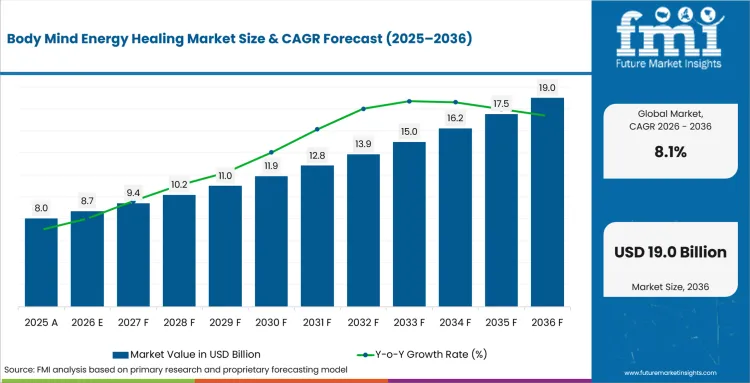
USD 8.7 billion in 2026 and USD 19 billion by 2036 at an 8.1% CAGR.
Demand for body mind energy healing is projected to expand at 8.1% CAGR from 2026 to 2036, increasing valuation from USD 8.7 billion to USD 19 billion. Expansion of accessible practitioner training programs is supporting workforce growth and increasing the availability of body-mind-energy healing services. Healing Touch Program reported in May 2025 that its first three training levels each cost USD 497 and could be completed through live online or in-person instruction. The pricing confirms a commercial education route that adds practitioner capacity without requiring major physical infrastructure.
Commercial durability depends on repeat attendance and clear service boundaries since most practices compete through trust rather than proprietary equipment. Local rules shape how organizations describe sessions and enter institutional wellness programs across different national settings. Ebserh reported in January 2025 that selected federal hospitals in Brazil offered integrative practices including Reiki. The hospital route confirms current service availability but does not prove clinical effectiveness or private consumer spending. Practitioners therefore need accurate claims and transparent credentials before they approach larger wellness centers or institutional programs. Mindfulness meditation applications can widen access through digital booking, but remote delivery requires informed consent and reliable referral routes for clients needing licensed care.
Key Takeaways of Body Mind Energy Healing Market
- Demand depends on consumers purchasing relaxation and reflective wellness sessions without confusing supportive services with diagnosis or medical treatment.
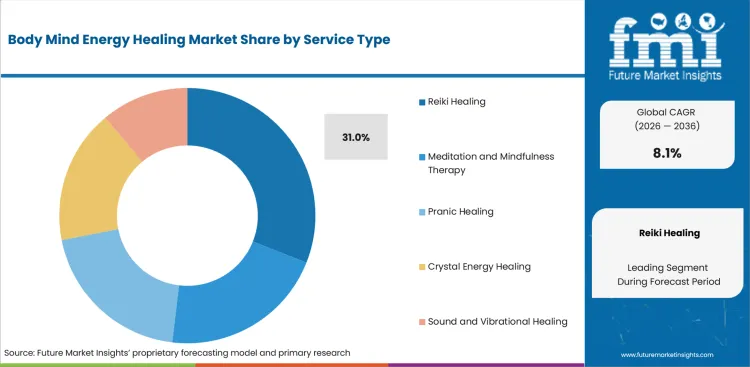
- Reiki healing is expected to account for 31.0% share in 2026, supported by familiar session formats and accessible practitioner education.
- Stress and anxiety management is projected to represent 37.0% share by application in 2026, linked to clear client goals and flexible appointments.
- Wellness centers and holistic clinics are estimated to hold 34.0% share in 2026, underpinned by shared scheduling and cross-referrals.
- Limited clinical evidence and uneven practitioner standards remain material restraints that weaken stronger claims and reduce referral confidence.
- The Reiki Center for Healing Arts, Healing Touch Program, and Brahma Kumaris compete through different mixes of training, guided practice, and digital access.
Analyst Perspective
"Body mind energy healing has a simple entry point, but every commercial model faces a demanding trust test. A durable practice must turn a clearly explained relaxation session into repeat attendance without crossing into diagnosis or promised treatment. Wellness centers can widen access through digital scheduling and group programs that share reception and practitioner oversight. Their strongest advantage comes from consistent practitioner standards and reliable referral routes for clients who need licensed clinical care."
- Rahul Pandita, Principal Analyst, Future Market Insights
How is the Body Mind Energy Healing Market segmented?
The body mind energy healing industry is segmented by service type, application, end user, distribution channel, modality, and region.
The market is segmented by service type, application, end user, distribution channel, modality, and region. Service type separates Reiki from meditation-linked practices and other guided energy approaches presented through paid appointments. Application identifies the client goal, including stress support, pain support, sleep improvement, emotional wellness, or spiritual wellness. End user distinguishes wellness centers, hospitals, individual consumers, employers, and education or research institutions using different approval routes. Distribution channel compares direct appointments with digital platforms, center-based delivery, healthcare partnerships, and retreat or training routes. Modality groups energy healing, mind-body therapy, spiritual healing, vibrational therapy, and integrated holistic therapy according to the method presented. Regional analysis evaluates training access and claims rules that shape commercial entry across each service model. Related yoga and meditation services provide a useful comparison for delivery formats without defining the energy-healing scope.
What supports reiki healing within the service type category?
Reiki uses a familiar one-to-one session structure that lets practitioners explain duration and price before an appointment begins. A report from October 2025 noted that Reiki practitioners often seek Healing Touch Program's standardized five-level curriculum to add structure and professional documentation.The comparison supports practitioner crossover while leaving clinical outcomes and wider commercial acceptance clearly unproven. Training organizations must distinguish course completion from licensed healthcare qualifications during client intake and public promotion.
- Reiki healing is set to lead the service type category with 31.0% share in 2026 due to familiar appointment formats and broad practitioner education. The segment retains its position through clear relaxation language and training records that support more consistent delivery across independent practices. Referral boundaries remain necessary for symptoms requiring licensed clinical assessment rather than another supportive wellness session.
- Independent practitioners and wellness studios favor Reiki because standard sessions require limited physical infrastructure and fit existing appointment schedules. Transparent pricing and documented training can support repeat referrals across community networks and small group programs. Adoption weakens whenever inconsistent practice quality prevents centers from presenting a dependable client experience across several practitioners.
How does stress and anxiety management shape the application category?
Stress-focused sessions present a familiar consumer goal without requiring practitioners to diagnose or treat an anxiety disorder. Brahma Kumaris reported in December 2025 that Awakening TV hosted a full-day program with guided meditation and related reflective content. The broadcast confirms a scalable digital participation route without proving paid demand for every energy-healing modality. Employer-funded corporate wellness solutions require clear program boundaries and qualified escalation procedures that protect participants needing licensed mental health support.
- The stress and anxiety management segment is likely to capture 37.0% share in 2026 attributable to clear client goals and flexible appointment formats. Practitioners protect that position through restrained wellness language and intake records that reveal inappropriate treatment expectations. Complaint documentation and referral procedures help center managers identify cases requiring qualified mental health services.
- Consumers select stress-focused sessions because the intended outcome is understandable and progress can be discussed through perceived calm or sleep routines. Group programs and digital follow-up extend engagement between appointments without presenting the service as clinical treatment. Repeat demand weakens whenever practitioners promise guaranteed outcomes or ignore persistent symptoms requiring qualified mental health care.
Why do wellness centers and holistic clinics lead the end user category?
Wellness centers combine several appointment types within one location and direct clients toward practitioners without changing the booking relationship. Brahma Kumaris reported in December 2025 that a three-day program at its Brahmapur retreat center involved nearly 1,000 participants and training for 150 teachers. The event shows how one center can combine guided practice with teacher development and community programming. Center managers need consistent consent language across resident and visiting practitioners serving the same client base.
- Based on end user, wellness centers and holistic clinics are projected to account for 34.0% in 2026 due to shared scheduling and cross-referrals. Their commercial advantage depends on consistent intake language and documented service boundaries across every resident or visiting practitioner. Shared reception improves utilization without making one teacher or modality responsible for the center’s complete appointment pipeline.
- Wellness centers can place energy-healing sessions beside meditation or breathwork without creating a separate facility or reception process. Related workplace wellness programs can supply employer groups through scheduled sessions and formal referral arrangements. Centers must manage consent and escalation rules across individual and institutional bookings to protect contract continuity and client trust.
How do direct service providers influence distribution channel demand?
Direct providers control the client relationship from initial inquiry through follow-up and therefore carry full responsibility for clear expectations. The Reiki Center for Healing Arts scheduled monthly free Reiki clinics beginning in January 2026 with several practitioners offering short sessions to visitors. The schedule confirms an active center-based service route without proving paid demand or clinical effectiveness. Comparable digital health platforms require similar responsibility for remote screening and complaint handling across direct online services.
- Direct service providers are projected to hold 43.0% share in 2026 owing to personal referrals and low operating overhead. The route retains value through clear session records and cancellation terms that support repeat visits without institutional administration. Consistent disclosure helps independent practitioners preserve trust across booking and follow-up conversations with returning clients.
- Practitioners use direct channels to tailor session length and maintain continuity with returning clients across several appointments. Direct ownership supports rapid scheduling and immediate client feedback without a separate approval layer for every appointment. Unsupported claims can damage the complete revenue base whenever one practitioner handles promotion and delivery together.
What keeps energy healing central within the modality category?
Energy healing groups Reiki and related biofield practices around a service description that clients can recognize before choosing a practitioner. Healing Touch Program reported in August 2025 that ChristianaCare trained nurses and other caregivers through a two-day Level 1 program with 16 continuing education hours. The development demonstrates structured education inside a hospital system while leaving actual treatment effectiveness unproven. Clear consent must preserve complementary positioning throughout every remote or face-to-face session delivered by trained practitioners.
- The modality category is forecast to be led by energy healing at 39.0% share in 2026 due to familiar practitioner language and established training communities. The segment protects its position through precise service descriptions and informed consent that separate personal experience from verified clinical outcomes. Practitioners need consistent screening language across remote and in-person sessions that may attract clients with untreated symptoms.
- Guided sessions can extend through virtual appointments and recorded preparation materials without claiming remote clinical treatment or guaranteed results. Wider digital therapeutics and wellness services provide a useful comparison for digital access that supports education and continued engagement. Practitioners and program managers must preserve individual screening and referral routes across every digital or face-to-face delivery format.
What are the drivers, restraints, and opportunities in Body Mind Energy Healing Market?
Driver: Consumers seek scheduled relaxation and reflective wellness sessions outside formal clinical care. Restraint: Limited clinical evidence restricts treatment claims and referral confidence. Opportunity: Clear credentials and referral boundaries can improve consistency across direct and center-based delivery.
- Driver: Consumers seek accessible sessions that provide structured relaxation and personal reflection outside formal clinical appointments.
- Restraint: Limited clinical substantiation restricts treatment claims and increases complaint exposure across independently delivered services.
- Opportunity: Clear credentials and documented referral boundaries can professionalize delivery without overstating health outcomes or practitioner authority.
Accessible stress-support services support a notable demand route because consumers can book short sessions without joining a clinical treatment program. NCCIH published a consumer guide in May 2025 covering complementary approaches for stress and anxiety alongside sleep problems. The guide confirms public demand for reliable information about non-clinical options without proving energy-healing adoption. Wellness practices convert that interest through transparent session goals and repeat scheduling rather than stronger treatment claims.
Limited clinical substantiation is one of the key restraints because unsupported health claims can trigger complaints and weaken referrals across an entire practice. The UK Advertising Standards Authority stated in April 2025 that it had not seen evidence supporting physical healing claims for Reiki. Commercial marketers making comparable claims must hold robust clinical evidence under the applicable advertising rules. Wellness operators therefore need restrained language and documented referral procedures that protect promotion without implying medical treatment authority.
Professional standards create credible opening for organizations that define eligibility and instruction requirements at enrollment. Healing Touch Program explained in November 2025 that practitioners may offer sessions without certification if they describe their training level accurately. The guidance separates course completion from formal certification and makes credential claims easier for clients to interpret. Related wellness tourism services can use comparable credential disclosure across retreats and destination programs serving unfamiliar participants.
Which country CAGRs are profiled in the Body Mind Energy Healing Market?
| Country | CAGR |
|---|---|
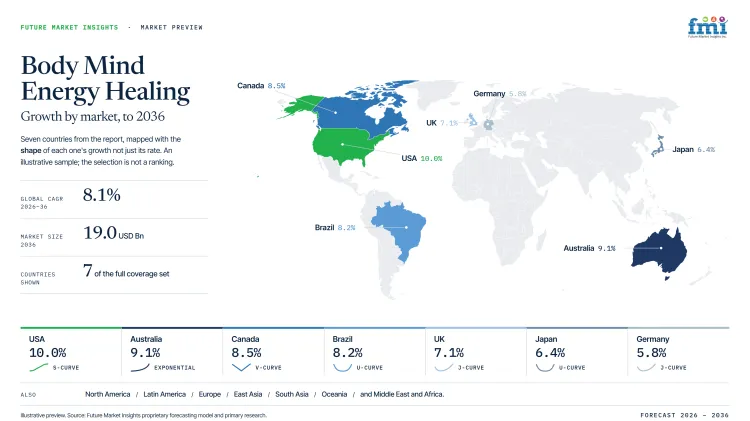
| USA | 10.0% |
| Australia | 9.1% |
| Canada | 8.5% |
| Brazil | 8.2% |
| UK | 7.1% |
| Japan | 6.4% |
| Germany | 5.8% |
How do country-level CAGRs compare in the Body Mind Energy Healing Market?
The country forecasts show a structured progression across the body mind energy healing market, reflecting different levels of consumer engagement with holistic wellness practices and complementary healing approaches. The USA forms a clear upper position, supported by a large wellness economy and broad acceptance of mind-body therapies. Australia, Canada and Brazil create a closely connected middle group where only modest differences separate the forecasts, indicating comparable momentum in energy healing, meditation and integrative wellness services. The UK follows at a noticeable distance from this cluster, while Japan and Germany form a lower pair with limited separation between them. This pattern suggests that market expansion is influenced by cultural acceptance of holistic health practices, practitioner networks and the integration of complementary wellness services into broader self-care routines.
- The USA benefits from a mature wellness ecosystem where energy healing, mindfulness practices and alternative therapeutic services are increasingly incorporated into personal well-being programs.
- Australia reflects strong consumer interest in holistic health approaches, supported by growing participation in meditation, wellness coaching and complementary healing modalities.
- Canada continues to expand through rising awareness of preventive wellness and increasing demand for non-clinical approaches that support mental, emotional and physical well-being.
- Brazil's outlook is influenced by growing interest in spiritual wellness, community-based healing practices and broader adoption of complementary wellness services.
- The UK supports steady market development as consumers increasingly explore integrative wellness solutions alongside conventional health and self-care practices.
- Japan maintains demand through established interest in balance-oriented wellness philosophies, although adoption tends to be shaped by structured and culturally specific approaches to holistic well-being.
- Germany reflects a more measured growth trajectory where expansion is supported by interest in natural health practices, with consumers often placing greater emphasis on evidence-informed wellness approaches.
Similar CAGRs do not necessarily translate into identical market conditions. Differences in cultural attitudes toward complementary therapies, practitioner availability, consumer spending patterns and wellness service delivery models can significantly influence adoption pathways. As a result, businesses may encounter distinct commercialization and customer engagement dynamics despite broadly comparable growth trends. The full report provides country-level CAGR analysis across North America, Latin America, Europe, East Asia, South Asia, Oceania and the Middle East and Africa.
Country-wise Analysis
- Private wellness practices in the USA rely on direct booking and referral networks that support recurring sessions without institutional purchasing. By 2036, the USA body mind energy healing market is projected to grow at 10.0% CAGR, supported by broad practitioner availability and retreat-based delivery. Brahma Kumaris reported in June 2026 that its New York retreat center hosted a Healthy Mind, Healthy Body program and received representatives from the Indian Embassy. The development confirms an active guided-practice route connected with an established retreat facility and organized programming. Fragmented state rules and uneven credential recognition create material commercial frictions for independent practitioner networks. Multi-location practices need visible training records and complaint procedures before adding practitioners across several sites.
- Australia combines metropolitan wellness centers with community retreat programs that require reliable scheduling across long travel distances. Body mind energy healing demand in Australia is forecast to rise at 9.1% CAGR over the forecast period, influenced by established retreat delivery and local instructor networks. Brahma Kumaris reported in June 2026 that its Australian organization co-hosted the Beyond the Mat program with the Indian Consulate and related cultural bodies in Sydney. The partnership confirms an institutional route for guided meditation and wider wellbeing programming across a metropolitan setting. Geographic distance raises delivery costs and weakens instructor continuity outside larger regional population centers nationwide. Blended programs can improve continuity through scheduled in-person instruction and structured remote follow-up between group sessions.
- Canadian wellness operators serve dispersed provincial markets that require clear online information and dependable local referral routes. Body mind energy healing sales in Canada are forecast to expand at 8.5% CAGR by 2036, supported by digital access and institutional wellness routes. Nova Scotia Health reported in May 2025 that its renovated Sunshine Room would offer Reiki through licensed volunteers for patients and family members. The opening confirms current service availability inside a public cancer-care setting without proving paid private demand or clinical effectiveness. Provincial differences in credential recognition and service funding remain material commercial frictions for wider service networks. National operators need consistent consent language and qualified local referrals before remote appointments expand across several provinces.
- Brazil has a defined institutional route for integrative practices through selected public hospitals and employee wellness activities. The Brazil body mind energy healing sector is projected to record 8.2% CAGR during the assessment period, shaped by public familiarity and community access. HC-UFG reported in March 2026 that its Women’s Week program included Reiki among several activities for hospital personnel. The event demonstrates current service availability inside a federal hospital setting without proving paid private adoption. Regional differences in practitioner training and purchasing power create material frictions across commercial delivery outside major centers. Wider expansion requires affordable session formats and a clear separation between public wellbeing activity and private treatment claims.
- UK practitioners operate within an established training environment but advertising rules require a clear separation between wellness support and medical treatment. Adoption of body mind energy healing in the UK is estimated to expand at 7.1% CAGR through 2036, supported by active guided-practice networks and public meditation programs. Brahma Kumaris reported in December 2025 that its UK organization observed UN World Meditation Day through guided participation and digital app access. The development confirms an active national engagement route without establishing paid service demand or verified clinical outcomes. Strong claims oversight creates the central commercial friction for independent practitioners promoting paid wellness sessions. Precise relaxation language and published referral routes protect trust whenever clients require licensed clinical care.
- Japanese delivery favors local-language instruction and dependable scheduling across compact urban markets with high service expectations. In Japan, body mind energy healing demand is predicted to advance at 6.4% CAGR through 2036, linked to local practitioner communities and digital instruction. Brahma Kumaris reported in January 2026 that a dedicated peace meditation program operated through its Hiroshima Peace Meditation Space. The development confirms a current guided-practice route with a local physical setting and community-facing program. Translation quality and consistent follow-up create material commercial frictions for international organizations entering recurring programs. Commercial providers need Japanese consent materials and stable support before introductory participation converts into paid session relationships.
- German consumers compare energy-healing offers with established relaxation methods and structured expectations around instructor qualifications. Germany’s body mind energy healing outlook is anticipated to advance at 5.8% CAGR over the assessment period, supported by paid course delivery and local instructor access. Germany’s federal health portal reported in March 2026 that statutory insurers may reimburse recognized relaxation courses based on course content and instructor qualifications. The guidance does not cover energy healing but it shapes consumer expectations for wellness-course structure and evidence. Unsupported equivalence claims create a material commercial friction for independent practitioners promoting paid wellness sessions. Commercial promotion should define training scope and avoid suggesting that energy-healing sessions qualify for recognized reimbursement routes.
Who are the notable companies in the Body Mind Energy Healing Market?
The Reiki Center for Healing Arts, Healing Touch Program, Institute for Inner Studies, Inc., International Center for Reiki Training, HeartMath, Inc., Brahma Kumaris, The Art of Living Foundation, and Quantum-Touch, Inc. are notable organizations shaping the Body Mind Energy Healing market.
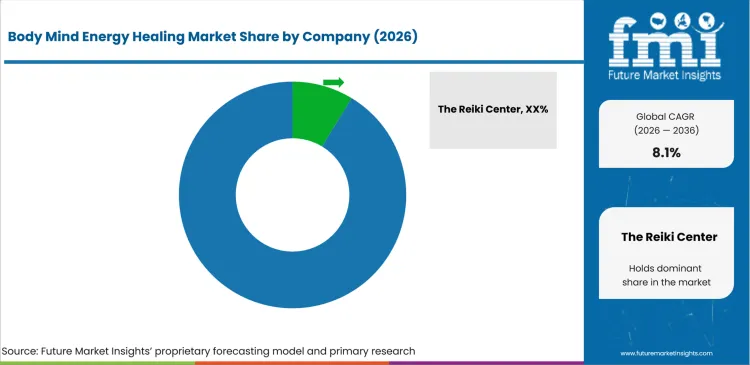
The competitive landscape combines practitioner-training organizations with meditation networks and digital engagement platforms rather than uniform clinical providers. International Center for Reiki Training listed an online Reiki Master class for January 2025 that prepared graduates to teach online and in person. The dated offer confirms a current commercial training route that extends beyond local appointments and local instructor networks. The Reiki Center and Healing Touch Program emphasize structured practitioner education while Quantum-Touch operates scheduled workshop networks. Brahma Kumaris and The Art of Living Foundation use centers and digital programs to widen guided participation. HeartMath combines professional certification with technology-supported instruction while Institute for Inner Studies coordinates recurring online meditation and Pranic Healing programs. Health and fitness products can influence consumer discovery but cannot establish service effectiveness or practitioner quality.
- The Reiki Center for Healing Arts and Healing Touch Program combine direct client services with structured education and professional expectations. Their commercial position depends on consistent practitioner conduct and transparent scope across each center or affiliated instructor. Local supervision supports repeat referrals but creates operating costs that digital-only training models can avoid.
- Institute for Inner Studies and ICRT coordinate multilevel teaching routes across several countries through authorized or licensed instructors. Their networks expand practitioner availability without requiring every organization to operate a local wellness center. Brand control depends on training consistency and clear distinctions between educational credentials and regulated healthcare qualifications.
- HeartMath and the meditation networks combine guided practice with online engagement while Quantum-Touch adds a paid workshop pathway across several languages. Their reach supports recurring participation and instructor development through clearly differentiated service models and enrollment routes. Each organization must prevent promotional language from implying guaranteed treatment outcomes beyond its verified service boundary.
Competitive Benchmarking: Body Mind Energy Healing Market
| Company | Structured Training | Guided Practice | Digital Access | Geographic Reach |
|---|---|---|---|---|
| The Reiki Center for Healing Arts | High | High | Medium | United States |
| Healing Touch Program | High | Medium | High | International |
| Institute for Inner Studies, Inc. | Low | High | High | Global |
| International Center for Reiki Training | High | Medium | High | International |
| HeartMath, Inc. | High | Medium | High | International |
| Brahma Kumaris | Medium | High | High | Global |
| The Art of Living Foundation | Medium | High | High | Global |
| Quantum-Touch, Inc. | High | Medium | High | International |
Key Developments in the Body Mind Energy Healing Market
- In December 2025, Brahma Kumaris launched the Time To Meditate app and portal with guided Rajyoga sessions alongside habit tracking and multilingual access. The release created a direct digital delivery route that supports recurring engagement beyond local meditation centers. Its commercial relevance comes from wider session availability and structured daily participation rather than evidence that guided practice treats a medical condition.
- In August 2025, Healing Touch Program introduced a Fast Track learning path that moves participants through Levels 1 to 3 within an accelerated schedule. The offer created a defined commercial route for students seeking faster progression with live online instruction and guided practice. Its relevance comes from packaging education and support around a clear sequence rather than selling one isolated introductory class.
- In December 2025, The Art of Living Foundation led a global World Meditation Day program that reached 12 million participants through a digital event. The program demonstrated the substantial audience scale available to established meditation networks through coordinated online delivery. Its market relevance lies in audience reach and repeat program visibility rather than proof that every participant purchased a related wellness service.
- In April 2026, Institute for Inner Studies announced a multilingual online WESAK meditation program with a defined global streaming window. The delivery model expanded access beyond local Pranic Healing centers and gave international participants a scheduled digital experience. Its commercial relevance comes from repeatable cross-border engagement and community retention rather than evidence of clinical effectiveness or paid practitioner demand across every participating country.
Key Players in the Body Mind Energy Healing Market
Practitioner Training and Direct Service Organizations
- The Reiki Center for Healing Arts
- Healing Touch Program
- Institute for Inner Studies, Inc.
- International Center for Reiki Training
Guided Practice and Digital Engagement Organizations
- HeartMath, Inc.
- Brahma Kumaris
- The Art of Living Foundation
Specialist Energy Healing Organization
- Quantum-Touch, Inc.
Body Mind Energy Healing Market - Report Scope
| Coverage field | Report scope |
|---|---|
| Market breakdown | Service type, application, end user, distribution channel, modality, and region. |
| Market Definition | Paid Reiki, Healing Touch, pranic healing, energy-oriented meditation, and related guided wellness sessions delivered through clinics, studios, retreats, or digital appointments. |
| Regions Covered | North America, Latin America, Europe, East Asia, South Asia, Oceania, and Middle East and Africa. |
| Countries Covered | USA, Australia, Canada, Brazil, UK, Japan, and Germany. |
| Key Companies Profiled | The Reiki Center for Healing Arts, Healing Touch Program, Institute for Inner Studies, Inc., International Center for Reiki Training, HeartMath, Inc., Brahma Kumaris, The Art of Living Foundation, and Quantum-Touch, Inc. |
| Forecast Period | 2026 to 2036. |
| Approach | Hybrid bottom-up and top-down sizing based on paid service revenue, practitioner capacity, segment structure, and country demand conditions. |
Body Mind Energy Healing Market - Research Methodology
| Method | Approach |
|---|---|
| Primary Research | FMI analysts gathered input from manufacturers, service providers, technology developers, distributors, end users, procurement teams, and subject-matter experts. Interviews examined purchasing decisions, product or service evaluation, adoption barriers, approval requirements, pricing considerations, and expectations for technical or commercial support. Respondents were also asked what evidence is required before a trial, pilot, or initial order develops into regular purchasing. |
| Desk Research | Desk research covered government statistics, regulatory publications, trade data, industry associations, technical literature, standards, company filings, product information, and official corporate announcements. Sources were reviewed for relevance, publication date, geographic coverage, and consistency with the defined market scope. Claims relating to performance, applications, approvals, capacity, investment, and commercial activity were retained only when supported by credible public evidence. |
| Market Sizing and Forecasting | The market model combined the baseline value with historical performance, segment structure, pricing and volume indicators, adoption levels, company participation, and country-level demand conditions. Forecast assumptions considered economic activity, investment trends, regulatory developments, technology adoption, purchasing cycles, supply availability, and barriers to wider market use. Segment and regional estimates were reconciled before the final market total was calculated. |
| Data Validation | Estimates were checked against multiple independent indicators, including public data, company activity, trade patterns, industry developments, and findings from primary interviews. Validation also tested whether products, services, applications, and company revenues fell within the defined market boundaries. Adjacent categories, unsupported claims, overlapping revenues, and activities without direct market relevance were excluded to reduce double counting and maintain consistency across segments and countries. |
Body Mind Energy Healing Market by Segments
Body Mind Energy Healing Market segmented by Service Type:
- Reiki Healing
- Usui Reiki
- Karuna Reiki
- Meditation and Mindfulness Therapy
- Guided Meditation
- Mindfulness-Based Stress Reduction
- Pranic Healing
- Basic Pranic Healing
- Advanced Pranic Healing
- Crystal Energy Healing
- Chakra Crystal Healing
- Crystal Grid Healing
- Sound and Vibrational Healing
- Singing Bowl Therapy
- Tuning Fork Therapy
Body Mind Energy Healing Market segmented by Application:
- Stress and Anxiety Management
- Stress Reduction
- Emotional Wellness
- Pain Management
- Chronic Pain Relief
- Post-Surgical Recovery
- Sleep Improvement
- Insomnia Management
- Sleep Quality Enhancement
- Emotional and Mental Wellness
- Depression Support
- Trauma Recovery
- Spiritual Wellness
- Chakra Balancing
- Energy Alignment
Body Mind Energy Healing Market segmented by End User:
- Wellness Centers and Holistic Clinics
- Holistic Therapy Centers
- Integrative Wellness Clinics
- Hospitals and Integrative Healthcare Providers
- Complementary Medicine Departments
- Rehabilitation Centers
- Individual Consumers
- Home Users
- Personal Wellness Enthusiasts
- Corporate Wellness Programs
- Employee Wellness Programs
- Stress Management Programs
- Educational and Research Institutions
- Universities
- Holistic Health Research Centers
Body Mind Energy Healing Market segmented by Distribution Channel:
- Direct Service Providers
- In-Person Therapy Sessions
- Private Practice Clinics
- Online Wellness Platforms
- Virtual Healing Sessions
- Mobile Wellness Applications
- Wellness Centers
- Holistic Wellness Chains
- Independent Wellness Studios
- Healthcare Partnerships
- Hospital Wellness Programs
- Insurance Wellness Networks
- Retreats and Training Centers
- Wellness Retreats
- Certification Institutes
Body Mind Energy Healing Market segmented by Modality:
- Energy Healing
- Biofield Therapy
- Therapeutic Touch
- Mind-Body Therapy
- Breathwork
- Guided Visualization
- Spiritual Healing
- Chakra Healing
- Aura Cleansing
- Vibrational Therapy
- Sound Therapy
- Color Therapy
- Integrated Holistic Therapy
- Mindfulness and Energy Healing
- Multi-Modality Healing
Body Mind Energy Healing Market by Region:
- North America
- United States
- Canada
- Europe
- Germany
- United Kingdom
- France
- Italy
- Spain
- Asia Pacific
- India
- China
- Japan
- South Korea
- Australia
- Latin America
- Brazil
- Argentina
- Mexico
- Chile
- Middle East & Africa
- UAE
- Saudi Arabia
- South Africa
Research Sources and Bibliography
- Gordon, L. (2025, May 31).
- Empresa Brasileira de Serviços Hospitalares. (2025, January 23).
- Gordon, L. (2025, October 20).
- Brahma Kumaris. (2025, December 21).
- The Reiki Center for Healing Arts. (2026, January 19).
- Healing Touch Program. (2025, August 5).
- National Center for Complementary and Integrative Health. (2025, May).
- Advertising Standards Authority. (2025, April 25).
- Guda, R. (2026, February 11).
- Brahma Kumaris. (2026, June 11).
- Brahma Kumaris. (2026, June 21).
- Nova Scotia Health. (2025, May 8)
- Empresa Brasileira de Serviços Hospitalares. (2026, March 23).
- Brahma Kumaris. (2025, December 7).
- Brahma Kumaris. (2026, January 28).
- Federal Ministry of Health. (2026, March 27).
- Brahma Kumaris. (2025, December 1)
- Healing Touch Program. (2025, August 22).
- Gurudev Sri Sri Ravi Shankar. (2025, December 21).
- Institute for Inner Studies, Inc. (2026, April 28).
- The Reiki Center for Healing Arts. (2026, June 22)
- Gordon, L. (2025, November 3).
- Institute for Inner Studies, Inc. (2026, March 31).
- International Center for Reiki Training. (2026, April 27).
- Brahma Kumaris. (2026, June 18).
- The Art of Living Foundation. (2026, May 22).
- Quantum-Touch, Inc. (2025, October).
- International Center for Reiki Training. (2025, January 31).
This bibliography is provided for reader reference and is not exhaustive. The full report contains the complete reference list and detailed citations.
This Report Answers
- How large is the Body Mind Energy Healing market in 2026 and 2036?
- Which consumer needs support paid energy-healing and guided wellness sessions?
- Why does Reiki Healing account for the largest Service Type share in 2026?
- How do wellness centers convert several practices into repeat client relationships?
- What claims and practitioner-quality issues restrain wider commercial acceptance?
- How do country growth conditions differ across the seven profiled markets?
- Which organizations provide training, guided practice, digital access, or research support?
- How should operators evaluate credentials and complaint handling before expansion?
- What digital and retreat models can widen access without weakening service boundaries?
Frequently Asked Questions
How big is the Body Mind Energy Healing Market in 2026?
The body mind energy healing market is valued at USD 8.7 billion in 2026 and is forecast to reach USD 19.0 billion by 2036, reflecting growing consumer demand for structured relaxation and reflective wellness sessions delivered through practitioners, wellness centers, and digital platforms outside formal clinical care.
What is the CAGR of the Body Mind Energy Healing Market from 2026 to 2036?
The body mind energy healing market is projected to grow at a CAGR of 8.1% between 2026 and 2036, supported by accessible practitioner training programs that expand workforce capacity and increasing consumer interest in stress-support sessions that provide structured relaxation without requiring clinical appointments.
Which application leads the Body Mind Energy Healing Market?
Stress and anxiety management accounts for 37.0% of the body mind energy healing market by application in 2026, driven by clear client goals and flexible appointment formats that allow practitioners to present understandable session outcomes without crossing into clinical diagnosis or guaranteed treatment claims.
Which country is growing fastest in the Body Mind Energy Healing Market?
The body mind energy healing market in the USA is projected to expand at a CAGR of 10.0% through 2036, ahead of Australia at 9.1%, Canada at 8.5%, Brazil at 8.2%, the UK at 7.1%, Japan at 6.4%, and Germany at 5.8%, reflecting a mature wellness ecosystem with broad practitioner availability and wide consumer acceptance of mind-body therapies.
Who are the leading companies in the Body Mind Energy Healing Market?
Leading organizations in the body mind energy healing market include The Reiki Center for Healing Arts, Healing Touch Program, Institute for Inner Studies Inc., International Center for Reiki Training, HeartMath Inc., Brahma Kumaris, The Art of Living Foundation, and Quantum-Touch Inc., spanning structured practitioner training, guided practice networks, and digital engagement platforms across global wellness markets.
Preview the report firsthand - request a free sample
Get SampleGet the brochure for pricing and purchase details.
Get PDFTable of Content
- Key Takeaways
- Market Size and CAGR
- Top Growth Driver
- Fastest Growing Segment
- Leading Region
- Key Companies
- Emerging Opportunities
- Executive Summary
- Global Market Outlook
- Demand-side Trends
- Supply-side Trends
- Technology Roadmap Analysis
- Analysis and Recommendations
- Analyst Perspective (What is happening? Why now? What should investors know?)
- Key Questions Answered
- How large is the market?
- What is the CAGR?
- What are key trends?
- Which region dominates?
- Who are the leaders?
- Market Overview
- Market Coverage / Taxonomy
- Market Definition / Scope / Limitations
- Research Methodology
- Chapter Orientation
- Analytical Lens and Working Hypotheses
- Market Structure, Signals, and Trend Drivers
- Benchmarking and Cross-market Comparability
- Market Sizing, Forecasting, and Opportunity Mapping
- Research Design and Evidence Framework
- Desk Research Programme (Secondary Evidence)
- Expert Input and Fieldwork (Primary Evidence)
- Tooling, Models, and Reference Databases
- Data Engineering and Model Build
- Quality Assurance and Audit Trail
- Market Background
- Market Dynamics (Drivers, Restraints, Opportunity, Trends)
- Scenario Forecast (Optimistic, Likely, Conservative)
- Impact Analysis
- AI Impact
- Sustainability Impact
- Regulatory Impact
- Technology Impact
- Consumer / Buyer Analysis
- Purchase Drivers
- Adoption Barriers
- Buyer Journey
- Opportunity Map Analysis
- Product Life Cycle Analysis
- Supply Chain Analysis
- Investment Feasibility Matrix
- Value Chain Analysis
- PESTLE and Porter's Analysis
- Regulatory Landscape
- Regional Parent Market Outlook
- Production and Consumption Statistics
- Import and Export Statistics
- Global Market Analysis and Forecast, 2021 to 2036
- Historical Market Size Value (USD Billion) Analysis, 2021 to 2025
- Current and Future Market Size Value (USD Billion) Projections, 2026 to 2036
- Y-o-Y Growth Trend Analysis
- Absolute $ Opportunity Analysis
- Global Market Pricing Analysis, 2021 to 2036
- Global Market Analysis and Forecast, By Service Type, 2021 to 2036
- Introduction / Key Findings
- Historical Market Size Value (USD Billion) Analysis By Service Type, 2021 to 2025
- Current and Future Market Size Value (USD Billion) Analysis and Forecast By Service Type, 2026 to 2036
- Reiki Healing
- Usui Reiki
- Karuna Reiki
- Meditation and Mindfulness Therapy
- Guided Meditation
- Mindfulness-Based Stress Reduction
- Pranic Healing
- Basic Pranic Healing
- Advanced Pranic Healing
- Crystal Energy Healing
- Chakra Crystal Healing
- Crystal Grid Healing
- Sound and Vibrational Healing
- Singing Bowl Therapy
- Tuning Fork Therapy
- Reiki Healing
- Y-o-Y Growth Trend Analysis By Service Type, 2021 to 2025
- Absolute $ Opportunity Analysis By Service Type, 2026 to 2036
- Global Market Analysis and Forecast, By Application, 2021 to 2036
- Introduction / Key Findings
- Historical Market Size Value (USD Billion) Analysis By Application, 2021 to 2025
- Current and Future Market Size Value (USD Billion) Analysis and Forecast By Application, 2026 to 2036
- Stress and Anxiety Management
- Stress Reduction
- Emotional Wellness
- Pain Management
- Chronic Pain Relief
- Post-Surgical Recovery
- Sleep Improvement
- Insomnia Management
- Sleep Quality Enhancement
- Emotional and Mental Wellness
- Depression Support
- Trauma Recovery
- Spiritual Wellness
- Chakra Balancing
- Energy Alignment
- Stress and Anxiety Management
- Y-o-Y Growth Trend Analysis By Application, 2021 to 2025
- Absolute $ Opportunity Analysis By Application, 2026 to 2036
- Global Market Analysis and Forecast, By End User, 2021 to 2036
- Introduction / Key Findings
- Historical Market Size Value (USD Billion) Analysis By End User, 2021 to 2025
- Current and Future Market Size Value (USD Billion) Analysis and Forecast By End User, 2026 to 2036
- Wellness Centers and Holistic Clinics
- Holistic Therapy Centers
- Integrative Wellness Clinics
- Hospitals and Integrative Healthcare Providers
- Complementary Medicine Departments
- Rehabilitation Centers
- Individual Consumers
- Home Users
- Personal Wellness Enthusiasts
- Corporate Wellness Programs
- Employee Wellness Programs
- Stress Management Programs
- Educational and Research Institutions
- Universities
- Holistic Health Research Centers
- Wellness Centers and Holistic Clinics
- Y-o-Y Growth Trend Analysis By End User, 2021 to 2025
- Absolute $ Opportunity Analysis By End User, 2026 to 2036
- Global Market Analysis and Forecast, By Distribution Channel, 2021 to 2036
- Introduction / Key Findings
- Historical Market Size Value (USD Billion) Analysis By Distribution Channel, 2021 to 2025
- Current and Future Market Size Value (USD Billion) Analysis and Forecast By Distribution Channel, 2026 to 2036
- Direct Service Providers
- In-Person Therapy Sessions
- Private Practice Clinics
- Online Wellness Platforms
- Virtual Healing Sessions
- Mobile Wellness Applications
- Wellness Centers
- Holistic Wellness Chains
- Independent Wellness Studios
- Healthcare Partnerships
- Hospital Wellness Programs
- Insurance Wellness Networks
- Retreats and Training Centers
- Wellness Retreats
- Certification Institutes
- Direct Service Providers
- Y-o-Y Growth Trend Analysis By Distribution Channel, 2021 to 2025
- Absolute $ Opportunity Analysis By Distribution Channel, 2026 to 2036
- Global Market Analysis and Forecast, By Modality, 2021 to 2036
- Introduction / Key Findings
- Historical Market Size Value (USD Billion) Analysis By Modality, 2021 to 2025
- Current and Future Market Size Value (USD Billion) Analysis and Forecast By Modality, 2026 to 2036
- Energy Healing
- Biofield Therapy
- Therapeutic Touch
- Mind-Body Therapy
- Breathwork
- Guided Visualization
- Spiritual Healing
- Chakra Healing
- Aura Cleansing
- Vibrational Therapy
- Sound Therapy
- Color Therapy
- Integrated Holistic Therapy
- Mindfulness and Energy Healing
- Multi-Modality Healing
- Energy Healing
- Y-o-Y Growth Trend Analysis By Modality, 2021 to 2025
- Absolute $ Opportunity Analysis By Modality, 2026 to 2036
- Global Market Analysis and Forecast, By Region, 2021 to 2036
- Introduction
- Historical Market Size Value (USD Billion) Analysis By Region, 2021 to 2025
- Current Market Size Value (USD Billion) Analysis and Forecast By Region, 2026 to 2036
- North America
- Latin America
- Western Europe
- Eastern Europe
- East Asia
- South Asia and Pacific
- Middle East & Africa
- Market Attractiveness Analysis By Region
- North America Market Analysis and Forecast, By Country, 2021 to 2036
- Historical Market Size Value (USD Billion) Trend Analysis By Market Taxonomy, 2021 to 2025
- Market Size Value (USD Billion) Forecast By Market Taxonomy, 2026 to 2036
- By Country
- USA
- Canada
- By Service Type
- By Application
- By End User
- By Distribution Channel
- By Modality
- By Country
- Market Attractiveness Analysis
- By Country
- By Service Type
- By Application
- By End User
- By Distribution Channel
- By Modality
- Key Takeaways
- Latin America Market Analysis and Forecast, By Country
- Historical Market Size Value (USD Billion) Trend Analysis By Market Taxonomy, 2021 to 2025
- Market Size Value (USD Billion) Forecast By Market Taxonomy, 2026 to 2036
- By Country
- Brazil
- Mexico
- Chile
- Rest of Latin America
- By Service Type
- By Application
- By End User
- By Distribution Channel
- By Modality
- By Country
- Market Attractiveness Analysis
- By Country
- By Service Type
- By Application
- By End User
- By Distribution Channel
- By Modality
- Key Takeaways
- Western Europe Market Analysis and Forecast, By Country
- Historical Market Size Value (USD Billion) Trend Analysis By Market Taxonomy, 2021 to 2025
- Market Size Value (USD Billion) Forecast By Market Taxonomy, 2026 to 2036
- By Country
- Germany
- UK
- Italy
- Spain
- France
- Nordic
- BENELUX
- Rest of Western Europe
- By Service Type
- By Application
- By End User
- By Distribution Channel
- By Modality
- By Country
- Market Attractiveness Analysis
- By Country
- By Service Type
- By Application
- By End User
- By Distribution Channel
- By Modality
- Key Takeaways
- Eastern Europe Market Analysis and Forecast, By Country
- Historical Market Size Value (USD Billion) Trend Analysis By Market Taxonomy, 2021 to 2025
- Market Size Value (USD Billion) Forecast By Market Taxonomy, 2026 to 2036
- By Country
- Russia
- Poland
- Hungary
- Balkan & Baltic
- Rest of Eastern Europe
- By Service Type
- By Application
- By End User
- By Distribution Channel
- By Modality
- By Country
- Market Attractiveness Analysis
- By Country
- By Service Type
- By Application
- By End User
- By Distribution Channel
- By Modality
- Key Takeaways
- East Asia Market Analysis and Forecast, By Country
- Historical Market Size Value (USD Billion) Trend Analysis By Market Taxonomy, 2021 to 2025
- Market Size Value (USD Billion) Forecast By Market Taxonomy, 2026 to 2036
- By Country
- China
- Japan
- South Korea
- By Service Type
- By Application
- By End User
- By Distribution Channel
- By Modality
- By Country
- Market Attractiveness Analysis
- By Country
- By Service Type
- By Application
- By End User
- By Distribution Channel
- By Modality
- Key Takeaways
- South Asia and Pacific Market Analysis and Forecast, By Country
- Historical Market Size Value (USD Billion) Trend Analysis By Market Taxonomy, 2021 to 2025
- Market Size Value (USD Billion) Forecast By Market Taxonomy, 2026 to 2036
- By Country
- India
- ASEAN
- Australia & New Zealand
- Rest of South Asia and Pacific
- By Service Type
- By Application
- By End User
- By Distribution Channel
- By Modality
- By Country
- Market Attractiveness Analysis
- By Country
- By Service Type
- By Application
- By End User
- By Distribution Channel
- By Modality
- Key Takeaways
- Middle East & Africa Market Analysis and Forecast, By Country
- Historical Market Size Value (USD Billion) Trend Analysis By Market Taxonomy, 2021 to 2025
- Market Size Value (USD Billion) Forecast By Market Taxonomy, 2026 to 2036
- By Country
- Kingdom of Saudi Arabia
- Other GCC Countries
- Türkiye
- South Africa
- Other African Union
- Rest of Middle East & Africa
- By Service Type
- By Application
- By End User
- By Distribution Channel
- By Modality
- By Country
- Market Attractiveness Analysis
- By Country
- By Service Type
- By Application
- By End User
- By Distribution Channel
- By Modality
- Key Takeaways
- Key Countries Market Analysis
- USA
- Pricing Analysis
- Market Share Analysis, 2025
- By Service Type
- By Application
- By End User
- By Distribution Channel
- By Modality
- Canada
- Pricing Analysis
- Market Share Analysis, 2025
- By Service Type
- By Application
- By End User
- By Distribution Channel
- By Modality
- Mexico
- Pricing Analysis
- Market Share Analysis, 2025
- By Service Type
- By Application
- By End User
- By Distribution Channel
- By Modality
- Brazil
- Pricing Analysis
- Market Share Analysis, 2025
- By Service Type
- By Application
- By End User
- By Distribution Channel
- By Modality
- Chile
- Pricing Analysis
- Market Share Analysis, 2025
- By Service Type
- By Application
- By End User
- By Distribution Channel
- By Modality
- Germany
- Pricing Analysis
- Market Share Analysis, 2025
- By Service Type
- By Application
- By End User
- By Distribution Channel
- By Modality
- UK
- Pricing Analysis
- Market Share Analysis, 2025
- By Service Type
- By Application
- By End User
- By Distribution Channel
- By Modality
- Italy
- Pricing Analysis
- Market Share Analysis, 2025
- By Service Type
- By Application
- By End User
- By Distribution Channel
- By Modality
- Spain
- Pricing Analysis
- Market Share Analysis, 2025
- By Service Type
- By Application
- By End User
- By Distribution Channel
- By Modality
- France
- Pricing Analysis
- Market Share Analysis, 2025
- By Service Type
- By Application
- By End User
- By Distribution Channel
- By Modality
- India
- Pricing Analysis
- Market Share Analysis, 2025
- By Service Type
- By Application
- By End User
- By Distribution Channel
- By Modality
- ASEAN
- Pricing Analysis
- Market Share Analysis, 2025
- By Service Type
- By Application
- By End User
- By Distribution Channel
- By Modality
- Australia & New Zealand
- Pricing Analysis
- Market Share Analysis, 2025
- By Service Type
- By Application
- By End User
- By Distribution Channel
- By Modality
- China
- Pricing Analysis
- Market Share Analysis, 2025
- By Service Type
- By Application
- By End User
- By Distribution Channel
- By Modality
- Japan
- Pricing Analysis
- Market Share Analysis, 2025
- By Service Type
- By Application
- By End User
- By Distribution Channel
- By Modality
- South Korea
- Pricing Analysis
- Market Share Analysis, 2025
- By Service Type
- By Application
- By End User
- By Distribution Channel
- By Modality
- Russia
- Pricing Analysis
- Market Share Analysis, 2025
- By Service Type
- By Application
- By End User
- By Distribution Channel
- By Modality
- Poland
- Pricing Analysis
- Market Share Analysis, 2025
- By Service Type
- By Application
- By End User
- By Distribution Channel
- By Modality
- Hungary
- Pricing Analysis
- Market Share Analysis, 2025
- By Service Type
- By Application
- By End User
- By Distribution Channel
- By Modality
- Kingdom of Saudi Arabia
- Pricing Analysis
- Market Share Analysis, 2025
- By Service Type
- By Application
- By End User
- By Distribution Channel
- By Modality
- Türkiye
- Pricing Analysis
- Market Share Analysis, 2025
- By Service Type
- By Application
- By End User
- By Distribution Channel
- By Modality
- South Africa
- Pricing Analysis
- Market Share Analysis, 2025
- By Service Type
- By Application
- By End User
- By Distribution Channel
- By Modality
- USA
- Market Structure Analysis
- Competition Dashboard
- Competition Benchmarking
- Market Share Analysis of Top Players
- By Regional
- By Service Type
- By Application
- By End User
- By Distribution Channel
- By Modality
- Emerging Startups
- Innovation Benchmarking
- Competition Analysis
- Competition Deep Dive
- The Reiki Center
- Overview
- Product Portfolio
- Profitability by Market Segments
- Sales Footprint
- Strategy Overview
- Marketing Strategy
- Product Strategy
- Channel Strategy
- Healing Touch Program
- Pranic Healing Foundation
- International Center for Reiki Training
- HeartMath
- Brahma Kumaris
- Art of Living Foundation
- Institute of Noetic Sciences
- Energy Medicine Institute
- Quantum-Touch
- The Reiki Center
- Case Studies
- Success Stories
- Recent Developments
- Competition Deep Dive
- Assumptions & Acronyms Used


