

- Market Size (2026)
- USD 805.9 Mn
- Forecast (2036)
- USD 1541.4 Mn
- CAGR (2026 to 2036)
- 6.7%
How big is Body Oils Market in 2026?
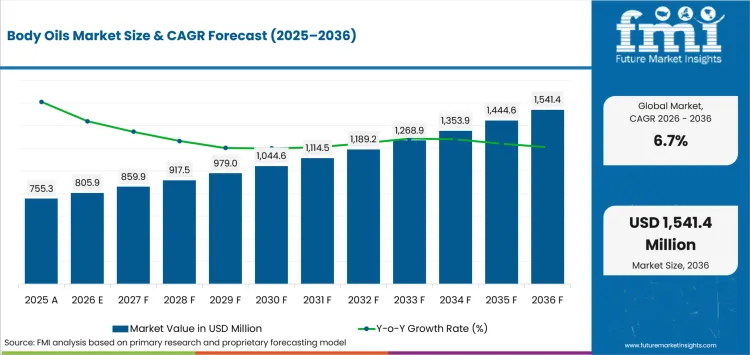
USD 805.9 million in 2026 and USD 1,541.4 million by 2036 at a 6.7% CAGR.
Demand for body oils is projected to expand at 6.7% CAGR between 2026 and 2036, increasing valuation from USD 805.9 million in 2026 to USD 1,541.4 million by 2036. Product innovation remains important because repeat purchases depend on visible skincare benefits rather than fragrance alone. Beiersdorf said in March 2026 that NIVEA would allocate investment more evenly among face care, body care and deodorants. The wider body-care allocation gives cosmetic oils a larger innovation budget, but skincare oils still need fast absorption and clear treatment value to earn repeat purchase.
UAE and Saudi Arabia are forecast to outpace France as Gulf beauty retail turns new body-care concepts over quickly once registration clears. Dubai Municipality reported in October 2025 that nearly 13,000 establishments traded cosmetics and consumer products in Dubai. The retail base gives registered products a dense network for controlled trial, but laboratory work and local labeling make wide early fragrance assortments expensive.
Key Takeaways of Body Oils Market
- Treatment-led body care is widening use beyond basic moisturization as lighter oil serums fit radiance, massage and post-shower routines.
- Based on product type, core - classic lines are projected to account for 35.0% in 2026 because familiar moisturization requires little consumer retraining.
- By nature, conventional formulas are estimated to hold 47.0% in 2026 owing to flexible ingredient selection and broad price coverage.
- Liquid & serum formats are set to lead the format category with 27.0% share in 2026 due to fluid dosing that suits treatment and massage.
- Heavy residue and fragrance-sensitive labeling requirements can reduce repeat use or force costly reformulation during a wider country rollout.
- Some of the key players in this market include Beiersdorf, Amorepacific, L'Oreal, Kao Corporation, Shiseido, e.l.f. Beauty, Procter & Gamble, and Unilever.
Analyst Perspective
"Body oils earn repeat purchase through clean absorption that fits daily dressing and treatment claims that stay credible after the first use. The stronger commercial offer pairs a light finish with one clear skin benefit, then limits fragrance variants until local claims and safety files are settled."
- Rahul Pandita, Principal Consultant, Future Market Insights
How is the Body Oils Market segmented?
The market is segmented by Product Type, Nature, Format, Price Positioning and Sales Channel.
Product type covers core - classic lines, targeted treatment lines, sensitive & gentle lines, premium & clinical lines and kits & sets. Nature covers conventional, vegan & cruelty-free, natural & organic, dermocosmetic / clinical and fragrance-free & sensitive formulas. Format includes liquid & serum, cream & balm, stick & solid, spray & mist, sheet & patch and powder. Price positioning spans mass, masstige, premium and professional. Sales channels include specialty beauty retail, e-commerce & DTC, pharmacies & drugstores, supermarkets & hypermarkets and salons & spas.
What makes Core - classic lines central to the Product type category?
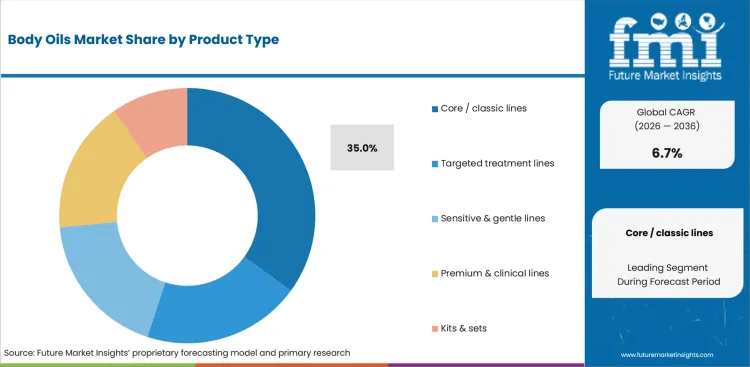
Core - classic lines answer routine dry-skin care without asking consumers to learn a new application method or accept a narrow treatment claim. Retailers can place them beside lotions and washes, which makes the format easier to trial and replenish within familiar body-care routines.
- Based on product type, core - classic lines are projected to account for 35.0% in 2026 because simple moisturization keeps the eligible user base broad.
- In July 2026, Unilever described how Vaseline converts scientifically reviewed consumer hacks into products and partnerships. The program gives an established body-care brand a way to test routine behavior and limit development spending on unproven formats.
How do Formulators evaluate conventional products within the Nature category?
Conventional formulas give formulators wider control over emollients and fragrance than narrower certification-led propositions in personal care products. Natural cosmetics can strengthen ingredient positioning, but conventional lines retain more room to adjust residue and price after early trials.
- By nature, conventional formulas are estimated to hold 47.0% in 2026 owing to flexible ingredient selection and broader price architecture.
- During 2025, Beiersdorf developed a new NIVEA Body Creme formula with a 72-hour moisture claim for local markets. The work shows how a scaled body-care platform can change formula performance without limiting the line to one certification claim.
What drives Liquid & serum formats within the Format category?
Liquid & serum formats spread quickly and let users control dosing after a shower or during massage. Their lighter treatment language also resembles healing skin care products that compete on comfort and targeted skin concerns without heavy occlusion.
- In 2026, liquid & serum formats are expected to lead the format category with 27.0% share driven by spreadability and controlled dosing.
- L'Oreal stated in July 2026 that NYX Professional Makeup launched its Fat Oil Body Collection and entered body care and fragrance. The launch gives fluid oil formats a direct route from familiar makeup branding into routine body-care use.
How does Mass pricing shape selection within the Price positioning category?
Mass pricing lowers the trial barrier for consumers who already own lotion and remain unsure about oil texture. Stick-based body lotions face the same switching test since convenience must justify a new format without demanding a large premium.
- By price positioning, mass products are forecast to represent 33.0% in 2026 due to accessible pricing that supports trial in broad retail.
- During 2025, Beiersdorf's India R&D team further developed NIVEA Body SUPER 10 Vitamins Serum for Southeast Asian consumers. The program shows how a scaled body-care platform can localize treatment claims without pushing the offer beyond an accessible brand system.
What are the drivers, restraints and opportunities in the Body Oils Market?
Treatment-led routines widen demand, but residue and documentation slow repeat purchase as lightweight oil serums provide a route into texture-sensitive body care.
- Driver: Body oils gain more use occasions as brands pair moisturization with radiance, massage and post-shower treatment cues.
- Restraint: Persistent residue and incomplete cosmetic documentation can delay launches and weaken repeat purchase following trial of richer formulas.
- Opportunity: Fast-absorbing oil serums can recruit lotion users who want treatment benefits without the heavy finish associated with traditional oils.
Tactile Trial Converts Texture Uncertainty
Specialty trial reduces uncertainty about oil texture at a first body-oil purchase, particularly for shoppers comparing absorption against familiar lotions. In October 2025, e.l.f. Beauty opened Naturium's first Los Angeles pop-up with interactive testing of Glow Getter Multi-Oil Body Wash. Organic personal care brands face the same trial barrier, so body-oil merchandising gains more from tactile proof of absorption than from ingredient claims alone.
Documentation Quality Can Reset Launch Economics
European launches become expensive once artwork and fragrance decisions have already been fixed for multiple country packs. France's DGCCRF examined 147 cosmetics establishments in February 2026 and found widespread product-file gaps among newer operators. Personal care ingredients need claims and safety records settled early since late corrections multiply packaging work for every scented variant during planned multi-country retail rollout programs.
Treatment Language Extends Oil-Serum Relevance
Light oil-serum textures reach body-care users who reject the heavy finish of traditional oils and want treatment-led moisturization. Procter & Gamble launched Olay Super Serum Body Wash in February 2025 to transfer facial-serum ingredients and treatment language into daily body care. Sensitive-skin body lotions already compete on similar comfort cues, so body oils need faster absorption for serum language to earn repeat purchase.
Which country CAGRs are profiled in the Body Oils Market?
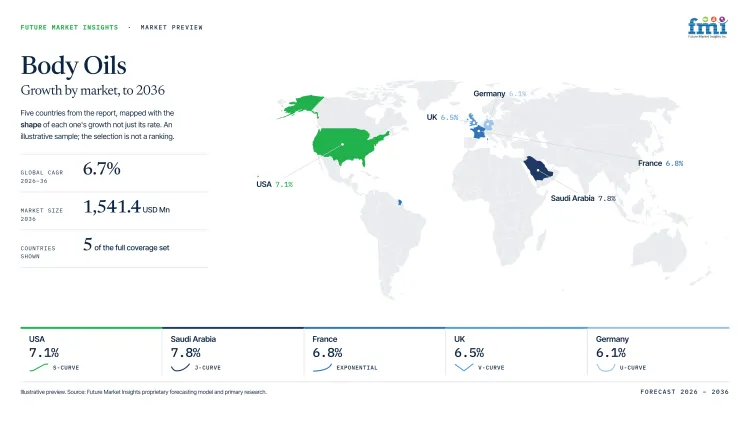
| Country | CAGR |
|---|---|
| Saudi Arabia | 7.8% |
| USA | 7.1% |
| France | 6.8% |
| UK | 6.5% |
| Germany | 6.1% |
How do country-level CAGRs compare in the Body Oils Market?
Profiled CAGRs span 1.7 percentage points, from Saudi Arabia at 7.8% to Germany at 6.1%. Saudi Arabia and USA form the upper band owing to fragrance-led routines and seasonal retail activity. France and UK follow through selective and pharmacy-adjacent body-care demand, while Germany remains lower amid tighter product documentation.
- Saudi Arabia links body oils naturally with fragrance shopping and premium gifting rituals.
- USA seasonal retail resets remove slow-moving fragrances quickly from national body-care assortments.
- France gives pharmacy-adjacent body care added credibility for fragrance-sensitive formulas in selective retail.
- UK benefits from premium body-care discovery across specialty beauty and fragrance-led retail channels.
- Germany emphasizes documented formulations and established retail standards, moderating category growth.
Similar CAGRs conceal different trial costs and repeat-purchase barriers for body-oil lines. The full report provides country-level CAGR analysis across North America, Latin America, Europe, East Asia, South Asia, Oceania and the Middle East and Africa.
Country-wise Analysis
- Saudi body-care shelves place scented oils beside fragrance and bath products in malls and digital storefronts, giving the format a familiar ritual setting without requiring brands to explain a separate treatment routine. The SFDA's March 2025 notification service now displays more than one million listed cosmetic products, which makes disciplined SKU selection important since each fragrance variant carries its own notification and pack-control work. Saudi Arabia is estimated to post 7.8% CAGR over the forecast period given premium beauty demand and wider retail reach even as large early assortments increase compliance work until repeat purchase proves which scented variants deserve national distribution.
- US specialty chains and digital retailers expose body-oil variants to national demand quickly, giving brands broad trial reach without guaranteeing that heavier textures or fringe fragrances survive later assortment decisions. FDA data for June 30 2026 counted 16,398 active cosmetic facility registrations under MoCRA and confirm the scale of registration work facing companies that expand leave-on body-care lines in national channels. The USA body oils sector is projected to record 7.1% CAGR during the assessment period attributable to omnichannel discovery even as repeat purchase depends on fast absorption and claim discipline rather than shelf reach alone at national scale.
- French body-oil launches face a documentation-heavy route to wider retail expansion, so brands need product information files and claims support settled as a sensorial concept progresses from selective trial to scale. France's body oils outlook is anticipated to advance at 6.8% CAGR over the assessment period owing to premium body-care routines that give differentiated textures room in selective beauty channels. DGCCRF found in February 2026 that only 26 of 147 reviewed operators could present complete or nearly complete product files, evidence that dossier gaps can quickly erase a retailer's speed advantage before a new fragrance line reaches national scale.
- UK specialty beauty retailers and department stores give body-oil brands access to consumers seeking premium textures, seasonal gifting formats, and fragrance-oriented routines, while online channels broaden discovery beyond established chains. The UK body oils sector is projected to record a 6.5% CAGR during the assessment period, supported by premiumization and expanding self-care routines, although sustained demand depends on texture performance, fragrance acceptance, and clear product positioning. Retailers increasingly favor differentiated body-care concepts that can demonstrate repeat-purchase potential, making sensory appeal and accessible pricing important as brands move from limited launches toward broader national distribution across competitive beauty channels.
- German body-oil brands operate within a quality-conscious market where consumers place strong emphasis on formulation transparency, product performance, and established retail credibility. The Germany body oils sector is projected to record a 6.1% CAGR during the assessment period, supported by demand for premium personal-care routines and functional body treatments, while growth remains moderated by careful purchasing and stringent market expectations. Pharmacies, specialty retailers, and established beauty channels provide credible routes for differentiated formulas, but brands must maintain robust documentation, compliant claims, and consistent product quality as sensorial innovations progress from niche offerings toward wider distribution across Germany's structured personal-care market.
Who are the notable companies in the Body Oils Market?
Beiersdorf, Amorepacific, L'Oreal, Kao Corporation, Shiseido, e.l.f. Beauty, Procter & Gamble, and Unilever are the notable companies serving this market.
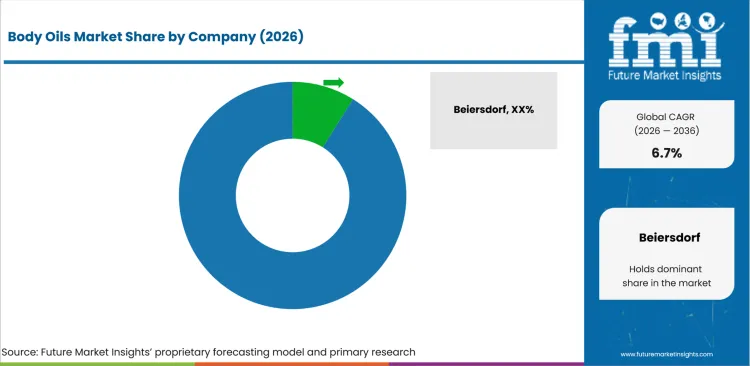
Competition separates scaled personal-care groups from beauty companies that use treatment or ritual cues to justify oil formats. Shelf access cannot compensate for a persistent film that discourages repeat body-oil use. Soothing skin care sets the same comfort expectation for fragrance-sensitive users.
- Beiersdorf, Kao Corporation, Procter & Gamble and Unilever operate large body-care platforms with broad mass or pharmacy distribution.
- L'Oreal and Shiseido bring treatment science plus prestige beauty routes that give oil-serum concepts room to carry higher-value claims and service rituals.
- Amorepacific and e.l.f. Beauty rely on sensitive-skin positioning or digital-first education to make newer body-care formats easier to discover and trial.
Competitive Benchmarking: Body Oils Market
| Company | Oil-led Body Product Evidence | Sensitive or Treatment Architecture | Specialty & Digital Channel Execution | Geographic Reach |
|---|---|---|---|---|
| Beiersdorf | Medium | High | Medium | Global |
| Amorepacific | Medium | Medium | Medium | East Asia and selected global beauty channels |
| L'Oreal | High | High | High | Global |
| Kao Corporation | High | High | Medium | Asia, Europe and Americas |
| Shiseido | High | High | Medium | Global prestige channels with strong Asia presence |
| e.l.f. Beauty | High | Medium | High | North America with expanding international retail |
| Procter & Gamble | High | High | High | Global |
| Unilever | Medium | Medium | High | Global |
Scoring basis: High oil-led body evidence requires a dated 2025+ official action involving a body oil or oil serum. Medium oil evidence requires a dated adjacent body-care action and Low identifies a narrower documented route. High treatment architecture requires several current skin-concern routes. Medium denotes one current route and Low indicates limited documented depth. High channel execution requires specialist plus digital reach. Medium denotes one strong route and Low identifies narrow access. Geographic reach records only regions supported by current corporate or distribution evidence.
Key Developments in the Body Oils Market
- In August 2026, Procter & Gamble launched Olay Enrich Boosting Body Oil as the final leave-on step in its revamped Repair Serum body-care routine.
- In July 2026, Kao Corporation announced Curél Moist Barrier Oil Serum for dry sensitive skin with a September launch in Japan and later international rollout.
- In February 2026, Shiseido announced THE GINZA Spa Retreat at Capella Kyoto with full-body treatments using THE GINZA oil serum from March.
Key Players in the Body Oils Market
Scaled skin and body-care platforms
- Beiersdorf
- Amorepacific
Treatment and prestige beauty portfolios
- L'Oreal
- Kao Corporation
- Shiseido
Broad retail and digital body-care reach
- e.l.f. Beauty
- Procter & Gamble
- Unilever
Body Oils Market - Report Scope
| Coverage field | Report scope |
|---|---|
| Market breakdown | By product type, nature, format, price positioning, sales channel and region. |
| Quantitative Units | USD Million. |
| Market Definition | Finished leave-on body oils and oil-serum formats used for moisturization, treatment, radiance, fragrance layering or massage. Face-only oils, hair oils, raw bulk oils and spa-service revenue are excluded. |
| Regions Covered | North America, Latin America, Europe, East Asia, South Asia and Pacific and Middle East and Africa. |
| Countries Covered | UAE, Saudi Arabia, South Korea, USA, France, and 20+ countries included in the full report. |
| Key Companies Profiled | Beiersdorf, Amorepacific, L'Oreal, Kao Corporation, Shiseido, e.l.f. Beauty, Procter & Gamble, Unilever. |
| Forecast Period | 2026 to 2036. |
| Approach | Primary and secondary research with market triangulation. |
Body Oils Market - Research Methodology
| Method | Approach |
|---|---|
| Primary Research | FMI analysts gathered input from manufacturers, service providers, technology developers, distributors, end users, procurement teams, and subject-matter experts. Interviews examined purchasing decisions, product or service evaluation, adoption barriers, approval requirements, pricing considerations, and expectations for technical or commercial support. Respondents were also asked what evidence is required before a trial, pilot, or initial order develops into regular purchasing. |
| Desk Research | Desk research covered government statistics, regulatory publications, trade data, industry associations, technical literature, standards, company filings, product information, and official corporate announcements. Sources were reviewed for relevance, publication date, geographic coverage, and consistency with the defined market scope. Claims relating to performance, applications, approvals, capacity, investment, and commercial activity were retained only when supported by credible public evidence. |
| Market Sizing and Forecasting | The market model combined the baseline value with historical performance, segment structure, pricing and volume indicators, adoption levels, company participation, and country-level demand conditions. Forecast assumptions considered economic activity, investment trends, regulatory developments, technology adoption, purchasing cycles, supply availability, and barriers to wider market use. Segment and regional estimates were reconciled before the final market total was calculated. |
| Data Validation | Estimates were checked against multiple independent indicators, including public data, company activity, trade patterns, industry developments, and findings from primary interviews. Validation also tested whether products, services, applications, and company revenues fell within the defined market boundaries. Adjacent categories, unsupported claims, overlapping revenues, and activities without direct market relevance were excluded to reduce double counting and maintain consistency across segments and countries. |
Body Oils Market by Segments
Body Oils Market segmented by Product Type:
- Core - classic lines
- Targeted treatment lines
- Sensitive & gentle lines
- Premium & clinical lines
- Kits & sets
Body Oils Market segmented by Nature:
- Conventional
- Vegan & cruelty-free
- Natural & organic
- Dermocosmetic / clinical
- Fragrance-free & sensitive
Body Oils Market segmented by Format:
- Liquid & serum
- Cream & balm
- Stick & solid
- Spray & mist
- Sheet & patch
- Powder
Body Oils Market segmented by Price Positioning:
- Mass
- Masstige
- Premium
- Professional
Body Oils Market segmented by Sales Channel:
- Specialty beauty retail
- E-commerce & DTC
- Pharmacies & drugstores
- Supermarkets & hypermarkets
- Salons & spas
Body Oils Market by Region:
- North America
- United States
- Canada
- Latin America
- Brazil
- Mexico
- Chile
- Rest of Latin America
- Western Europe
- Germany
- United Kingdom
- Italy
- Spain
- France
- Nordics
- Benelux
- Rest of Western Europe
- Eastern Europe
- Russia
- Poland
- Hungary
- Balkan and Baltic States
- Rest of Eastern Europe
- East Asia
- China
- Japan
- South Korea
- South Asia and Pacific
- India
- ASEAN
- Australia and New Zealand
- Rest of South Asia and Pacific
- Middle East and Africa
- Kingdom of Saudi Arabia
- Other GCC Countries
- Türkiye
- South Africa
- Other African Union Countries
- Rest of Middle East and Africa
Research Sources and Bibliography
- Beiersdorf. (2026, March 2). Full year results 2025: Beiersdorf grows in a slowing market, Derma outperforms.
- Dubai Municipality. (2025, October 27). Product safety at Beautyworld Middle East 2025.
- Unilever. (2026, July 13). How Vaseline turned verified hacks into new products and partnerships.
- Beiersdorf. (2026, March 3). Research and Development - Annual Report 2025.
- L'Oreal Groupe. (2026, July 29). 2026 Half-Year Results.
- e.l.f. Beauty. (2025, October 3). Naturium Debuts First-Ever Pop-Up in Los Angeles, Bringing Biocompatible Skincare to Every One, Every Where, Every Day.
- Direction générale de la concurrence, de la consommation et de la répression des fraudes. (2026, February 2). Cosmétiques : des TPE nouvelles dans le secteur qui méconnaissent trop souvent la réglementation.
- Procter & Gamble. (2025, February 22). OLAY Elevates Your Shower with New Super Serum Body Wash.
- Saudi Food and Drug Authority. (2025, March 5). List of Notification of Marketing for Cosmetic Products (Listed Products).
- Ministry of Food and Drug Safety. (2026, May 28). 2025 cosmetics trade surplus exceeds USD 10 billion for the first time and Korea becomes the world's second-largest cosmetics exporter.
- USA Food and Drug Administration. (2026, February 11). Registration & Listing of Cosmetic Product Facilities and Products.
- Procter & Gamble. (2026, August 27). Olay Launches 'Barrier Bootcamp' With New Repair Serum Body Wash Collection - Your Shower-Powered Workout for Skin Barrier Repair.
- Kao Corporation. (2026, July 1). Curél Unveils 'Moist Barrier Oil Serum' for Rough, Tight Skin Caused by Extreme Dryness.
- Shiseido Company. (2026, February 26). THE GINZA Introduces Its First Spa Treatment Experience "THE GINZA Spa Retreat".
- Beiersdorf. (2026, April 21). Beiersdorf delivers Q1 2026 in line with expectations - Derma performance strong, NIVEA rebalancing progressing.
- Kao Corporation. (2026, June 2). Kao Accelerates Skin Care Growth in EMEA with Launch of Japan's Leading Sensitive Skincare Brand Curél in the Netherlands.
- L'Oreal Groupe. (2026, April 2). L'Oréal and Institut Pasteur announce historic partnership to advance skin health science.
- Amorepacific. (2025, July 25). AESTURA, Korea's #1 Dermatologist-Recommended Dermocosmetic Brand for Sensitive Skin Launches Exclusively at Sephora Canada.
- Procter & Gamble. (2026, June 25). Native Launches Reformulated Deodorant and Body Washes with Enhanced Performance and Improved Formulations.
- Beiersdorf. (2025, October 2). A Winning Team Continues: NIVEA MEN and Real Madrid Extend Global Partnership Through 2030.
- Amorepacific. (2026, March 5). AESTURA Announces Official Launch at Sephora Across 17 European Countries.
- L'Oreal Groupe. (2026, June 18). L'Oréal to acquire a majority stake in Innovist, a leading digital-first Indian personal care house of brands.
- Kao Corporation. (2026, August 25). Kao Steps Up EMEA Skincare Growth with Curél Launch in the Nordics.
- Shiseido Company. (2025, January 15). Co-creating Future Beauty by Connecting Researchers and Consumers at “Shiseido Beauty Park” Opening on January 22.
- Kao Corporation. (2026, March). Certification Status of ISO and Other Standards.
- e.l.f. Beauty. (2026, May 26). e.l.f. Beauty to Participate in Upcoming Investor Conferences and Events.
- e.l.f. Beauty. (2026, May 27). Naturium Launches “Glow Better Together” Campaign Celebrating the Community Behind Its Bestselling Glow Getter Collection.
- Procter & Gamble. (2026, August 11). Old Spice Introduces This Year's Limited-Edition Fallidudes Collection, Serving Up Peak Fall Freshness with Pumpking, Apple Crumbro and Frankenstud.
- Unilever. (2025, June 23). Unilever to acquire men's personal care brand Dr. Squatch.
This bibliography is provided for reader reference and is not exhaustive. The full report contains the complete reference list and detailed citations.
This Report Answers
- What is the body oils market size in 2026 and what value is forecast by 2036?
- Which treatment and ritual use cases are supporting body oils demand?
- Why do core - classic lines hold the leading product type share in 2026?
- Why do conventional formulas hold the leading nature share in 2026?
- Why do liquid & serum formats hold the leading format share in 2026?
- How do country growth rates compare among UAE, Saudi Arabia, South Korea, USA and France?
- Which eight companies are active in the body oils market?
- Which sensory and compliance frictions can reduce repeat purchase or delay rollout?
Frequently Asked Questions
How big is the body oils market in 2026?
The body oils market is valued at USD 805.9 million in 2026 and is projected to reach USD 1,541.4 million by 2036. Treatment-led routines and lighter oil-serum textures give the category more reasons to earn repeat purchase beyond basic moisturization.
What is the CAGR of the body oils market from 2026 to 2036?
The body oils market is projected to grow at a CAGR of 6.7% between 2026 and 2036. Expansion is tied to wider ritual use and treatment-style positioning that makes oil formats easier to place inside daily body-care routines.
Which product type leads the body oils market?
The core - classic lines segment is expected to hold 35.0% of the body oils market in 2026, driven by familiar moisturization and a low learning barrier. Its broad use case supports trial beside established lotions and washes during routine replenishment.
Which nature segment leads the body oils market?
The conventional segment is estimated to hold 47.0% of the body oils market in 2026 owing to flexible ingredient selection and broad price coverage. Wider formula choice lets brands adjust residue and fragrance without narrowing the eligible user base.
Which companies are active in the body oils market?
Key companies operating in the body oils market include Beiersdorf, Amorepacific, L'Oreal, Kao Corporation, Shiseido, e.l.f. Beauty, Procter & Gamble, and Unilever. Their competition centers on texture, treatment credibility, retail reach and repeat-purchase economics.
Preview the report firsthand - request a free sample
Get SampleGet the brochure for pricing and purchase details.
Get PDFTable of Content
- Key Takeaways
- Market Size and CAGR
- Top Growth Driver
- Fastest Growing Segment
- Leading Region
- Key Companies
- Emerging Opportunities
- Executive Summary
- Global Market Outlook
- Demand-side Trends
- Supply-side Trends
- Technology Roadmap Analysis
- Analysis and Recommendations
- Analyst Perspective (What is happening? Why now? What should investors know?)
- Key Questions Answered
- How large is the market?
- What is the CAGR?
- What are key trends?
- Which region dominates?
- Who are the leaders?
- Market Overview
- Market Coverage / Taxonomy
- Market Definition / Scope / Limitations
- Research Methodology
- Chapter Orientation
- Analytical Lens and Working Hypotheses
- Market Structure, Signals, and Trend Drivers
- Benchmarking and Cross-market Comparability
- Market Sizing, Forecasting, and Opportunity Mapping
- Research Design and Evidence Framework
- Desk Research Programme (Secondary Evidence)
- Expert Input and Fieldwork (Primary Evidence)
- Tooling, Models, and Reference Databases
- Data Engineering and Model Build
- Quality Assurance and Audit Trail
- Market Background
- Market Dynamics (Drivers, Restraints, Opportunity, Trends)
- Scenario Forecast (Optimistic, Likely, Conservative)
- Impact Analysis
- AI Impact
- Sustainability Impact
- Regulatory Impact
- Technology Impact
- Consumer / Buyer Analysis
- Purchase Drivers
- Adoption Barriers
- Buyer Journey
- Opportunity Map Analysis
- Product Life Cycle Analysis
- Supply Chain Analysis
- Investment Feasibility Matrix
- Value Chain Analysis
- PESTLE and Porter's Analysis
- Regulatory Landscape
- Regional Parent Market Outlook
- Production and Consumption Statistics
- Import and Export Statistics
- Global Market Analysis and Forecast, 2021 to 2036
- Historical Market Size Value (USD Million) Analysis, 2021 to 2025
- Current and Future Market Size Value (USD Million) Projections, 2026 to 2036
- Y-o-Y Growth Trend Analysis
- Absolute $ Opportunity Analysis
- Global Market Pricing Analysis, 2021 to 2036
- Global Market Analysis and Forecast, By Product Type, 2021 to 2036
- Introduction / Key Findings
- Historical Market Size Value (USD Million) Analysis By Product Type, 2021 to 2025
- Current and Future Market Size Value (USD Million) Analysis and Forecast By Product Type, 2026 to 2036
- Core / classic lines
- Targeted treatment lines
- Sensitive & gentle lines
- Premium & clinical lines
- Kits & sets
- Core / classic lines
- Y-o-Y Growth Trend Analysis By Product Type, 2021 to 2025
- Absolute $ Opportunity Analysis By Product Type, 2026 to 2036
- Global Market Analysis and Forecast, By Nature, 2021 to 2036
- Introduction / Key Findings
- Historical Market Size Value (USD Million) Analysis By Nature, 2021 to 2025
- Current and Future Market Size Value (USD Million) Analysis and Forecast By Nature, 2026 to 2036
- Conventional
- Vegan & cruelty-free
- Natural & organic
- Dermocosmetic / clinical
- Fragrance-free & sensitive
- Conventional
- Y-o-Y Growth Trend Analysis By Nature, 2021 to 2025
- Absolute $ Opportunity Analysis By Nature, 2026 to 2036
- Global Market Analysis and Forecast, By Format, 2021 to 2036
- Introduction / Key Findings
- Historical Market Size Value (USD Million) Analysis By Format, 2021 to 2025
- Current and Future Market Size Value (USD Million) Analysis and Forecast By Format, 2026 to 2036
- Liquid & serum
- Cream & balm
- Stick & solid
- Spray & mist
- Sheet & patch
- Powder
- Liquid & serum
- Y-o-Y Growth Trend Analysis By Format, 2021 to 2025
- Absolute $ Opportunity Analysis By Format, 2026 to 2036
- Global Market Analysis and Forecast, By Price Positioning, 2021 to 2036
- Introduction / Key Findings
- Historical Market Size Value (USD Million) Analysis By Price Positioning, 2021 to 2025
- Current and Future Market Size Value (USD Million) Analysis and Forecast By Price Positioning, 2026 to 2036
- Mass
- Masstige
- Premium
- Professional
- Mass
- Y-o-Y Growth Trend Analysis By Price Positioning, 2021 to 2025
- Absolute $ Opportunity Analysis By Price Positioning, 2026 to 2036
- Global Market Analysis and Forecast, By Sales Channel, 2021 to 2036
- Introduction / Key Findings
- Historical Market Size Value (USD Million) Analysis By Sales Channel, 2021 to 2025
- Current and Future Market Size Value (USD Million) Analysis and Forecast By Sales Channel, 2026 to 2036
- Specialty beauty retail
- E-commerce & DTC
- Pharmacies & drugstores
- Supermarkets & hypermarkets
- Salons & spas
- Specialty beauty retail
- Y-o-Y Growth Trend Analysis By Sales Channel, 2021 to 2025
- Absolute $ Opportunity Analysis By Sales Channel, 2026 to 2036
- Global Market Analysis and Forecast, By Region, 2021 to 2036
- Introduction
- Historical Market Size Value (USD Million) Analysis By Region, 2021 to 2025
- Current Market Size Value (USD Million) Analysis and Forecast By Region, 2026 to 2036
- North America
- Latin America
- Western Europe
- Eastern Europe
- East Asia
- South Asia and Pacific
- Middle East & Africa
- Market Attractiveness Analysis By Region
- North America Market Analysis and Forecast, By Country, 2021 to 2036
- Historical Market Size Value (USD Million) Trend Analysis By Market Taxonomy, 2021 to 2025
- Market Size Value (USD Million) Forecast By Market Taxonomy, 2026 to 2036
- By Country
- USA
- Canada
- By Product Type
- By Nature
- By Format
- By Price Positioning
- By Sales Channel
- By Country
- Market Attractiveness Analysis
- By Country
- By Product Type
- By Nature
- By Format
- By Price Positioning
- By Sales Channel
- Key Takeaways
- Latin America Market Analysis and Forecast, By Country
- Historical Market Size Value (USD Million) Trend Analysis By Market Taxonomy, 2021 to 2025
- Market Size Value (USD Million) Forecast By Market Taxonomy, 2026 to 2036
- By Country
- Brazil
- Mexico
- Chile
- Rest of Latin America
- By Product Type
- By Nature
- By Format
- By Price Positioning
- By Sales Channel
- By Country
- Market Attractiveness Analysis
- By Country
- By Product Type
- By Nature
- By Format
- By Price Positioning
- By Sales Channel
- Key Takeaways
- Western Europe Market Analysis and Forecast, By Country
- Historical Market Size Value (USD Million) Trend Analysis By Market Taxonomy, 2021 to 2025
- Market Size Value (USD Million) Forecast By Market Taxonomy, 2026 to 2036
- By Country
- Germany
- UK
- Italy
- Spain
- France
- Nordic
- BENELUX
- Rest of Western Europe
- By Product Type
- By Nature
- By Format
- By Price Positioning
- By Sales Channel
- By Country
- Market Attractiveness Analysis
- By Country
- By Product Type
- By Nature
- By Format
- By Price Positioning
- By Sales Channel
- Key Takeaways
- Eastern Europe Market Analysis and Forecast, By Country
- Historical Market Size Value (USD Million) Trend Analysis By Market Taxonomy, 2021 to 2025
- Market Size Value (USD Million) Forecast By Market Taxonomy, 2026 to 2036
- By Country
- Russia
- Poland
- Hungary
- Balkan & Baltic
- Rest of Eastern Europe
- By Product Type
- By Nature
- By Format
- By Price Positioning
- By Sales Channel
- By Country
- Market Attractiveness Analysis
- By Country
- By Product Type
- By Nature
- By Format
- By Price Positioning
- By Sales Channel
- Key Takeaways
- East Asia Market Analysis and Forecast, By Country
- Historical Market Size Value (USD Million) Trend Analysis By Market Taxonomy, 2021 to 2025
- Market Size Value (USD Million) Forecast By Market Taxonomy, 2026 to 2036
- By Country
- China
- Japan
- South Korea
- By Product Type
- By Nature
- By Format
- By Price Positioning
- By Sales Channel
- By Country
- Market Attractiveness Analysis
- By Country
- By Product Type
- By Nature
- By Format
- By Price Positioning
- By Sales Channel
- Key Takeaways
- South Asia and Pacific Market Analysis and Forecast, By Country
- Historical Market Size Value (USD Million) Trend Analysis By Market Taxonomy, 2021 to 2025
- Market Size Value (USD Million) Forecast By Market Taxonomy, 2026 to 2036
- By Country
- India
- ASEAN
- Australia & New Zealand
- Rest of South Asia and Pacific
- By Product Type
- By Nature
- By Format
- By Price Positioning
- By Sales Channel
- By Country
- Market Attractiveness Analysis
- By Country
- By Product Type
- By Nature
- By Format
- By Price Positioning
- By Sales Channel
- Key Takeaways
- Middle East & Africa Market Analysis and Forecast, By Country
- Historical Market Size Value (USD Million) Trend Analysis By Market Taxonomy, 2021 to 2025
- Market Size Value (USD Million) Forecast By Market Taxonomy, 2026 to 2036
- By Country
- Kingdom of Saudi Arabia
- Other GCC Countries
- Türkiye
- South Africa
- Other African Union
- Rest of Middle East & Africa
- By Product Type
- By Nature
- By Format
- By Price Positioning
- By Sales Channel
- By Country
- Market Attractiveness Analysis
- By Country
- By Product Type
- By Nature
- By Format
- By Price Positioning
- By Sales Channel
- Key Takeaways
- Key Countries Market Analysis
- USA
- Pricing Analysis
- Market Share Analysis, 2025
- By Product Type
- By Nature
- By Format
- By Price Positioning
- By Sales Channel
- Canada
- Pricing Analysis
- Market Share Analysis, 2025
- By Product Type
- By Nature
- By Format
- By Price Positioning
- By Sales Channel
- Mexico
- Pricing Analysis
- Market Share Analysis, 2025
- By Product Type
- By Nature
- By Format
- By Price Positioning
- By Sales Channel
- Brazil
- Pricing Analysis
- Market Share Analysis, 2025
- By Product Type
- By Nature
- By Format
- By Price Positioning
- By Sales Channel
- Chile
- Pricing Analysis
- Market Share Analysis, 2025
- By Product Type
- By Nature
- By Format
- By Price Positioning
- By Sales Channel
- Germany
- Pricing Analysis
- Market Share Analysis, 2025
- By Product Type
- By Nature
- By Format
- By Price Positioning
- By Sales Channel
- UK
- Pricing Analysis
- Market Share Analysis, 2025
- By Product Type
- By Nature
- By Format
- By Price Positioning
- By Sales Channel
- Italy
- Pricing Analysis
- Market Share Analysis, 2025
- By Product Type
- By Nature
- By Format
- By Price Positioning
- By Sales Channel
- Spain
- Pricing Analysis
- Market Share Analysis, 2025
- By Product Type
- By Nature
- By Format
- By Price Positioning
- By Sales Channel
- France
- Pricing Analysis
- Market Share Analysis, 2025
- By Product Type
- By Nature
- By Format
- By Price Positioning
- By Sales Channel
- India
- Pricing Analysis
- Market Share Analysis, 2025
- By Product Type
- By Nature
- By Format
- By Price Positioning
- By Sales Channel
- ASEAN
- Pricing Analysis
- Market Share Analysis, 2025
- By Product Type
- By Nature
- By Format
- By Price Positioning
- By Sales Channel
- Australia & New Zealand
- Pricing Analysis
- Market Share Analysis, 2025
- By Product Type
- By Nature
- By Format
- By Price Positioning
- By Sales Channel
- China
- Pricing Analysis
- Market Share Analysis, 2025
- By Product Type
- By Nature
- By Format
- By Price Positioning
- By Sales Channel
- Japan
- Pricing Analysis
- Market Share Analysis, 2025
- By Product Type
- By Nature
- By Format
- By Price Positioning
- By Sales Channel
- South Korea
- Pricing Analysis
- Market Share Analysis, 2025
- By Product Type
- By Nature
- By Format
- By Price Positioning
- By Sales Channel
- Russia
- Pricing Analysis
- Market Share Analysis, 2025
- By Product Type
- By Nature
- By Format
- By Price Positioning
- By Sales Channel
- Poland
- Pricing Analysis
- Market Share Analysis, 2025
- By Product Type
- By Nature
- By Format
- By Price Positioning
- By Sales Channel
- Hungary
- Pricing Analysis
- Market Share Analysis, 2025
- By Product Type
- By Nature
- By Format
- By Price Positioning
- By Sales Channel
- Kingdom of Saudi Arabia
- Pricing Analysis
- Market Share Analysis, 2025
- By Product Type
- By Nature
- By Format
- By Price Positioning
- By Sales Channel
- Türkiye
- Pricing Analysis
- Market Share Analysis, 2025
- By Product Type
- By Nature
- By Format
- By Price Positioning
- By Sales Channel
- South Africa
- Pricing Analysis
- Market Share Analysis, 2025
- By Product Type
- By Nature
- By Format
- By Price Positioning
- By Sales Channel
- USA
- Market Structure Analysis
- Competition Dashboard
- Competition Benchmarking
- Market Share Analysis of Top Players
- By Regional
- By Product Type
- By Nature
- By Format
- By Price Positioning
- By Sales Channel
- Emerging Startups
- Innovation Benchmarking
- Competition Analysis
- Competition Deep Dive
- Beiersdorf
- Overview
- Product Portfolio
- Profitability by Market Segments
- Sales Footprint
- Strategy Overview
- Marketing Strategy
- Product Strategy
- Channel Strategy
- Amorepacific
- L'Oreal
- Kao Corporation
- Estee Lauder Companies
- Coty
- Shiseido
- e.l.f. Beauty
- Procter & Gamble
- Unilever
- Beiersdorf
- Case Studies
- Success Stories
- Recent Developments
- Competition Deep Dive
- Assumptions & Acronyms Used


