

- Market Size (2026)
- USD 860.7 Mn
- Forecast (2036)
- USD 1402.0 Mn
- CAGR (2026 to 2036)
- 5.0%
How big is BOP Pressure Test Units Market in 2026?
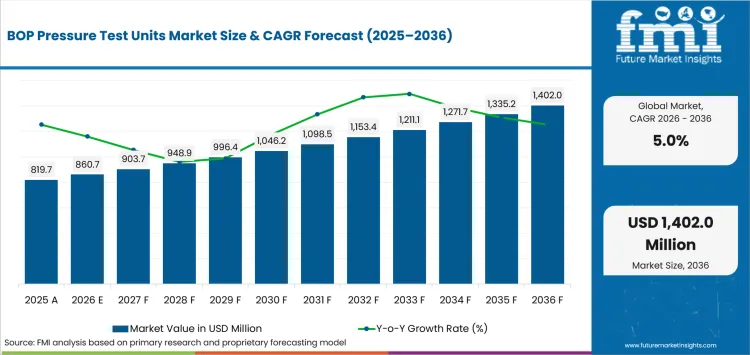
USD 860.7 million in 2026 and USD 1,402.0 million by 2036 at a 5.0% CAGR.
Demand in the BOP pressure test units market is projected to rise from USD 860.7 million in 2026 to USD 1,402.0 million by 2036 at 5.0% CAGR. Operators reuse test packages during BOP installation and well construction because pressure acceptance occurs at defined stages during the well program. BSEE's January 2026 inspection checklist requires pressure testing after BOP installation and before fourteen days have elapsed since the preceding test. The prescribed interval keeps pumps and calibrated recorders available for drilling work and repair turnover without treating testing as a one-time commissioning event.
Drilling activity converts into test-unit orders once equipment can reach the next campaign with required pressure and service support. ANP's August 2026 exploration review documented 431 Brazilian exploration blocks under contract at the end of 2025. The contracted base includes onshore and offshore programs that require mobilized well-control testing before drilling advances. KSA and the UAE concentrate purchasing inside national programs that standardize equipment approval and local support. USA and Norway rely more heavily on mature service networks and existing fleets during replacement decisions.
Key Takeaways
- Repeated BOP pressure verification converts installation work, drilling progression and repaired pressure seals into scheduled use of pumps and calibrated recorders.
- By unit type, skid-mounted test units are estimated to hold 29.0% in 2026, owing to liftable package layouts that keep pressure hardware together.
- In 2026, below 5,000 psi is expected to lead pressure rating with 18.0% share, because routine low-pressure verification avoids ultrahigh-pressure hardware.
- By application, BOP stack testing is forecast to represent 34.0% in 2026, tied to repeated integrity checks on the primary well-control assembly.
- Long equipment lives and repairable components slow replacement because rental fleets cover intermittent work without another capital purchase.
- Key players in the BOP pressure test units market include NOV Inc., SLB, Forum Energy Technologies, Inc., Halliburton, Oil States International, Inc., Hydratron Limited, CM Energy Tech Co., Ltd., and Worldwide Oilfield Machine (WOM).
Analyst Perspective
"A BOP pressure-test package earns its place by reaching the required test pressure without compromising the record used for acceptance. Fleet operators therefore value local calibration and traceable pressure data more than a lower purchase price that extends rig downtime."
- Nikhil Kaitwade, Principal Consultant, Future Market Insights
How is the BOP pressure test units market segmented?
The BOP pressure test units market is segmented by unit type, pressure rating, application, end use, sales channel and region.
Unit type covers skid-mounted, portable, containerized, high-pressure pump and digital packages and pressure rating ranges from below 5,000 psi to above 15,000 psi. Applications include BOP stack, wellhead, choke or kill line, hydrostatic and acceptance testing during drilling or service work. End use covers drilling contractors, oilfield service firms, rig maintenance yards, OEM service centers and offshore operators that control equipment access. Sales channels include direct equipment OEMs, rental fleets, service companies and regional distributors serving different ownership and mobilization models.
What makes skid-mounted test units central to the unit type category?
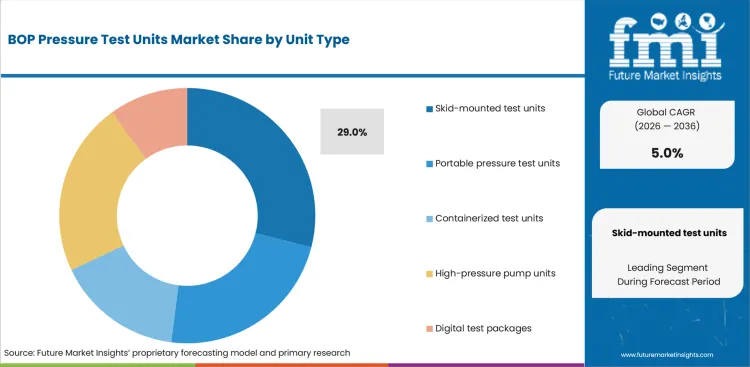
Skid-mounted units keep pumps and reservoirs beside the recorder on one liftable base for repeated rig-side work. The fixed layout gives technicians direct access to hydraulic pump packages during inspection without rebuilding the complete test spread before mobilization.
- By unit type, skid-mounted test units are estimated to hold 29.0% in 2026, owing to a fixed equipment layout that travels as one serviceable package.
- Hydratron Limited's January 2026 ISO 45001 certificate covers high-pressure pumps, power packs, test rigs and control systems within one certified scope. The certified scope documents current engineering controls for equipment used in dedicated high-pressure test packages.
Why does below 5,000 psi lead the pressure rating category?
Low-pressure verification checks sealing integrity before operators expose a BOP system to the approved high-pressure stage. BSEE's January 2026 checklist requires BOP components to pass a 250 psi to 350 psi low-pressure test before the high-pressure stage. The formal sequence keeps lower-pressure pumping capacity inside offshore procedures and gives hydrostatic testing equipment a defined preliminary role before full-pressure acceptance.
- In 2026, below 5,000 psi is expected to lead pressure rating with 18.0% share, attributable to routine verification tasks that avoid ultrahigh-pressure components.
- Lower-pressure packages receive repeat maintenance work because technicians can confirm seal response before committing the stack to its higher acceptance pressure.
How does BOP stack testing anchor the application category?
BOP stack testing directs pressure generation and recorded proof toward the barrier assembly that protects the well during drilling. Dedicated industrial pump systems must reach the specified pressure without breaking the recorded test trace or delaying acceptance.
- Based on application, BOP stack testing is projected to account for 34.0% in 2026, because the stack is the primary pressure-control assembly verified during drilling.
- BSEE's January 2026 inspection checklist requires surface and subsea BOP systems to be pressure-tested before drilling out applicable casing or liners. The rule places stack verification at defined points during well construction and gives dedicated test packages repeat operating work.
What supports drilling contractors as the leading end use segment?
Drilling contractors control the rig schedule that determines whether a pressure-test package is owned or rented for each campaign. ADNOC Drilling stated in July 2026 that fleet availability stayed high and rig AD-300 entered service ahead of schedule. Regional field service operations become more valuable as high fleet utilization increases the cost of missing calibrated equipment during planned BOP work.
- Drilling contractors are projected to hold 31.0% share in 2026, tied to direct control of rig-side test timing and equipment availability.
- Contractors can standardize hose connections and recorder formats for repeated campaigns, reducing setup time and keeping pressure-test responsibility close to rig operations.
What are the drivers, restraints and opportunities in the BOP Pressure Test Units Market?
Repair-triggered retesting sustains equipment use, long service lives slow complete-unit replacement and digital records strengthen the case for upgrades.
- Driver: Repair-triggered retesting raises utilization because affected BOP components must pass another pressure test before well operations resume.
- Restraint: Repairable pumps and established rental fleets stretch complete-unit replacement cycles even if test frequency stays high.
- Opportunity: Digital recording lets standardized fleets transfer pressure-test evidence into maintenance systems without repeated manual transcription between test events.
Repair-triggered retesting raises equipment utilization
Repair work generates another pressure-test event before a BOP returns to service, so demand follows maintenance activity as well as drilling schedules. BSEE's January 2026 checklist requires affected BOP components to pass pressure testing following disconnection or repair of a well-pressure containment seal. The requirement gives drilling tools and related well-control equipment a defined service-turnover test window instead of reserving pressure-test capacity for initial rig commissioning.
Repair and recertification stretch complete-unit purchase cycles
Complete-unit replacement develops more slowly because pumps and gauges can be repaired without retiring the full test package. Forum Energy Technologies' February 2026 Form 10-K describes refurbishment and recertification as critical work for pressure-control fleets. Rental coverage gives drilling contractors another route for intermittent jobs, so pressure-compensated hydraulic pumps and other components can receive spending before the complete unit retires.
Digital records turn compliance work into fleet data
Digital recording gains commercial value if a test record enters maintenance systems without manual transcription. BSEE's January 2026 checklist requires each BOP pressure test to be recorded on a digital recorder or a chart lasting no more than four hours. Packages designed for digital oilfield workflows reduce document handling and preserve calibration traceability for fleets that repeat one recorder format at several rigs.
Which country CAGRs are profiled in the BOP Pressure Test Units Market?
| Country | CAGR |
|---|---|
| KSA | 5.8% |
| UAE | 5.5% |
| Brazil | 5.0% |
| USA | 4.6% |
| Norway | 4.4% |
| Canada | 4.3% |
| Japan | 3.2% |
How do country-level CAGRs compare in the BOP Pressure Test Units Market?
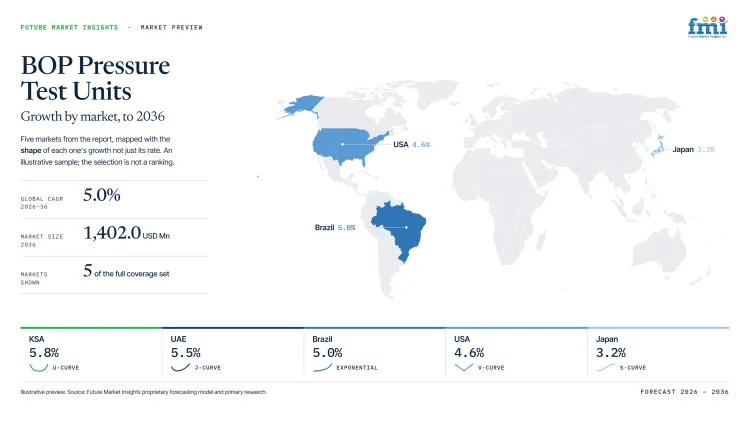
Country outlooks span 3.2% to 5.8% CAGR and create a 2.6-point forecast spread between Japan and KSA. KSA and the UAE form the upper band while Brazil follows at 5.0% within the same service-intensive drilling group. USA and Norway remain close to Canada while Japan records the lowest forecast because domestic exploration volumes remain more selective.
- KSA centralizes package approval inside national drilling programs where local service bases can standardize pressure-test equipment between rig campaigns.
- UAE multi-well offshore schedules favor repeatable pressure-test interfaces that service teams can prepare between wells on existing rig fleets.
- Brazilian deepwater campaigns require longer equipment mobilization plans and stocked coastal spares before pressure-test packages move offshore for well work.
- USA purchasing splits between offshore compliance work and contractor-led land rental access that covers intermittent test demand without dedicated fleet purchases.
- Norwegian harsh-environment operations place greater value on documented test reliability because offshore downtime raises the cost of failed pressure verification.
- Canadian gas drilling sustains service demand for calibrated test packages that can move between active well programs without permanent rig assignment.
- Japanese demand concentrates in specialist exploration work because selective domestic drilling volumes limit the case for broad pressure-test fleet expansion.
The wider spread changes the value of local service coverage more than it changes the need for documented test reliability. The full report provides country-level CAGR analysis across North America, Latin America, Europe, East Asia, South Asia, Oceania and the Middle East and Africa.
Country-wise Analysis
- Saudi drilling programs concentrate rig scheduling and equipment approval within national operations that favor standardized test packages and nearby calibration support. KSA is estimated to post 5.8% CAGR over the forecast period, tied to sustained upstream investment and tighter fleet standardization. Saudi Press Agency reported in February 2026 that Aramco targeted about 80% growth in sales gas production capacity by 2030 from 2021 levels. Local workshops with stocked pressure-control components can shorten turnaround during simultaneous rig campaigns and planned BOP maintenance. Qualification rules remain a material entry barrier because manufacturers without trained technicians or repair inventory inside the Kingdom struggle to convert approvals into repeat fleet orders.
- Abu Dhabi offshore developments group well construction into multi-rig programs that favor repeatable pressure-test layouts and nearby service preparation. The Abu Dhabi Media Office stated in July 2026 that Umm Shaif Gas Cap covers fourteen wells using three existing rigs over eighteen months. The UAE BOP pressure test units sector is projected to record 5.5% CAGR during the assessment period, because concentrated schedules reward standardized packages. Local technicians and stocked spares can keep test equipment ready between well-control events without returning packages to distant repair centers. Approved-vendor frameworks still slow entry for manufacturers that lack regional technicians or a documented path into national operator purchasing systems.
- Brazilian deepwater campaigns require offshore-ready pressure-test packages that fit vessel schedules and operator qualification before equipment leaves coastal service bases. BOP pressure test unit sales in Brazil are forecast to expand at 5.0% CAGR by 2036, reflecting continued deepwater exploration activity. ANP's August 2026 review documented nineteen exploration wells started in 2025, including ten offshore wells that sustained field activity. Local fabrication and Macae-area service capacity can shorten repair cycles during active campaigns and reduce exposure to long component lead times. Imported high-pressure parts remain a friction for manufacturers without stocked spares near campaign bases, especially during tightly sequenced offshore mobilization windows.
- Between federal offshore operations and contractor-led land fleets, United States test-unit demand relies on rental access during short maintenance windows. BSEE's January 2026 checklist requires seventy-two hours of notice before specified initial BOP or stump tests for blowout preventer systems. Regional service depots and rental inventories give drilling contractors another route to calibrated equipment without purchasing a dedicated unit for every rig. Adoption of BOP pressure test units in the USA is estimated to expand at 4.6% CAGR through 2036, supported by broad service access. Fragmented land and offshore fleets limit national standardization, so manufacturers need interchangeable connections and field support that work under different ownership models.
- North Sea service mobilization must fit weather-limited rig windows, making delayed well-control acceptance especially expensive for subsea and harsh-environment drilling campaigns. Experienced Norwegian workshops give qualified manufacturers a local repair and calibration route for pressure-control equipment between scheduled offshore drilling campaigns. The Norwegian Offshore Directorate recorded forty-nine exploration wells terminated during 2025 and twenty-one new discoveries in its August 2026 review. By 2036, Norway is projected to grow at 4.4% CAGR, given continued offshore activity and repeat service requirements on mature fleets. Demanding technical approval and a smaller rig base constrain newcomers because qualification costs must be recovered through repeated fleet work.
- Canadian natural-gas drilling gives pressure-test fleets work tied to active well construction instead of replacement alone. Canada is forecast to expand at 4.3% CAGR through 2036 because drilling remains active in Alberta and British Columbia. Canada Energy Regulator reported in May 2026 that 2025 gas production averaged about 19.0 Bcf/d and linked the record to sustained drilling activity. That activity gives rental and service firms recurring opportunities to mobilize calibrated pumps between well programs. Fleet purchases still depend on service coverage because contractors can rent units for intermittent campaigns.
- Japan's domestic upstream base is smaller, so pressure-test demand concentrates in specialist exploration work and established operator programs. BOP pressure test unit sales in Japan are projected to grow at 3.2% CAGR by 2036 because domestic drilling remains selective. JOGMEC disclosed in May 2026 that 243 domestic oil and gas survey results were available including 66 basic test-drilling projects. The technical archive shows a continuing well-investigation base that requires controlled pressure work without implying high rig volumes. Suppliers therefore need specialized qualification and compact service coverage for domestic programs instead of expecting broad fleet expansion from Japan.
Who are the notable companies in the BOP Pressure Test Units Market?
NOV Inc., SLB, Forum Energy Technologies, Inc., Halliburton, Oil States International, Inc., Hydratron Limited, CM Energy Tech Co., Ltd., and Worldwide Oilfield Machine (WOM) are the notable companies serving this market.
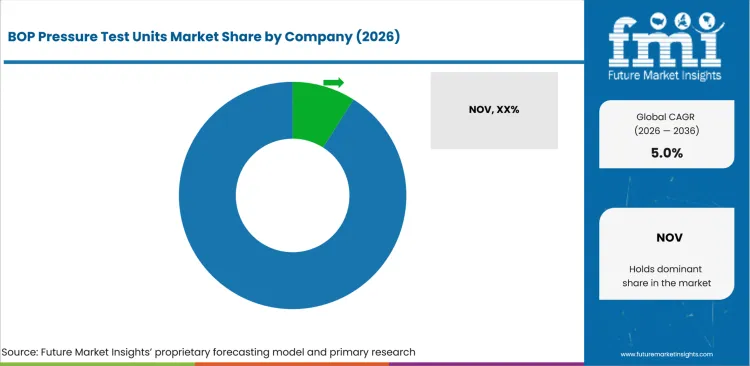
The competitive field turns on proximity to the BOP test event more than corporate scale alone. NOV Inc. and SLB integrate BOP systems with rig equipment. Forum Energy Technologies, Inc. and Worldwide Oilfield Machine (WOM) supply pressure-control hardware and repair capability for RAM BOP equipment. Hydratron Limited focuses on certified high-pressure pumps and test rigs. Halliburton and Oil States International, Inc. support complex offshore programs through pressure-management services. CM Energy Tech Co., Ltd. integrates offshore rig systems for international fleets.
- NOV Inc., SLB and Worldwide Oilfield Machine (WOM) cover integrated BOP hardware, control systems and lifecycle field support.
- Forum Energy Technologies, Inc. and Hydratron Limited concentrate on pressure-control hardware, high-pressure pumps and test-equipment service.
- Halliburton, Oil States International, Inc. and CM Energy Tech Co., Ltd. serve drilling integration, offshore packages and field execution.
Competitive Benchmarking: BOP Pressure Test Units Market
| Company | BOP / system integration | High-pressure test capability | Service and recertification depth | Geographic reach |
|---|---|---|---|---|
| NOV Inc. | High | High | High | Global |
| SLB | High | High | High | Global |
| Forum Energy Technologies, Inc. | Medium | High | High | North America and international intervention markets |
| Halliburton | Medium | Medium | High | Global |
| Oil States International, Inc. | High | Medium | High | Offshore-focused global network |
| Hydratron Limited | Medium | High | Medium | United Kingdom and international supply |
| CM Energy Tech Co., Ltd. | High | Medium | Medium | China and international offshore markets |
| Worldwide Oilfield Machine (WOM) | High | High | High | Global |
Scoring basis: For BOP or system integration, High requires documented stack and control work within a complete rig-system role. Medium identifies adjacent pressure-control integration and Low marks a narrower stand-alone equipment role. High pressure-test capability requires direct evidence of pressure generation, dedicated test rigs or well-control hardware. Medium covers high-pressure systems without dedicated test-unit evidence and Low marks narrower pressure capability. High service and recertification depth requires documented repair or recertification plus active field support. Medium reflects narrower lifecycle service and Low identifies limited after-delivery support. Geographic reach records verified operating or service regions and is not part of the capability score.
Key Developments in the BOP Pressure Test Units Market
- In April 2026, NOV Inc. disclosed a North Sea harsh-environment semisubmersible reactivation contract covering BOP stack upgrades and a separate RCX BOP control order.
- In February 2026, Oil States International, Inc. disclosed multiple 2025 deepwater managed-pressure drilling contracts and deployment of its first Low Impact Workover Package.
- In March 2025, SLB launched electric well-control technology for onshore and offshore BOP control with real-time pressure readouts and digital monitoring.
Key Players in the BOP Pressure Test Units Market
Integrated BOP and pressure-control platforms
- NOV Inc.
- SLB
- Forum Energy Technologies, Inc.
Drilling and offshore well-control services
- Halliburton
- Oil States International, Inc.
Specialized high-pressure and offshore equipment
- Hydratron Limited
- CM Energy Tech Co., Ltd.
- Worldwide Oilfield Machine (WOM)
BOP Pressure Test Units Market - Report Scope
| Coverage field | Report scope |
|---|---|
| Market breakdown | By unit type, pressure rating, application, end use, sales channel and region. |
| Quantitative Units | USD million. |
| Market Definition | Complete BOP pressure test units and integrated packages that generate, control, measure and record pressure for the defined well-control applications. |
| Regions Covered | North America, Latin America, Europe, East Asia, South Asia and Pacific, and Middle East and Africa. |
| Countries Covered | KSA, UAE, Brazil, USA, Norway, Canada, Japan, and 20+ countries included in the full report. |
| Key Companies Profiled | NOV Inc., SLB, Forum Energy Technologies, Inc., Halliburton, Oil States International, Inc., Hydratron Limited, CM Energy Tech Co., Ltd., Worldwide Oilfield Machine (WOM). |
| Forecast Period | 2026 to 2036. |
| Approach | Primary and secondary research with market triangulation. |
BOP Pressure Test Units Market - Research Methodology
| Method | Approach |
|---|---|
| Primary Research | FMI analysts gathered input from manufacturers, service providers, technology developers, distributors, end users, procurement teams, and subject-matter experts. Interviews examined purchasing decisions, product or service evaluation, adoption barriers, approval requirements, pricing considerations, and expectations for technical or commercial support. Respondents were also asked what evidence is required before a trial, pilot, or initial order develops into regular purchasing. |
| Desk Research | Desk research covered government statistics, regulatory publications, trade data, industry associations, technical literature, standards, company filings, product information, and official corporate announcements. Sources were reviewed for relevance, publication date, geographic coverage, and consistency with the defined market scope. Claims relating to performance, applications, approvals, capacity, investment, and commercial activity were retained only when supported by credible public evidence. |
| Market Sizing and Forecasting | The market model combined the baseline value with historical performance, segment structure, pricing and volume indicators, adoption levels, company participation, and country-level demand conditions. Forecast assumptions considered economic activity, investment trends, regulatory developments, technology adoption, purchasing cycles, supply availability, and barriers to wider market use. Segment and regional estimates were reconciled before the final market total was calculated. |
| Data Validation | Estimates were checked against multiple independent indicators, including public data, company activity, trade patterns, industry developments, and findings from primary interviews. Validation also tested whether products, services, applications, and company revenues fell within the defined market boundaries. Adjacent categories, unsupported claims, overlapping revenues, and activities without direct market relevance were excluded to reduce double counting and maintain consistency across segments and countries. |
BOP Pressure Test Units Market by Segments
Unit type
- Skid-mounted test units
- Portable pressure test units
- Containerized test units
- High-pressure pump units
- Digital test packages
Pressure rating
- Below 5,000 psi
- 5,000-10,000 psi
- 10,000-15,000 psi
- Above 15,000 psi
Application
- BOP stack testing
- Wellhead testing
- Choke/kill line testing
- Hydrostatic pressure testing
- Acceptance testing
End use
- Drilling contractors
- Oilfield service firms
- Rig maintenance yards
- OEM service centers
- Offshore operators
Sales channel
- Direct equipment OEM
- Rental fleets
- Service companies
- Regional distributors
BOP Pressure Test Units Market by Region:
- North America
- United States
- Canada
- Latin America
- Brazil
- Mexico
- Chile
- Rest of Latin America
- Western Europe
- Germany
- United Kingdom
- Italy
- Spain
- France
- Nordics
- Benelux
- Rest of Western Europe
- Eastern Europe
- Russia
- Poland
- Hungary
- Balkan and Baltic States
- Rest of Eastern Europe
- East Asia
- China
- Japan
- South Korea
- South Asia and Pacific
- India
- ASEAN
- Australia and New Zealand
- Rest of South Asia and Pacific
- Middle East and Africa
- Kingdom of Saudi Arabia
- Other GCC Countries
- Türkiye
- South Africa
- Other African Union Countries
- Rest of Middle East and Africa
Research Sources and Bibliography
- Bureau of Safety and Environmental Enforcement. (2026, January). Subpart G - Well Operations and Equipment: Potential Incidents of Noncompliance, Operators Version - January 2026.
- Hydratron Limited. (2026, January 27). ISO 45001:2018 certificate, Certificate No. UK013339.
- Saudi Press Agency. (2026, February 26). Aramco’s Gas Strategy Builds Momentum with Major Progress Towards Growth Target.
- Abu Dhabi Media Office. (2026, July 21). ADNOC accelerates gas growth strategy with US$6.2bn final investment decision for Umm Shaif Gas Cap in Abu Dhabi.
- ADNOC Drilling. (2026, July 30). ADNOC Drilling Delivers Record 1H Revenue and Profits, with Dividends Exceeding Half Billion USD.
- Agência Nacional do Petróleo, Gás Natural e Biocombustíveis. (2026, August 6). Seminário da ANP apresenta resultados da atividade de exploração em 2025.
- Norwegian Offshore Directorate. (2026, August 1). Oil and gas on the NCS moving forward.
- Forum Energy Technologies, Inc. (2026, February 27). 2025 Form 10-K.
- NOV Inc. (2026, April 27). NOV Reports First Quarter 2026 Earnings.
- NOV Inc. (2026, February 4). NOV Reports Fourth Quarter and Full-Year 2025 Earnings.
- Oil States International, Inc. (2026, February 20). Oil States Announces Fourth Quarter 2025 Results.
- SLB. (2025, March 4). SLB Electrifies Well Control With Latest Tech.
- Halliburton. (2025, February 26). Halliburton and Sekal deliver world’s first automated on-bottom drilling system for Equinor in the North Sea.
- Halliburton. (2026, July 9). Eni and Halliburton achieve industry first with closed-loop rig automation in deepwater Indonesia.
- Hydratron Limited. (2026, January 27). ISO 9001:2015 certificate, Certificate No. UK013338.
- CM Energy Tech Co., Ltd. (2026). Annual Report 2025.
- CM Energy Tech Co., Ltd. (2025, March 14). Strategic Alliance Between CM Energy and Honghua Group Established a New Benchmark in Offshore Engineering Industry.
- Worldwide Oilfield Machine. (2026). Certifications.
- American Petroleum Institute. (2026, January 25). Certificate of Authority to use the Official API Monogram, License Number: 16A-0079.
- Oil States International, Inc. (2026, March 4). 2025 Form 10-K.
- NOV Inc. (2026, February). 2025 Form 10-K.
- SLB. (2026, January). 2025 Form 10-K.
- Halliburton. (2026, February 6). 2025 Form 10-K.
- Forum Energy Technologies, Inc. (2026, May 1). Form 10-Q for the quarterly period ended March 31, 2026.
- Canada Energy Regulator. (2026, May 20). Canada’s natural gas production kept climbing in 2025.
- Japan Organization for Metals and Energy Security. (2026, May 13). 国内石油・天然ガス基礎調査の成果物を開示.
This bibliography is provided for reader reference and is not exhaustive. The full report contains the complete reference list and detailed citations.
This Report Answers
- How large is the BOP pressure test units market in 2026 and 2036?
- Which testing requirements sustain repeat use of BOP pressure-test equipment?
- Why do skid-mounted test units lead unit type in 2026?
- Why does below 5,000 psi lead pressure rating in 2026?
- Why does BOP stack testing hold the largest application share?
- Which countries have the highest profiled CAGRs through 2036?
- How do rental fleets and repairable components affect unit replacement?
- Which companies are benchmarked for BOP integration and lifecycle service?
Frequently Asked Questions
How big is the BOP Pressure Test Units Market in 2026?
The BOP pressure test units market is valued at USD 860.7 million in 2026 and is projected to reach USD 1,402.0 million by 2036. Repeat BOP verification and repair-triggered retesting sustain equipment use through the assessment period.
What is the CAGR of the BOP Pressure Test Units Market from 2026 to 2036?
The BOP pressure test units market is projected to grow at a CAGR of 5.0% between 2026 and 2036. Installed fleets require repeated well-control testing and lifecycle service that keeps test equipment in active use.
Which unit type leads the BOP Pressure Test Units Market?
The skid-mounted test units segment is expected to hold 29.0% of the BOP pressure test units market in 2026, driven by liftable layouts that keep pressure hardware on one serviceable base. Rig technicians can inspect and service the package without rebuilding the full test spread.
Which application leads the BOP Pressure Test Units Market?
The BOP stack testing segment is forecast to represent 34.0% of the BOP pressure test units market in 2026, because integrity checks focus on the primary well-control assembly. Scheduled verification during drilling and maintenance keeps this application central to dedicated test-unit use during well construction.
Which countries are projected to record the highest growth in the BOP Pressure Test Units Market?
KSA is projected to grow at 5.8% CAGR, followed by the UAE at 5.5% and Brazil at 5.0% through 2036. National drilling programs and deepwater project activity sustain the faster growth profiles.
Which companies are active in the BOP Pressure Test Units Market?
Key companies operating in the market include NOV Inc., SLB, Forum Energy Technologies, Inc., Halliburton, Oil States International, Inc., Hydratron Limited, CM Energy Tech Co., Ltd., and Worldwide Oilfield Machine (WOM). They differentiate through BOP integration and high-pressure service coverage during critical well-control work.
Preview the report firsthand - request a free sample
Get SampleGet the brochure for pricing and purchase details.
Get PDFTable of Content
- Key Takeaways
- Market Size and CAGR
- Top Growth Driver
- Fastest Growing Segment
- Leading Region
- Key Companies
- Emerging Opportunities
- Executive Summary
- Global Market Outlook
- Demand-side Trends
- Supply-side Trends
- Technology Roadmap Analysis
- Analysis and Recommendations
- Analyst Perspective (What is happening? Why now? What should investors know?)
- Key Questions Answered
- How large is the market?
- What is the CAGR?
- What are key trends?
- Which region dominates?
- Who are the leaders?
- Market Overview
- Market Coverage / Taxonomy
- Market Definition / Scope / Limitations
- Research Methodology
- Chapter Orientation
- Analytical Lens and Working Hypotheses
- Market Structure, Signals, and Trend Drivers
- Benchmarking and Cross-market Comparability
- Market Sizing, Forecasting, and Opportunity Mapping
- Research Design and Evidence Framework
- Desk Research Programme (Secondary Evidence)
- Expert Input and Fieldwork (Primary Evidence)
- Tooling, Models, and Reference Databases
- Data Engineering and Model Build
- Quality Assurance and Audit Trail
- Market Background
- Market Dynamics (Drivers, Restraints, Opportunity, Trends)
- Scenario Forecast (Optimistic, Likely, Conservative)
- Impact Analysis
- AI Impact
- Sustainability Impact
- Regulatory Impact
- Technology Impact
- Consumer / Buyer Analysis
- Purchase Drivers
- Adoption Barriers
- Buyer Journey
- Opportunity Map Analysis
- Product Life Cycle Analysis
- Supply Chain Analysis
- Investment Feasibility Matrix
- Value Chain Analysis
- PESTLE and Porter's Analysis
- Regulatory Landscape
- Regional Parent Market Outlook
- Production and Consumption Statistics
- Import and Export Statistics
- Global Market Analysis and Forecast, 2021 to 2036
- Historical Market Size Value (USD Million) Analysis, 2021 to 2025
- Current and Future Market Size Value (USD Million) Projections, 2026 to 2036
- Y-o-Y Growth Trend Analysis
- Absolute $ Opportunity Analysis
- Global Market Pricing Analysis, 2021 to 2036
- Global Market Analysis and Forecast, By Value (USD Million) Type, 2021 to 2036
- Introduction / Key Findings
- Historical Market Size Value (USD Million) Analysis By Value (USD Million) Type, 2021 to 2025
- Current and Future Market Size Value (USD Million) Analysis and Forecast By Value (USD Million) Type, 2026 to 2036
- Skid-mounted test units
- Portable pressure test units
- Containerized test units
- High-pressure pump units
- Digital test packages
- Skid-mounted test units
- Y-o-Y Growth Trend Analysis By Value (USD Million) Type, 2021 to 2025
- Absolute $ Opportunity Analysis By Value (USD Million) Type, 2026 to 2036
- Global Market Analysis and Forecast, By Pressure Rating, 2021 to 2036
- Introduction / Key Findings
- Historical Market Size Value (USD Million) Analysis By Pressure Rating, 2021 to 2025
- Current and Future Market Size Value (USD Million) Analysis and Forecast By Pressure Rating, 2026 to 2036
- Below 5,000 psi
- 5,000-10,000 psi
- 10,000-15,000 psi
- Above 15,000 psi
- Below 5,000 psi
- Y-o-Y Growth Trend Analysis By Pressure Rating, 2021 to 2025
- Absolute $ Opportunity Analysis By Pressure Rating, 2026 to 2036
- Global Market Analysis and Forecast, By Application, 2021 to 2036
- Introduction / Key Findings
- Historical Market Size Value (USD Million) Analysis By Application, 2021 to 2025
- Current and Future Market Size Value (USD Million) Analysis and Forecast By Application, 2026 to 2036
- BOP stack testing
- Wellhead testing
- Choke/kill line testing
- Hydrostatic pressure testing
- Acceptance testing
- BOP stack testing
- Y-o-Y Growth Trend Analysis By Application, 2021 to 2025
- Absolute $ Opportunity Analysis By Application, 2026 to 2036
- Global Market Analysis and Forecast, By End Use, 2021 to 2036
- Introduction / Key Findings
- Historical Market Size Value (USD Million) Analysis By End Use, 2021 to 2025
- Current and Future Market Size Value (USD Million) Analysis and Forecast By End Use, 2026 to 2036
- Drilling contractors
- Oilfield service firms
- Rig maintenance yards
- OEM service centers
- Offshore operators
- Drilling contractors
- Y-o-Y Growth Trend Analysis By End Use, 2021 to 2025
- Absolute $ Opportunity Analysis By End Use, 2026 to 2036
- Global Market Analysis and Forecast, By Sales Channel, 2021 to 2036
- Introduction / Key Findings
- Historical Market Size Value (USD Million) Analysis By Sales Channel, 2021 to 2025
- Current and Future Market Size Value (USD Million) Analysis and Forecast By Sales Channel, 2026 to 2036
- Direct equipment OEM
- Rental fleets
- Service companies
- Regional distributors
- Direct equipment OEM
- Y-o-Y Growth Trend Analysis By Sales Channel, 2021 to 2025
- Absolute $ Opportunity Analysis By Sales Channel, 2026 to 2036
- Global Market Analysis and Forecast, By Region, 2021 to 2036
- Introduction
- Historical Market Size Value (USD Million) Analysis By Region, 2021 to 2025
- Current Market Size Value (USD Million) Analysis and Forecast By Region, 2026 to 2036
- North America
- Latin America
- Western Europe
- Eastern Europe
- East Asia
- South Asia and Pacific
- Middle East & Africa
- Market Attractiveness Analysis By Region
- North America Market Analysis and Forecast, By Country, 2021 to 2036
- Historical Market Size Value (USD Million) Trend Analysis By Market Taxonomy, 2021 to 2025
- Market Size Value (USD Million) Forecast By Market Taxonomy, 2026 to 2036
- By Country
- USA
- Canada
- By Value (USD Million) Type
- By Pressure Rating
- By Application
- By End Use
- By Sales Channel
- By Country
- Market Attractiveness Analysis
- By Country
- By Value (USD Million) Type
- By Pressure Rating
- By Application
- By End Use
- By Sales Channel
- Key Takeaways
- Latin America Market Analysis and Forecast, By Country
- Historical Market Size Value (USD Million) Trend Analysis By Market Taxonomy, 2021 to 2025
- Market Size Value (USD Million) Forecast By Market Taxonomy, 2026 to 2036
- By Country
- Brazil
- Mexico
- Chile
- Rest of Latin America
- By Value (USD Million) Type
- By Pressure Rating
- By Application
- By End Use
- By Sales Channel
- By Country
- Market Attractiveness Analysis
- By Country
- By Value (USD Million) Type
- By Pressure Rating
- By Application
- By End Use
- By Sales Channel
- Key Takeaways
- Western Europe Market Analysis and Forecast, By Country
- Historical Market Size Value (USD Million) Trend Analysis By Market Taxonomy, 2021 to 2025
- Market Size Value (USD Million) Forecast By Market Taxonomy, 2026 to 2036
- By Country
- Germany
- UK
- Italy
- Spain
- France
- Nordic
- BENELUX
- Rest of Western Europe
- By Value (USD Million) Type
- By Pressure Rating
- By Application
- By End Use
- By Sales Channel
- By Country
- Market Attractiveness Analysis
- By Country
- By Value (USD Million) Type
- By Pressure Rating
- By Application
- By End Use
- By Sales Channel
- Key Takeaways
- Eastern Europe Market Analysis and Forecast, By Country
- Historical Market Size Value (USD Million) Trend Analysis By Market Taxonomy, 2021 to 2025
- Market Size Value (USD Million) Forecast By Market Taxonomy, 2026 to 2036
- By Country
- Russia
- Poland
- Hungary
- Balkan & Baltic
- Rest of Eastern Europe
- By Value (USD Million) Type
- By Pressure Rating
- By Application
- By End Use
- By Sales Channel
- By Country
- Market Attractiveness Analysis
- By Country
- By Value (USD Million) Type
- By Pressure Rating
- By Application
- By End Use
- By Sales Channel
- Key Takeaways
- East Asia Market Analysis and Forecast, By Country
- Historical Market Size Value (USD Million) Trend Analysis By Market Taxonomy, 2021 to 2025
- Market Size Value (USD Million) Forecast By Market Taxonomy, 2026 to 2036
- By Country
- China
- Japan
- South Korea
- By Value (USD Million) Type
- By Pressure Rating
- By Application
- By End Use
- By Sales Channel
- By Country
- Market Attractiveness Analysis
- By Country
- By Value (USD Million) Type
- By Pressure Rating
- By Application
- By End Use
- By Sales Channel
- Key Takeaways
- South Asia and Pacific Market Analysis and Forecast, By Country
- Historical Market Size Value (USD Million) Trend Analysis By Market Taxonomy, 2021 to 2025
- Market Size Value (USD Million) Forecast By Market Taxonomy, 2026 to 2036
- By Country
- India
- ASEAN
- Australia & New Zealand
- Rest of South Asia and Pacific
- By Value (USD Million) Type
- By Pressure Rating
- By Application
- By End Use
- By Sales Channel
- By Country
- Market Attractiveness Analysis
- By Country
- By Value (USD Million) Type
- By Pressure Rating
- By Application
- By End Use
- By Sales Channel
- Key Takeaways
- Middle East & Africa Market Analysis and Forecast, By Country
- Historical Market Size Value (USD Million) Trend Analysis By Market Taxonomy, 2021 to 2025
- Market Size Value (USD Million) Forecast By Market Taxonomy, 2026 to 2036
- By Country
- Kingdom of Saudi Arabia
- Other GCC Countries
- Türkiye
- South Africa
- Other African Union
- Rest of Middle East & Africa
- By Value (USD Million) Type
- By Pressure Rating
- By Application
- By End Use
- By Sales Channel
- By Country
- Market Attractiveness Analysis
- By Country
- By Value (USD Million) Type
- By Pressure Rating
- By Application
- By End Use
- By Sales Channel
- Key Takeaways
- Key Countries Market Analysis
- USA
- Pricing Analysis
- Market Share Analysis, 2025
- By Value (USD Million) Type
- By Pressure Rating
- By Application
- By End Use
- By Sales Channel
- Canada
- Pricing Analysis
- Market Share Analysis, 2025
- By Value (USD Million) Type
- By Pressure Rating
- By Application
- By End Use
- By Sales Channel
- Mexico
- Pricing Analysis
- Market Share Analysis, 2025
- By Value (USD Million) Type
- By Pressure Rating
- By Application
- By End Use
- By Sales Channel
- Brazil
- Pricing Analysis
- Market Share Analysis, 2025
- By Value (USD Million) Type
- By Pressure Rating
- By Application
- By End Use
- By Sales Channel
- Chile
- Pricing Analysis
- Market Share Analysis, 2025
- By Value (USD Million) Type
- By Pressure Rating
- By Application
- By End Use
- By Sales Channel
- Germany
- Pricing Analysis
- Market Share Analysis, 2025
- By Value (USD Million) Type
- By Pressure Rating
- By Application
- By End Use
- By Sales Channel
- UK
- Pricing Analysis
- Market Share Analysis, 2025
- By Value (USD Million) Type
- By Pressure Rating
- By Application
- By End Use
- By Sales Channel
- Italy
- Pricing Analysis
- Market Share Analysis, 2025
- By Value (USD Million) Type
- By Pressure Rating
- By Application
- By End Use
- By Sales Channel
- Spain
- Pricing Analysis
- Market Share Analysis, 2025
- By Value (USD Million) Type
- By Pressure Rating
- By Application
- By End Use
- By Sales Channel
- France
- Pricing Analysis
- Market Share Analysis, 2025
- By Value (USD Million) Type
- By Pressure Rating
- By Application
- By End Use
- By Sales Channel
- India
- Pricing Analysis
- Market Share Analysis, 2025
- By Value (USD Million) Type
- By Pressure Rating
- By Application
- By End Use
- By Sales Channel
- ASEAN
- Pricing Analysis
- Market Share Analysis, 2025
- By Value (USD Million) Type
- By Pressure Rating
- By Application
- By End Use
- By Sales Channel
- Australia & New Zealand
- Pricing Analysis
- Market Share Analysis, 2025
- By Value (USD Million) Type
- By Pressure Rating
- By Application
- By End Use
- By Sales Channel
- China
- Pricing Analysis
- Market Share Analysis, 2025
- By Value (USD Million) Type
- By Pressure Rating
- By Application
- By End Use
- By Sales Channel
- Japan
- Pricing Analysis
- Market Share Analysis, 2025
- By Value (USD Million) Type
- By Pressure Rating
- By Application
- By End Use
- By Sales Channel
- South Korea
- Pricing Analysis
- Market Share Analysis, 2025
- By Value (USD Million) Type
- By Pressure Rating
- By Application
- By End Use
- By Sales Channel
- Russia
- Pricing Analysis
- Market Share Analysis, 2025
- By Value (USD Million) Type
- By Pressure Rating
- By Application
- By End Use
- By Sales Channel
- Poland
- Pricing Analysis
- Market Share Analysis, 2025
- By Value (USD Million) Type
- By Pressure Rating
- By Application
- By End Use
- By Sales Channel
- Hungary
- Pricing Analysis
- Market Share Analysis, 2025
- By Value (USD Million) Type
- By Pressure Rating
- By Application
- By End Use
- By Sales Channel
- Kingdom of Saudi Arabia
- Pricing Analysis
- Market Share Analysis, 2025
- By Value (USD Million) Type
- By Pressure Rating
- By Application
- By End Use
- By Sales Channel
- Türkiye
- Pricing Analysis
- Market Share Analysis, 2025
- By Value (USD Million) Type
- By Pressure Rating
- By Application
- By End Use
- By Sales Channel
- South Africa
- Pricing Analysis
- Market Share Analysis, 2025
- By Value (USD Million) Type
- By Pressure Rating
- By Application
- By End Use
- By Sales Channel
- USA
- Market Structure Analysis
- Competition Dashboard
- Competition Benchmarking
- Market Share Analysis of Top Players
- By Regional
- By Value (USD Million) Type
- By Pressure Rating
- By Application
- By End Use
- By Sales Channel
- Emerging Startups
- Innovation Benchmarking
- Competition Analysis
- Competition Deep Dive
- NOV
- Overview
- Product Portfolio
- Profitability by Market Segments
- Sales Footprint
- Strategy Overview
- Marketing Strategy
- Product Strategy
- Channel Strategy
- Forum Energy Technologies
- Cameron / SLB
- Halliburton
- Baker Hughes
- Schlumberger Pressure Control
- TSC Group
- STATS Group
- Hydratron
- Oil States Industries
- NOV
- Case Studies
- Success Stories
- Recent Developments
- Competition Deep Dive
- Assumptions & Acronyms Used


