

- Market Size (2026)
- USD 287.6 Mn
- Forecast (2036)
- USD 773.5 Mn
- CAGR (2026 to 2036)
- 10.4%
How big is the bread moulders market in 2026?
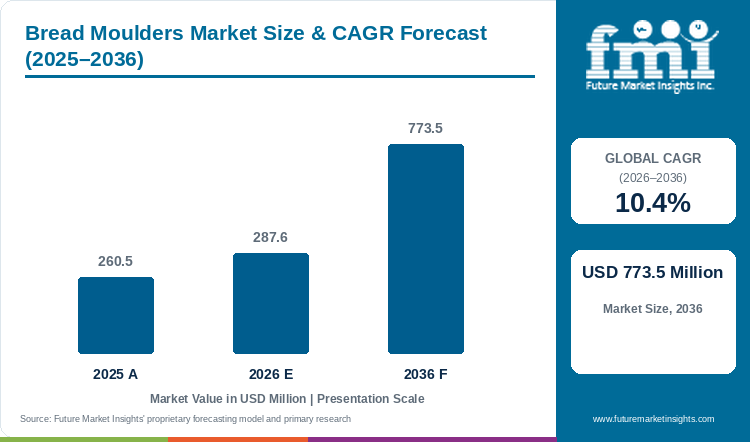
The market was valued at USD 260.5 million in 2025 and is expected to reach USD 287.6 million in 2026. It is projected to reach USD 773.5 million by 2036 at a CAGR of 10.4% from 2026 to 2036.
The bread moulders market was valued at USD 260.5 million in 2025 and is estimated at USD 287.6 million in 2026, with revenue forecast to reach USD 773.5 million by 2036 at a CAGR of 10.4%. Mid-capacity lines account for 39.0% of equipment type demand in 2026. Grupo Bimbo announced approximately USD 1.0 billion of US investment for 2026 to 2028, covering a broader program of renewal and development.[5] At the moulder level, buyers assess seam consistency, loaf shape and how many bread styles a machine can handle without extensive setup. A plant may replace a moulder when forming limits its product range or creates rework downstream, even before it needs more overall capacity. That assessment needs trials across the actual dough range and normal shift, because a moulder that forms one loaf reliably may create defects when hydration or shape changes.
Key Market Trends & Insights
- By equipment type: Mid-Capacity Lines represented 39.0% of 2026 equipment type demand. Adjustable forming spreads one installation across several loaf weights and lengths. The test is how reliably staff recover the established settings after each product change.
- By capacity: 500-2,000 kg/hr accounted for 39.0% of 2026 capacity demand. Loaf weight and the adjoining stages set the piece rate a moulder is asked to hold. It's tested by whether the installation keeps pace with dividing and proofing across the daily range.
- By automation level: Fully Automatic / Robotic held 44.0% of 2026 automation level demand. Linked orientation, shaping and transfer present each piece the same way. The test is how the line recovers after a stoppage leaves pieces between machines.
Regional Highlights
- For bread moulders, the UAE leads the eight-country outlook at 11.7% CAGR from 2026 to 2036, reflecting the value of consistent loaf forming across changing product ranges.
- Saudi Arabia follows at 11.3%, South Korea at 11.0% and the USA at 10.7%; Japan's 9.4% forecast represents the most measured growth in the group.
Market Size & Forecast
Table 1: Bread Moulders Market Size and Forecast (USD million), 2025 to 2036
| Market size and forecast | Value |
|---|---|
| 2025 Value (actual) | USD 260.5 million |
| Estimated market size in 2026 | USD 287.6 million |
| Projected market size by 2036 | USD 773.5 million |
| CAGR (2026-2036) | 10.4% |
The practical opportunity depends on whether a moulder reproduces the same seam and loaf form across products and shifts. MECATHERM’s May 2025 M-RT presentation described a combined M-NS II divider and M-RT moulder producing up to 4,000 pieces per hour within 50 m².[1] Baker Perkins includes the Multitex4 moulder in its general-bakery range,[4] and AMF and Puratos opened a joint pilot bakery in New Jersey in June 2025.[2] These offers widen the choice for a buyer, although a published rate does not show how a hydrated, rested dough behaves over a full shift. FDA manufacturing requirements add cleaning and upkeep obligations to every installation.[3] Consequently, actual demand will depend on whether a moulder holds seam and form across the bread range without adding changeover or cleaning time.
Bread Moulders Market is segmented by Equipment Type, Capacity, Automation Level, End User, Sales Channel and Region. The forecast period runs from 2026 to 2036.
The moulder’s work becomes visible in the loaf after proofing and baking. Rolling, elongation and seam formation affect how the piece develops, linking bakery processing equipment to the bread’s final form and crumb. MECATHERM’s M-RT offer emphasises limited mechanical action for industrial crusty bread.[1] Its commercial purpose is to give that shaping process an industrial configuration while respecting the dough. A bakery moving into another bread style may therefore require a different moulder even when the existing one has sufficient speed. Product suitability can become the reason for investment before additional capacity is needed.
Preparation determines the dough presented to the moulder. Hydration, mixing and fermentation can alter elasticity and release, changing the pressure and handling required during shaping. AMF and Puratos opened their joint pilot bakery in June 2025 to combine ingredient and equipment development.[2] That kind of work allows a new formulation to be followed through forming and baking before the machinery is specified. For an established plant, it can clarify whether product expansion needs a different shaping stage or adjustments to preparation. The distinction affects the size of the order and how much surrounding equipment has to change with it.
Broader investment in bakery maintenance and innovation provides a commercial setting for these projects. Both purposes feature in Grupo Bimbo’s announced US programme.[5] At machinery level, Baker Perkins includes the Multitex4 moulder within its general-bakery range, offering a dedicated shaping stage.[4] Such equipment can enter a line with existing divider timing, piece orientation and pan movement. Those connections influence installation cost. Cleaning and service access add further requirements under the factory’s sanitation routine.[3] A replacement that fits these constraints can concentrate spending on moulding, while a larger change to the bread range may justify alterations across several stages.
Table 2: Supporting Industry Indicators for the Bread Moulders Market, 2025 to 2026 with announced investment through 2028
| Indicator | Data point | Why it matters | Source |
|---|---|---|---|
| Downstream bakery investment | Grupo Bimbo plans approximately USD 1.0 billion in US investment during 2026–2028. | Bakery capital programmes include renewal and product development. | [5] |
| Investment purposes | The announced programme includes maintenance and product innovation. | Demand for shaping equipment can arise within existing bakery operations. | [5] |
| Combined line rate | Mecatherm lists up to 4,000 pieces/hour for the M-NS II/M-RT arrangement. | The offer brings dividing and moulding together for industrial bread production. | [1] |
| Combined line footprint | The same divider-and-moulder arrangement occupies 50 m². | Available factory space affects the feasible configuration. | [1] |
| Joint pilot bakery | AMF and Puratos opened their New Jersey facility in June 2025. | Formulation and forming trials can be conducted together. | [2] |
| Dedicated moulding offer | Baker Perkins includes Multitex4 in its general-bakery range. | A dedicated shaping stage creates a route for focused renewal. | [4] |
Demand Intensity Analysis
The bread moulders market is forecast to generate an additional USD 485.9 million in annual revenue between 2026 and 2036, growing at a 10.4% value CAGR. The opportunities lie in new facilities, additional bread varieties and replacement of difficult shaping processes. Grupo Bimbo’s announced investment of approximately USD 1.0 billion in the USA for 2026 to 2028 covers maintenance and product innovation, so shaping equipment competes with other bakery projects for capital.[5] A moulding proposal earns its place by reducing recurring losses or enabling a product the bakery can sell. Consistent finished bread and a manageable installation cost determine whether that opportunity becomes an equipment order.
Industrial bakeries account for USD 129.4 million in 2026, the largest End User share. At that scale, a small recurring shaping defect can affect a long run and create extra correction or rejection later. MECATHERM’s May 2025 combination of M-NS II divider and M-RT moulder produces up to 4,000 pieces per hour within 50 m² for industrial crusty bread.[1] Its rate and footprint also show why moulding is evaluated with the stages around it. Proofing and baking set their own demands on time and space. The order consequently depends on the bread range and the installed line, with a dedicated product campaign creating a different requirement from frequent switches between formats.
Mid-capacity lines represent USD 112.2 million in 2026. Their role is strongest where several loaf forms share the same shaping equipment and the bakery needs to move between them regularly. Differences in weight, length or dough condition can make adjustment capability more valuable than another increase in speed. A well-defined setting for each recurring product reduces the work at the start of a run. This supports investment in moulders that extend the assortment a plant can supply, particularly when its dividers, proofers and ovens have enough capacity for those products already. A plant that tracks the minutes lost at each product change can see which purchase repays first.
Fully automatic / robotic equipment contributes USD 126.5 million in 2026. Automation connects piece orientation, shaping and onward movement, reducing repeated handling around the moulder. The return depends on reproducing the required seam and form across successive pieces. Dough variation still influences that result, so the mechanical settings have to be established for the formulations being run. Suppliers with application knowledge contribute beyond movement and speed, through the operating method that lets different shifts make the same loaf. Direct OEM sales, at USD 158.2 million, bring dough development and the engineering of transfers into the same commercial discussion. Long-term sales are ultimately determined by whether a moulder reproduces the same loaf across products and shifts.
Table 3: Demand Intensity Metrics for the Bread Moulders Market, 2026 to 2036 with relevant industry comparisons
| Demand intensity metric | Value | Basis |
|---|---|---|
| Bread moulders value CAGR | 10.4% | Global market value, 2026 to 2036. |
| Planned downstream US investment | Approximately USD 1.0 billion | Grupo Bimbo programme for 2026–2028; covers several corporate purposes.[5] |
| Combined dividing-and-moulding rate | Up to 4,000 pieces/hour | Mecatherm M-NS II/M-RT arrangement, announced May 2025.[1] |
| Combined equipment footprint | 50 m² | Combined MECATHERM M-NS II divider and M-RT moulder arrangement.[1] |
| Mid-capacity-line revenue, 2026 | USD 112.2 million | Equipment Type category. |
| Fully automatic / robotic revenue, 2026 | USD 126.5 million | Automation Level category. |
| Added revenue through 2036 | USD 485.9 million | Increase in market value between 2026 and 2036. |
Analyst Perspective
A moulder earns a lasting place when it forms the same seam and loaf across products and shifts without disrupting proofing and panning. Suppliers that fix the forming defects behind panning corrections win the replacement, while those selling piece rate alone lose it.
- Nandini Roy Choudhury, Principal Consultant, FMI
How is the bread moulders market segmented?
The bread moulders market is segmented by Equipment Type (Mid-capacity lines, Compact / entry systems, High-capacity industrial lines), Capacity (500-2,000 kg/hr, Below 500 kg/hr, Above 2,000 kg/hr), Automation Level (Fully automatic / robotic, Semi-automatic, Manual), End User (Industrial bakeries, In-store & retail bakeries, Artisan bakeries, Foodservice / QSR central kitchens), and Sales Channel (Direct OEM sales, Dealers & distributors, Aftermarket & refurbished). Regionally, the market is segmented into North America, Latin America, Western Europe, Eastern Europe, East Asia, South Asia and Pacific, and Middle East and Africa.
Why do Mid-capacity lines anchor equipment selection?
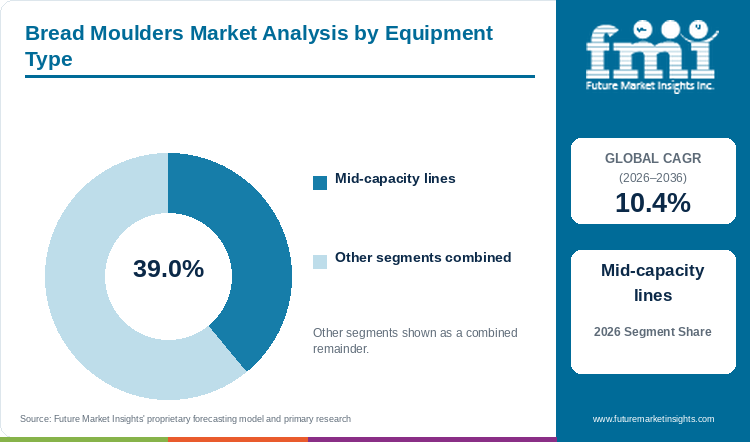
Mid-capacity lines lead with 39.0% of Equipment Type revenue in 2026.
Mid-capacity lines allow moulding investment to follow the variety of bread a bakery makes. Adjustable forming can serve several weights and loaf lengths on one installation, spreading the equipment cost across a broader assortment. The benefit depends on how reliably staff can move between established settings. Compact / entry systems suit a smaller workload, while High-capacity industrial lines need enough recurring volume to justify their scale.
- Mid-capacity lines account for 39.0% of Equipment Type revenue in 2026.
- A wider loaf range needs to spread the investment across several recurring products.
What sustains demand for 500-2,000 kg/hr systems?
500-2,000 kg/hr leads with 39.0% of Capacity revenue in 2026.
The 500-2,000 kg/hr class covers moulding installations serving different loaf weights and production patterns. Smaller pieces place more demands on orientation and transfers at a given mass rate, while larger loaves change how the shaping stage feeds proofing and baking. A bakery with a stable bread range can dedicate the moulder to repeated settings; a broader assortment requires time for adjustments.
- 500-2,000 kg/hr holds 39.0% of Capacity revenue in 2026.
- Loaf size and the frequency of adjustments need to be weighed against daily production.
How does Fully automatic / robotic moulding change plant economics?
Fully automatic / robotic leads with 44.0% of Automation Level revenue in 2026.
Automatic orientation and conveyor timing present dough to the moulder consistently, and repeated shaping settings then reduce the manual attention needed between pieces. The process remains sensitive to preparation and fermentation, and a stoppage can leave pieces between machines. Semi-automatic and Manual arrangements retain roles where staff adjust the shape frequently or output does not justify a more connected system.
- Fully automatic / robotic accounts for 44.0% of Automation Level revenue in 2026.
- Orientation and spacing need to allow established settings to be reproduced across a run.
Why are Industrial bakeries the largest end-user group?
Industrial bakeries lead with 45.0% of End User revenue in 2026.
Industrial bread production magnifies the effect of small shaping defects across repeated loaf cycles, since uneven elongation or poor seams create correction work. That gives a dedicated moulding stage direct relevance to production economics. Baker Perkins includes the Multitex4 in its general-bakery range, illustrating that specialist role.[4] Industrial users also need the result to hold as residue accumulates and components wear.
- Industrial bakeries account for 45.0% of End User revenue in 2026.
- Small shaping defects need to be caught before they spread across an industrial campaign.
Why does Direct OEM sales dominate equipment procurement?
Direct OEM sales hold 55.0% of Sales Channel revenue in 2026.
Moulding projects combine application knowledge with mechanical connections to the bread line, and an OEM can develop the shaping settings alongside the divider, intermediate proofer and pan-handling arrangement. The extent of that engineering separates a complete make-up project from a stand-alone replacement. Dealers & distributors offer smaller machines and local assistance, while Aftermarket & refurbished equipment depends on machine condition and component availability.
- Direct OEM sales hold 55.0% of Sales Channel revenue in 2026, connecting recipe trials with the engineering needed around the moulder.
- Application development and transfer engineering need to be part of the project scope.
What are the drivers, restraints and opportunities in the bread moulders market?
Driver: Consistent shaping supports predictable finished bread quality
A consistent seam and loaf form help bread develop predictably through proofing and baking, which reduces correction at panning and variation in the finished product. MECATHERM’s May 2025 M-RT presentation emphasised limited mechanical action for industrial crusty bread.[1] The design links the machine to the preservation of dough characteristics. A supplier gains where the customer needs a different treatment of the dough even though the current shaping stage is fast enough.
Restraint: A new moulder can disrupt an established production balance
An established bread line presents dough at a particular height, orientation and stage of rest, and a replacement moulder has to fit those conditions or force changes around it. Commissioning can then extend beyond positioning the machine. FDA’s manufacturing guidance covers equipment and process controls,[3] and difficult access lengthens cleaning between runs. A supplier gains where the improvement in bread quality can repay the installation cost and the production lost during the change.
Opportunity: Recipe trials can support more flexible bread make-up lines
A bread range can expand through a new shape or formulation while using much of an existing line. The AMF-Puratos pilot bakery, opened in June 2025, combines ingredient and equipment work relevant to such decisions.[2] Development also concerns the surrounding dough processing systems, which set the condition and presentation of each piece. A supplier gains where it connects those requirements and helps the bakery add a recurring product with a focused machinery investment.
Which country CAGRs are profiled in the bread moulders market?
Table 4: Country growth outlook for the bread moulders market
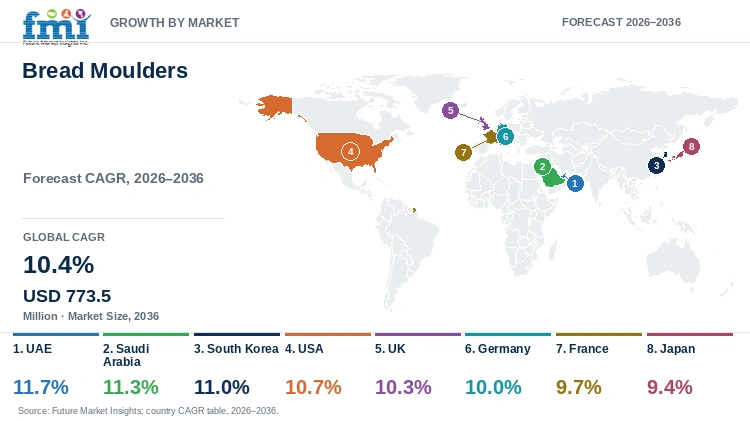
| Country | CAGR, 2026 to 2036 |
|---|---|
| UAE | 11.7% |
| Saudi Arabia | 11.3% |
| South Korea | 11.0% |
| USA | 10.7% |
| UK | 10.3% |
| Germany | 10.0% |
| France | 9.7% |
| Japan | 9.4% |
UAE
The UAE has the highest profiled CAGR at 11.7% for 2026 to 2036, above the global rate of 10.4%. The USDA Foreign Agricultural Service’s April 2026 report forecast wheat imports at 2.0 million tonnes in 2026/27, with white medium hard wheat making up 70.0%. The report covers grain supply, not bread machinery. Hard wheat tends to give strong dough that resists elongation, so a moulder in a new multi-format bakery has to close the seam without tearing. Adjustable moulding can then serve several loaf forms on one installation. However, that holds only while the doughs share enough in hydration and strength. Demand will depend on how many new bakeries plan orientation and pan movement for later varieties.
Saudi Arabia
Saudi Arabia has an 11.3% CAGR outlook from 2026 to 2036, above the global rate of 10.4%. The USDA Foreign Agricultural Service’s April 2026 report put per capita wheat consumption at about 129 kg in 2024/25 and named flat bread the main wheat product. The report describes consumption, not shaping equipment or bakery capacity. A central plant making buns and loaves to recurring specifications has a strong reason to reproduce the same seam and length across shifts. Automated presentation and shaping can support that. However, flat bread is formed on other equipment, so the moulder serves only part of a plant’s output. Demand will depend on how many plants add loaf and bun lines beside flat-bread capacity.
South Korea
South Korea is forecast at 11.0% CAGR during 2026 to 2036, above the global rate of 10.4%. The Korea Times reported in August 2026 that Paris Baguette raised prices by an average 5.0% on 127 products, 86 of them bread. It added that SPC Samlip planned a 9.0% rise on about 50 bread products from 1 September. The article reports prices, not equipment spending, but it shows how broad a chain’s assortment is. Where several loaf weights share a line, a moulder’s adjustment range decides how much of the assortment can stay on that installation. However, a compact arrangement helps only if staff can still reach the shaping components for cleaning. Demand will depend on how many chains keep wide assortments on shared lines.
USA
The USA is projected at 10.7% CAGR over 2026 to 2036, above the global rate of 10.4%. The Bureau of Labor Statistics put whole wheat pan bread at USD 2.814 per pound in May 2026, against USD 1.830 for white, a premium of about 54.0%. The prices show product mix, not machinery. Grupo Bimbo’s announced investment of approximately USD 1.0 billion in the USA for 2026 to 2028 covers maintenance and product innovation.[5] A premium or whole-grain loaf can ask more of the shaping stage than a white pan loaf, because denser dough can respond differently to rolling. However, a moulding order arises only when the installed line lacks that capability. Demand will depend on how many product launches need a change in shaping.
UK
The UK forecast is 10.3% CAGR from 2026 to 2036, slightly below the global rate of 10.4%. UK Flour Millers reported in October 2025 that Group 1 breadmaking varieties fell to 19.0% of wheat area from 24.0% in 2024. Estimated Group 1 production of 2.2 million tonnes was the lowest in over ten years. The briefing concerns wheat supply, not bread machinery. Flour from a changing wheat mix can arrive with different strength, and that reaches the moulder as a change in elasticity. Baker Perkins’ Multitex4 provides a dedicated moulding option within its general-bakery offer,[4] so a plant can renew shaping while leaving adjoining stages in service. Demand will depend on whether a replacement holds seam and length through changes in flour strength.
Germany
Germany has a 10.0% CAGR outlook for 2026 to 2036, below the global rate of 10.4%. The statutory minimum wage rose to EUR 13.90 an hour on 1 January 2026 and is set by federal regulation to reach EUR 14.60 on 1 January 2027. The rate is a pay floor, not a measure of bakery wages or orders. A varied bread programme and a dedicated high-volume loaf line create different moulding opportunities. The former values repeatable adjustment across products, and the latter benefits from holding the same form over a long campaign. However, a scheduled wage step helps the case only where the moulder removes hands-on correction at panning. Demand will depend on how many plants can show that saving for their own bread range.
France
France is forecast at 9.7% CAGR over 2026 to 2036, below the global rate of 10.4%. The Observatoire de la formation des prix et des marges put artisan bakeries at about half of the flour used for bread and industrial bakeries at about 40.0%. The split shows where large moulding lines can be placed, not how many will be bought. MECATHERM’s May 2025 M-RT announcement addresses hydrated, rested dough in industrial crusty-bread production.[1] For a bakery using that process, investment depends on keeping the structure built during fermentation while achieving a repeatable loaf form. However, an artisan bakery working at lower volume may not justify an industrial line. Demand will depend on how many industrial bakeries move crusty-bread lines to gentler shaping.
Japan
Japan is projected at 9.4% CAGR for 2026 to 2036, the lowest profiled rate and below the global 10.4%. Japan’s Ministry of Internal Affairs and Communications reported in February 2026 that food took 28.6% of household spending in 2025, a 44-year high. Food spending rose 5.5% in nominal terms and fell 1.2% in real terms, and the survey does not separate bread. Rising prices with falling real volume can push a bakery toward shorter runs of varied loaves. In a bakery with short runs, each format change consumes shaping time, and a moulder that returns predictably to an earlier setting improves the economics of sharing the line. Demand will depend on whether adjustment method and compatible doughs outweigh speed in replacement decisions.
Who are the notable companies in the bread moulders market?
AMF Bakery Systems; Baker Perkins; MECATHERM; Rheon Automatic Machinery; Glimek
AMF Bakery Systems and Baker Perkins supply dedicated bread moulding equipment. MECATHERM’s M-RT serves industrial crusty bread, Rheon Automatic Machinery offers variety moulding equipment, and Glimek includes moulders in its dough-processing range. These offers address different shaping and handling requirements. Competition turns on how well the design reproduces the customer’s bread and connects to the make-up line.
Uniform loaf form has consequences beyond shaping. Consistent dimensions help later handling, including bakery depanning equipment after baking. This gives the moulder a role in the reliability of the broader bread plant. Suppliers that can trace a forming problem through these later stages are better placed to define the scope of a replacement.
Competitive Benchmarking: Bread Moulders Market
Table 5: Company capabilities in the bread moulders market
| Company | Moulding capability | Buyer evaluation |
|---|---|---|
| AMF Bakery Systems | Bread moulding and make-up systems | Transfer coordination within automated bread lines |
| Baker Perkins | Multitex4 bread moulder | Forming settings and integration with dividing[4] |
| MECATHERM | M-RT industrial bread moulder | Hydrated-dough handling and accessible operation[1] |
| Rheon Automatic Machinery | Variety moulding equipment | Adjustment to the required bread form and recipe |
| Glimek | Bread moulders and dough-processing equipment | Fit with the bakery’s throughput and available layout |
Key Developments in the Bread Moulders Market
- MECATHERM introduced M-RT for industrial crusty-bread production in May 2025. The presentation emphasised limited mechanical action, reduced dusting-flour needs and access for operation, cleaning and maintenance.[1]
- AMF Bakery Systems and Puratos established a joint pilot bakery in New Jersey in June 2025, combining ingredient and equipment expertise for trials of dough preparation and make-up performance.[2]
Key Players in the Bread Moulders Market
- AMF Bakery Systems
- Baker Perkins
- MECATHERM
- Rheon Automatic Machinery
- Glimek
Bread Moulders Market - Report Scope
Table 6: Report scope for the bread moulders market
| Coverage field | Report scope |
|---|---|
| Market breakdown | Equipment Type, Capacity, Automation Level, End User, Sales Channel |
| Quantitative Units | USD Million |
| Market Definition | Revenue from new bread moulders and identifiable bread-moulding modules within compact, mid-capacity and industrial systems. The scope excludes ovens, mixers, packaging machinery, finished bread, maintenance services and resale of machinery previously recorded as new-equipment revenue. |
| Regions Covered | North America, Latin America, Western Europe, Eastern Europe, East Asia, South Asia and Pacific, Middle East and Africa |
| Countries Covered | UAE; Saudi Arabia; South Korea; USA; UK; Germany; France; Japan |
| Key Companies Profiled | AMF Bakery Systems; Baker Perkins; MECATHERM; Rheon Automatic Machinery; Glimek |
| Forecast Period | 2026 to 2036 |
| Approach | Market assessment supported by official technical and regulatory publications, company product information and country operating conditions. |
Bread Moulders Market - Research Methodology
Table 7: Research approach for the bread moulders market
| Method | Approach |
|---|---|
| Equipment scope | Bread moulders and attributable moulding modules are assessed separately from mixing, dividing, proofing, baking and finished bread sales. |
| Product assessment | Official manufacturer descriptions are reviewed for forming arrangements, dough compatibility, adjustment range and cleaning access. |
| Commercial analysis | Purchasing conditions are considered through product variety, line interfaces, installation requirements and the operating schedule of the bakery. |
| Evidence review | Dated company announcements and regulatory guidance support technical context. Forecast values, segment allocations and country rates are checked for consistent presentation. |
Bread Moulders Market by Segments
Equipment Type
- Mid-capacity lines
- Compact / entry systems
- High-capacity industrial lines
Capacity
- 500-2,000 kg/hr
- Below 500 kg/hr
- Above 2,000 kg/hr
Automation Level
- Fully automatic / robotic
- Semi-automatic
- Manual
End User
- Industrial bakeries
- In-store & retail bakeries
- Artisan bakeries
- Foodservice / QSR central kitchens
Sales Channel
- Direct OEM sales
- Dealers & distributors
- Aftermarket & refurbished
Bread Moulders Market by Region
- North America
- United States
- Canada
- Latin America
- Brazil
- Mexico
- Argentina
- Chile
- Western Europe
- Germany
- France
- United Kingdom
- Italy
- Spain
- Benelux
- Nordics
- Eastern Europe
- Poland
- Czech Republic
- Romania
- Hungary
- East Asia
- China
- Japan
- South Korea
- South Asia and Pacific
- India
- ASEAN
- Australia and New Zealand
- Middle East and Africa
- GCC Countries
- South Africa
- Türkiye
- Israel
Research Sources and Bibliography
- [1] MECATHERM. (2025, May 13). New M-RT moulder: Cutting-edge equipment for your crusty breads.
- [2] AMF Bakery Systems. (2025, June 9). AMF and Puratos launch joint pilot bakery facility to accelerate commercial baking innovation.
- [3] U.S. Food and Drug Administration. (n.d.). Current Good Manufacturing Practices for food and dietary supplements.
- [4] Baker Perkins. (n.d.). General bakery equipment.
- [5] Grupo Bimbo. (2026, May 5). Grupo Bimbo announces approximately US $1 billion investment in the United States between 2026 and 2028.
This Report Answers
- How large is the bread moulders market in 2026, and what is its 2036 outlook?
- Which operating pressures make bakers invest in automatic moulding?
- Why do Mid-capacity lines lead Equipment Type?
- Why is 500-2,000 kg/hr the largest Capacity class?
- How do profiled country CAGRs differ from the UAE to Japan?
- Which suppliers provide bread moulders and what should buyers compare during a trial?
Frequently Asked Questions
How big is the bread moulders market in 2026, and what is forecast for 2036?
The global market is valued at USD 287.6 Million in 2026 and is projected to reach USD 773.5 Million by 2036.
What is the forecast CAGR for bread moulders from 2026 to 2036?
The forecast CAGR is 10.4% from 2026 to 2036.
Which Equipment Type segment leads in 2026?
Mid-capacity lines lead Equipment Type with 39.0% of revenue in 2026. Adjustable shaping allows several loaf formats to share the installation.
Which Capacity segment holds the leading position?
500-2,000 kg/hr leads Capacity with 39.0% in 2026. The bread assortment and adjoining proofing and baking stages influence how the capacity is used.
Which profiled countries have the fastest bread moulders market growth?
The UAE has an 11.7% CAGR, followed by Saudi Arabia at 11.3% and South Korea at 11.0%, from 2026 to 2036.
Which companies provide bread moulding equipment?
The report profiles AMF Bakery Systems, Baker Perkins, MECATHERM, Rheon Automatic Machinery and Glimek, covering several forming and handling configurations.
Preview the report firsthand - request a free sample
Get SampleGet the brochure for pricing and purchase details.
Get PDFTable of Content
- Key Takeaways
- Market Size and CAGR
- Top Growth Driver
- Fastest Growing Segment
- Leading Region
- Key Companies
- Emerging Opportunities
- Executive Summary
- Global Market Outlook
- Demand-side Trends
- Supply-side Trends
- Technology Roadmap Analysis
- Analysis and Recommendations
- Analyst Perspective (What is happening? Why now? What should investors know?)
- Key Questions Answered
- How large is the market?
- What is the CAGR?
- What are key trends?
- Which region dominates?
- Who are the leaders?
- Market Overview
- Market Coverage / Taxonomy
- Market Definition / Scope / Limitations
- Research Methodology
- Chapter Orientation
- Analytical Lens and Working Hypotheses
- Market Structure, Signals, and Trend Drivers
- Benchmarking and Cross-market Comparability
- Market Sizing, Forecasting, and Opportunity Mapping
- Research Design and Evidence Framework
- Desk Research Programme (Secondary Evidence)
- Expert Input and Fieldwork (Primary Evidence)
- Tooling, Models, and Reference Databases
- Data Engineering and Model Build
- Quality Assurance and Audit Trail
- Market Background
- Market Dynamics (Drivers, Restraints, Opportunity, Trends)
- Scenario Forecast (Optimistic, Likely, Conservative)
- Impact Analysis
- AI Impact
- Sustainability Impact
- Regulatory Impact
- Technology Impact
- Consumer / Buyer Analysis
- Purchase Drivers
- Adoption Barriers
- Buyer Journey
- Opportunity Map Analysis
- Product Life Cycle Analysis
- Supply Chain Analysis
- Investment Feasibility Matrix
- Value Chain Analysis
- PESTLE and Porter's Analysis
- Regulatory Landscape
- Regional Parent Market Outlook
- Production and Consumption Statistics
- Import and Export Statistics
- Global Market Analysis and Forecast, 2021 to 2036
- Historical Market Size Value (USD Million) Analysis, 2021 to 2025
- Current and Future Market Size Value (USD Million) Projections, 2026 to 2036
- Y-o-Y Growth Trend Analysis
- Absolute $ Opportunity Analysis
- Global Market Pricing Analysis, 2021 to 2036
- Global Market Analysis and Forecast, By Equipment Type, 2021 to 2036
- Introduction / Key Findings
- Historical Market Size Value (USD Million) Analysis By Equipment Type, 2021 to 2025
- Current and Future Market Size Value (USD Million) Analysis and Forecast By Equipment Type, 2026 to 2036
- Mid-capacity lines
- Compact / entry systems
- High-capacity industrial lines
- Y-o-Y Growth Trend Analysis By Equipment Type, 2021 to 2025
- Absolute $ Opportunity Analysis By Equipment Type, 2026 to 2036
- Global Market Analysis and Forecast, By Capacity, 2021 to 2036
- Introduction / Key Findings
- Historical Market Size Value (USD Million) Analysis By Capacity, 2021 to 2025
- Current and Future Market Size Value (USD Million) Analysis and Forecast By Capacity, 2026 to 2036
- 500-2,000 kg/hr
- Below 500 kg/hr
- Above 2,000 kg/hr
- Y-o-Y Growth Trend Analysis By Capacity, 2021 to 2025
- Absolute $ Opportunity Analysis By Capacity, 2026 to 2036
- Global Market Analysis and Forecast, By Automation Level, 2021 to 2036
- Introduction / Key Findings
- Historical Market Size Value (USD Million) Analysis By Automation Level, 2021 to 2025
- Current and Future Market Size Value (USD Million) Analysis and Forecast By Automation Level, 2026 to 2036
- Fully automatic / robotic
- Semi-automatic
- Manual
- Y-o-Y Growth Trend Analysis By Automation Level, 2021 to 2025
- Absolute $ Opportunity Analysis By Automation Level, 2026 to 2036
- Global Market Analysis and Forecast, By End User, 2021 to 2036
- Introduction / Key Findings
- Historical Market Size Value (USD Million) Analysis By End User, 2021 to 2025
- Current and Future Market Size Value (USD Million) Analysis and Forecast By End User, 2026 to 2036
- Industrial bakeries
- In-store & retail bakeries
- Artisan bakeries
- Foodservice / QSR central kitchens
- Y-o-Y Growth Trend Analysis By End User, 2021 to 2025
- Absolute $ Opportunity Analysis By End User, 2026 to 2036
- Global Market Analysis and Forecast, By Sales Channel, 2021 to 2036
- Introduction / Key Findings
- Historical Market Size Value (USD Million) Analysis By Sales Channel, 2021 to 2025
- Current and Future Market Size Value (USD Million) Analysis and Forecast By Sales Channel, 2026 to 2036
- Direct OEM sales
- Dealers & distributors
- Aftermarket & refurbished
- Y-o-Y Growth Trend Analysis By Sales Channel, 2021 to 2025
- Absolute $ Opportunity Analysis By Sales Channel, 2026 to 2036
- Global Market Analysis and Forecast, By Region, 2021 to 2036
- Introduction
- Historical Market Size Value (USD Million) Analysis By Region, 2021 to 2025
- Current Market Size Value (USD Million) Analysis and Forecast By Region, 2026 to 2036
- North America
- Latin America
- Western Europe
- Eastern Europe
- East Asia
- South Asia and Pacific
- Middle East and Africa
- Market Attractiveness Analysis By Region
- North America Market Analysis and Forecast, By Country, 2021 to 2036
- Historical Market Size Value (USD Million) Trend Analysis By Market Taxonomy, 2021 to 2025
- Market Size Value (USD Million) Forecast By Market Taxonomy, 2026 to 2036
- By Country
- United States
- Canada
- By Equipment Type
- By Capacity
- By Automation Level
- By End User
- By Sales Channel
- By Country
- Market Attractiveness Analysis
- By Country
- By Equipment Type
- By Capacity
- By Automation Level
- By End User
- By Sales Channel
- Key Takeaways
- Latin America Market Analysis and Forecast, By Country
- Historical Market Size Value (USD Million) Trend Analysis By Market Taxonomy, 2021 to 2025
- Market Size Value (USD Million) Forecast By Market Taxonomy, 2026 to 2036
- By Country
- Brazil
- Mexico
- Argentina
- Chile
- By Equipment Type
- By Capacity
- By Automation Level
- By End User
- By Sales Channel
- By Country
- Market Attractiveness Analysis
- By Country
- By Equipment Type
- By Capacity
- By Automation Level
- By End User
- By Sales Channel
- Key Takeaways
- Western Europe Market Analysis and Forecast, By Country
- Historical Market Size Value (USD Million) Trend Analysis By Market Taxonomy, 2021 to 2025
- Market Size Value (USD Million) Forecast By Market Taxonomy, 2026 to 2036
- By Country
- Germany
- France
- United Kingdom
- Italy
- Spain
- Benelux
- Nordics
- By Equipment Type
- By Capacity
- By Automation Level
- By End User
- By Sales Channel
- By Country
- Market Attractiveness Analysis
- By Country
- By Equipment Type
- By Capacity
- By Automation Level
- By End User
- By Sales Channel
- Key Takeaways
- Eastern Europe Market Analysis and Forecast, By Country
- Historical Market Size Value (USD Million) Trend Analysis By Market Taxonomy, 2021 to 2025
- Market Size Value (USD Million) Forecast By Market Taxonomy, 2026 to 2036
- By Country
- Poland
- Czech Republic
- Romania
- Hungary
- By Equipment Type
- By Capacity
- By Automation Level
- By End User
- By Sales Channel
- By Country
- Market Attractiveness Analysis
- By Country
- By Equipment Type
- By Capacity
- By Automation Level
- By End User
- By Sales Channel
- Key Takeaways
- East Asia Market Analysis and Forecast, By Country
- Historical Market Size Value (USD Million) Trend Analysis By Market Taxonomy, 2021 to 2025
- Market Size Value (USD Million) Forecast By Market Taxonomy, 2026 to 2036
- By Country
- China
- Japan
- South Korea
- By Equipment Type
- By Capacity
- By Automation Level
- By End User
- By Sales Channel
- By Country
- Market Attractiveness Analysis
- By Country
- By Equipment Type
- By Capacity
- By Automation Level
- By End User
- By Sales Channel
- Key Takeaways
- South Asia and Pacific Market Analysis and Forecast, By Country
- Historical Market Size Value (USD Million) Trend Analysis By Market Taxonomy, 2021 to 2025
- Market Size Value (USD Million) Forecast By Market Taxonomy, 2026 to 2036
- By Country
- India
- ASEAN
- Australia and New Zealand
- By Equipment Type
- By Capacity
- By Automation Level
- By End User
- By Sales Channel
- By Country
- Market Attractiveness Analysis
- By Country
- By Equipment Type
- By Capacity
- By Automation Level
- By End User
- By Sales Channel
- Key Takeaways
- Middle East and Africa Market Analysis and Forecast, By Country
- Historical Market Size Value (USD Million) Trend Analysis By Market Taxonomy, 2021 to 2025
- Market Size Value (USD Million) Forecast By Market Taxonomy, 2026 to 2036
- By Country
- GCC Countries
- South Africa
- Türkiye
- Israel
- By Equipment Type
- By Capacity
- By Automation Level
- By End User
- By Sales Channel
- By Country
- Market Attractiveness Analysis
- By Country
- By Equipment Type
- By Capacity
- By Automation Level
- By End User
- By Sales Channel
- Key Takeaways
- Key Countries Market Analysis
- United States
- Pricing Analysis
- Market Share Analysis, 2025
- By Equipment Type
- By Capacity
- By Automation Level
- By End User
- By Sales Channel
- Canada
- Pricing Analysis
- Market Share Analysis, 2025
- By Equipment Type
- By Capacity
- By Automation Level
- By End User
- By Sales Channel
- Mexico
- Pricing Analysis
- Market Share Analysis, 2025
- By Equipment Type
- By Capacity
- By Automation Level
- By End User
- By Sales Channel
- Brazil
- Pricing Analysis
- Market Share Analysis, 2025
- By Equipment Type
- By Capacity
- By Automation Level
- By End User
- By Sales Channel
- Chile
- Pricing Analysis
- Market Share Analysis, 2025
- By Equipment Type
- By Capacity
- By Automation Level
- By End User
- By Sales Channel
- Germany
- Pricing Analysis
- Market Share Analysis, 2025
- By Equipment Type
- By Capacity
- By Automation Level
- By End User
- By Sales Channel
- United Kingdom
- Pricing Analysis
- Market Share Analysis, 2025
- By Equipment Type
- By Capacity
- By Automation Level
- By End User
- By Sales Channel
- Italy
- Pricing Analysis
- Market Share Analysis, 2025
- By Equipment Type
- By Capacity
- By Automation Level
- By End User
- By Sales Channel
- Spain
- Pricing Analysis
- Market Share Analysis, 2025
- By Equipment Type
- By Capacity
- By Automation Level
- By End User
- By Sales Channel
- France
- Pricing Analysis
- Market Share Analysis, 2025
- By Equipment Type
- By Capacity
- By Automation Level
- By End User
- By Sales Channel
- India
- Pricing Analysis
- Market Share Analysis, 2025
- By Equipment Type
- By Capacity
- By Automation Level
- By End User
- By Sales Channel
- ASEAN
- Pricing Analysis
- Market Share Analysis, 2025
- By Equipment Type
- By Capacity
- By Automation Level
- By End User
- By Sales Channel
- Australia and New Zealand
- Pricing Analysis
- Market Share Analysis, 2025
- By Equipment Type
- By Capacity
- By Automation Level
- By End User
- By Sales Channel
- China
- Pricing Analysis
- Market Share Analysis, 2025
- By Equipment Type
- By Capacity
- By Automation Level
- By End User
- By Sales Channel
- Japan
- Pricing Analysis
- Market Share Analysis, 2025
- By Equipment Type
- By Capacity
- By Automation Level
- By End User
- By Sales Channel
- South Korea
- Pricing Analysis
- Market Share Analysis, 2025
- By Equipment Type
- By Capacity
- By Automation Level
- By End User
- By Sales Channel
- Poland
- Pricing Analysis
- Market Share Analysis, 2025
- By Equipment Type
- By Capacity
- By Automation Level
- By End User
- By Sales Channel
- Hungary
- Pricing Analysis
- Market Share Analysis, 2025
- By Equipment Type
- By Capacity
- By Automation Level
- By End User
- By Sales Channel
- Türkiye
- Pricing Analysis
- Market Share Analysis, 2025
- By Equipment Type
- By Capacity
- By Automation Level
- By End User
- By Sales Channel
- South Africa
- Pricing Analysis
- Market Share Analysis, 2025
- By Equipment Type
- By Capacity
- By Automation Level
- By End User
- By Sales Channel
- UAE
- Pricing Analysis
- Market Share Analysis, 2025
- By Equipment Type
- By Capacity
- By Automation Level
- By End User
- By Sales Channel
- Saudi Arabia
- Pricing Analysis
- Market Share Analysis, 2025
- By Equipment Type
- By Capacity
- By Automation Level
- By End User
- By Sales Channel
- United States
- Market Structure Analysis
- Competition Dashboard
- Competition Benchmarking
- Market Share Analysis of Top Players
- By Regional
- By Equipment Type
- By Capacity
- By Automation Level
- By End User
- By Sales Channel
- Emerging Startups
- Innovation Benchmarking
- Competition Analysis
- Competition Deep Dive
- AMF Bakery Systems
- Overview
- Product Portfolio
- Profitability by Market Segments
- Sales Footprint
- Strategy Overview
- Marketing Strategy
- Product Strategy
- Channel Strategy
- Baker Perkins
- MECATHERM
- Rheon Automatic Machinery
- Glimek
- AMF Bakery Systems
- Case Studies
- Success Stories
- Recent Developments
- Competition Deep Dive
- Assumptions & Acronyms Used


