

- Market Size (2026)
- USD 184.4 Mn
- Forecast (2036)
- USD 474.0 Mn
- CAGR (2026 to 2036)
- 9.9%
How Big is the Bread Topping Seed Blends Market in 2026?
The bread topping seed blends market is estimated at USD 184.4 million in 2026.
The global bread topping seed blends market was valued at USD 167.8 million in 2025 and is estimated to reach USD 184.4 million in 2026. The market is projected to reach USD 474.0 million by 2036, expanding at a compound annual growth rate (CAGR) of 9.9% between 2026 and 2036. Standard grade accounted for the largest share of the market, contributing 40.0% of total revenue in 2026. Demand is supported by bakeries that use prepared seed and grain dressings to give breads and rolls a distinctive crust. Seed supply is broad. According to FAOSTAT data, world sesame production reached 6.7 million tonnes in 2024[6], and international sesame prices fell by USD 1,000.0 to 1,200 per metric ton by September 2025, according to Mundus Agri[5]. Sunflower supply is also ample, as the Food and Agriculture Organization of the United Nations (FAO) reported that sunflower oil prices declined for a third successive month in September 2026 on expectations of ample Black Sea supplies[7]. Prepared mixes simplify application. For instance, Zeelandia's Seedmix combines oat flakes, linseed, sesame and sunflower kernels in a ready-to-use dressing for breads and rolls[3].
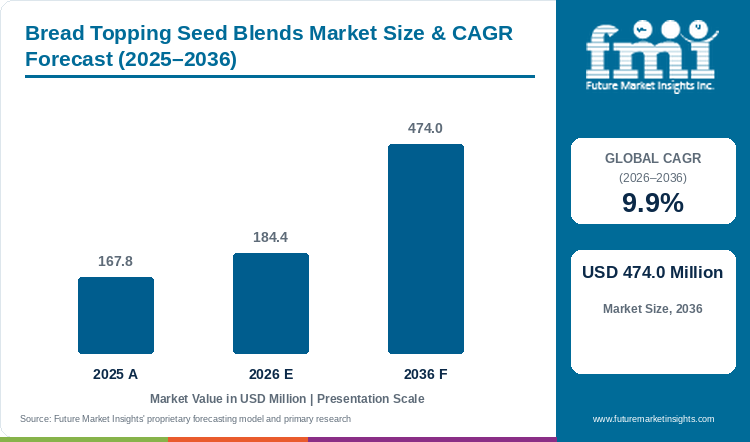
Table 1: Bread Topping Seed Blends Market Size and Forecast (USD million), 2025 to 2036
| Market size and forecast | Value |
|---|---|
| 2025 market size | USD 167.8 million |
| Estimated market size in 2026 | USD 184.4 million |
| Projected market size by 2036 | USD 474.0 million |
| CAGR (2026-2036) | 9.9% |
| Added revenue, 2026 to 2036 | USD 289.6 million |
Key Market Trends & Insights
- By Product Type: The Standard grade segment accounted for the largest share of the bread topping seed blends market in 2026, representing 40.0% of total market revenue.
- By Form: Powder / dry products held the leading market position with a share of 47.0% in 2026, with component size and density influencing flow through topping equipment.
- By Application: Bread & rolls remained the largest application segment, accounting for 30.0% of the market in 2026.
Regional Highlights
- Fastest-growing country: The UAE is expected to record the highest growth rate among the eight profiled countries, with a projected CAGR of 11.3% between 2026 and 2036.
- Growth across other countries: Saudi Arabia is projected to expand at a CAGR of 11.0%, followed by South Korea at 10.7% and the USA at 10.4%. Japan is expected to register comparatively slower growth, with a CAGR of 9.1% during the forecast period.
The cost of seeds remains an important factor influencing blend prices. Mundus Agri reported that natural sesame was quoted at USD 1,320.0 per metric ton and hulled sesame at USD 1,635.0 FOB India in September 2025, following a decline in international prices[5]. China, which consumes an estimated 1.5 million metric tons of sesame a year, imported 1.13 million metric tons in 2024[5], so Asian demand has a strong influence on global sesame prices. FAOSTAT data show that India, Myanmar and Sudan accounted for 33.0% of world sesame output in 2024[6]. A prepared seed dressing connects these ingredient choices with the bakery's application routine, as surface conditions and dough preparation affect adhesion.
Bread costs are rising, which increases interest in higher-value seeded products. The FAO Cereal Price Index stood 17.2% above its year-earlier level in September 2026, with world wheat prices at their highest since August 2023[7]. A seeded crust allows bakeries to differentiate bread and support a higher selling price. IREKS presented surface and grain concepts, including sprouted seed bread, at iba 2025[4]. The opportunity depends on making those differences recognisable without adding disproportionate application work. A finer dressing may suit smaller rolls, while a coarser mixture changes the appearance and bite of a larger loaf, and each must tolerate the handling that follows baking.
Ingredient identity places a further condition on changes to a seed mixture. The US Food and Drug Administration's (FDA) January 2025 guidance addresses allergen labelling, including information relevant to sesame-containing food[1]. In March 2025, the Welsh Government highlighted updated guidance on accessible written allergen information for the out-of-home sector[2]. These requirements concern different markets and routes to sale, but both make an accurate blend description commercially necessary, as a substitution that changes seed composition can alter the declaration as well as colour or flavour.
Table 2: Supporting Industry Indicators for the Bread Topping Seed Blends Market, 2024 to 2026
| Indicator | Data point | Why it matters | Source |
|---|---|---|---|
| World sesame production | World sesame production reached 6.7 million tonnes in 2024. | Sesame is a core component of bread topping blends. | [6] |
| Sesame prices | International sesame prices declined by USD 1,000.0 to 1,200 per metric ton by September 2025. | Lower seed prices ease blend costs. | [5] |
| Sesame quotations | Natural sesame was quoted at USD 1,320.0 and hulled sesame at USD 1,635.0 per metric ton FOB India. | The prices provide a benchmark for blend cost. | [5] |
| Asian demand | China imported 1.13 million metric tons of sesame in 2024 against demand of 1.5 million. | Asian demand affects global seed prices. | [5] |
| Sunflower supply | Sunflower oil prices declined for a third successive month in September 2026 on ample Black Sea supplies. | Ample sunflower supply supports kernel availability. | [7] |
| Wheat prices | The FAO Cereal Price Index stood 17.2% above its year-earlier level in September 2026. | Higher bread costs encourage value-added seeded products. | [7] |
| Prepared dressing | Zeelandia Seedmix combines oat flakes, linseed, sesame and sunflower kernels. | A preblended product reduces component assembly. | [3] |
| Bread development | IREKS included topping variety and sprouted seed bread among its iba 2025 concepts. | Surface and grain differences provide development options. | [4] |
| US allergen guidance | FDA issued Edition 5 of its food allergen labelling guidance in January 2025. | Sesame-containing blends require accurate information. | [1] |
| Out-of-home information | The Welsh Government highlighted updated allergen guidance in March 2025. | Foodservice supply needs accessible ingredient information. | [2] |
Demand Intensity Analysis
A comparison of FMI's market estimate with sesame prices provides a measure of the scale of seed use in bread toppings. At the September 2025 price of USD 1,635.0 per metric ton for hulled sesame[5], FMI's 2025 market value of USD 167.8 million corresponds to approximately 102,600 tonnes of seed. This is equivalent to approximately 1.5% of world sesame production of 6.68 million tonnes in 2024[6]. Since topping blends also contain linseed, sunflower kernels and cereal flakes, and include blending and packaging costs, this is a reference point rather than a measure of actual seed volume.
Input cost trends provide another perspective. International sesame prices fell by USD 1,000.0 to 1,200 per metric ton in 2025[5], and sunflower oil prices declined for three consecutive months to September 2026[7], while wheat prices rose to their highest level since August 2023[7]. As base bread becomes more expensive and seeds become cheaper, the relative cost of adding a seeded finish has fallen, which supports wider use of topping blends.
A similar comparison can be made with the projected growth rate. FMI expects the market to grow at a CAGR of 9.9% between 2026 and 2036, adding USD 289.6 million in revenue. The growth implies wider use of seeded finishes across bread formats, supported by stable seed supply and demand for differentiated bread.
Segment values show where demand is concentrated. Powder / dry accounted for USD 86.7 million in 2026, or 47.0% of the market, while Standard grade represented USD 73.8 million in the separate Product Type dimension. Bread & rolls contributed USD 55.3 million within Application, and Direct to industrial bakeries accounted for USD 99.6 million within Sales Channel. Market revenue is projected to reach 2.6 times its 2026 level by 2036.
Table 3: Demand Intensity Metrics for the Bread Topping Seed Blends Market, Seed Price Data Against 2025 and 2026 Market Values
| Demand intensity metric | Value | Basis |
|---|---|---|
| FMI market value, 2025 | USD 167.8 million | FMI estimate of bread topping seed blend revenue. |
| Hulled sesame price, September 2025 | USD 1,635.0 per metric ton | FOB India. |
| Seed tonnage equivalent of FMI 2025 value | Approximately 102,600 tonnes | USD 167.8 million divided by USD 1,635.0 per metric ton. |
| World sesame production, 2024 | 6.68 million tonnes | FAOSTAT. |
| Equivalent share of world sesame production | Approximately 1.5% | 102,600 tonnes divided by 6.68 million tonnes. |
| Sesame price decline, 2025 | USD 1,000.0 to 1,200 per metric ton | Mundus Agri, September 2025. |
| FAO Cereal Price Index, year-on-year change | +17.2% | September 2026. |
| FMI value CAGR, 2026 to 2036 | 9.9% | FMI market forecast. |
| Powder / dry revenue, 2026 | USD 86.7 million | 47.0% of the market. |
| Direct industrial bakery revenue, 2026 | USD 99.6 million | 54.0% of the market. |
| Market expansion multiple | 2.6 times | Projected 2036 market value relative to 2026. |
Analyst Perspective
"Seeds became cheaper in 2025 while wheat became more expensive, which makes a seeded crust one of the most affordable ways for a bakery to add value to an everyday loaf."
- Nandini Roy Choudhury, Principal Analyst at Future Market Insights
How is the bread topping seed blends market segmented?
The bread topping seed blends market is segmented by product type, form, application, claim and sales channel. Product Type comprises Standard grade, Premium / specialty grade, Organic certified and Clean label grade. Form comprises Powder / dry, Liquid, Paste / semi-solid and Granules / pieces. Application comprises Bread & rolls, Cakes & muffins, Biscuits & cookies, Viennoiserie & pastry and Other bakery & snacks. Claim comprises Conventional, Clean label, Organic and Non-GMO / identity preserved. Sales Channel comprises Direct to industrial bakeries, Ingredient distributors, Foodservice & artisan supply and Online B2B.
Why does Standard grade anchor the Product Type category?
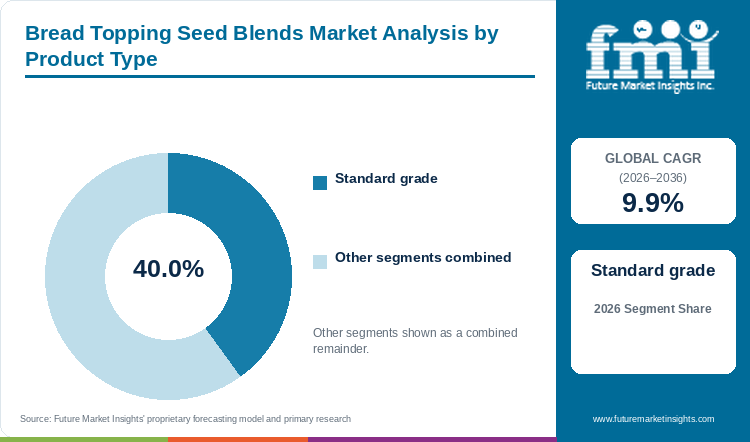
Standard grade accounts for 40.0% of Product Type revenue in 2026.
For a standard seed dressing, the coverage retained on finished bread determines the true cost, and Standard grade generated approximately USD 73.8 million in 2026. Seed dimensions, lot moisture and foreign-material checks form part of the specification, while application rate determines how the blend is used. Small and large components must stay mixed as they move down the hopper, otherwise a correct incoming composition can still produce different surfaces during a run. Lower sesame prices in 2025[5] reduce the cost of the blend, but a low-priced mixture can still become expensive if more of it is lost before packing.
- Standard grade accounts for 40.0% of Product Type revenue in 2026.
- Checking the mixture at application reveals separation that can be missed in the incoming pack.
What keeps Powder / dry ahead within Form?
Powder / dry holds 47.0% of Form revenue in 2026.
Dry blends generated approximately USD 86.7 million in 2026, as they fit ambient storage and weighing without a separate liquid carrier. Their components do not necessarily move together, however, as light flakes and denser kernels can separate during transport or hopper vibration. Checking composition and flow at the applicator outlet reveals that difference. A controlled wetting step can help hold the topping on the dough, while pack size and refill practice affect the consistency of supply to the equipment.
- Powder / dry holds 47.0% of Form revenue in 2026.
- A full hopper run shows how flow, segregation and refill practice affect coverage.
Why are Bread & rolls the largest Application?
Bread & rolls account for 30.0% of Application revenue in 2026.
Loaves and rolls are the largest application, accounting for approximately USD 55.3 million in 2026, as sesame, linseed and sunflower mixtures provide a visible texture on a broad crust. The same dressing can be repeated over large runs or used to distinguish variants from a common bread base. Retention needs to be followed beyond baking, as a neat oven-exit sample may shed seeds during cooling, slicing or bagging. Measuring the coverage retained at packing gives a better indication of what the customer receives.
- Bread & rolls account for 30.0% of Application revenue in 2026.
- Retention after cooling, slicing and bagging determines how much topping reaches the customer.
What sustains the Conventional lead in Claim?
Conventional represents 53.0% of Claim revenue in 2026.
Conventional blends represented 53.0% of Claim revenue in 2026, as they allow seed origins and proportions to be chosen around flavour, cost and availability. That flexibility still requires exact ingredient identity and allergen information, and sesame-containing mixtures need attention under FDA guidance[1]. Organic, clean label and identity-preserved alternatives introduce their own purchasing conditions, which must coexist with uniform application. A claim does not establish how the mixture will flow or how much will remain on the bread.
- Conventional represents 53.0% of Claim revenue in 2026.
- Complete ingredient and allergen records remain necessary for a conventional blend.
How does Direct to industrial bakeries lead Sales Channel?
Direct to industrial bakeries has 54.0% of Sales Channel revenue in 2026.
Bakery groups using one dressing across several factories need purchasing and production to work from the same approved mixture, and direct supply accounted for approximately USD 99.6 million in 2026. Direct supply can align the target composition with hopper settings, surface treatment and acceptable loss at each plant. A crop or source change may alter seed size, colour or flavour, so agreed change procedures are useful before a substitute enters the system. Distributors remain practical for smaller accounts.
- Direct to industrial bakeries has 54.0% of Sales Channel revenue in 2026.
- The agreement can identify permitted substitutions and changes that require another bakery trial.
What are the drivers, restraints and opportunities in the bread topping seed blends market?
A seeded crust adds value to an established bread range, but losses and allergen changes can outweigh a lower bag price, making application-specific blends a stronger development route.
A seeded crust adds value to an established bread range
A surface dressing can give a familiar loaf a visibly different finish while the base dough remains the same. Zeelandia's Seedmix shows this with a ready-to-use mixture of oat flakes, linseed, sesame and sunflower kernels[3]. With wheat prices at their highest level since August 2023[7], bakeries have a stronger reason to add value to bread through finishes that support a higher price. The blend's usefulness depends on its physical behaviour, and connecting the formulation with bakery equipment settings turns a sample loaf into a repeatable method.
Losses and allergen changes can outweigh a lower bag price
Seeds that fall away during conveying, slicing or packing add cost without improving the saleable loaf, so a quotation must be assessed together with these losses. Composition also affects customer information, particularly where sesame is included. FDA's January 2025 guidance addresses allergen labelling, while updated UK guidance summarised by the Welsh Government in March 2025 emphasises accessible written information for the out-of-home sector[1][2]. A replacement must demonstrate retained coverage and a clear ingredient specification before its lower price can be treated as an improvement.
Application-specific blends offer a stronger development route
Bread shape and handling provide useful starting points for developing a seed dressing. A small roll may need fine, even coverage, a rustic loaf can carry a larger-seed appearance, and sliced bread adds another retention test. IREKS included topping variety and sprouted seed bread among its iba 2025 concepts[4]. Turning such variety into a few distinct specifications makes adoption easier, and this can form part of broader bakery ingredient development. Stable seed supply, with sesame production of 6.7 million tonnes in 2024[6], supports the development of new blends.
Which country CAGRs are profiled in the bread topping seed blends market?
Table 4: Country growth outlook for the bread topping seed blends market
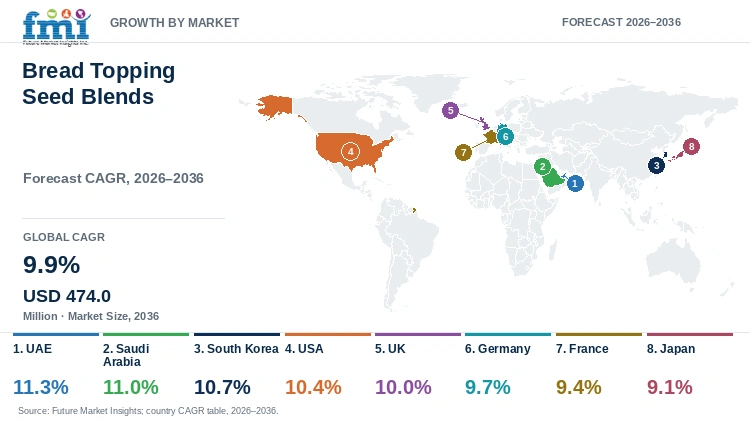
| Country | CAGR |
|---|---|
| UAE | 11.3% |
| Saudi Arabia | 11.0% |
| South Korea | 10.7% |
| USA | 10.4% |
| UK | 10.0% |
| Germany | 9.7% |
| France | 9.4% |
| Japan | 9.1% |
UAE
- The UAE is the fastest-growing market among the profiled countries, with a projected CAGR of 11.3% from 2026 to 2036. Seeded bread supplied to several UAE outlets must keep its finish through different delivery journeys, so trials should follow cooling, packing and distribution. A limited set of dressings that work across rolls, sandwich loaves and larger breads keeps preparation manageable, and maintaining the agreed proportions through replenishment preserves the finish.
Saudi Arabia
- For Saudi chain and industrial bakeries, a seeded concept becomes practical when application weight stays steady across shifts. Saudi Arabia is forecast to grow at a CAGR of 11.0% from 2026 to 2036. Where several formats share a line, trials can establish whether one dressing works throughout or whether smaller rolls need a separate particle specification, and packaging must protect material left between runs.
South Korea
- With a projected CAGR of 10.7% from 2026 to 2036, South Korea ranks third among the profiled countries. The surface of an individually portioned South Korean bread can reveal uneven coverage more readily than a large loaf, so a dressing needs its own size and application-density trial. The assessment can also examine whether seeds interfere with slicing, filling or retail presentation.
USA
- Introducing a sesame topping in a US industrial bakery involves accurate ingredient information as well as an equipment trial, as FDA allergen guidance makes that communication part of approval[1]. The USA is forecast to grow at a CAGR of 10.4% from 2026 to 2036. The dressing must move consistently through the applicator without leaving excessive loose material in the finished pack, and a common specification preserves the bread's identity across sites with different equipment.
UK
- UK foodservice buyers need seeded bread with a topping specification that stays clear through ordering and menu information. Updated guidance highlighted by the Welsh Government in 2025 reinforces the value of accessible written allergen information[2]. The UK is projected to grow at a CAGR of 10.0% from 2026 to 2036. The physical dressing must also stay attached through sandwich preparation, and substitutions should be communicated before use.
Germany
- Germany is forecast to grow at a CAGR of 9.7% from 2026 to 2036. German bakeries that carry several seed and grain finishes face multiplied handling requirements. Organising dressings by texture, visible particle size and coverage gives each mixture a clearer role, and trials then distinguish what works on dense loaves, crusty rolls and sliced bread. Colour after the intended bake also needs attention.
France
- In France, seed dressings distinguish bread variants that share a common production base, provided they complement the crust and remain convenient to cut and serve. France is projected to grow at a CAGR of 9.4% from 2026 to 2036. Comparing application before proofing with later surface treatment helps establish how the chosen blend adheres, and the balance of small seeds and larger kernels matters for sandwich and table bread.
Japan
- Japan is expected to register the slowest growth among the profiled countries, with a forecast CAGR of 9.1% from 2026 to 2036. In smaller Japanese bakery products, topping retention through handling and packing is central to presentation, so trials check whether seeds collect in the bag or change the intended softness. Smaller batches can also favour resealable packs and manageable order quantities.
Who are the notable companies in the bread topping seed blends market?
Zeelandia; Bakels; IREKS; Sonneveld; SwissBake
Zeelandia, Bakels, IREKS, Sonneveld and SwissBake offer dedicated bread decoration mixtures as alternatives to blending individual ingredients at the bakery. Zeelandia's Seedmix combines seeds and cereal flakes in a ready-to-use dressing[3], while IREKS presented new seeded and sprouted grain concepts at iba 2025[4]. Lower sesame prices in 2025[5] may improve margins for blend suppliers. The reliability of the physical mixture is as relevant to comparison as the ingredient list.
Composition, application instructions and pack handling connect a blend with the customer's process. Development alongside bread mixes can support an integrated recipe, although the topping still needs its own adhesion and finished-bread assessment.
Competitive Benchmarking: Bread Topping Seed Blends Market
Table 5: Company capabilities in the bread topping seed blends market
| Company | Product capability | Application emphasis |
|---|---|---|
| Zeelandia | Seedmix ready-to-use seed and cereal blend | Bread and roll decoration |
| Bakels | Seed Topping blend | Bread decoration |
| IREKS | IREKS TOPPING oilseed mix | Bread, rolls and bakery specialties |
| Sonneveld | Bread decoration mixes | Seed and grain finishes |
| SwissBake | Rustic Decor seed and cereal blend | Rustic and artisan-style breads |
Key Developments in the Bread Topping Seed Blends Market
- In January 2025, FDA issued Edition 5 of its food allergen labelling questions and answers, which connects sesame-containing seed dressings with the finished bread's allergen information[1].
- In March 2025, the Welsh Government highlighted updated Food Standards Agency guidance for allergen information in the out-of-home sector[2].
- In 2025, IREKS presented topping variety and sprouted seed bread among its iba concepts[4].
- In September 2025, Mundus Agri reported a decline of USD 1,000.0 to 1,200 per metric ton in international sesame prices[5].
- In October 2026, the FAO reported that sunflower oil prices had declined for a third month on ample Black Sea supplies, while cereal prices rose by 17.2% year on year[7].
- IREKS presented topping variety and sprouted seed bread among its iba 2025 concepts. The examples connect surface dressings with assortment development, with practical adoption dependent on repeatable application in the bakery.[4]
Key Players in the Bread Topping Seed Blends Market
- Zeelandia
- Bakels
- IREKS
- Sonneveld
- SwissBake
Bread Topping Seed Blends Market - Report Scope
Table 6: Report scope for the bread topping seed blends market
| Coverage field | Report scope |
|---|---|
| Market breakdown | Product Type; Form; Application; Claim; Sales Channel |
| Quantitative Units | USD Million |
| Market Definition | Revenue from separately sold formulations primarily intended to deposit edible seed blends on bakery product surfaces, including qualifying dry, liquid, semi-solid and piece formats. Excludes finished baked goods, seed-containing dough mixes not sold as toppings, standalone raw seeds, fruit preparations, chocolate decorations and adjacent finishing systems. For bundled products, only a separately identifiable seed-topping component is counted. |
| Regions Covered | North America: United States, Canada; Latin America: Brazil, Mexico, Argentina, Chile; Western Europe: Germany, France, United Kingdom, Italy, Spain, Benelux, Nordics; Eastern Europe: Poland, Czech Republic, Romania, Hungary; East Asia: China, Japan, South Korea; South Asia and Pacific: India, ASEAN, Australia and New Zealand; Middle East and Africa: GCC Countries, South Africa, Türkiye, Israel |
| Countries Covered | UAE; Saudi Arabia; South Korea; USA; UK; Germany; France; Japan |
| Key Companies Profiled | Zeelandia; Bakels; IREKS; Sonneveld; SwissBake |
| Forecast Period | 2026 to 2036 |
| Approach | Market assessment supported by official technical and regulatory publications, company product information and country operating conditions. |
Bread Topping Seed Blends Market - Research Methodology
Table 7: Research approach for the bread topping seed blends market
| Method | Approach |
|---|---|
| Market definition | The assessment covers prepared seed blends sold for application to bakery surfaces, with standalone seeds and unrelated dough mixes excluded from the defined market. |
| Desk research | Government and regulatory publications, technical literature and official product information establish the application and supply context. |
| Commercial assessment | Commercial analysis considers blend segregation, adhesion, retained application weight, ingredient information and the procurement requirements of bread and roll manufacturers. |
| Comparability | Market values, segment allocations and country growth rates use consistent units and the stated 2026 to 2036 forecast period. Company comparisons describe product roles and purchasing relevance. |
Bread Topping Seed Blends Market by Segments
Product Type
- Standard grade
- Premium / specialty grade
- Organic certified
- Clean label grade
Form
- Powder / dry
- Liquid
- Paste / semi-solid
- Granules / pieces
Application
- Bread & rolls
- Cakes & muffins
- Biscuits & cookies
- Viennoiserie & pastry
- Other bakery & snacks
Claim
- Conventional
- Clean label
- Organic
- Non-GMO / identity preserved
Sales Channel
- Direct to industrial bakeries
- Ingredient distributors
- Foodservice & artisan supply
- Online B2B
Bread Topping Seed Blends Market by Region
- North America
- United States
- Canada
- Latin America
- Brazil
- Mexico
- Argentina
- Chile
- Western Europe
- Germany
- France
- United Kingdom
- Italy
- Spain
- Benelux
- Nordics
- Eastern Europe
- Poland
- Czech Republic
- Romania
- Hungary
- East Asia
- China
- Japan
- South Korea
- South Asia and Pacific
- India
- ASEAN
- Australia and New Zealand
- Middle East and Africa
- GCC Countries
- South Africa
- Türkiye
- Israel
Research Sources and Bibliography
- [1] U.S. Food and Drug Administration. (2025, January). Guidance for industry: Questions and answers regarding food allergen labeling (Edition 5).
- [2] Welsh Government, Business Wales. (2025, March 18). Updated industry guidance issued for food allergen information in the out-of-home sector.
- [3] Zeelandia International. (n.d.). Seedmix.
- [4] IREKS. (2025). iba 2025.
- [5] Mundus Agri. (2025, September 18). Sesame seeds: China's imports exceed 1 million mt.
- [6] Food and Agriculture Organization of the United Nations. (2026). FAOSTAT. Crops and livestock products: Sesame seed production, 2024.
- [7] Food and Agriculture Organization of the United Nations. (2026, October 2). FAO Food Price Index.
Future Market Insights. (2026). Bread Topping Seed Blends Market: Global Industry Analysis and Opportunity Assessment 2036.
This Report Answers
- What are the bread topping seed blends market values in 2026 and 2036?
- Which bakery assortment and production pressures support demand for seed toppings?
- Why does Standard grade lead the Product Type category?
- What makes Powder / dry the leading Form?
- How do the eight profiled country growth rates compare?
- Which suppliers provide seed blends for bakery surface decoration?
Frequently Asked Questions
How big is the bread topping seed blends market in 2026, and what is forecast for 2036?
The market is valued at USD 184.4 million in 2026 and is forecast to reach USD 474.0 million by 2036.
What is the CAGR of the bread topping seed blends market from 2026 to 2036?
The market is forecast to grow at a CAGR of 9.9% from 2026 to 2036.
Which Product Type segment leads the bread topping seed blends market?
Standard grade leads Product Type with a 40.0% share in 2026.
Which Form segment leads the bread topping seed blends market?
Powder / dry leads Form with a 47.0% share in 2026.
Which profiled countries have the highest bread topping seed blends growth rates?
The UAE leads at 11.3%, followed by Saudi Arabia at 11.0% and South Korea at 10.7% from 2026 to 2036.
Which companies participate in the bread topping seed blends market?
The report profiles Zeelandia, Bakels, IREKS, Sonneveld and SwissBake, which offer dedicated seed or cereal mixtures for bakery surface decoration.
Preview the report firsthand - request a free sample
Get SampleGet the brochure for pricing and purchase details.
Get PDFTable of Content
- Key Takeaways
- Market Size and CAGR
- Top Growth Driver
- Fastest Growing Segment
- Leading Region
- Key Companies
- Emerging Opportunities
- Executive Summary
- Global Market Outlook
- Demand-side Trends
- Supply-side Trends
- Technology Roadmap Analysis
- Analysis and Recommendations
- Analyst Perspective (What is happening? Why now? What should investors know?)
- Key Questions Answered
- How large is the market?
- What is the CAGR?
- What are key trends?
- Which region dominates?
- Who are the leaders?
- Market Overview
- Market Coverage / Taxonomy
- Market Definition / Scope / Limitations
- Research Methodology
- Chapter Orientation
- Analytical Lens and Working Hypotheses
- Market Structure, Signals, and Trend Drivers
- Benchmarking and Cross-market Comparability
- Market Sizing, Forecasting, and Opportunity Mapping
- Research Design and Evidence Framework
- Desk Research Programme (Secondary Evidence)
- Expert Input and Fieldwork (Primary Evidence)
- Tooling, Models, and Reference Databases
- Data Engineering and Model Build
- Quality Assurance and Audit Trail
- Market Background
- Market Dynamics (Drivers, Restraints, Opportunity, Trends)
- Scenario Forecast (Optimistic, Likely, Conservative)
- Impact Analysis
- AI Impact
- Sustainability Impact
- Regulatory Impact
- Technology Impact
- Consumer / Buyer Analysis
- Purchase Drivers
- Adoption Barriers
- Buyer Journey
- Opportunity Map Analysis
- Product Life Cycle Analysis
- Supply Chain Analysis
- Investment Feasibility Matrix
- Value Chain Analysis
- PESTLE and Porter's Analysis
- Regulatory Landscape
- Regional Parent Market Outlook
- Production and Consumption Statistics
- Import and Export Statistics
- Global Market Analysis and Forecast, 2021 to 2036
- Historical Market Size Value (USD Million) Analysis, 2021 to 2025
- Current and Future Market Size Value (USD Million) Projections, 2026 to 2036
- Y-o-Y Growth Trend Analysis
- Absolute $ Opportunity Analysis
- Global Market Pricing Analysis, 2021 to 2036
- Global Market Analysis and Forecast, By Product Type, 2021 to 2036
- Introduction / Key Findings
- Historical Market Size Value (USD Million) Analysis By Product Type, 2021 to 2025
- Current and Future Market Size Value (USD Million) Analysis and Forecast By Product Type, 2026 to 2036
- Standard grade
- Premium / specialty grade
- Organic certified
- Clean label grade
- Y-o-Y Growth Trend Analysis By Product Type, 2021 to 2025
- Absolute $ Opportunity Analysis By Product Type, 2026 to 2036
- Global Market Analysis and Forecast, By Form, 2021 to 2036
- Introduction / Key Findings
- Historical Market Size Value (USD Million) Analysis By Form, 2021 to 2025
- Current and Future Market Size Value (USD Million) Analysis and Forecast By Form, 2026 to 2036
- Powder / dry
- Liquid
- Paste / semi-solid
- Granules / pieces
- Y-o-Y Growth Trend Analysis By Form, 2021 to 2025
- Absolute $ Opportunity Analysis By Form, 2026 to 2036
- Global Market Analysis and Forecast, By Application, 2021 to 2036
- Introduction / Key Findings
- Historical Market Size Value (USD Million) Analysis By Application, 2021 to 2025
- Current and Future Market Size Value (USD Million) Analysis and Forecast By Application, 2026 to 2036
- Bread & rolls
- Cakes & muffins
- Biscuits & cookies
- Viennoiserie & pastry
- Other bakery & snacks
- Y-o-Y Growth Trend Analysis By Application, 2021 to 2025
- Absolute $ Opportunity Analysis By Application, 2026 to 2036
- Global Market Analysis and Forecast, By Claim, 2021 to 2036
- Introduction / Key Findings
- Historical Market Size Value (USD Million) Analysis By Claim, 2021 to 2025
- Current and Future Market Size Value (USD Million) Analysis and Forecast By Claim, 2026 to 2036
- Conventional
- Clean label
- Organic
- Non-GMO / identity preserved
- Y-o-Y Growth Trend Analysis By Claim, 2021 to 2025
- Absolute $ Opportunity Analysis By Claim, 2026 to 2036
- Global Market Analysis and Forecast, By Sales Channel, 2021 to 2036
- Introduction / Key Findings
- Historical Market Size Value (USD Million) Analysis By Sales Channel, 2021 to 2025
- Current and Future Market Size Value (USD Million) Analysis and Forecast By Sales Channel, 2026 to 2036
- Direct to industrial bakeries
- Ingredient distributors
- Foodservice & artisan supply
- Online B2B
- Y-o-Y Growth Trend Analysis By Sales Channel, 2021 to 2025
- Absolute $ Opportunity Analysis By Sales Channel, 2026 to 2036
- Global Market Analysis and Forecast, By Region, 2021 to 2036
- Introduction
- Historical Market Size Value (USD Million) Analysis By Region, 2021 to 2025
- Current Market Size Value (USD Million) Analysis and Forecast By Region, 2026 to 2036
- North America
- Latin America
- Western Europe
- Eastern Europe
- East Asia
- South Asia and Pacific
- Middle East and Africa
- Market Attractiveness Analysis By Region
- North America Market Analysis and Forecast, By Country, 2021 to 2036
- Historical Market Size Value (USD Million) Trend Analysis By Market Taxonomy, 2021 to 2025
- Market Size Value (USD Million) Forecast By Market Taxonomy, 2026 to 2036
- By Country
- United States
- Canada
- By Product Type
- By Form
- By Application
- By Claim
- By Sales Channel
- By Country
- Market Attractiveness Analysis
- By Country
- By Product Type
- By Form
- By Application
- By Claim
- By Sales Channel
- Key Takeaways
- Latin America Market Analysis and Forecast, By Country
- Historical Market Size Value (USD Million) Trend Analysis By Market Taxonomy, 2021 to 2025
- Market Size Value (USD Million) Forecast By Market Taxonomy, 2026 to 2036
- By Country
- Brazil
- Mexico
- Argentina
- Chile
- By Product Type
- By Form
- By Application
- By Claim
- By Sales Channel
- By Country
- Market Attractiveness Analysis
- By Country
- By Product Type
- By Form
- By Application
- By Claim
- By Sales Channel
- Key Takeaways
- Western Europe Market Analysis and Forecast, By Country
- Historical Market Size Value (USD Million) Trend Analysis By Market Taxonomy, 2021 to 2025
- Market Size Value (USD Million) Forecast By Market Taxonomy, 2026 to 2036
- By Country
- Germany
- France
- United Kingdom
- Italy
- Spain
- Benelux
- Nordics
- By Product Type
- By Form
- By Application
- By Claim
- By Sales Channel
- By Country
- Market Attractiveness Analysis
- By Country
- By Product Type
- By Form
- By Application
- By Claim
- By Sales Channel
- Key Takeaways
- Eastern Europe Market Analysis and Forecast, By Country
- Historical Market Size Value (USD Million) Trend Analysis By Market Taxonomy, 2021 to 2025
- Market Size Value (USD Million) Forecast By Market Taxonomy, 2026 to 2036
- By Country
- Poland
- Czech Republic
- Romania
- Hungary
- By Product Type
- By Form
- By Application
- By Claim
- By Sales Channel
- By Country
- Market Attractiveness Analysis
- By Country
- By Product Type
- By Form
- By Application
- By Claim
- By Sales Channel
- Key Takeaways
- East Asia Market Analysis and Forecast, By Country
- Historical Market Size Value (USD Million) Trend Analysis By Market Taxonomy, 2021 to 2025
- Market Size Value (USD Million) Forecast By Market Taxonomy, 2026 to 2036
- By Country
- China
- Japan
- South Korea
- By Product Type
- By Form
- By Application
- By Claim
- By Sales Channel
- By Country
- Market Attractiveness Analysis
- By Country
- By Product Type
- By Form
- By Application
- By Claim
- By Sales Channel
- Key Takeaways
- South Asia and Pacific Market Analysis and Forecast, By Country
- Historical Market Size Value (USD Million) Trend Analysis By Market Taxonomy, 2021 to 2025
- Market Size Value (USD Million) Forecast By Market Taxonomy, 2026 to 2036
- By Country
- India
- ASEAN
- Australia and New Zealand
- By Product Type
- By Form
- By Application
- By Claim
- By Sales Channel
- By Country
- Market Attractiveness Analysis
- By Country
- By Product Type
- By Form
- By Application
- By Claim
- By Sales Channel
- Key Takeaways
- Middle East and Africa Market Analysis and Forecast, By Country
- Historical Market Size Value (USD Million) Trend Analysis By Market Taxonomy, 2021 to 2025
- Market Size Value (USD Million) Forecast By Market Taxonomy, 2026 to 2036
- By Country
- GCC Countries
- South Africa
- Türkiye
- Israel
- By Product Type
- By Form
- By Application
- By Claim
- By Sales Channel
- By Country
- Market Attractiveness Analysis
- By Country
- By Product Type
- By Form
- By Application
- By Claim
- By Sales Channel
- Key Takeaways
- Key Countries Market Analysis
- United States
- Pricing Analysis
- Market Share Analysis, 2025
- By Product Type
- By Form
- By Application
- By Claim
- By Sales Channel
- Canada
- Pricing Analysis
- Market Share Analysis, 2025
- By Product Type
- By Form
- By Application
- By Claim
- By Sales Channel
- Mexico
- Pricing Analysis
- Market Share Analysis, 2025
- By Product Type
- By Form
- By Application
- By Claim
- By Sales Channel
- Brazil
- Pricing Analysis
- Market Share Analysis, 2025
- By Product Type
- By Form
- By Application
- By Claim
- By Sales Channel
- Chile
- Pricing Analysis
- Market Share Analysis, 2025
- By Product Type
- By Form
- By Application
- By Claim
- By Sales Channel
- Germany
- Pricing Analysis
- Market Share Analysis, 2025
- By Product Type
- By Form
- By Application
- By Claim
- By Sales Channel
- United Kingdom
- Pricing Analysis
- Market Share Analysis, 2025
- By Product Type
- By Form
- By Application
- By Claim
- By Sales Channel
- Italy
- Pricing Analysis
- Market Share Analysis, 2025
- By Product Type
- By Form
- By Application
- By Claim
- By Sales Channel
- Spain
- Pricing Analysis
- Market Share Analysis, 2025
- By Product Type
- By Form
- By Application
- By Claim
- By Sales Channel
- France
- Pricing Analysis
- Market Share Analysis, 2025
- By Product Type
- By Form
- By Application
- By Claim
- By Sales Channel
- India
- Pricing Analysis
- Market Share Analysis, 2025
- By Product Type
- By Form
- By Application
- By Claim
- By Sales Channel
- ASEAN
- Pricing Analysis
- Market Share Analysis, 2025
- By Product Type
- By Form
- By Application
- By Claim
- By Sales Channel
- Australia and New Zealand
- Pricing Analysis
- Market Share Analysis, 2025
- By Product Type
- By Form
- By Application
- By Claim
- By Sales Channel
- China
- Pricing Analysis
- Market Share Analysis, 2025
- By Product Type
- By Form
- By Application
- By Claim
- By Sales Channel
- Japan
- Pricing Analysis
- Market Share Analysis, 2025
- By Product Type
- By Form
- By Application
- By Claim
- By Sales Channel
- South Korea
- Pricing Analysis
- Market Share Analysis, 2025
- By Product Type
- By Form
- By Application
- By Claim
- By Sales Channel
- Poland
- Pricing Analysis
- Market Share Analysis, 2025
- By Product Type
- By Form
- By Application
- By Claim
- By Sales Channel
- Hungary
- Pricing Analysis
- Market Share Analysis, 2025
- By Product Type
- By Form
- By Application
- By Claim
- By Sales Channel
- Türkiye
- Pricing Analysis
- Market Share Analysis, 2025
- By Product Type
- By Form
- By Application
- By Claim
- By Sales Channel
- South Africa
- Pricing Analysis
- Market Share Analysis, 2025
- By Product Type
- By Form
- By Application
- By Claim
- By Sales Channel
- UAE
- Pricing Analysis
- Market Share Analysis, 2025
- By Product Type
- By Form
- By Application
- By Claim
- By Sales Channel
- Saudi Arabia
- Pricing Analysis
- Market Share Analysis, 2025
- By Product Type
- By Form
- By Application
- By Claim
- By Sales Channel
- United States
- Market Structure Analysis
- Competition Dashboard
- Competition Benchmarking
- Market Share Analysis of Top Players
- By Regional
- By Product Type
- By Form
- By Application
- By Claim
- By Sales Channel
- Emerging Startups
- Innovation Benchmarking
- Competition Analysis
- Competition Deep Dive
- Zeelandia
- Overview
- Product Portfolio
- Profitability by Market Segments
- Sales Footprint
- Strategy Overview
- Marketing Strategy
- Product Strategy
- Channel Strategy
- Bakels
- IREKS
- Sonneveld
- SwissBake
- Zeelandia
- Case Studies
- Success Stories
- Recent Developments
- Competition Deep Dive
- Assumptions & Acronyms Used


