

- Market Size (2026)
- USD 118.0 Mn
- Forecast (2036)
- USD 373.2 Mn
- CAGR (2026 to 2036)
- 12.2%
How big is Seed Mineral Coatings Market in 2026?
Demand for seed mineral coatings is projected to expand at 12.2% CAGR between 2026 and 2036. Industry value grows from USD 105.2 million in 2025 to USD 118.0 million in 2026 and is projected to reach USD 373.2 million by 2036.
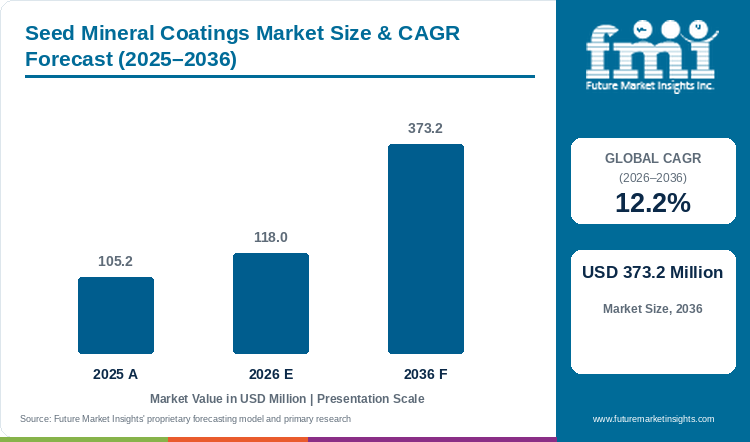
Seed mineral coatings are used for placing minerals, nutrients, and compatible microorganisms directly on seed. The global seed mineral coatings market was valued at USD 105.2 million in 2025 and is projected to grow from USD 118.0 million in 2026 to USD 373.2 million by 2036, at 12.2% CAGR from 2026 to 2036. Polymer-based systems accounted for 49.8% of demand in 2026, owing to better adhesion and easy movement of treated seed. USDA estimated 95.3 million corn acres in the USA during 2026 and biotech varieties covered 92% of this area [1]. Such broad commercial seed volume provides recurring lots for specialized seed treatment materials. Applying nutrients and protective layers directly on seed reduces separate field passes while supporting early crop establishment. Increasing commercial seed volumes and precision planting standards are expected to support seed mineral coatings market expansion through 2036.
Key Market Trends & Insights
- By product type: Polymer-based systems accounted for 49.8% of demand in 2026, owing to adhesion, dust control and easy movement of treated seed.
- By crop type: Corn and cereals represented the leading 43.8% share in 2026, driven by high seed volume and recurring treatment across broad-acre crops.
- By treatment point: In-plant treatment held 46.9% in 2026, as calibrated lines can control dose, coverage and drying before seed distribution.
- By formulation: Liquid slurries accounted for 49.3% in 2026, supported by low-dose metering and even spread over the seed surface.
- By sales channel: Agri-input distributors led with 43.9% in 2026, as growers generally purchase treatment products and fertility inputs through the same local supplier.
Regional Highlights
- Fastest-growing profiled country: South Korea, at 11.7% CAGR from 2026 to 2036.
- By country: The USA, at 11.4%, and Germany, at 11.1%, follow, while Japan records the lowest profiled CAGR at 10.1%.
Market Size & Forecast
Table 1: Market Size and Forecast for the Seed Mineral Coatings Market (USD million and CAGR percentage), 2025 to 2036
| Metric | Value |
|---|---|
| 2025 Market Size | USD 105.2 million |
| Estimated Market Size in 2026 | USD 118.0 million |
| Projected Market Size by 2036 | USD 373.2 million |
| CAGR, 2026 to 2036 | 12.2% |
| Added Revenue, 2026 to 2036 | USD 255.2 million |
| Market Expansion Multiple | 3.16x |
Seed mineral coating suppliers are developing multifunctional layers that carry active micronutrients without reducing germination or seed flowability. In October 2026, the Food and Agriculture Organization forecast world cereal production at 2,979 million tonnes [17]. Such extensive broad-acre cereal cultivation requires dependable seed nutrient coatings that ensure uniform low-dose delivery across high-throughput commercial seed lines. According to FMI, liquid and polymer formulations are increasingly engineered to maintain microbial viability during warehouse storage and automated planting. Rising quality expectations from commercial treaters are expected to drive demand for validated seed mineral coatings through 2036.
Treated Acreage and Commercial Readiness
Table 2: Treated-Acreage and Commercial-Readiness Indicators for the Seed Mineral Coatings Market (acres, hectares, cultures, percentages, tonnes, and compliance dates), mixed reporting years from 2025 to 2026
| Indicator | Data Point | Why It Matters | Source |
|---|---|---|---|
| USA corn base | 95.3 million acres; 92% biotech in 2026 | Large recurring seed volume supports commercial treatment and repeat coating recipes. | [1] |
| EU cereal output | 287.3 million tonnes in 2025/2026 | Broad cereal production increases the number of seed lots prepared for planting. | [11] |
| England cereal area | 2.4 million hectares; down 5.1% in 2026 | Lower acreage raises the performance requirement from each treated lot. | [7] |
| South Korea microbial resource | More than 29,000 cultures; over 3,900 distributed annually | Local research resources support development of microbial coating formulations. | [9] |
| Biodegradable coating trials | 12% to 37% productivity gains | Measured field performance provides a route for nutrient and microbial loading. | [3] |
| Microplastics reporting | First reports due 31 May 2026 | Composition and emission records can influence synthetic polymer selection. | [6] |
Basis: The indicators combine government, regulator and official research data. These figures do not represent direct coated acreage. They show crop volume, research resources and compliance conditions supporting commercial demand.
Analyst Perspective
“Commercial demand will move towards coatings which retain active loading and seed flow from treatment until planting. Biodegradable layers carrying minerals and microorganisms are expected to form the strongest product opportunity through 2036.”
- Nandini Roy Choudhury, Principal Consultant, Future Market Insights.
How is the seed mineral coatings market segmented?
Seed Mineral Coatings Market is segmented across five primary commercial axes and region: Product Type, Crop Type, Treatment Point, Formulation, Sales Channel, and Region. In 2026, polymer-based systems are estimated to hold 49.8% of Product Type revenue, corn and cereals 43.8% of Crop Type, in-plant treatment 46.9% of Treatment Point, liquid slurries 49.3% of Formulation, and agri-input distributors 43.9% of Sales Channel.
The market is segmented five ways, with Region providing the geographic framework for the 2026 to 2036 forecast. Product Type covers the coating material chemistry, spanning polymer-based systems, biological and microbial systems, nutrient-loaded formulations, and other functional carriers. Crop Type divides commercial demand across major agricultural crops, including corn and cereals, soybean and pulses, vegetables, and cotton. Treatment Point describes where coating application occurs, distinguishing in-plant seed facilities from commercial seed treaters and on-farm operations. Formulation covers the physical delivery form, encompassing liquid slurries, dry powders, and film coats. Sales Channel defines the commercial route to growers, running from agri-input distributors and cooperatives to agri-retail chains and direct-to-farm routes.
Why do polymer-based systems retain product type demand?
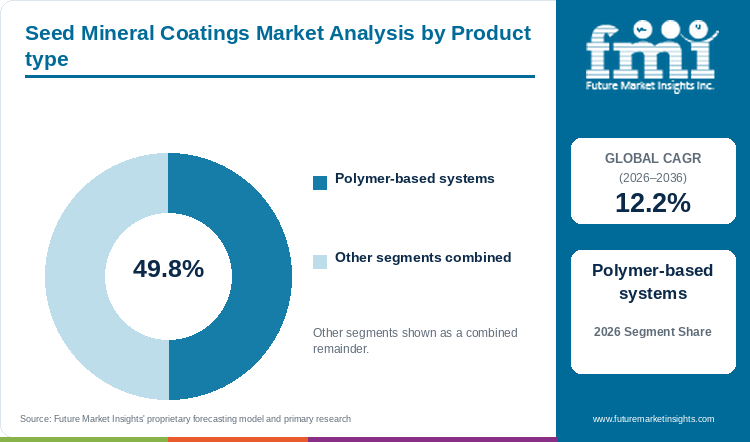
Polymer-based systems are projected to capture 49.8% of product type revenue in 2026, supported by improved adhesion and seed handling.
Table 3: Product Type Share for the Seed Mineral Coatings Market (percentage share), 2026
| Product Type | Share (2026) |
|---|---|
| Polymer-Based Systems | 49.8% |
| Other Segments Combined | 50.2%* |
| Total | 100.0% |
*Calculated as the balance remaining after deducting the leading segment's reported share from 100.0%.
Table 4: Product Type Leadership and Market Growth for the Seed Mineral Coatings Market (segment and CAGR percentage), 2026 to 2036
| Metric | Value |
|---|---|
| Global CAGR (2026 to 2036) | 12.2% |
| Leading Segment | Polymer-Based Systems |
Polymer-based systems are used for keeping minerals, micronutrients and compatible biological inputs attached on seed. The polymer layer provides uniform coverage and reduces loss of material through dust during handling. It also allows treated seed to move through processing and planting equipment without affecting seed flow. In addition, commercial treaters utilize biological seed carriers to ensure stable loading and active ingredient retention. Owing to these properties, polymer-based systems are expected to retain higher demand during the forecast period.
- As per the analysis from FMI, polymer-based systems are projected to hold 49.8% of product type demand in 2026, owing to adhesion and easy seed handling.
- In June 2026, ICAR-IIOR reported a patented biodegradable biopolymer seed coating carrying nutrients, micronutrients and beneficial microorganisms. Multi-location trials reported 12% to 37% productivity gains over untreated seed [3]. Ability of one biodegradable layer to carry different functional inputs is expected to increase the development of polymer-based seed coatings.
What supports corn and cereals as a preferred crop category?
Corn and cereals are estimated to hold 43.8% of crop type demand in 2026, driven by broad-acre treatment volumes.
Corn and cereals are treated in large volume through established commercial seed facilities. One coating recipe can be applied on repeated seed lots, due to which manufacturers can maintain similar dose and surface coverage. Commercial programs also integrate microbial seed primers to improve early root development and seedling vigor. Corn and cereal seeds also move through different planters, therefore the coating needs to suit seed size, drying requirement and equipment flow. These factors are anticipated to support demand for corn and cereals over the forecast period.
- In the FMI report, corn and cereals are estimated to account for 43.8% of crop type demand in 2026, attributed to repeat broad-acre treatment volumes.
- The European Commission projected 287.4 million tonnes of cereal production in the EU for 2025/2026 [11]. Presence of a broad cereal crop base increases the number of seed lots moving through commercial preparation, which is anticipated to support demand for repeatable seed coating materials.
How does in-plant treatment improve application control?
In-plant treatment is expected to secure 46.9% of treatment point demand in 2026, enabled by calibrated metering and lot control.
In-plant treatment applies mineral and biological coating as a controlled step before seed distribution. Seed companies can measure the recipe for every lot and can inspect coverage, drying and flow before treated seed reaches farm. Treating facilities frequently apply seed stress protectors during early batching to safeguard germination under challenging field conditions. Presence of calibrated treatment equipment reduces differences in application and is expected to drive the in-plant treatment segment.
- As noted by FMI, in-plant treatment is expected to represent 46.9% of treatment point demand in 2026, as calibrated lines provide better dose control.
- In May 2026, BASF commissioned its BioHub fermentation plant at Ludwigshafen for biological crop-protection and seed-treatment inputs [4]. Increasing availability of biological ingredients from integrated manufacturing sites is likely to support their use in commercial seed-treatment recipes.
Why do liquid slurries fit commercial formulation needs?
In 2026, liquid slurries are forecast to command 49.3% of formulation demand, aided by metered blending and uniform coverage.
Liquid slurries combine minerals, polymers and compatible biological ingredients in one formulation. The liquid form spreads easily on seed surfaces and can be measured at low doses through commercial treatment equipment. Formulators also incorporate biofertilizer formulations into liquid slurries to enhance rhizosphere nutrient availability without clogging spray nozzles. However, high viscosity, slow drying and biological viability can affect processing speed. Controlled application and easy blending are anticipated to support liquid slurry demand.
- FMI research indicates that liquid slurries will hold 49.3% of formulation demand in 2026, as metering systems distribute low-dose ingredients evenly.
- In June 2026, Novonesis and Rovensa Next entered into a U.S. distribution agreement for selected biosolutions from the 2027 season, including products used from seed treatment onward [5]. Wider distribution of biological products is expected to increase product availability through retailers and support their use in liquid seed-treatment programs.
Which channel keeps agri-input distributors commercially relevant?
Agri-input distributors are set to lead sales channel with 43.9% share in 2026, underpinned by local agronomy access.
Agri-input distributors connect seed treatment products with local crop plans and fertility programs. Growers generally require guidance regarding dose, crop use and equipment compatibility before using mineral or microbial coatings. Distributors also supply agricultural surfactants and adjuvant packages that improve droplet retention and coating spread on commercial lines. Availability of local agronomic support and reliable product access is expected to propel demand through this sales channel.
- FMI data suggests that agri-input distributors will hold 43.9% of sales channel demand in 2026, because growers often purchase treatment and fertility inputs together.
- In March 2026, Rovensa Next launched Otimais Duo after 94 field trials on 10 crops in seven countries [12]. Availability of crop-based field results supports local distributors in explaining use of microbial nutrition products, which is expected to strengthen demand through agri-input distribution.
What are the drivers, restraints, and opportunities in the seed mineral coatings market?
In the seed mineral coatings market, targeted input placement and seed efficiency support demand, recipe qualification and storage constraints limit adoption, and biodegradable multifunctional formulations provide the primary commercial opportunity.
- Driver: Seed-applied delivery can place a low-volume input during an existing treatment or planting operation.
- Restraint: Coating recipes must preserve germination, loading, flowability and biological viability through storage.
- Opportunity: Biodegradable layers can combine minerals, microorganisms and crop-protection functions in one application.
Targeted Placement Uses Existing Operations
Seed-applied coating places mineral or biological inputs during treatment operations already performed by seed companies. Sowing treated seed allows soil pathogen inhibitors and nutrient complexes to be delivered directly to the root zone without requiring separate field passes. Defra reported that the UK produced just over 19.5 million tonnes of cereals in 2025 [13]. Recurring cereal production creates a large volume of seed lots that can receive low-volume inputs before planting. Increasing requirements for reducing separate field handling and placing inputs close to seed are expected to drive the seed mineral coatings market.
Recipe Qualification Constrains Line Adoption
Seed mineral coatings must retain germination, active loading and seed flow through treatment, storage and planting. Coatings creating higher dust, slow drying or poor flow can limit adoption on high-speed commercial lines. The European Chemicals Agency states that annual microplastics reporting started in 2026 for specified industrial users, with reports due by 31 May for emissions from the previous year [6]. Increasing documentation requirements for synthetic polymer microparticles may raise formulation and compliance costs, which can constrain seed mineral coatings market growth.
Biodegradable Layers Expand Functional Delivery
Biodegradable multifunctional coatings are creating opportunities for combining nutrients, microorganisms and crop-protection functions in one layer. In April 2026, Incotec launched a microplastic-free film coat for cereal seed [14]. Development of such coatings indicates that seed-treatment suppliers are moving towards material systems that provide coating performance without restricted microplastic chemistry. Commercial treaters are also testing microbial disease suppressors within multifunctional layers to safeguard early crop emergence. Products retaining seed safety, coating adhesion and flow after combining these inputs are expected to witness higher demand over the forecast period.
Which country CAGRs are profiled in the seed mineral coatings market?
Table 5: Country CAGR Comparison for the Seed Mineral Coatings Market (CAGR percentage), 2026 to 2036
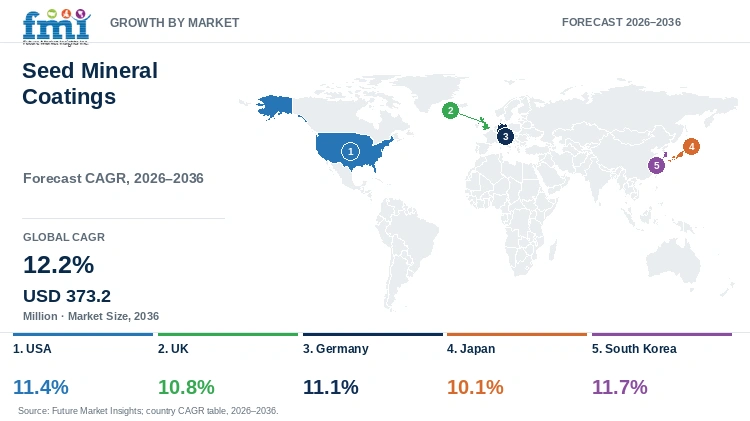
| Country | CAGR |
|---|---|
| USA | 11.4% |
| UK | 10.8% |
| Germany | 11.1% |
| Japan | 10.1% |
| South Korea | 11.7% |
How do country-level CAGRs compare in the seed mineral coatings market?
As per FMI, country growth remains within a narrow range, however factors supporting demand are different across the profiled markets as crop acreage, treatment infrastructure, and local regulatory requirements vary. South Korea and the USA lead projected expansion, while Germany and the UK develop through demanding environmental and quality standards, and Japan focuses on high-precision biotechnology applications.
Country-wise Analysis
- Seed mineral coating demand in the USA is forecast to rise at 11.4% CAGR between 2026 and 2036. USDA Economic Research Service data indicate that herbicide-tolerant varieties reached 96% of domestic soybean acreage and 92% of corn acreage in 2025, providing a vast commercial base for seed-applied treatments [18]. Large corn and soybean area provides repeat seed volume for commercial seed treaters. Mineral and biological coatings that preserve germination, active loading, and planter flow are therefore expected to gain wider adoption. Expansion of broad-acre seed treatment is anticipated to drive the USA seed mineral coatings market.
- The UK seed mineral coatings market is anticipated to grow at 10.8% CAGR between 2026 and 2036. Defra reported 2.4 million hectares of cereals in England during 2026, down 5.1% from 2025, while barley area declined by 9.2% to 673,000 hectares [7]. Lower planted area increases the performance requirement from every treated lot. Seed coatings providing nutrient placement, controlled handling and better establishment are likely to witness higher demand. These factors are expected to support the UK seed mineral coatings market growth.
- Germany seed mineral coatings demand is anticipated to advance at 11.1% CAGR over the forecast period. Destatis estimated 6.03 million hectares of cereals for the 2026 harvest, 1.8% above 2025, with winter cereals accounting for 82.9% of the area [2]. Large cereal acreage provides recurring volume for commercial seed treatment. Apart from that, polymer restrictions are encouraging development of degradable and microplastic-free coating materials. Availability of broad seed volume along with changing coating chemistry is expected to fuel Germany seed mineral coatings market growth.
- Seed mineral coatings demand in Japan is estimated to expand at 10.1% CAGR through 2036. Japan Ministry of Agriculture released Research Innovation Strategy 2026 in July and identified smart agriculture, biotechnology and lower chemical-input use among research priorities [8]. Such research focus can increase testing of precise on-seed placement and crop-specific coating formulations. However, products require local validation for dose, storage and seed-treatment practice. Increasing research and clear application instructions are anticipated to support Japan seed mineral coatings market.
- South Korea seed mineral coatings market is projected to grow at 11.7% CAGR by 2036. The Rural Development Administration microbial collection maintained more than 29,000 cultures in 2026 and distributed over 3,900 cultures annually for research [9]. Availability of locally studied microorganisms provides a wider base for seed-applied formulation development. However, microorganisms need to remain viable after coating, storage and planting. Increasing local development partnerships and stable microbial recipes are expected to propel South Korea seed mineral coatings market growth.
Full report country CAGRs cover: North America, Latin America, Western Europe, Eastern Europe, East Asia, South Asia and Pacific, and Middle East and Africa.
Who are the notable companies in the seed mineral coatings market?
Novonesis, Pivot Bio, Groundwork BioAg, Verdesian Life Sciences, Bayer SeedGrowth, Syngenta, Corteva Agriscience, and BASF are notable companies profiled in this market.
The seed mineral coatings market is moderately fragmented with the presence of integrated seed-treatment manufacturers and biological specialists. Integrated suppliers utilize advanced seed coating materials to deliver broad crop-protection platforms, whereas microbial specialists focus on inoculant survival and active rhizosphere colonization. Pivot Bio and Verdesian Life Sciences are engaged in nutrient-use efficiency and on-seed formulations. Leading players are expanding biological manufacturing and distribution networks to meet growing demand for functional seed coatings.
- Integrated seed-treatment platforms: Bayer SeedGrowth, Syngenta, Corteva Agriscience and BASF.
- Nutrient-efficiency platforms: Pivot Bio and Verdesian Life Sciences.
- Microbial inoculant specialists: Novonesis and Groundwork BioAg.
Competitive Benchmarking: Seed Mineral Coatings Market
Table 6: Competitive Benchmarking for the Seed Mineral Coatings Market (qualitative capability ratings), 2026
| Company | Treatment integration | On-seed function | Formulation depth | Reach |
|---|---|---|---|---|
| Novonesis | Medium | High | High | High |
| Pivot Bio | Medium | High | High | Medium |
| Groundwork BioAg | Medium | High | Medium | Medium |
| Verdesian Life Sciences | Medium | High | High | Medium |
| Bayer SeedGrowth | High | High | High | High |
| Syngenta | High | High | High | High |
| Corteva Agriscience | High | Medium | High | High |
| BASF | High | High | High | High |
High represents wider documented capability across the stated area, whereas Medium represents comparatively limited public evidence. These ratings describe company capability and do not indicate product quality, market share or company ranking.
Key Developments in the Seed Mineral Coatings Market
- In July 2026, Syngenta and Groundwork BioAg entered into a commercial partnership to accelerate biologicals and mycorrhizal inoculants for seed treatment and soil health [15].
- In June 2026, Novonesis and Rovensa Next entered into a U.S. distribution agreement for selected biosolutions from the 2027 season, including products used from seed treatment onward [5]. Wider distribution of biological products is expected to increase product availability through retailers and support their use in liquid seed-treatment programs.
- In July 2025, Pivot Bio announced a retailer partnership with Aurora Cooperative for PROVEN 40 and PROVEN G3 across Nebraska and northern Kansas [10].
- In 2026, Bayer SeedGrowth documented Susteed for biological seed treatment using Bacillus amyloliquefaciens QST713 to provide early disease protection and root establishment [16].
Key Players in the Seed Mineral Coatings Market
Integrated seed-treatment and coating platforms
- Bayer SeedGrowth
- Syngenta
- Corteva Agriscience
- BASF
Nutrient-efficiency and on-seed nitrogen platforms
- Pivot Bio
- Verdesian Life Sciences
Microbial inoculant specialists
- Novonesis
- Groundwork BioAg
Seed Mineral Coatings Market - Report Scope
Table 7: Report Scope for the Seed Mineral Coatings Market (coverage fields and definitions), 2026 to 2036
| Coverage field | Report scope |
|---|---|
| Market breakdown | Product type; crop type; treatment point; formulation; sales channel; region |
| Quantitative units | USD million |
| Market definition | Supplier revenue from seed coating formulations that deliver minerals, nutrient-use functions, compatible polymers or microorganisms on seed. Seed value, machinery, services and field-applied inputs are excluded. |
| Regions covered | North America; Latin America; Western Europe; Eastern Europe; East Asia; South Asia and Pacific; Middle East and Africa |
| Countries covered | USA; UK; Germany; Japan; South Korea |
| Key companies profiled | Novonesis; Pivot Bio; Groundwork BioAg; Verdesian Life Sciences; Bayer SeedGrowth; Syngenta; Corteva Agriscience; BASF |
| Forecast period | 2026 to 2036 |
| Approach | The Future Market Insights report covers supplier activity, segment structure, treatment routes and country adoption within the stated boundary. |
Seed Mineral Coatings Market - Research Methodology
Table 8: Research Methodology for the Seed Mineral Coatings Market (research methods and approach), 2026 edition
| Method | Approach |
|---|---|
| Primary Research | The research study includes primary interviews with manufacturers, technology developers, distributors, end users, procurement teams and industry experts. Interviews cover purchasing decisions, product evaluation, pricing, adoption barriers, approval requirements and technical support. |
| Desk Research | Desk research covers government statistics, regulatory publications, industry associations, technical literature, standards, company product information and official announcements. Sources are checked for date, geography and direct relevance with the market scope. |
| Market Sizing and Forecasting | Market sizing combines the 2025 value, 2026 estimate, segment structure, prices, adoption levels, company participation and country demand. Forecast considers investment, regulation, technology adoption, supply availability and barriers to wider use. |
| Data Validation | Market estimates are checked with public data, company activity, trade patterns, industry developments and primary interviews. Adjacent products, unsupported claims and overlapping revenue are excluded from the market value. |
Seed Mineral Coatings Market by Segments
Product type
- Polymer-based systems
- Biological and microbial systems
- Nutrient-loaded systems
- Others
Crop type
- Corn and cereals
- Soybean and pulses
- Vegetables
- Cotton and others
Treatment point
- In-plant treatment
- Commercial seed treaters
- On-farm treatment
- Others
Formulation
- Liquid slurries
- Dry powders
- Film coats and encrusting
- Others
Sales channel
- Agri-input distributors
- Cooperatives
- Agri-retail chains
- Online or direct-to-farm
- Others
Seed Mineral Coatings Market by Region
- North America
- United States
- Canada
- Latin America
- Brazil
- Mexico
- Argentina
- Chile
- Western Europe
- Germany
- France
- United Kingdom
- Italy
- Spain
- Benelux
- Nordics
- Eastern Europe
- Poland
- Czech Republic
- Romania
- Hungary
- East Asia
- Japan
- South Korea
- South Asia and Pacific
- ASEAN
- Australia and New Zealand
- Middle East and Africa
- GCC Countries
- South Africa
- Türkiye
- Israel
Research Sources and Bibliography
- [1] U.S. Department of Agriculture, National Agricultural Statistics Service. (2026, June 30). Corn planted acreage down 3% from 2025, soybean acreage up 5% from last year. https://www.nass.usda.gov/Newsroom/2026/06-30-2026.php
- [2] Statistisches Bundesamt. (2026, May 19). Getreideanbaufläche 2026 hat sich nach Tiefststand von 2024 weiter stabilisiert. https://www.destatis.de/DE/Presse/Pressemitteilungen/2026/05/PD26_168_412.html
- [3] Press Information Bureau, Government of India. (2026, June 18). ICAR-IIOR smart seed coating technology strengthens climate-resilient agriculture. https://pib.gov.in/PressReleaseIframePage.aspx?PRID=2274497
- [4] BASF. (2026, May 11). BASF Agricultural Solutions successfully commissions new fermentation plant for crop protection products in Ludwigshafen. https://www.basf.com/global/en/media/news-releases/2026/05/p-26-078
- [5] Novonesis. (2026, June 11). Rovensa Next to distribute Novonesis biosolutions for plant health in the United States.
- [6] European Chemicals Agency. (2025, November 26). Submitting a microplastics report. https://echa.europa.eu/hot-topics/microplastics
- [7] Department for Environment, Food & Rural Affairs. (2026, August 27). Cereal and oilseed areas in England at 1 June 2026.
- [8] Ministry of Agriculture, Forestry and Fisheries of Japan. (2026, July 14). Agriculture, forestry and fisheries research innovation strategy 2026.
- [9] Rural Development Administration, Republic of Korea. (2026). Korean Agricultural Culture Collection: History and holdings.
- [10] Pivot Bio. (2025, July 7). Pivot Bio expands retailer network through partnership with Aurora Cooperative.
- [11] European Commission. (2026, March 24). Cereals market situation: 2025/2026 marketing year.
- [12] Rovensa Next. (2026, March 9). Otimais Duo, synergistic inoculant for maximizing nutrient efficiency, launched in Brazil.
- [13] Department for Environment, Food & Rural Affairs. (2026, September 3). Agriculture in the United Kingdom 2025: Chapter 7, crops.
- [14] Incotec. (2026, April 8). New microplastic-free seed coating for cereal.
- [15] Syngenta. (2026, July 14). Syngenta and Groundwork BioAg enter partnership for biologicals and soil carbon solutions.
- [16] Bayer SeedGrowth. (2026). Susteed biological seed treatment brochure.
- [17] Food and Agriculture Organization of the United Nations. (2026, October 2). FAO Cereal Supply and Demand Brief. World Food Situation.
- [18] U.S. Department of Agriculture, Economic Research Service. (2025, December 12). Recent Trends in GE Adoption: Adoption of Genetically Engineered Crops in the United States.
This bibliography is provided for reader reference. The full report contains the complete reference list and detailed citations.
This Report Answers
- What is Seed Mineral Coatings Market worth during 2026?
- What value is Seed Mineral Coatings Market projected by 2036?
- Which product type holds notable Seed Mineral Coatings Market share?
- Which crop type holds notable Seed Mineral Coatings Market share?
- Which countries have notable Seed Mineral Coatings Market growth?
- Which companies are notable in Seed Mineral Coatings Market today?
Frequently Asked Questions
How large is the Seed Mineral Coatings Market expected to be in 2026?
Future Market Insights estimates that the seed mineral coatings market is valued at USD 118.0 million in 2026 and is projected to reach USD 373.2 million by 2036.
What CAGR is forecast for the Seed Mineral Coatings Market through 2036?
As per FMI analysis, demand for seed mineral coatings is projected to expand at 12.2% CAGR between 2026 and 2036.
Which product type holds a notable market share in 2026?
Polymer-based systems are projected to hold 49.8% of product type demand in 2026, owing to adhesion and easy seed handling.
Which crop type holds a notable demand share in 2026?
Corn and cereals are estimated to account for 43.8% of crop type demand in 2026, attributed to repeat broad-acre treatment volumes.
Which country has a notable expansion outlook through 2036?
South Korea seed mineral coatings demand is projected to expand at 11.7% CAGR from 2026 to 2036, supported by microbial research and local formulation development.
Which companies are active in the Seed Mineral Coatings Market during 2026?
Notable companies include Novonesis, Pivot Bio, Groundwork BioAg, Verdesian Life Sciences, Bayer SeedGrowth, Syngenta, Corteva Agriscience, and BASF. These companies are focusing on formulation stability, biological inoculants, and commercial treatment capabilities. Source: Future Market Insights, Seed Mineral Coatings Market Report, 2026-2036.
Preview the report firsthand - request a free sample
Get SampleGet the brochure for pricing and purchase details.
Get PDFTable of Content
- Key Takeaways
- Market Size and CAGR
- Top Growth Driver
- Fastest Growing Segment
- Leading Region
- Key Companies
- Emerging Opportunities
- Executive Summary
- Global Market Outlook
- Demand-side Trends
- Supply-side Trends
- Technology Roadmap Analysis
- Analysis and Recommendations
- Analyst Perspective (What is happening? Why now? What should investors know?)
- Key Questions Answered
- How large is the market?
- What is the CAGR?
- What are key trends?
- Which region dominates?
- Who are the leaders?
- Market Overview
- Market Coverage / Taxonomy
- Market Definition / Scope / Limitations
- Research Methodology
- Chapter Orientation
- Analytical Lens and Working Hypotheses
- Market Structure, Signals, and Trend Drivers
- Benchmarking and Cross-market Comparability
- Market Sizing, Forecasting, and Opportunity Mapping
- Research Design and Evidence Framework
- Desk Research Programme (Secondary Evidence)
- Expert Input and Fieldwork (Primary Evidence)
- Tooling, Models, and Reference Databases
- Data Engineering and Model Build
- Quality Assurance and Audit Trail
- Market Background
- Market Dynamics (Drivers, Restraints, Opportunity, Trends)
- Scenario Forecast (Optimistic, Likely, Conservative)
- Impact Analysis
- AI Impact
- Sustainability Impact
- Regulatory Impact
- Technology Impact
- Consumer / Buyer Analysis
- Purchase Drivers
- Adoption Barriers
- Buyer Journey
- Opportunity Map Analysis
- Product Life Cycle Analysis
- Supply Chain Analysis
- Investment Feasibility Matrix
- Value Chain Analysis
- PESTLE and Porter's Analysis
- Regulatory Landscape
- Regional Parent Market Outlook
- Production and Consumption Statistics
- Import and Export Statistics
- Global Market Analysis and Forecast, 2021 to 2036
- Historical Market Size Value (USD Million) Analysis, 2021 to 2025
- Current and Future Market Size Value (USD Million) Projections, 2026 to 2036
- Y-o-Y Growth Trend Analysis
- Absolute $ Opportunity Analysis
- Global Market Pricing Analysis, 2021 to 2036
- Global Market Analysis and Forecast, By Product type, 2021 to 2036
- Introduction / Key Findings
- Historical Market Size Value (USD Million) Analysis By Product type, 2021 to 2025
- Current and Future Market Size Value (USD Million) Analysis and Forecast By Product type, 2026 to 2036
- Polymer-based systems
- Biological and microbial systems
- Nutrient-loaded systems
- Others
- Y-o-Y Growth Trend Analysis By Product type, 2021 to 2025
- Absolute $ Opportunity Analysis By Product type, 2026 to 2036
- Global Market Analysis and Forecast, By Crop type, 2021 to 2036
- Introduction / Key Findings
- Historical Market Size Value (USD Million) Analysis By Crop type, 2021 to 2025
- Current and Future Market Size Value (USD Million) Analysis and Forecast By Crop type, 2026 to 2036
- Corn and cereals
- Soybean and pulses
- Vegetables
- Cotton and others
- Y-o-Y Growth Trend Analysis By Crop type, 2021 to 2025
- Absolute $ Opportunity Analysis By Crop type, 2026 to 2036
- Global Market Analysis and Forecast, By Treatment point, 2021 to 2036
- Introduction / Key Findings
- Historical Market Size Value (USD Million) Analysis By Treatment point, 2021 to 2025
- Current and Future Market Size Value (USD Million) Analysis and Forecast By Treatment point, 2026 to 2036
- In-plant treatment
- Commercial seed treaters
- On-farm treatment
- Others
- Y-o-Y Growth Trend Analysis By Treatment point, 2021 to 2025
- Absolute $ Opportunity Analysis By Treatment point, 2026 to 2036
- Global Market Analysis and Forecast, By Formulation, 2021 to 2036
- Introduction / Key Findings
- Historical Market Size Value (USD Million) Analysis By Formulation, 2021 to 2025
- Current and Future Market Size Value (USD Million) Analysis and Forecast By Formulation, 2026 to 2036
- Liquid slurries
- Dry powders
- Film coats and encrusting
- Others
- Y-o-Y Growth Trend Analysis By Formulation, 2021 to 2025
- Absolute $ Opportunity Analysis By Formulation, 2026 to 2036
- Global Market Analysis and Forecast, By Sales channel, 2021 to 2036
- Introduction / Key Findings
- Historical Market Size Value (USD Million) Analysis By Sales channel, 2021 to 2025
- Current and Future Market Size Value (USD Million) Analysis and Forecast By Sales channel, 2026 to 2036
- Agri-input distributors
- Cooperatives
- Agri-retail chains
- Online or direct-to-farm
- Others
- Y-o-Y Growth Trend Analysis By Sales channel, 2021 to 2025
- Absolute $ Opportunity Analysis By Sales channel, 2026 to 2036
- Global Market Analysis and Forecast, By Region, 2021 to 2036
- Introduction
- Historical Market Size Value (USD Million) Analysis By Region, 2021 to 2025
- Current Market Size Value (USD Million) Analysis and Forecast By Region, 2026 to 2036
- North America
- Latin America
- Western Europe
- Eastern Europe
- East Asia
- South Asia and Pacific
- Middle East and Africa
- Market Attractiveness Analysis By Region
- North America Market Analysis and Forecast, By Country, 2021 to 2036
- Historical Market Size Value (USD Million) Trend Analysis By Market Taxonomy, 2021 to 2025
- Market Size Value (USD Million) Forecast By Market Taxonomy, 2026 to 2036
- By Country
- United States
- Canada
- By Product type
- By Crop type
- By Treatment point
- By Formulation
- By Sales channel
- By Country
- Market Attractiveness Analysis
- By Country
- By Product type
- By Crop type
- By Treatment point
- By Formulation
- By Sales channel
- Key Takeaways
- Latin America Market Analysis and Forecast, By Country
- Historical Market Size Value (USD Million) Trend Analysis By Market Taxonomy, 2021 to 2025
- Market Size Value (USD Million) Forecast By Market Taxonomy, 2026 to 2036
- By Country
- Brazil
- Mexico
- Argentina
- Chile
- By Product type
- By Crop type
- By Treatment point
- By Formulation
- By Sales channel
- By Country
- Market Attractiveness Analysis
- By Country
- By Product type
- By Crop type
- By Treatment point
- By Formulation
- By Sales channel
- Key Takeaways
- Western Europe Market Analysis and Forecast, By Country
- Historical Market Size Value (USD Million) Trend Analysis By Market Taxonomy, 2021 to 2025
- Market Size Value (USD Million) Forecast By Market Taxonomy, 2026 to 2036
- By Country
- Germany
- France
- United Kingdom
- Italy
- Spain
- Benelux
- Nordics
- By Product type
- By Crop type
- By Treatment point
- By Formulation
- By Sales channel
- By Country
- Market Attractiveness Analysis
- By Country
- By Product type
- By Crop type
- By Treatment point
- By Formulation
- By Sales channel
- Key Takeaways
- Eastern Europe Market Analysis and Forecast, By Country
- Historical Market Size Value (USD Million) Trend Analysis By Market Taxonomy, 2021 to 2025
- Market Size Value (USD Million) Forecast By Market Taxonomy, 2026 to 2036
- By Country
- Poland
- Czech Republic
- Romania
- Hungary
- By Product type
- By Crop type
- By Treatment point
- By Formulation
- By Sales channel
- By Country
- Market Attractiveness Analysis
- By Country
- By Product type
- By Crop type
- By Treatment point
- By Formulation
- By Sales channel
- Key Takeaways
- East Asia Market Analysis and Forecast, By Country
- Historical Market Size Value (USD Million) Trend Analysis By Market Taxonomy, 2021 to 2025
- Market Size Value (USD Million) Forecast By Market Taxonomy, 2026 to 2036
- By Country
- Japan
- South Korea
- By Product type
- By Crop type
- By Treatment point
- By Formulation
- By Sales channel
- By Country
- Market Attractiveness Analysis
- By Country
- By Product type
- By Crop type
- By Treatment point
- By Formulation
- By Sales channel
- Key Takeaways
- South Asia and Pacific Market Analysis and Forecast, By Country
- Historical Market Size Value (USD Million) Trend Analysis By Market Taxonomy, 2021 to 2025
- Market Size Value (USD Million) Forecast By Market Taxonomy, 2026 to 2036
- By Country
- ASEAN
- Australia and New Zealand
- By Product type
- By Crop type
- By Treatment point
- By Formulation
- By Sales channel
- By Country
- Market Attractiveness Analysis
- By Country
- By Product type
- By Crop type
- By Treatment point
- By Formulation
- By Sales channel
- Key Takeaways
- Middle East and Africa Market Analysis and Forecast, By Country
- Historical Market Size Value (USD Million) Trend Analysis By Market Taxonomy, 2021 to 2025
- Market Size Value (USD Million) Forecast By Market Taxonomy, 2026 to 2036
- By Country
- GCC Countries
- South Africa
- Türkiye
- Israel
- By Product type
- By Crop type
- By Treatment point
- By Formulation
- By Sales channel
- By Country
- Market Attractiveness Analysis
- By Country
- By Product type
- By Crop type
- By Treatment point
- By Formulation
- By Sales channel
- Key Takeaways
- Key Countries Market Analysis
- United States
- Pricing Analysis
- Market Share Analysis, 2025
- By Product type
- By Crop type
- By Treatment point
- By Formulation
- By Sales channel
- Canada
- Pricing Analysis
- Market Share Analysis, 2025
- By Product type
- By Crop type
- By Treatment point
- By Formulation
- By Sales channel
- Mexico
- Pricing Analysis
- Market Share Analysis, 2025
- By Product type
- By Crop type
- By Treatment point
- By Formulation
- By Sales channel
- Brazil
- Pricing Analysis
- Market Share Analysis, 2025
- By Product type
- By Crop type
- By Treatment point
- By Formulation
- By Sales channel
- Chile
- Pricing Analysis
- Market Share Analysis, 2025
- By Product type
- By Crop type
- By Treatment point
- By Formulation
- By Sales channel
- Germany
- Pricing Analysis
- Market Share Analysis, 2025
- By Product type
- By Crop type
- By Treatment point
- By Formulation
- By Sales channel
- United Kingdom
- Pricing Analysis
- Market Share Analysis, 2025
- By Product type
- By Crop type
- By Treatment point
- By Formulation
- By Sales channel
- Italy
- Pricing Analysis
- Market Share Analysis, 2025
- By Product type
- By Crop type
- By Treatment point
- By Formulation
- By Sales channel
- Spain
- Pricing Analysis
- Market Share Analysis, 2025
- By Product type
- By Crop type
- By Treatment point
- By Formulation
- By Sales channel
- France
- Pricing Analysis
- Market Share Analysis, 2025
- By Product type
- By Crop type
- By Treatment point
- By Formulation
- By Sales channel
- ASEAN
- Pricing Analysis
- Market Share Analysis, 2025
- By Product type
- By Crop type
- By Treatment point
- By Formulation
- By Sales channel
- Australia and New Zealand
- Pricing Analysis
- Market Share Analysis, 2025
- By Product type
- By Crop type
- By Treatment point
- By Formulation
- By Sales channel
- Japan
- Pricing Analysis
- Market Share Analysis, 2025
- By Product type
- By Crop type
- By Treatment point
- By Formulation
- By Sales channel
- South Korea
- Pricing Analysis
- Market Share Analysis, 2025
- By Product type
- By Crop type
- By Treatment point
- By Formulation
- By Sales channel
- Poland
- Pricing Analysis
- Market Share Analysis, 2025
- By Product type
- By Crop type
- By Treatment point
- By Formulation
- By Sales channel
- Hungary
- Pricing Analysis
- Market Share Analysis, 2025
- By Product type
- By Crop type
- By Treatment point
- By Formulation
- By Sales channel
- Türkiye
- Pricing Analysis
- Market Share Analysis, 2025
- By Product type
- By Crop type
- By Treatment point
- By Formulation
- By Sales channel
- South Africa
- Pricing Analysis
- Market Share Analysis, 2025
- By Product type
- By Crop type
- By Treatment point
- By Formulation
- By Sales channel
- United States
- Market Structure Analysis
- Competition Dashboard
- Competition Benchmarking
- Market Share Analysis of Top Players
- By Regional
- By Product type
- By Crop type
- By Treatment point
- By Formulation
- By Sales channel
- Emerging Startups
- Innovation Benchmarking
- Competition Analysis
- Competition Deep Dive
- Novonesis
- Overview
- Product Portfolio
- Profitability by Market Segments
- Sales Footprint
- Strategy Overview
- Marketing Strategy
- Product Strategy
- Channel Strategy
- Pivot Bio
- Groundwork BioAg
- Verdesian Life Sciences
- Bayer SeedGrowth
- Syngenta
- Corteva Agriscience
- BASF
- Novonesis
- Case Studies
- Success Stories
- Recent Developments
- Competition Deep Dive
- Assumptions & Acronyms Used


