

- Market Size (2026)
- USD 1151.7 Mn
- Forecast (2036)
- USD 1902.2 Mn
- CAGR (2026 to 2036)
- 5.1%
How big is Mineral Processing Dispersants Market in 2026?
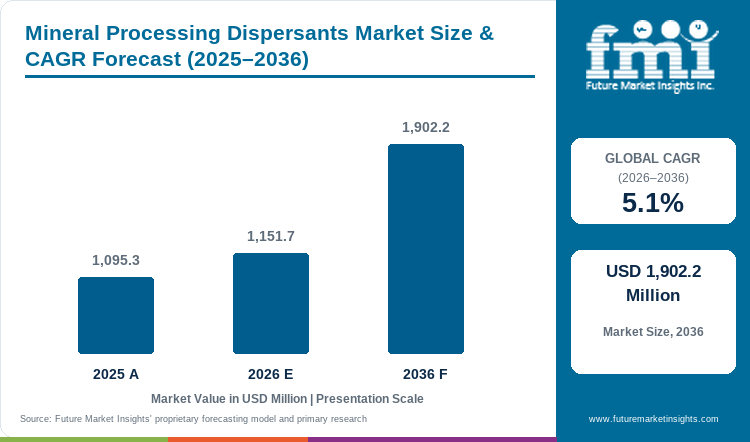
USD 1,151.7 million in 2026 and USD 1,902.2 million by 2036, expanding at 5.1% CAGR.
Sales are expected to grow at 5.1% CAGR through 2036. The value rises from USD 1,095.3 million in 2025 to USD 1,151.7 million in 2026. It is expected to reach USD 1,902.2 million by 2036. Plants are raising the solids level so current mills and pipes can move more ore. Clay-rich feed makes this harder because fine particles bind and raise yield stress. A 2024 bauxite study found that slurry became thicker above 20 wt.% solids. It also found that sodium polyacrylate improved flotation. Dispersants add value when they stop particle clumps without hurting flotation or dewatering. Plant teams compare dose with slurry thickness before regular use.
Countries support mineral plants in different ways. Australia plans a 10% refundable tax offset from July 2027. It covers eligible critical mineral processing and refining costs. Government guidance counts reagents as direct spending for registered work. It does not cover beneficiation. In August 2026 the United States announced USD 500 million for seven critical mineral and material projects. In July 2026 KfW reported two Raw Materials Fund investments. KfW also plans to raise the fund to EUR 1.5 billion. The fund will support extraction and processing plus recycling projects. These programs add plants and test circuits that need trials with each ore. Remote sites need field help and reliable stock. Regulated sites need clear records and repeatable results. In both settings the dispersant must work with the real ore and process water.
Key Takeaways
- More solids and more water reuse make slurry flow a key plant control. Teams set the dispersant dose for each ore.
- Polyacrylates are expected to hold 31.0% of chemistry in 2026. Their charge can be set for many mineral slurries.
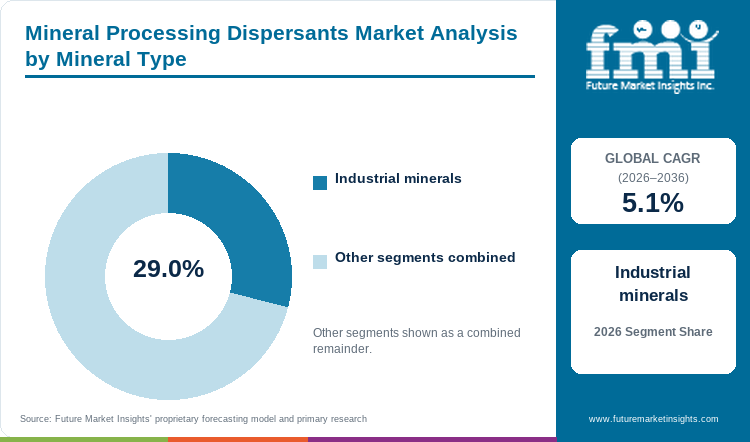
- Industrial minerals are expected to hold 29.0% of mineral type in 2026. Steady wet processing supports high-solids use.
- Grinding dispersion is expected to hold 28.0% of application in 2026. It helps control thick slurry as grinding exposes fresh mineral surfaces.
- Australia and Canada pair processing investment with field tests. Germany and Japan place more weight on controlled site testing.
- Key companies include BASF, Syensqo, SNF, Nouryon, Borregaard, Arkema, Dow, Ecolab, Ashland, and Solenis.
Analyst Perspective
“How much can a plant cut slurry thickness without causing trouble in flotation or dewatering? Mineral processing dispersants compete on that full-circuit result. Lower yield stress adds value when recovery and settling stay inside the plant range. Ore makeup and salt can change that range from one campaign to the next. A sound technical offer needs a stable dose range and tests on the real mineral feed. It also needs clear data on how the dispersant works with the rest of the reagent plan.”
- Nikhil Kaitwade, Principal Consultant, Future Market Insights
How is the mineral processing dispersants market segmented?
The mineral processing dispersants market is segmented by chemistry, mineral type, application, end use, sales channel and region.
The report groups demand in six ways for the 2026 to 2036 period. Chemistry shows how products keep mineral particles apart. Mineral type groups feeds by clay level and surface charge. Those traits change slurry flow. Application shows the plant step that needs the dispersant. End use shows the type of plant. Sales channel shows how the product and site help reach buyers. Region shows changes in ore mix and project needs.
Why does continuous high-solids handling favor industrial minerals within mineral type?
Industrial-mineral plants need close control of particle size and slurry flow. Wet grinding must keep fine solids moving through sorting and storage. More solids can cut drying and transport needs. They can also thicken the slurry when particles clump. Dispersants help plants keep useful solids levels in clay and carbonate slurries. Dow and Arkema list products for these high-solids systems. Mining ores can create large site demand. Industrial minerals also need regular formula work for many end uses.
- Industrial minerals are expected to hold 29.0% of mineral type in 2026. Regular wet processing at high solids supports this share.
- Plants use dispersants with kaolin and calcium carbonate during grinding or handling. The chemicals help keep thick water-based slurries stable.
How does charge control support polyacrylate selection across mineral slurries?
Polyacrylates let makers change molecular weight and negative charge. These changes help control mineral surfaces. Plant teams use them when they need thinner slurry without more water. Salt and other ions can change the dose that works. Sodium silicate and phosphate products still serve some circuits. Natural lignosulfonates offer a bio-based route when they suit the ore and later steps. Site tests focus on the dose range that works.
- Polyacrylates are expected to hold 31.0% of chemistry in 2026. Their charge can be set for clay-rich and industrial-mineral slurries.
- Borregaard uses biopolymer chemistry in mineral processing. Lignosulfonates are also part of the wider renewable dispersant family.
How does fresh particle surface make grinding dispersion the leading application?
Grinding creates fresh mineral surfaces. It can also expose clays that make slurry harder to move. Teams can add a dispersant here to keep particles from clumping again. That control helps before classification or flotation. Smooth slurry flow helps mill discharge and cyclone feed without extra water. Teams still test the whole reagent plan because surface changes can affect later separation. The same circuit may also use mining flotation chemicals. Teams approve the dose when slurry gets thinner and mineral recovery stays sound.
- Grinding dispersion is expected to hold 28.0% of application in 2026. It controls thick slurry as grinding exposes new mineral surfaces.
- A 2024 study of chalcopyrite and serpentine found less slime coating with phosphonic-acid dispersants. It also found better recovery during flotation.
How does circuit scale support mining within the end use category?
Mining plants move very large ore loads under changing ore and water conditions. They may need dispersants during grinding or clay control. Other uses appear in flotation and tailings transport. A small dose can change how well the slurry pumps. The chemistry adds value when it also protects recovery and solid and liquid separation. Tailings systems can use mining tailings water-soluble flocculants in later steps. Plant teams therefore treat site support as part of the product offer. They use that support to keep the dose steady as ore and water change.
- Mining is projected at 41.0% of the end use category in 2026. Large circuits can gain value from small improvements in slurry handling.
- Australian guidance counts reagents as direct spending for qualifying extractive processing and refining. It excludes beneficiation.
Why does site accountability favor mining chemical suppliers in the sales channel?
Mining chemical suppliers sell dispersants and help plants use them. They also support field trials. Results depend on the ore makeup (mineralogy) and process water. One dose rule cannot work at every site. Large mines may buy direct after a plant team approves the formula. Distributors serve smaller industrial-mineral users. Formulators support special systems. Suppliers stay involved after delivery because site conditions can change. Their work also links dispersants with flocculants and coagulants. Plants use those chemicals later to separate solids from water.
- Mining chemical suppliers are expected to hold 41.0% of the sales channel in 2026. Site access and plant support help explain this share.
- SNF opened a Mining Technical Center in Brazil in March 2026. The center tests new products under field-like mining conditions.
What are the drivers, restraints and opportunities in the Mineral Processing Dispersants Market?
Higher solids loading expands use, circuit-wide interactions lengthen qualification and salt-tolerant formulations create a focused technical opening.
- Driver: More solids and more water reuse make slurry thickness a direct plant throughput issue.
- Restraint: A dispersant can help one plant step but change flotation or later solid and liquid separation.
- Opportunity: Salt-tolerant polymers can work with recycled water and clay-rich feeds. These feeds often have unstable slurry flow.
Higher solids loading makes slurry flow behavior (rheology) a production constraint
More solids make slurry flow harder to control during grinding and transport. Plants use less extra water when they recover water or move more solids through current pumps. This choice brings particles closer and can raise yield stress in clay-rich feed. In 2024 Leiva and colleagues found that extra kaolin and salt made clay tailings harder to pump. Their tests found lower flow resistance after adding sodium acid pyrophosphate. Plants use dispersants to keep slurry moving at useful solids levels. They want to avoid adding more water. One dose has more value when it works through normal feed changes. It also has more value when thinner slurry does not hurt recovery or water cleaning.
Circuit-wide reagent interactions lengthen site testing
Site tests take longer when a dispersant helps one plant step but changes another. Mineral surfaces compete for reagents. Process water also changes the charge around fine particles. Collectors and other flotation reagents can react to dispersant left in the slurry. A 2024 study of chalcopyrite and serpentine found that slime coating cut recovery. The study also found that phosphonic-acid dispersants changed particle contact. Plant teams test the full circuit before regular use. They compare slurry thickness with flotation results and solid and liquid separation. A narrow dose range can require longer trials or more changes. Buying also slows when results change with water salt or ore makeup. Full-circuit fit is the main restraint.
Salt-tolerant chemistry opens a route for recycled process water
Salty and recycled process water can change how well a dispersant works. Freshwater shortages push some mines toward recycled water. In 2024 Leiva and colleagues found that extra salt made clay tailings harder to pump. The study found lower yield stress after adding sodium acid pyrophosphate. It also found less elastic behavior. water treatment chemicals matter more as reused streams collect dissolved ions. Plants gain more value when they manage slurry flow and water recovery together. Polymer makers can tune charge for each mineral feed. Plant teams can set dose rules for reused water. Use is expected to widen when suppliers keep slurry flow stable. They must also protect flotation and clear water quality.
Which country CAGRs are profiled in the Mineral Processing Dispersants Market?
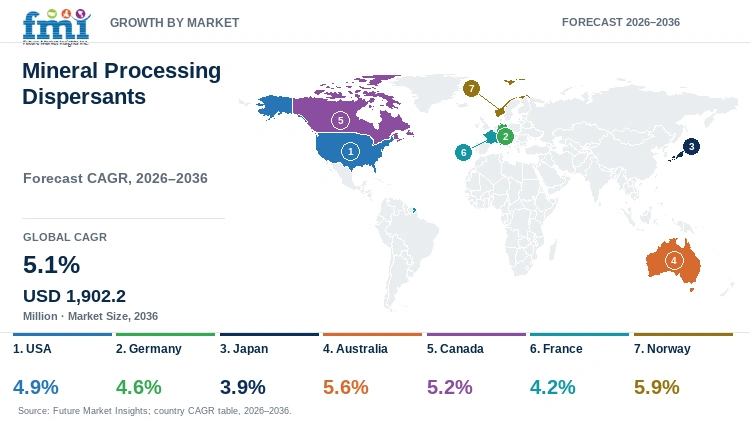
| Country | CAGR |
|---|---|
| USA | 4.9% |
| Germany | 4.6% |
| Japan | 3.9% |
| Australia | 5.6% |
| Canada | 5.2% |
| France | 4.2% |
| Norway | 5.9% |
How do country-level CAGRs compare in the Mineral Processing Dispersants Market?
The country CAGRs show different plant needs rather than one rank. Norway has a broad mineral base and new permit rules. Australia links policy with reagent spending. Canada and the USA are funding new plants and test work. Germany is adding project finance. France is rebuilding its resource data. Japan faces import risk and long site approval. These conditions change support needs and test time. They do not show current sales.
- In the USA, federally supported processing projects are increasing demand for reagent validation through full-scale circuit testing before commercial deployment.
- Germany’s raw-material investment initiatives support new processing capacity, while maintaining strong emphasis on documentation and controlled formulation changes.
- Japan is advancing flotation approaches designed to separate arsenic-bearing copper from cleaner copper concentrates.
- In Australia, processing and refining incentives recognize reagent spending as a qualifying investment, supporting downstream project development.
- Canada places significant importance on pilot-scale validation before reagent programs are deployed at remote operating sites.
- France’s pilot-scale spodumene testing activities are helping evaluate and optimize mineral-processing reagent performance.
- Norway’s evolving minerals sector supports project development under strict water-management and residue-control requirements.
The full report gives country CAGR data for North America and Latin America. It also covers Western Europe and Eastern Europe. The report includes East Asia. It also includes South Asia and Pacific plus the Middle East and Africa.
Country-wise Analysis
- Demand in the USA is expected to grow at 4.9% CAGR through 2036. New critical-material plants support this path. In August 2026 the U.S. Department of Energy announced USD 500 million for seven projects. The projects add processing and related factory capacity. New plants still need reagent plans that match the ore mix and process water. Teams test dose against slurry thickness before plant trials. They also check flotation and dewatering as trials scale up. Regional labs can shorten site tests. Reliable supply matters after a team approves one formula for several sites. That need keeps local support important as new projects move from test work to steady plant use.
- Demand in Germany is expected to grow at 4.6% CAGR through 2036. New raw material projects support this path. In July 2026 KfW said the Raw Materials Fund had made its first two investments. KfW plans to raise funds for extraction and processing projects to EUR 1.5 billion. The first two investments include lithium and rare earth elements projects. German plants pair new project spending with strict chemical records. Teams review reagent changes through set technical steps. Low-dose products can cut disruption during site tests. Local support helps when an approved dispersant must handle changes in feed without changing later separation. That support can also help sites keep one approved formula in regular use.
- Demand in Japan is expected to grow at 3.9% CAGR through 2036. Strict site tests for impurities support this path. In December 2025 JOGMEC reported a new flotation method. The method separates copper minerals that contain arsenic from cleaner copper minerals. Teams add reagents during flotation. JOGMEC moved the work into joint research with CODELCO after its own tests. Japanese teams judge a reagent by how it affects concentrate quality. Slurry thickness alone is not enough. A dispersant or modifier must work with the full flotation plan before regular use. Clear test records help teams keep control when the ore mix changes. This process can make approval take longer before daily plant use.
- Demand in Australia is expected to grow at 5.6% CAGR through 2036. Policy support for critical mineral plants helps this path. The Critical Minerals Production Tax Incentive is set to give a 10% refundable offset from July 2027. It covers eligible processing and refining costs. Government guidance counts reagents as direct spending for registered work. It excludes beneficiation, the early step that upgrades raw ore. The rule keeps the policy focused on later steps that extract target minerals. Reagent plans can be part of plant costs there. Remote projects still need reliable stock and field help. Plant teams must also prove that a dispersant works with the full separation circuit. That test keeps site support important before regular use.
- Demand in Canada is expected to grow at 5.2% CAGR through 2036. Federal support for new plants helps this path. In March 2026 Natural Resources Canada announced up to CAD 165.2 million for 22 critical-minerals projects. The package covers planning and new plant capacity across eight provinces. It is expected to unlock CAD 434 million in project capital. Remote sites need pilot proof and sound supply plans during reagent tests. New plants may need staged trials before they start steady dosing. Teams track water chemistry and tailings behavior with slurry thickness. A formula gains regular use when its plant effect stays steady through feed changes. Seasonal access can also make supply planning part of the approval choice.
- Demand in France is expected to grow at 4.2% CAGR through 2036. Pilot work on hard-rock lithium supports this path. In April 2026 BRGM said its Plat'inn platform processed three tonnes of spodumene ore for the LITHOS project. The platform runs pilot tests for mineral processing and liquid-based metal recovery. Teams can test particle separation and slurry control before making larger choices. Reagent choice still depends on ore makeup and the chosen process plan. Teams value low-dose formulas that keep fine particles stable without hurting later separation. Clear pilot data can move a new chemistry into longer process tests. Those tests can then support a plant decision on regular use.
- Demand in Norway is expected to grow at 5.9% CAGR through 2036. A spread-out mineral industry and new permit rules support this path. In August 2025 the Directorate of Mining said 299 of 357 municipalities extracted minerals during 2024. It also reported mineral sales of NOK 14.409 billion for 2024. The new Minerals Act took effect in July 2026. The law aims to make mineral permit work more efficient. It also calls for stronger work across permit bodies. New projects must still manage water quality and excess mineral mass under strict rules. Early reagent tests can link better slurry flow with water recovery and tailings handling. This helps teams judge a formula before regular use.
Who are the notable companies in the Mineral Processing Dispersants Market?
BASF, Syensqo, SNF, Nouryon, Borregaard, Arkema (Coatex), Dow, Ecolab (Nalco Water), Ashland, and Solenis are active within the defined mineral processing dispersants supply boundary.
Competition depends on chemistry that works with the real mineral feed. Companies also need proof from plant-scale tests. Product range matters because different slurries may need a different polymer charge or molecular weight. Field support matters more after site tests when water or ore blends change.
- Integrated mining reagent platforms: BASF and Syensqo with SNF and Ecolab (Nalco Water).
- Dedicated mineral-slurry dispersant portfolios: Nouryon and Arkema (Coatex) with Dow and Borregaard.
- Complementary polymer and process-aid platforms: Ashland and Solenis.
Competitive Benchmarking: Mineral Processing Dispersants Market
| Company | Mineral-Dispersant Specificity | Mineral/Circuit Breadth | Technical Support Evidence | Geographic Reach |
|---|---|---|---|---|
| BASF | High | High | High | Global |
| Syensqo | High | High | High | Global |
| SNF | High | High | High | Global |
| Nouryon | High | Medium | Medium | Global |
| Borregaard | High | High | High | Global |
| Arkema (Coatex) | High | High | High | Global |
| Dow | High | High | Medium | Global |
| Ecolab (Nalco Water) | High | High | High | Global |
| Ashland | Medium | Medium | Medium | Multi-region |
| Solenis | High | High | High | Global |
Scoring basis: Specificity tells how direct the product proof is. A High score needs current official proof of a named mineral dispersant or viscosity modifier. Medium means the mining polymer has several uses and one use is dispersion. Breadth tells how many minerals or plant steps the company serves. High needs proof across several minerals or steps. Medium covers a smaller proven range. Support looks at site help. High needs a mining lab or field center. Clear plant support can also count as High. Medium means site help without a dedicated center. Geographic reach only shows coverage. It is not a score.
Key Developments in the Mineral Processing Dispersants Market
- In 2026 Ecolab published a case study from a full-size copper and molybdenum plant. The study covered NALFLOTE 600.05. The clay dispersant raised the molybdenum grade. It did not lower recovery.
- On March 5 2026 SNF opened a Mining Technical Center in Ouro Preto in Brazil. The center tests polymers under conditions that match mine sites.
- On February 25 2026 Syensqo shared guidance for mineral plants at SME MINEXCHANGE. The program covered flotation control. It also covered reagent choice for hard ore conditions.
Key Players in the Mineral Processing Dispersants Market
Integrated mining reagent platforms
- BASF
- Syensqo
- SNF
- Ecolab (Nalco Water)
Dedicated mineral-slurry dispersant portfolios
- Nouryon
- Arkema (Coatex)
- Dow
- Borregaard
Complementary polymer and process-aid platforms
- Ashland
- Solenis
Mineral Processing Dispersants Market - Report Scope
| Coverage field | Report scope |
|---|---|
| Market breakdown | By chemistry, mineral type, application, end use, sales channel and region. |
| Quantitative Units | USD million. |
| Market Definition | Commercial dispersants used in mineral-processing slurries to control particle association, rheology, slime coating or solids handling during grinding, beneficiation, transport and tailings operations. General-purpose water-treatment chemicals without a mineral-processing function are excluded. |
| Regions Covered | North America, Latin America, Western Europe, Eastern Europe, East Asia, South Asia and Pacific, and Middle East and Africa. |
| Countries Covered | USA, Germany, Japan, Australia, Canada, France, Norway, and 30+ countries included in the full report. |
| Key Companies Profiled | BASF, Syensqo, SNF, Nouryon, Borregaard, Arkema (Coatex), Dow, Ecolab (Nalco Water), Ashland, and Solenis. |
| Forecast Period | 2026 to 2036. |
| Approach | Primary and secondary research with market triangulation. |
Mineral Processing Dispersants Market - Research Methodology
| Method | Approach |
|---|---|
| Primary Research | FMI analysts gathered input from manufacturers, service providers, technology developers, distributors, end users, procurement teams, and subject-matter experts. Interviews examined purchasing decisions, product or service evaluation, adoption barriers, approval requirements, pricing considerations, and expectations for technical or commercial support. Respondents were also asked what evidence is required before a trial, pilot, or initial order develops into regular purchasing. |
| Desk Research | Desk research covered government statistics, regulatory publications, trade data, industry associations, technical literature, standards, company filings, product information, and official corporate announcements. Sources were reviewed for relevance, publication date, geographic coverage, and consistency with the defined market scope. Claims relating to performance, applications, approvals, capacity, investment, and commercial activity were retained only when supported by credible public evidence. |
| Market Sizing and Forecasting | The market model combined the baseline value with historical performance, segment structure, pricing and volume indicators, adoption levels, company participation, and country-level demand conditions. Forecast assumptions considered economic activity, investment trends, regulatory developments, technology adoption, purchasing cycles, supply availability, and barriers to wider market use. Segment and regional estimates were reconciled before the final market total was calculated. |
| Data Validation | Estimates were checked against multiple independent indicators, including public data, company activity, trade patterns, industry developments, and findings from primary interviews. Validation also tested whether products, services, applications, and company revenues fell within the defined market boundaries. Adjacent categories, unsupported claims, overlapping revenues, and activities without direct market relevance were excluded to reduce double counting and maintain consistency across segments and countries. |
Mineral Processing Dispersants Market by Segments
Mineral Processing Dispersants Market segmented by Chemistry:
- Polyacrylate dispersants
- Sodium silicate
- Phosphate dispersants
- Lignosulfonates
- Specialty polymer dispersants
Mineral Processing Dispersants Market segmented by Mineral Type:
- Industrial minerals
- Iron ore
- Copper ore
- Phosphate rock
- Rare earth minerals
Mineral Processing Dispersants Market segmented by Application:
- Grinding dispersion
- Slurry viscosity control
- Flotation conditioning
- Clay dispersion
- Tailings handling
Mineral Processing Dispersants Market segmented by End Use:
- Mining
- Ceramics
- Cement/minerals
- Battery minerals
- Pigments/fillers
Mineral Processing Dispersants Market segmented by Sales Channel:
- Mining chemical suppliers
- Direct processor contracts
- Distributors
- Formulators
Mineral Processing Dispersants Market by Region
- North America
- United States
- Canada
- Latin America
- Brazil
- Mexico
- Argentina
- Chile
- Western Europe
- Germany
- France
- United Kingdom
- Italy
- Spain
- Benelux
- Nordics
- Eastern Europe
- Poland
- Czech Republic
- Romania
- Hungary
- East Asia
- China
- Japan
- South Korea
- South Asia and Pacific
- India
- ASEAN
- Australia and New Zealand
- Middle East and Africa
- GCC
- South Africa
- Türkiye
- Israel
Research Sources and Bibliography
- Batista e Silva, G. V., Oliveira, G. J. R., & Horta, D. G. (2024). Effect of ultrasonic pre-treatment on the reverse flotation of kaolinite from bauxite. Mineral Processing and Extractive Metallurgy Review, 45(8), 982-990.
- Leiva, W., Ayala, L., Robles, P., Nieto, S., Castellón, C., Herrera, N., & Jeldres, R. (2024). Sodium acid pyrophosphate as a rheological modifier of clay-based tailings in saline water. Applied Clay Science, 253, 107352.
- Yang, B., Liu, Q., Liu, J., & Ren, S. (2024). Application of organic phosphonic acid dispersant in the separation and flotation of chalcopyrite and serpentine. Colloids and Surfaces A: Physicochemical and Engineering Aspects, 695, 134265.
- U.S. Department of Energy. (2026, August 20). Energy Department announces $500 million to secure America's critical mineral and battery supply chains.
- KfW. (2026, July 15). A successful first half-year for the Germany Fund: Initial investments made; further funding measures to follow shortly.
- Japan Organization for Metals and Energy Security. (2025, December 8). Agreement on cooperation for technology to reduce impurities in copper raw materials with CODELCO.
- Australian Department of Industry, Science and Resources. (2026). Critical Minerals Production Tax Incentive.
- Natural Resources Canada. (2026, March 3). Government of Canada invests to unlock Canada's critical minerals advantage.
- BRGM. (2026, April 23). LITHOS: Developing responsible lithium production in Europe.
- Directorate of Mining with the Commissioner of Mines at Svalbard. (2025, August 11). Hard facts: The Norwegian mineral industry sold minerals worth NOK 14.409 billion.
- Norwegian Ministry of Trade, Industry and Fisheries. (2026, July 1). New Minerals Act to strengthen the industry.
- BASF. (n.d.). Antiscalants, descalants and dispersants. Retrieved September 20, 2026.
- Syensqo. (n.d.). Modifiers for mineral processing. Retrieved September 20, 2026.
- SNF. (n.d.). Mining chemicals, water treatment and process solutions. Retrieved September 20, 2026.
- Nouryon. (n.d.). Alcosperse 149 sodium polyacrylate. Retrieved September 20, 2026.
- Borregaard. (n.d.). Viscosity reducers. Retrieved September 20, 2026.
- Arkema. (n.d.). Rheosperse: Over 40 years of experience in minerals processing. Retrieved September 20, 2026.
- Dow. (n.d.). ACUMER 9400 polymer. Retrieved September 20, 2026.
- Ecolab. (n.d.). Mining and mineral processing aids. Retrieved September 20, 2026.
- Ashland. (n.d.). Blanose REF CMC 7L1T sodium carboxymethylcellulose. Retrieved September 20, 2026.
- Solenis. (n.d.). Zalta viscosity modifiers. Retrieved September 20, 2026.
- BASF. (2026). BASF @ CRU Conference 2026.
- Ecolab. (2026). Nalco Water clay dispersant-NALFLOTE 600.05-boosts molybdenum concentrate grade, adding $2M in annual revenue.
- SNF. (2026, March 5). SNF has established a Mining Technical Center in Brazil.
- Syensqo. (2026, February 25). Syensqo at SME 2026: Mining reagent innovations & expert talks.
This bibliography is provided for reader reference and is not exhaustive. The full report contains the complete reference list and detailed citations.
This Report Answers
- How large is the Mineral Processing Dispersants Market in 2026 and 2036?
- Which plant conditions are increasing the use of mineral processing dispersants?
- Why are polyacrylate dispersants projected at 31.0% of chemistry in 2026?
- Why are industrial minerals projected at 29.0% of mineral type in 2026?
- Why is grinding dispersion projected at 28.0% of application in 2026?
- How do site conditions differ across the seven countries in the report?
- Which companies supply mineral-processing dispersants or slurry viscosity modifiers across major regions?
- Why do other reagents make mineral dispersant site tests take longer?
- What should plant teams check before they approve a dispersant for routine use?
Frequently Asked Questions
How big is the Mineral Processing Dispersants Market in 2026?
The mineral processing dispersants market is valued at USD 1,151.7 million in 2026. Demand is supported by the need to improve slurry handling, particle dispersion, and process efficiency across mineral beneficiation operations.
What is the CAGR of the Mineral Processing Dispersants Market from 2026 to 2036?
The mineral processing dispersants market is expected to grow at 5.1% CAGR between 2026 and 2036. Expansion is driven by increasing focus on ore recovery, water management, and process optimization in mining and mineral processing facilities.
Which chemistry leads the Mineral Processing Dispersants Market?
Polyacrylates are expected to hold 31.0% share in 2026. Their effective particle dispersion properties help improve slurry stability and processing performance.
Which application leads the Mineral Processing Dispersants Market?
Grinding dispersion is expected to account for 28.0% share in 2026. Efficient dispersion during grinding supports better particle separation and downstream processing outcomes.
Which end use leads the Mineral Processing Dispersants Market?
Mining is expected to hold 41.0% of end-use demand in the mineral processing dispersants market in 2026. High mineral throughput and the need for efficient processing workflows sustain dispersant consumption across mining operations.
Preview the report firsthand - request a free sample
Get SampleGet the brochure for pricing and purchase details.
Get PDFTable of Content
- Key Takeaways
- Market Size and CAGR
- Top Growth Driver
- Fastest Growing Segment
- Leading Region
- Key Companies
- Emerging Opportunities
- Executive Summary
- Global Market Outlook
- Demand-side Trends
- Supply-side Trends
- Technology Roadmap Analysis
- Analysis and Recommendations
- Analyst Perspective (What is happening? Why now? What should investors know?)
- Key Questions Answered
- How large is the market?
- What is the CAGR?
- What are key trends?
- Which region dominates?
- Who are the leaders?
- Market Overview
- Market Coverage / Taxonomy
- Market Definition / Scope / Limitations
- Research Methodology
- Chapter Orientation
- Analytical Lens and Working Hypotheses
- Market Structure, Signals, and Trend Drivers
- Benchmarking and Cross-market Comparability
- Market Sizing, Forecasting, and Opportunity Mapping
- Research Design and Evidence Framework
- Desk Research Programme (Secondary Evidence)
- Expert Input and Fieldwork (Primary Evidence)
- Tooling, Models, and Reference Databases
- Data Engineering and Model Build
- Quality Assurance and Audit Trail
- Market Background
- Market Dynamics (Drivers, Restraints, Opportunity, Trends)
- Scenario Forecast (Optimistic, Likely, Conservative)
- Impact Analysis
- AI Impact
- Sustainability Impact
- Regulatory Impact
- Technology Impact
- Consumer / Buyer Analysis
- Purchase Drivers
- Adoption Barriers
- Buyer Journey
- Opportunity Map Analysis
- Product Life Cycle Analysis
- Supply Chain Analysis
- Investment Feasibility Matrix
- Value Chain Analysis
- PESTLE and Porter's Analysis
- Regulatory Landscape
- Regional Parent Market Outlook
- Production and Consumption Statistics
- Import and Export Statistics
- Global Market Analysis and Forecast, 2021 to 2036
- Historical Market Size Value (USD Million) Analysis, 2021 to 2025
- Current and Future Market Size Value (USD Million) Projections, 2026 to 2036
- Y-o-Y Growth Trend Analysis
- Absolute $ Opportunity Analysis
- Global Market Pricing Analysis, 2021 to 2036
- Global Market Analysis and Forecast, By Chemistry, 2021 to 2036
- Introduction / Key Findings
- Historical Market Size Value (USD Million) Analysis By Chemistry, 2021 to 2025
- Current and Future Market Size Value (USD Million) Analysis and Forecast By Chemistry, 2026 to 2036
- Polyacrylate dispersants
- Sodium silicate
- Phosphate dispersants
- Lignosulfonates
- Specialty polymer dispersants
- Y-o-Y Growth Trend Analysis By Chemistry, 2021 to 2025
- Absolute $ Opportunity Analysis By Chemistry, 2026 to 2036
- Global Market Analysis and Forecast, By Mineral Type, 2021 to 2036
- Introduction / Key Findings
- Historical Market Size Value (USD Million) Analysis By Mineral Type, 2021 to 2025
- Current and Future Market Size Value (USD Million) Analysis and Forecast By Mineral Type, 2026 to 2036
- Industrial minerals
- Iron ore
- Copper ore
- Phosphate rock
- Rare earth minerals
- Y-o-Y Growth Trend Analysis By Mineral Type, 2021 to 2025
- Absolute $ Opportunity Analysis By Mineral Type, 2026 to 2036
- Global Market Analysis and Forecast, By Application, 2021 to 2036
- Introduction / Key Findings
- Historical Market Size Value (USD Million) Analysis By Application, 2021 to 2025
- Current and Future Market Size Value (USD Million) Analysis and Forecast By Application, 2026 to 2036
- Grinding dispersion
- Slurry viscosity control
- Flotation conditioning
- Clay dispersion
- Tailings handling
- Y-o-Y Growth Trend Analysis By Application, 2021 to 2025
- Absolute $ Opportunity Analysis By Application, 2026 to 2036
- Global Market Analysis and Forecast, By End Use, 2021 to 2036
- Introduction / Key Findings
- Historical Market Size Value (USD Million) Analysis By End Use, 2021 to 2025
- Current and Future Market Size Value (USD Million) Analysis and Forecast By End Use, 2026 to 2036
- Mining
- Ceramics
- Cement/minerals
- Battery minerals
- Pigments/fillers
- Y-o-Y Growth Trend Analysis By End Use, 2021 to 2025
- Absolute $ Opportunity Analysis By End Use, 2026 to 2036
- Global Market Analysis and Forecast, By Sales Channel, 2021 to 2036
- Introduction / Key Findings
- Historical Market Size Value (USD Million) Analysis By Sales Channel, 2021 to 2025
- Current and Future Market Size Value (USD Million) Analysis and Forecast By Sales Channel, 2026 to 2036
- Mining chemical suppliers
- Direct processor contracts
- Distributors
- Formulators
- Y-o-Y Growth Trend Analysis By Sales Channel, 2021 to 2025
- Absolute $ Opportunity Analysis By Sales Channel, 2026 to 2036
- Global Market Analysis and Forecast, By Region, 2021 to 2036
- Introduction
- Historical Market Size Value (USD Million) Analysis By Region, 2021 to 2025
- Current Market Size Value (USD Million) Analysis and Forecast By Region, 2026 to 2036
- North America
- Latin America
- Western Europe
- Eastern Europe
- East Asia
- South Asia and Pacific
- Middle East and Africa
- Market Attractiveness Analysis By Region
- North America Market Analysis and Forecast, By Country, 2021 to 2036
- Historical Market Size Value (USD Million) Trend Analysis By Market Taxonomy, 2021 to 2025
- Market Size Value (USD Million) Forecast By Market Taxonomy, 2026 to 2036
- By Country
- United States
- Canada
- By Chemistry
- By Mineral Type
- By Application
- By End Use
- By Sales Channel
- By Country
- Market Attractiveness Analysis
- By Country
- By Chemistry
- By Mineral Type
- By Application
- By End Use
- By Sales Channel
- Key Takeaways
- Latin America Market Analysis and Forecast, By Country
- Historical Market Size Value (USD Million) Trend Analysis By Market Taxonomy, 2021 to 2025
- Market Size Value (USD Million) Forecast By Market Taxonomy, 2026 to 2036
- By Country
- Brazil
- Mexico
- Argentina
- Chile
- By Chemistry
- By Mineral Type
- By Application
- By End Use
- By Sales Channel
- By Country
- Market Attractiveness Analysis
- By Country
- By Chemistry
- By Mineral Type
- By Application
- By End Use
- By Sales Channel
- Key Takeaways
- Western Europe Market Analysis and Forecast, By Country
- Historical Market Size Value (USD Million) Trend Analysis By Market Taxonomy, 2021 to 2025
- Market Size Value (USD Million) Forecast By Market Taxonomy, 2026 to 2036
- By Country
- Germany
- France
- United Kingdom
- Italy
- Spain
- Benelux
- Nordics
- By Chemistry
- By Mineral Type
- By Application
- By End Use
- By Sales Channel
- By Country
- Market Attractiveness Analysis
- By Country
- By Chemistry
- By Mineral Type
- By Application
- By End Use
- By Sales Channel
- Key Takeaways
- Eastern Europe Market Analysis and Forecast, By Country
- Historical Market Size Value (USD Million) Trend Analysis By Market Taxonomy, 2021 to 2025
- Market Size Value (USD Million) Forecast By Market Taxonomy, 2026 to 2036
- By Country
- Poland
- Czech Republic
- Romania
- Hungary
- By Chemistry
- By Mineral Type
- By Application
- By End Use
- By Sales Channel
- By Country
- Market Attractiveness Analysis
- By Country
- By Chemistry
- By Mineral Type
- By Application
- By End Use
- By Sales Channel
- Key Takeaways
- East Asia Market Analysis and Forecast, By Country
- Historical Market Size Value (USD Million) Trend Analysis By Market Taxonomy, 2021 to 2025
- Market Size Value (USD Million) Forecast By Market Taxonomy, 2026 to 2036
- By Country
- China
- Japan
- South Korea
- By Chemistry
- By Mineral Type
- By Application
- By End Use
- By Sales Channel
- By Country
- Market Attractiveness Analysis
- By Country
- By Chemistry
- By Mineral Type
- By Application
- By End Use
- By Sales Channel
- Key Takeaways
- South Asia and Pacific Market Analysis and Forecast, By Country
- Historical Market Size Value (USD Million) Trend Analysis By Market Taxonomy, 2021 to 2025
- Market Size Value (USD Million) Forecast By Market Taxonomy, 2026 to 2036
- By Country
- India
- ASEAN
- Australia and New Zealand
- By Chemistry
- By Mineral Type
- By Application
- By End Use
- By Sales Channel
- By Country
- Market Attractiveness Analysis
- By Country
- By Chemistry
- By Mineral Type
- By Application
- By End Use
- By Sales Channel
- Key Takeaways
- Middle East and Africa Market Analysis and Forecast, By Country
- Historical Market Size Value (USD Million) Trend Analysis By Market Taxonomy, 2021 to 2025
- Market Size Value (USD Million) Forecast By Market Taxonomy, 2026 to 2036
- By Country
- GCC
- South Africa
- Türkiye
- Israel
- By Chemistry
- By Mineral Type
- By Application
- By End Use
- By Sales Channel
- By Country
- Market Attractiveness Analysis
- By Country
- By Chemistry
- By Mineral Type
- By Application
- By End Use
- By Sales Channel
- Key Takeaways
- Key Countries Market Analysis
- United States
- Pricing Analysis
- Market Share Analysis, 2025
- By Chemistry
- By Mineral Type
- By Application
- By End Use
- By Sales Channel
- Canada
- Pricing Analysis
- Market Share Analysis, 2025
- By Chemistry
- By Mineral Type
- By Application
- By End Use
- By Sales Channel
- Mexico
- Pricing Analysis
- Market Share Analysis, 2025
- By Chemistry
- By Mineral Type
- By Application
- By End Use
- By Sales Channel
- Brazil
- Pricing Analysis
- Market Share Analysis, 2025
- By Chemistry
- By Mineral Type
- By Application
- By End Use
- By Sales Channel
- Chile
- Pricing Analysis
- Market Share Analysis, 2025
- By Chemistry
- By Mineral Type
- By Application
- By End Use
- By Sales Channel
- Germany
- Pricing Analysis
- Market Share Analysis, 2025
- By Chemistry
- By Mineral Type
- By Application
- By End Use
- By Sales Channel
- United Kingdom
- Pricing Analysis
- Market Share Analysis, 2025
- By Chemistry
- By Mineral Type
- By Application
- By End Use
- By Sales Channel
- Italy
- Pricing Analysis
- Market Share Analysis, 2025
- By Chemistry
- By Mineral Type
- By Application
- By End Use
- By Sales Channel
- Spain
- Pricing Analysis
- Market Share Analysis, 2025
- By Chemistry
- By Mineral Type
- By Application
- By End Use
- By Sales Channel
- France
- Pricing Analysis
- Market Share Analysis, 2025
- By Chemistry
- By Mineral Type
- By Application
- By End Use
- By Sales Channel
- India
- Pricing Analysis
- Market Share Analysis, 2025
- By Chemistry
- By Mineral Type
- By Application
- By End Use
- By Sales Channel
- ASEAN
- Pricing Analysis
- Market Share Analysis, 2025
- By Chemistry
- By Mineral Type
- By Application
- By End Use
- By Sales Channel
- Australia and New Zealand
- Pricing Analysis
- Market Share Analysis, 2025
- By Chemistry
- By Mineral Type
- By Application
- By End Use
- By Sales Channel
- China
- Pricing Analysis
- Market Share Analysis, 2025
- By Chemistry
- By Mineral Type
- By Application
- By End Use
- By Sales Channel
- Japan
- Pricing Analysis
- Market Share Analysis, 2025
- By Chemistry
- By Mineral Type
- By Application
- By End Use
- By Sales Channel
- South Korea
- Pricing Analysis
- Market Share Analysis, 2025
- By Chemistry
- By Mineral Type
- By Application
- By End Use
- By Sales Channel
- Poland
- Pricing Analysis
- Market Share Analysis, 2025
- By Chemistry
- By Mineral Type
- By Application
- By End Use
- By Sales Channel
- Hungary
- Pricing Analysis
- Market Share Analysis, 2025
- By Chemistry
- By Mineral Type
- By Application
- By End Use
- By Sales Channel
- Türkiye
- Pricing Analysis
- Market Share Analysis, 2025
- By Chemistry
- By Mineral Type
- By Application
- By End Use
- By Sales Channel
- South Africa
- Pricing Analysis
- Market Share Analysis, 2025
- By Chemistry
- By Mineral Type
- By Application
- By End Use
- By Sales Channel
- Australia
- Pricing Analysis
- Market Share Analysis, 2025
- By Chemistry
- By Mineral Type
- By Application
- By End Use
- By Sales Channel
- Norway
- Pricing Analysis
- Market Share Analysis, 2025
- By Chemistry
- By Mineral Type
- By Application
- By End Use
- By Sales Channel
- United States
- Market Structure Analysis
- Competition Dashboard
- Competition Benchmarking
- Market Share Analysis of Top Players
- By Regional
- By Chemistry
- By Mineral Type
- By Application
- By End Use
- By Sales Channel
- Emerging Startups
- Innovation Benchmarking
- Competition Analysis
- Competition Deep Dive
- BASF
- Overview
- Product Portfolio
- Profitability by Market Segments
- Sales Footprint
- Strategy Overview
- Marketing Strategy
- Product Strategy
- Channel Strategy
- Syensqo
- SNF
- Nouryon
- Borregaard
- Arkema (Coatex)
- Dow
- Ecolab (Nalco Water)
- Ashland
- Solenis
- BASF
- Case Studies
- Success Stories
- Recent Developments
- Competition Deep Dive
- Assumptions & Acronyms Used


