

- Market Size (2026)
- USD 15.4 Bn
- Forecast (2036)
- USD 27.8 Bn
- CAGR (2026 to 2036)
- 6.1%
How big is Mineral Supplements (Chelated Minerals) Market in 2026?
USD 15.4 billion in 2026 and USD 27.8 billion by 2036 at a 6.1% CAGR.
Sales in mineral supplements (chelated minerals) market are projected to expand at 6.1% CAGR from 2026 to 2036, raising valuation from USD 15.4 billion in 2026 to USD 27.8 billion by 2036. Dietary supplement products declare elemental magnesium instead of the full compound weight, so formulators must compare dose delivery across chemical forms. The NIH confirmed that labeling basis in January 2026 and also explained that magnesium absorption differs across compound types. Commercial selection therefore weighs elemental yield against solubility and tolerance rather than treating every magnesium ingredient as interchangeable.
China separates health-food registration from filing according to ingredient scope and import status under national regulatory pathways. India applies a dedicated nutraceutical framework, and Germany combines European food law with national guidance on mineral intake levels. SAMR reported in June 2025 that 13 thousand registrations and 22 thousand filings remained valid at the end of March. The scale demonstrates an established compliance route for mineral premix systems without proving acceptance for every chelated form. Commercial planning must also compare calcium supplementation rules; national limits can change the viable dose and label wording.
-market-value-analysis.webp "Mineral Supplements (chelated Minerals) Market Value Analysis")
Key Takeaways of Mineral Supplements (Chelated Minerals) Market
- Industry is expected to witness steady growth, driven by increasing consumer focus on nutritional health, mineral deficiency prevention, and the rising adoption of bioavailable dietary supplements.
- Magnesium is projected to represent 42.8% share in 2026 due to its broad use across capsules and gummies.
- Bisglycinate or chelated compounds are estimated to capture 52.7% of form revenue in 2026 through verified reaction control and differentiated positioning.
- Gummies are forecast to account for 43.5% in 2026 as convenient dosing expands regular supplement use.
- Incomplete identity and elemental-strength specifications can delay release decisions and weaken finished-product claims across regulated supplement formats.
- Jungbunzlauer and Balchem compete with Budenheim and Innophos through chelated mineral chemistry across several supplement formats. Glanbia and Jost Chemical join Gadot and TSI Group through premix design or application support across commercial programs.
Analyst Perspective
“Mineral form selection starts with elemental dose, yet commercial success depends on finished-format behavior and local labeling rules. Magnesium bisglycinate can support premium positioning, but a gummy or liquid fails commercially if sensory quality or stability breaks during scale-up. Strong companies combine verified chemistry with application testing and clear regulatory documentation that shortens qualification without weakening release controls.”
- Nandini Roy Choudhury, Principal Analyst, Future Market Insights
How is the Mineral Supplements (Chelated Minerals) Market segmented?
The mineral supplements industry is segmented by mineral, form, format, and region.
The market is segmented by mineral, form, format, and region across the complete commercial assessment and country comparison. Mineral compares magnesium with zinc and iron as well as calcium, while form separates bisglycinate or chelated compounds from oxide and citrate. Format distinguishes gummy supplement formats from liquids and capsules according to dose loading and sensory requirements. Regional analysis reflects national regulatory pathways and available formulation capacity across commercial supplement programs and distribution systems.
How does magnesium shape the mineral category?
-market-analysis-by-mineral.webp "Mineral Supplements (chelated Minerals) Market Analysis By Mineral")
Magnesium spans sleep and muscle products alongside general wellness formulas, but commercial value depends on the selected compound rather than the familiar nutrient name. Jungbunzlauer launched fully chelated magnesium bisglycinate in October 2025 for commercial tablet and capsule manufacturing programs. The launch expanded access to a form designed for stronger flow and compressibility during production. Formulators compare elemental yield with processing performance during initial qualification across sports nutrition products and general wellness applications.
- Magnesium is likely to capture 42.8% share in 2026 attributable to demand for flexible dosing across several finished formats. Its position also reflects the need to compare elemental delivery across citrate and oxide alternatives during finished-product development. A broad compound range gives formulation teams more options for balancing label dose with processing performance and consumer tolerance.
- Capsule programs prioritize powder flow and compression behavior across repeated commercial production runs and packaging operations. Gummy development places greater weight on dispersion and flavor control at useful elemental doses during high-moisture processing. Distinct capsule and gummy workflows require different tests even though both products display magnesium on the finished label. Repeat purchasing depends on dependable specifications and consistent batch performance across retail channels and multiple manufacturing sites.
What supports bisglycinate or chelated forms within the form category?
Bisglycinate adoption depends on proving that the mineral is fully reacted rather than physically mixed with an amino acid. Budenheim launched its BUDAL Plus portfolio in May 2026 with magnesium bisglycinate, ferrous bisglycinate hydrochloride, and zinc gluconate for manufacturers across the Americas. The launch widened commercial access to chelated forms through regional production for nutrition ingredient systems. Formulation teams must confirm identity and processing behavior for each compound during qualification and commercial scale-up.
- By form, bisglycinate or chelated compounds are estimated to hold 52.7% in 2026 owing to demand for defined chemical identity. The position reflects demand for usable elemental content combined with defensible chemical identity across premium supplement programs. Development teams also confirm that the selected compound retains its specification through blending and finished-product testing under commercial conditions.
- Premium brands use chelated forms to distinguish products from conventional salts and support tolerance-focused positioning. Cost-sensitive product ranges require stronger performance evidence since every chelate carries added documentation and formulation costs. Commercial adoption depends on a measurable benefit that justifies the premium across repeated production runs and national retail channels.
What drives gummy products within the format category?
Gummies broaden access for consumers who avoid tablets, but concentrated mineral doses can create texture and flavor problems during commercial production. Jungbunzlauer presented finer magnesium citrate granulation in July 2025 for nutraceutical gummy development with smoother texture and improved dispersibility. The finer particles directly address sandiness and uneven distribution within high-moisture gummy systems during commercial mixing. Formulation teams must also deliver useful elemental content without creating an impractical serving size for routine consumer use.
- The format category is forecast to be led by gummies at 43.5% share in 2026 due to strong acceptance across routine wellness products. The format supports daily routines without water and gives product teams broad options for flavors and serving shapes. Its position also depends on ingredient systems that carry useful mineral doses without excessive sandiness or impractical serving counts.
- Gummy adoption requires sensory testing and moisture-stability work rather than direct reformulation from tablets or capsules. Mineral salts can weaken gel structure or introduce bitterness at effective doses during commercial processing. A viable product needs compatible chemistry and packaging controls that preserve texture throughout the intended shelf life and distribution cycle.
What are the drivers, restraints, and opportunities in the Mineral Supplements (Chelated Minerals) Market?
Regular supplement use supports mineral demand. Incomplete specifications constrain product release. Alternative delivery technologies create openings for difficult mineral compounds.
- Driver: Regular supplement use creates an established channel for mineral products that combine clear elemental dosing with convenient daily formats.
- Restraint: Incomplete identity and composition specifications can prevent reliable release decisions across chelated and conventional mineral supplements.
- Opportunity: Solubility and taste technologies can open alternative delivery formats for mineral compounds that perform poorly in conventional drinks.
Regular supplement use gives mineral products an established commercial channel across capsules and gummies in major retail markets. The CDC reported in May 2026 that 60.2% of American adults used a dietary supplement during the previous thirty days. The figure confirms active category participation without proving demand for one mineral form across the United States. Programs for vitamin gummy production and capsules create value through products that communicate elemental dose clearly and support consistent daily use.
Incomplete specifications are forecast to restrain adoption by weakening confidence in mineral identity and finished-batch strength during release decisions. The FDA reported in March 2025 that Mother Earth Minerals lacked required identity and composition specifications for calcium and magnesium supplements. Weak controls obscure meaningful differences between chelated materials and lower-cost salts during finished-product review and release decisions. Manufacturers need test methods that connect incoming minerals with declared elemental content and documented batch decisions.
Alternative delivery formats are expected to offer a lucrative opportunity for mineral ingredients that perform poorly in conventional drinks. TSI Group launched OptiClear in May 2025 to improve solubility and taste across difficult ingredients including vitamins and minerals. The technology converts insoluble actives into fast-dissolving effervescent formats with stability support during commercial production and storage. Product teams comparing multivitamin gummy design with effervescent delivery can choose format-specific routes instead of forcing one compound into every dosage form.
Which country CAGRs are profiled in the Mineral Supplements (Chelated Minerals) Market?
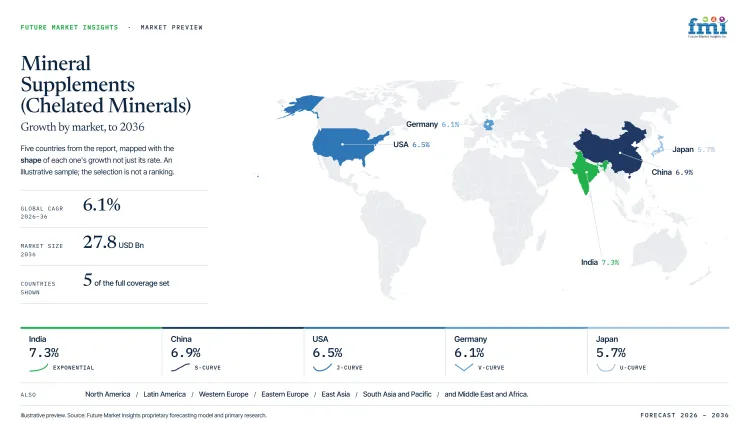
| Country | CAGR |
|---|---|
| India | 7.3% |
| China | 6.9% |
| USA | 6.5% |
| Germany | 6.1% |
| Japan | 5.7% |
How do country-level CAGRs compare in the Mineral Supplements (Chelated Minerals) Market?
The country forecasts show a steady progression across the mineral supplements (chelated minerals) market, with all five countries remaining within a relatively narrow growth band. India and China form an upper group, reflecting expanding use of mineral supplementation and increasing focus on nutrient bioavailability. The USA follows closely behind and remains connected to this group through a modest difference in forecast growth. Germany and Japan create a lower pair with limited separation between their projections, indicating comparable market dynamics. The overall pattern suggests that demand for chelated minerals is supported by growing interest in preventive health, nutritional supplementation and advanced mineral formulations. Variations between countries are influenced more by supplement usage trends, consumer awareness and product innovation than by fundamental differences in market demand.
- India shows a notable position within the comparison as rising health awareness and increasing consumption of dietary supplements continue to support demand for chelated mineral formulations.
- China remains closely aligned with India as consumers increasingly seek mineral supplements that offer improved absorption and targeted nutritional benefits.
- The USA benefits from a mature supplement industry where manufacturers continue to incorporate chelated minerals into premium wellness, sports nutrition and healthy aging products.
- Germany reflects steady market development through consistent demand for scientifically formulated nutritional products and high-quality mineral supplementation.
- Japan maintains a meaningful position within the comparison as healthy aging trends and preventive nutrition practices encourage continued use of bioavailable mineral ingredients.
Comparable CAGRs do not create identical market conditions across countries. Differences in consumer supplementation habits, regulatory frameworks, product positioning and distribution channels can influence adoption patterns and commercialization strategies. Similar growth forecasts may therefore reflect distinct market priorities and competitive environments within the chelated minerals sector. The full report provides country-level CAGR analysis across North America, Latin America, Europe, East Asia, South Asia, Oceania and the Middle East and Africa.
Country-wise Analysis
- India regulates health supplements through a framework that defines nutrient ingredients and premixes for domestic product development. FSSAI re-operationalised the draft Health Supplements, Nutraceuticals, Food for Special Dietary Use, Food for Special Medical Purpose and Prebiotic and Probiotic Food Regulations, 2022 from July 2024 while finalization remained pending, allowing the use of additives and GMP tables as per Codex across formats until final notification. Mineral supplements sales in India are forecast to expand at 7.3% CAGR by 2036, driven by local product development across tablets and gummies. Domestic contract manufacturers provide flexible batch sizes across several finished formats and emerging supplement brand programs. Regional ingredient distributors can shorten sample delivery and technical review for local development teams during qualification. Imported compounds require complete documentation and purity review, which can extend qualification for unfamiliar forms or claims.
- China separates health-food registration from filing through ingredient scope and import status across defined regulatory pathways. Domestic producers benefit from established manufacturing networks and provincial filing activity across major production regions. Adoption of mineral supplements in China is estimated to expand at 6.9% CAGR through 2036, underpinned by defined registration and filing routes for vitamin and mineral products. SAMR issued food-label supervision measures in March 2025 that require truthful declarations and visible registration details. Local testing organizations can support dossier preparation during provincial review for several mineral supplement applications. Unfamiliar compounds or claims can extend launch schedules through additional technical documentation requirements across provincial review routes.
- United States manufacturers operate under dietary supplement manufacturing requirements and detailed finished-product specification controls across commercial batches. By 2036 the mineral supplements market in the United States is projected to grow at 6.5% CAGR, supported by established retail access and experienced contract manufacturing. The FDA reported in September 2025 that Eniva USA lacked adequate identity and composition specifications for finished gummies. Experienced laboratories and contract manufacturers support corrective testing across capsules and gummy production as well as release investigations. National distribution networks also shorten replenishment cycles for established supplement brands across major regional retail markets. Enforcement exposure remains a material friction for companies that cannot connect incoming mineral results with finished claims.
- German supplement companies operate within European food law and national risk guidance for nutrient levels. In Germany mineral supplements demand is predicted to advance at 6.1% CAGR through 2036, shaped by mature retail channels and strong analytical capacity. Local laboratories support precise elemental measurement and finished-product testing across chelated and conventional compounds during commercial qualification. BfR updated its maximum-level recommendation table in March 2026 for vitamins and minerals used in supplements. Specialist distributors shorten sample delivery and technical response times across established supplement manufacturing clusters and neighboring markets. Nonbinding recommendations can complicate one-formula strategies across countries with different enforcement practices and national risk expectations.
- Japanese supplements require careful positioning across ordinary foods and recognized health-claim routes during commercial planning. Domestic quality systems support consistent production and detailed finished-product documentation across regulated supplement formats and commercial batches. Mineral supplements demand in Japan is forecast to rise at 5.7% CAGR over the forecast period, influenced by demanding evidence expectations and established quality systems. MHLW made electronic health-damage reporting available from April 2026 for relevant food businesses and supplement manufacturers. Local trading companies can coordinate samples and technical documentation for overseas manufacturers entering established retail and pharmacy channels. Classification reviews and Japanese-language records increase entry costs for brands without established local regulatory support.
Who are the notable companies in the Mineral Supplements (Chelated Minerals) Market?
Jungbunzlauer, Balchem (Albion), Glanbia Health & Nutrition, Innophos, Budenheim, Jost Chemical, Gadot, and TSI Group are notable companies in the mineral supplements (chelated minerals) market.
-market-analysis-by-company.webp "Mineral Supplements (chelated Minerals) Market Analysis By Company")
Competition spans chelated chemistry and high-purity mineral salts alongside premix design and finished-format support across global supplement programs. Glanbia introduced its Health & Nutrition business in October 2025 around premixes and flavor ingredients for supplement applications. The business combines customizable vitamin and mineral premixes with application support across several finished forms. Comparable dairy mineral premixes show how mineral sourcing can connect with blending and formulation services. Competitive strength depends on documentation and application performance rather than ingredient breadth alone across several finished supplement formats.
- Jungbunzlauer and Balchem support chelated mineral programs across tablets and other supplement formats in multiple commercial markets. Balchem outlined its mineral and nutrient innovation model in August 2025, highlighting scalable formulation and sensory development. Their competitive value rests on consistent chemistry and technical documentation that supports finished-product development and commercial scale-up.
- Innophos and Budenheim offer chelated magnesium options for capsules and gummies across commercial nutrition programs. Jost Chemical provides high-purity mineral salts for regulated supplement manufacturing through operations in North America and Europe. Each route requires compound-specific evidence during product qualification and finished-product testing under commercial manufacturing conditions.
- Glanbia Health & Nutrition supports premix optimization and finished-format development across supplement applications and commercial production programs. Gadot provides citrate-based mineral solutions for beverages and supplements through its nutrition portfolio and application support network. TSI Group adds finished-format manufacturing and alternative delivery technologies across international supplement programs and regional commercialization routes.
Competitive Benchmarking: Mineral Supplements (Chelated Minerals) Market
| Company | Chelated and Specialty Mineral Portfolio | Finished-Format Application Support | Analytical and Scale Support | Geographic Reach |
|---|---|---|---|---|
| Jungbunzlauer | High | High | Medium | Global |
| Balchem (Albion) | High | High | High | Global |
| Glanbia Health & Nutrition | Medium | High | High | Global |
| Innophos | High | High | High | North America and Asia-Pacific |
| Budenheim | High | High | Medium | Americas and Europe |
| Jost Chemical | Medium | Medium | High | North America and Europe |
| Gadot | Medium | High | Medium | Europe and international markets |
| TSI Group | Medium | High | High | Global |
Key Developments in the Mineral Supplements (Chelated Minerals) Market
- In November 2025, Jungbunzlauer completed the acquisition of a production site in Thomson within Illinois. The location became its first United States manufacturing facility and improved proximity to North American customers. Equipment installation and regulatory work began immediately to prepare the facility for future commercial ingredient production. The development expands regional service capacity without presenting every planned mineral ingredient as commercially available from the facility.
- In June 2025, Jost Chemical earned ISO/IEC 17025:2017 accreditation for its testing laboratory in Saint Louis. The accreditation confirms technical competence for chemical and biological testing under validated quality systems for commercial customers. Supplement manufacturers gain a stronger analytical route for reviewing identity and composition data across commercial mineral batches. The development improves documentation quality during qualification without treating laboratory accreditation as proof of finished-product performance.
- In September 2025, TSI Group announced its Medisci TSI joint venture in Thailand to expand regional supplement manufacturing capacity. The venture adds local supplement manufacturing and regulatory support for brands entering Southeast Asian markets. The expansion can shorten regional production routes for mineral tablets and related capsule or gummy formats. Commercial value depends on product-specific certification and finished-form validation rather than the joint venture announcement alone.
Key Players in the Mineral Supplements (Chelated Minerals) Market
Chelated Mineral Technology Providers
- Jungbunzlauer
- Balchem (Albion)
- Innophos
- Budenheim
High-Purity Mineral Salt Providers
- Jost Chemical
- Gadot
Premix and Application Support Providers
- Glanbia Health & Nutrition
- TSI Group
Mineral Supplements (Chelated Minerals) Market - Report Scope
| Coverage field | Report scope |
|---|---|
| Market breakdown | Mineral, form, format, and region. |
| Quantitative Units | Revenue in USD Billion, CAGR in %. |
| Market Definition | Revenue from magnesium, zinc, iron, calcium, and other mineral supplements sold in chelated, citrate, oxide, and related forms across gummies, liquids, capsules, and comparable dietary supplement formats. |
| Regions Covered | North America, Latin America, Western Europe, Eastern Europe, East Asia, South Asia and Pacific, and Middle East and Africa. |
| Countries Covered | India, China, USA, Germany, and Japan. |
| Key Companies Profiled | Jungbunzlauer, Balchem (Albion), Glanbia Health & Nutrition, Innophos, Budenheim, Jost Chemical, Gadot, and TSI Group. |
| Forecast Period | 2026 to 2036. |
| Approach | Hybrid bottom-up and top-down market sizing supported by primary interviews and official desk research. |
Mineral Supplements (Chelated Minerals) Market - Research Methodology
| Method | Approach |
|---|---|
| Primary Research | FMI analysts gathered input from manufacturers, service providers, technology developers, distributors, end users, procurement teams, and subject-matter experts. Interviews examined purchasing decisions, product or service evaluation, adoption barriers, approval requirements, pricing considerations, and expectations for technical or commercial support. Respondents were also asked what evidence is required before a trial, pilot, or initial order develops into regular purchasing. |
| Desk Research | Desk research covered government statistics, regulatory publications, trade data, industry associations, technical literature, standards, company filings, product information, and official corporate announcements. Sources were reviewed for relevance, publication date, geographic coverage, and consistency with the defined market scope. Claims relating to performance, applications, approvals, capacity, investment, and commercial activity were retained only when supported by credible public evidence. |
| Market Sizing and Forecasting | The market model combined the baseline value with historical performance, segment structure, pricing and volume indicators, adoption levels, company participation, and country-level demand conditions. Forecast assumptions considered economic activity, investment trends, regulatory developments, technology adoption, purchasing cycles, supply availability, and barriers to wider market use. Segment and regional estimates were reconciled before the final market total was calculated. |
| Data Validation | Estimates were checked against multiple independent indicators, including public data, company activity, trade patterns, industry developments, and findings from primary interviews. Validation also tested whether products, services, applications, and company revenues fell within the defined market boundaries. Adjacent categories, unsupported claims, overlapping revenues, and activities without direct market relevance were excluded to reduce double counting and maintain consistency across segments and countries. |
Mineral Supplements (Chelated Minerals) Market by Segments
Mineral Supplements (Chelated Minerals) Market segmented by Mineral:
- Magnesium
- Zinc
- Iron
- Calcium
Mineral Supplements (Chelated Minerals) Market segmented by Form:
- Bisglycinate/Chelated
- Oxide
- Citrate
Mineral Supplements (Chelated Minerals) Market segmented by Format:
- Gummy
- Liquid
- Capsule
Mineral Supplements (Chelated Minerals) Market by Region:
- North America
- United States
- Canada
- Latin America
- Brazil
- Mexico
- Argentina
- Chile
- Western Europe
- Germany
- France
- United Kingdom
- Italy
- Spain
- Benelux
- Nordics
- Eastern Europe
- Poland
- Czech Republic
- Romania
- Hungary
- East Asia
- China
- Japan
- South Korea
- South Asia and Pacific
- India
- ASEAN
- Australia and New Zealand
- Middle East and Africa
- GCC Countries
- South Africa
- Türkiye
- Israel
Research Sources and Bibliography
- National Institutes of Health, Office of Dietary Supplements. (2026, January 6). Magnesium - Health Professional Fact Sheet.
- State Administration for Market Regulation. (2025, June 24).
- Jungbunzlauer Suisse AG. (2025, October 21). Jungbunzlauer launches highly bioavailable, fully chelated Magnesium Bisglycinate at SupplySide Global 2025.
- Budenheim. (2026, May 26). Budenheim expands life science portfolio with chelated minerals in the Americas.
- Jungbunzlauer Suisse AG. (2025, July 10). Jungbunzlauer showcases bioavailable mineral innovations for Gummies at IFT FIRST 2025.
- Stierman, B., Couch, C. A., Gahche, J. J., & Mishra, S. (2026, May). Dietary supplement use: United States, August 2021-August 2023.
- USA Food and Drug Administration. (2025, March 28). Mother Earth Minerals, Inc. - 692527 - 03/28/2025.
- TSI Group. (2025, May 12). TSI Group Launches OptiClear™: Crystal-Clear Innovation for Supplement Formulation Challenges.
- USA Food and Drug Administration. (2025, September 10). Eniva USA, Inc. - 706565 - 09/10/2025.
- State Administration for Market Regulation. (2025, March 26).
- Food Safety and Standards Authority of India. (2024, August 30). Direction under Section 16(5) regarding re-operationalisation of draft FSS (Health Supplements, Nutraceuticals, Food for Special Dietary Use, Food for Special Medical Purpose and Prebiotic and Probiotic Food) Regulations, 2022.
- German Federal Institute for Risk Assessment. (2026, March 9). Table: BfR recommendations for maximum levels.
- Ministry of Health, Labour and Welfare. (2026, April 1).
- Balchem Corporation. (2025, August 22). How Balchem Supports Mineral & Nutrient Solutions for Scalable Product Innovation.
- Glanbia plc. (2025, October 21). Innovation uncovered: Inside Health & Nutrition.
- Innophos. (2025, September 29). Innophos Attending SupplySide Global 2025.
- Gadot Biochemical Industries Ltd. (2024, July 8). Magnesium Citrate Supports All Life Stages for Women: Gadot Leads Women’s Health Ingredient Development.
- Jungbunzlauer Suisse AG. (2025, November 6). Jungbunzlauer closes acquisition of Illinois facility to launch USA manufacturing operations.
- Jost Chemical Co. (2025, June 3). Jost Chemical Earns ISO/IEC 17025:2017 Accreditation.
- Glanbia plc. (2026, July 6). Inside Glanbia innovation: Where science, flavour and formulation come together.
- TSI Group. (2025, September 3). At Vitafoods Asia, TSI Group Will Showcase Bold Innovation and Market Access.
This bibliography is provided for reader reference and is not exhaustive. The full report contains the complete reference list and detailed citations
This Report Answers
- How large is the mineral supplements (chelated minerals) market in 2026 and 2036?
- Which operating factors support mineral supplement demand across finished formats?
- Why does magnesium account for the largest mineral share in 2026?
- What supports bisglycinate or chelated forms within the form category?
- Why are gummies expected to capture a substantial format share in 2026?
- How do country growth rates differ across India, China, the USA, Germany, and Japan?
- Which companies provide chelated minerals, premixes, or high-purity mineral salts?
- What limits qualification across mineral compounds and country-specific labeling systems?
- How should product teams compare chelated forms with oxide and citrate alternatives?
Frequently Asked Questions
How big is the Mineral Supplements (Chelated Minerals) Market in 2026?
The mineral supplements (chelated minerals) market is valued at USD 15.4 billion in 2026 and is forecast to reach USD 27.8 billion by 2036, reflecting consistent demand for bioavailable dietary supplement formats across capsules, gummies, and other finished-product systems.
What is the CAGR of the Mineral Supplements (Chelated Minerals) Market from 2026 to 2036?
The mineral supplements (chelated minerals) market is projected to grow at a CAGR of 6.1% between 2026 and 2036, supported by increasing consumer focus on nutritional health, mineral deficiency prevention, and the rising adoption of bioavailable dietary supplement formats.
Which mineral leads the Mineral Supplements (Chelated Minerals) Market?
Magnesium accounts for 42.8% of the mineral supplements (chelated minerals) market by mineral in 2026, driven by its broad application across capsules and gummies and the need to balance elemental delivery across citrate, bisglycinate, and oxide compound options during formulation.
What is the growth outlook for India in the Mineral Supplements (Chelated Minerals) Market?
The mineral supplements (chelated minerals) market in India is projected to expand at a CAGR of 7.3% through 2036, ahead of the overall market average of 6.1%, underpinned by rising health awareness, growing dietary supplement consumption, and expanding domestic contract manufacturing capacity across tablets and gummies.
Who are the leading companies in the Mineral Supplements (Chelated Minerals) Market?
Leading companies in the mineral supplements (chelated minerals) market include Jungbunzlauer, Balchem (Albion), Glanbia Health & Nutrition, Innophos, Budenheim, Jost Chemical, Gadot, and TSI Group, competing across chelated mineral chemistry, high-purity mineral salts, and premix design with finished-format application support.
Preview the report firsthand - request a free sample
Get SampleGet the brochure for pricing and purchase details.
Get PDFTable of Content
- Key Takeaways
- Market Size and CAGR
- Top Growth Driver
- Fastest Growing Segment
- Leading Region
- Key Companies
- Emerging Opportunities
- Executive Summary
- Global Market Outlook
- Demand-side Trends
- Supply-side Trends
- Technology Roadmap Analysis
- Analysis and Recommendations
- Analyst Perspective (What is happening? Why now? What should investors know?)
- Key Questions Answered
- How large is the market?
- What is the CAGR?
- What are key trends?
- Which region dominates?
- Who are the leaders?
- Market Overview
- Market Coverage / Taxonomy
- Market Definition / Scope / Limitations
- Research Methodology
- Chapter Orientation
- Analytical Lens and Working Hypotheses
- Market Structure, Signals, and Trend Drivers
- Benchmarking and Cross-market Comparability
- Market Sizing, Forecasting, and Opportunity Mapping
- Research Design and Evidence Framework
- Desk Research Programme (Secondary Evidence)
- Expert Input and Fieldwork (Primary Evidence)
- Tooling, Models, and Reference Databases
- Data Engineering and Model Build
- Quality Assurance and Audit Trail
- Market Background
- Market Dynamics (Drivers, Restraints, Opportunity, Trends)
- Scenario Forecast (Optimistic, Likely, Conservative)
- Impact Analysis
- AI Impact
- Sustainability Impact
- Regulatory Impact
- Technology Impact
- Consumer / Buyer Analysis
- Purchase Drivers
- Adoption Barriers
- Buyer Journey
- Opportunity Map Analysis
- Product Life Cycle Analysis
- Supply Chain Analysis
- Investment Feasibility Matrix
- Value Chain Analysis
- PESTLE and Porter's Analysis
- Regulatory Landscape
- Regional Parent Market Outlook
- Production and Consumption Statistics
- Import and Export Statistics
- Global Market Analysis and Forecast, 2021 to 2036
- Historical Market Size Value (USD Billion) Analysis, 2021 to 2025
- Current and Future Market Size Value (USD Billion) Projections, 2026 to 2036
- Y-o-Y Growth Trend Analysis
- Absolute $ Opportunity Analysis
- Global Market Pricing Analysis, 2021 to 2036
- Global Market Analysis and Forecast, By Mineral, 2021 to 2036
- Introduction / Key Findings
- Historical Market Size Value (USD Billion) Analysis By Mineral, 2021 to 2025
- Current and Future Market Size Value (USD Billion) Analysis and Forecast By Mineral, 2026 to 2036
- Magnesium
- Zinc
- Iron
- Calcium
- Magnesium
- Y-o-Y Growth Trend Analysis By Mineral, 2021 to 2025
- Absolute $ Opportunity Analysis By Mineral, 2026 to 2036
- Global Market Analysis and Forecast, By Form, 2021 to 2036
- Introduction / Key Findings
- Historical Market Size Value (USD Billion) Analysis By Form, 2021 to 2025
- Current and Future Market Size Value (USD Billion) Analysis and Forecast By Form, 2026 to 2036
- Bisglycinate/Chelated
- Oxide
- Citrate
- Bisglycinate/Chelated
- Y-o-Y Growth Trend Analysis By Form, 2021 to 2025
- Absolute $ Opportunity Analysis By Form, 2026 to 2036
- Global Market Analysis and Forecast, By Format, 2021 to 2036
- Introduction / Key Findings
- Historical Market Size Value (USD Billion) Analysis By Format, 2021 to 2025
- Current and Future Market Size Value (USD Billion) Analysis and Forecast By Format, 2026 to 2036
- Gummy
- Liquid
- Capsule
- Gummy
- Y-o-Y Growth Trend Analysis By Format, 2021 to 2025
- Absolute $ Opportunity Analysis By Format, 2026 to 2036
- Global Market Analysis and Forecast, By Region, 2021 to 2036
- Introduction
- Historical Market Size Value (USD Billion) Analysis By Region, 2021 to 2025
- Current Market Size Value (USD Billion) Analysis and Forecast By Region, 2026 to 2036
- North America
- Latin America
- Western Europe
- Eastern Europe
- East Asia
- South Asia and Pacific
- Middle East & Africa
- Market Attractiveness Analysis By Region
- North America Market Analysis and Forecast, By Country, 2021 to 2036
- Historical Market Size Value (USD Billion) Trend Analysis By Market Taxonomy, 2021 to 2025
- Market Size Value (USD Billion) Forecast By Market Taxonomy, 2026 to 2036
- By Country
- USA
- Canada
- By Mineral
- By Form
- By Format
- By Country
- Market Attractiveness Analysis
- By Country
- By Mineral
- By Form
- By Format
- Key Takeaways
- Latin America Market Analysis and Forecast, By Country
- Historical Market Size Value (USD Billion) Trend Analysis By Market Taxonomy, 2021 to 2025
- Market Size Value (USD Billion) Forecast By Market Taxonomy, 2026 to 2036
- By Country
- Brazil
- Mexico
- Chile
- Rest of Latin America
- By Mineral
- By Form
- By Format
- By Country
- Market Attractiveness Analysis
- By Country
- By Mineral
- By Form
- By Format
- Key Takeaways
- Western Europe Market Analysis and Forecast, By Country
- Historical Market Size Value (USD Billion) Trend Analysis By Market Taxonomy, 2021 to 2025
- Market Size Value (USD Billion) Forecast By Market Taxonomy, 2026 to 2036
- By Country
- Germany
- UK
- Italy
- Spain
- France
- Nordic
- BENELUX
- Rest of Western Europe
- By Mineral
- By Form
- By Format
- By Country
- Market Attractiveness Analysis
- By Country
- By Mineral
- By Form
- By Format
- Key Takeaways
- Eastern Europe Market Analysis and Forecast, By Country
- Historical Market Size Value (USD Billion) Trend Analysis By Market Taxonomy, 2021 to 2025
- Market Size Value (USD Billion) Forecast By Market Taxonomy, 2026 to 2036
- By Country
- Russia
- Poland
- Hungary
- Balkan & Baltic
- Rest of Eastern Europe
- By Mineral
- By Form
- By Format
- By Country
- Market Attractiveness Analysis
- By Country
- By Mineral
- By Form
- By Format
- Key Takeaways
- East Asia Market Analysis and Forecast, By Country
- Historical Market Size Value (USD Billion) Trend Analysis By Market Taxonomy, 2021 to 2025
- Market Size Value (USD Billion) Forecast By Market Taxonomy, 2026 to 2036
- By Country
- China
- Japan
- South Korea
- By Mineral
- By Form
- By Format
- By Country
- Market Attractiveness Analysis
- By Country
- By Mineral
- By Form
- By Format
- Key Takeaways
- South Asia and Pacific Market Analysis and Forecast, By Country
- Historical Market Size Value (USD Billion) Trend Analysis By Market Taxonomy, 2021 to 2025
- Market Size Value (USD Billion) Forecast By Market Taxonomy, 2026 to 2036
- By Country
- India
- ASEAN
- Australia & New Zealand
- Rest of South Asia and Pacific
- By Mineral
- By Form
- By Format
- By Country
- Market Attractiveness Analysis
- By Country
- By Mineral
- By Form
- By Format
- Key Takeaways
- Middle East & Africa Market Analysis and Forecast, By Country
- Historical Market Size Value (USD Billion) Trend Analysis By Market Taxonomy, 2021 to 2025
- Market Size Value (USD Billion) Forecast By Market Taxonomy, 2026 to 2036
- By Country
- Kingdom of Saudi Arabia
- Other GCC Countries
- Türkiye
- South Africa
- Other African Union
- Rest of Middle East & Africa
- By Mineral
- By Form
- By Format
- By Country
- Market Attractiveness Analysis
- By Country
- By Mineral
- By Form
- By Format
- Key Takeaways
- Key Countries Market Analysis
- USA
- Pricing Analysis
- Market Share Analysis, 2025
- By Mineral
- By Form
- By Format
- Canada
- Pricing Analysis
- Market Share Analysis, 2025
- By Mineral
- By Form
- By Format
- Mexico
- Pricing Analysis
- Market Share Analysis, 2025
- By Mineral
- By Form
- By Format
- Brazil
- Pricing Analysis
- Market Share Analysis, 2025
- By Mineral
- By Form
- By Format
- Chile
- Pricing Analysis
- Market Share Analysis, 2025
- By Mineral
- By Form
- By Format
- Germany
- Pricing Analysis
- Market Share Analysis, 2025
- By Mineral
- By Form
- By Format
- UK
- Pricing Analysis
- Market Share Analysis, 2025
- By Mineral
- By Form
- By Format
- Italy
- Pricing Analysis
- Market Share Analysis, 2025
- By Mineral
- By Form
- By Format
- Spain
- Pricing Analysis
- Market Share Analysis, 2025
- By Mineral
- By Form
- By Format
- France
- Pricing Analysis
- Market Share Analysis, 2025
- By Mineral
- By Form
- By Format
- India
- Pricing Analysis
- Market Share Analysis, 2025
- By Mineral
- By Form
- By Format
- ASEAN
- Pricing Analysis
- Market Share Analysis, 2025
- By Mineral
- By Form
- By Format
- Australia & New Zealand
- Pricing Analysis
- Market Share Analysis, 2025
- By Mineral
- By Form
- By Format
- China
- Pricing Analysis
- Market Share Analysis, 2025
- By Mineral
- By Form
- By Format
- Japan
- Pricing Analysis
- Market Share Analysis, 2025
- By Mineral
- By Form
- By Format
- South Korea
- Pricing Analysis
- Market Share Analysis, 2025
- By Mineral
- By Form
- By Format
- Russia
- Pricing Analysis
- Market Share Analysis, 2025
- By Mineral
- By Form
- By Format
- Poland
- Pricing Analysis
- Market Share Analysis, 2025
- By Mineral
- By Form
- By Format
- Hungary
- Pricing Analysis
- Market Share Analysis, 2025
- By Mineral
- By Form
- By Format
- Kingdom of Saudi Arabia
- Pricing Analysis
- Market Share Analysis, 2025
- By Mineral
- By Form
- By Format
- Türkiye
- Pricing Analysis
- Market Share Analysis, 2025
- By Mineral
- By Form
- By Format
- South Africa
- Pricing Analysis
- Market Share Analysis, 2025
- By Mineral
- By Form
- By Format
- USA
- Market Structure Analysis
- Competition Dashboard
- Competition Benchmarking
- Market Share Analysis of Top Players
- By Regional
- By Mineral
- By Form
- By Format
- Emerging Startups
- Innovation Benchmarking
- Competition Analysis
- Competition Deep Dive
- Jungbunzlauer
- Overview
- Product Portfolio
- Profitability by Market Segments
- Sales Footprint
- Strategy Overview
- Marketing Strategy
- Product Strategy
- Channel Strategy
- Balchem (Albion)
- Glanbia (Bergstrom)
- BASF
- Lonza
- Gadot
- Dr. Paul Lohmann
- Jungbunzlauer
- Case Studies
- Success Stories
- Recent Developments
- Competition Deep Dive
- Assumptions & Acronyms Used


