

- Market Size (2026)
- USD 215.5 Mn
- Forecast (2036)
- USD 595.6 Mn
- CAGR (2026 to 2036)
- 10.7%
How big is Soil Pathogen Inhibitors Market in 2026?
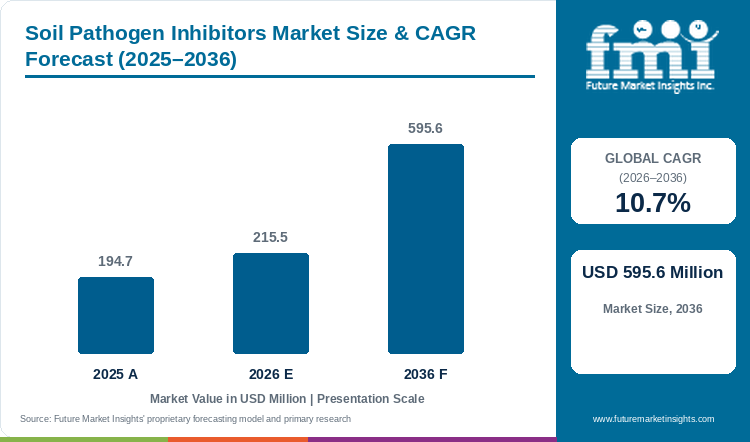
Demand for soil pathogen inhibitors is projected to expand at 10.7% CAGR between 2026 and 2036. Industry value grows from USD 194.7 million in 2025 to USD 215.5 million in 2026 and is projected to reach USD 595.6 million by 2036.
Trend analysis of soil pathogen inhibitors industry by FMI suggests expansion at 10.7% CAGR between 2026 and 2036. Industry value grew from USD 194.7 million in 2025 to USD 215.5 million in 2026 and is set to reach USD 595.6 million by 2036. Increasing soilborne disease losses is creating need for inhibitors placed before roots lose establishment. EPA recorded seven biopesticide active ingredients first registered during 2025, including four microbial strains[1]. Seed, transplant and soil use are widening application spread, while stable viable count is moving premium-grade demand, which means factors like named crop, pathogen, dose and placement direction remains the final commercial filter.
Soil pathogen inhibitor demand is not developing uniformly across countries, with the USA projected to grow at 10.2% CAGR, whilst South Korea is forecast at 9.9% through 2036. The U.S. harvested 91.3 million corn acres in 2025, giving seed and in-furrow application a wider buying base[2]. South Korea had 25 registered items among 29 microbial pesticide products in February 2026, equal to 0.8% of registered pesticides[3]. South Korea therefore grows from a smaller base, whereas the USA gets demand from scale and planting channels. USA buyers compare large-acre crop fit, while South Korean buying remains connected with local registration and distributor support. Qualification and local documentation will decide repeat use in both countries.
Key Takeaways
- In the FMI report, preventive disease management supports demand when products fit seed, transplant, and root-zone routines.
- Based on active type, bacillus-based products are projected to account for 48.2% in 2026 owing to storage stability and delivery flexibility.
- By crop type, cereals and grains are estimated to hold 41.8% in 2026 because treatment can be placed during high-acreage planting.
- In 2026, soil or drench application is expected to lead application method with 47.6% share due to direct root-zone placement.
- USA is projected at 10.2% CAGR through 2036, while South Korea is forecast at 9.9% as registration routes and farm channels differ.
- Notable companies in the soil pathogen inhibitors market include ProFarm, BioWorks, Bayer Crop Science, Syngenta, Corteva Agriscience, and FMC Corporation.
Analyst Perspective
“Seed and root-zone placement will bring biological inhibitors into regular crop programs. Local disease proof will decide repeat demand across crops and regions.”
- Nikhil Kaitwade, Principal Consultant, Future Market Insights.
How is the soil pathogen inhibitors market segmented?
Soil pathogen inhibitors market is segmented by five primary commercial axes and region: active type, crop type, application method, target setting, sales channel, and region. Bacillus-based products, cereals and grains, and soil or drench application are projected at 48.2%, 41.8%, and 47.6% in 2026.
By active type: bacillus-based, trichoderma and fungal-based, botanical extracts, and bacteriophage and others.
By crop type: cereals and grains, fruits and vegetables, oilseeds and pulses, turf and ornamentals, and others.
By application method: soil or drench, foliar spray, seed or transplant treatment, and others.
By target setting: open field, protected cultivation, post-plant rescue, and others.
By sales channel: agri-input distributors, cooperatives, agri-retail chains, online or direct-to-farm, and others.
By region: North America, Latin America, Western Europe, Eastern Europe, East Asia, South Asia and Pacific, and Middle East and Africa.
Why do bacillus-based products hold notable active type demand?
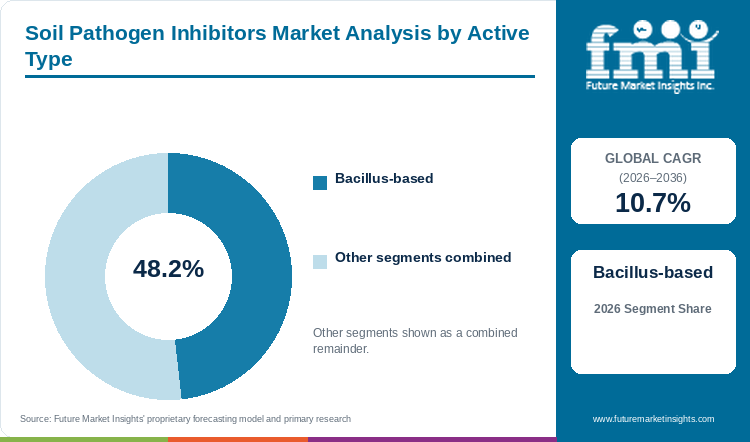
Based on active type, bacillus-based products are projected to account for 48.2% in 2026, supported by durable spore-forming formulations.
Bacillus-based products are facing high preference as the spores remain stable during storage and can be used across seed, soil and foliar formats. Bayer introduced Susteed in September 2025 with Bacillus amyloliquefaciens QST713 for Rhizoctonia and Phoma control[4]. This product development indicates that Bacillus strains are moving directly into seed-treatment programs and not remaining only as separate biological applications. Apart from that, durable spores allow distributors to hold inventory through the planting season with comparatively lower handling risk. Owing to these factors, Bacillus-based products are expected to retain notable demand where viable count, crop label and placement flexibility is required together.
- Bacillus-based products hold 48.2% of active type revenue in 2026, supported by stable spores and flexible placement.
- Spore-forming biology supports inventory handling where seasonal storage and several delivery formats are required.
What keeps cereals and grains central within crop type demand?
By crop type, cereals and grains are estimated to hold 41.8% in 2026, owing to repeatable at-plant treatment.
Cereals and grains are cultivated across large areas within a fixed planting window, due to which treatment can be placed with the seed and repeated every season. A March 2025 EPA registration for ProFarm product MBI-306 EP required storage-stability data before wider commercial shipment[5]. This requirement shows that microbial efficacy by itself is not enough for cereal programs as the product must also remain usable before and during planting. Seed treatment eliminates an additional field pass and allows inhibitors to move through an already planned operation. These factors are anticipated to support cereals and grains demand over the forecast period.
- Cereals and grains account for 41.8% of crop type revenue in 2026, as treatment fits fixed high-acreage planting windows.
- Fixed planting windows allow treatment planning, but storage stability remains important before seasonal shipment.
How does soil or drench placement support application method demand?
In 2026, soil or drench is expected to lead application method with 47.6% share, driven by direct root-zone placement.
Soil or drench application places viable organisms near roots where Pythium, Rhizoctonia and Fusarium can affect crop establishment. BioWorks states that RootShield HC suppresses these pathogens in greenhouse and field crops[6]. Direct placement reduces the distance between the organism and infection area, which is increasing preference for soil and drench use. Apart from that, the same route can be connected with transplant and irrigation routines. The application is expected to remain important where growers are looking for preventive control before visible disease and not a rescue treatment after root damage has occurred.
- Soil or drench represents 47.6% of application method revenue in 2026, owing to direct placement in the root infection zone.
- Direct placement reduces distance between the viable organism and the early root infection area.
Which conditions support open field use within target setting?
Open field is set to lead target setting with 42.6% share in 2026, aided by broadacre preventive programs.
Open-field cultivation provides the widest farm area for soil pathogen inhibitors; however, moisture, temperature and soil condition are not controlled like protected cultivation. In 2025, the Food and Agriculture Organization reported that open-field arable crops represent over 90% of globally cultivated agricultural land, requiring formulation stability across variable weather conditions[7]. This makes label precision and local trial performance a very important factor for open-field use. A living product can perform differently when weather and soil conditions change, due to which broad biological claims may not support repeat buying. Products having approved crop directions and adviser support are therefore expected to gain higher adoption in open-field programs.
- Open field holds 42.6% of target setting revenue in 2026, because farm-scale use creates the broadest placement base.
- Open-field buying remains stronger where advisers can match approved directions with local soil conditions.
Why do agri-input distributors retain sales channel relevance?
Agri-input distributors are projected to hold 44.7% of sales channel revenue in 2026, underpinned by local technical advice.
Biological inhibitors require correct storage, mixing, temperature and application timing before they are used on farm. Syngenta opened a 22,000 m² biologicals facility in 2025 with capacity for 16,000 tons of biostimulants annually[8]. Increasing biological production will increase the volume moving through local inventory and distributor channels. Agri-input distributors can explain the dose, handling limit and placement window, due to which growers are likely to prefer this channel over a channel providing only the product. Distributor training and seasonal inventory availability are expected to support sales through this channel.
- Agri-input distributors account for 44.7% of sales channel revenue in 2026, as local advice reduces handling and application risk.
- Distributor training can reduce mixing, timing and temperature errors before living products reach the farm.
What are the drivers, restraints, and opportunities in the soil pathogen inhibitors market?
In the soil pathogen inhibitors market, the key driver is preventive IPM, the key restraint is field consistency, and the key opportunity is at-plant delivery.
- Driver: Integrated pest management gives biological disease-control tools a defined place before crop loss becomes visible.
- Restraint: Strain viability, storage conditions, and local efficacy can slow registration, trial conversion, and repeat use.
- Opportunity: Seed and root-zone delivery can place inhibitors into existing planting routines without another field pass.
Preventive IPM Expands Product Use
Increasing preference for preventive crop protection is giving biological inhibitors a defined place within integrated pest management. In May 2025, the USDA National Institute of Food and Agriculture prioritized biological controls within integrated pest management programs to mitigate soilborne disease risk while sustaining crop yields[9]. This will support biological controls used with crop rotation, field monitoring and selective chemistry rather than as a full replacement. Products carrying one clear crop-pathogen use are likely to gain better adoption. However, broad sustainability language without application timing and disease scope may attract interest but is less likely to create routine farm purchase.
Field Consistency Delays Repeat Buying
Microbial products remain living systems after leaving the production facility, due to which storage and field conditions can change the final result. In May 2025, the USDA Agricultural Research Service reported that microbial biocontrol colonization declines significantly when root-zone temperatures remain below 12°C[10]. This limits the confidence of growers who require similar performance across seasons. Mixing errors, unsuitable temperature and delayed application can also reduce the working viable count. Owing to these issues, field consistency is expected to remain a major restraining factor and one weak season can delay repeat buying even when the product carries a valid label.
At-Plant Routes Open Scale
Seed treatment places a biological inhibitor before planting and moves the product through equipment already used by growers. In September 2026, the Netherlands Board for the Authorisation of Plant Protection Products and Biocides authorized Susteed biological seed treatment across multiple vegetable crop groups[11]. This eliminates the requirement of another field pass and places the organism before disease becomes visible. Cereals and oilseeds are expected to provide a wide opportunity as the treatment can be connected with high-acreage planting. However, shelf life, seed compatibility and viable count after storage will decide how much of this opportunity converts into regular demand.
Which country CAGRs are profiled in the soil pathogen inhibitors market?
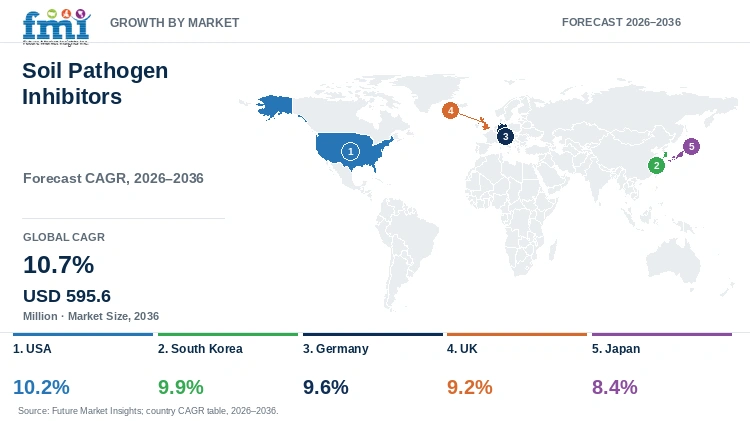
| Country | CAGR |
|---|---|
| USA | 10.2% |
| South Korea | 9.9% |
| Germany | 9.6% |
| UK | 9.2% |
| Japan | 8.4% |
How do country-level CAGRs compare in the soil pathogen inhibitors market?
Country outlook remains positive; however, every country is following a different authorization and farm-support route. The USA and South Korea have stronger expansion outlooks, while Germany, the UK and Japan are expected to remain more dependent on documentation and approved use directions.
- USA demand follows large cereal acreage and a federal biopesticide registration route with crop-specific labels.
- South Korea is simplifying microbial pesticide criteria while the registered product base remains small.
- Germany relies on an authorization register that links each product to approved crops, pests, and restrictions.
- UK policy places biological methods inside an integrated pest management plan rather than treating them as stand-alone replacements.
- Japan applies periodic pesticide re-evaluation and detailed active-ingredient records before products remain in use.
Full report country CAGRs cover: North America; Latin America; Western Europe; Eastern Europe; East Asia; South Asia and Pacific; Middle East and Africa.
Country-wise Analysis
- According to FMI, the USA soil pathogen inhibitors sector is projected to record 10.2% CAGR during the assessment period. Large cereal acreage and established seed-treatment equipment is giving suppliers a wide at-plant route. However, crop volume by itself will not ensure adoption. A registered strain must connect with one soilborne pathogen and a planting step already performed by growers. Products requiring a separate and uncertain field operation may grow slower even when the biological claim is strong.
- FMI data suggests adoption of soil pathogen inhibitors in South Korea will expand at 9.9% CAGR through 2036. The smaller registered base leaves room for new crop-specific approvals as microbial criteria becomes clearer. However, faster registration will not remove the need for local trials, viable strain evidence and distributor training. Suppliers connecting the organism with a named crop disease are expected to gain more than companies entering only with a wider biological message.
- Germany is estimated to post 9.6% CAGR over the forecast period, supported by structured authorization and adviser-led selection. The BVL authorization database connects listed products with crops, pests, restrictions and directions for use[12]. This structure supports microbial inhibitors having narrow and defensible disease claims; however, it also raises the entry burden for products carrying broad platform language. By the analysis of this route, authorization quality and local trial records will decide how fast product interest converts into a commercial program.
- Soil pathogen inhibitor demand in the UK is forecast to rise at 9.2% CAGR over the forecast period. The UK Pesticides National Action Plan places biological controls within integrated pest management rather than treating them as stand-alone chemical replacements[13]. This is expected to benefit products having clear timing, named pathogen scope and a role between monitoring and targeted intervention. Policy support will develop the opening, but adviser guidance and crop-specific evidence will still decide repeat purchase.
- The outlook for soil pathogen inhibitors in Japan remains positive, with sales projected to rise at 8.4% CAGR through 2036. In April 2025, the Ministry of Agriculture, Forestry and Fisheries updated procedures for periodic re-evaluation of registered pesticides[14]. Registration records by product, crop, pest and active ingredient favors focused disease claims and verified strain identity. However, the depth of the dossier can lengthen local entry, owing to which adoption is expected to move through established crop programs and advice channels.
Who are the notable companies in the soil pathogen inhibitors market?
Notable companies include ProFarm, BioWorks, Bayer Crop Science, Syngenta, Corteva Agriscience, FMC Corporation, Vestaron, and e-nema.
Soil pathogen inhibitor competition includes microbial fungicide specialists, integrated crop-protection companies and adjacent biological platforms. ProFarm, BioWorks, Bayer Crop Science and FMC Corporation compete through products having seed or root-disease use. Syngenta and Corteva Agriscience have wider discovery, manufacturing and distribution networks. Vestaron and e-nema provide different biological pest technologies and have limited direct overlap with soil pathogens. By the analysis of these situations, a broad company portfolio will support market access; however, the approved crop-pathogen claim, viable count, shelf life and local field record will decide the final supplier selection.
- Direct microbial disease-control suppliers: ProFarm, BioWorks, Bayer Crop Science, and FMC Corporation compete through labeled strains and placement routes.
- Broad biological platforms: Syngenta and Corteva Agriscience combine biological discovery with larger commercial and development networks.
- Adjacent biological specialists: Vestaron and e-nema bring peptide and nematode capabilities with narrower direct overlap in soil pathogens.
Competitive Benchmarking: Soil Pathogen Inhibitors Market
| Company | Portfolio fit | Root-zone fit | Platform depth | Geographic reach |
|---|---|---|---|---|
| ProFarm | High | Medium | High | High |
| BioWorks | High | High | High | Medium |
| Bayer Crop Science | High | High | High | High |
| Syngenta | Medium | Medium | High | High |
| Corteva Agriscience | High | High | High | High |
| FMC Corporation | High | High | High | High |
| Vestaron | Low | Low | Medium | Medium |
| e-nema | Low | High | Medium | Medium |
High indicates broad current evidence. Medium indicates narrower documented capability. Low indicates limited direct evidence for the criterion. Ratings describe public capability and do not rank quality, revenue, or market share.
Key Developments in the Soil Pathogen Inhibitors Market
- In September 2025, Bayer Crop Science introduced Susteed as a QST713 biological seed treatment for Rhizoctonia and Phoma.
- In June 2025, Syngenta reported that its 22,000 m² South Carolina biologicals facility could produce 16,000 tons annually.
- In February 2025, Syngenta acquired natural-compound and genetic-strain assets from Novartis and added fermentation capabilities.
- In March 2025, the U.S. EPA registered ProFarm product MBI-306 EP and required a one-year storage-stability study.
Key Players in the Soil Pathogen Inhibitors Market
Microbial Biofungicide Specialists
- ProFarm
- BioWorks
- FMC Corporation
Integrated Biological Crop-Protection Platforms
- Bayer Crop Science
- Syngenta
- Corteva Agriscience
Adjacent Biological Pest Platforms
- Vestaron
- e-nema
Soil Pathogen Inhibitors Market - Report Scope
| Coverage field | Report scope |
|---|---|
| Market breakdown | Active type; crop type; application method; target setting; sales channel; region |
| Quantitative units | USD million |
| Market definition | Commercial products sold to inhibit or suppress soil-associated plant pathogens. Generic fertilizers, biostimulants without pathogen claims, insecticides, equipment, and service revenue are excluded. |
| Regions covered | North America; Latin America; Western Europe; Eastern Europe; East Asia; South Asia and Pacific; Middle East and Africa |
| Countries covered | USA, South Korea, Germany, UK, Japan, and additional countries in the full report |
| Key companies profiled | ProFarm, BioWorks, Bayer Crop Science, Syngenta, Corteva Agriscience, FMC Corporation, Vestaron, e-nema |
| Forecast period | 2026 to 2036 |
| Approach | The report covers product revenue, application penetration, authorization access, channels, and crop-level demand. |
Soil Pathogen Inhibitors Market - Research Methodology
| Method | Approach |
|---|---|
| Primary Research | Analysts gathered input from manufacturers, service providers, technology developers, distributors, end users, procurement teams, and subject-matter experts. Interviews examined purchasing decisions, product evaluation, adoption barriers, approval requirements, pricing, and technical support. |
| Desk Research | Desk research covered government statistics, regulatory publications, trade data, industry associations, technical literature, standards, company filings, product information, and official corporate announcements. |
| Market Sizing and Forecasting | The market model combined the baseline value with historical performance, segment structure, pricing and volume indicators, adoption levels, company participation, and country-level demand conditions. |
| Data Validation | Estimates were checked against public data, company activity, trade patterns, industry developments, and primary interviews. Adjacent categories and overlapping revenue were excluded. |
Segment shares and forecasts are proprietary analytical estimates. They are not government statistics or direct measurements of global market share.
Soil Pathogen Inhibitors Market by Segments
Soil Pathogen Inhibitors Market segmented by Active Type:
- Bacillus-based
- Trichoderma and fungal-based
- Botanical extracts
- Bacteriophage and others
Soil Pathogen Inhibitors Market segmented by Crop Type:
- Cereals and grains
- Fruits and vegetables
- Oilseeds and pulses
- Turf and ornamentals
- Others
Soil Pathogen Inhibitors Market segmented by Application Method:
- Soil or drench
- Foliar spray
- Seed or transplant treatment
- Others
Soil Pathogen Inhibitors Market segmented by Target Setting:
- Open field
- Protected cultivation
- Post-plant rescue
- Others
Soil Pathogen Inhibitors Market segmented by Sales Channel:
- Agri-input distributors
- Cooperatives
- Agri-retail chains
- Online or direct-to-farm
- Others
Soil Pathogen Inhibitors Market by Region
- North America
- United States
- Canada
- Latin America
- Brazil
- Mexico
- Argentina
- Chile
- Western Europe
- Germany
- France
- United Kingdom
- Italy
- Spain
- Benelux
- Nordics
- Eastern Europe
- Poland
- Czech Republic
- Romania
- Hungary
- East Asia
- Japan
- South Korea
- South Asia and Pacific
- ASEAN
- Australia and New Zealand
- Middle East and Africa
- GCC Countries
- South Africa
- Türkiye
- Israel
Research Sources and Bibliography
- [1] U.S. Environmental Protection Agency. (2026, July 9). Biopesticide active ingredients.
- [2] U.S. Department of Agriculture, National Agricultural Statistics Service. (2026, January 12). Crop Production 2025 Summary.
- [3] Rural Development Administration of Korea. (2026, February 6). Revised microbial pesticide registration criteria.
- [4] Bayer Crop Science. (2025, September 29). Susteed brings together biologicals and seed treatments.
- [5] U.S. Environmental Protection Agency. (2025, March 7). MBI-306 EP pesticide registration, EPA Reg. No. 84059-34.
- [6] BioWorks, Inc. (2025). RootShield HC biological fungicide label.
- [7] Food and Agriculture Organization of the United Nations. (2025). World Food and Agriculture - Statistical Yearbook 2025.
- [8] Syngenta. (2025, June 30). Syngenta expands nature-inspired biological solutions.
- [9] U.S. Department of Agriculture, National Institute of Food and Agriculture. (2025, May 15). Integrated Pest Management programs and crop biosecurity.
- [10] U.S. Department of Agriculture, Agricultural Research Service. (2025, May 20). Soilborne pathogen suppression and microbial colonization dynamics.
- [11] Board for the Authorisation of Plant Protection Products and Biocides. (2026, September 2). Authorization of biological seed treatment Susteed.
- [12] Federal Office of Consumer Protection and Food Safety. (2026). Authorised plant protection products.
- [13] Department for Environment, Food & Rural Affairs. (2025, October 24). UK Pesticides National Action Plan 2025.
- [14] Ministry of Agriculture, Forestry and Fisheries of Japan. (2025, April 1). Pesticide re-evaluation procedures.
This bibliography is provided for reader reference. The full report contains the complete reference list and detailed citations.
This Report Answers
- What is Soil Pathogen Inhibitors Market worth during 2026?
- What value is Soil Pathogen Inhibitors Market projected by 2036?
- Which active type holds notable Soil Pathogen Inhibitors Market share?
- Which crop type holds notable Soil Pathogen Inhibitors Market share?
- Which countries have notable Soil Pathogen Inhibitors Market growth?
- Which companies are notable in Soil Pathogen Inhibitors Market today?
Frequently Asked Questions
How large is the Soil Pathogen Inhibitors Market expected to be in 2026?
Future Market Insights estimates that the soil pathogen inhibitors market will reach USD 215.5 million in 2026. The market is projected to expand further and reach USD 595.6 million by 2036.
What CAGR is forecast for the Soil Pathogen Inhibitors Market through 2036?
As per FMI, the soil pathogen inhibitors market is projected to grow at a 10.7% CAGR from 2026 to 2036. Growth is supported by increasing adoption of preventive seed and root-zone treatment in high-acreage field programs.
Which active type holds a notable soil pathogen inhibitors demand share in 2026?
Future Market Insights projects bacillus-based products to hold 48.2% of active type demand in 2026. The segment benefits from durable spore stability and multi-format application flexibility across seed and soil routines.
Which crop type holds a notable soil pathogen inhibitors share in 2026?
FMI finds that cereals and grains will hold 41.8% of crop type demand in 2026. Demand is supported by treatment fitting repeatable, high-acreage planting windows and established seed-handling routines.
Which country has a notable soil pathogen inhibitors expansion outlook during the forecast period?
Future Market Insights predicts the USA to expand at a 10.2% CAGR during the 2026 to 2036 assessment period. Growth is supported by extensive cereal acreage, advanced seed-treatment infrastructure, and clear federal biopesticide registration pathways.
Which companies are active in the Soil Pathogen Inhibitors Market during 2026?
Notable companies active in the Soil Pathogen Inhibitors Market during 2026 include ProFarm, BioWorks, Bayer Crop Science, Syngenta, Corteva Agriscience, FMC Corporation, Vestaron, and e-nema. These companies are focusing on strain discovery, formulation optimization, broader crop-label registrations, and distributor technical support.
Preview the report firsthand - request a free sample
Get SampleGet the brochure for pricing and purchase details.
Get PDFTable of Content
- Key Takeaways
- Market Size and CAGR
- Top Growth Driver
- Fastest Growing Segment
- Leading Region
- Key Companies
- Emerging Opportunities
- Executive Summary
- Global Market Outlook
- Demand-side Trends
- Supply-side Trends
- Technology Roadmap Analysis
- Analysis and Recommendations
- Analyst Perspective (What is happening? Why now? What should investors know?)
- Key Questions Answered
- How large is the market?
- What is the CAGR?
- What are key trends?
- Which region dominates?
- Who are the leaders?
- Market Overview
- Market Coverage / Taxonomy
- Market Definition / Scope / Limitations
- Research Methodology
- Chapter Orientation
- Analytical Lens and Working Hypotheses
- Market Structure, Signals, and Trend Drivers
- Benchmarking and Cross-market Comparability
- Market Sizing, Forecasting, and Opportunity Mapping
- Research Design and Evidence Framework
- Desk Research Programme (Secondary Evidence)
- Expert Input and Fieldwork (Primary Evidence)
- Tooling, Models, and Reference Databases
- Data Engineering and Model Build
- Quality Assurance and Audit Trail
- Market Background
- Market Dynamics (Drivers, Restraints, Opportunity, Trends)
- Scenario Forecast (Optimistic, Likely, Conservative)
- Impact Analysis
- AI Impact
- Sustainability Impact
- Regulatory Impact
- Technology Impact
- Consumer / Buyer Analysis
- Purchase Drivers
- Adoption Barriers
- Buyer Journey
- Opportunity Map Analysis
- Product Life Cycle Analysis
- Supply Chain Analysis
- Investment Feasibility Matrix
- Value Chain Analysis
- PESTLE and Porter's Analysis
- Regulatory Landscape
- Regional Parent Market Outlook
- Production and Consumption Statistics
- Import and Export Statistics
- Global Market Analysis and Forecast, 2021 to 2036
- Historical Market Size Value (USD Million) Analysis, 2021 to 2025
- Current and Future Market Size Value (USD Million) Projections, 2026 to 2036
- Y-o-Y Growth Trend Analysis
- Absolute $ Opportunity Analysis
- Global Market Pricing Analysis, 2021 to 2036
- Global Market Analysis and Forecast, By Active Type, 2021 to 2036
- Introduction / Key Findings
- Historical Market Size Value (USD Million) Analysis By Active Type, 2021 to 2025
- Current and Future Market Size Value (USD Million) Analysis and Forecast By Active Type, 2026 to 2036
- Bacillus-based
- Trichoderma and fungal-based
- Botanical extracts
- Bacteriophage and others
- Y-o-Y Growth Trend Analysis By Active Type, 2021 to 2025
- Absolute $ Opportunity Analysis By Active Type, 2026 to 2036
- Global Market Analysis and Forecast, By Crop Type, 2021 to 2036
- Introduction / Key Findings
- Historical Market Size Value (USD Million) Analysis By Crop Type, 2021 to 2025
- Current and Future Market Size Value (USD Million) Analysis and Forecast By Crop Type, 2026 to 2036
- Cereals and grains
- Fruits and vegetables
- Oilseeds and pulses
- Turf and ornamentals
- Others
- Y-o-Y Growth Trend Analysis By Crop Type, 2021 to 2025
- Absolute $ Opportunity Analysis By Crop Type, 2026 to 2036
- Global Market Analysis and Forecast, By Application Method, 2021 to 2036
- Introduction / Key Findings
- Historical Market Size Value (USD Million) Analysis By Application Method, 2021 to 2025
- Current and Future Market Size Value (USD Million) Analysis and Forecast By Application Method, 2026 to 2036
- Soil or drench
- Foliar spray
- Seed or transplant treatment
- Others
- Y-o-Y Growth Trend Analysis By Application Method, 2021 to 2025
- Absolute $ Opportunity Analysis By Application Method, 2026 to 2036
- Global Market Analysis and Forecast, By Target Setting, 2021 to 2036
- Introduction / Key Findings
- Historical Market Size Value (USD Million) Analysis By Target Setting, 2021 to 2025
- Current and Future Market Size Value (USD Million) Analysis and Forecast By Target Setting, 2026 to 2036
- Open field
- Protected cultivation
- Post-plant rescue
- Others
- Y-o-Y Growth Trend Analysis By Target Setting, 2021 to 2025
- Absolute $ Opportunity Analysis By Target Setting, 2026 to 2036
- Global Market Analysis and Forecast, By Sales Channel, 2021 to 2036
- Introduction / Key Findings
- Historical Market Size Value (USD Million) Analysis By Sales Channel, 2021 to 2025
- Current and Future Market Size Value (USD Million) Analysis and Forecast By Sales Channel, 2026 to 2036
- Agri-input distributors
- Cooperatives
- Agri-retail chains
- Online or direct-to-farm
- Others
- Y-o-Y Growth Trend Analysis By Sales Channel, 2021 to 2025
- Absolute $ Opportunity Analysis By Sales Channel, 2026 to 2036
- Global Market Analysis and Forecast, By Region, 2021 to 2036
- Introduction
- Historical Market Size Value (USD Million) Analysis By Region, 2021 to 2025
- Current Market Size Value (USD Million) Analysis and Forecast By Region, 2026 to 2036
- North America
- Latin America
- Western Europe
- Eastern Europe
- East Asia
- South Asia and Pacific
- Middle East and Africa
- Market Attractiveness Analysis By Region
- North America Market Analysis and Forecast, By Country, 2021 to 2036
- Historical Market Size Value (USD Million) Trend Analysis By Market Taxonomy, 2021 to 2025
- Market Size Value (USD Million) Forecast By Market Taxonomy, 2026 to 2036
- By Country
- United States
- Canada
- By Active Type
- By Crop Type
- By Application Method
- By Target Setting
- By Sales Channel
- By Country
- Market Attractiveness Analysis
- By Country
- By Active Type
- By Crop Type
- By Application Method
- By Target Setting
- By Sales Channel
- Key Takeaways
- Latin America Market Analysis and Forecast, By Country
- Historical Market Size Value (USD Million) Trend Analysis By Market Taxonomy, 2021 to 2025
- Market Size Value (USD Million) Forecast By Market Taxonomy, 2026 to 2036
- By Country
- Brazil
- Mexico
- Argentina
- Chile
- By Active Type
- By Crop Type
- By Application Method
- By Target Setting
- By Sales Channel
- By Country
- Market Attractiveness Analysis
- By Country
- By Active Type
- By Crop Type
- By Application Method
- By Target Setting
- By Sales Channel
- Key Takeaways
- Western Europe Market Analysis and Forecast, By Country
- Historical Market Size Value (USD Million) Trend Analysis By Market Taxonomy, 2021 to 2025
- Market Size Value (USD Million) Forecast By Market Taxonomy, 2026 to 2036
- By Country
- Germany
- France
- United Kingdom
- Italy
- Spain
- Benelux
- Nordics
- By Active Type
- By Crop Type
- By Application Method
- By Target Setting
- By Sales Channel
- By Country
- Market Attractiveness Analysis
- By Country
- By Active Type
- By Crop Type
- By Application Method
- By Target Setting
- By Sales Channel
- Key Takeaways
- Eastern Europe Market Analysis and Forecast, By Country
- Historical Market Size Value (USD Million) Trend Analysis By Market Taxonomy, 2021 to 2025
- Market Size Value (USD Million) Forecast By Market Taxonomy, 2026 to 2036
- By Country
- Poland
- Czech Republic
- Romania
- Hungary
- By Active Type
- By Crop Type
- By Application Method
- By Target Setting
- By Sales Channel
- By Country
- Market Attractiveness Analysis
- By Country
- By Active Type
- By Crop Type
- By Application Method
- By Target Setting
- By Sales Channel
- Key Takeaways
- East Asia Market Analysis and Forecast, By Country
- Historical Market Size Value (USD Million) Trend Analysis By Market Taxonomy, 2021 to 2025
- Market Size Value (USD Million) Forecast By Market Taxonomy, 2026 to 2036
- By Country
- Japan
- South Korea
- By Active Type
- By Crop Type
- By Application Method
- By Target Setting
- By Sales Channel
- By Country
- Market Attractiveness Analysis
- By Country
- By Active Type
- By Crop Type
- By Application Method
- By Target Setting
- By Sales Channel
- Key Takeaways
- South Asia and Pacific Market Analysis and Forecast, By Country
- Historical Market Size Value (USD Million) Trend Analysis By Market Taxonomy, 2021 to 2025
- Market Size Value (USD Million) Forecast By Market Taxonomy, 2026 to 2036
- By Country
- ASEAN
- Australia and New Zealand
- By Active Type
- By Crop Type
- By Application Method
- By Target Setting
- By Sales Channel
- By Country
- Market Attractiveness Analysis
- By Country
- By Active Type
- By Crop Type
- By Application Method
- By Target Setting
- By Sales Channel
- Key Takeaways
- Middle East and Africa Market Analysis and Forecast, By Country
- Historical Market Size Value (USD Million) Trend Analysis By Market Taxonomy, 2021 to 2025
- Market Size Value (USD Million) Forecast By Market Taxonomy, 2026 to 2036
- By Country
- GCC Countries
- South Africa
- Türkiye
- Israel
- By Active Type
- By Crop Type
- By Application Method
- By Target Setting
- By Sales Channel
- By Country
- Market Attractiveness Analysis
- By Country
- By Active Type
- By Crop Type
- By Application Method
- By Target Setting
- By Sales Channel
- Key Takeaways
- Key Countries Market Analysis
- United States
- Pricing Analysis
- Market Share Analysis, 2025
- By Active Type
- By Crop Type
- By Application Method
- By Target Setting
- By Sales Channel
- Canada
- Pricing Analysis
- Market Share Analysis, 2025
- By Active Type
- By Crop Type
- By Application Method
- By Target Setting
- By Sales Channel
- Mexico
- Pricing Analysis
- Market Share Analysis, 2025
- By Active Type
- By Crop Type
- By Application Method
- By Target Setting
- By Sales Channel
- Brazil
- Pricing Analysis
- Market Share Analysis, 2025
- By Active Type
- By Crop Type
- By Application Method
- By Target Setting
- By Sales Channel
- Chile
- Pricing Analysis
- Market Share Analysis, 2025
- By Active Type
- By Crop Type
- By Application Method
- By Target Setting
- By Sales Channel
- Germany
- Pricing Analysis
- Market Share Analysis, 2025
- By Active Type
- By Crop Type
- By Application Method
- By Target Setting
- By Sales Channel
- United Kingdom
- Pricing Analysis
- Market Share Analysis, 2025
- By Active Type
- By Crop Type
- By Application Method
- By Target Setting
- By Sales Channel
- Italy
- Pricing Analysis
- Market Share Analysis, 2025
- By Active Type
- By Crop Type
- By Application Method
- By Target Setting
- By Sales Channel
- Spain
- Pricing Analysis
- Market Share Analysis, 2025
- By Active Type
- By Crop Type
- By Application Method
- By Target Setting
- By Sales Channel
- France
- Pricing Analysis
- Market Share Analysis, 2025
- By Active Type
- By Crop Type
- By Application Method
- By Target Setting
- By Sales Channel
- ASEAN
- Pricing Analysis
- Market Share Analysis, 2025
- By Active Type
- By Crop Type
- By Application Method
- By Target Setting
- By Sales Channel
- Australia and New Zealand
- Pricing Analysis
- Market Share Analysis, 2025
- By Active Type
- By Crop Type
- By Application Method
- By Target Setting
- By Sales Channel
- Japan
- Pricing Analysis
- Market Share Analysis, 2025
- By Active Type
- By Crop Type
- By Application Method
- By Target Setting
- By Sales Channel
- South Korea
- Pricing Analysis
- Market Share Analysis, 2025
- By Active Type
- By Crop Type
- By Application Method
- By Target Setting
- By Sales Channel
- Poland
- Pricing Analysis
- Market Share Analysis, 2025
- By Active Type
- By Crop Type
- By Application Method
- By Target Setting
- By Sales Channel
- Hungary
- Pricing Analysis
- Market Share Analysis, 2025
- By Active Type
- By Crop Type
- By Application Method
- By Target Setting
- By Sales Channel
- Türkiye
- Pricing Analysis
- Market Share Analysis, 2025
- By Active Type
- By Crop Type
- By Application Method
- By Target Setting
- By Sales Channel
- South Africa
- Pricing Analysis
- Market Share Analysis, 2025
- By Active Type
- By Crop Type
- By Application Method
- By Target Setting
- By Sales Channel
- United States
- Market Structure Analysis
- Competition Dashboard
- Competition Benchmarking
- Market Share Analysis of Top Players
- By Regional
- By Active Type
- By Crop Type
- By Application Method
- By Target Setting
- By Sales Channel
- Emerging Startups
- Innovation Benchmarking
- Competition Analysis
- Competition Deep Dive
- ProFarm
- Overview
- Product Portfolio
- Profitability by Market Segments
- Sales Footprint
- Strategy Overview
- Marketing Strategy
- Product Strategy
- Channel Strategy
- BioWorks
- Bayer Crop Science
- Syngenta
- Corteva Agriscience
- FMC Corporation
- Vestaron
- e-nema
- ProFarm
- Case Studies
- Success Stories
- Recent Developments
- Competition Deep Dive
- Assumptions & Acronyms Used


