

- Market Size (2026)
- USD 379.5 Mn
- Forecast (2036)
- USD 915.0 Mn
- CAGR (2026 to 2036)
- 9.2%
How big is Bread Concentrates Market in 2026?
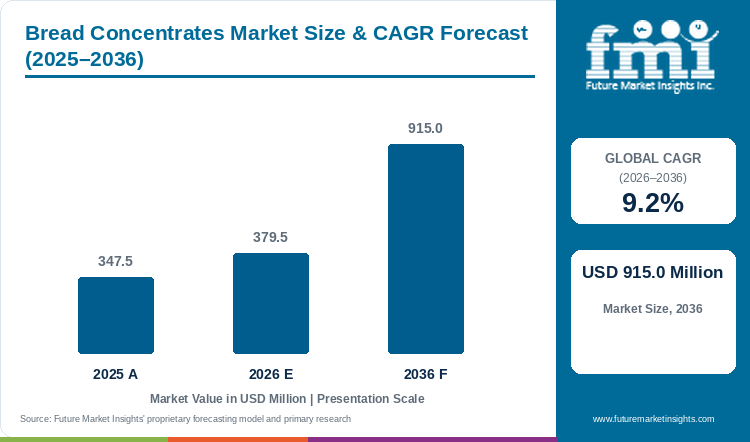
The bread concentrates market establishes its foundation at USD 347.5 million in 2025, advances to USD 379.5 million in 2026, and is forecast to scale to USD 915.0 million by 2036 at a CAGR of 9.2%.
The global bread concentrates market was valued at USD 347.5 million in 2025 and is estimated to reach USD 379.5 million in 2026. The market is projected to reach USD 915.0 million by 2036, expanding at a compound annual growth rate (CAGR) of 9.2% between 2026 and 2036. Standard grade is projected to account for 39.0% of 2026 type demand, since pre-balanced enzyme-emulsifier bases lower batch correction rates on high-speed pan-bread lines. Demand for concentrates is supported by dosing precision economics, as a supermarket bakery that measures improver by the cube rather than by the scoop removes both weighing labor and the over-feed staling defects that follow it [3]. That handling premium puts concentrates ahead of the bread improvers market at 7.1% CAGR, because bulk improver sales track flour tonnage while concentrate sales track the automation projects replacing open powder handling [9]. Product launches confirm the direction, as Puratos won an IBIE sustainability award in September 2025 for its pre-dosed 10-kg-flour improver cube that cuts storage space by 75% [3], and IFF's POWERFRESH ACE 2000 launched in August 2025 promising up to 34 days of bread softness and slice cohesiveness for US industrial bakeries [7]. Corbion paired that shelf-life push with clean-label emulsifier replacement through Ultra Fresh Plus 100 in September 2025 [20]. Bakers renew concentrate contracts on slice yield per shift, and suppliers whose dosing formats survive both automation audits and clean-label lists hold those ovens through 2036.
Key Market Trends & Insights
- By product type: Standard Grade is projected to account for 39.0% of the product type segment in 2026 because pre-balanced enzyme-emulsifier bases lower batch cost per ton of flour.
- By form: Powder / Dry formats are estimated to hold 45.0% of the form segment in 2026 due to smooth compatibility with automated micro-ingredient feeders.
- By application: Bread & Rolls are expected to represent 32.0% of the application segment in 2026 because high-speed pan and roll lines demand uniform proof height and slice resilience.
- By claim: Conventional formulations are forecast to capture 53.0% of the claim segment in 2026 owing to proven DATEM and fungal-enzyme shock tolerance.
- By sales channel: Direct to Industrial Bakeries is anticipated to command 49.0% of the sales channel segment in 2026 through plant-specific flour-rheology calibration contracts.
Regional Highlights
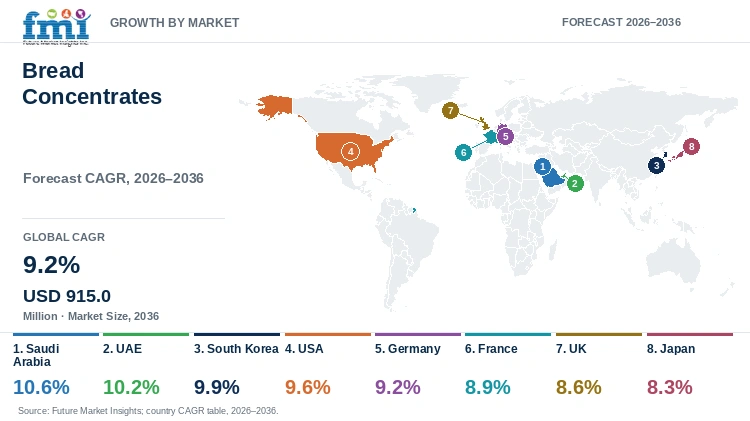
- Top national expansion: Saudi Arabia is projected to lead evaluated national markets at a 10.6% CAGR through 2036 under foodservice standardization and desert-wheat quality buffering.
- Broader country progression: The UAE is expected to expand at a 10.2% CAGR ahead of South Korea at a 9.9% CAGR and the USA at a 9.6% CAGR, while Japan is forecast to advance at an 8.3% CAGR.
Market Size & Forecast
Table 1: Market Size and Forecast for the Bread Concentrates Market (USD million and CAGR percentage), 2025 to 2036
| Metric | Value |
|---|---|
| 2025 Market Size | USD 347.5 million |
| Estimated Market Size in 2026 | USD 379.5 million |
| Projected Market Size by 2036 | USD 915.0 million |
| CAGR, 2026 to 2036 | 9.2% |
| Added Value Opportunity, 2026 to 2036 | USD 535.5 million |
Commercial bakeries confront acute shortages of experienced dough-mixers and erratic wheat protein or Hagberg Falling Number scores caused by volatile harvest weather. Manual scaling of multiple micro-ingredients per batch introduces dosing drift that triggers proof-box collapse or uneven crust blistering. In December 2025, a Scientific Reports study demonstrated that supplementing wheat dough with 300 to 600 U/kg of a dual xylanase-cellulase complex cut dough development time while improving extensibility and 7-day crumb softness [2]. Production directors therefore replace loose additive bins with dose-defined bakery ingredients and flour improver concentrates that standardize mixer tolerance across shifts.
Production-Volume and Batch-Formulation Sizing
Table 2: Production-Volume and Batch-Formulation Sizing for the Bread Concentrates Market (USD million and operational ranges), 2025 to 2036
| Metric | 2025 | 2026 | 2036 |
|---|---|---|---|
| Market size (USD million) | 347.5 | 379.5 | 915.0 |
| Treated flour volume (million metric tons) | 14.5 to 16.8 | 15.8 to 18.2 | 34.0 to 39.5 |
| Active concentrate dosage (% flour weight) | 0.5% to 5.0% | 0.5% to 5.0% | 0.4% to 4.5% |
| Average concentrate spend per ton of flour (USD) | 20.7 to 24.0 | 20.9 to 24.0 | 23.2 to 26.9 |
Operational note: Batch-formulation ranges reflect commercial low-inclusion improver concentrates (0.5% to 2.0% flour weight) and flavored/functional bread bases (2.0% to 5.0% flour weight), strictly excluding 50%-to-100% flour-heavy complete mixes.
Compression of functional dosage from 3.0% down to 0.5%-to-1.0% cube or powder concentrates cuts warehouse pallet space by up to 75% and eliminates heavy bag lifting on the mixing deck. Multi-plant baking groups routinely pair dough-based premixes with ultra-concentrated enzymatic tablets calibrated to 10-kilogram or 50-kilogram flour increments.
Per Capita & Commercial Bakery Facility Sizing
Table 3: Per Capita and Facility Spending Indicators for the Bread Concentrates Market (USD), 2025 to 2036
| Metric | 2025 | 2026 | 2036 |
|---|---|---|---|
| World population (million) | 8,200 | 8,300 | 9,000 |
| Spend per 1,000 people (USD) | 42.4 | 45.7 | 101.7 |
| Annual spend per commercial bakery plant (USD) | 18,500 to 21,500 | 20,100 to 23,400 | 44,000 to 51,200 |
| Direct industrial contract share (%) | 47.0% to 50.0% | 48.0% to 51.0% | 52.0% to 56.0% |
Table 4: Facility & Industrial Bakery Spending Indicators for the Bread Concentrates Market (USD and percentages), 2026
| Metric | Value | Institutional Reference Basis |
|---|---|---|
| Market size, 2026 | USD 379.5 million | 2026 global market value baseline |
| Commercial bakery establishments | 185,000 | Global industrial and craft bakery plant registry |
| Market spend per bakery establishment | USD 2,051.4 | Annualized bread-concentrate expenditure |
| Direct industrial bakery allocation, 2026 | USD 186.0 million | 49.0% sales-channel segment allocation |
Gas-cell stabilization during frozen par-baked storage and high-speed dividing requires balanced ascorbic acid and hemicellulase ratios. Industrial commissaries combine concentrated bases with alpha-amylase baking enzyme preparations to maintain uniform oven spring across seasonal wheat transitions.
Analyst Perspective
"The commercial inflection point for a bread concentrate is never laboratory loaf height alone. Procurement teams award standing supply contracts only when a dose-defined concentrate buffers local flour variability and eliminates manual weighing errors without triggering E-number label rejections."
- Nandini Roy Choudhury, Principal Consultant, Future Market Insights.
How is the bread concentrates market segmented?
The bread concentrates market is segmented by product type, form, application, claim, and sales channel. In 2026, Standard Grade is projected at 39.0%, Powder / Dry at 45.0%, Bread & Rolls at 32.0%, Conventional at 53.0%, and Direct to Industrial Bakeries at 49.0%.
By product type: Standard Grade, Premium Specialty Grade, Organic Certified, and Clean Label Grade.
By form: Powder / Dry, Liquid, Semi-Solid Paste, and Granular Pieces.
By application: Bread & Rolls, Cakes & Muffins, Biscuits & Cookies, Viennoiserie & Pastry, and Specialty Bakery Snacks.
By claim: Conventional, Clean Label, Organic, and Identity-Preserved Non-GMO.
By sales channel: Direct to Industrial Bakeries, Ingredient Distributors, Foodservice & Artisan, and Online B2B.
Why does Standard Grade lead the product type segment?
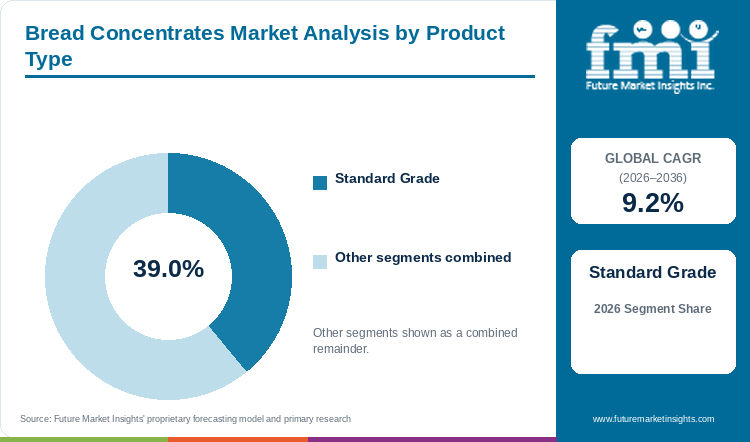
Standard Grade is projected to capture 39.0% of the product type segment in 2026, supported by predictable batch cost and broad flour compatibility.
Table 5: Product Type Share for the Bread Concentrates Market (percentage share), 2026
| Product Type | Share (2026) |
|---|---|
| Standard Grade | 39.0% |
| Other Segments Combined | 61.0%* |
| Total | 100.0% |
*Note: Remaining product type subsegments sum to 100.0% of 2026 bread concentrates volume.
Table 6: Product Type Leadership and Market Growth for the Bread Concentrates Market (segment and CAGR percentage), 2026 to 2036
| Metric | Value |
|---|---|
| Global CAGR (2026 to 2036) | 9.2% |
| Leading Segment | Standard Grade |
Standard Grade concentrates provide pre-calibrated blends of oxidizing agents and fungal enzymes with emulsifiers dosed at 0.5% to 2.5% flour weight that fit mainstream white and wholemeal pan bread lines without redesigning base recipes. Procurement officers benchmark these workhorse concentrates against bakery improvers on usable loaf yield per ton of flour.
- Standard Grade is projected to secure 39.0% of the product type segment in 2026 because high-volume bakeries prioritize low reformulation risk and repeatable proof tolerance.
- In May 2025, Puratos unveiled Cubease at iba 2025 in Germany as a compact, pre-dosed bakery improver cube engineered so one lightweight cube treats 10 kg of flour while cutting storage space by up to 75% [3].
What keeps Powder / Dry ahead in the form segment?
Powder / Dry formats are estimated to secure 45.0% of the form segment in 2026, driven by ambient silo stability and gravimetric dosing accuracy.
Dry powdered concentrates integrate directly into existing micro-ingredient screw feeders and flour-blending silos without heated liquid pumps. Dry carrier matrices also protect moisture-sensitive enzymes from premature activation during ambient warehouse storage in parallel with cake enzyme and batter-stabilizer premixes.
- Powder / Dry options are estimated to command 45.0% of the form segment in 2026 because dry premix handling eliminates liquid line flushing between production runs.
- Palsgaard inaugurated its advanced Application Centre in Navi Mumbai in July 2025 with industrial-scale pilot bakery equipment to test dry powdered emulsifiers and stabilizer concentrates under local flour conditions [4].
Why do Bread & Rolls anchor the application segment?
Bread & Rolls are expected to command 32.0% of the application segment in 2026, reflecting continuous high-speed demand for proof stability and crumb resilience.
Continuous pan-bread and hamburger-bun lines expose dough pieces to intense mechanical shear during dividing and moulding. Calibrated dosing of a 1.0%-to-2.5% bread concentrate reinforces gluten gas retention and prevents loaf sidewall collapse while pairing with bread emulsifier systems to preserve slice softness.
- Bread & Rolls are expected to hold 32.0% of the application segment in 2026 because retail sandwich-bread and QSR bun contracts enforce strict height and resilience tolerances.
- In July 2025, Kerry Group published technical shelf-life data confirming that bread represents 83% of global bakery volume and 57% of value, while mold (65%) and staling (46%) drive the 10% global bread waste rate [5].
Why does Conventional lead the claim segment?
Conventional formulations are forecast to generate 53.0% of the claim segment in 2026, owing to established food-safety dossiers and mechanical shock tolerance.
Industrial bakeries running 8,000-loaf-per-hour lines rely on Conventional concentrates containing DATEM and L-ascorbic acid to survive mechanical proof-box delays. Substitution of conventional emulsifiers with clean-label or certified-organic alternatives requires extensive line re-tuning to prevent crust splitting and slice crumbling.
- Conventional claims are forecast to account for 53.0% of the claim segment in 2026 as high-throughput commissaries prioritize shock tolerance and low cost-in-use.
- Corbion announced the launch of Ultra Fresh Plus 100 in September 2025 ahead of IBIE to provide bakers with a fermentation-derived replacement for synthetic emulsifiers that preserves softness and sliceability [6].
What gives Direct to Industrial Bakeries the leading position in the sales channel segment?
Direct to Industrial Bakeries is anticipated to account for 49.0% of the sales channel segment in 2026, reinforced by plant-specific enzyme and rheology tuning.
Concentrate performance depends on the interaction between enzyme activity and local wheat damaged-starch levels during spiral mixing. Direct technical accounts allow supplier applications bakers to audit flour extensograph curves and customize concentrate ratios before committing to multi-plant supply contracts.
- Direct to Industrial Bakeries is anticipated to capture 49.0% of the sales channel segment in 2026 because multi-line enterprises require customized flour-buffering specifications.
- IFF launched POWERFRESH ACE 2000 for commercial bakeries in the USA in August 2025 to maintain white and whole-wheat bread softness and easy-to-butter cohesiveness for up to 34 days [7].
What are the drivers, restraints, and opportunities in the bread concentrates market?
In the bread concentrates market, harvest flour variability and bakery labor shortages propel dose-defined concentrate adoption whereas plant requalification costs and allergen rules restrain switching and compact cube or clean-label sourdough concentrates unlock new margin opportunities.
- Driver: Climate-induced wheat quality fluctuations and skilled mixer shortages push bakeries toward pre-balanced, dose-defined improver concentrates.
- Restraint: Multi-shift line trial waste and cross-contact allergen documentation slow supplier replacement across commercial plants.
- Opportunity: Pre-dosed 10-kg-flour improver cubes and citrus-fiber or sourdough-based concentrates simplify handling and clean-label compliance.
Growth Analysis and Future Potential: Qualitative Demand Catalysts
Unpredictable wheat harvest protein levels and rising bakery utility and staffing costs compel industrial plant managers to standardize dough rheology through concentrated improver systems. When a single pre-weighed concentrate buffers variations in flour arabinoxylans and damaged starch, bakeries eliminate shift-to-shift proofing failures and reduce crib-waste reject rates. Demand for concentrated dough conditioners expands directly in tandem with sourdough and frozen bake-off commissary production. In December 2025, Food Research International published a study demonstrating that supplementing frozen part-baked bread dough with 10% Lactobacillus bulgaricus fermented taro-yogurt improver cut 28-day retrogradation enthalpy by up to 26.99% and shortened water migration time from 11.84 to 6.58 days [8]. Commercial bakeries consequently lock in concentrated improver systems to protect frozen and ambient loaf yields.
Risk Assessment of the Bread Concentrates Market: Operational and Formulation Friction
Plant-scale trial waste and mandatory supply-chain allergen disclosures represent the primary friction points slowing vendor switching. Because multi-component concentrates combine enzymes and oxidants in a single bag, any uncalibrated dosage shift can cause sticky rounder buildup or excessive oven spring. In August 2025, a Seoul National University and Kookmin University study in the Journal of the Science of Food and Agriculture showed that while 0.6% citrus fiber improved dough storage modulus and specific loaf volume as a clean-label emulsifier replacement, raising dosage to 0.9% degraded bread quality [9]. also updated UK Food Standards Agency allergen guidance in July 2026 requires full sub-ingredient allergen matrices across compound B2B premixes, extending procurement sign-off cycles for clean-label emulsifiers.
Commercial Opportunity Analysis: Formulation Differentiation and Value-Add Formats
Concentrate manufacturers capture premium margin tiers by combining zero-weighing compressed tablet formats with sprouted-grain or transglutaminase-strengthened clean-label bases. Artisan and in-store supermarket bakeries lack skilled night-shift staff to scale micro-gram enzyme doses yet demand authentic fermentation aroma and clean ingredient decks. Suppliers pairing compressed improver cubes with yeast and sourdough flavor bases eliminate weighing scales while cutting packaging waste tenfold. In August 2025, CONICET researchers in Argentina reported in Foods that substituting 20% unsprouted wheat flour with sprouted whole-wheat sourdough reduced phytic acid and boosted water-extractable arabinoxylans and loaf volume [10]. Supply of pre-dosed, clean-label concentrates validated by local flour-testing labs enables suppliers to convert craft and industrial accounts.
Bread Concentrates Market by Country (2026 to 2036)
As per FMI, Saudi Arabia is projected to lead bread concentrates growth across evaluated countries at a 10.6% CAGR through 2036, whereas Japan is forecast to progress at an 8.3% CAGR. National adoption patterns reflect differences in industrial commissary consolidation and statutory menu or allergen labeling rules.
Table 7: Country CAGR and Primary Growth Levers for the Bread Concentrates Market (CAGR percentage and operational drivers), 2026 to 2036
| Country | CAGR (2026 to 2036) | Primary Growth Lever |
|---|---|---|
| Saudi Arabia | 10.6% | Desert-wheat heat-stress variability buffering and centralized QSR bun standardization |
| UAE | 10.2% | Hospitality food-contact hygiene compliance and pre-dosed commissary concentrates |
| South Korea | 9.9% | Transglutaminase-hydrocolloid composite dough conditioning in franchise bakeries |
| USA | 9.6% | High-speed industrial bread scale and IBIE-awarded compact improver cube adoption |
| Germany | 9.2% | Gluten subunit variability across wheat lines driving pre-dosed craft concentrates |
| France | 8.9% | National baguette salt-reduction reformulation and enzyme-buffered dough strength |
| UK | 8.6% | Prograins fibre-enriched school and retail bread reformulation plus FSA allergen rules |
| Japan | 8.3% | 12.0% October 2026 imported-wheat price hike and 10 ug/g allergen threshold compliance |
Source: Future Market Insights analysis
Saudi Arabia Bread Concentrates Market Outlook (2026 to 2036)
Saudi Arabia is projected to lead evaluated national markets at a 10.6% CAGR from 2026 to 2036 across high-volume foodservice commissaries and automated industrial pan-bread manufacturing plants. Flour mills and commercial bakeries in Riyadh and Jeddah blend imported wheat with domestic desert-grown grain that experiences wide protein and gluten fluctuations under extreme summer heat. In October 2025, a two-year field study at King Saud University published in Scientific Reports across 20 wheat genotypes in Saudi Arabia confirmed that desert heat stress reduced average grain yield by 53.8% and altered grain quality traits [11]. Bakeries therefore adopt pre-calibrated xylanase-oxidant bread concentrates to standardize bun height while meeting bilingual SFDA labeling rules.
Key takeaway: In Saudi Arabia, desert-wheat quality variability and foodservice chain expansion are projected to drive conversion toward standardized bread concentrates.
UAE Bread Concentrates Market Outlook (2026 to 2036)
High turnover across airline catering kitchens and supermarket bake-off hubs in the UAE creates strong demand for compact bread concentrates that simplify multi-ethnic flatbread and roll production. Sales of bread concentrates in the UAE are forecast to expand at a 10.2% CAGR over the 2026 to 2036 forecast period across commercial baking groups. In February 2026, a food-safety audit by University of Sharjah and Dubai Municipality researchers in the Journal of Food Protection across 947 swab samples from 308 food establishments in Dubai found that 87% met microbial standards while identifying handling risks on manual mixing surfaces [12]. Substitution of open micro-ingredient bins with sealed single-dose bread concentrates reduces cross-contamination and simplifies municipal hygiene compliance.
Key takeaway: In the UAE, strict kitchen hygiene audits and multi-format hospitality baking are forecast to favor sealed, pre-dosed bread concentrates.
South Korea Bread Concentrates Market Outlook (2026 to 2036)
Commercial bakeries in South Korea manufacture a wide spectrum of soft pullman loaves and composite-grain steamed breads that require distinct crumb elasticity and anti-staling profiles. In February 2026, a Food Chemistry study demonstrated that dosing 0.15% transglutaminase and 0.6% hydrocolloid gum into composite wheat dough lowered crumb hardness to 54.36 N and achieved an 81.4 sensory score [13]. Demand for bread concentrates in South Korea is anticipated to rise at a 9.9% CAGR between 2026 and 2036 across national bakery franchises and supermarket retail commissaries. Strict Ministry of Food and Drug Safety labeling rules require full translation and additive verification for imported multi-enzyme blends before commercial adoption.
Key takeaway: In South Korea, diverse soft-bakery textures and strict MFDS composition rules are anticipated to sustain demand for locally validated bread concentrates.
USA Bread Concentrates Market Outlook (2026 to 2036)
Continuous high-speed pan bread and bun lines in the USA prioritize concentrates that protect dough machinability while extending soft eating quality across interstate grocery distribution. In September 2026, the U.S. Census Bureau reported in its 2024 Annual Integrated Economic Survey that Food Manufacturing generated over USD 1,054,300 million in shipments across 1.70 million employees in commercial plants [14]. To capture industrial bakery volume and eliminate manual scaling errors, Puratos presented its award-winning Cubease dough conditioner and Industrial Pilot Bakery at IBIE in Las Vegas in September 2025 [15]. Market value in the USA is estimated to progress at a 9.6% CAGR through 2036, gated by USDA organic and clean-label certification rules.
Key takeaway: In the USA, high-speed continuous baking scale and multi-week retail softness targets are estimated to anchor direct industrial concentrate contracts.
Germany Bread Concentrates Market Outlook (2026 to 2036)
Germany is projected to record a 9.2% CAGR in the bread concentrates market from 2026 to 2036 across multi-branch craft bakeries and industrial commissaries. Continuous 24-hour retarded-fermentation lines for Brötchen rolls and mixed-rye loaves require precise enzyme and ascorbic-acid dosing to buffer gluten subunit variations across regional wheat lots. In December 2025, researchers at the Technical University of Munich and Karlsruhe Institute of Technology reported in Food Research International across 394 wheat lines in Germany that individual gluten protein groups showed only weak-to-moderate correlation (r = 0.40 to 0.41) with loaf volume [16]. Pre-dosed improver cubes such as Puratos's May 2025 Cubease launch help bakers in Germany stabilize loaf volume without manual weighing errors [3].
Key takeaway: In Germany, wheat gluten subunit variability and night-shift labor deficits are projected to drive uptake of pre-dosed improver concentrates.
France Bread Concentrates Market Outlook (2026 to 2036)
France's baking sector balances traditional artisanal baguette quality against national public-health mandates that lower sodium levels across everyday loaves. Bread concentrates market value in France is expected to expand at an 8.9% CAGR between 2026 and 2036 across high-speed industrial pan-bread bakeries and regional multi-store craft baking channels. In January 2026, a Santé publique France and Université Paris Cité study published in Hypertension documented how France's national voluntary and regulatory salt-reduction targets in baguettes and traditional breads significantly lowered population sodium intake [17]. Because reducing salt weakens gluten tenacity and makes dough sticky during mechanical dividing, bakers in France adopt enzyme- and sourdough-based bread concentrates to restore dough tolerance.
Key takeaway: In France, national bread sodium-reduction targets and clean-label retail standards are expected to steer bakers toward enzyme- and sourdough-based concentrates.
UK Bread Concentrates Market Outlook (2026 to 2036)
High-speed Chorleywood-process plant bakeries and institutional caterers in the UK rely on functional concentrates to boost dietary fiber and loaf volume in white and wholemeal breads. In January 2025, researchers at the University of Leeds and University of Sheffield reported in Nutrients that UK primary-school children consume only 14.6 g of fiber daily and demonstrated that novel fiber-enriched Prograins breads improved glucose release while winning strong child acceptance [18]. Demand for bread concentrates in the UK is slated to advance at an 8.6% CAGR from 2026 to 2036 across commercial bakeries. Updated Food Standards Agency allergen guidance in July 2026 obliges concentrate suppliers to provide complete allergen matrices before bakery onboarding.
Key takeaway: In the UK, fiber-enriched bread reformulation and July 2026 FSA allergen-matrix mandates are slated to govern commercial concentrate selection.
Japan Bread Concentrates Market Outlook (2026 to 2036)
Wholesale bakeries in Japan face intense formulation cost pressure as regulated imported-wheat prices rise under strict convenience-store specifications for ultra-soft shokupan and sweet rolls. In September 2026, Japan's agriculture ministry announced a 12.0% increase in the government selling price for imported wheat to JPY 70,020 per metric ton for the October 2026 period across five major wheat classes [19]. Higher flour costs push bakery R&D teams in Japan to test low-dosage enzyme and hydrocolloid concentrates that lift dough water yield and extend softness without raising batch cost. Commercial bread concentrates market value in Japan is predicted to progress at an 8.3% CAGR through 2036 across wholesale plant bakeries and national convenience-store commissaries.
Key takeaway: In Japan, the 12.0% October 2026 government imported-wheat price hike is predicted to accelerate trials of yield-enhancing bread concentrates.
Full report country CAGRs cover: North America; Latin America; Western Europe; Eastern Europe; East Asia; South Asia and Pacific; Middle East and Africa.
Who are the notable companies in the bread concentrates market?
Novonesis, IFF, Kerry Group, AB Enzymes, Amano Enzyme, Palsgaard, Corbion, BASF, Puratos, and DSM-Firmenich are the notable companies evaluated in this market.
FMI's competitive analysis distinguishes suppliers of complete, ready-to-dose bread concentrates and improver bases from developers of enabling baking enzymes and emulsifiers integrated into those blends. Upstream ownership shifted on September 30, 2025 when BASF completed the sale of its Food and Health Performance Ingredients business in Illertissen to Louis Dreyfus Company while retaining core vitamin and carotenoid operations.
- Integrated Bread Concentrate & Preservation System Formulators: Puratos and Corbion along with Kerry Group market ready-to-dose bread improver cubes and fermented mold-control systems.
- Enzyme Platforms for Concentrate Formulation: Novonesis and IFF supply xylanases and amylases that form the active core of bread concentrates. AB Enzymes and Amano Enzyme also provide specialized baking enzymes with DSM-Firmenich.
- Emulsifier & Functional Baking Input Participants: Palsgaard supplies powdered cake-premix and bakery emulsifiers with global pilot centers, while BASF's legacy food-emulsifier lines transferred to Louis Dreyfus Company in September 2025.
Competitive Benchmarking: Bread Concentrates Market
Table 8: Competitive Benchmarking for the Bread Concentrates Market (qualitative capability ratings), 2026
| Company | Concentrate Systems | Dough / Freshness Inputs | Bakery Trial Support | Geographic Reach |
|---|---|---|---|---|
| Novonesis | Medium | High | High | High |
| IFF | Medium | High | High | High |
| Kerry Group | High | High | High | High |
| AB Enzymes | Medium | High | High | Medium |
| Amano Enzyme | Medium | High | Medium | Medium |
| Palsgaard | Medium | Medium | High | High |
| Corbion | High | High | High | High |
| BASF | Medium | Medium | Medium | High |
| Puratos | High | High | High | High |
| DSM-Firmenich | Medium | High | High | High |
Scoring basis: Capability ratings evaluate documented ready-to-dose bread improver and concentrate systems with active enzyme or emulsifier functionality. Scores also reflect pilot-scale bakery testing laboratories and multi-region technical service coverage.
Key Developments in the Bread Concentrates Market
- Puratos launched Cubease in May 2025 at iba 2025 and won an IBIE Best in Baking Sustainability Award in September 2025 for its pre-dosed 10-kg-flour improver cube that cuts storage space by 75% [3].
- IFF launched POWERFRESH ACE 2000 in August 2025 for industrial bakeries in the USA to deliver up to 34 days of bread softness and slice cohesiveness [7].
- Corbion unveiled Verdad Essence WH100 and its upgraded Natural Mold Inhibition Model in April 2025 and introduced Ultra Fresh Plus 100 clean-label emulsifier replacement in September 2025 [20].
Key Players in the Bread Concentrates Market
Integrated Bread Concentrate and Preservation System Formulators
- Puratos
- Corbion
- Kerry Group
Enzyme Platforms for Concentrate Formulation
- Novonesis
- IFF
- AB Enzymes
- Amano Enzyme
- DSM-Firmenich
Emulsifier and Functional Baking Input Participants
- Palsgaard
- BASF
Bread Concentrates Market - Report Scope
Table 9: Report Scope for the Bread Concentrates Market (coverage fields and definitions), 2026 to 2036
| Coverage field | Report scope |
|---|---|
| Market breakdown | Product Type; Form; Application; Claim; Sales Channel |
| Quantitative Units | USD Million |
| Market Definition | Includes commercial supplier sales of formulated bread concentrates and dose-defined concentrated bakery improver blends (typically dosed at 0.5% to 5.0% flour weight). Category Scope Note: Excludes finished baked-goods retail value, 50%-to-100% flour-heavy complete bakery mixes, and unblended single enzymes or commodity emulsifiers sold outside a formulated concentrate. |
| Regions Covered | North America; Latin America; Western Europe; Eastern Europe; East Asia; South Asia and Pacific; Middle East and Africa |
| Countries Covered | Saudi Arabia, UAE, South Korea, USA, Germany, France, UK, Japan, and additional countries in the full report |
| Key Companies Covered | Novonesis, IFF, Kerry Group, AB Enzymes, Amano Enzyme, Palsgaard, Corbion, BASF, Puratos, DSM-Firmenich |
| Forecast Period | 2026 to 2036 |
| Approach | Primary and secondary research with top-down and bottom-up market triangulation. |
Bread Concentrates Market - Research Methodology
Table 10: Research Methodology for the Bread Concentrates Market (research methods and approach), 2026 edition
| Method | Approach |
|---|---|
| Primary Research | Structured interviews with industrial bakery production managers, flour mill rheologists, and improver formulators to verify 0.5% to 5.0% flour-weight concentrate dosing and line trial qualification gates. |
| Secondary Research | Audit of U.S. Census Bureau 2024 AIES NAICS 311 bakery shipments, TUM/KIT wheat gluten proteomics studies, Santé publique France bread sodium assessments, and Japan MAFF wheat price notifications. |
| Market Sizing and Forecasting | Bottom-up mass-balance calculation of commercial bread, roll, and viennoiserie flour tonnage multiplied by verified concentrate dosing rates and B2B contract prices from 2025 to 2036. |
| Country Forecasting Model | Econometric national models weight craft-bakery consolidation, QSR and foodservice menu standardization, statutory allergen/sodium labeling laws, and imported-wheat price swings across eight nations. |
| Operational Benchmark Traceability | Treated flour tonnage and per-plant spending indicators in Tables 2, 3, and 4 trace to U.S. Census Bureau AIES records, ZDH craft-bakery counts in Germany, and INSEE boulangerie registries in France. |
| Data Triangulation and Validation | Supplier allocations are cross-checked against formulated improver and concentrate shipments, strictly isolating dose-defined concentrates from bulk flour-heavy complete mixes and downstream retail bread value. |
Bread Concentrates Market by Segments
Bread Concentrates Market segmented by Product Type:
- Standard Grade
- Premium Specialty Grade
- Organic Certified
- Clean Label Grade
Bread Concentrates Market segmented by Form:
- Powder / Dry
- Liquid
- Semi-Solid Paste
- Granular Pieces
Bread Concentrates Market segmented by Application:
- Bread & Rolls
- Cakes & Muffins
- Biscuits & Cookies
- Viennoiserie & Pastry
- Specialty Bakery Snacks
Bread Concentrates Market segmented by Claim:
- Conventional
- Clean Label
- Organic
- Identity-Preserved Non-GMO
Bread Concentrates Market segmented by Sales Channel:
- Direct to Industrial Bakeries
- Ingredient Distributors
- Foodservice & Artisan
- Online B2B
Bread Concentrates Market by Region
- North America
- United States
- Canada
- Latin America
- Brazil
- Mexico
- Argentina
- Chile
- Western Europe
- Germany
- France
- United Kingdom
- Italy
- Spain
- Benelux
- Nordics
- Eastern Europe
- Poland
- Czech Republic
- Romania
- Hungary
- East Asia
- China
- Japan
- South Korea
- South Asia and Pacific
- India
- ASEAN
- Australia and New Zealand
- Middle East and Africa
- GCC Countries
- South Africa
- Türkiye
- Israel
Research Sources and Bibliography
- [1] Souza, P., Quadros, A., Dogan, H., Li, Y., Shi, Y.-C., & Karkle, E. (2026, February 1). Exploring Bread Quality through the Use of Commercial Bacterial and Fungal Xylanases: Effects on Dough Rheology, Loaf Volume, and Arabinoxylan Structure. Journal of Food Science, 91(2), e70940 (PubMed PMID 41709635).
- [2] Askari, H., Soleimanian-Zad, S., Kadivar, M., & Shahbazi, S. (2025, December 2). Enhancement of wheat bread quality using xylanase cellulase from gamma radiated Trichoderma afroharzianum mutant. Scientific Reports, 15(1), 43001 (PubMed PMID 41330969).
- [3] Puratos NV. (2025, May 12). Puratos brings a trio of transformative innovations to iba 2025. Puratos Newsroom.
- [4] Palsgaard A/S. (2025, July 8). Palsgaard Inaugurates State-of-the-Art Application Centre in Navi Mumbai to Strengthen Regional Customer Support. Palsgaard Newsroom.
- [5] O'Rourke, T. (2025, July 11). Fresh Thinking: How to Improve Bakery Shelf Life and Reduce Waste. Kerry Group plc.
- [6] Corbion N.V. (2025, September 2). Corbion leads clean-label reformulation forward at IBIE 2025. Corbion Press Releases.
- [7] International Flavors & Fragrances Inc. (2025, August 13). IFF Launches POWERFRESH ACE 2000, a Bread Fresh-Keeping Solution That 'Aces' the Shelf-Life Test. IFF Media Center.
- [8] Li, Y., Wang, J., Zhao, M., Kong, C., Xiao, J., Tu, J., & Niu, L. (2025, December 21). Insights into the delaying mechanism of taro-based yogurt on the retrogradation of the frozen part-baked bread: Starting with strain screening. Food Research International, 226, 118173 (PubMed PMID 41539770).
- [9] Kim, Y., Lee, S. H., Lim, I. K., & Imm, J.-Y. (2025, August 14). Functional role of citrus fiber as an emulsifier in dough rheology, gluten structure formation and bread quality characteristics. Journal of the Science of Food and Agriculture, 105(15), 8911-8920 (PubMed PMID 40814163).
- [10] Navarro, J. L., López, M. S., Salvucci, E., León, A. E., & Steffolani, M. E. (2025, August 13). Chemical and Nutritional Characterization of Sourdoughs Made with Sprouted and Unsprouted Whole-Wheat Flour and Their Effects on the Technological Quality of Bread. Foods, 14(16), 2805 (PubMed PMID 40870718).
- [11] Ghazy, A. I., Al Ateeq, T. K., Ibrahim, E. I., Abdel-Haleem, H., Attia, K. A., Azab, O., & Al-Doss, A. A. (2025, October 21). Selection of heat stress tolerant wheat genotypes for desert environments. Scientific Reports, 15(1), 36672 (PubMed PMID 41120614).
- [12] Osaili, T. M., Dhanasekaran, D. K., Bani Odeh, W. A., Hasan, F., Cheikh Ismail, L., Buhelaibi, A., Obaid, R. S., & Holley, R. (2026, February 12). Microbial Quality of Food Establishments in Dubai. Journal of Food Protection, 100720 (PubMed PMID 41690400).
- [13] Zhang, L., Wang, H., Gao, H., Li, J., Zeng, J., Song, M., & Xu, J. (2026, February 26). Effects of different modifiers on the properties of sorghum-wheat flour, dough, and steamed bread. Food Chemistry, 510, 148667 (PubMed PMID 41785754).
- [14] U.S. Census Bureau. (2026, September 3). Census Bureau Releases New Annual Integrated Economic Survey Data. U.S. Department of Commerce Press Release CB26-TPS.51.
- [15] Puratos U.S. (2025, September 23). Puratos Unveils Award-Winning Innovations and New Product Launches at IBIE 2025. Puratos Newsroom.
- [16] Kaemper, C., Geyer, M., Hartl, L., Geisslitz, S., & Scherf, K. A. (2025, December 27). Absolute quantification of gluten protein groups and their relation to wheat baking quality. Food Research International, 227, 118228 (PubMed PMID 41652760).
- [17] Grave, C., Carcaillon-Bentata, L., Bonaldi, C., Blacher, J., & Olié, V. (2026, January 26). From French Gastronomy to Cardiovascular Health: Cutting Salt in the Baguette Has Saved Thousands of Lives in France. Hypertension, 83(3), e25977 (PubMed PMID 41582808).
- [18] Wilkinson, N. M., Niaz, T., Tann, E., Croden, F., Boyle, N. B., Mackie, A., & Dye, L. (2025, January 16). Novel Fibre-Rich Breads Yield Improved Glucose Release Curves and Are Well Accepted by Children in Primary School Breakfast Clubs. Nutrients, 17(2), 308 (PubMed PMID 39861438).
- [19] Ministry of Agriculture, Forestry and Fisheries of Japan. (2026, September 9). Revision of Government Selling Prices for Imported Wheat (October 2026 Period). Government of Japan Crop Production Bureau.
- [20] Corbion N.V. (2025, April 21). Corbion Unveils Verdad Essence WH100: Redefining Natural Mold Inhibition for Bakers. Corbion Press Releases.
- [21] BASF SE & Louis Dreyfus Company. (2025, September 30). Joint News Release: BASF and Louis Dreyfus Company Complete Sale and Purchase Transaction for BASF's Food and Health Performance Ingredients Business. BASF Corporate Media.
- [22] Novonesis Group. (2025, June 11). Novonesis launches Optiva LS Prime, helping bakers cut up to 50% added sugar and create more cost-effective baked goods. Novonesis Media & News.
- [23] AB Enzymes GmbH. (2026, June 1). AB Enzymes Opens New Office and Baking Lab in Curitiba, Brazil. AB Enzymes Newsroom.
This bibliography is provided for reader reference and is not exhaustive. The full report contains the complete reference list and detailed citations.
This Report Answers
- How large is the bread concentrates market in 2026 and what is forecast for 2036?
- Which flour-variability and bakery labor pressures support demand for bread concentrates?
- Why does Standard Grade lead the product type segment?
- Why does Powder / Dry lead the form segment globally?
- How do growth rates differ across Saudi Arabia and the UAE versus the USA?
- Which leading companies supply integrated bread concentrates and baking enzymes today?
- What limits adoption or supplier switching in the bread concentrates market?
- What should buyers evaluate before purchasing a bread concentrate?
Frequently Asked Questions
How big is the bread concentrates market in 2026, and what is forecast for 2036?
FMI estimates indicate that the global bread concentrates market size will reach USD 379.5 million in 2026 from USD 347.5 million in 2025. The market valuation is forecast to hit USD 915.0 million by 2036 as commercial bakeries adopt dose-defined improver systems.
What is the CAGR for the bread concentrates market from 2026 to 2036?
Future Market Insights projects a 9.2% compound annual growth rate between 2026 and 2036, generating an anticipated USD 535.5 million in incremental market value across industrial and artisan bakery channels.
Which product type segment leads the bread concentrates market?
Standard Grade is projected to capture 39.0% of the product type segment in 2026 because pre-balanced enzyme-emulsifier concentrates deliver reliable loaf volume at low batch cost.
Which form segment leads the bread concentrates market?
Powder / Dry formats are estimated to secure 45.0% of the form segment in 2026 as dry blends and pre-dosed cubes fit standard bakery weighing and silo workflows.
Which country has the fastest growth outlook during the assessment period?
Saudi Arabia is projected to lead national expansion at a 10.6% CAGR through 2036, supported by desert-wheat quality buffering and industrial bakery capacity growth.
Who are the key players in the market?
Novonesis, IFF, Kerry Group, AB Enzymes, Amano Enzyme, Palsgaard, Corbion, BASF, Puratos, and DSM-Firmenich participate across integrated bread-concentrate systems and baking enzymes.
Preview the report firsthand - request a free sample
Get SampleGet the brochure for pricing and purchase details.
Get PDFTable of Content
- Key Takeaways
- Market Size and CAGR
- Top Growth Driver
- Fastest Growing Segment
- Leading Region
- Key Companies
- Emerging Opportunities
- Executive Summary
- Global Market Outlook
- Demand-side Trends
- Supply-side Trends
- Technology Roadmap Analysis
- Analysis and Recommendations
- Analyst Perspective (What is happening? Why now? What should investors know?)
- Key Questions Answered
- How large is the market?
- What is the CAGR?
- What are key trends?
- Which region dominates?
- Who are the leaders?
- Market Overview
- Market Coverage / Taxonomy
- Market Definition / Scope / Limitations
- Research Methodology
- Chapter Orientation
- Analytical Lens and Working Hypotheses
- Market Structure, Signals, and Trend Drivers
- Benchmarking and Cross-market Comparability
- Market Sizing, Forecasting, and Opportunity Mapping
- Research Design and Evidence Framework
- Desk Research Programme (Secondary Evidence)
- Expert Input and Fieldwork (Primary Evidence)
- Tooling, Models, and Reference Databases
- Data Engineering and Model Build
- Quality Assurance and Audit Trail
- Market Background
- Market Dynamics (Drivers, Restraints, Opportunity, Trends)
- Scenario Forecast (Optimistic, Likely, Conservative)
- Impact Analysis
- AI Impact
- Sustainability Impact
- Regulatory Impact
- Technology Impact
- Consumer / Buyer Analysis
- Purchase Drivers
- Adoption Barriers
- Buyer Journey
- Opportunity Map Analysis
- Product Life Cycle Analysis
- Supply Chain Analysis
- Investment Feasibility Matrix
- Value Chain Analysis
- PESTLE and Porter's Analysis
- Regulatory Landscape
- Regional Parent Market Outlook
- Production and Consumption Statistics
- Import and Export Statistics
- Global Market Analysis and Forecast, 2021 to 2036
- Historical Market Size Value (USD Million) Analysis, 2021 to 2025
- Current and Future Market Size Value (USD Million) Projections, 2026 to 2036
- Y-o-Y Growth Trend Analysis
- Absolute $ Opportunity Analysis
- Global Market Pricing Analysis, 2021 to 2036
- Global Market Analysis and Forecast, By Product Type, 2021 to 2036
- Introduction / Key Findings
- Historical Market Size Value (USD Million) Analysis By Product Type, 2021 to 2025
- Current and Future Market Size Value (USD Million) Analysis and Forecast By Product Type, 2026 to 2036
- Standard Grade
- Premium Specialty Grade
- Organic Certified
- Clean Label Grade
- Y-o-Y Growth Trend Analysis By Product Type, 2021 to 2025
- Absolute $ Opportunity Analysis By Product Type, 2026 to 2036
- Global Market Analysis and Forecast, By Form, 2021 to 2036
- Introduction / Key Findings
- Historical Market Size Value (USD Million) Analysis By Form, 2021 to 2025
- Current and Future Market Size Value (USD Million) Analysis and Forecast By Form, 2026 to 2036
- Powder / Dry
- Liquid
- Semi-Solid Paste
- Granular Pieces
- Y-o-Y Growth Trend Analysis By Form, 2021 to 2025
- Absolute $ Opportunity Analysis By Form, 2026 to 2036
- Global Market Analysis and Forecast, By Application, 2021 to 2036
- Introduction / Key Findings
- Historical Market Size Value (USD Million) Analysis By Application, 2021 to 2025
- Current and Future Market Size Value (USD Million) Analysis and Forecast By Application, 2026 to 2036
- Bread & Rolls
- Cakes & Muffins
- Biscuits & Cookies
- Viennoiserie & Pastry
- Specialty Bakery Snacks
- Y-o-Y Growth Trend Analysis By Application, 2021 to 2025
- Absolute $ Opportunity Analysis By Application, 2026 to 2036
- Global Market Analysis and Forecast, By Claim, 2021 to 2036
- Introduction / Key Findings
- Historical Market Size Value (USD Million) Analysis By Claim, 2021 to 2025
- Current and Future Market Size Value (USD Million) Analysis and Forecast By Claim, 2026 to 2036
- Conventional
- Clean Label
- Organic
- Identity-Preserved Non-GMO
- Y-o-Y Growth Trend Analysis By Claim, 2021 to 2025
- Absolute $ Opportunity Analysis By Claim, 2026 to 2036
- Global Market Analysis and Forecast, By Sales Channel, 2021 to 2036
- Introduction / Key Findings
- Historical Market Size Value (USD Million) Analysis By Sales Channel, 2021 to 2025
- Current and Future Market Size Value (USD Million) Analysis and Forecast By Sales Channel, 2026 to 2036
- Direct to Industrial Bakeries
- Ingredient Distributors
- Foodservice & Artisan
- Online B2B
- Y-o-Y Growth Trend Analysis By Sales Channel, 2021 to 2025
- Absolute $ Opportunity Analysis By Sales Channel, 2026 to 2036
- Global Market Analysis and Forecast, By Region, 2021 to 2036
- Introduction
- Historical Market Size Value (USD Million) Analysis By Region, 2021 to 2025
- Current Market Size Value (USD Million) Analysis and Forecast By Region, 2026 to 2036
- North America
- Latin America
- Western Europe
- Eastern Europe
- East Asia
- South Asia and Pacific
- Middle East and Africa
- Market Attractiveness Analysis By Region
- North America Market Analysis and Forecast, By Country, 2021 to 2036
- Historical Market Size Value (USD Million) Trend Analysis By Market Taxonomy, 2021 to 2025
- Market Size Value (USD Million) Forecast By Market Taxonomy, 2026 to 2036
- By Country
- United States
- Canada
- By Product Type
- By Form
- By Application
- By Claim
- By Sales Channel
- By Country
- Market Attractiveness Analysis
- By Country
- By Product Type
- By Form
- By Application
- By Claim
- By Sales Channel
- Key Takeaways
- Latin America Market Analysis and Forecast, By Country
- Historical Market Size Value (USD Million) Trend Analysis By Market Taxonomy, 2021 to 2025
- Market Size Value (USD Million) Forecast By Market Taxonomy, 2026 to 2036
- By Country
- Brazil
- Mexico
- Argentina
- Chile
- By Product Type
- By Form
- By Application
- By Claim
- By Sales Channel
- By Country
- Market Attractiveness Analysis
- By Country
- By Product Type
- By Form
- By Application
- By Claim
- By Sales Channel
- Key Takeaways
- Western Europe Market Analysis and Forecast, By Country
- Historical Market Size Value (USD Million) Trend Analysis By Market Taxonomy, 2021 to 2025
- Market Size Value (USD Million) Forecast By Market Taxonomy, 2026 to 2036
- By Country
- Germany
- France
- United Kingdom
- Italy
- Spain
- Benelux
- Nordics
- By Product Type
- By Form
- By Application
- By Claim
- By Sales Channel
- By Country
- Market Attractiveness Analysis
- By Country
- By Product Type
- By Form
- By Application
- By Claim
- By Sales Channel
- Key Takeaways
- Eastern Europe Market Analysis and Forecast, By Country
- Historical Market Size Value (USD Million) Trend Analysis By Market Taxonomy, 2021 to 2025
- Market Size Value (USD Million) Forecast By Market Taxonomy, 2026 to 2036
- By Country
- Poland
- Czech Republic
- Romania
- Hungary
- By Product Type
- By Form
- By Application
- By Claim
- By Sales Channel
- By Country
- Market Attractiveness Analysis
- By Country
- By Product Type
- By Form
- By Application
- By Claim
- By Sales Channel
- Key Takeaways
- East Asia Market Analysis and Forecast, By Country
- Historical Market Size Value (USD Million) Trend Analysis By Market Taxonomy, 2021 to 2025
- Market Size Value (USD Million) Forecast By Market Taxonomy, 2026 to 2036
- By Country
- China
- Japan
- South Korea
- By Product Type
- By Form
- By Application
- By Claim
- By Sales Channel
- By Country
- Market Attractiveness Analysis
- By Country
- By Product Type
- By Form
- By Application
- By Claim
- By Sales Channel
- Key Takeaways
- South Asia and Pacific Market Analysis and Forecast, By Country
- Historical Market Size Value (USD Million) Trend Analysis By Market Taxonomy, 2021 to 2025
- Market Size Value (USD Million) Forecast By Market Taxonomy, 2026 to 2036
- By Country
- India
- ASEAN
- Australia and New Zealand
- By Product Type
- By Form
- By Application
- By Claim
- By Sales Channel
- By Country
- Market Attractiveness Analysis
- By Country
- By Product Type
- By Form
- By Application
- By Claim
- By Sales Channel
- Key Takeaways
- Middle East and Africa Market Analysis and Forecast, By Country
- Historical Market Size Value (USD Million) Trend Analysis By Market Taxonomy, 2021 to 2025
- Market Size Value (USD Million) Forecast By Market Taxonomy, 2026 to 2036
- By Country
- GCC Countries
- South Africa
- Türkiye
- Israel
- By Product Type
- By Form
- By Application
- By Claim
- By Sales Channel
- By Country
- Market Attractiveness Analysis
- By Country
- By Product Type
- By Form
- By Application
- By Claim
- By Sales Channel
- Key Takeaways
- Key Countries Market Analysis
- United States
- Pricing Analysis
- Market Share Analysis, 2025
- By Product Type
- By Form
- By Application
- By Claim
- By Sales Channel
- Canada
- Pricing Analysis
- Market Share Analysis, 2025
- By Product Type
- By Form
- By Application
- By Claim
- By Sales Channel
- Mexico
- Pricing Analysis
- Market Share Analysis, 2025
- By Product Type
- By Form
- By Application
- By Claim
- By Sales Channel
- Brazil
- Pricing Analysis
- Market Share Analysis, 2025
- By Product Type
- By Form
- By Application
- By Claim
- By Sales Channel
- Chile
- Pricing Analysis
- Market Share Analysis, 2025
- By Product Type
- By Form
- By Application
- By Claim
- By Sales Channel
- Germany
- Pricing Analysis
- Market Share Analysis, 2025
- By Product Type
- By Form
- By Application
- By Claim
- By Sales Channel
- United Kingdom
- Pricing Analysis
- Market Share Analysis, 2025
- By Product Type
- By Form
- By Application
- By Claim
- By Sales Channel
- Italy
- Pricing Analysis
- Market Share Analysis, 2025
- By Product Type
- By Form
- By Application
- By Claim
- By Sales Channel
- Spain
- Pricing Analysis
- Market Share Analysis, 2025
- By Product Type
- By Form
- By Application
- By Claim
- By Sales Channel
- France
- Pricing Analysis
- Market Share Analysis, 2025
- By Product Type
- By Form
- By Application
- By Claim
- By Sales Channel
- India
- Pricing Analysis
- Market Share Analysis, 2025
- By Product Type
- By Form
- By Application
- By Claim
- By Sales Channel
- ASEAN
- Pricing Analysis
- Market Share Analysis, 2025
- By Product Type
- By Form
- By Application
- By Claim
- By Sales Channel
- Australia and New Zealand
- Pricing Analysis
- Market Share Analysis, 2025
- By Product Type
- By Form
- By Application
- By Claim
- By Sales Channel
- China
- Pricing Analysis
- Market Share Analysis, 2025
- By Product Type
- By Form
- By Application
- By Claim
- By Sales Channel
- Japan
- Pricing Analysis
- Market Share Analysis, 2025
- By Product Type
- By Form
- By Application
- By Claim
- By Sales Channel
- South Korea
- Pricing Analysis
- Market Share Analysis, 2025
- By Product Type
- By Form
- By Application
- By Claim
- By Sales Channel
- Poland
- Pricing Analysis
- Market Share Analysis, 2025
- By Product Type
- By Form
- By Application
- By Claim
- By Sales Channel
- Hungary
- Pricing Analysis
- Market Share Analysis, 2025
- By Product Type
- By Form
- By Application
- By Claim
- By Sales Channel
- Türkiye
- Pricing Analysis
- Market Share Analysis, 2025
- By Product Type
- By Form
- By Application
- By Claim
- By Sales Channel
- South Africa
- Pricing Analysis
- Market Share Analysis, 2025
- By Product Type
- By Form
- By Application
- By Claim
- By Sales Channel
- Saudi Arabia
- Pricing Analysis
- Market Share Analysis, 2025
- By Product Type
- By Form
- By Application
- By Claim
- By Sales Channel
- UAE
- Pricing Analysis
- Market Share Analysis, 2025
- By Product Type
- By Form
- By Application
- By Claim
- By Sales Channel
- United States
- Market Structure Analysis
- Competition Dashboard
- Competition Benchmarking
- Market Share Analysis of Top Players
- By Regional
- By Product Type
- By Form
- By Application
- By Claim
- By Sales Channel
- Emerging Startups
- Innovation Benchmarking
- Competition Analysis
- Competition Deep Dive
- Novonesis
- Overview
- Product Portfolio
- Profitability by Market Segments
- Sales Footprint
- Strategy Overview
- Marketing Strategy
- Product Strategy
- Channel Strategy
- IFF
- Kerry Group
- AB Enzymes
- Amano Enzyme
- Palsgaard
- Corbion
- BASF
- Puratos
- DSM-Firmenich
- Novonesis
- Case Studies
- Success Stories
- Recent Developments
- Competition Deep Dive
- Assumptions & Acronyms Used


