

- Industry Size (2026):
- USD 165.0 Mn
- Forecast (2036):
- USD 315.6 Mn
- CAGR (2026 to 2036)
- 6.7%
Caffeic Acid Market Forecast and Outlook 2026 to 2036
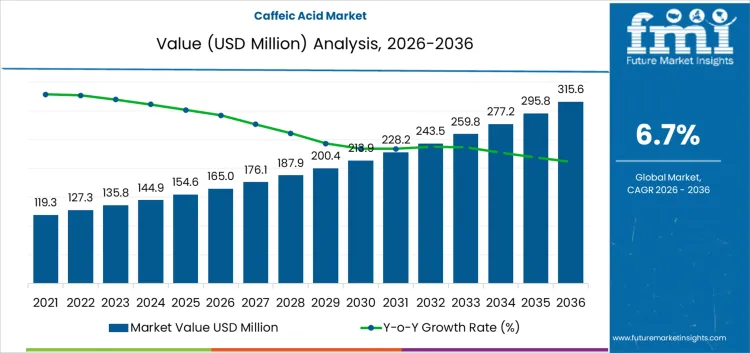
The caffeic acid market is likely to be valued at USD 165.0 million in 2026 and is projected to reach USD 315.6 million by 2036 at a CAGR of 6.7%. Value behavior is shaped by the role of caffeic acid as a functional bioactive ingredient rather than a bulk commodity chemical. Demand formation reflects its use in regulated pharmaceutical formulations, nutraceutical supplements, cosmetic actives, and analytical reference standards. Capital allocation follows requirements for antioxidant efficacy, purity consistency, and formulation compatibility across low inclusion rate applications. Purchasing decisions align with downstream sensitivity to impurity profiles, oxidation stability, and documentation supporting regulatory filings. Demand persistence concentrates where caffeic acid serves as a validated phenolic compound within repeatable formulation and research workflows.
Supply economics are influenced by variability in botanical feedstock composition and extraction yield efficiency. Natural sourcing exposes producers to seasonal availability, geographic concentration of raw materials, and fluctuations in phenolic content. Purification complexity increases cost when pharmaceutical or analytical grade specifications are required. Synthetic production routes face regulatory scrutiny related to residual solvents and impurity control. Stability limitations under light, heat, and oxygen impose handling and storage constraints. Competition from alternative polyphenols with overlapping functional claims increases price sensitivity. Limited supplier availability for high-purity grades restricts sourcing flexibility. Compliance testing, waste solvent recovery, and byproduct management further add to operational cost structures.
Quick Stats for Caffeic Acid Market
- Caffeic Acid Market Value (2026): USD 165.0 million
- Caffeic Acid Market Forecast Value (2036): USD 315.6 million
- Caffeic Acid Market Forecast CAGR 2026 to 2036: 6.7%
- Leading Application by Demand Share: Pharmaceuticals
- Fastest-Growing Countries: China, India, USA, Germany, Japan
- Top Players in Global Demand: Merck, Cayman Chemical, TCI Chemicals, Alfa Aesar, Tokyo Chemical Industry
Caffeic Acid Market Key Takeaways
| Metric | Value |
|---|---|
| Market Value (2026) | USD 165.0 million |
| Market Forecast Value (2036) | USD 315.6 million |
| Forecast CAGR 2026 to 2036 | 6.7% |
Why is the Demand for Caffeic Acid Market Growing?
Demand for caffeic acid is rising as pharmaceutical manufacturers expand formulation pipelines that incorporate this phenolic compound for its biochemical properties associated with antioxidant and anti-inflammatory activity. Nutraceutical producers incorporate caffeic acid into dietary supplements positioned for metabolic health support and immune function. Cosmetic formulators include caffeic acid in topical serums and creams intended to mitigate oxidative stress on skin and address signs of environmental aging. Research organizations studying plant secondary metabolites require caffeic acid for in vitro assays and synthesis of derivative compounds.
Academic and industrial laboratories performing analytical method development seek reliable supplies of high purity caffeic acid to calibrate instrumentation and validate quantification techniques. Growth in functional food and beverage segments contributes to market expansion as producers explore plant extracts rich in caffeic acid to differentiate products positioned for health conscious consumers. Agricultural feed companies investigate inclusion of phenolic compounds to support animal wellbeing. Suppliers scale production capacity of caffeic acid derived from botanical sources to meet demand from diverse end use industries that prioritize traceability and natural origins. Advances in extraction and purification processes improve yield and reduce production variability, enabling broader adoption across sectors with stringent quality requirements.
How Are the Segments Classified in the Caffeic Acid Market?
Demand for caffeic acid expands due to rising utilization across health focused formulations, natural antioxidant incorporation, and bioactive ingredient adoption. Processing industries value functional compounds supporting stability, efficacy, and formulation compatibility. Regulatory acceptance of plant derived actives encourages broader integration into regulated applications. Supply chain investments and extraction technology improvements further enable consistent quality and scalability across industrial users.
Which application represents the largest share of demand?
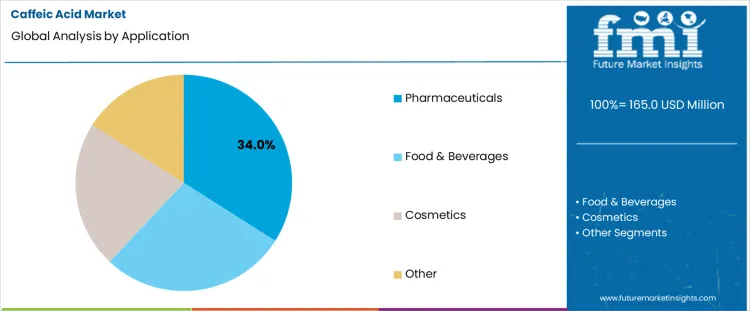
Pharmaceuticals lead application demand, representing 34.0% share due to therapeutic relevance and bioactivity utilization. Caffeic acid supports antioxidant, anti-inflammatory, and antimicrobial functions required in active ingredient formulations. Controlled dosing and purity requirements align with pharmaceutical manufacturing standards. Demand concentration reflects integration into prescription and research driven formulations. Compatibility with excipient systems enables stable incorporation into diverse dosage forms. Ongoing formulation development sustains consistent utilization across drug development pipelines.
Key Points
- Supports bioactive functionality required in therapeutic formulations
- Aligns with purity and consistency expectations in regulated production
- Integrates effectively within pharmaceutical formulation systems
Which source accounts for the highest share of demand?
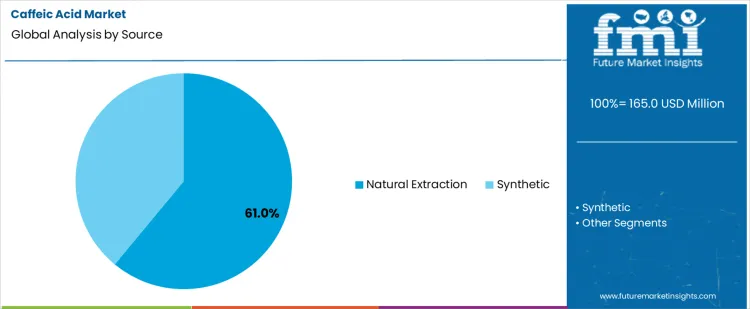
Natural extraction dominates sourcing preference with a 61.0% share, driven by clean label alignment and bio based ingredient positioning. Extracted caffeic acid meets regulatory and consumer acceptance expectations across sensitive applications. Plant derived sourcing supports traceability and perception of safety across value chains. Functional performance remains consistent with synthetic alternatives while supporting sustainability objectives. Extraction based supply also enables differentiation for manufacturers emphasizing naturally sourced actives.
Key Points
- Aligns with clean label and natural sourcing expectations
- Supports traceability and regulatory acceptance requirements
- Maintains functional performance across application categories
Which end use industry holds the highest share of demand?
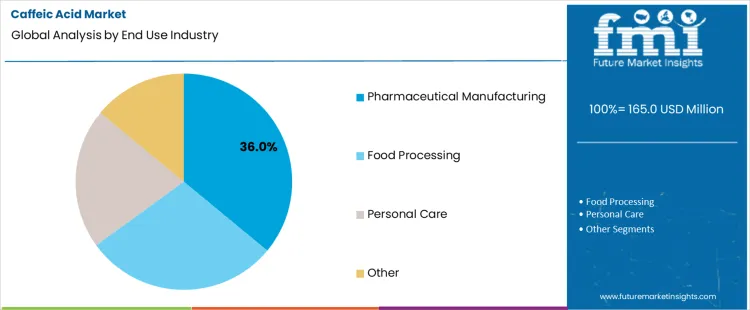
Pharmaceutical manufacturing represents the leading end use industry with a 36.0% share due to concentrated formulation demand. High value production emphasizes reliable supply of bioactive compounds with consistent specifications. Integration into upstream synthesis and downstream formulation workflows sustains recurring consumption. Regulatory oversight reinforces dependence on validated ingredient sources. Production scale and compliance requirements sustain stable demand within pharmaceutical manufacturing environments.
Key Points
- Concentrates high value production requiring validated ingredients
- Relies on consistent supply for regulated manufacturing workflows
- Prioritizes specification control and quality assurance systems
What are the Key Dynamics in the Caffeic Acid Market?
Demand dynamics in the caffeic acid market reflect functional ingredient utilization across food, nutraceutical, pharmaceutical, and cosmetic formulations. Global activity centers on antioxidant performance, bioactivity profiles, and compatibility with natural ingredient positioning. Value formation depends on purity levels, extraction routes, and formulation stability. Purchasing decisions align with regulatory acceptance, application-specific concentration requirements, and supply consistency from botanical and synthetic production pathways.
How do biofunctional ingredient performance requirements shape adoption?
Adoption increases as manufacturers prioritize antioxidant, anti-inflammatory, and antimicrobial performance within regulated formulation limits. Demand strengthens in nutraceutical and dietary supplement applications requiring standardized phenolic content and reproducible efficacy. Functional food development favors caffeic acid for oxidative stability support and clean-label alignment. Pharmaceutical research usage reflects interest in precursor chemistry and bioactive compound synthesis. Cosmetic formulations adopt caffeic acid for photoprotective and skin-conditioning properties requiring low irritation profiles. Extraction efficiency from coffee, fruits, and plant biomass influences cost competitiveness. Standardization protocols and analytical verification support batch consistency across applications. Compatibility with encapsulation, emulsification, and thermal processing systems further supports integration into diverse product matrices.
How do raw material variability and regulatory constraints influence market scalability?
Market scalability remains constrained by variability in botanical feedstock composition and seasonal supply fluctuations. Demand faces pressure where extraction yields vary across crop origin and processing conditions. Synthetic production routes encounter regulatory scrutiny related to purity specifications and residual solvents. Compliance requirements across food, pharmaceutical, and cosmetic sectors impose testing and documentation costs. Stability limitations under heat, light, and oxidation complicate storage and transport logistics. Price sensitivity increases where caffeic acid competes with alternative polyphenols offering similar functional claims. Limited supplier base for high-purity grades restricts sourcing flexibility. Waste management and solvent recovery obligations further add operational complexity for producers and processors.
How Is Demand for the Caffeic Acid Market Evolving Globally?
Global demand for caffeic acid is increasing due to wider application of plant based antioxidants across pharmaceuticals, nutraceuticals, cosmetics, and food formulations. Expansion reflects preference for naturally derived bioactive compounds supporting anti-inflammatory and preservative functions. Processing improvements and byproduct utilization enhance commercial extraction economics. China records 8.4% CAGR, India records 7.9% CAGR, the USA records 6.3% CAGR, Germany records 5.8% CAGR, and Japan records 5.4% CAGR. Demand growth remains linked to regulatory acceptance, formulation standardization, and scalable sourcing of botanical feedstocks across international supply chains.

| Country | CAGR (%) |
|---|---|
| China | 8.4% |
| India | 7.9% |
| USA | 6.3% |
| Germany | 5.8% |
| Japan | 5.4% |
Why is China seeing expansion in caffeic acid adoption?
Caffeic acid demand in China is expanding as pharmaceutical, cosmetic, and food ingredient manufacturing scales domestic antioxidant usage. Growth at 8.4% CAGR reflects integration of plant derived actives within functional foods and traditional medicine formulations. Local extraction capacity benefits from abundant agricultural byproducts and coffee processing residues. Pharmaceutical intermediates consumption supports steady baseline volumes across dermatology and infection control applications. Regulatory frameworks increasingly recognize standardized botanical ingredients. Export oriented ingredient suppliers drive quality upgrades and documentation requirements. Procurement decisions emphasize cost efficiency, volume scalability, and supply reliability. Industrial clustering enables integration of extraction, purification, and downstream formulation activities.
- Expansion of functional food production
- Abundant botanical feedstock availability
- Growth of export oriented ingredient suppliers
- Integration with traditional medicine formulations
What is driving growth of caffeic acid demand in India?
Demand for caffeic acid in India is increasing as nutraceutical and functional food formulation expands nationwide. Growth at 7.9% CAGR reflects rising use of natural antioxidants across supplements, cosmetics, and fortified beverages. Domestic extraction capacity improves availability from coffee waste, fruits, and plant biomass streams. Pharmaceutical intermediates consumption supports baseline volumes through anti-inflammatory and antimicrobial applications. Cost sensitivity encourages local sourcing and process optimization investments. Regulatory acceptance of plant derived actives strengthens commercialization pathways. Purchasing decisions prioritize purity consistency and scalable supply contracts. Expansion of ayurvedic and wellness product manufacturing further reinforces recurring demand from branded consumer goods producers.
- Growth of nutraceutical manufacturing
- Utilization of agricultural byproducts
- Expansion of ayurvedic product lines
- Emphasis on local sourcing economics
How is the USA supporting growth of caffeic acid demand?
Sales of caffeic acid in the USA are rising as clean label and natural ingredient adoption expands across food and supplement industries. Growth of 6.3% CAGR reflects formulation demand for antioxidant and preservative functionality. Pharmaceutical research supports niche applications within dermatology and anti-inflammatory product development. Import reliance persists for bulk supply while domestic processing focuses on refinement and formulation. Regulatory clarity on dietary supplements supports commercialization. Purchasing behavior emphasizes traceability, purity certification, and compliance documentation. Cosmetic manufacturers integrate caffeic acid within anti-aging and skin protection products. Stable demand emerges from long term supplier agreements across consumer health brands.
- Clean label ingredient adoption
- Dietary supplement formulation growth
- Cosmetic anti-aging applications
- Strong regulatory compliance requirements
What factors are shaping caffeic acid sales in Germany?
Caffeic acid demand in Germany is shaped by emphasis on pharmaceutical quality standards and functional food innovation. Expansion at 5.8% CAGR reflects controlled adoption within nutraceuticals, cosmetics, and specialty food applications. Buyers prioritize high purity grades meeting stringent regulatory and documentation requirements. Limited domestic extraction increases dependence on imported intermediates. Processing and formulation expertise supports value added applications rather than bulk volume growth. Sustainability criteria influence supplier selection and feedstock sourcing. Cosmetic and dermatological product development sustains recurring demand. Replacement and reformulation cycles drive steady purchasing aligned with regulatory updates and quality audits.
- Stringent quality compliance standards
- Functional food product innovation
- Dependence on imported intermediates
- Sustainability driven sourcing criteria
How is Japan supporting growth of caffeic acid demand?
Caffeic acid market demand in Japan is advancing through controlled expansion of functional foods, cosmetics, and pharmaceutical research applications. Growth at 5.4% CAGR reflects preference for scientifically validated natural antioxidants. Domestic manufacturers integrate caffeic acid within beverages, supplements, and skin care formulations. Regulatory oversight emphasizes safety validation and consistent quality performance. Limited domestic feedstock availability sustains import reliance. Purchasing decisions favor long term supplier stability and documented efficacy. Cosmetic sector innovation supports specialized applications rather than high volume consumption. Aging population trends indirectly reinforce demand for antioxidant enriched wellness products across premium consumer categories.
- Functional beverage formulation growth
- High regulatory validation requirements
- Premium cosmetic product integration
- Reliance on imported raw materials
What is the competitive landscape of demand for the caffeic acid market globally?
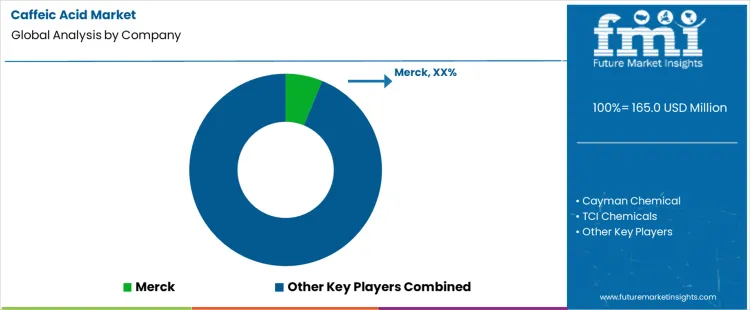
Demand for caffeic acid is driven by pharmaceutical research, nutraceutical formulation growth, cosmetics actives usage, and food antioxidant applications. Buyers evaluate chemical purity, batch consistency, traceability, regulatory documentation, synthesis route reliability, and suitability for research or formulation use. Procurement behavior prioritizes suppliers with validated analytical data, global distribution, stable pricing, and reliable lead times. Purchasing decisions emphasize compliance with pharmacopeial standards, scalability from laboratory to production volumes, and documentation support. Trend in the caffeic acid market reflects rising preference for bioactive phenolic compounds, clean label formulations, and increased research utilization across life science sectors.
Merck holds leading competitive positioning through high purity grades, extensive catalog coverage, and trusted supply for regulated applications. Tokyo Chemical Industry supports demand through broad reagent portfolios, consistent specifications, and strong penetration within academic and industrial research. TCI Chemicals competes with diversified specialty chemical offerings, global logistics, and reliable quality control processes. Alfa Aesar participates by supplying research grade caffeic acid aligned with materials science and pharmaceutical development workflows. Cayman Chemical maintains relevance through niche biochemical expertise, detailed analytical validation, and focused life science customer relationships. Competitive logic centers on purity assurance, documentation depth, supply reliability, and brand credibility among research buyers.
Key Players in the Caffeic Acid Market
- Merck
- Cayman Chemical
- TCI Chemicals
- Alfa Aesar
- Tokyo Chemical Industry
Scope of the Report
| Items | Values |
|---|---|
| Quantitative Units | USD million |
| Application | Pharmaceuticals; Food & Beverages; Cosmetics; Other |
| Source | Natural Extraction; Synthetic |
| End Use Industry | Pharmaceutical Manufacturing; Food Processing; Personal Care; Other |
| Regions Covered | Asia Pacific, Europe, North America, Latin America, Middle East & Africa |
| Countries Covered | China, India, USA, Germany, Japan, and 40+ countries |
| Key Companies Profiled | Merck; Cayman Chemical; TCI Chemicals; Alfa Aesar; Tokyo Chemical Industry |
| Additional Attributes | Dollar sales by application, source, end use industry, and sales channel; purity grade distribution between pharmaceutical, food, and cosmetic use cases; extraction yield efficiency and raw material sourcing stability for natural variants; synthetic production scalability and cost consistency; regulatory compliance across food and pharmaceutical standards; procurement trends reflecting laboratory supply contracts, bulk industrial sourcing, and specialty chemical distribution networks. |
Caffeic Acid Market by Segment
Application:
- Pharmaceuticals
- Food & Beverages
- Cosmetics
- Other
Source:
- Natural Extraction
- Synthetic
End Use Industry:
- Pharmaceutical Manufacturing
- Food Processing
- Personal Care
- Other
Region:
- Asia Pacific
- China
- Japan
- South Korea
- India
- Australia & New Zealand
- ASEAN
- Rest of Asia Pacific
- Europe
- Germany
- United Kingdom
- France
- Italy
- Spain
- Nordic
- BENELUX
- Rest of Europe
- North America
- United States
- Canada
- Mexico
- Latin America
- Brazil
- Chile
- Rest of Latin America
- Middle East & Africa
- Kingdom of Saudi Arabia
- Other GCC Countries
- Turkey
- South Africa
- Other African Union
- Rest of Middle East & Africa
Bibliography
- Food and Agriculture Organization of the United Nations. (2022). Food-based dietary guidelines and the role of bioactive compounds from plants. FAO.
- European Food Safety Authority. (2023). Scientific opinion on the safety and bioavailability of phenolic acids used in food supplements. EFSA Journal, 21(9), 1–42.
- National Institutes of Health, National Center for Biotechnology Information. (2024). Caffeic acid: Biological activities, metabolism, and therapeutic potential. National Library of Medicine.
Frequently Asked Questions
How big is the caffeic acid market in 2026?
The global caffeic acid market is estimated to be valued at USD 165.0 million in 2026.
What will be the size of caffeic acid market in 2036?
The market size for the caffeic acid market is projected to reach USD 315.6 million by 2036.
How much will be the caffeic acid market growth between 2026 and 2036?
The caffeic acid market is expected to grow at a 6.7% CAGR between 2026 and 2036.
What are the key product types in the caffeic acid market?
The key product types in caffeic acid market are pharmaceuticals, food & beverages, cosmetics and other.
Which source segment to contribute significant share in the caffeic acid market in 2026?
In terms of source, natural extraction segment to command 61.0% share in the caffeic acid market in 2026.
Preview the report firsthand - request a free sample
Get SampleGet the brochure for pricing and purchase details.
Get PDFTable of Content
- Executive Summary
- Global Market Outlook
- Demand-side Trends
- Supply-side Trends
- Technology Roadmap Analysis
- Analysis and Recommendations
- Market Overview
- Market Coverage / Taxonomy
- Market Definition / Scope / Limitations
- Market Background
- Market Dynamics
- Drivers
- Restraints
- Opportunity
- Trends
- Scenario Forecast
- Demand in Optimistic Scenario
- Demand in Likely Scenario
- Demand in Conservative Scenario
- Opportunity Map Analysis
- Product Life Cycle Analysis
- Supply Chain Analysis
- Investment Feasibility Matrix
- Value Chain Analysis
- PESTLE and Porter’s Analysis
- Regulatory Landscape
- Regional Parent Market Outlook
- Production and Consumption Statistics
- Import and Export Statistics
- Market Dynamics
- Global Market Analysis 2021 to 2025 and Forecast, 2026 to 2036
- Historical Market Size Value (USD Million) Analysis, 2021 to 2025
- Current and Future Market Size Value (USD Million) Projections, 2026 to 2036
- Y-o-Y Growth Trend Analysis
- Absolute $ Opportunity Analysis
- Global Market Pricing Analysis 2021 to 2025 and Forecast 2026 to 2036
- Global Market Analysis 2021 to 2025 and Forecast 2026 to 2036, By Application
- Introduction / Key Findings
- Historical Market Size Value (USD Million) Analysis By Application, 2021 to 2025
- Current and Future Market Size Value (USD Million) Analysis and Forecast By Application, 2026 to 2036
- Pharmaceuticals
- Food & Beverages
- Cosmetics
- Other
- Pharmaceuticals
- Y-o-Y Growth Trend Analysis By Application, 2021 to 2025
- Absolute $ Opportunity Analysis By Application, 2026 to 2036
- Global Market Analysis 2021 to 2025 and Forecast 2026 to 2036, By Source
- Introduction / Key Findings
- Historical Market Size Value (USD Million) Analysis By Source, 2021 to 2025
- Current and Future Market Size Value (USD Million) Analysis and Forecast By Source, 2026 to 2036
- Natural Extraction
- Synthetic
- Natural Extraction
- Y-o-Y Growth Trend Analysis By Source, 2021 to 2025
- Absolute $ Opportunity Analysis By Source, 2026 to 2036
- Global Market Analysis 2021 to 2025 and Forecast 2026 to 2036, By End Use Industry
- Introduction / Key Findings
- Historical Market Size Value (USD Million) Analysis By End Use Industry, 2021 to 2025
- Current and Future Market Size Value (USD Million) Analysis and Forecast By End Use Industry, 2026 to 2036
- Pharmaceutical Manufacturing
- Food Processing
- Personal Care
- Other
- Pharmaceutical Manufacturing
- Y-o-Y Growth Trend Analysis By End Use Industry, 2021 to 2025
- Absolute $ Opportunity Analysis By End Use Industry, 2026 to 2036
- Global Market Analysis 2021 to 2025 and Forecast 2026 to 2036, By Region
- Introduction
- Historical Market Size Value (USD Million) Analysis By Region, 2021 to 2025
- Current Market Size Value (USD Million) Analysis and Forecast By Region, 2026 to 2036
- North America
- Latin America
- Western Europe
- Eastern Europe
- East Asia
- South Asia and Pacific
- Middle East & Africa
- Market Attractiveness Analysis By Region
- North America Market Analysis 2021 to 2025 and Forecast 2026 to 2036, By Country
- Historical Market Size Value (USD Million) Trend Analysis By Market Taxonomy, 2021 to 2025
- Market Size Value (USD Million) Forecast By Market Taxonomy, 2026 to 2036
- By Country
- USA
- Canada
- Mexico
- By Application
- By Source
- By End Use Industry
- By Country
- Market Attractiveness Analysis
- By Country
- By Application
- By Source
- By End Use Industry
- Key Takeaways
- Latin America Market Analysis 2021 to 2025 and Forecast 2026 to 2036, By Country
- Historical Market Size Value (USD Million) Trend Analysis By Market Taxonomy, 2021 to 2025
- Market Size Value (USD Million) Forecast By Market Taxonomy, 2026 to 2036
- By Country
- Brazil
- Chile
- Rest of Latin America
- By Application
- By Source
- By End Use Industry
- By Country
- Market Attractiveness Analysis
- By Country
- By Application
- By Source
- By End Use Industry
- Key Takeaways
- Western Europe Market Analysis 2021 to 2025 and Forecast 2026 to 2036, By Country
- Historical Market Size Value (USD Million) Trend Analysis By Market Taxonomy, 2021 to 2025
- Market Size Value (USD Million) Forecast By Market Taxonomy, 2026 to 2036
- By Country
- Germany
- UK
- Italy
- Spain
- France
- Nordic
- BENELUX
- Rest of Western Europe
- By Application
- By Source
- By End Use Industry
- By Country
- Market Attractiveness Analysis
- By Country
- By Application
- By Source
- By End Use Industry
- Key Takeaways
- Eastern Europe Market Analysis 2021 to 2025 and Forecast 2026 to 2036, By Country
- Historical Market Size Value (USD Million) Trend Analysis By Market Taxonomy, 2021 to 2025
- Market Size Value (USD Million) Forecast By Market Taxonomy, 2026 to 2036
- By Country
- Russia
- Poland
- Hungary
- Balkan & Baltic
- Rest of Eastern Europe
- By Application
- By Source
- By End Use Industry
- By Country
- Market Attractiveness Analysis
- By Country
- By Application
- By Source
- By End Use Industry
- Key Takeaways
- East Asia Market Analysis 2021 to 2025 and Forecast 2026 to 2036, By Country
- Historical Market Size Value (USD Million) Trend Analysis By Market Taxonomy, 2021 to 2025
- Market Size Value (USD Million) Forecast By Market Taxonomy, 2026 to 2036
- By Country
- China
- Japan
- South Korea
- By Application
- By Source
- By End Use Industry
- By Country
- Market Attractiveness Analysis
- By Country
- By Application
- By Source
- By End Use Industry
- Key Takeaways
- South Asia and Pacific Market Analysis 2021 to 2025 and Forecast 2026 to 2036, By Country
- Historical Market Size Value (USD Million) Trend Analysis By Market Taxonomy, 2021 to 2025
- Market Size Value (USD Million) Forecast By Market Taxonomy, 2026 to 2036
- By Country
- India
- ASEAN
- Australia & New Zealand
- Rest of South Asia and Pacific
- By Application
- By Source
- By End Use Industry
- By Country
- Market Attractiveness Analysis
- By Country
- By Application
- By Source
- By End Use Industry
- Key Takeaways
- Middle East & Africa Market Analysis 2021 to 2025 and Forecast 2026 to 2036, By Country
- Historical Market Size Value (USD Million) Trend Analysis By Market Taxonomy, 2021 to 2025
- Market Size Value (USD Million) Forecast By Market Taxonomy, 2026 to 2036
- By Country
- Kingdom of Saudi Arabia
- Other GCC Countries
- Turkiye
- South Africa
- Other African Union
- Rest of Middle East & Africa
- By Application
- By Source
- By End Use Industry
- By Country
- Market Attractiveness Analysis
- By Country
- By Application
- By Source
- By End Use Industry
- Key Takeaways
- Key Countries Market Analysis
- USA
- Pricing Analysis
- Market Share Analysis, 2025
- By Application
- By Source
- By End Use Industry
- Canada
- Pricing Analysis
- Market Share Analysis, 2025
- By Application
- By Source
- By End Use Industry
- Mexico
- Pricing Analysis
- Market Share Analysis, 2025
- By Application
- By Source
- By End Use Industry
- Brazil
- Pricing Analysis
- Market Share Analysis, 2025
- By Application
- By Source
- By End Use Industry
- Chile
- Pricing Analysis
- Market Share Analysis, 2025
- By Application
- By Source
- By End Use Industry
- Germany
- Pricing Analysis
- Market Share Analysis, 2025
- By Application
- By Source
- By End Use Industry
- UK
- Pricing Analysis
- Market Share Analysis, 2025
- By Application
- By Source
- By End Use Industry
- Italy
- Pricing Analysis
- Market Share Analysis, 2025
- By Application
- By Source
- By End Use Industry
- Spain
- Pricing Analysis
- Market Share Analysis, 2025
- By Application
- By Source
- By End Use Industry
- France
- Pricing Analysis
- Market Share Analysis, 2025
- By Application
- By Source
- By End Use Industry
- India
- Pricing Analysis
- Market Share Analysis, 2025
- By Application
- By Source
- By End Use Industry
- ASEAN
- Pricing Analysis
- Market Share Analysis, 2025
- By Application
- By Source
- By End Use Industry
- Australia & New Zealand
- Pricing Analysis
- Market Share Analysis, 2025
- By Application
- By Source
- By End Use Industry
- China
- Pricing Analysis
- Market Share Analysis, 2025
- By Application
- By Source
- By End Use Industry
- Japan
- Pricing Analysis
- Market Share Analysis, 2025
- By Application
- By Source
- By End Use Industry
- South Korea
- Pricing Analysis
- Market Share Analysis, 2025
- By Application
- By Source
- By End Use Industry
- Russia
- Pricing Analysis
- Market Share Analysis, 2025
- By Application
- By Source
- By End Use Industry
- Poland
- Pricing Analysis
- Market Share Analysis, 2025
- By Application
- By Source
- By End Use Industry
- Hungary
- Pricing Analysis
- Market Share Analysis, 2025
- By Application
- By Source
- By End Use Industry
- Kingdom of Saudi Arabia
- Pricing Analysis
- Market Share Analysis, 2025
- By Application
- By Source
- By End Use Industry
- Turkiye
- Pricing Analysis
- Market Share Analysis, 2025
- By Application
- By Source
- By End Use Industry
- South Africa
- Pricing Analysis
- Market Share Analysis, 2025
- By Application
- By Source
- By End Use Industry
- USA
- Market Structure Analysis
- Competition Dashboard
- Competition Benchmarking
- Market Share Analysis of Top Players
- By Regional
- By Application
- By Source
- By End Use Industry
- Competition Analysis
- Competition Deep Dive
- Merck
- Overview
- Product Portfolio
- Profitability by Market Segments (Product/Age /Sales Channel/Region)
- Sales Footprint
- Strategy Overview
- Marketing Strategy
- Product Strategy
- Channel Strategy
- Cayman Chemical
- TCI Chemicals
- Alfa Aesar
- Tokyo Chemical Industry
- Merck
- Competition Deep Dive
- Assumptions & Acronyms Used
- Research Methodology


