

- Industry Size (2026)
- USD 4.5 Bn
- Forecast (2036)
- USD 7.9 Bn
- CAGR (2026 to 2036)
- 5.8%
Canine Heartworm Treatment Market Forecast and Outlook 2026 to 2036
The canine heartworm treatment market is likely to value at USD 4.5 billion in 2026 and reach USD 7.9 billion by 2036, at a CAGR of 5.8%. The market’s growth quality is heavily influenced by application concentration, where preventive therapy dominates, capturing 54% of the market share. This concentration underscores the growing importance of proactive care in managing heartworm disease. End-use dependency, particularly the reliance on veterinary clinics for diagnosis and treatment, shapes volume stability, as clinic-based sales offer predictable, recurring demand.
Growth is not uniform across all regions, with disparities in access to veterinary care and treatment availability creating volatility. Volume stability is further reinforced by ongoing pet health trends, driving consistent demand for heartworm treatments. As awareness increases, the market sees stable growth driven by preventive solutions, but fluctuations may occur in active infection treatments, where cost and complexity play a more significant role in adoption rates.
Quick Stats for Canine Heartworm Treatment Market
- Canine Heartworm Treatment Market Value (2026): USD 4.5 Billion
- Canine Heartworm Treatment Market Forecast Value (2036): USD 7.9 Billion
- Canine Heartworm Treatment Market Forecast CAGR 2026 to 2036: 5.8%
- Leading Therapy Type in Canine Heartworm Treatment Market: Macrocyclic Lactone Preventives
- Leading Application in Canine Heartworm Treatment Market: Preventive Therapy
- Key Growth Regions in Canine Heartworm Treatment Market: North America, Asia Pacific, Europe
- Top Key Players in Canine Heartworm Treatment Market: Zoetis, Elanco, Boehringer Ingelheim, Virbac, Ceva
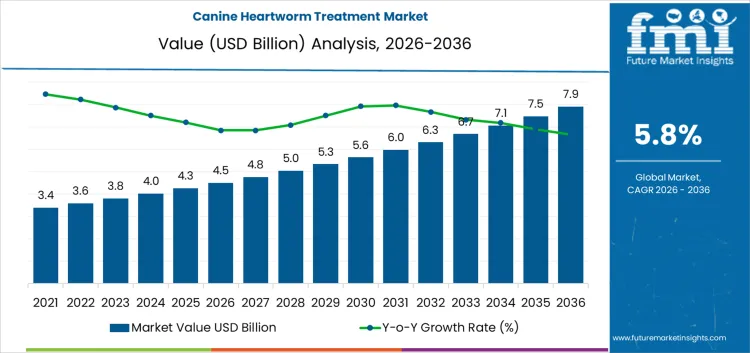
Canine Heartworm Treatment Market Key Takeaways
| Metric | Value |
|---|---|
| Canine Heartworm Treatment Market Value (2026) | USD 4.5 Billion |
| Canine Heartworm Treatment Market Forecast Value (2036) | USD 7.9 Billion |
| Canine Heartworm Treatment Market Forecast CAGR 2026 to 2036 | 5.8% |
Why is the Canine Heartworm Treatment Market Growing?
The canine heartworm treatment market is growing due to increasing awareness about heartworm disease and the rising number of pet owners seeking preventive and therapeutic treatments. Canine heartworm disease, caused by parasitic worms transmitted by mosquitoes, poses significant health risks to dogs, making effective treatment options essential. As pet ownership continues to rise globally, along with a growing focus on pet health and wellness, the demand for heartworm prevention and treatment solutions is on the rise.
Advancements in veterinary medicine are supporting growth in the canine heartworm treatment market. The development of more effective treatments, such as injectable medications, oral medications, and long-acting preventatives, has made managing and treating heartworm disease more efficient and accessible. The availability of combination therapies that target multiple stages of the parasite lifecycle has improved treatment outcomes, enhancing pet owners' confidence in these products.
Increased awareness and education campaigns by veterinary organizations and pet care brands are further contributing to the market's growth. As pet owners become more informed about the importance of regular heartworm testing, prevention, and early intervention, the demand for treatment options is expected to continue to rise. These factors, combined with growing pet health consciousness and expanding veterinary care, are driving the steady growth of the canine heartworm treatment market over the forecast period.
What Does The Segment Overview Indicate About The Canine Heartworm Treatment Market?
The canine heartworm treatment market is segmented by therapy type and application, reflecting the different approaches to preventing and treating heartworm disease in dogs. Macrocyclic lactone preventives lead the therapy segment with 36% share, as they are widely used to prevent heartworm infection in dogs. Adulticide therapies, adjunct anti-inflammatory drugs, and diagnostic-treatment bundles cater to the treatment of active infections and associated conditions. On the application side, preventive therapy dominates with 54% share, as heartworm prevention is a critical aspect of canine healthcare. Active infection treatment, along with diagnostic-treatment bundles, follows, reflecting the need for ongoing management once an infection is detected.
Why Do Macrocyclic Lactone Preventives Hold The Leading Therapy Share In The Canine Heartworm Treatment Market?
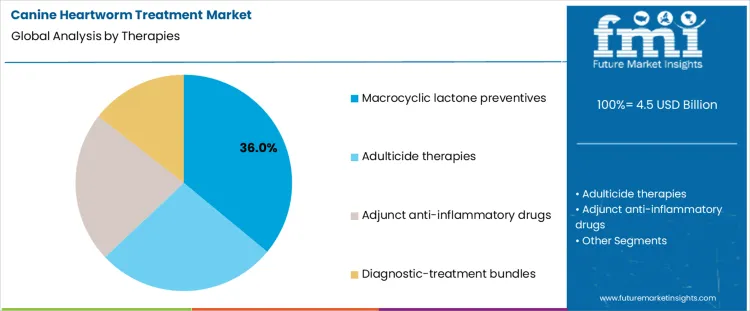
Macrocyclic lactone preventives hold the largest 36% share in the canine heartworm treatment market due to their proven efficacy in preventing heartworm infections in dogs. These medications, which include products like ivermectin, milbemycin oxime, and moxidectin, are widely recommended by veterinarians as part of routine heartworm prevention protocols. They work by eliminating larvae before they can mature into adult heartworms. The ongoing adoption of monthly preventives, ease of administration, and long-term effectiveness continue to drive their dominance in the market. With growing awareness of heartworm risks and an increasing number of pet owners prioritizing preventive care, the demand for macrocyclic lactone preventives remains strong.
How Does Preventive Therapy Drive Application Demand In The Canine Heartworm Treatment Market?
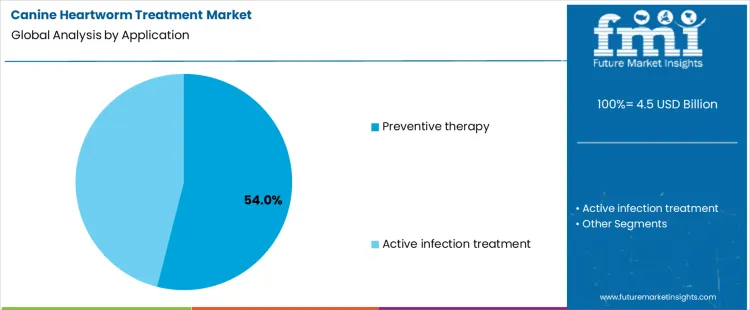
Preventive therapy accounts for the largest 54% share in the canine heartworm treatment market, reflecting the critical role prevention plays in protecting dogs from heartworm disease. Heartworm prevention is key to avoiding the costly and potentially life-threatening consequences of infection. Preventive therapies, particularly macrocyclic lactone-based products, are administered monthly to keep dogs free from heartworm larvae. These treatments are easily integrated into regular pet care routines, making them a preferred choice for pet owners. As awareness of the dangers of heartworm disease increases, along with advancements in preventive medications, demand for preventive therapies continues to grow, reinforcing their central role in the market.
What Are the Key Dynamics for the Canine Heartworm Treatment Market?
The canine heartworm treatment market is driven by the increasing prevalence of heartworm disease, rising pet ownership, and growing awareness of the importance of prevention. As pet owners prioritize the health and well-being of their dogs, demand for preventative treatments and early-stage interventions continues to rise. Technological advancements in diagnostic tools, medications, and treatment methods are enhancing the market’s growth, making treatments more effective and safer for dogs. However, challenges such as high treatment costs, limited access to veterinary care in some regions, and the risks associated with advanced heartworm treatments must be addressed for the market to continue expanding. The increasing focus on preventive care, coupled with technological innovations, is expected to sustain growth in the coming years.
What Are the Key Challenges in the Canine Heartworm Treatment Market?
The canine heartworm treatment market faces several challenges, including the cost of treatment, limited availability in certain regions, and concerns regarding the safety of some treatments. The cost of heartworm prevention medications, as well as the treatment for advanced heartworm disease, can be prohibitively expensive, particularly for low-income pet owners or those with multiple pets. Heartworm treatment can carry some risks, particularly in severe cases, as the treatment involves killing adult worms that can cause complications if not done correctly. In some regions, access to veterinary care and heartworm-specific medications may be limited, further inhibiting the market’s growth, especially in rural or underserved areas.
How Are Technological Advancements Shaping the Canine Heartworm Treatment Market?
Technological advancements are shaping the canine heartworm treatment market by improving diagnostic tools and treatment options. Innovations in diagnostic tests, such as antigen and antibody assays, are enabling earlier detection of heartworm infections, allowing for more effective treatment before the disease progresses to severe stages. The development of more advanced, safer, and easier-to-administer treatments, such as long-acting injectable medications, is improving the efficacy and compliance of heartworm prevention and treatment. Research into new drug formulations and treatment protocols is ongoing, with a focus on reducing side effects and improving the overall safety profile of heartworm therapies. These advancements are helping to drive the growth of the market and enhance the quality of care for dogs affected by heartworm disease.
What Is the Country-Wise Growth Outlook for the Canine Heartworm Treatment Market?
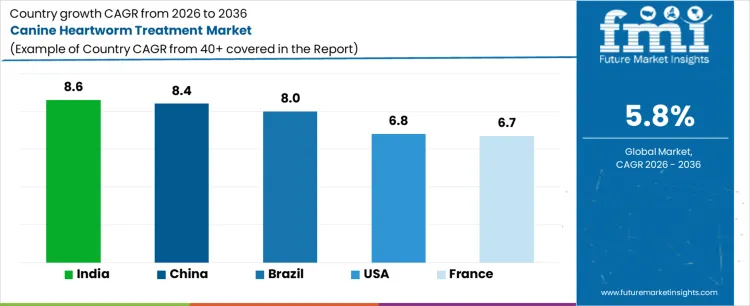
The canine heartworm treatment market is experiencing steady growth across key regions, driven by increasing awareness of heartworm disease, rising pet ownership, and advancements in veterinary medicine. India leads with a CAGR of 8.6%, driven by rising pet ownership, increasing awareness of heartworm prevention, and a growing veterinary care sector. China follows with a CAGR of 8.4%, supported by the increasing pet population and improved access to pet healthcare. Brazil shows an 8% CAGR, with expanding pet care markets and greater focus on pet health. The USA records a CAGR of 6.8%, with strong adoption of heartworm treatment and prevention programs in veterinary clinics. France shows a CAGR of 6.7%, driven by an increasing demand for pet health products and the country’s well-established veterinary infrastructure.
| Country | CAGR |
|---|---|
| India | 8.6% |
| China | 8.4% |
| Brazil | 8% |
| USA | 6.8% |
| France | 6.7% |
Why Is India Leading in the Canine Heartworm Treatment Market?
Demand for canine heartworm treatment in India is growing at a CAGR of 8.6%, driven by increasing pet ownership, greater awareness of heartworm disease, and a growing veterinary care sector. As India’s middle class expands, more families are adopting pets, which has led to a surge in demand for pet healthcare products. Heartworm prevention and treatment are becoming essential as the awareness of zoonotic diseases and parasitic infections grows among pet owners. Veterinary care in India is evolving, with more clinics offering advanced diagnostic tools and treatment options. The rise of online pet care platforms is also contributing to the growing accessibility of heartworm treatments for pet owners. India’s expanding veterinary infrastructure, coupled with a focus on educating pet owners about preventive care, is expected to drive continued growth in the canine heartworm treatment market. With the increasing focus on pet health and wellness, India is positioned as a rapidly growing market for heartworm treatment solutions.
What Is Contributing to the Growth of the Canine Heartworm Treatment Market in China?
Sales for canine heartworm treatment in China are growing at a CAGR of 8.4%, supported by the increasing pet population, rising awareness of heartworm disease, and improving access to veterinary care. As China’s pet industry continues to grow, pet owners are becoming more conscientious about preventive healthcare, including heartworm treatments. The increasing number of veterinary clinics in urban areas is making it easier for pet owners to access heartworm prevention products and treatments. China’s growing awareness of zoonotic diseases and pet wellness is further driving the demand for heartworm treatments. The country’s improving pet care regulations and increasing pet healthcare expenditure are fostering growth in the market. China’s shift toward higher-quality pet products and services, coupled with the rise in disposable income among urban pet owners, is contributing to the expansion of the canine heartworm treatment market. As the Chinese pet care sector continues to mature, heartworm treatment demand will continue to rise.
What Is Supporting the Growth of the Canine Heartworm Treatment Market in Brazil?
Demand for canine heartworm treatment in Brazil is growing at a CAGR of 8%, driven by increasing pet ownership, greater awareness of pet diseases, and growing focus on veterinary care. Brazil has one of the largest pet populations in Latin America, and as pet ownership rises, so does the demand for veterinary treatments, including heartworm prevention and care. The country’s expanding middle class and increasing disposable income are contributing to the growth of the pet care market. More Brazilian pet owners are seeking advanced treatments for heartworm and other pet diseases, driving demand for heartworm medications. The growing number of veterinary clinics and pet care services in Brazil’s major cities is making these treatments more accessible. Brazil’s veterinary industry is becoming increasingly professionalized, with more emphasis on preventive care and regular pet checkups. As heartworm disease awareness improves and treatment options become more readily available, Brazil is poised to see continued growth in the canine heartworm treatment market.
Why Is the USA a Key Market for Canine Heartworm Treatments?
Sales for canine heartworm treatment in the USA are growing at a CAGR of 6.8%, supported by strong adoption of heartworm prevention programs and the increasing focus on pet health and wellness. The USA has a large and mature pet care market, with pet owners increasingly seeking effective treatments and preventive solutions for heartworm disease. Awareness of the risks posed by heartworm disease and the importance of early diagnosis and treatment is widespread, driving strong demand for heartworm treatments. The availability of a variety of heartworm medications and products through veterinary clinics, online platforms, and pet retailers makes it easy for pet owners to access these treatments. The USA’s advanced veterinary care system, coupled with its strong focus on preventative pet healthcare, ensures that canine heartworm treatment continues to be a key priority. With a growing emphasis on pet wellness and longevity, the demand for heartworm treatments in the USA is expected to remain strong.
What Is Contributing to the Growth of the Canine Heartworm Treatment Market in France?
Demand for canine heartworm treatment in France is growing at a CAGR of 6.7%, driven by the country’s strong focus on pet health, increasing pet ownership, and the growing availability of heartworm prevention and treatment options. France has a well-established veterinary care system, with a focus on high-quality pet healthcare services. As pet ownership rises and the awareness of heartworm disease increases, more pet owners are seeking preventive treatments for their dogs. The French government’s focus on improving pet welfare and health, along with rising veterinary expenditures, is also contributing to market growth. France’s pet owners are becoming more conscious of the importance of preventative healthcare, leading to greater adoption of heartworm medications and other pet health products. The rise of e-commerce platforms for pet products is making heartworm treatments more accessible to French consumers. As France’s pet care market continues to evolve, the demand for effective and accessible heartworm treatments is expected to rise.
What Is the Competitive Landscape for the Canine Heartworm Treatment Market?
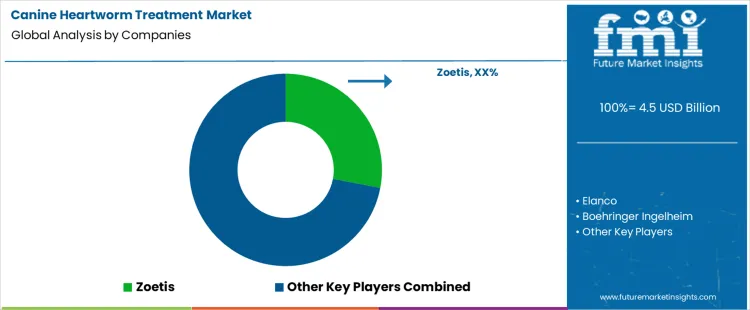
Competition in the Canine Heartworm Treatment Market is shaped by brand strength, veterinary trust, product efficacy, and regional reach. Zoetis holds a commanding position with its Heartgard Plus collateral emphasizing broad-spectrum prevention and ease of administration. Educational brochures underscore dosing guidance and compliance benefits. Elanco’s Interceptor and Sentinel materials highlight dual action against heartworm and other parasites. Technical sheets include safety profiles and dosing charts. Boehringer Ingelheim’s Trifexis literature stresses combination therapy and palatability. Virbac’s brochures for ProHeart injectables center on long-acting protection and veterinarian administration protocols. Ceva’s product collateral, such as Vectra 3D and Immiticide, details topical repellents and adulticide protocols. Others in the market leverage niche positioning with region-specific product sheets and targeted therapy guides.
Strategic differentiation is reflected in product brochures tailored for veterinarians and pet owners. Zoetis emphasizes clinical evidence and widespread adoption. Its literature is structured with clear diagrams and outcomes data. Elanco focuses on portfolio versatility, with modular brochure layouts that compare products by lifecycle coverage. Boehringer Ingelheim underscores palatability and combination protection in visual layouts. Virbac’s ProHeart collateral is procedure oriented, with visual step-by-step administration guidance. Ceva’s brochures position topical and injectable solutions side by side with parasite coverage charts. Smaller players produce concise, cost-focused brochures with direct comparisons and dosing matrices.
Market presence is amplified through multichannel distribution of product brochures. Digital catalogs, QR-linked datasheets, and clinic display materials are common. All competitors stress safety profiles, dosing schedules, and compliance support in their literature. Competitive differences are evident in feature callouts and clinical indication tables. Regional adaptations reflect prevalence patterns and regulatory frameworks. Brochure language and imagery align with practice workflows and pet owner education needs, driving differentiated positioning across the market landscape.
Key Players in Canine Heartworm Treatment Market
- Zoetis
- Elanco
- Boehringer Ingelheim
- Virbac
- Ceva
- Others
Scope of Report
| Attributes | Description |
|---|---|
| Quantitative Unit | USD Billion |
| Therapies | Macrocyclic lactone preventives, Adulticide therapies, Adjunct anti-inflammatory drugs, Diagnostic-treatment bundles |
| Applications | Preventive therapy, Active infection treatment |
| Regions Covered | Asia Pacific, Europe, North America, Latin America, Middle East & Africa |
| Countries Covered | China, Japan, South Korea, India, Australia & New Zealand, ASEAN, Rest of Asia Pacific, Germany, United Kingdom, France, Italy, Spain, Nordic, BENELUX, Rest of Europe, United States, Canada, Mexico, Brazil, Chile, Rest of Latin America, Kingdom of Saudi Arabia, Other GCC Countries, Turkey, South Africa, Other African Union, Rest of Middle East & Africa |
| Key Companies Profiled | Zoetis, Elanco, Boehringer Ingelheim, Virbac, Ceva |
| Additional Attributes | Market revenue by therapy type and application; adoption trends for preventive and active treatment therapies; technological advancements in heartworm treatment; competitive landscape with strategy and portfolio analysis of leading players; emerging diagnostic and therapeutic innovations for canine heartworm management. |
Canine Heartworm Treatment Market by Key Segments
Therapies
- Macrocyclic lactone preventives
- Adulticide therapies
- Adjunct anti-inflammatory drugs
- Diagnostic-treatment bundles
Application
- Preventive therapy
- Active infection treatment
Region:
- Asia Pacific
- China
- Japan
- South Korea
- India
- Australia & New Zealand
- ASEAN
- Rest of Asia Pacific
- Europe
- Germany
- United Kingdom
- France
- Italy
- Spain
- Nordic
- BENELUX
- Rest of Europe
- North America
- United States
- Canada
- Mexico
- Latin America
- Brazil
- Chile
- Rest of Latin America
- Middle East & Africa
- Kingdom of Saudi Arabia
- Other GCC Countries
- Turkey
- South Africa
- Other African Union
- Rest of Middle East & Africa
Bibliography
- American Heartworm Society. (2024, April 9). American Heartworm Society announces updated guidelines on management of canine heartworm disease. American Heartworm Society.
- U.S. Food and Drug Administration, Center for Veterinary Medicine. (2024, June). Effectiveness of anthelmintics: Specific recommendations for products proposed for the prevention of heartworm disease in dogs (CVM GFI #276). U.S. Food and Drug Administration.
- European Scientific Counsel Companion Animal Parasites. (2024, December). ESCCAP guideline 05: Control of vector-borne diseases in dogs and cats (5th ed.). ESCCAP.
Frequently Asked Questions
How big is the canine heartworm treatment market in 2026?
The global canine heartworm treatment market is estimated to be valued at USD 4.5 billion in 2026.
What will be the size of canine heartworm treatment market in 2036?
The market size for the canine heartworm treatment market is projected to reach USD 7.9 billion by 2036.
How much will be the canine heartworm treatment market growth between 2026 and 2036?
The canine heartworm treatment market is expected to grow at a 5.8% CAGR between 2026 and 2036.
What are the key product types in the canine heartworm treatment market?
The key product types in canine heartworm treatment market are macrocyclic lactone preventives, adulticide therapies, adjunct anti-inflammatory drugs and diagnostic-treatment bundles.
Which application segment to contribute significant share in the canine heartworm treatment market in 2026?
In terms of application, preventive therapy segment to command 54.0% share in the canine heartworm treatment market in 2026.
Preview the report firsthand - request a free sample
Get SampleGet the brochure for pricing and purchase details.
Get PDFTable of Content
- Executive Summary
- Global Market Outlook
- Demand-side Trends
- Supply-side Trends
- Technology Roadmap Analysis
- Analysis and Recommendations
- Market Overview
- Market Coverage / Taxonomy
- Market Definition / Scope / Limitations
- Market Background
- Market Dynamics
- Drivers
- Restraints
- Opportunity
- Trends
- Scenario Forecast
- Demand in Optimistic Scenario
- Demand in Likely Scenario
- Demand in Conservative Scenario
- Opportunity Map Analysis
- Product Life Cycle Analysis
- Supply Chain Analysis
- Investment Feasibility Matrix
- Value Chain Analysis
- PESTLE and Porter’s Analysis
- Regulatory Landscape
- Regional Parent Market Outlook
- Production and Consumption Statistics
- Import and Export Statistics
- Market Dynamics
- Global Market Analysis 2021 to 2025 and Forecast, 2026 to 2036
- Historical Market Size Value (USD Million) Analysis, 2021 to 2025
- Current and Future Market Size Value (USD Million) Projections, 2026 to 2036
- Y-o-Y Growth Trend Analysis
- Absolute $ Opportunity Analysis
- Global Market Pricing Analysis 2021 to 2025 and Forecast 2026 to 2036
- Global Market Analysis 2021 to 2025 and Forecast 2026 to 2036, By Therapies
- Introduction / Key Findings
- Historical Market Size Value (USD Million) Analysis By Therapies, 2021 to 2025
- Current and Future Market Size Value (USD Million) Analysis and Forecast By Therapies, 2026 to 2036
- Macrocyclic lactone preventives
- Adulticide therapies
- Adjunct anti-inflammatory drugs
- Diagnostic-treatment bundles
- Macrocyclic lactone preventives
- Y-o-Y Growth Trend Analysis By Therapies, 2021 to 2025
- Absolute $ Opportunity Analysis By Therapies, 2026 to 2036
- Global Market Analysis 2021 to 2025 and Forecast 2026 to 2036, By Application
- Introduction / Key Findings
- Historical Market Size Value (USD Million) Analysis By Application, 2021 to 2025
- Current and Future Market Size Value (USD Million) Analysis and Forecast By Application, 2026 to 2036
- Preventive therapy
- Active infection treatment
- Preventive therapy
- Y-o-Y Growth Trend Analysis By Application, 2021 to 2025
- Absolute $ Opportunity Analysis By Application, 2026 to 2036
- Global Market Analysis 2021 to 2025 and Forecast 2026 to 2036, By Region
- Introduction
- Historical Market Size Value (USD Million) Analysis By Region, 2021 to 2025
- Current Market Size Value (USD Million) Analysis and Forecast By Region, 2026 to 2036
- North America
- Latin America
- Western Europe
- Eastern Europe
- East Asia
- South Asia and Pacific
- Middle East & Africa
- Market Attractiveness Analysis By Region
- North America Market Analysis 2021 to 2025 and Forecast 2026 to 2036, By Country
- Historical Market Size Value (USD Million) Trend Analysis By Market Taxonomy, 2021 to 2025
- Market Size Value (USD Million) Forecast By Market Taxonomy, 2026 to 2036
- By Country
- USA
- Canada
- Mexico
- By Therapies
- By Application
- By Country
- Market Attractiveness Analysis
- By Country
- By Therapies
- By Application
- Key Takeaways
- Latin America Market Analysis 2021 to 2025 and Forecast 2026 to 2036, By Country
- Historical Market Size Value (USD Million) Trend Analysis By Market Taxonomy, 2021 to 2025
- Market Size Value (USD Million) Forecast By Market Taxonomy, 2026 to 2036
- By Country
- Brazil
- Chile
- Rest of Latin America
- By Therapies
- By Application
- By Country
- Market Attractiveness Analysis
- By Country
- By Therapies
- By Application
- Key Takeaways
- Western Europe Market Analysis 2021 to 2025 and Forecast 2026 to 2036, By Country
- Historical Market Size Value (USD Million) Trend Analysis By Market Taxonomy, 2021 to 2025
- Market Size Value (USD Million) Forecast By Market Taxonomy, 2026 to 2036
- By Country
- Germany
- UK
- Italy
- Spain
- France
- Nordic
- BENELUX
- Rest of Western Europe
- By Therapies
- By Application
- By Country
- Market Attractiveness Analysis
- By Country
- By Therapies
- By Application
- Key Takeaways
- Eastern Europe Market Analysis 2021 to 2025 and Forecast 2026 to 2036, By Country
- Historical Market Size Value (USD Million) Trend Analysis By Market Taxonomy, 2021 to 2025
- Market Size Value (USD Million) Forecast By Market Taxonomy, 2026 to 2036
- By Country
- Russia
- Poland
- Hungary
- Balkan & Baltic
- Rest of Eastern Europe
- By Therapies
- By Application
- By Country
- Market Attractiveness Analysis
- By Country
- By Therapies
- By Application
- Key Takeaways
- East Asia Market Analysis 2021 to 2025 and Forecast 2026 to 2036, By Country
- Historical Market Size Value (USD Million) Trend Analysis By Market Taxonomy, 2021 to 2025
- Market Size Value (USD Million) Forecast By Market Taxonomy, 2026 to 2036
- By Country
- China
- Japan
- South Korea
- By Therapies
- By Application
- By Country
- Market Attractiveness Analysis
- By Country
- By Therapies
- By Application
- Key Takeaways
- South Asia and Pacific Market Analysis 2021 to 2025 and Forecast 2026 to 2036, By Country
- Historical Market Size Value (USD Million) Trend Analysis By Market Taxonomy, 2021 to 2025
- Market Size Value (USD Million) Forecast By Market Taxonomy, 2026 to 2036
- By Country
- India
- ASEAN
- Australia & New Zealand
- Rest of South Asia and Pacific
- By Therapies
- By Application
- By Country
- Market Attractiveness Analysis
- By Country
- By Therapies
- By Application
- Key Takeaways
- Middle East & Africa Market Analysis 2021 to 2025 and Forecast 2026 to 2036, By Country
- Historical Market Size Value (USD Million) Trend Analysis By Market Taxonomy, 2021 to 2025
- Market Size Value (USD Million) Forecast By Market Taxonomy, 2026 to 2036
- By Country
- Kingdom of Saudi Arabia
- Other GCC Countries
- Turkiye
- South Africa
- Other African Union
- Rest of Middle East & Africa
- By Therapies
- By Application
- By Country
- Market Attractiveness Analysis
- By Country
- By Therapies
- By Application
- Key Takeaways
- Key Countries Market Analysis
- USA
- Pricing Analysis
- Market Share Analysis, 2025
- By Therapies
- By Application
- Canada
- Pricing Analysis
- Market Share Analysis, 2025
- By Therapies
- By Application
- Mexico
- Pricing Analysis
- Market Share Analysis, 2025
- By Therapies
- By Application
- Brazil
- Pricing Analysis
- Market Share Analysis, 2025
- By Therapies
- By Application
- Chile
- Pricing Analysis
- Market Share Analysis, 2025
- By Therapies
- By Application
- Germany
- Pricing Analysis
- Market Share Analysis, 2025
- By Therapies
- By Application
- UK
- Pricing Analysis
- Market Share Analysis, 2025
- By Therapies
- By Application
- Italy
- Pricing Analysis
- Market Share Analysis, 2025
- By Therapies
- By Application
- Spain
- Pricing Analysis
- Market Share Analysis, 2025
- By Therapies
- By Application
- France
- Pricing Analysis
- Market Share Analysis, 2025
- By Therapies
- By Application
- India
- Pricing Analysis
- Market Share Analysis, 2025
- By Therapies
- By Application
- ASEAN
- Pricing Analysis
- Market Share Analysis, 2025
- By Therapies
- By Application
- Australia & New Zealand
- Pricing Analysis
- Market Share Analysis, 2025
- By Therapies
- By Application
- China
- Pricing Analysis
- Market Share Analysis, 2025
- By Therapies
- By Application
- Japan
- Pricing Analysis
- Market Share Analysis, 2025
- By Therapies
- By Application
- South Korea
- Pricing Analysis
- Market Share Analysis, 2025
- By Therapies
- By Application
- Russia
- Pricing Analysis
- Market Share Analysis, 2025
- By Therapies
- By Application
- Poland
- Pricing Analysis
- Market Share Analysis, 2025
- By Therapies
- By Application
- Hungary
- Pricing Analysis
- Market Share Analysis, 2025
- By Therapies
- By Application
- Kingdom of Saudi Arabia
- Pricing Analysis
- Market Share Analysis, 2025
- By Therapies
- By Application
- Turkiye
- Pricing Analysis
- Market Share Analysis, 2025
- By Therapies
- By Application
- South Africa
- Pricing Analysis
- Market Share Analysis, 2025
- By Therapies
- By Application
- USA
- Market Structure Analysis
- Competition Dashboard
- Competition Benchmarking
- Market Share Analysis of Top Players
- By Regional
- By Therapies
- By Application
- Competition Analysis
- Competition Deep Dive
- Zoetis
- Overview
- Product Portfolio
- Profitability by Market Segments (Product/Age /Sales Channel/Region)
- Sales Footprint
- Strategy Overview
- Marketing Strategy
- Product Strategy
- Channel Strategy
- Elanco
- Boehringer Ingelheim
- Virbac
- Ceva
- Others
- Zoetis
- Competition Deep Dive
- Assumptions & Acronyms Used
- Research Methodology


