

- Industry Size (2026)
- USD 1538.0 Mn
- Forecast (2036)
- USD 3413.8 Mn
- CAGR (2026 to 2036)
- 8.3%
Canine Cataract Treatment Market Forecast and Outlook 2026 to 2036
The canine cataract treatment market is expected to be valued at USD 1,538.0 million in 2026, reach USD 3,413.8 million by 2036, and expand at a CAGR of 8.3%. Value creation in this segment is primarily linked to irreversible lens opacity requiring interventional correction rather than long-term pharmacological management.
Surgical treatment dominates expenditure patterns because cataracts directly impair vision and mobility, creating a clear quality-of-life threshold that prompts owner decision-making. Case volumes are influenced by breed predisposition, rising incidence of diabetes-related ocular complications, and longer canine lifespans that expose age-related lens degeneration. Spending intensity remains higher in referral-driven settings where diagnostic confirmation and surgical readiness determine treatment eligibility.
Clinical demand develops unevenly across regions, shaped by availability of veterinary ophthalmologists, anesthesia infrastructure, and postoperative monitoring capability. Treatment pathways depend on early diagnosis before secondary complications such as retinal degeneration or glaucoma limit surgical benefit. Cost sensitivity persists, as cataract surgery remains a discretionary yet functionally restorative procedure rather than routine care. Insurance penetration, referral efficiency, and owner education directly affect procedure uptake rates. Supporting pharmaceutical use contributes incremental value through perioperative inflammation control rather than standalone therapy. Overall expansion reflects gradual scaling of specialty ophthalmic capacity, improved surgical outcomes, and sustained willingness among owners to invest in vision restoration when functional impairment becomes evident.
Quick Stats for Canine Cataract Treatment Market
- Canine Cataract Treatment Market Value (2026): USD 1,538.0 million
- Canine Cataract Treatment Market Forecast Value (2036): USD 3,413.8 million
- Canine Cataract Treatment Market Forecast CAGR 2026 to 2036: 8.3%
- Leading Product Type by Demand Share: Surgical interventions
- Fastest-Growing Countries: India, China, Brazil, USA, UK
- Top Players in Global Demand: Alcon, Bausch + Lomb, Zeiss, Topcon, Nidek
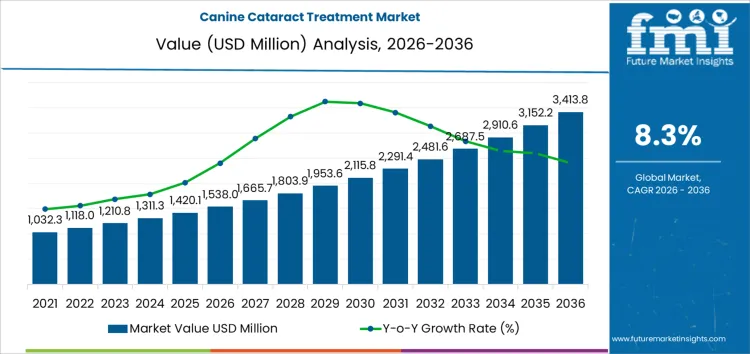
Canine Cataract Treatment Market Key Takeaways
| Metric | Value |
|---|---|
| Market Value (2026) | USD 1,538.0 million |
| Market Forecast Value (2036) | USD 3,413.8 million |
| Forecast CAGR 2026 to 2036 | 8.3% |
Why is the Demand for Canine Cataract Treatment Growing?
Demand for canine cataract treatment is increasing as veterinary ophthalmologists and general practice veterinarians encounter higher caseloads of age-related and metabolic disorder-associated lens opacities in dogs. Cataracts impair visual acuity and quality of life, especially in older and predisposed breeds, and owners seek interventions that restore functional vision rather than solely managing symptoms. Surgical removal of the opacified lens followed by intraocular lens implantation remains the definitive therapy, and advances in microsurgical technique and perioperative care have expanded eligibility criteria for a broader canine patient population.
Clinics evaluate surgical systems, anesthetic protocols, and postoperative management strategies to optimize outcomes, and procurement teams prioritize instruments and implant quality that support predictable refractive results and minimize intraoperative complications. Availability of advanced diagnostic imaging, such as ophthalmic ultrasound and slit-lamp biomicroscopy, facilitates accurate assessment of cataract density and associated ocular pathology, reinforcing adoption of definitive treatment pathways.
Growth in pet healthcare investment and increased owner willingness to pursue specialty procedures are reinforcing uptake of canine cataract treatments, particularly in markets where pets are viewed as family members with expectations for quality healthcare. Veterinary referral centers and specialty eye clinics are developing structured protocols for preoperative assessment, surgical execution, and long-term follow-up, which supports consistent clinical performance and client satisfaction.
Education for veterinarians on surgical candidacy criteria and complication management enhances confidence in offering cataract surgery, expanding its availability beyond urban referral hubs. Pharmaceutical support for perioperative anti-inflammatory and antioxidant therapy also complements surgical outcomes. These clinical and operational drivers are contributing to sustained demand growth in the canine cataract treatment market.
How Is the Canine Cataract Treatment Industry Segmented by Product Type, Application, and End User?
Demand for canine cataract treatment reflects longer pet lifespans, rising metabolic disorders, and improved access to veterinary ophthalmology services. Care pathways prioritize functional vision recovery, complication avoidance, and postoperative quality of life. Adoption is influenced by earlier diagnosis during routine screening and owner readiness to pursue definitive correction. Therapy selection weighs disease progression speed, anesthesia suitability, and availability of specialized surgical infrastructure. Segmentation clarifies how intervention modality, cataract etiology, and care setting determine treatment intensity, referral patterns, and continuity across veterinary eye care.
Which Product Type Dominates Canine Cataract Treatment Utilization?
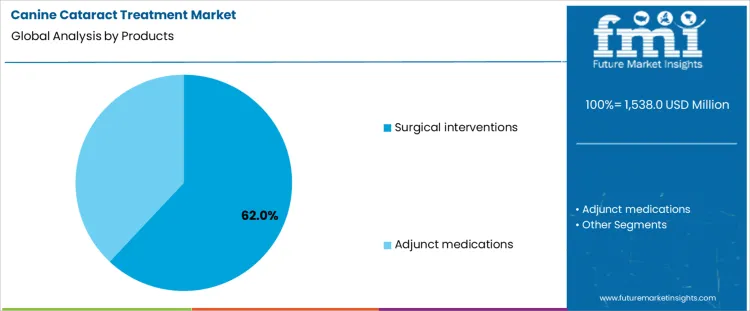
Surgical interventions lead utilization at 62.0%, driven by their role as the only definitive method to restore vision once lens opacity develops. Phacoemulsification-based procedures address irreversible structural changes rather than symptom modulation. Clinical decision-making favors surgery when visual impairment affects mobility and daily behavior. Outcomes depend on surgeon expertise, perioperative protocols, and postoperative compliance. Adjunct medications at 38.0% support inflammation control and intraocular pressure management before and after procedures. Product segmentation reflects concentration where mechanical correction is required, while pharmacologic options remain supportive rather than curative.
Key Points:
- Surgery directly removes opaque lenses and restores visual function.
- Clinical outcomes rely on specialized expertise and postoperative care.
- Medications support surgical pathways without reversing cataracts.
How Does Cataract Etiology Shape Treatment Demand Across Applications?
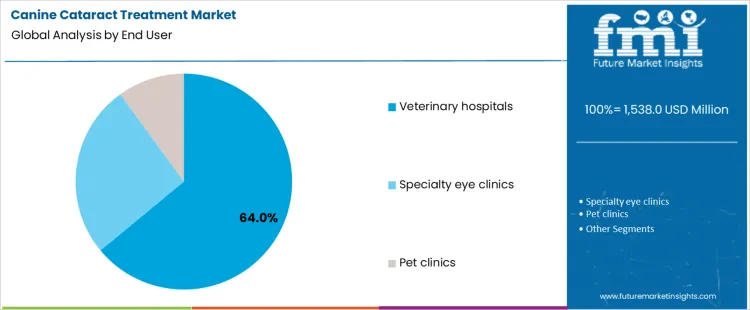
Treatment demand centers on diabetic cataract at 54.0%, reflecting rapid disease onset linked to metabolic dysregulation. Bilateral progression often occurs quickly, creating functional blindness within weeks if untreated. Medical glycemic control does not halt lens fiber swelling, increasing urgency for surgical correction. Age-related cataract at 46.0% progresses more gradually, allowing staged decision-making and monitoring. Application segmentation highlights higher intervention pressure where disease trajectory accelerates vision loss and limits conservative management options.
Key Points:
- Diabetic cataracts progress rapidly and affect both eyes.
- Metabolic control does not reverse lens opacity.
- Age-related cases allow longer observation windows.
Which Care Setting Handles the Majority of Canine Cataract Treatment?
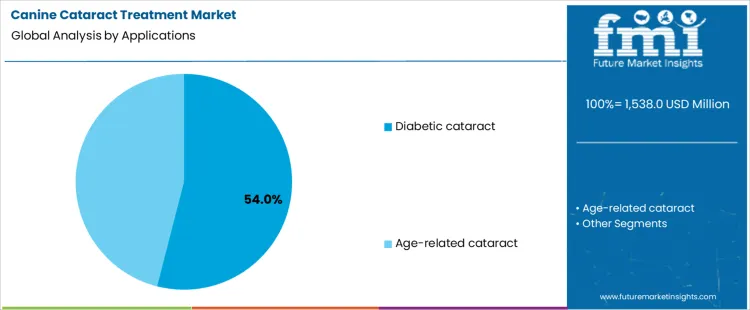
Veterinary hospitals manage 64.0% of treatment delivery due to infrastructure requirements showing beyond routine clinic capability. Cataract surgery requires operating theaters, anesthesia teams, diagnostic imaging, and postoperative monitoring capacity. Hospitals coordinate systemic disease management alongside ophthalmic intervention, especially in diabetic patients. Specialty eye clinics at 26.0% provide focused surgical expertise with narrower service scope. Pet clinics at 10.0% concentrate on screening and referral. End-user segmentation reflects concentration where surgical readiness, multidisciplinary support, and postoperative care capacity are available.
Key Points:
- Hospitals provide comprehensive surgical infrastructure.
- Multidisciplinary teams support complex systemic cases.
- Other settings focus on referral or specialized procedures.
What are the Key Dynamics in the Canine Cataract Treatment Market?
Demand for canine cataract treatments reflects veterinary need to restore or preserve vision impaired by lens opacity in dogs. Adoption concentrates in companion animal ophthalmology clinics, referral hospitals, and specialty surgical centers. Global scope aligns with aging pet populations and breed-specific cataract prevalence. Usage centers on surgical lens extraction with intraocular lens implantation, supported by medical management to control inflammation and comorbid ocular conditions.
How do disease progression patterns and vision outcome expectations shape adoption?
Canine cataracts progress at variable rates depending on etiology, age, and metabolic status. Demand increases where vision loss affects mobility, behavior, and quality of life. Surgical intervention remains primary option for functional vision restoration, with outcomes closely tied to timing before retinal or inflammatory complications develop. Preoperative evaluation emphasizes retinal health, intraocular pressure, and systemic disease control. Owner decision-making weighs anticipated visual improvement against surgical risk and recovery demands. Postoperative care requires strict adherence to anti-inflammatory regimens and follow-up visits. Referral pathways influence access to board-certified ophthalmologists. Adoption reflects alignment between clinical prognosis, owner commitment, and availability of specialized surgical capability.
How do surgical access limits, cost exposure, and postoperative management influence market scalability?
Cataract surgery requires specialized equipment, anesthesia support, and trained ophthalmic surgeons, limiting geographic availability. Demand sensitivity rises where procedure cost exceeds owner affordability or insurance coverage. Postoperative complications such as uveitis or glaucoma necessitate intensive monitoring, increasing care burden. Systemic conditions like diabetes complicate eligibility and outcomes. Medical therapies cannot reverse established cataracts, restricting non-surgical alternatives. Owner compliance with postoperative care affects success rates. Limited specialist capacity constrains throughput. Scalability remains constrained by capital-intensive infrastructure, skilled workforce requirements, and reliance on sustained owner engagement for perioperative management.
How Is Demand for Canine Cataract Treatments Evolving Globally?
Demand for canine cataract treatments is expanding globally as companion animal longevity increases and veterinary ophthalmology services mature. Earlier diagnosis during routine eye examinations and higher owner willingness to pursue vision-restoring procedures support case volumes. Surgical intervention remains central, while perioperative pharmaceuticals and post-surgical care extend treatment value chains. Insurance penetration and referral networks influence access. Growth rates in India at 10.0%, China at 9.8%, Brazil at 9.5%, USA at 8.9%, and the UK at 7.8% indicate sustained expansion driven by aging canine populations, specialist availability, and owner compliance rather than episodic disease spikes.
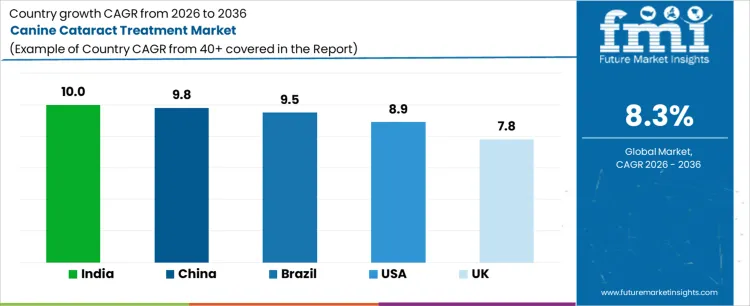
| Country | CAGR (%) |
|---|---|
| India | 10.0% |
| China | 9.8% |
| Brazil | 9.5% |
| USA | 8.9% |
| UK | 7.8% |
What Is Driving Expansion of Canine Cataract Treatment Demand in India?
Canine cataract treatment demand in India is growing at a CAGR of 10.0%, shaped by longer pet lifespans and improving access to referral ophthalmology. Urban veterinary hospitals identify cataracts earlier through routine screenings. Rising disposable income increases acceptance of surgical correction. Breed concentration, including diabetic-prone dogs, elevates incidence. Organized referral pathways improve surgical throughput and follow-up adherence. Growth reflects service accessibility and owner education rather than rapid diffusion of advanced intraocular technologies.
- Longer canine lifespan increasing cataract prevalence
- Early detection during routine eye examinations
- Rising owner willingness for surgical correction
- Strengthening referral ophthalmology networks
Why Is China Experiencing Strong Uptake of Canine Cataract Treatments?
Demand for canine cataract treatments in China is expanding at a CAGR of 9.8%, supported by rapid growth in companion animal healthcare infrastructure. Specialty veterinary hospitals expand ophthalmic diagnostic capacity. Preventive wellness packages increase early cataract identification. Domestic equipment suppliers improve availability of surgical consumables. Urban pet owners increasingly prioritize vision preservation. Growth reflects integrated service delivery and owner expectations rather than expansion of emergency-only interventions.
- Expansion of specialty veterinary hospitals
- Preventive wellness programs detecting cataracts
- Improved access to surgical consumables
- Strong urban focus on pet quality of life
How Is Brazil Sustaining Growth in Canine Cataract Treatment Demand?
Canine cataract treatment demand in Brazil is growing at a CAGR of 9.5%, influenced by aging dog populations and high veterinary engagement. Warm climates and metabolic conditions increase cataract incidence. Referral clinics integrate surgical treatment with long-term ocular management. Strong grooming and preventive care culture supports early referral. Retail access to postoperative medications improves outcomes. Growth reflects service-led detection and procedural acceptance rather than concentration in elite specialty centers.
- Aging canine population with metabolic risk
- Referral clinics integrating surgical pathways
- Preventive care culture aiding early referral
- Access to postoperative ophthalmic medications
What Factors Are Supporting Canine Cataract Treatment Growth in United States?
Canine cataract treatment demand in the United States is expanding at a CAGR of 8.9%, driven by advanced veterinary ophthalmology and insurance coverage. Routine eye screening is common in senior dogs. High availability of board-certified specialists supports surgical volume. Pet insurance reduces financial barriers for elective procedures. Postoperative care standards sustain favorable outcomes. Growth reflects treatment persistence and referral efficiency rather than increased disease incidence.
- Routine senior canine eye screening
- High density of veterinary ophthalmologists
- Pet insurance supporting elective surgery
- Established postoperative care protocols
Why Is the UK Showing Steady Expansion in Canine Cataract Treatments?
Demand for canine cataract treatments in United Kingdom is growing at a CAGR of 7.8%, supported by structured referral systems and preventive veterinary care. General practitioners identify cataracts during annual health checks. Insurance coverage encourages timely referral for surgery. Evidence-based treatment protocols guide case selection. Aging pet demographics increase cumulative case volumes. Growth remains steady, reflecting guideline-aligned care and owner compliance rather than rapid expansion of specialist capacity.
- Structured referral pathways from general practice
- Insurance-enabled access to surgical care
- Evidence-based ophthalmic treatment protocols
- Aging canine population increasing case load
What is the competitive landscape of demand for the canine cataract treatment market globally?
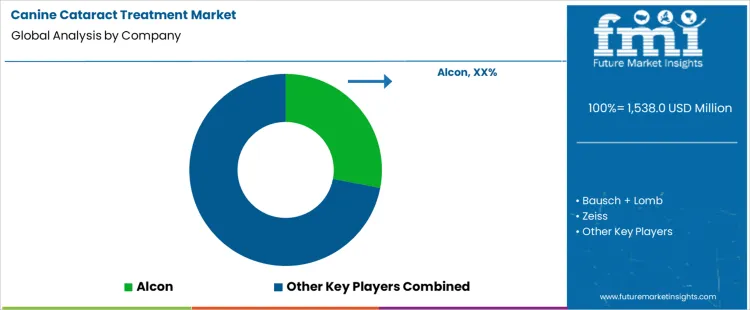
Demand for canine cataract treatment is shaped by rising companion animal longevity and greater willingness to pursue vision-restoring care. Veterinary ophthalmologists assess surgical outcomes, intraocular lens quality, complication rates, and post-operative inflammation control. Buyer evaluation includes equipment precision, availability of phacoemulsification systems, consumable consistency, and long-term visual prognosis. Procurement behavior reflects referral center concentration, capital equipment investment cycles, and reliance on suppliers offering training and technical service. Purchasing decisions emphasize procedural reliability, safety margins, and clinical success rates across breeds. Trend in the canine cataract treatment market shows increasing concentration within specialty clinics delivering surgical intervention rather than pharmacologic management.
Alcon leads competitive positioning through dedicated veterinary ophthalmic solutions supported by advanced surgical platforms and intraocular lenses. Bausch plus Lomb competes with ophthalmic devices and consumables adapted from human eye care expertise. Zeiss supports demand through high-precision surgical visualization and diagnostic equipment used in veterinary ophthalmology centers. Topcon maintains relevance by supplying imaging and surgical support systems integrated into specialty eye clinics. Nidek participates with ophthalmic surgical technologies supporting cataract procedures in advanced veterinary practices. Competitive differentiation centers on surgical accuracy, device reliability, clinician training support, and integration across the ophthalmic surgical workflow.
Key Players in the Canine Cataract Treatment Market
- Alcon
- Bausch + Lomb
- Zeiss
- Topcon
- Nidek
- Others
Scope of the Report
| Items | Values |
|---|---|
| Quantitative Units | USD million |
| Products | Surgical interventions; Adjunct medications |
| Applications | Diabetic cataract; Age-related cataract |
| End User | Veterinary hospitals; Specialty eye clinics; Pet clinics |
| Regions Covered | Asia Pacific, Europe, North America, Latin America, Middle East & Africa |
| Countries Covered | India, China, Brazil, USA, UK, and 40+ countries |
| Key Companies Profiled | Alcon; Bausch + Lomb; Zeiss; Topcon; Nidek; Others |
| Additional Attributes | Dollar sales by product type, application, end user, and sales channel; surgical adoption rates for phacoemulsification and lens implantation in companion animals; adjunct medication use for inflammation control and post-operative recovery; equipment precision and imaging accuracy influencing surgical outcomes; referral patterns between pet clinics and specialty eye centers; procurement dynamics driven by veterinary hospital capital equipment purchases and consumables demand. |
Canine Cataract Treatment Market by Segment
Products:
- Surgical interventions
- Adjunct medications
Applications:
- Diabetic cataract
- Age-related cataract
End User:
- Veterinary hospitals
- Specialty eye clinics
- Pet clinics
Region:
- Asia Pacific
- China
- Japan
- South Korea
- India
- Australia & New Zealand
- ASEAN
- Rest of Asia Pacific
- Europe
- Germany
- United Kingdom
- France
- Italy
- Spain
- Nordic
- BENELUX
- Rest of Europe
- North America
- United States
- Canada
- Mexico
- Latin America
- Brazil
- Chile
- Rest of Latin America
- Middle East & Africa
- Kingdom of Saudi Arabia
- Other GCC Countries
- Turkey
- South Africa
- Other African Union
- Rest of Middle East & Africa
Bibliography
- American College of Veterinary Ophthalmologists. (2024). Canine cataracts: Diagnosis, surgical indications, and postoperative management. ACVO Clinical Guidelines.
- Lim, C. C., Bakker, S. C., & Davidson, M. G. (2024). Diabetic cataracts in dogs: Pathophysiology, progression, and surgical considerations. Journal of Veterinary Internal Medicine, 38(1), 1–12.
- Miller, P. E., & Ofri, R. (2024). Cataract surgery in companion animals: Advances in diagnostics, anesthesia, and perioperative care. Veterinary Ophthalmology, 27(1), 3–18.
- World Small Animal Veterinary Association. (2024). WSAVA global guidelines on ocular diseases: Cataracts and lens disorders in dogs. World Small Animal Veterinary Association.
Frequently Asked Questions
How big is the canine cataract treatment market in 2026?
The global canine cataract treatment market is estimated to be valued at USD 1,538.0 million in 2026.
What will be the size of canine cataract treatment market in 2036?
The market size for the canine cataract treatment market is projected to reach USD 3,413.8 million by 2036.
How much will be the canine cataract treatment market growth between 2026 and 2036?
The canine cataract treatment market is expected to grow at a 8.3% CAGR between 2026 and 2036.
What are the key product types in the canine cataract treatment market?
The key product types in canine cataract treatment market are surgical interventions and adjunct medications.
Which applications segment to contribute significant share in the canine cataract treatment market in 2026?
In terms of applications, diabetic cataract segment to command 54.0% share in the canine cataract treatment market in 2026.
Preview the report firsthand - request a free sample
Get SampleGet the brochure for pricing and purchase details.
Get PDFTable of Content
- Executive Summary
- Global Market Outlook
- Demand-side Trends
- Supply-side Trends
- Technology Roadmap Analysis
- Analysis and Recommendations
- Market Overview
- Market Coverage / Taxonomy
- Market Definition / Scope / Limitations
- Market Background
- Market Dynamics
- Drivers
- Restraints
- Opportunity
- Trends
- Scenario Forecast
- Demand in Optimistic Scenario
- Demand in Likely Scenario
- Demand in Conservative Scenario
- Opportunity Map Analysis
- Product Life Cycle Analysis
- Supply Chain Analysis
- Investment Feasibility Matrix
- Value Chain Analysis
- PESTLE and Porter’s Analysis
- Regulatory Landscape
- Regional Parent Market Outlook
- Production and Consumption Statistics
- Import and Export Statistics
- Market Dynamics
- Global Market Analysis 2021 to 2025 and Forecast, 2026 to 2036
- Historical Market Size Value (USD Million) Analysis, 2021 to 2025
- Current and Future Market Size Value (USD Million) Projections, 2026 to 2036
- Y-o-Y Growth Trend Analysis
- Absolute $ Opportunity Analysis
- Global Market Pricing Analysis 2021 to 2025 and Forecast 2026 to 2036
- Global Market Analysis 2021 to 2025 and Forecast 2026 to 2036, By Products
- Introduction / Key Findings
- Historical Market Size Value (USD Million) Analysis By Products , 2021 to 2025
- Current and Future Market Size Value (USD Million) Analysis and Forecast By Products , 2026 to 2036
- Surgical interventions
- Adjunct medications
- Surgical interventions
- Y-o-Y Growth Trend Analysis By Products , 2021 to 2025
- Absolute $ Opportunity Analysis By Products , 2026 to 2036
- Global Market Analysis 2021 to 2025 and Forecast 2026 to 2036, By Applications
- Introduction / Key Findings
- Historical Market Size Value (USD Million) Analysis By Applications, 2021 to 2025
- Current and Future Market Size Value (USD Million) Analysis and Forecast By Applications, 2026 to 2036
- Diabetic cataract
- Age-related cataract
- Diabetic cataract
- Y-o-Y Growth Trend Analysis By Applications, 2021 to 2025
- Absolute $ Opportunity Analysis By Applications, 2026 to 2036
- Global Market Analysis 2021 to 2025 and Forecast 2026 to 2036, By End User
- Introduction / Key Findings
- Historical Market Size Value (USD Million) Analysis By End User, 2021 to 2025
- Current and Future Market Size Value (USD Million) Analysis and Forecast By End User, 2026 to 2036
- Veterinary hospitals
- Specialty eye clinics
- Pet clinics
- Veterinary hospitals
- Y-o-Y Growth Trend Analysis By End User, 2021 to 2025
- Absolute $ Opportunity Analysis By End User, 2026 to 2036
- Global Market Analysis 2021 to 2025 and Forecast 2026 to 2036, By Region
- Introduction
- Historical Market Size Value (USD Million) Analysis By Region, 2021 to 2025
- Current Market Size Value (USD Million) Analysis and Forecast By Region, 2026 to 2036
- North America
- Latin America
- Western Europe
- Eastern Europe
- East Asia
- South Asia and Pacific
- Middle East & Africa
- Market Attractiveness Analysis By Region
- North America Market Analysis 2021 to 2025 and Forecast 2026 to 2036, By Country
- Historical Market Size Value (USD Million) Trend Analysis By Market Taxonomy, 2021 to 2025
- Market Size Value (USD Million) Forecast By Market Taxonomy, 2026 to 2036
- By Country
- USA
- Canada
- Mexico
- By Products
- By Applications
- By End User
- By Country
- Market Attractiveness Analysis
- By Country
- By Products
- By Applications
- By End User
- Key Takeaways
- Latin America Market Analysis 2021 to 2025 and Forecast 2026 to 2036, By Country
- Historical Market Size Value (USD Million) Trend Analysis By Market Taxonomy, 2021 to 2025
- Market Size Value (USD Million) Forecast By Market Taxonomy, 2026 to 2036
- By Country
- Brazil
- Chile
- Rest of Latin America
- By Products
- By Applications
- By End User
- By Country
- Market Attractiveness Analysis
- By Country
- By Products
- By Applications
- By End User
- Key Takeaways
- Western Europe Market Analysis 2021 to 2025 and Forecast 2026 to 2036, By Country
- Historical Market Size Value (USD Million) Trend Analysis By Market Taxonomy, 2021 to 2025
- Market Size Value (USD Million) Forecast By Market Taxonomy, 2026 to 2036
- By Country
- Germany
- UK
- Italy
- Spain
- France
- Nordic
- BENELUX
- Rest of Western Europe
- By Products
- By Applications
- By End User
- By Country
- Market Attractiveness Analysis
- By Country
- By Products
- By Applications
- By End User
- Key Takeaways
- Eastern Europe Market Analysis 2021 to 2025 and Forecast 2026 to 2036, By Country
- Historical Market Size Value (USD Million) Trend Analysis By Market Taxonomy, 2021 to 2025
- Market Size Value (USD Million) Forecast By Market Taxonomy, 2026 to 2036
- By Country
- Russia
- Poland
- Hungary
- Balkan & Baltic
- Rest of Eastern Europe
- By Products
- By Applications
- By End User
- By Country
- Market Attractiveness Analysis
- By Country
- By Products
- By Applications
- By End User
- Key Takeaways
- East Asia Market Analysis 2021 to 2025 and Forecast 2026 to 2036, By Country
- Historical Market Size Value (USD Million) Trend Analysis By Market Taxonomy, 2021 to 2025
- Market Size Value (USD Million) Forecast By Market Taxonomy, 2026 to 2036
- By Country
- China
- Japan
- South Korea
- By Products
- By Applications
- By End User
- By Country
- Market Attractiveness Analysis
- By Country
- By Products
- By Applications
- By End User
- Key Takeaways
- South Asia and Pacific Market Analysis 2021 to 2025 and Forecast 2026 to 2036, By Country
- Historical Market Size Value (USD Million) Trend Analysis By Market Taxonomy, 2021 to 2025
- Market Size Value (USD Million) Forecast By Market Taxonomy, 2026 to 2036
- By Country
- India
- ASEAN
- Australia & New Zealand
- Rest of South Asia and Pacific
- By Products
- By Applications
- By End User
- By Country
- Market Attractiveness Analysis
- By Country
- By Products
- By Applications
- By End User
- Key Takeaways
- Middle East & Africa Market Analysis 2021 to 2025 and Forecast 2026 to 2036, By Country
- Historical Market Size Value (USD Million) Trend Analysis By Market Taxonomy, 2021 to 2025
- Market Size Value (USD Million) Forecast By Market Taxonomy, 2026 to 2036
- By Country
- Kingdom of Saudi Arabia
- Other GCC Countries
- Turkiye
- South Africa
- Other African Union
- Rest of Middle East & Africa
- By Products
- By Applications
- By End User
- By Country
- Market Attractiveness Analysis
- By Country
- By Products
- By Applications
- By End User
- Key Takeaways
- Key Countries Market Analysis
- USA
- Pricing Analysis
- Market Share Analysis, 2025
- By Products
- By Applications
- By End User
- Canada
- Pricing Analysis
- Market Share Analysis, 2025
- By Products
- By Applications
- By End User
- Mexico
- Pricing Analysis
- Market Share Analysis, 2025
- By Products
- By Applications
- By End User
- Brazil
- Pricing Analysis
- Market Share Analysis, 2025
- By Products
- By Applications
- By End User
- Chile
- Pricing Analysis
- Market Share Analysis, 2025
- By Products
- By Applications
- By End User
- Germany
- Pricing Analysis
- Market Share Analysis, 2025
- By Products
- By Applications
- By End User
- UK
- Pricing Analysis
- Market Share Analysis, 2025
- By Products
- By Applications
- By End User
- Italy
- Pricing Analysis
- Market Share Analysis, 2025
- By Products
- By Applications
- By End User
- Spain
- Pricing Analysis
- Market Share Analysis, 2025
- By Products
- By Applications
- By End User
- France
- Pricing Analysis
- Market Share Analysis, 2025
- By Products
- By Applications
- By End User
- India
- Pricing Analysis
- Market Share Analysis, 2025
- By Products
- By Applications
- By End User
- ASEAN
- Pricing Analysis
- Market Share Analysis, 2025
- By Products
- By Applications
- By End User
- Australia & New Zealand
- Pricing Analysis
- Market Share Analysis, 2025
- By Products
- By Applications
- By End User
- China
- Pricing Analysis
- Market Share Analysis, 2025
- By Products
- By Applications
- By End User
- Japan
- Pricing Analysis
- Market Share Analysis, 2025
- By Products
- By Applications
- By End User
- South Korea
- Pricing Analysis
- Market Share Analysis, 2025
- By Products
- By Applications
- By End User
- Russia
- Pricing Analysis
- Market Share Analysis, 2025
- By Products
- By Applications
- By End User
- Poland
- Pricing Analysis
- Market Share Analysis, 2025
- By Products
- By Applications
- By End User
- Hungary
- Pricing Analysis
- Market Share Analysis, 2025
- By Products
- By Applications
- By End User
- Kingdom of Saudi Arabia
- Pricing Analysis
- Market Share Analysis, 2025
- By Products
- By Applications
- By End User
- Turkiye
- Pricing Analysis
- Market Share Analysis, 2025
- By Products
- By Applications
- By End User
- South Africa
- Pricing Analysis
- Market Share Analysis, 2025
- By Products
- By Applications
- By End User
- USA
- Market Structure Analysis
- Competition Dashboard
- Competition Benchmarking
- Market Share Analysis of Top Players
- By Regional
- By Products
- By Applications
- By End User
- Competition Analysis
- Competition Deep Dive
- Alcon
- Overview
- Product Portfolio
- Profitability by Market Segments (Product/Age /Sales Channel/Region)
- Sales Footprint
- Strategy Overview
- Marketing Strategy
- Product Strategy
- Channel Strategy
- Bausch + Lomb
- Zeiss
- Topcon
- Nidek
- Others
- Alcon
- Competition Deep Dive
- Assumptions & Acronyms Used
- Research Methodology


