

- Market Size (2026)
- USD 6.2 Bn
- Forecast (2036)
- USD 23.6 Bn
- CAGR (2026 to 2036)
- 14.2%
How big is the carbon capture and storage market in 2026?
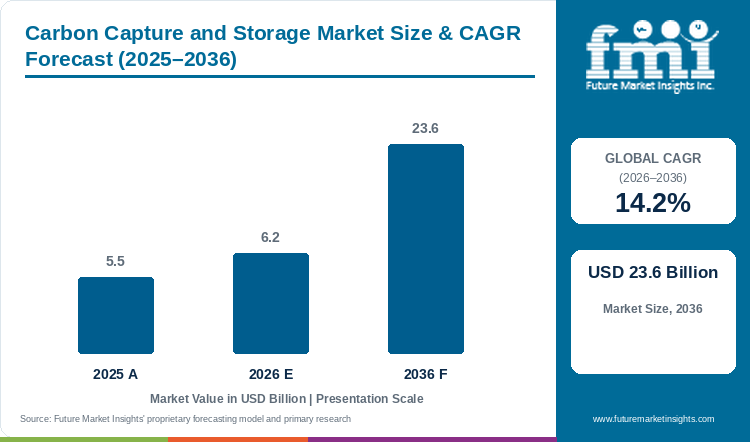
The Carbon Capture and Storage Market is projected to expand at a CAGR of 14.2% between 2026 and 2036. Market value rises from USD 5.5 billion in 2025 to USD 6.2 billion in 2026 and USD 23.6 billion by 2036. [1]
The carbon capture and storage market was valued at USD 5.5 billion in 2025. It reaches USD 6.2 billion in 2026 and is forecast at USD 23.6 billion by 2036. Post-combustion capture holds 48.0% of technology demand, while Oil and Gas accounts for 42.0% by end-use industry. Project development connects capture equipment at an emission source with transport infrastructure and a suitable permanent storage destination. The market is forecast to expand at 14.2% CAGR over 2026 to 2036. CCS involves capturing carbon dioxide, transporting it and storing it in geological formations. An industrial project needs all three stages to work together. Capture technology must fit the emission stream and the host plant’s energy requirements; transport needs a dependable route; storage requires a characterized site and operating permissions. Revenue opportunities arise across equipment, engineering, infrastructure and the services supporting those activities. [1, 2] The first stored carbon dioxide at Northern Lights in August 2025 demonstrates a working connection between an industrial source and a storage service. CO2 from Heidelberg Materials’ Brevik cement plant moved by vessel to the Norwegian receiving facilities before injection beneath the seabed. The chain involves different responsibilities and operating locations. For other industrial customers, this model creates a route to storage beyond the boundaries of their own facility, provided that transport, capacity and delivery terms can be agreed. [3]
Key Market Trends & Insights
- Post-combustion Capture holds 48.0% of technology demand in 2026. [1]
- Oil and Gas accounts for 42.0% of end-use industry demand. [1]
- Shared transport and storage infrastructure can connect several industrial emitters.
- Capture technology, storage access, permitting and coordination influence project delivery.
Regional Highlights
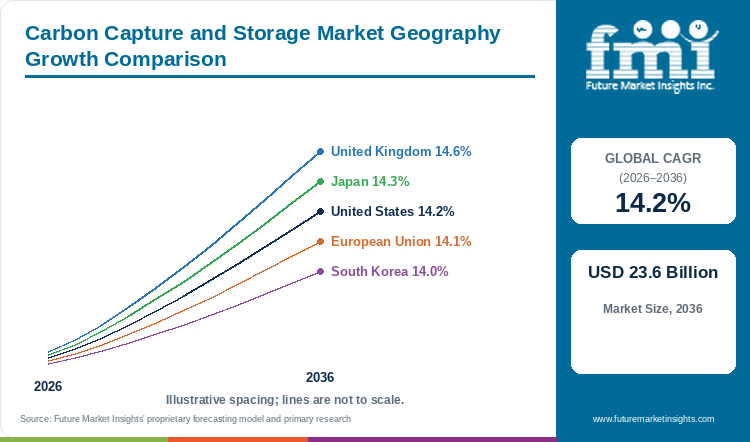
- United Kingdom has the fastest profiled CAGR at 14.6%, followed by Japan at 14.3%, over 2026 to 2036. [1]
- Other profiled outlooks: United States (14.2%), European Union (14.1%), South Korea (14.0%). [1]
Market Size & Forecast
Table 1: Market Size and Forecast for the Carbon Capture and Storage Market (USD billion and percentage), 2025 to 2036
| Metric | Value |
|---|---|
| 2025 Market Size | USD 5.5 billion |
| Estimated Market Size in 2026 | USD 6.2 billion |
| Projected Market Size by 2036 | USD 23.6 billion |
| CAGR, 2026 to 2036 | 14.2% |
| Added Revenue, 2026 to 2036 | USD 17.4 billion |
| Market Expansion Multiple | 3.8x |
CCS projects need capture equipment, a transport route and an available storage destination. Each part has its own operating requirements and responsibilities. Industrial buyers assess the emission stream and host plant alongside the timing, quality specifications and contractual arrangements for moving and storing the captured carbon dioxide. [3, 5, 7, 8, 11]
Capture Deployment and Storage Connections
Operating milestones and manufacturing investments show how capture facilities connect with transport and permanent storage services.
Table 2: Industry Indicators for the Carbon Capture and Storage Market, 2025 to 2026
| Indicator | Data Point | Why It Matters | Source |
|---|---|---|---|
| First Northern Lights storage | Northern Lights stored its first CO2 volumes in August 2025 after vessel transport from the Brevik cement plant. | Demonstrates a working industrial capture-to-storage connection. | [3] |
| Industrial capture deployment | Carbon Clean announced completion of its CycloneCC industrial deployment in April 2025. | Provides an example of capture equipment operating at an industrial site. | [9] |
| Capture-filter manufacturing | Svante completed commissioning of its Redwood capture-filter manufacturing facility in 2025. | Adds manufacturing capacity supporting capture-system delivery. | [10] |
Analyst Perspective
A capture plant needs a destination for its output. Equipment selection and a storage agreement therefore belong in the same project discussion. The emitter’s operating pattern, transport route and injection schedule must fit together before the installation can become a dependable part of industrial production.
- Nikhil Kaitwade, Principal Consultant, Future Market Insights.
How is the carbon capture and storage market segmented?
The market is segmented by Technology, End-use Industry, Product and Application. [1]
By Technology: Post-combustion, Pre-combustion, Oxy-fuel Combustion.
By End-use Industry: Oil and Gas, Coal and Biomass Power Plant, Iron and Steel, Chemicals, Others.
By Product: Carbon Capture Systems, Carbon Transport Systems, Carbon Storage Solutions, Carbon Utilization Solutions with Permanent Retention.
By Application: Power Generation, Oil and Gas, Cement Production, Iron and Steel, Chemical and Petrochemical.
By Region: North America, Latin America, Western Europe, Eastern Europe, East Asia, South Asia and Pacific, Middle East and Africa.
Technology separates post-combustion, pre-combustion and oxy-fuel capture. End-use industries include oil and gas, power, iron and steel, and chemicals. Product coverage follows capture, transport and storage equipment and solutions. Applications distinguish the industrial activity served, including cement production. Permanent retention defines the storage requirement: offshore projects use geological formations beneath the seabed, while utilization belongs within this assessment only where the carbon remains permanently stored. These distinctions keep the project’s capture and storage purpose clear. [1, 4]
Why does post-combustion capture lead?
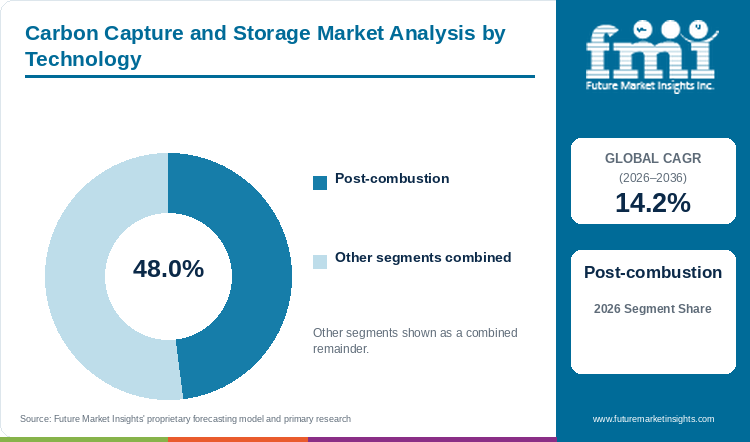
Post-combustion Capture holds 48.0% of technology demand in 2026. Suppliers adapt treatment of the gas stream to the host facility’s energy, space and maintenance requirements. [1, 5, 6]
Table 3: Technology Share for the Carbon Capture and Storage Market (percentage share), 2026
| Technology | Share (2026) |
|---|---|
| Post-combustion Capture | 48.0% |
| Other Segments Combined | 52.0% |
| Total | 100.0% |
Table 4: Technology Focus and Market Growth for the Carbon Capture and Storage Market, 2026 to 2036
| Metric | Value |
|---|---|
| Global CAGR (2026 to 2036) | 14.2% |
| Leading Segment | Post-combustion Capture |
Post-combustion technology treats the gas stream after combustion or industrial processing. It can provide a route for existing facilities to add capture, although each project still needs an assessment of the stream, energy supply and space available. Mitsubishi Heavy Industries documents its KM CDR and Advanced KM CDR processes for different flue-gas sources. SLB Capturi’s Brevik installation provides a cement-sector example. Suppliers need to translate the technology into a design that works with the host plant’s production and maintenance arrangements. [5, 6]
- Post-combustion capture holds 48.0% of technology demand in 2026. [1]
- MHI provides capture processes developed for a range of industrial flue-gas sources. [5]
What supports Oil and Gas demand?
Oil and Gas accounts for 42.0% of end-use industry demand in 2026. Gas handling, pipelines and subsurface development support transport and storage services for industrial customers. [1, 7, 8]
Oil and gas operators bring experience in gas handling, pipelines and subsurface development to CCS projects. Their role can extend from an individual facility into a transport and storage service for industrial customers. ExxonMobil began operating its commercial CCS connection with CF Industries in Louisiana in 2025. Chevron’s Bayou Bend project is developing another transport and storage route along the Gulf Coast. These activities create demand for site assessment and infrastructure as well as capture equipment at the emission source. [7, 8]
- Oil and Gas accounts for 42.0% of end-use industry demand in 2026. [1]
- ExxonMobil documents transport and storage operations for CF Industries’ Donaldsonville complex. [7]
How do capture systems shape the product offer?
The capture system must handle the actual gas stream while fitting the facility’s operating requirements. Equipment design can involve pretreatment, separation, regeneration and conditioning of the captured CO2. Carbon Clean’s CycloneCC deployment at Fertiglobe’s Abu Dhabi plant illustrates a modular approach, while Svante manufactures capture filters for its technology platform. These suppliers address different components of the process. A buyer must consider the complete installation and the interfaces with the plant and downstream transport system. [9, 10]
- Carbon capture systems form a core product category. [1]
- Carbon Clean announced completion of the CycloneCC industrial deployment in April 2025. [9]
What drives and constrains CCS demand?
Industrial emissions programs and policy support create demand; capital requirements and coordination across the chain constrain delivery; shared infrastructure creates opportunities.
- Driver: Industrial facilities seek routes to capture and permanently store CO2 from their operations.
- Restraint: Capture, transport and storage must progress together through design, permitting and financing.
- Opportunity: Hub infrastructure can offer storage access to several industrial customers.
Driver. Government programs give CCS projects a policy and commercial framework. The European Union’s industrial-carbon-management work includes a target for annual injection capacity by 2030, while U.S. tax rules define the carbon-oxide sequestration credit. Such arrangements affect project development alongside the emitter’s own industrial plan. They create requirements for documentation and qualifying operation, making the capture and storage pathway part of the business case rather than simply an equipment purchase. [12, 13]
Restraint. The project chain can involve an industrial emitter, a capture supplier, a pipeline or shipping operator and a storage developer. A delay at one stage affects the others. Site characterization, access agreements and commissioning plans therefore need to be coordinated before the facility begins regular capture. The Global CCS Institute’s 2025 status report distinguishes operational projects from construction and development pipelines. That distinction matters commercially because announced capacity becomes a service only when the facilities and their connections enter operation. [2]
Opportunity. A hub can pool transport and storage infrastructure around several emission sources. The U.K. cluster framework and Northern Lights illustrate different routes to a shared service. A prospective customer needs to understand the network’s timing, capacity and acceptance requirements before committing to capture. Providers that can coordinate these interfaces have a role across the project cycle, from assessing the initial emission stream to maintaining a reliable transfer of CO2 during operation. [3, 11]
Which country and market-group CAGRs are profiled?
The outlook covers 2026 to 2036. [1]
| Country or Market Group | CAGR 2026 to 2036 |
|---|---|
| United Kingdom | 14.6% |
| Japan | 14.3% |
| United States | 14.2% |
| European Union | 14.1% |
| South Korea | 14.0% |
How do the geographic opportunities compare?
The five profiled growth rates are closely grouped. The United Kingdom’s outlook reflects cluster infrastructure, Japan’s programs link capture with domestic and overseas storage planning, and the United States combines industrial customers with subsurface and pipeline capabilities. European Union policy addresses storage capacity across member states. South Korea brings industrial engineering and equipment partnerships into the market. Each setting creates a different coordination task between the emission source, technology supplier and storage destination. [1]
United Kingdom: Cluster networks provide a route for several industrial emitters to access storage. Japan: Public project support covers the chain from capture through transport and storage. United States: Industrial customers can connect with transport and geological-storage providers. European Union: Injection-capacity requirements and storage regulation support infrastructure planning. South Korea: Engineering partnerships contribute to modular capture-system development.
Country-wise Analysis
United Kingdom
HyNet’s transport and storage network reached financial close in April 2025, following the East Coast Cluster’s progress. The U.K. program creates shared infrastructure to which industrial projects can connect. At 14.6% CAGR, the country has the fastest profiled growth rate through 2036. For an emitter, network development needs to align with capture-plant readiness and the required CO2 quality. The buyer also needs to understand how capacity is allocated and how operating changes at its facility will affect delivery. Those agreements turn access to a regional network into a usable storage route. [1, 11]
Japan
JOGMEC’s advanced CCS support covers the value chain from separation and capture to transport and storage, with domestic and overseas projects in its portfolio. That creates a context in which shipping and cross-border coordination can be as relevant as capture equipment. Japan is forecast at 14.3% CAGR over 2026 to 2036. A project needs a receiving destination and clear responsibilities along the route. Suppliers with process engineering and transport-system capabilities can contribute to these plans, while the customer must connect them with the operating pattern of the industrial emission source. [1, 14]
United States
ExxonMobil’s 2025 startup with CF Industries provides a commercial example of an industrial customer using a separate transport and storage operator. Chevron’s Bayou Bend work adds a developing Gulf Coast infrastructure route. The U.S. outlook is 14.2% CAGR through 2036. The opportunity depends on characterization and permissions for the storage site as well as access from the source. Tax-credit requirements form another part of the project framework. Developers therefore need to coordinate technical design, operating evidence and commercial agreements across the chain. [1, 7, 8, 13]
European Union
The Net-Zero Industry Act sets an EU objective of at least 50 million tonnes of annual CO2 injection capacity by 2030. The Commission’s framework also connects storage development with the geological-storage directive. These requirements address the availability of destinations for captured carbon. The EU market-group forecast is 14.1% CAGR over 2026 to 2036. Industrial customers still need access to those sites through suitable transport and commercial arrangements. Equipment suppliers can support capture at the facility, while infrastructure developers must make the wider route available on a workable schedule. [1, 12]
South Korea
Svante and Samsung E&A signed a joint-development agreement in May 2025 for modular carbon-capture plants. The partnership combines capture technology with engineering and digital delivery capabilities, showing a role for Korean industrial suppliers within the CCS chain. South Korea’s forecast CAGR is 14.0% through 2036. A modular design can support repeatable fabrication, but the installation still has to fit the customer’s gas stream and energy supply. The project also needs a transport and storage route, which remains a separate requirement from the design of the capture equipment. [1, 15]
Who participates in the CCS market?
Notable participants include ExxonMobil, Chevron, Shell, TotalEnergies, Mitsubishi Heavy Industries, SLB Capturi, Carbon Clean and Svante.
Energy companies and technology suppliers perform different roles. ExxonMobil and Chevron develop transport and storage services; Shell and TotalEnergies participate in projects such as Northern Lights. MHI, SLB Capturi and Carbon Clean provide industrial capture technology and engineering. Svante supplies a filter-based capture platform. Direct-air-capture providers including Climeworks address a related carbon-removal pathway that also needs permanent storage, while the core industrial taxonomy in this report follows point-source capture. [3, 5, 6, 7, 8, 9, 10, 16]
- Transport and storage development: ExxonMobil, Chevron, Shell and TotalEnergies.
- Industrial capture technology: Mitsubishi Heavy Industries, SLB Capturi, Carbon Clean and Svante.
- Related direct-air-capture technology: Climeworks and Zero Carbon Systems, which acquired Global Thermostat. [16, 17]
Competitive Benchmarking: Carbon Capture and Storage Market
| Provider | Documented Role | Project or Technology | Chain Position | Commercial Context |
|---|---|---|---|---|
| ExxonMobil | Industrial transport and storage | CF Industries connection | Transport and geological storage | Industrial customer services |
| Chevron | CCS infrastructure development | Bayou Bend | Transport and storage | Gulf Coast project development |
| Shell | CCS project participant | Northern Lights and Quest | Capture and storage operations | Industrial emissions programs |
| TotalEnergies | Transport and storage participant | Northern Lights | Receiving and geological storage | Shared storage services |
| Mitsubishi Heavy Industries | Capture technology and engineering | KM CDR processes | Industrial CO2 separation | New facilities and retrofit projects |
| SLB Capturi | Capture plant delivery | Brevik and modular capture designs | Capture equipment and engineering | Industrial project implementation |
| Carbon Clean | Modular capture technology | CycloneCC | Industrial CO2 capture | Site-specific modular installations |
| Svante | Capture technology and filters | Redwood manufacturing and modular partnerships | Capture components and system design | Industrial equipment supply |
Key Developments in Carbon Capture and Storage
- Northern Lights stored its first CO2 volumes in August 2025 after vessel transport from Heidelberg Materials’ Brevik cement plant. The milestone connects an operating industrial capture facility with the shared storage service. [3]
- Carbon Clean announced the successful completion of its CycloneCC industrial deployment at Fertiglobe in Abu Dhabi in April 2025. [9]
- Svante completed commissioning of its Redwood capture-filter manufacturing facility in 2025 and signed a modular-plant development agreement with Samsung E&A in May. [10, 15]
Key Players in Carbon Capture and Storage
Energy and Infrastructure Companies
- ExxonMobil
- Chevron Corporation
- Shell plc
- TotalEnergies
Industrial Capture and Engineering
- Mitsubishi Heavy Industries
- SLB Capturi, combining SLB and Aker Carbon Capture technologies
- Carbon Clean
- Svante Inc.
Related Atmospheric Carbon Removal
- Climeworks
- Zero Carbon Systems / Global Thermostat
Carbon Capture and Storage Market - Report Scope
| Coverage Field | Report Scope |
|---|---|
| Market Breakdown | Technology; End-use Industry; Product; Application |
| Quantitative Units | Revenue in USD billion |
| Market Definition | Technologies, systems and services for capturing industrial and power-sector CO2, transporting it and retaining it permanently in geological formations. Includes offshore geological storage and utilization pathways with permanent retention. |
| Exclusions | Carbon trading administration; nature-based removal; utilization without permanent retention; open-water CO2 disposal. |
| Regions Covered | North America; Latin America; Western Europe; Eastern Europe; East Asia; South Asia and Pacific; Middle East and Africa |
| Geographic Profiles | United Kingdom; Japan; United States; European Union; South Korea |
| Competitive Coverage | Industrial capture technology, engineering, CO2 transport and geological-storage services |
| 2025 Market Value | USD 5.5 billion |
| 2026 Market Value | USD 6.2 billion |
| 2036 Forecast Value | USD 23.6 billion |
| CAGR | 14.2% |
| Forecast Period | 2026 to 2036 |
Carbon Capture and Storage Market - Research Framework
| Research Area | Coverage |
|---|---|
| Market Coverage | Point-source industrial capture and connected permanent-storage systems |
| Industry Evidence | Operating project milestones, technology portfolios, official infrastructure programs and storage frameworks |
| Geographic Analysis | Industrial sources, infrastructure access, project support and cross-border transport |
| Competitive Analysis | Capture process, engineering delivery, transport capability and storage services |
Carbon Capture and Storage Market by Segments
Carbon Capture and Storage (CCS) Market segmented by Technology:
- Post-combustion
- Pre-combustion
- Oxy-fuel Combustion
Carbon Capture and Storage (CCS) Market segmented by End-use Industry:
- Oil and Gas
- Coal and Biomass Power Plant
- Iron and Steel
- Chemicals
- Others
Carbon Capture and Storage (CCS) Market segmented by Product:
- Carbon Capture Systems
- Post-combustion Capture
- Pre-combustion Capture
- Oxy-fuel Combustion Capture
- Carbon Transport Systems
- Pipeline Transport
- Ship Transport
- Carbon Storage Solutions
- Geological Storage
- Offshore Geological Storage
- Carbon Utilization Solutions with Permanent Retention
- Enhanced Oil Recovery with Geological Storage
- Chemical Conversion with Permanent Retention
- Mineralization
- Post-combustion Capture
Carbon Capture and Storage (CCS) Market segmented by Application:
- Power Generation
- Oil and Gas
- Cement Production
- Iron and Steel
- Chemical and Petrochemical
Carbon Capture and Storage Market by Region
- North America
- United States
- Canada
- Mexico
- Latin America
- Brazil
- Chile
- Rest of Latin America
- Western Europe
- Germany
- United Kingdom
- Italy
- Spain
- France
- Nordics
- Benelux
- Rest of Western Europe
- Eastern Europe
- Russia
- Poland
- Hungary
- Balkan and Baltic Countries
- Rest of Eastern Europe
- East Asia
- China
- Japan
- South Korea
- South Asia and Pacific
- India
- ASEAN
- Australia and New Zealand
- Rest of South Asia and Pacific
- Middle East and Africa
- Saudi Arabia
- Other GCC Countries
- Türkiye
- South Africa
- Other African Union Countries
- Rest of Middle East and Africa
Research Sources and Bibliography
- [1] Future Market Insights. Carbon Capture and Storage Market.
- [2] Global CCS Institute (2025). Global Status of CCS 2025.
- [3] Equinor (2025). Northern Lights storage.
- International Maritime Organization. Sub-seabed geological storage.
- [5] Mitsubishi Heavy Industries. CO2 Capture Process.
- SLB (2025). Second-Quarter Results and Brevik Capture Facility Opening.
- [7] ExxonMobil. 2025 Commercial CCS Operations with CF Industries.
- Chevron (2025, June 30). Bayou Bend Transport and Storage Project.
- [9] Carbon Clean (2025, April 3). CycloneCC deployment.
- [10] Svante (2025). Redwood Capture-Filter Manufacturing Facility.
- Department for Energy Security and Net Zero. U.K. CCUS Cluster Programme.
- European Commission. Industrial Carbon Management Legislative Framework.
- Internal Revenue Service (2025, December). Instructions for Form 8933.
- JOGMEC. Advanced CCS Project Support.
- [15] Svante (2025, May 13). Samsung E&A Modular Capture-Plant Agreement.
- Climeworks. Direct Air Capture and Storage Technology.
- National Energy Technology Laboratory (2024, September). Carbon Capture Newsletter.
- SLB Capturi (2024, June 14). SLB and Aker Carbon Capture Joint Venture.
This Report Answers
- What was the CCS market value in 2025?
- How large is the market in 2026 and what is forecast for 2036?
- Why does post-combustion capture lead technology demand?
- What supports the Oil and Gas end-use segment?
- How do shared transport and storage networks serve industrial emitters?
- Which country and market-group growth rates are profiled?
- Which suppliers deliver capture technology and storage services?
- What connects an industrial capture facility with permanent storage?
Frequently Asked Questions
How big is the carbon capture and storage market in 2026?
The market is valued at USD 6.2 billion in 2026, following USD 5.5 billion in 2025. [1]
What is the CCS market forecast for 2036?
The market is forecast at USD 23.6 billion by 2036 at 14.2% CAGR over 2026 to 2036. [1]
Which capture technology leads?
Post-combustion capture holds 48.0% of technology demand in 2026. [1]
Which end-use industry leads?
Oil and Gas accounts for 42.0% of end-use industry demand. [1]
Which profiled market grows fastest?
The United Kingdom leads at 14.6% CAGR, followed by Japan at 14.3%, over 2026 to 2036. [1]
What does permanent storage involve?
Captured CO2 is retained in a characterized geological formation, including suitable formations beneath the seabed, within the relevant storage framework.
Preview the report firsthand - request a free sample
Get SampleGet the brochure for pricing and purchase details.
Get PDFTable of Content
- Key Takeaways
- Market Size and CAGR
- Top Growth Driver
- Fastest Growing Segment
- Leading Region
- Key Companies
- Emerging Opportunities
- Executive Summary
- Global Market Outlook
- Demand-side Trends
- Supply-side Trends
- Technology Roadmap Analysis
- Analysis and Recommendations
- Analyst Perspective (What is happening? Why now? What should investors know?)
- Key Questions Answered
- How large is the market?
- What is the CAGR?
- What are key trends?
- Which region dominates?
- Who are the leaders?
- Market Overview
- Market Coverage / Taxonomy
- Market Definition / Scope / Limitations
- Research Methodology
- Chapter Orientation
- Analytical Lens and Working Hypotheses
- Market Structure, Signals, and Trend Drivers
- Benchmarking and Cross-market Comparability
- Market Sizing, Forecasting, and Opportunity Mapping
- Research Design and Evidence Framework
- Desk Research Programme (Secondary Evidence)
- Expert Input and Fieldwork (Primary Evidence)
- Tooling, Models, and Reference Databases
- Data Engineering and Model Build
- Quality Assurance and Audit Trail
- Market Background
- Market Dynamics (Drivers, Restraints, Opportunity, Trends)
- Scenario Forecast (Optimistic, Likely, Conservative)
- Impact Analysis
- AI Impact
- Sustainability Impact
- Regulatory Impact
- Technology Impact
- Consumer / Buyer Analysis
- Purchase Drivers
- Adoption Barriers
- Buyer Journey
- Opportunity Map Analysis
- Product Life Cycle Analysis
- Supply Chain Analysis
- Investment Feasibility Matrix
- Value Chain Analysis
- PESTLE and Porter's Analysis
- Regulatory Landscape
- Regional Parent Market Outlook
- Production and Consumption Statistics
- Import and Export Statistics
- Global Market Analysis and Forecast, 2021 to 2036
- Historical Market Size Value (USD Billion) Analysis, 2021 to 2025
- Current and Future Market Size Value (USD Billion) Projections, 2026 to 2036
- Y-o-Y Growth Trend Analysis
- Absolute $ Opportunity Analysis
- Global Market Pricing Analysis, 2021 to 2036
- Global Market Analysis and Forecast, By Technology, 2021 to 2036
- Introduction / Key Findings
- Historical Market Size Value (USD Billion) Analysis By Technology, 2021 to 2025
- Current and Future Market Size Value (USD Billion) Analysis and Forecast By Technology, 2026 to 2036
- Post-combustion
- Pre-combustion
- Oxy-fuel Combustion
- Y-o-Y Growth Trend Analysis By Technology, 2021 to 2025
- Absolute $ Opportunity Analysis By Technology, 2026 to 2036
- Global Market Analysis and Forecast, By End-use Industry, 2021 to 2036
- Introduction / Key Findings
- Historical Market Size Value (USD Billion) Analysis By End-use Industry, 2021 to 2025
- Current and Future Market Size Value (USD Billion) Analysis and Forecast By End-use Industry, 2026 to 2036
- Oil and Gas
- Coal and Biomass Power Plant
- Iron and Steel
- Chemicals
- Others
- Y-o-Y Growth Trend Analysis By End-use Industry, 2021 to 2025
- Absolute $ Opportunity Analysis By End-use Industry, 2026 to 2036
- Global Market Analysis and Forecast, By Product, 2021 to 2036
- Introduction / Key Findings
- Historical Market Size Value (USD Billion) Analysis By Product, 2021 to 2025
- Current and Future Market Size Value (USD Billion) Analysis and Forecast By Product, 2026 to 2036
- Carbon Capture Systems
- Post-combustion Capture
- Pre-combustion Capture
- Oxy-fuel Combustion Capture
- Carbon Transport Systems
- Pipeline Transport
- Ship Transport
- Carbon Storage Solutions
- Geological Storage
- Offshore Geological Storage
- Carbon Utilization Solutions with Permanent Retention
- Enhanced Oil Recovery with Geological Storage
- Chemical Conversion with Permanent Retention
- Mineralization
- Y-o-Y Growth Trend Analysis By Product, 2021 to 2025
- Absolute $ Opportunity Analysis By Product, 2026 to 2036
- Global Market Analysis and Forecast, By Application, 2021 to 2036
- Introduction / Key Findings
- Historical Market Size Value (USD Billion) Analysis By Application, 2021 to 2025
- Current and Future Market Size Value (USD Billion) Analysis and Forecast By Application, 2026 to 2036
- Power Generation
- Oil and Gas
- Cement Production
- Iron and Steel
- Chemical and Petrochemical
- Y-o-Y Growth Trend Analysis By Application, 2021 to 2025
- Absolute $ Opportunity Analysis By Application, 2026 to 2036
- Global Market Analysis and Forecast, By Region, 2021 to 2036
- Introduction
- Historical Market Size Value (USD Billion) Analysis By Region, 2021 to 2025
- Current Market Size Value (USD Billion) Analysis and Forecast By Region, 2026 to 2036
- North America
- Latin America
- Western Europe
- Eastern Europe
- East Asia
- South Asia and Pacific
- Middle East and Africa
- Market Attractiveness Analysis By Region
- North America Market Analysis and Forecast, By Country, 2021 to 2036
- Historical Market Size Value (USD Billion) Trend Analysis By Market Taxonomy, 2021 to 2025
- Market Size Value (USD Billion) Forecast By Market Taxonomy, 2026 to 2036
- By Country
- United States
- Canada
- Mexico
- By Technology
- By End-use Industry
- By Product
- By Application
- By Country
- Market Attractiveness Analysis
- By Country
- By Technology
- By End-use Industry
- By Product
- By Application
- Key Takeaways
- Latin America Market Analysis and Forecast, By Country
- Historical Market Size Value (USD Billion) Trend Analysis By Market Taxonomy, 2021 to 2025
- Market Size Value (USD Billion) Forecast By Market Taxonomy, 2026 to 2036
- By Country
- Brazil
- Chile
- Rest of Latin America
- By Technology
- By End-use Industry
- By Product
- By Application
- By Country
- Market Attractiveness Analysis
- By Country
- By Technology
- By End-use Industry
- By Product
- By Application
- Key Takeaways
- Western Europe Market Analysis and Forecast, By Country
- Historical Market Size Value (USD Billion) Trend Analysis By Market Taxonomy, 2021 to 2025
- Market Size Value (USD Billion) Forecast By Market Taxonomy, 2026 to 2036
- By Country
- Germany
- United Kingdom
- Italy
- Spain
- France
- Nordics
- Benelux
- Rest of Western Europe
- By Technology
- By End-use Industry
- By Product
- By Application
- By Country
- Market Attractiveness Analysis
- By Country
- By Technology
- By End-use Industry
- By Product
- By Application
- Key Takeaways
- Eastern Europe Market Analysis and Forecast, By Country
- Historical Market Size Value (USD Billion) Trend Analysis By Market Taxonomy, 2021 to 2025
- Market Size Value (USD Billion) Forecast By Market Taxonomy, 2026 to 2036
- By Country
- Russia
- Poland
- Hungary
- Balkan and Baltic Countries
- Rest of Eastern Europe
- By Technology
- By End-use Industry
- By Product
- By Application
- By Country
- Market Attractiveness Analysis
- By Country
- By Technology
- By End-use Industry
- By Product
- By Application
- Key Takeaways
- East Asia Market Analysis and Forecast, By Country
- Historical Market Size Value (USD Billion) Trend Analysis By Market Taxonomy, 2021 to 2025
- Market Size Value (USD Billion) Forecast By Market Taxonomy, 2026 to 2036
- By Country
- China
- Japan
- South Korea
- By Technology
- By End-use Industry
- By Product
- By Application
- By Country
- Market Attractiveness Analysis
- By Country
- By Technology
- By End-use Industry
- By Product
- By Application
- Key Takeaways
- South Asia and Pacific Market Analysis and Forecast, By Country
- Historical Market Size Value (USD Billion) Trend Analysis By Market Taxonomy, 2021 to 2025
- Market Size Value (USD Billion) Forecast By Market Taxonomy, 2026 to 2036
- By Country
- India
- ASEAN
- Australia and New Zealand
- Rest of South Asia and Pacific
- By Technology
- By End-use Industry
- By Product
- By Application
- By Country
- Market Attractiveness Analysis
- By Country
- By Technology
- By End-use Industry
- By Product
- By Application
- Key Takeaways
- Middle East and Africa Market Analysis and Forecast, By Country
- Historical Market Size Value (USD Billion) Trend Analysis By Market Taxonomy, 2021 to 2025
- Market Size Value (USD Billion) Forecast By Market Taxonomy, 2026 to 2036
- By Country
- Saudi Arabia
- Other GCC Countries
- Türkiye
- South Africa
- Other African Union Countries
- Rest of Middle East and Africa
- By Technology
- By End-use Industry
- By Product
- By Application
- By Country
- Market Attractiveness Analysis
- By Country
- By Technology
- By End-use Industry
- By Product
- By Application
- Key Takeaways
- Key Countries Market Analysis
- United States
- Pricing Analysis
- Market Share Analysis, 2025
- By Technology
- By End-use Industry
- By Product
- By Application
- Canada
- Pricing Analysis
- Market Share Analysis, 2025
- By Technology
- By End-use Industry
- By Product
- By Application
- Mexico
- Pricing Analysis
- Market Share Analysis, 2025
- By Technology
- By End-use Industry
- By Product
- By Application
- Brazil
- Pricing Analysis
- Market Share Analysis, 2025
- By Technology
- By End-use Industry
- By Product
- By Application
- Chile
- Pricing Analysis
- Market Share Analysis, 2025
- By Technology
- By End-use Industry
- By Product
- By Application
- Germany
- Pricing Analysis
- Market Share Analysis, 2025
- By Technology
- By End-use Industry
- By Product
- By Application
- United Kingdom
- Pricing Analysis
- Market Share Analysis, 2025
- By Technology
- By End-use Industry
- By Product
- By Application
- Italy
- Pricing Analysis
- Market Share Analysis, 2025
- By Technology
- By End-use Industry
- By Product
- By Application
- Spain
- Pricing Analysis
- Market Share Analysis, 2025
- By Technology
- By End-use Industry
- By Product
- By Application
- France
- Pricing Analysis
- Market Share Analysis, 2025
- By Technology
- By End-use Industry
- By Product
- By Application
- India
- Pricing Analysis
- Market Share Analysis, 2025
- By Technology
- By End-use Industry
- By Product
- By Application
- ASEAN
- Pricing Analysis
- Market Share Analysis, 2025
- By Technology
- By End-use Industry
- By Product
- By Application
- Australia and New Zealand
- Pricing Analysis
- Market Share Analysis, 2025
- By Technology
- By End-use Industry
- By Product
- By Application
- China
- Pricing Analysis
- Market Share Analysis, 2025
- By Technology
- By End-use Industry
- By Product
- By Application
- Japan
- Pricing Analysis
- Market Share Analysis, 2025
- By Technology
- By End-use Industry
- By Product
- By Application
- South Korea
- Pricing Analysis
- Market Share Analysis, 2025
- By Technology
- By End-use Industry
- By Product
- By Application
- Russia
- Pricing Analysis
- Market Share Analysis, 2025
- By Technology
- By End-use Industry
- By Product
- By Application
- Poland
- Pricing Analysis
- Market Share Analysis, 2025
- By Technology
- By End-use Industry
- By Product
- By Application
- Hungary
- Pricing Analysis
- Market Share Analysis, 2025
- By Technology
- By End-use Industry
- By Product
- By Application
- Türkiye
- Pricing Analysis
- Market Share Analysis, 2025
- By Technology
- By End-use Industry
- By Product
- By Application
- South Africa
- Pricing Analysis
- Market Share Analysis, 2025
- By Technology
- By End-use Industry
- By Product
- By Application
- European Union
- Pricing Analysis
- Market Share Analysis, 2025
- By Technology
- By End-use Industry
- By Product
- By Application
- United States
- Market Structure Analysis
- Competition Dashboard
- Competition Benchmarking
- Market Share Analysis of Top Players
- By Regional
- By Technology
- By End-use Industry
- By Product
- By Application
- Emerging Startups
- Innovation Benchmarking
- Competition Analysis
- Competition Deep Dive
- ExxonMobil
- Overview
- Product Portfolio
- Profitability by Market Segments
- Sales Footprint
- Strategy Overview
- Marketing Strategy
- Product Strategy
- Channel Strategy
- Chevron
- Shell
- TotalEnergies
- Mitsubishi Heavy Industries
- SLB Capturi
- Carbon Clean
- Svante
- Chevron Corporation
- Shell plc
- SLB Capturi, combining SLB and Aker Carbon Capture technologies
- Climeworks
- Zero Carbon Systems / Global Thermostat
- ExxonMobil
- Case Studies
- Success Stories
- Recent Developments
- Competition Deep Dive
- Assumptions & Acronyms Used


