

- Market Size (2026)
- USD 1.1 Bn
- Forecast (2036)
- USD 2.3 Bn
- CAGR (2026 to 2036)
- 7.4%
How big is Cathode Surface Coatings Market in 2026?
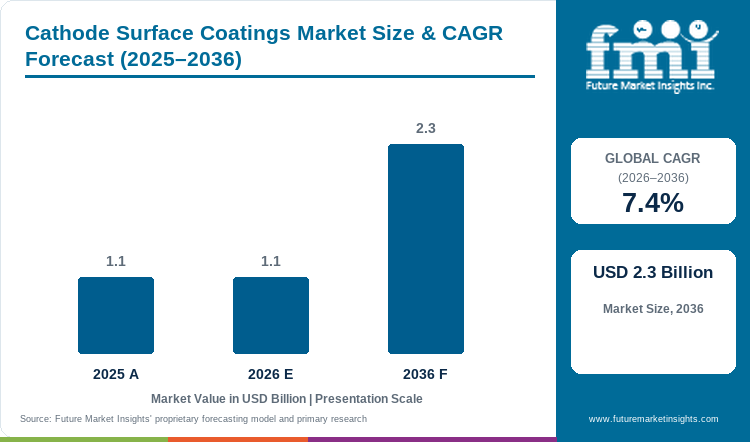
USD 1.1 Billion in 2026 and USD 2.3 Billion by 2036 at a 7.4% CAGR.
The Cathode Surface Coatings market stood at USD 1.1 Billion in 2025, is estimated at USD 1.1 Billion in 2026, and is forecast to reach USD 2.3 Billion by 2036 at a 7.4% CAGR from 2026 to 2036.
Demand is tied to the amount of cathode material entering high-energy battery production and to the severity of interface degradation that cell designers must manage. The International Energy Agency reported on May 20, 2026 that EV battery deployment reached 1.2 TWh in 2025.
That was almost 30% above 2024, with EVs accounting for more than 70% of total battery deployment. Surface coatings convert part of that volume expansion into specialized materials spending because cathode producers use thin protective layers to limit electrolyte-driven side reactions and preserve surface stability.
The requirement becomes more acute in nickel-rich cathodes where higher energy density raises sensitivity to interfacial deterioration. Buyers therefore compare coating chemistry and loading against cycle-life gains, thermal behavior and throughput. Coating choices interact with battery binders during electrode fabrication.
Purchasing shifts when a coating can be integrated into qualified cathode production without creating a new yield bottleneck or a costly reformulation step.
Country conditions shape that conversion differently. Suppliers in the USA face a policy-driven push for domestic battery materials while qualification economics remain sensitive to cell demand and sourcing rules.
Germany combines a large automotive customer base with local cathode production at Schwarzheide, so coating suppliers must meet industrial repeatability and European compliance expectations.
South Korea has a dense cathode and cell manufacturing ecosystem that rewards high-throughput processes able to support both high-nickel and lower-cost chemistries.
Japan places a stronger premium on material consistency and long qualification cycles as its 2026 battery strategy targets a larger domestic manufacturing base. Across these markets, interest becomes revenue only when the coating clears cell-level validation and can be reproduced at powder scale.
The decisive threshold is not laboratory performance alone. It is stable output at a cost and cycle time that a cathode producer can absorb.
Key Takeaways
- The market is estimated at USD 1.1 Billion in 2026 and is forecast to reach USD 2.3 Billion by 2036 at a 7.4% CAGR.
- Aluminum oxide leads the Coating Material category in 2026. High-nickel NCM leads the Cathode Type category in 2026.
- Wet chemical coating leads the Process category in 2026. EV batteries lead the End Use category in 2026. Cathode active material producers lead the Sales Channel category in 2026.
- Driver: Higher EV battery deployment and high-energy cathode use increase the volume of material that needs interface stabilization.
- Restraint: Coatings must justify added process cost and qualification time without creating yield, transport or recycling penalties.
- Opportunity: Multifunctional and ion-conducting coatings can address more demanding interfaces in next-generation high-nickel and solid-state systems. Canada has the highest profiled country CAGR at 7.1%, compared with Japan at 5.0%.
Analyst Perspective
Revenue capture will favor suppliers that make coating performance transferable from laboratory evidence to repeatable cathode production. The strongest offers link coating thickness and chemistry to a measurable cell-performance objective rather than selling a generic treatment.
- Nikhil Kaitwade, Principal Consultant, Future Market Insights
How is the Cathode Surface Coatings Market segmented?
The market is segmented by Coating Material, Cathode Type, Process, End Use, and Sales Channel.
Coating Material distinguishes the protective chemistry placed on the cathode surface and the interaction it is designed to control. Cathode Type separates the underlying active material because high-nickel, phosphate and manganese-rich systems present different interface risks.
Process captures how the coating is deposited and therefore determines thickness control, solvent use and production fit. End Use reflects the cell duty cycle and the value placed on energy density, power capability or long service life.
Sales Channel identifies who specifies the coating and where the commercial transaction sits in the cathode-to-cell manufacturing chain.
What makes Aluminum oxide central to the Coating Material category?
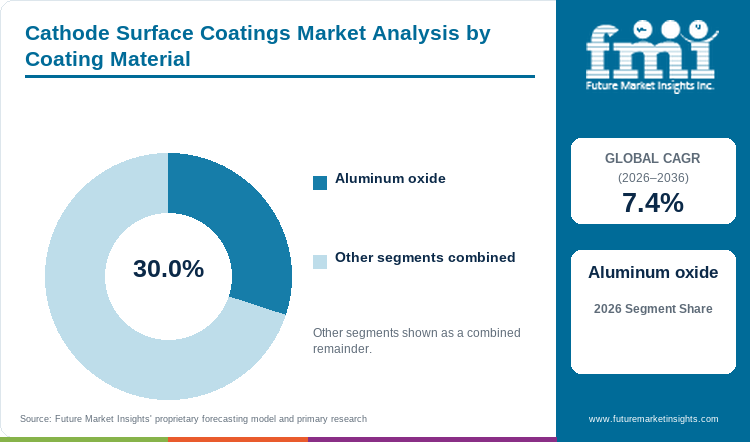
Aluminum oxide is a familiar surface barrier because it can suppress direct contact between reactive cathode surfaces and electrolyte while requiring only a thin added layer.
Its usefulness is broad enough to span several layered oxide cathodes, which gives formulators a well-understood starting point for balancing protection against lithium-ion transport.
Peer-reviewed literature published in 2024 describes aluminum-oxygen coatings as one of the established approaches for nickel-rich cathodes and notes that coating thickness must be controlled to avoid transport penalties.
That combination of technical familiarity and adjustable loading supports adoption in both development and scaled powder-treatment programs.
- Aluminum oxide represents 30.0% of the Coating Material category in 2026, supported by its established role as a thin protective oxide and by extensive process familiarity.
- On May 6, 2024, Small Methods published a review of nickel-rich cathode coatings that discussed Al-O based protective layers and the need to control coating thickness for electrochemical performance.
Why does High-nickel NCM lead the Cathode Type category?
High-nickel NCM concentrates the commercial need for surface stabilization because the chemistry is pursued for high capacity while its reactive surface becomes harder to manage as nickel content increases. Coatings can limit parasitic reactions and reduce the direct exposure of the active particle to electrolyte.
This makes surface engineering part of a broader package that also includes doping, particle design and formation control. The buying decision is therefore performance-specific. Cathode producers look for a layer that protects the interface without undermining power capability or adding excessive resistance.
That need is strongest in premium cells where energy-density gains justify additional material-engineering cost.
- High-nickel NCM accounts for 39.0% of the Cathode Type category in 2026 because its higher-energy design creates a pronounced requirement for surface and interface control.
- On August 29, 2025, BASF Battery Materials reported mass-produced ultra-high-nickel NCM cathode active material with a composite coating layer developed for semi-solid-state battery interfaces.
How does Wet chemical coating lead the Process category?
Wet chemical coating remains commercially attractive because it can distribute coating precursors around cathode particles through mixing steps that resemble established powder-processing operations. The route offers flexibility in composition and can be adapted to oxides, phosphates or mixed surface chemistries.
Its principal advantage is not maximum nanoscale precision. It is the ability to combine controllable chemistry with manufacturing throughput. A June 2026 Nature Reviews Clean Technology analysis described wet-chemical strategies as compositionally versatile and compatible with scalable manufacturing.
That positioning suits cathode producers that need a measurable surface effect without committing to high-vacuum or highly specialized deposition hardware.
- Wet chemical coating holds 36.0% of the Process category in 2026 because it combines formulation flexibility with a production route that can be integrated into scaled powder processing.
- On June 8, 2026, Nature Reviews Clean Technology identified wet-chemical coating as a manufacturing-compatible route while noting that industrial adoption must balance electrochemical benefit with cost and scalability.
What supports EV batteries as the leading End Use?
EV batteries create the largest commercial pull because automotive cells combine large cathode volumes with demanding lifetime and energy-density targets.
A coating has economic value when it helps the cathode retain performance through repeated cycling or reduces degradation at the voltage and temperature conditions required by the vehicle program.
This puts surface treatments inside a high-volume qualification system where even small material additions can represent substantial aggregate demand. The IEA reported that EVs accounted for more than 70% of global battery deployment in 2025.
That deployment base gives EV cathode programs the strongest near-term volume pathway for coating suppliers that clear automotive validation.
- EV batteries represent 58.0% of the End Use category in 2026 because automotive deployment combines the largest qualified cathode volumes with demanding durability requirements.
- On May 20, 2026, the IEA reported that EV battery deployment reached 1.2 TWh in 2025 and represented more than 70% of total global battery deployment.
What drives Cathode active material producers in the Sales Channel category?
Cathode active material producers sit at the most natural point for specifying a particle-level coating because the treatment must be integrated with precursor conversion, calcination and final powder finishing.
They can evaluate whether a surface layer changes residual lithium, moisture sensitivity, powder handling or downstream electrode behavior before material reaches the cell maker. This position also gives them control over repeatability across production lots.
Cell makers can still specify performance targets, while specialty chemical suppliers and process partners provide enabling inputs. Commercial conversion is strongest when the coating becomes part of the qualified cathode material rather than a separate downstream operation that adds another process owner.
- Cathode active material producers account for 44.0% of the Sales Channel category in 2026 because they control the powder-processing stage where surface treatment is most directly integrated and qualified.
- BASF Battery Materials reported on August 29, 2025 that it delivered mass-produced coated cathode active material directly into WELION New Energy semi-solid-state battery programs. The development illustrates the cathode-producer-to-cell-maker route.
What are the drivers, restraints, and opportunities in the Cathode Surface Coatings Market?
Rising battery throughput and harder cathode interfaces support demand, while qualification and scale economics constrain adoption and multifunctional coatings create the clearest expansion path.
- Driver: Higher EV battery deployment and high-energy cathode use increase the volume of material that needs interface stabilization.
- Restraint: Coatings must justify added process cost and qualification time without creating yield, transport or recycling penalties.
- Opportunity: Multifunctional and ion-conducting coatings can address more demanding interfaces in next-generation high-nickel and solid-state systems.
Battery throughput is the main demand multiplier. The IEA reported on May 20, 2026 that EV battery deployment grew almost 30% in 2025 to 1.2 TWh.
Each additional unit of qualified cathode material increases the addressable base for particle-level stabilization, but coatings are not purchased simply because battery volume rises. The spending response is strongest where cathode chemistry operates closer to thermal, voltage or lifetime limits.
High-nickel NCM is a clear example because producers pursue higher capacity while managing a more reactive interface. Suppliers gain revenue when they can tie the coating to a measurable cell objective and keep the treatment compatible with existing cathode throughput.
The principal restraint is the gap between laboratory benefit and factory economics. Nature Reviews Clean Technology stated on June 8, 2026 that industrial adoption depends on balancing electrochemical gains with process scalability and cost. Life-cycle impact and recycling compatibility also matter.
A coating may improve cycling in a controlled experiment yet still fail procurement if deposition is slow, precursor use is costly or thickness variation creates inconsistent lots. Qualification adds another barrier because a change at the particle surface can affect electrode processing and cell formation.
This friction delays purchase rather than eliminating demand. Suppliers must provide repeatable specifications and process controls that reduce the customer effort needed to validate the treatment at scale.
The opportunity is to move from passive surface barriers toward coatings that solve several interface problems at once. BASF reported on August 29, 2025 that an ultra-high-nickel NCM material for WELION used a composite coating layer to address the interface between cathode active material and solid electrolyte.
That development shows why future revenue can extend beyond conventional liquid-electrolyte protection. Ion-conducting layers and multifunctional architectures can combine chemical isolation with faster lithium transport or improved solid-solid contact.
Cathode material producers and specialist process firms are best placed to capture this opening when they can co-develop the layer with cell customers and prove that the added function survives mass-production tolerances.
Which country CAGRs are profiled in the Cathode Surface Coatings Market?
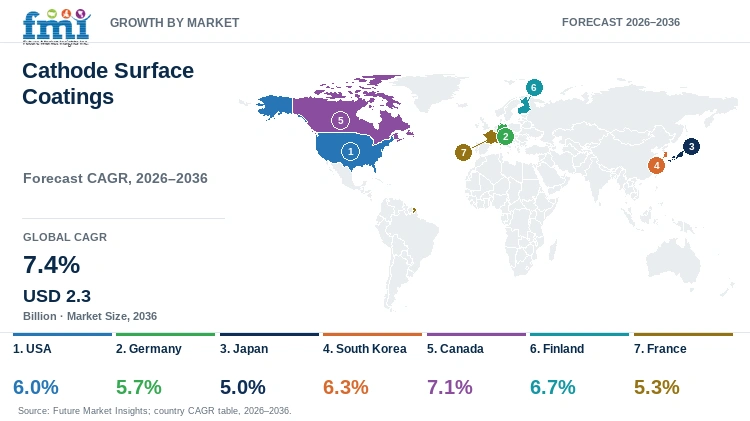
| Country | CAGR |
|---|---|
| USA | 6.0% |
| Germany | 5.7% |
| Japan | 5.0% |
| South Korea | 6.3% |
| Canada | 7.1% |
| Finland | 6.7% |
| France | 5.3% |
How do country-level CAGRs compare in the Cathode Surface Coatings Market?
The seven profiled countries span a 2.1-percentage-point range between Canada at 7.1% CAGR and Japan at 5.0% from 2026 to 2036. Canada and Finland form the upper growth band, supported by battery-material investment and industrial-policy incentives.
South Korea and the USA sit in a middle band where large battery programs coexist with qualification and demand uncertainty. Germany, France and Japan form a lower but still positive band. Their slower rates do not imply weak absolute opportunity.
These countries have established industrial users and demanding customer specifications that can support specialized coating value even when percentage growth is more measured.
- Canada at 7.1% and Finland at 6.7% are separated by 0.4 percentage points. Their commercial advantage is tied to new midstream investment where coating capability can be specified as capacity is built rather than retrofitted later.
- Finland at 6.7% and South Korea at 6.3% are also separated by 0.4 percentage points. South Korea offers denser incumbent cathode manufacturing, while Finland offers a smaller but policy-supported route into European battery materials projects.
- South Korea at 6.3% and the USA at 6.0% differ by 0.3 percentage points. Suppliers in both markets need local process support, but programs in the USA place greater emphasis on domestic supply-chain qualification and project economics.
- The USA at 6.0% sits above Germany at 5.7%, France at 5.3% and Japan at 5.0%. In these lower-growth markets, winning depends more on integration with established cathode programs and less on assuming rapid greenfield conversion.
CAGR should be read as a pace indicator rather than a proxy for market size. Supplier attractiveness also depends on the amount of cathode active material produced locally, the timing of customer qualification and whether coating is purchased as a material input or embedded in a cathode product.
The full report therefore evaluates country growth alongside manufacturing depth, policy support, process requirements and customer access.
Country-wise Analysis
- USA: Battery-material buyers in the USA increasingly assess coating technologies through domestic manufacturing programs and cell-level qualification rather than stand-alone laboratory data. Demand for Cathode Surface Coatings in the USA is forecast to expand at 6.0% CAGR from 2026 to 2036. On 13 March 2026 the U.S. Department of Energy opened up to USD 500 million in funding for critical-material processing and derivative battery manufacturing. Strategic battery materials and components were included. The local friction is uncertain production economics when cell demand, sourcing requirements and plant ramp rates change. Suppliers need domestic technical support, scalable deposition and evidence that the coating can be incorporated without slowing qualified cathode output.
- Germany: German purchasing is closely linked to automotive-grade cathode qualification and to local production that must meet repeatability, traceability and European compliance requirements. Demand for Cathode Surface Coatings in Germany is forecast to expand at 5.7% CAGR from 2026 to 2036. BASF Battery Materials reported on 2 September 2025 that it renewed a long-term cathode active material supply agreement for its Schwarzheide plant. The company describes the site as Germany’s only high-performance cathode active material production facility. The friction is the cost of changing a validated powder process for demanding automotive customers. Suppliers need reproducible coating specifications, European production support and clear process-control evidence before a new surface treatment can move into series programs.
- Japan: Japanese cathode and cell buyers tend to prioritize material consistency, detailed evaluation and long qualification cycles before expanding a new surface treatment. Demand for Cathode Surface Coatings in Japan is forecast to expand at 5.0% CAGR from 2026 to 2036. In June 2026 Japan’s Ministry of Economy, Trade and Industry revised its Battery Industry Strategy into the Battery and Power Industry Strategy after identifying global oversupply and supply-chain risks. The local friction is conservative scale-up when new coatings alter established cathode recipes or long-life validation. Suppliers need stable lot-to-lot quality and deep technical documentation. Coating options should support several cathode chemistries without forcing major line redesign.
- South Korea: South Korean buyers operate within a dense cathode and cell manufacturing base, so coating decisions are made against high throughput and rapid product-cycle requirements. Demand for Cathode Surface Coatings in South Korea is forecast to expand at 6.3% CAGR from 2026 to 2036. On 8 February 2024 Invest KOREA reported that secondary-battery facility investment planned for the year would total KRW 7.1 trillion under the government’s industrial investment strategy. The local friction is margin pressure while producers develop both high-nickel and lower-cost chemistries. Suppliers need adaptable surface technologies, fast qualification support and process economics that remain credible when customers switch chemistry or target market.
- Canada: Canadian purchasing is emerging around a build-out of midstream battery materials and planned cell factories, which makes early process specification important for coating suppliers. Demand for Cathode Surface Coatings in Canada is forecast to expand at 7.1% CAGR from 2026 to 2036. The Government of Canada’s 2024 Critical Minerals Strategy annual report stated that approved or federally funded cathode active material projects represented 93% of modeled demand from four announced battery factories. The same report identified a need for 19 new midstream processing facilities. That gap is the main friction. Suppliers need local material partnerships, low-carbon process positioning and qualification plans that connect new cathode capacity to downstream cell customers.
- Finland: Finnish demand is shaped by a smaller domestic market but a strong European battery-material position and policy support for clean-transition investment. Demand for Cathode Surface Coatings in Finland is forecast to expand at 6.7% CAGR from 2026 to 2036. Finland published Government Decree 2/2025 on January 10, 2025 and brought it into force on January 13. The decree identifies cathodes among key battery components eligible within strategic clean-transition investment support. The local friction is that coating projects must reach export-relevant scale to justify specialized process capacity. Suppliers need to align with European cathode projects, document low-carbon manufacturing and show recycling compatibility from the start.
- France: French buyers are increasingly coordinated through an industrial policy that connects gigafactories with local materials, components and recycling. Demand for Cathode Surface Coatings in France is forecast to expand at 5.3% CAGR from 2026 to 2036. On 24 March 2026 the Direction générale des Entreprises launched France Batterie with 40 industrial companies and major research organizations. Its roadmap targets 100 to 120 GWh of cell capacity by 2030 while strengthening raw-material and component security. The friction is scaling a complete local value chain while maintaining competitive battery costs. Suppliers need partnerships with cathode and cell projects, European compliance readiness and coatings designed with recycling in mind.
Who are the notable companies in the Cathode Surface Coatings Market?
Umicore and BASF Battery Materials are profiled. POSCO Future M and Ecopro BM are also covered. Nichia and Sumitomo Metal Mining are also covered. L&F and Toda Kogyo are also covered. NEI Corporation and Forge Nano complete the notable-company set.
Competition is defined by where surface engineering sits inside the cathode value chain. Integrated cathode-material producers can embed coating into powder synthesis and sell a qualified material rather than a separate treatment. Their advantage is access to cell customers and production-scale feedback.
A second group combines established cathode synthesis with surface-treatment know-how, giving buyers an option to source coatings as part of chemistry-specific material design. Specialist firms compete differently.
They sell coated development powders, coating materials or deposition access that can be used by cathode producers and cell developers without owning the underlying cathode business.
The most defensible positions therefore depend on coating repeatability, chemistry-specific evidence and the ability to move from development quantities to production-relevant throughput.
- Integrated cathode platforms: Umicore and BASF Battery Materials compete alongside POSCO Future M and Ecopro BM. Their offers combine cathode formulation and customer qualification with production-scale materials integration.
- Cathode synthesis and surface-treatment specialists: Nichia and Sumitomo Metal Mining compete alongside L&F and Toda Kogyo. Their powder design and cathode chemistry expertise support selected surface-engineering capabilities.
- Specialty coating and process partners: NEI Corporation and Forge Nano compete through coated materials, surface-engineering formulations or dedicated deposition technology that can be adopted by other battery-material developers.
Competitive Benchmarking: Cathode Surface Coatings Market
| Company | Particle-Surface Engineering | Scalable Coating Process Access | Cathode Chemistry Coverage | Geographic Reach |
|---|---|---|---|---|
| Umicore | Medium | Low | High | Europe, Asia and North America |
| BASF Battery Materials | High | Medium | High | Europe, Asia and North America |
| POSCO Future M | Medium | Medium | High | South Korea, North America and Asia |
| Ecopro BM | High | Medium | High | South Korea, Europe and Asia |
| Nichia | Medium | Low | High | Japan, Asia and international customers |
| Sumitomo Metal Mining | High | Medium | Medium | Japan, Asia and global customer programs |
| L&F | High | Medium | High | South Korea and international customers |
| Toda Kogyo | Low | Low | Medium | Japan and international battery-material customers |
| NEI Corporation | High | Medium | Medium | USA and international development customers |
| Forge Nano | High | High | Medium | USA and international technology customers |
Scoring basis: Particle-Surface Engineering measures documented coating, surface-treatment or coating-enabled cathode design. Scalable Coating Process Access measures evidence that the supplier can provide or support a production-relevant coating route beyond small laboratory work.
Cathode Chemistry Coverage measures the breadth of cathode families supported by documented products or development programs. High indicates broad or deep documented capability and Medium indicates credible but narrower coverage. Low is reserved for a documented limitation.
Where public information is insufficient for a fair rating, the criterion is marked Low. Geographic Reach reflects evidenced manufacturing, commercial or customer-facing presence relevant to battery materials rather than office location alone.
Key Developments in the Cathode Surface Coatings Market
- In July 2024, Forge Nano Forge Battery began bulk customer shipments of prototype 21700 lithium-ion cells using an NMC811 cathode and Atomic Armor-coated cell materials. The company stated that its Atomic Armor atomic layer deposition technology placed ultrathin uniform coatings on battery materials to reduce unwanted surface reactions. The shipment moved the coating platform from materials development into customer sampling and created a direct route for coating performance to be evaluated in finished high-energy cells.
- In June 2025, L&F a patent application assigned to L&F Co. Ltd. was published as WO2025127525A1 for a cathode active material and a rechargeable battery containing it. The patent record describes a core-and-coating design around the cathode active material. The filing gives L&F an additional protected pathway for surface-engineered cathodes and indicates that coating architecture remains part of its product-development pipeline rather than only a general processing capability.
- In August 2025, BASF Battery Materials delivered its first mass-produced cathode active material batches for semi-solid-state batteries to WELION New Energy. BASF reported an ultra-high-nickel NCM cathode active material with a composite coating layer designed to address the cathode-active-material to solid-electrolyte interface. The development demonstrates that surface coating can be embedded in a commercial cathode product to solve an interface requirement that differs from conventional liquid-electrolyte cells.
Key Players in the Cathode Surface Coatings Market
Integrated Cathode Material Platforms
- Umicore
- BASF Battery Materials
- POSCO Future M
- Ecopro BM
Cathode Synthesis and Surface-Treatment Specialists
- Nichia
- Sumitomo Metal Mining
- L&F
- Toda Kogyo
Specialty Coating and Process Partners
- NEI Corporation
- Forge Nano
Cathode Surface Coatings Market - Report Scope
| Coverage field | Report scope |
|---|---|
| Market breakdown | Coating Material; Cathode Type; Process; End Use; Sales Channel |
| Quantitative Units | USD Billion |
| Market Definition | Revenue includes cathode surface-coating materials and contracted coating or surface-treatment services applied to cathode active materials across the listed market segments. It excludes underlying cathode active material value, standalone process-equipment revenue, finished electrodes, cells, packs and downstream finished-product revenue. |
| Regions Covered | North America; Latin America; Western Europe; Eastern Europe; East Asia; South Asia and Pacific; Middle East and Africa |
| Countries Covered | USA; Germany; Japan; South Korea; Canada; Finland; France; more than twenty-five additional countries in the full report |
| Key Companies Profiled | Umicore; BASF Battery Materials; POSCO Future M; Ecopro BM; Nichia; Sumitomo Metal Mining; L&F; Toda Kogyo; NEI Corporation; Forge Nano |
| Forecast Period | 2026 to 2036 |
| Approach | A hybrid bottom-up and top-down approach maps coating-material and coating-service revenue against cathode production, chemistry mix, process adoption and end-use demand, with cross-checks to prevent adjacent-category double counting. |
Cathode Surface Coatings Market - Research Methodology
| Method | Approach |
|---|---|
| Primary Research | FMI consults cathode-material producers and coating suppliers. Cell makers and process partners test integration needs and switching criteria. The research tests purchase criteria and adoption barriers. |
| Desk Research | FMI reviews official battery publications and technical literature. Company filings and product updates establish coating scope. Sources are retained when they support the defined market boundary. |
| Market Sizing and Forecasting | FMI reconciles coating material and service revenue with cathode output. Forecasts reflect chemistry mix and coating-process adoption. Country conditions and channel structure are checked against the revenue boundary. |
| Data Validation | Findings are checked against independent evidence. The estimate excludes finished-cell and equipment revenue. Duplicate coated-material and coating-service value is removed. |
Cathode Surface Coatings Market by Segments
Cathode Surface Coatings Market segmented by Coating Material:
- Aluminum oxide
- Lithium phosphate
- Zirconium oxide
- Carbon coating
- Mixed metal oxide coatings
Cathode Surface Coatings Market segmented by Cathode Type:
- High-nickel NCM
- LFP
- NCA
- LMFP
- Manganese-rich cathodes
Cathode Surface Coatings Market segmented by Process:
- Wet chemical coating
- Atomic layer deposition
- Solid-state coating
- Spray coating
- Plasma-assisted coating
Cathode Surface Coatings Market segmented by End Use:
- EV batteries
- Energy storage systems
- Consumer electronics
- High-power cells
- Pilot/R&D
Cathode Surface Coatings Market segmented by Sales Channel:
- Cathode active material producers
- Cell makers direct
- Specialty chemical suppliers
- Equipment/process partners
Cathode Surface Coatings Market by Region:
- North America
- United States
- Canada
- Latin America
- Brazil
- Mexico
- Argentina
- Chile
- Western Europe
- Germany
- France
- United Kingdom
- Italy
- Spain
- Benelux
- Nordics
- Eastern Europe
- Poland
- Czech Republic
- Romania
- Hungary
- East Asia
- China
- Japan
- South Korea
- South Asia and Pacific
- India
- ASEAN
- Australia and New Zealand
- Middle East and Africa
- GCC Countries
- South Africa
- Türkiye
- Israel
Research Sources and Bibliography
- International Energy Agency (2026, May 20). Global EV Outlook 2026.
- Lin, J., Li, F., Ji, Y., Xiao, J., and Chen, Z. (2026, June 8). Coating technologies for battery active materials.
- Shao, Y., Xu, J., Amardeep, A., Xia, Y., Meng, X., Liu, J., and Liao, S. (2024, May 6). Lithium-Ion Conductive Coatings for Nickel-Rich Cathodes for Lithium-Ion Batteries.
- Llanos, P. S., Bogdanova, A. R., Obrezkov, F., Farrahi, N., and Kallio, T. (2025, January 3). Impact of powder and electrode ALD coatings on the performance of intercalation cathodes for lithium-ion batteries.
- U.S. Department of Energy (2026, March 13). Energy Department Announces $500 Million to Strengthen Domestic Critical Materials Processing and Manufacturing.
- BASF Battery Materials (2025, September 2). BASF Battery Materials renews long-term cathode active materials supply agreement for Schwarzheide.
- Ministry of Economy, Trade and Industry, Japan (2026, June 2). Battery Industry Strategy Revised as the Battery and Power Industry Strategy.
- Invest KOREA (2024, February 8). Investment in major manufacturing sectors to hit $82 bn.
- Government of Canada (2024). Canadian Critical Minerals Strategy Annual Report 2024.
- Finlex (2025, January 10). Government Decree 2/2025 on aid for industrial decarbonisation, energy efficiency and the transition to a climate-neutral economy.
- Direction générale des Entreprises, France (2026, March 24). Avec France Batterie, la France structure une filière compétitive et souveraine.
- Forge Nano (2024, July 31). Forge Battery Begins Bulk Customer Shipments of 300 Wh/kg Lithium-Ion Battery Cells.
- BASF Battery Materials (2025, August 29). BASF Delivers First Cathode Active Materials for Semi-Solid-State Batteries to WELION New Energy.
- World Intellectual Property Organization / Google Patents (2025, June 19). WO2025127525A1: Cathode active material and rechargeable battery including the same.
- Umicore (2025, July 30). From Lab to Road.
- POSCO Future M (2025, August 21). Completes Cathode Material Portfolio from Entry-Level to Premium Electric Vehicles.
- Nichia Corporation (n.d.). Cathode Materials.
This bibliography is provided for reader reference and is not exhaustive. The full report contains the complete reference list and detailed citations.
This Report Answers
- What is the Cathode Surface Coatings Market size in 2026 and what value is forecast by 2036?
- Which battery-industry pressures and interface problems support demand for cathode surface coatings?
- Why does Aluminum oxide hold the leading position in the Coating Material category?
- How does High-nickel NCM influence downstream demand for surface stabilization?
- Why does Wet chemical coating hold the leading position in the Process category?
- How do the profiled country growth rates compare for the Cathode Surface Coatings market?
- Which companies provide integrated cathode materials, surface-treatment capability or specialist coating processes?
- What qualification and process-economics issues limit adoption of cathode surface coatings?
Frequently Asked Questions
What is driving growth in the Cathode Surface Coatings Market?
Growth is driven by rising battery deployment and by the need to control reactive cathode interfaces as energy density increases. Coatings gain commercial value when they protect cycle life or stability without disrupting qualified powder-processing throughput.
Who are the key players in the Cathode Surface Coatings Market?
Umicore, BASF Battery Materials and POSCO Future M are among the profiled companies. The wider group listed under Key Players includes integrated cathode suppliers and specialist coating-process providers.
What notable restraint affects the Cathode Surface Coatings Market?
The main restraint is the need to prove that electrochemical improvement justifies added processing cost and qualification effort. A coating can be technically effective yet fail adoption if it reduces throughput, complicates recycling or creates inconsistent powder behavior.
Why should executives track the Cathode Surface Coatings Market?
Surface engineering can determine whether higher-energy cathode chemistries achieve required durability and safety in commercial cells. Executives should track which coating routes are becoming production-compatible because that affects material sourcing, qualification schedules and supplier differentiation.
What business problem does the Cathode Surface Coatings Market address?
The market addresses degradation at the cathode surface where electrolyte contact can trigger parasitic reactions and structural damage. Coatings create a controlled interface that can reduce those reactions while preserving the electrochemical function required from the active material.
What should cathode material procurement and process engineering teams evaluate in the Cathode Surface Coatings Market?
Teams should evaluate coating chemistry and thickness control; they should also assess process throughput and lot consistency against the cell-level metric the coating is intended to improve. They should also test whether the treatment fits existing calcination, finishing and electrode-processing conditions.
What limits return on investment in the Cathode Surface Coatings Market?
Deposition cost and precursor use must be justified by the performance gain. Buyers should also test process yield and recycling compatibility, then account for qualification time and extra quality control.
What supports long-term commercial confidence in the Cathode Surface Coatings Market?
Long-term confidence is supported by sustained battery production and by persistent interface challenges in high-energy cathodes and next-generation cell designs. Commercial durability will depend on coating technologies that can deliver repeatable benefit at industrial scale rather than only in laboratory tests.
Preview the report firsthand - request a free sample
Get SampleGet the brochure for pricing and purchase details.
Get PDFTable of Content
- Key Takeaways
- Market Size and CAGR
- Top Growth Driver
- Fastest Growing Segment
- Leading Region
- Key Companies
- Emerging Opportunities
- Executive Summary
- Global Market Outlook
- Demand-side Trends
- Supply-side Trends
- Technology Roadmap Analysis
- Analysis and Recommendations
- Analyst Perspective (What is happening? Why now? What should investors know?)
- Key Questions Answered
- How large is the market?
- What is the CAGR?
- What are key trends?
- Which region dominates?
- Who are the leaders?
- Market Overview
- Market Coverage / Taxonomy
- Market Definition / Scope / Limitations
- Research Methodology
- Chapter Orientation
- Analytical Lens and Working Hypotheses
- Market Structure, Signals, and Trend Drivers
- Benchmarking and Cross-market Comparability
- Market Sizing, Forecasting, and Opportunity Mapping
- Research Design and Evidence Framework
- Desk Research Programme (Secondary Evidence)
- Expert Input and Fieldwork (Primary Evidence)
- Tooling, Models, and Reference Databases
- Data Engineering and Model Build
- Quality Assurance and Audit Trail
- Market Background
- Market Dynamics (Drivers, Restraints, Opportunity, Trends)
- Scenario Forecast (Optimistic, Likely, Conservative)
- Impact Analysis
- AI Impact
- Sustainability Impact
- Regulatory Impact
- Technology Impact
- Consumer / Buyer Analysis
- Purchase Drivers
- Adoption Barriers
- Buyer Journey
- Opportunity Map Analysis
- Product Life Cycle Analysis
- Supply Chain Analysis
- Investment Feasibility Matrix
- Value Chain Analysis
- PESTLE and Porter's Analysis
- Regulatory Landscape
- Regional Parent Market Outlook
- Production and Consumption Statistics
- Import and Export Statistics
- Global Market Analysis and Forecast, 2021 to 2036
- Historical Market Size Value (USD Billion) Analysis, 2021 to 2025
- Current and Future Market Size Value (USD Billion) Projections, 2026 to 2036
- Y-o-Y Growth Trend Analysis
- Absolute $ Opportunity Analysis
- Global Market Pricing Analysis, 2021 to 2036
- Global Market Analysis and Forecast, By Coating Material, 2021 to 2036
- Introduction / Key Findings
- Historical Market Size Value (USD Billion) Analysis By Coating Material, 2021 to 2025
- Current and Future Market Size Value (USD Billion) Analysis and Forecast By Coating Material, 2026 to 2036
- Aluminum oxide
- Lithium phosphate
- Zirconium oxide
- Carbon coating
- Mixed metal oxide coatings
- Y-o-Y Growth Trend Analysis By Coating Material, 2021 to 2025
- Absolute $ Opportunity Analysis By Coating Material, 2026 to 2036
- Global Market Analysis and Forecast, By Cathode Type, 2021 to 2036
- Introduction / Key Findings
- Historical Market Size Value (USD Billion) Analysis By Cathode Type, 2021 to 2025
- Current and Future Market Size Value (USD Billion) Analysis and Forecast By Cathode Type, 2026 to 2036
- High-nickel NCM
- LFP
- NCA
- LMFP
- Manganese-rich cathodes
- Y-o-Y Growth Trend Analysis By Cathode Type, 2021 to 2025
- Absolute $ Opportunity Analysis By Cathode Type, 2026 to 2036
- Global Market Analysis and Forecast, By Process, 2021 to 2036
- Introduction / Key Findings
- Historical Market Size Value (USD Billion) Analysis By Process, 2021 to 2025
- Current and Future Market Size Value (USD Billion) Analysis and Forecast By Process, 2026 to 2036
- Wet chemical coating
- Atomic layer deposition
- Solid-state coating
- Spray coating
- Plasma-assisted coating
- Y-o-Y Growth Trend Analysis By Process, 2021 to 2025
- Absolute $ Opportunity Analysis By Process, 2026 to 2036
- Global Market Analysis and Forecast, By End Use, 2021 to 2036
- Introduction / Key Findings
- Historical Market Size Value (USD Billion) Analysis By End Use, 2021 to 2025
- Current and Future Market Size Value (USD Billion) Analysis and Forecast By End Use, 2026 to 2036
- EV batteries
- Energy storage systems
- Consumer electronics
- High-power cells
- Pilot/R&D
- Y-o-Y Growth Trend Analysis By End Use, 2021 to 2025
- Absolute $ Opportunity Analysis By End Use, 2026 to 2036
- Global Market Analysis and Forecast, By Sales Channel, 2021 to 2036
- Introduction / Key Findings
- Historical Market Size Value (USD Billion) Analysis By Sales Channel, 2021 to 2025
- Current and Future Market Size Value (USD Billion) Analysis and Forecast By Sales Channel, 2026 to 2036
- Cathode active material producers
- Cell makers direct
- Specialty chemical suppliers
- Equipment/process partners
- Y-o-Y Growth Trend Analysis By Sales Channel, 2021 to 2025
- Absolute $ Opportunity Analysis By Sales Channel, 2026 to 2036
- Global Market Analysis and Forecast, By Region, 2021 to 2036
- Introduction
- Historical Market Size Value (USD Billion) Analysis By Region, 2021 to 2025
- Current Market Size Value (USD Billion) Analysis and Forecast By Region, 2026 to 2036
- North America
- Latin America
- Western Europe
- Eastern Europe
- East Asia
- South Asia and Pacific
- Middle East and Africa
- Market Attractiveness Analysis By Region
- North America Market Analysis and Forecast, By Country, 2021 to 2036
- Historical Market Size Value (USD Billion) Trend Analysis By Market Taxonomy, 2021 to 2025
- Market Size Value (USD Billion) Forecast By Market Taxonomy, 2026 to 2036
- By Country
- United States
- Canada
- By Coating Material
- By Cathode Type
- By Process
- By End Use
- By Sales Channel
- By Country
- Market Attractiveness Analysis
- By Country
- By Coating Material
- By Cathode Type
- By Process
- By End Use
- By Sales Channel
- Key Takeaways
- Latin America Market Analysis and Forecast, By Country
- Historical Market Size Value (USD Billion) Trend Analysis By Market Taxonomy, 2021 to 2025
- Market Size Value (USD Billion) Forecast By Market Taxonomy, 2026 to 2036
- By Country
- Brazil
- Mexico
- Argentina
- Chile
- By Coating Material
- By Cathode Type
- By Process
- By End Use
- By Sales Channel
- By Country
- Market Attractiveness Analysis
- By Country
- By Coating Material
- By Cathode Type
- By Process
- By End Use
- By Sales Channel
- Key Takeaways
- Western Europe Market Analysis and Forecast, By Country
- Historical Market Size Value (USD Billion) Trend Analysis By Market Taxonomy, 2021 to 2025
- Market Size Value (USD Billion) Forecast By Market Taxonomy, 2026 to 2036
- By Country
- Germany
- France
- United Kingdom
- Italy
- Spain
- Benelux
- Nordics
- By Coating Material
- By Cathode Type
- By Process
- By End Use
- By Sales Channel
- By Country
- Market Attractiveness Analysis
- By Country
- By Coating Material
- By Cathode Type
- By Process
- By End Use
- By Sales Channel
- Key Takeaways
- Eastern Europe Market Analysis and Forecast, By Country
- Historical Market Size Value (USD Billion) Trend Analysis By Market Taxonomy, 2021 to 2025
- Market Size Value (USD Billion) Forecast By Market Taxonomy, 2026 to 2036
- By Country
- Poland
- Czech Republic
- Romania
- Hungary
- By Coating Material
- By Cathode Type
- By Process
- By End Use
- By Sales Channel
- By Country
- Market Attractiveness Analysis
- By Country
- By Coating Material
- By Cathode Type
- By Process
- By End Use
- By Sales Channel
- Key Takeaways
- East Asia Market Analysis and Forecast, By Country
- Historical Market Size Value (USD Billion) Trend Analysis By Market Taxonomy, 2021 to 2025
- Market Size Value (USD Billion) Forecast By Market Taxonomy, 2026 to 2036
- By Country
- China
- Japan
- South Korea
- By Coating Material
- By Cathode Type
- By Process
- By End Use
- By Sales Channel
- By Country
- Market Attractiveness Analysis
- By Country
- By Coating Material
- By Cathode Type
- By Process
- By End Use
- By Sales Channel
- Key Takeaways
- South Asia and Pacific Market Analysis and Forecast, By Country
- Historical Market Size Value (USD Billion) Trend Analysis By Market Taxonomy, 2021 to 2025
- Market Size Value (USD Billion) Forecast By Market Taxonomy, 2026 to 2036
- By Country
- India
- ASEAN
- Australia and New Zealand
- By Coating Material
- By Cathode Type
- By Process
- By End Use
- By Sales Channel
- By Country
- Market Attractiveness Analysis
- By Country
- By Coating Material
- By Cathode Type
- By Process
- By End Use
- By Sales Channel
- Key Takeaways
- Middle East and Africa Market Analysis and Forecast, By Country
- Historical Market Size Value (USD Billion) Trend Analysis By Market Taxonomy, 2021 to 2025
- Market Size Value (USD Billion) Forecast By Market Taxonomy, 2026 to 2036
- By Country
- GCC Countries
- South Africa
- Türkiye
- Israel
- By Coating Material
- By Cathode Type
- By Process
- By End Use
- By Sales Channel
- By Country
- Market Attractiveness Analysis
- By Country
- By Coating Material
- By Cathode Type
- By Process
- By End Use
- By Sales Channel
- Key Takeaways
- Key Countries Market Analysis
- United States
- Pricing Analysis
- Market Share Analysis, 2025
- By Coating Material
- By Cathode Type
- By Process
- By End Use
- By Sales Channel
- Canada
- Pricing Analysis
- Market Share Analysis, 2025
- By Coating Material
- By Cathode Type
- By Process
- By End Use
- By Sales Channel
- Mexico
- Pricing Analysis
- Market Share Analysis, 2025
- By Coating Material
- By Cathode Type
- By Process
- By End Use
- By Sales Channel
- Brazil
- Pricing Analysis
- Market Share Analysis, 2025
- By Coating Material
- By Cathode Type
- By Process
- By End Use
- By Sales Channel
- Chile
- Pricing Analysis
- Market Share Analysis, 2025
- By Coating Material
- By Cathode Type
- By Process
- By End Use
- By Sales Channel
- Germany
- Pricing Analysis
- Market Share Analysis, 2025
- By Coating Material
- By Cathode Type
- By Process
- By End Use
- By Sales Channel
- United Kingdom
- Pricing Analysis
- Market Share Analysis, 2025
- By Coating Material
- By Cathode Type
- By Process
- By End Use
- By Sales Channel
- Italy
- Pricing Analysis
- Market Share Analysis, 2025
- By Coating Material
- By Cathode Type
- By Process
- By End Use
- By Sales Channel
- Spain
- Pricing Analysis
- Market Share Analysis, 2025
- By Coating Material
- By Cathode Type
- By Process
- By End Use
- By Sales Channel
- France
- Pricing Analysis
- Market Share Analysis, 2025
- By Coating Material
- By Cathode Type
- By Process
- By End Use
- By Sales Channel
- India
- Pricing Analysis
- Market Share Analysis, 2025
- By Coating Material
- By Cathode Type
- By Process
- By End Use
- By Sales Channel
- ASEAN
- Pricing Analysis
- Market Share Analysis, 2025
- By Coating Material
- By Cathode Type
- By Process
- By End Use
- By Sales Channel
- Australia and New Zealand
- Pricing Analysis
- Market Share Analysis, 2025
- By Coating Material
- By Cathode Type
- By Process
- By End Use
- By Sales Channel
- China
- Pricing Analysis
- Market Share Analysis, 2025
- By Coating Material
- By Cathode Type
- By Process
- By End Use
- By Sales Channel
- Japan
- Pricing Analysis
- Market Share Analysis, 2025
- By Coating Material
- By Cathode Type
- By Process
- By End Use
- By Sales Channel
- South Korea
- Pricing Analysis
- Market Share Analysis, 2025
- By Coating Material
- By Cathode Type
- By Process
- By End Use
- By Sales Channel
- Poland
- Pricing Analysis
- Market Share Analysis, 2025
- By Coating Material
- By Cathode Type
- By Process
- By End Use
- By Sales Channel
- Hungary
- Pricing Analysis
- Market Share Analysis, 2025
- By Coating Material
- By Cathode Type
- By Process
- By End Use
- By Sales Channel
- Türkiye
- Pricing Analysis
- Market Share Analysis, 2025
- By Coating Material
- By Cathode Type
- By Process
- By End Use
- By Sales Channel
- South Africa
- Pricing Analysis
- Market Share Analysis, 2025
- By Coating Material
- By Cathode Type
- By Process
- By End Use
- By Sales Channel
- Finland
- Pricing Analysis
- Market Share Analysis, 2025
- By Coating Material
- By Cathode Type
- By Process
- By End Use
- By Sales Channel
- United States
- Market Structure Analysis
- Competition Dashboard
- Competition Benchmarking
- Market Share Analysis of Top Players
- By Regional
- By Coating Material
- By Cathode Type
- By Process
- By End Use
- By Sales Channel
- Emerging Startups
- Innovation Benchmarking
- Competition Analysis
- Competition Deep Dive
- Umicore
- Overview
- Product Portfolio
- Profitability by Market Segments
- Sales Footprint
- Strategy Overview
- Marketing Strategy
- Product Strategy
- Channel Strategy
- BASF Battery Materials
- POSCO Future M
- Ecopro BM
- Nichia
- Sumitomo Metal Mining
- L&F
- Toda Kogyo
- NEI Corporation
- Forge Nano
- Umicore
- Case Studies
- Success Stories
- Recent Developments
- Competition Deep Dive
- Assumptions & Acronyms Used


