

- Industry Size (2026)
- USD 42.3 Bn
- Forecast (2036)
- USD 69.5 Bn
- CAGR (2026 to 2036)
- 5.1%
Centrifugal Pumps Market Size, Market Forecast and Outlook By FMI
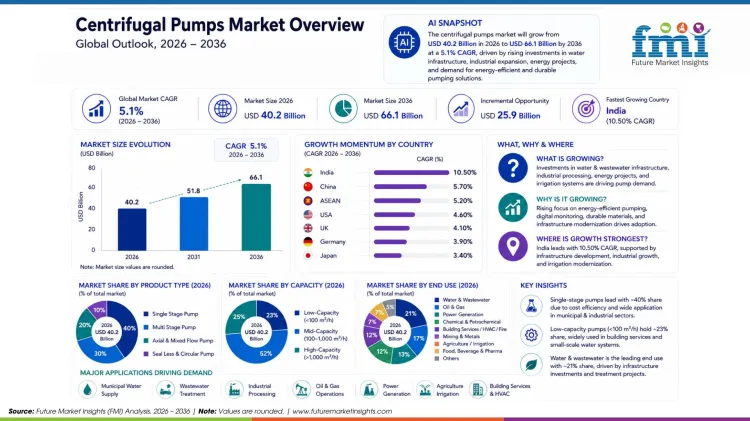
The global Centrifugal Pumps market was valued at USD 42.3 billion in 2026. Industry estimates indicate the market will reach USD 69.5 billion by 2036, expanding at a CAGR of 5.1% during the forecast period.
Key Takeaways, Market Size, and Forecast
| Metric | Value |
|---|---|
| Market Size (2026) | USD 42.3 Billion |
| Market Size (2036) | USD 69.5 Billion |
| CAGR (2026–2036) | 5.1% |
| Incremental Opportunity (2026–2036) | USD 25.9 Billion |
| Leading Product Type (2026) | Single-Stage Pumps |
| Single-Stage Pumps Share (2026) | ~40% |
| Fastest-Growing Country | China |
| China CAGR | 5.7% |
| 2nd Fastest-Growing Country | ASEAN |
| ASEAN CAGR | 5.2% |
Summary of Centrifugal Pumps Market
- The market is estimated at USD 42.3 billion in 2026.
- The market is projected to reach USD 69.5 billion by 2036.
- The market is expected to grow at a CAGR of 5.1% from 2026 to 2036.
- The forecast period represents an incremental opportunity of USD 25.9 billion.
- Single-stage pumps lead the product type segment with around a 40% share.
- Low-capacity pumps (<100 m³/h) lead the capacity segment with about a 23% share.
- Water and wastewater treatment leads the end use segment with about a 21% share.
- Demand is driven by increasing investments in water and wastewater infrastructure.
- Industrial expansion across oil & gas, chemicals, and power sectors supports market growth.
- Adoption is influenced by rising focus on energy-efficient and digitally monitored pumping systems.
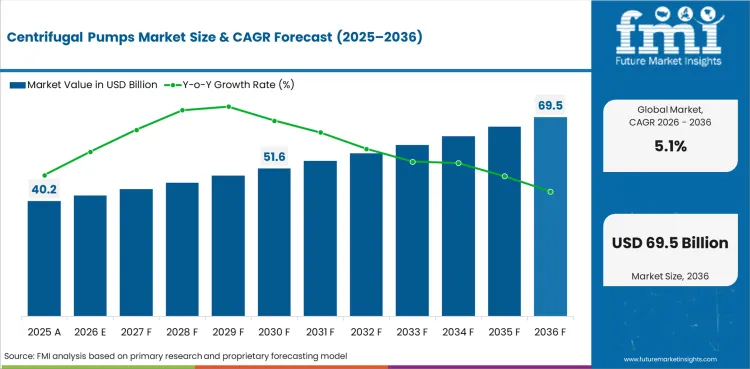
Centrifugal Pumps Market Analysis
| Metric | Value |
|---|---|
| Market Size, 2026 | USD 42.3 billion |
| Market Size, 2036 | USD 69.5 billion |
| CAGR (2026-2036) | 5.1% |
Source: FMI analysis based on primary research and proprietary forecasting model
An absolute opportunity of USD 25.9 billion is expected to be created between 2026 and 2036 as demand continues to grow across water infrastructure, industrial processing, energy, and agricultural irrigation. Growth is supported by increasing investments in water and wastewater infrastructure, industrial processing facilities, and energy sector applications. Rising demand for reliable fluid handling systems, along with improvements in pump efficiency and durable materials, continues to support adoption across municipal, industrial, and agricultural applications.
Centrifugal pumps remain the most widely used pumping technology due to their simple design, continuous flow operation, and ability to handle large fluid volumes across municipal and industrial applications. Increasing investments in water and wastewater treatment plants, chemical processing facilities, power generation, and oil & gas infrastructure are supporting consistent market expansion. In addition, infrastructure development and irrigation modernization in emerging economies are creating steady demand for reliable pumping systems.
Demand is also supported by industrial automation and energy efficiency initiatives, as operators increasingly prefer pumps with optimized hydraulic design, smart monitoring, and reduced maintenance requirements. Manufacturers are focusing on improved materials, corrosion-resistant alloys, and digital monitoring systems to enhance pump efficiency and operational reliability across heavy-duty environments.
Growth trends vary across regions depending on industrialization, infrastructure investments, and water management policies. The global centrifugal pumps market shows varied growth patterns across key countries, reflecting differences in industrial development, infrastructure investments, and water management initiatives. China is projected to grow at a CAGR of 5.7%, driven by rapid industrial expansion, increasing urbanization, and significant investments in municipal water and wastewater infrastructure. ASEAN countries are expected to expand at a CAGR of 5.2%, supported by manufacturing growth, infrastructure development, and rising demand for water management systems.
India is forecast to grow at 4.7% CAGR due to increasing irrigation modernization projects and the expansion of wastewater treatment facilities. The United States is expected to grow at 4.6%, mainly driven by industrial upgrades and replacement demand across municipal utilities and aging infrastructure. The United Kingdom is projected to expand at 4.1% CAGR, supported by modernization of building services and water management systems. Germany is expected to grow at 3.9%, driven by advanced industrial applications and chemical processing facilities, while Japan is projected to grow at 3.4%, reflecting its mature industrial market and replacement-driven demand.
Centrifugal Pumps Market Definition
Centrifugal pumps are mechanical devices used to transport fluids by converting rotational kinetic energy into hydrodynamic energy through an impeller-driven mechanism. These pumps are widely deployed across industrial processing, municipal water systems, irrigation, power plants, and oil & gas facilities where continuous fluid transfer is required. They are preferred for applications requiring high flow rates, relatively low pressure generation, and reliable continuous operation.
Market Inclusions
The centrifugal pumps market includes revenue generated from the manufacturing and sale of centrifugal pump systems used across industrial, municipal, and commercial sectors. The scope covers single-stage and multi-stage centrifugal pumps, axial and mixed-flow pumps, and seal-less or circular pump designs. These pumps are widely used in applications such as water and wastewater infrastructure, oil and gas operations, power generation facilities, chemical and petrochemical plants, mining activities, and agricultural irrigation systems. The market also includes pumps manufactured using various materials such as cast iron, carbon steel, stainless steel, duplex alloys, and other corrosion-resistant materials designed for harsh industrial operating environments.
Market Exclusions
The centrifugal pumps market excludes technologies and revenues not directly related to centrifugal pump equipment sales. Positive displacement pumps, diaphragm pumps, and other non-centrifugal pumping technologies are not included in the scope. Standalone pump components such as impellers, seals, motors, and spare parts sold independently of full pump systems are also excluded. Maintenance, repair, and servicing activities without associated pump equipment sales are not counted in the market size. In addition, pilot-scale or experimental pumping systems used only for research or demonstration purposes and not deployed in commercial operations are excluded from the market analysis.
Centrifugal Pumps Research Methodology
- Primary Research: Primary interviews were conducted with centrifugal pump manufacturers, distributors, EPC contractors, pump system integrators, and maintenance service providers across key industries. End users from sectors such as water and wastewater utilities, oil & gas companies, power generation plants, chemical and petrochemical facilities, mining operations, and agricultural irrigation projects were also consulted. Discussions focused on pump selection criteria, capacity requirements, hydraulic performance, pricing benchmarks, replacement cycles, and material preferences. Participants also shared insights on demand trends, infrastructure investments, procurement patterns, and operational challenges affecting pump deployment.
- Desk Research: Desk research involved reviewing company annual reports, product catalogs, technical papers, industry association publications, and government infrastructure reports. Additional sources included press releases on new pump installations, municipal water projects, industrial plant expansions, and energy sector investments. Industry datasets on pump production, trade statistics, and infrastructure spending were analyzed to understand market demand across regions.
- Market Sizing and Forecasting: Market sizing used a bottom-up approach by country, assessing centrifugal pump demand across major end-use sectors including water infrastructure, oil & gas, power generation, chemicals, mining, agriculture, and building services. Segment-level demand was mapped by pump type, capacity range, hydraulic design, and material of construction. Regional and global estimates were derived by aggregating country-level demand and cross-referencing with manufacturer production capacity and shipment data.
- Data Validation and Update Cycles: Market estimates were validated through triangulation of supply-side data, end-user demand insights, and infrastructure investment indicators. Findings were cross-checked with industry experts, company disclosures, and trade statistics. Any discrepancies between sources were resolved through additional interviews or document verification before finalizing the market model and forecast assumptions.
Segmental Analysis
Centrifugal Pumps Market Analysis by Product Type
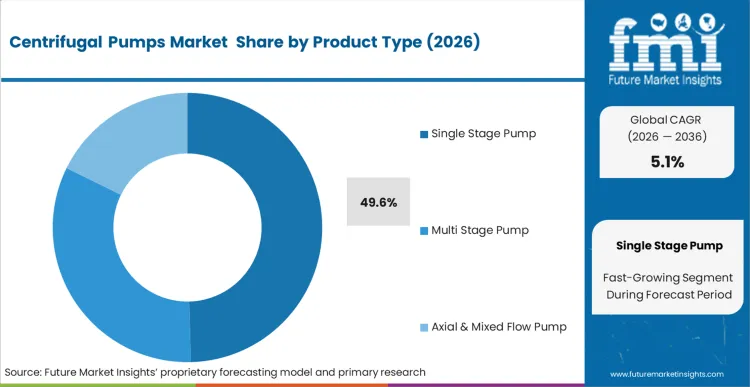
The centrifugal pumps market is segmented by product type into Single-stage Pumps, Multi-stage Pumps, Axial & Mixed Flow Pumps, and Seal-less & Circular Pumps. Single-stage pumps hold the leading share in 2026 at around 40%, driven by their simple design, cost efficiency, and wide use in municipal water supply, building services, and light industrial operations. Multi-stage pumps account for nearly 30% share, supported by applications requiring higher pressure such as boiler feed systems, industrial processing, and power generation. Axial and mixed-flow pumps together account for about 20%, widely used in large-scale water movement applications including irrigation systems, flood control, and drainage projects. Seal-less and circular pumps represent the remaining 10%, typically deployed in specialized industrial environments such as chemical processing where leakage prevention and safety are critical.
Centrifugal Pumps Market Analysis by Capacity
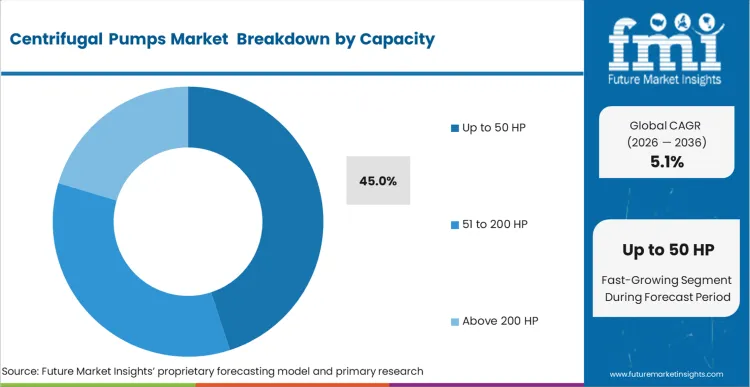
By capacity, the market is segmented into Low-capacity pumps (<100 m³/h), Mid-capacity pumps (100-1,000 m³/h), and High-capacity pumps (>1,000 m³/h). Low-capacity pumps account for about 23% of demand, supported by applications in residential water systems, building services, and small municipal installations. Mid-capacity pumps represent a major portion of installations across industrial plants, water treatment facilities, and commercial infrastructure projects where balanced flow and pressure requirements are necessary. High-capacity pumps are widely deployed in heavy industries and large infrastructure projects including irrigation networks, power plants, mining operations, and large municipal water supply systems where high-volume fluid transfer is required.
Centrifugal Pumps Market Drivers, Restraints and Opportunities
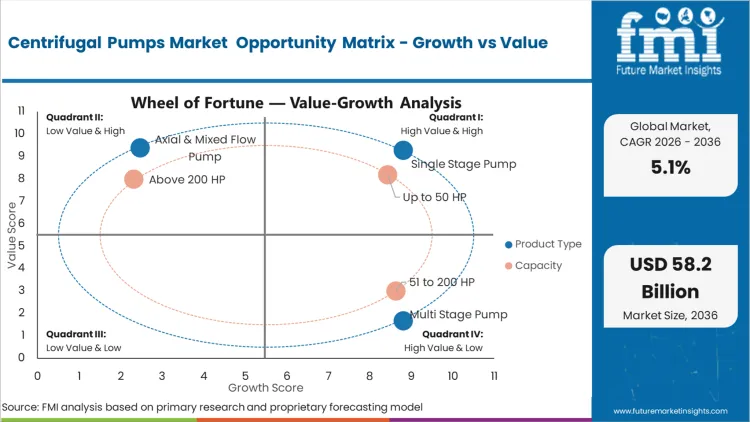
Market performance is influenced by infrastructure development, industrial expansion, and growing demand for efficient fluid management systems. Investments in municipal water supply and wastewater treatment facilities are increasing the deployment of centrifugal pumps across urban infrastructure projects. Industrial sectors such as oil & gas, chemicals, and power generation also contribute significantly to demand due to continuous fluid transfer requirements in processing operations. However, energy consumption and maintenance requirements can influence pump selection and lifecycle cost considerations.
- Industries are increasingly adopting energy-efficient centrifugal pumps to reduce operational energy consumption and meet environmental regulations.
- Installation delays can occur when system integration requirements such as pressure control, pipeline design, and corrosion protection expand project complexity.
- Manufacturers can enhance revenue opportunities by offering digital monitoring, predictive maintenance services, and advanced corrosion-resistant pump materials for demanding industrial environments.
Regional Analysis
FMI’s regional analysis covers seven key regions globally, including North America, Latin America, Eastern Europe, Western Europe, South Asia & Pacific, East Asia, and Middle East & Africa. The full report provides market attractiveness analysis and market potential assessment across more than 30 countries based on regional industrial development, infrastructure investment, and water management trends influencing the centrifugal pump market.
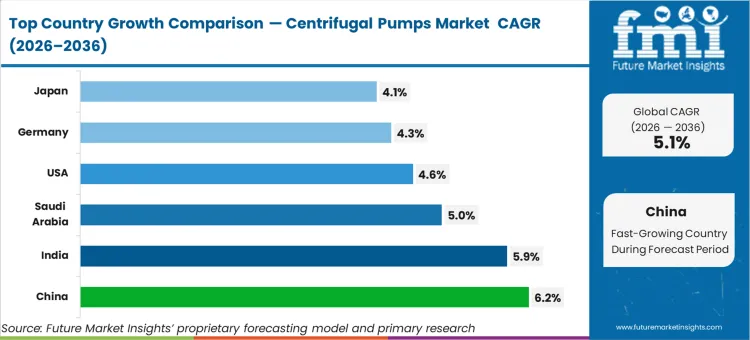
.webp "Top Country Growth Comparison Centrifugal Pumps Market Cagr (2026 2036)")
| Country | CAGR (2026 to 2036) |
|---|---|
| India | 4.7% |
| USA | 4.6% |
| China | 5.7% |
| Germany | 3.9% |
| France | 5.3% |
| ASEAN | 5.2% |
| Japan | 3.4% |
Source: Future Market Insights (FMI) analysis, based on proprietary forecasting model and primary research
North America Market Analysis
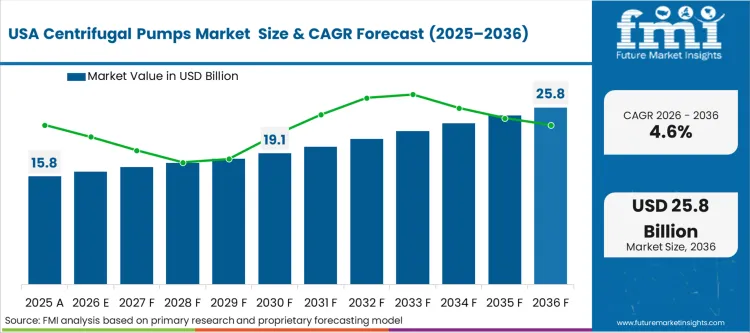
North America is expected to remain a mature yet steadily expanding centrifugal pump market where demand is shaped by infrastructure modernization, industrial automation, and energy sector investments. Pump deployment is widely observed in water utilities, chemical processing, oil & gas, and power generation facilities. Adoption is increasingly influenced by energy-efficient pump technologies, predictive maintenance solutions, and digital monitoring systems that help reduce operational costs and improve reliability.
- The United States market is expected to expand at a CAGR of 4.6% during 2026 to 2036, supported by infrastructure upgrades and strong industrial demand.
- Replacement demand and efficiency-driven upgrades are accelerating adoption of advanced centrifugal pump systems.
FMI’s report covers detailed analysis of the North American market including the USA and regional industrial demand trends. Readers can find relevant market opportunities for centrifugal pump manufacturers along with supporting insights.
Europe Market Analysis
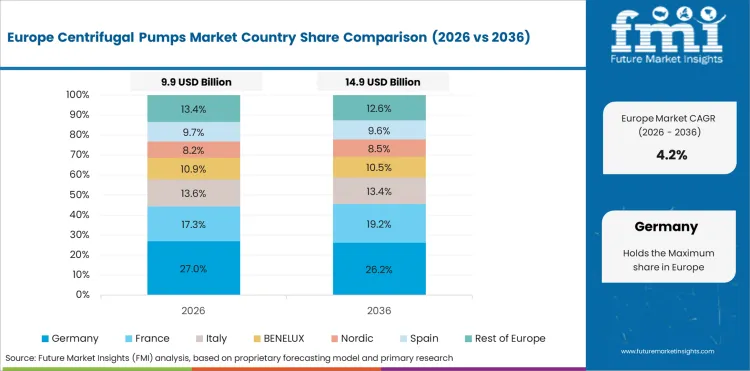
Europe is expected to progress as a regulation-driven centrifugal pump market where adoption is shaped by energy efficiency standards, environmental compliance requirements, and investments in sustainable water management infrastructure. Industries are increasingly adopting high-efficiency pump systems and corrosion-resistant materials to meet stringent EU environmental and operational standards.
- Germany is expected to register a CAGR of 3.9% during 2026 to 2036, supported by strong manufacturing and industrial processing demand.
- France is projected to grow at a CAGR of 5.3% through 2036, driven by wastewater treatment and infrastructure projects.
- The United Kingdom is expected to expand at a CAGR of 4.1% over the forecast period due to water utility modernization and industrial maintenance demand.
FMI’s assessment of the European market includes country-level analysis for Germany, France, the UK, and other key countries, covering industrial adoption trends and regulatory influence in detail.
Asia Pacific Market Analysis
Asia Pacific is expected to emerge as the fastest-growing centrifugal pump market due to rapid industrialization, expanding urban infrastructure, and increasing investments in water supply and wastewater management systems. Governments and private industries across the region are investing heavily in manufacturing facilities, energy production plants, and municipal water infrastructure, which is driving strong demand for efficient and reliable pumping systems. The expansion of chemical processing, oil & gas, and power generation industries is also contributing to increased adoption of centrifugal pumps. Additionally, growing urban populations and rising demand for sustainable water management solutions are encouraging utilities to upgrade pumping infrastructure with more energy-efficient and technologically advanced systems.
- India is expected to grow at a CAGR of 4.7% during 2026 to 2036, supported by ongoing infrastructure development, expansion of industrial manufacturing, and increasing investments in water treatment and irrigation projects.
- Japan is expected to expand at a CAGR of 3.4% through 2036, supported by technological innovation, automation in industrial systems, and replacement demand for high-efficiency centrifugal pump solutions.
FMI’s analysis of the Asia Pacific market includes country-level assessments for India, Japan, and other countries, covering industrial demand, infrastructure investment, and pump technology adoption.
Middle East Market Analysis
The Middle East is expected to expand as an infrastructure-driven centrifugal pump market where demand is strongly influenced by large-scale water desalination projects, oil & gas exploration and production activities, and expanding industrial infrastructure. The region faces significant water scarcity challenges, which has led to substantial investments in desalination facilities and water distribution networks, creating sustained demand for high-capacity centrifugal pump systems. In addition, the growth of petrochemical complexes, refineries, and energy production facilities is increasing the need for reliable pumping solutions used in fluid transport, cooling systems, and process operations. Government-led infrastructure programs and economic diversification strategies are also driving investments in power plants, industrial zones, and municipal water treatment projects. These developments are expected to create long-term opportunities for centrifugal pump manufacturers and suppliers across the region.
- Saudi Arabia is projected to rise at a CAGR of 6.0% during 2026 to 2036, supported by expanding desalination capacity, large petrochemical investments, and ongoing industrial development initiatives.
- Large infrastructure projects, energy sector expansion, and increasing investments in water management systems continue to support the deployment of centrifugal pump technologies across the Middle East.
FMI’s coverage of the Middle East includes country-level analysis of Saudi Arabia and related markets, detailing infrastructure development trends, industrial demand, and pump technology adoption priorities.
Competitive Aligners for Market Players
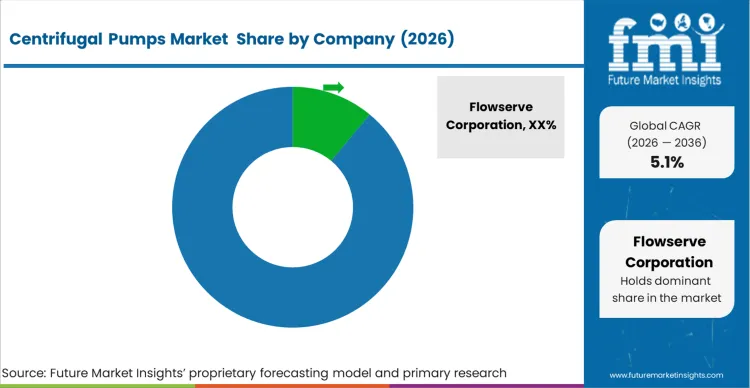
The centrifugal pumps market is characterized by strong competition among global manufacturers and regional suppliers, where differentiation is increasingly driven by product efficiency, reliability, and lifecycle service capabilities. Companies compete through the development of energy-efficient pump systems, corrosion-resistant materials, and digitally integrated monitoring solutions that improve operational performance. Access to strong distribution networks, long-term relationships with EPC contractors, and after-sales service capabilities are also important competitive factors. Manufacturers with broad product portfolios and modular pump designs gain advantages in serving multiple industries such as water infrastructure, oil & gas, chemicals, and power generation. In addition, firms that offer integrated pump packages, predictive maintenance solutions, and customized engineering support are better positioned to secure large infrastructure and industrial contracts.
Recent Developments
- On August 2025, Pioneer Pump launched an NSF/ANSI 61-certified pump line for drinking water applications, extending its centrifugal pump portfolio into municipal and potable water infrastructure. This development is relevant because certified clean-water pumps strengthen supplier positioning in regulated water projects, where compliance, delivery reliability, and application-specific product design influence purchase decisions.
- On May 2025, Finish Thompson highlighted its new UCP Series ANSI-dimensional magnetic drive centrifugal pump, designed as a drop-in replacement for existing ANSI pumps in surface finishing applications. This is relevant to the centrifugal pump market because it reflects demand for leak-free, corrosion-resistant, lower-maintenance pump solutions that reduce ownership cost in chemical handling environments.
- On November 2025, DXP Enterprises announced the acquisition of Triangle Pump & Equipment, Inc., expanding its water and wastewater presence in the Pacific Northwest and strengthening its aftermarket service and repair capabilities. This development matters because centrifugal pump competition is increasingly shaped by distribution reach, service depth, and regional coverage, not only by product sales.
- On August 2024, Tapflo UK acquired TS Pumps to broaden its application coverage and enhance service capabilities across the UK. The acquisition is significant for the centrifugal pump market because it shows how suppliers are using bolt-on deals to widen industry access, strengthen aftermarket support, and offer more tailored pump and system solutions across industrial segments.
Key Players in the Centrifugal Pumps Market
- Ebara Corporation
- Xylem Inc.
- Sulzer AG
- Flowserve Corporation
- Grundfos
- Weir Group
- KSB Group
- Shakti Pump
- Kirloskar Brothers Ltd.
- WILO SE
Scope of the Report
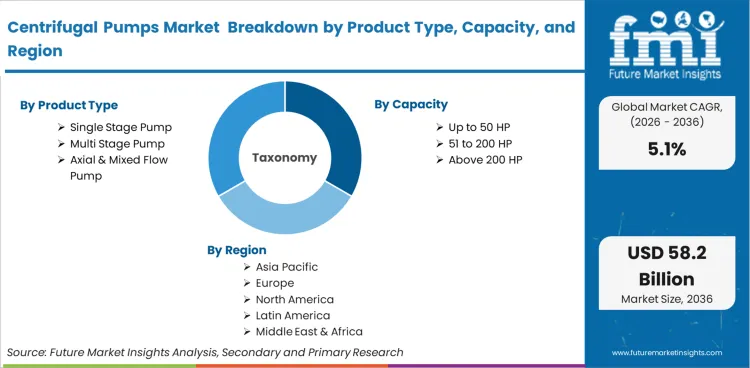
| Metric | Value |
|---|---|
| Quantitative Units | USD 42.3 Billion to USD 69.5 Billion, at a CAGR of 5.1% |
| Market Definition | The Centrifugal Pumps Market covers pumps that use rotational energy to move fluids through a system by converting mechanical energy into hydraulic energy. It is used across industries including water and wastewater, oil and gas, chemicals, power generation, and agriculture for efficient fluid handling. |
| Segmentation | By Product Type, By Capacity, By End Use, By Hydraulic Design, By Material of Construction |
| Regions Covered | North America, Latin America, Europe, East Asia, South Asia, Oceania, Middle East & Africa |
| Countries Covered | China, India, Germany, Brazil, USA, UK, Japan, and 40+ countries |
| Key Companies Profiled | Ebara Corporation, Xylem Inc., Sulzer AG, Flowserve Corporation, Grundfos, Weir Group, KSB Group, Shakti Pump, Kirloskar Brothers Ltd., WILO SE |
| Forecast Period | 2026 to 2036 |
| Approach | Baseline estimates are based on industrial and infrastructure activity, aligned with centrifugal pump adoption across key end-use sectors, and adjusted for regional investment trends and regulatory standards to project demand through 2036.. |
Centrifugal Pumps Market by Segments
By Product Type:
- Single Stage Pump
- Multi Stage Pump
- Axial & Mixed Flow Pump
- Seal Less & Circular Pump
By Capacity:
- Low-capacity: < 100 m³/h
- Mid-capacity: 100-1,000 m³/h
- High-capacity: > 1,000 m³/h
By End Use:
- Water & Wastewater
- Oil & Gas
- Power Generation
- Chemical & Petrochemical
- Building Services / HVAC / Fire
- Mining & Metals
- Agriculture / Irrigation
- Food, Beverage & Pharma
- Others
By Hydraulic Design:
- Radial-flow
- Mixed-flow
- Axial-flow
By Material of Construction:
- Cast iron
- Carbon steel
- Stainless steel
- Duplex & Ni-alloys
- Non-metallic
Region:
- North America
- USA
- Canada
- Mexico
- Latin America
- Brazil
- Chile
- Rest of Latin America
- Western Europe
- Germany
- UK
- Italy
- Spain
- France
- Nordic
- BENELUX
- Rest of Western Europe
- Eastern Europe
- Russia
- Poland
- Hungary
- Balkan & Baltic
- Rest of Eastern Europe
- East Asia
- China
- Japan
- South Korea
- South Asia and Pacific
- India
- ASEAN
- Australia & New Zealand
- Rest of South Asia and Pacific
- Middle East & Africa
- Kingdom of Saudi Arabia
- Other GCC Countries
- Turkiye
- South Africa
- Other African Union
- Rest of Middle East & Africa
Bibliography
- World Pumps. “Pump Industry News and Market Developments.” World Pumps Industry Portal.
- Hydraulic Institute. “Pump Systems Matter and Pump Efficiency Guidelines.” Hydraulic Institute Publications.
- Pioneer Pump, “Pioneer Pump Launches NSF/ANSI 61 Certified Pump Line,” 2025.
- Fluid Handling Magazine, “Finish Thompson Highlights New UCP Series Magnetic Drive Centrifugal Pump,” 2025.
- DXP Enterprises, Inc., “DXP Enterprises, Inc. Announces Acquisition of Triangle Pump & Equipment, Inc.,” 2025.
- Tapflo UK, “Tapflo UK Acquires TS Pumps,” 2024.
This bibliography is provided for reader reference and is not exhaustive. The full report contains the complete reference list and detailed citations.
Frequently Asked Questions
How large is the demand for Centrifugal Pumps Market in the global market in 2026?
Demand for the centrifugal pumps market in the global market is estimated to be valued at USD 40.2 Billion in 2026.
What will be the market size of Centrifugal Pumps Market in the global market by 2036?
Market size for the centrifugal pumps market is projected to reach USD 66.1 Billion by 2036.
What is the expected demand growth for Centrifugal Pumps Market between 2026 and 2036?
Demand for the centrifugal pumps market is expected to grow at a CAGR of 5.1% between 2026 and 2036.
Which Product Type segment is poised to lead global sales by 2026?
Single Stage Pumps account for 40% of product type share in 2026, making them the leading segment due to their simple design, cost efficiency, and wide industrial usage.
Which Capacity segment is poised to lead global sales by 2026?
Low-capacity pumps (<100 m³/h) account for around 23% of capacity share in 2026, supported by widespread use in municipal water systems, building services, and small industrial applications.
Which End-use segment is poised to lead global sales by 2026?
Water & Wastewater is poised to lead global sales by 2026, supported by increasing investments in municipal water supply, wastewater treatment, and related infrastructure projects.
What is driving demand in India?
India is projected to grow at a CAGR of 4.7% during 2026 to 2036, supported by infrastructure development, industrial manufacturing growth, and rising investments in water treatment and irrigation projects.
What is driving demand in China?
China is projected to grow at a CAGR of 5.7% during 2026 to 2036, supported by rapid industrial expansion, urbanization, and strong investment in municipal water and wastewater infrastructure.
What are the key trends shaping the Centrifugal Pumps Market?
Key trends include rising adoption of energy-efficient pumps, integration of digital monitoring and predictive maintenance systems, increasing use of corrosion-resistant materials, and growing demand for reliable pumping solutions across water, industrial, and energy applications.
Preview the report firsthand - request a free sample
Get SampleGet the brochure for pricing and purchase details.
Get PDFTable of Content
- Executive Summary
- Global Market Outlook
- Demand-side Trends
- Supply-side Trends
- Technology Roadmap Analysis
- Analysis and Recommendations
- Market Overview
- Market Coverage / Taxonomy
- Market Definition / Scope / Limitations
- Research Methodology
- Chapter Orientation
- Analytical Lens and Working Hypotheses
- Market Structure, Signals, and Trend Drivers
- Benchmarking and Cross-market Comparability
- Market Sizing, Forecasting, and Opportunity Mapping
- Research Design and Evidence Framework
- Desk Research Programme (Secondary Evidence)
- Company Annual and Sustainability Reports
- Peer-reviewed Journals and Academic Literature
- Corporate Websites, Product Literature, and Technical Notes
- Earnings Decks and Investor Briefings
- Statutory Filings and Regulatory Disclosures
- Technical White Papers and Standards Notes
- Trade Journals, Industry Magazines, and Analyst Briefs
- Conference Proceedings, Webinars, and Seminar Materials
- Government Statistics Portals and Public Data Releases
- Press Releases and Reputable Media Coverage
- Specialist Newsletters and Curated Briefings
- Sector Databases and Reference Repositories
- FMI Internal Proprietary Databases and Historical Market Datasets
- Subscription Datasets and Paid Sources
- Social Channels, Communities, and Digital Listening Inputs
- Additional Desk Sources
- Expert Input and Fieldwork (Primary Evidence)
- Primary Modes
- Qualitative Interviews and Expert Elicitation
- Quantitative Surveys and Structured Data Capture
- Blended Approach
- Why Primary Evidence is Used
- Field Techniques
- Interviews
- Surveys
- Focus Groups
- Observational and In-context Research
- Social and Community Interactions
- Stakeholder Universe Engaged
- C-suite Leaders
- Board Members
- Presidents and Vice Presidents
- R&D and Innovation Heads
- Technical Specialists
- Domain Subject-matter Experts
- Scientists
- Physicians and Other Healthcare Professionals
- Governance, Ethics, and Data Stewardship
- Research Ethics
- Data Integrity and Handling
- Primary Modes
- Tooling, Models, and Reference Databases
- Desk Research Programme (Secondary Evidence)
- Data Engineering and Model Build
- Data Acquisition and Ingestion
- Cleaning, Normalisation, and Verification
- Synthesis, Triangulation, and Analysis
- Quality Assurance and Audit Trail
- Market Background
- Market Dynamics
- Drivers
- Restraints
- Opportunity
- Trends
- Scenario Forecast
- Demand in Optimistic Scenario
- Demand in Likely Scenario
- Demand in Conservative Scenario
- Opportunity Map Analysis
- Product Life Cycle Analysis
- Supply Chain Analysis
- Investment Feasibility Matrix
- Value Chain Analysis
- PESTLE and Porter’s Analysis
- Regulatory Landscape
- Regional Parent Market Outlook
- Production and Consumption Statistics
- Import and Export Statistics
- Market Dynamics
- Global Market Analysis 2021 to 2025 and Forecast, 2026 to 2036
- Historical Market Size Value (USD Billion) Analysis, 2021 to 2025
- Current and Future Market Size Value (USD Billion) Projections, 2026 to 2036
- Y-o-Y Growth Trend Analysis
- Absolute $ Opportunity Analysis
- Global Market Pricing Analysis 2021 to 2025 and Forecast 2026 to 2036
- Global Market Analysis 2021 to 2025 and Forecast 2026 to 2036, By Product Type
- Introduction / Key Findings
- Historical Market Size Value (USD Billion) Analysis By Product Type , 2021 to 2025
- Current and Future Market Size Value (USD Billion) Analysis and Forecast By Product Type , 2026 to 2036
- Single Stage Pump
- Multi Stage Pump
- Axial & Mixed Flow Pump
- Seal Less & Circular Pump
- Single Stage Pump
- Y-o-Y Growth Trend Analysis By Product Type , 2021 to 2025
- Absolute $ Opportunity Analysis By Product Type , 2026 to 2036
- Global Market Analysis 2021 to 2025 and Forecast 2026 to 2036, By Capacity
- Introduction / Key Findings
- Historical Market Size Value (USD Billion) Analysis By Capacity, 2021 to 2025
- Current and Future Market Size Value (USD Billion) Analysis and Forecast By Capacity, 2026 to 2036
- Low-capacity: < 100 m³/h
- Mid-capacity: 100-1,000 m³/h
- High-capacity: > 1,000 m³/h
- Low-capacity: < 100 m³/h
- Y-o-Y Growth Trend Analysis By Capacity, 2021 to 2025
- Absolute $ Opportunity Analysis By Capacity, 2026 to 2036
- Global Market Analysis 2021 to 2025 and Forecast 2026 to 2036, By Region
- Introduction
- Historical Market Size Value (USD Billion) Analysis By Region, 2021 to 2025
- Current Market Size Value (USD Billion) Analysis and Forecast By Region, 2026 to 2036
- North America
- Latin America
- Western Europe
- Eastern Europe
- East Asia
- South Asia and Pacific
- Middle East & Africa
- Market Attractiveness Analysis By Region
- North America Market Analysis 2021 to 2025 and Forecast 2026 to 2036, By Country
- Historical Market Size Value (USD Billion) Trend Analysis By Market Taxonomy, 2021 to 2025
- Market Size Value (USD Billion) Forecast By Market Taxonomy, 2026 to 2036
- By Country
- USA
- Canada
- Mexico
- By Product Type
- By Capacity
- By Country
- Market Attractiveness Analysis
- By Country
- By Product Type
- By Capacity
- Key Takeaways
- Latin America Market Analysis 2021 to 2025 and Forecast 2026 to 2036, By Country
- Historical Market Size Value (USD Billion) Trend Analysis By Market Taxonomy, 2021 to 2025
- Market Size Value (USD Billion) Forecast By Market Taxonomy, 2026 to 2036
- By Country
- Brazil
- Chile
- Rest of Latin America
- By Product Type
- By Capacity
- By Country
- Market Attractiveness Analysis
- By Country
- By Product Type
- By Capacity
- Key Takeaways
- Western Europe Market Analysis 2021 to 2025 and Forecast 2026 to 2036, By Country
- Historical Market Size Value (USD Billion) Trend Analysis By Market Taxonomy, 2021 to 2025
- Market Size Value (USD Billion) Forecast By Market Taxonomy, 2026 to 2036
- By Country
- Germany
- UK
- Italy
- Spain
- France
- Nordic
- BENELUX
- Rest of Western Europe
- By Product Type
- By Capacity
- By Country
- Market Attractiveness Analysis
- By Country
- By Product Type
- By Capacity
- Key Takeaways
- Eastern Europe Market Analysis 2021 to 2025 and Forecast 2026 to 2036, By Country
- Historical Market Size Value (USD Billion) Trend Analysis By Market Taxonomy, 2021 to 2025
- Market Size Value (USD Billion) Forecast By Market Taxonomy, 2026 to 2036
- By Country
- Russia
- Poland
- Hungary
- Balkan & Baltic
- Rest of Eastern Europe
- By Product Type
- By Capacity
- By Country
- Market Attractiveness Analysis
- By Country
- By Product Type
- By Capacity
- Key Takeaways
- East Asia Market Analysis 2021 to 2025 and Forecast 2026 to 2036, By Country
- Historical Market Size Value (USD Billion) Trend Analysis By Market Taxonomy, 2021 to 2025
- Market Size Value (USD Billion) Forecast By Market Taxonomy, 2026 to 2036
- By Country
- China
- Japan
- South Korea
- By Product Type
- By Capacity
- By Country
- Market Attractiveness Analysis
- By Country
- By Product Type
- By Capacity
- Key Takeaways
- South Asia and Pacific Market Analysis 2021 to 2025 and Forecast 2026 to 2036, By Country
- Historical Market Size Value (USD Billion) Trend Analysis By Market Taxonomy, 2021 to 2025
- Market Size Value (USD Billion) Forecast By Market Taxonomy, 2026 to 2036
- By Country
- India
- ASEAN
- Australia & New Zealand
- Rest of South Asia and Pacific
- By Product Type
- By Capacity
- By Country
- Market Attractiveness Analysis
- By Country
- By Product Type
- By Capacity
- Key Takeaways
- Middle East & Africa Market Analysis 2021 to 2025 and Forecast 2026 to 2036, By Country
- Historical Market Size Value (USD Billion) Trend Analysis By Market Taxonomy, 2021 to 2025
- Market Size Value (USD Billion) Forecast By Market Taxonomy, 2026 to 2036
- By Country
- Kingdom of Saudi Arabia
- Other GCC Countries
- Turkiye
- South Africa
- Other African Union
- Rest of Middle East & Africa
- By Product Type
- By Capacity
- By Country
- Market Attractiveness Analysis
- By Country
- By Product Type
- By Capacity
- Key Takeaways
- Key Countries Market Analysis
- USA
- Pricing Analysis
- Market Share Analysis, 2025
- By Product Type
- By Capacity
- Canada
- Pricing Analysis
- Market Share Analysis, 2025
- By Product Type
- By Capacity
- Mexico
- Pricing Analysis
- Market Share Analysis, 2025
- By Product Type
- By Capacity
- Brazil
- Pricing Analysis
- Market Share Analysis, 2025
- By Product Type
- By Capacity
- Chile
- Pricing Analysis
- Market Share Analysis, 2025
- By Product Type
- By Capacity
- Germany
- Pricing Analysis
- Market Share Analysis, 2025
- By Product Type
- By Capacity
- UK
- Pricing Analysis
- Market Share Analysis, 2025
- By Product Type
- By Capacity
- Italy
- Pricing Analysis
- Market Share Analysis, 2025
- By Product Type
- By Capacity
- Spain
- Pricing Analysis
- Market Share Analysis, 2025
- By Product Type
- By Capacity
- France
- Pricing Analysis
- Market Share Analysis, 2025
- By Product Type
- By Capacity
- India
- Pricing Analysis
- Market Share Analysis, 2025
- By Product Type
- By Capacity
- ASEAN
- Pricing Analysis
- Market Share Analysis, 2025
- By Product Type
- By Capacity
- Australia & New Zealand
- Pricing Analysis
- Market Share Analysis, 2025
- By Product Type
- By Capacity
- China
- Pricing Analysis
- Market Share Analysis, 2025
- By Product Type
- By Capacity
- Japan
- Pricing Analysis
- Market Share Analysis, 2025
- By Product Type
- By Capacity
- South Korea
- Pricing Analysis
- Market Share Analysis, 2025
- By Product Type
- By Capacity
- Russia
- Pricing Analysis
- Market Share Analysis, 2025
- By Product Type
- By Capacity
- Poland
- Pricing Analysis
- Market Share Analysis, 2025
- By Product Type
- By Capacity
- Hungary
- Pricing Analysis
- Market Share Analysis, 2025
- By Product Type
- By Capacity
- Kingdom of Saudi Arabia
- Pricing Analysis
- Market Share Analysis, 2025
- By Product Type
- By Capacity
- Turkiye
- Pricing Analysis
- Market Share Analysis, 2025
- By Product Type
- By Capacity
- South Africa
- Pricing Analysis
- Market Share Analysis, 2025
- By Product Type
- By Capacity
- USA
- Market Structure Analysis
- Competition Dashboard
- Competition Benchmarking
- Market Share Analysis of Top Players
- By Regional
- By Product Type
- By Capacity
- Competition Analysis
- Competition Deep Dive
- Ebara Corporation
- Overview
- Product Portfolio
- Profitability by Market Segments (Product/Age /Sales Channel/Region)
- Sales Footprint
- Strategy Overview
- Marketing Strategy
- Product Strategy
- Channel Strategy
- Xylem Inc.
- Sulzer AG
- Flowserve Corporation
- Grundfos
- Weir Group
- KSB Group
- Shakti Pump
- Kirloskar Brothers Ltd.
- WILO SE
- Ebara Corporation
- Competition Deep Dive
- Assumptions & Acronyms Used


