

- Market Size (2026)
- USD 83.1 Bn
- Forecast (2036)
- USD 144.7 Bn
- CAGR (2026 to 2036)
- 5.7%
How big is Cereal & Grain Fortification Ingredients Market size in 2026?
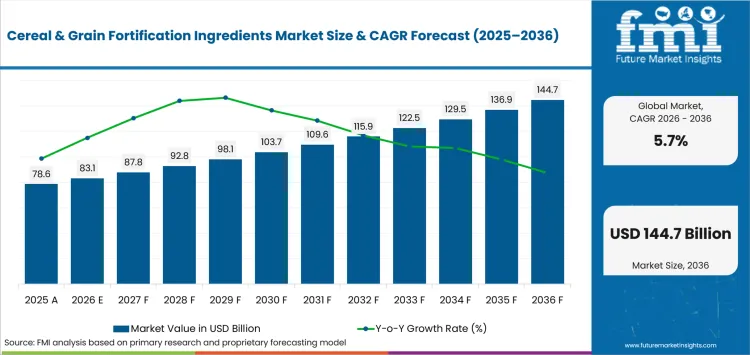
USD 83.1 billion in 2026 and USD 144.7 billion by 2036 at a 5.7% CAGR.
Demand for cereal & grain fortification ingredients is projected to expand at 5.7% CAGR between 2026 and 2036, increasing valuation from USD 83.1 billion in 2026 to USD 144.7 billion by 2036. Staple-food programs and branded nutrition products create a steady demand for repeat ingredient purchases. In April 2025, the Press Information Bureau reported on a fortified rice kernel pilot plant with a production capacity of 30 to 50 kilograms per hour. This facility demonstrates practical production and testing capabilities for blending essential micronutrients into grains. Leading such technical developments to help food processors safely enrich staple foods on a commercial scale.
International food manufacturers apply distinct regional priorities on sourcing fortification ingredients. Food processors in India emphasize tender-ready premixes and local blending support. Buyers in the United States and China prioritize permitted nutrient levels and strict alignment with national standards. In February 2026, the Press Information Bureau announced the temporary discontinuation of rice fortification under major Indian welfare schemes. This major policy shift has increased attention toward shelf-life evidence and commercial cereal applications as suppliers adjust their long-term planning.
Key Takeaways for Cereal & Grain Fortification Ingredients Market
- Demand for cereal & grain fortification ingredients is influenced by staple-food programmes, with branded nutrition products creating another route for repeat ingredient purchasing.
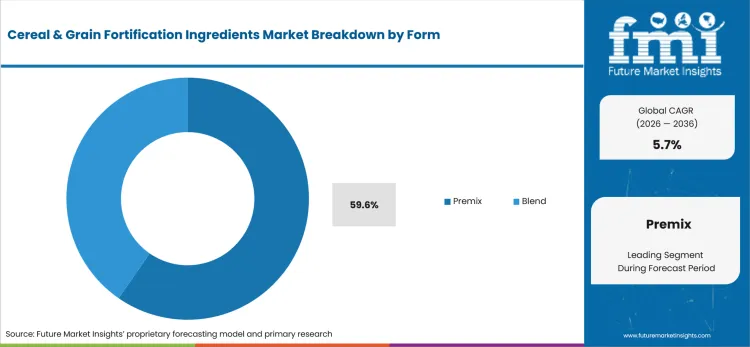
- Premix is forecast to lead form with 59.6% share in 2026, aided by controlled dilution that improves dosing across nutrients used at low inclusion rates.
- Vitamins are estimated to garner 47.9% share of nutrient in 2026, driven by recurring restoration needs across refined flour and cereal products.
- Storage loss and sensory change form primary barriers, with feeder variation increasing quality risk during routine production.
- Competition focuses on dsm-firmenich, BASF, Cargill, ADM, Glanbia, Kerry, and Corbion, with suppliers differentiated based on nutrient breadth and grain-application support.
Analyst Perspective
“Cereal and grain fortification purchasing extends beyond micronutrient price. Millers examine dosing uniformity and nutrient recovery during supplier review. Application tests connect ingredient design with plant performance. Clear records strengthen confidence during repeat purchasing.”
- Nandini Roy Choudhury, Principal Analyst for Food and Beverage at Future Market Insights
How is Cereal & Grain Fortification Ingredients Market segmented?
The cereal & grain fortification ingredients industry is segmented by nutrient, application, form, and region.
The cereal & grain fortification ingredients market is segmented by nutrient, application, form, and region. Nutrient coverage includes vitamins, minerals, fiber, and protein across distinct dosage and stability requirements. Application coverage spans breakfast cereal, bread, flour, and bakery according to process exposure and nutrition targets. Form coverage separates premix from blend based on dilution design and ingredient handling. Regional coverage includes North America and Latin America together with Western Europe. Eastern Europe and East Asia extend analysis across established grain industries. South Asia and Pacific with Middle East and Africa complete geographic assessment.
What supports premix leadership in form selection?
Premix combines several nutrients inside one measured input, reducing weighing steps across low-dose addition. Mill teams gain steadier dosing through carrier-controlled dispersion. Press Information Bureau reported 15 notified laboratories for premix testing in April 2025, strengthening batch confirmation during supplier approval. A qualified food premix also reduces separate material records inside each production lot.
- Premix is predicted to account for 59.6% share of form in 2026, driven by pre-dilution that improves handling across vitamin and mineral addition at narrow dosage levels. Mill teams assess feeder response and blend uniformity during supplier trials.
- Blend formats combine micronutrients with fiber or protein across higher inclusion levels Product teams review texture and flow response during application trials.
Why do vitamins lead nutrient demand?
Refining removes part of natural vitamin content from flour and cereal, creating planned restoration needs under product specifications. dsm-firmenich reported in September 2024 that at least 90.0% of Dry Vitamin A Palmitate NI particles pass through a 250-micrometre sieve, influencing more uniform flour blending through controlled particle size. Stable delivery strengthens finished-food verification across declared nutrient levels.
- Vitamins are anticipated to hold 47.9% share of nutrient in 2026, reflecting multi-vitamin requirements across flour and cereal products. Buyers review potency and storage evidence during commercial approval.
- Minerals address separate product briefs across iron and zinc enrichment. Fiber and Protein support distinct nutrition goals, prompting formulators to test nutrient density against taste and texture.
Why does breakfast cereal lead application demand?
General Mills introduced Cheerios Protein with 8 grams of protein per serving in January 2025, demonstrating continued nutrition reformulation within branded cereal ranges. Ingredient suppliers assist nutrient recovery during extrusion and coating. Breakfast cereal production uses measured batches and defined serving declarations, enabling repeat nutrient addition across standardized processing.
- Based on application, breakfast cereal is estimated to represent 32.4% share in 2026 as it is backed by production records connecting added nutrients with finished serving claims. Supplier trials assess retention through extrusion and coating.
- Bread faces fermentation and heating stress across fortified formulations. Flour requires stable storage performance, and Bakery products introduce separate shelf-life demands.
What are drivers, restraints, and opportunities in Cereal & Grain Fortification Ingredients Market?
Staple-food standards support nutrient loss restricts qualification and local technical service creates expansion potential. Storage instability and inconsistent dosing control are likely to delay qualification across grain-processing facilities.
- Driver: Mandatory and voluntary fortification programmes convert nutrition goals into defined ingredient specifications for mills and food processors.
- Restraint: Nutrient degradation may weaken finished-food consistency across storage and processing conditions.
- Opportunity: Local formulation service improves feeder setup and batch verification across grain plants.
Staple-food fortification reaches consumers through flour and rice products. Such technical developments help food processors safely enrich staple foods on a commercial scale., supporting sustained interest in fortification across frequently consumed staples. Programme demand requires approved nutrient forms and dependable supply throughout plant execution.
Storage stability affects supplier approval for folic acid systems. BMC Nutrition recorded folic-acid retention from 68.5% to 87.8% in December 2025, highlighting overage and storage-control requirements across fortified wheat flour. Millers need retention evidence and finished-food sampling during routine qualification.
Local technical service reduces failed production lots across variable mill equipment. Global Alliance for Improved Nutrition reported in 2024 that 2 in 3 women of reproductive age lack at least one micronutrient, reinforcing demand for local support that improves dosage control and finished-food verification. Premix suppliers assist feeder checks and corrective work across participating sites.
How are country CAGRs aligned in Cereal & Grain Fortification Ingredients Market?
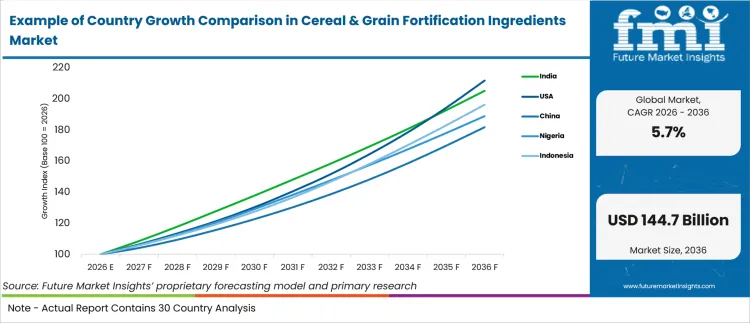
| Country or Market | CAGR |
|---|---|
| India | 7.4% |
| Indonesia | 7.0% |
| Nigeria | 6.6% |
| China | 6.2% |
| USA | 5.9% |
Source: Future Market Insights analysis, 2026.
How do country-level CAGRs compare in Cereal & Grain Fortification Ingredients Market?
Country comparison shows a gradual step-down across covered markets. India occupies the upper end of the range, followed by Indonesia. Nigeria forms the middle position across disclosed comparison. China and United States complete the lower forecast band. A 1.5 percentage-point spread separates India from the United States, showing measured divergence without a sharp national split. Profiled rates reflect expansion pace under distinct implementation conditions.
- India is anticipated to lead comparison and place South Asia at the upper forecast position.
- Indonesia is likely to follow India and maintain a limited difference from the leading rate.
- Nigeria is expected to occupy the middle band under mandatory flour-fortification requirements.
- China and USA are projected to complete comparison under standards-led formulation systems.
- Profiled rates create a gradual downward slope without sharp national separation.
Markets with similar CAGRs are expected to present distinct entry conditions based on programme status and testing access. Full report coverage includes North America, Latin America, Europe, East Asia, South Asia and Pacific, Middle East and Africa.
Country-wise Analysis
- Demand for cereal & grain fortification ingredients in India is projected to expand at 7.4% CAGR by 2036, driven by extensive blending infrastructure and formal fortification standards. Press Information Bureau reported more than 21,000 operational rice mills with installed blending equipment in October 2024, providing a substantial technical base for commercial and renewed programme use. Supplier review favours local stock and clear batch records.
- A Bappenas and UNICEF review presented 5 key findings in March 2024, exposing monitoring gaps that raise the value of compliant wheat fortification premix delivery and technical assistance. Supplier service focuses on documentation and plant-level checks. Industry in Indonesia is forecast to expand at 7.0% CAGR from 2026 to 2036, reflecting mandatory wheat-flour rules and growing use of processed flour foods.
- Sales in Nigeria are estimated to advance at 6.6% CAGR during the study period, backed by mandatory nutrient specifications and coordinated factory oversight. Standards Organisation of Nigeria reported participation from 3 regulatory agencies in February 2025, improving information exchange across fortification standards and plant checks. Local laboratory support influences repeat supplier approval.
- USDA Foreign Agricultural Service reported 50 new or updated food-safety standards in April 2025, including nutritional fortification substances that require local specification review. Chinese-language records reduce formulation delays across domestic plants. Sector in China is anticipated to rise at 6.2% CAGR during the assessment period, led by industrial cereal production and regular standards updates.
- The market in United States is projected to expand at 5.9% CAGR between 2026 and 2036, guided by established enrichment rules and documentation-led reformulation. USA Food and Drug Administration stated in June 2024 that corn masa flour may contain folic acid up to 0.7 milligrams per pound, providing a defined dosage ceiling for formulation and label control. Stable nutrient forms support recurring supplier relationships.
Who are notable companies in Cereal & Grain Fortification Ingredients Market?
dsm-firmenich, BASF, Cargill, ADM, Glanbia, Kerry, and Corbion are notable companies active in cereal & grain fortification ingredients.
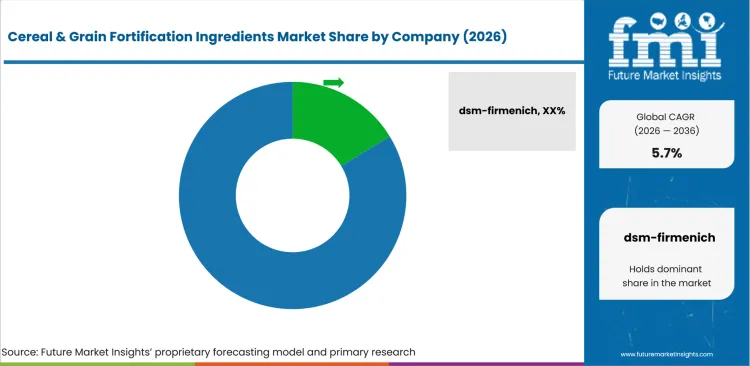
Competition centers on nutrient design and premix consistency across grain applications. dsm-firmenich and BASF supply vitamins for staple-food programmes. Cargill and ADM connect grain knowledge with food formulation. Glanbia supplies custom nutrient premixes, and Kerry supports taste control across cereal and bakery projects. Corbion addresses bakery preservation and process performance.
- dsm-firmenich and BASF compete based on vitamin portfolios and stabilized forms. Buyers examine assay control and supply continuity during supplier qualification.
- Cargill and ADM contribute grain-processing knowledge across cereal and flour applications. Customer teams assess application depth during product development.
- Glanbia and Kerry compete depending on multi-ingredient formulation and sensory support. Product developers examine nutrient recovery across taste and texture decisions.
- Corbion supports bakery process stability and shelf-life control. Preservation performance influences acceptance of fortified bakery products.
Competitive Benchmarking: Cereal & Grain Fortification Ingredients Market
| Company | Micronutrient Premix Breadth | Grain Application Support | Programme and Compliance Reach | Service Reach |
|---|---|---|---|---|
| dsm-firmenich | Extensive | Extensive | Extensive | Global |
| BASF | Extensive | Established | Extensive | Global |
| Cargill | Established | Extensive | Established | Global |
| ADM | Established | Extensive | Established | Global |
| Glanbia | Extensive | Extensive | Established | International |
| Kerry | Established | Extensive | Established | Global |
| Corbion | Selective | Extensive | Established | International |
Source: Future Market Insights competitive analysis, 2026.
Key Developments in Cereal & Grain Fortification Ingredients Market
- In March 2025, Nestlé India launched a CEREGROW multigrain cereal with 19 key nutrients, expanding serving-level vitamin and mineral delivery through a grain-based product. Company information connected cereal reformulation with child-nutrition positioning across Indian retail.
- In June 2025, dsm-firmenich extended its World Food Programme partnership through 2027, expanding fortified rice and flour support across 32 countries. Company information connected micronutrient expertise with multi-country staple-food programmes.
- In October 2025, Nestlé Cereals launched Very Berry Cheerios with 7 vitamins, calcium, and iron, expanding fortified multigrain options across United Kingdom retail. Product information connected a new cereal launch with wider use of grain-fortification ingredients.
Key Players in Cereal & Grain Fortification Ingredients Market
Micronutrient Premix and Vitamin Specialists
- dsm-firmenich
- BASF
- Glanbia
Grain and Food Formulation Platforms
- ADM
- Cargill
- Kerry
Bakery Process and Shelf-Life Systems
- Corbion
Cereal & Grain Fortification Ingredients Market Report Scope
| Coverage field | Report scope |
|---|---|
| Market breakdown | Cereal & grain fortification ingredients market breakdown by nutrient, application, form, and region |
| Quantitative Units | USD billion in 2026 to USD billion by 2036 at CAGR |
| Market Definition | Vitamin, mineral, fiber, and protein premixes or blends sold for fortifying flour, rice, maize, breakfast cereal, bread, and industrial bakery products. Finished fortified foods and therapeutic supplements are excluded. |
| Regions Covered | North America, Latin America, Western Europe, Eastern Europe, East Asia, South Asia and Pacific, Middle East and Africa. |
| Countries Covered | India, USA, China, Nigeria, Indonesia, and more than 25 additional countries complete full report coverage. |
| Key Companies Profiled | dsm-firmenich, BASF, Cargill, ADM, Glanbia, Kerry, and Corbion. |
| Forecast Period | 2026 to 2036 |
| Approach | Hybrid bottom-up and top-down methodology uses ingredient volumes, realized prices, fortification coverage, application demand, company activity, trade flows, and expert validation. |
Source: Future Market Insights analysis, 2026.
Cereal & Grain Fortification Ingredients Market - Research Methodology
| Method | Approach |
|---|---|
| Primary Research | FMI analysts gathered input from manufacturers, service providers, technology developers, distributors, end users, procurement teams, and subject-matter experts. Interviews examined purchasing decisions, product or service evaluation, adoption barriers, approval requirements, pricing considerations, and expectations for technical or commercial support. Respondents were also asked what evidence is required before a trial, pilot, or initial order develops into regular purchasing. |
| Desk Research | Desk research covered government statistics, regulatory publications, trade data, industry associations, technical literature, standards, company filings, product information, and official corporate announcements. Sources were reviewed for relevance, publication date, geographic coverage, and consistency with the defined market scope. Claims relating to performance, applications, approvals, capacity, investment, and commercial activity were retained only when supported by credible public evidence. |
| Market Sizing and Forecasting | The market model combined the baseline value with historical performance, segment structure, pricing and volume indicators, adoption levels, company participation, and country-level demand conditions. Forecast assumptions considered economic activity, investment trends, regulatory developments, technology adoption, purchasing cycles, supply availability, and barriers to wider market use. Segment and regional estimates were reconciled before the final market total was calculated. |
| Data Validation | Estimates were checked against multiple independent indicators, including public data, company activity, trade patterns, industry developments, and findings from primary interviews. Validation also tested whether products, services, applications, and company revenues fell within the defined market boundaries. Adjacent categories, unsupported claims, overlapping revenues, and activities without direct market relevance were excluded to reduce double counting and maintain consistency across segments and countries. |
Source: Future Market Insights analysis, 2026.
Cereal & Grain Fortification Ingredients Market by Segments
Cereal & Grain Fortification Ingredients Market segmented by Nutrient:
- Vitamins
- Minerals
- Fiber
- Protein
Cereal & Grain Fortification Ingredients Market segmented by Application:
- Breakfast Cereal
- Bread
- Flour
- Bakery
Cereal & Grain Fortification Ingredients Market segmented by Form:
- Premix
- Blend
Cereal & Grain Fortification Ingredients Market segmented by Region:
- North America
- United States
- Canada
- Latin America
- Brazil
- Mexico
- Argentina
- Chile
- Western Europe
- Germany
- France
- United Kingdom
- Italy
- Spain
- Benelux
- Nordics
- Eastern Europe
- Poland
- Czech Republic
- Romania
- Hungary
- East Asia
- China
- Japan
- South Korea
- South Asia and Pacific
- India
- ASEAN
- Australia and New Zealand
- Middle East and Africa
- GCC Countries
- South Africa
- Türkiye
- Israel
Research Sources and Bibliography
- Press Information Bureau. (2025, April 25). Padma Bhushan Dr. Krishna M. Ella unveils fortified rice kernels pilot plant at CSIR-NIIST.
- Press Information Bureau. (2026, February 27). Recalibration of nutrition intervention - temporary discontinuation of rice fortification.
- Press Information Bureau. (2025, April 1). Update on Anemia Mukt Bharat.
- dsm-firmenich. (2024, September 20). Combating hidden hunger: dsm-firmenich unveils new dry vitamin A form to fight malnutrition.
- General Mills. (2025, January 15). Kickstart your mornings with an exciting new breakfast lineup for 2025.
- World Food Programme. (2026, May 22). Food fortification.
- Zegeye, A. B., Ayelign, A., Gezmu, A. H., Tadesse, C., Tesfaye, K., Andualem, M., & Sime, Z. A. (2025, December 18). Evaluation of the iron, zinc, and folic acid stability in fortified wheat flour storage and its impact on quality indicators. BMC Nutrition, 11, Article 226.
- Global Alliance for Improved Nutrition. (2024, December 20). Food fortification: Policy recommendations to strengthen programmes and enhance impact.
- Press Information Bureau. (2024, October 17). Fortified rice: Centre’s ambitious initiative to combat micronutrient deficiencies.
- Ministry of National Development Planning/Bappenas, & UNICEF. (2024, March). Landscape analysis of large-scale food fortification in Indonesia.
- Standards Organisation of Nigeria. (2025, February 14). Regulatory agencies, partners convene to strengthen food fortification programme in Nigeria.
- USDA Foreign Agricultural Service. (2025, April 2). China: Fifty national food safety standards and nine amendments released.
- USA Food and Drug Administration. (2024, June 3). Fortifying corn masa flour products with folic acid.
- Nestlé India. (2025, March 24). Nestlé India unveils new CEREGROW variant with no refined sugar.
- dsm-firmenich. (2025, June 25). dsm-firmenich and the United Nations World Food Programme expand partnership through 2027.
- Nestlé UK & Ireland. (2025, October 7). New Very Berry Cheerios: A berry delicious way to start your day.
This bibliography entries provide reader reference and are not exhaustive. The full report coverage contains a complete reference register and detailed source notes.
This Report Answers
- How do segment choices influence demand across nutrient, application, and form coverage?
- What operating criteria guide millers evaluating premixes prior to repeat use?
- Why do country CAGRs differ across profiled countries for the market?
- What companies compete based on micronutrient breadth and grain-application capability?
- How are forecasts validated through bottom-up and top-down analysis using independent indicators?
- What evidence supports supplier review prior to regular mill use?
- Why do stability records and dosage controls influence premix selection?
- How does weak plant control limit return across fortification programmes?
- How do application tests influence approval across quality and production teams?
- What company capabilities improve long-term confidence and repeat ingredient use?
Frequently Asked Questions
How big is the Cereal & Grain Fortification Ingredients Market in 2026?
The cereal & grain fortification ingredients market is valued at USD 83.1 billion in 2026 and is forecast to reach USD 144.7 billion by 2036, supported by mandatory and voluntary staple-food fortification programs converting nutrition goals into defined ingredient specifications for mills and food processors across flour, rice, and breakfast cereal applications.
What is the CAGR of the Cereal & Grain Fortification Ingredients Market from 2026 to 2036?
The cereal & grain fortification ingredients market is projected to grow at a CAGR of 5.7% between 2026 and 2036, supported by sustained micronutrient malnutrition burden across staple-food-dependent populations, expanding branded nutrition reformulation programs, and growing demand for premix systems with documented dosing uniformity and nutrient retention evidence.
Which nutrient leads the Cereal & Grain Fortification Ingredients Market?
Vitamins account for 47.9% of the cereal & grain fortification ingredients market by nutrient in 2026, driven by recurring restoration needs created when refining removes natural vitamin content from flour and cereal, requiring multi-vitamin premix specifications supported by potency and storage evidence during commercial supplier approval.
How much will the Cereal & Grain Fortification Ingredients Market add between 2026 and 2036?
The cereal & grain fortification ingredients market is set to add USD 61.6 billion between 2026 and 2036, growing from USD 83.1 billion to USD 144.7 billion as staple-food fortification programs expand across South Asia, Sub-Saharan Africa, and Southeast Asia and branded cereal nutrition reformulation drives repeat premix purchasing across established grain industries globally.
Who are the leading companies in the Cereal & Grain Fortification Ingredients Market?
Leading companies in the cereal & grain fortification ingredients market include dsm-firmenich, BASF, Glanbia, ADM, Cargill, Kerry, and Corbion, competing across micronutrient premix and vitamin specialist platforms, grain and food formulation systems, and bakery process and shelf-life capabilities with global and international service reach.
Preview the report firsthand - request a free sample
Get SampleGet the brochure for pricing and purchase details.
Get PDFTable of Content
- Key Takeaways
- Market Size and CAGR
- Top Growth Driver
- Fastest Growing Segment
- Leading Region
- Key Companies
- Emerging Opportunities
- Executive Summary
- Global Market Outlook
- Demand-side Trends
- Supply-side Trends
- Technology Roadmap Analysis
- Analysis and Recommendations
- Analyst Perspective (What is happening? Why now? What should investors know?)
- Key Questions Answered
- How large is the market?
- What is the CAGR?
- What are key trends?
- Which region dominates?
- Who are the leaders?
- Market Overview
- Market Coverage / Taxonomy
- Market Definition / Scope / Limitations
- Research Methodology
- Chapter Orientation
- Analytical Lens and Working Hypotheses
- Market Structure, Signals, and Trend Drivers
- Benchmarking and Cross-market Comparability
- Market Sizing, Forecasting, and Opportunity Mapping
- Research Design and Evidence Framework
- Desk Research Programme (Secondary Evidence)
- Expert Input and Fieldwork (Primary Evidence)
- Tooling, Models, and Reference Databases
- Data Engineering and Model Build
- Quality Assurance and Audit Trail
- Market Background
- Market Dynamics (Drivers, Restraints, Opportunity, Trends)
- Scenario Forecast (Optimistic, Likely, Conservative)
- Impact Analysis
- AI Impact
- Sustainability Impact
- Regulatory Impact
- Technology Impact
- Consumer / Buyer Analysis
- Purchase Drivers
- Adoption Barriers
- Buyer Journey
- Opportunity Map Analysis
- Product Life Cycle Analysis
- Supply Chain Analysis
- Investment Feasibility Matrix
- Value Chain Analysis
- PESTLE and Porter's Analysis
- Regulatory Landscape
- Regional Parent Market Outlook
- Production and Consumption Statistics
- Import and Export Statistics
- Global Market Analysis and Forecast, 2021 to 2036
- Historical Market Size Value (USD Billion) Analysis, 2021 to 2025
- Current and Future Market Size Value (USD Billion) Projections, 2026 to 2036
- Y-o-Y Growth Trend Analysis
- Absolute $ Opportunity Analysis
- Global Market Pricing Analysis, 2021 to 2036
- Global Market Analysis and Forecast, By Nutrient, 2021 to 2036
- Introduction / Key Findings
- Historical Market Size Value (USD Billion) Analysis By Nutrient, 2021 to 2025
- Current and Future Market Size Value (USD Billion) Analysis and Forecast By Nutrient, 2026 to 2036
- Vitamins
- Minerals
- Fiber
- Protein
- Vitamins
- Y-o-Y Growth Trend Analysis By Nutrient, 2021 to 2025
- Absolute $ Opportunity Analysis By Nutrient, 2026 to 2036
- Global Market Analysis and Forecast, By Application, 2021 to 2036
- Introduction / Key Findings
- Historical Market Size Value (USD Billion) Analysis By Application, 2021 to 2025
- Current and Future Market Size Value (USD Billion) Analysis and Forecast By Application, 2026 to 2036
- Breakfast Cereal
- Bread
- Flour
- Bakery
- Breakfast Cereal
- Y-o-Y Growth Trend Analysis By Application, 2021 to 2025
- Absolute $ Opportunity Analysis By Application, 2026 to 2036
- Global Market Analysis and Forecast, By Form, 2021 to 2036
- Introduction / Key Findings
- Historical Market Size Value (USD Billion) Analysis By Form, 2021 to 2025
- Current and Future Market Size Value (USD Billion) Analysis and Forecast By Form, 2026 to 2036
- Premix
- Blend
- Premix
- Y-o-Y Growth Trend Analysis By Form, 2021 to 2025
- Absolute $ Opportunity Analysis By Form, 2026 to 2036
- Global Market Analysis and Forecast, By Region, 2021 to 2036
- Introduction
- Historical Market Size Value (USD Billion) Analysis By Region, 2021 to 2025
- Current Market Size Value (USD Billion) Analysis and Forecast By Region, 2026 to 2036
- North America
- Latin America
- Western Europe
- Eastern Europe
- East Asia
- South Asia and Pacific
- Middle East & Africa
- Market Attractiveness Analysis By Region
- North America Market Analysis and Forecast, By Country, 2021 to 2036
- Historical Market Size Value (USD Billion) Trend Analysis By Market Taxonomy, 2021 to 2025
- Market Size Value (USD Billion) Forecast By Market Taxonomy, 2026 to 2036
- By Country
- USA
- Canada
- By Nutrient
- By Application
- By Form
- By Country
- Market Attractiveness Analysis
- By Country
- By Nutrient
- By Application
- By Form
- Key Takeaways
- Latin America Market Analysis and Forecast, By Country
- Historical Market Size Value (USD Billion) Trend Analysis By Market Taxonomy, 2021 to 2025
- Market Size Value (USD Billion) Forecast By Market Taxonomy, 2026 to 2036
- By Country
- Brazil
- Mexico
- Chile
- Rest of Latin America
- By Nutrient
- By Application
- By Form
- By Country
- Market Attractiveness Analysis
- By Country
- By Nutrient
- By Application
- By Form
- Key Takeaways
- Western Europe Market Analysis and Forecast, By Country
- Historical Market Size Value (USD Billion) Trend Analysis By Market Taxonomy, 2021 to 2025
- Market Size Value (USD Billion) Forecast By Market Taxonomy, 2026 to 2036
- By Country
- Germany
- UK
- Italy
- Spain
- France
- Nordic
- BENELUX
- Rest of Western Europe
- By Nutrient
- By Application
- By Form
- By Country
- Market Attractiveness Analysis
- By Country
- By Nutrient
- By Application
- By Form
- Key Takeaways
- Eastern Europe Market Analysis and Forecast, By Country
- Historical Market Size Value (USD Billion) Trend Analysis By Market Taxonomy, 2021 to 2025
- Market Size Value (USD Billion) Forecast By Market Taxonomy, 2026 to 2036
- By Country
- Russia
- Poland
- Hungary
- Balkan & Baltic
- Rest of Eastern Europe
- By Nutrient
- By Application
- By Form
- By Country
- Market Attractiveness Analysis
- By Country
- By Nutrient
- By Application
- By Form
- Key Takeaways
- East Asia Market Analysis and Forecast, By Country
- Historical Market Size Value (USD Billion) Trend Analysis By Market Taxonomy, 2021 to 2025
- Market Size Value (USD Billion) Forecast By Market Taxonomy, 2026 to 2036
- By Country
- China
- Japan
- South Korea
- By Nutrient
- By Application
- By Form
- By Country
- Market Attractiveness Analysis
- By Country
- By Nutrient
- By Application
- By Form
- Key Takeaways
- South Asia and Pacific Market Analysis and Forecast, By Country
- Historical Market Size Value (USD Billion) Trend Analysis By Market Taxonomy, 2021 to 2025
- Market Size Value (USD Billion) Forecast By Market Taxonomy, 2026 to 2036
- By Country
- India
- ASEAN
- Australia & New Zealand
- Rest of South Asia and Pacific
- By Nutrient
- By Application
- By Form
- By Country
- Market Attractiveness Analysis
- By Country
- By Nutrient
- By Application
- By Form
- Key Takeaways
- Middle East & Africa Market Analysis and Forecast, By Country
- Historical Market Size Value (USD Billion) Trend Analysis By Market Taxonomy, 2021 to 2025
- Market Size Value (USD Billion) Forecast By Market Taxonomy, 2026 to 2036
- By Country
- Kingdom of Saudi Arabia
- Other GCC Countries
- Türkiye
- South Africa
- Other African Union
- Rest of Middle East & Africa
- By Nutrient
- By Application
- By Form
- By Country
- Market Attractiveness Analysis
- By Country
- By Nutrient
- By Application
- By Form
- Key Takeaways
- Key Countries Market Analysis
- USA
- Pricing Analysis
- Market Share Analysis, 2025
- By Nutrient
- By Application
- By Form
- Canada
- Pricing Analysis
- Market Share Analysis, 2025
- By Nutrient
- By Application
- By Form
- Mexico
- Pricing Analysis
- Market Share Analysis, 2025
- By Nutrient
- By Application
- By Form
- Brazil
- Pricing Analysis
- Market Share Analysis, 2025
- By Nutrient
- By Application
- By Form
- Chile
- Pricing Analysis
- Market Share Analysis, 2025
- By Nutrient
- By Application
- By Form
- Germany
- Pricing Analysis
- Market Share Analysis, 2025
- By Nutrient
- By Application
- By Form
- UK
- Pricing Analysis
- Market Share Analysis, 2025
- By Nutrient
- By Application
- By Form
- Italy
- Pricing Analysis
- Market Share Analysis, 2025
- By Nutrient
- By Application
- By Form
- Spain
- Pricing Analysis
- Market Share Analysis, 2025
- By Nutrient
- By Application
- By Form
- France
- Pricing Analysis
- Market Share Analysis, 2025
- By Nutrient
- By Application
- By Form
- India
- Pricing Analysis
- Market Share Analysis, 2025
- By Nutrient
- By Application
- By Form
- ASEAN
- Pricing Analysis
- Market Share Analysis, 2025
- By Nutrient
- By Application
- By Form
- Australia & New Zealand
- Pricing Analysis
- Market Share Analysis, 2025
- By Nutrient
- By Application
- By Form
- China
- Pricing Analysis
- Market Share Analysis, 2025
- By Nutrient
- By Application
- By Form
- Japan
- Pricing Analysis
- Market Share Analysis, 2025
- By Nutrient
- By Application
- By Form
- South Korea
- Pricing Analysis
- Market Share Analysis, 2025
- By Nutrient
- By Application
- By Form
- Russia
- Pricing Analysis
- Market Share Analysis, 2025
- By Nutrient
- By Application
- By Form
- Poland
- Pricing Analysis
- Market Share Analysis, 2025
- By Nutrient
- By Application
- By Form
- Hungary
- Pricing Analysis
- Market Share Analysis, 2025
- By Nutrient
- By Application
- By Form
- Kingdom of Saudi Arabia
- Pricing Analysis
- Market Share Analysis, 2025
- By Nutrient
- By Application
- By Form
- Türkiye
- Pricing Analysis
- Market Share Analysis, 2025
- By Nutrient
- By Application
- By Form
- South Africa
- Pricing Analysis
- Market Share Analysis, 2025
- By Nutrient
- By Application
- By Form
- USA
- Market Structure Analysis
- Competition Dashboard
- Competition Benchmarking
- Market Share Analysis of Top Players
- By Regional
- By Nutrient
- By Application
- By Form
- Emerging Startups
- Innovation Benchmarking
- Competition Analysis
- Competition Deep Dive
- dsm-firmenich
- Overview
- Product Portfolio
- Profitability by Market Segments
- Sales Footprint
- Strategy Overview
- Marketing Strategy
- Product Strategy
- Channel Strategy
- BASF
- Cargill
- ADM
- Glanbia
- Kerry
- Corbion
- dsm-firmenich
- Case Studies
- Success Stories
- Recent Developments
- Competition Deep Dive
- Assumptions & Acronyms Used


