

- Market Size (2026)
- USD 293.5 Mn
- Forecast (2036)
- USD 701.2 Mn
- CAGR (2026 to 2036)
- 9.1%
How Big is the Chocolate Batons Market in 2026?
The chocolate batons market is estimated at USD 293.5 million in 2026.
The global chocolate batons market was valued at USD 269.0 million in 2025 and is estimated to reach USD 293.5 million in 2026. The market is projected to reach USD 701.2 million by 2036, expanding at a compound annual growth rate (CAGR) of 9.1% between 2026 and 2036. Dark chocolate accounted for the largest share of the Product Type breakdown, contributing 36.0% of total revenue in 2026. Demand is supported by pain au chocolat and other filled pastries that use pre-portioned chocolate sticks to place a consistent centre in each unit. Cocoa supply has begun to recover. According to the International Cocoa Organization (ICCO), world gross cocoa production rose by 8.5% to 4.733 million tonnes in 2024/25, while world grindings fell by 3.3% to 4.649 million tonnes, leaving a supply surplus of 37,000 tonnes[1]. The earlier price surge continues to affect chocolate demand. Barry Callebaut reported that its sales volume fell by 6.8% in its 2024/25 financial year, while revenue rose by 49.0% to CHF 14.8 billion, mainly because of higher cocoa-related pricing[5].
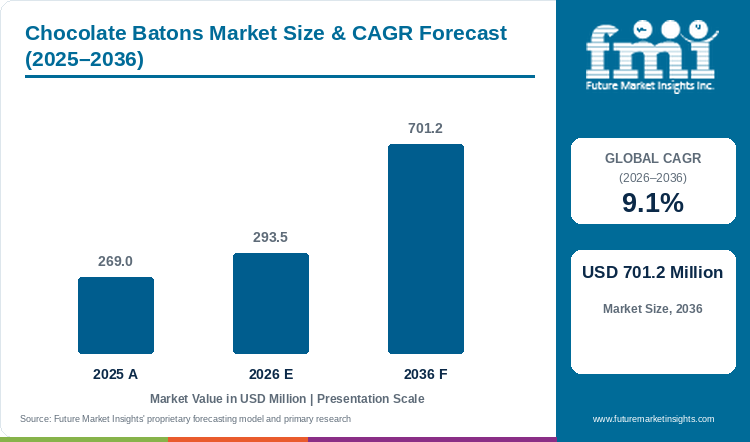
Table 1: Chocolate Batons Market Size and Forecast (USD million), 2025 to 2036
| Market size and forecast | Value |
|---|---|
| 2025 market size | USD 269.0 million |
| Estimated market size in 2026 | USD 293.5 million |
| Projected market size by 2036 | USD 701.2 million |
| CAGR (2026-2036) | 9.1% |
| Added revenue, 2026 to 2036 | USD 407.7 million |
Key Market Trends & Insights
- By Product Type: The Dark segment accounted for the largest share of the chocolate batons market in 2026, representing 36.0% of total market revenue.
- By Form: Powder / dry products held the leading market position with a share of 44.0% in 2026.
- By Application: Bread & rolls remained the largest application segment, accounting for 36.0% of the market in 2026.
Regional Highlights
- Fastest-growing country: The UAE is expected to record the highest growth rate among the eight profiled countries, with a projected CAGR of 10.4% between 2026 and 2036.
- Growth across other countries: Saudi Arabia is projected to expand at a CAGR of 10.1%, followed by South Korea at 9.8% and the USA at 9.4%. Japan is expected to register comparatively slower growth, with a CAGR of 8.2% during the forecast period.
Cocoa availability remains the most important factor influencing baton costs. The ICCO estimated that end-of-season cocoa stocks rose by almost 3.0% to 1.309 million tonnes in 2024/25, raising the stocks-to-grindings ratio to 28.2%[1]. Exports of cocoa beans and semi-finished products reached 2.09 million tonnes in January to March 2026, 2.8% lower than a year earlier[1]. The ICCO has also highlighted weather risks from an El Niño event expected later in 2026[1], which could reverse the recovery in supply. Product specifications link these costs to bakery use. Cacao Barry's dark baking stick, for instance, combines an eight-centimetre length with a minimum cocoa content of 44.0%[2], so its fit with pastry production equipment and its flavour are defined together.
Large chocolate users have seen demand weaken as prices rose. Mondelēz International reported that chocolate organic net revenue grew by 11.4% in 2025 despite a 7.5% decline in volume/mix, which the company attributed partly to the effect of significant cocoa-led pricing[6]. Barry Callebaut's Global Chocolate volumes fell by 5.3% in 2024/25, with the company citing customer behaviour shifts and consumption softness[5]. For bakeries, these conditions encourage closer attention to the quantity of chocolate in each pastry. Breakage and changes in piece weight influence the number of acceptable finished portions, so a revised chocolate specification carries both a sourcing decision and a need to preserve the established flavour and baking behaviour.
Regional production is expanding. IRCA's February 2025 announcement confirmed that its St. Louis chocolate facility was operating and introduced US production of RENO X[3], which broadens the professional chocolate supply available to customers in the Americas. Selection of a particular baton still depends on its own dimensions, formulation and baking specification. Ingredient communication also remains relevant in markets covered by EU food-information requirements[4], as changes in composition or manufacturing source can affect both application assessment and product records.
Table 2: Supporting Industry Indicators for the Chocolate Batons Market, 2024/25 to 2026
| Indicator | Data point | Why it matters | Source |
|---|---|---|---|
| Cocoa production | World gross cocoa production rose by 8.5% to 4.733 million tonnes in 2024/25. | Recovering production eases pressure on chocolate prices. | [1] |
| Cocoa grindings | World grindings fell by 3.3% to 4.649 million tonnes in 2024/25. | Lower grindings indicate weaker demand for cocoa products. | [1] |
| Supply balance | The ICCO estimates a 2024/25 cocoa supply surplus of 37,000 tonnes. | A surplus supports more stable chocolate costs. | [1] |
| Stocks | End-of-season stocks rose by almost 3.0% to 1.309 million tonnes, a stocks-to-grindings ratio of 28.2%. | Higher stocks provide a buffer against supply shocks. | [1] |
| Cocoa exports | Exports of cocoa beans and products fell by 2.8% to 2.09 million tonnes in January to March 2026. | Trade flows affect chocolate availability for processors. | [1] |
| Chocolate volumes | Barry Callebaut's sales volume fell by 6.8% in 2024/25, with Global Chocolate down 5.3%. | Weaker volumes reflect the impact of high cocoa prices on demand. | [5] |
| Chocolate pricing | Barry Callebaut's revenue rose by 49.0% to CHF 14.8 billion, driven by cocoa-related pricing. | Higher prices raise the cost of chocolate batons for bakeries. | [5] |
| Consumer response | Mondelēz chocolate organic revenue grew by 11.4% in 2025 despite a 7.5% decline in volume/mix. | Price-driven growth with lower volumes shows consumer sensitivity. | [6] |
| Baking-stick specification | Cacao Barry lists eight-centimetre dark sticks with 44.0% minimum cocoa content. | Geometry and cocoa content define placement and flavour. | [2] |
| Regional production | IRCA confirmed operating St. Louis chocolate production in February 2025. | Regional production widens supply options in the Americas. | [3] |
Demand Intensity Analysis
A comparison of FMI's market estimate with world cocoa grindings provides a measure of the share of cocoa processing directed to bakery batons. World grindings were 4.649 million tonnes in 2024/25[1]. FMI estimated the chocolate batons market at USD 269.0 million in 2025, which is equivalent to approximately USD 58.0 for every tonne of cocoa ground worldwide. The figure is small because batons represent a specialised bakery format within total chocolate use.
Chocolate pricing provides another reference point. Barry Callebaut's revenue increased by 49.0% while its volume fell by 6.8% in 2024/25[5], which implies an increase of approximately 60.0% in revenue per tonne. Mondelēz's chocolate organic revenue rose by 11.4% despite a 7.5% decline in volume/mix[6], implying a pricing contribution of approximately 19 percentage points. These figures indicate that chocolate costs for bakeries rose sharply over 2025, which may encourage reduced baton counts or smaller pieces in some recipes.
A similar comparison can be made between projected market growth and cocoa demand. World grindings fell by 3.3% in 2024/25[1], while FMI expects the chocolate batons market to grow at a CAGR of 9.1% between 2026 and 2036. The difference implies that baton growth will rely on wider use of pre-portioned chocolate in bakery, supported by a recovery in cocoa supply, rather than on growth in overall cocoa consumption. The 8.5% increase in production and the 28.2% stocks-to-grindings ratio[1] suggest that conditions are improving for buyers, although the El Niño risk remains.
Segment values show where demand is concentrated. Dark chocolate accounted for USD 105.7 million of Product Type revenue in 2026, and Bread & rolls separately accounted for USD 105.7 million on the Application axis. Direct to industrial bakeries represented USD 155.6 million of Sales Channel revenue. The market is projected to add USD 407.7 million from 2026 to 2036 and reach 2.4 times its 2026 value.
Table 3: Demand Intensity Metrics for the Chocolate Batons Market, 2024/25 Cocoa Data Against 2025 and 2026 Market Values
| Demand intensity metric | Value | Basis |
|---|---|---|
| FMI market value, 2025 | USD 269.0 million | FMI estimate of chocolate baton revenue. |
| World cocoa grindings, 2024/25 | 4.649 million tonnes | ICCO. |
| FMI value per tonne of cocoa ground | Approximately USD 58.0 | The calculation divides USD 269.0 million by 4.649 million tonnes. |
| Cocoa stocks-to-grindings ratio | 28.2% | ICCO, end of 2024/25. |
| Barry Callebaut revenue change, 2024/25 | +49.0% | Driven by cocoa-related pricing. |
| Barry Callebaut volume change, 2024/25 | -6.8% | Group sales volume. |
| Implied change in revenue per tonne | Approximately +60.0% | 1.49 divided by 0.932. |
| Mondelēz chocolate pricing contribution, 2025 | Approximately 19 percentage points | 11.4% organic growth less -7.5% volume/mix. |
| FMI value CAGR, 2026 to 2036 | 9.1% | FMI market forecast. |
| Dark revenue, 2026 | USD 105.7 million | 36.0% of the market. |
| Direct industrial bakery revenue, 2026 | USD 155.6 million | 53.0% of the market. |
| Market expansion multiple | 2.4 times | Projected 2036 market value relative to 2026. |
Analyst Perspective
"After two years of record cocoa costs, bakeries are counting every gram of chocolate in a pastry, so a baton that breaks less and places more consistently is worth more than a lower price per kilogram."
- Nandini Roy Choudhury, Principal Analyst at Future Market Insights
How is the chocolate batons market segmented?
The chocolate batons market is segmented by product type, form, application, claim and sales channel. Product Type comprises Dark, Milk, White & blond and Sugar-free & specialty. Form comprises Powder / dry, Liquid, Paste / semi-solid and Granules / pieces. Application comprises Bread & rolls, Cakes & muffins, Biscuits & cookies, Viennoiserie & pastry and Other bakery & snacks. Claim comprises Conventional, Clean label, Organic and Non-GMO / identity preserved. Sales Channel comprises Direct to industrial bakeries, Ingredient distributors, Foodservice & artisan supply and Online B2B.
Why does Dark anchor Product Type specifications?
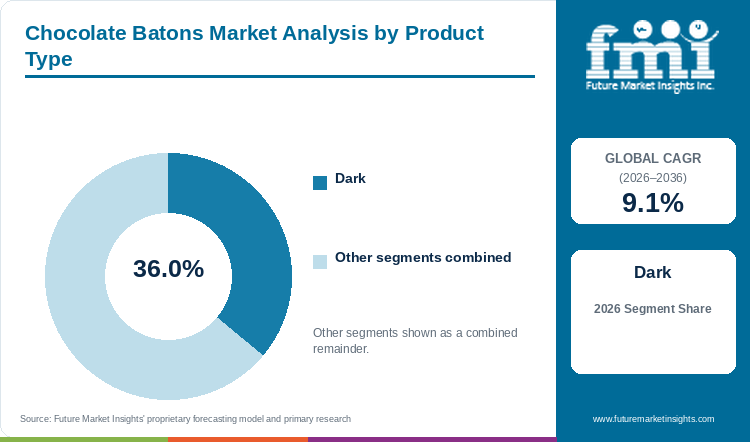
Dark accounts for 36.0% of Product Type in 2026.
Pain au chocolat is traditionally made with dark chocolate, which gives a distinct cocoa note within butter-rich dough, and the Dark segment generated approximately USD 105.7 million in 2026. Intensity needs to be judged at the planned serving size and piece count. Cacao Barry's extruded baking sticks specify minimum cocoa content and an eight-centimetre length[2]. Higher cocoa costs[5] place particular pressure on dark grades, which contain more cocoa solids than milk or white chocolate. The selected grade should reproduce the intended centre through the established shaping, proofing and oven sequence.
- Dark accounts for 36.0% of Product Type in 2026.
- The intended dough and serving portion determine whether the selected cocoa intensity is balanced.
How does Powder / dry support repeatable bakery handling?
Powder / dry holds 44.0% of Form in 2026.
Dry formats accounted for 44.0% of the Form classification, or approximately USD 129.1 million, in 2026. For batons, evaluation centres on the exact format and instructions supplied for the intended recipe. Piece dimensions and packing influence placement, while composition determines the flavour and behaviour of the centre after baking. Alternative chocolate preparations involve different dosing arrangements and cannot be assessed solely by a shared product description. Separation in the pack and resistance to breakage affect the material usable at the bench.
- Powder / dry holds 44.0% of Form in 2026.
- Normal unpacking and handling show the share of pieces that remain intact and easy to place.
Why are Bread & rolls the central Application route?
Bread & rolls represent 36.0% of Application in 2026.
Filled breads and sweet rolls accounted for approximately USD 105.7 million in 2026, and in these products the relationship between baton length and dough weight determines how the chocolate centre is distributed. Closure also matters, as a piece that sits well in one shape may need another position in a different product. The trial needs to follow ordinary proofing, baking and cooling before the portion is assessed at serving temperature. Once the geometry is settled, a pre-portioned piece gives staff a visible reference for repeating the centre.
- Bread & rolls represent 36.0% of Application in 2026.
- Baton position and dough closure are assessed together through proofing, baking and cooling.
What sustains Conventional claims within bakery procurement?
Conventional leads Claim with 56.0% in 2026.
Conventional batons led the Claim segment with 56.0% in 2026, but they still need a clear ingredient record even where the finished product carries no additional claim. An unexpected change in milk content, emulsifier or another component may affect processing and product information. EU food-information rules address ingredient and allergen communication[4]. Suppliers under cost pressure from cocoa[5] may consider reformulation, so accurate change notification keeps the agreed specification useful.
- Conventional leads Claim with 56.0% in 2026.
- Formulation changes need to be reflected in the bakery's ingredient and product records.
Why do Direct to industrial bakeries contracts lead Sales Channel?
Direct to industrial bakeries represents 53.0% of Sales Channel in 2026.
Industrial bakeries buying directly can specify baton dimensions, pack configuration and replenishment around their assembly schedule, and direct supply accounted for approximately USD 155.6 million in 2026. Contracts also establish how formulation or manufacturing-source changes are communicated. With cocoa prices volatile[1][5], direct arrangements can include pricing mechanisms that give both sides more certainty. Distributors serve smaller orders, while direct supply allows closer coordination over larger requirements.
- Direct to industrial bakeries represents 53.0% of Sales Channel in 2026.
- Contracts can define dimensional limits and the response when a delivery falls outside them.
What are the drivers, restraints and opportunities in the chocolate batons market?
A defined chocolate portion simplifies pastry assembly, but high cocoa costs make usable yield central to the price comparison, while geometry and sensory choice can widen the role of the baton.
A defined chocolate portion simplifies pastry assembly
A defined baton turns chocolate addition into a placement operation within pastry assembly. Its benefit depends on the piece fitting the dough and remaining intact through ordinary handling, as illustrated by Cacao Barry's baking-stick specification[2]. Piece count determines the portion, which gives bakeries precise control over chocolate use at a time of high cocoa costs[5]. Consistent dimensions preserve the placement method across a run and reduce adjustment, while packing protects the specification between dispatch and use. These conditions allow a qualified format to support increased output without a new method for distributing chocolate.
High cocoa costs make usable yield central to the price comparison
Chocolate is bought by weight, while the bakery sells pastries by the piece, so the useful cost comparison depends on how much of a delivery becomes acceptable finished units. Breakage, inconsistent portions and leakage can erode the value of a lower quotation. Cocoa costs have added pressure. Barry Callebaut's revenue per tonne rose by approximately 60.0% in 2024/25[5], and the ICCO has warned of weather risks from El Niño[1]. The wider cocoa ingredient supply context helps frame negotiation, while intact yield and the accepted pastry specification determine what an offer is worth in practice.
Geometry and sensory choice can widen the role of the baton
Changes in baton size or chocolate profile extend the possible bakery applications while retaining a defined placement method. Development alongside dough formulation connects sweetness, fat and chocolate intensity across the complete product. A revised geometry can support a compact pastry, while another arrangement may suit a larger filled roll. As cocoa supply recovers, with world production up 8.5% in 2024/25[1], suppliers have room to develop new formats, provided each remains practical to unpack and place in the normal assembly sequence.
Which country CAGRs are profiled in the chocolate batons market?
Table 4: Country growth outlook for the chocolate batons market
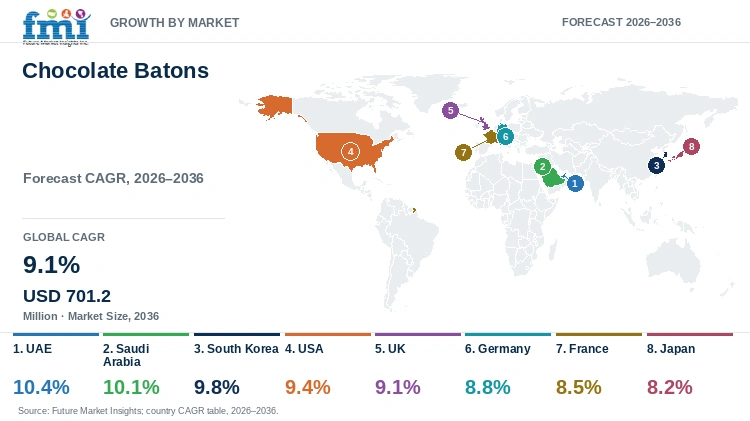
| Country | CAGR |
|---|---|
| UAE | 10.4% |
| Saudi Arabia | 10.1% |
| South Korea | 9.8% |
| USA | 9.4% |
| UK | 9.1% |
| Germany | 8.8% |
| France | 8.5% |
| Japan | 8.2% |
UAE
- The UAE is the fastest-growing market among the profiled countries, with a forecast CAGR of 10.4% from 2026 to 2036. Intact delivery and consistent placement shape chocolate baton purchasing for UAE bakeries serving hotels and cafés. The piece must keep its dimensions through distribution before its flavour can be assessed in the chosen pastry, and chocolate intensity depends on portion size and serving temperature. A common recipe and presentation standard connect each team's assembly work with the same finished centre.
Saudi Arabia
- In Saudi central-bakery production, baton dimensions and dough closure determine how well a chocolate centre fits. Breakage during unpacking and placement changes the amount usable in a run, so pack configuration is part of qualification. Saudi Arabia is projected to grow at a CAGR of 10.1% for 2026 to 2036. As output increases, trial packs give way to larger deliveries under the same grade specification, and clear composition and dimensions allow several teams to keep the accepted method.
South Korea
- With a forecast CAGR of 9.8% from 2026 to 2036, South Korea ranks third among the profiled countries. A narrow pastry needs a different chocolate piece from a richer, larger filled product, so South Korean development involves placement and geometry as much as composition. Comparing alternatives in small trial packs helps establish the balance within the complete portion before one format is standardised.
USA
- Larger US accounts run filled rolls and pastries on fixed schedules, which gives them a defined requirement for chocolate portions and replenishment. IRCA's 2025 confirmation of operating production in St. Louis adds regional supply options[3]. The USA is forecast to grow at a CAGR of 9.4% from 2026 to 2036. Mondelēz's report of a 7.5% decline in chocolate volume/mix in 2025[6] shows that US consumers have responded to higher chocolate prices, which reinforces the value of precise portioning.
UK
- In UK pastry, piece weight, breakage and stick count determine the chocolate cost in each saleable unit. A smaller baton changes both the nominal portion and the balance between chocolate and dough, so the sensory result remains part of the comparison. The UK is forecast to grow at a CAGR of 9.1% from 2026 to 2036. Matching replenishment quantities to regular output supports continued use of the accepted piece without excess stock.
Germany
- Germany is projected to grow at a CAGR of 8.8% from 2026 to 2036. German forming lines depend on dimensional tolerances, as differences in length or breakage can increase manual intervention even when the chocolate meets the taste specification. A trial therefore needs to start with unpacking and continue through placement, closure and baking. Accurate composition records also support the food information required in the EU[4], and advance notice of product changes gives the bakery time to examine their effect.
France
- France is forecast to grow at a CAGR of 8.5% from 2026 to 2036. Pain au chocolat gives French buyers a precise setting in which to judge a baton, which must fit laminated dough and leave a defined chocolate centre after baking. Cacao Barry's eight-centimetre baking stick is designed for this application[2]. Artisan kitchens compare intensity and texture within their own dough, while larger operations focus on repeated assembly. Maintaining portion geometry preserves the pastry's balance when volume changes.
Japan
- Japan is expected to register the slowest growth among the profiled countries, with a projected CAGR of 8.2% for 2026 to 2036. The balance between chocolate and dough guides baton selection for Japanese pastries and individually portioned filled breads, with sweetness and texture after cooling as the reference. Specified piece weights support consistent placement during trials, and stable dimensions and composition preserve the assembly method as a recipe becomes a regular item.
Who are the notable companies in the chocolate batons market?
Barry Callebaut; IRCA Group; Puratos / Belcolade; Valrhona; Cémoi
Barry Callebaut, IRCA Group, Puratos / Belcolade, Valrhona and Cémoi offer identifiable professional chocolate sticks or batons. Barry Callebaut, the owner of the Cacao Barry and Callebaut brands, reported 2024/25 revenue of CHF 14.8 billion[5], while IRCA has added US production in St. Louis[3]. Cacao Barry's published specification illustrates the detail available for a dedicated bakery piece[2].
Chocolate composition and piece geometry have to fit the same recipe. Dimensions affect placement and closure, while intensity and texture emerge in the finished pastry, so assessment across assembly and baking establishes which supplier specification provides the intended portion.
Competitive Benchmarking: Chocolate Batons Market
Table 5: Company capabilities in the chocolate batons market
| Company | Relevant offering | Purchasing consideration |
|---|---|---|
| Barry Callebaut | Cacao Barry and Callebaut baking sticks | Compare dimensions and chocolate specification |
| IRCA Group | Barrette Fondente for pre-bake applications | Assess the selected barrette in the customer’s dough |
| Puratos / Belcolade | Bake-stable chocolate sticks | Match piece count and flavor to the recipe |
| Valrhona | Dark chocolate batons and specialty viennoiserie sticks | Select the chocolate profile and working dimensions |
| Cémoi | Bâtons boulangers for professional bakeries | Evaluate baking behavior and usable piece yield |
Key Developments in the Chocolate Batons Market
- In February 2025, IRCA confirmed that its St. Louis chocolate facility was operational and introduced US production of RENO X[3].
- In November 2025, Barry Callebaut reported a 6.8% decline in sales volume and a 49.0% increase in revenue for 2024/25[5].
- In February 2026, Mondelēz reported that its chocolate organic revenue grew by 11.4% in 2025 despite a 7.5% decline in volume/mix[6].
- In August 2026, the ICCO estimated a global cocoa surplus of 37,000 tonnes for 2024/25, with production up 8.5% and grindings down 3.3%, and warned of weather risks from an expected El Niño event[1].
Key Players in the Chocolate Batons Market
- Barry Callebaut
- IRCA Group
- Puratos / Belcolade
- Valrhona
- Cémoi
Chocolate Batons Market - Report Scope
Table 6: Report scope for the chocolate batons market
| Coverage field | Report scope |
|---|---|
| Market breakdown | Product Type, Form, Application, Claim, Sales Channel |
| Quantitative Units | USD Million |
| Market Definition | Revenue from professional chocolate batons and compatible cocoa/chocolate ingredient formats sold specifically for defined bakery baton-style fillings or inclusions. Excludes downstream finished bakery sales, stand-alone cocoa powder used outside the defined application, generic confectionery bars and adjacent non-chocolate substitutes. For a multi-ingredient transaction, only the eligible chocolate component is in scope. |
| Regions Covered | North America, Latin America, Western Europe, Eastern Europe, East Asia, South Asia and Pacific, Middle East and Africa |
| Countries Covered | UAE; Saudi Arabia; South Korea; USA; UK; Germany; France; Japan |
| Key Companies Profiled | Barry Callebaut; IRCA Group; Puratos / Belcolade; Valrhona; Cémoi |
| Forecast Period | 2026 to 2036 |
| Approach | Market assessment supported by official technical and regulatory publications, company product information and country operating conditions. |
Chocolate Batons Market - Research Methodology
Table 7: Research approach for the chocolate batons market
| Method | Approach |
|---|---|
| Market definition | The assessment separates qualifying ingredient revenue from finished bakery products and unrelated formulation inputs. |
| Secondary evidence | Government publications, regulatory material, technical literature and first-party product documentation establish the operating context. |
| Commercial assessment | Product performance, supply continuity and customer qualification requirements are considered within each segment and country profile. |
| Comparability | Market values, segment shares and country forecasts use the stated revenue boundary, units and forecast period. |
Chocolate Batons Market by Segments
Product Type
- Dark
- Milk
- White & blond
- Sugar-free & specialty
Form
- Powder / dry
- Liquid
- Paste / semi-solid
- Granules / pieces
Application
- Bread & rolls
- Cakes & muffins
- Biscuits & cookies
- Viennoiserie & pastry
- Other bakery & snacks
Claim
- Conventional
- Clean label
- Organic
- Non-GMO / identity preserved
Sales Channel
- Direct to industrial bakeries
- Ingredient distributors
- Foodservice & artisan supply
- Online B2B
Chocolate Batons Market by Region
- North America
- United States
- Canada
- Latin America
- Brazil
- Mexico
- Argentina
- Chile
- Western Europe
- Germany
- France
- United Kingdom
- Italy
- Spain
- Benelux
- Nordics
- Eastern Europe
- Poland
- Czech Republic
- Romania
- Hungary
- East Asia
- China
- Japan
- South Korea
- South Asia and Pacific
- India
- ASEAN
- Australia and New Zealand
- Middle East and Africa
- GCC Countries
- South Africa
- Türkiye
- Israel
Research Sources and Bibliography
- [1] International Cocoa Organization. (2026, August 31). August 2026 quarterly bulletin of cocoa statistics.
- [2] Barry Callebaut. (n.d.). Cacao Barry baking: Dark extruded baking sticks, 44% minimum cacao, 8 cm.
- [3] IRCA Group. (2025, February 18). Crafted in Italy, produced in the USA.
- [4] European Commission. (n.d.). Food information to consumers: Legislation.
- [5] Eastlake, D. (2025, November 5). ConfectioneryNews. Barry Callebaut revenue up 49% but sales down, as cocoa price hikes hit industry leader.
- [6] Redman, R. (2026, February 5). Food Business News. Mondelez offers cautious guidance for 2026.
Future Market Insights. (2026). Chocolate Batons Market: Global Industry Analysis and Opportunity Assessment 2036.
This Report Answers
- What are the chocolate batons market values in 2026 and 2036?
- How does pre-portioned chocolate affect bakery assembly?
- Why does Dark lead Product Type in 2026?
- Which handling and portion characteristics matter when comparing formats?
- What are the forecast CAGRs across the eight profiled countries?
- Which suppliers offer professional chocolate batons or sticks?
Frequently Asked Questions
How big is the chocolate batons market in 2026, and what is forecast for 2036?
The market is valued at USD 293.5 million in 2026 and is forecast to reach USD 701.2 million by 2036.
What is the projected CAGR from 2026 to 2036?
The market is forecast to grow at a CAGR of 9.1% from 2026 to 2036.
Which Product Type leads the chocolate batons market?
Dark leads with 36.0% in 2026, as chocolate intensity and baking performance guide selection.
Which Form leads the chocolate batons market?
Powder / dry leads with 44.0% in 2026.
Which profiled country has the highest projected growth?
The UAE leads at 10.4%, followed by Saudi Arabia at 10.1% and South Korea at 9.8% from 2026 to 2036.
Which companies are active in the market?
The report profiles Barry Callebaut, IRCA Group, Puratos / Belcolade, Valrhona and Cémoi.
Preview the report firsthand - request a free sample
Get SampleGet the brochure for pricing and purchase details.
Get PDFTable of Content
- Key Takeaways
- Market Size and CAGR
- Top Growth Driver
- Fastest Growing Segment
- Leading Region
- Key Companies
- Emerging Opportunities
- Executive Summary
- Global Market Outlook
- Demand-side Trends
- Supply-side Trends
- Technology Roadmap Analysis
- Analysis and Recommendations
- Analyst Perspective (What is happening? Why now? What should investors know?)
- Key Questions Answered
- How large is the market?
- What is the CAGR?
- What are key trends?
- Which region dominates?
- Who are the leaders?
- Market Overview
- Market Coverage / Taxonomy
- Market Definition / Scope / Limitations
- Research Methodology
- Chapter Orientation
- Analytical Lens and Working Hypotheses
- Market Structure, Signals, and Trend Drivers
- Benchmarking and Cross-market Comparability
- Market Sizing, Forecasting, and Opportunity Mapping
- Research Design and Evidence Framework
- Desk Research Programme (Secondary Evidence)
- Expert Input and Fieldwork (Primary Evidence)
- Tooling, Models, and Reference Databases
- Data Engineering and Model Build
- Quality Assurance and Audit Trail
- Market Background
- Market Dynamics (Drivers, Restraints, Opportunity, Trends)
- Scenario Forecast (Optimistic, Likely, Conservative)
- Impact Analysis
- AI Impact
- Sustainability Impact
- Regulatory Impact
- Technology Impact
- Consumer / Buyer Analysis
- Purchase Drivers
- Adoption Barriers
- Buyer Journey
- Opportunity Map Analysis
- Product Life Cycle Analysis
- Supply Chain Analysis
- Investment Feasibility Matrix
- Value Chain Analysis
- PESTLE and Porter's Analysis
- Regulatory Landscape
- Regional Parent Market Outlook
- Production and Consumption Statistics
- Import and Export Statistics
- Global Market Analysis and Forecast, 2021 to 2036
- Historical Market Size Value (USD Million) Analysis, 2021 to 2025
- Current and Future Market Size Value (USD Million) Projections, 2026 to 2036
- Y-o-Y Growth Trend Analysis
- Absolute $ Opportunity Analysis
- Global Market Pricing Analysis, 2021 to 2036
- Global Market Analysis and Forecast, By Product Type, 2021 to 2036
- Introduction / Key Findings
- Historical Market Size Value (USD Million) Analysis By Product Type, 2021 to 2025
- Current and Future Market Size Value (USD Million) Analysis and Forecast By Product Type, 2026 to 2036
- Dark
- Milk
- White & blond
- Sugar-free & specialty
- Y-o-Y Growth Trend Analysis By Product Type, 2021 to 2025
- Absolute $ Opportunity Analysis By Product Type, 2026 to 2036
- Global Market Analysis and Forecast, By Form, 2021 to 2036
- Introduction / Key Findings
- Historical Market Size Value (USD Million) Analysis By Form, 2021 to 2025
- Current and Future Market Size Value (USD Million) Analysis and Forecast By Form, 2026 to 2036
- Powder / dry
- Liquid
- Paste / semi-solid
- Granules / pieces
- Y-o-Y Growth Trend Analysis By Form, 2021 to 2025
- Absolute $ Opportunity Analysis By Form, 2026 to 2036
- Global Market Analysis and Forecast, By Application, 2021 to 2036
- Introduction / Key Findings
- Historical Market Size Value (USD Million) Analysis By Application, 2021 to 2025
- Current and Future Market Size Value (USD Million) Analysis and Forecast By Application, 2026 to 2036
- Bread & rolls
- Cakes & muffins
- Biscuits & cookies
- Viennoiserie & pastry
- Other bakery & snacks
- Y-o-Y Growth Trend Analysis By Application, 2021 to 2025
- Absolute $ Opportunity Analysis By Application, 2026 to 2036
- Global Market Analysis and Forecast, By Claim, 2021 to 2036
- Introduction / Key Findings
- Historical Market Size Value (USD Million) Analysis By Claim, 2021 to 2025
- Current and Future Market Size Value (USD Million) Analysis and Forecast By Claim, 2026 to 2036
- Conventional
- Clean label
- Organic
- Non-GMO / identity preserved
- Y-o-Y Growth Trend Analysis By Claim, 2021 to 2025
- Absolute $ Opportunity Analysis By Claim, 2026 to 2036
- Global Market Analysis and Forecast, By Sales Channel, 2021 to 2036
- Introduction / Key Findings
- Historical Market Size Value (USD Million) Analysis By Sales Channel, 2021 to 2025
- Current and Future Market Size Value (USD Million) Analysis and Forecast By Sales Channel, 2026 to 2036
- Direct to industrial bakeries
- Ingredient distributors
- Foodservice & artisan supply
- Online B2B
- Y-o-Y Growth Trend Analysis By Sales Channel, 2021 to 2025
- Absolute $ Opportunity Analysis By Sales Channel, 2026 to 2036
- Global Market Analysis and Forecast, By Region, 2021 to 2036
- Introduction
- Historical Market Size Value (USD Million) Analysis By Region, 2021 to 2025
- Current Market Size Value (USD Million) Analysis and Forecast By Region, 2026 to 2036
- North America
- Latin America
- Western Europe
- Eastern Europe
- East Asia
- South Asia and Pacific
- Middle East and Africa
- Market Attractiveness Analysis By Region
- North America Market Analysis and Forecast, By Country, 2021 to 2036
- Historical Market Size Value (USD Million) Trend Analysis By Market Taxonomy, 2021 to 2025
- Market Size Value (USD Million) Forecast By Market Taxonomy, 2026 to 2036
- By Country
- United States
- Canada
- By Product Type
- By Form
- By Application
- By Claim
- By Sales Channel
- By Country
- Market Attractiveness Analysis
- By Country
- By Product Type
- By Form
- By Application
- By Claim
- By Sales Channel
- Key Takeaways
- Latin America Market Analysis and Forecast, By Country
- Historical Market Size Value (USD Million) Trend Analysis By Market Taxonomy, 2021 to 2025
- Market Size Value (USD Million) Forecast By Market Taxonomy, 2026 to 2036
- By Country
- Brazil
- Mexico
- Argentina
- Chile
- By Product Type
- By Form
- By Application
- By Claim
- By Sales Channel
- By Country
- Market Attractiveness Analysis
- By Country
- By Product Type
- By Form
- By Application
- By Claim
- By Sales Channel
- Key Takeaways
- Western Europe Market Analysis and Forecast, By Country
- Historical Market Size Value (USD Million) Trend Analysis By Market Taxonomy, 2021 to 2025
- Market Size Value (USD Million) Forecast By Market Taxonomy, 2026 to 2036
- By Country
- Germany
- France
- United Kingdom
- Italy
- Spain
- Benelux
- Nordics
- By Product Type
- By Form
- By Application
- By Claim
- By Sales Channel
- By Country
- Market Attractiveness Analysis
- By Country
- By Product Type
- By Form
- By Application
- By Claim
- By Sales Channel
- Key Takeaways
- Eastern Europe Market Analysis and Forecast, By Country
- Historical Market Size Value (USD Million) Trend Analysis By Market Taxonomy, 2021 to 2025
- Market Size Value (USD Million) Forecast By Market Taxonomy, 2026 to 2036
- By Country
- Poland
- Czech Republic
- Romania
- Hungary
- By Product Type
- By Form
- By Application
- By Claim
- By Sales Channel
- By Country
- Market Attractiveness Analysis
- By Country
- By Product Type
- By Form
- By Application
- By Claim
- By Sales Channel
- Key Takeaways
- East Asia Market Analysis and Forecast, By Country
- Historical Market Size Value (USD Million) Trend Analysis By Market Taxonomy, 2021 to 2025
- Market Size Value (USD Million) Forecast By Market Taxonomy, 2026 to 2036
- By Country
- China
- Japan
- South Korea
- By Product Type
- By Form
- By Application
- By Claim
- By Sales Channel
- By Country
- Market Attractiveness Analysis
- By Country
- By Product Type
- By Form
- By Application
- By Claim
- By Sales Channel
- Key Takeaways
- South Asia and Pacific Market Analysis and Forecast, By Country
- Historical Market Size Value (USD Million) Trend Analysis By Market Taxonomy, 2021 to 2025
- Market Size Value (USD Million) Forecast By Market Taxonomy, 2026 to 2036
- By Country
- India
- ASEAN
- Australia and New Zealand
- By Product Type
- By Form
- By Application
- By Claim
- By Sales Channel
- By Country
- Market Attractiveness Analysis
- By Country
- By Product Type
- By Form
- By Application
- By Claim
- By Sales Channel
- Key Takeaways
- Middle East and Africa Market Analysis and Forecast, By Country
- Historical Market Size Value (USD Million) Trend Analysis By Market Taxonomy, 2021 to 2025
- Market Size Value (USD Million) Forecast By Market Taxonomy, 2026 to 2036
- By Country
- GCC Countries
- South Africa
- Türkiye
- Israel
- By Product Type
- By Form
- By Application
- By Claim
- By Sales Channel
- By Country
- Market Attractiveness Analysis
- By Country
- By Product Type
- By Form
- By Application
- By Claim
- By Sales Channel
- Key Takeaways
- Key Countries Market Analysis
- United States
- Pricing Analysis
- Market Share Analysis, 2025
- By Product Type
- By Form
- By Application
- By Claim
- By Sales Channel
- Canada
- Pricing Analysis
- Market Share Analysis, 2025
- By Product Type
- By Form
- By Application
- By Claim
- By Sales Channel
- Mexico
- Pricing Analysis
- Market Share Analysis, 2025
- By Product Type
- By Form
- By Application
- By Claim
- By Sales Channel
- Brazil
- Pricing Analysis
- Market Share Analysis, 2025
- By Product Type
- By Form
- By Application
- By Claim
- By Sales Channel
- Chile
- Pricing Analysis
- Market Share Analysis, 2025
- By Product Type
- By Form
- By Application
- By Claim
- By Sales Channel
- Germany
- Pricing Analysis
- Market Share Analysis, 2025
- By Product Type
- By Form
- By Application
- By Claim
- By Sales Channel
- United Kingdom
- Pricing Analysis
- Market Share Analysis, 2025
- By Product Type
- By Form
- By Application
- By Claim
- By Sales Channel
- Italy
- Pricing Analysis
- Market Share Analysis, 2025
- By Product Type
- By Form
- By Application
- By Claim
- By Sales Channel
- Spain
- Pricing Analysis
- Market Share Analysis, 2025
- By Product Type
- By Form
- By Application
- By Claim
- By Sales Channel
- France
- Pricing Analysis
- Market Share Analysis, 2025
- By Product Type
- By Form
- By Application
- By Claim
- By Sales Channel
- India
- Pricing Analysis
- Market Share Analysis, 2025
- By Product Type
- By Form
- By Application
- By Claim
- By Sales Channel
- ASEAN
- Pricing Analysis
- Market Share Analysis, 2025
- By Product Type
- By Form
- By Application
- By Claim
- By Sales Channel
- Australia and New Zealand
- Pricing Analysis
- Market Share Analysis, 2025
- By Product Type
- By Form
- By Application
- By Claim
- By Sales Channel
- China
- Pricing Analysis
- Market Share Analysis, 2025
- By Product Type
- By Form
- By Application
- By Claim
- By Sales Channel
- Japan
- Pricing Analysis
- Market Share Analysis, 2025
- By Product Type
- By Form
- By Application
- By Claim
- By Sales Channel
- South Korea
- Pricing Analysis
- Market Share Analysis, 2025
- By Product Type
- By Form
- By Application
- By Claim
- By Sales Channel
- Poland
- Pricing Analysis
- Market Share Analysis, 2025
- By Product Type
- By Form
- By Application
- By Claim
- By Sales Channel
- Hungary
- Pricing Analysis
- Market Share Analysis, 2025
- By Product Type
- By Form
- By Application
- By Claim
- By Sales Channel
- Türkiye
- Pricing Analysis
- Market Share Analysis, 2025
- By Product Type
- By Form
- By Application
- By Claim
- By Sales Channel
- South Africa
- Pricing Analysis
- Market Share Analysis, 2025
- By Product Type
- By Form
- By Application
- By Claim
- By Sales Channel
- UAE
- Pricing Analysis
- Market Share Analysis, 2025
- By Product Type
- By Form
- By Application
- By Claim
- By Sales Channel
- Saudi Arabia
- Pricing Analysis
- Market Share Analysis, 2025
- By Product Type
- By Form
- By Application
- By Claim
- By Sales Channel
- United States
- Market Structure Analysis
- Competition Dashboard
- Competition Benchmarking
- Market Share Analysis of Top Players
- By Regional
- By Product Type
- By Form
- By Application
- By Claim
- By Sales Channel
- Emerging Startups
- Innovation Benchmarking
- Competition Analysis
- Competition Deep Dive
- Barry Callebaut
- Overview
- Product Portfolio
- Profitability by Market Segments
- Sales Footprint
- Strategy Overview
- Marketing Strategy
- Product Strategy
- Channel Strategy
- IRCA Group
- Puratos / Belcolade
- Valrhona
- Cémoi
- Barry Callebaut
- Case Studies
- Success Stories
- Recent Developments
- Competition Deep Dive
- Assumptions & Acronyms Used


