

- Market Size (2026)
- USD 131.8 Bn
- Forecast (2036)
- USD 200.9 Bn
- CAGR (2026 to 2036)
- 4.3%
How big is Clinical Trials Market in 2026?
Demand is projected to expand at 4.3% CAGR from 2026 to 2036. Market value rises from USD 126.36 billion in 2025 to USD 131.8 billion in 2026 and USD 200.9 billion by 2036.
Sponsors purchase a coordinated programme of site preparation, participant recruitment, monitoring and data work, with the required resources changing across trial phases and therapeutic areas. Phase 3 programmes account for approximately 48% of spending in 2026, reflecting their extensive confirmatory work, while earlier studies and post-approval research create different service requirements. Country rules also influence execution: the UK reform connects combined review with disclosure duties, Germany provides standard contractual clauses, and China's eligible innovative-drug pathway includes defined local execution conditions. [1][2][3] These arrangements make preparation at the site and sponsor level commercially important alongside regulatory submission. Through 2036, research providers are likely to compete through protocol-specific delivery and the ability to maintain useful data across participating locations, with recruitment and staff capacity continuing to shape study progress.
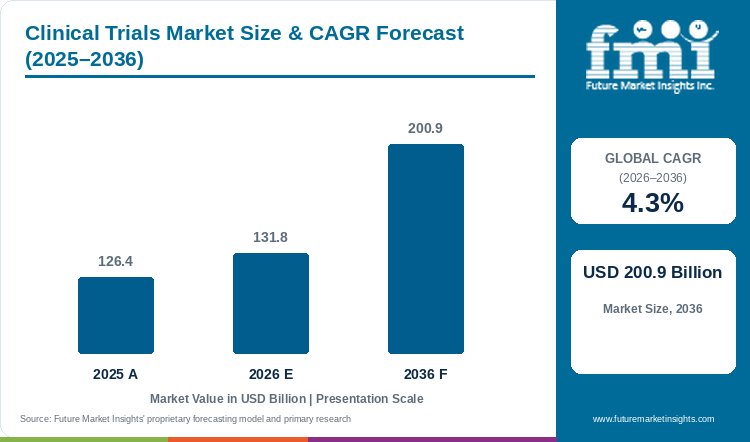
Key Market Trends & Insights
- Defined conduct requirements create demand for specific trial capabilities.
- Authorisation can advance faster than contracting and recruitment readiness.
- Execution-linked start-up offers can connect regulatory change with usable capacity.
Regional Highlights
- India's clinical research market brings a broad patient population and varied institutional capabilities into sponsors' feasibility decisions (FMI outlook: 6.1% CAGR, 2026 to 2036).
- China's innovative-drug review pathway connects an accelerated submission route with specific execution conditions, making local preparation important before a sponsor applies (FMI outlook: 5.8% CAGR, 2026 to 2036).
- Germany's standard contractual-clause ordinance applies to relevant trial contracts concluded after December 17, 2025, giving sponsors and centres a defined framework for several rights and responsibilities (FMI outlook: 5.6% CAGR, 2026 to 2036).
Market Size & Forecast
Table 1: Market Size and Forecast for Clinical Trials Market (USD billion and percentage), 2025 to 2036
| Metric | Value |
|---|---|
| 2025 market value | USD 126.36 billion |
| 2026 market value | USD 131.8 billion |
| 2036 market value | USD 200.9 billion |
| CAGR 2026 to 2036 | 4.3% |
| Revenue increase 2026 to 2036 | USD 69.1 billion |
| Market expansion 2026 to 2036 | 1.52 times |
The market covers interventional-trial approvals and the services involved in recruitment and conduct. Protocols and applications are distinguished from sites, participants and registry entries.
Clinical site networks connect sponsors with the investigators, coordinators and participant access required to execute a study across locations.
The trial start-up and conduct clock
Trial preparation spans contracts, regulatory review and the resources required across participating institutions. Germany's standard clauses address sponsor-site responsibilities, while the UK's reforms connect review with initiation and disclosure. These contractual and regulatory interfaces need to be managed as a study moves into conduct. [1][2]
Table 2: Industry evidence relevant to the clinical trials market
| Indicator | Data point or observation | Market relevance | Source |
|---|---|---|---|
| German contracts | Standard clauses apply after 17 December 2025 | Sponsor-site responsibilities enter study preparation | [1] |
| UK reform | Combined review and disclosure conditions effective 28 April 2026 | Regulatory preparation remains connected with execution | [2] |
Analyst Perspective
"A clinical-trial provider is selected against the protocol and the work needed to carry it through. Sponsors need coordinated sites, dependable data handling and clear responsibilities across the research programme, with regulatory requirements and practical implementation shaping the service relationship as much as its initial scope."
- Anurag Sharma, Principal Consultant for Healthcare, FMI
How is the Clinical Trials Market segmented?
The market is segmented by Phase, Trial Focus, Therapeutic Area, Study Design, and Region.
The market is segmented by Phase, Trial Focus, Therapeutic Area and Study Design. Trial phase follows the development stage from initial clinical evaluation through confirmatory and post-marketing studies, while the remaining categories describe the study objective, disease setting and research design. Resource requirements depend on the protocol and participant population within each category.
Why do Phase 3 Trials account for 48.0% of phase demand in 2026?
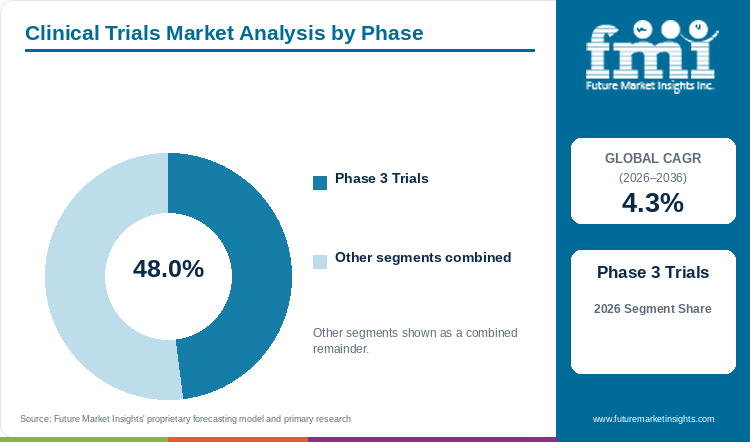
The Phase 3 Trials segment is projected to account for 48.0% of trial phase demand in 2026.
Table 3: Phase Share for Clinical Trials Market (percentage share), 2026
| Phase | Estimated share (2026) |
|---|---|
| Phase 3 Trials | 48.0% |
| Other phase segments | 52.0% |
| Total | 100.0% |
Table 4: Segment Position and Market Growth for Clinical Trials Market, 2026 to 2036
| Metric | Value |
|---|---|
| Global CAGR (2026 to 2036) | 4.3% |
| Profiled phase segment | Phase 3 Trials |
- Confirmatory studies can require extensive coordination across sites, participant populations and scheduled assessments, giving Phase 3 a substantial role in clinical research spending. The sponsor needs a programme that can recruit the intended population and maintain consistent protocol execution as data accumulate, with monitoring and study management continuing over the trial's course. Country-specific submission and contractual requirements add further preparation work when the study spans several markets. The UK reform and Germany's standard clauses illustrate different parts of that operating environment. [1][2] The approximately 48.0% share reported for 2026 reflects this resource-intensive confirmatory stage, while a provider's commercial usefulness depends on its ability to translate the protocol into a functioning site-level programme.
- Phase 3 Trials account for approximately 48.0% of trial-phase demand in 2026, reflecting the extensive execution requirements of confirmatory research.
- Multicentre preparation needs to connect the study contract, recruitment plan and monitoring responsibilities with the work each participating site can perform. [1][2]
Phase 2 Trials: efficacy and proof-of-concept research services
2026 trial-phase scenario: Phase 2 Trials, 26.0%; other trial phases, 74.0%; total, 100.0%.
Phase 2 studies examine efficacy and the practical development questions that determine how a candidate may progress, creating a different service requirement from a large confirmatory programme. Sponsors need suitable participants, interpretable assessments and a study plan capable of testing the intended clinical proposition, while operational choices must fit the particular disease and intervention. Phase 2 Trials are estimated at 26.0% of trial-phase demand under the 2026 market scenario, representing a substantial earlier-development services opportunity within the same phase-spending denominator. Providers can add value through feasibility work, site preparation and coordinated data collection, especially where the emerging clinical questions require a focused protocol and reliable execution across the selected locations.
The Phase 2 Trials segment accounts for an estimated 26.0% of trial-phase demand under the 2026 market scenario.
- Phase 2 Trials are estimated at 26.0% of trial-phase demand under the 2026 market scenario, reflecting efficacy and proof-of-concept work before confirmatory development.
- Study providers need to connect the candidate's clinical questions with suitable sites, recruitment feasibility and assessments that can produce interpretable results.
- Trial logistics coordinates the movement of study products and supplies around the protocol and participating sites.
What are the drivers, restraints, and opportunities in the Clinical Trials Market?
A clinical-trial contract purchases coordinated work across people, sites and data, with the protocol determining which resources matter most. Regulatory and contractual preparation creates an entry point, while recruitment readiness and consistent assessments influence what follows. Providers that connect these stages with a credible site-level plan can compete through dependable execution as sponsors expand complex development programmes.
Driver
Sponsors need clinical evidence that answers the development questions attached to a candidate medicine, supporting demand for recruitment, site conduct and data services across several phases. Multiregional programmes add coordination requirements when the protocol spans institutions and markets. Providers can serve this demand by connecting feasibility and site preparation with dependable study execution.
Restraint
Regulatory permission, site readiness and recruitment capacity can progress at different speeds, making preparation a material constraint on study delivery. China's eligible accelerated pathway includes execution conditions, while the UK framework links approval with initiation and disclosure responsibilities. [2][3] Sponsors and providers therefore need workable plans for the study's actual sites and participant population alongside the submission strategy.
Opportunity
Research providers can build value by making contractual, regulatory and operational responsibilities fit together before study conduct begins. Germany's standard clauses and the UK combined-review framework provide different institutional settings for that work. [1][2] The opportunity extends through feasibility, monitoring and data processes that remain dependable as the programme moves from site activation into recruitment and final reporting.
Clinical research software supports selected study tasks when its functions fit the protocol, data requirements and operating teams.
Which country CAGRs are profiled in the Clinical Trials Market?
Table 5: Country CAGR Comparison for Clinical Trials Market (CAGR percentage), 2026 to 2036
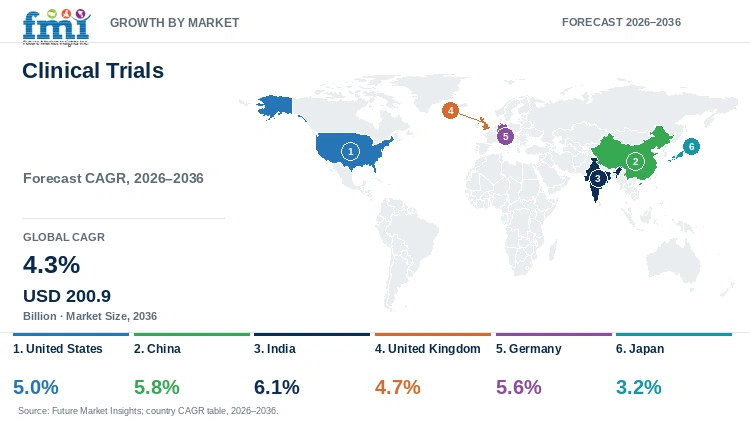
| Country | CAGR |
|---|---|
| United States | 5.0% |
| China | 5.8% |
| India | 6.1% |
| United Kingdom | 4.7% |
| Germany | 5.6% |
| Japan | 3.2% |
Country-wise Analysis
United States Clinical Trials Market Outlook (2026 to 2036)
US sponsors and research providers operate across an extensive clinical development environment in which a study's practical requirements can differ considerably by phase and therapeutic area. A large confirmatory programme may require many participating centres and repeated assessments, whereas an earlier study can place greater emphasis on a tightly defined participant population and the interpretation of preliminary efficacy. Providers can compete through feasibility assessment, dependable site management and data work that preserves the relationship between protocol requirements and the information collected across participating locations.
China Clinical Trials Market Outlook (2026 to 2036)
China's innovative-drug review pathway connects an accelerated submission route with specific execution conditions, making local preparation important before a sponsor applies. NMPA describes a 30-working-day pathway for eligible trials alongside the established 60-day implicit-approval route, with conditions concerning Chinese institutional leadership of eligible multinational Phase III studies and initiation commitments. [3] A research partner needs suitable investigators, recruitment readiness and a workable site plan, because the commercial value of a faster review depends on being able to begin and conduct the study within its applicable conditions.
India Clinical Trials Market Outlook (2026 to 2036)
India's clinical research market brings a broad patient population and varied institutional capabilities into sponsors' feasibility decisions. A study team needs to establish whether the selected sites can recruit the protocol's actual population, maintain scheduled assessments and provide the staff needed for monitoring and data management. These practical questions become especially important when a programme includes several languages or locations, with site preparation shaping the reliability of subsequent study conduct. Recruitment planning and dependable execution remain central to the services purchased across different phases.
United Kingdom Clinical Trials Market Outlook (2026 to 2036)
UK clinical-trial reforms effective from April 28, 2026 connect combined regulatory and ethics review with registration and results-summary responsibilities, creating a defined operating framework for medicine studies. HRA explains these arrangements together with conditions affecting trial initiation and disclosure. [2] Sponsors therefore need to prepare the regulatory submission and the site's execution plan as connected tasks, while research providers support the records and processes required through completion. Clear responsibilities across sponsor and investigator teams remain commercially useful as the study moves from authorisation into participant visits and final reporting.
Germany Clinical Trials Market Outlook (2026 to 2036)
Germany's standard contractual-clause ordinance applies to relevant trial contracts concluded after December 17, 2025, giving sponsors and centres a defined framework for several rights and responsibilities. Its provisions include publication and result-related matters, making the contract part of the practical preparation for study conduct. [1] A research provider needs to connect these agreements with site capacity, investigator availability and the monitoring work required by the protocol. Contractual clarity supports that process, while recruitment and clinical workload continue to influence the site's ability to deliver.
Japan Clinical Trials Market Outlook (2026 to 2036)
Sponsors planning multinational programmes need Japanese sites to fit the wider protocol while retaining the local preparation, documentation and participant support required for study conduct. Initial and subsequent notifications arise at different stages, making the operational sequence important to the service purchased. Providers can add value through investigator communication and consistent assessment processes that keep Japanese site work connected with the programme's wider data and monitoring requirements.
Who are the notable companies in the Clinical Trials Market?
IQVIA; ICON; PPD, Thermo Fisher Scientific; Syneos Health; SGS
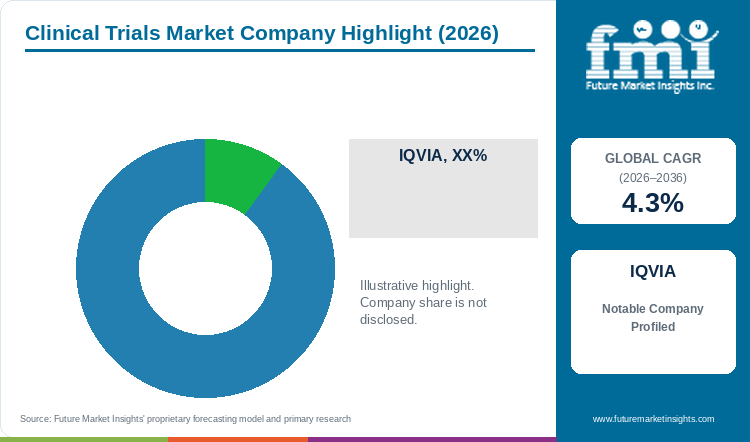
Clinical research providers compete through the people, sites and data processes needed to execute a sponsor's protocol. IQVIA, ICON, PPD, Syneos Health and SGS participate through research-service roles, with the assigned scope varying by programme. Phase, participant population and geographic design affect the required resources, making site readiness and coordination central to the proposal a sponsor evaluates.
Competitive Benchmarking: Clinical Trials Market
Table 6: Competitive positioning for the clinical trials market
| Company | Positioning | Commercial distinction |
|---|---|---|
| IQVIA | Clinical research services | Protocol fit and execution responsibilities |
| ICON | Clinical research services | Site activation and study conduct |
| PPD, Thermo Fisher Scientific | Clinical research services | Assigned trial and laboratory interfaces |
| Syneos Health | Clinical development services | Start-up and ongoing execution scope |
| SGS | Clinical research services | Study-specific capabilities and operating setting |
Key Developments in the Clinical Trials Market
- Germany's standard contractual-clause ordinance applies to relevant trial contracts concluded after 17 December 2025, establishing sponsor-site provisions including publication matters. [1]
- UK medicine-trial reforms effective 28 April 2026 connect combined review with initiation and disclosure conditions described by HRA. [2]
- NMPA's October 2025 policy interpretation sets out an accelerated review route for eligible innovative-drug trials together with local execution conditions. [3]
Key Players in the Clinical Trials Market
Clinical research services
- IQVIA
Clinical research services
- ICON
Clinical research services
- PPD, Thermo Fisher Scientific
Clinical development services
- Syneos Health
Clinical research services
- SGS
Clinical Trials Market Report Scope
Table 7: Report Scope for Clinical Trials Market, 2026 to 2036
| Coverage field | Report scope |
|---|---|
| Market definition | The market covers interventional-trial approvals and the services involved in recruitment and conduct. Protocols and applications are distinguished from sites, participants and registry entries. |
| Quantitative units | USD billion |
| Historical reference year | 2025 |
| Forecast period | 2026 to 2036 |
| Market breakdown | Phase; Trial Focus; Therapeutic Area; Study Design; Region |
| Countries profiled | United States; China; India; United Kingdom; Germany; Japan |
| Regions covered | North America; Latin America; Western Europe; Eastern Europe; East Asia; South Asia and Pacific; Middle East and Africa |
| Key companies profiled | IQVIA; ICON; PPD, Thermo Fisher Scientific; Syneos Health; SGS |
Clinical Trials Market Research Methodology
Table 8: Research Methodology for Clinical Trials Market, 2026 edition
| Method | Approach |
|---|---|
| Market definition | The market covers interventional-trial approvals and the services involved in recruitment and conduct. Protocols and applications are distinguished from sites, participants and registry entries. |
| Secondary research | Public institutional reports, regulator publications, technical literature and supplier documentation provide the operating context for the market. |
| Quantitative coverage | Market values are expressed in USD billion, with a 2025 base value, a 2026 estimate and a projection for 2036. |
| Segment and country assessment | Segment categories retain distinct demand measures, while each country profile is linked with its estimated CAGR for 2026 to 2036. |
| Company comparison | Representative participants are compared by the product or service offered, the customer application and the implementation requirements relevant to procurement. |
Clinical Trials Market by Segments
Clinical Trials Market segmented by Phase:
- Phase 1 Trials
- Phase 2 Trials
- Phase 3 Trials
- Phase 4 Trials
Clinical Trials Market segmented by Trial Focus:
- Early-stage Safety and Dosage Evaluation
- Efficacy and Proof-of-concept Studies
- Large-scale Confirmatory Trials
- Post-marketing Surveillance and Real-world Evidence
Clinical Trials Market segmented by Therapeutic Area:
- Oncology
- Rare Diseases
- Cardiovascular
- Neurology
- Infectious Diseases
- Metabolic Disorders
- Vaccines and Immunology
- Other Therapeutic Areas
Clinical Trials Market segmented by Study Design:
- Interventional Trials
- Observational Studies
- Randomized Controlled Trials
- Decentralized and Hybrid Trials
Clinical Trials Market by Region
- North America
- United States
- Canada
- Latin America
- Brazil
- Mexico
- Argentina
- Chile
- Western Europe
- United Kingdom
- Germany
- France
- Italy
- Spain
- Benelux
- Nordics
- Eastern Europe
- Poland
- Czech Republic
- Romania
- Hungary
- East Asia
- China
- Japan
- South Korea
- South Asia and Pacific
- India
- ASEAN
- Australia and New Zealand
- Middle East and Africa
- GCC Countries
- South Africa
- Türkiye
- Israel
Research Sources and Bibliography
- [1] Federal Ministry of Health / Federal Ministry of Justice. 2025-09-18. Standard contractual clauses for clinical trials (StandVKlV)
- [2] Health Research Authority. 2026-04-28. Clinical trials regulations reform
- [3] National Medical Products Administration. 2025-10-14. Interpretation of innovative-drug clinical-trial review optimisation
This Report Answers
- How large is the Clinical Trials Market in 2026?
- What is the growth outlook for the Clinical Trials Market through 2036?
- What is the 2026 share of Phase 3 Trials?
- What is the 2026 share of Phase 2 Trials?
- Which profiled market has the highest projected growth?
- Who are the notable participants in the Clinical Trials Market?
Frequently Asked Questions
How large is the Clinical Trials Market in 2026?
The market is estimated at USD 131.8 billion in 2026, compared with USD 126.36 billion in 2025.
What is the growth outlook for the Clinical Trials Market through 2036?
The market is projected to reach USD 200.9 billion by 2036, representing a CAGR of 4.3% from 2026 to 2036.
What is the 2026 share of Phase 3 Trials?
The Phase 3 Trials segment is estimated to account for 48% of trial phase demand in 2026. Multicentre preparation needs to connect the study contract, recruitment plan and monitoring responsibilities with the work each participating site can perform. [1][2]
What is the 2026 share of Phase 2 Trials?
The Phase 2 Trials segment is estimated to account for 26% of trial phase demand under the 2026 market scenario. Study providers need to connect the candidate's clinical questions with suitable sites, recruitment feasibility and assessments that can produce interpretable results.
Which profiled market has the highest projected growth?
India has the highest projected rate among the markets profiled, at 6.1% CAGR from 2026 to 2036.
Who are the notable participants in the Clinical Trials Market?
Representative participants include IQVIA, ICON, PPD, Thermo Fisher Scientific, Syneos Health, SGS.
Preview the report firsthand - request a free sample
Get SampleGet the brochure for pricing and purchase details.
Get PDFTable of Content
- Key Takeaways
- Market Size and CAGR
- Top Growth Driver
- Fastest Growing Segment
- Leading Region
- Key Companies
- Emerging Opportunities
- Executive Summary
- Global Market Outlook
- Demand-side Trends
- Supply-side Trends
- Technology Roadmap Analysis
- Analysis and Recommendations
- Analyst Perspective (What is happening? Why now? What should investors know?)
- Key Questions Answered
- How large is the market?
- What is the CAGR?
- What are key trends?
- Which region dominates?
- Who are the leaders?
- Market Overview
- Market Coverage / Taxonomy
- Market Definition / Scope / Limitations
- Research Methodology
- Chapter Orientation
- Analytical Lens and Working Hypotheses
- Market Structure, Signals, and Trend Drivers
- Benchmarking and Cross-market Comparability
- Market Sizing, Forecasting, and Opportunity Mapping
- Research Design and Evidence Framework
- Desk Research Programme (Secondary Evidence)
- Expert Input and Fieldwork (Primary Evidence)
- Tooling, Models, and Reference Databases
- Data Engineering and Model Build
- Quality Assurance and Audit Trail
- Market Background
- Market Dynamics (Drivers, Restraints, Opportunity, Trends)
- Scenario Forecast (Optimistic, Likely, Conservative)
- Impact Analysis
- AI Impact
- Sustainability Impact
- Regulatory Impact
- Technology Impact
- Consumer / Buyer Analysis
- Purchase Drivers
- Adoption Barriers
- Buyer Journey
- Opportunity Map Analysis
- Product Life Cycle Analysis
- Supply Chain Analysis
- Investment Feasibility Matrix
- Value Chain Analysis
- PESTLE and Porter's Analysis
- Regulatory Landscape
- Regional Parent Market Outlook
- Production and Consumption Statistics
- Import and Export Statistics
- Global Market Analysis and Forecast, 2021 to 2036
- Historical Market Size Value (USD Billion) Analysis, 2021 to 2025
- Current and Future Market Size Value (USD Billion) Projections, 2026 to 2036
- Y-o-Y Growth Trend Analysis
- Absolute $ Opportunity Analysis
- Global Market Pricing Analysis, 2021 to 2036
- Global Market Analysis and Forecast, By Phase, 2021 to 2036
- Introduction / Key Findings
- Historical Market Size Value (USD Billion) Analysis By Phase, 2021 to 2025
- Current and Future Market Size Value (USD Billion) Analysis and Forecast By Phase, 2026 to 2036
- Phase 1 Trials
- Phase 2 Trials
- Phase 3 Trials
- Phase 4 Trials
- Y-o-Y Growth Trend Analysis By Phase, 2021 to 2025
- Absolute $ Opportunity Analysis By Phase, 2026 to 2036
- Global Market Analysis and Forecast, By Trial Focus, 2021 to 2036
- Introduction / Key Findings
- Historical Market Size Value (USD Billion) Analysis By Trial Focus, 2021 to 2025
- Current and Future Market Size Value (USD Billion) Analysis and Forecast By Trial Focus, 2026 to 2036
- Early-stage Safety and Dosage Evaluation
- Efficacy and Proof-of-concept Studies
- Large-scale Confirmatory Trials
- Post-marketing Surveillance and Real-world Evidence
- Y-o-Y Growth Trend Analysis By Trial Focus, 2021 to 2025
- Absolute $ Opportunity Analysis By Trial Focus, 2026 to 2036
- Global Market Analysis and Forecast, By Therapeutic Area, 2021 to 2036
- Introduction / Key Findings
- Historical Market Size Value (USD Billion) Analysis By Therapeutic Area, 2021 to 2025
- Current and Future Market Size Value (USD Billion) Analysis and Forecast By Therapeutic Area, 2026 to 2036
- Oncology
- Rare Diseases
- Cardiovascular
- Neurology
- Infectious Diseases
- Metabolic Disorders
- Vaccines and Immunology
- Other Therapeutic Areas
- Y-o-Y Growth Trend Analysis By Therapeutic Area, 2021 to 2025
- Absolute $ Opportunity Analysis By Therapeutic Area, 2026 to 2036
- Global Market Analysis and Forecast, By Study Design, 2021 to 2036
- Introduction / Key Findings
- Historical Market Size Value (USD Billion) Analysis By Study Design, 2021 to 2025
- Current and Future Market Size Value (USD Billion) Analysis and Forecast By Study Design, 2026 to 2036
- Interventional Trials
- Observational Studies
- Randomized Controlled Trials
- Decentralized and Hybrid Trials
- Y-o-Y Growth Trend Analysis By Study Design, 2021 to 2025
- Absolute $ Opportunity Analysis By Study Design, 2026 to 2036
- Global Market Analysis and Forecast, By Region, 2021 to 2036
- Introduction
- Historical Market Size Value (USD Billion) Analysis By Region, 2021 to 2025
- Current Market Size Value (USD Billion) Analysis and Forecast By Region, 2026 to 2036
- North America
- Latin America
- Western Europe
- Eastern Europe
- East Asia
- South Asia and Pacific
- Middle East and Africa
- Market Attractiveness Analysis By Region
- North America Market Analysis and Forecast, By Country, 2021 to 2036
- Historical Market Size Value (USD Billion) Trend Analysis By Market Taxonomy, 2021 to 2025
- Market Size Value (USD Billion) Forecast By Market Taxonomy, 2026 to 2036
- By Country
- United States
- Canada
- By Phase
- By Trial Focus
- By Therapeutic Area
- By Study Design
- By Country
- Market Attractiveness Analysis
- By Country
- By Phase
- By Trial Focus
- By Therapeutic Area
- By Study Design
- Key Takeaways
- Latin America Market Analysis and Forecast, By Country
- Historical Market Size Value (USD Billion) Trend Analysis By Market Taxonomy, 2021 to 2025
- Market Size Value (USD Billion) Forecast By Market Taxonomy, 2026 to 2036
- By Country
- Brazil
- Mexico
- Argentina
- Chile
- By Phase
- By Trial Focus
- By Therapeutic Area
- By Study Design
- By Country
- Market Attractiveness Analysis
- By Country
- By Phase
- By Trial Focus
- By Therapeutic Area
- By Study Design
- Key Takeaways
- Western Europe Market Analysis and Forecast, By Country
- Historical Market Size Value (USD Billion) Trend Analysis By Market Taxonomy, 2021 to 2025
- Market Size Value (USD Billion) Forecast By Market Taxonomy, 2026 to 2036
- By Country
- United Kingdom
- Germany
- France
- Italy
- Spain
- Benelux
- Nordics
- By Phase
- By Trial Focus
- By Therapeutic Area
- By Study Design
- By Country
- Market Attractiveness Analysis
- By Country
- By Phase
- By Trial Focus
- By Therapeutic Area
- By Study Design
- Key Takeaways
- Eastern Europe Market Analysis and Forecast, By Country
- Historical Market Size Value (USD Billion) Trend Analysis By Market Taxonomy, 2021 to 2025
- Market Size Value (USD Billion) Forecast By Market Taxonomy, 2026 to 2036
- By Country
- Poland
- Czech Republic
- Romania
- Hungary
- By Phase
- By Trial Focus
- By Therapeutic Area
- By Study Design
- By Country
- Market Attractiveness Analysis
- By Country
- By Phase
- By Trial Focus
- By Therapeutic Area
- By Study Design
- Key Takeaways
- East Asia Market Analysis and Forecast, By Country
- Historical Market Size Value (USD Billion) Trend Analysis By Market Taxonomy, 2021 to 2025
- Market Size Value (USD Billion) Forecast By Market Taxonomy, 2026 to 2036
- By Country
- China
- Japan
- South Korea
- By Phase
- By Trial Focus
- By Therapeutic Area
- By Study Design
- By Country
- Market Attractiveness Analysis
- By Country
- By Phase
- By Trial Focus
- By Therapeutic Area
- By Study Design
- Key Takeaways
- South Asia and Pacific Market Analysis and Forecast, By Country
- Historical Market Size Value (USD Billion) Trend Analysis By Market Taxonomy, 2021 to 2025
- Market Size Value (USD Billion) Forecast By Market Taxonomy, 2026 to 2036
- By Country
- India
- ASEAN
- Australia and New Zealand
- By Phase
- By Trial Focus
- By Therapeutic Area
- By Study Design
- By Country
- Market Attractiveness Analysis
- By Country
- By Phase
- By Trial Focus
- By Therapeutic Area
- By Study Design
- Key Takeaways
- Middle East and Africa Market Analysis and Forecast, By Country
- Historical Market Size Value (USD Billion) Trend Analysis By Market Taxonomy, 2021 to 2025
- Market Size Value (USD Billion) Forecast By Market Taxonomy, 2026 to 2036
- By Country
- GCC Countries
- South Africa
- Türkiye
- Israel
- By Phase
- By Trial Focus
- By Therapeutic Area
- By Study Design
- By Country
- Market Attractiveness Analysis
- By Country
- By Phase
- By Trial Focus
- By Therapeutic Area
- By Study Design
- Key Takeaways
- Key Countries Market Analysis
- United States
- Pricing Analysis
- Market Share Analysis, 2025
- By Phase
- By Trial Focus
- By Therapeutic Area
- By Study Design
- Canada
- Pricing Analysis
- Market Share Analysis, 2025
- By Phase
- By Trial Focus
- By Therapeutic Area
- By Study Design
- Mexico
- Pricing Analysis
- Market Share Analysis, 2025
- By Phase
- By Trial Focus
- By Therapeutic Area
- By Study Design
- Brazil
- Pricing Analysis
- Market Share Analysis, 2025
- By Phase
- By Trial Focus
- By Therapeutic Area
- By Study Design
- Chile
- Pricing Analysis
- Market Share Analysis, 2025
- By Phase
- By Trial Focus
- By Therapeutic Area
- By Study Design
- Germany
- Pricing Analysis
- Market Share Analysis, 2025
- By Phase
- By Trial Focus
- By Therapeutic Area
- By Study Design
- United Kingdom
- Pricing Analysis
- Market Share Analysis, 2025
- By Phase
- By Trial Focus
- By Therapeutic Area
- By Study Design
- Italy
- Pricing Analysis
- Market Share Analysis, 2025
- By Phase
- By Trial Focus
- By Therapeutic Area
- By Study Design
- Spain
- Pricing Analysis
- Market Share Analysis, 2025
- By Phase
- By Trial Focus
- By Therapeutic Area
- By Study Design
- France
- Pricing Analysis
- Market Share Analysis, 2025
- By Phase
- By Trial Focus
- By Therapeutic Area
- By Study Design
- India
- Pricing Analysis
- Market Share Analysis, 2025
- By Phase
- By Trial Focus
- By Therapeutic Area
- By Study Design
- ASEAN
- Pricing Analysis
- Market Share Analysis, 2025
- By Phase
- By Trial Focus
- By Therapeutic Area
- By Study Design
- Australia and New Zealand
- Pricing Analysis
- Market Share Analysis, 2025
- By Phase
- By Trial Focus
- By Therapeutic Area
- By Study Design
- China
- Pricing Analysis
- Market Share Analysis, 2025
- By Phase
- By Trial Focus
- By Therapeutic Area
- By Study Design
- Japan
- Pricing Analysis
- Market Share Analysis, 2025
- By Phase
- By Trial Focus
- By Therapeutic Area
- By Study Design
- South Korea
- Pricing Analysis
- Market Share Analysis, 2025
- By Phase
- By Trial Focus
- By Therapeutic Area
- By Study Design
- Poland
- Pricing Analysis
- Market Share Analysis, 2025
- By Phase
- By Trial Focus
- By Therapeutic Area
- By Study Design
- Hungary
- Pricing Analysis
- Market Share Analysis, 2025
- By Phase
- By Trial Focus
- By Therapeutic Area
- By Study Design
- Türkiye
- Pricing Analysis
- Market Share Analysis, 2025
- By Phase
- By Trial Focus
- By Therapeutic Area
- By Study Design
- South Africa
- Pricing Analysis
- Market Share Analysis, 2025
- By Phase
- By Trial Focus
- By Therapeutic Area
- By Study Design
- United States
- Market Structure Analysis
- Competition Dashboard
- Competition Benchmarking
- Market Share Analysis of Top Players
- By Regional
- By Phase
- By Trial Focus
- By Therapeutic Area
- By Study Design
- Emerging Startups
- Innovation Benchmarking
- Competition Analysis
- Competition Deep Dive
- IQVIA
- Overview
- Product Portfolio
- Profitability by Market Segments
- Sales Footprint
- Strategy Overview
- Marketing Strategy
- Product Strategy
- Channel Strategy
- ICON
- PPD, Thermo Fisher Scientific
- Syneos Health
- SGS
- IQVIA
- Case Studies
- Success Stories
- Recent Developments
- Competition Deep Dive
- Assumptions & Acronyms Used


